Genesis 47:12

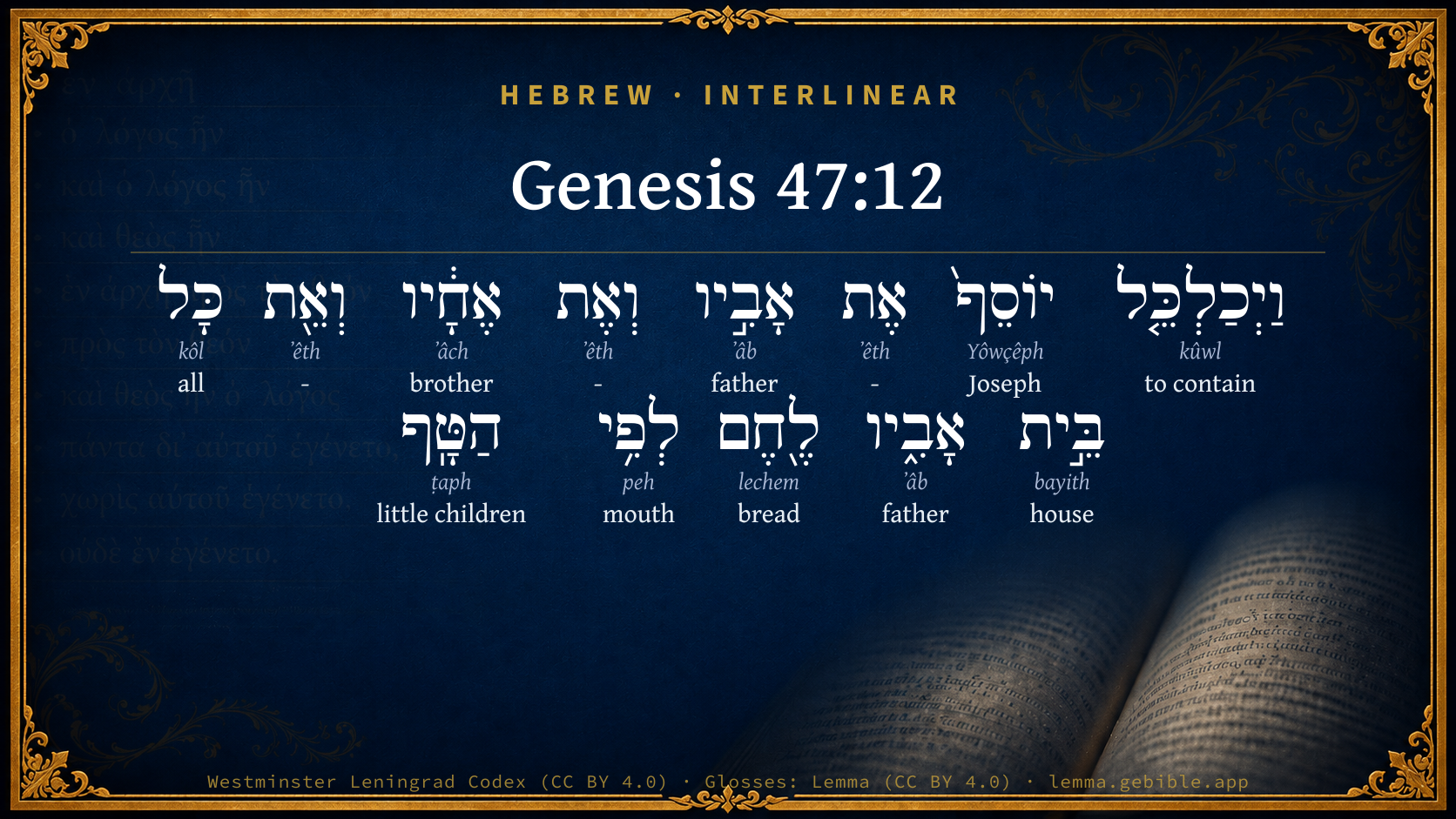
Hebrew (Westminster Leningrad Codex) Genesis 47:12 appears in the Hebrew Old Testament. The text above is from the Westminster Leningrad Codex. Each word links to its Strong’s number, a concise gloss, and parsing drawn from the Open Scriptures Hebrew Bible morphology. Click any word for its full Brown-Driver-Briggs (BDB) entry.
Download image
Cite this verse

Genesis 47:12 (World English Bible). Public Domain. Lemma interlinear Bible study tool, https://lemma.gebible.app/v/genesis/47/12.

Show BibTeX & RIS
BibTeX
RIS
English Translation
Joseph nourished his father, his brothers, and all of his father's household, with bread, according to their families.
World English Bible · Public Domain
Download a study sheet

One document with this verse’s original text, its word-by-word gloss line, the meaning frame, cross-references with their text, attributed commentary, and full source and license credits — printable, and it pastes into notes with its structure intact.

This verse Autodidact and up

Study sheet (.html) Plain text (.txt)

A passage Seminary Student

Up to 50 verses in one chapter. A passage sheet keeps up to 6 commentary sources and 12 cross-references per verse, in the order this page ranks them, and says so on the sheet whenever that leaves anything out. Ask for a single verse and you get the Autodidact verse sheet above.

Everything on this page stays free to read, with no account — the sheet is a download of what is already on screen, not access to it.

Want to remove ads? Support Godless Engineer
Compare translations 3

The same verse in 3 English versions, stacked beneath the original-language interlinear above. Click any original word for its lexicon entry.

Each is an independent rendering of the whole verse — the interlinear is not word-aligned to these translations.

Highlighted words mark where these versions differ — a whole-verse word diff, not a word-by-word alignment.

  • World English Bible Public Domain
    Joseph nourished his father, his brothers, and all of his father's household, with bread, according to their families.
  • King James Version Public Domain
    And Joseph nourished his father, and his brethren, and all his father's household, with bread, according to their families.
  • unfoldingWord Literal Text CC BY-SA 4.0
    And Joseph provided his father and his brothers and all the household of his father bread, according to the mouth of the little ones. How Joseph Ruled Egypt During the Rest of the Famine 47:13-26

unfoldingWord Literal Text — © unfoldingWord, licensed CC BY-SA 4.0. Word-aligned USFM3 via Door43 (git.door43.org/unfoldingWord/en_ult).

Versions to compare (up to 4)

3 of 4 selected

Show all 18 translations

Every available English version of this verse, each an independent rendering of the whole verse.

  • World English Bible Public Domain
    Joseph nourished his father, his brothers, and all of his father's household, with bread, according to their families.
  • Berean Standard Bible Public Domain
    Joseph also provided his father and brothers and all his father’s household with food for their families.
  • Majority Standard Bible Public Domain
    Joseph also provided his father and brothers and all his father’s household with food for their families.
  • King James Version Public Domain
    And Joseph nourished his father, and his brethren, and all his father's household, with bread, according to their families.
  • American Standard Version (1901) Public Domain
    And Joseph nourished his father, and his brethren, and all his father's household, with bread, according to their families.
  • Revised Version (1885) Public Domain
    And Joseph nourished his father, and his brethren, and all his father’s household, with bread, according to their families.
  • Geneva Bible (1599) Public Domain
    And Ioseph nourished his father, and his brethren, and all his fathers houshold with bread, euen to the yong children.
  • Douay-Rheims (1899) Public Domain
    And he nourished them, and all his father's house, allowing food to every one.
  • Young's Literal Translation Public Domain
    and Joseph nourisheth his father, and his brethren, and all the house of his father `with' bread, according to the mouth of the infants.
  • Literal Standard Version CC BY-SA 4.0
    and Joseph nourishes his father, and his brothers, and all the house of his father [with] bread, according to the mouth of the infants.
  • Unlocked Literal Bible CC BY-SA 4.0
    Joseph provided food for his father, his brothers, and all his father's household, according the number of their dependents.
  • unfoldingWord Literal Text CC BY-SA 4.0
    And Joseph provided his father and his brothers and all the household of his father bread, according to the mouth of the little ones. How Joseph Ruled Egypt During the Rest of the Famine 47:13-26
  • Darby Bible Public Domain
    And Joseph maintained his father, and his brethren, and all his father's household, with bread, according to the number of the little ones.
  • World Messianic Bible Public Domain
    Joseph provided his father, his brothers, and all of his father’s household with bread, according to the sizes of their families.
  • Webster's Bible Public Domain
    And Joseph nourished his father, and his brethren, and all his father's household, with bread according to their families.
  • Free Bible Version CC BY-SA 4.0
    He also provided food for all of them—his father, his brothers, and his father's whole household—depending on family size.
  • Bible in Basic English Public Domain
    And Joseph took care of his father and his brothers and all his father's people, giving them food for the needs of their families.
  • JPS Tanakh (1917) Public Domain
    And Joseph sustained his father, and his brethren, and all his father's household, with bread, according to the want of their little ones.

Literal Standard Version (2020), Covenant Press — licensed CC BY-SA 4.0. Text via the HelloAO Bible API (eBible.org). Unlocked Literal Bible (unfoldingWord) — licensed CC BY-SA 4.0. Text via the HelloAO Bible API (eBible.org). unfoldingWord Literal Text — © unfoldingWord, licensed CC BY-SA 4.0. Word-aligned USFM3 via Door43 (git.door43.org/unfoldingWord/en_ult). Free Bible Version, Dr. Jonathan Gallagher — licensed CC BY-SA 4.0. Text via the HelloAO Bible API (eBible.org).

Word by word

More ways to search: Search by grammar → Find every occurrence → Compare this word →

Practice this passage: Drill this verse → Learn its vocabulary →

וַיְכַלְכֵּ֤ל
kûwl
H3557
“and · to contain”
Conjunction + Verb, Pilpel, Sequential Imperfect, 3rd Person, Masculine, Singular
Part of Speech
Conjunction + Verb
Stem
Pilpel
Form
Sequential Imperfect
Person
3rd Person
Gender
Masculine
Number
Singular
Full BDB Definition

Origin: a primitive root

TWOT: 962

to seize, contain, measure - (Qal) to measure, calculate - (Pilpel) to sustain, maintain, contain - to sustain, support, nourish - to contain, hold in, restrain - to support, endure - (Polpal) to be supplied - (Hiphil) to contain, hold, hold in, endure - to contain - to sustain, endure
  1. יוֹסֵף֙ Yôwçêph H3130 “Joseph” Noun, Proper
  2. אֶת ʼêth H853 “-” Particle, Direct Object
  3. אָבִ֣יו ʼâb H1 “father · his” Noun, Common, Masculine, Singular, Construct + Suffix, Personal, 3rd Person, Masculine, Singular
  4. וְאֶת ʼêth H853 “and · -” Conjunction + Particle, Direct Object
  5. אֶחָ֔יו ʼâch H251 “brothers · his” Noun, Common, Masculine, Plural, Construct + Suffix, Personal, 3rd Person, Masculine, Singular
  6. וְאֵ֖ת ʼêth H853 “and · -” Conjunction + Particle, Direct Object
  7. כָּל kôl H3605 “all of” Noun, Common, Masculine, Singular, Construct
  8. בֵּ֣ית bayith H1004 “house of” Noun, Common, Masculine, Singular, Construct
  9. אָבִ֑יו ʼâb H1 “father · his” Noun, Common, Masculine, Singular, Construct + Suffix, Personal, 3rd Person, Masculine, Singular
  10. לֶ֖חֶם lechem H3899 “bread” Noun, Common, Both, Singular, Absolute
  11. לְפִ֥י peh H6310 “to/for · mouth of” Preposition + Noun, Common, Masculine, Singular, Construct
  12. הַטָּֽף ṭaph H2945 “the · little children” Particle, Definite Article + Noun, Common, Masculine, Singular, Absolute

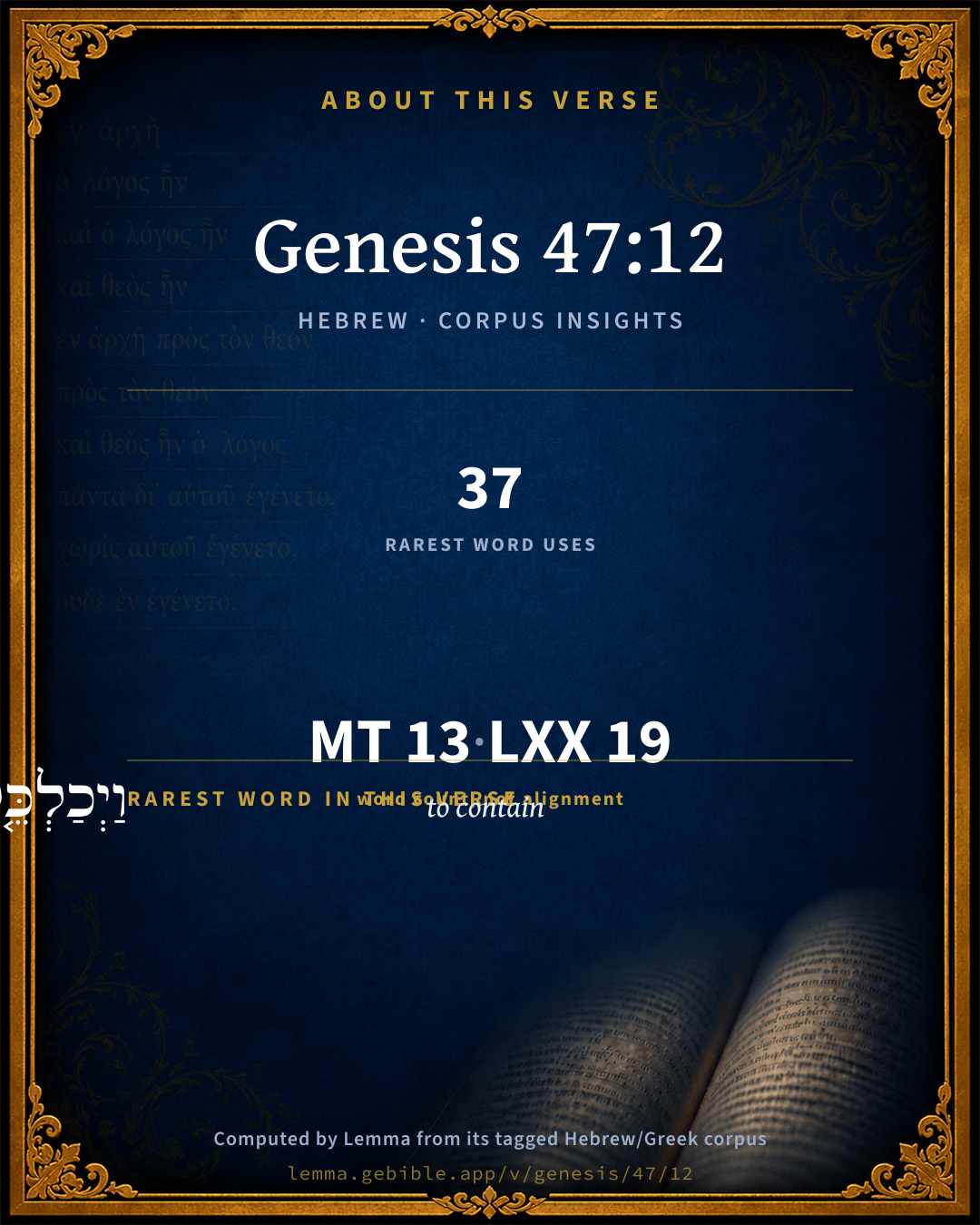
About this verse

These counts appear in no published source. They are computed here, from the morphology-tagged text and Lemma’s own curated glosses. What Lemma adds →

13
words
10
distinct lemmas
Pentateuch
section

Shared distinctive vocabulary

וַיְכַלְכֵּ֤ל to contain H3557 occurs in 36 verses of the Hebrew Bible. Also found in:

Grammatical profile

  • 1 verb
  • 9 nouns
  • 3 particles

Verb forms

  • וַיְכַלְכֵּ֤ל Pilpel · Sequential Imperfect

Repetition

A word recurs within this verse — often emphatic in Hebrew:

  • אָבִ֣יו father H1 ×2

Hebrew & Septuagint length

In English translation the verse runs 18 words from the Hebrew and 22 from the Septuagint (LXX English) — closely comparable.

A rough comparison of the two English renderings, which tokenize alike — not a word-level alignment.

Word counts can differ between the Hebrew and the Greek without any difference in meaning — e.g. the Hebrew direct-object marker אֵת has no separate Greek word, and Greek often adds the article ὁ.

In the original languages it is 13 Hebrew tokens and 19 Greek tokens — but the two are counted differently (Hebrew bundles its prefixes and suffixes into one token; the Greek is in lemma form), so that isn’t a like-for-like length.

Cross-references

12

Topical passages linked to Genesis 47:12 in the Treasury of Scripture Knowledge — connected by theme and wording, ordered by reader-vote popularity; previews shown in the World English Bible.

  • Genesis 45:11 There I will nourish you; for there are yet five years of famine; lest you come to poverty, you, and your household, and all that you have."'
  • Genesis 47:1 Then Joseph went in and told Pharaoh, and said, "My father and my brothers, with their flocks, their herds, and all that they own, have come out of the land of Canaan; and, behold, they are in the land of Goshen."
  • Genesis 47:21 As for the people, he moved them to the cities from one end of the border of Egypt even to the other end of it.
  • Genesis 47:24 It will happen at the harvests, that you shall give a fifth to Pharaoh, and four parts will be your own, for seed of the field, for your food, for them of your households, and for food for your little ones."
  • Exodus 20:12 "Honor your father and your mother, that your days may be long in the land which Yahweh your God gives you.
  • Ruth 4:15 He shall be to you a restorer of life, and sustain you in your old age, for your daughter-in-law, who loves you, who is better to you than seven sons, has borne him.
  • Matthew 15:4–6 For God commanded, 'Honor your father and your mother,' and, 'He who speaks evil of father or mother, let him be put to death.'
  • Mark 7:10–13 For Moses said, 'Honor your father and your mother;' and, 'He who speaks evil of father or mother, let him be put to death.'
  • 1 Thessalonians 2:7 But we were gentle among of you, as when a nurse cherishes her own children.
  • 1 Timothy 4:8 For bodily exercise has some value, but godliness has value for all things, having the promise of the life which is now, and of that which is to come.
  • 1 Timothy 5:4 But if any widow has children or grandchildren, let them learn first to show piety towards their own family, and to repay their parents, for this is acceptable in the sight of God.
  • 1 Timothy 5:8 But if anyone doesn't provide for his own, and especially his own household, he has denied the faith, and is worse than an unbeliever.

Cross-references courtesy of OpenBible.info (CC BY 4.0).

Hebrew and Greek witnesses Masoretic Hebrew ↔ Greek Septuagint

The same verse in the two great witnesses to the Old Testament, shown verse-for-verse.

These are two independent witnesses, not word-aligned to each other, and the Septuagint is shown in lemma (dictionary) form.

Hebrew Genesis 47:12 Masoretic · Westminster Leningrad Codex

וַיְכַלְכֵּ֤ל יוֹסֵף֙ אֶת אָבִ֣יו וְאֶת אֶחָ֔יו וְאֵ֖ת כָּל בֵּ֣ית אָבִ֑יו לֶ֖חֶם לְפִ֥י הַטָּֽף

Joseph nourished his father, his brothers, and all of his father's household, with bread, according to their families.

World English Bible · Public Domain

Greek LXX Genesis 47:12 Septuagint · lemma form

καί σιτομετρέω ιωσηφ ὁ πατήρ καί ὁ ἀδελφός αὐτός καί πᾶς ὁ οἶκος ὁ πατήρ αὐτός σῖτος κατά σῶμα

And Joseph gave provision to his father, and his brethren, and to all the house of his father, corn for each person.

LXX2012 (modern English Septuagint) · Public Domain

On this verse, The Pulpit Commentary discusses the Septuagint’s reading. Read the note in Commentary ↓

Hebrew: Westminster Leningrad Codex (CC BY 4.0). Greek: Septuagint (public domain); English from LXX2012 (modern English Septuagint) (Public Domain). How the Septuagint differs from the Hebrew →

Targum (Aramaic paraphrase)

2

The Targum is the ancient Jewish Aramaic paraphrase of the Hebrew Scriptures — an interpretive translation, not the Hebrew text itself. Onkelos (literal) and Pseudo-Jonathan (expansive) render the Torah, and Jonathan the Prophets. Coverage is partial: where no permissively-licensed English translation exists for a verse, only the Aramaic is shown. This is verse-level text, not a word-by-word alignment to the Hebrew.

  1. Targum Onkelos Torah (Genesis–Deuteronomy)
    וְזָן יוֹסֵף יָת אֲבוּהִי וְיָת אֲחוֹהִי וְיָת כָּל בֵּית אֲבוּהִי לַחְמָא לְפוּם טַפְלָא

    (no public-domain English translation for this verse)

    Targum Onkelos — Aramaic: “Onkelos Genesis” (public domain); “Onkelos Exodus” (public domain); “Onkelos Leviticus” (public domain); “Onkelos Numbers” (public domain); “Onkelos Deuteronomy” (public domain). English: “Sefaria Community Translation” (CC0 1.0 (public-domain dedication)); “J.W. Etheridge. The Targums of Onkelos and Jonathan Ben Uzziel on the Pentateuch. London: Longmans, Green, 1862” (public domain). Text via Sefaria.

  2. Targum Pseudo-Jonathan Torah (Genesis–Deuteronomy)
    וְזָן יוֹסֵף יַת אָבוּהִי וְיַת אָחוֹי וְיַת כָּל בֵּית אָבוֹי לַחְמָא לְפוּם דְמִצְטָרֵךְ לְטַפְלַיָיא

    And Joseph sustained his father and his brethren and all his father's house with bread, according to the need of their families.

    Targum Pseudo-Jonathan — Aramaic: “Targum Jonathan on Genesis” (public domain); “Targum Jonathan on Exodus” (public domain); “Targum Jonathan on Leviticus” (public domain); “Targum Jonathan on Numbers” (public domain); “Targum Jonathan on Deuteronomy” (public domain). English: “The Targum of Jonathan ben Uzziel, trans. J. W. Etheridge, London, 1862” (public domain). Text via Sefaria.

Commentary

Notes on Genesis 47:12 from classic Christian and Jewish commentators (each source and its license shown beneath its notes). The classic Christian expositions comment on the surrounding passage and are grouped to its opening verse, so a note may address several verses; the Jewish commentaries on the Tanakh (Rashi and others) are per-verse, so they appear only where the commentator wrote on this verse.

Lemma curates 59 commentaries, every one of them public domain or Creative Commons licensed, each selected and text-cleaned for this edition rather than reprinted as found. About our sources →

Trapp's Complete Commentary

John Trapp

Gen 47:12 And Joseph nourished his father, and his brethren, and all his father’s household, with bread, according to [their] families.

Ver. 12. And Joseph nourished his father.] For which end he was "sent before" {Psa 105:17} by God: and for whose sake so many thousands were preserved, that else would have perished. What fools, then, are they that hunt out the saints, their only safeguard! and hate them to whom they owe all the good they have! This is, with the foolish deer, to eat up the leaves that hide them from the huuter.

John Trapp, A Commentary or Exposition upon All the Books of the Old and New Testament (1647–1656) — public domain. Text from a community e-Sword module.

The Biblical Illustrator

Joseph S. Exell

Gen_47:12

And Joseph nourished his father, and his brethren, and all his fathers household, with bread

Types of the Holy Eucharist

I.

WHO WAS THIS THAT FED HIS BRETHREN IN THE TIME OF DEARTH? Act_7:11). Joseph, separate from his brethren (Gen_49:26), sold to be a bond servant (Psa_105:17), tried, afflicted, and imprisoned, so that the iron entered into his soul (Psa_105:18), was a true type of Jesus our Lord, Who became a stranger unto His brethren, an alien unto His mothers children (Psa_69:8; Psa_88:7; Psa_88:18), Who took upon Him the form of a servant (Php_2:7), was afflicted and smitten (Isa_53:4-5, and cf. Psa_88:8). Then, too, as Joseph brought out of prison (Psa_105:19-20). set over all the land of Egypt (Gen_41:41; Gen_41:43; Psa_105:21), saluted as Zaphnath-pasneah (Gen_41:45), the Saviour of the world (Neals), sustained the life of all nations by miraculous supplies of bread (Gen_41:57): even so Jesus our Lord, the true Joseph, taken from prison and from judgment (Isa_53:8), entrusted with all power (Mt Eph_1:20-23), exalted to the right hand of God to be a Prince and a Saviour (Act_5:31), now feeds countless thousands throughout all the world, with Himself, the Living Bread, in the Holy Eucharist.

II. WHOM DID JOSEPH FEED?

1. All countries--for all countries came into Egypt to Joseph for to buy corn: because that the famine was so sore in all lands (Gen_41:57). So in one sense our True Joseph giveth food to all flesh (Psa_136:25), and openeth His hand, and filleth all things living with plenteousness (Psa_145:16; Psa_104:27; Psa_28:1-9).

2. Joseph fed his people, the Egyptians, for when all the land of Egypt was famished, the people cried to Pharaoh for bread: and Pharaoh said unto all the Egyptians, Go unto Joseph; what he saith unto you, do . . . And Joseph opened all the storehouses, and sold unto the Egyptians Gen_41:55-56). And when money failed . . . all the Egyptians came unto Joseph, and said, Give us bread . . . And Joseph gave them bread Gen_47:15; Gen_47:17). So now Jesus our Lord, the True Joseph, prepares a table in the wilderness of this world, at which He feeds His people, not with common food, but with spiritual good things, help, benedictions, knowledge, grace, to deliver their soul from death and to feed them in the time of dearth (Psa_33:18), so that they may eat and crave for that still greater food, the Holy Eucharist, of which He spake (Psa_81:11), open thy mouth, &c.

3. But Joseph specially cared for his brethren--his kinsfolk according to the flesh--for he brought them into his house and feasted them Gen_43:17; Gen_43:34), he gave them provision for the way (Gen_42:25). So now our own Joseph, Jesus our Lord, hath special care for His elect (Wis_3:9), the saints of the Most High whom He is not ashamed to call His brethren (Heb_2:11), He brings them into His house, He makes them to sit down to meat, at His table in His kingdom, He comes forth and serves them, saying, Come, eat of My bread and drink of the wine that I have mingled (Pro_9:5), for My flesh is meat indeed and My blood is drink indeed (Joh_6:55). Thus do the poor eat andare satisfied. They are full, yet hungry still.

III. WHEN DID JOSEPH FEED THEM?

1. When the dearth was in all lands, and the famine was over all the face of the earth, and was sore in all lands (Gen_41:54; Gen_41:56-57), and there was no bread in all the land: for the famine was very sore, so that the land of Egypt and all the land of Canaan fainted by reason of the famine Gen_47:13), then Joseph nourished his father and his brethren and all his fathers household, with bread. So now, in the time of dearth, when there is a sore and grievous famine in the weary land of this world and multitudes are perishing with hunger, because they cannot satisfy the cravings of their immortal spirit with the husks that the swine do eat Luk_15:16), our True Joseph feedeth the hungry, satisfieth the fainting soul with Himself, the bread of God, and saith to every soul that is hungering and thirsting after righteousness (Mat_5:6), Open thy mouth wide, and I will fill it (Psa_81:11.)

2. After he had made himself strange unto them (Gen_42:7-8), he nourishes them with bread. So now Jesus our Lord appears in another form, and makes Himself strange as it were unto us by veiling His beauty and His brightness under the veils of bread and wine, as it is written, Verily Thou art a God that hidest Thyself, O God of Israel, the Saviour Isa_45:15).

3. When his brethren had repented of their wickedness and fault, and were sorry for their sin--for they said, We are verily guilty concerning our brother. So now it is when we have confessed our wickedness, and are sorry for our sins (Psa_38:18; Psa_51:3), when we have examined ourselves (1Co_11:28; 1Co_11:31-32), when we do truly and earnestly repent us of our sins . . . and have made our humble confession to Almighty God, meekly kneeling upon our knees; then is it that our dear Lord vouchsafes to feed and nourish us with that True Wine that maketh glad the heart of man, and that True Bread that strengtheneth mans heart, in the Holy Communion.

IV. WHERE DID JOSEPH NOURISH HIS BRETHREN WITH BREAD?

1. He fed and feasted them in his house, at his princely table, albeit sitting apart from them (Gen_43:16-17; Gen_43:32); whereas the Greater One than Joseph, even Jesus our King, receiveth sinners and eateth with them Luk_15:2) at His own royal table of Sacred Communion (Luk_22:30), in His house the Church (1Ti_3:15; Heb_3:6).

2. Also Joseph gave his brethren provision for the way (Gen_42:25; Gen_45:21): so our Blessed Lord invites us to draw nigh unto the altar of God, and strengthen ourselves with the Bread of Life now, whilst we are in the way, saying, Arise and eat of My Flesh and drink of My Blood, because the journey is too great for thee (1Ki_19:7).

3. He fed and nourished them in Goshen (Gen_46:28; Gen_47:1; Gen_47:4; Gen_47:27; Gen_50:8; Gen_50:22); so it is in the true Goshen that Jesus our King Eternal feeds His brethren at the marriage Supper of the Lamb (Rev_19:1-21.), and reveals Himself to them face to face.

V. How DID JOSEPH NOURISH HIS BRETHREN?

1. He fed his brethren at no expense to themselves--for Joseph commanded to fill their sacks with corn, and to restore every mans money into his sack, and to give them provision for the way; and thus did he unto Gen_42:25, and cf Gen_43:12; Gen_43:21-24; Gen_45:20-24; Gen_47:11-12; Gen_47:27; Gen_50:21 not once nor twice. So Jesus our Saviour feeds us with His own most Blessed Body and Blood, and satisfies our mouth with good things, without money and without price (Isa_55:1-2), again and yetagain throughout our earthly pilgrimage.

2. He nourished them with corn (Gen_42:19; Gen_50:25), and wine Gen_43:34), and bread (Gen_47:12), and so saved their lives by a great deliverance; and yet the food which Joseph provided was perishable in its nature, and they who partook of it died at their appointed time. Whereas our True Joseph--Who is the Corn of Wheat (Joh_12:24), the Wine that cheereth God and man (Jdg_9:13), and theBread of God which cometh down from heaven, and giveth life unto the Joh_6:33)--gives us Food which is incorruptible, and is the seed of immortality, seeing that This is the Bread which cometh down from heaven that a man may eat thereof, and not die, if any man eat of this Bread he shall live for ever. (W. F. Shaw, B. D.)

The Biblical Illustrator, edited by Joseph S. Exell (c. 1880s–1900s) — public domain. Text from a community e-Sword module.

Joseph Benson's Commentary

Gen 47:12. With bread according to their families — לחם לפי השׂŠ, literally, with bread to the mouth of the little one — That is, as much as every one desired, without any restraint, mouth being put for desire, as chap. Gen 24:57; Isa 30:2; or, as a little child is nourished: he, as it were, put their meat into their very mouths: it was brought to them without any more care or pains of their own, than an infant takes for its food.

Joseph Benson's Commentary on the Old and New Testaments (1811–1818) — public domain. Text from a community e-Sword module.

Geneva Bible (1599)

Geneva Bible translators

Some read, that he fed them as little babes, because they could not provide for themselves against that famine.

Geneva Bible (1599) marginal notes — public domain. Text via Bolls.life.

John Calvin's Commentaries

12. And Joseph nourished his father, etc., according to their families Some explain the expression, “the mouth of the little one,” as if Joseph nourished his father and his whole family, in the manner in which food is conveyed to the mouths of children. These interpreters regard the form of speech as emphatical, because, during the famine, Jacob and his family had no more anxiety about the providing of food than children, who cannot even stretch out their hand to receive it. Others translate it “youth,” but I know not with what meaning. Others take it, simply, according to the proportion and number of the little children. To me the genuine sense seems to be that he fed all, from the greatest to the least. Therefore, there was sufficient bread for the whole family of Jacob, because, by the care of Joseph, provision was made to supply nourishment even to the little ones. In this manner Moses commemorates both the clemency of God, and the piety of Joseph; for it was an instance of uncommon attention, that these hungry husband men, who had not a grain of corn, were entirely fed at his expense.

John Calvin's Commentaries (1540-1563) — public domain. Text from the Calvin Translation Society English edition (1840s-50s) via the Christian Classics Ethereal Library (ccel.org). Calvin's coverage is partial (roughly two-thirds of the Bible); uncommented books and verses are honest gaps, never fabricated. The 19th-century editor's footnotes and remarks are omitted so the notes are faithfully Calvin's own voice.

Ellicott's Commentary for English Readers

(12) According to their families.—Heb., according to the “taf” This, as we have seen above, means “according to the clan or body of dependants possessed by each one.” Dan, with his one child, would have been starved to death if the allowance for himself and his household had depended upon the number of his “little ones,” which is the usual translation of this word in the Authorised Version. (See margin.)

A Bible Commentary for English Readers, edited by Charles John Ellicott (1878–1897) — public domain. Text from a community e-Sword module.

The Cambridge Bible for Schools and Colleges

gen. ed. J. J. S. Perowne

12. according to their families] The margin, according to the number of their little ones, gives the literal rendering. Delitzsch comments, “little children being mentioned because they would require much food, and also because people would be less willing to see them in want.” Cf. Gen_45:11.

The Cambridge Bible for Schools and Colleges (gen. ed. J. J. S. Perowne; Cambridge University Press, 1878–1918) — public domain. Text from a community e-Sword module.

John Gill's Exposition

And there was no bread in all the land,.... The land of Egypt and the parts adjacent, but in Pharaoh's storehouses, all being consumed that were in private hands the first two years of the famine:

for the famine was very sore; severe, pressed very hard:

so that the land of Egypt, and all the land of Canaan, fainted by reason of the famine; that is, the inhabitants of both countries, their spirits sunk, as well as their flesh failed for want of food: or "raged" (b); became furious, and were like madmen, as the word signifies; according to Kimchi (c), they were at their wits' end, knew not what to do, as Aben Ezra interprets it, and became tumultuous; it is much they had not in a violent manner broke open the storehouses of corn, and took it away by force; that they did not must be owing to the providence of God, which restrained them, and to the care and prudence of Joseph as a means, who, doubtless, had well fortified the granaries; and very probably there were a body of soldiers placed everywhere, who were one of the three parts or states of the kingdom of Egypt, as Diodorus Siculus (d) relates; to which may be added, the mild and gentle address of Joseph to the people, speaking kindly to them, giving them hopes of a supply during the famine, and readily relieving them upon terms they could not object to.

(b) "insanivit vel acta fuit in rahiem", Vatablus; "furebat", Junius & Tremellius, Piscator. (c) In Sepher Shorash rad so Ben Melech in loc. (d) Bibliothec. l. 1. p. 67.

John Gill's Exposition of the Whole Bible (1746–1763) — public domain (CC PDM 1.0). Text via the HelloAO Bible API.

Matthew Poole's English Annotations

Or, according to the mouth of the family; mouth being put for their will or desire, as it is Gen 24:57; Isa 30:2, as much as every one desired, without any restraint; or, according to the manner of a little child, he put their meat into their very months; it was brought to them without any more care or pains of theirs than an infant takes for its food.

Matthew Poole's English Annotations on the Holy Bible (1683–1685) — public domain. Text from a community e-Sword/MySword module.

Whedon's Commentary on the Bible

Daniel D. Whedon

12. According to their families — Hebrews, for the mouth of the little ones; that is, bread for the mouths of these. Thus Joseph became a nourishing father to his aged father’s household, as well as to Pharaoh and all Egypt.

Daniel D. Whedon (gen. ed.), Commentary on the Old and New Testaments (1874–1909) — public domain. Text from a community e-Sword module.

The Pulpit Commentary

And Joseph nourished ejsitometrei (LXX), i.e. gave them their measure of cornhis father, and his brethren, and all his father"s household, with bread, according to their families literally, to, or according to, the mouth of the little ones, meaning either in proportion to the size of their families (LXX, Keil, Kalisch, Murphy), or with all the tenderness with which a parent provides for his offspring (Murphy), or the whole body of them, from the greatest even to the least (Calvin), or completely, down even to the food for their children ("Speaker"s Commentary").

The Pulpit Commentary (1880–1919), ed. H.D.M. Spence-Jones & Joseph S. Exell — public domain. Text from a community e-Sword module.

Rashi

Rabbi Shlomo Yitzchaki (Rashi)

לפי הטף ACCORDING TO THEIR LITTLE ONES — according to the requirements of all their household.

Rashi on the Tanakh — English translations: “The Judaica Press complete Tanach with Rashi, translated by A. J. Rosenberg” (CC BY 4.0); “Pentateuch with Rashi's commentary by M. Rosenbaum and A.M. Silbermann, 1929-1934” (public domain); “The Metsudah Tanach series, Lakewood, N.J” (CC BY 4.0); and “The Book of Joshua, Metsudah Publications, 1997” (CC BY 4.0). Text via Sefaria.

Radak

Rabbi David Kimhi (Radak)

ויכלכל..לחם לפי הטף, the reason children are mentioned is that children eat all day long and waste food, leaving crumbs behind all over the place. Our sages in Pessachim 10 state that it is in the nature of children to break food up into crumbs and to leave them all over the place. There is a well known proverb which states that children are responsible for decay of food.

Radak on the Tanakh — English translations: “Sefaria Community Translation” (CC0 1.0 (public-domain dedication)); “Eliyahu Munk, HaChut Hameshulash” (CC BY 4.0); “Rabbi Mike Feuer, Jerusalem Anthology” (CC BY 4.0); and “R. David Kimhi on the first book of Psalms, Translated by R.G. Finch, London, 1919” (public domain). Text via Sefaria.

Lesson kit

Teaching starters — assembled from the data on this page, not authored interpretation. Every prompt links to the verse data it draws on. Edit before teaching.

Genesis, in the Pentateuch, opens this verse with 13 words (10 distinct Hebrew lemmas). Its most distinctive word is kûwl (“to contain”). A historical commentator’s framing appears above. Read the whole chapter for the surrounding context.

Discussion questions

  1. What does “to contain” (kûwl) contribute to the verse as a whole?
  2. Genesis 45:11 shares the word «to contain» with this verse. How do the two illuminate each other?
  3. “father” occurs 2× in this one verse. What is the effect of the repetition?
  4. These translations render this verse differently. What is at stake in choosing one wording over another?
  5. The verb «וַיְכַלְכֵּ֤ל» is Pilpel Sequential Imperfect. How does its form color the action?
  6. Reading how Trapp's Complete Commentary and The Biblical Illustrator read this verse, where do the two commentators agree and where do they part?

Things to notice

Reading settings

Reading text

Shown beneath each verse's original-language words.

Old Testament
Old Testament edition

Read the OT as the Masoretic Hebrew (MT) or the Greek Septuagint (LXX).

English shown for the Greek Septuagint (in the Hebrew ↔ Greek comparison).

Comparing translations? Open the Compare panel on any verse page to stack up to four side by side.