
Genesis 28:21

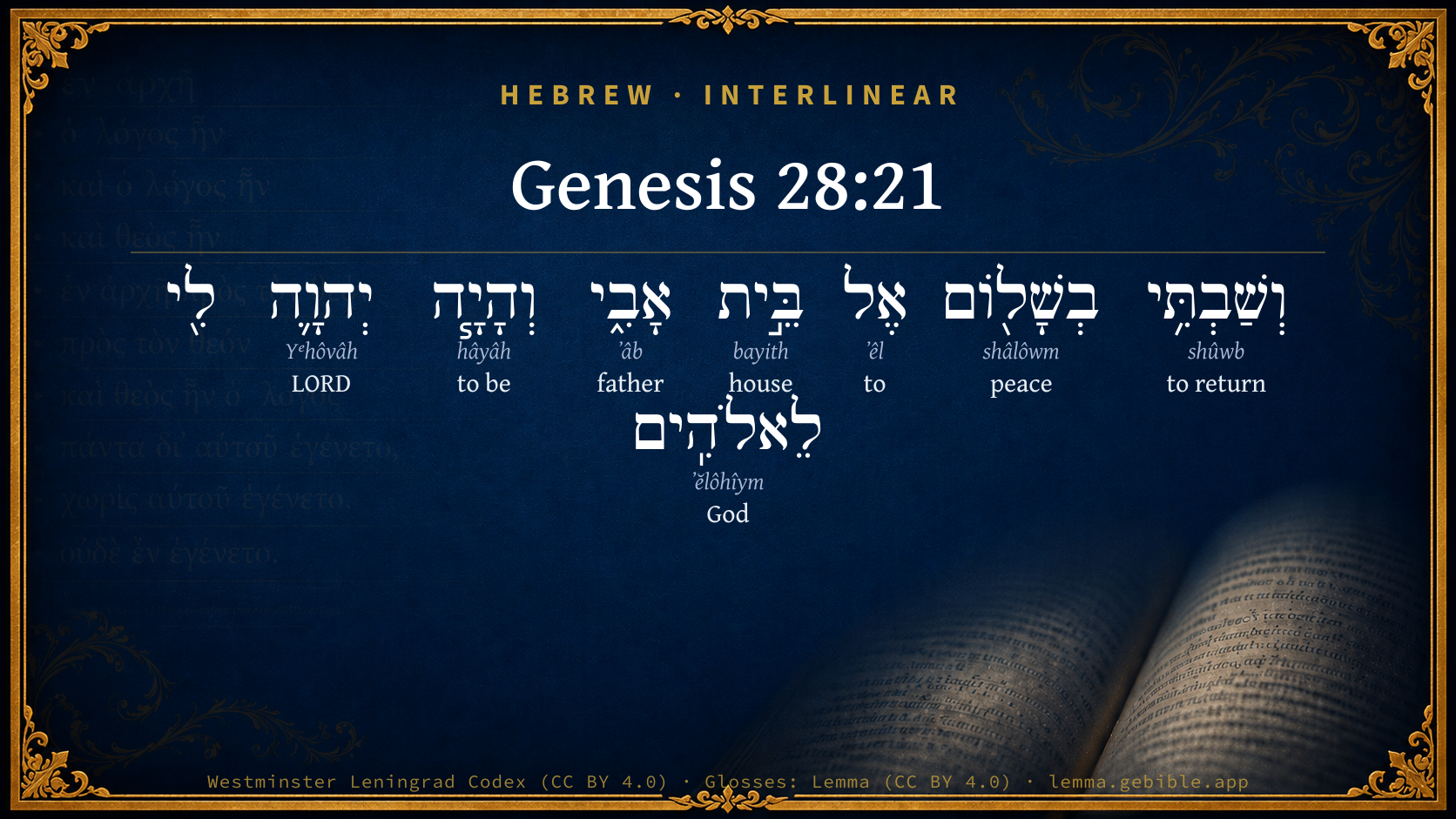
Hebrew (Westminster Leningrad Codex) Genesis 28:21 appears in the Hebrew Old Testament. The text above is from the Westminster Leningrad Codex. Each word links to its Strong’s number, a concise gloss, and parsing drawn from the Open Scriptures Hebrew Bible morphology. Click any word for its full Brown-Driver-Briggs (BDB) entry.
Download image
Cite this verse

Genesis 28:21 (World English Bible). Public Domain. Lemma interlinear Bible study tool, https://lemma.gebible.app/v/genesis/28/21.

Show BibTeX & RIS
BibTeX
RIS
English Translation
so that I come again to my father's house in peace, and Yahweh will be my God,
World English Bible · Public Domain
Download a study sheet

One document with this verse’s original text, its word-by-word gloss line, the meaning frame, cross-references with their text, attributed commentary, and full source and license credits — printable, and it pastes into notes with its structure intact.

This verse Autodidact and up

Study sheet (.html) Plain text (.txt)

A passage Seminary Student

Up to 50 verses in one chapter. A passage sheet keeps up to 6 commentary sources and 12 cross-references per verse, in the order this page ranks them, and says so on the sheet whenever that leaves anything out. Ask for a single verse and you get the Autodidact verse sheet above.

Everything on this page stays free to read, with no account — the sheet is a download of what is already on screen, not access to it.

Want to remove ads? Support Godless Engineer
Compare translations 3

The same verse in 3 English versions, stacked beneath the original-language interlinear above. Click any original word for its lexicon entry.

Each is an independent rendering of the whole verse — the interlinear is not word-aligned to these translations.

Highlighted words mark where these versions differ — a whole-verse word diff, not a word-by-word alignment.

  • World English Bible Public Domain
    so that I come again to my father's house in peace, and Yahweh will be my God,
  • King James Version Public Domain
    So that I come again to my father's house in peace; then shall the LORD be my God:
  • unfoldingWord Literal Text CC BY-SA 4.0
    and I return in peace to the home of my father, then Yahweh will be God to me,

unfoldingWord Literal Text — © unfoldingWord, licensed CC BY-SA 4.0. Word-aligned USFM3 via Door43 (git.door43.org/unfoldingWord/en_ult).

Versions to compare (up to 4)

3 of 4 selected

Show all 18 translations

Every available English version of this verse, each an independent rendering of the whole verse.

  • World English Bible Public Domain
    so that I come again to my father's house in peace, and Yahweh will be my God,
  • Berean Standard Bible Public Domain
    so that I may return safely to my father’s house, then the LORD will be my God.
  • Majority Standard Bible Public Domain
    so that I may return safely to my father’s house, then the LORD will be my God.
  • King James Version Public Domain
    So that I come again to my father's house in peace; then shall the LORD be my God:
  • American Standard Version (1901) Public Domain
    so that I come again to my father's house in peace, and Jehovah will be my God,
  • Revised Version (1885) Public Domain
    so that I come again to my father’s house in peace, then shall the LORD be my God,
  • Geneva Bible (1599) Public Domain
    So that I come againe vnto my fathers house in safetie, then shall the Lord be my God.
  • Douay-Rheims (1899) Public Domain
    And I shall return prosperously to my father's house: the Lord shall be my God:
  • Young's Literal Translation Public Domain
    when I have turned back in peace unto the house of my father, and Jehovah hath become my God,
  • Literal Standard Version CC BY-SA 4.0
    when I have turned back in peace to the house of my father, and YHWH has become my God,
  • Unlocked Literal Bible CC BY-SA 4.0
    so that I return safely to my father's house, then Yahweh will be my God.
  • unfoldingWord Literal Text CC BY-SA 4.0
    and I return in peace to the home of my father, then Yahweh will be God to me,
  • Darby Bible Public Domain
    and I come again to my father's house in peace -- then shall Jehovah be my God.
  • World Messianic Bible Public Domain
    so that I come again to my father’s house in peace, and the LORD will be my God,
  • Webster's Bible Public Domain
    So that I come again to my father's house in peace; then shall the LORD be my God:
  • Free Bible Version CC BY-SA 4.0
    so I can return safely to my father's home, then you Lord will be my God.
  • Bible in Basic English Public Domain
    So that I come again to my father's house in peace, then I will take the Lord to be my God,
  • JPS Tanakh (1917) Public Domain
    so that I come back to my father's house in peace, then shall the LORD be my God,

Literal Standard Version (2020), Covenant Press — licensed CC BY-SA 4.0. Text via the HelloAO Bible API (eBible.org). Unlocked Literal Bible (unfoldingWord) — licensed CC BY-SA 4.0. Text via the HelloAO Bible API (eBible.org). unfoldingWord Literal Text — © unfoldingWord, licensed CC BY-SA 4.0. Word-aligned USFM3 via Door43 (git.door43.org/unfoldingWord/en_ult). Free Bible Version, Dr. Jonathan Gallagher — licensed CC BY-SA 4.0. Text via the HelloAO Bible API (eBible.org).

Word by word

More ways to search: Search by grammar → Find every occurrence → Compare this word →

Practice this passage: Drill this verse → Learn its vocabulary →

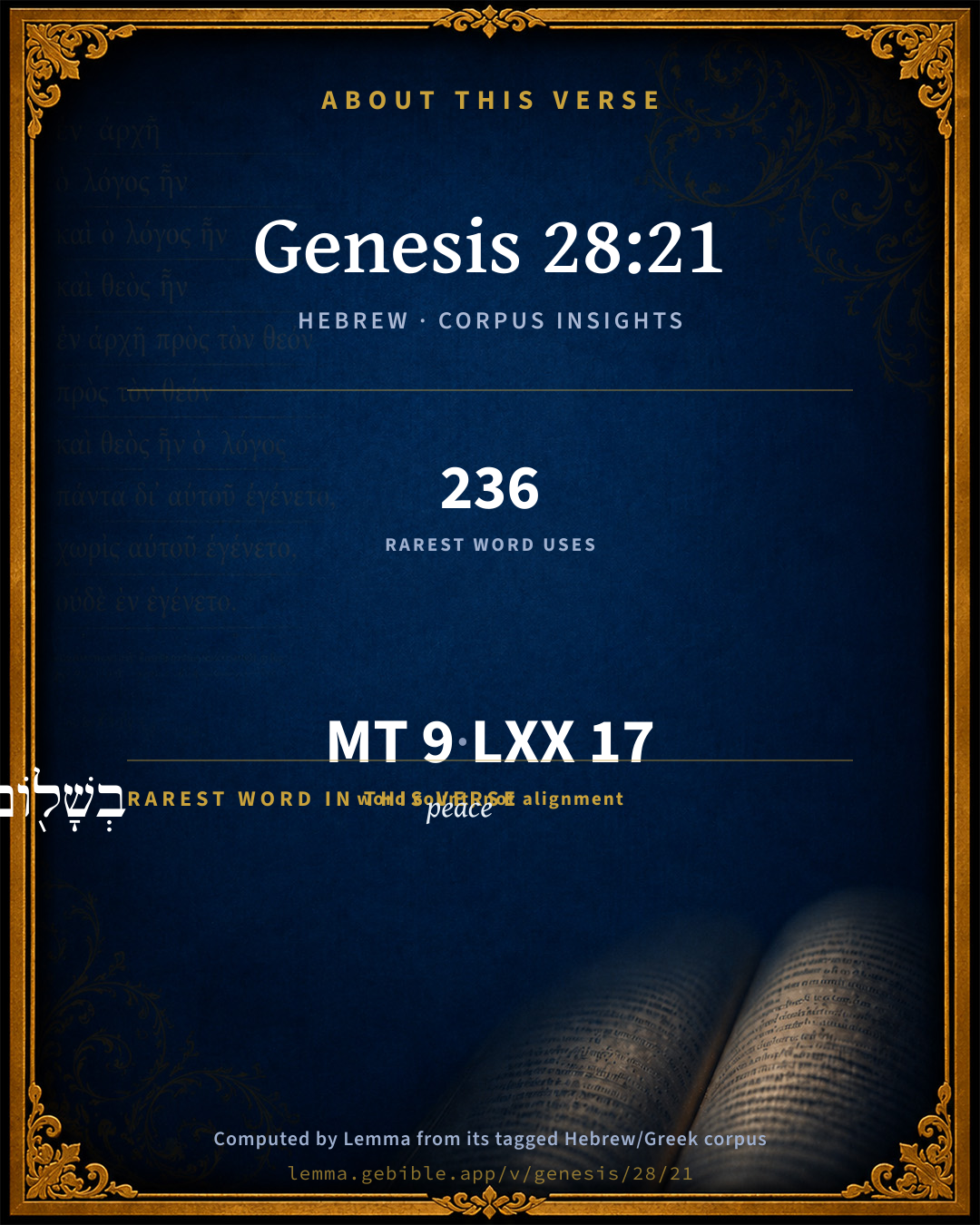
בְשָׁל֖וֹם
shâlôwm
H7965
“in/at · peace”
Preposition + Noun, Common, Masculine, Singular, Absolute
Part of Speech
Preposition + Noun
Type
Common
Gender
Masculine
Number
Singular
State
Absolute
Full BDB Definition

Origin: from H7999

TWOT: 2401a

completeness, soundness, welfare, peace - completeness (in number) - safety, soundness (in body) - welfare, health, prosperity - peace, quiet, tranquillity, contentment - peace, friendship - of human relationships - with God especially in covenant relationship - peace (from war) - peace (as adjective)
  1. וְשַׁבְתִּ֥י shûwb H7725 “and · to return” Conjunction + Verb, Qal, Sequential Perfect, 1st Person, Common, Singular
  2. אֶל ʼêl H413 “to” Preposition
  3. בֵּ֣ית bayith H1004 “house of” Noun, Common, Masculine, Singular, Construct
  4. אָבִ֑י ʼâb H1 “father · my” Noun, Common, Masculine, Singular, Construct + Suffix, Personal, 1st Person, Common, Singular
  5. וְהָיָ֧ה hâyâh H1961 “and · to be” Conjunction + Verb, Qal, Sequential Perfect, 3rd Person, Masculine, Singular
  6. יְהוָ֛ה Yᵉhôvâh H3068 “LORD” Noun, Proper
  7. לֵאלֹהִֽים ʼĕlôhîym H430 “to/for · God(s)” Preposition + Noun, Common, Masculine, Plural, Absolute

About this verse

These counts appear in no published source. They are computed here, from the morphology-tagged text and Lemma’s own curated glosses. What Lemma adds →

9
words
8
distinct lemmas
Pentateuch
section

Grammatical profile

  • 2 verbs
  • 5 nouns
  • 2 prepositions

Verb forms

  • וְשַׁבְתִּ֥י Qal · Sequential Perfect
  • וְהָיָ֧ה Qal · Sequential Perfect

Hebrew & Septuagint length

In English translation the verse runs 17 words from the Hebrew and 22 from the Septuagint (LXX English) — closely comparable.

A rough comparison of the two English renderings, which tokenize alike — not a word-level alignment.

Word counts can differ between the Hebrew and the Greek without any difference in meaning — e.g. the Hebrew direct-object marker אֵת has no separate Greek word, and Greek often adds the article ὁ.

In the original languages it is 9 Hebrew tokens and 17 Greek tokens — but the two are counted differently (Hebrew bundles its prefixes and suffixes into one token; the Greek is in lemma form), so that isn’t a like-for-like length.

Cross-references

7

Topical passages linked to Genesis 28:21 in the Treasury of Scripture Knowledge — connected by theme and wording, ordered by reader-vote popularity; previews shown in the World English Bible.

  • Deuteronomy 26:17 You have declared Yahweh this day to be your God, and that you would walk in his ways, and keep his statutes, and his commandments, and his ordinances, and listen to his voice:
  • Judges 11:31 then it shall be, that whatever comes forth from the doors of my house to meet me, when I return in peace from the children of Ammon, it shall be Yahweh's, and I will offer it up for a burnt offering.
  • Exodus 15:2 Yah is my strength and song, He has become my salvation: This is my God, and I will praise him; My father's God, and I will exalt him.
  • 2 Samuel 15:8 For your servant vowed a vow while I abode at Geshur in Syria, saying, If Yahweh shall indeed bring me again to Jerusalem, then I will serve Yahweh.
  • 2 Samuel 19:24 Mephibosheth the son of Saul came down to meet the king; and he had neither dressed his feet, nor trimmed his beard, nor washed his clothes, from the day the king departed until the day he came home in peace.
  • 2 Samuel 19:30 Mephibosheth said to the king, yes, let him take all, because my lord the king is come in peace to his own house.
  • 2 Kings 5:17 Naaman said, If not, yet, please let there be given to your servant two mules' burden of earth; for your servant will henceforth offer neither burnt offering nor sacrifice to other gods, but to Yahweh.

Cross-references courtesy of OpenBible.info (CC BY 4.0).

Hebrew and Greek witnesses Masoretic Hebrew ↔ Greek Septuagint

The same verse in the two great witnesses to the Old Testament, shown verse-for-verse.

These are two independent witnesses, not word-aligned to each other, and the Septuagint is shown in lemma (dictionary) form.

Hebrew Genesis 28:21 Masoretic · Westminster Leningrad Codex

וְשַׁבְתִּ֥י בְשָׁל֖וֹם אֶל בֵּ֣ית אָבִ֑י וְהָיָ֧ה יְהוָ֛ה לִ֖י לֵאלֹהִֽים

so that I come again to my father's house in peace, and Yahweh will be my God,

World English Bible · Public Domain

Greek LXX Genesis 28:21 Septuagint · lemma form

καί ἀποστρέφω ἐγώ μετά σωτηρία εἰς ὁ οἶκος ὁ πατήρ ἐγώ καί εἰμί ἐγώ κύριος εἰς θεός

and bring me back in safety to the house of my father, then shall the Lord be for a God to me.

LXX2012 (modern English Septuagint) · Public Domain

On this verse, The Cambridge Bible for Schools and Colleges discusses the Septuagint’s reading. Read the note in Commentary ↓

Hebrew: Westminster Leningrad Codex (CC BY 4.0). Greek: Septuagint (public domain); English from LXX2012 (modern English Septuagint) (Public Domain). How the Septuagint differs from the Hebrew →

Targum (Aramaic paraphrase)

2

The Targum is the ancient Jewish Aramaic paraphrase of the Hebrew Scriptures — an interpretive translation, not the Hebrew text itself. Onkelos (literal) and Pseudo-Jonathan (expansive) render the Torah, and Jonathan the Prophets. Coverage is partial: where no permissively-licensed English translation exists for a verse, only the Aramaic is shown. This is verse-level text, not a word-by-word alignment to the Hebrew.

  1. Targum Onkelos Torah (Genesis–Deuteronomy)
    וְאֵתוּב בִּשְׁלַם לְבֵית אַבָּא וִיהֵא מֵימְרָא דַיְיָ לִי לֵאלָהָא

    (no public-domain English translation for this verse)

    Targum Onkelos — Aramaic: “Onkelos Genesis” (public domain); “Onkelos Exodus” (public domain); “Onkelos Leviticus” (public domain); “Onkelos Numbers” (public domain); “Onkelos Deuteronomy” (public domain). English: “Sefaria Community Translation” (CC0 1.0 (public-domain dedication)); “J.W. Etheridge. The Targums of Onkelos and Jonathan Ben Uzziel on the Pentateuch. London: Longmans, Green, 1862” (public domain). Text via Sefaria.

  2. Targum Pseudo-Jonathan Torah (Genesis–Deuteronomy)
    וְאֵיתוּב בִּשְׁלָם לְבֵיתֵיהּ דִאַבָּא וִיהֵי יְיָ לִי לֵאלָהָא

    and will bring me back in peace to my father's house; the Lord shall be my God:

    Targum Pseudo-Jonathan — Aramaic: “Targum Jonathan on Genesis” (public domain); “Targum Jonathan on Exodus” (public domain); “Targum Jonathan on Leviticus” (public domain); “Targum Jonathan on Numbers” (public domain); “Targum Jonathan on Deuteronomy” (public domain). English: “The Targum of Jonathan ben Uzziel, trans. J. W. Etheridge, London, 1862” (public domain). Text via Sefaria.

Commentary

Notes on Genesis 28:21 from classic Christian and Jewish commentators (each source and its license shown beneath its notes). The classic Christian expositions comment on the surrounding passage and are grouped to its opening verse, so a note may address several verses; the Jewish commentaries on the Tanakh (Rashi and others) are per-verse, so they appear only where the commentator wrote on this verse.

Lemma curates 59 commentaries, every one of them public domain or Creative Commons licensed, each selected and text-cleaned for this edition rather than reprinted as found. About our sources →

John Calvin's Commentaries

21. Then shall the Lord be my God. In these words Jacob binds himself never to apostatize from the pure worship of the One God; for there is no doubt that he here comprises the sum of piety. But he may seem to promise what far exceeds his strength; for newness of life, spiritual righteousness, integrity of heart, and a holy regulation of the whole life, were not in his own power. I answer, when holy men vow those things which God requires of them, and which are due from them as acts of piety; they, at the same time, embrace what God promises concerning the remission of sins by the help of his Holy Spirit. Hence it follows that they ascribe nothing to their own strength; and also, that whatever falls short of entire perfection does not vitiate their worship, because God, mercifully and with paternal indulgence, pardons them.

John Calvin's Commentaries (1540-1563) — public domain. Text from the Calvin Translation Society English edition (1840s-50s) via the Christian Classics Ethereal Library (ccel.org). Calvin's coverage is partial (roughly two-thirds of the Bible); uncommented books and verses are honest gaps, never fabricated. The 19th-century editor's footnotes and remarks are omitted so the notes are faithfully Calvin's own voice.

The Cambridge Bible for Schools and Colleges

gen. ed. J. J. S. Perowne

21. to my father’s house in peace] It does not appear that this was literally fulfilled. Jacob, on his return, did not dwell at his father’s house. But, perhaps, “father’s house” means “the land of his fathers.” “In peace,” a common Heb. phrase, noticeable here for the rendering of LXX μετὰ σωτηρίας, “with safety.”

then shall the Lord be my God] The rendering of the margin, and the Lord will be my God, then this stone, &c., is that of the ancient versions, LXX, Lat. and Syr.: that of the text is on the whole preferable. The crowning thought is that in days to come, Jehovah, who has been the God of Abraham and Isaac, shall also be the God of Jacob. This forms the substance of Jacob’s vow; to which is added, that Bethel, as well as Beer-sheba and Hebron, shall be a place of Jehovah’s worship. Jacob’s vow, with the conditions attached to it, reflects his calculating character. But it acknowledges that Jehovah is the God who has revealed Himself to his fathers, and is distinct from mere nature-gods.

The Cambridge Bible for Schools and Colleges (gen. ed. J. J. S. Perowne; Cambridge University Press, 1878–1918) — public domain. Text from a community e-Sword module.

John Gill's Exposition

So that I come again to my father's house in peace,.... In safety from Esau, and all other enemies, as God promised him he should:

then the Lord shall be my God; not as if he should not be his God if he did not do all this for him; which would savour not only of a mercenary spirit, but of great impiety; neither of which were to be found in Jacob: but the meaning is, that he should not only continue to own him as his God, and to worship him, but having fresh obligations upon him, should be stirred up more eagerly and devoutly to serve him in a very singular way and manner, and particularly by doing what is expressed in Gen 28:22. Some think he has respect to the Messiah, owning him to be the true God with the Father and the blessed Spirit, who had appeared to Abraham, and was the fear of Isaac, and whom Jacob now owned as his God: this receives some confirmation from the Targum of Jonathan, which begins the paragraph thus,"if the Word of the Lord will be my help, &c. then the Lord shall be my God.''

John Gill's Exposition of the Whole Bible (1746–1763) — public domain (CC PDM 1.0). Text via the HelloAO Bible API.

Matthew Poole's English Annotations

I will publicly own him for my God and the Saviour of men, and will establish his solemn worship, as it follows.

Matthew Poole's English Annotations on the Holy Bible (1683–1685) — public domain. Text from a community e-Sword/MySword module.

Rashi

Rabbi Shlomo Yitzchaki (Rashi)

ושבתי SO THAT I RETURN — even as He said (v. 15) “I will restore thee again into this land” (Genesis Rabbah 70:4),

בשלום IN PEACE, perfectly free (שלם) from sin, not having learnt evil from Laban’s ways,

והיה ה' לי לאלהים AND IF THE LORD WILL BE MY GOD, in that His Name shall rest upon me from the beginning to the end: that no unworthy person shall be found in my descendants (Sifré, ואתחנן 31) — just as it is said (v. 15), “I will do that which I spake concerning thee”; and this promise He made to Abraham, as it is said (17:7) “To be a God unto thee and unto thy seed after thee”,

Rashi on the Tanakh — English translations: “The Judaica Press complete Tanach with Rashi, translated by A. J. Rosenberg” (CC BY 4.0); “Pentateuch with Rashi's commentary by M. Rosenbaum and A.M. Silbermann, 1929-1934” (public domain); “The Metsudah Tanach series, Lakewood, N.J” (CC BY 4.0); and “The Book of Joshua, Metsudah Publications, 1997” (CC BY 4.0). Text via Sefaria.

Ramban (Nachmanides)

Rabbi Moshe ben Nachman (Ramban / Nachmanides)

THEN THE ETERNAL SHALL BE MY G-D. This is not a condition, as Rashi would have it. It is rather a vow, and its purport is as follows: “If I will return to my father’s house, I will worship the proper Name of the Eternal in the Chosen Land at the location of this stone which will be for me a house of G-d, and there I will set aside the tithe.” There is in this matter a secret relating to that which the Rabbis have said: “He who dwells outside the Land of Israel is like one who has no G-d.” [Thus, according to the meaning of the above quotation, the Eternal will be Jacob’s G-d only when he returns to the Land of Israel.]

Ramban (Nachmanides) on the Tanakh — English translation: “Commentary on the Torah by Ramban (Nachmanides). Translated and annotated by Charles B. Chavel. New York, Shilo Pub. House, 1971-1976” (CC BY 4.0). Text via Sefaria.

Radak

Rabbi David Kimhi (Radak)

ושבתי בשלום, with his wife and children, for without them neither he, his father, or his mother would consider themselves at peace, seeing that he was forbidden to marry one of the Canaanite girls.

והיה ה' לי לאלוקים, this was the gist of the vow, meaning that he would concentrate on the service of the Lord and minimise any mundane activities. Furthermore, he vowed that he would build an altar on the place where he had slept on the stone which he had just anointed. יהיה בית אלוקים, he would build a Temple and altar there so that anyone worshipping the Lord could come there and pray and offer his sacrifices on that altar. It would be a Temple for the G’d in heaven only. Another way of understanding these words could be that he would instruct his children to build a Temple there in the future when they would take possession of the land of Israel. A further vow Yaakov made at this time was: וכל אשר תתן לי עשר אעשרנו לך, I will give a tithe of all the acquisitions including the cattle which You will give me. I will distribute this tithe to needy people in order to encourage them to switch to monotheism. According to Bereshit Rabbah 70,7 the vow included tithing one of his future children to G’d, i.e. appointing him as a servant of the Lord representing the other sons. [As an interesting aside, the Midrash there claims that assigning only one of 12, respectively 14 sons, if we add Ephrayim and Menashe, Yaakov did not “tithe” i.e. give 10% of his children to the Lord, he is reported as having replied that seeing that each of his four wives had one firstborn, someone whose duty it was as a firstborn to devote himself to spiritual matters without his father “donating” him to G’d for such a task, he Yaakov had done well to additionally assign Levi as a “tithe” for the remaining 10 “children.” Ed.] As to the formulation:

עשר אעשרנו לך, as a grammatically unusual formulation, this is an accepted formulation as we find it also confirmed in Deuteronomy 11,13 with the same verb, or in Deuteronomy 14,22 שמור תשמרון with a different verb. There are many similar examples of this kind of repetition for emphasis. Our sages in Ketuvot 50 use the formulation used in this verse as teaching that even if one wants to be generous in his donations to charity and holy causes, one should not give away more than 20% of one’s wealth in order not to become an object of charity himself because of carelessly squandering wealth given to one by G’d. The wordsעשר אעשרנו are understood by the Talmud there as applying to two such tithes of 10% each.

Radak on the Tanakh — English translations: “Sefaria Community Translation” (CC0 1.0 (public-domain dedication)); “Eliyahu Munk, HaChut Hameshulash” (CC BY 4.0); “Rabbi Mike Feuer, Jerusalem Anthology” (CC BY 4.0); and “R. David Kimhi on the first book of Psalms, Translated by R.G. Finch, London, 1919” (public domain). Text via Sefaria.

Lesson kit

Teaching starters — assembled from the data on this page, not authored interpretation. Every prompt links to the verse data it draws on. Edit before teaching.

Genesis, in the Pentateuch, opens this verse with 9 words (8 distinct Hebrew lemmas). Its most distinctive word is shâlôwm (“peace”). A historical commentator’s framing appears above. Read the whole chapter for the surrounding context.

Discussion questions

  1. What does “peace” (shâlôwm) contribute to the verse as a whole?
  2. How does Deuteronomy 26:17, which shares this passage’s theme, read alongside this verse?
  3. These translations render this verse differently. What is at stake in choosing one wording over another?
  4. «וְשַׁבְתִּ֥י» is a Qal Sequential Perfect verb. How does that grammatical form shape the action described?
  5. Compare how John Calvin's Commentaries and The Cambridge Bible for Schools and Colleges read this verse. Where do they agree or differ?

Things to notice

Reading settings

Reading text

Shown beneath each verse's original-language words.

Old Testament
Old Testament edition

Read the OT as the Masoretic Hebrew (MT) or the Greek Septuagint (LXX).

English shown for the Greek Septuagint (in the Hebrew ↔ Greek comparison).

Comparing translations? Open the Compare panel on any verse page to stack up to four side by side.