
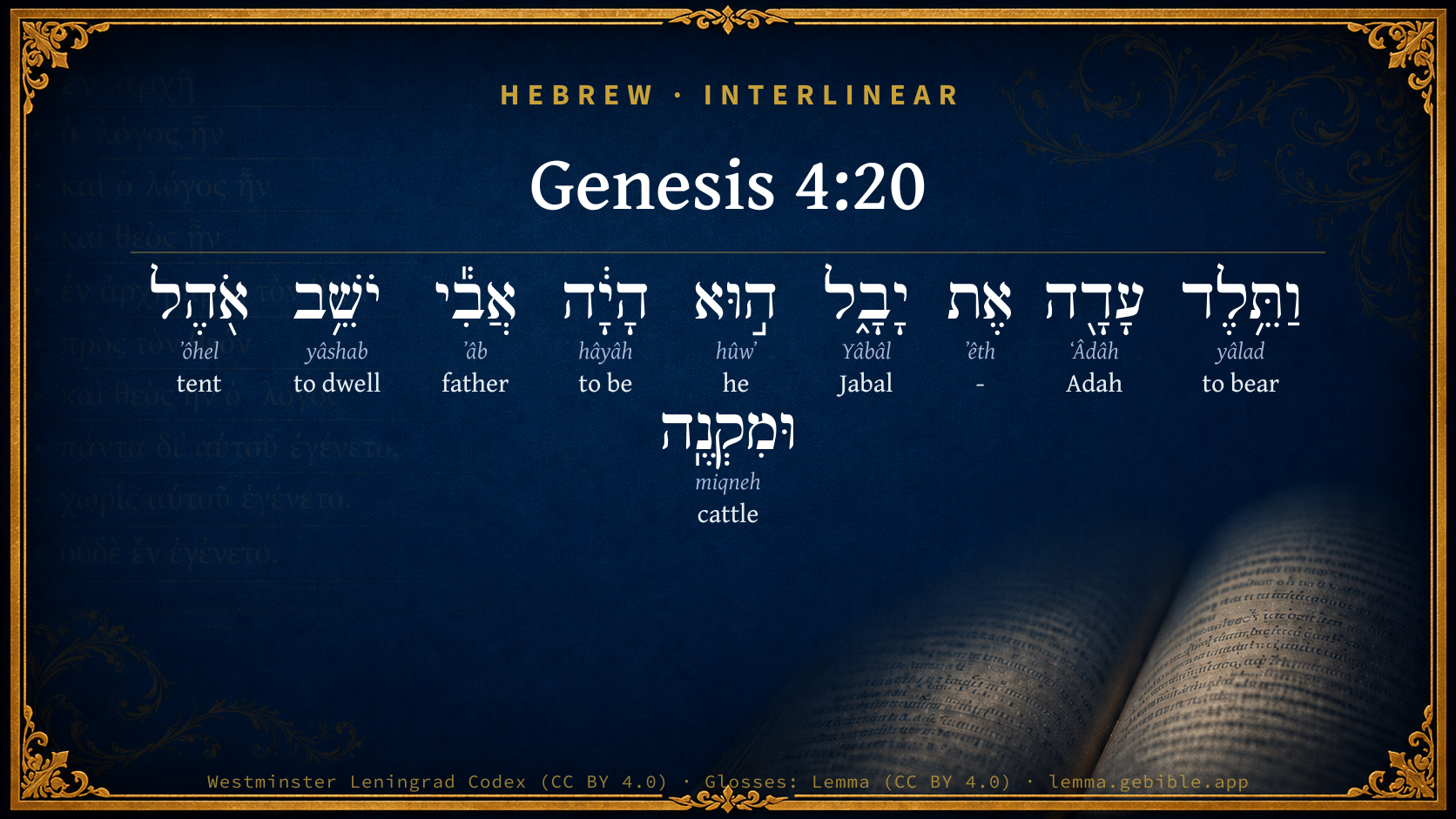
Genesis 4:20

Hebrew (Westminster Leningrad Codex) Genesis 4:20 appears in the Hebrew Old Testament. The text above is from the Westminster Leningrad Codex. Each word links to its Strong’s number, a concise gloss, and parsing drawn from the Open Scriptures Hebrew Bible morphology. Click any word for its full Brown-Driver-Briggs (BDB) entry.
Download image
Cite this verse

Genesis 4:20 (World English Bible). Public Domain. Lemma interlinear Bible study tool, https://lemma.gebible.app/v/genesis/4/20.

Show BibTeX & RIS
BibTeX
RIS
English Translation
Adah gave birth to Jabal, who was the father of those who dwell in tents and have cattle.
World English Bible · Public Domain
Highlights
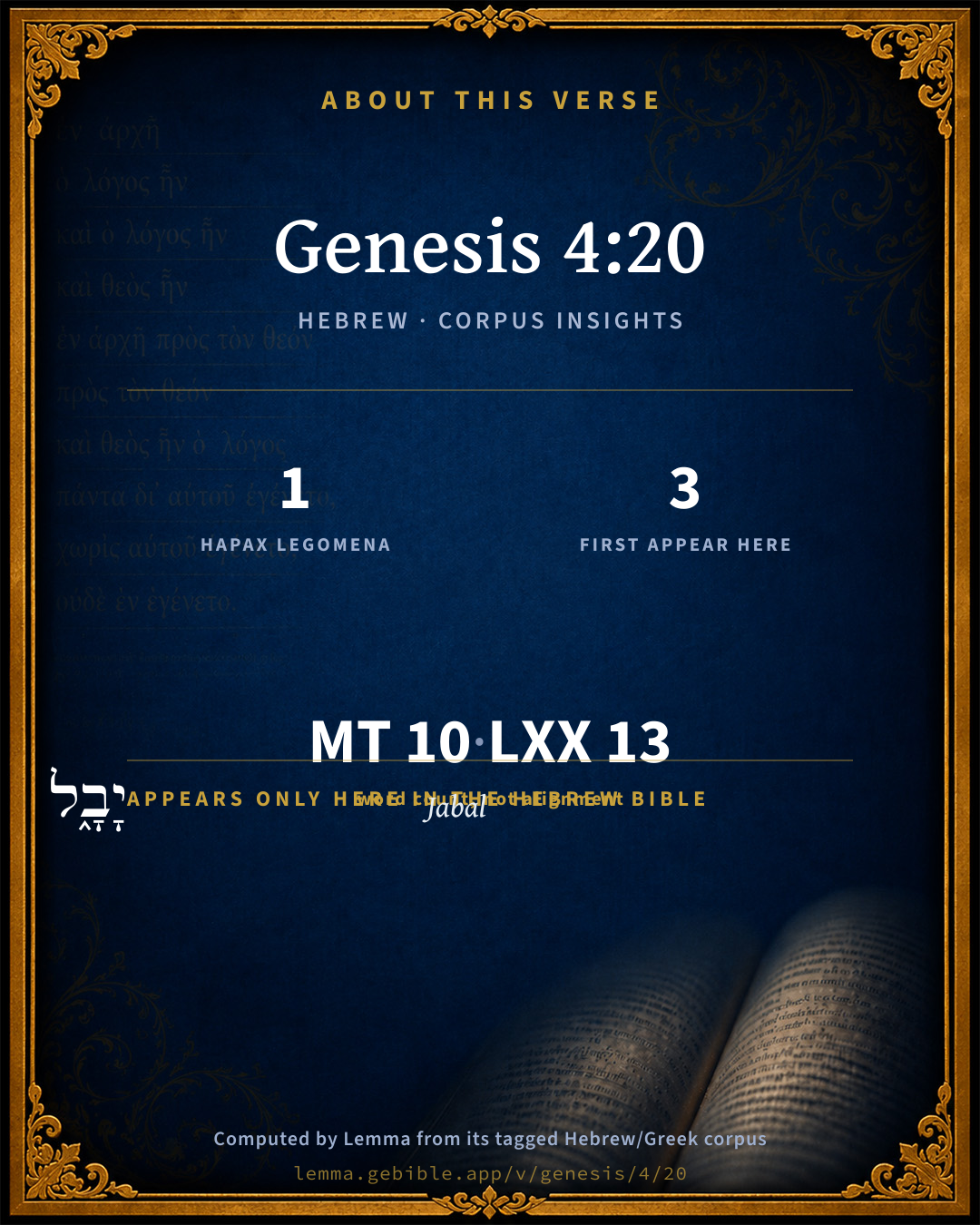
  • 1 hapax legomenon — only here in the Hebrew Bible
  • 3 first appearances in the Hebrew Bible
Full analysis ↓
Download a study sheet

One document with this verse’s original text, its word-by-word gloss line, the meaning frame, cross-references with their text, attributed commentary, and full source and license credits — printable, and it pastes into notes with its structure intact.

This verse Autodidact and up

Study sheet (.html) Plain text (.txt)

A passage Seminary Student

Up to 50 verses in one chapter. A passage sheet keeps up to 6 commentary sources and 12 cross-references per verse, in the order this page ranks them, and says so on the sheet whenever that leaves anything out. Ask for a single verse and you get the Autodidact verse sheet above.

Everything on this page stays free to read, with no account — the sheet is a download of what is already on screen, not access to it.

Want to remove ads? Support Godless Engineer
Compare translations 3

The same verse in 3 English versions, stacked beneath the original-language interlinear above. Click any original word for its lexicon entry.

Each is an independent rendering of the whole verse — the interlinear is not word-aligned to these translations.

Highlighted words mark where these versions differ — a whole-verse word diff, not a word-by-word alignment.

  • World English Bible Public Domain
    Adah gave birth to Jabal, who was the father of those who dwell in tents and have cattle.
  • King James Version Public Domain
    And Adah bare Jabal: he was the father of such as dwell in tents, and of such as have cattle.
  • unfoldingWord Literal Text CC BY-SA 4.0
    And Adah bore Jabal. He was the father of who live tents and own livestock.

unfoldingWord Literal Text — © unfoldingWord, licensed CC BY-SA 4.0. Word-aligned USFM3 via Door43 (git.door43.org/unfoldingWord/en_ult).

Versions to compare (up to 4)

3 of 4 selected

Show all 18 translations

Every available English version of this verse, each an independent rendering of the whole verse.

  • World English Bible Public Domain
    Adah gave birth to Jabal, who was the father of those who dwell in tents and have cattle.
  • Berean Standard Bible Public Domain
    Adah gave birth to Jabal; he was the father of those who dwell in tents and raise livestock.
  • Majority Standard Bible Public Domain
    Adah gave birth to Jabal; he was the father of those who dwell in tents and raise livestock.
  • King James Version Public Domain
    And Adah bare Jabal: he was the father of such as dwell in tents, and of such as have cattle.
  • American Standard Version (1901) Public Domain
    And Adah bare Jabal: he was the father of such as dwell in tents and `have' cattle.
  • Revised Version (1885) Public Domain
    And Adah bare Jabal: he was the father of such as dwell in tents and have cattle.
  • Geneva Bible (1599) Public Domain
    And Adah bare Iabal, who was the father of such as dwell in the tents, and of such as haue cattell.
  • Douay-Rheims (1899) Public Domain
    And Ada brought forth Jabel: who was the father of such as dwell in tents, and of herdsmen.
  • Young's Literal Translation Public Domain
    And Adah beareth Jabal, he hath been father of those inhabiting tents and purchased possessions;
  • Literal Standard Version CC BY-SA 4.0
    And Adah bears Jabal, he has been father of those inhabiting tents and [having] purchased livestock;
  • Unlocked Literal Bible CC BY-SA 4.0
    Adah gave birth to Jabal. He was the father of those who lived in tents who have livestock.
  • unfoldingWord Literal Text CC BY-SA 4.0
    And Adah bore Jabal. He was the father of who live tents and own livestock.
  • Darby Bible Public Domain
    And Adah bore Jabal: he was the father of those who dwell in tents, and [breed] cattle.
  • World Messianic Bible Public Domain
    Adah gave birth to Jabal, who was the father of those who dwell in tents and have livestock.
  • Webster's Bible Public Domain
    And Adah bore Jabal: he was the father of such as dwell in tents, and of such as have cattle.
  • Free Bible Version CC BY-SA 4.0
    Adah had a son named Jabal. He was the father of those who live in tents and have livestock.
  • Bible in Basic English Public Domain
    And Adah gave birth to Jabal: he was the father of such as are living in tents and keep cattle.
  • JPS Tanakh (1917) Public Domain
    And Adah bore Jabal; he was the father of such as dwell in tents and have cattle.

Literal Standard Version (2020), Covenant Press — licensed CC BY-SA 4.0. Text via the HelloAO Bible API (eBible.org). Unlocked Literal Bible (unfoldingWord) — licensed CC BY-SA 4.0. Text via the HelloAO Bible API (eBible.org). unfoldingWord Literal Text — © unfoldingWord, licensed CC BY-SA 4.0. Word-aligned USFM3 via Door43 (git.door43.org/unfoldingWord/en_ult). Free Bible Version, Dr. Jonathan Gallagher — licensed CC BY-SA 4.0. Text via the HelloAO Bible API (eBible.org).

Word by word

More ways to search: Search by grammar → Find every occurrence → Compare this word →

Practice this passage: Drill this verse → Learn its vocabulary →

About this verse

These counts appear in no published source. They are computed here, from the morphology-tagged text and Lemma’s own curated glosses. What Lemma adds →

10
words
10
distinct lemmas
Pentateuch
section

Notable vocabulary

1 hapax legomenon — a word that appears only here in the entire Hebrew Bible:

  • יָבָ֑ל Jabal H2989

First appearance in Scripture

These words make their first canonical appearance in the Hebrew Bible here:

  • יָבָ֑ל Jabal H2989
  • אֹ֖הֶל tent H168
  • וּמִקְנֶֽה cattle H4735

Shared distinctive vocabulary

עָדָ֖ה Adah H5711 occurs in 8 verses of the Hebrew Bible. Also found in:

Grammatical profile

  • 3 verbs
  • 5 nouns
  • 1 pronoun
  • 1 particle

Verb forms

  • וַתֵּ֥לֶד Qal · Sequential Imperfect
  • הָיָ֔ה Qal · Perfect
  • יֹשֵׁ֥ב Qal · Participle Active

Hebrew & Septuagint length

In English translation the verse runs 18 words from the Hebrew and 16 from the Septuagint (LXX English) — closely comparable.

A rough comparison of the two English renderings, which tokenize alike — not a word-level alignment.

Word counts can differ between the Hebrew and the Greek without any difference in meaning — e.g. the Hebrew direct-object marker אֵת has no separate Greek word, and Greek often adds the article ὁ.

In the original languages it is 10 Hebrew tokens and 13 Greek tokens — but the two are counted differently (Hebrew bundles its prefixes and suffixes into one token; the Greek is in lemma form), so that isn’t a like-for-like length.

Cross-references

9

Topical passages linked to Genesis 4:20 in the Treasury of Scripture Knowledge — connected by theme and wording, ordered by reader-vote popularity; previews shown in the World English Bible.

  • Genesis 4:2 Again she gave birth, to Cain's brother Abel. Abel was a keeper of sheep, but Cain was a tiller of the ground.
  • Genesis 4:21 His brother's name was Jubal, who was the father of all who handle the harp and pipe.
  • Genesis 25:27 The boys grew. Esau was a skillful hunter, a man of the field. Jacob was a quiet man, living in tents.
  • 1 Chronicles 2:50–52 These were the sons of Caleb, the son of Hur, the firstborn of Ephrathah: Shobal the father of Kiriath Jearim,
  • 1 Chronicles 4:4–5 and Penuel the father of Gedor, and Ezer the father of Hushah. These are the sons of Hur, the firstborn of Ephrathah, the father of Bethlehem.
  • Jeremiah 35:9–10 nor to build houses for us to dwell in; neither have we vineyard, nor field, nor seed:
  • John 8:44 You are of your Father, the devil, and you want to do the desires of your father. He was a murderer from the beginning, and doesn't stand in the truth, because there is no truth in him. When he speaks a lie, he speaks on his own; for he is a liar, and the father of it.
  • Romans 4:11–12 He received the sign of circumcision, a seal of the righteousness of the faith which he had while he was in uncircumcision, that he might be the father of all those who believe, though they be in uncircumcision, that righteousness might also be accounted to them.
  • Hebrews 11:9 By faith, he lived as an alien in the land of promise, as in a land not his own, dwelling in tents, with Isaac and Jacob, the heirs with him of the same promise.

Cross-references courtesy of OpenBible.info (CC BY 4.0).

Hebrew and Greek witnesses Masoretic Hebrew ↔ Greek Septuagint

The same verse in the two great witnesses to the Old Testament, shown verse-for-verse.

These are two independent witnesses, not word-aligned to each other, and the Septuagint is shown in lemma (dictionary) form.

Hebrew Genesis 4:20 Masoretic · Westminster Leningrad Codex

וַתֵּ֥לֶד עָדָ֖ה אֶת יָבָ֑ל ה֣וּא הָיָ֔ה אֲבִ֕י יֹשֵׁ֥ב אֹ֖הֶל וּמִקְנֶֽה

Adah gave birth to Jabal, who was the father of those who dwell in tents and have cattle.

World English Bible · Public Domain

Greek LXX Genesis 4:20 Septuagint · lemma form

καί τίκτω αδα ὁ ιωβελ οὗτος εἰμί ὁ πατήρ οἰκέω ἐν σκηνή κτηνοτρόφος

And Ada bore Jobel; he was the father of those that dwell in tents, feeding cattle.

LXX2012 (modern English Septuagint) · Public Domain

Hebrew: Westminster Leningrad Codex (CC BY 4.0). Greek: Septuagint (public domain); English from LXX2012 (modern English Septuagint) (Public Domain). How the Septuagint differs from the Hebrew →

Targum (Aramaic paraphrase)

2

The Targum is the ancient Jewish Aramaic paraphrase of the Hebrew Scriptures — an interpretive translation, not the Hebrew text itself. Onkelos (literal) and Pseudo-Jonathan (expansive) render the Torah, and Jonathan the Prophets. Coverage is partial: where no permissively-licensed English translation exists for a verse, only the Aramaic is shown. This is verse-level text, not a word-by-word alignment to the Hebrew.

  1. Targum Onkelos Torah (Genesis–Deuteronomy)
    וִילֵידַת עָדָה יָת יָבָל הוּא הֲוָה רַבְּהוֹן דְּיָתְבֵי מַשְׁכְּנִין וּמָרֵי בְעִיר

    (no public-domain English translation for this verse)

    Targum Onkelos — Aramaic: “Onkelos Genesis” (public domain); “Onkelos Exodus” (public domain); “Onkelos Leviticus” (public domain); “Onkelos Numbers” (public domain); “Onkelos Deuteronomy” (public domain). English: “Sefaria Community Translation” (CC0 1.0 (public-domain dedication)); “J.W. Etheridge. The Targums of Onkelos and Jonathan Ben Uzziel on the Pentateuch. London: Longmans, Green, 1862” (public domain). Text via Sefaria.

  2. Targum Pseudo-Jonathan Torah (Genesis–Deuteronomy)
    וִילֵידַת עָדָה יַת יָבָל הוּא הֲוָה רַב בְּהוֹן דְכָל יַתְבֵי מַשְׁכְּנִין וּמָארֵי בְּעִיר

    And Ada bare Javal; he was the chief (rab) of all those who dwell in tents, and are masters of cattle.

    Targum Pseudo-Jonathan — Aramaic: “Targum Jonathan on Genesis” (public domain); “Targum Jonathan on Exodus” (public domain); “Targum Jonathan on Leviticus” (public domain); “Targum Jonathan on Numbers” (public domain); “Targum Jonathan on Deuteronomy” (public domain). English: “The Targum of Jonathan ben Uzziel, trans. J. W. Etheridge, London, 1862” (public domain). Text via Sefaria.

Commentary

Notes on Genesis 4:20 from classic Christian and Jewish commentators (each source and its license shown beneath its notes). The classic Christian expositions comment on the surrounding passage and are grouped to its opening verse, so a note may address several verses; the Jewish commentaries on the Tanakh (Rashi and others) are per-verse, so they appear only where the commentator wrote on this verse.

Lemma curates 59 commentaries, every one of them public domain or Creative Commons licensed, each selected and text-cleaned for this edition rather than reprinted as found. About our sources →

Trapp's Complete Commentary

John Trapp

Gen 4:20 And Adah bare Jabal: he was the father of such as dwell in tents, and [of such as have] cattle.

Ver. 20. Adah bare Jabal.] Jabal, a good husband. Jubal, a merry Greek; whence the word iubilo in Latin, and our English jovial. Jabal, that dwelt in tents, and tended the herds, had Jubal to his brother, the father of hand and wind music. Jabal and Jubal, frugality and mirth, good husbandry and sweet content, dwell together. Virgil makes mention of a happy husbandman in his time, who

"Regum aequabat opes animis, seraque reversus

Nocte domum, dapibus mensas onerabat inemptis."

- Georg.

John Trapp, A Commentary or Exposition upon All the Books of the Old and New Testament (1647–1656) — public domain. Text from a community e-Sword module.

Joseph Benson's Commentary

Gen 4:20. He (Jabal) was the father of such as dwell in tents — That is, he taught shepherds to dwell in them, and to remove them from place to place for conveniency of pasture. The first authors of any thing are commonly called its fathers.

Joseph Benson's Commentary on the Old and New Testaments (1811–1818) — public domain. Text from a community e-Sword module.

Tyndale Open Study Notes

Tyndale Open Resources

4:20-22 Technological advancement masks increasing self-assertion and distance from God (see study note on 4:17–5:32).

Tyndale Open Study Notes — © Tyndale Open Resources, licensed CC BY-SA 4.0. Text via the HelloAO Bible API.

Geneva Bible (1599)

Geneva Bible translators

Or, first inventor.

Geneva Bible (1599) marginal notes — public domain. Text via Bolls.life.

Adam Clarke's Commentary

Verse 20. Jabal - was the father] The inventor or teacher, for so the word is understood, 1Sa 10:12. He was the first who invented tent-making, and the breeding and managing of cattle; or he was, in these respects, the most eminent in that time. Though Abel was a shepherd, it is not likely he was such on an extensive scale.

Adam Clarke's Commentary on the Bible (1810–1826) — public domain. Text from a community e-Sword/MySword module.

John Calvin's Commentaries

20. Jabal ; he was the father of such as dwell in tents. Moses now relates that, with the evils which proceeded from the family of Cain, some good had been blended. For the invention of arts, and of other things which serve to the common use and convenience of life, is a gift of God by no means to be despised, and a faculty worthy of commendation. It is truly wonderful, that this race, which had most deeply fallen from integrity, should have excelled the rest of the posterity of Adam in rare endowments. I, however, understand Moses to have spoken expressly concerning these arts, as having been invented in the family of Cain, for the purpose of showing that he was not so accursed by the Lord but that he would still scatter some excellent gifts among his posterity; for it is probable, that the genius of others was in the meantime not inactive; but that there were, among the sons of Adam, industrious and skillful men, who exercised their diligence in the invention and cultivation of arts. Moses, however, expressly celebrates the remaining benediction of God on that race, which otherwise would have been deemed void and barren of all good. Let us then know, that the sons of Cain, though deprived of the Spirit of regeneration, were yet endued with gifts of no despicable kind; just as the experience of all ages teaches us how widely the rays of divine light have shone on unbelieving nations, for the benefit of the present life; and we see, at the present time, that the excellent gifts of the Spirit are diffused through the whole human race. Moreover, the liberal arts and sciences have descended to us from the heathen. We are, indeed, compelled to acknowledge that we have received astronomy, and the other parts of philosophy, medicines and the order of civil government, from them. Nor is it to be doubted, that God has thus liberally enriched them with excellent favors that their impiety might have the less excuse. But, while we admire the riches of his favor which he has bestowed on them, let us still value far more highly that grace of regeneration with which he peculiarly sanctifies his elect unto himself.

Now, although the invention of the harp, and of similar instruments of music, may minister to our pleasure, rather than to our necessity, still it is not to be thought altogether superfluous; much less does it deserve, in itself, to be condemned. Pleasure is indeed to be condemned, unless it be combined with the fear of God, and with the common benefit of human society. But such is the nature of music, that it can be adapted to the offices of religion, and made profitable to men; if only it be free from vicious attractions, and from that foolish delight, by which it seduces men from better employments, and occupies them in vanity. If, however, we allow the invention of the harp no praise, it is well known how far and how widely extends the usefulness of the art of the carpenter. Finally, Moses, in my opinion, intends to teach that that race flourished in various and preeminent endowments, which would both render it inexcusable, and would prove most evident testimonies of the divine goodness. The name of “the father of them that dwell in tents,” is given to him who was the first inventor of that convenience, which others afterwards imitated.

John Calvin's Commentaries (1540-1563) — public domain. Text from the Calvin Translation Society English edition (1840s-50s) via the Christian Classics Ethereal Library (ccel.org). Calvin's coverage is partial (roughly two-thirds of the Bible); uncommented books and verses are honest gaps, never fabricated. The 19th-century editor's footnotes and remarks are omitted so the notes are faithfully Calvin's own voice.

The Cambridge Bible for Schools and Colleges

gen. ed. J. J. S. Perowne

20. Jabal] The meaning of this name is doubtful. Dillmann conjectures “a wanderer.” Jabal, like Abel (see note, on Gen_4:2), is a founder of the shepherd’s and herdsman’s life.

father of] i.e. the founder, or originator, of nomad life. To the Hebrews, to live in tents was the alternative to life in the village or the town. It is strange to find that tent life is here placed later than the building of a town (Gen_4:17).

such as dwell in tents, &c.] Literally, “such as dwell in tents and cattle”; i.e. those who wander about, occupied in the care of flocks and herds, and pitching their camps at different places. The eldest brother represents the Bedouin chieftain, the second brother represents the arts of primitive pastoral life, the third brother represents the most necessary industry.

The Cambridge Bible for Schools and Colleges (gen. ed. J. J. S. Perowne; Cambridge University Press, 1878–1918) — public domain. Text from a community e-Sword module.

John Gill's Exposition

And his brother's name was Jubal,.... This was another son of Lamech by Adah, and his name differs only in one letter from his brother's:

he was the father of all such that handle the harp and organ: he was the inventor of instrumental music, both of stringed instruments, such as were touched by the fingers, or struck with a quill, as the "harp"; and of wind instruments, such as were blown, as the "organ", which seems not to be the same we call so, being a late invention; but however a pleasant instrument, as its name signifies. Jubal is thought by some to be the same with Apollo, to whom with the Greeks the invention of the harp is ascribed; and some have been of opinion, that the jubilee trumpet was so called from Jubal, Lev 25:9. Sanchoniatho (r) makes Chrysor or Vulcan, the same with Tubalcain, the brother of Jubal, to exercise himself in eloquence, songs and divination, confounding or mistaking the employment of the two brothers. The Arabs have such a notion of the Cainites being the inventors of music, that they commonly call a singing girl "Cainah" (s); and the Arabic writers (t) make Jubal to be the first inventor of music, and that the beasts and birds gathered together to hear him; the same that is said of Orpheus.

(r) Apud Euseb. Praepar. Evangel. l. 1. p. 35. (s) Abulpharag. Hist. Dynast. p. 9. (t) Elmacinus, p. 8. apud Hottinger. Smegma, p. 232.

John Gill's Exposition of the Whole Bible (1746–1763) — public domain (CC PDM 1.0). Text via the HelloAO Bible API.

Matthew Poole's English Annotations

He taught shepherds to dwell in tents, and to remove them from place to place, for conveniency of pasture. The first authors or inventors of any thing are commonly called its fathers. And he was the inventor of the art of keeping and managing cattle.

Matthew Poole's English Annotations on the Holy Bible (1683–1685) — public domain. Text from a community e-Sword/MySword module.

Whedon's Commentary on the Bible

Daniel D. Whedon

20. Jabal… father of… tents… cattle — Though descended from a city-builder, he adopted the nomadic life; but, unlike Abel, who probably held to a settled habitation and kept only sheep or small cattle, Jabal led a wandering life, living in tents, which were easily pitched and easily removed from place to place. Thus he was the originator of genuine nomadic life.

Daniel D. Whedon (gen. ed.), Commentary on the Old and New Testaments (1874–1909) — public domain. Text from a community e-Sword module.

The Pulpit Commentary

And Adah bare Jabal. Either the Traveler or the Producer, from yabhal, to flow; poetically, to go to walk; hiphil, to produce; descriptive, in the one case, of his nomadic life, in the other of his occupation or his wealth. He was the fatherav, father; used of the founder of a family or nation, (Gen_10:21) of the author or maker of anything, especially of the Creator", (Job_38:28) of the master or teacher of any art or science (Gen_4:21) of such as dwell in tents, and of such as have cattle. Mikneh, literally, possession, from kanah, to acquire, as in ver. 1; hence cattle, as that was the primitive form of wealth (cf. pecus, pecunia); by which may be meant that Jabal was the first nomad who introduced the custom of living in tents, and pasturing and breeding not sheep merely, but larger quadrupeds as well, for the sake of wealth.

The Pulpit Commentary (1880–1919), ed. H.D.M. Spence-Jones & Joseph S. Exell — public domain. Text from a community e-Sword module.

unfoldingWord translationNotes

Door43 World Missions Community

Adah ... Zillah

See how you translated these women's names in Genesis 4:19.

He was the father of those who lived in tents

Possible meanings are 1) "He was the first person to live in a tent" or 2) "He and his descendants lived in tents."

who lived in tents who have livestock

people who both live in tents and also take care of animals

He was the father of those who play the harp and pipe

Possible meanings are 1) "He was the first person to play the harp and pipe" or 2) "He and his descendants played the harp and pipe."

Tubal-Cain

the name of a man (See: How to Translate Names)

the forger of tools of bronze and iron

"who made tools out of bronze and iron"

iron

a very strong metal used to make tools and weapons.

translationWords

harp

bronze

unfoldingWord translationNotes — © Distant Shores Media and the Door43 World Missions Community, licensed CC BY-SA 4.0. Source: git.door43.org/Door43/en_tn.

Rashi

Rabbi Shlomo Yitzchaki (Rashi)

אבי יושב אהל ומקנה THE FATHER OF SUCH AS ABIDE IN TENTS AND OF SUCH THAT HAVE CATTLE — He was the first of those who pastured cattle, and he dwelt in tents, a month here and a month there, on account of the pasture necessary for his sheep; for when the grass was finished in one place he went away and pitched his tent in another place. There is a Midrashic statement (Genesis Rabbah 23:3) that he built temples for idol worship, (for ומקנה may be read ומקנה –– provoking jealousy), just as you say, (Ezekiel 8:3) "the image of jealousy which provoketh God to jealousy" (המקנה); similarly his brother handled the harp and guitar to make music for idol worship.

Rashi on the Tanakh — English translations: “The Judaica Press complete Tanach with Rashi, translated by A. J. Rosenberg” (CC BY 4.0); “Pentateuch with Rashi's commentary by M. Rosenbaum and A.M. Silbermann, 1929-1934” (public domain); “The Metsudah Tanach series, Lakewood, N.J” (CC BY 4.0); and “The Book of Joshua, Metsudah Publications, 1997” (CC BY 4.0). Text via Sefaria.

Radak

Rabbi David Kimhi (Radak)

ותלד..אבי ישב אהל ומקנה. The word אבי, is the same as “the first of,” The meaning of יושב אהל ומקנה is that he dwelled in a tent to supervise what was happening to his herds and to tend them. Apparently, the need for a tent, i.e. temporary shelter, was due to his leading his herds to pastures far away from his home. People prior to him were content to graze their flocks within walking distance of their homes. The letter ו at the beginning of the word ומקנה is to save having to write the word רועה. We find similar constructions in Proverbs 20,1 לץ היין, where it refers to someone drinking wine, the author saving himself the word שותה by writing the letter ה in front of the word יין. It is also possible that the meaning of the letter ו in front of the word מקנה means “with.” A similar construction occurs in Exodus 1,5 in the line ויוסף היה במצרים, where it means that when one combines Joseph (and his family) who were already in Egypt with the number of Israelites descending to Egypt now the total comes to 70.

Radak on the Tanakh — English translations: “Sefaria Community Translation” (CC0 1.0 (public-domain dedication)); “Eliyahu Munk, HaChut Hameshulash” (CC BY 4.0); “Rabbi Mike Feuer, Jerusalem Anthology” (CC BY 4.0); and “R. David Kimhi on the first book of Psalms, Translated by R.G. Finch, London, 1919” (public domain). Text via Sefaria.

Lesson kit

Teaching starters — assembled from the data on this page, not authored interpretation. Every prompt links to the verse data it draws on. Edit before teaching.

Genesis, in the Pentateuch, opens this verse with 10 words (10 distinct Hebrew lemmas). Its most distinctive word is Yâbâl (“Jabal”). A historical commentator’s framing appears above. Read the whole chapter for the surrounding context.

Discussion questions

  1. How does “Jabal” (Yâbâl) shape what this verse is saying?
  2. This verse holds 1 word here found nowhere else in the Hebrew Bible. What might the rare word draw attention to?
  3. 3 words here appear for the first time in Scripture. What is being introduced at this debut?
  4. Genesis 4:19 shares the word «Adah» with this verse. How do the two illuminate each other?
  5. The translations on this page render this verse differently — a whole-verse word diff, not a word-by-word alignment. What might account for the different wordings?
  6. The verb «וַתֵּ֥לֶד» is Qal Sequential Imperfect. How does its form color the action?
  7. Reading how Trapp's Complete Commentary and Joseph Benson's Commentary read this verse, where do the two commentators agree and where do they part?

Things to notice

Reading settings

Reading text

Shown beneath each verse's original-language words.

Old Testament
Old Testament edition

Read the OT as the Masoretic Hebrew (MT) or the Greek Septuagint (LXX).

English shown for the Greek Septuagint (in the Hebrew ↔ Greek comparison).

Comparing translations? Open the Compare panel on any verse page to stack up to four side by side.