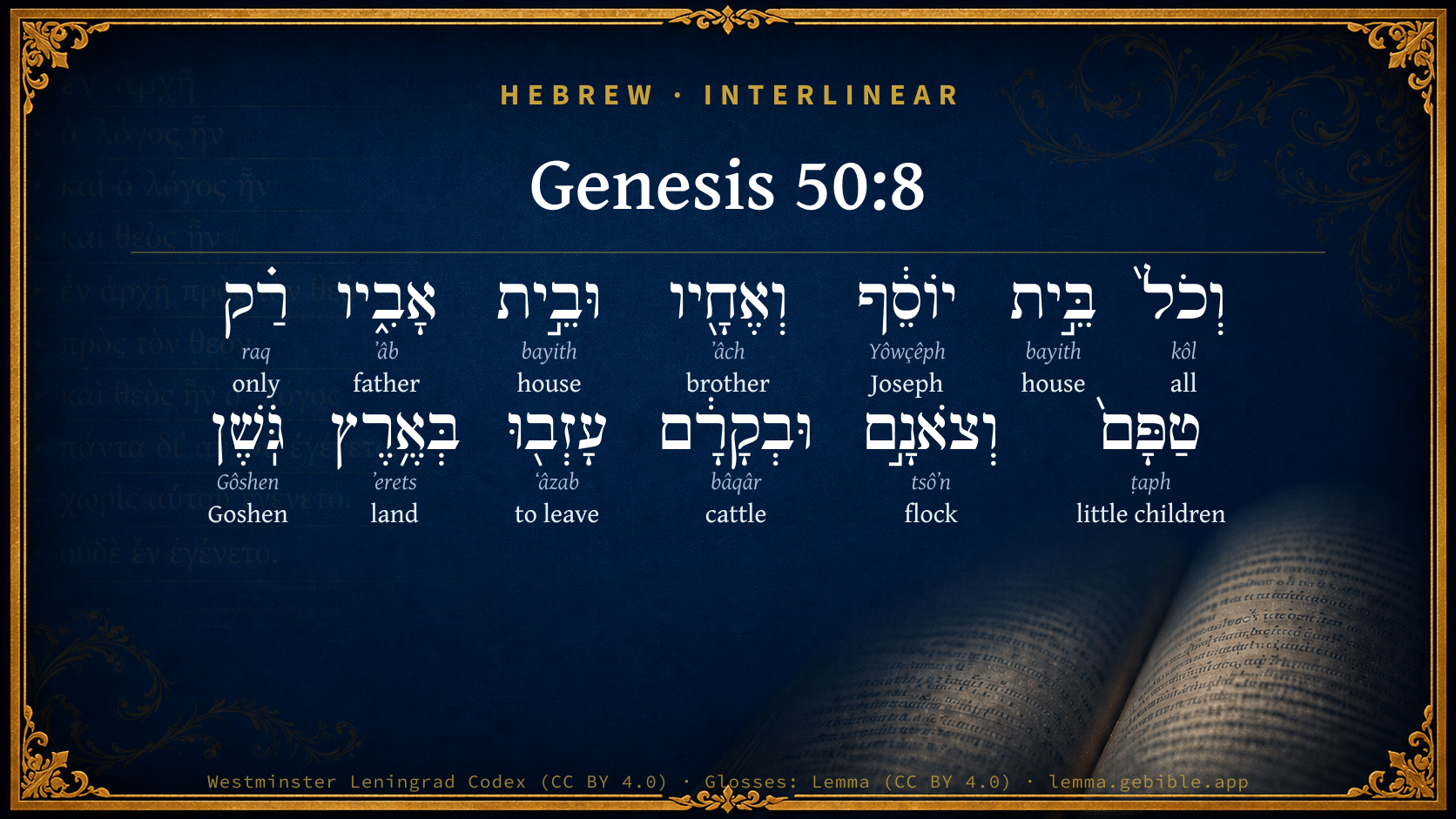
Genesis 50:8

Hebrew (Westminster Leningrad Codex) Genesis 50:8 appears in the Hebrew Old Testament. The text above is from the Westminster Leningrad Codex. Each word links to its Strong’s number, a concise gloss, and parsing drawn from the Open Scriptures Hebrew Bible morphology. Click any word for its full Brown-Driver-Briggs (BDB) entry.
Download image
Cite this verse

Genesis 50:8 (World English Bible). Public Domain. Lemma interlinear Bible study tool, https://lemma.gebible.app/v/genesis/50/8.

Show BibTeX & RIS
BibTeX
RIS
English Translation
all the house of Joseph, his brothers, and his father's house. Only their little ones, their flocks, and their herds, they left in the land of Goshen.
World English Bible · Public Domain
Download a study sheet

One document with this verse’s original text, its word-by-word gloss line, the meaning frame, cross-references with their text, attributed commentary, and full source and license credits — printable, and it pastes into notes with its structure intact.

This verse Autodidact and up

Study sheet (.html) Plain text (.txt)

A passage Seminary Student

Up to 50 verses in one chapter. A passage sheet keeps up to 6 commentary sources and 12 cross-references per verse, in the order this page ranks them, and says so on the sheet whenever that leaves anything out. Ask for a single verse and you get the Autodidact verse sheet above.

Everything on this page stays free to read, with no account — the sheet is a download of what is already on screen, not access to it.

Want to remove ads? Support Godless Engineer
Compare translations 3

The same verse in 3 English versions, stacked beneath the original-language interlinear above. Click any original word for its lexicon entry.

Each is an independent rendering of the whole verse — the interlinear is not word-aligned to these translations.

Highlighted words mark where these versions differ — a whole-verse word diff, not a word-by-word alignment.

  • World English Bible Public Domain
    all the house of Joseph, his brothers, and his father's house. Only their little ones, their flocks, and their herds, they left in the land of Goshen.
  • King James Version Public Domain
    And all the house of Joseph, and his brethren, and his father's house: only their little ones, and their flocks, and their herds, they left in the land of Goshen.
  • unfoldingWord Literal Text CC BY-SA 4.0
    and all of the house of Joseph and his brothers and the house of his father. Only their little ones and their flock and their herd they left in the land of Goshen.

unfoldingWord Literal Text — © unfoldingWord, licensed CC BY-SA 4.0. Word-aligned USFM3 via Door43 (git.door43.org/unfoldingWord/en_ult).

Versions to compare (up to 4)

3 of 4 selected

Show all 18 translations

Every available English version of this verse, each an independent rendering of the whole verse.

  • World English Bible Public Domain
    all the house of Joseph, his brothers, and his father's house. Only their little ones, their flocks, and their herds, they left in the land of Goshen.
  • Berean Standard Bible Public Domain
    along with all of Joseph’s household, and his brothers, and his father’s household. Only their children and flocks and herds were left in Goshen.
  • Majority Standard Bible Public Domain
    along with all of Joseph’s household, and his brothers, and his father’s household. Only their children and flocks and herds were left in Goshen.
  • King James Version Public Domain
    And all the house of Joseph, and his brethren, and his father's house: only their little ones, and their flocks, and their herds, they left in the land of Goshen.
  • American Standard Version (1901) Public Domain
    and all the house of Joseph, and his brethren, and his father's house: only their little ones, and their flocks, and their herds, they left in the land of Goshen.
  • Revised Version (1885) Public Domain
    and all the house of Joseph, and his brethren, and his father’s house: only their little ones, and their flocks, and their herds, they left in the land of Goshen.
  • Geneva Bible (1599) Public Domain
    Likewise all the house of Ioseph, and his brethren, and his fathers house: onely their children, and their sheepe, and their cattell left they in the land of Goshen.
  • Douay-Rheims (1899) Public Domain
    And the house of Joseph with his brethren, except their children, and their flocks and herds, which they left in the land of Gessen.
  • Young's Literal Translation Public Domain
    and all the house of Joseph, and his brethren, and the house of his father; only their infants, and their flock, and their herd, have they left in the land of Goshen;
  • Literal Standard Version CC BY-SA 4.0
    and all the house of Joseph, and his brothers, and the house of his father; only their infants, and their flock, and their herd, have they left in the land of Goshen;
  • Unlocked Literal Bible CC BY-SA 4.0
    with all Joseph's household and his brothers, and his father's household. But their children, their flocks, and their herds were left in the land of Goshen.
  • unfoldingWord Literal Text CC BY-SA 4.0
    and all of the house of Joseph and his brothers and the house of his father. Only their little ones and their flock and their herd they left in the land of Goshen.
  • Darby Bible Public Domain
    and all the house of Joseph, and his brethren, and his father's house; only their little ones, and their flocks, and their herds, they left in the land of Goshen.
  • World Messianic Bible Public Domain
    all the house of Joseph, his brothers, and his father’s house. Only their little ones, their flocks, and their herds, they left in the land of Goshen.
  • Webster's Bible Public Domain
    And all the house of Joseph, and his brethren, and his father's house: only their little ones, and their flocks, and their herds they left in the land of Goshen.
  • Free Bible Version CC BY-SA 4.0
    as well as Joseph's family, his brothers, and his father's family. They only left the small children and their flocks and herds back in Goshen.
  • Bible in Basic English Public Domain
    And all the family of Joseph, and his brothers and his father's people: only their little ones and their flocks and herds they did not take with them from the land of Goshen.
  • JPS Tanakh (1917) Public Domain
    and all the house of Joseph, and his brethren, and his father's house; only their little ones, and their flocks, and their herds, they left in the land of Goshen.

Literal Standard Version (2020), Covenant Press — licensed CC BY-SA 4.0. Text via the HelloAO Bible API (eBible.org). Unlocked Literal Bible (unfoldingWord) — licensed CC BY-SA 4.0. Text via the HelloAO Bible API (eBible.org). unfoldingWord Literal Text — © unfoldingWord, licensed CC BY-SA 4.0. Word-aligned USFM3 via Door43 (git.door43.org/unfoldingWord/en_ult). Free Bible Version, Dr. Jonathan Gallagher — licensed CC BY-SA 4.0. Text via the HelloAO Bible API (eBible.org).

Word by word

More ways to search: Search by grammar → Find every occurrence → Compare this word →

Practice this passage: Drill this verse → Learn its vocabulary →

גֹּֽשֶׁן
Gôshen
H1657
“Goshen”
Noun, Proper
Part of Speech
Noun
Type
Proper
Full BDB Definition

Origin: probably of Egyptian origin

TWOT: 390

Goshen = "drawing near" - a region in northern Egypt, east of the lower Nile, where the children of Israel lived from the time of Joseph to the time of Moses - a district in southern Palestine between Gaza and Gibeon - a town in the mountains of Judah probably in the district of Goshen
  1. וְכֹל֙ kôl H3605 “and · all of” Conjunction + Noun, Common, Masculine, Singular, Construct
  2. בֵּ֣ית bayith H1004 “house of” Noun, Common, Masculine, Singular, Construct
  3. יוֹסֵ֔ף Yôwçêph H3130 “Joseph” Noun, Proper
  4. וְאֶחָ֖יו ʼâch H251 “and · brothers · his” Conjunction + Noun, Common, Masculine, Plural, Construct + Suffix, Personal, 3rd Person, Masculine, Singular
  5. וּבֵ֣ית bayith H1004 “and · house of” Conjunction + Noun, Common, Masculine, Singular, Construct
  6. אָבִ֑יו ʼâb H1 “father · his” Noun, Common, Masculine, Singular, Construct + Suffix, Personal, 3rd Person, Masculine, Singular
  7. רַ֗ק raq H7535 “only” Particle, Accusative
  8. טַפָּם֙ ṭaph H2945 “little children · their” Noun, Common, Masculine, Singular, Construct + Suffix, Personal, 3rd Person, Masculine, Plural
  9. וְצֹאנָ֣ם tsôʼn H6629 “and · flock · their” Conjunction + Noun, Common, Both, Singular, Construct + Suffix, Personal, 3rd Person, Masculine, Plural
  10. וּבְקָרָ֔ם bâqâr H1241 “and · cattle · their” Conjunction + Noun, Common, Both, Singular, Construct + Suffix, Personal, 3rd Person, Masculine, Plural
  11. עָזְב֖וּ ʻâzab H5800 “to leave” Verb, Qal, Perfect, 3rd Person, Common, Plural
  12. בְּאֶ֥רֶץ ʼerets H776 “in/at · land of” Preposition + Noun, Common, Both, Singular, Construct

About this verse

These counts appear in no published source. They are computed here, from the morphology-tagged text and Lemma’s own curated glosses. What Lemma adds →

13
words
12
distinct lemmas
Pentateuch
section

Notable vocabulary

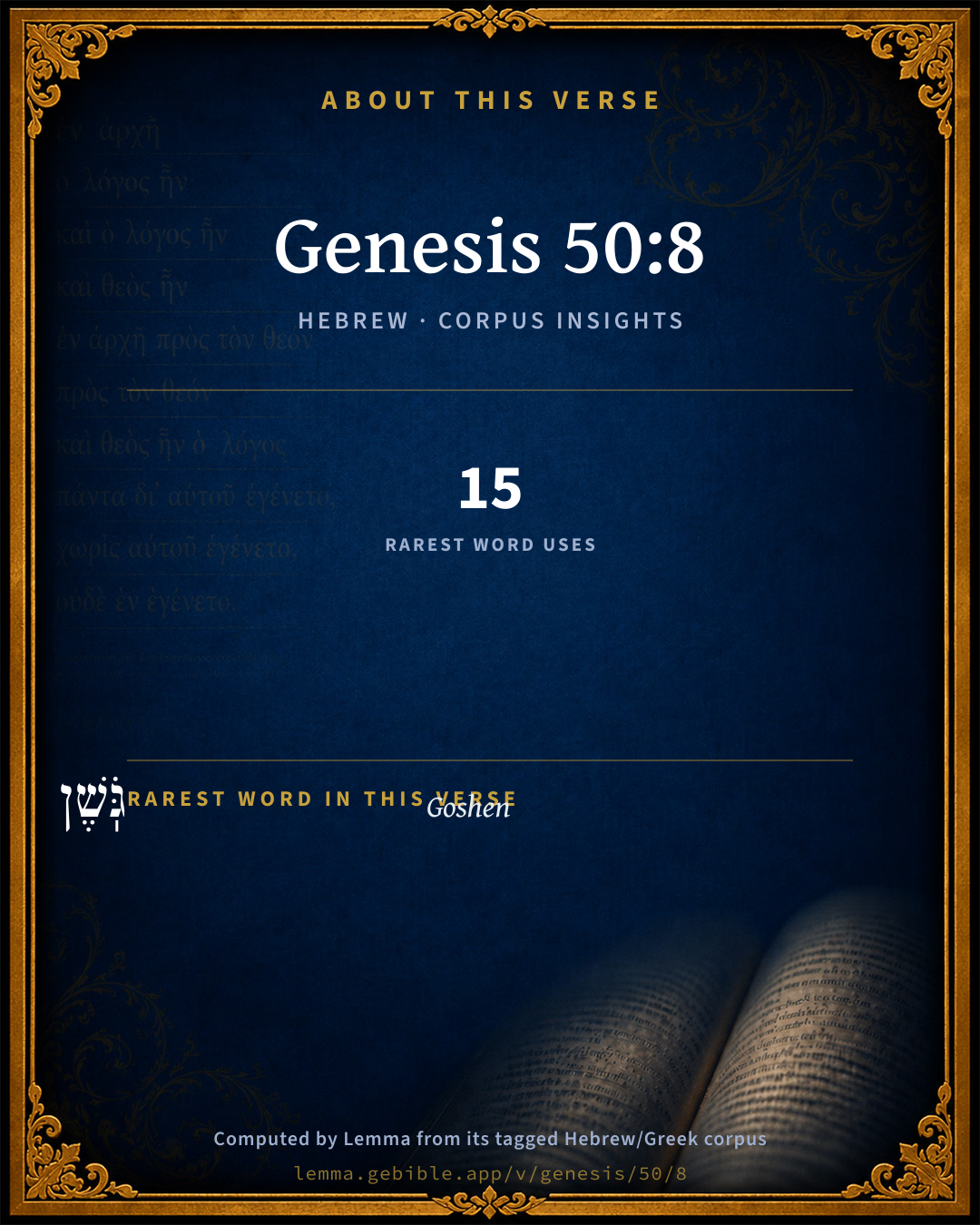
The rarest word here is גֹּֽשֶׁן Goshen H1657 — appearing just 15 times in the whole Hebrew Bible.

Shared distinctive vocabulary

גֹּֽשֶׁן Goshen H1657 occurs in 14 verses of the Hebrew Bible. Also found in:

Grammatical profile

  • 1 verb
  • 11 nouns
  • 1 particle

Verb forms

  • עָזְב֖וּ Qal · Perfect

Repetition

A word recurs within this verse — often emphatic in Hebrew:

  • בֵּ֣ית house H1004 ×2

Hebrew & Septuagint length

In English translation the verse runs 27 words from the Hebrew and 33 from the Septuagint (LXX English) — closely comparable.

A rough comparison of the two English renderings, which tokenize alike — not a word-level alignment.

Word counts can differ between the Hebrew and the Greek without any difference in meaning — e.g. the Hebrew direct-object marker אֵת has no separate Greek word, and Greek often adds the article ὁ.

Cross-references

3

Topical passages linked to Genesis 50:8 in the Treasury of Scripture Knowledge — connected by theme and wording, ordered by reader-vote popularity; previews shown in the World English Bible.

  • Exodus 10:8–9 Moses and Aaron were brought again to Pharaoh, and he said to them, "Go, serve Yahweh your God; but who are those who will go?"
  • Exodus 10:26 Our cattle also shall go with us. There shall not a hoof be left behind, for of it we must take to serve Yahweh our God; and we don't know with what we must serve Yahweh, until we come there."
  • Numbers 32:24–27 Build you cities for your little ones, and folds for your sheep; and do that which has proceeded out of your mouth.

Cross-references courtesy of OpenBible.info (CC BY 4.0).

Hebrew and Greek witnesses Masoretic Hebrew ↔ Greek Septuagint

The same verse in the two great witnesses to the Old Testament, shown verse-for-verse.

These are two independent witnesses, not word-aligned to each other, and the Septuagint is shown in lemma (dictionary) form.

Hebrew Genesis 50:8 Masoretic · Westminster Leningrad Codex

וְכֹל֙ בֵּ֣ית יוֹסֵ֔ף וְאֶחָ֖יו וּבֵ֣ית אָבִ֑יו רַ֗ק טַפָּם֙ וְצֹאנָ֣ם וּבְקָרָ֔ם עָזְב֖וּ בְּאֶ֥רֶץ גֹּֽשֶׁן

all the house of Joseph, his brothers, and his father's house. Only their little ones, their flocks, and their herds, they left in the land of Goshen.

World English Bible · Public Domain

Greek LXX Genesis 50:8 Septuagint · lemma form

καί πᾶς ὁ πανοικία ιωσηφ καί ὁ ἀδελφός αὐτός καί πᾶς ὁ οἰκία ὁ πατρικός αὐτός καί ὁ συγγένεια καί ὁ πρόβατον καί ὁ βοῦς ὑπολείπω ἐν γῆ γεσεμ

And all the household of Joseph, and his brethren, and all the house of his father, and his kindred; and they left behind the sheep and the oxen in the land of Gesem.

LXX2012 (modern English Septuagint) · Public Domain

Hebrew: Westminster Leningrad Codex (CC BY 4.0). Greek: Septuagint (public domain); English from LXX2012 (modern English Septuagint) (Public Domain). How the Septuagint differs from the Hebrew →

Targum (Aramaic paraphrase)

2

The Targum is the ancient Jewish Aramaic paraphrase of the Hebrew Scriptures — an interpretive translation, not the Hebrew text itself. Onkelos (literal) and Pseudo-Jonathan (expansive) render the Torah, and Jonathan the Prophets. Coverage is partial: where no permissively-licensed English translation exists for a verse, only the Aramaic is shown. This is verse-level text, not a word-by-word alignment to the Hebrew.

  1. Targum Onkelos Torah (Genesis–Deuteronomy)
    וְכֹל בֵּית יוֹסֵף וַאֲחוֹהִי וּבֵית אָבוּהִי לְחוֹד טַפְלְהוֹן וְעָנְהוֹן וְתוֹרֵיהוֹן שְׁבָקוּ בְּאַרְעָא דְגשֶׁן

    (no public-domain English translation for this verse)

    Targum Onkelos — Aramaic: “Onkelos Genesis” (public domain); “Onkelos Exodus” (public domain); “Onkelos Leviticus” (public domain); “Onkelos Numbers” (public domain); “Onkelos Deuteronomy” (public domain). English: “Sefaria Community Translation” (CC0 1.0 (public-domain dedication)); “J.W. Etheridge. The Targums of Onkelos and Jonathan Ben Uzziel on the Pentateuch. London: Longmans, Green, 1862” (public domain). Text via Sefaria.

  2. Targum Pseudo-Jonathan Torah (Genesis–Deuteronomy)
    וְכָל אֱנָשׁ בֵּיתָא דְיוֹסֵף וְאָחוֹי וּבֵית אָבוֹי לְחוֹד טַפְלְהוֹן וְעַנְהוֹן וְתוֹרֵיהוֹן שְׁבָקוּ בְּאַרְעָא דְגוֹשֶׁן

    And all the men of Joseph's house, and his brethren, and his father's household: only their children, and their sheep and oxen, left they in the land of Goshen.

    Targum Pseudo-Jonathan — Aramaic: “Targum Jonathan on Genesis” (public domain); “Targum Jonathan on Exodus” (public domain); “Targum Jonathan on Leviticus” (public domain); “Targum Jonathan on Numbers” (public domain); “Targum Jonathan on Deuteronomy” (public domain). English: “The Targum of Jonathan ben Uzziel, trans. J. W. Etheridge, London, 1862” (public domain). Text via Sefaria.

Commentary

Notes on Genesis 50:8 from classic Christian and Jewish commentators (each source and its license shown beneath its notes). The classic Christian expositions comment on the surrounding passage and are grouped to its opening verse, so a note may address several verses; the Jewish commentaries on the Tanakh (Rashi and others) are per-verse, so they appear only where the commentator wrote on this verse.

Lemma curates 59 commentaries, every one of them public domain or Creative Commons licensed, each selected and text-cleaned for this edition rather than reprinted as found. About our sources →

Trapp's Complete Commentary

John Trapp

Gen 50:8 And all the house of Joseph, and his brethren, and his father’s house: only their little ones, and their flocks, and their herds, they left in the land of Goshen.

Ver. 8. Only their little ones.] And some to look to them.

John Trapp, A Commentary or Exposition upon All the Books of the Old and New Testament (1647–1656) — public domain. Text from a community e-Sword module.

John Gill's Exposition

And all the house of Joseph, and his brethren, and his father's house,.... Joseph and his two sons, and his servants, and his eleven brethren and their sons that were grown up, and as many of his father's domestics as could be spared attended the funeral:

only their little ones, and their flocks, and their herds, they left in the land of Goshen; there must be some servants left, though they are not mentioned, to take care of the little ones, and of the flocks and herds; and these being left behind, plainly show they intended to return again, and did not make this an excuse to get out of the land.

John Gill's Exposition of the Whole Bible (1746–1763) — public domain (CC PDM 1.0). Text via the HelloAO Bible API.

Matthew Poole's English Annotations

And such as were necessary to take care of them, which must needs be understood.

Chariots and horsemen, for their defence, in case of any opposition.

Matthew Poole's English Annotations on the Holy Bible (1683–1685) — public domain. Text from a community e-Sword/MySword module.

Lesson kit

Teaching starters — assembled from the data on this page, not authored interpretation. Every prompt links to the verse data it draws on. Edit before teaching.

Genesis, in the Pentateuch, opens this verse with 13 words (12 distinct Hebrew lemmas). Its most distinctive word is Gôshen (“Goshen”). A historical commentator’s framing appears above. Read the whole chapter for the surrounding context.

Discussion questions

  1. What does “Goshen” (Gôshen) contribute to the verse as a whole?
  2. How does Genesis 45:10, which shares the word «Goshen», read alongside this verse?
  3. What does the repetition of “house” (2× in this one verse) do in this verse?
  4. These translations render this verse differently. What is at stake in choosing one wording over another?
  5. «עָזְב֖וּ» is a Qal Perfect verb. How does that grammatical form shape the action described?
  6. Compare how Trapp's Complete Commentary and John Gill's Exposition read this verse. Where do they agree or differ?

Things to notice

Reading settings

Reading text

Shown beneath each verse's original-language words.

Old Testament
Old Testament edition

Read the OT as the Masoretic Hebrew (MT) or the Greek Septuagint (LXX).

English shown for the Greek Septuagint (in the Hebrew ↔ Greek comparison).

Comparing translations? Open the Compare panel on any verse page to stack up to four side by side.