
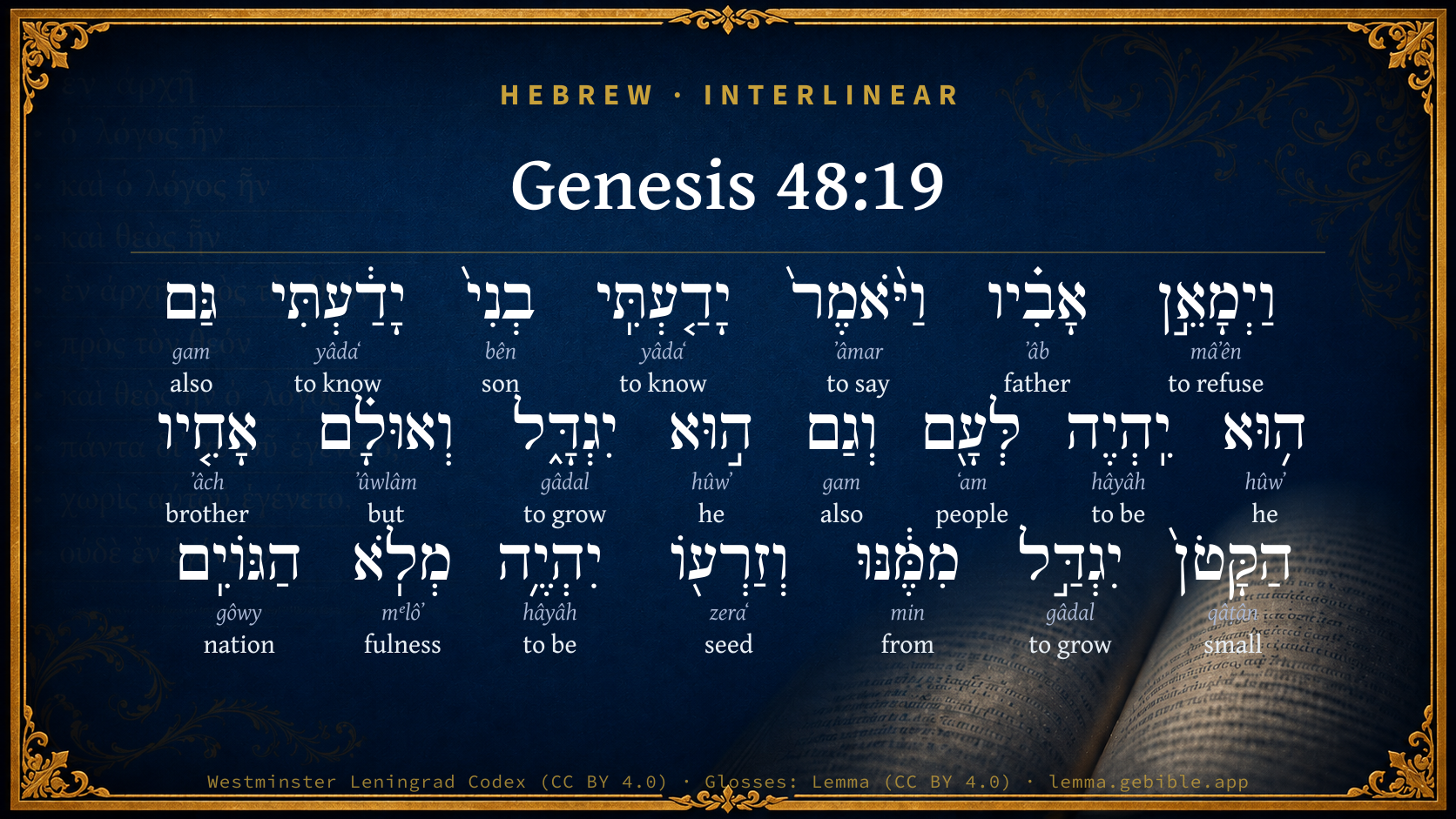
Genesis 48:19

Hebrew (Westminster Leningrad Codex) Genesis 48:19 appears in the Hebrew Old Testament. The text above is from the Westminster Leningrad Codex. Each word links to its Strong’s number, a concise gloss, and parsing drawn from the Open Scriptures Hebrew Bible morphology. Click any word for its full Brown-Driver-Briggs (BDB) entry.
Download image
Cite this verse

Genesis 48:19 (World English Bible). Public Domain. Lemma interlinear Bible study tool, https://lemma.gebible.app/v/genesis/48/19.

Show BibTeX & RIS
BibTeX
RIS
English Translation
His father refused, and said, "I know, my son, I know. He also will become a people, and he also will be great. However, his younger brother will be greater than he, and his seed will become a multitude of nations."
World English Bible · Public Domain
Highlights
  • 1 first appearance in the Hebrew Bible
Full analysis ↓
Download a study sheet

One document with this verse’s original text, its word-by-word gloss line, the meaning frame, cross-references with their text, attributed commentary, and full source and license credits — printable, and it pastes into notes with its structure intact.

This verse Autodidact and up

Study sheet (.html) Plain text (.txt)

A passage Seminary Student

Up to 50 verses in one chapter. A passage sheet keeps up to 6 commentary sources and 12 cross-references per verse, in the order this page ranks them, and says so on the sheet whenever that leaves anything out. Ask for a single verse and you get the Autodidact verse sheet above.

Everything on this page stays free to read, with no account — the sheet is a download of what is already on screen, not access to it.

Want to remove ads? Support Godless Engineer
Compare translations 3

The same verse in 3 English versions, stacked beneath the original-language interlinear above. Click any original word for its lexicon entry.

Each is an independent rendering of the whole verse — the interlinear is not word-aligned to these translations.

Highlighted words mark where these versions differ — a whole-verse word diff, not a word-by-word alignment.

  • World English Bible Public Domain
    His father refused, and said, "I know, my son, I know. He also will become a people, and he also will be great. However, his younger brother will be greater than he, and his seed will become a multitude of nations."
  • King James Version Public Domain
    And his father refused, and said, I know it, my son, I know it: he also shall become a people, and he also shall be great: but truly his younger brother shall be greater than he, and his seed shall become a multitude of nations.
  • unfoldingWord Literal Text CC BY-SA 4.0
    But his father refused and said, “I know, my son, I know. He will also become a people, and he will also be great. Nevertheless his younger brother will be greater than he, and his offspring will become a multitude of nations.”

unfoldingWord Literal Text — © unfoldingWord, licensed CC BY-SA 4.0. Word-aligned USFM3 via Door43 (git.door43.org/unfoldingWord/en_ult).

Versions to compare (up to 4)

3 of 4 selected

Show all 18 translations

Every available English version of this verse, each an independent rendering of the whole verse.

  • World English Bible Public Domain
    His father refused, and said, "I know, my son, I know. He also will become a people, and he also will be great. However, his younger brother will be greater than he, and his seed will become a multitude of nations."
  • Berean Standard Bible Public Domain
    But his father refused. “I know, my son, I know!” he said. “He too shall become a people, and he too shall be great; nevertheless, his younger brother shall be greater than he, and his offspring shall become a multitude of nations.”
  • Majority Standard Bible Public Domain
    But his father refused. “I know, my son, I know!” he said. “He too shall become a people, and he too shall be great; nevertheless, his younger brother shall be greater than he, and his offspring shall become a multitude of nations.”
  • King James Version Public Domain
    And his father refused, and said, I know it, my son, I know it: he also shall become a people, and he also shall be great: but truly his younger brother shall be greater than he, and his seed shall become a multitude of nations.
  • American Standard Version (1901) Public Domain
    And his father refused, and said, I know `it', my son, I know `it'. He also shall become a people, and he also shall be great: howbeit his younger brother shall be greater than he, and his seed shall become a multitude of nations.
  • Revised Version (1885) Public Domain
    And his father refused, and said, I know it, my son, I know it: he also shall become a people, and he also shall be great: howbeit his younger brother shall be greater than he, and his seed shall become a multitude of nations.
  • Geneva Bible (1599) Public Domain
    But his father refused, and sayd, I know well, my sonne, I know well: he shalbe also a people, and he shalbe great likewise: but his yonger brother shalbe greater then he, and his seede shall be full of nations.
  • Douay-Rheims (1899) Public Domain
    But he refusing, said: I know, my son, I know: and this also shall become peoples, and shall be multiplied: but this younger brother shall be greater than he: and his seed shall grow into nations.
  • Young's Literal Translation Public Domain
    And his father refuseth, and saith, `I have known, my son, I have known; he also becometh a people, and he also is great, and yet, his young brother is greater than he, and his seed is the fulness of the nations;'
  • Literal Standard Version CC BY-SA 4.0
    And his father refuses and says, “I have known, my son, I have known; he also becomes a people, and he also is great, and yet, his young brother is greater than he, and his seed is the fullness of the nations”;
  • Unlocked Literal Bible CC BY-SA 4.0
    His father refused and said, “I know, my son, I know. He also will become a people, and he also will be great. Yet his younger brother will be greater than he, and his descendants will become a multitude of nations.”
  • unfoldingWord Literal Text CC BY-SA 4.0
    But his father refused and said, “I know, my son, I know. He will also become a people, and he will also be great. Nevertheless his younger brother will be greater than he, and his offspring will become a multitude of nations.”
  • Darby Bible Public Domain
    But his father refused and said, I know, my son, I know: he also will become a people, and he also will be great; but truly his younger brother will be greater than he; and his seed will become the fulness of nations.
  • World Messianic Bible Public Domain
    His father refused, and said, “I know, my son, I know. He also will become a people, and he also will be great. However, his younger brother will be greater than he, and his offspring will become a multitude of nations.”
  • Webster's Bible Public Domain
    And his father refused, and said, I know it, my son, I know it; he also shall become a people, and he also shall be great; but truly his younger brother shall be greater than he, and his seed shall become a multitude of nations.
  • Free Bible Version CC BY-SA 4.0
    But his father refused, saying, “I know what I'm doing. Manasseh will also become an important people, but his younger brother will be greater than him, and his descendants will become a large nation.”
  • Bible in Basic English Public Domain
    But his father would not, saying, I am doing it on purpose, my son; he will certainly become a nation and a great one; but his younger brother will be greater than he, and his seed will become a great family of nations.
  • JPS Tanakh (1917) Public Domain
    And his father refused, and said: 'I know it, my son, I know it; he also shall become a people, and he also shall be great; howbeit his younger brother shall be greater than he, and his seed shall become a multitude of nations.'

Literal Standard Version (2020), Covenant Press — licensed CC BY-SA 4.0. Text via the HelloAO Bible API (eBible.org). Unlocked Literal Bible (unfoldingWord) — licensed CC BY-SA 4.0. Text via the HelloAO Bible API (eBible.org). unfoldingWord Literal Text — © unfoldingWord, licensed CC BY-SA 4.0. Word-aligned USFM3 via Door43 (git.door43.org/unfoldingWord/en_ult). Free Bible Version, Dr. Jonathan Gallagher — licensed CC BY-SA 4.0. Text via the HelloAO Bible API (eBible.org).

Word by word

More ways to search: Search by grammar → Find every occurrence → Compare this word →

Practice this passage: Drill this verse → Learn its vocabulary →

וְאוּלָ֗ם
ʼûwlâm
H199
“and · but”
Conjunction + Adverb
Part of Speech
Conjunction + Adverb
Full BDB Definition

Origin: apparently a variation of H194

TWOT: 47

but, but indeed (a strong adversative) - however, nevertheless
  1. וַיְמָאֵ֣ן mâʼên H3985 “and · to refuse” Conjunction + Verb, Piel, Sequential Imperfect, 3rd Person, Masculine, Singular
  2. אָבִ֗יו ʼâb H1 “father · his” Noun, Common, Masculine, Singular, Construct + Suffix, Personal, 3rd Person, Masculine, Singular
  3. וַיֹּ֨אמֶר֙ ʼâmar H559 “and · to say” Conjunction + Verb, Qal, Sequential Imperfect, 3rd Person, Masculine, Singular
  4. יָדַ֤עְתִּֽי yâdaʻ H3045 “to know” Verb, Qal, Perfect, 1st Person, Common, Singular
  5. בְנִי֙ bên H1121 “son · my” Noun, Common, Masculine, Singular, Construct + Suffix, Personal, 1st Person, Common, Singular
  6. יָדַ֔עְתִּי yâdaʻ H3045 “to know” Verb, Qal, Perfect, 1st Person, Common, Singular
  7. גַּם gam H1571 “also” Particle, Accusative
  8. ה֥וּא hûwʼ H1931 “he” Pronoun, Personal, 3rd Person, Masculine, Singular
  9. יִֽהְיֶה hâyâh H1961 “to be” Verb, Qal, Imperfect, 3rd Person, Masculine, Singular
  10. לְּעָ֖ם ʻam H5971 “to/for · people” Preposition + Noun, Common, Masculine, Singular, Absolute
  11. וְגַם gam H1571 “and · also” Conjunction + Particle, Accusative
  12. ה֣וּא hûwʼ H1931 “he” Pronoun, Personal, 3rd Person, Masculine, Singular
  13. יִגְדָּ֑ל gâdal H1431 “to grow” Verb, Qal, Imperfect, 3rd Person, Masculine, Singular
  14. אָחִ֤יו ʼâch H251 “brother · his” Noun, Common, Masculine, Singular, Construct + Suffix, Personal, 3rd Person, Masculine, Singular
  15. הַקָּטֹן֙ qâṭân H6996 “the · small” Particle, Definite Article + Adjective, Adjective, Masculine, Singular, Absolute
  16. יִגְדַּ֣ל gâdal H1431 “to grow” Verb, Qal, Imperfect, 3rd Person, Masculine, Singular
  17. מִמֶּ֔נּוּ min H4480 “from · us” Preposition + Suffix, Personal, 1st Person, Common, Plural
  18. וְזַרְע֖וֹ zeraʻ H2233 “and · seed · his” Conjunction + Noun, Common, Masculine, Singular, Construct + Suffix, Personal, 3rd Person, Masculine, Singular
  19. יִהְיֶ֥ה hâyâh H1961 “to be” Verb, Qal, Imperfect, 3rd Person, Masculine, Singular
  20. מְלֹֽא mᵉlôʼ H4393 “fulness of” Noun, Common, Masculine, Singular, Construct
  21. הַגּוֹיִֽם gôwy H1471 “the · nations” Particle, Definite Article + Noun, Common, Masculine, Plural, Absolute

About this verse

These counts appear in no published source. They are computed here, from the morphology-tagged text and Lemma’s own curated glosses. What Lemma adds →

22
words
17
distinct lemmas
Pentateuch
section

Notable vocabulary

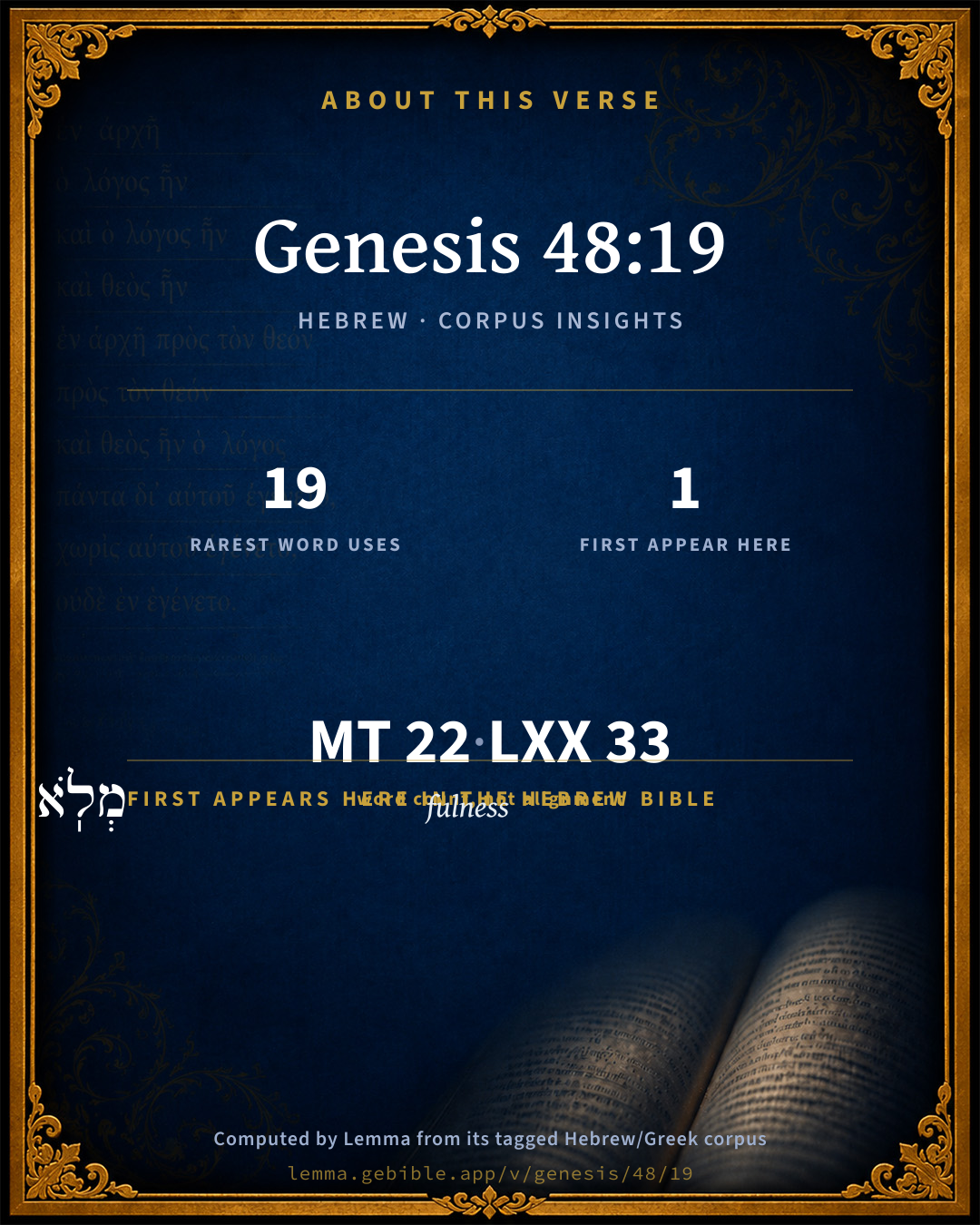
The rarest word here is וְאוּלָ֗ם but H199 — appearing just 19 times in the whole Hebrew Bible.

First appearance in Scripture

This word makes its first canonical appearance in the Hebrew Bible here:

  • מְלֹֽא fulness H4393

Shared distinctive vocabulary

וְאוּלָ֗ם but H199 occurs in 19 verses of the Hebrew Bible. Also found in:

Grammatical profile

  • 8 verbs
  • 7 nouns
  • 1 adjective
  • 2 pronouns
  • 1 preposition
  • 1 adverb
  • 2 particles

Verb forms

  • וַיְמָאֵ֣ן Piel · Sequential Imperfect
  • וַיֹּ֨אמֶר֙ Qal · Sequential Imperfect
  • יָדַ֤עְתִּֽי Qal · Perfect
  • יָדַ֔עְתִּי Qal · Perfect
  • יִֽהְיֶה Qal · Imperfect
  • יִגְדָּ֑ל Qal · Imperfect
  • יִגְדַּ֣ל Qal · Imperfect
  • יִהְיֶ֥ה Qal · Imperfect

Repetition

Words recur within this verse — often emphatic in Hebrew:

  • יָדַ֤עְתִּֽי to know H3045 ×2
  • גַּם also H1571 ×2
  • יִֽהְיֶה to be H1961 ×2
  • יִגְדָּ֑ל to grow H1431 ×2
  • ה֥וּא he H1931 ×2

Hebrew & Septuagint length

In English translation the verse runs 41 words from the Hebrew and 42 from the Septuagint (LXX English) — closely comparable.

A rough comparison of the two English renderings, which tokenize alike — not a word-level alignment.

Word counts can differ between the Hebrew and the Greek without any difference in meaning — e.g. the Hebrew direct-object marker אֵת has no separate Greek word, and Greek often adds the article ὁ.

In the original languages it is 22 Hebrew tokens and 33 Greek tokens — but the two are counted differently (Hebrew bundles its prefixes and suffixes into one token; the Greek is in lemma form), so that isn’t a like-for-like length.

Cross-references

12

Topical passages linked to Genesis 48:19 in the Treasury of Scripture Knowledge — connected by theme and wording, ordered by reader-vote popularity; previews shown in the World English Bible.

  • Numbers 1:33–35 those who were numbered of them, of the tribe of Ephraim, were forty thousand five hundred.
  • Deuteronomy 33:17 The firstborn of his herd, majesty is his; His horns are the horns of the wild-ox: With them he shall push the peoples all of them, [even] the ends of the earth: They are the ten thousands of Ephraim, They are the thousands of Manasseh.
  • Genesis 17:20–21 As for Ishmael, I have heard you. Behold, I have blessed him, and will make him fruitful, and will multiply him exceedingly. He will become the father of twelve princes, and I will make him a great nation.
  • Genesis 25:28 Now Isaac loved Esau, because he ate his venison. Rebekah loved Jacob.
  • Genesis 48:14 Israel stretched out his right hand, and laid it on Ephraim's head, who was the younger, and his left hand on Manasseh's head, guiding his hands knowingly, for Manasseh was the firstborn.
  • Numbers 2:19–21 His division, and those who were numbered of them, were forty thousand five hundred.
  • Deuteronomy 1:10 Yahweh your God has multiplied you, and, behold, you are this day as the stars of the sky for multitude.
  • Ruth 4:11–12 All the people who were in the gate, and the elders, said, We are witnesses. Yahweh make the woman who has come into your house like Rachel and like Leah, which two built the house of Israel: and do you worthily in Ephrathah, and be famous in Bethlehem:
  • Isaiah 7:17 Yahweh will bring on you, on your people, and on your father's house, days that have not come, from the day that Ephraim departed from Judah; even the king of Assyria.
  • Ezekiel 27:10 Persia and Lud and Put were in your army, your men of war: they hanged the shield and helmet in you; they set forth your comeliness.
  • Revelation 7:6 Of the tribe of Asher twelve thousand, Of the tribe of Naphtali twelve thousand, Of the tribe of Manasseh twelve thousand,
  • Revelation 7:8 Of the tribe of Zebulun twelve thousand, Of the tribe of Joseph twelve thousand, Of the tribe of Benjamin were sealed twelve thousand.

Cross-references courtesy of OpenBible.info (CC BY 4.0).

Hebrew and Greek witnesses Masoretic Hebrew ↔ Greek Septuagint

The same verse in the two great witnesses to the Old Testament, shown verse-for-verse.

These are two independent witnesses, not word-aligned to each other, and the Septuagint is shown in lemma (dictionary) form.

Hebrew Genesis 48:19 Masoretic · Westminster Leningrad Codex

וַיְמָאֵ֣ן אָבִ֗יו וַיֹּ֨אמֶר֙ יָדַ֤עְתִּֽי בְנִי֙ יָדַ֔עְתִּי גַּם ה֥וּא יִֽהְיֶה לְּעָ֖ם וְגַם ה֣וּא יִגְדָּ֑ל וְאוּלָ֗ם אָחִ֤יו הַקָּטֹן֙ יִגְדַּ֣ל מִמֶּ֔נּוּ וְזַרְע֖וֹ יִהְיֶ֥ה מְלֹֽא הַגּוֹיִֽם

His father refused, and said, "I know, my son, I know. He also will become a people, and he also will be great. However, his younger brother will be greater than he, and his seed will become a multitude of nations."

World English Bible · Public Domain

Greek LXX Genesis 48:19 Septuagint · lemma form

καί οὐ θέλω ἀλλά εἶπον οἶδα τέκνον οἶδα καί οὗτος εἰμί εἰς λαός καί οὗτος ὑψόω ἀλλά ὁ ἀδελφός αὐτός ὁ νέος μέγας αὐτός εἰμί καί ὁ σπέρμα αὐτός εἰμί εἰς πλῆθος ἔθνος

And he would not, but said, I know it, son, I know it; he also shall be a people, and he shall be exalted, but his younger brother shall be greater than he, and his seed shall become a multitude of nations.

LXX2012 (modern English Septuagint) · Public Domain

Hebrew: Westminster Leningrad Codex (CC BY 4.0). Greek: Septuagint (public domain); English from LXX2012 (modern English Septuagint) (Public Domain). How the Septuagint differs from the Hebrew →

Targum (Aramaic paraphrase)

2

The Targum is the ancient Jewish Aramaic paraphrase of the Hebrew Scriptures — an interpretive translation, not the Hebrew text itself. Onkelos (literal) and Pseudo-Jonathan (expansive) render the Torah, and Jonathan the Prophets. Coverage is partial: where no permissively-licensed English translation exists for a verse, only the Aramaic is shown. This is verse-level text, not a word-by-word alignment to the Hebrew.

  1. Targum Onkelos Torah (Genesis–Deuteronomy)
    וְסָרֵיב אָבוּהִי וַאֲמַר יְדַעְנָא בְרִי יְדַעְנָא אַף הוּא יְהֵי לְעַמָּא וְאַף הוּא יִסְגֵּי וּבְרַם אָחוּהִי זְעִירָא יִסְגֵּי מִנֵּהּ וּבְנוֹהִי יְהוֹן שַׁלִּיטִין בְּעַמְמַיָּא

    (no public-domain English translation for this verse)

    Targum Onkelos — Aramaic: “Onkelos Genesis” (public domain); “Onkelos Exodus” (public domain); “Onkelos Leviticus” (public domain); “Onkelos Numbers” (public domain); “Onkelos Deuteronomy” (public domain). English: “Sefaria Community Translation” (CC0 1.0 (public-domain dedication)); “J.W. Etheridge. The Targums of Onkelos and Jonathan Ben Uzziel on the Pentateuch. London: Longmans, Green, 1862” (public domain). Text via Sefaria.

  2. Targum Pseudo-Jonathan Torah (Genesis–Deuteronomy)
    וְסָרֵב אָבוּי וַאֲמַר יָדַעְנָא בְּרִי יָדַעְנָא דְהוּא בּוּכְרָא אוּף חֲכִּימְנָא דְאוּף הוּא יְהֵי לְעַם רַב וְאוּף הוּא יִסְגֵי וּבְרַם אָחוֹי קַלִילָא יַסְגֵי יַתִּיר מִנֵיהּ וּבְנוֹי יְהוֹן סַגִיאִין בְּעַמְמַיָא

    But his father was not willing, and said, I know, my son, I know that he is the firstborn, and also that he will be a great people, and will also be multiplied; yet will his younger brother be greater than he, and his sons be greater among the nations.

    Targum Pseudo-Jonathan — Aramaic: “Targum Jonathan on Genesis” (public domain); “Targum Jonathan on Exodus” (public domain); “Targum Jonathan on Leviticus” (public domain); “Targum Jonathan on Numbers” (public domain); “Targum Jonathan on Deuteronomy” (public domain). English: “The Targum of Jonathan ben Uzziel, trans. J. W. Etheridge, London, 1862” (public domain). Text via Sefaria.

Commentary

Notes on Genesis 48:19 from classic Christian and Jewish commentators (each source and its license shown beneath its notes). The classic Christian expositions comment on the surrounding passage and are grouped to its opening verse, so a note may address several verses; the Jewish commentaries on the Tanakh (Rashi and others) are per-verse, so they appear only where the commentator wrote on this verse.

Lemma curates 59 commentaries, every one of them public domain or Creative Commons licensed, each selected and text-cleaned for this edition rather than reprinted as found. About our sources →

Trapp's Complete Commentary

John Trapp

Gen 48:19 And his father refused, and said, I know [it], my son, I know [it]: he also shall become a people, and he also shall be great: but truly his younger brother shall be greater than he, and his seed shall become a multitude of nations.

Ver. 19. And his father refused, and said.] Here are father and son divided in matter of ceremony, as Bishop Babington observeth. This hath been an ancient quarrel, from the very cradle of the Christian Church. The Jewish converts stood hard for a mixture of Christ and Moses. Their rites they called "the rudiments of the world"; {Col 2:8} because they held them as needful as the four elements of the world; or as the first letters of the book, to school God’s people. Soon after, what a dispute was there among the primitive Christians, even unto blows and bloodshed, about the time of keeping Easter, and other like trifles and niceties! St Augustine complains, that in his time the Church, which the mercy of God would have to be at liberty, was woefully oppressed with many burdens and bondages this way; so that the condition of the Jews was in this respect more tolerable, for that they were held under by legal injunctions, and not by human presumptions. {a} What would this father have said to the following times, under the rise and reign of Antichrist? wherein the formality of God’s worship had utterly eaten up the reality of it, as Pharaoh’s lean kine did the fatter; and gotten out the very heart of it, as the ivy dealeth by the oak it grows on. Our heroic reformers, Luther, Zuinglius, &c., pruned and pared off these luxuriances for the most part; which caused John Hunt, a Roman Catholic, in his humble appeal to King James, thus to blaspheme: - The God of the Protestants is the most uncivil and ill-mannered God of all those who have borne the name of gods upon the earth; yea, worse than Pan, god of the clowns, which can endure no ceremonies, nor good manners at all. {b} But yet, what a grievous stir was there, about these indifferents, between Luther and Carolostadius, at Wittenberg; between the doctors of Magdeburg and Leipsic, Anno Dom. 1549; {c} and between Calvin {d} and his auditors of Geneva, about wafer cakes at the communion; insomuch as he was compelled to depart the city till he had yielded they should be used, though he never liked them, but could have wished it otherwise. Who knows not what jars and heart burnings were here between Ridley and Hooper, two godly bishops, in King Edward VI’s time, about cap and surplice. They could never agree till they met in prison; and then misery bred unity; then they could heartily bewail their former dissensions about matters of no more moment. Peter Martyr commends it to the care of Queen Elizabeth, {e} that church governors endeavour not to carry the gospel into England upon the cart of needless ceremonies. By his advice, among others, in King Edward VI’s days, some people contending for one image, some for another, the king took down all those Balaam’s blocks. And the very self-same day and hour wherein the Reformation enjoined by Parliament was put ia execution at London by burning of idolatrous images, the English put to flight their enemies in Musselburgh field, as Mr Fox hath well observed. {f}

{a} Queritur Aug. suo tempore Ecclesiam, quam misericormdia Dei esse liberam voluit & c. - Pareus, in Mat 15:2.

{b} Dr Sheldon’s Mark of the Beast., ep. ded. Scultet. Annul.

{c} Alsted., Chron., p. 550.

{d} Beza, in Vita.

{e} Epist. 36, ad Reg. Elizabeth.

{f} Act. and Mon.

John Trapp, A Commentary or Exposition upon All the Books of the Old and New Testament (1647–1656) — public domain. Text from a community e-Sword module.

Joseph Benson's Commentary

Gen 48:19. Truly his younger brother shall be greater than he — This prophecy was evidently fulfilled in the posterity of these two children: a convincing proof that Jacob spoke by inspiration of God; for who but he can foresee what is to happen in distant ages? About two hundred years after this, when the Israelites were first numbered in the wilderness, the tribe of Ephraim had eight thousand three hundred men more than that of Manasseh, Num 1:32; Num 1:35. In encamping about the tabernacle, Ephraim had the standard, and was set before Manasseh, Num 11:18-20. Of him came Joshua, the conqueror of Canaan, Num 13:18, and Jeroboam, king of Israel, 1Ki 11:26. So that the name of Ephraim is often used to signify that whole kingdom. God, in bestowing his blessings upon his people, gives more to some than to others, more gifts, graces, and comforts, and more of the good things of this life. And he often gives most to those that are least likely: he chooseth the weak things of the world, raiseth the poor out of the dust. Grace observes not the order of nature, nor doth God prefer those whom we think fittest to be preferred, but as it pleaseth him.

Joseph Benson's Commentary on the Old and New Testaments (1811–1818) — public domain. Text from a community e-Sword module.

John Calvin's Commentaries

19. He also shall become a people. Jacob does not dispute which of the youths shall be the more worthy; but only pronounces what God had decreed with himself, concerning each, and, what would take place after a long succession of time. He seeks, therefore, no causes elsewhere; but contents himself with this one statement, that Ephraim will be more greatly multiplied than Manasseh. And truly our dignity is hidden in the counsel of God alone, until, by his vocation, he makes it manifest what he wills to do with us. Meanwhile, sinful emulation is forbidden, when he commands Manasseh to be contented with his lot. They are therefore altogether insane, who hew out dry and perforated cisterns, in seeking causes of divine adoption; whereas, everywhere, the Scripture defines in one word, that they are called to salvation whom God has chosen, (Romans 8:29,) and that the primary source of election is his free good pleasure. The form of the benediction, which is shortly afterwards related, more fully confirms what I have alluded to, that the grace of God towards both is commended, in order that Manasseh, considering that more was given to him than he deserved, might not envy his brother. Moreover, this blessing pronounced on Ephraim and Manasseh is not to be taken in the same sense as the former, in which it is said, In thy seed shall all nations be blessed: but the simple meaning is, that the grace of God should be so conspicuous towards the two sons of Joseph, as to furnish the people of Israel with a form by which to express their good wishes.

John Calvin's Commentaries (1540-1563) — public domain. Text from the Calvin Translation Society English edition (1840s-50s) via the Christian Classics Ethereal Library (ccel.org). Calvin's coverage is partial (roughly two-thirds of the Bible); uncommented books and verses are honest gaps, never fabricated. The 19th-century editor's footnotes and remarks are omitted so the notes are faithfully Calvin's own voice.

Ellicott's Commentary for English Readers

(19) His younger brother shall be greater.—In the final numbering of the tribes on the plains of Moab, the tribe of Manasseh had 52,700 souls, and that of Ephraim only 32,500 (Num_26:34; Num_26:37). It was the division of the tribe of Manasseh into two portions which made it politically insignificant, while Ephraim obtained a commanding position in the land of Canaan; and as Joshua was an Ephraimite, it naturally held the rank of foremost tribe during his days, and claimed it always afterwards. For Joshua, after the conquest of Canaan, must have held a position similar to that of General Washington after the independence of the United States had been secured, and all Israel would regard him as their ruler and chief. The influence also of the tribe would be strengthened by the ark being placed in one of its towns.

A Bible Commentary for English Readers, edited by Charles John Ellicott (1878–1897) — public domain. Text from a community e-Sword module.

The Cambridge Bible for Schools and Colleges

gen. ed. J. J. S. Perowne

19. his younger … greater] The preference given to the younger reminds us of the blessing of Jacob himself. Cf. Gen_25:23, Gen_27:29; Gen_27:40. See also the story of Perez and Zerah in Gen_38:29-30. For the superiority of Ephraim over Manasseh, the history of Israel affords the fullest testimony. Cf. Num_1:33; Num_1:35; Num_2:19; Num_2:21.

a multitude] Lit. fulness, as Isa_31:4, “a multitude (lit. fulness) of shepherds.” To become “the fulness of the nations” is to be as full of population as all the nations of the world; a strong hyperbole.

The Cambridge Bible for Schools and Colleges (gen. ed. J. J. S. Perowne; Cambridge University Press, 1878–1918) — public domain. Text from a community e-Sword module.

John Gill's Exposition

And his father refused,.... To have any alteration made, and therefore, though Joseph lifted it up from. Ephraim's head and held it over it, Jacob put it on again and went on with the blessing:

and said, I know it, my son, I know it; he knew what he did, and he repeats it to confirm it, as well as to show the vehemency of his mind, and his resolution to abide by what he had done; he knew on whom he laid his right hand, and he knew that Manasseh was the firstborn: so the Targum of Jonathan:

and he also shall become a people; a tribe or nation:

and he also shall be great; in number, riches, and honour:

but truly his younger brother shall be greater than he; more numerous, as the tribe of Ephraim was, than that of Manasseh, when they came out of Egypt; for in numbering them there appeared to be 8300 more in the one tribe than in the other, Num 1:33, as well as more honourable; Ephraim's standard was placed before Manasseh's, Num 2:18; and upon the division of the tribes in Rehoboam's time, as Jeroboam was of the tribe of Ephraim, that tribe was at the head of the ten tribes, and the seat of the kingdom was in it, and the whole kingdom of Israel often goes by the name of Ephraim:

and his seed shall become a multitude of nations; that is, of families, for as nations are called families, Amo 3:1; so families may be called nations; the Targum of Onkelos is,"his sons shall be rulers among the people,''so Joshua, who was of the tribe of Ephraim, conquered and subdued the nations of the Canaanites, and Jeroboam of this tribe ruled over the ten tribes or nations of Israel: it may be rendered, "his seed shall fill the nations" (t), or be "the fulness" of them; which Jarchi interprets of the whole world being filled with the fame and renown of Joshua, who was of this tribe, when the sun and moon stood still in his days; but it is best to understand this of the large share he should have of the land of Canaan among the rest of the tribes or nations of Israel.

(t) "implebit nationes", Munster; "erit plenitudo gentium", Pagninus, Montanus, Schmidt; "impletio gentium", Tigurine version.

John Gill's Exposition of the Whole Bible (1746–1763) — public domain (CC PDM 1.0). Text via the HelloAO Bible API.

Haydock's Catholic Bible Commentary

A people, (in populos). He shall be father of many peoples. The tribe of Manasses was divided, and had a large territory on either side of the Jordan, immediately north of that which fell to the lots of Ephraim and of Gad. (Haydock) --- Grow. Hebrew, "shall be the fulness of nations;" or shall possess every thing that can make a nation great and enviable. The event justified this prediction. Ephraim was at the head of the ten tribes, most valiant and powerful, 3 Kings xi. 26. (Calmet)

George Leo Haydock (1774–1849), Haydock's Catholic Family Bible and Commentary, 1859 edition — public domain. Excludes Psalms (Douay-Rheims chapter numbering differs from Protestant) and Deuterocanonical books (Catholic canon only).

Matthew Poole's English Annotations

Greater than he; so the tribe of Ephraim was both in number, Num 1:32,33,35; 2:19,21; Deu 33:17, and in power and privileges; for that tribe was the seat first of the tabernacle, and afterwards of the kingdom. Whence the name of Ephraim is sometimes put for all the ten tribes, as Isa 7:2, and sometimes for Joseph himself, as Num 1:32; Rev 7:8, which Manasseh never is.

A multitude of nations, i.e. equal to many nations in number and strength; or, from them shall proceed many nations, i.e. many numerous; potent, and flourishing families, whereof each is equivalent to an ordinary nation. For as

nations are sometimes called families, as Zec 14:18, so the tribes and families of Israel are called nations or people, as Eze 2:3; Act 4:27.

Matthew Poole's English Annotations on the Holy Bible (1683–1685) — public domain. Text from a community e-Sword/MySword module.

The Pulpit Commentary

And his father refused, and said, I know it, my son, I know it: he also shall become a people, and he also shall be great: but truly (literally, and over against that; Wa, the strongly adversative particle, signifying that which stands in front of, or opposite to, another thing) his younger brother shall be greater than he, (cf. Num_1:33 with Num_1:35 Num_2:19 with Num_2:21) and his seed shall become a multitude of nations literally, shall be a fullness of nations. In the time of Moses this prediction began to realize itself. In the first census which took place in the wilderness the tribe of Ephraim had 40, 500 men, while that of Manasseh could only reckon 32, 200; in the second the numbers received a temporary alteration, Ephraim counting only 32, 500, and Manasseh 52, 700; but after the conquest the ascendancy of Ephraim wag restored, so that she easily assumed the lead among the ten northern tribes, and acquired a name and an influence only second to that of Judah (cf. Jud_1:4:5 5:14 8:12)

The Pulpit Commentary (1880–1919), ed. H.D.M. Spence-Jones & Joseph S. Exell — public domain. Text from a community e-Sword module.

John Wesley's Explanatory Notes

Ephraim shall he greater - When the tribes were mustered in the wilderness Ephraim was more numerous than Manasseh, and had the standard of that squadron, Num. i, 32, 33, 35-ii, 18, 20, and is named first, Psalm lxxx, 2. Joshua was of that tribe. The tribe of Manasseh was divided, one half on one side Jordan, the other half on the other side, which made it the less powerful and considerable. God, in bestowing his blessings upon his people, gives more to some than to others, more gifts, graces and comforts, and more of the good things of this life. And he often gives most to those that are least likely: he chuseth the weak things of the world, raiseth the poor out of the dust. Grace observes not the order of nature, nor doth God prefer those whom we think fittest to be preferred but as it pleaseth him.

John Wesley, Explanatory Notes Upon the Whole Bible (1754–1765) — public domain. Text via the GEBible commentary corpus.

unfoldingWord translationNotes

Door43 World Missions Community

He also will become a people, and he also will be great

Here "He" refers to Manasseh, but it stands for his descendants. AT: "Your older son will have many descendants, and they will become a great people" (See: Metonymy)

that day with these words

"that day, saying"

The people of Israel will pronounce blessings by your names saying

"The people of Israel will speak your names when they are blessing others"

by your names saying, 'May God make you like Ephraim and like Manasseh'

This is a quotation within a quotation. It can be stated as an indirect quotation. AT: "by your names. They will ask God to make others like Ephraim and like Manasseh" (See: Quotes Within Quotes and Direct and Indirect Quotations)

like Ephraim and like Manasseh

Israel saying Ephraim's name first is another way he indicates that Ephraim will be greater than Manasseh.

Israel put Ephraim before Manasseh

Giving Ephraim the greater blessing and making him more important than Manasseh is spoken of as if Israel physically put Ephraim in front of Manasseh. (See: Metaphor)

translationWords

people group

descend

nation

bless

unfoldingWord translationNotes — © Distant Shores Media and the Door43 World Missions Community, licensed CC BY-SA 4.0. Source: git.door43.org/Door43/en_tn.

Rashi

Rabbi Shlomo Yitzchaki (Rashi)

ידעתי בני ידעתי I KNOW IT, MY SON, I KNOW that he is the first-born.

גם הוא יהיה לעם וגם הוא יגדל HE ALSO SHALL BECOME A PEOPLE, AND HE ALSO SHALL BE GREAT, for of him will be born Gideon through whom the Holy One, blessed be He, will perform a miracle (See Midrash Tanchuma, Vayechi 6).

ואולם אחיו הקטן יגדל ממנו BUT TRULY HIS YOUNGER BROTHER SHALL BE GREATER THAN HE — for of him will be born Joshua who will make Israel inherit the land of Canaan and will instruct them in the Torah (Midrash Tanchuma, Vayechi 6).

וזרעו יהיה מלא הגוים AND HIS SEED SHALL BECOME A MULTITUDE OF NATIONS (more lit, shall fill the nations) — the fame and renown of his seed, Joshua, will spread abroad and fill the whole world when he will make the sun stand still upon Gibeon and the moon in the valley of Aijalon (Avodah Zarah 25a).

Rashi on the Tanakh — English translations: “The Judaica Press complete Tanach with Rashi, translated by A. J. Rosenberg” (CC BY 4.0); “Pentateuch with Rashi's commentary by M. Rosenbaum and A.M. Silbermann, 1929-1934” (public domain); “The Metsudah Tanach series, Lakewood, N.J” (CC BY 4.0); and “The Book of Joshua, Metsudah Publications, 1997” (CC BY 4.0). Text via Sefaria.

Radak

Rabbi David Kimhi (Radak)

יהיה לעם, will become so numerous until people will refer to his descendants as “a nation.”

וגם הוא יגדל, he will also develop into becoming very numerous. However his younger brother will become even more numerous. At the Exodus from Egyptian the arms-bearing males of the tribe of Ephrayim were 45.500 (Numbers 1,33-35 as opposed to only 32.200 members of the tribe of Menashe. Interestingly, when numbering the males over 20 who entered the Holy Land, the members of the tribe of Menashe outnumbered those of Ephrayim by 52.700 to 32.500. (Numbers 26,34-36.) If we keep this in mind we may have to redefine the meaning of the word יגדל when used by Yaakov not as referring to numerical strength, but as referring to the great men produced by each of these tribes and the relative importance of these men. We know that Moses’ successor, Joshua, was from the tribe of Ephrayim. He was a great saviour, and conquered the land of Canaan enabling the promise of G’d to the patriarchs to finally become realised. The tribe of Ephrayim also provided the first king of the 10 tribes who had split away from Solomon’s son Rechavam after the death of Solomon. Furthermore, throughout the history of the Jewish people until the destruction of the first Temple the political rivalry between Ephrayim and Yehudah is well documented, whereas hardly ever is Menashe mentioned as playing a major part in this. When the prophet Isaiah prophesied an idyllic future, he described this as being characterised by the end of the rivalry between Ephrayim and Yehudah. (Isaiah 11,13). Still, it is possible to also understand the word יגדל ממנו as referring to numerical strength, as except in the single instance we mentioned before Ephrayim always outnumbered Menashe. We must also take into consideration the words וזרעו יהיה מלא הגויים, “and his seed will become plentiful enough to form nations.” The unique phenomenon of the members of Ephrayim being inferior in numbers at the time the Israelites entered the Holy Land may possibly be accounted for by the tradition that 30 years prior to the Exodus the tribe of Ephrayim rebelled, left Egypt and marched to the land of the Philistines on the way to the land of Canaan. According to that report they lost 200.000 of their number in a battle at Gat. [the reason why I do not think this relevant is that if so, there should have been fewer member of the tribe of Ephrayim at the time of the Exodus, instead of 40 years later when near entering the Holy Land. Ed.]

יהיה מלא הגויים, until his descendants are numerous enough when they go into exile to fill countries belonging to, or having belonged to other nations with their numbers alone. [possibly a reference to the population transfer mentioned in Kings II after the Assyrians conquered the Northern Kingdom. and replaced the exiled Jews there with other nationals. (Kings II chapter 17) Ed.]

Radak on the Tanakh — English translations: “Sefaria Community Translation” (CC0 1.0 (public-domain dedication)); “Eliyahu Munk, HaChut Hameshulash” (CC BY 4.0); “Rabbi Mike Feuer, Jerusalem Anthology” (CC BY 4.0); and “R. David Kimhi on the first book of Psalms, Translated by R.G. Finch, London, 1919” (public domain). Text via Sefaria.

Lesson kit

Teaching starters — assembled from the data on this page, not authored interpretation. Every prompt links to the verse data it draws on. Edit before teaching.

Genesis, in the Pentateuch, opens this verse with 22 words (17 distinct Hebrew lemmas). Its most distinctive word is ʼûwlâm (“but”). A historical commentator’s framing appears above. Read the whole chapter for the surrounding context.

Discussion questions

  1. What does “but” (ʼûwlâm) contribute to the verse as a whole?
  2. The word “fulness” first appears here in Scripture. What is being introduced at this debut?
  3. Genesis 28:19 shares the word «but» with this verse. How do the two illuminate each other?
  4. “to know” occurs 2× in this one verse. What is the effect of the repetition?
  5. These translations render this verse differently; the difference is in the English rendering, not the original. What questions does that raise?
  6. The verb «וַיְמָאֵ֣ן» is Piel Sequential Imperfect. How does its form color the action?
  7. Reading how Trapp's Complete Commentary and Joseph Benson's Commentary read this verse, where do the two commentators agree and where do they part?

Things to notice

Reading settings

Reading text

Shown beneath each verse's original-language words.

Old Testament
Old Testament edition

Read the OT as the Masoretic Hebrew (MT) or the Greek Septuagint (LXX).

English shown for the Greek Septuagint (in the Hebrew ↔ Greek comparison).

Comparing translations? Open the Compare panel on any verse page to stack up to four side by side.