Genesis 28:2

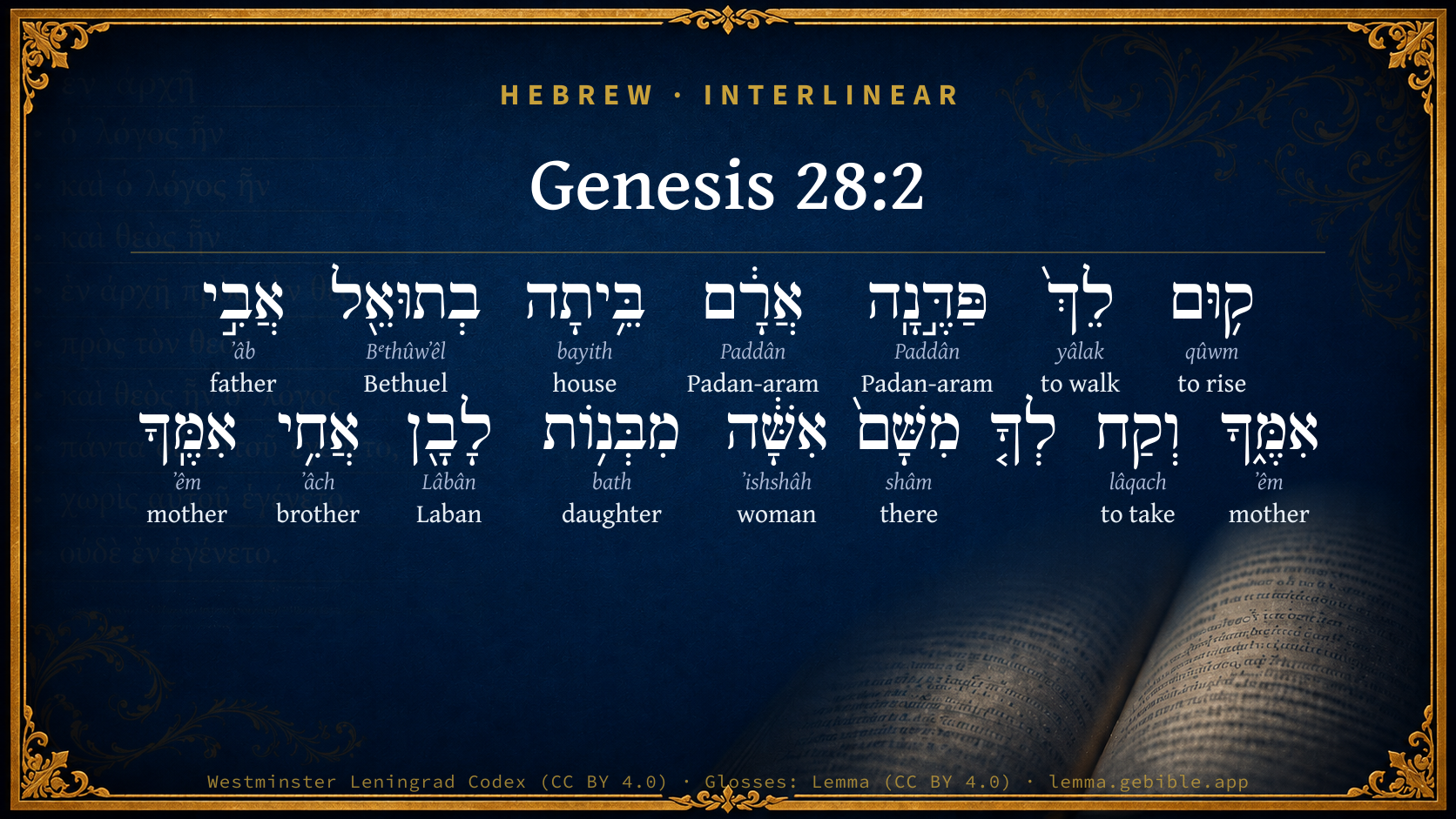
Hebrew (Westminster Leningrad Codex) Genesis 28:2 appears in the Hebrew Old Testament. The text above is from the Westminster Leningrad Codex. Each word links to its Strong’s number, a concise gloss, and parsing drawn from the Open Scriptures Hebrew Bible morphology. Click any word for its full Brown-Driver-Briggs (BDB) entry.
Download image
Cite this verse

Genesis 28:2 (World English Bible). Public Domain. Lemma interlinear Bible study tool, https://lemma.gebible.app/v/genesis/28/2.

Show BibTeX & RIS
BibTeX
RIS
English Translation
Arise, go to Paddan Aram, to the house of Bethuel your mother's father. Take a wife from there from the daughters of Laban, your mother's brother.
World English Bible · Public Domain
Download a study sheet

One document with this verse’s original text, its word-by-word gloss line, the meaning frame, cross-references with their text, attributed commentary, and full source and license credits — printable, and it pastes into notes with its structure intact.

This verse Autodidact and up

Study sheet (.html) Plain text (.txt)

A passage Seminary Student

Up to 50 verses in one chapter. A passage sheet keeps up to 6 commentary sources and 12 cross-references per verse, in the order this page ranks them, and says so on the sheet whenever that leaves anything out. Ask for a single verse and you get the Autodidact verse sheet above.

Everything on this page stays free to read, with no account — the sheet is a download of what is already on screen, not access to it.

Want to remove ads? Support Godless Engineer
Compare translations 3

The same verse in 3 English versions, stacked beneath the original-language interlinear above. Click any original word for its lexicon entry.

Each is an independent rendering of the whole verse — the interlinear is not word-aligned to these translations.

Highlighted words mark where these versions differ — a whole-verse word diff, not a word-by-word alignment.

  • World English Bible Public Domain
    Arise, go to Paddan Aram, to the house of Bethuel your mother's father. Take a wife from there from the daughters of Laban, your mother's brother.
  • King James Version Public Domain
    Arise, go to Padanaram, to the house of Bethuel thy mother's father; and take thee a wife from thence of the daughters of Laban thy mother's brother.
  • unfoldingWord Literal Text CC BY-SA 4.0
    Get up, go to Paddan Aram, to the home of Bethuel the father of your mother, and take a wife for yourself from there, from the daughters of Laban the brother of your mother.

unfoldingWord Literal Text — © unfoldingWord, licensed CC BY-SA 4.0. Word-aligned USFM3 via Door43 (git.door43.org/unfoldingWord/en_ult).

Versions to compare (up to 4)

3 of 4 selected

Show all 18 translations

Every available English version of this verse, each an independent rendering of the whole verse.

  • World English Bible Public Domain
    Arise, go to Paddan Aram, to the house of Bethuel your mother's father. Take a wife from there from the daughters of Laban, your mother's brother.
  • Berean Standard Bible Public Domain
    “Go at once to Paddan-aram, to the house of your mother’s father Bethuel, and take a wife from among the daughters of Laban, your mother’s brother.
  • Majority Standard Bible Public Domain
    “Go at once to Paddan-aram, to the house of your mother’s father Bethuel, and take a wife from among the daughters of Laban, your mother’s brother.
  • King James Version Public Domain
    Arise, go to Padanaram, to the house of Bethuel thy mother's father; and take thee a wife from thence of the daughters of Laban thy mother's brother.
  • American Standard Version (1901) Public Domain
    Arise, go to Paddan-aram, to the house of Bethuel thy mother's father. And take thee a wife from thence of the daughters of Laban thy mother's brother.
  • Revised Version (1885) Public Domain
    Arise, go to Paddan-aram, to the house of Bethuel thy mother’s father; and take thee a wife from thence of the daughters of Laban thy mother’s brother.
  • Geneva Bible (1599) Public Domain
    Arise, get thee to Padan Aram to the house of Bethuel thy mothers father, and thence take thee a wife of the daughters of Laban thy mothers brother.
  • Douay-Rheims (1899) Public Domain
    But go, and take a journey to Mesopotamia of Syria, to the house of Bathuel thy mother's father, and take thee a wife thence of the daughters of Laban thy uncle.
  • Young's Literal Translation Public Domain
    rise, go to Padan-Aram, to the house of Bethuel, thy mother's father, and take for thyself from thence a wife, of the daughters of Laban, thy mother's brother;
  • Literal Standard Version CC BY-SA 4.0
    rise, go to Padan-Aram, to the house of your mother’s father Bethuel, and take for yourself a wife from there, from the daughters of your mother’s brother Laban;
  • Unlocked Literal Bible CC BY-SA 4.0
    Arise, go to Paddan Aram, to the house of Bethuel your mother's father, and take a wife from there, one of the daughters of Laban, your mother's brother.
  • unfoldingWord Literal Text CC BY-SA 4.0
    Get up, go to Paddan Aram, to the home of Bethuel the father of your mother, and take a wife for yourself from there, from the daughters of Laban the brother of your mother.
  • Darby Bible Public Domain
    Arise, go to Padan-Aram, to the house of Bethuel thy mother's father, and take a wife thence of the daughters of Laban thy mother's brother.
  • World Messianic Bible Public Domain
    Arise, go to Paddan Aram, to the house of Bethuel your mother’s father. Take a wife from there from the daughters of Laban, your mother’s brother.
  • Webster's Bible Public Domain
    Arise, go to Padan-aram, to the house of Bethuel thy mother's father; and take thee a wife from thence of the daughters of Laban thy mother's brother.
  • Free Bible Version CC BY-SA 4.0
    “Leave right away and go to Paddan-aram, to the home of Bethuel, your mother's father. Find yourself a wife there—a daughter of Laban, your mother's brother.
  • Bible in Basic English Public Domain
    But go to Paddan-aram, to the house of Bethuel, your mother's father, and there get yourself a wife from the daughters of Laban, your mother's brother.
  • JPS Tanakh (1917) Public Domain
    Arise, go to Paddan-aram, to the house of Bethuel thy mother's father; and take thee a wife from thence of the daughters of Laban thy mother's brother.

Literal Standard Version (2020), Covenant Press — licensed CC BY-SA 4.0. Text via the HelloAO Bible API (eBible.org). Unlocked Literal Bible (unfoldingWord) — licensed CC BY-SA 4.0. Text via the HelloAO Bible API (eBible.org). unfoldingWord Literal Text — © unfoldingWord, licensed CC BY-SA 4.0. Word-aligned USFM3 via Door43 (git.door43.org/unfoldingWord/en_ult). Free Bible Version, Dr. Jonathan Gallagher — licensed CC BY-SA 4.0. Text via the HelloAO Bible API (eBible.org).

Word by word

More ways to search: Search by grammar → Find every occurrence → Compare this word →

Practice this passage: Drill this verse → Learn its vocabulary →

בְתוּאֵ֖ל
Bᵉthûwʼêl
H1328
“Bethuel”
Noun, Proper
Part of Speech
Noun
Type
Proper
Full BDB Definition

Origin: apparently from the same as H1326 and H410

TWOT: None

Bethuel = "God destroys" or " man of God" or " dweller in God" - nephew of Abraham, son of Nahor by Milcah, father of Rebekah (noun proper masculine) - a town of Simeon in the south (noun proper locative)
  1. ק֥וּם qûwm H6965 “rise” Verb, Qal, Imperative, 2nd Person, Masculine, Singular
  2. לֵךְ֙ yâlak H3212 “walk” Verb, Qal, Imperative, 2nd Person, Masculine, Singular
  3. פַּדֶּ֣נָֽה Paddân H6307 “Padan-aram · toward” Noun, Proper + Suffix, Demonstrative
  4. אֲרָ֔ם Paddân H6307 “Padan-aram” Noun, Proper
  5. בֵּ֥יתָה bayith H1004 “house · toward” Noun, Common, Masculine, Singular, Construct + Suffix, Demonstrative
  6. אֲבִ֣י ʼâb H1 “father of” Noun, Common, Masculine, Singular, Construct
  7. אִמֶּ֑ךָ ʼêm H517 “mother · your” Noun, Common, Feminine, Singular, Construct + Suffix, Personal, 2nd Person, Masculine, Singular
  8. וְקַח lâqach H3947 “and · take” Conjunction + Verb, Qal, Imperative, 2nd Person, Masculine, Singular
  9. מִשָּׁם֙ shâm H8033 “from · there” Preposition + Adverb
  10. אִשָּׁ֔ה ʼishshâh H802 “woman” Noun, Common, Feminine, Singular, Absolute
  11. מִבְּנ֥וֹת bath H1323 “from · daughters of” Preposition + Noun, Common, Feminine, Plural, Construct
  12. לָבָ֖ן Lâbân H3837 “Laban” Noun, Proper
  13. אֲחִ֥י ʼâch H251 “brother of” Noun, Common, Masculine, Singular, Construct
  14. אִמֶּֽךָ ʼêm H517 “mother · your” Noun, Common, Feminine, Singular, Construct + Suffix, Personal, 2nd Person, Masculine, Singular

About this verse

These counts appear in no published source. They are computed here, from the morphology-tagged text and Lemma’s own curated glosses. What Lemma adds →

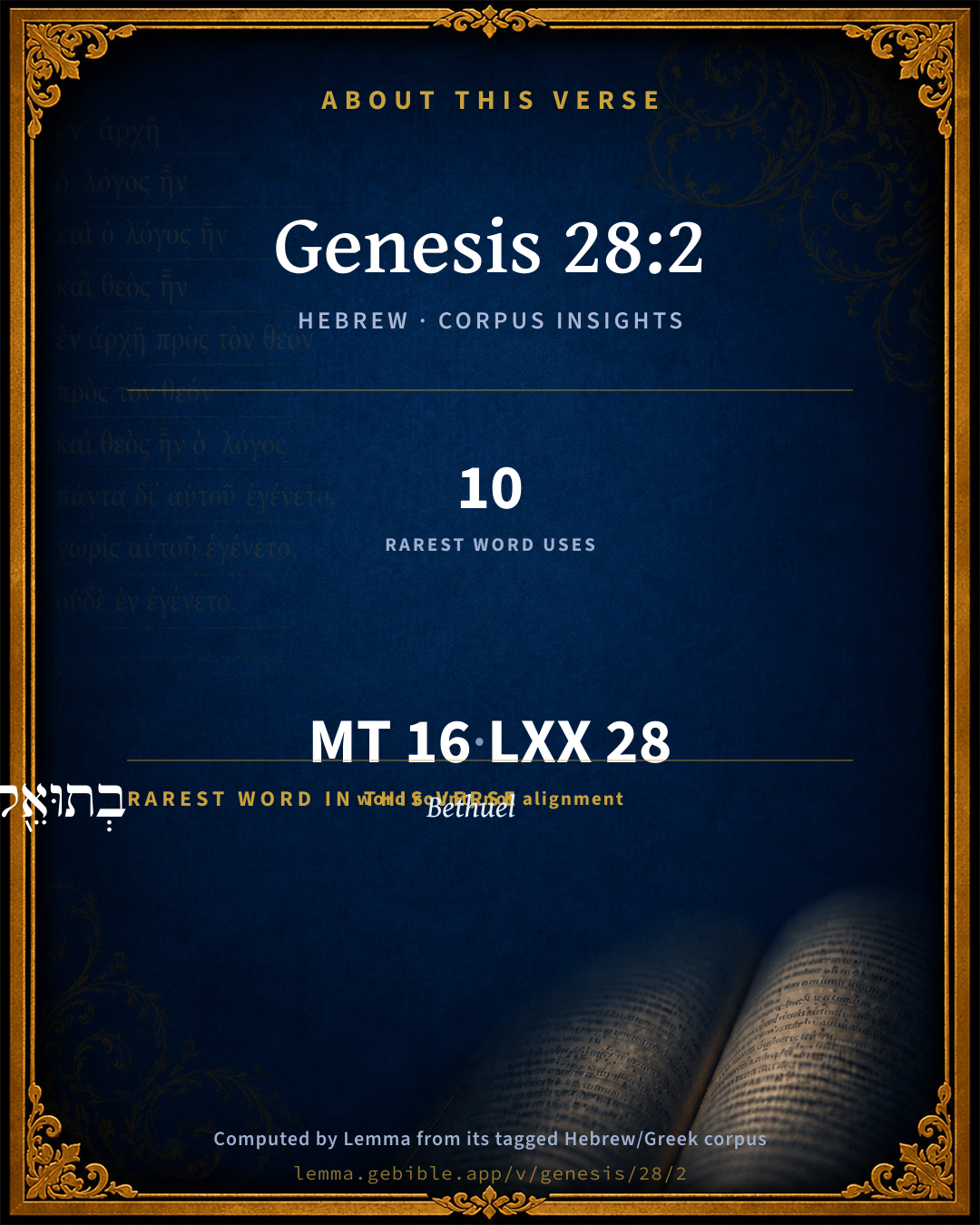
16
words
13
distinct lemmas
Pentateuch
section

Notable vocabulary

The rarest word here is בְתוּאֵ֖ל Bethuel H1328 — appearing just 10 times in the whole Hebrew Bible.

Shared distinctive vocabulary

בְתוּאֵ֖ל Bethuel H1328 occurs in 10 verses of the Hebrew Bible. Also found in:

Grammatical profile

  • 3 verbs
  • 11 nouns
  • 1 preposition
  • 1 adverb

Verb forms

  • ק֥וּם Qal · Imperative
  • לֵךְ֙ Qal · Imperative
  • וְקַח Qal · Imperative

Repetition

Words recur within this verse — often emphatic in Hebrew:

  • פַּדֶּ֣נָֽה Padan-aram H6307 ×2
  • אִמֶּ֑ךָ mother H517 ×2

Hebrew & Septuagint length

In English translation the verse runs 26 words from the Hebrew and 31 from the Septuagint (LXX English) — closely comparable.

A rough comparison of the two English renderings, which tokenize alike — not a word-level alignment.

Word counts can differ between the Hebrew and the Greek without any difference in meaning — e.g. the Hebrew direct-object marker אֵת has no separate Greek word, and Greek often adds the article ὁ.

In the original languages it is 16 Hebrew tokens and 28 Greek tokens — but the two are counted differently (Hebrew bundles its prefixes and suffixes into one token; the Greek is in lemma form), so that isn’t a like-for-like length.

Cross-references

13

Topical passages linked to Genesis 28:2 in the Treasury of Scripture Knowledge — connected by theme and wording, ordered by reader-vote popularity; previews shown in the World English Bible.

  • Genesis 25:20 Isaac was forty years old when he took Rebekah, the daughter of Bethuel the Syrian of Paddan Aram, the sister of Laban the Syrian, to be his wife.
  • Hosea 12:12 Jacob fled into the country of Aram, And Israel served to get a wife, And for a wife he tended flocks and herds.
  • Genesis 22:20–23 It happened after these things, that it was told Abraham, saying, "Behold, Milcah, she also has borne children to your brother Nahor:
  • Genesis 24:15–24 It happened, before he had done speaking, that behold, Rebekah came out, who was born to Bethuel the son of Milcah, the wife of Nahor, Abraham's brother, with her pitcher on her shoulder.
  • Genesis 24:29 Rebekah had a brother, and his name was Laban. Laban ran out to the man, to the spring.
  • Genesis 24:50 Then Laban and Bethuel answered, "The thing proceeds from Yahweh. We can't speak to you bad or good.
  • Genesis 28:5 Isaac sent Jacob away. He went to Paddan Aram to Laban, son of Bethuel the Syrian, Rebekah's brother, Jacob's and Esau's mother.
  • Genesis 32:10 I am not worthy of the least of all the loving kindnesses, and of all the truth, which you have shown to your servant; for with just my staff I passed over this Jordan; and now I have become two companies.
  • Genesis 35:9 God appeared to Jacob again, when he came from Paddan Aram, and blessed him.
  • Genesis 46:15 These are the sons of Leah, whom she bore to Jacob in Paddan Aram, with his daughter Dinah. All the souls of his sons and his daughters were thirty-three.
  • Genesis 24:10 The servant took ten camels, of his master's camels, and departed, having all goodly things of his master's in his hand. He arose, and went to Mesopotamia, to the city of Nahor.
  • Genesis 29:1 Then Jacob went on his journey, and came to the land of the children of the east.
  • Genesis 31:18 and he carried away all his cattle, and all his substance which he had gathered, the cattle of his getting, which he had gathered in Paddan Aram, to go to Isaac his father to the land of Canaan.

Cross-references courtesy of OpenBible.info (CC BY 4.0).

Hebrew and Greek witnesses Masoretic Hebrew ↔ Greek Septuagint

The same verse in the two great witnesses to the Old Testament, shown verse-for-verse.

These are two independent witnesses, not word-aligned to each other, and the Septuagint is shown in lemma (dictionary) form.

Hebrew Genesis 28:2 Masoretic · Westminster Leningrad Codex

ק֥וּם לֵךְ֙ פַּדֶּ֣נָֽה אֲרָ֔ם בֵּ֥יתָה בְתוּאֵ֖ל אֲבִ֣י אִמֶּ֑ךָ וְקַח לְךָ֤ מִשָּׁם֙ אִשָּׁ֔ה מִבְּנ֥וֹת לָבָ֖ן אֲחִ֥י אִמֶּֽךָ

Arise, go to Paddan Aram, to the house of Bethuel your mother's father. Take a wife from there from the daughters of Laban, your mother's brother.

World English Bible · Public Domain

Greek LXX Genesis 28:2 Septuagint · lemma form

ἀναἵστημι ἀποδιδράσκω εἰς ὁ μεσοποταμία εἰς ὁ οἶκος βαθουηλ ὁ πατήρ ὁ μήτηρ σύ καί λαμβάνω σεαυτοῦ ἐκεῖθεν γυνή ἐκ ὁ θυγάτηρ λαβαν ὁ ἀδελφός ὁ μήτηρ σύ

Rise and depart quickly into Mesopotamia, to the house of Bathuel the father of your mother, and take to yourself thence a wife of the daughters of Laban your mother's brother.

LXX2012 (modern English Septuagint) · Public Domain

On this verse, Haydock's Catholic Bible Commentary discusses the Septuagint’s reading. Read the note in Commentary ↓

Hebrew: Westminster Leningrad Codex (CC BY 4.0). Greek: Septuagint (public domain); English from LXX2012 (modern English Septuagint) (Public Domain). How the Septuagint differs from the Hebrew →

Targum (Aramaic paraphrase)

2

The Targum is the ancient Jewish Aramaic paraphrase of the Hebrew Scriptures — an interpretive translation, not the Hebrew text itself. Onkelos (literal) and Pseudo-Jonathan (expansive) render the Torah, and Jonathan the Prophets. Coverage is partial: where no permissively-licensed English translation exists for a verse, only the Aramaic is shown. This is verse-level text, not a word-by-word alignment to the Hebrew.

  1. Targum Onkelos Torah (Genesis–Deuteronomy)
    קוּם אִזֵּיל לְפַדַּן אֲרָם לְבֵית בְּתוּאֵל אֲבוּהָא דְאִמָּךְ וְסַב לָךְ מִתַּמָּן אִתְּתָא מִבְּנַת לָבָן אֲחוּהָא דְאִמָּךְ

    (no public-domain English translation for this verse)

    Targum Onkelos — Aramaic: “Onkelos Genesis” (public domain); “Onkelos Exodus” (public domain); “Onkelos Leviticus” (public domain); “Onkelos Numbers” (public domain); “Onkelos Deuteronomy” (public domain). English: “Sefaria Community Translation” (CC0 1.0 (public-domain dedication)); “J.W. Etheridge. The Targums of Onkelos and Jonathan Ben Uzziel on the Pentateuch. London: Longmans, Green, 1862” (public domain). Text via Sefaria.

  2. Targum Pseudo-Jonathan Torah (Genesis–Deuteronomy)
    קוּם אִיזֵיל לְפַדַן דַאֲרָם לְבֵית בְּתוּאֵל אָבוּהָא דְאִמָךְ וְסַב לָךְ מִתַּמָן אִיתָּא מִבְּנַת לָבָן אָחוּהָא דְאִמָךְ

    Arise, go to Padan of Aram, to the house of Bethuel thy mother's father, and take thee from thence a wife from the daughters of Laban mother's brother.

    Targum Pseudo-Jonathan — Aramaic: “Targum Jonathan on Genesis” (public domain); “Targum Jonathan on Exodus” (public domain); “Targum Jonathan on Leviticus” (public domain); “Targum Jonathan on Numbers” (public domain); “Targum Jonathan on Deuteronomy” (public domain). English: “The Targum of Jonathan ben Uzziel, trans. J. W. Etheridge, London, 1862” (public domain). Text via Sefaria.

Commentary

Notes on Genesis 28:2 from classic Christian and Jewish commentators (each source and its license shown beneath its notes). The classic Christian expositions comment on the surrounding passage and are grouped to its opening verse, so a note may address several verses; the Jewish commentaries on the Tanakh (Rashi and others) are per-verse, so they appear only where the commentator wrote on this verse.

Lemma curates 59 commentaries, every one of them public domain or Creative Commons licensed, each selected and text-cleaned for this edition rather than reprinted as found. About our sources →

Trapp's Complete Commentary

John Trapp

Gen 28:2 Arise, go to Padanaram, to the house of Bethuel thy mother’s father; and take thee a wife from thence of the daughters of Laban thy mother’s brother.

Ver. 2. Arise, go to Padanaram.] Jacob was no sooner blest, but banished. So our Saviour was no sooner out of the water of baptism, and had heard, "This is my beloved Son," &c., but he was presently in the fire of temptation, and heard, "If thou be the Son," &c. {Mat 3:1-17; Mat 4:1-11} When Hezekiah had set all in good order, {2Ch 31:1-21} then up came Sennacherib with an army. {2Ch 32:1} God puts his people to it; and often, after sweetest feelings.

John Trapp, A Commentary or Exposition upon All the Books of the Old and New Testament (1647–1656) — public domain. Text from a community e-Sword module.

Adam Clarke's Commentary

Verse 2. Go to Padan-aram] This mission, in its spirit and design, is nearly the same as that in Ge 24:1-4, c., which see. There have been several ingenious conjectures concerning the retinue which Jacob had, or might have had, for his journey and by some he has been supposed to have been well attended. Of this nothing is mentioned here, and the reverse seems to be intimated elsewhere. It appears, from Ge 28:11, that he lodged in the open air, with a stone for his pillow; and from Ge 32:10, that he went on foot with his staff in his hand; nor is there even the most indirect mention of any attendants, nor is it probable there were any. He no doubt took provisions with him sufficient to carry him to the nearest encampment or village on the way, where he would naturally recruit his bread and water to carry him to the next stage, and so on. The oil that he poured on the pillar might be a little of that which he had brought for his own use, and can be no rational arguement of his having a stock of provisions, servants, camels, &c., for which it has been gravely brought. He had God alone with him.

Adam Clarke's Commentary on the Bible (1810–1826) — public domain. Text from a community e-Sword/MySword module.

John Calvin's Commentaries

2. Arise, go to Padan-aram. In the first place, he commands him to take a wife from his maternal race. He might have sent for her by some one of his servants, as Rebekah had been brought to him; but perhaps he took this course to avoid the envy of Esau, who might regard it as a reproach if more solicitude were manifested about his brother’s marriage than about his own.

John Calvin's Commentaries (1540-1563) — public domain. Text from the Calvin Translation Society English edition (1840s-50s) via the Christian Classics Ethereal Library (ccel.org). Calvin's coverage is partial (roughly two-thirds of the Bible); uncommented books and verses are honest gaps, never fabricated. The 19th-century editor's footnotes and remarks are omitted so the notes are faithfully Calvin's own voice.

Ellicott's Commentary for English Readers

(2) Padan-aram.—See Note on Gen_25:20. Throughout this verse Isaac shows a much more intimate acquaintance with the family at Haran than was possessed by Abraham. (Comp. Gen_24:4.) And though we gather from Gen_28:5 that Bethuel was now dead, yet it is evident that he was a person of more importance than is supposed by the Rabbins, who ascribe to his feebleness or death the prominent part taken by Laban in his sister’s marriage. It was this greater knowledge which made Isaac send Jacob in person, and not a deputy. With a few trusty attendants he would journey till he reached the usual caravan route which led through Damascus to Haran. and would then attach himself to some trading company for escort and society.

A Bible Commentary for English Readers, edited by Charles John Ellicott (1878–1897) — public domain. Text from a community e-Sword module.

The Cambridge Bible for Schools and Colleges

gen. ed. J. J. S. Perowne

2. Paddan-aram] See note on Gen_25:20. This is the name given by P (cf. Gen_31:18, Gen_33:18, Gen_35:9; Gen_35:26, Gen_46:15) to the region which in the J narrative is called “Haran”: another indication of the literary distinctness of this passage from that which immediately precedes it: see Gen_27:43.

The Cambridge Bible for Schools and Colleges (gen. ed. J. J. S. Perowne; Cambridge University Press, 1878–1918) — public domain. Text from a community e-Sword module.

John Gill's Exposition

Arise, go to Padanaram,.... Of this place; see Gill on Gen 25:20; either he is bid to go directly, in haste and alone; perhaps by this time Rebekah had given Isaac some hint of the ill design of Esau against him, which made Isaac the more urgent upon him to be gone, as well as it was high time he had took to himself a wife:

to the house of Bethuel thy mother's father; who though now dead in all probability, yet the house and family went by his name:

and take thee a wife from thence of the daughters of Laban thy mother's brother: who had daughters unmarried, of which no doubt Isaac and Rebekah had knowledge, a correspondence being kept up between the two families, though at a great distance.

John Gill's Exposition of the Whole Bible (1746–1763) — public domain (CC PDM 1.0). Text via the HelloAO Bible API.

Haydock's Catholic Bible Commentary

Take. Septuagint, "flee;" as if Isaac began at last to be apprized of Esau’s designs. Wisdom (x. 10) conducted the just when he fled from his brother’s wrath, &c. --- Thy uncle. He points out the house, but leaves the woman to his choice.

George Leo Haydock (1774–1849), Haydock's Catholic Family Bible and Commentary, 1859 edition — public domain. Excludes Psalms (Douay-Rheims chapter numbering differs from Protestant) and Deuterocanonical books (Catholic canon only).

Matthew Poole's English Annotations

The house of Bethuel. See Gen 22:22-23; 25:20

Matthew Poole's English Annotations on the Holy Bible (1683–1685) — public domain. Text from a community e-Sword/MySword module.

Whedon's Commentary on the Bible

Daniel D. Whedon

2. Padan-aram — See on Gen_24:10.

Daniel D. Whedon (gen. ed.), Commentary on the Old and New Testaments (1874–1909) — public domain. Text from a community e-Sword module.

The Pulpit Commentary

Arise, go to Padan-aram, (vide Gen_14:10 Gen_25:20 Gen_27:43) to the house of Bethuel thy mother"s father. (vide Gen_14:24) If yet alive, Bethuel must have been very old, since he was Isaac"s cousin, and probably born many years before the son of Abrahamand take thee a wife from thence though Isaac"s wife was found for him, he does not think of imitating Abraham and dispatching Another,eliezer in search of a spouse for Rebekah s son. Probably he saw that Jacob could attend to that business sufficiently without assistance from othersof the daughters of Laban thy mother"s brother. (vide Gen_14:2-9) "Isaac appears to entertain no doubt of Jacob"s success, which might be the more probable since the same reason which kept Jacob from marrying in Canaan might prevent Laban"s daughters from being married in Haran, the worshippers of the Lord being few (Inglis).

The Pulpit Commentary (1880–1919), ed. H.D.M. Spence-Jones & Joseph S. Exell — public domain. Text from a community e-Sword module.

Rashi

Rabbi Shlomo Yitzchaki (Rashi)

פדנה is the same as לפדן to Padan;

ביתה בתואל is the same as לבית בתואל to the house of Bethuel. To every word requiring a ל prefixed you may attach a ה as a suffix (Yevamot 13b).

Rashi on the Tanakh — English translations: “The Judaica Press complete Tanach with Rashi, translated by A. J. Rosenberg” (CC BY 4.0); “Pentateuch with Rashi's commentary by M. Rosenbaum and A.M. Silbermann, 1929-1934” (public domain); “The Metsudah Tanach series, Lakewood, N.J” (CC BY 4.0); and “The Book of Joshua, Metsudah Publications, 1997” (CC BY 4.0). Text via Sefaria.

Radak

Rabbi David Kimhi (Radak)

קום לך, the word קום is not to be understood literally as “rise!,” but as an instruction to go about the task to be fulfilled with speed, without delay. פדנה ארם, we explained this as meaning “to Charan.”

Radak on the Tanakh — English translations: “Sefaria Community Translation” (CC0 1.0 (public-domain dedication)); “Eliyahu Munk, HaChut Hameshulash” (CC BY 4.0); “Rabbi Mike Feuer, Jerusalem Anthology” (CC BY 4.0); and “R. David Kimhi on the first book of Psalms, Translated by R.G. Finch, London, 1919” (public domain). Text via Sefaria.

Lesson kit

Teaching starters — assembled from the data on this page, not authored interpretation. Every prompt links to the verse data it draws on. Edit before teaching.

Genesis, in the Pentateuch, opens this verse with 16 words (13 distinct Hebrew lemmas). Its most distinctive word is Bᵉthûwʼêl (“Bethuel”). A historical commentator’s framing appears above. Read the whole chapter for the surrounding context.

Discussion questions

  1. What does “Bethuel” (Bᵉthûwʼêl) contribute to the verse as a whole?
  2. Genesis 22:22 shares the word «Bethuel» with this verse. How do the two illuminate each other?
  3. “Padan-aram” occurs 2× in this one verse. What is the effect of the repetition?
  4. These translations render this verse differently. What is at stake in choosing one wording over another?
  5. The verb «ק֥וּם» is Qal Imperative. How does its form color the action?
  6. Reading how Trapp's Complete Commentary and Adam Clarke's Commentary read this verse, where do the two commentators agree and where do they part?

Things to notice

Reading settings

Reading text

Shown beneath each verse's original-language words.

Old Testament
Old Testament edition

Read the OT as the Masoretic Hebrew (MT) or the Greek Septuagint (LXX).

English shown for the Greek Septuagint (in the Hebrew ↔ Greek comparison).

Comparing translations? Open the Compare panel on any verse page to stack up to four side by side.