
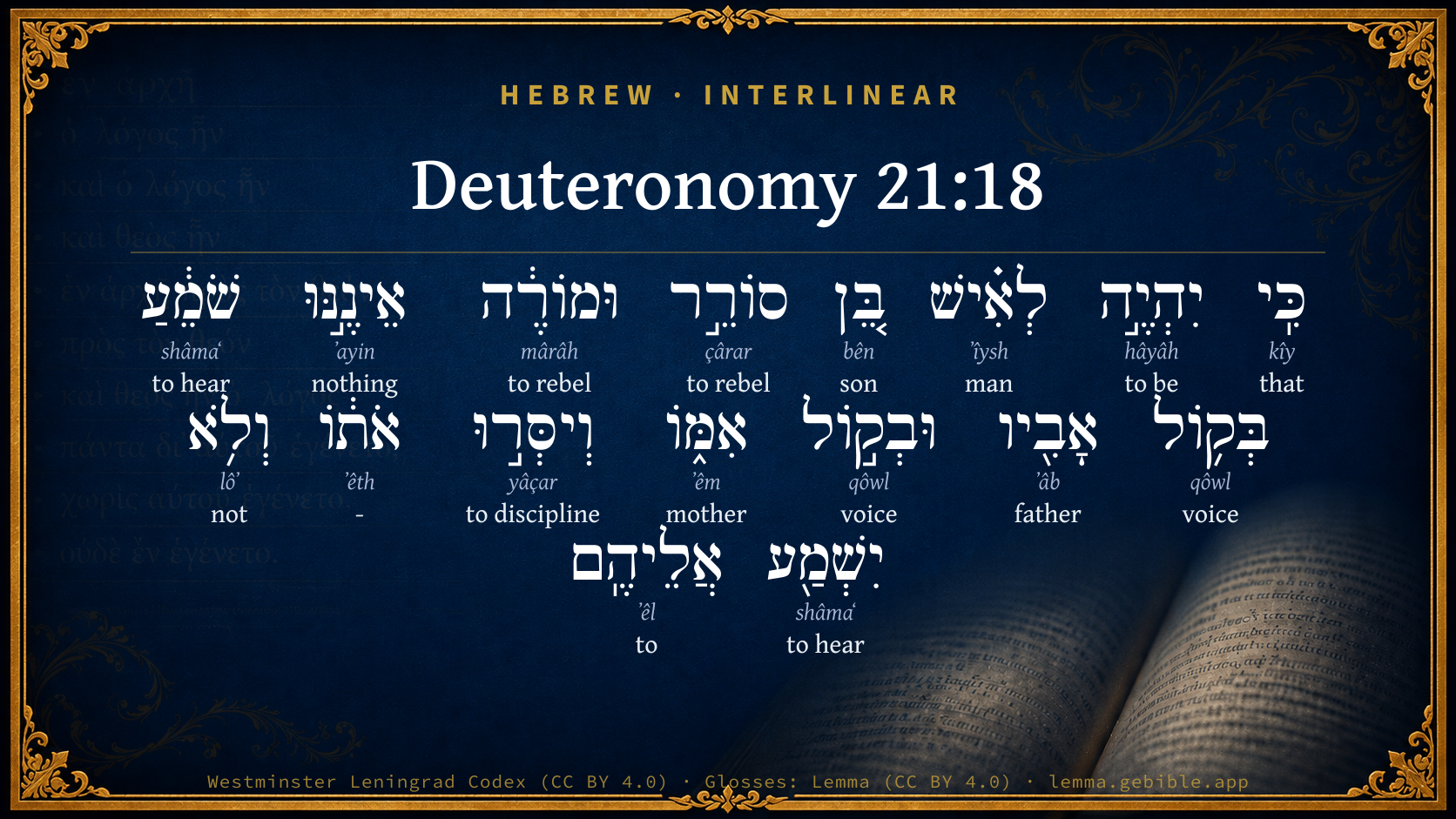
Deuteronomy 21:18

Hebrew (Westminster Leningrad Codex) Deuteronomy 21:18 appears in the Hebrew Old Testament. The text above is from the Westminster Leningrad Codex. Each word links to its Strong’s number, a concise gloss, and parsing drawn from the Open Scriptures Hebrew Bible morphology. Click any word for its full Brown-Driver-Briggs (BDB) entry.
Download image
Cite this verse

Deuteronomy 21:18 (World English Bible). Public Domain. Lemma interlinear Bible study tool, https://lemma.gebible.app/v/deuteronomy/21/18.

Show BibTeX & RIS
BibTeX
RIS
English Translation
If a man have a stubborn and rebellious son, who will not obey the voice of his father, or the voice of his mother, and, though they chasten him, will not listen to them;
World English Bible · Public Domain
Highlights
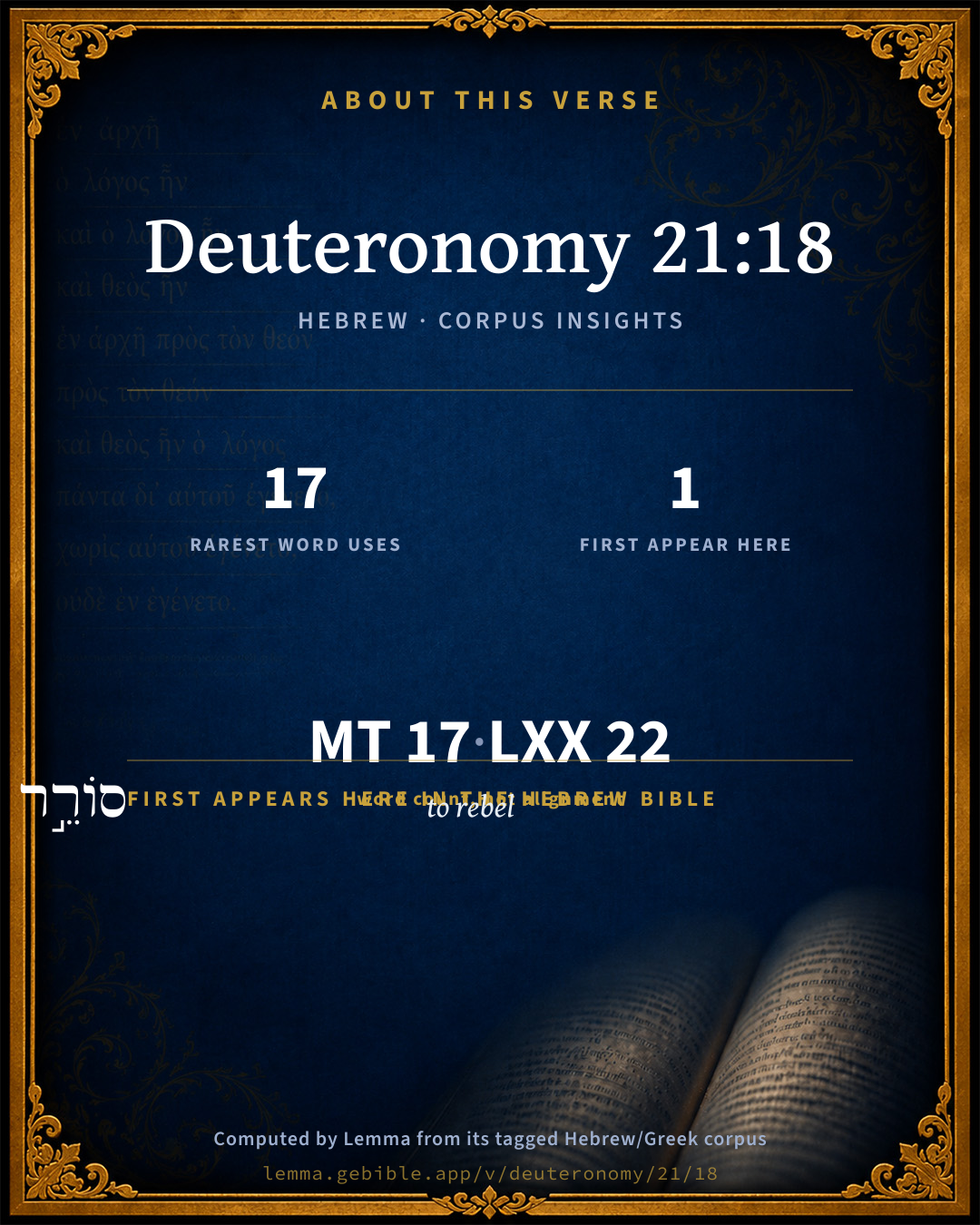
  • 1 first appearance in the Hebrew Bible
Full analysis ↓
Download a study sheet

One document with this verse’s original text, its word-by-word gloss line, the meaning frame, cross-references with their text, attributed commentary, and full source and license credits — printable, and it pastes into notes with its structure intact.

This verse Autodidact and up

Study sheet (.html) Plain text (.txt)

A passage Seminary Student

Up to 50 verses in one chapter. A passage sheet keeps up to 6 commentary sources and 12 cross-references per verse, in the order this page ranks them, and says so on the sheet whenever that leaves anything out. Ask for a single verse and you get the Autodidact verse sheet above.

Everything on this page stays free to read, with no account — the sheet is a download of what is already on screen, not access to it.

Want to remove ads? Support Godless Engineer
Compare translations 3

The same verse in 3 English versions, stacked beneath the original-language interlinear above. Click any original word for its lexicon entry.

Each is an independent rendering of the whole verse — the interlinear is not word-aligned to these translations.

Highlighted words mark where these versions differ — a whole-verse word diff, not a word-by-word alignment.

  • World English Bible Public Domain
    If a man have a stubborn and rebellious son, who will not obey the voice of his father, or the voice of his mother, and, though they chasten him, will not listen to them;
  • King James Version Public Domain
    If a man have a stubborn and rebellious son, which will not obey the voice of his father, or the voice of his mother, and that, when they have chastened him, will not hearken unto them:
  • unfoldingWord Literal Text CC BY-SA 4.0
    If a man has a stubborn and rebellious son who will not listen to the voice of his father or the voice of his mother, and they chastise him, but he will not listen to them,

unfoldingWord Literal Text — © unfoldingWord, licensed CC BY-SA 4.0. Word-aligned USFM3 via Door43 (git.door43.org/unfoldingWord/en_ult).

Versions to compare (up to 4)

3 of 4 selected

Show all 18 translations

Every available English version of this verse, each an independent rendering of the whole verse.

  • World English Bible Public Domain
    If a man have a stubborn and rebellious son, who will not obey the voice of his father, or the voice of his mother, and, though they chasten him, will not listen to them;
  • Berean Standard Bible Public Domain
    If a man has a stubborn and rebellious son who does not obey his father and mother and does not listen to them when disciplined,
  • Majority Standard Bible Public Domain
    If a man has a stubborn and rebellious son who does not obey his father and mother and does not listen to them when disciplined,
  • King James Version Public Domain
    If a man have a stubborn and rebellious son, which will not obey the voice of his father, or the voice of his mother, and that, when they have chastened him, will not hearken unto them:
  • American Standard Version (1901) Public Domain
    If a man have a stubborn and rebellious son, that will not obey the voice of his father, or the voice of his mother, and, though they chasten him, will not hearken unto them;
  • Revised Version (1885) Public Domain
    If a man have a stubborn and rebellious son, which will not obey the voice of his father, or the voice of his mother, and though they chasten him, will not hearken unto them:
  • Geneva Bible (1599) Public Domain
    If any man haue a sonne that is stubburne and disobedient, which wil not hearken vnto the voice of his father, nor the voyce of his mother, and they haue chastened him, and he would not obey them,
  • Douay-Rheims (1899) Public Domain
    If a man have a stubborn and unruly son, who will not hear the commandments of his father or mother, and being corrected, slighteth obedience:
  • Young's Literal Translation Public Domain
    `When a man hath a son apostatizing and rebellious -- he is not hearkening to the voice of his father, and to the voice of his mother, and they have chastised him, and he doth not hearken unto them --
  • Literal Standard Version CC BY-SA 4.0
    When a man has a son apostatizing and being rebellious—he is not listening to the voice of his father and to the voice of his mother, and they have disciplined him, and he does not listen to them—
  • Unlocked Literal Bible CC BY-SA 4.0
    If a man has a stubborn and rebellious son who will not obey the voice of his father or the voice of his mother, and who, even though they correct him, will not listen to them;
  • unfoldingWord Literal Text CC BY-SA 4.0
    If a man has a stubborn and rebellious son who will not listen to the voice of his father or the voice of his mother, and they chastise him, but he will not listen to them,
  • Darby Bible Public Domain
    If a man have an unmanageable and rebellious son, who hearkeneth not unto the voice of his father, nor unto the voice of his mother, and they have chastened him, but he hearkeneth not unto them;
  • World Messianic Bible Public Domain
    If a man has a stubborn and rebellious son who will not obey the voice of his father or the voice of his mother, and though they chasten him, will not listen to them,
  • Webster's Bible Public Domain
    If a man shall have a stubborn and rebellious son, who will not obey the voice of his father, or the voice of his mother, and who, when they have chastened him, will not hearken to them:
  • Free Bible Version CC BY-SA 4.0
    If someone has an obstinate and rebellious son who doesn't obey his parents and doesn't obey them even when he's punished,
  • Bible in Basic English Public Domain
    If a man has a son who is hard-hearted and uncontrolled, who gives no attention to the voice of his father and mother, and will not be ruled by them, though they give him punishment:
  • JPS Tanakh (1917) Public Domain
    If a man have a stubborn and rebellious son, that will not hearken to the voice of his father, or the voice of his mother, and though they chasten him, will not hearken unto them;

Literal Standard Version (2020), Covenant Press — licensed CC BY-SA 4.0. Text via the HelloAO Bible API (eBible.org). Unlocked Literal Bible (unfoldingWord) — licensed CC BY-SA 4.0. Text via the HelloAO Bible API (eBible.org). unfoldingWord Literal Text — © unfoldingWord, licensed CC BY-SA 4.0. Word-aligned USFM3 via Door43 (git.door43.org/unfoldingWord/en_ult). Free Bible Version, Dr. Jonathan Gallagher — licensed CC BY-SA 4.0. Text via the HelloAO Bible API (eBible.org).

Word by word

More ways to search: Search by grammar → Find every occurrence → Compare this word →

Practice this passage: Drill this verse → Learn its vocabulary →

סוֹרֵ֣ר
çârar
H5637
“rebelling”
Verb, Qal, Participle Active, Masculine, Singular, Absolute
Part of Speech
Verb
Stem
Qal
Form
Participle Active
Gender
Masculine
Number
Singular
State
Absolute
Full BDB Definition

Origin: a primitive root

TWOT: 1549

to rebel, be stubborn, be rebellious, be refractory - (Qal) - to be stubborn - stubborn, rebel (substantive)
  1. כִּֽי kîy H3588 “that” Conjunction
  2. יִהְיֶ֣ה hâyâh H1961 “to be” Verb, Qal, Imperfect, 3rd Person, Masculine, Singular
  3. לְאִ֗ישׁ ʼîysh H376 “to/for · man” Preposition + Noun, Common, Masculine, Singular, Absolute
  4. בֵּ֚ן bên H1121 “son” Noun, Common, Masculine, Singular, Absolute
  5. וּמוֹרֶ֔ה mârâh H4784 “and · rebelling” Conjunction + Verb, Qal, Participle Active, Masculine, Singular, Absolute
  6. אֵינֶ֣נּוּ ʼayin H369 “nothing · him” Particle, Negative + Suffix, Personal, 3rd Person, Masculine, Singular
  7. שֹׁמֵ֔עַ shâmaʻ H8085 “hearing” Verb, Qal, Participle Active, Masculine, Singular, Absolute
  8. בְּק֥וֹל qôwl H6963 “in/at · voice of” Preposition + Noun, Common, Masculine, Singular, Construct
  9. אָבִ֖יו ʼâb H1 “father · his” Noun, Common, Masculine, Singular, Construct + Suffix, Personal, 3rd Person, Masculine, Singular
  10. וּבְק֣וֹל qôwl H6963 “and · in/at · voice of” Conjunction + Preposition + Noun, Common, Masculine, Singular, Construct
  11. אִמּ֑וֹ ʼêm H517 “mother · his” Noun, Common, Feminine, Singular, Construct + Suffix, Personal, 3rd Person, Masculine, Singular
  12. וְיסְּר֣וּ yâçar H3256 “and · to discipline” Conjunction + Verb, Piel, Sequential Perfect, 3rd Person, Common, Plural
  13. אֹת֔וֹ ʼêth H853 “- · him” Particle, Direct Object + Suffix, Personal, 3rd Person, Masculine, Singular
  14. וְלֹ֥א lôʼ H3808 “and · not” Conjunction + Particle, Negative
  15. יִשְׁמַ֖ע shâmaʻ H8085 “to hear” Verb, Qal, Imperfect, 3rd Person, Masculine, Singular
  16. אֲלֵיהֶֽם ʼêl H413 “to · them” Preposition + Suffix, Personal, 3rd Person, Masculine, Plural

About this verse

These counts appear in no published source. They are computed here, from the morphology-tagged text and Lemma’s own curated glosses. What Lemma adds →

17
words
15
distinct lemmas
Pentateuch
section

Notable vocabulary

The rarest word here is סוֹרֵ֣ר to rebel H5637 — appearing just 17 times in the whole Hebrew Bible.

First appearance in Scripture

This word makes its first canonical appearance in the Hebrew Bible here:

  • סוֹרֵ֣ר to rebel H5637

Shared distinctive vocabulary

סוֹרֵ֣ר to rebel H5637 occurs in 16 verses of the Hebrew Bible. Also found in:

Grammatical profile

  • 6 verbs
  • 6 nouns
  • 1 preposition
  • 1 conjunction
  • 3 particles

Verb forms

  • יִהְיֶ֣ה Qal · Imperfect
  • סוֹרֵ֣ר Qal · Participle Active
  • וּמוֹרֶ֔ה Qal · Participle Active
  • שֹׁמֵ֔עַ Qal · Participle Active
  • וְיסְּר֣וּ Piel · Sequential Perfect
  • יִשְׁמַ֖ע Qal · Imperfect

Repetition

Words recur within this verse — often emphatic in Hebrew:

  • שֹׁמֵ֔עַ to hear H8085 ×2
  • בְּק֥וֹל voice H6963 ×2

Hebrew & Septuagint length

In English translation the verse runs 34 words from the Hebrew and 37 from the Septuagint (LXX English) — closely comparable.

A rough comparison of the two English renderings, which tokenize alike — not a word-level alignment.

Word counts can differ between the Hebrew and the Greek without any difference in meaning — e.g. the Hebrew direct-object marker אֵת has no separate Greek word, and Greek often adds the article ὁ.

In the original languages it is 17 Hebrew tokens and 22 Greek tokens — but the two are counted differently (Hebrew bundles its prefixes and suffixes into one token; the Greek is in lemma form), so that isn’t a like-for-like length.

Cross-references

28

Topical passages linked to Deuteronomy 21:18 in the Treasury of Scripture Knowledge — connected by theme and wording, ordered by reader-vote popularity; previews shown in the World English Bible.

  • Exodus 20:12 "Honor your father and your mother, that your days may be long in the land which Yahweh your God gives you.
  • Leviticus 19:3 "'Each one of you shall respect his mother and his father. You shall keep my Sabbaths. I am Yahweh your God.
  • Amos 4:11–12 "I have overthrown some of you, As when God overthrew Sodom and Gomorrah, And you were like a burning stick plucked out of the fire; Yet you haven't returned to me," says Yahweh.
  • Hebrews 12:9–11 Furthermore, we had the fathers of our flesh to chasten us, and we paid them respect. Shall we not much rather be in subjection to the Father of spirits, and live?
  • Proverbs 19:18 Discipline your son, for there is hope; Don't be a willing party to his death.
  • Proverbs 20:20 Whoever curses his father or his mother, His lamp shall be put out in blackness of darkness.
  • Proverbs 23:13–14 Don't withhold correction from a child. If you punish him with the rod, he will not die.
  • Proverbs 29:17 Correct your son, and he will give you peace; Yes, he will bring delight to your soul.
  • Proverbs 30:17 The eye that mocks at his father, And scorns obedience to his mother: The ravens of the valley shall pick it out, The young eagles shall eat it.
  • Isaiah 1:2 Hear, heavens, And listen, earth; for Yahweh has spoken: I have nourished and brought up children, And they have rebelled against me.
  • Isaiah 1:5 Why should you be beaten more, That you revolt more and more? The whole head is sick, And the whole heart faint.
  • Ephesians 6:1–3 Children, obey your parents in the Lord, for this is right.
  • Exodus 21:15 "Anyone who attacks his father or his mother shall be surely put to death.
  • Exodus 21:17 "Anyone who curses his father or his mother shall surely be put to death.
  • Leviticus 21:9 "'The daughter of any priest, if she profanes herself by playing the prostitute, she profanes her father: she shall be burned with fire.
  • Deuteronomy 8:5 You shall consider in your heart that as a man chastens his son, so Yahweh your God chastens you.
  • Deuteronomy 27:16 Cursed be he who sets light by his father or his mother. All the people shall say, Amen.
  • 2 Samuel 7:14 I will be his father, and he shall be my son: if he commit iniquity, I will chasten him with the rod of men, and with the stripes of the children of men;
  • Proverbs 1:8 My son, listen to your father's instruction, And don't forsake your mother's teaching:
  • Proverbs 13:24 One who spares the rod hates his son, But one who loves him is careful to discipline him.
  • Proverbs 15:5 A fool despises his father's correction, But he who heeds reproof shows prudence.
  • Proverbs 22:15 Folly is bound up in the heart of a child: The rod of discipline drives it far from him.
  • Proverbs 28:24 Whoever robs his father or his mother, and says, "It's not wrong." He is a partner with a destroyer.
  • Proverbs 30:11 There is a generation that curses their father, And doesn't bless their mother.
  • Jeremiah 5:3 O Yahweh, don't your eyes look on truth? you have stricken them, but they were not grieved; you have consumed them, but they have refused to receive correction: they have made their faces harder than a rock; they have refused to return.
  • Jeremiah 31:18 I have surely heard Ephraim bemoaning himself [thus], You have chastised me, and I was chastised, as a calf unaccustomed [to the yoke]: turn you me, and I shall be turned; for you are Yahweh my God.
  • Ezekiel 22:7 In you have they set light by father and mother; in the midst of you have they dealt by oppression with the foreigner; in you have they wronged the fatherless and the widow.
  • Ezekiel 24:13 In your filthiness is lewdness: because I have cleansed you and you weren't cleansed, you shall not be cleansed from your filthiness any more, until I have caused my wrath toward you to rest.

Cross-references courtesy of OpenBible.info (CC BY 4.0).

Hebrew and Greek witnesses Masoretic Hebrew ↔ Greek Septuagint

The same verse in the two great witnesses to the Old Testament, shown verse-for-verse.

These are two independent witnesses, not word-aligned to each other, and the Septuagint is shown in lemma (dictionary) form.

Hebrew Deuteronomy 21:18 Masoretic · Westminster Leningrad Codex

כִּֽי יִהְיֶ֣ה לְאִ֗ישׁ בֵּ֚ן סוֹרֵ֣ר וּמוֹרֶ֔ה אֵינֶ֣נּוּ שֹׁמֵ֔עַ בְּק֥וֹל אָבִ֖יו וּבְק֣וֹל אִמּ֑וֹ וְיסְּר֣וּ אֹת֔וֹ וְלֹ֥א יִשְׁמַ֖ע אֲלֵיהֶֽם

If a man have a stubborn and rebellious son, who will not obey the voice of his father, or the voice of his mother, and, though they chasten him, will not listen to them;

World English Bible · Public Domain

Greek LXX Deuteronomy 21:18 Septuagint · lemma form

ἐάν δέ τις εἰμί υἱός ἀπειθής καί ἐρεθιστὴς οὐ ὑποἀκούω φωνή πατήρ καί φωνή μήτηρ καί παιδεύω αὐτός καί μή εἰςἀκούω αὐτός

And if any man has a disobedient and contentious son, who hearkens not to the voice of his father and the voice of his mother, and they should correct him, and he should not listen to them;

LXX2012 (modern English Septuagint) · Public Domain

Hebrew: Westminster Leningrad Codex (CC BY 4.0). Greek: Septuagint (public domain); English from LXX2012 (modern English Septuagint) (Public Domain). How the Septuagint differs from the Hebrew →

Targum (Aramaic paraphrase)

2

The Targum is the ancient Jewish Aramaic paraphrase of the Hebrew Scriptures — an interpretive translation, not the Hebrew text itself. Onkelos (literal) and Pseudo-Jonathan (expansive) render the Torah, and Jonathan the Prophets. Coverage is partial: where no permissively-licensed English translation exists for a verse, only the Aramaic is shown. This is verse-level text, not a word-by-word alignment to the Hebrew.

  1. Targum Onkelos Torah (Genesis–Deuteronomy)
    אֲרֵי יְהֵי לִגְבַר בַּר סָטֵי וּמָרֵי לֵיתוֹהִי מְקַבַּל לְמֵימַר אֲבוּהִי וּלְמֵימַר אִמֵהּ וּמַלְפָן יָתֵהּ וְלָא יְקַבֵּל מִנְהוֹן

    (no public-domain English translation for this verse)

    Targum Onkelos — Aramaic: “Onkelos Genesis” (public domain); “Onkelos Exodus” (public domain); “Onkelos Leviticus” (public domain); “Onkelos Numbers” (public domain); “Onkelos Deuteronomy” (public domain). English: “Sefaria Community Translation” (CC0 1.0 (public-domain dedication)); “J.W. Etheridge. The Targums of Onkelos and Jonathan Ben Uzziel on the Pentateuch. London: Longmans, Green, 1862” (public domain). Text via Sefaria.

  2. Targum Pseudo-Jonathan Torah (Genesis–Deuteronomy)
    אֲרוּם יְהֵי לִגְבַר בִּיר סוּרְהֲבָן וּמְרוֹד דְּלֵיתוֹי מְקַבֵּל לְמֵימָר אָבוֹי וּלְמֵימְרָא דְאִמֵּיהּ וְיִכְסְנוּן יָתֵיהּ וְלָא מְקַבֵּל אוּלְפַן מִנְהוֹן

    If a man hath a son depraved and rebellious, who will not obey the word of his father or of his mother, and who, when they reprove him, will not receive admonition from them;

    Targum Pseudo-Jonathan — Aramaic: “Targum Jonathan on Genesis” (public domain); “Targum Jonathan on Exodus” (public domain); “Targum Jonathan on Leviticus” (public domain); “Targum Jonathan on Numbers” (public domain); “Targum Jonathan on Deuteronomy” (public domain). English: “The Targum of Jonathan ben Uzziel, trans. J. W. Etheridge, London, 1862” (public domain). Text via Sefaria.

Commentary

Notes on Deuteronomy 21:18 from classic Christian and Jewish commentators (each source and its license shown beneath its notes). The classic Christian expositions comment on the surrounding passage and are grouped to its opening verse, so a note may address several verses; the Jewish commentaries on the Tanakh (Rashi and others) are per-verse, so they appear only where the commentator wrote on this verse.

Lemma curates 59 commentaries, every one of them public domain or Creative Commons licensed, each selected and text-cleaned for this edition rather than reprinted as found. About our sources →

Matthew Henry's Commentary

Here is, I. A law for the punishing of a rebellious son. Having in the former law provided that parents should not deprive their children of their right, it was fit that it should next be provided that children withdraw not the honour and duty which are owing to their parents, for there is no partiality in the divine law. Observe,

1. How the criminal is here described. He is a stubborn and rebellious son, Deu 21:18. No child was to fare the worse for the weakness of his capacity, the slowness or dulness of his understanding, but for his wilfulness and obstinacy. If he carry himself proudly and insolently towards his parents, contemn their authority, slight their reproofs and admonitions, disobey the express commands they give him for his own good, hate to be reformed by the correction they give him, shame their family, grieve their hearts, waste their substance, and threaten to ruin their estate by riotous living - this is a stubborn and rebellious son. He is particularly supposed (Deu 21:20) to be a glutton or a drunkard. This intimates either, (1.) That these were sins which his parents did in a particular manner warn him against, and therefore that in these instances there was a plain evidence that he did not obey their voice. Lemuel had this charge from his mother, Pro 31:4. Note, In the education of children, great care should be taken to suppress all inclinations to drunkenness, and to keep them out of the way of temptations to it; in order hereunto they should be possessed betimes with a dread and detestation of that beastly sin, and taught betimes to deny themselves. Or, (2.) That his being a glutton and a drunkard was the cause of his insolence and obstinacy towards his parents. Note, There is nothing that draws men into all manner of wickedness, and hardens them in it, more certainly and fatally than drunkenness does. When men take to drink they forget the law, they forget all law (Pro 31:5), even that fundamental law of honouring parents.

2. How this criminal is to be proceeded against. His own father and mother are to be his prosecutors, Deu 21:19, Deu 21:20. They might not put him to death themselves, but they must complain of him to the elders of the city, and the complaint must needs be made with a sad heart: This our son is stubborn and rebellious. Note, Those that give up themselves to vice and wickedness, and will not be reclaimed, forfeit their interest in the natural affections of the nearest relations; the instruments of their being justly become the instruments of their destruction. The children that forget their duty must thank themselves and not blame their parents if they are regarded with less and less affection. And, how difficult soever tender parents now find it to reconcile themselves to the just punishment of their rebellious children, in the day of the revelation of the righteous judgment of God all natural affection will be so entirely swallowed up in divine love that they will acquiesce even in the condemnation of those children, because God will be therein for ever glorified.

3. What judgment is to be executed upon him: he must publicly stoned to death by the men of his city, Deu 21:21. And thus, (1.) The paternal authority was supported, and God, our common Father, showed himself jealous for it, it being one of the first and most ancient streams derived from him that is the fountain of all power. (2.) This law, if duly executed, would early destroy the wicked of the land. (Psa 101:8), and prevent the spreading of the gangrene, by cutting off the corrupt part betimes; for those that were bad members of families would never make good members of the commonwealth. (3.) It would strike an awe upon children, and frighten them into obedience to their parents, if they would not otherwise be brought to their duty and kept in it: All Israel shall hear. The Jews say, "The elders that condemned him were to send notice of it in writing all the nation over, In such a court, such a day, we stoned such a one, because he was a stubborn and rebellious son." And I have sometimes wished that as in all our courts there is an exact record kept of the condemnation of criminals, in perpetuam rei memoriam - that the memorial may never be lost, so there might be public and authentic notice given in print to the kingdom of such condemnations, and the executions upon them, by the elders themselves, in terrorem - that all may hear and fear.

II. A law for the burying of the bodies of malefactors that were hanged, Deu 21:22. The hanging of them by the neck till the body was dead was not used at all among the Jews, as with us; but of such as were stoned to death, if it were for blasphemy, or some other very execrable crime, it was usual, by order of the judges, to hang up the dead bodies upon a post for some time, as a spectacle to the world, to express the ignominy of the crime, and to strike the greater terror upon others, that they might not only hear and fear, but see and fear. Now it is here provided that, whatever time of the day they were thus hanged up, at sun-set they should be taken down and buried, and not left to hang out all night; sufficient (says the law) to such a man is this punishment; hitherto let it go, but no further. Let the malefactor and his crime be hidden in the grave. Now, 1. God would thus preserve the honour of human bodies and tenderness towards the worst of criminals. The time of exposing dead bodies thus is limited for the same reason that the number of stripes was limited by another law: Lest thy brother seem vile unto thee. Punishing beyond death God reserves to himself; as for man, there is no more that he can do. Whether therefore the hanging of malefactors in chains, and setting up their heads and quarters, be decent among Christians that look for the resurrection of the body, may perhaps be worth considering. 2. Yet it is plain there was something ceremonial in it; by the law of Moses the touch of a dead body was defiling, and therefore dead bodies must not be left hanging up in the country, because, by the same rule, this would defile the land. But, 3. There is one reason here given which has reference to Christ. He that is hanged is accursed of God, that is, it is the highest degree of disgrace and reproach that can be done to a man, and proclaims him under the curse of God as much as any external punishment can. Those that see him thus hang between heaven and earth will conclude him abandoned of both and unworthy of either; and therefore let him not hang all night, for that would carry it too far. Now the apostle, showing how Christ has redeemed us from the curse of the law by being himself made a curse for us, illustrates it by comparing the brand here put on him that was hanged on a tree with the death of Christ, Gal 3:13. Moses, by the Spirit, uses this phrase of being accursed of God, when he means no more than being treated most ignominiously, that it might afterwards be applied to the death of Christ, and might show that in it he underwent the curse of the law for us, which is a great enhancement of his love and a great encouragement to our faith in him. And (as the excellent bishop Patrick well observes) this passage is applied to the death of Christ, not only because he bore our sins and was exposed to shame, as these malefactors were that were accursed of God, but because he was in the evening taken down from the cursed tree and buried (and that by the particular care of the Jews, with an eye to this law, Joh 19:31), in token that now, the guilt being removed, the law was satisfied, as it was when the malefactor had hanged till sun-set; it demanded no more. Then he ceased to be a curse, and those that were his. And, as the land of Israel was pure and clean when the dead body was buried, so the church is washed and cleansed by the complete satisfaction which thus Christ made.

Matthew Henry's Commentary on the Whole Bible (1708–1710) — public domain (CC PDM 1.0). Text via the HelloAO Bible API.

Ellicott's Commentary for English Readers

Deu_21:18-21. THE INCORRIGIBLE SON.

(18) If a man have a stubborn and rebellious son.—Here we are again reminded that the Law of Jehovah was also the civil and criminal law of Israel. The systematic breach of the first commandment of the second table of the Law, no less than of the first commandment of the first table, entailed the penalty of death. Manifestly this enactment, if carried out, would be a great protection to the country against lawless and abandoned characters, and would rid it of one very large element in the dangerous classes.

(20) Stubborn and rebellious.—The Hebrew words became proverbial as the worst form of reproach, sôrêr û-môreh. This word môreh was the one employed by Moses, when, speaking “unadvisedly” (Num_20:10), he said to the people, “Hear now, ye rebels, must we fetch you water out of this rock?” It appears in the Revised New Testament, in the margin of St. Mat_5:22, for “thou fool.” But the Greek word there employed is true Greek, and has its own affinities in the New Testament. And the word môreh is true Hebrew. They may be idiomatically synonymous. They are not etymologically identical.

A glutton and a drunkard.—The same two words are found in Pro_23:20-22, “Be not among wine bibbers; among riotous eaters of flesh: For the drunkard and the glutton shall come to poverty: and drowsiness shall clothe a man with rags. Hearken unto thy father that begat thee; and despise not thy mother when she is old.” The context of this quotation seems to make it a distinct reference to the law in Deuteronomy 21

(21) Shall stone him with stones.—Rashi says that the Law cuts short the man’s career, anticipating what its close will be. When he has spent all his father’s money, he will take to the road, and become a public robber. It is better that he die innocent of such crimes than guilty. We can hardly adopt this view of the case; but it contains one feature that is terribly true.

A Bible Commentary for English Readers, edited by Charles John Ellicott (1878–1897) — public domain. Text from a community e-Sword module.

The Cambridge Bible for Schools and Colleges

gen. ed. J. J. S. Perowne

18. If a man have] See introd. to Deu_21:15-17.

stubborn and rebellious] Jer_5:23, Psa_78:8.

father or … mother] Mark the equality of the parents, as in the next v., the Fifth Comm. and in E, Exo_21:15; Exo_21:17; also in the Babylonian laws cited above.

chasten] see on Deu_8:5.

18–21. Of a Disobedient Son

If a man have a son, who, in spite of his parents’ rebuke, fails to obey them (Deu_21:18), they shall bring him forth to the gate, and state the case to the elders of the town (Deu_21:19 f.), and the townsmen shall stone him to death, so shall evil be put out of Israel and all take warning (21).—Except for the closing formula this law is not in the form of address to Israel, and the term for stoning is other than D’s. Therefore probably another of the laws incorporated by D.

The power of parents over their children (E, Exo_21:7, Gen_31:15), even to putting them to death, which prevailed in early Israel also to this degree (Gen_38:24; cp. Buhl, Soc. Verkältn. d. Isr. 29), as among the Greeks and Romans, is here enforced and controlled by public authority. See further introd. to previous law. Cp. Deu_27:16; E, Exo_21:15; Exo_21:17, H, Lev_20:9 (death for smiting or cursing parents); Pro_30:17, Code of Ḫammurabi § 195, and two Sumerian laws cited by Johns, op. cit. p. 41. For Herod’s abuse of this law see Josephus, xvi. Antt. xi. 2.

The Cambridge Bible for Schools and Colleges (gen. ed. J. J. S. Perowne; Cambridge University Press, 1878–1918) — public domain. Text from a community e-Sword module.

Whedon's Commentary on the Bible

Daniel D. Whedon

THE PUNISHMENT OF AN INCORRIGIBLE SON, Deu_21:18-21.

18. A stubborn and rebellious son — The directions given are intended to assert and also limit the authority of the parents. If the son was refractory — no longer obedient — provision was made for his punishment. From our point of view the law seems severe. But it must be borne in mind that in some ancient nations the power over the life of the child was absolutely in the father’s hand. Moses provides that both parents should consent to the infliction of the penalty, the matter having first been brought before the whole community. In the Gemara, Rabbi Simon is represented as saving that the law concerning a stubborn and rebellious son has never been, and never can be, practically applied.

Daniel D. Whedon (gen. ed.), Commentary on the Old and New Testaments (1874–1909) — public domain. Text from a community e-Sword module.

Geneva Bible (1599)

Geneva Bible translators

For it is the mother’s duty also to instruct her children.

Geneva Bible (1599) marginal notes — public domain. Text via Bolls.life.

Jamieson, Fausset & Brown

Robert Jamieson, A. R. Fausset & David Brown

If a man have a stubborn and rebellious son--A severe law was enacted in this case. But the consent of both parents was required as a prevention of any abuse of it; for it was reasonable to suppose that they would not both agree to a criminal information against their son except from absolute necessity, arising from his inveterate and hopeless wickedness; and, in that view, the law was wise and salutary, as such a person would be a pest and nuisance to society. The punishment was that to which blasphemers were doomed [Lev 24:23]; for parents are considered God's representatives and invested with a portion of his authority over their children.

Jamieson, Fausset & Brown — Commentary Critical and Explanatory on the Whole Bible (1871) — public domain (CC PDM 1.0). Text via the HelloAO Bible API.

Adam Clarke's Commentary

Verse 18. - 21. The stubborn, rebellious, gluttonous, and drunken son is to be stoned to death. - This law, severe as it may seem, must have acted as a powerful preventive of crime. If such a law were in force now, and duly executed, how many deaths of disobedient and profligate children would there be in all corners of the land!

Adam Clarke's Commentary on the Bible (1810–1826) — public domain. Text from a community e-Sword/MySword module.

John Gill's Exposition

If a man have a stubborn and rebellious son,.... It is observed (w) that this law quickly follows, and is subjoined to that which relates to the marriage of a woman taken captive, because often from such marriages wicked and refractory children have sprung, and which they exemplify in the case of Absalom, whose mother they say David took in war and married: the character of such a son follows, and by which it may be known that he is stubborn and rebellious; stubborn in his nature, and rebellious in his actions; behaves contrary to the laws of God, and the instructions of his parents; what he should do, that he does not; and what he should not do, that he does; will not do what is commanded him, and will do what is forbidden him, notwithstanding all counsels, admonitions, and corrections given him:

which will not obey the voice of his father, or the voice of his mother; is disobedient to the commands of either of them; see Pro 30:17 and, when they have chastened him, will not hearken to them; when they have reproved him by words, and corrected him with blows; the Jews understand this of scourging or beating by the order of the sanhedrim, after admonition given; it is said (x),"they admonish him before three (a court of judicature consisting of three judges), and they beat him; but it seems rather to respect private corrections of their own by words and stripes, which having no effect, they were to proceed as follows.''

(w) Moses Kotensis Mitzvot Torah, pr. affirm. 122. Kimchi in 2 Sam. 3. 3. (x) Misn. Sandedrin, c. 8. sect. 4.

John Gill's Exposition of the Whole Bible (1746–1763) — public domain (CC PDM 1.0). Text via the HelloAO Bible API.

Albert Barnes' Notes on the Bible

The formal accusation of parents against a child was to be received without inquiry, as being its own proof. Thus the just authority of the parents is recognized and effectually upheld (compare Exo 20:12; Exo 21:15, Exo 21:17; Lev 20:9); but the extreme and irresponsible power of life and death, conceded by the law of Rome and other pagan nations, is withheld from the Israelite father. In this, as in the last law, provision is made against the abuses of a necessary authority.

Albert Barnes' Notes on the Bible (1834–1885) — public domain. Text from a community e-Sword/MySword module.

Haydock's Catholic Bible Commentary

Son. The Rabbins do not look upon children as bound by the law, till they be 13 years old. Their faults, before that age, are imputed to the father, and he is to be punished for them. When, therefore, a son has attained the competent years, the father makes attestation of it in the presence of ten Jews, declaring that he has instructed his son in the commandments, customs of the nation, and daily prayers; and that he now sets him at liberty to answer, in future, for his own faults, praying that God would enable him to lead a virtuous life. (Calmet)

George Leo Haydock (1774–1849), Haydock's Catholic Family Bible and Commentary, 1859 edition — public domain. Excludes Psalms (Douay-Rheims chapter numbering differs from Protestant) and Deuterocanonical books (Catholic canon only).

The Pulpit Commentary

Vers. 18-21. If a son was refractory and unmanageable by his parents, if, given to sensual indulgence, he would yield neither to reproof nor to chastisement, the parents were to lay hold on him, and lead him to the ciders of the town, sitting as magistrates at its gates, and there accuse him of his evil ways and rebelliousness. The testimony of the parents was apparently held sufficient to substantiate the charge, and this being received by the elders, the culprit was to be put to death by stoning.

Vers. 18-21. A bad son a State peril.

This is a very remarkable provision. It is based on the well-known fact that there are some who need a strong deterrent to keep them from being a plague and peril to a State, and also on the all-important principle, that whoever is a pest and nuisance in the home, is the bane of the commonwealth to which he belongs. Moses had just laid down the duty of the parent to deal justly with his sons, whatever his personal partialities might be. He now lays down the extent and limits of parental authority over the son. He does not give the father the absolute power of life and death in reference to the child, as some ancient codes did, but, without abolishing that power altogether, he places such checks upon it that while, on the one hand, if a bad son became so outrageous that his life was putting others in peril through its poisonous influence, he would have before him the possibility of capital punishment; yet, on the other hand, this penalty could only be inflicted with the sanction of the elders of the city; the consent of both parents was required ere he could be brought before them; and they (the parents) were expected to be able to say that they had exhausted every known means of reclaiming him before they brought him to that tribunal. It is evident that the law is enacted with the intention of being so deterrent that it may never need to be put into execution. And thus indeed it seems to have proved. For there is no known instance in Jewish history of its having been carried out. Forming part, as it did, of an ancient civil code for the Hebrew nation only, it is not in force with us now, and we are not called upon to appreciate its real worth as a guard to the stability of the Hebrew nation. But here, as elsewhere, even in obsolete statutes, we discover permanent principles, which it behooves preachers to develop and enforce, if they would not "shun to declare the whole counsel of God." The truth here taught is thisA bad son is a State peril. Five lines of thought may with advantage be followed out here, with the view of impressing this truth upon the hearts of the people.

I A STATE IS WHAT ITS HOMES MAKE IT. It cannot be otherwise. It is made up of its own cities, towns, villages, and hamlets. Each one of these is made up of its homes. If they axe all good, little legislation will be required; if they are all bad, no legislation will avail, even if it could be secured. And according as the good or bad element preponderates, will a State be secure and prosperous or otherwise.

II AN INCORRIGIBLE SON IS THE BANE OF ANY HOME. It is not within our present province to illustrate or even take up the truth that it is extremely unlikely any son will become incorrigible, unless there is some grievous failure in duty on the part of the parents in not correcting him betimes, and in not keeping the reins in their own hands. It is, unhappily, too often true sons made themselves vile, and he restrained them not." But, however it may come about, the truth is the same, that where a son hearkens not to the voice of his father, and despises to obey his mother, there will be in any home in which such is the case, a source of deep sorrow and indescribable misery; there will be an example fraught with evil influence to the other members of the family. "One sickly sheep infects the flock.

III SUCH A HOME, SO POISONED, MAY BECOME A CENTER OF UNSPEAKABLE MISCHIEF. For the sons who act so mischievously in the house are, as a rule, those who wander far and wide in pursuit of forbidden pleasure, giving way to the lusts of the flesh, and to sins of the tongue, polluting others wherever they go. Thus a moral miasma, pestilential and even deadly, may be carried from street to street, and from town to town.

IV THOSE THUS POLLUTED WILL TAKE THE POISON TO OTHER HOMES, One home will infect others. Each infected home will spread the contagion. And so the evil will spread far and wide, not only in an arithmetical, but in a geometrical progression, till even in the course of one or two generations, it will assume a proportion which baffle all powers of calculation to formulate it, and a virulence which may defy the most powerful legislation to arrest it.

V HENCE THE VERY EXISTENCE OF SUCH A CENTER OF EVIL OUT OF WHICH SUCH COMPLICATED AND WIDESPREAD MISCHIEF MAY ARISE, IS A SOURCE OF GRAVE PERIL TO ANY COMMONWEALTH IN THE WORLD! It may not be seen nor even suspected when in germ. But germs of evil are fraught with all the evil of which they are the germs.

1. Learn how far-seeing are the provisions of this Mosaic law! What seems severity to the individual is really mercy to the nation. Preventive measures, though severe, may be most genuinely philanthropic.

2. Learn how great is the importance of wisdom and firmness in maintaining parental authority.

3. Learn the need of early habits of obedience to parents. An obedient son is a joy and honor to his parents, a credit to the home, an element of safety in a State. But "God never smiles on a boy that breaks his mother"s heart." So said Richard Knill. Finally: What we have said thus far is valid, even if this life were all. But if to this life we add on the next, and bethink us of the amazing issues projecting themselves from time into eternity, who can adequately set forth the importance of taking heed to those early steps on which depend the direction of this earthly life, when on it depends the weal or woe of the life which is to come?

Vers. 18-23. Parental authority enforced.

It is plain that parents are to deal with their children to the best of their ability: but in case a stubborn and rebellious son would not hearken to father or mother, would not appreciate chastisement, and had become a drunkard and glutton, then the parents were directed to bring the case before the elders of the city, and the impenitent, licentious son was to be taken away from the earth by public stoning. The public law was thus, in the last resort, to back up parental authority and to remove the "scapegrace.

I PARENTAL AUTHORITY IS TO BE EXERCISED TO THE UTMOST. Father and mother are both to do their best to save their son from being a public disgrace. They are to use the rod, to chasten him, if nothing milder will do. Only after they have prosecuted their parental authority to the last degree are they to seek the public officers.

II GLUTTONY AND DRUNKENNESS ARE TREATED AS CAPITAL OFFENCES UNDER THE THEOCRACY. They are incompatible with membership in God"s kingdom. Hence they are deemed worthy of death. Because they are not now so severely visited by public law does not imply that they are less heinous in God"s sight than they were then.

III IT MUST HAVE BEEN THE LAST RESORT WHEN PARENTS WOULD BRING FORTH THEIR SON FOR PUBLIC EXECUTION. What a wearying of love and patience there must have been before such a commandment as this would be carried out! The father and mother would bear long before they would bring themselves to make of their child a public infamy.

IV THE EXECUTION OF THE SCAPEGRACE WAS A SOLEMN DEDICATION OF HIM, BY IMPOSITION OF HANDS, TO DEATH BY STONING. Such a public disgrace must have had a very wholesome effect in deterring reckless children from self-abandonment. We do not hear of any instance of such an execution. Drunkenness and gluttony were not common crimes in Israel.

V IT WOULD SEEM THAT GIBBETING WAS ADDED TO THE STONING, TO EMPHASIZE STILL MORE THE DISGRACE IN SUCH CASES. When this was carried out, it was understood that the gibbeted person was taken down at sundown, so as not to defile the land, and was buried without delay. As accursed of God, the corpse was as soon as possible put out of sight into the tomb.

VI IT IS INSTRUCTIVE TO THINK OF JESUS CHRIST BEING EXPOSED TO JUST SUCH A PUBLIC INFAMY. He was made a curse for us. He was hanged on a tree, gibbeted as a malefactor. What love led him to place himself in such a position! The authorities took him, and in his Father"s and mother"s presence they did him to death, as if he bad been a disobedient and disgraceful Son. Thus did he deliver us from the curse of the Law. We receive honor because he accepted shame. The "holy Child Jesus" was nailed to the cross, was suspended on a tree, as if he were accursed of God. May we all profit by his voluntary humiliation, and imitate him as the holy, consecrated Child! R.M.E.

Vers. 18-21. The rebellious son.

A law of this kind, which left it to the parents themselves to impeach their disobedient son, while ordaining that, when the charge was proved against him, and it could be shown that the parents had duly corrected him, the offender should be put to death, would, we may believe, very rarely be enforced. In cases so aggravated that its enforcement was necessary, the penalty, judged by the usages and state of feeling of the time, would be thought anything but severe. The law, whether enforced or not, was a standing testimony to the enormity attaching in the eyes of God to the sin of filial disobedience. We learn

I INSUBORDINATION TO PARENTS IS A GRAVE OFFENCE AGAINST SOCIETY. It is treated here, not simply as a private wrong, but as a crime. Hebrew society rested so largely on the patriarchal basis that the due maintenance of parental authority was a necessity of its existence. The theocratic principle, according to which parents were invested with a peculiar sacredness as representatives of God, likewise called for the repression of incorrigible disobedience. But, whatever the form of social order, a spread of the spirit of insubordination to parents is the invariable prelude to a universal loosening of the ties and obligations of corporate existence. "It has been found," says Dr. Fleming, in his " Moral Philosophy," "in the history of all nations that the best security for the public welfare is a wise and happy exercise of parental authority; and one of the surest forerunners of national degradation and public anarchy and disorder is neglect or contempt of domestic happiness or rule.

II PARENTS ARE NOT ENTITLED TO COMPLAIN OF THE DISOBEDIENCE OF CHILDREN, SAVE WHERE THEIR OWN DUTIES TO THEIR CHILDREN HAVE BEEN FAITHFULLY DISCHARGED. TO secure a conviction, the parents had to show, not only that they had done their best to bring the son up in right ways, but that they had corrected him, and otherwise endeavored to reclaim him from his vices. Before parents are entitled to complain of the disobedience of children, they must have done their utmost

(1) by instruction,

(2) by admonition,

(3) by correction,

(4) by example,

(5) by a firm assertion of parental authority generally, to keep them from error.

Parents who neglect these duties have little cause to wonder at a son turning out ill; the wonder would be if he should turn out well. It is they, as much as the son, who deserve blame. Lesson: Compare with the behavior of this rebellious son our own treatment of our heavenly Father. J.O.

Vers. 18-21. A slippery path to ruin.

It is of the first importance that a child should begin life well. A twist in the young stem will develop into a gnarled and crooked tree. A slight divergence at the outset of a voyage may end in a complete reversal of the ship"s course. Early obedience is the pathway to a prosperous life; disobedience leads to death. The tongue that curseth its father shall be scorched with devouring flame.

I SELFISH INDULGENCE DESTROYS FILIAL REVERENCE. The human body is to be the servant of the mind. If the appetites and lusts of the body are allowed to rule, the mind becomes a slave, and all the better principles are manacled and enfeebled. We begin life as dependent children, and the fresh sense of loving obligation should be an antidote for selfishness. But if we set out in life with a resolve to please self, we are already on the way to ruin. Reverence for the parental character, and regard for parental authority, are the only solid foundations for a noble life. To feed unduly the body, and for gratification alone, is to starve the soul. Sensuality fosters self-will.

II REBELLION IN THE CHILD DESTROYS SONSHIP. Disregard of authority soon chokes and strangles filial feeling. The tie of sonship is snapped. The qualities and attributes of a son are wanting. There is a relationship of body, but no true relationship of soul. Alienation has sprung up instead of vital union. The lad may dwell under the old roof-tree, but in reality there is a great gulf between him and his parents: he is a descendant, but not a son. To be the children of God there must be resemblance of character.

III UNFRUITFUL CHASTISEMENT IS A TREMENDOUS CURSE. The medicine that does not do good, does harm. The flame that does not melt, hardens. Parental chastisement, when needed, is an imperative duty, but should be administered with wisdom, self-restraint, and pity. The obstinacy of the son is not infrequently due to the foolish leniency or unrestrained severity of the parent. Chastisement is a serious experiment, and always produces some effect, either favorable or unfavorable. We are not the same men after trial or pain that we were before.

IV THE STATE MUST SUPPORT PARENTAL AUTHORITY. SO valuable is human life that the State wisely claims the sole power of capital punishment. If the disciplines and chastisements of home have failed to produce a virtuous citizen, the whole community must deal with the incorrigible reprobate. The State cannot afford, for its safety"s sake, to allow a firebrand to be let loose in its midst. The example and influence of such a miscreant would be fatally mischievous. The whole State has vital interests to serve, and it would be sheerest folly to sacrifice them to a drunken madman.

V PERSISTENT REBELLION LEADS TO AN IGNOMINIOUS END. It must be a duty, the most painful for human nature to perform, to surrender a son to public execution. Yet it sometimes is a duty. The hope of amendment has been quenched. To continue such a one in life has become a bane to himself and to others. If all remedies have failed, destruction must ensue. All the men of the city shall put their hand to the deed. This may be done by personal service or by representation. The mad career of the culprit ends in pain, loss, and perpetual disgrace. It is a symbol of the great judgment doom. D.

The Pulpit Commentary (1880–1919), ed. H.D.M. Spence-Jones & Joseph S. Exell — public domain. Text from a community e-Sword module.

Keil & Delitzsch

C. F. Keil & F. Delitzsch

Punishment of a Refractory Son. - The laws upon this point aim not only at the defence, but also at the limitation, of parental authority. If any one's son was unmanageable and refractory, not hearkening to the voice of his parents, even when they chastised him, his father and mother were to take him and lead him out to the elders of the town into the gate of the place. The elders are not regarded here as judges in the strict sense of the word, but as magistrates, who had to uphold the parental authority, and administer the local police. The gate of the town was the forum, where the public affairs of the place were discussed (cf. Deu 22:15; Deu 25:7); as it is in the present day in Syria (Seetzen, R. ii. p. 88), and among the Moors (Hst, Nachrichten v. Marokkos, p. 239).

Keil & Delitzsch — Biblical Commentary on the Old Testament (1861–1891) — public domain (CC PDM 1.0). Text via the HelloAO Bible API. (Old Testament only.)

Kretzmann's Popular Commentary

Paul E. Kretzmann

Punishment of a Rebellious Child

v. 18. If a man have a stubborn and rebellious son, disputing the parental authority in disposition and deed, which will not obey the voice of his father or the voice of his mother, being incorrigibly disobedient and refractory, and that, when they have chastened him, have punished him according to the obligation resting upon them, will not hearken unto them,

v. 19. then shall his father-and his mother lay hold on him, and bring him out unto the elders of his city, to the magistrates who were charged with upholding authority and therefore also with backing up the parents in such a case, and unto the gate of his place, the open space inside the city gate, where all public affairs of this nature were decided;

v. 20. and they shall say unto the elders of his city, This our son is stubborn and rebellious, he will not obey our voice, calmly disregarding all commands; he is a glutton and a drunkard, a fact which explains his rebellious behavior.

v. 21. And all the men of his city, not the parents themselves, who had no power over life and death, shall stone him with stones that he die, the whole city agreeing that the case is clear beyond question; so shalt thou put evil away from among you; and all Israel shall hear and fear. Thus parental authority was upheld among the Israelites, but at the same time guarded. A good many modern parents, who have reached the opposite extreme, in permitting their children to tread all authority, both parental and civil, under foot, might learn from this passage the fact that God will not be mocked.

Paul E. Kretzmann, Popular Commentary of the Bible (1921–1924) — public domain. Text from a community e-Sword module.

unfoldingWord translationNotes

Door43 World Missions Community

General Information:

Moses continues speaking to the people of Israel.

who will not obey the voice of his father or the voice of his mother

Here "voice" is a metonym for what a person says. AT: "who will not obey what his father or mother say" (See: Metonymy)

they correct him

"they punish him for his wrongdoing" or "they train and instruct him"

must lay hold on him and bring him out

"must force him to come out"

translationWords

rebel

obey

voice

elder

gate

unfoldingWord translationNotes — © Distant Shores Media and the Door43 World Missions Community, licensed CC BY-SA 4.0. Source: git.door43.org/Door43/en_tn.

Rashi

Rabbi Shlomo Yitzchaki (Rashi)

סורר (from the root סור to deviate) means, one who deviates from the proper path of life.

ומורה means, one who is disobedient to the words of his father, of the same meaning as ממרים in the phrase (Deuteronomy 9:7) “ממרים הייתם”, “ye have been rebellious”.

ויסרו אתו AND THEY SHALL CHASTISE HIM — admonish him in the presence of three people, and if he still remains refractory they cause him to be lashed through the court (Sanhedrin 71a; cf. Sifrei Devarim 218:11). The refractory and rebellious son is not liable to the death penalty until he proves to be a thief and eats at one meal a “tartemar” (a weight of half a Maneh) flesh and drinks half a Log wine, for it is said of him, (v. 20) זולל וסבא, and in another passage (Proverbs 23:20) it says: “Do not be among wine-guzzlers (בְסֹבְאֵי-יָיִן), among gluttonous eaters of meat” (Sanhedrin 70a; cf. Sifrei Devarim 219:4). — The refractory and rebellious son is put to death on account of the final course his life must necessarily take (not because his present offence is deserving death); — the Torah has fathomed his ultimate disposition: in the end he will squander his fathers property and seeking in vain for the pleasures to which he has been accustomed, he will take his stand on the crossroads and rob people, and in some way or other make, himself liable to the death penalty. Says the Torah, “Let him die innocent of such crimes, and let him not die guilty of them” (Sifrei Devarim 220:3; Sanhedrin 72a).

Rashi on the Tanakh — English translations: “The Judaica Press complete Tanach with Rashi, translated by A. J. Rosenberg” (CC BY 4.0); “Pentateuch with Rashi's commentary by M. Rosenbaum and A.M. Silbermann, 1929-1934” (public domain); “The Metsudah Tanach series, Lakewood, N.J” (CC BY 4.0); and “The Book of Joshua, Metsudah Publications, 1997” (CC BY 4.0). Text via Sefaria.

Ramban (Nachmanides)

Rabbi Moshe ben Nachman (Ramban / Nachmanides)

A STUBBORN AND REBELLIOUS SON. In the opinion of our Rabbis he is not a minor, for a minor is not subject to any punishments ordained by the Torah or to [the observance of] any commandments. Rather, this verse applies to a boy who has grown two hairs [signifying puberty, and, therefore making the child subject to all the laws prescribed by the Torah]. Now, he is liable to two punishments: the first, because he dishonors his father and his mother and rebels against them, and the second, because he is a glutton, and a drunkard, transgressing that which we have been commanded, Ye shall be holy, and it is further stated, and Him shall ye serve, and unto Him shall ye cleave — as I have explained, 6:12. we are commanded to know G-d in all our ways, and a glutton, and a drunkard does not know the way of G-d. In general, then, as of now he [this stubborn and rebellious son] has not committed a sin punishable by death, but is judged because of [what he is destined to become in] the end, just as our Rabbis have mentioned. This is the sense of the expression, and all Israel shall hear, and fear, for he was not executed due to the greatness of his sin, but in order to discipline the public, and so that he not become a menace to others. It is the manner of Scripture so to warn that when the death-penalty is imposed as a deterrent, the execution should serve as a benefit to others. Thus it mentioned the same in the case of the rebellious elder [who defies the decision of the Great Sanhedrin — And all the people shall hear, and fear] because, in his decision [contradicting that of the court] there is no sin deserving of death, but [the death sentence being imposed only to] deter dissension from the Torah, as I have explained there., Verse 11. Similar is the case of plotting witnesses, 19:20: And those that remain shall hear, and fear. who are executed [for scheming to condemn someone to death] although they have not caused his execution., Verse 19. Scripture also mentions it in the case of the beguiler, 13:12: And all Israel shall hear, and fear. because he is executed merely for his evil speech even though the beguiled has not worshipped the idols, nor hearkened to him; his [the beguiler’s] death is rather to chasten the survivors. This, too, is a newly-declared commandment — or it may be explanatory of the commandments, Honor thy father and thy mother, and Ye shall fear every man his mother and his father.

Ramban (Nachmanides) on the Tanakh — English translation: “Commentary on the Torah by Ramban (Nachmanides). Translated and annotated by Charles B. Chavel. New York, Shilo Pub. House, 1971-1976” (CC BY 4.0). Text via Sefaria.

Ibn Ezra

Rabbi Abraham ibn Ezra

A wayward and rebellious son. Wayward against Hashem and rebellious against his parents, if they fear Hashem.

Rebellious. As in the verse, “For Yisroel is like a stubborn heifer”.

Though they chasten him. Before witnesses.

Ibn Ezra on the Tanakh — English translations: “Sefaria Community Translation” (CC0 1.0 (public-domain dedication)); “Yalkut, Sifsei Chachomim Chumash, Metsudah Publications, 2009” (CC BY 4.0); and “Commentary of Ibn Ezra on Isaiah - trans. by M. Friedlander, 1873” (public domain). Text via Sefaria.

Lesson kit

Teaching starters — assembled from the data on this page, not authored interpretation. Every prompt links to the verse data it draws on. Edit before teaching.

Deuteronomy, in the Pentateuch, opens this verse with 17 words (15 distinct Hebrew lemmas). Its most distinctive word is çârar (“to rebel”). A historical commentator’s framing appears above. Read the whole chapter for the surrounding context.

Discussion questions

  1. How does “to rebel” (çârar) shape what this verse is saying?
  2. This is the first place “to rebel” appears in Scripture (first appears here). What does its debut here establish?
  3. How does Deuteronomy 21:20, which shares the word «to rebel», read alongside this verse?
  4. What does the repetition of “to hear” (2× in this one verse) do in this verse?
  5. These translations render this verse differently; the difference is in the English rendering, not the original. What questions does that raise?
  6. «יִהְיֶ֣ה» is a Qal Imperfect verb. How does that grammatical form shape the action described?
  7. Compare how Matthew Henry's Commentary and Ellicott's Commentary for English Readers read this verse. Where do they agree or differ?

Things to notice

Reading settings

Reading text

Shown beneath each verse's original-language words.

Old Testament
Old Testament edition

Read the OT as the Masoretic Hebrew (MT) or the Greek Septuagint (LXX).

English shown for the Greek Septuagint (in the Hebrew ↔ Greek comparison).

Comparing translations? Open the Compare panel on any verse page to stack up to four side by side.