
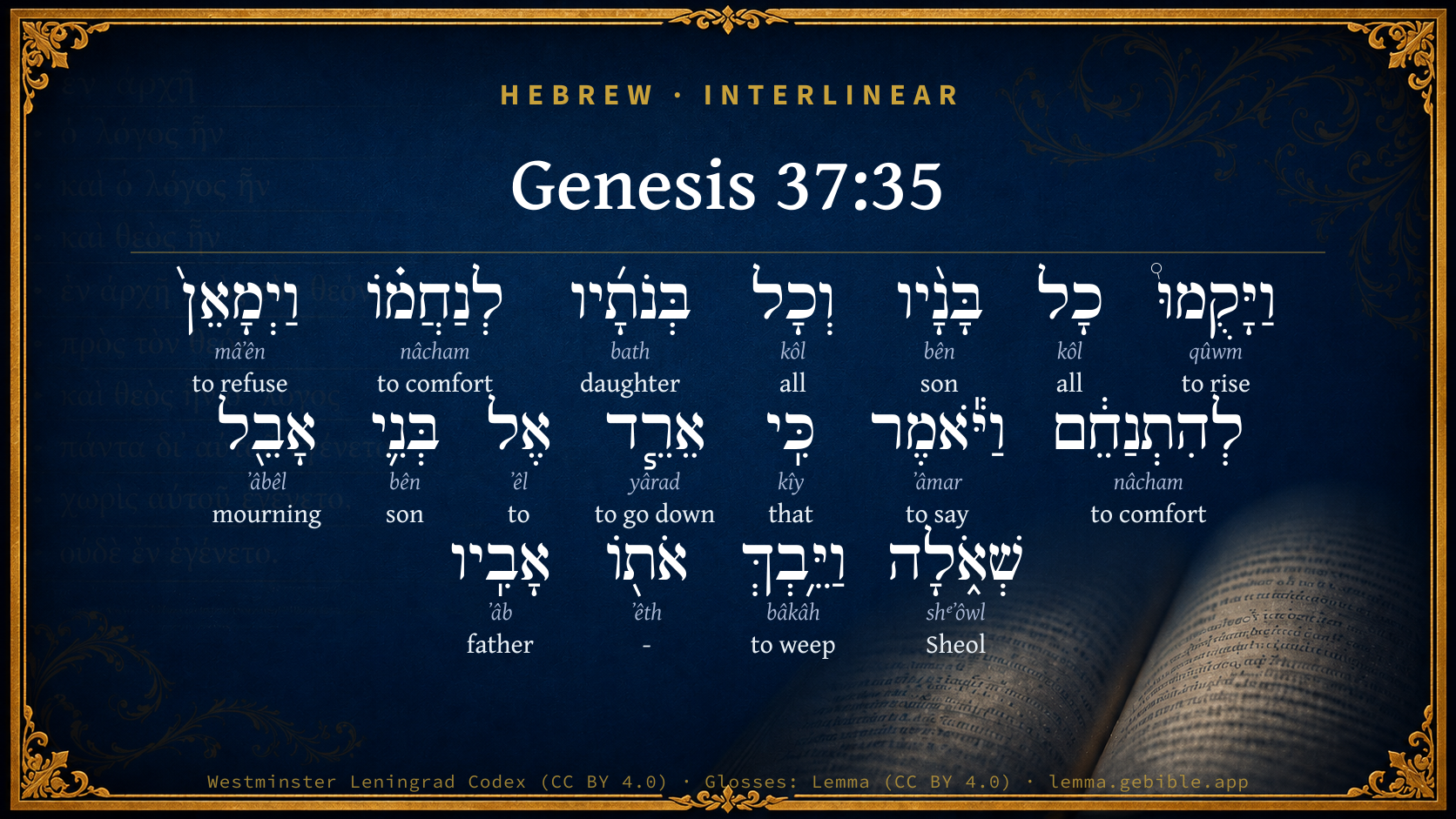
Genesis 37:35

Hebrew (Westminster Leningrad Codex) Genesis 37:35 appears in the Hebrew Old Testament. The text above is from the Westminster Leningrad Codex. Each word links to its Strong’s number, a concise gloss, and parsing drawn from the Open Scriptures Hebrew Bible morphology. Click any word for its full Brown-Driver-Briggs (BDB) entry.
Download image
Cite this verse

Genesis 37:35 (World English Bible). Public Domain. Lemma interlinear Bible study tool, https://lemma.gebible.app/v/genesis/37/35.

Show BibTeX & RIS
BibTeX
RIS
English Translation
All his sons and all his daughters rose up to comfort him; but he refused to be comforted. He said, "For I will go down to Sheol to my son mourning." His father wept for him.
World English Bible · Public Domain
Highlights Full analysis ↓
Download a study sheet

One document with this verse’s original text, its word-by-word gloss line, the meaning frame, cross-references with their text, attributed commentary, and full source and license credits — printable, and it pastes into notes with its structure intact.

This verse Autodidact and up

Study sheet (.html) Plain text (.txt)

A passage Seminary Student

Up to 50 verses in one chapter. A passage sheet keeps up to 6 commentary sources and 12 cross-references per verse, in the order this page ranks them, and says so on the sheet whenever that leaves anything out. Ask for a single verse and you get the Autodidact verse sheet above.

Everything on this page stays free to read, with no account — the sheet is a download of what is already on screen, not access to it.

Want to remove ads? Support Godless Engineer
Compare translations 3

The same verse in 3 English versions, stacked beneath the original-language interlinear above. Click any original word for its lexicon entry.

Each is an independent rendering of the whole verse — the interlinear is not word-aligned to these translations.

Highlighted words mark where these versions differ — a whole-verse word diff, not a word-by-word alignment.

  • World English Bible Public Domain
    All his sons and all his daughters rose up to comfort him; but he refused to be comforted. He said, "For I will go down to Sheol to my son mourning." His father wept for him.
  • King James Version Public Domain
    And all his sons and all his daughters rose up to comfort him; but he refused to be comforted; and he said, For I will go down into the grave unto my son mourning. Thus his father wept for him.
  • unfoldingWord Literal Text CC BY-SA 4.0
    And all his sons and all his daughters got up to comfort him, but he refused to be comforted and said, “For I will go down to my son in Sheol mourning.” So his father wept for him.

unfoldingWord Literal Text — © unfoldingWord, licensed CC BY-SA 4.0. Word-aligned USFM3 via Door43 (git.door43.org/unfoldingWord/en_ult).

Versions to compare (up to 4)

3 of 4 selected

Show all 18 translations

Every available English version of this verse, each an independent rendering of the whole verse.

  • World English Bible Public Domain
    All his sons and all his daughters rose up to comfort him; but he refused to be comforted. He said, "For I will go down to Sheol to my son mourning." His father wept for him.
  • Berean Standard Bible Public Domain
    All his sons and daughters tried to comfort him, but he refused to be comforted. “No,” he said. “I will go down to Sheol mourning for my son.” So his father wept for him.
  • Majority Standard Bible Public Domain
    All his sons and daughters tried to comfort him, but he refused to be comforted. “No,” he said. “I will go down to Sheol mourning for my son.” So his father wept for him.
  • King James Version Public Domain
    And all his sons and all his daughters rose up to comfort him; but he refused to be comforted; and he said, For I will go down into the grave unto my son mourning. Thus his father wept for him.
  • American Standard Version (1901) Public Domain
    And all his sons and all his daughters rose up to comfort him; but he refused to be comforted; and he said, For I will go down to Sheol to my son mourning. And his father wept for him.
  • Revised Version (1885) Public Domain
    And all his sons and all his daughters rose up to comfort him; but he refused to be comforted; and he said, For I will go down to the grave to my son mourning. And his father wept for him.
  • Geneva Bible (1599) Public Domain
    Then all his sonnes and all his daughters rose vp to comfort him, but he woulde not be comforted, but said, Surely I will go downe into the graue vnto my sonne mourning: so his father wept for him.
  • Douay-Rheims (1899) Public Domain
    And alibis children being gathered together to comfort their father in his sorrow, he would not receive comfort, but said: I will go down to my son into hell, mourning. And whilst he continued weeping,
  • Young's Literal Translation Public Domain
    and all his sons and all his daughters rise to comfort him, and he refuseth to comfort himself, and saith, `For -- I go down mourning unto my son, to Sheol,' and his father weepeth for him.
  • Literal Standard Version CC BY-SA 4.0
    and all his sons and all his daughters rise to comfort him, and he refuses to comfort himself, and says, “For I go down to my son mourning, to Sheol,” and his father weeps for him.
  • Unlocked Literal Bible CC BY-SA 4.0
    All his sons and daughters rose up to comfort him, but he refused to be comforted. He said, “Indeed I will go down to Sheol mourning for my son.” His father wept for him.
  • unfoldingWord Literal Text CC BY-SA 4.0
    And all his sons and all his daughters got up to comfort him, but he refused to be comforted and said, “For I will go down to my son in Sheol mourning.” So his father wept for him.
  • Darby Bible Public Domain
    And all his sons and all his daughters rose up to comfort him, but he refused to be comforted, and said, For I will go down to my son into Sheol mourning. Thus his father wept for him.
  • World Messianic Bible Public Domain
    All his sons and all his daughters rose up to comfort him, but he refused to be comforted. He said, “For I will go down to Sheol to my son, mourning.” His father wept for him.
  • Webster's Bible Public Domain
    And all his sons and all his daughters rose up to comfort him; but he refused to be comforted; and he said, For I will go down into the grave to my son mourning: Thus his father wept for him.
  • Free Bible Version CC BY-SA 4.0
    All his sons and daughters tried to console him, but he rejected their attempts. “No,” he said, “I will go down into my grave mourning for my son.” So Joseph's father went on weeping for him.
  • Bible in Basic English Public Domain
    And all his sons and all his daughters came to give him comfort, but he would not be comforted, saying with weeping, I will go down to the underworld to my son. So great was his father's sorrow for him.
  • JPS Tanakh (1917) Public Domain
    And all his sons and all his daughters rose up to comfort him; but he refused to be comforted; and he said: 'Nay, but I will go down to the grave to my son mourning.' And his father wept for him.

Literal Standard Version (2020), Covenant Press — licensed CC BY-SA 4.0. Text via the HelloAO Bible API (eBible.org). Unlocked Literal Bible (unfoldingWord) — licensed CC BY-SA 4.0. Text via the HelloAO Bible API (eBible.org). unfoldingWord Literal Text — © unfoldingWord, licensed CC BY-SA 4.0. Word-aligned USFM3 via Door43 (git.door43.org/unfoldingWord/en_ult). Free Bible Version, Dr. Jonathan Gallagher — licensed CC BY-SA 4.0. Text via the HelloAO Bible API (eBible.org).

Word by word

More ways to search: Search by grammar → Find every occurrence → Compare this word →

Practice this passage: Drill this verse → Learn its vocabulary →

אָבֵ֖ל
ʼâbêl
H57
“mourning”
Adjective, Adjective, Masculine, Singular, Absolute
Part of Speech
Adjective
Type
Adjective
Gender
Masculine
Number
Singular
State
Absolute
Full BDB Definition

Origin: from H56

TWOT: 6b

mourning - for the dead - because of calamity - of rites of mourning - mourner (substantive) - for the dead - for calamity
  1. וַיָּקֻמוּ֩ qûwm H6965 “and · to rise” Conjunction + Verb, Qal, Sequential Imperfect, 3rd Person, Masculine, Plural
  2. כָל kôl H3605 “all of” Noun, Common, Masculine, Singular, Construct
  3. בָּנָ֨יו bên H1121 “sons · his” Noun, Common, Masculine, Plural, Construct + Suffix, Personal, 3rd Person, Masculine, Singular
  4. וְכָל kôl H3605 “and · all of” Conjunction + Noun, Common, Masculine, Singular, Construct
  5. בְּנֹתָ֜יו bath H1323 “daughters · his” Noun, Common, Feminine, Plural, Construct + Suffix, Personal, 3rd Person, Masculine, Singular
  6. לְנַחֲמ֗וֹ nâcham H5162 “to comfort · him” Preposition + Verb, Piel, Infinitive Construct + Suffix, Personal, 3rd Person, Masculine, Singular
  7. וַיְמָאֵן֙ mâʼên H3985 “and · to refuse” Conjunction + Verb, Piel, Sequential Imperfect, 3rd Person, Masculine, Singular
  8. לְהִתְנַחֵ֔ם nâcham H5162 “to comfort” Preposition + Verb, Hithpael, Infinitive Construct
  9. וַיֹּ֕אמֶר ʼâmar H559 “and · to say” Conjunction + Verb, Qal, Sequential Imperfect, 3rd Person, Masculine, Singular
  10. כִּֽי kîy H3588 “that” Conjunction
  11. אֵרֵ֧ד yârad H3381 “to go down” Verb, Qal, Imperfect, 1st Person, Common, Singular
  12. אֶל ʼêl H413 “to” Preposition
  13. בְּנִ֛י bên H1121 “son · my” Noun, Common, Masculine, Singular, Construct + Suffix, Personal, 1st Person, Common, Singular
  14. שְׁאֹ֑לָה shᵉʼôwl H7585 “Sheol · toward” Noun, Common, Masculine, Singular, Absolute + Suffix, Demonstrative
  15. וַיֵּ֥בְךְּ bâkâh H1058 “and · to weep” Conjunction + Verb, Qal, Sequential Imperfect, 3rd Person, Masculine, Singular
  16. אֹת֖וֹ ʼêth H853 “- · him” Particle, Direct Object + Suffix, Personal, 3rd Person, Masculine, Singular
  17. אָבִֽיו ʼâb H1 “father · his” Noun, Common, Masculine, Singular, Construct + Suffix, Personal, 3rd Person, Masculine, Singular

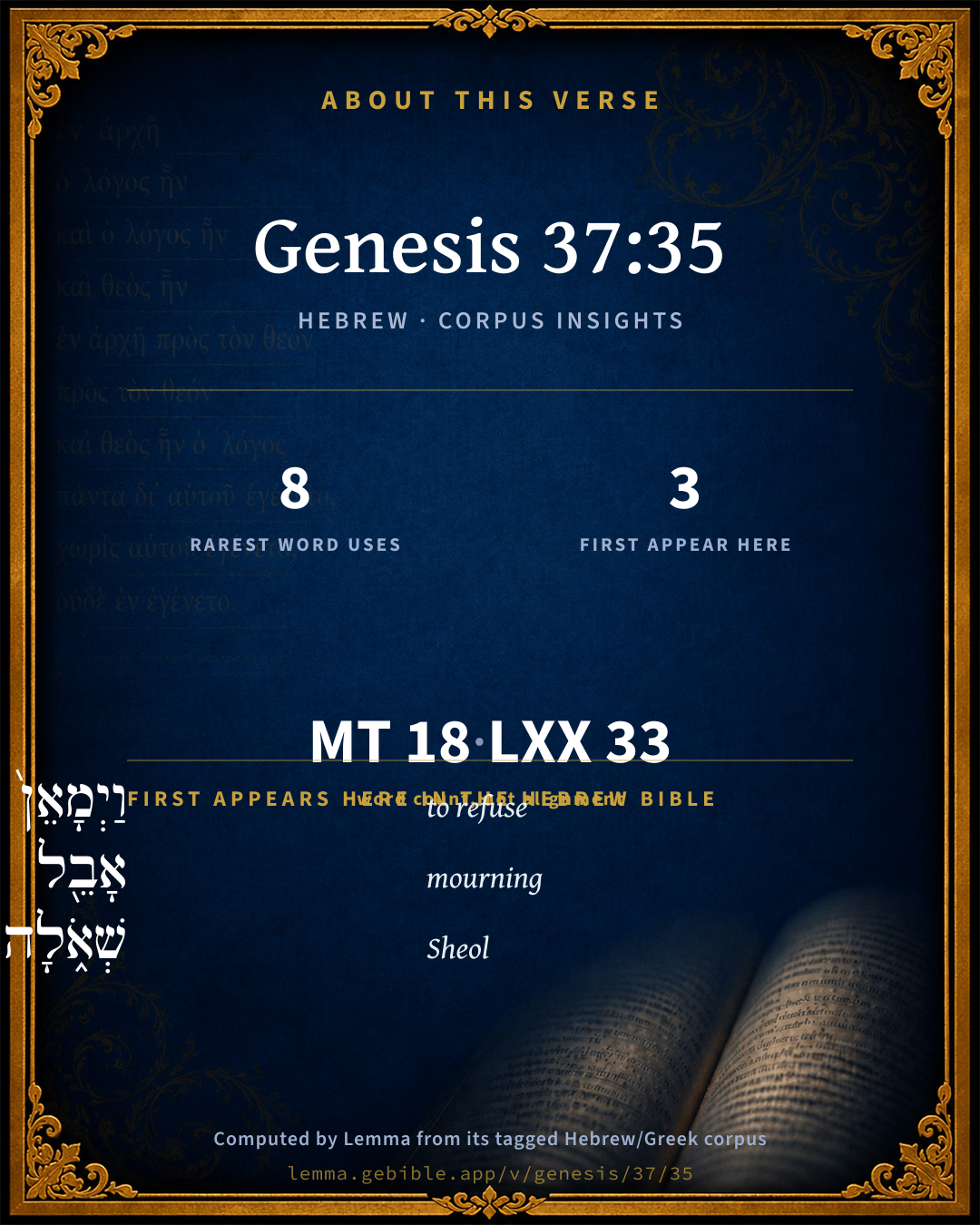
About this verse

These counts appear in no published source. They are computed here, from the morphology-tagged text and Lemma’s own curated glosses. What Lemma adds →

18
words
15
distinct lemmas
Pentateuch
section

Notable vocabulary

The rarest word here is אָבֵ֖ל mourning H57 — appearing just 8 times in the whole Hebrew Bible.

First appearance in Scripture

These words make their first canonical appearance in the Hebrew Bible here:

  • וַיְמָאֵן֙ to refuse H3985
  • אָבֵ֖ל mourning H57
  • שְׁאֹ֑לָה Sheol H7585

Shared distinctive vocabulary

אָבֵ֖ל mourning H57 occurs in 8 verses of the Hebrew Bible. Also found in:

Grammatical profile

  • 7 verbs
  • 7 nouns
  • 1 adjective
  • 1 preposition
  • 1 conjunction
  • 1 particle

Verb forms

  • וַיָּקֻמוּ֩ Qal · Sequential Imperfect
  • לְנַחֲמ֗וֹ Piel · Infinitive Construct
  • וַיְמָאֵן֙ Piel · Sequential Imperfect
  • לְהִתְנַחֵ֔ם Hithpael · Infinitive Construct
  • וַיֹּ֕אמֶר Qal · Sequential Imperfect
  • אֵרֵ֧ד Qal · Imperfect
  • וַיֵּ֥בְךְּ Qal · Sequential Imperfect

Repetition

Words recur within this verse — often emphatic in Hebrew:

  • כָל all H3605 ×2
  • בָּנָ֨יו son H1121 ×2
  • לְנַחֲמ֗וֹ to comfort H5162 ×2

Hebrew & Septuagint length

In English translation the verse runs 36 words from the Hebrew and 17 from the Septuagint (LXX English) — the Septuagint runs noticeably shorter here. See the side-by-side →

A rough comparison of the two English renderings, which tokenize alike — not a word-level alignment.

Word counts can differ between the Hebrew and the Greek without any difference in meaning — e.g. the Hebrew direct-object marker אֵת has no separate Greek word, and Greek often adds the article ὁ.

In the original languages it is 18 Hebrew tokens and 33 Greek tokens — but the two are counted differently (Hebrew bundles its prefixes and suffixes into one token; the Greek is in lemma form), so that isn’t a like-for-like length.

Cross-references

10

Topical passages linked to Genesis 37:35 in the Treasury of Scripture Knowledge — connected by theme and wording, ordered by reader-vote popularity; previews shown in the World English Bible.

  • Genesis 42:38 He said, "My son shall not go down with you; for his brother is dead, and he only is left. If harm happens to him by the way in which you go, then you will bring down my gray hairs with sorrow to Sheol."
  • 2 Samuel 12:17 The elders of his house arose, [and stood] beside him, to raise him up from the earth: but he would not, neither did he eat bread with them.
  • Job 2:11 Now when Job's three friends heard of all this evil that had come on him, they each came from his own place: Eliphaz the Temanite, Bildad the Shuhite, and Zophar the Naamathite, and they made an appointment together to come to sympathize with him and to comfort him.
  • Genesis 31:43 Laban answered Jacob, "The daughters are my daughters, the children are my children, the flocks are my flocks, and all that you see is mine: and what can I do this day to these my daughters, or to their children whom they have borne?
  • Genesis 35:22–26 It happened, while Israel lived in that land, that Reuben went and lay with Bilhah, his father's concubine, and Israel heard of it. Now the sons of Jacob were twelve.
  • Genesis 42:31 We said to him, 'We are honest men. We are no spies.
  • Genesis 44:29–31 If you take this one also from me, and harm happens to him, you will bring down my gray hairs with sorrow to Sheol.'
  • Genesis 45:28 Israel said, "It is enough. Joseph my son is still alive. I will go and see him before I die."
  • Psalms 77:2 In the day of my trouble I sought the Lord. My hand was stretched out in the night, and didn't get tired. My soul refused to be comforted.
  • Jeremiah 31:15 Thus says Yahweh: A voice is heard in Ramah, lamentation, and bitter weeping, Rachel weeping for her children; she refuses to be comforted for her children, because they are no more.

Cross-references courtesy of OpenBible.info (CC BY 4.0).

Hebrew and Greek witnesses Masoretic Hebrew ↔ Greek Septuagint

The same verse in the two great witnesses to the Old Testament, shown verse-for-verse.

Here the Septuagint runs noticeably shorter than the Hebrew — LXX2012 (modern English Septuagint) 17 words vs World English Bible 36. A rough length comparison of the two English translations, not a word-level alignment — read both below.

These are two independent witnesses, not word-aligned to each other, and the Septuagint is shown in lemma (dictionary) form.

Hebrew Genesis 37:35 Masoretic · Westminster Leningrad Codex

וַיָּקֻמוּ֩ כָל בָּנָ֨יו וְכָל בְּנֹתָ֜יו לְנַחֲמ֗וֹ וַיְמָאֵן֙ לְהִתְנַחֵ֔ם וַיֹּ֕אמֶר כִּֽי אֵרֵ֧ד אֶל בְּנִ֛י אָבֵ֖ל שְׁאֹ֑לָה וַיֵּ֥בְךְּ אֹת֖וֹ אָבִֽיו

All his sons and all his daughters rose up to comfort him; but he refused to be comforted. He said, "For I will go down to Sheol to my son mourning." His father wept for him.

World English Bible · Public Domain

Greek LXX Genesis 37:35 Septuagint · lemma form

συνἄγω δέ πᾶς ὁ υἱός αὐτός καί ὁ θυγάτηρ καί ἔρχομαι παρακαλέω αὐτός καί οὐ θέλω παρακαλέω λέγω ὅτι καταβαίνω πρός ὁ υἱός ἐγώ πενθέω εἰς ᾅδης καί κλαίω αὐτός ὁ πατήρ αὐτός

And the Madianites sold Joseph into Egypt; to Petephres, the eunuch of Pharao, captain of the guard.

LXX2012 (modern English Septuagint) · Public Domain

On this verse, The Pulpit Commentary discusses the Septuagint’s reading. Read the note in Commentary ↓

Hebrew: Westminster Leningrad Codex (CC BY 4.0). Greek: Septuagint (public domain); English from LXX2012 (modern English Septuagint) (Public Domain). How the Septuagint differs from the Hebrew →

Targum (Aramaic paraphrase)

2

The Targum is the ancient Jewish Aramaic paraphrase of the Hebrew Scriptures — an interpretive translation, not the Hebrew text itself. Onkelos (literal) and Pseudo-Jonathan (expansive) render the Torah, and Jonathan the Prophets. Coverage is partial: where no permissively-licensed English translation exists for a verse, only the Aramaic is shown. This is verse-level text, not a word-by-word alignment to the Hebrew.

  1. Targum Onkelos Torah (Genesis–Deuteronomy)
    וְקָמוּ כָל בְּנוֹהִי וְכָל בְּנָתֵהּ לְנַחֲמוּתֵהּ וְסָרֵיב לְקַבָּלָא תַנְחוּמִין וַאֲמַר אֲרֵי אֵחוֹת לְוַת (עַל) בְּרִי כַּד אֲבֵילָא לִשְׁאוֹל וּבְכָא יָתֵהּ אֲבוּהִי

    (no public-domain English translation for this verse)

    Targum Onkelos — Aramaic: “Onkelos Genesis” (public domain); “Onkelos Exodus” (public domain); “Onkelos Leviticus” (public domain); “Onkelos Numbers” (public domain); “Onkelos Deuteronomy” (public domain). English: “Sefaria Community Translation” (CC0 1.0 (public-domain dedication)); “J.W. Etheridge. The Targums of Onkelos and Jonathan Ben Uzziel on the Pentateuch. London: Longmans, Green, 1862” (public domain). Text via Sefaria.

  2. Targum Pseudo-Jonathan Torah (Genesis–Deuteronomy)
    וְקָמוּ כָּל בְּנוֹי וְכָל נְשֵׁי בְנוֹי וַאֲזָלוּ לְמִנַחֲמָא לֵיהּ וְסָרִיב לְקַבָּלָא תַּנְחוּמִין וַאֲמַר אֲרוּם אֵיחוּת לְוַת בְּרִי כַּד אָבֵילְנָא לְבֵי קְבוּרְתָּא וּבְכָא יָתֵיהּ בְּרַם יִצְחָק אָבוֹי

    And all his sons and all the men of his house arose and went to console him; but he refused to receive consolation, and said, For I will go down to my son mourning to the house of the grave. And Izhak his father also wept for him.

    Targum Pseudo-Jonathan — Aramaic: “Targum Jonathan on Genesis” (public domain); “Targum Jonathan on Exodus” (public domain); “Targum Jonathan on Leviticus” (public domain); “Targum Jonathan on Numbers” (public domain); “Targum Jonathan on Deuteronomy” (public domain). English: “The Targum of Jonathan ben Uzziel, trans. J. W. Etheridge, London, 1862” (public domain). Text via Sefaria.

Commentary

Notes on Genesis 37:35 from classic Christian and Jewish commentators (each source and its license shown beneath its notes). The classic Christian expositions comment on the surrounding passage and are grouped to its opening verse, so a note may address several verses; the Jewish commentaries on the Tanakh (Rashi and others) are per-verse, so they appear only where the commentator wrote on this verse.

Lemma curates 59 commentaries, every one of them public domain or Creative Commons licensed, each selected and text-cleaned for this edition rather than reprinted as found. About our sources →

Trapp's Complete Commentary

John Trapp

Gen 37:35 And all his sons and all his daughters rose up to comfort him; but he refused to be comforted; and he said, For I will go down into the grave unto my son mourning. Thus his father wept for him.

Ver. 35. And all his sons, &c.] Oh, faces hatched with impudence! Oh, hearts hewn out of a rock! Could they cause his woe, and then comfort him? Miserable comforters were they all; such as the usurer is to the young novice, or the crocodile that weeps over the dead body that it is devouring. These were the evil beasts that devoured Joseph. {a}

But he refused to be comforted.] Wherein he showed his fatherly love, but not his son-like subjection to God’s good providence: without the which, no evil beast could have set tooth in Joseph; whom he was sure also to receive safe and whole again at the resurrection: which was a great comfort to those afflicted Jews, {Dan 12:2} and those mangled martyrs. {Heb 11:34}

Thus his father wept for him.] Jacob’s father Isaac, saith Junius; which might very well be; for he lived twelve years after this, and likely loved Joseph best, for his great towardiiness.

{a} Nullae infestae hominibus bestiae, ut sunt sibi ferales plerique Christiani. - Am. Marcell., lib. ii. cap. 2. A sad thing that a heathen should see cause to say so.

John Trapp, A Commentary or Exposition upon All the Books of the Old and New Testament (1647–1656) — public domain. Text from a community e-Sword module.

The Biblical Illustrator

Joseph S. Exell

Gen_37:35

He refused to be comforted

Real and unreal consolations

Earth is so full of sorrows, and its sorrows are so various, and its cry for their healing so piteous and so importunate, that no man who lives can always stop his ears, if he can even steel his heart, against the demand for his sympathy and his ministration.

The world itself has its forms and its phrases of consolation; borrowed, no doubt, in name, from Christianity and the Bible, but divested, in the transfer, of their efficacy for healing, by being torn (as it were) from the context, and presented bare and solitary to the aching and thirsting heart. And the Church has its ministry of comfort; its ordained and consecrated representatives in things sacred, of whose profession it is one half, and not the least anxious and difficult half, to be at the beck and call of sorrow, whatever its kind or cause, for the express purpose of conveying to it, in Christs behalf, the consolations of the Gospel. Nevertheless, how many are they who, whether the world speaks or the Church, yet, like the patriarch in the text, refuse to be comforted. How small a part of the suffering of mankind as a whole, even in Christendom, is healed, or sensibly mitigated, by the comfort professedly offered it. Let us ask why. Let us take a few specimens of consolation, as the word is commonly understood, and see where and why they fail, and must fail, in doing the thing attempted. We need not, for our present purpose, distinguish accurately between different kinds of distress. Pain is pain, whether it has to do with mind or body, with circumstances or affections, with conscience or the soul. And as the malady is, in this sense, one in all cases, so the idea and principle of consolation, may be the same in very various applications.

1. Thus there is one kind of consolation, the least adroit, it may be, but not the least common, which practically consists in a disparagement of the suffering. This sort of comfort fails in both the essentials. First, it is unsympathizing; and secondly, it is unreal. A man could not thus speak who felt with you. This man is just getting rid of an irksome duty. He does not enter into your ease. Thus the comfort lacks sympathy, and must be refused. But it lacks reality too. It is not true that you exaggerate. Your pain is painful.

2. There is another kind of consolation, of which the characteristic is that it deals largely in false promises. The physician, conjured to be true, looks the patient in the face, and says she thing that is not. He sees nothing to make him anxious. You may live for years. He tells the next person he meets that you are a doomed man. You are anxious--you have cause to be so--about professional success. You confide your misgiving, your apprehension, your mortification, to your friend. To save himself, or to save you, a moments pain, he assures you that you are mistaken. The next turn of fortunes wheel will be in your favour. He has reason to hope, he almost knows, that your name stands next for an appointment. To a third person he says plainly that you are a failure, that you have not a chance. Worse still is it, when the soul is the subject.

3. There is a still larger class of consolations which have this for their feature, that they use true words but apply them falsely. In mere carelessness, in worse than carelessness, in headlong headstrong presumption, a man has incurred a terrible, perhaps fatal, accident. There is instantly a chorus of comforters, it is the will of God. Worse than this: a son has been the plague of his home, the scourge of mother and sister, the ill example, the guide into all mischief, of brothers and schoolfellows! no change, save from worse to worse, comes over his youth; all manner of sin and wickedness is his sport and his occupation; at last he commits a crime, brings shame upon his name, reduces his family to misery and destitution--who cannot anticipate, even then, a view of the terrible history, whichshall lightly and confidently bring into it, if not for the sinner yet for the sufferers, the hand and counsel of God; bidding them believe that the whole aspect of it, for them at least, is one of blessing and hope and fatherly love? And so, when at last the grave closes over one whose whole life has been a denial and defiance of the Bible, whose last breath may have been the repudiation, not only of clergyman or sacrament, but of prayer, and of Christ, and of immortality itself; there are those who can see in all this nothing more than an idiosyncrasy or a misfortune, and who, not contented (as all ought to be) with silence and sorrow, with refraining from cruel judgments and ill-omened words, are ready to offer to the survivors the most cheerful and confident of consolations, as if over a deathbed of sweet hope, crowning a life of consistent, of Christ-like devotion. Brethren, the sight and the touch of suffering is keen and sensitive; and it must revolt against all this as an offensive obstrusion of an unreal and impertinent consolation. That which we could not say without cruelty in the individual instance, or in the house darkened by the calamity itself, we can say and we ought to say in general terms, while it may yet be for the admonition of men whose day of grace is not ended. Truth is not always comfort. We cannot always with propriety say in the moment of sorrow the word which nevertheless may be the true one, about the healing power of time, or the reparative processes of reviving interests and affections. But this has no exception; comfort cannot be without truth. Sympathy itself is dead, being alone. Let us who would be sons of consolation, take good heed to our truthfulness. This estimate of life and the Bible will alter the language of our consolations. It will make them entirely real, and in the same degree strongly supporting. We shall ask no man to call evil good, or to write sweet for bitter. When some terrible thing happens, and we are called to minister, we shall say, Alas, my brother! Let us sit and weep together over the mighty power of evil. Oh, how necessary was the Gospel! Oh, how intelligible has become the Cross! Oh, how desirable that last revelation--death and hell cast into the lake of fire--the tabernacle of God come down to earth, and tears wiped from off all faces! And then, although we cannot offer the false consolation, which confounds light and darkness, receives with an impartial and indifferent complaisance alike the good and the evil, sees a God (so called) equally in both and in neither, and encourages an easy, trivial, light-hearted passage, through a world neither clear nor dark, into another world, itself neither day nor night; yet we shall at least have realized God in His holiness, Christ in His necessity, life in its seriousness, heaven in its glory; we shall at least have renounced for ever that vile flattery which barters truth for a smile--that ignoble traggicing in great names, of which the Nemesis is the forfeiture of great realities. And the moral of it all is weighty and legible. If the battle is so sore around and within us; if good and evil are not words but things; if Christ and Satan are not phantoms but persons; if we must have a side, though we know it not, and he that is not with Christ must be against Him--let us be serious. The mere use of true words will help us.(Dean Vaughan.)

I will go down into the grave unto my son mourning

Jacobs grief for his son

I. IT WAS DEEP AND OVERWHELMING.

II. IT WAS INCONSOLABLE.

III. IT CAST HIM UPON THE FUTURE. (T. H. Leade.)

Jacobs mistake

I will go down to the grave, or to the world of departed spirits, mourning for my son. Jacob did not hope to see any more good in this world, when his choicest comfort in life was taken from him. He had the prospect of no days of gladness, when Joseph, the joy of his heart, was torn in pieces by wild beasts. But he did not know what joys were yet before him in the recovery of his long-lost son. We know not what joys or what sorrows may be before us in the course of our lives. Let us never despond while Gods throne continues firm and stable in heaven. Jacob had the prospect of sorrow while he lived in the world. He knew, and he ought to have rejoiced in the knowledge, that his sorrows would last only during his present life. The saints of God will indeed be in heaviness through manifold temptations, whilst they continue in this bad world. But they have good reason (if they had hearts) to rejoice with joy unspeakable, and full of glory, in the prospect of the unknown joys that lie beyond the grave. The present life is but a single night to their future life; and although sorrow may endure through the whole night, yet joy cometh in the morning. (G. Lawson, D. D.)

.

The Biblical Illustrator, edited by Joseph S. Exell (c. 1880s–1900s) — public domain. Text from a community e-Sword module.

Joseph Benson's Commentary

Gen 37:35. All his sons and all his daughters — Namely, Dinah and his daughters-in-law, for several of his sons were married; rose up to comfort him — In this his excess of sorrow to which he had imprudently and sinfully abandoned himself. He refused to be comforted — Resolving to go down to, the grave mourning, And yet there was no foundation for all this sorrow. Joseph, whose supposed premature and violent death he thus deeply and inconsolably lamented, was still alive and in health; and God was preparing him for, and conducting him to, a state of felicity and glory much beyond what Jacob could reasonably have expected or desired for him. Nay, and God by these very means, which had deprived Jacob of him for a time, was pursuing the measures which his infinite wisdom had devised to make Joseph the instrument of preserving Jacob and all his family from perishing by famine! Thus do we often mourn, with the bitterest anguish, those very ways and acts of Providence, which are designed to be productive of the greatest good to us; and consider as the greatest evils those things which God intends to be real and lasting blessings! Let us then learn to resign ourselves and all our affairs to the disposal of that infinitely wise and gracious Being, who is engaged, by promise, to make all things work for good to them that love and trust in him. And let us be aware that great affection to any creature doth but prepare for so much the greater affliction, when it is either removed from us, or imbittered to us: inordinate love commonly ends in immoderate grief.

Joseph Benson's Commentary on the Old and New Testaments (1811–1818) — public domain. Text from a community e-Sword module.

Geneva Bible (1599)

Geneva Bible translators

Or, I will mourn for him so long as I live.

Geneva Bible (1599) marginal notes — public domain. Text via Bolls.life.

Jamieson, Fausset & Brown

Robert Jamieson, A. R. Fausset & David Brown

and he said, For I will go down into the grave unto my son--not the earth, for Joseph was supposed to be torn in pieces, but the unknown place--the place of departed souls, where Jacob expected at death to meet his beloved son.

Next: Genesis Chapter 38

Jamieson, Fausset & Brown — Commentary Critical and Explanatory on the Whole Bible (1871) — public domain (CC PDM 1.0). Text via the HelloAO Bible API.

Adam Clarke's Commentary

Verse 35. All his sons and all his daughters] He had only one daughter, Dinah; but his sons' wives may be here included. But what hypocrisy in his sons to attempt to comfort him concerning the death of a son who they knew was alive; and what cruelty to put their aged father to such torture, when, properly speaking, there was no ground for it!

Adam Clarke's Commentary on the Bible (1810–1826) — public domain. Text from a community e-Sword/MySword module.

John Calvin's Commentaries

35. And all his sons and daughters rose up. The burden of his grief is more clearly expressed by the circumstance that all his sons and daughters meet together to comfort him. For by the term “rose up,” is implied a common deliberation, they having agreed to come together, because necessity urged them. But hence it appears how vast is the innate dissimulation of men. The sons of Jacob assume a character by no means suitable to them; and perform an office of piety, from which their minds are most alien. If they had had respect unto God, they would have acknowledged their fault, and though no remedy might have been found for their evil, yet repentance would have brought forth some fruit; but now they are satisfied with a vanity as empty as the wind. By this example we are taught how carefully we ought to avoid dissimulation, which continually implicates men in new snares.

But he refused to be comforted. It may be asked, whether Jacob had entirely cast off the virtue of patience: for so much the language seems to mean. Besides, he sins more grievously, because he, knowingly and voluntarily, indulges in grief: for this is as if he would purposely augment his sorrow, which is to rebel against God. But I suppose his refusal to be restricted to that alleviation of grief which man might offer. For nothing is more unreasonable than that a holy man, who, all his life had borne the yoke of God with such meekness of disposition, should now, like an unbroken horse, bite his bridle; in order that, by nourishing his grief, he might confirm himself in unsubdued impetuosity. I therefore do not doubt that he was willing now to submit himself unto the Lord, though he rejects human consolations. He seems also angrily to chide his sons, whose envy and malevolence towards Joseph he knew, as if he would upbraid them by declaring that he esteemed this one son more than all the rest: since he rather desires to be with him, dead in the grave, than to enjoy the society of ten living sons whom he had yet remaining; for I except little Benjamin. I do not, however, here excuse that excess of grief which I have lately condemned. And certainly he proves himself to be overwhelmed with sadness, in speaking of the grave, as if the sons of God did not pass through death to a better life. And hence we learn the blindness of immoderate grief, which almost quenches the light of faith in the saints; so much the more diligent, then, ought we to be in our endeavor to restrain it. Job greatly excelled in piety; yet we see, after he had been oppressed by the magnitude of his grief, in what a profane manner he mixes men with beasts in death. If the angelic minds of holy men were thus darkened by sadness, how much deeper gloom will rest upon us, unless God, by the shining of his word and Spirit, should scatter it, and we also, with suitable anxiety, meet the temptation, before it overwhelms us? The principal mitigation of sorrow is the consolation of the future life; to which whosoever applies himself, need not fear lest he should be absorbed by excess of grief. Now though the immoderate sorrow of Jacob is not to be approved; yet the special design of Moses was, to set a mark of infamy on that iron hardness which cruelly reigned in the hearts of his sons. They saw that, if their father should miserably perish, consumed with grief, they would be the cause of it; in short, they saw that he was already dying through their wickedness. If they are not able to heal the wound, why, at least, do they not attempt to alleviate his pain? Therefore they are exceedingly cruel, seeing that they have not sufficient care of their father’s life, to cause them to drop a single word in mitigation of his sorrow, when it was in their power to do so.

John Calvin's Commentaries (1540-1563) — public domain. Text from the Calvin Translation Society English edition (1840s-50s) via the Christian Classics Ethereal Library (ccel.org). Calvin's coverage is partial (roughly two-thirds of the Bible); uncommented books and verses are honest gaps, never fabricated. The 19th-century editor's footnotes and remarks are omitted so the notes are faithfully Calvin's own voice.

Ellicott's Commentary for English Readers

(35) Into the grave.—Heb., Sheol, which, like Hades in Greek, means the place of departed spirits. Jacob supposed that Joseph had been devoured by wild beasts, and as he was not buried, the father could not have “gone down into the grave unto his son.” (Comp. Note on Gen_15:15.)

A Bible Commentary for English Readers, edited by Charles John Ellicott (1878–1897) — public domain. Text from a community e-Sword module.

The Cambridge Bible for Schools and Colleges

gen. ed. J. J. S. Perowne

35. his daughters] Either a different version from that in chap. 30 where Dinah is his only daughter; or referring to his sons’ wives.

the grave] Heb. Sheol, the name of the abode of the dead, answering to the Greek ᾅδης, e.g. Act_2:27. Sheol, as the region of the dead, is, according to Hebrew ideas, the locality beneath the ground, where the disembodied spirits led a shadowy existence. See Isa_14:9-20. Jacob thinks that he will arrive in Sheol, as he had been on the earth, in mourning for his lost son. See Gen_42:38. The shade of his son will there recognize the signs of his father’s grief for his sake. “To bring a man’s gray hairs with sorrow to the grave” (here and Gen_42:38, Gen_44:29; Gen_44:31) does not, therefore, only mean “to bring a man prematurely aged to his grave,” but also “to bring an old man to the place of departed spirits in a state of lamentation for bereavement.”

The Cambridge Bible for Schools and Colleges (gen. ed. J. J. S. Perowne; Cambridge University Press, 1878–1918) — public domain. Text from a community e-Sword module.

John Gill's Exposition

And the Midianites sold him into Egypt,.... Or Medanites, who sprung from Medan, a brother of Midian, and son of Keturah, Gen 24:2; and were distinct from the Midianites, though they dwelt near them, and were now in company with them, and with the Ishmaelites, and were all concerned in the buying and selling of Joseph, and therefore this is sometimes ascribed to the one, and sometimes to the other:

unto Potiphar, an officer of Pharaoh; the word is sometimes used for an eunuch, but cannot design one here, since Potiphar had a wife, and some say a child; but he either was a chamberlain, or however some officer at court, besides what follows:

and captain of the guard; of Pharoah's guard, his bodyguard; some render it, "of the slaughterers" (h); meaning either cooks or butchers, of whom he was the chief; or rather executioners, he having the charge of prisoners, and the care of executing them, like our sheriffs. Joseph was a most eminent type of Christ, and there are so many things in this chapter which show an agreement between them that cannot be passed over. Joseph was the son of his father's old age, Christ the son of the Ancient of days; Joseph was in a peculiar manner beloved by his father, Christ is the dear son of his Father's love; Jacob made for Joseph a coat of many colours, God prepared a body in human nature for Christ, filled and adorned with the various gifts and graces of the Spirit without measure. Joseph was hated by his brethren, and they could not endure to think he should have the dominion over them. The Jews, of whom Christ was according to the flesh, hated him, and would not have him to reign over them; Joseph was sent by his father a long journey to visit his brethren, and know the welfare of them and their flocks, Christ was sent from heaven to earth to seek and save the lost sheep of the house of Israel; Joseph's brethren, when they saw him come to them, conspired to take away his life, the Jews, who were Christ's own, when he came to them, received him not, but said, this is the heir, let us kill him, and they consulted to take away his life; Joseph was stripped of his clothes, and sold for twenty pieces of silver at the motion of Judah, and Christ, by one of the same name, was sold for thirty pieces of silver, and was stripped of his clothes by the Roman soldiers; Joseph was delivered into the hands of foreigners, and Christ into the hands of the Gentiles; Joseph being reckoned as dead by his father, and yet alive, may be herein an emblem of Christ's death, and his resurrection from the dead.

(h) Sept. "principi coquorum", Cartwright; so Josephus, "principi lanionum", Pagninus, Montanus, "capitalium rerum praefecto", Tigurine version.

Next: Genesis Chapter 38

John Gill's Exposition of the Whole Bible (1746–1763) — public domain (CC PDM 1.0). Text via the HelloAO Bible API.

Haydock's Catholic Bible Commentary

Into hell; that is, into limbo, the place where the souls of the just were received before the death of our Redeemer. For allowing that the word hell sometimes is taken for the grave, it cannot be so taken in this place; since Jacob did not believe his son to be in the grave, (whom he supposed to be devoured by a wild beast) and therefore could not mean to go down to him thither: but certainly meant the place of rest, where he believed his soul to be. (Challoner) --- Soal, or sheol, to crave, denotes the receptacle of the dead, (Leigh) or a lower region; the grave for the body; limbo, or hell, when speaking of the soul. See Delrio, Adag. in 2 Kings, p. 209. (Haydock) --- Protestants here translate it, "the grave," being unwilling to admit a third place in the other world for the soul. See the contrary in St. Augustine, ep. 99, ad Evod.; City of God xx. 15. (Worthington)

George Leo Haydock (1774–1849), Haydock's Catholic Family Bible and Commentary, 1859 edition — public domain. Excludes Psalms (Douay-Rheims chapter numbering differs from Protestant) and Deuterocanonical books (Catholic canon only).

Matthew Poole's English Annotations

All his daughters; Dinah, and his daughters-in-law, and his sons’ daughters.

The grave; this Hebrew word sheol is taken sometimes for hell, as Job 11:8; Pro 15:11, but most commonly for the grave, or the place or state of the dead, as Gen 42:38; 44:29,31; Psa 6:5; 16:10, &c. And whether of those it signifies, must be determined by the subject and the circumstances of the place. Here it cannot be meant of hell, for Jacob neither could believe that good Joseph was there, nor would have resolved to go thither; but the sense is, I will kill myself with grief, or I will never leave mourning till I die.

Unto my son; or, for my son: so the preposition el is oft used for al, as 1Sa 1:2,7; 4:19,21,22; 2Sa 21:2.

Matthew Poole's English Annotations on the Holy Bible (1683–1685) — public domain. Text from a community e-Sword/MySword module.

Whedon's Commentary on the Bible

Daniel D. Whedon

35. His daughters — “His sons’ wives, or possibly he may have had daughters besides Dinah, which are not mentioned by name. ‘And he said, (I will not be comforted,) for I will go down to my son, mourning, to Sheol.’ This is the first place in which the word Sheol occurs, which means the place or state of the dead. It is derived by Gesenius from a word meaning to dig, that is, the grave, but has been usually derived from a verb meaning to ask, or demand, the craving grave. Lewis, however, understands the word to express the inquiring wonder with which we ask for the dead, the eager listening at the gates of death. So the Greek word Hades, the unseen, (Sept. translation of Sheol,) sets forth the same world as sealed to the sense of sight. ‘In the one, it is the eye peering into the dark; in the other it is the ear intently listening to the silence. Both give rise to the same question, Where is he? whither has he gone? and both seem to imply with equal emphasis that the one unseen and unheard yet really is.’ Jacob did not expect that his body would lie with Joseph’s in the same grave, for he thought that an ‘evil beast had devoured him,’ yet he expected to go to his son.” — Newhall.

Daniel D. Whedon (gen. ed.), Commentary on the Old and New Testaments (1874–1909) — public domain. Text from a community e-Sword module.

The Pulpit Commentary

And all his sons the criminals become comforters (Lange) and all his daughters either Jacob had other daughters besides Dinah (Kalisch, Gerlach, "Speaker"s Commentary"), or these included his daughters-in-law, the word being employed as in Rth_1:11, 12 (Willet, Bush, Murphy) or the term is used freely without being designed to indicate whether he had one or more girls in his family (Augustine)rose up to comfort him (this implies the return of Jacob"s brethren to Hebron); but he refused to be comforted; and he said (here the thought must be supplied: It is vain to ask me to be comforted), For I will go down into the grave unto my son mourning or, retaining the order of the Hebrew words, which is almost always more expressive than those adopted by our translators, I will go down to my son mourning to, or towards, in the direction of, Sheol. The term laov more fully lwOav, an inf. absol, for a noun, either

(1) from lav = lv to go down, to sink (Gesenius, Ftirst), signifying the hollow place; or,

(2) according to the older lexicographers and etymologists, from lav; to ask, and meaning either the region which inexorably summons all men into its shade, the realm that is always craving because never satisfied (Keil, Murphy, Lange), or the land that excites questioning and wonder in the human heart, "the undiscovered country from whose bourne no traveler returns" (T. Lewis) is not the grave, since Jacob"s son had no grave, but the place of departed spirits, the unseen world (Adhv, LXX) into which the dead disappear, and where they consciously exist. (2Sa_12:23) Thus (literally, and) his father (not Isaac) wept for him.

The Pulpit Commentary (1880–1919), ed. H.D.M. Spence-Jones & Joseph S. Exell — public domain. Text from a community e-Sword module.

John Wesley's Explanatory Notes

He refused to be comforted - He resolved to go down to the grave mourning; Great affection to any creature doth but prepare for so much the greater affliction, when it is either removed from us, or embittered to us: inordinate love commonly ends in immoderate grief.

John Wesley, Explanatory Notes Upon the Whole Bible (1754–1765) — public domain. Text via the GEBible commentary corpus.

Scofield Reference Notes

C. I. Scofield

grave

Heb. "Sheol," (See Scofield "Hab 2:5").

The Scofield Reference Bible (1917 edition), notes by C. I. Scofield — public domain. Text from a community e-Sword module.

Rashi

Rabbi Shlomo Yitzchaki (Rashi)

וכל בנתיו AND ALL HIS DAUGHTERS — R Judah said: a twin-sister was born with each of Jacob’s sons and they each took a step-sister to wife (It was these daughters who comforted Jacob) R. Nehemiah said: their wives were Canaanite women and not their step-sisters; what is meant then “by all his daughters”? His daughters-in-law, for a person does not hesitate to call his son-in-law his son and his daughter-in-law his daughter (Genesis Rabbah 84:21).

וימאן להתנחם BUT HE REFUSED TO COMFORT HIMSELF — A person does not accept consolation for one living whom he believes to be dead, for with regard to the dead it is decreed that he be forgotten from the heart, but it is not so decreed with regard to the living (Genesis Rabbah 84:20).

ארד אל בני I WILL GO DOWN TO MY SON — This has the same meaning as על בני, on account of my son. There are many examples where אל is used in the sense of על: (2 Samuel 4:21) “(אל) because of Saul (ואל) and because of his bloody house”; (1 Samuel 4:21) “(אל) because the ark of God was taken (ואל) and because of the death of her father-in-law and her husband”.

אבל שאלה MOURNING INTO THE GRAVE — According to the literal meaning שאל means “the grave” — whilst I am still in a state of mourning I shall be interred (i.e. even to the day of my burial I shall mourn) and I shall not be comforted all my life. The Midrash explains it to refer to Gehinnom. “This omen has been given me by God: if none of my sons die during my lifetime I may be assured that I shall not see Gehinnom” (Midrash Tanchuma, Vayigash 9).

ויגש). ויבך אתו אביו THUS HIS FATHER WEPT FOR HIM — His father refers to Isaac: he wept for Jacob’s trouble, but he did not mourn for he knew that he (Joseph) was alive (Genesis Rabbah 84:21).

Rashi on the Tanakh — English translations: “The Judaica Press complete Tanach with Rashi, translated by A. J. Rosenberg” (CC BY 4.0); “Pentateuch with Rashi's commentary by M. Rosenbaum and A.M. Silbermann, 1929-1934” (public domain); “The Metsudah Tanach series, Lakewood, N.J” (CC BY 4.0); and “The Book of Joshua, Metsudah Publications, 1997” (CC BY 4.0). Text via Sefaria.

Ramban (Nachmanides)

Rabbi Moshe ben Nachman (Ramban / Nachmanides)

AND ALL HIS DAUGHTERS. This refers to his daughter and his son’s daughter. Now it is possible that his daughters-in-law are also included in this category, for in Scripture they too are called “daughters,” or as the saying of the Sages has it: “A person does not refrain from calling his daughters-in-law ‘daughters.’” So did Naomi say to her daughters-in-law: Go, turn back, my daughters; Nay, my daughters;, Verse 13. Go, my daughter., 2:2. It is nothing but an expression of love, just as, Hearest thou not, my daughter?, Verse 8. This was said by Boaz to Ruth and can certainly not indicate the relationship of daughter or daughter-in-law.

Ramban (Nachmanides) on the Tanakh — English translation: “Commentary on the Torah by Ramban (Nachmanides). Translated and annotated by Charles B. Chavel. New York, Shilo Pub. House, 1971-1976” (CC BY 4.0). Text via Sefaria.

Radak

Rabbi David Kimhi (Radak)

ויקומו...וכל בנותיו, his daughter and daughters-in-law who were like daughters to him. In Bereshit Rabbah 84,21 Rabbi Yehudah is quoted as saying that a female twin had been born with each of Yaakov’s sons and they married their respective half-brothers. Rabbi Nechemyah, in commenting on the words וכל בנותיו, says that actually Yaakov had only one daughter, i.e. Dinah, but that he wished he had already buried her (as the fact that she had been raped was something he found it hard to live with) [Rashi on that Midrash. Ed] At any rate, we need not take the text so literally, as most people describe their sons-in-law as sons, and their daughters-in-law as daughters.

שאלה, until the grave, i.e. “I will mourn him for the rest of my life.” The meaning of the words

על בנו, instead of the pronoun ending ויתאבלו, is to describe Yaakov’s attitude henceforth, i.e. “I will go join him in his grave.” Compare Samuel II 12,23 where David uses such language explaining that in order to be reunited with the baby son he had just lost he would have to join him in his grave, as the baby would not come back to him and be resurrected. Or, compare the standard expression used by the Torah when people die and they join their ancestors in the grave or hereafter, i.e. ויאסף אל עמיו “he was gathered in to his people” (Genesis 25,17 et al).

ויבך אותו אביו, the reason why the Torah adds the unnecessary word אביו, “his father,” is to demonstrate the serious nature of losing a son who had been constantly the one at his father’s side. The remarkable thing about Joseph had been that although the Torah had described him as occupied tending sheep with his brothers, most of the time he had spent in attending to the needs of his widowed father, whose beloved wife Rachel, Joseph’s mother, had died when Joseph had only been about 6 years old. Whenever an occasion would arise which would have required the services normally rendered by his son Joseph, his absence would rekindle Yaakov’s grief over his fate. According to our sages in Bereshit Rabbah 84,21 the superfluous word אביו refers to Yaakov’s father Yitzchok, who was still alive at the time Joseph was sold, seeing that Yaakov had been born when Yitzchok was 60 years old, in other words Yitzchok only died when Yaakov was 120 years of age. At the time of Joseph’s sale Yitzchok was 168 years old seeing that the separation between Yaakov and Joseph lasted for 22 years, the same length of time as Yaakov had been separated from his father Yitzchok.

Radak on the Tanakh — English translations: “Sefaria Community Translation” (CC0 1.0 (public-domain dedication)); “Eliyahu Munk, HaChut Hameshulash” (CC BY 4.0); “Rabbi Mike Feuer, Jerusalem Anthology” (CC BY 4.0); and “R. David Kimhi on the first book of Psalms, Translated by R.G. Finch, London, 1919” (public domain). Text via Sefaria.

Lesson kit

Teaching starters — assembled from the data on this page, not authored interpretation. Every prompt links to the verse data it draws on. Edit before teaching.

Genesis, in the Pentateuch, opens this verse with 18 words (15 distinct Hebrew lemmas). Its most distinctive word is ʼâbêl (“mourning”). The Greek Septuagint runs shorter here. A historical commentator’s framing appears above. Read the whole chapter for the surrounding context.

Discussion questions

  1. How does “mourning” (ʼâbêl) shape what this verse is saying?
  2. 3 words here appear for the first time in Scripture. What is being introduced at this debut?
  3. Esther 6:12 shares the word «mourning» with this verse. How do the two illuminate each other?
  4. “all” occurs 2× in this one verse. What is the effect of the repetition?
  5. Compared with the Hebrew, the Septuagint runs shorter here. What questions does that raise?
  6. The translations on this page render this verse differently — a whole-verse word diff, not a word-by-word alignment. What might account for the different wordings?
  7. The verb «וַיָּקֻמוּ֩» is Qal Sequential Imperfect. How does its form color the action?
  8. Reading how Trapp's Complete Commentary and The Biblical Illustrator read this verse, where do the two commentators agree and where do they part?

Things to notice

Reading settings

Reading text

Shown beneath each verse's original-language words.

Old Testament
Old Testament edition

Read the OT as the Masoretic Hebrew (MT) or the Greek Septuagint (LXX).

English shown for the Greek Septuagint (in the Hebrew ↔ Greek comparison).

Comparing translations? Open the Compare panel on any verse page to stack up to four side by side.