
Genesis 26:24

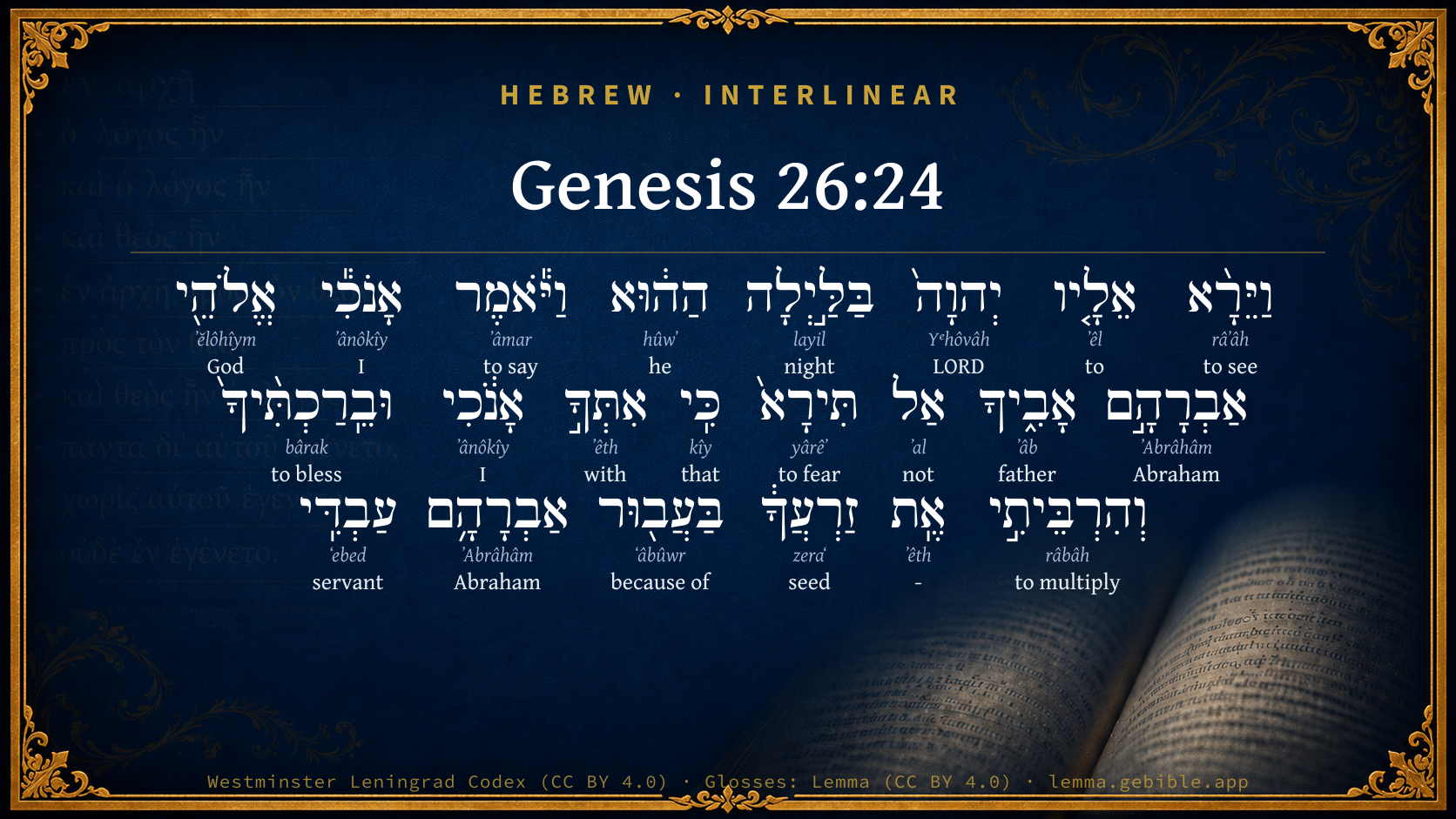
Hebrew (Westminster Leningrad Codex) Genesis 26:24 appears in the Hebrew Old Testament. The text above is from the Westminster Leningrad Codex. Each word links to its Strong’s number, a concise gloss, and parsing drawn from the Open Scriptures Hebrew Bible morphology. Click any word for its full Brown-Driver-Briggs (BDB) entry.
Download image
Cite this verse

Genesis 26:24 (World English Bible). Public Domain. Lemma interlinear Bible study tool, https://lemma.gebible.app/v/genesis/26/24.

Show BibTeX & RIS
BibTeX
RIS
English Translation
Yahweh appeared to him the same night, and said, "I am the God of Abraham your father. Don't be afraid, for I am with you, and will bless you, and multiply your seed for my servant Abraham's sake."
World English Bible · Public Domain
Download a study sheet

One document with this verse’s original text, its word-by-word gloss line, the meaning frame, cross-references with their text, attributed commentary, and full source and license credits — printable, and it pastes into notes with its structure intact.

This verse Autodidact and up

Study sheet (.html) Plain text (.txt)

A passage Seminary Student

Up to 50 verses in one chapter. A passage sheet keeps up to 6 commentary sources and 12 cross-references per verse, in the order this page ranks them, and says so on the sheet whenever that leaves anything out. Ask for a single verse and you get the Autodidact verse sheet above.

Everything on this page stays free to read, with no account — the sheet is a download of what is already on screen, not access to it.

Want to remove ads? Support Godless Engineer
Compare translations 3

The same verse in 3 English versions, stacked beneath the original-language interlinear above. Click any original word for its lexicon entry.

Each is an independent rendering of the whole verse — the interlinear is not word-aligned to these translations.

Highlighted words mark where these versions differ — a whole-verse word diff, not a word-by-word alignment.

  • World English Bible Public Domain
    Yahweh appeared to him the same night, and said, "I am the God of Abraham your father. Don't be afraid, for I am with you, and will bless you, and multiply your seed for my servant Abraham's sake."
  • King James Version Public Domain
    And the LORD appeared unto him the same night, and said, I am the God of Abraham thy father: fear not, for I am with thee, and will bless thee, and multiply thy seed for my servant Abraham's sake.
  • unfoldingWord Literal Text CC BY-SA 4.0
    And Yahweh appeared to him during that night and said, “I the God of Abraham your father. Do not be afraid, because I with you. And I will bless you and multiply your offspring for the sake of Abraham my servant.”

unfoldingWord Literal Text — © unfoldingWord, licensed CC BY-SA 4.0. Word-aligned USFM3 via Door43 (git.door43.org/unfoldingWord/en_ult).

Versions to compare (up to 4)

3 of 4 selected

Show all 18 translations

Every available English version of this verse, each an independent rendering of the whole verse.

  • World English Bible Public Domain
    Yahweh appeared to him the same night, and said, "I am the God of Abraham your father. Don't be afraid, for I am with you, and will bless you, and multiply your seed for my servant Abraham's sake."
  • Berean Standard Bible Public Domain
    and that night the LORD appeared to him and said, “I am the God of your father Abraham. Do not be afraid, for I am with you. I will bless you and multiply your descendants for the sake of My servant Abraham.”
  • Majority Standard Bible Public Domain
    and that night the LORD appeared to him and said, “I am the God of your father Abraham. Do not be afraid, for I am with you. I will bless you and multiply your descendants for the sake of My servant Abraham.”
  • King James Version Public Domain
    And the LORD appeared unto him the same night, and said, I am the God of Abraham thy father: fear not, for I am with thee, and will bless thee, and multiply thy seed for my servant Abraham's sake.
  • American Standard Version (1901) Public Domain
    And Jehovah appeared unto him the same night, and said, I am the God of Abraham thy father. Fear not, for I am with thee, and will bless thee, and multiply thy seed for my servant Abraham's sake.
  • Revised Version (1885) Public Domain
    And the LORD appeared unto him the same night, and said, I am the God of Abraham thy father: fear not, for I am with thee, and will bless thee, and multiply thy seed for my servant Abraham’s sake.
  • Geneva Bible (1599) Public Domain
    And the Lord appeared vnto him the same night, and sayde, I am the God of Abraham thy father: feare not, for I am with thee, and wil blesse thee, and will multiplie thy seede for my seruant Abrahams sake.
  • Douay-Rheims (1899) Public Domain
    Where the Lord appeared to him that same might, saying: I am the God of Abraham thy father; do not fear, for I am with thee: I will bless thee, and multiply thy seed for my servant Abraham's sake.
  • Young's Literal Translation Public Domain
    and Jehovah appeareth unto him during that night, and saith, `I `am' the God of Abraham thy father, fear not, for I `am' with thee, and have blessed thee, and have multiplied thy seed, because of Abraham My servant;'
  • Literal Standard Version CC BY-SA 4.0
    and YHWH appears to him during that night and says, “I [am] the God of your father Abraham, do not fear, for I [am] with you, and have blessed you, and have multiplied your seed, because of My servant Abraham”;
  • Unlocked Literal Bible CC BY-SA 4.0
    Yahweh appeared to him that same night and said, “I am the God of Abraham your father. Do not fear, for I am with you and will bless you and multiply your descendants, for my servant Abraham's sake.”
  • unfoldingWord Literal Text CC BY-SA 4.0
    And Yahweh appeared to him during that night and said, “I the God of Abraham your father. Do not be afraid, because I with you. And I will bless you and multiply your offspring for the sake of Abraham my servant.”
  • Darby Bible Public Domain
    And Jehovah appeared to him the same night, and said, I am the God of Abraham thy father: fear not, for I am with thee, and will bless thee, and multiply thy seed for my servant Abraham's sake.
  • World Messianic Bible Public Domain
    The LORD appeared to him the same night, and said, “I am the God of Abraham your father. Don’t be afraid, for I am with you, and will bless you, and multiply your offspring for my servant Abraham’s sake.”
  • Webster's Bible Public Domain
    And the LORD appeared to him the same night, and said, I am the God of Abraham thy father: fear not, for I am with thee, and will bless thee, and multiply thy seed for my servant Abraham's sake.
  • Free Bible Version CC BY-SA 4.0
    That night the Lord appeared to him and said, “I am the God of Abraham your father. Don't be afraid, for I am with you. I will bless you and give you many descendants for the sake of my servant Abraham.”
  • Bible in Basic English Public Domain
    That night the Lord came to him in a vision, and said, I am the God of your father Abraham: have no fear for I am with you, blessing you, and your seed will be increased because of my servant Abraham.
  • JPS Tanakh (1917) Public Domain
    And the LORD appeared unto him the same night, and said: 'I am the God of Abraham thy father. Fear not, for I am with thee, and will bless thee, and multiply thy seed for My servant Abraham's sake.'

Literal Standard Version (2020), Covenant Press — licensed CC BY-SA 4.0. Text via the HelloAO Bible API (eBible.org). Unlocked Literal Bible (unfoldingWord) — licensed CC BY-SA 4.0. Text via the HelloAO Bible API (eBible.org). unfoldingWord Literal Text — © unfoldingWord, licensed CC BY-SA 4.0. Word-aligned USFM3 via Door43 (git.door43.org/unfoldingWord/en_ult). Free Bible Version, Dr. Jonathan Gallagher — licensed CC BY-SA 4.0. Text via the HelloAO Bible API (eBible.org).

Word by word

More ways to search: Search by grammar → Find every occurrence → Compare this word →

Practice this passage: Drill this verse → Learn its vocabulary →

בַּעֲב֖וּר
ʻâbûwr
H5668
“in/at · because of of”
Preposition + Noun, Common, Masculine, Singular, Construct
Part of Speech
Preposition + Noun
Type
Common
Gender
Masculine
Number
Singular
State
Construct
Full BDB Definition

Origin: pass part of H5674

TWOT: 1556g

for the sake of, on account of, because of, in order to (preposition) - in order that (conjunction)
  1. וַיֵּרָ֨א râʼâh H7200 “and · to see” Conjunction + Verb, Niphal, Sequential Imperfect, 3rd Person, Masculine, Singular
  2. אֵלָ֤יו ʼêl H413 “to · him” Preposition + Suffix, Personal, 3rd Person, Masculine, Singular
  3. יְהוָה֙ Yᵉhôvâh H3068 “LORD” Noun, Proper
  4. בַּלַּ֣יְלָה layil H3915 “in/at the · night” Preposition, Determined + Noun, Common, Masculine, Singular, Absolute
  5. הַה֔וּא hûwʼ H1931 “the · he” Particle, Definite Article + Pronoun, Personal, 3rd Person, Masculine, Singular
  6. וַיֹּ֕אמֶר ʼâmar H559 “and · to say” Conjunction + Verb, Qal, Sequential Imperfect, 3rd Person, Masculine, Singular
  7. אָנֹכִ֕י ʼânôkîy H595 “I” Pronoun, Personal, 1st Person, Common, Singular
  8. אֱלֹהֵ֖י ʼĕlôhîym H430 “God(s) of” Noun, Common, Masculine, Plural, Construct
  9. אַבְרָהָ֣ם ʼAbrâhâm H85 “Abraham” Noun, Proper
  10. אָבִ֑יךָ ʼâb H1 “father · your” Noun, Common, Masculine, Singular, Construct + Suffix, Personal, 2nd Person, Masculine, Singular
  11. אַל ʼal H408 “not” Particle, Negative
  12. תִּירָא֙ yârêʼ H3372 “to fear” Verb, Qal, Jussive, 2nd Person, Masculine, Singular
  13. כִּֽי kîy H3588 “that” Conjunction
  14. אִתְּךָ֣ ʼêth H854 “with · you” Preposition + Suffix, Personal, 2nd Person, Masculine, Singular
  15. אָנֹ֔כִי ʼânôkîy H595 “I” Pronoun, Personal, 1st Person, Common, Singular
  16. וּבֵֽרַכְתִּ֨יךָ֙ bârak H1288 “and · to bless · you” Conjunction + Verb, Piel, Sequential Perfect, 1st Person, Common, Singular + Suffix, Personal, 2nd Person, Masculine, Singular
  17. וְהִרְבֵּיתִ֣י râbâh H7235 “and · to multiply” Conjunction + Verb, Hiphil, Sequential Perfect, 1st Person, Common, Singular
  18. אֶֽת ʼêth H853 “-” Particle, Direct Object
  19. זַרְעֲךָ֔ zeraʻ H2233 “seed · your” Noun, Common, Masculine, Singular, Construct + Suffix, Personal, 2nd Person, Masculine, Singular
  20. אַבְרָהָ֥ם ʼAbrâhâm H85 “Abraham” Noun, Proper
  21. עַבְדִּֽי ʻebed H5650 “servant · my” Noun, Common, Masculine, Singular, Construct + Suffix, Personal, 1st Person, Common, Singular

About this verse

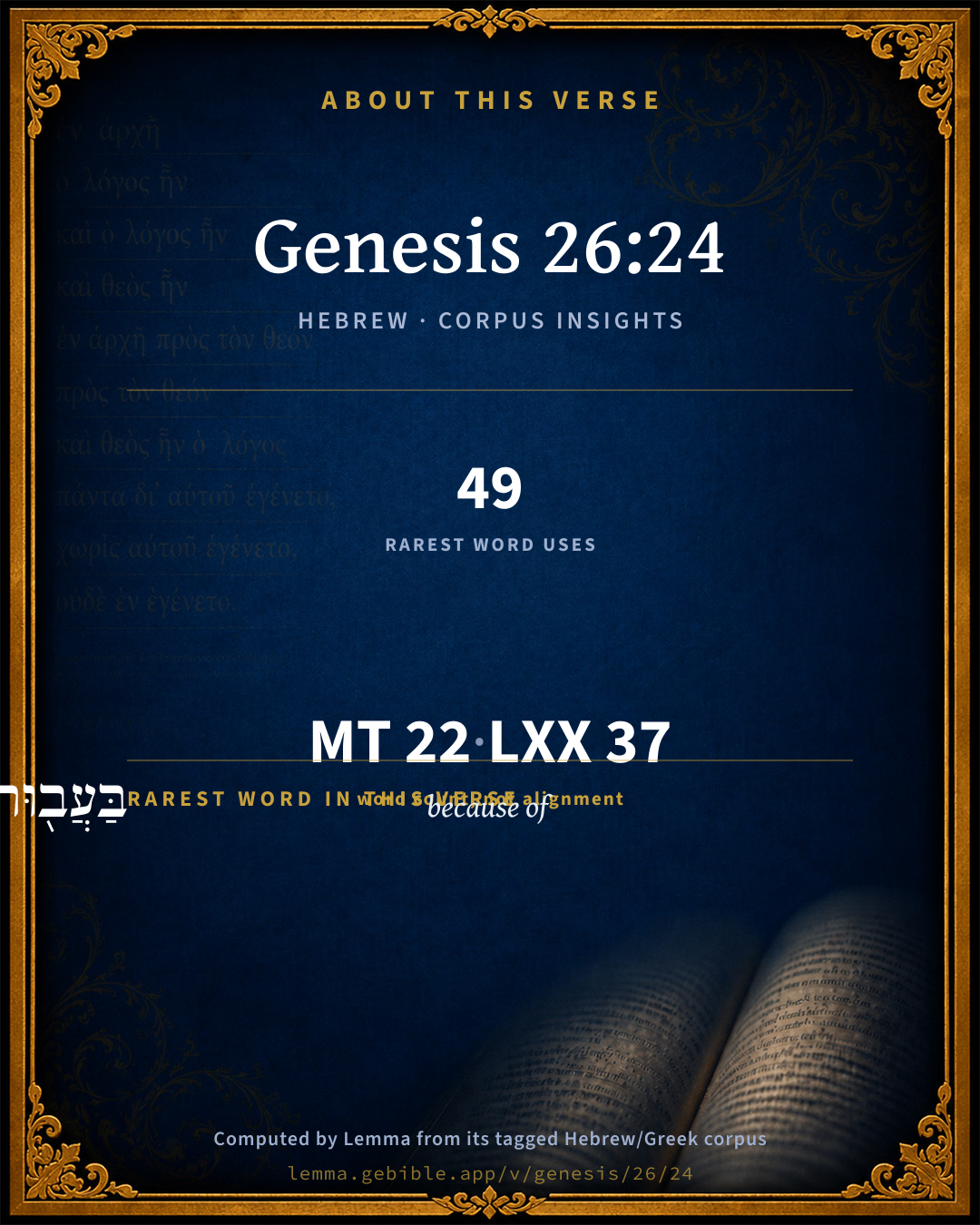
These counts appear in no published source. They are computed here, from the morphology-tagged text and Lemma’s own curated glosses. What Lemma adds →

22
words
20
distinct lemmas
Pentateuch
section

Shared distinctive vocabulary

בַּעֲב֖וּר because of H5668 occurs in 47 verses of the Hebrew Bible. Also found in:

Grammatical profile

  • 5 verbs
  • 9 nouns
  • 3 pronouns
  • 2 prepositions
  • 1 conjunction
  • 2 particles

Verb forms

  • וַיֵּרָ֨א Niphal · Sequential Imperfect
  • וַיֹּ֕אמֶר Qal · Sequential Imperfect
  • תִּירָא֙ Qal · Jussive
  • וּבֵֽרַכְתִּ֨יךָ֙ Piel · Sequential Perfect
  • וְהִרְבֵּיתִ֣י Hiphil · Sequential Perfect

Repetition

Words recur within this verse — often emphatic in Hebrew:

  • אַבְרָהָ֣ם Abraham H85 ×2
  • אָנֹכִ֕י I H595 ×2

Hebrew & Septuagint length

In English translation the verse runs 38 words from the Hebrew and 42 from the Septuagint (LXX English) — closely comparable.

A rough comparison of the two English renderings, which tokenize alike — not a word-level alignment.

Word counts can differ between the Hebrew and the Greek without any difference in meaning — e.g. the Hebrew direct-object marker אֵת has no separate Greek word, and Greek often adds the article ὁ.

In the original languages it is 22 Hebrew tokens and 37 Greek tokens — but the two are counted differently (Hebrew bundles its prefixes and suffixes into one token; the Greek is in lemma form), so that isn’t a like-for-like length.

Cross-references

23

Topical passages linked to Genesis 26:24 in the Treasury of Scripture Knowledge — connected by theme and wording, ordered by reader-vote popularity; previews shown in the World English Bible.

  • Genesis 15:1 After these things the word of Yahweh came to Abram in a vision, saying, "Don't be afraid, Abram. I am your shield, your exceedingly great reward."
  • Exodus 3:6 Moreover he said, "I am the God of your father, the God of Abraham, the God of Isaac, and the God of Jacob." Moses hid his face; for he was afraid to look at God.
  • Genesis 17:7 I will establish my covenant between me and you and your seed after you throughout their generations for an everlasting covenant, to be a God to you and to your seed after you.
  • Genesis 24:12 He said, "Yahweh, the God of my master Abraham, please give me success this day, and show kindness to my master Abraham.
  • Isaiah 43:1–2 But now thus says Yahweh who created you, Jacob, and he who formed you, Israel: Don't be afraid, for I have redeemed you; I have called you by your name, you are mine.
  • Acts 7:32 'I am the God of your fathers, the God of Abraham, the God of Isaac, and the God of Jacob.' Moses trembled, and dared not look.
  • Revelation 1:17 When I saw him, I fell at his feet like a dead man. He laid his right hand on me, saying, "Don't be afraid. I am the first and the last,
  • Genesis 13:16 I will make your offspring as the dust of the earth, so that if a man can number the dust of the earth, then your seed may also be numbered.
  • Genesis 28:13 Behold, Yahweh stood above it, and said, "I am Yahweh, the God of Abraham your father, and the God of Isaac. The land whereon you lie, to you will I give it, and to your seed.
  • Genesis 31:5 and said to them, "I see the expression on your father's face, that it is not toward me as before; but the God of my father has been with me.
  • Psalms 46:1–2 God is our refuge and strength, A very present help in trouble.
  • Isaiah 12:2 Behold, God is my salvation. I will trust, and will not be afraid; for Yah, Yahweh, is my strength and song; and he has become my salvation."
  • Isaiah 41:10 Don't you be afraid, for I am with you; don't be dismayed, for I am your God; I will strengthen you; yes, I will help you; yes, I will uphold you with the right hand of my righteousness.
  • Isaiah 41:13–15 For I, Yahweh your God, will hold your right hand, saying to you, Don't be afraid; I will help you.
  • Isaiah 44:2 Thus says Yahweh who made you, and formed you from the womb, who will help you: Don't be afraid, Jacob my servant; and you, Jeshurun, whom I have chosen.
  • Matthew 22:32 'I am the God of Abraham, and the God of Isaac, and the God of Jacob?' God is not the God of the dead, but of the living."
  • Luke 12:32 Don't be afraid, little flock, for it is your Father's good pleasure to give you the Kingdom.
  • Hebrews 13:6 So that with good courage we say, "The Lord is my helper. I will not fear. What can man do to me?"
  • Genesis 26:2–4 Yahweh appeared to him, and said, "Don't go down into Egypt. Dwell in the land which I will tell you of.
  • Psalms 27:1–3 Yahweh is my light and my salvation. Whom shall I fear? Yahweh is the strength of my life. Of whom shall I be afraid?
  • Isaiah 51:7 Listen to me, you who know righteousness, the people in whose heart is my law; don't you fear the reproach of men, neither be you dismayed at their insults.
  • Isaiah 51:12 I, even I, am he who comforts you: who are you, that you are afraid of man who shall die, and of the son of man who shall be made as grass;
  • Genesis 22:19 So Abraham returned to his young men, and they rose up and went together to Beersheba. Abraham lived at Beersheba.

Cross-references courtesy of OpenBible.info (CC BY 4.0).

Hebrew and Greek witnesses Masoretic Hebrew ↔ Greek Septuagint

The same verse in the two great witnesses to the Old Testament, shown verse-for-verse.

These are two independent witnesses, not word-aligned to each other, and the Septuagint is shown in lemma (dictionary) form.

Hebrew Genesis 26:24 Masoretic · Westminster Leningrad Codex

וַיֵּרָ֨א אֵלָ֤יו יְהוָה֙ בַּלַּ֣יְלָה הַה֔וּא וַיֹּ֕אמֶר אָנֹכִ֕י אֱלֹהֵ֖י אַבְרָהָ֣ם אָבִ֑יךָ אַל תִּירָא֙ כִּֽי אִתְּךָ֣ אָנֹ֔כִי וּבֵֽרַכְתִּ֨יךָ֙ וְהִרְבֵּיתִ֣י אֶֽת זַרְעֲךָ֔ בַּעֲב֖וּר אַבְרָהָ֥ם עַבְדִּֽי

Yahweh appeared to him the same night, and said, "I am the God of Abraham your father. Don't be afraid, for I am with you, and will bless you, and multiply your seed for my servant Abraham's sake."

World English Bible · Public Domain

Greek LXX Genesis 26:24 Septuagint · lemma form

καί ὁράω αὐτός κύριος ἐν ὁ νύξ ἐκεῖνος καί εἶπον ἐγώ εἰμί ὁ θεός αβρααμ ὁ πατήρ σύ μή φοβέω μετά σύ γάρ εἰμί καί εὐλογέω σύ καί πληθύνω ὁ σπέρμα σύ διά αβρααμ ὁ πατήρ σύ

And the Lord appeared to him in that night, and said, I am the God of Abraam your father; fear not, for I am with you, and I will bless you, and multiply your seed for the sake of Abraam your father.

LXX2012 (modern English Septuagint) · Public Domain

On this verse, The Cambridge Bible for Schools and Colleges discusses the Septuagint’s reading. Read the note in Commentary ↓

Hebrew: Westminster Leningrad Codex (CC BY 4.0). Greek: Septuagint (public domain); English from LXX2012 (modern English Septuagint) (Public Domain). How the Septuagint differs from the Hebrew →

Targum (Aramaic paraphrase)

2

The Targum is the ancient Jewish Aramaic paraphrase of the Hebrew Scriptures — an interpretive translation, not the Hebrew text itself. Onkelos (literal) and Pseudo-Jonathan (expansive) render the Torah, and Jonathan the Prophets. Coverage is partial: where no permissively-licensed English translation exists for a verse, only the Aramaic is shown. This is verse-level text, not a word-by-word alignment to the Hebrew.

  1. Targum Onkelos Torah (Genesis–Deuteronomy)
    וְאִתְגְּלִי לֵהּ יְיָ בְּלֵילְיָא הַהוּא וַאֲמַר אֲנָא אֱלָהֵהּ דְּאַבְרָהָם אֲבוּךְ לָא תִדְחַל אֲרֵי בְסַעְדָּךְ מֵימְרִי וֶאֱבָרֵכִנָּךְ וְאַסְגֵּי יָת בְּנָיךְ בְּדִיל אַבְרָהָם עַבְדִּי

    (no public-domain English translation for this verse)

    Targum Onkelos — Aramaic: “Onkelos Genesis” (public domain); “Onkelos Exodus” (public domain); “Onkelos Leviticus” (public domain); “Onkelos Numbers” (public domain); “Onkelos Deuteronomy” (public domain). English: “Sefaria Community Translation” (CC0 1.0 (public-domain dedication)); “J.W. Etheridge. The Targums of Onkelos and Jonathan Ben Uzziel on the Pentateuch. London: Longmans, Green, 1862” (public domain). Text via Sefaria.

  2. Targum Pseudo-Jonathan Torah (Genesis–Deuteronomy)
    וְאִתְגְלֵי לֵיהּ יְיָ בְּלֵילָא הַהוּא וַאֲמַר אֲנָא אֱלָהָא דְאַבְרָהָם אָבוּךְ לָא תִדְחַל אֲרוּם בְּסַעֲדָךְ מֵימְרִי וַאֲבָרְכִנָךְ וְאַסְגֵי יַת בְּנָךְ בְּגִין זַכְוָותָא דְאַבְרָהָם עַבְדִי

    And the Lord appeared to him that night, and said, I am the God of Abraham thy father: fear not; for My Word is for thy help, and I will bless thee, and multiply thy sons for the righteousness' sake of Abraham My servant.

    Targum Pseudo-Jonathan — Aramaic: “Targum Jonathan on Genesis” (public domain); “Targum Jonathan on Exodus” (public domain); “Targum Jonathan on Leviticus” (public domain); “Targum Jonathan on Numbers” (public domain); “Targum Jonathan on Deuteronomy” (public domain). English: “The Targum of Jonathan ben Uzziel, trans. J. W. Etheridge, London, 1862” (public domain). Text via Sefaria.

Commentary

Notes on Genesis 26:24 from classic Christian and Jewish commentators (each source and its license shown beneath its notes). The classic Christian expositions comment on the surrounding passage and are grouped to its opening verse, so a note may address several verses; the Jewish commentaries on the Tanakh (Rashi and others) are per-verse, so they appear only where the commentator wrote on this verse.

Lemma curates 59 commentaries, every one of them public domain or Creative Commons licensed, each selected and text-cleaned for this edition rather than reprinted as found. About our sources →

Trapp's Complete Commentary

John Trapp

Gen 26:24 And the LORD appeared unto him the same night, and said, I [am] the God of Abraham thy father: fear not, for I [am] with thee, and will bless thee, and multiply thy seed for my servant Abraham’s sake.

Ver. 24. Fear not.] For the continued opposition of the Philistines, or whatever other discouragement. The best minds, when troubled for any long time, yield inconsiderate motions, and suffer some perturbation; as water that is violently stirred sends up bubbles. They cannot be so much master over their passions, as not otherwhiles to be disquieted: for, not the evenest weights but, at their first putting into the balance, somewhat sway both parts thereof, not without some show of inequality; which, after some tittle motion, settle themselves in a meet poise. Potissimum vero fidei murus, tentationum ariete durius aliquanto pulsatus et concussus, facile nutare ac ruinam minari incipit, nisi divinitus sustentetur. {a}

{a} Bucholcer. Cηρονολ., 320.

John Trapp, A Commentary or Exposition upon All the Books of the Old and New Testament (1647–1656) — public domain. Text from a community e-Sword module.

Joseph Benson's Commentary

Gen 26:24. Fear not, I am with thee, and will bless thee — Those may remove with comfort that are sure of God’s presence with them wherever they go.

Joseph Benson's Commentary on the Old and New Testaments (1811–1818) — public domain. Text from a community e-Sword module.

Geneva Bible (1599)

Geneva Bible translators

God assureth Isaac against all fear by rehearsing the promise made to Abraham.

Geneva Bible (1599) marginal notes — public domain. Text via Bolls.life.

Adam Clarke's Commentary

Verse 24. The Lord appeared unto him] He needed especial encouragement when insulted and outraged by the Philistines; for having returned to the place where his noble father had lately died, the remembrance of his wrongs, and the remembrance of his loss, could not fail to afflict his mind; and God immediately appears to comfort and support him in his trials, by a renewal of all his promises.

Adam Clarke's Commentary on the Bible (1810–1826) — public domain. Text from a community e-Sword/MySword module.

John Calvin's Commentaries

24. And the Lord appeared unto him. This vision (as I have elsewhere said) was to prepare him to listen more attentively to God, and to convince him that it was God with whom he had to deal; for a voice alone would have had less energy. Therefore God appears, in order to produce confidence in and reverence towards his word. In short, visions were a kind of symbols of the Divine presence, designed to remove all doubt from the minds of the holy fathers respecting him who was about to speak. Should it be objected, that such evidence was not sufficiently sure, since Satan often deceives men by similar manifestations, being, as it were, the ape of God; — we must keep in mind what has been said before, that a clear and unambiguous mark was engraven on the visions of God, by which the faithful might certainly distinguish them from those which were fallacious, so that their faith should not be kept in suspense: and certainly, since Satan can only delude us in the dark, God exempts his children from this danger, by illuminating their eyes with the brightness of his countenance. Yet God did not fully manifest his glory to the holy fathers, but assumed a form by means of which they might apprehend him according to the measure of their capacities; for, as the majesty of God is infinite, it cannot be comprehended by the human mind, and by its magnitude it absorbs the whole world. Besides, it follows of necessity that men, on account of their infirmity, must not only faint, but be altogether annihilated in the presence of God. Wherefore, Moses does not mean that God was seen in his true nature and greatness, but in such a manner as Isaac was able to bear the sight. But what we have said, namely, that the vision was a testimony of Deity, for the purpose of giving credibility to the oracle, will more fully appear from the context; for this appearance was not a mute spectre; but the word immediately followed, which confirmed, in the mind of Isaac, faith in gratuitous adoption and salvation.

I am the God of Abraham. This preface is intended to renew the memory of all the promises before given, and to direct the mind of Isaac to the perpetual covenant which had been made with Abraham, and which was to be transmitted, as by tradition, to his posterity. The Lord therefore begins by declaring himself to be the God who had spoken at the first to Abraham, in order that Isaac might not sever the present from the former oracles: for as often as he repeated the testimony of his grace to the faithful, he sustained their faith with fresh supports. Yet he would have that very faith to remain based upon the first covenant by which he had adopted them to himself: and we must always keep this method in mind, in order that we may learn to gather together the promises of God, as they are combined in an inseparable bond. Let this also ever occur to us, as a first principle, that God thus kindly promises us his grace because he has freely adopted us.

Fear not. Since these words are elsewhere expounded, I shall now be the more brief. In the first place, we must observe, that God thus addresses the faithful for the purpose of tranquillizing their minds; for, if his word be withdrawn, they necessarily become torpid through stupidity, or are tormented with disquietude. Whence it follows, that we can receive peace from no other source than from the mouth of the Lord, when he declares himself the author of our salvation; not that we are then free from all fear, but because the confidence of faith is sufficiently efficacious to assuage our perturbations. Afterwards the Lord gives proofs of his love, by its effect, when he promises that he will bless Isaac.

John Calvin's Commentaries (1540-1563) — public domain. Text from the Calvin Translation Society English edition (1840s-50s) via the Christian Classics Ethereal Library (ccel.org). Calvin's coverage is partial (roughly two-thirds of the Bible); uncommented books and verses are honest gaps, never fabricated. The 19th-century editor's footnotes and remarks are omitted so the notes are faithfully Calvin's own voice.

The Cambridge Bible for Schools and Colleges

gen. ed. J. J. S. Perowne

23–25 (J). Isaac at Beer-sheba

24. the same night] The manner of the appearance of Jehovah is not defined. Was it “in a vision” (Gen_15:1), or “in a dream” (Gen_20:3)?

fear not] The words of encouragement are probably spoken in reference to the hostility Isaac had recently experienced, and to his loneliness in the land of his sojournings; cf. Gen_15:1 (J).

I am with thee] Cf. Gen_26:3, Gen_28:15, Gen_31:3. Isaac might feel lonely as a stranger (gêr) in the land, but he was assured of the presence of Jehovah wherever he went.

for my servant … sake]. See note on Gen_26:5. The title “my servant” here given to Abraham is only found in this place in Genesis. LXX reads “thy father.” But it was the obedience of Abraham that won for him this great title: cf. Isa_41:8, “Israel my servant … Abraham my friend.”

The Cambridge Bible for Schools and Colleges (gen. ed. J. J. S. Perowne; Cambridge University Press, 1878–1918) — public domain. Text from a community e-Sword module.

John Gill's Exposition

Then Abimelech went to him from Gerar,.... After Isaac was settled at Beersheba, and was still increasing in his family and substance, of which Abimelech very probably was informed; and fearing lest he should resent his being sent out of his country by him, and the ill treatment he met with afterwards from the herdmen of Gerar in the valley about the wells, and should employ his riches and power against him, and fall upon him, and take his kingdom from him, he took a journey from Gerar to Beersheba, to pay Isaac a visit, and make a covenant with him: and

Ahuzzath one of his friends; Jarchi and Jonathan take Ahuzzath for an appellative, and interpret it of a collection or company of his friends, which the king took along with him to attend him in his journey: but it seems rather to be the proper name of a man, who was very intimate and familiar with the king, and always kept him company, and so went along with him to Beersheba:

and Phichol the chief captain of his army; his general, as the other was his principal counsellor or prime minister. There was one of this name, and in the same office, in the days of Abraham, and who attended the then present king, who also was called Abimelech on a like account as here, Gen 21:22; but as the one affair was at the distance of an hundred years or more from the other, it is probable, that as this Abimelech might be the son of that Abimelech that lived in the times of Abraham, so this Phichol might be the son of him that lived then, and who succeeded his father in his office; though some think that Phichol is the name of an office, and signifies "the mouth of all", by whom the addresses of the people were made to the king; but this is not likely, since he is described by his office as general of the army; which is very different from the master of the ceremonies, or anything of that kind, and plainly shows it to be the name of a man.

John Gill's Exposition of the Whole Bible (1746–1763) — public domain (CC PDM 1.0). Text via the HelloAO Bible API.

Haydock's Catholic Bible Commentary

Of Abraham, who still lives before me, and for whom I always testified such affection, though I suffered him to be persecuted: hence, fear not. (Haydock)

George Leo Haydock (1774–1849), Haydock's Catholic Family Bible and Commentary, 1859 edition — public domain. Excludes Psalms (Douay-Rheims chapter numbering differs from Protestant) and Deuterocanonical books (Catholic canon only).

Whedon's Commentary on the Bible

Daniel D. Whedon

24. The Lord appeared — Immediately on Isaac’s return to Beer-sheba Jehovah renews to him the promises, and there he builds an altar in acknowledgment of his mercy.

Daniel D. Whedon (gen. ed.), Commentary on the Old and New Testaments (1874–1909) — public domain. Text from a community e-Sword module.

The Pulpit Commentary

And the Lord appeared unto him the same night (i.e. the night of his arrival at Beersheba), and said (in a dream or vision), I (the pronoun is emphatic) am the God (the Elohim) of Abraham thy father (the language is expressive not alone of the covenant relationship which subsisted between Jehovah and the patriarch while the latter lived, but also of the present continuance of that relationship, since Abraham, though dead, had not ceased to he): fear not (cf., Gen_15:1, in which the same encouraging admonition is addressed to Abraham after his battle with the kings) for I am with thee, and will bless thee, and multiply thy seed a repetition of promises already given to himself (vide vers. 3, 4)for my servant Abraham"s sake a reason declaring God"s gracious covenant, and not personal merit, to be the true source of blessing for Isaac.

The Pulpit Commentary (1880–1919), ed. H.D.M. Spence-Jones & Joseph S. Exell — public domain. Text from a community e-Sword module.

John Wesley's Explanatory Notes

Fear not, I am with thee, and will bless thee - Those may remove with comfort that are sure of God's presence with them wherever they go.

John Wesley, Explanatory Notes Upon the Whole Bible (1754–1765) — public domain. Text via the GEBible commentary corpus.

Ramban (Nachmanides)

Rabbi Moshe ben Nachman (Ramban / Nachmanides)

FEAR NOT, FOR I AM WITH THEE. Since Abimelech drove him away because of the Philistines’ jealousy of him, and since the herdsmen of Gerar quarrelled with him, Isaac feared lest they gather against him and smite him and his family. Therefore the Holy One, blessed be He, assured him that he should not fear them, and He blessed him. Then He prompted them so that the king went to Isaac with greater honor than that which he did to his father since he came with Phichol, the chief of his host, and also brought with him many of his friends.

Ramban (Nachmanides) on the Tanakh — English translation: “Commentary on the Torah by Ramban (Nachmanides). Translated and annotated by Charles B. Chavel. New York, Shilo Pub. House, 1971-1976” (CC BY 4.0). Text via Sefaria.

Radak

Rabbi David Kimhi (Radak)

וירא, this vision was meant to encourage Yitzchok not to be afraid on account of these territorial disputes over the sources of water for his flocks. He reassured him that those hating him now would not only give up their opposition but would come pleading for a peace-treaty with him; this is why He added that Yitzchok’s success would be linked to that of G’d’s servant Avraham. We see this promise fulfilled already in verse 26 when the King himself travels to see Yitzchok and is forced to acknowledge that the combination of Yitzchok’s G’d and Yitzchok is too powerful for him to oppose.

בעבור אברהם עבדי, seeing that Avraham had complied with all of G’d’s instructions just like a slave carrying out the dictates of his master.

Radak on the Tanakh — English translations: “Sefaria Community Translation” (CC0 1.0 (public-domain dedication)); “Eliyahu Munk, HaChut Hameshulash” (CC BY 4.0); “Rabbi Mike Feuer, Jerusalem Anthology” (CC BY 4.0); and “R. David Kimhi on the first book of Psalms, Translated by R.G. Finch, London, 1919” (public domain). Text via Sefaria.

Lesson kit

Teaching starters — assembled from the data on this page, not authored interpretation. Every prompt links to the verse data it draws on. Edit before teaching.

Genesis, in the Pentateuch, opens this verse with 22 words (20 distinct Hebrew lemmas). Its most distinctive word is ʻâbûwr (“because of”). A historical commentator’s framing appears above. Read the whole chapter for the surrounding context.

Discussion questions

  1. How does “because of” (ʻâbûwr) shape what this verse is saying?
  2. Genesis 3:17 shares the word «because of» with this verse. How do the two illuminate each other?
  3. “Abraham” occurs 2× in this one verse. What is the effect of the repetition?
  4. The translations on this page render this verse differently — a whole-verse word diff, not a word-by-word alignment. What might account for the different wordings?
  5. The verb «וַיֵּרָ֨א» is Niphal Sequential Imperfect. How does its form color the action?
  6. Reading how Trapp's Complete Commentary and Joseph Benson's Commentary read this verse, where do the two commentators agree and where do they part?

Things to notice

Reading settings

Reading text

Shown beneath each verse's original-language words.

Old Testament
Old Testament edition

Read the OT as the Masoretic Hebrew (MT) or the Greek Septuagint (LXX).

English shown for the Greek Septuagint (in the Hebrew ↔ Greek comparison).

Comparing translations? Open the Compare panel on any verse page to stack up to four side by side.