
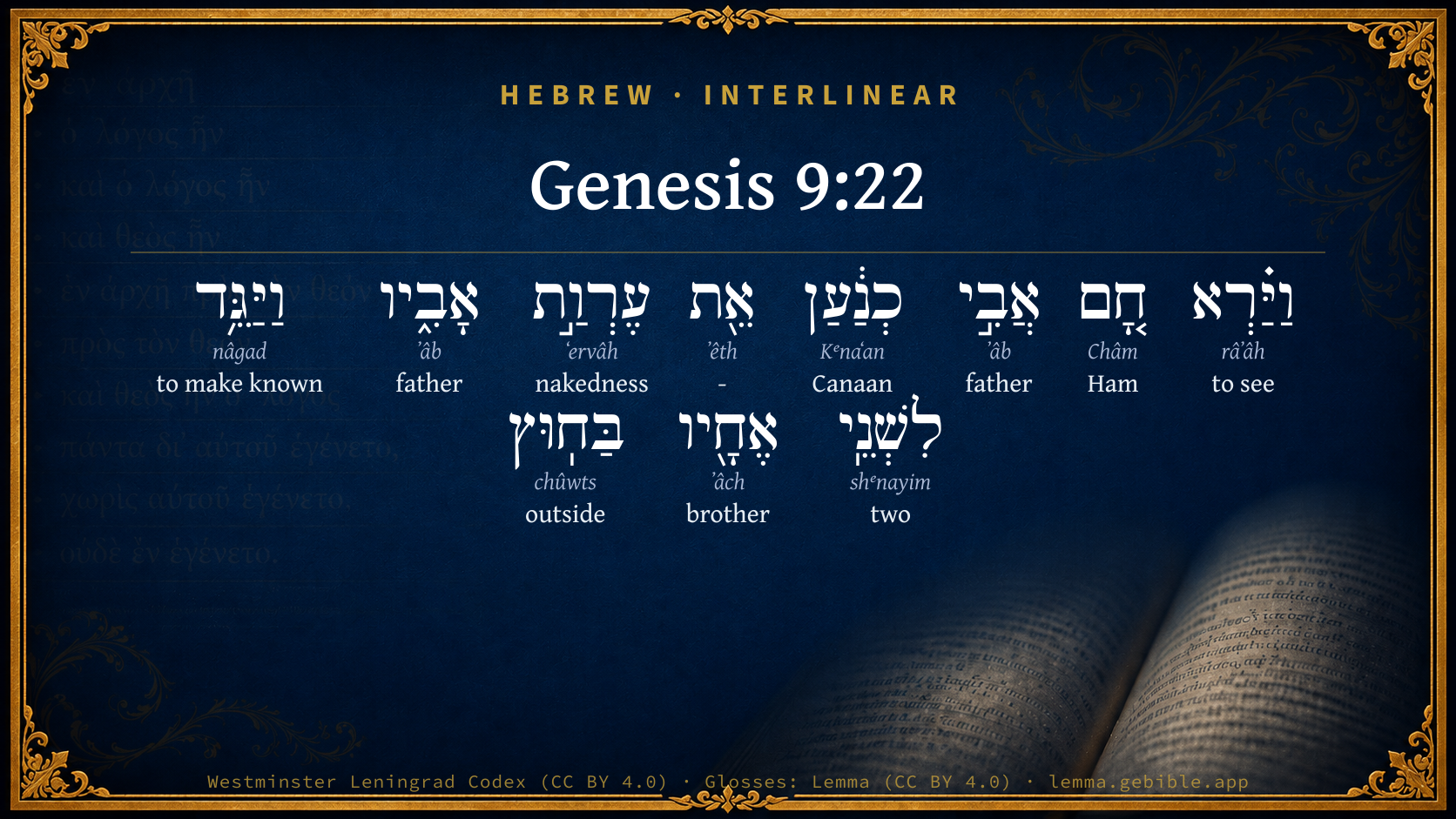
Genesis 9:22

Hebrew (Westminster Leningrad Codex) Genesis 9:22 appears in the Hebrew Old Testament. The text above is from the Westminster Leningrad Codex. Each word links to its Strong’s number, a concise gloss, and parsing drawn from the Open Scriptures Hebrew Bible morphology. Click any word for its full Brown-Driver-Briggs (BDB) entry.
Download image
Cite this verse

Genesis 9:22 (World English Bible). Public Domain. Lemma interlinear Bible study tool, https://lemma.gebible.app/v/genesis/9/22.

Show BibTeX & RIS
BibTeX
RIS
English Translation
Ham, the father of Canaan, saw the nakedness of his father, and told his two brothers outside.
World English Bible · Public Domain
Highlights
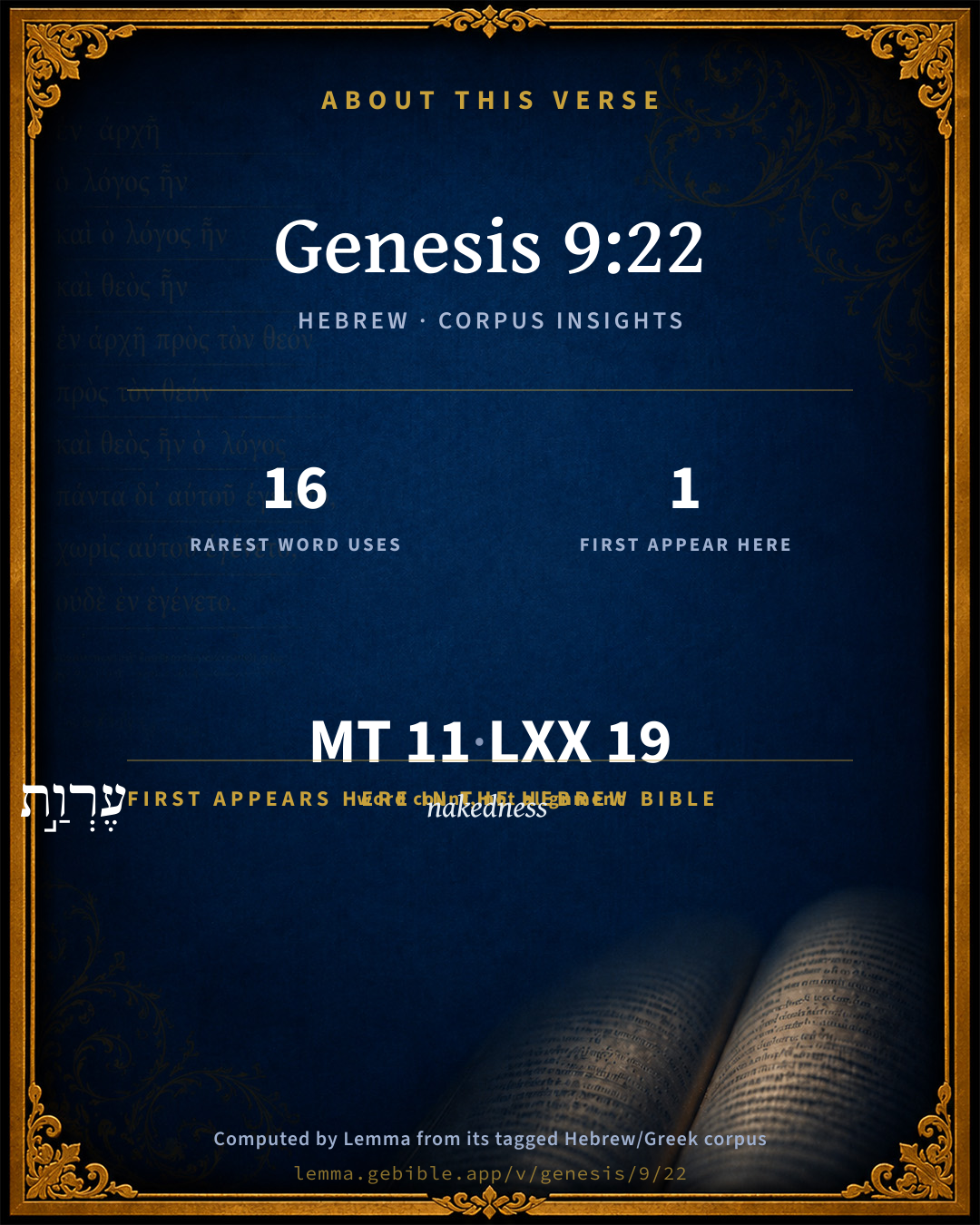
  • 1 first appearance in the Hebrew Bible
Full analysis ↓
Download a study sheet

One document with this verse’s original text, its word-by-word gloss line, the meaning frame, cross-references with their text, attributed commentary, and full source and license credits — printable, and it pastes into notes with its structure intact.

This verse Autodidact and up

Study sheet (.html) Plain text (.txt)

A passage Seminary Student

Up to 50 verses in one chapter. A passage sheet keeps up to 6 commentary sources and 12 cross-references per verse, in the order this page ranks them, and says so on the sheet whenever that leaves anything out. Ask for a single verse and you get the Autodidact verse sheet above.

Everything on this page stays free to read, with no account — the sheet is a download of what is already on screen, not access to it.

Want to remove ads? Support Godless Engineer
Compare translations 3

The same verse in 3 English versions, stacked beneath the original-language interlinear above. Click any original word for its lexicon entry.

Each is an independent rendering of the whole verse — the interlinear is not word-aligned to these translations.

Highlighted words mark where these versions differ — a whole-verse word diff, not a word-by-word alignment.

  • World English Bible Public Domain
    Ham, the father of Canaan, saw the nakedness of his father, and told his two brothers outside.
  • King James Version Public Domain
    And Ham, the father of Canaan, saw the nakedness of his father, and told his two brethren without.
  • unfoldingWord Literal Text CC BY-SA 4.0
    Then Ham, the father of Canaan, saw the nakedness of his father, and he told his two brothers outside.

unfoldingWord Literal Text — © unfoldingWord, licensed CC BY-SA 4.0. Word-aligned USFM3 via Door43 (git.door43.org/unfoldingWord/en_ult).

Versions to compare (up to 4)

3 of 4 selected

Show all 18 translations

Every available English version of this verse, each an independent rendering of the whole verse.

  • World English Bible Public Domain
    Ham, the father of Canaan, saw the nakedness of his father, and told his two brothers outside.
  • Berean Standard Bible Public Domain
    And Ham, the father of Canaan, saw his father’s nakedness and told his two brothers outside.
  • Majority Standard Bible Public Domain
    And Ham, the father of Canaan, saw his father’s nakedness and told his two brothers outside.
  • King James Version Public Domain
    And Ham, the father of Canaan, saw the nakedness of his father, and told his two brethren without.
  • American Standard Version (1901) Public Domain
    And Ham, the father of Canaan, saw the nakedness of his father, and told his two brethren without.
  • Revised Version (1885) Public Domain
    And Ham, the father of Canaan, saw the nakedness of his father, and told his two brethren without.
  • Geneva Bible (1599) Public Domain
    And when Ham the father of Canaan sawe the nakednesse of his father, he tolde his two brethren without.
  • Douay-Rheims (1899) Public Domain
    Which when Cham the father of Chaanan had seen, to wit, that his father's nakedness was uncovered, he told it to his two brethren without.
  • Young's Literal Translation Public Domain
    And Ham, father of Canaan, seeth the nakedness of his father, and declareth to his two brethren without.
  • Literal Standard Version CC BY-SA 4.0
    And Ham, father of Canaan, sees the nakedness of his father, and declares to his two brothers outside.
  • Unlocked Literal Bible CC BY-SA 4.0
    Then Ham, the father of Canaan, saw the nakedness of his father and told his two brothers outside.
  • unfoldingWord Literal Text CC BY-SA 4.0
    Then Ham, the father of Canaan, saw the nakedness of his father, and he told his two brothers outside.
  • Darby Bible Public Domain
    And Ham the father of Canaan saw the nakedness of his father, and told his two brethren outside.
  • World Messianic Bible Public Domain
    Ham, the father of Canaan, saw the nakedness of his father, and told his two brothers outside.
  • Webster's Bible Public Domain
    And Ham, the father of Canaan, saw the nakedness of his father, and told his two brethren without.
  • Free Bible Version CC BY-SA 4.0
    Ham, the father of Canaan, saw his father's private parts and went and told his two brothers who were outside.
  • Bible in Basic English Public Domain
    And Ham, the father of Canaan, saw his father unclothed, and gave news of it to his two brothers outside.
  • JPS Tanakh (1917) Public Domain
    And Ham, the father of Canaan, saw the nakedness of his father, and told his two brethren without.

Literal Standard Version (2020), Covenant Press — licensed CC BY-SA 4.0. Text via the HelloAO Bible API (eBible.org). Unlocked Literal Bible (unfoldingWord) — licensed CC BY-SA 4.0. Text via the HelloAO Bible API (eBible.org). unfoldingWord Literal Text — © unfoldingWord, licensed CC BY-SA 4.0. Word-aligned USFM3 via Door43 (git.door43.org/unfoldingWord/en_ult). Free Bible Version, Dr. Jonathan Gallagher — licensed CC BY-SA 4.0. Text via the HelloAO Bible API (eBible.org).

Word by word

More ways to search: Search by grammar → Find every occurrence → Compare this word →

Practice this passage: Drill this verse → Learn its vocabulary →

חָ֚ם
Châm
H2526
“Ham”
Noun, Proper
Part of Speech
Noun
Type
Proper
Full BDB Definition

Origin: the same as H2525

TWOT: None

Ham = "hot" - 2nd son of Noah, father of Canaan and of various peoples which were inhabitants of southern lands (noun proper masculine) - in late usage, a collective name for Egyptians (noun proper masculine) - the place where Chedorlaomer smote the Zuzim, probably in the territory of Ammonites (Gilead) east of the Jordan (noun proper locative)
  1. וַיַּ֗רְא râʼâh H7200 “and · to see” Conjunction + Verb, Qal, Sequential Imperfect, 3rd Person, Masculine, Singular
  2. אֲבִ֣י ʼâb H1 “father of” Noun, Common, Masculine, Singular, Construct
  3. כְנַ֔עַן Kᵉnaʻan H3667 “Canaan” Noun, Proper
  4. אֵ֖ת ʼêth H853 “-” Particle, Direct Object
  5. עֶרְוַ֣ת ʻervâh H6172 “nakedness of” Noun, Common, Feminine, Singular, Construct
  6. אָבִ֑יו ʼâb H1 “father · his” Noun, Common, Masculine, Singular, Construct + Suffix, Personal, 3rd Person, Masculine, Singular
  7. וַיַּגֵּ֥ד nâgad H5046 “and · to make known” Conjunction + Verb, Hiphil, Sequential Imperfect, 3rd Person, Masculine, Singular
  8. לִשְׁנֵֽי shᵉnayim H8147 “to/for · two” Preposition + Adjective, Cardinal number, Masculine, Dual, Construct
  9. אֶחָ֖יו ʼâch H251 “brothers · his” Noun, Common, Masculine, Plural, Construct + Suffix, Personal, 3rd Person, Masculine, Singular
  10. בַּחֽוּץ chûwts H2351 “in/at the · outside” Preposition, Determined + Noun, Common, Masculine, Singular, Absolute

About this verse

These counts appear in no published source. They are computed here, from the morphology-tagged text and Lemma’s own curated glosses. What Lemma adds →

11
words
10
distinct lemmas
Pentateuch
section

Notable vocabulary

The rarest word here is חָ֚ם Ham H2526 — appearing just 16 times in the whole Hebrew Bible.

First appearance in Scripture

This word makes its first canonical appearance in the Hebrew Bible here:

  • עֶרְוַ֣ת nakedness H6172

Shared distinctive vocabulary

חָ֚ם Ham H2526 occurs in 15 verses of the Hebrew Bible. Also found in:

Grammatical profile

  • 2 verbs
  • 7 nouns
  • 1 adjective
  • 1 particle

Verb forms

  • וַיַּ֗רְא Qal · Sequential Imperfect
  • וַיַּגֵּ֥ד Hiphil · Sequential Imperfect

Repetition

A word recurs within this verse — often emphatic in Hebrew:

  • אֲבִ֣י father H1 ×2

Hebrew & Septuagint length

In English translation the verse runs 17 words from the Hebrew and 22 from the Septuagint (LXX English) — closely comparable.

A rough comparison of the two English renderings, which tokenize alike — not a word-level alignment.

Word counts can differ between the Hebrew and the Greek without any difference in meaning — e.g. the Hebrew direct-object marker אֵת has no separate Greek word, and Greek often adds the article ὁ.

In the original languages it is 11 Hebrew tokens and 19 Greek tokens — but the two are counted differently (Hebrew bundles its prefixes and suffixes into one token; the Greek is in lemma form), so that isn’t a like-for-like length.

Cross-references

15

Topical passages linked to Genesis 9:22 in the Treasury of Scripture Knowledge — connected by theme and wording, ordered by reader-vote popularity; previews shown in the World English Bible.

  • Proverbs 30:17 The eye that mocks at his father, And scorns obedience to his mother: The ravens of the valley shall pick it out, The young eagles shall eat it.
  • Galatians 6:1 Brothers, even if a man is caught in some fault, you who are spiritual must restore such a one in a spirit of gentleness; looking to yourself so that you also aren't tempted.
  • Psalms 40:15 Let them be desolate by reason of their shame that tell me, "Aha! Aha!"
  • Matthew 18:15 "If your brother sins against you, go, show him his fault between you and him alone. If he listens to you, you have gained back your brother.
  • 1 Corinthians 13:6 doesn't rejoice in unrighteousness, but rejoices with the truth;
  • Genesis 10:6 The sons of Ham: Cush, Mizraim, Put, and Canaan.
  • Genesis 10:15–19 Canaan became the father of Sidon (his firstborn), Heth,
  • Psalms 70:3 Let them be turned because of their shame Who say, "Aha! Aha!"
  • Obadiah 1:12–13 But don't look down on your brother in the day of his disaster, and don't rejoice over the children of Judah in the day of their destruction. Don't speak proudly in the day of distress.
  • Genesis 9:25 He said, "Cursed be Canaan; A servant of servants will he be to his brothers."
  • 2 Samuel 1:19–20 Your glory, Israel, is slain on your high places! How are the mighty fallen!
  • 1 Chronicles 1:8 The sons of Ham: Cush, and Mizraim, Put, and Canaan.
  • 1 Chronicles 1:13–16 Canaan became the father of Sidon his firstborn, and Heth,
  • Psalms 35:20–21 For they don't speak peace, But they devise deceitful words against those who are quiet in the land.
  • Proverbs 25:9 Debate your case with your neighbor, And don't betray the confidence of another;

Cross-references courtesy of OpenBible.info (CC BY 4.0).

Hebrew and Greek witnesses Masoretic Hebrew ↔ Greek Septuagint

The same verse in the two great witnesses to the Old Testament, shown verse-for-verse.

These are two independent witnesses, not word-aligned to each other, and the Septuagint is shown in lemma (dictionary) form.

Hebrew Genesis 9:22 Masoretic · Westminster Leningrad Codex

וַיַּ֗רְא חָ֚ם אֲבִ֣י כְנַ֔עַן אֵ֖ת עֶרְוַ֣ת אָבִ֑יו וַיַּגֵּ֥ד לִשְׁנֵֽי אֶחָ֖יו בַּחֽוּץ

Ham, the father of Canaan, saw the nakedness of his father, and told his two brothers outside.

World English Bible · Public Domain

Greek LXX Genesis 9:22 Septuagint · lemma form

καί ὁράω χαμ ὁ πατήρ χανααν ὁ γύμνωσις ὁ πατήρ αὐτός καί ἐκἔρχομαι ἀναἀγγέλλω ὁ δύο ἀδελφός αὐτός ἔξω

And Cham the father of Chanaan saw the nakedness of his father, and he went out and told his two brothers without.

LXX2012 (modern English Septuagint) · Public Domain

Hebrew: Westminster Leningrad Codex (CC BY 4.0). Greek: Septuagint (public domain); English from LXX2012 (modern English Septuagint) (Public Domain). How the Septuagint differs from the Hebrew →

Targum (Aramaic paraphrase)

2

The Targum is the ancient Jewish Aramaic paraphrase of the Hebrew Scriptures — an interpretive translation, not the Hebrew text itself. Onkelos (literal) and Pseudo-Jonathan (expansive) render the Torah, and Jonathan the Prophets. Coverage is partial: where no permissively-licensed English translation exists for a verse, only the Aramaic is shown. This is verse-level text, not a word-by-word alignment to the Hebrew.

  1. Targum Onkelos Torah (Genesis–Deuteronomy)
    וַחֲזָא חָם אֲבוּהִי דִּכְנַעַן יָת עֶרְיְתָא דַּאֲבוּהִי וְחַוֵּי לִתְרֵין אֲחוֹהִי בְּשׁוּקָא

    And Cham the father of Kenaan saw the nakedness of his father, and he showed to his two brethren without.

    Targum Onkelos — Aramaic: “Onkelos Genesis” (public domain); “Onkelos Exodus” (public domain); “Onkelos Leviticus” (public domain); “Onkelos Numbers” (public domain); “Onkelos Deuteronomy” (public domain). English: “Sefaria Community Translation” (CC0 1.0 (public-domain dedication)); “J.W. Etheridge. The Targums of Onkelos and Jonathan Ben Uzziel on the Pentateuch. London: Longmans, Green, 1862” (public domain). Text via Sefaria.

  2. Targum Pseudo-Jonathan Torah (Genesis–Deuteronomy)
    וַחֲמָא חָם אֲבוֹי דִכְנָעַן יַת עֶרְיְיתָא דַאֲבוֹי וְחַוֵי לִתְרֵי אֲחוֹהִי בְּשׁוֹקָא

    And Cham, the father of Kenaan, beheld the nakedness of his father, and showed to his brethren without.

    Targum Pseudo-Jonathan — Aramaic: “Targum Jonathan on Genesis” (public domain); “Targum Jonathan on Exodus” (public domain); “Targum Jonathan on Leviticus” (public domain); “Targum Jonathan on Numbers” (public domain); “Targum Jonathan on Deuteronomy” (public domain). English: “The Targum of Jonathan ben Uzziel, trans. J. W. Etheridge, London, 1862” (public domain). Text via Sefaria.

Commentary

Notes on Genesis 9:22 from classic Christian and Jewish commentators (each source and its license shown beneath its notes). The classic Christian expositions comment on the surrounding passage and are grouped to its opening verse, so a note may address several verses; the Jewish commentaries on the Tanakh (Rashi and others) are per-verse, so they appear only where the commentator wrote on this verse.

Lemma curates 59 commentaries, every one of them public domain or Creative Commons licensed, each selected and text-cleaned for this edition rather than reprinted as found. About our sources →

Trapp's Complete Commentary

John Trapp

Gen 9:22 And Ham, the father of Canaan, saw the nakedness of his father, and told his two brethren without.

Ver. 22. And Ham, the father of Canaan, saw.] The Hebrews say, that Canaan first saw it, and then showed it to Ham his father, who looks upon it with delight, Ut vultures ad male olentia feruntur , saith Basil; as carrion-kites are carried after stinking carcasses.

And told his two brethren without.] Sic et impii hodie ex Ecclesiae tragaediis comaedias componunt . How glad are the wicked, if they can but get any hint to lay hold on, whereby to blaspheme, and blaze abroad the saints’ infirmities! "Report say they, and we will report". {Jer 20:10} Yea, rather than want matter against God’s people, they will suck it out of their own fingers’ ends. But if such a thing as this fall out, that Noah be drunk, though but once in an age, the banks of blasphemy will soon be broken down, and the whole race of religious persons must rue for it; among these Canaanites some also will be found to excuse them in it, as Scaliger doth Ham.

John Trapp, A Commentary or Exposition upon All the Books of the Old and New Testament (1647–1656) — public domain. Text from a community e-Sword module.

Joseph Benson's Commentary

Gen 9:22. And Ham saw the nakedness of his father, and told his two brethren — To have seen it accidentally and involuntarily would not have been a crime. But he pleased himself with the sight. And he told his brethren without — In the street, as the word is, in a scornful, deriding manner.

Joseph Benson's Commentary on the Old and New Testaments (1811–1818) — public domain. Text from a community e-Sword module.

Tyndale Open Study Notes

Tyndale Open Resources

9:22 the father of Canaan: See study note on 9:18. • Ham’s behavior was shameful. He gazed upon his naked father and, rather than covering him and keeping the matter secret, robbed him of his dignity by announcing it to his brothers (see Exod 21:15, 17; Lam 4:21; Hab 2:15). An ancient Near Eastern tale says that a son is expected to come to his father’s aid when he is drunk (Tale of Aqhat; cp. Isa 51:17-18). Ham’s neglect of familial duty explains why Noah praised Shem and Japheth but cursed Ham (Gen 9:24-27).

Tyndale Open Study Notes — © Tyndale Open Resources, licensed CC BY-SA 4.0. Text via the HelloAO Bible API.

Geneva Bible (1599)

Geneva Bible translators

Of whom came the Canaanites that wicked nation, who were also cursed of God.

In derision and contempt of his father.

Geneva Bible (1599) marginal notes — public domain. Text via Bolls.life.

Adam Clarke's Commentary

Verse 22. - 24. And Ham, the father of Canaan, c.] There is no occasion to enter into any detail here the sacred text is circumstantial enough. Ham, and very probably his son Canaan, had treated their father on this occasion with contempt or reprehensible levity. Had Noah not been innocent, as my exposition supposes him, God would not have endued him with the spirit of prophecy on this occasion, and testified such marked disapprobation of their conduct. The conduct of Shem and Japheth was such as became pious and affectionate children, who appear to have been in the habit of treating their father with decency, reverence, and obedient respect. On the one the spirit of prophecy (not the incensed father) pronounces a curse: on the others the same spirit (not parental tenderness) pronounces a blessing. These things had been just as they afterwards occurred had Noah never spoken. God had wise and powerful reasons to induce him to sentence the one to perpetual servitude, and to allot to the others prosperity and dominion. Besides, the curse pronounced on Canaan neither fell immediately upon himself nor on his worthless father, but upon the Canaanites; and from the history we have of this people, in Le 18:6-7, Le 18:24, Le 18:29-30, Le 20:9, Le 20:22-24, Le 20:26; and De 9:4; De 12:31, we may ask, Could the curse of God fall more deservedly on any people than on these? Their profligacy was great, but it was not the effect of the curse; but, being foreseen by the Lord, the curse was the effect of their conduct. But even this curse does not exclude them from the possibility of obtaining salvation; it extends not to the soul and to eternity, but merely to their bodies and to time; though, if they continued to abuse their liberty, resist the Holy Ghost, and refuse to be saved on God's terms, then the wrath of Divine justice must come upon them to the uttermost. How many, even of these, repented, we cannot tell.

Adam Clarke's Commentary on the Bible (1810–1826) — public domain. Text from a community e-Sword/MySword module.

John Calvin's Commentaries

22. And Ham, the father of Canaan. This circumstance is added to augment the sorrow of Noah, that he is mocked by his own son. For we must ever keep in memory, that this punishment was divinely inflicted upon him; partly, because his fault was not a light one; partly that God in his person might present a lesson of temperance to all ages. Drunkenness in itself deserves as its reward, that they who deface the image of their heavenly Father in themselves, should become a laughingstock to their own children. For certainly, as far as possible, drunkards subvert their own understanding, and so far deprive themselves of reason as to degenerate into beasts. And let us remember, that if the Lord so grievously avenged the single transgression of the holy man, he will prove an avenger no less severe against those who are daily intoxicated; and of this we have examples sufficiently numerous before our eyes. In the meanwhile, Ham, by reproachfully laughing at his feather, betrays his own depraved and malignant disposition. We know that parents, next to God, are most deeply to be reverenced; and if there were neither books nor sermons, nature itself constantly inculcates this lesson upon us. It is received by common consent, that piety towards parents is the mother of all virtues. This Ham, therefore, must have been of a wicked, perverse, and crooked disposition; since he not only took pleasure in his father’s shame, but wished to expose him to his brethren. And this is no slight occasion of offense; first, that Noah, the minister of salvation to men, and the chief restorer of the world, should in extreme old age, lie intoxicated in his house; and then, that the ungodly and wicked Ham should have proceeded from the sanctuary of God. God had selected eight souls as a sacred seed, thoroughly purged from all corruption, for the renovation of the Church: but the son of Noah shows, how necessary it is for men to be held as with the bridle of God, however they may be exalted by privilege. The impiety of Ham proves to us how deep is the root of wickedness in men; and that it continually puts forth its shoots, except where the power of the Spirit prevails over it. But if, in the hallowed sanctuary of God, among so small a number, one fiend was preserved; let us not wonder if, at this day, in the Church, containing a much greater multitude of men, the wicked are mingled with the good. Nor is there any doubt that the minds of Shem and Japheth were grievously wounded, when they perceived in their own brother such a prodigy of scorn; and, on the other hand, their father shamefully lying prostrate on the ground. Such a debasing alienation of mind in the prince of the new world, and the holy patriarch of the Church, could not less astonish them, than if they had seen the ark itself broken, dashed in pieces, cleft asunder, and destroyed. Yet this cause of offense they alike overcome by their magnanimity, and conceal by their modesty. Ham alone eagerly seizes the occasion of ridiculing and inveighing against his father; just as perverse men are wont to catch at occasions of offense in others, which may serve as a pretext for indulgence in sin. And his age renders him the less excusable; for he was not a lascivious youth, who, by his thoughtless laughter, betrayed his own folly, seeing that he was already more than one hundred years old. Therefore, it is probable, that he thus perversely insulted his father, for the purpose of acquiring for himself the license of sinning with impunity. We see many such at this day, who most studiously pry into the faults of holy and pious men, in order that without shame they may precipitate themselves into all iniquity; they even make the faults of other men an occasion of hardening themselves into a contempt for God.

John Calvin's Commentaries (1540-1563) — public domain. Text from the Calvin Translation Society English edition (1840s-50s) via the Christian Classics Ethereal Library (ccel.org). Calvin's coverage is partial (roughly two-thirds of the Bible); uncommented books and verses are honest gaps, never fabricated. The 19th-century editor's footnotes and remarks are omitted so the notes are faithfully Calvin's own voice.

Ellicott's Commentary for English Readers

(22, 23) Ham . . . saw . . . and told.—The sin lay not in seeing, which might be unintentional, but in telling, especially if his purpose was to ridicule his father. His brothers, with filial piety, “take a garment,” the loose outer robe or cloak enveloping the whole body, and with reverent delicacy walk backwards, and lay it upon their father’s person.

A Bible Commentary for English Readers, edited by Charles John Ellicott (1878–1897) — public domain. Text from a community e-Sword module.

The Cambridge Bible for Schools and Colleges

gen. ed. J. J. S. Perowne

22. Ham, the father of] Words probably inserted by the compiler (R). If so, in the original narrative there stood in this verse simply the name of “Canaan,” “and Canaan saw the nakedness.” Otherwise the curse pronounced upon Canaan, instead of upon Ham, in Gen_9:25, is unintelligible (see note).

According to this view, the old tradition, from which these verses are derived, regarded “Canaan,” and not “Ham,” as the brother of Shem and Japheth.

The Cambridge Bible for Schools and Colleges (gen. ed. J. J. S. Perowne; Cambridge University Press, 1878–1918) — public domain. Text from a community e-Sword module.

John Gill's Exposition

And Ham, the father of Canaan, saw the nakedness of his father,.... Which, had it been through surprise, and at an unawares, would not have been thought criminal; but be went into his father's tent, where he ought not to have entered; he looked with pleasure and delight on his father's nakedness: Ham is represented by many writers as a very wicked, immodest, and profligate creature: Berosus (i) makes him a magician, and to be the same with Zoroast or Zoroastres, and speaks of him as the public corrupter of mankind; and says that he taught men to live as before the flood, to lie with mothers, sisters, daughters, males and brutes, and creatures of all sorts; and that he actually did so himself, and therefore was cast out by his father Janus, or Noah, and got the name of "Chem", the infamous and immodest:

and told his two brethren without; he went out of the tent after he had pleased himself with the sight; see Hab 2:15 and in a wanton, ludicrous, and scoffing manner, related what he had seen: some of the Jewish Rabbins (k), as Jarchi relates, say that Canaan first saw it, and told his father of it; and some say (l), that he or Ham committed an unnatural crime with him; and others (m), that he castrated him; and hence, it is supposed, came the stories of Jupiter castrating his father Saturn, and Chronus his father Uranus: and Berosus (n) says, that Ham taking hold of his father's genitals, and muttering some words, by a magic charm rendered him impotent: and some (o) will have it that he committed incest with his father's wife; but these things are said without foundation: what Noah's younger son did unto him, besides looking on him, we are not told, yet it was such as brought a curse on Canaan; and one would think it would be more than bare sight, nay, it is expressly said there was something done, but what is not said, Gen 9:24.

(i) Antiqu. l. 3. fol. 25. 1. (k) In Bereshit Rabba, sect. 36. fol. 32. 1. (l) Some in Jarchi. (m) Pirke Eliezer, c. 23. Some Rabbins in Ben Gersom & Jarchi in loc. (n) Antiqu. l. 3. fol. 25. 1. (o) Vander Hart, apud Bayle Dict. vol. 10. Art. "Ham", p. 588.

John Gill's Exposition of the Whole Bible (1746–1763) — public domain (CC PDM 1.0). Text via the HelloAO Bible API.

Matthew Poole's English Annotations

The grown age of Ham was a great aggravation of this sin.

The father of Canaan: this is here added as a reason of Canaan’s curse, Gen 9:25.

The nakedness, i.e. the secret parts, oft so called, as Lev 18:1-30, and elsewhere,

and told his two brethren without, who were then without the house or room where their father lay in that posture, whom he invited to that prospect.

Matthew Poole's English Annotations on the Holy Bible (1683–1685) — public domain. Text from a community e-Sword/MySword module.

Whedon's Commentary on the Bible

Daniel D. Whedon

22. Saw the nakedness of his father, and told his two brethren without — Ham displays immodesty and sensuality, as well as an unfilial glorying in his father’s shame.

Daniel D. Whedon (gen. ed.), Commentary on the Old and New Testaments (1874–1909) — public domain. Text from a community e-Sword module.

The Pulpit Commentary

And Ham, the father of Canaan, saw the nakedness. Pudenda, from a root (hr) signifying to make naked, from a kindred root to which ( comes the term expressive of the nakedness of Adam and Eve after eating the forbidden fruit. (Gen_3:7) The sin of Ham not a trifling and unintentional transgression" (Von Bohlen) obviously lay not in seeing what perhaps he may have come upon unexpectedly, but

(1) in wickedly rejoicing in what he saw, which, considering who he was that was overcome with wine, minister of salvation to men, and the chief restorer of the world, the relation in which he stood to Ham, that of father, the advanced age to which he had now come, and the comparatively mature years of Ham himself, who was "already more than a hundred years old," should have filled him with sincere sorrow; "sed nunquam vino victum pattern filius risisset, nisi prius ejecisset animo illam reverentiam et opinionem, quae in liberis de parentibus ex mandato Dei existere debet" (Luther); and

(2) in reporting it, doubtless with a malicious purpose, to his brethren. And told his two brethren without. Possibly inviting them to come and look upon their father"s shame.

The Pulpit Commentary (1880–1919), ed. H.D.M. Spence-Jones & Joseph S. Exell — public domain. Text from a community e-Sword module.

John Wesley's Explanatory Notes

And Ham saw the nakedness of his father, and told his two brethren -- to have seen it accidentally and involuntarily would not have been a crime. But he pleased himself with the sight. And he told his two brethren without - In the street, as the word is, in a scornful deriding manner.

John Wesley, Explanatory Notes Upon the Whole Bible (1754–1765) — public domain. Text via the GEBible commentary corpus.

unfoldingWord translationNotes

Door43 World Missions Community

his father

This refers to Noah.

translationWords

Ham

Canaan

unfoldingWord translationNotes — © Distant Shores Media and the Door43 World Missions Community, licensed CC BY-SA 4.0. Source: git.door43.org/Door43/en_tn.

Rashi

Rabbi Shlomo Yitzchaki (Rashi)

וירא חם אבי כנען AND HAM THE FATHER OF CANAAN SAW — Some of our Rabbis say that Canaan saw it and told his father about it, and on that account he is mentioned in connection with this matter and was cursed (Genesis Rabbah 36:7).

Rashi on the Tanakh — English translations: “The Judaica Press complete Tanach with Rashi, translated by A. J. Rosenberg” (CC BY 4.0); “Pentateuch with Rashi's commentary by M. Rosenbaum and A.M. Silbermann, 1929-1934” (public domain); “The Metsudah Tanach series, Lakewood, N.J” (CC BY 4.0); and “The Book of Joshua, Metsudah Publications, 1997” (CC BY 4.0). Text via Sefaria.

Radak

Rabbi David Kimhi (Radak)

וירא, by feasting his eyes on his father’s nudity, Cham showed that he was the father of Canaan, i.e. that his son already had inherited a genetic flaw. The additional impropriety he committed was that he told his brothers about it, instead of first covering his father’s nudity.

Radak on the Tanakh — English translations: “Sefaria Community Translation” (CC0 1.0 (public-domain dedication)); “Eliyahu Munk, HaChut Hameshulash” (CC BY 4.0); “Rabbi Mike Feuer, Jerusalem Anthology” (CC BY 4.0); and “R. David Kimhi on the first book of Psalms, Translated by R.G. Finch, London, 1919” (public domain). Text via Sefaria.

Lesson kit

Teaching starters — assembled from the data on this page, not authored interpretation. Every prompt links to the verse data it draws on. Edit before teaching.

Genesis, in the Pentateuch, opens this verse with 11 words (10 distinct Hebrew lemmas). Its most distinctive word is Châm (“Ham”). A historical commentator’s framing appears above. Read the whole chapter for the surrounding context.

Discussion questions

  1. The word Châm carries the sense “Ham.” How does it shape the verse?
  2. This is the first place “nakedness” appears in Scripture (first appears here). What does its debut here establish?
  3. How does Genesis 5:32, which shares the word «Ham», read alongside this verse?
  4. What does the repetition of “father” (2× in this one verse) do in this verse?
  5. These translations render this verse differently; the difference is in the English rendering, not the original. What questions does that raise?
  6. «וַיַּ֗רְא» is a Qal Sequential Imperfect verb. How does that grammatical form shape the action described?
  7. Compare how Trapp's Complete Commentary and Joseph Benson's Commentary read this verse. Where do they agree or differ?

Things to notice

Reading settings

Reading text

Shown beneath each verse's original-language words.

Old Testament
Old Testament edition

Read the OT as the Masoretic Hebrew (MT) or the Greek Septuagint (LXX).

English shown for the Greek Septuagint (in the Hebrew ↔ Greek comparison).

Comparing translations? Open the Compare panel on any verse page to stack up to four side by side.