Genesis 33:19

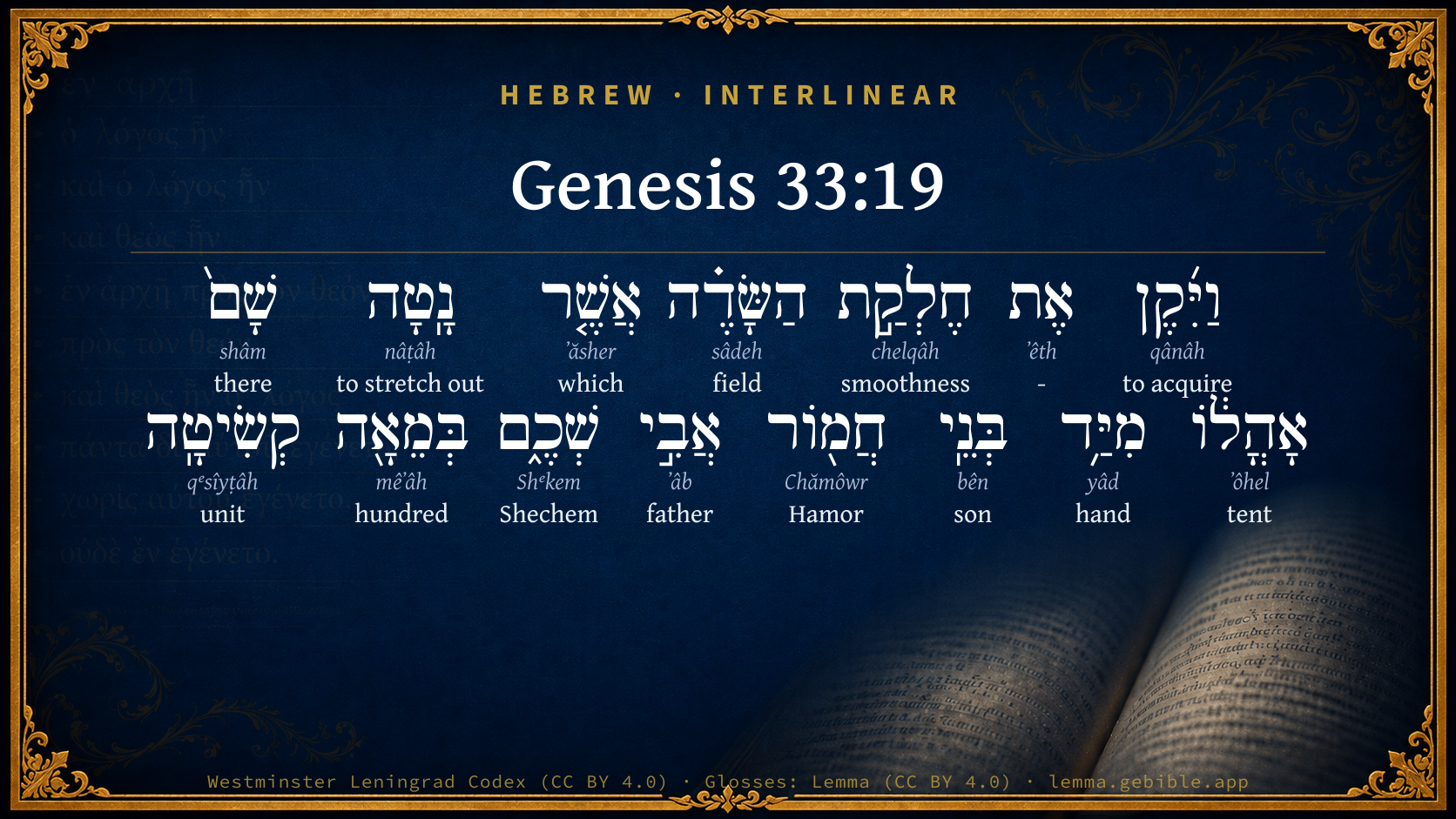
Hebrew (Westminster Leningrad Codex) Genesis 33:19 appears in the Hebrew Old Testament. The text above is from the Westminster Leningrad Codex. Each word links to its Strong’s number, a concise gloss, and parsing drawn from the Open Scriptures Hebrew Bible morphology. Click any word for its full Brown-Driver-Briggs (BDB) entry.
Download image
Cite this verse

Genesis 33:19 (World English Bible). Public Domain. Lemma interlinear Bible study tool, https://lemma.gebible.app/v/genesis/33/19.

Show BibTeX & RIS
BibTeX
RIS
English Translation
He bought the parcel of ground, where he had spread his tent, at the hand of the children of Hamor, Shechem's father, for one hundred pieces of money.
World English Bible · Public Domain
Highlights
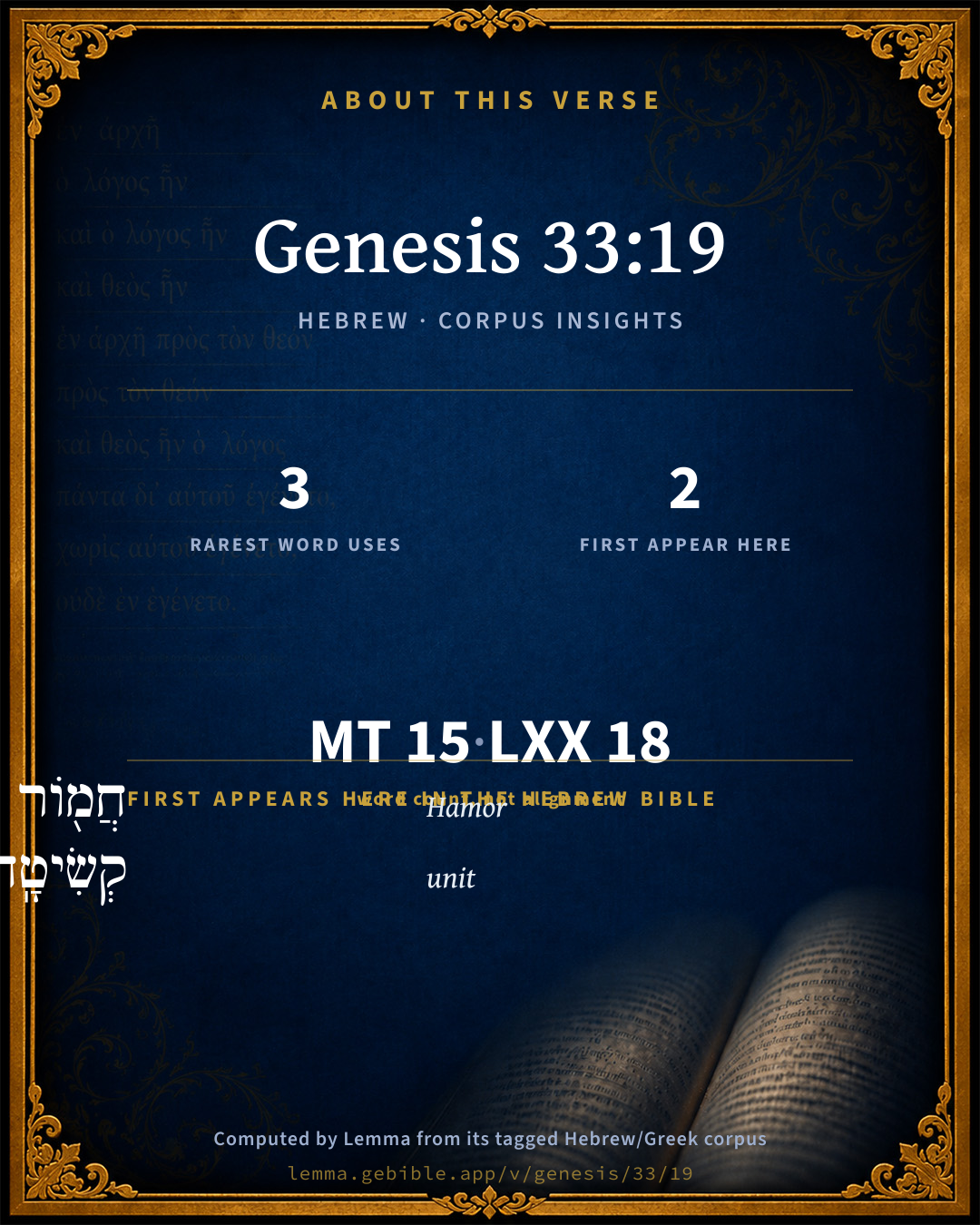
  • 2 first appearances in the Hebrew Bible
Full analysis ↓
Download a study sheet

One document with this verse’s original text, its word-by-word gloss line, the meaning frame, cross-references with their text, attributed commentary, and full source and license credits — printable, and it pastes into notes with its structure intact.

This verse Autodidact and up

Study sheet (.html) Plain text (.txt)

A passage Seminary Student

Up to 50 verses in one chapter. A passage sheet keeps up to 6 commentary sources and 12 cross-references per verse, in the order this page ranks them, and says so on the sheet whenever that leaves anything out. Ask for a single verse and you get the Autodidact verse sheet above.

Everything on this page stays free to read, with no account — the sheet is a download of what is already on screen, not access to it.

Want to remove ads? Support Godless Engineer
Compare translations 3

The same verse in 3 English versions, stacked beneath the original-language interlinear above. Click any original word for its lexicon entry.

Each is an independent rendering of the whole verse — the interlinear is not word-aligned to these translations.

Highlighted words mark where these versions differ — a whole-verse word diff, not a word-by-word alignment.

  • World English Bible Public Domain
    He bought the parcel of ground, where he had spread his tent, at the hand of the children of Hamor, Shechem's father, for one hundred pieces of money.
  • King James Version Public Domain
    And he bought a parcel of a field, where he had spread his tent, at the hand of the children of Hamor, Shechem's father, for an hundred pieces of money.
  • unfoldingWord Literal Text CC BY-SA 4.0
    And he bought the portion of the field where he pitched his tent from the hand of the sons of Hamor, the father of Shechem, for a hundred kesitahs.

unfoldingWord Literal Text — © unfoldingWord, licensed CC BY-SA 4.0. Word-aligned USFM3 via Door43 (git.door43.org/unfoldingWord/en_ult).

Versions to compare (up to 4)

3 of 4 selected

Show all 18 translations

Every available English version of this verse, each an independent rendering of the whole verse.

  • World English Bible Public Domain
    He bought the parcel of ground, where he had spread his tent, at the hand of the children of Hamor, Shechem's father, for one hundred pieces of money.
  • Berean Standard Bible Public Domain
    And the plot of ground where he pitched his tent, he purchased from the sons of Hamor, Shechem’s father, for a hundred pieces of silver.
  • Majority Standard Bible Public Domain
    And the plot of ground where he pitched his tent, he purchased from the sons of Hamor, Shechem’s father, for a hundred pieces of silver.
  • King James Version Public Domain
    And he bought a parcel of a field, where he had spread his tent, at the hand of the children of Hamor, Shechem's father, for an hundred pieces of money.
  • American Standard Version (1901) Public Domain
    And he bought the parcel of ground, where he had spread his tent, at the hand of the children of Hamor, Shechem's father, for a hundred pieces of money.
  • Revised Version (1885) Public Domain
    And he bought the parcel of ground, where he had spread his tent, at the hand of the children of Hamor, Shechem’s father, for an hundred pieces of money.
  • Geneva Bible (1599) Public Domain
    And there he bought a parcell of ground, where hee pitched his tent, at the hande of the sonnes of Hamor Shechems father, for an hundreth pieces of money.
  • Douay-Rheims (1899) Public Domain
    And he bought that part of the field, in which he pitched his tents, of the children of Hemor, the father of Sichem for a hundred lambs.
  • Young's Literal Translation Public Domain
    and he buyeth the portion of the field where he hath stretched out his tent, from the hand of the sons of Hamor, father of Shechem, for a hundred kesitah;
  • Literal Standard Version CC BY-SA 4.0
    and he buys the portion of the field where he has stretched out his tent, from the hand of the sons of Hamor, father of Shechem, for one hundred kesitah;
  • Unlocked Literal Bible CC BY-SA 4.0
    Then he bought the piece of ground where he had pitched his tent from the sons of Hamor, Shechem's father, for a hundred pieces of silver.
  • unfoldingWord Literal Text CC BY-SA 4.0
    And he bought the portion of the field where he pitched his tent from the hand of the sons of Hamor, the father of Shechem, for a hundred kesitahs.
  • Darby Bible Public Domain
    And he bought the portion of the field where he had spread his tent, of the hand of the sons of Hamor, Shechem's father, for a hundred kesitahs.
  • World Messianic Bible Public Domain
    He bought the parcel of ground where he had spread his tent, at the hand of the children of Hamor, Shechem’s father, for one hundred pieces of money.
  • Webster's Bible Public Domain
    And he bought a part of a field, where he had spread his tent, at the hand of the children of Hamor, Shechem's father, for a hundred pieces of money.
  • Free Bible Version CC BY-SA 4.0
    He bought the plot of ground where he was camping from the sons of Hamor, the founder of Shechem, for 100 pieces of money.
  • Bible in Basic English Public Domain
    And for a hundred bits of money he got from the children of Hamor, the builder of Shechem, the field in which he had put up his tents.
  • JPS Tanakh (1917) Public Domain
    And he bought the parcel of ground, where he had spread his tent, at the hand of the children of Hamor, Shechem's father, for a hundred pieces of money.

Literal Standard Version (2020), Covenant Press — licensed CC BY-SA 4.0. Text via the HelloAO Bible API (eBible.org). Unlocked Literal Bible (unfoldingWord) — licensed CC BY-SA 4.0. Text via the HelloAO Bible API (eBible.org). unfoldingWord Literal Text — © unfoldingWord, licensed CC BY-SA 4.0. Word-aligned USFM3 via Door43 (git.door43.org/unfoldingWord/en_ult). Free Bible Version, Dr. Jonathan Gallagher — licensed CC BY-SA 4.0. Text via the HelloAO Bible API (eBible.org).

Word by word

More ways to search: Search by grammar → Find every occurrence → Compare this word →

Practice this passage: Drill this verse → Learn its vocabulary →

קְשִׂיטָֽה
qᵉsîyṭâh
H7192
“unit”
Noun, Common, Feminine, Singular, Absolute
Part of Speech
Noun
Type
Common
Gender
Feminine
Number
Singular
State
Absolute
Full BDB Definition

Origin: from an unused root (probably meaning to weigh out)

TWOT: 2081a

a unit of unknown value - perhaps weight, money
  1. וַיִּ֜קֶן qânâh H7069 “and · to acquire” Conjunction + Verb, Qal, Sequential Imperfect, 3rd Person, Masculine, Singular
  2. אֶת ʼêth H853 “-” Particle, Direct Object
  3. חֶלְקַ֣ת chelqâh H2513 “smoothness of” Noun, Common, Feminine, Singular, Construct
  4. הַשָּׂדֶ֗ה sâdeh H7704 “the · field” Particle, Definite Article + Noun, Common, Masculine, Singular, Absolute
  5. אֲשֶׁ֤ר ʼăsher H834 “which” Particle, Relative
  6. נָֽטָה nâṭâh H5186 “to stretch out” Verb, Qal, Perfect, 3rd Person, Masculine, Singular
  7. שָׁם֙ shâm H8033 “there” Adverb
  8. אָהֳל֔וֹ ʼôhel H168 “tent · his” Noun, Common, Masculine, Singular, Construct + Suffix, Personal, 3rd Person, Masculine, Singular
  9. מִיַּ֥ד yâd H3027 “from · hand of” Preposition + Noun, Common, Both, Singular, Construct
  10. בְּנֵֽי bên H1121 “sons of” Noun, Common, Masculine, Plural, Construct
  11. חֲמ֖וֹר Chămôwr H2544 “Hamor” Noun, Proper
  12. אֲבִ֣י ʼâb H1 “father of” Noun, Common, Masculine, Singular, Construct
  13. שְׁכֶ֑ם Shᵉkem H7927 “Shechem” Noun, Proper
  14. בְּמֵאָ֖ה mêʼâh H3967 “in/at · hundred” Preposition + Adjective, Cardinal number, Both, Singular, Absolute

About this verse

These counts appear in no published source. They are computed here, from the morphology-tagged text and Lemma’s own curated glosses. What Lemma adds →

15
words
15
distinct lemmas
Pentateuch
section

Notable vocabulary

The rarest word here is קְשִׂיטָֽה unit H7192 — appearing just 3 times in the whole Hebrew Bible.

First appearance in Scripture

These words make their first canonical appearance in the Hebrew Bible here:

  • חֲמ֖וֹר Hamor H2544
  • קְשִׂיטָֽה unit H7192

Shared distinctive vocabulary

קְשִׂיטָֽה unit H7192 occurs in 3 verses of the Hebrew Bible. Also found in:

Grammatical profile

  • 2 verbs
  • 9 nouns
  • 1 adjective
  • 1 adverb
  • 2 particles

Verb forms

  • וַיִּ֜קֶן Qal · Sequential Imperfect
  • נָֽטָה Qal · Perfect

Hebrew & Septuagint length

In English translation the verse runs 28 words from the Hebrew and 23 from the Septuagint (LXX English) — closely comparable.

A rough comparison of the two English renderings, which tokenize alike — not a word-level alignment.

Word counts can differ between the Hebrew and the Greek without any difference in meaning — e.g. the Hebrew direct-object marker אֵת has no separate Greek word, and Greek often adds the article ὁ.

In the original languages it is 15 Hebrew tokens and 18 Greek tokens — but the two are counted differently (Hebrew bundles its prefixes and suffixes into one token; the Greek is in lemma form), so that isn’t a like-for-like length.

Cross-references

6

Topical passages linked to Genesis 33:19 in the Treasury of Scripture Knowledge — connected by theme and wording, ordered by reader-vote popularity; previews shown in the World English Bible.

  • John 4:5 So he came to a city of Samaria, called Sychar, near the parcel of ground that Jacob gave to his son, Joseph.
  • Acts 7:16 and they were brought back to Shechem, and laid in the tomb that Abraham bought for a price in silver from the children of Hamor of Shechem.
  • Joshua 24:32 The bones of Joseph, which the children of Israel brought up out of Egypt, buried they in Shechem, in the parcel of ground which Jacob bought of the sons of Hamor the father of Shechem for a hundred pieces of money: and they became the inheritance of the children of Joseph.
  • Genesis 23:17–20 So the field of Ephron, which was in Machpelah, which was before Mamre, the field, the cave which was therein, and all the trees that were in the field, that were in all the border of it round about, were made sure
  • Genesis 34:2–31 Shechem the son of Hamor the Hivite, the prince of the land, saw her. He took her, lay with her, and humbled her.
  • Genesis 49:30–32 in the cave that is in the field of Machpelah, which is before Mamre, in the land of Canaan, which Abraham bought with the field from Ephron the Hittite as a burial place.

Cross-references courtesy of OpenBible.info (CC BY 4.0).

Hebrew and Greek witnesses Masoretic Hebrew ↔ Greek Septuagint

The same verse in the two great witnesses to the Old Testament, shown verse-for-verse.

These are two independent witnesses, not word-aligned to each other, and the Septuagint is shown in lemma (dictionary) form.

Hebrew Genesis 33:19 Masoretic · Westminster Leningrad Codex

וַיִּ֜קֶן אֶת חֶלְקַ֣ת הַשָּׂדֶ֗ה אֲשֶׁ֤ר נָֽטָה שָׁם֙ אָהֳל֔וֹ מִיַּ֥ד בְּנֵֽי חֲמ֖וֹר אֲבִ֣י שְׁכֶ֑ם בְּמֵאָ֖ה קְשִׂיטָֽה

He bought the parcel of ground, where he had spread his tent, at the hand of the children of Hamor, Shechem's father, for one hundred pieces of money.

World English Bible · Public Domain

Greek LXX Genesis 33:19 Septuagint · lemma form

καί κτάομαι ὁ μερίς ὁ ἀγρός οὗ ἵστημι ἐκεῖ ὁ σκηνή αὐτός παρά εμμωρ πατήρ συχεμ ἑκατόν ἀμνός

And he bought the portion of the field, where he pitched his tent, of Emmor the father of Sychem, for one hundred lambs.

LXX2012 (modern English Septuagint) · Public Domain

On this verse, The Cambridge Bible for Schools and Colleges discusses the Septuagint’s reading. Read the note in Commentary ↓

Hebrew: Westminster Leningrad Codex (CC BY 4.0). Greek: Septuagint (public domain); English from LXX2012 (modern English Septuagint) (Public Domain). How the Septuagint differs from the Hebrew →

Targum (Aramaic paraphrase)

2

The Targum is the ancient Jewish Aramaic paraphrase of the Hebrew Scriptures — an interpretive translation, not the Hebrew text itself. Onkelos (literal) and Pseudo-Jonathan (expansive) render the Torah, and Jonathan the Prophets. Coverage is partial: where no permissively-licensed English translation exists for a verse, only the Aramaic is shown. This is verse-level text, not a word-by-word alignment to the Hebrew.

  1. Targum Onkelos Torah (Genesis–Deuteronomy)
    וּזְבַן יָת אַחֲסָנַת חַקְלָא דִּי פְרַס תַּמָּן מַשְׁכְּנֵהּ מִידָא דִּבְנֵי חֲמוֹר אֲבוּהִי דִּשְׁכֶם בְּמֵאָה חוּרְפָן

    (no public-domain English translation for this verse)

    Targum Onkelos — Aramaic: “Onkelos Genesis” (public domain); “Onkelos Exodus” (public domain); “Onkelos Leviticus” (public domain); “Onkelos Numbers” (public domain); “Onkelos Deuteronomy” (public domain). English: “Sefaria Community Translation” (CC0 1.0 (public-domain dedication)); “J.W. Etheridge. The Targums of Onkelos and Jonathan Ben Uzziel on the Pentateuch. London: Longmans, Green, 1862” (public domain). Text via Sefaria.

  2. Targum Pseudo-Jonathan Torah (Genesis–Deuteronomy)
    וּזְבַן יַת אַחֲסָנַת חֲקַל דִפְרַס תַּמָן מַשְׁכְּנֵיהּ מִן יַד בְּנֵי חֲמוֹר אָבוּי דִשְׁכֶם בְּמֵאָה מַרְגַלְיָין

    and bought the possession of a field where lie spread his tent from the hand of the sons of Hamor father of Shekem, for a hundred pearls.

    Targum Pseudo-Jonathan — Aramaic: “Targum Jonathan on Genesis” (public domain); “Targum Jonathan on Exodus” (public domain); “Targum Jonathan on Leviticus” (public domain); “Targum Jonathan on Numbers” (public domain); “Targum Jonathan on Deuteronomy” (public domain). English: “The Targum of Jonathan ben Uzziel, trans. J. W. Etheridge, London, 1862” (public domain). Text via Sefaria.

Commentary

Notes on Genesis 33:19 from classic Christian and Jewish commentators (each source and its license shown beneath its notes). The classic Christian expositions comment on the surrounding passage and are grouped to its opening verse, so a note may address several verses; the Jewish commentaries on the Tanakh (Rashi and others) are per-verse, so they appear only where the commentator wrote on this verse.

Lemma curates 59 commentaries, every one of them public domain or Creative Commons licensed, each selected and text-cleaned for this edition rather than reprinted as found. About our sources →

Trapp's Complete Commentary

John Trapp

Gen 33:19 And he bought a parcel of a field, where he had spread his tent, at the hand of the children of Hamor, Shechem’s father, for an hundred pieces of money.

Ver. 19. For an hundred pieces of money.] Heb., Lambs, - as {a} we call angels, Jacobuses, - because stamped with the image of a lamb. So Jos 24:32, marg.; Job 42:11.

{a} Sic pecunia, a pecude.

John Trapp, A Commentary or Exposition upon All the Books of the Old and New Testament (1647–1656) — public domain. Text from a community e-Sword module.

The Biblical Illustrator

Joseph S. Exell

Gen_33:19-20

And he bought a parcel of a field

Jacobs faith and piety

I.

HIS FAITH. He bought a parcel of ground as a pledge of his faith in the future possession of that country by his posterity (Gen_33:19). This purchase of a portion of land, concerning which God had promised Abraham that it should be his, showed Jacobs deep conviction that the promise was renewed to him and to his seed.

II. HIS PIETY. This was an evidence of his faith. He gave himself up entirely to God, and this inward feeling was expressed outwardly by acts of obedience and devotion. His piety is seen--

1. In an act of worship. He erected there an altar. This was in keeping with his vow (Gen_28:21).

2. In the use of blessings already given. He called the altar El-Elohe-Israel (Gen_33:20). He now uses his own new name, Israel, for the first time, in association with the name of God. He uses that name which signifies the Mighty One, who was now his covenant God. He lives up to his privilege, uses all that God had given. He had vowed that he would take the Lord to be his God.

3. In the peace he enjoyed. He arrived in peace at his journeys end (Gen_33:18). (T. H. Leale.)

Lessons

1. Jacob and his seed desire to usurp nothing but what they buy from the world.

2. Gods pilgrims mind no great purchase below, but only a place for a tent: a little place.

3. It is lawful for Jacob to deal with Canaanites in just exchanges (Gen_33:19).

4. Saints would not have a house but that God should dwell in 2:5. Succeeding saints repair religion and the means of the exercise of it, set up by progenitors.

6. Altarworship, or worship by Christ, is that which saints have ever practised.

7. True religion is terminated in the Almighty God.

8. Religious worship is the true memorial of Gods making His Church truly Israel (Gen_2:20). (G. Hughes, B. D.)

He erected there an altar

The family altar

By calling this altar El-Elohe-Israel, or God the God of Israel, it was virtually saying, I erect this altar for the worship of my family, to the God with whom I have prevailed in supplication, and who has proved Himself the hearer of my prayer. Such an altar should there be in every household; and, without further special reference to our text, I proceed to the subject I have chosen for this occasion,, namely, that of family worship.

1. We may remark, first, that it is clearly the duty of every family to maintain such worship.

2. We may pass on, therefore, in the second place, to the advantages of family worship. Among its lesser benefits, we may remark in passing that, rightly conducted, it makes a profitable impression upon those out of the family, who may chance to witness it. Family worship is also of unspeakable advantage in maintaining all the other institutions of our holy religion. We can hardly enumerate the advantages of family worship to the household itself. That it draws down the blessing of God upon the domestic circle needs no proof, for we have for our encouragement, not only the general promises made to prayer, but the special assurance that where two or three are gathered together in Christs name He will be with them; and we have farther, the evidence of actual experience. If we value the salvation of our loved ones we shall not neglect this means of securing it. The restraining influence of domestic worship upon all the annoyances and disturbers of domestic peace is most powerful and valuable. Who can kneel down and pray daily before his family against a sin which he habitually commits? How can the inmates of a dwelling cherish unkind feelings towards each other while united in common prayer?

3. We may next notice the manner in which family devotions may best be performed.

4. Our last point will be to notice the objections and difficulties which are commonly opposed to the duty. One may reply, that all these arguments and statements may be very good and true, but that he makes no profession of religion, and it would be improper, therefore, for him to set up family worship. Why so? Is it wrong for him to pray in secret, or in the house of God, or to give his children religious instruction? And why any more so to pray in the family? (W. H. Lewis, D. D.)

Jacobs thankfulness after deliverance

See the practice of faithful men, ever when God hath been merciful to them, and delivered them out of danger. Now Jacob buildeth an altar in the true thankfulness of his soul unto God for this great mercy and deliverance of him from his brother Esau. And he calleth it the mighty God of Israel: giving to the sign the name of the thing which it signified, which is usual in the Scripture. Thus would God it might kindle some heat in our hearts and consciences, to consider ourselves, the dangers we have been in our days, the dangers of the land wherein we inhabit. The dangers of wife, children, and friends, and now our safety and deliverance from all our fears. For this hath the Lord done for us, and whatsoever it is in our eyes, surely it is wonderful even through the world. But where now are our altars? That is, where are our thanks and most grateful songs for our deliverance? We have found mercy as Jacob did; yea, for more, for greater Esaus have come against us, than did against him, not with four hundred men, but many thousands, to captivate us for ever as their slaves when they had slain their fill. And yet we live, and by God only who hath strangely revenged us upon them that would thus have eaten us up. That is, as I say again, we give not thanks for the custom of our time, as he did after the manner of his. At the first peradventure we did, but it was soon at an end. Now are we fallen into a deep sleep again, and both God and His mercy is forgotten. Our danger also, as if it had never been. But in the Lord I beseech you, let us awake again, look upon Jacob here what he cloth, and every man and woman follow his example. Build God an altar, not in earth with lime and stone, but in your heart of most kind and thankful remembrance for all His mercies to the land, to our dread sovereign, to ourselves, our souls and bodies, to our wives and children, to our neighbours and friends, and infinite ways that we cannot name. Bless His majesty for them, and let not the remembrance die, till you die yourself. A thankful heart is all that the Lord seeketh, and it is all that indeed we can do to Him. (Bp. Babington.)

.

The Biblical Illustrator, edited by Joseph S. Exell (c. 1880s–1900s) — public domain. Text from a community e-Sword module.

Geneva Bible (1599)

Geneva Bible translators

Or, lambs, or money so marked.

Geneva Bible (1599) marginal notes — public domain. Text via Bolls.life.

Jamieson, Fausset & Brown

Robert Jamieson, A. R. Fausset & David Brown

an hundred pieces of money--literally, "lambs"; probably a coin with the figure of a lamb on it.

Jamieson, Fausset & Brown — Commentary Critical and Explanatory on the Whole Bible (1871) — public domain (CC PDM 1.0). Text via the HelloAO Bible API.

Adam Clarke's Commentary

Verse 19. For a hundred pieces of money.] The original, במאה קשיטה bemeah kesitah, has been a matter of long and learned discussion among critics. As kesitah signifies a lamb, it may imply that Jacob gave the Hamorites one hundred lambs for the field; but if it be the same transaction that St. Stephen refers to in Ac 7:16, it was money, τιμης αργυριον, a sum or price of silver, which was given on the occasion. It has been conjectured that the money had the figure of a lamb stamped on it, because it was on an average the value of a lamb; and hence it might be called a kesitah or lamb from the impression it bore. It is certain that in many countries the coin has had its name from the image it bore; so among our ancestors a coin was called an angel because it bore the image of an angel; hence also a Jacobus, a Carolus, a Lewis, (Louis d' Or,) a Joe, because certain coins in England, Spain, France, and Portugal, bore on one side the image of the kings of those countries, James, Charles, Lewis, Joseph, or Johannes. The Athenians had a coin called bouv, an ox, because it was stamped with the figure of an ox. Hence the saying in AEschylus:

Τα δ' αλλα σιγω, βους επι γλωττης μεγας Βεβηκεν

AGAM. v. 36.

"I must be silent concerning other matters, a great ox has come upon my tongue;" to signify a person who had received a bribe for secrecy, i.e., a sum of money, on each piece of which an ox was stamped, and hence called βουσ, an ox. The word opes, riches, is a corruption of the word oves, sheep, because these animals in ancient times constituted the principal riches of their owners; but when other cattle were added, the word pecunia, (from pecus, cattle,) which we translate money, and from which we still have our English term pecuniary, appears to have been substituted for oves, because pecus, pecoris, and pecus, pecudis, were used to signify all kinds of cattle large and small. Among our British and Saxon ancestors we find coins stamped with the figure of an ox, horse, hog, goat, c., and this custom arose in all probability, both among them and other nations, from this circumstance, that in primitive times the coin was the ordinary value of the animal whose image it bore. It is, all circumstances weighed, most likely that a piece of money is here intended, and possibly marked with the image of a lamb but as the original word קשיטה kesitah occurs only here, and in Jos 24:32, and Job 42:11, this is not sufficiently evident, the word itself being of very doubtful signification. Mr. Parkhurst is of opinion that the kesitah bore the image of a lamb; and that these lamb coins of the ancient Hebrews typified the Lamb of God, who in the Divine purpose was considered as slain from the foundation of the world, and who purchased us unto God with his own blood. The conjecture is at least pious, and should lead to useful reflections. Those who wish to see more on this subject may consult the writers in the Critici Sacri, and Calmet.

Adam Clarke's Commentary on the Bible (1810–1826) — public domain. Text from a community e-Sword/MySword module.

Ellicott's Commentary for English Readers

(19) He bought . . . —Abraham had been obliged to buy land for a burial-place, and we find even then that the field he wanted had an owner who could give him a title to its possession. Jacob a century later finds it necessary to buy even the ground on which to pitch his tent, though his cattle might still roam freely about for pasture. This, however, would certainly not have been required except in the immediate neighbourhood of a town. As he had now recovered from his sprain, he returns to his habits as a nomad, and dwells in a tent. In this, the first parcel of ground possessed by Jacob, the embalmed body of Joseph was buried (Jos_24:32; see also Joh_4:5); and it is remarkable that the possession of it was secure, even when the owners were far away in Egypt.

An hundred pieces of money.—Heb., a hundred hesitas. It is plain that the kesita was an ingot of metal of some considerable value, from what is said in the Book of Job (Gen_42:11), that each of his friends gave the patriarch “one kesita and a nose-ring of gold.” The etymology of the word is uncertain, and apparently all knowledge of its meaning had at an early period passed away, inasmuch as Onkelos and some of the versions translate it lambs, for which rendering there is no support.

A Bible Commentary for English Readers, edited by Charles John Ellicott (1878–1897) — public domain. Text from a community e-Sword module.

The Cambridge Bible for Schools and Colleges

gen. ed. J. J. S. Perowne

19. the parcel of ground] or “the portion of the field.” Lat. partem agri. For “parcel,” Fr. “parcelle,” from Lat. particula, see Jos_24:32; Rth_4:3. Cf. “Many a thousand, Which now mistrust no parcel of my fear” (Shakespeare, 3 Hen. VI, Gen_33:6).

his tent] Jacob has resumed dwelling in tents, see Gen_33:17.

the children of Hamor, Shechem’s father] This apparently means the people of the tribe of Hamor; and Hamor was the founder, or chieftain, of the city of Shechem. The confusion between the “sons of Hamor, Shechem’s father,” and “Shechem the son of Hamor,” in Gen_34:2, caused LXX in this verse to omit “sons of.”

LXX, by rendering Συχέμ for the name of the man, and Σίκιμα (cf. Gen_12:6) for the name of the city, draws a distinction which it is not always possible to observe in English.

pieces of money] Heb. kesitah. Apparently a ḳesitah was a piece of metal used for money; elsewhere it is mentioned only in Jos_24:32; Job_42:11. Whether it denotes a small coin, or an ingot, cannot be determined. The versions, LXX, Lat. and Targ. Onkelos, render “lambs1[53]

[53] LXX (ἑκατὸν ἀμνῶν = “a hundred lambs”) “vel agnos ipsos intellegere potuerunt, vel nummos agnorum imagine signatos.” Schleusner, Lex. Vet. Test., s.v. ἀμνός.

”: Targ. Jon. and Jerus., “pearls.”

The purchase of this plot of ground was historically important. It was the burial-place of the bones of Joseph (cf. Jos_24:32; Act_7:16). The possession of such small pieces of territory (cf. the purchase of Machpelah ch. 23) constituted no claim for the possession of the country: the patriarchs were “strangers and sojourners,” Gen_23:4.

The Cambridge Bible for Schools and Colleges (gen. ed. J. J. S. Perowne; Cambridge University Press, 1878–1918) — public domain. Text from a community e-Sword module.

John Gill's Exposition

And he erected there an altar,.... To offer sacrifice upon to God, by way of thanksgiving, for the many mercies he had received since he went out of the land of Canaan, whither he was now returned; and especially for his safety in journeying hither from Padanaram, and for deliverance from Laban and Esau, and for all other favours that he and his had been partakers of. And this he also erected for the sake of religious worship, to be continued in his family; he intending to reside here for some time, as appears by the purchase he had made, and as it is certain he did:

and called it Elelohe-Israel: God, the God of Israel; that is, he called the altar the altar of God, who is the God of Israel, who had been his God, his preserver and protector; and had lately given him the name of Israel, and had made good what answered to it, and was designed by it, that as he had had power with God, and prevailed, so he should with man; and as a memorial of all these favours and mercies, he erected this altar, and devoted it to God and his service, and called it by this name: or "he called upon God, the God of Israel", as the Septuagint and Vulgate Latin versions; he prayed unto him at the time he offered sacrifice on the altar, and gave him praise for all the great and good things he had done for him. Jacob must have stayed at Succoth, and at this place, many years, especially at the latter; since, when he came into those parts, Dinah was a child of little more than six years of age, and Simeon and Levi were very young, not above eleven or twelve years of age; and yet, before he left Shechem, Dinah was marriageable, and Simeon and Levi were grown strong and able bodied men, and did a most strange exploit in slaying all the males in Shechem, as recorded in the next chapter.

Next: Genesis Chapter 34

John Gill's Exposition of the Whole Bible (1746–1763) — public domain (CC PDM 1.0). Text via the HelloAO Bible API.

Haydock's Catholic Bible Commentary

Lambs. Hebrew, Kossite, or Kesita, a word which occurs also, Josue xxvi. 32, and Job xlii. 11; and may signify lambs, or a species of money, marked perhaps with their figure. It may also denote pearls, coral, a vessel, or purse of good money. St. Stephen, Acts vii. 19, mentions the price of money. But he probably speaks of the bargain made by Abraham with Ephron, son of Heth, for which some have substituted Hemor, the son of Sichem. Kista in the Chaldean means a vessel or measure; and we learn from Herodotus iii. 130, that the Persians were accustomed to keep their money in this manner. In the Chaldean, Syriac, and Arabic languages, there are words derived from the same root as Kesita, which mean purity, perfection; and thus what Jacob gave was good current money; (Calmet) or such things as we received among merchants.

George Leo Haydock (1774–1849), Haydock's Catholic Family Bible and Commentary, 1859 edition — public domain. Excludes Psalms (Douay-Rheims chapter numbering differs from Protestant) and Deuterocanonical books (Catholic canon only).

Matthew Poole's English Annotations

He bought a parcel of a field for his present possession and use; for the right which he had to it was only in reversion after the time that God had allotted for it.

The children of Hamor, i.e. subjects, called his children to note the duty which they owed to him, and the care and affection that he owed to them. Compare Num 11:12.

An hundred pieces of money. The word is used only here, and Jos 24:32; Job 42:11, and it may signify either lambs, given in way of exchange for it, or pieces of money, which seems more probable, both by comparing Act 7:16, and because money was come into use in that place and time, Gen 17:12,13; 23:16; 47:16, which were called lambs possibly from the fignre of a lamb stamped upon it, as the Athenian money was called an ox for the like reason, and as we call a piece of gold a Jacobus, because the picture of that king is upon it.

Matthew Poole's English Annotations on the Holy Bible (1683–1685) — public domain. Text from a community e-Sword/MySword module.

Whedon's Commentary on the Bible

Daniel D. Whedon

19. Bought a parcel of a field — Rather, the portion of the field. Abraham’s only purchase of land was a place to bury his dead; Jacob now probably found the land more thickly settled, and found it necessary to buy land in order to dwell in peace. On this same land he dug the famous well at which the Saviour taught the Samaritan woman. Joh_4:5-6; Joh_4:12.

Hundred pieces of money — Hebrews, a hundred kesitah. The Sept. and Vulg. render a hundred lambs, a sense, says Gesenius, “which has no support either from etymology or in the kindred dialects, nor is it in accordance with patriarchal usages.” The word means some sort of money, in precious metal, weighed out, as Abraham weighed out the silver for Machpelah, (xxiii, 16,) but the exact value of a hundred kesitah cannot now be ascertained.

Daniel D. Whedon (gen. ed.), Commentary on the Old and New Testaments (1874–1909) — public domain. Text from a community e-Sword module.

The Pulpit Commentary

And he bought a parcel of a field, literally, the portion (from a root signifying to divide) of the fieldwhere he had spread his tent, and in which he afterwards sank a well (cf. Joh_4:6) at the hand of the children of Homer, Shechem"s father (after whom the town was named, ut supra), for a hundred pieces of money or kesitahs, the etymology of which is uncertain (Kalisch), though connected by some philologists (Gesenius, Furst) with kasat, to weigh; translated lambs (Onkelos, LXX, Vulgate), but believed to have been a certain weight now unknown (Michaelis, "Suppl.," p. 2207), or a piece of money of a definite value, perhaps the price of a lamb (Murphy), which, like the shekel, was used for purposes of commercial exchange by the patriarchs (Gesenius) probably a coin stamped with the figure of a lamb (Bochart, Munter); but coined money does not appear to have been of so great antiquity (Rosenm Wordsworth, Alford).

The Pulpit Commentary (1880–1919), ed. H.D.M. Spence-Jones & Joseph S. Exell — public domain. Text from a community e-Sword module.

Scofield Reference Notes

C. I. Scofield

Shechem’s

Called "Sychem," Act 7:16.

The Scofield Reference Bible (1917 edition), notes by C. I. Scofield — public domain. Text from a community e-Sword module.

Rashi

Rabbi Shlomo Yitzchaki (Rashi)

קשיטה is a Meah (a certain coin) — Rabbi Akiba said, “When I visited the coast-towns I found that they called a Meah a Kesittah (Rosh Hashanah 26a). In the Targum it is rendered by חורפן good ones, current everywhere: the same idea as (23:16) “current with the merchant.

Rashi on the Tanakh — English translations: “The Judaica Press complete Tanach with Rashi, translated by A. J. Rosenberg” (CC BY 4.0); “Pentateuch with Rashi's commentary by M. Rosenbaum and A.M. Silbermann, 1929-1934” (public domain); “The Metsudah Tanach series, Lakewood, N.J” (CC BY 4.0); and “The Book of Joshua, Metsudah Publications, 1997” (CC BY 4.0). Text via Sefaria.

Radak

Rabbi David Kimhi (Radak)

ויקן...מיד בני חמור, the Torah does not write “from Chamor,” but from “the sons of Chamor” who was the father of Shechem, as perhaps the land had belonged to the sons and not to him.

אבי שכם, seeing that the son was so distinguished the father is identified by reference to his son.

במאה קשיטה, silver coins. According to our sages in Rosh Hashanah 26 Rabbi Akiva once reported that while he walked in a place called Arabia he heard that the local people called a certain coin equivalent to a מעה in the land of Israel a קשיטה. According to Onkelos the meaning of קשיטה may be חורפן, “young lambs.” He translated it as such also in 21,28

Radak on the Tanakh — English translations: “Sefaria Community Translation” (CC0 1.0 (public-domain dedication)); “Eliyahu Munk, HaChut Hameshulash” (CC BY 4.0); “Rabbi Mike Feuer, Jerusalem Anthology” (CC BY 4.0); and “R. David Kimhi on the first book of Psalms, Translated by R.G. Finch, London, 1919” (public domain). Text via Sefaria.

Ibn Ezra

Rabbi Abraham ibn Ezra

The part of the field. One who acquires a portion in the Holy Land is likened to one who acquires a portion in the World to Come.

Ibn Ezra on the Tanakh — English translations: “Sefaria Community Translation” (CC0 1.0 (public-domain dedication)); “Yalkut, Sifsei Chachomim Chumash, Metsudah Publications, 2009” (CC BY 4.0); and “Commentary of Ibn Ezra on Isaiah - trans. by M. Friedlander, 1873” (public domain). Text via Sefaria.

Lesson kit

Teaching starters — assembled from the data on this page, not authored interpretation. Every prompt links to the verse data it draws on. Edit before teaching.

Genesis, in the Pentateuch, opens this verse with 15 words (15 distinct Hebrew lemmas). Its most distinctive word is qᵉsîyṭâh (“unit”). A historical commentator’s framing appears above. Read the whole chapter for the surrounding context.

Discussion questions

  1. The word qᵉsîyṭâh carries the sense “unit.” How does it shape the verse?
  2. 2 words here appear for the first time in Scripture. What is being introduced at this debut?
  3. Joshua 24:32 shares the word «unit» with this verse. How do the two illuminate each other?
  4. The translations on this page render this verse differently — a whole-verse word diff, not a word-by-word alignment. What might account for the different wordings?
  5. The verb «וַיִּ֜קֶן» is Qal Sequential Imperfect. How does its form color the action?
  6. Reading how Trapp's Complete Commentary and The Biblical Illustrator read this verse, where do the two commentators agree and where do they part?

Things to notice

Reading settings

Reading text

Shown beneath each verse's original-language words.

Old Testament
Old Testament edition

Read the OT as the Masoretic Hebrew (MT) or the Greek Septuagint (LXX).

English shown for the Greek Septuagint (in the Hebrew ↔ Greek comparison).

Comparing translations? Open the Compare panel on any verse page to stack up to four side by side.