Genesis 43:27

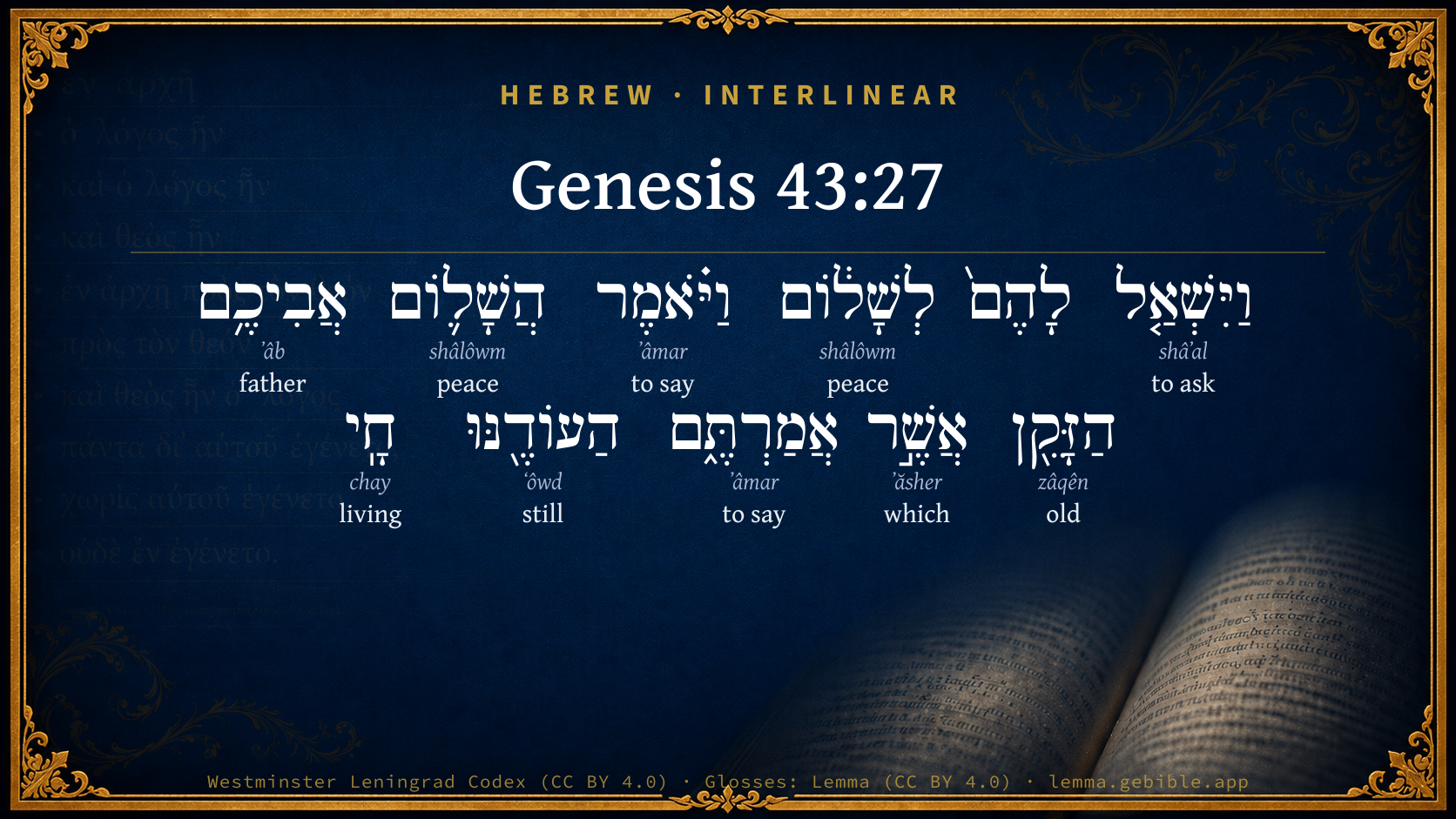
Hebrew (Westminster Leningrad Codex) Genesis 43:27 appears in the Hebrew Old Testament. The text above is from the Westminster Leningrad Codex. Each word links to its Strong’s number, a concise gloss, and parsing drawn from the Open Scriptures Hebrew Bible morphology. Click any word for its full Brown-Driver-Briggs (BDB) entry.
Download image
Cite this verse

Genesis 43:27 (World English Bible). Public Domain. Lemma interlinear Bible study tool, https://lemma.gebible.app/v/genesis/43/27.

Show BibTeX & RIS
BibTeX
RIS
English Translation
He asked them of their welfare, and said, "Is your father well, the old man of whom you spoke? Is he yet alive?"
World English Bible · Public Domain
Download a study sheet

One document with this verse’s original text, its word-by-word gloss line, the meaning frame, cross-references with their text, attributed commentary, and full source and license credits — printable, and it pastes into notes with its structure intact.

This verse Autodidact and up

Study sheet (.html) Plain text (.txt)

A passage Seminary Student

Up to 50 verses in one chapter. A passage sheet keeps up to 6 commentary sources and 12 cross-references per verse, in the order this page ranks them, and says so on the sheet whenever that leaves anything out. Ask for a single verse and you get the Autodidact verse sheet above.

Everything on this page stays free to read, with no account — the sheet is a download of what is already on screen, not access to it.

Want to remove ads? Support Godless Engineer
Compare translations 3

The same verse in 3 English versions, stacked beneath the original-language interlinear above. Click any original word for its lexicon entry.

Each is an independent rendering of the whole verse — the interlinear is not word-aligned to these translations.

Highlighted words mark where these versions differ — a whole-verse word diff, not a word-by-word alignment.

  • World English Bible Public Domain
    He asked them of their welfare, and said, "Is your father well, the old man of whom you spoke? Is he yet alive?"
  • King James Version Public Domain
    And he asked them of their welfare, and said, Is your father well, the old man of whom ye spake? Is he yet alive?
  • unfoldingWord Literal Text CC BY-SA 4.0
    Then he asked them about wellbeing, and he said, “ well your aged father whom you spoke about? Is he still alive?”

unfoldingWord Literal Text — © unfoldingWord, licensed CC BY-SA 4.0. Word-aligned USFM3 via Door43 (git.door43.org/unfoldingWord/en_ult).

Versions to compare (up to 4)

3 of 4 selected

Show all 18 translations

Every available English version of this verse, each an independent rendering of the whole verse.

  • World English Bible Public Domain
    He asked them of their welfare, and said, "Is your father well, the old man of whom you spoke? Is he yet alive?"
  • Berean Standard Bible Public Domain
    He asked if they were well, and then he asked, “How is your elderly father you told me about? Is he still alive?”
  • Majority Standard Bible Public Domain
    He asked if they were well, and then he asked, “How is your elderly father you told me about? Is he still alive?”
  • King James Version Public Domain
    And he asked them of their welfare, and said, Is your father well, the old man of whom ye spake? Is he yet alive?
  • American Standard Version (1901) Public Domain
    And he asked them of their welfare, and said, Is your father well, the old man of whom ye spake? Is he yet alive?
  • Revised Version (1885) Public Domain
    And he asked them of their welfare, and said, Is your father well, the old man of whom ye spake? Is he yet alive?
  • Geneva Bible (1599) Public Domain
    And he asked them of their prosperitie, and sayd, Is your father the olde man, of whome ye tolde me, in good health? is he yet aliue?
  • Douay-Rheims (1899) Public Domain
    But he, courteously saluting them again, asked them, saying: Is the old man your father in health, of whom uou told me? Is he yet living?
  • Young's Literal Translation Public Domain
    and he asketh of them of peace, and saith, `Is your father well? the aged man of whom ye have spoken, is he yet alive?'
  • Literal Standard Version CC BY-SA 4.0
    and he asks of them of peace and says, “Is your father well? The aged man of whom you have spoken, is he yet alive?”
  • Unlocked Literal Bible CC BY-SA 4.0
    He asked them about their welfare and said, “Is your father well, the old man of whom you spoke? Is he still alive?”
  • unfoldingWord Literal Text CC BY-SA 4.0
    Then he asked them about wellbeing, and he said, “ well your aged father whom you spoke about? Is he still alive?”
  • Darby Bible Public Domain
    And he asked them of their welfare, and said, Is your father well -- the old man of whom ye spoke? Is he yet alive?
  • World Messianic Bible Public Domain
    He asked them of their welfare, and said, “Is your father well, the old man of whom you spoke? Is he yet alive?”
  • Webster's Bible Public Domain
    \\43:28\\And they answered, Thy servant, our father, is in good health, he is yet alive: and they bowed their heads and made obeisance.
  • Free Bible Version CC BY-SA 4.0
    He asked how they were, and then he asked, “How is your elderly father doing that you spoke of? Is he still alive?”
  • Bible in Basic English Public Domain
    And they said, Your servant, our father, is well, he is still living. And they went down on their faces before him.
  • JPS Tanakh (1917) Public Domain
    And he asked them of their welfare, and said: 'Is your father well, the old man of whom ye spoke? Is he yet alive?'

Literal Standard Version (2020), Covenant Press — licensed CC BY-SA 4.0. Text via the HelloAO Bible API (eBible.org). Unlocked Literal Bible (unfoldingWord) — licensed CC BY-SA 4.0. Text via the HelloAO Bible API (eBible.org). unfoldingWord Literal Text — © unfoldingWord, licensed CC BY-SA 4.0. Word-aligned USFM3 via Door43 (git.door43.org/unfoldingWord/en_ult). Free Bible Version, Dr. Jonathan Gallagher — licensed CC BY-SA 4.0. Text via the HelloAO Bible API (eBible.org).

Word by word

More ways to search: Search by grammar → Find every occurrence → Compare this word →

Practice this passage: Drill this verse → Learn its vocabulary →

וַיִּשְׁאַ֤ל
shâʼal
H7592
“and · to ask”
Conjunction + Verb, Qal, Sequential Imperfect, 3rd Person, Masculine, Singular
Part of Speech
Conjunction + Verb
Stem
Qal
Form
Sequential Imperfect
Person
3rd Person
Gender
Masculine
Number
Singular
Full BDB Definition

Origin: a primitive root

TWOT: 2303

to ask, enquire, borrow, beg - (Qal) - to ask, ask for - to ask (as a favour), borrow - to enquire, enquire of - to enquire of, consult (of deity, oracle) - to seek - (Niphal) to ask for oneself, ask leave of absence - (Piel) - to enquire, enquire carefully - to beg, practise beggary - (Hiphil) - to be given on request - to grant, make over to, let (one) ask (successfully) or give or lend on request (then) grant or make over to
  1. לְשָׁל֔וֹם shâlôwm H7965 “to/for · peace” Preposition + Noun, Common, Masculine, Singular, Absolute
  2. וַיֹּ֗אמֶר ʼâmar H559 “and · to say” Conjunction + Verb, Qal, Sequential Imperfect, 3rd Person, Masculine, Singular
  3. הֲשָׁל֛וֹם shâlôwm H7965 “peace” Particle, Interrogative + Noun, Common, Masculine, Singular, Absolute
  4. אֲבִיכֶ֥ם ʼâb H1 “father · your” Noun, Common, Masculine, Singular, Construct + Suffix, Personal, 2nd Person, Masculine, Plural
  5. הַזָּקֵ֖ן zâqên H2205 “the · old” Particle, Definite Article + Adjective, Adjective, Masculine, Singular, Absolute
  6. אֲשֶׁ֣ר ʼăsher H834 “which” Particle, Relative
  7. אֲמַרְתֶּ֑ם ʼâmar H559 “to say” Verb, Qal, Perfect, 2nd Person, Masculine, Plural
  8. הַעוֹדֶ֖נּוּ ʻôwd H5750 “still · his” Particle, Interrogative + Adverb + Suffix, Personal, 3rd Person, Masculine, Singular
  9. חָֽי chay H2416 “living” Adjective, Adjective, Masculine, Singular, Absolute

About this verse

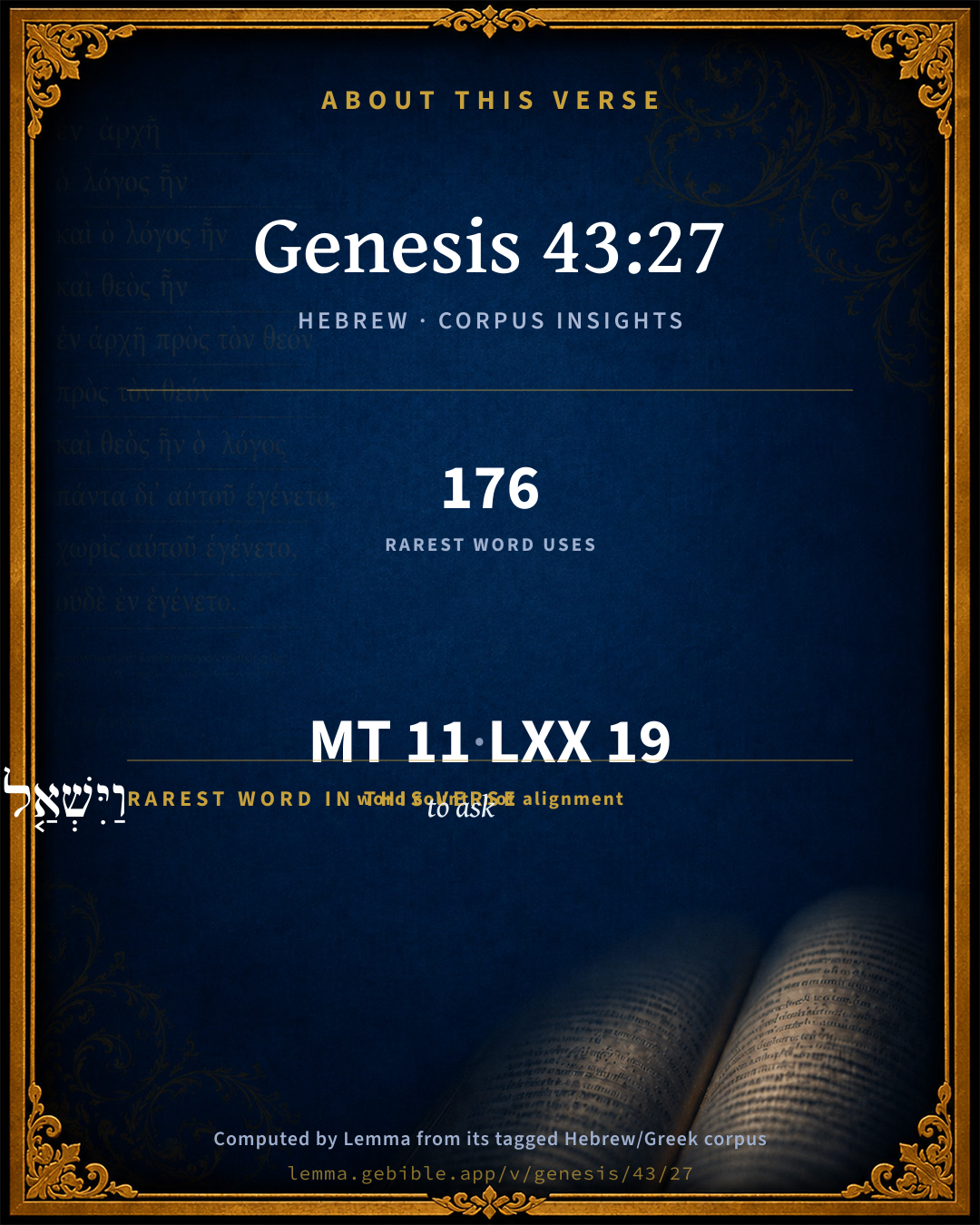
These counts appear in no published source. They are computed here, from the morphology-tagged text and Lemma’s own curated glosses. What Lemma adds →

11
words
8
distinct lemmas
Pentateuch
section

Grammatical profile

  • 3 verbs
  • 3 nouns
  • 2 adjectives
  • 1 preposition
  • 1 adverb
  • 1 particle

Verb forms

  • וַיִּשְׁאַ֤ל Qal · Sequential Imperfect
  • וַיֹּ֗אמֶר Qal · Sequential Imperfect
  • אֲמַרְתֶּ֑ם Qal · Perfect

Repetition

Words recur within this verse — often emphatic in Hebrew:

  • לְשָׁל֔וֹם peace H7965 ×2
  • וַיֹּ֗אמֶר to say H559 ×2

Hebrew & Septuagint length

In English translation the verse runs 23 words from the Hebrew and 27 from the Septuagint (LXX English) — closely comparable.

A rough comparison of the two English renderings, which tokenize alike — not a word-level alignment.

Word counts can differ between the Hebrew and the Greek without any difference in meaning — e.g. the Hebrew direct-object marker אֵת has no separate Greek word, and Greek often adds the article ὁ.

In the original languages it is 11 Hebrew tokens and 19 Greek tokens — but the two are counted differently (Hebrew bundles its prefixes and suffixes into one token; the Greek is in lemma form), so that isn’t a like-for-like length.

Cross-references

10

Topical passages linked to Genesis 43:27 in the Treasury of Scripture Knowledge — connected by theme and wording, ordered by reader-vote popularity; previews shown in the World English Bible.

  • Genesis 42:13 They said, "We, your servants, are twelve brothers, the sons of one man in the land of Canaan; and, behold, the youngest is this day with our father, and one is no more."
  • Genesis 37:14 He said to him, "Go now, see whether it is well with your brothers, and well with the flock; and bring me word again." So he sent him out of the valley of Hebron, and he came to Shechem.
  • Genesis 41:16 Joseph answered Pharaoh, saying, "It isn't in me. God will give Pharaoh an answer of peace."
  • Genesis 42:11 We are all one man's sons; we are honest men. Your servants are not spies."
  • Exodus 18:7 Moses went out to meet his father-in-law, and bowed and kissed him. They asked each other of their welfare, and they came into the tent.
  • Judges 18:15 They turned aside there, and came to the house of the young man the Levite, even to the house of Micah, and asked him of his welfare.
  • 1 Samuel 17:22 David left his baggage in the hand of the keeper of the baggage, and ran to the army, and came and greeted his brothers.
  • 1 Samuel 25:5 David sent ten young men, and David said to the young men, Go up to Carmel, and go to Nabal, and greet him in my name:
  • 1 Chronicles 18:10 he sent Hadoram his son to king David, to Greet him, and to bless him, because he had fought against Hadarezer and struck him; (for Hadarezer had wars with Tou;) and [he had with him] all manner of vessels of gold and silver and brass.
  • Genesis 43:7 They said, "The man asked directly concerning ourselves, and concerning our relatives, saying, 'Is your father still alive? Have you another brother?' We just answered his questions. Is there any way we could know that he would say, 'Bring your brother down?'"

Cross-references courtesy of OpenBible.info (CC BY 4.0).

Hebrew and Greek witnesses Masoretic Hebrew ↔ Greek Septuagint

The same verse in the two great witnesses to the Old Testament, shown verse-for-verse.

These are two independent witnesses, not word-aligned to each other, and the Septuagint is shown in lemma (dictionary) form.

Hebrew Genesis 43:27 Masoretic · Westminster Leningrad Codex

וַיִּשְׁאַ֤ל לָהֶם֙ לְשָׁל֔וֹם וַיֹּ֗אמֶר הֲשָׁל֛וֹם אֲבִיכֶ֥ם הַזָּקֵ֖ן אֲשֶׁ֣ר אֲמַרְתֶּ֑ם הַעוֹדֶ֖נּוּ חָֽי

He asked them of their welfare, and said, "Is your father well, the old man of whom you spoke? Is he yet alive?"

World English Bible · Public Domain

Greek LXX Genesis 43:27 Septuagint · lemma form

ἐρωτάω δέ αὐτός πῶς ἔχω καί εἶπον αὐτός εἰ ὑγιαίνω ὁ πατήρ σύ ὁ πρεσβύτερος ὅς εἶπον ἔτι ζάω

And he asked them, How are you⌃? and he said to them, Is your father, the old man of whom you⌃ spoke, well? Does he yet live?

LXX2012 (modern English Septuagint) · Public Domain

Hebrew: Westminster Leningrad Codex (CC BY 4.0). Greek: Septuagint (public domain); English from LXX2012 (modern English Septuagint) (Public Domain). How the Septuagint differs from the Hebrew →

Targum (Aramaic paraphrase)

2

The Targum is the ancient Jewish Aramaic paraphrase of the Hebrew Scriptures — an interpretive translation, not the Hebrew text itself. Onkelos (literal) and Pseudo-Jonathan (expansive) render the Torah, and Jonathan the Prophets. Coverage is partial: where no permissively-licensed English translation exists for a verse, only the Aramaic is shown. This is verse-level text, not a word-by-word alignment to the Hebrew.

  1. Targum Onkelos Torah (Genesis–Deuteronomy)
    וּשְׁאֵיל לְהוֹן לִשְׁלַם וַאֲמַר הַשְׁלַם אֲבוּכוֹן סָבָא דִּי אֲמַרְתּוּן הַעַד כְּעַן קַיָּם

    (no public-domain English translation for this verse)

    Targum Onkelos — Aramaic: “Onkelos Genesis” (public domain); “Onkelos Exodus” (public domain); “Onkelos Leviticus” (public domain); “Onkelos Numbers” (public domain); “Onkelos Deuteronomy” (public domain). English: “Sefaria Community Translation” (CC0 1.0 (public-domain dedication)); “J.W. Etheridge. The Targums of Onkelos and Jonathan Ben Uzziel on the Pentateuch. London: Longmans, Green, 1862” (public domain). Text via Sefaria.

  2. Targum Pseudo-Jonathan Torah (Genesis–Deuteronomy)
    וּשְׁאֵיל לְהוֹם לִשְׁלָם וַאֲמַר הַשְׁלָם לַאֲבוּכוֹן סָבָא דַאֲמַרְתּוּן לִי הַעוֹד כְּדוֹן קַיָים

    And Joseph saluted them, and said, Is it well with your father, the old man of whom you told me? Is he still alive?

    Targum Pseudo-Jonathan — Aramaic: “Targum Jonathan on Genesis” (public domain); “Targum Jonathan on Exodus” (public domain); “Targum Jonathan on Leviticus” (public domain); “Targum Jonathan on Numbers” (public domain); “Targum Jonathan on Deuteronomy” (public domain). English: “The Targum of Jonathan ben Uzziel, trans. J. W. Etheridge, London, 1862” (public domain). Text via Sefaria.

Commentary

Notes on Genesis 43:27 from classic Christian and Jewish commentators (each source and its license shown beneath its notes). The classic Christian expositions comment on the surrounding passage and are grouped to its opening verse, so a note may address several verses; the Jewish commentaries on the Tanakh (Rashi and others) are per-verse, so they appear only where the commentator wrote on this verse.

Lemma curates 59 commentaries, every one of them public domain or Creative Commons licensed, each selected and text-cleaned for this edition rather than reprinted as found. About our sources →

Trapp's Complete Commentary

John Trapp

Gen 43:27 And he asked them of [their] welfare, and said, [Is] your father well, the old man of whom ye spake? [Is] he yet alive?

Ver. 27. And he asked them of their welfare.] Heb., Of their peace; which is a comprehensive, voluminous mercy.

John Trapp, A Commentary or Exposition upon All the Books of the Old and New Testament (1647–1656) — public domain. Text from a community e-Sword module.

Geneva Bible (1599)

Geneva Bible translators

Hebrew, peace.

Geneva Bible (1599) marginal notes — public domain. Text via Bolls.life.

Adam Clarke's Commentary

Verse 27. And he asked them of their welfare] This verse may be thus translated: "And he asked them concerning their prosperity; and he said, is your father prosperous, the old man who ye told me was alive? And they said, Thy servant our father prospers; he is yet alive."

Adam Clarke's Commentary on the Bible (1810–1826) — public domain. Text from a community e-Sword/MySword module.

The Cambridge Bible for Schools and Colleges

gen. ed. J. J. S. Perowne

27. of their welfare] Lit. “as to their peace.”

Is your father well] Lit. “is there peace [to] your father.” 2Sa_20:9, “Is it well with thee,” lit. = “Art thou peace, my brother?” Psa_120:7, “I am [for] peace.” The word shâlôm in these passages is a substantive, i.e. “peace,” “health,” “welfare”: cf. Gen_29:6, Gen_37:4.

The Cambridge Bible for Schools and Colleges (gen. ed. J. J. S. Perowne; Cambridge University Press, 1878–1918) — public domain. Text from a community e-Sword module.

John Gill's Exposition

And they answered, thy servant our father is in good health, he is yet alive,.... Which is an answer to both his questions; and by calling their father Joseph's servant, he did obeisance to him in them, as well as by sending a present to him, which they delivered as coming from him his servant; and it is not improbable that Jacob sent his salutation to him as his servant, and so that part of the dream of Joseph's was also fulfilled, which represented the sun doing obeisance to him, Gen 37:9,

and they bowed their heads, and made obeisance; a second time, as they did, no doubt, at every time they gave answer to Joseph's questions; and this is again observed, to show the full completion of the above dream.

John Gill's Exposition of the Whole Bible (1746–1763) — public domain (CC PDM 1.0). Text via the HelloAO Bible API.

The Pulpit Commentary

And he asked them of their welfare (literally, peace), and said, Is your father well (literally, Is there peace to your father?), the old man of whom ye spake? Is he yet alive?

The Pulpit Commentary (1880–1919), ed. H.D.M. Spence-Jones & Joseph S. Exell — public domain. Text from a community e-Sword module.

Lesson kit

Teaching starters — assembled from the data on this page, not authored interpretation. Every prompt links to the verse data it draws on. Edit before teaching.

Genesis, in the Pentateuch, opens this verse with 11 words (8 distinct Hebrew lemmas). Its most distinctive word is shâʼal (“to ask”). A historical commentator’s framing appears above. Read the whole chapter for the surrounding context.

Discussion questions

  1. What does “to ask” (shâʼal) contribute to the verse as a whole?
  2. Genesis 42:13 shares this passage’s theme. How do the two illuminate each other?
  3. “peace” occurs 2× in this one verse. What is the effect of the repetition?
  4. The translations on this page render this verse differently — a whole-verse word diff, not a word-by-word alignment. What might account for the different wordings?
  5. The verb «וַיִּשְׁאַ֤ל» is Qal Sequential Imperfect. How does its form color the action?
  6. Reading how Trapp's Complete Commentary and Geneva Bible (1599) read this verse, where do the two commentators agree and where do they part?

Things to notice

Reading settings

Reading text

Shown beneath each verse's original-language words.

Old Testament
Old Testament edition

Read the OT as the Masoretic Hebrew (MT) or the Greek Septuagint (LXX).

English shown for the Greek Septuagint (in the Hebrew ↔ Greek comparison).

Comparing translations? Open the Compare panel on any verse page to stack up to four side by side.