

Job 29:16

Hebrew (Westminster Leningrad Codex) Job 29:16 appears in the Hebrew Old Testament. The text above is from the Westminster Leningrad Codex. Each word links to its Strong’s number, a concise gloss, and parsing drawn from the Open Scriptures Hebrew Bible morphology. Click any word for its full Brown-Driver-Briggs (BDB) entry.
Download image
Cite this verse

Job 29:16 (World English Bible). Public Domain. Lemma interlinear Bible study tool, https://lemma.gebible.app/v/job/29/16.

Show BibTeX & RIS
BibTeX
RIS
English Translation
I was a father to the needy. The cause of him who I didn't know, I searched out.
World English Bible · Public Domain
Download a study sheet

One document with this verse’s original text, its word-by-word gloss line, the meaning frame, cross-references with their text, attributed commentary, and full source and license credits — printable, and it pastes into notes with its structure intact.

This verse Autodidact and up

Study sheet (.html) Plain text (.txt)

A passage Seminary Student

Up to 50 verses in one chapter. A passage sheet keeps up to 6 commentary sources and 12 cross-references per verse, in the order this page ranks them, and says so on the sheet whenever that leaves anything out. Ask for a single verse and you get the Autodidact verse sheet above.

Everything on this page stays free to read, with no account — the sheet is a download of what is already on screen, not access to it.

Want to remove ads? Support Godless Engineer
Compare translations 3

The same verse in 3 English versions, stacked beneath the original-language interlinear above. Click any original word for its lexicon entry.

Each is an independent rendering of the whole verse — the interlinear is not word-aligned to these translations.

Highlighted words mark where these versions differ — a whole-verse word diff, not a word-by-word alignment.

  • World English Bible Public Domain
    I was a father to the needy. The cause of him who I didn't know, I searched out.
  • King James Version Public Domain
    I was a father to the poor: and the cause which I knew not I searched out.
  • unfoldingWord Literal Text CC BY-SA 4.0
    I a father to the needy, and the case I did not know, I examined it.

unfoldingWord Literal Text — © unfoldingWord, licensed CC BY-SA 4.0. Word-aligned USFM3 via Door43 (git.door43.org/unfoldingWord/en_ult).

Versions to compare (up to 4)

3 of 4 selected

Show all 18 translations

Every available English version of this verse, each an independent rendering of the whole verse.

  • World English Bible Public Domain
    I was a father to the needy. The cause of him who I didn't know, I searched out.
  • Berean Standard Bible Public Domain
    I was a father to the needy, and I took up the case of the stranger.
  • Majority Standard Bible Public Domain
    I was a father to the needy, and I took up the case of the stranger.
  • King James Version Public Domain
    I was a father to the poor: and the cause which I knew not I searched out.
  • American Standard Version (1901) Public Domain
    I was a father to the needy: And the cause of him that I knew not I searched out.
  • Revised Version (1885) Public Domain
    I was a father to the needy: and the cause of him that I knew not I searched out.
  • Geneva Bible (1599) Public Domain
    I was a father vnto the poore, and when I knewe not the cause, I sought it out diligently.
  • Douay-Rheims (1899) Public Domain
    I was the father of the poor: and the cause which I knew not, I searched out most diligently.
  • Young's Literal Translation Public Domain
    A father I `am' to the needy, And the cause I have not known I search out.
  • Literal Standard Version CC BY-SA 4.0
    I [am] a father to the needy, || And the cause I have not known I search out.
  • Unlocked Literal Bible CC BY-SA 4.0
    I was a father to needy people; I would examine the case even of one whom I did not know.
  • unfoldingWord Literal Text CC BY-SA 4.0
    I a father to the needy, and the case I did not know, I examined it.
  • Darby Bible Public Domain
    I was a father to the needy, and the cause which I knew not I searched out;
  • World Messianic Bible Public Domain
    I was a father to the needy. I researched the cause of him whom I didn’t know.
  • Webster's Bible Public Domain
    I was a father to the poor: and the cause which I knew not I searched out.
  • Free Bible Version CC BY-SA 4.0
    I was like a father to the poor, and I defended the rights of strangers.
  • Bible in Basic English Public Domain
    I was a father to the poor, searching out the cause of him who was strange to me.
  • JPS Tanakh (1917) Public Domain
    I was a father to the needy; and the cause of him that I knew not I searched out.

Literal Standard Version (2020), Covenant Press — licensed CC BY-SA 4.0. Text via the HelloAO Bible API (eBible.org). Unlocked Literal Bible (unfoldingWord) — licensed CC BY-SA 4.0. Text via the HelloAO Bible API (eBible.org). unfoldingWord Literal Text — © unfoldingWord, licensed CC BY-SA 4.0. Word-aligned USFM3 via Door43 (git.door43.org/unfoldingWord/en_ult). Free Bible Version, Dr. Jonathan Gallagher — licensed CC BY-SA 4.0. Text via the HelloAO Bible API (eBible.org).

Word by word

More ways to search: Search by grammar → Find every occurrence → Compare this word →

Practice this passage: Drill this verse → Learn its vocabulary →

About this verse

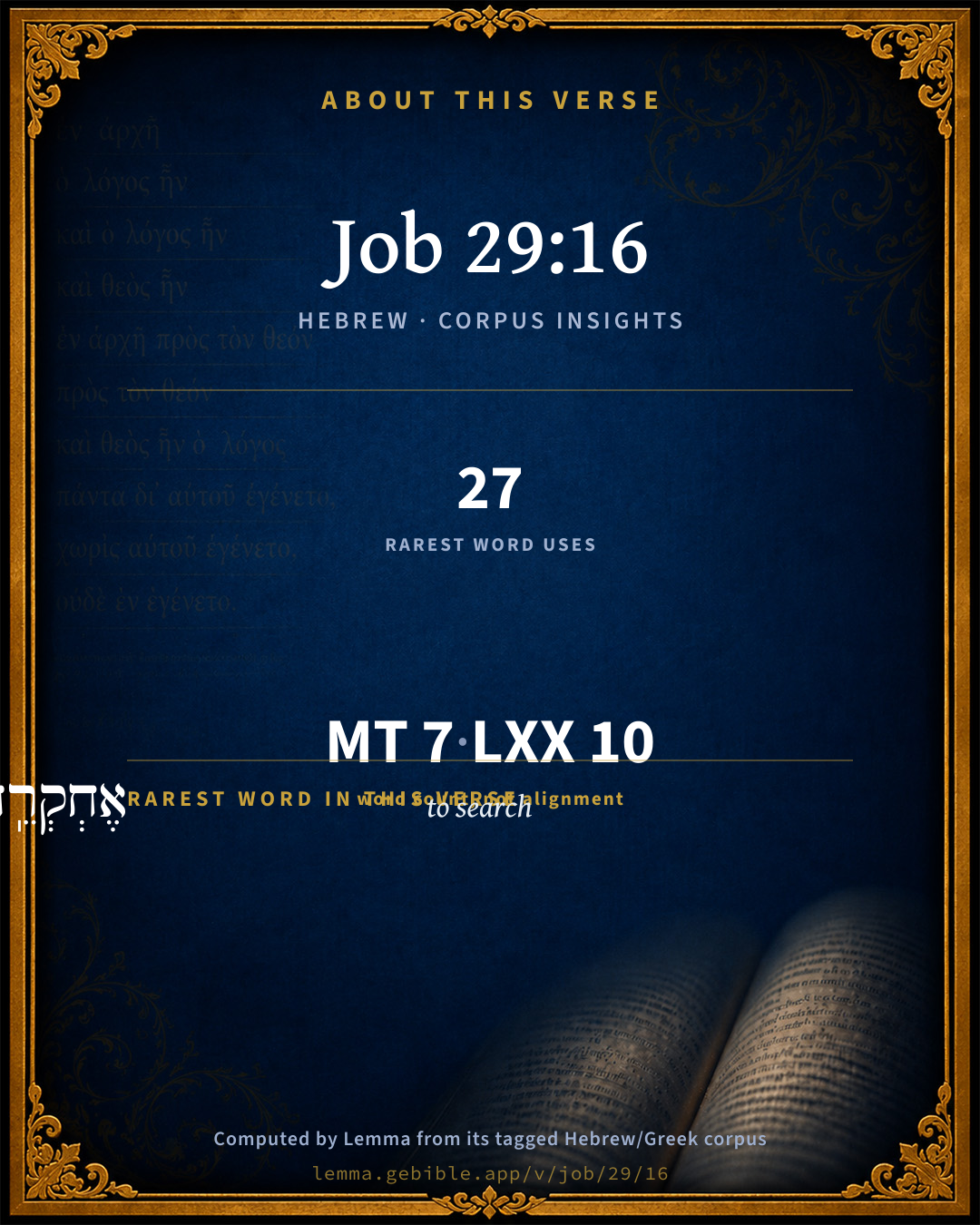
These counts appear in no published source. They are computed here, from the morphology-tagged text and Lemma’s own curated glosses. What Lemma adds →

7
words
7
distinct lemmas
Wisdom
section

Shared distinctive vocabulary

אֶחְקְרֵֽהוּ to search H2713 occurs in 26 verses of the Hebrew Bible. Also found in:

Grammatical profile

  • 2 verbs
  • 2 nouns
  • 1 adjective
  • 1 pronoun
  • 1 particle

Verb forms

  • יָדַ֣עְתִּי Qal · Perfect
  • אֶחְקְרֵֽהוּ Qal · Imperfect

Hebrew & Septuagint length

In English translation the verse runs 18 words from the Hebrew and 17 from the Septuagint (LXX English) — closely comparable.

A rough comparison of the two English renderings, which tokenize alike — not a word-level alignment.

Word counts can differ between the Hebrew and the Greek without any difference in meaning — e.g. the Hebrew direct-object marker אֵת has no separate Greek word, and Greek often adds the article ὁ.

In the original languages it is 7 Hebrew tokens and 10 Greek tokens — but the two are counted differently (Hebrew bundles its prefixes and suffixes into one token; the Greek is in lemma form), so that isn’t a like-for-like length.

Cross-references

12

Topical passages linked to Job 29:16 in the Treasury of Scripture Knowledge — connected by theme and wording, ordered by reader-vote popularity; previews shown in the World English Bible.

  • Proverbs 29:7 The righteous care about justice for the poor. The wicked aren't concerned about knowledge.
  • Psalms 68:5 A father of the fatherless, and a defender of the widows, Is God in his holy habitation.
  • Esther 2:7 He brought up Hadassah, who is, Esther, his uncle's daughter: for she had neither father nor mother, and the maiden was fair and beautiful; and when her father and mother were dead, Mordecai took her for his own daughter.
  • Job 24:4 They turn the needy out of the way. The poor of the earth all hide themselves.
  • Job 31:18 (No, from my youth he grew up with me as with a father, Her have I guided from my mother's womb);
  • Proverbs 25:2 It is the glory of God to conceal a thing, But the glory of kings is to search out a matter.
  • Exodus 18:26 They judged the people at all times. They brought the hard causes to Moses, but every small matter they judged themselves.
  • Deuteronomy 13:14 then shall you inquire, and make search, and ask diligently; and, behold, if it be truth, and the thing certain, that such abomination is done in the midst of you,
  • Deuteronomy 17:8–10 If there arise a matter too hard for you in judgment, between blood and blood, between plea and plea, and between stroke and stroke, being matters of controversy within your gates; then shall you arise, and go up to the place which Yahweh your God shall choose;
  • 1 Kings 3:16–28 Then there came two women who were prostitutes, to the king, and stood before him.
  • Ephesians 5:1 Be therefore imitators of God, as beloved children.
  • James 1:27 Pure religion and undefiled before our God and Father is this: to visit the fatherless and widows in their affliction, and to keep oneself unstained by the world.

Cross-references courtesy of OpenBible.info (CC BY 4.0).

Hebrew and Greek witnesses Masoretic Hebrew ↔ Greek Septuagint

The same verse in the two great witnesses to the Old Testament, shown verse-for-verse.

These are two independent witnesses, not word-aligned to each other, and the Septuagint is shown in lemma (dictionary) form.

Hebrew Job 29:16 Masoretic · Westminster Leningrad Codex

אָ֣ב אָ֭נֹכִֽי לָֽאֶבְיוֹנִ֑ים וְרִ֖ב לֹא יָדַ֣עְתִּי אֶחְקְרֵֽהוּ

I was a father to the needy. The cause of him who I didn't know, I searched out.

World English Bible · Public Domain

Greek LXX Job 29:16 Septuagint · lemma form

ἐγώ εἰμί πατήρ ἀδύνατος δίκη δέ ὅς οὐ οἶδα ἐξιχνιάζω

I was the father of the helpless; and I searched out the cause which I knew not.

LXX2012 (modern English Septuagint) · Public Domain

Hebrew: Westminster Leningrad Codex (CC BY 4.0). Greek: Septuagint (public domain); English from LXX2012 (modern English Septuagint) (Public Domain). How the Septuagint differs from the Hebrew →

Commentary

Notes on Job 29:16 from classic Christian and Jewish commentators (each source and its license shown beneath its notes). The classic Christian expositions comment on the surrounding passage and are grouped to its opening verse, so a note may address several verses; the Jewish commentaries on the Tanakh (Rashi and others) are per-verse, so they appear only where the commentator wrote on this verse.

Lemma curates 59 commentaries, every one of them public domain or Creative Commons licensed, each selected and text-cleaned for this edition rather than reprinted as found. About our sources →

Trapp's Complete Commentary

John Trapp

Job 29:16 I [was] a father to the poor: and the cause [which] I knew not I searched out.

Ver. 16. I was a father to the poor] Ab laebionim, an elegant alliteration, as Mercer here noteth. Job was not only a friend to the poor, as said before, but a father, providing for their necessities, and protecting them from injuries. So Augustus Caesar delighted to be called Pater Patriae, the father of his country (Suet.). And our Queen Elizabeth would many times say that she could believe nothing of her people that parents would not believe of their children (Cambden, Eliz.).

And the cause which I knew not I sought out] Sifting it to the bran, and not pronouncing sentence till I had fully understood each circumstance of the controversy. Judge not according to the appearance, but judge a righteous judgment, Joh 7:24. Thucydides well saith, That there are two things most opposite to right proceedings, ταχος τε και οργην, haste and anger; a justificer must do nothing rashly, but with greatest deliberation and industry, to come to a right understanding of matters, in capital causes especially, lest he repent it too late; as that Sir James Pawlet did, who, out of humour and for revenge, laid by the heels Thomas Wolsey, then a country minister (afterwards a cardinal, and Lord Chancellor of England), for the which he suffered long imprisonment (Negotiat. of Card. Wolsey). And as that judge mentioned by Fortescue, who, having condemned a gentle woman to death for the murder of her husband, upon the bare accusation of her man, which afterwards was found false, saepius ipse mihi falsus est; he afterwards confessed unto me, saith the author, that he should never during his life be able to clear his conscience of that fact. We know what pains Solomon took in the case of the two harlots that strove before him. And we have read of a judge, who, to find out a murder, caused those that were accused to open their bosoms, and felt the beating of their hearts. And when he found one of their hearts to beat extraordinarily, Tu, inquit, fecisti, Thou art the murderer certainly, said he. The man presently confessed the fact, and was executed for it (John Manl. loc. com. p. 290).

John Trapp, A Commentary or Exposition upon All the Books of the Old and New Testament (1647–1656) — public domain. Text from a community e-Sword module.

The Biblical Illustrator

Joseph S. Exell

Job_29:16

I was a father to the poor.

A father to the poor

The text is part of Jobs noble vindication of himself from a charge of hypocrisy and impiety. So far was Job from considering the poor as made for him, so far from neglecting and oppressing them, that his wealth and its attendant influence prompted him to become their advocate, to befriend the friendless, and to attempt the relief of every species of human distress.

I. The paternal character, as it respects the poor. It includes--

1. A real and an affectionate concern for the poor. So far was Job from considering the poor as made for his aggrandisement, to do him homage, to wait his nod, that he saw and respected himself in them; made their cause his own, entered into their afflictions, and had a heart to feel for all their wants and sorrows.

2. Well-digested schemes, and well-directed endeavours, to promote, under God, their temporal and eternal good. There can be no true charity, among the affluent, without liberality. This fallen world opens a widely extended field for the exercise of every compassionate and benevolent principle in the heart. The paternal character has a relation to the bodies of the poor, as that of a father to the bodies of his immediate offspring. More important are the souls of the poor.

II. Recommend and urge the paternal character, as it respects the poor. An argument might be brought from the very constitution of human nature. A principle of self-love is common to us all. The paternal character is more Divine, more Godlike, than anything else within the reach and ability of man. It makes that very use of talents and advantages which God designed. The character enters into the main and substantial part of Christianity. Solid comfort and felicity will ever result from it. (N. Hill.)

A father to the poor

Such a man is surely one of the most useful friends to virtue, to religion, and to society. The two principal branches of paternal care are provision and instruction. A serious and benevolent attention to the cause of the poor is a necessary part of the character of everyone who acts upon principle, either as a Christian or a man, of everyone who values either the civil or religious constitution of this country. The righteous considereth the cause of the poor, because he considereth them as partakers of the same nature, and children of the same Father with himself. The righteous looks into himself, and from thence learns to show compassion to others. His nature prompts him to this benevolent office; his reason inculcates it; his conscience approves it; his condition of life empowers him to fulfil it. What is led to by the principles of reason and morality, is brought home to his bosom by the declarations of the Gospel. The infirm, the industrious, and the lazy, make up the great body of the poor. The infirm claim our pity to relieve our attention to employ them; the lazy our resolution to them; the industrious force them to labour. Difficulties occur in the modelling of all schemes for the provision of the poor, from that discretionary power which must unavoidably be allowed in the execution of them. Difficulty again arises from that prevalence of luxury which we see tempts all persons to live above the rank which they hold in the society. Instruction is the second part of a fathers care. The subject of instruction for the poor is the Christian religion as established in this kingdom. The principles of the Gospel cultivate the general interests of civil society. (Archbishop Hay Drummond.)

On beneficence

1. By the exercise of compassion and kindness to our fellow creatures, we fulfil the intention of providence. The blessings of life are distributed in very different proportions to different classes of men. The division of mankind into rich and poor is not the effect of any particular political institution. It is altogether unavoidable in the course of human affairs. All that society has to do is to secure to the industrious the fruits of their virtuous labours. This division of mankind into rich and poor ought not to be considered as a subject of regret. There are many salutary effects which it seems well fitted to produce. It furnishes an opportunity for the exercise of human virtue, in an infinite variety of situations; it keeps alive the spirit of industry, by holding out to the industrious the hope of rising to distinction; it improves the human condition, by rendering the exertions of every individual, in his own particular sphere, more conducive than they would otherwise be to the general happiness of society. But, in this imperfect state, inequalities frequently appear, which call for the interposition of the generous. Disasters sometimes arise, which no prudence or industry can prevent. The pressure of bodily distress often makes the hands of the diligent to hang down. Hence arises a new relation; a relation between the fortunate and the miserable. Let both parties be instructed in their duty. Whatever you possess, you owe to the bounty of your Maker. You are the depositaries of His bounty, not absolute disposers. You are not at liberty to squander His gifts, as your own caprice or passion may dictate; but are required to fulfil the purpose of the Giver. In few situations are men destitute of the means of contributing to the happiness of their fellow creatures. God has not left the wretched without resource. He has ordained that compassion should be the balm of misery. The selfish, indeed, seem to behold in the whole world no being but themselves. For them alone the sun arises, the dews descend, and the earth yields its increase. Such were the sentiments of the hard-hearted Nabal.

2. The exercise of our compassion and kindness to our brethren is one of the best expressions of our piety to God. What shall we render to the Lord for all His mercies? God is Himself exalted above the reach of our most perfect services; our goodness doth not extend to Him. Our brethren are placed within the reach of our beneficence, and our charity to them is piety to our Maker. No fervours of religious affection will atone for the want of charity. Your alms must ascend with your prayers as a memorial before God.

3. By the exercise of compassion and kindness to our fellow creatures, we promote our own happiness. Benevolence is a source of pleasure. Compare the benevolent with the selfish in every situation of life. Place them in affluence, and observe how they differ. Place them in adversity, and see how they differ. Let disease come to the man who has shown no compassion to his brethren. How ill is he prepared for the evil day. Let sickness increase, let death approach; where now is the joy of the selfish? (W. Moodie, D. D.)

Home and Sunday school

Here is a matchless picture of a great and beautiful human life in that grand, calm, and stately patriarchal time, which presents a refreshing contrast to these eager, rapid, rushing days, in which God has east our lot. Each age has its own form of dignity and nobleness, and its own field of Divine service. This grand old sheikh, who was the Christus consolator of his people, was not even a member of the elect line. Job saw into the heart of the great social question of all ages when he declared himself a father to the poor. It is just the fathers wisdom, firmness, and tenderness which poverty and ignorance need. It is just this which law cannot proffer to them. This explains the reason why in all ages the true help of the poor comes from the life-warm hand of the Christian Church. It is a large subject, and one full of interest, the fatherly ministry of the Church to the poor and helpless. We dwell on one feature only. The foremost duty of a father is the nurture and culture of the children. Let us see how, when the father wholly or partially fails, the Church steps forward with its Divinely helpful hand in his room. Plato, in his conception of the ideal republic, makes the children the charge of the State from the first. He makes their culture its most sacred duty, seeing that on their wisdom, industry, and moral habits so much of the health and wealth of the community in successive generations inevitably depends. It is practically impossible on any scheme of government to get a full representation of the highest wisdom of the community in the governing powers; and the training of all the children of the community in one type elaborated by human wisdom, however, admirable, contradicts and does its best to frustrate the benignant purpose of God in the varied natural endowments of mankind. He has not made men in one type. Think of a Christian household of a lofty Christian type, where the children are trained to a noble manhood and womanhood by parents whom they both reverence and love; where the hand of authority is firm but never capricious; where Gods statutes and judgments are maintained in absolute supremacy; but where the children are never suffered to question for a moment that the motive of their maintenance is love. And whence the children are sent forth at length into the theatre of life with this deepest conviction in their hearts--that the only life worth the living is a life of service and ministry to mankind. Multiply such a home by all the homes of the community, and what a millennium of peace, and joy, and wealth would they bring in. But look at it on the other side. Think of thousands of homes, in which the children from the very first grow up in an atmosphere which taints at the spring their physical, mental, and moral life; in which they never hear the name of God or of Christ but in blasphemy. Multiply such homes by all the homes of the community, and then measure the dire and deadly ruin in which they would plunge themselves and the State at last. How does Christianity solve this question of the education of the children of a generation, with due regard to freedom of individual development on the one hand, and the need of bringing to bear on it the highest wisdom on the other? The Gospel establishes on the firmest and most lasting foundations the institution of the home. It deepens parental responsibility; it enlarges parental functions; it enhances the estimate of the momentous issues which are hanging on the due and Christian fulfilment of parental duty. The home is the ultimate unit of society. God sets the parent the pattern; God helps the parent in the task; God holds forth to the parent the prize. God attends the progress of humanity with an institution in which His truth is enshrined, in which His Spirit dwells, and which is the living and ever-present organ of His counsel and influence--the Christian Church. And here comes into the field the Sunday School. It would be wrong to say that the parental institution, the home, had failed; but a great mass of human parents are utterly unequal to the task that is laid upon them. The Church steps in with her helping hand, and sends forth from her bosom a great army of earnest, loving, and self-devoted teachers, to be as fathers to the children whose souls are fatherless, and to surround the shivering, homeless outcasts with the warm atmosphere of Christian love. This word, I was a father to the poor, is the key to the teachers position and work. Not to supersede the parent, but in every way to stimulate and help him, are teachers sent forth by the Church and by the world. Three things he must keep constantly in sight.

1. Instruction. To impart knowledge is his first and most important work. The Christian teacher mostly confines himself to the highest knowledge.

2. The teacher is to be a shepherd, a pastor to the children. Sunday school teaching is pastoral work.

3. The teacher should follow the children to their homes, and do what he can to sweeten and purify the atmosphere of their lives. I honour the Sabbath School because--

(1) It has opened a very noble field for that passion of ministry which is the Divine endowment of the Christian Church.

(2) It maintains so nobly the Christian tradition of self-denying service, draws forth so richly and trains so effectively the self-denying, self-devoted spirit.

(3) The teacher and teaching have formed a nexus, a link of connection of incalculable strength and importance, between jealous and often hostile classes of society.

(4) The Sunday School is the nursery of the Christian Church. To train the child for Christ and for His service is the great object of the teacher. (J. Baldwin Brown, B. A.)

The Biblical Illustrator, edited by Joseph S. Exell (c. 1880s–1900s) — public domain. Text from a community e-Sword module.

Tyndale Open Study Notes

Tyndale Open Resources

29:16 Job actively searched out and assisted strangers who needed help.

Tyndale Open Study Notes — © Tyndale Open Resources, licensed CC BY-SA 4.0. Text via the HelloAO Bible API.

Jamieson, Fausset & Brown

Robert Jamieson, A. R. Fausset & David Brown

So far was I from "breaking the arms of the fatherless," as Eliphaz asserts (Job 22:9), I was a "father" to such.

the cause which I knew not--rather, "of him whom I knew not," the stranger (Pro 29:7 [UMBREIT]; contrast Luk 18:1, &c.). Applicable to almsgiving (Psa 41:1); but here primarily, judicial conscientiousness (Job 31:13).

Jamieson, Fausset & Brown — Commentary Critical and Explanatory on the Whole Bible (1871) — public domain (CC PDM 1.0). Text via the HelloAO Bible API.

Adam Clarke's Commentary

Verse 16. The cause which I knew not I searched out.] When any thing difficult occurred, I did not give it a slight consideration; I examined it to the bottom, whatever pain, time, and trouble it cost me, that I might not pronounce a hasty judgment.

Adam Clarke's Commentary on the Bible (1810–1826) — public domain. Text from a community e-Sword/MySword module.

The Cambridge Bible for Schools and Colleges

gen. ed. J. J. S. Perowne

16. the cause which I knew not] Rather, the cause of him whom I knew not. Not merely the poor about him, to whom he might feel that he owed help, but even strangers who had a cause that needed unravelling he aided by his wisdom and justice.

The Cambridge Bible for Schools and Colleges (gen. ed. J. J. S. Perowne; Cambridge University Press, 1878–1918) — public domain. Text from a community e-Sword module.

John Gill's Exposition

I was a father to the poor,.... Not in a literal sense; for his children were rich as well as himself, while he had them; but in a civil sense, he was the patron of the poor; he was an advocate for them, he took their part, he pleaded their cause, defended their persons, and secured the little property they had; he had the pity and compassion of a father for them, and supplied their wants; he fed them and clothed them; he did not eat his morsel alone, but gave them part of it, and warmed them with the fleece of his flock:

and the cause which I knew not I searched out; any cause that was brought before him, he knew thing of before, and which, upon the opening of it, did not appear plain and easy, but had its difficulties; this he closely examined, and searched thoroughly into the merits of, till it appeared plain to him on which side the truth and justice of it lay; he did not hurry it over, and pass sentence, having only in a superficial manner considered it, as is too often the case; but after a long examination of the contending parties, and of the witnesses on both sides, to whom he gave an impartial hearing, he pronounced the decisive sentence; see Pro 25:2. Some think this refers to his diligent search and inquiry after causes that were not brought before him; he did, not wait for application to be made to him, but hearing of, or upon inquiry finding, that there were persons oppressed and distressed by cruel men, he of himself voluntarily offered his assistance, searched into their cause, made himself master of it, and freed them from their distresses; so different were his behaviour and character from that of the unjust judge, Luk 18:1; though others, choose to render the words, "the cause of him that I knew not", &c. (t); of a stranger, of one that he had never seen before, of one that was most unknown to him in the world; the cause of such an one he took as, much pains with to get the true knowledge of, and do justice to, as of the dearest relation, the nearest neighbour, and the most intimate friend and acquaintance that he had.

(t) "quem non cognoveram", Junius & Tremellius, Michaelis; "ignotissimi", Schultens.

John Gill's Exposition of the Whole Bible (1746–1763) — public domain (CC PDM 1.0). Text via the HelloAO Bible API.

Albert Barnes' Notes on the Bible

I was a father to the poor - I took them under my protection, and treated them as if they were my own children.

And the cause which I knew not I searched out - This is according to the interpretation of Jerome. But the more probable meaning is, “the cause of him who was unknown to me, that is, of the stranger, I searched out.” So Rosenmuller, Herder, Umbreit, and Good. According to this, the sense is, that, as a magistrate, he gave particular attention to the cause of the stranger, and investigated it with care. It is possible that Job here designs specifically to reply to the charge brought against him by Eliphaz in Job 22:6 ff. The duty of showing particular attention to the stranger is often inculcated in the Bible, and was regarded as essential to a character of uprightness and piety among the Orientals.

Albert Barnes' Notes on the Bible (1834–1885) — public domain. Text from a community e-Sword/MySword module.

Haydock's Catholic Bible Commentary

Diligently, not passing sentence at random. I also endeavoured to do justice to those who durst not make any complaint. The prince ought to have an eye to all things. (Calmet)

George Leo Haydock (1774–1849), Haydock's Catholic Family Bible and Commentary, 1859 edition — public domain. Excludes Psalms (Douay-Rheims chapter numbering differs from Protestant) and Deuterocanonical books (Catholic canon only).

Matthew Poole's English Annotations

A father, i.e. had the care and bowels of a father to them.

The cause which I knew not; either,

1. Those which were not brought to my knowledge or tribunal, either through neglect, or because the injured persons durst not complain, I diligently inquired after. Or,

2. Those which were hard and difficult, and possibly were made so by the frauds or arts of the oppressors, or their advocates, which the poor injured person could not find out, I took pains to discover.

Matthew Poole's English Annotations on the Holy Bible (1683–1685) — public domain. Text from a community e-Sword/MySword module.

Whedon's Commentary on the Bible

Daniel D. Whedon

16. The Hebrew for father to the poor, gives a paronomasia, a beauty frequent in Job, just as if we should say, a carer for the careful ones. See note, Job_3:25.

Which — Or, of him I knew not. He was not indifferent to the commonest claims of humanity. With no thought of gain he made the stranger his client.

Daniel D. Whedon (gen. ed.), Commentary on the Old and New Testaments (1874–1909) — public domain. Text from a community e-Sword module.

The Pulpit Commentary

I was a father to the poor: (comp. ver. 12, and see below, Jer_31:16-22) and the cause which I knew not I searched out; rather, the cause of him that I knew not I searched out (see the Revised Version). When men were quite unknown to him, Job still gave to their causes the utmost possible attention, "searching them out," or investigating them, as diligently as if they had been the causes of his own friends.

The Pulpit Commentary (1880–1919), ed. H.D.M. Spence-Jones & Joseph S. Exell — public domain. Text from a community e-Sword module.

Lesson kit

Teaching starters — assembled from the data on this page, not authored interpretation. Every prompt links to the verse data it draws on. Edit before teaching.

Job, in the Wisdom, opens this verse with 7 words (7 distinct Hebrew lemmas). Its most distinctive word is châqar (“to search”). A historical commentator’s framing appears above. Read the whole chapter for the surrounding context.

Discussion questions

  1. How does “to search” (châqar) shape what this verse is saying?
  2. How does Deuteronomy 13:14, which shares the word «to search», read alongside this verse?
  3. The translations on this page render this verse differently — a whole-verse word diff, not a word-by-word alignment. What might account for the different wordings?
  4. «יָדַ֣עְתִּי» is a Qal Perfect verb. How does that grammatical form shape the action described?
  5. Compare how Trapp's Complete Commentary and The Biblical Illustrator read this verse. Where do they agree or differ?

Things to notice

Reading settings

Reading text

Shown beneath each verse's original-language words.

Old Testament
Old Testament edition

Read the OT as the Masoretic Hebrew (MT) or the Greek Septuagint (LXX).

English shown for the Greek Septuagint (in the Hebrew ↔ Greek comparison).

Comparing translations? Open the Compare panel on any verse page to stack up to four side by side.