Leviticus 18:7

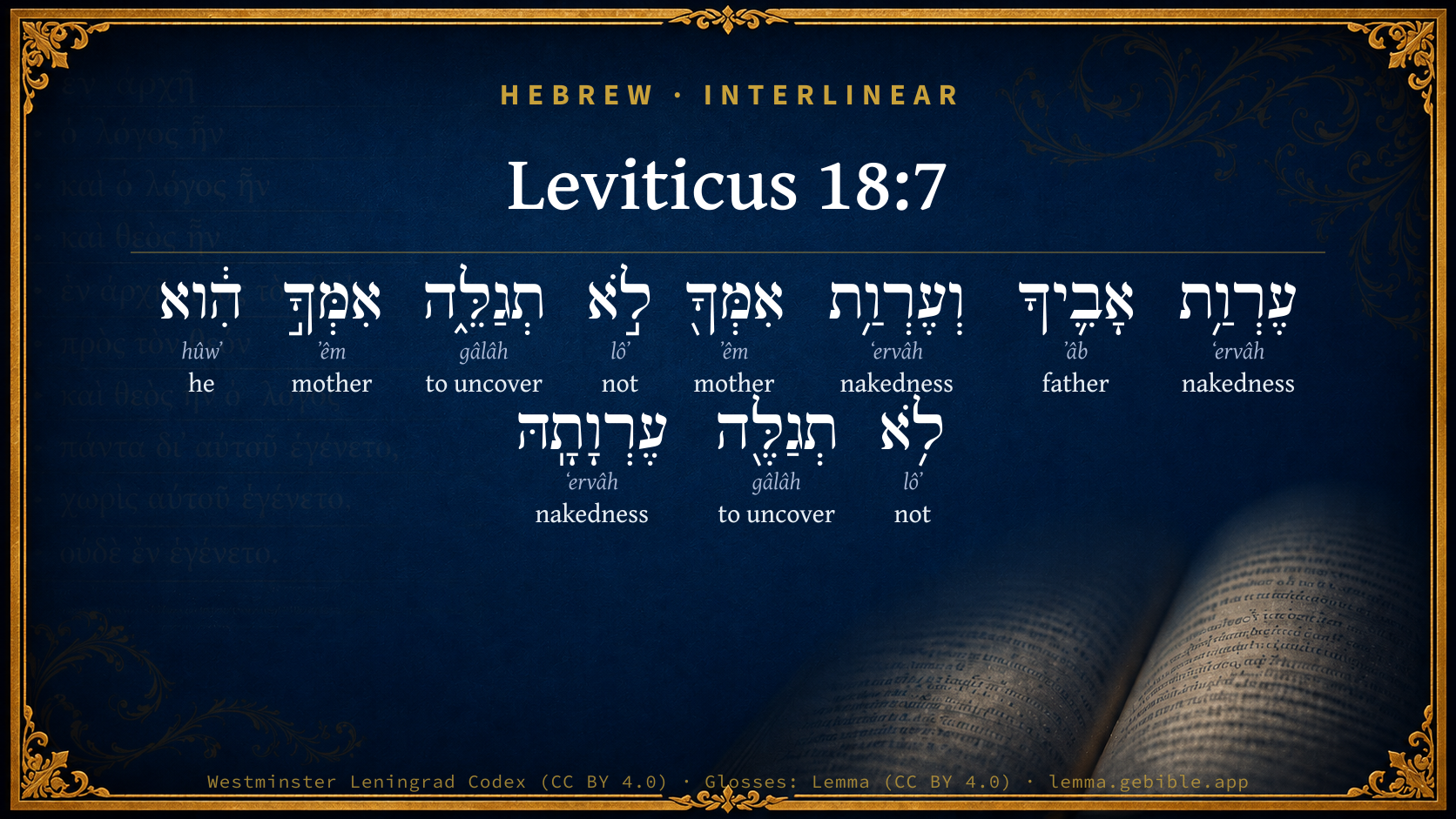
Hebrew (Westminster Leningrad Codex) Leviticus 18:7 appears in the Hebrew Old Testament. The text above is from the Westminster Leningrad Codex. Each word links to its Strong’s number, a concise gloss, and parsing drawn from the Open Scriptures Hebrew Bible morphology. Click any word for its full Brown-Driver-Briggs (BDB) entry.
Download image
Cite this verse

Leviticus 18:7 (World English Bible). Public Domain. Lemma interlinear Bible study tool, https://lemma.gebible.app/v/leviticus/18/7.

Show BibTeX & RIS
BibTeX
RIS
English Translation
"'You shall not uncover the nakedness of your father, nor the nakedness of your mother: she is your mother. You shall not uncover her nakedness.
World English Bible · Public Domain
Download a study sheet

One document with this verse’s original text, its word-by-word gloss line, the meaning frame, cross-references with their text, attributed commentary, and full source and license credits — printable, and it pastes into notes with its structure intact.

This verse Autodidact and up

Study sheet (.html) Plain text (.txt)

A passage Seminary Student

Up to 50 verses in one chapter. A passage sheet keeps up to 6 commentary sources and 12 cross-references per verse, in the order this page ranks them, and says so on the sheet whenever that leaves anything out. Ask for a single verse and you get the Autodidact verse sheet above.

Everything on this page stays free to read, with no account — the sheet is a download of what is already on screen, not access to it.

Want to remove ads? Support Godless Engineer
Compare translations 3

The same verse in 3 English versions, stacked beneath the original-language interlinear above. Click any original word for its lexicon entry.

Each is an independent rendering of the whole verse — the interlinear is not word-aligned to these translations.

Highlighted words mark where these versions differ — a whole-verse word diff, not a word-by-word alignment.

  • World English Bible Public Domain
    "'You shall not uncover the nakedness of your father, nor the nakedness of your mother: she is your mother. You shall not uncover her nakedness.
  • King James Version Public Domain
    The nakedness of thy father, or the nakedness of thy mother, shalt thou not uncover: she is thy mother; thou shalt not uncover her nakedness.
  • unfoldingWord Literal Text CC BY-SA 4.0
    The nakedness of your father and the nakedness of your mother you shall not uncover. She your mother; you shall not uncover her nakedness.

unfoldingWord Literal Text — © unfoldingWord, licensed CC BY-SA 4.0. Word-aligned USFM3 via Door43 (git.door43.org/unfoldingWord/en_ult).

Versions to compare (up to 4)

3 of 4 selected

Show all 18 translations

Every available English version of this verse, each an independent rendering of the whole verse.

  • World English Bible Public Domain
    "'You shall not uncover the nakedness of your father, nor the nakedness of your mother: she is your mother. You shall not uncover her nakedness.
  • Berean Standard Bible Public Domain
    You must not expose the nakedness of your father by having sexual relations with your mother. She is your mother; you must not have sexual relations with her.
  • Majority Standard Bible Public Domain
    You must not expose the nakedness of your father by having sexual relations with your mother. She is your mother; you must not have sexual relations with her.
  • King James Version Public Domain
    The nakedness of thy father, or the nakedness of thy mother, shalt thou not uncover: she is thy mother; thou shalt not uncover her nakedness.
  • American Standard Version (1901) Public Domain
    The nakedness of thy father, even the nakedness of thy mother, shalt thou not uncover: she is thy mother; thou shalt not uncover her nakedness.
  • Revised Version (1885) Public Domain
    The nakedness of thy father, even the nakedness of thy mother, shalt thou not uncover: she is thy mother; thou shalt not uncover her nakedness.
  • Geneva Bible (1599) Public Domain
    Thou shalt not vncouer the shame of thy father, nor the shame of thy mother: for she is thy mother, thou shalt not discouer her shame.
  • Douay-Rheims (1899) Public Domain
    Thou shalt not uncover the nakedness of thy father, or the nakedness of thy mother: she is thy mother, thou shalt not uncover her nakedness.
  • Young's Literal Translation Public Domain
    `The nakedness of thy father and the nakedness of thy mother thou dost not uncover, she `is' thy mother; thou dost not uncover her nakedness.
  • Literal Standard Version CC BY-SA 4.0
    You do not uncover the nakedness of your father and the nakedness of your mother, she [is] your mother; you do not uncover her nakedness.
  • Unlocked Literal Bible CC BY-SA 4.0
    Do not dishonor your father by sleeping with your mother. She is your mother! You must not dishonor her.
  • unfoldingWord Literal Text CC BY-SA 4.0
    The nakedness of your father and the nakedness of your mother you shall not uncover. She your mother; you shall not uncover her nakedness.
  • Darby Bible Public Domain
    The nakedness of thy father, and the nakedness of thy mother, shalt thou not uncover: she is thy mother: thou shalt not uncover her nakedness.
  • World Messianic Bible Public Domain
    “‘You shall not uncover the nakedness of your father, nor the nakedness of your mother: she is your mother. You shall not uncover her nakedness.
  • Webster's Bible Public Domain
    The nakedness of thy father, or the nakedness of thy mother, shalt thou not uncover: she is thy mother, thou shalt not uncover her nakedness.
  • Free Bible Version CC BY-SA 4.0
    Don't shame your father by having sex with your mother. She is your mother; don't have sex with her.
  • Bible in Basic English Public Domain
    You may not have sex relations with your father or your mother: she is your mother, you may not take her.
  • JPS Tanakh (1917) Public Domain
    The nakedness of thy father, and the nakedness of thy mother, shalt thou not uncover: she is thy mother; thou shalt not uncover her nakedness.

Literal Standard Version (2020), Covenant Press — licensed CC BY-SA 4.0. Text via the HelloAO Bible API (eBible.org). Unlocked Literal Bible (unfoldingWord) — licensed CC BY-SA 4.0. Text via the HelloAO Bible API (eBible.org). unfoldingWord Literal Text — © unfoldingWord, licensed CC BY-SA 4.0. Word-aligned USFM3 via Door43 (git.door43.org/unfoldingWord/en_ult). Free Bible Version, Dr. Jonathan Gallagher — licensed CC BY-SA 4.0. Text via the HelloAO Bible API (eBible.org).

Word by word

More ways to search: Search by grammar → Find every occurrence → Compare this word →

Practice this passage: Drill this verse → Learn its vocabulary →

עֶרְוַ֥ת
ʻervâh
H6172
“nakedness of”
Noun, Common, Feminine, Singular, Construct
Part of Speech
Noun
Type
Common
Gender
Feminine
Number
Singular
State
Construct
Full BDB Definition

Origin: from H6168

TWOT: 1692b

nakedness, nudity, shame, pudenda - pudenda (implying shameful exposure) - nakedness of a thing, indecency, improper behaviour - exposed, undefended (figuratively)
  1. אָבִ֛יךָ ʼâb H1 “father · your” Noun, Common, Masculine, Singular, Construct + Suffix, Personal, 2nd Person, Masculine, Singular
  2. וְעֶרְוַ֥ת ʻervâh H6172 “and · nakedness of” Conjunction + Noun, Common, Feminine, Singular, Construct
  3. אִמְּךָ֖ ʼêm H517 “mother · your” Noun, Common, Feminine, Singular, Construct + Suffix, Personal, 2nd Person, Masculine, Singular
  4. לֹ֣א lôʼ H3808 “not” Particle, Negative
  5. תְגַלֵּ֑ה gâlâh H1540 “to uncover” Verb, Piel, Imperfect, 2nd Person, Masculine, Singular
  6. אִמְּךָ֣ ʼêm H517 “mother · your” Noun, Common, Feminine, Singular, Construct + Suffix, Personal, 2nd Person, Masculine, Singular
  7. הִ֔וא hûwʼ H1931 “he” Pronoun, Personal, 3rd Person, Feminine, Singular
  8. לֹ֥א lôʼ H3808 “not” Particle, Negative
  9. תְגַלֶּ֖ה gâlâh H1540 “to uncover” Verb, Piel, Imperfect, 2nd Person, Masculine, Singular
  10. עֶרְוָתָֽהּ ʻervâh H6172 “nakedness · her” Noun, Common, Feminine, Singular, Construct + Suffix, Personal, 3rd Person, Feminine, Singular

About this verse

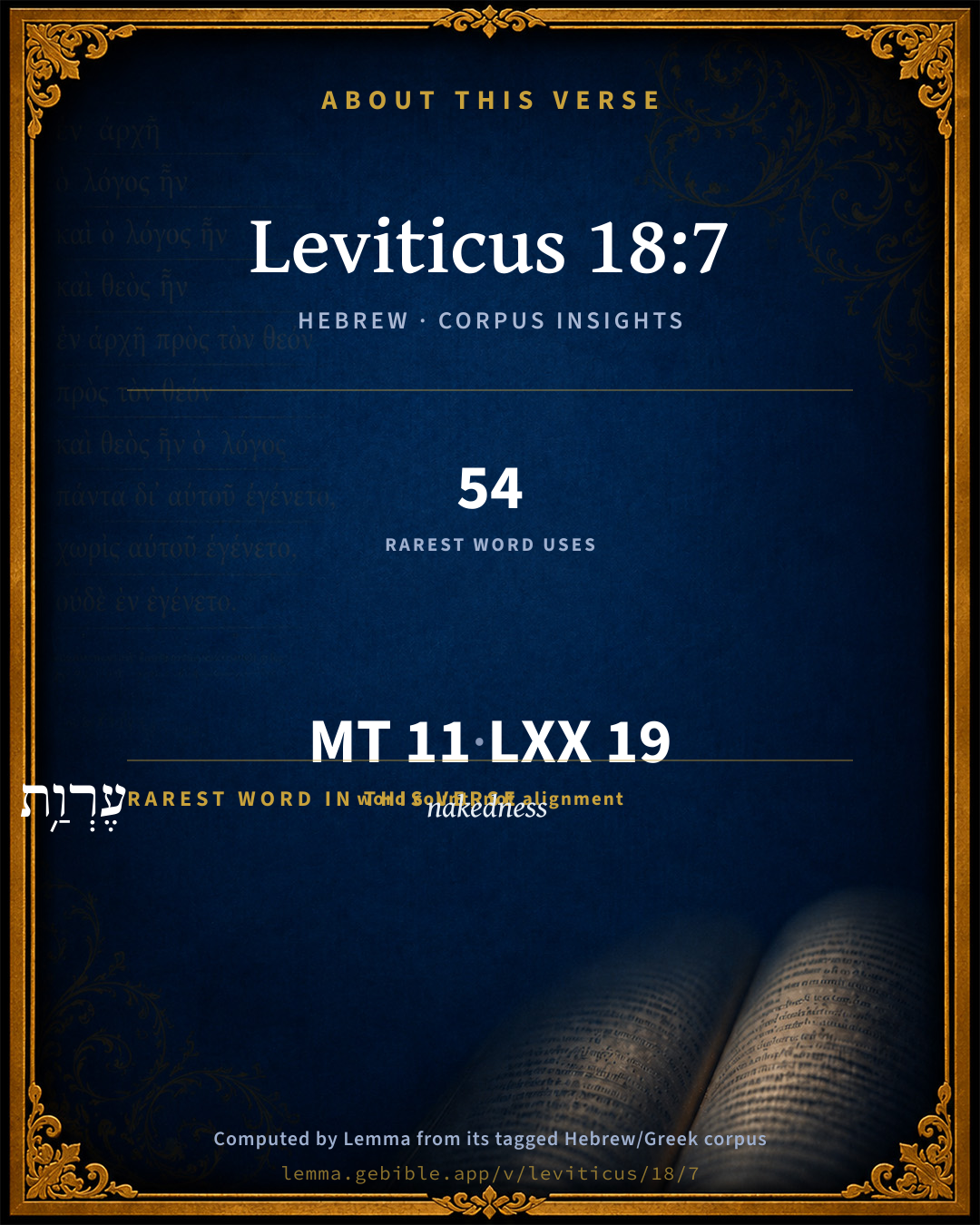
These counts appear in no published source. They are computed here, from the morphology-tagged text and Lemma’s own curated glosses. What Lemma adds →

11
words
6
distinct lemmas
Pentateuch
section

Shared distinctive vocabulary

עֶרְוַ֥ת nakedness H6172 occurs in 40 verses of the Hebrew Bible. Also found in:

Grammatical profile

  • 2 verbs
  • 6 nouns
  • 1 pronoun
  • 2 particles

Verb forms

  • תְגַלֵּ֑ה Piel · Imperfect
  • תְגַלֶּ֖ה Piel · Imperfect

Repetition

Words recur within this verse — often emphatic in Hebrew:

  • עֶרְוַ֥ת nakedness H6172 ×3
  • אִמְּךָ֖ mother H517 ×2
  • תְגַלֵּ֑ה to uncover H1540 ×2
  • לֹ֣א not H3808 ×2

Hebrew & Septuagint length

In English translation the verse runs 25 words from the Hebrew and 26 from the Septuagint (LXX English) — closely comparable.

A rough comparison of the two English renderings, which tokenize alike — not a word-level alignment.

Word counts can differ between the Hebrew and the Greek without any difference in meaning — e.g. the Hebrew direct-object marker אֵת has no separate Greek word, and Greek often adds the article ὁ.

In the original languages it is 11 Hebrew tokens and 19 Greek tokens — but the two are counted differently (Hebrew bundles its prefixes and suffixes into one token; the Greek is in lemma form), so that isn’t a like-for-like length.

Cross-references

4

Topical passages linked to Leviticus 18:7 in the Treasury of Scripture Knowledge — connected by theme and wording, ordered by reader-vote popularity; previews shown in the World English Bible.

  • Leviticus 20:11 The man who lies with his father's wife has uncovered his father's nakedness: both of them shall surely be put to death; their blood shall be upon them.
  • Ezekiel 22:10 In you have they uncovered their fathers' nakedness; in you have they humbled her who was unclean in her impurity.
  • Leviticus 18:8–16 "'You shall not uncover the nakedness of your father's wife: it is your father's nakedness.
  • Leviticus 20:14 "'If a man takes a wife and her mother, it is wickedness: they shall be burned with fire, both he and they; that there may be no wickedness among you.

Cross-references courtesy of OpenBible.info (CC BY 4.0).

Hebrew and Greek witnesses Masoretic Hebrew ↔ Greek Septuagint

The same verse in the two great witnesses to the Old Testament, shown verse-for-verse.

These are two independent witnesses, not word-aligned to each other, and the Septuagint is shown in lemma (dictionary) form.

Hebrew Leviticus 18:7 Masoretic · Westminster Leningrad Codex

עֶרְוַ֥ת אָבִ֛יךָ וְעֶרְוַ֥ת אִמְּךָ֖ לֹ֣א תְגַלֵּ֑ה אִמְּךָ֣ הִ֔וא לֹ֥א תְגַלֶּ֖ה עֶרְוָתָֽהּ

"'You shall not uncover the nakedness of your father, nor the nakedness of your mother: she is your mother. You shall not uncover her nakedness.

World English Bible · Public Domain

Greek LXX Leviticus 18:7 Septuagint · lemma form

ἀσχημοσύνη πατήρ σύ καί ἀσχημοσύνη μήτηρ σύ οὐ ἀποκαλύπτω μήτηρ γάρ σύ εἰμί καί οὐ ἀποκαλύπτω ὁ ἀσχημοσύνη αὐτός

You shall not uncover the nakedness of your father, or the nakedness of your mother, for she is your mother; you shall not uncover her nakedness.

LXX2012 (modern English Septuagint) · Public Domain

Hebrew: Westminster Leningrad Codex (CC BY 4.0). Greek: Septuagint (public domain); English from LXX2012 (modern English Septuagint) (Public Domain). How the Septuagint differs from the Hebrew →

Targum (Aramaic paraphrase)

2

The Targum is the ancient Jewish Aramaic paraphrase of the Hebrew Scriptures — an interpretive translation, not the Hebrew text itself. Onkelos (literal) and Pseudo-Jonathan (expansive) render the Torah, and Jonathan the Prophets. Coverage is partial: where no permissively-licensed English translation exists for a verse, only the Aramaic is shown. This is verse-level text, not a word-by-word alignment to the Hebrew.

  1. Targum Onkelos Torah (Genesis–Deuteronomy)
    עֶרְיַת אֲבוּךְ וְעֶרְיַת אִמָךְ לָא תְגַלֵי אִמָךְ הִיא לָא תְגַלֵי עֶרְיָתָהּ

    (no public-domain English translation for this verse)

    Targum Onkelos — Aramaic: “Onkelos Genesis” (public domain); “Onkelos Exodus” (public domain); “Onkelos Leviticus” (public domain); “Onkelos Numbers” (public domain); “Onkelos Deuteronomy” (public domain). English: “Sefaria Community Translation” (CC0 1.0 (public-domain dedication)); “J.W. Etheridge. The Targums of Onkelos and Jonathan Ben Uzziel on the Pentateuch. London: Longmans, Green, 1862” (public domain). Text via Sefaria.

  2. Targum Pseudo-Jonathan Torah (Genesis–Deuteronomy)
    עֶרְיַית אָבוּךְ וְעֶרְיַית אִמָךְ לָא תְבַזֵי אִיתָא לָא תְשַׁמֵשׁ עִם אַבְהָא וּגְבַר לָא יְשַׁמֵשׁ עִם אִמֵיהּ אִמָךְ הִיא לָא תְגַלֵי עִרְיָיתָהּ

    The nakedness of thy father, or the nakedness of thy mother, thou shall not dishonour. A woman shall not lie with her father, nor a man with his mother; she is thy mother: thou shalt not discover her nakedness.

    Targum Pseudo-Jonathan — Aramaic: “Targum Jonathan on Genesis” (public domain); “Targum Jonathan on Exodus” (public domain); “Targum Jonathan on Leviticus” (public domain); “Targum Jonathan on Numbers” (public domain); “Targum Jonathan on Deuteronomy” (public domain). English: “The Targum of Jonathan ben Uzziel, trans. J. W. Etheridge, London, 1862” (public domain). Text via Sefaria.

Commentary

Notes on Leviticus 18:7 from classic Christian and Jewish commentators (each source and its license shown beneath its notes). The classic Christian expositions comment on the surrounding passage and are grouped to its opening verse, so a note may address several verses; the Jewish commentaries on the Tanakh (Rashi and others) are per-verse, so they appear only where the commentator wrote on this verse.

Lemma curates 59 commentaries, every one of them public domain or Creative Commons licensed, each selected and text-cleaned for this edition rather than reprinted as found. About our sources →

Trapp's Complete Commentary

John Trapp

Lev 18:7 The nakedness of thy father, or the nakedness of thy mother, shalt thou not uncover: she [is] thy mother; thou shalt not uncover her nakedness.

Ver. 7. She is thy mother.] And so it is against nature to lie carnally with her. Aristotle {a} tells of a camel that killed his keeper for causing him to cover his dam, and of a horse that cast himself down headlong after he had done the like.

{a} Hist. Animal., lib. ix. cap. 47.

John Trapp, A Commentary or Exposition upon All the Books of the Old and New Testament (1647–1656) — public domain. Text from a community e-Sword module.

Joseph Benson's Commentary

Lev 18:7. The nakedness of thy father, or of thy mother — This is but one fact, though expressed two ways, as appears from Lev 18:8, compared with Lev 20:11. The expression imports, that such an action is doing the greatest dishonour to one’s father and mother.

Joseph Benson's Commentary on the Old and New Testaments (1811–1818) — public domain. Text from a community e-Sword module.

Tyndale Open Study Notes

Tyndale Open Resources

18:7-8 violate your father: The Hebrew text here equates having sexual relations with your mother or any of your father’s wives with having sexual relations with him (cp. Gen 35:22; 49:4; see also 1 Cor 5:1). The husband and his wife were “two united into one” (Gen 2:24; cp. Eph 5:29). Always in the background of these commands are the commands to honor your parents (Lev 20:9; Exod 20:12) and, by extension, other members of the family (see also study note on Lev 20:17).

18:7 She is your mother: Incest was prohibited because of the disruption it created in families, so the commands concerning this sin included close relatives not necessarily related by blood. Incest was a serious crime because it brought competition and chaos into the family structure. It threatened the safety of the home by violating a family’s appropriate intimacy and the sense of belonging shared by its members. • The commands were directly addressed to the male, even though the female could be older (such as one’s mother). The male, especially if he was the head of the household or the firstborn, wielded more power than the female; with this position came the responsibility to use that power lawfully. In addition, the male was more likely to be the sexual aggressor in an illicit sexual union, although this was not always the case (e.g., Gen 39:6-18).

Tyndale Open Study Notes — © Tyndale Open Resources, licensed CC BY-SA 4.0. Text via the HelloAO Bible API.

Ellicott's Commentary for English Readers

(7) The nakedness of thy father, or the nakedness of thy mother.—The rendering of the Authorised Version is based upon the interpretation which obtained during the second Temple, according to which this injunction is addressed both to the daughter and the son. The daughter must not marry or have commerce with the father, nor the son with the mother. Hence the Chaldee Version of Jonathan translates it “the woman shall not lie with her father, and the man shall not lie with his mother.” Accordingly the case here contemplated is that of Lot’s daughters (Gen_19:31-38). This passage may, however, be translated literally, the nakedness of thy father, and the nakedness of thy mother shalt thou not uncover. That is, they being both one flesh, the nakedness of the one is the nakedness of the other. Amongst the Persians and other eastern nations, marriage between son and mother was allowed.

A Bible Commentary for English Readers, edited by Charles John Ellicott (1878–1897) — public domain. Text from a community e-Sword module.

John Gill's Exposition

The nakedness of thy father, or the nakedness of thy mother,

shall thou not uncover,.... By uncovering a father's nakedness is not meant anything similar to what befell Noah, which Ham beheld with pleasure, and the other two sons of Noah studiously and with reverence to their father covered; nor any sodomitical practice of a son with his father; as Gersom interprets it; but the same is meant by both phrases, and the words are by many interpreters thus rendered, "the nakedness of thy father, that is (x), the nakedness of thy mother thou shalt not uncover": for what is the mother's is the father's, and uncovering the one is uncovering the other; wherefore the mother only is made mention of in the next clause, where the reason of this prohibition is given:

she is thy mother, thou shalt not uncover her nakedness; that is, not lie with her, nor marry her, because she is his mother that bore him, of whom he was born, and therefore ought not to become his wife, or be taken into his bed; such a marriage must be incestuous and shocking; such were the marriages of Oedipus with his mother Jocasta, and of Nero with Agrippina; though the words will bear another sense, that a woman may not marry her father, which may be meant by the first clause, nor a man his mother, intended in the next; and where indeed it is not expressed, females in the same degree of relation are included with the males, and under the same prohibition; and so the Targum of Jonathan explains this, a woman shall not have to do with her father, nor a man with his mother; as Lot's two daughters had with him, and the Persians with their mothers; among whom such incestuous marriages and copulations were frequent, and especially among their Magi (y) who might not perform their office unless they had lain with their mothers, sisters, and daughters (z), or were begotten in such incest (a): a man guilty of such incestuous copulations was cursed by the law of Moses, Deu 27:20; this is contrary to nature, what the brute creation abhors; a camel will not cover its dam: Aristotle (b) reports of one who was betrayed into it by his keeper, who, after he had discovered it, fixed his teeth in him and slew him; and he also relates of a horse after that he had ignorantly done the same, ran away in great haste and cast himself down from a precipice headlong.

(x) "id est, nuditatem vel pudenda", Vatablus, Fagius, Piscator. (y) Sex. Empir. Pyrrh. l. 3. c. 24. (z) Patricides apud Selden. de jure natur. Gent. l. 5. c. 11. p. 624. (a) "Nam magus ex matre et gnato nascatur oportet." Catull. Epigr. 91. (b) Hist. Animal. l. 9. c. 47.

John Gill's Exposition of the Whole Bible (1746–1763) — public domain (CC PDM 1.0). Text via the HelloAO Bible API.

Albert Barnes' Notes on the Bible

Or - It might be rendered “and”, or rather, even; that is, which belongs to both parents as being “one flesh” (Gen 2:24; compare Lev 18:8, Lev 18:14). These prohibitions are addressed to men.

Albert Barnes' Notes on the Bible (1834–1885) — public domain. Text from a community e-Sword/MySword module.

Haydock's Catholic Bible Commentary

Father, with whom the daughters must not have any connexion, as Myrrha had with Cymoras. (Metam. x.) (Haydock) --- All relations in a right line are excluded for ever, according to the emperor Justinian. The reason of these various impediments is, 1. That God’s people may not resemble infidels, who permitted such things, ver. 3. The Persians married their own mothers, daughters and sisters. (Clement of Alexandria, strom. 3.) Semiramis married her son Justin. Cleopatra was both mother and wife of the two Ptolemies, Philometor and Euergetes, or Physcon. (Tirinus) --- The Egyptians took their sisters to wife for a long time, by the authority of their laws, and in imitation of Isis. (Diodorus 1.; Clement, recogn. 9.) Solon permitted people to marry their step-sisters by the same father, and Lycurgus only those by the same mother. (Philo ad 6. præc.) 2. By this law, the bands of society are strengthened, and families become connected. (St. Augustine, City of God xv. 16.) 3. Disorders which would easily take place under the same roof, on the prospect of a future marriage, are prevented. 4. The contrary practice would often prove contrary to order and decency, as the son would be raised above his mother. These regulations seem to have been made from the beginning, or at least from the time of the deluge; since the nations not subject to the law of Moses, are condemned for the transgression of them, ver. 24. See Genesis xix. 33. (Calmet)

George Leo Haydock (1774–1849), Haydock's Catholic Family Bible and Commentary, 1859 edition — public domain. Excludes Psalms (Douay-Rheims chapter numbering differs from Protestant) and Deuterocanonical books (Catholic canon only).

Matthew Poole's English Annotations

Of thy father, or of thy mother, Heb. and of thy mother, put for that is, or to wit, as it is oft used. Here it notes that the nakedness of the father, and the nakedness of the mother, are one and the same thing, because they two are one flesh, and therefore her nakedness is his also; which further appears, because the mother only is mentioned in the following words, which contain the reason of the law.

She is thy mother; and therefore even nature teacheth thee to abhor such incest. Yet the Persians used to marry their mother; therein worse than the very camels, whom no force will drive to that act with their dams.

Matthew Poole's English Annotations on the Holy Bible (1683–1685) — public domain. Text from a community e-Sword/MySword module.

Whedon's Commentary on the Bible

Daniel D. Whedon

7. Nakedness of thy father — Here the “father” is grammatically the possessor. It is the wife’s nakedness, as the Hebrew properly rendered shows, where the “or” is rendered “even;” thus “the nakedness of thy father, even the nakedness of thy mother.” Since the husband and wife are one flesh, what is predicated of the wife may be predicated of him. The last clause of the verse implies that the command is directed only to a son, and refers only to his mother.

Daniel D. Whedon (gen. ed.), Commentary on the Old and New Testaments (1874–1909) — public domain. Text from a community e-Sword module.

The Pulpit Commentary

Vers. 7, 8. Incest with a stepmother is placed next after that with a mother. On account of the unity caused by marriage, ("they shall be one flesh," Gen_2:24) the stepmother"s nakedness is the father"s nakedness. The tie of affinity is thus declared to be similar in its effects to the tie of consanguinity. Reuben"s sin, by which he forfeited his birthright, is connected with this offense, but is of a more heinous character, as his father was alive at the time of his transgression. (Gen_49:4) It is one of the sins which Ezekiel enumerates as those which brought the judgment of God on Israel. (Eze_22:10) "That one should have his father"s wife" is declared by St. Paul to be "such fornication as is not named among the Gentiles," and to call for the excommunication of the offender. (1Co_5:1-5) Adonijah"s marriage with Abishag, so strongly resented by Solomon on political grounds, is not denounced as morally reprehensible, probably because Abishag was not the wife of David in such a way as to cause the marriage with his son to be abominable in the eye of the law. (cf. 1Ki_1:4 with Amo_2:7) Absalom"s" going in unto his father"s concubines" was regarded as the final act which made reconciliation with his father impossible. (2Sa_16:22 2Sa_20:3) The history of the Church has shown that marriage with the stepmother has had to be again and again prohibited by Council after Council (see Smith and Cheetham"s "Dictionary of Antiquities," s.v. "Prohibited Degrees").

The Pulpit Commentary (1880–1919), ed. H.D.M. Spence-Jones & Joseph S. Exell — public domain. Text from a community e-Sword module.

Rashi

Rabbi Shlomo Yitzchaki (Rashi)

אביך‎ ערות‎ THE NAKEDNESS OF THY FATHER, [AND THE NAKEDNESS OF THY MOTHER SHALT THOU NOT UNCOVER] — This refers to intercourse with thy father's wife (no matter whether she is thy own mother or thy stepmother). Or perhaps this is not so, but ערות אביך has to be taken literally (as sodomy)?! Scripture, however, uses the expression ערות אביך here, and it is said later on (Leviticus 20:11) “And the man that lieth with his father's wife hath uncovered his father's nakedness (״(ערות אביו גלה. Now what is the meaning of ערות אביו there? It refers to one's fathers wife! so does ערות אביך here also refer to one's father's wife (Sanhedrin 54a).

וערות אמך AND THE NAKEDNESS OF THY MOTHER [SHALT THOU NOT UNCOVER] — This is intended to include in the prohibition the marriage of one's own mother although she be not the wife of one's father (Sanhedrin 54a).

Rashi on the Tanakh — English translations: “The Judaica Press complete Tanach with Rashi, translated by A. J. Rosenberg” (CC BY 4.0); “Pentateuch with Rashi's commentary by M. Rosenbaum and A.M. Silbermann, 1929-1934” (public domain); “The Metsudah Tanach series, Lakewood, N.J” (CC BY 4.0); and “The Book of Joshua, Metsudah Publications, 1997” (CC BY 4.0). Text via Sefaria.

Ramban (Nachmanides)

Rabbi Moshe ben Nachman (Ramban / Nachmanides)

THE NAKEDNESS OF THY FATHER, AND THE NAKEDNESS OF THY MOTHER, SHALT THOU NOT UNCOVER. Rashi commented: “The nakedness of thy father — this refers to thy father’s wife. And the nakedness of thy mother — this is intended to include one’s own mother, although she be not the wife of one’s father. The nakedness of thy father’s wife shalt thou not uncover — this is intended to include in this prohibition one’s father’s wife even after [the father’s] death.” Similarly Rashi explained: “Thou shalt not uncover the nakedness of thy father’s brother. And what does this [uncovering of his] nakedness mean? Thou shalt not approach to his wife.” This is indeed true according to the correct sense [of the verses]. But in the Gemara of Tractate Sanhedrin the Rabbis concluded that the verses, the nakedness of thy father, and the nakedness of thy father’s brother, are prohibitions against carnal relationships with these males themselves [and not with their wives], and [are required] to make the offender liable to a double penalty if he committed it in error [lying carnally with his father or uncle]. But I wonder, according to the opinion of the Sages [who explain the verse, the nakedness of thy father as being a prohibition against lying carnally with one’s father], why did He not likewise admonish against lying carnally with a son or brother, in addition to prohibiting [sexual relationships with their] wives? Perhaps the Torah was more particular in guarding the honor of the elders. However, each and every verse in this section [of forbidden relationships] constitutes only one prohibition, does not constitute two separate prohibitions as Rashi explained it [one referring to one’s father’s wife, and one to one’s own mother although she is not the wife of one’s father, as stated above], but they are one prohibition, as explained further on in the text. there being here no case of two admonitions in one prohibition, for the command concerning sisters [in Verse 9] and also daughters [in Verse 10] each constitute but one prohibition [and not, as Rashi explained there, that each verse contains two prohibitions]. The correct interpretation by way of the simple meaning of Scripture appears to me to be that the nakedness of thy father, and the nakedness of thy mother [shalt thou not uncover], constitute but one negative commandment and one admonition, which forbids intercourse with one’s own mother, for in having such intercourse he thereby uncovers the nakedness of his father and that of his mother. This is the sense of the [concluding] expression in this verse, she is thy mother, meaning that you have done with her two evils, in that you have uncovered the nakedness of your mother and that of your father. Following the admonition against uncovering the nakedness of one’s father, which refers [as explained] to one’s mother, He went back [in the following Verse 8] and admonished against [uncovering] the nakedness of one’s father’s wife, although she be not one’s mother, saying, The nakedness of thy father’s wife shalt thou not uncover; it is thy father’s nakedness. Similarly, Thou shalt not uncover the nakedness of thy father’s brother means [as the verse itself continues], thou shalt not approach to his wife. This is why it does not say “and” to [his wife thou shalt not approach].

Ramban (Nachmanides) on the Tanakh — English translation: “Commentary on the Torah by Ramban (Nachmanides). Translated and annotated by Charles B. Chavel. New York, Shilo Pub. House, 1971-1976” (CC BY 4.0). Text via Sefaria.

Lesson kit

Teaching starters — assembled from the data on this page, not authored interpretation. Every prompt links to the verse data it draws on. Edit before teaching.

Leviticus, in the Pentateuch, opens this verse with 11 words (6 distinct Hebrew lemmas). Its most distinctive word is ʻervâh (“nakedness”). A historical commentator’s framing appears above. Read the whole chapter for the surrounding context.

Discussion questions

  1. The word ʻervâh carries the sense “nakedness.” How does it shape the verse?
  2. Genesis 9:22 shares the word «nakedness» with this verse. How do the two illuminate each other?
  3. “nakedness” occurs 3× in this one verse. What is the effect of the repetition?
  4. These translations render this verse differently. What is at stake in choosing one wording over another?
  5. The verb «תְגַלֵּ֑ה» is Piel Imperfect. How does its form color the action?
  6. Reading how Trapp's Complete Commentary and Joseph Benson's Commentary read this verse, where do the two commentators agree and where do they part?

Things to notice

Reading settings

Reading text

Shown beneath each verse's original-language words.

Old Testament
Old Testament edition

Read the OT as the Masoretic Hebrew (MT) or the Greek Septuagint (LXX).

English shown for the Greek Septuagint (in the Hebrew ↔ Greek comparison).

Comparing translations? Open the Compare panel on any verse page to stack up to four side by side.