Exodus 2:16

Hebrew (Westminster Leningrad Codex) Exodus 2:16 appears in the Hebrew Old Testament. The text above is from the Westminster Leningrad Codex. Each word links to its Strong’s number, a concise gloss, and parsing drawn from the Open Scriptures Hebrew Bible morphology. Click any word for its full Brown-Driver-Briggs (BDB) entry.
Download image
Cite this verse

Exodus 2:16 (World English Bible). Public Domain. Lemma interlinear Bible study tool, https://lemma.gebible.app/v/exodus/2/16.

Show BibTeX & RIS
BibTeX
RIS
English Translation
Now the priest of Midian had seven daughters. They came and drew water, and filled the troughs to water their father's flock.
World English Bible · Public Domain
Highlights Full analysis ↓
Download a study sheet

One document with this verse’s original text, its word-by-word gloss line, the meaning frame, cross-references with their text, attributed commentary, and full source and license credits — printable, and it pastes into notes with its structure intact.

This verse Autodidact and up

Study sheet (.html) Plain text (.txt)

A passage Seminary Student

Up to 50 verses in one chapter. A passage sheet keeps up to 6 commentary sources and 12 cross-references per verse, in the order this page ranks them, and says so on the sheet whenever that leaves anything out. Ask for a single verse and you get the Autodidact verse sheet above.

Everything on this page stays free to read, with no account — the sheet is a download of what is already on screen, not access to it.

Want to remove ads? Support Godless Engineer
Compare translations 3

The same verse in 3 English versions, stacked beneath the original-language interlinear above. Click any original word for its lexicon entry.

Each is an independent rendering of the whole verse — the interlinear is not word-aligned to these translations.

Highlighted words mark where these versions differ — a whole-verse word diff, not a word-by-word alignment.

  • World English Bible Public Domain
    Now the priest of Midian had seven daughters. They came and drew water, and filled the troughs to water their father's flock.
  • King James Version Public Domain
    Now the priest of Midian had seven daughters: and they came and drew water, and filled the troughs to water their father's flock.
  • unfoldingWord Literal Text CC BY-SA 4.0
    And the priest of Midian had seven daughters. And they came and drew and filled up the troughs to cause the flock of their father to drink water.

unfoldingWord Literal Text — © unfoldingWord, licensed CC BY-SA 4.0. Word-aligned USFM3 via Door43 (git.door43.org/unfoldingWord/en_ult).

Versions to compare (up to 4)

3 of 4 selected

Show all 18 translations

Every available English version of this verse, each an independent rendering of the whole verse.

  • World English Bible Public Domain
    Now the priest of Midian had seven daughters. They came and drew water, and filled the troughs to water their father's flock.
  • Berean Standard Bible Public Domain
    Now the priest of Midian had seven daughters, and they came to draw water and fill the troughs to water their father’s flock.
  • Majority Standard Bible Public Domain
    Now the priest of Midian had seven daughters, and they came to draw water and fill the troughs to water their father’s flock.
  • King James Version Public Domain
    Now the priest of Midian had seven daughters: and they came and drew water, and filled the troughs to water their father's flock.
  • American Standard Version (1901) Public Domain
    Now the priest of Midian had seven daughters: and they came and drew water, and filled the troughs to water their father's flock.
  • Revised Version (1885) Public Domain
    Now the priest of Midian had seven daughters: and they came and drew water, and filled the troughs to water their father’s flock.
  • Geneva Bible (1599) Public Domain
    And the Priest of Midian had seue daughters, which came and drewe water, and filled the troghes, for to water their fathers sheepe.
  • Douay-Rheims (1899) Public Domain
    And the priest of Madian had seven daughters, who came to draw water: and when the troughs were filled, desired to water their father's flocks.
  • Young's Literal Translation Public Domain
    And to a priest of Midian `are' seven daughters, and they come and draw, and fill the troughs, to water the flock of their father,
  • Literal Standard Version CC BY-SA 4.0
    And to a priest of Midian [are] seven daughters, and they come and draw, and fill the troughs to water the flock of their father,
  • Unlocked Literal Bible CC BY-SA 4.0
    Now the priest of Midian had seven daughters. They came, drew water, and filled the troughs to water their father's flock.
  • unfoldingWord Literal Text CC BY-SA 4.0
    And the priest of Midian had seven daughters. And they came and drew and filled up the troughs to cause the flock of their father to drink water.
  • Darby Bible Public Domain
    And the priest of Midian had seven daughters; and they came and drew [water], and filled the troughs, to water their father's flock.
  • World Messianic Bible Public Domain
    Now the priest of Midian had seven daughters. They came and drew water, and filled the troughs to water their father’s flock.
  • Webster's Bible Public Domain
    Now the priest of Midian had seven daughters: and they came and drew water, and filled the troughs to water their father's flock.
  • Free Bible Version CC BY-SA 4.0
    the Midianite priest's seven daughters came to fetch water to fill up the troughs so their father's flock could drink.
  • Bible in Basic English Public Domain
    Now the priest of Midian had seven daughters: and they came to get water for their father's flock.
  • JPS Tanakh (1917) Public Domain
    Now the priest of Midian had seven daughters; and they came and drew water, and filled the troughs to water their father's flock.

Literal Standard Version (2020), Covenant Press — licensed CC BY-SA 4.0. Text via the HelloAO Bible API (eBible.org). Unlocked Literal Bible (unfoldingWord) — licensed CC BY-SA 4.0. Text via the HelloAO Bible API (eBible.org). unfoldingWord Literal Text — © unfoldingWord, licensed CC BY-SA 4.0. Word-aligned USFM3 via Door43 (git.door43.org/unfoldingWord/en_ult). Free Bible Version, Dr. Jonathan Gallagher — licensed CC BY-SA 4.0. Text via the HelloAO Bible API (eBible.org).

Word by word

More ways to search: Search by grammar → Find every occurrence → Compare this word →

Practice this passage: Drill this verse → Learn its vocabulary →

הָ֣רְהָטִ֔ים
rahaṭ
H7298
“the · troughs”
Particle, Definite Article + Noun, Common, Masculine, Plural, Absolute
Part of Speech
Particle + Noun
Type
Common
Gender
Masculine
Number
Plural
State
Absolute
Full BDB Definition

Origin: from an unused root apparently meaning to hollow out

TWOT: TWOT - 2127a , 2128a

trough, hollow - lock of hair - meaning dubious
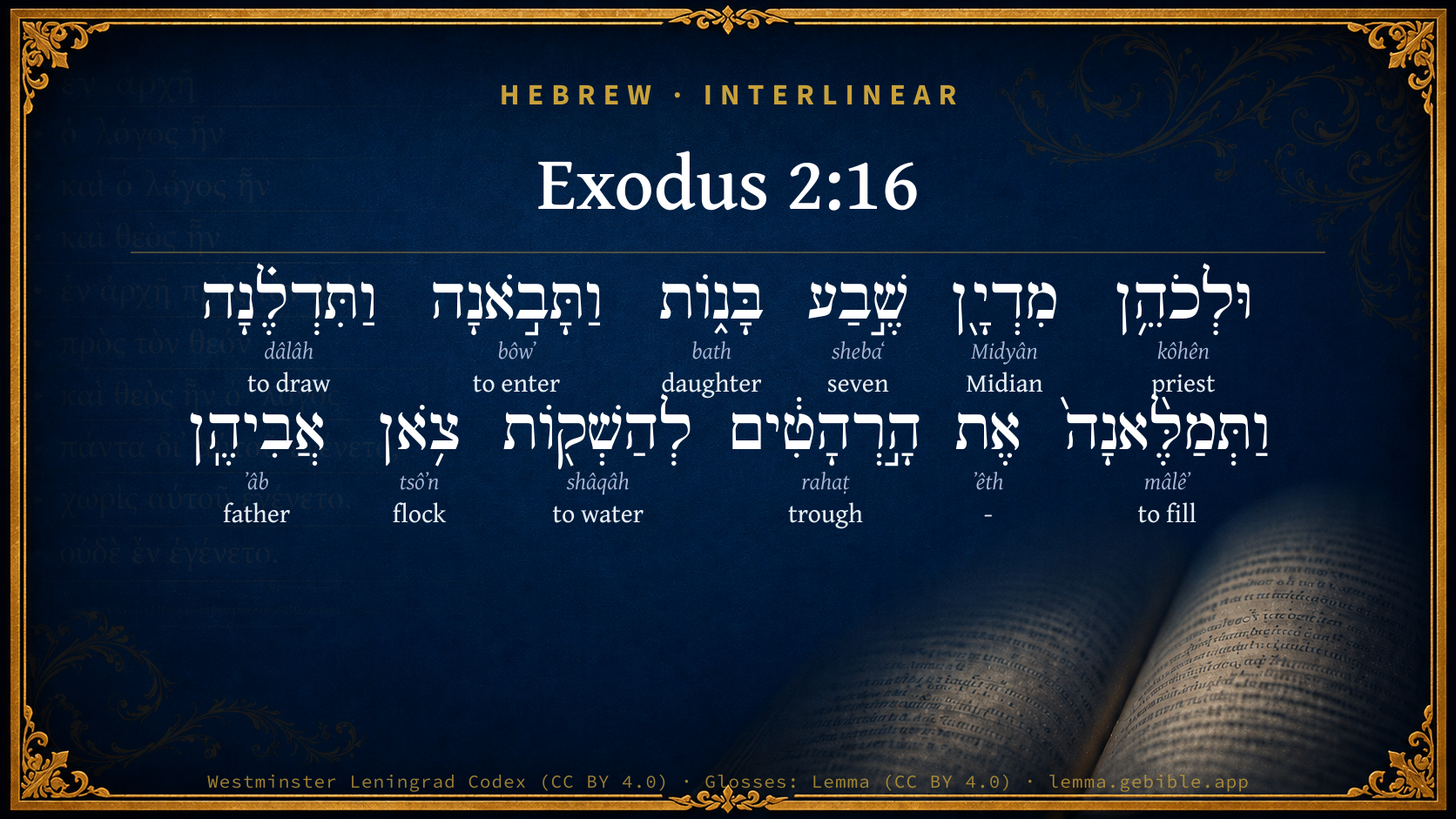
  1. וּלְכֹהֵ֥ן kôhên H3548 “and · to/for · priest of” Conjunction + Preposition + Noun, Common, Masculine, Singular, Construct
  2. מִדְיָ֖ן Midyân H4080 “Midian” Noun, Proper
  3. שֶׁ֣בַע shebaʻ H7651 “seven” Adjective, Cardinal number, Feminine, Singular, Absolute
  4. בָּנ֑וֹת bath H1323 “daughters” Noun, Common, Feminine, Plural, Absolute
  5. וַתָּבֹ֣אנָה bôwʼ H935 “and · to enter” Conjunction + Verb, Qal, Sequential Imperfect, 3rd Person, Feminine, Plural
  6. וַתִּדְלֶ֗נָה dâlâh H1802 “and · to draw” Conjunction + Verb, Qal, Sequential Imperfect, 3rd Person, Feminine, Plural
  7. וַתְּמַלֶּ֨אנָה֙ mâlêʼ H4390 “and · to fill” Conjunction + Verb, Piel, Sequential Imperfect, 3rd Person, Feminine, Plural
  8. אֶת ʼêth H853 “-” Particle, Direct Object
  9. לְהַשְׁק֖וֹת shâqâh H8248 “to water” Preposition + Verb, Hiphil, Infinitive Construct
  10. צֹ֥אן tsôʼn H6629 “flock of” Noun, Common, Both, Singular, Construct
  11. אֲבִיהֶֽן ʼâb H1 “father · their” Noun, Common, Masculine, Singular, Construct + Suffix, Personal, 3rd Person, Feminine, Plural

About this verse

These counts appear in no published source. They are computed here, from the morphology-tagged text and Lemma’s own curated glosses. What Lemma adds →

12
words
12
distinct lemmas
Pentateuch
section

Notable vocabulary

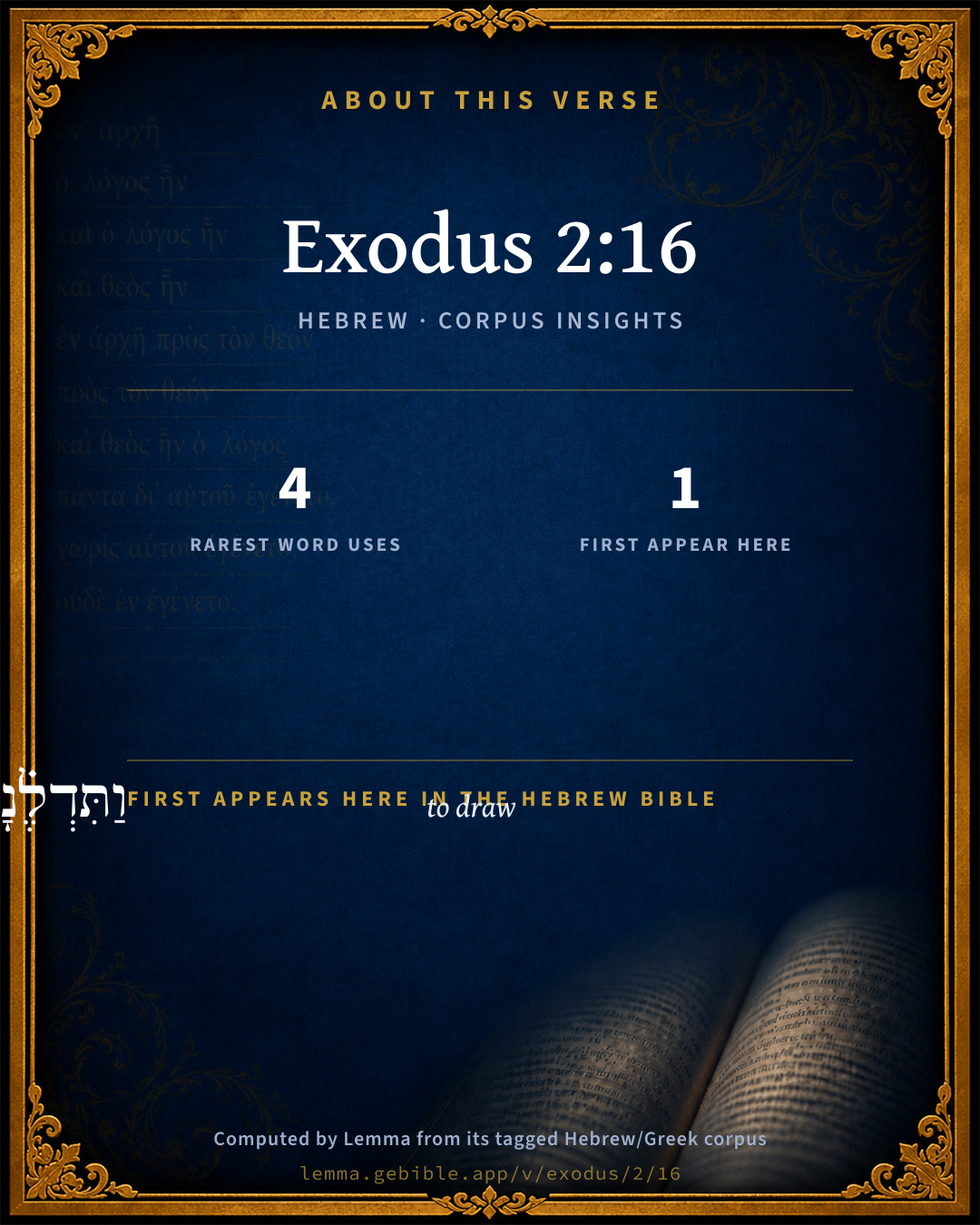
The rarest word here is הָ֣רְהָטִ֔ים trough H7298 — appearing just 4 times in the whole Hebrew Bible.

First appearance in Scripture

This word makes its first canonical appearance in the Hebrew Bible here:

  • וַתִּדְלֶ֗נָה to draw H1802

Shared distinctive vocabulary

הָ֣רְהָטִ֔ים trough H7298 occurs in 4 verses of the Hebrew Bible. Also found in:

Grammatical profile

  • 4 verbs
  • 6 nouns
  • 1 adjective
  • 1 particle

Verb forms

  • וַתָּבֹ֣אנָה Qal · Sequential Imperfect
  • וַתִּדְלֶ֗נָה Qal · Sequential Imperfect
  • וַתְּמַלֶּ֨אנָה֙ Piel · Sequential Imperfect
  • לְהַשְׁק֖וֹת Hiphil · Infinitive Construct

Hebrew & Septuagint length

In English translation the verse runs 22 words from the Hebrew and 34 from the Septuagint (LXX English) — the Septuagint runs noticeably longer here. See the side-by-side →

A rough comparison of the two English renderings, which tokenize alike — not a word-level alignment.

Word counts can differ between the Hebrew and the Greek without any difference in meaning — e.g. the Hebrew direct-object marker אֵת has no separate Greek word, and Greek often adds the article ὁ.

Cross-references

6

Topical passages linked to Exodus 2:16 in the Treasury of Scripture Knowledge — connected by theme and wording, ordered by reader-vote popularity; previews shown in the World English Bible.

  • Genesis 24:11 He made the camels kneel down outside the city by the well of water at the time of evening, the time that women go out to draw water.
  • Exodus 3:1 Now Moses was keeping the flock of Jethro, his father-in-law, the priest of Midian, and he led the flock to the back of the wilderness, and came to God's mountain, to Horeb.
  • 1 Samuel 9:11 As they went up the ascent to the city, they found young maidens going out to draw water, and said to them, Is the seer here?
  • Genesis 24:14–20 Let it happen, that the young lady to whom I will say, 'Please let down your pitcher, that I may drink.' She will say, 'Drink, and I will also give your camels a drink.' Let the same be she who you have appointed for your servant Isaac. Thereby will I know that you have shown kindness to my master."
  • Genesis 29:6–10 He said to them, "Is it well with him?" They said, "It is well. See, Rachel, his daughter, is coming with the sheep."
  • Genesis 41:45 Pharaoh called Joseph's name Zaphenath-paneah; and he gave him Asenath, the daughter of Potiphera priest of On as a wife. Joseph went out over the land of Egypt.

Cross-references courtesy of OpenBible.info (CC BY 4.0).

Hebrew and Greek witnesses Masoretic Hebrew ↔ Greek Septuagint

The same verse in the two great witnesses to the Old Testament, shown verse-for-verse.

Here the Septuagint runs noticeably longer than the Hebrew — LXX2012 (modern English Septuagint) 34 words vs World English Bible 22. A rough length comparison of the two English translations, not a word-level alignment — read both below.

These are two independent witnesses, not word-aligned to each other, and the Septuagint is shown in lemma (dictionary) form.

Hebrew Exodus 2:16 Masoretic · Westminster Leningrad Codex

וּלְכֹהֵ֥ן מִדְיָ֖ן שֶׁ֣בַע בָּנ֑וֹת וַתָּבֹ֣אנָה וַתִּדְלֶ֗נָה וַתְּמַלֶּ֨אנָה֙ אֶת הָ֣רְהָטִ֔ים לְהַשְׁק֖וֹת צֹ֥אן אֲבִיהֶֽן

Now the priest of Midian had seven daughters. They came and drew water, and filled the troughs to water their father's flock.

World English Bible · Public Domain

Greek LXX Exodus 2:16 Septuagint · lemma form

ὁ δέ ἱερεύς μαδιαμ εἰμί ἑπτά θυγάτηρ ποιμαίνω ὁ πρόβατον ὁ πατήρ αὐτός ιοθορ παραγίγνομαι δέ ἀντλέω ἕως πίμπλημι ὁ δεξαμενή ποτίζω ὁ πρόβατον ὁ πατήρ αὐτός ιοθορ

And the priest of Madiam had seven daughters, feeding the flock of their father Jothor; and they came and drew water until they filled their pitchers, to water the flock of their father Jothor.

LXX2012 (modern English Septuagint) · Public Domain

Hebrew: Westminster Leningrad Codex (CC BY 4.0). Greek: Septuagint (public domain); English from LXX2012 (modern English Septuagint) (Public Domain). How the Septuagint differs from the Hebrew →

Targum (Aramaic paraphrase)

2

The Targum is the ancient Jewish Aramaic paraphrase of the Hebrew Scriptures — an interpretive translation, not the Hebrew text itself. Onkelos (literal) and Pseudo-Jonathan (expansive) render the Torah, and Jonathan the Prophets. Coverage is partial: where no permissively-licensed English translation exists for a verse, only the Aramaic is shown. This is verse-level text, not a word-by-word alignment to the Hebrew.

  1. Targum Onkelos Torah (Genesis–Deuteronomy)
    וּלְרַבָא דְמִדְיָן שְׁבַע בְּנָן וְאָתָאָה וּדְלָאָה וּמְלָאָה יָת רְהָטַיָא לְאַשְׁקָאָה עֲנָא דַאֲבוּהֵן:

    (no public-domain English translation for this verse)

    Targum Onkelos — Aramaic: “Onkelos Genesis” (public domain); “Onkelos Exodus” (public domain); “Onkelos Leviticus” (public domain); “Onkelos Numbers” (public domain); “Onkelos Deuteronomy” (public domain). English: “Sefaria Community Translation” (CC0 1.0 (public-domain dedication)); “J.W. Etheridge. The Targums of Onkelos and Jonathan Ben Uzziel on the Pentateuch. London: Longmans, Green, 1862” (public domain). Text via Sefaria.

  2. Targum Pseudo-Jonathan Torah (Genesis–Deuteronomy)
    וּלְאוֹנֵיס דְמִדְיָן שְׁבַע בְּנָתָא וַאֲתוֹ וּדְלָאָה וּמְלָאָה יַת מוּרְכְוָותָא לְאַשְׁקָאָה יַת עָנָא דַאֲבוּהֶן

    And the priest of Midian had seven daughters; and they came and drew, and filled the watering-troughs, to give drink to the flocks of their father.

    Targum Pseudo-Jonathan — Aramaic: “Targum Jonathan on Genesis” (public domain); “Targum Jonathan on Exodus” (public domain); “Targum Jonathan on Leviticus” (public domain); “Targum Jonathan on Numbers” (public domain); “Targum Jonathan on Deuteronomy” (public domain). English: “The Targum of Jonathan ben Uzziel, trans. J. W. Etheridge, London, 1862” (public domain). Text via Sefaria.

Commentary

Notes on Exodus 2:16 from classic Christian and Jewish commentators (each source and its license shown beneath its notes). The classic Christian expositions comment on the surrounding passage and are grouped to its opening verse, so a note may address several verses; the Jewish commentaries on the Tanakh (Rashi and others) are per-verse, so they appear only where the commentator wrote on this verse.

Lemma curates 59 commentaries, every one of them public domain or Creative Commons licensed, each selected and text-cleaned for this edition rather than reprinted as found. About our sources →

Matthew Henry's Commentary

Moses here gains a settlement in Midian, just as his father Jacob had gained one in Syria, Gen 29:2, etc. And both these instances should encourage us to trust Providence, and to follow it. Events that seem inconsiderable, and purely accidental, afterwards appear to have been designed by the wisdom of God for very good purposes, and of great consequence to his people. A casual transient occurrence has sometimes occasioned the greatest and happiest turns of a man's life. Observe,

I. Concerning the seven daughters of Reuel the priest or prince of Midian. 1. They were humble, and very industrious, according as the employment of the country was: they drew water for their father's flock, Exo 2:16. If their father was a prince, it teaches us that even those who are honourably born, and are of quality and distinction in their country, should yet apply themselves to some useful business, and what their hand finds to do do it with all their might. Idleness can be no one's honour. If their father was a priest, it teaches us that ministers' children should, in a special manner, be examples of humility and industry. 2. They were modest, and would not ask this strange Egyptian to come home with them (though handsome and a great courtier), till their father sent for him. Modesty is the ornament of woman.

II. Concerning Moses. He was taken for an Egyptian (Exo 2:19); and strangers must be content to be the subjects of mistake; but it is observable, 1. How ready he was to help Reuel's daughters to water their flocks. Though bred in learning and at court, yet he knew how to turn his hand to such an office as this when there was occasion; nor had he learned of the Egyptians to despise shepherds. Note, Those that have had a liberal education yet should not be strangers to servile work, because they know not what necessity Providence may put them in of working for themselves, or what opportunity Providence may give them of being serviceable to others. These young women, it seems, met with some opposition in their employment, more than they and their servants could conquer; the shepherds of some neighbouring prince, as some think, or some idle fellows that called themselves shepherds, drove away their flocks; but Moses, though melancholy and in distress, stood up and helped them, not only to get clear of the shepherds, but, when that was done, to water the flocks. This he did, not only in complaisance to the daughters of Reuel (though that also did very well become him), but because, wherever he was, as occasion offered itself, (1.) He loved to be doing justice, and appearing in the defence of such as he saw injured, which every man ought to do as far as it is in the power of his hand to do it. (2.) He loved to be doing good. Wherever the Providence of God casts us we should desire and endeavour to be useful; and, when we cannot do the good we would, we must be ready to do the good we can. And he that is faithful in a little shall be entrusted with more. 2. How well he was paid for his serviceableness. When the young women acquainted their father with the kindnesses they had received from this stranger, he sent to invite him to his house, and made much of him, Exo 2:20. Thus God will recompense the kindnesses which are at any time shown to his children; they shall in no wise lose their reward. Moses soon recommended himself to the esteem and good affection of this prince of Midian, who took him into his house, and, in process of time, married one of his daughters to him (Exo 2:21), by whom he had a son, whom he called Gershom, a stranger there (Exo 2:22), that if ever God should give him a home of his own he might keep in remembrance the land in which he had been a stranger. Now this settlement of Moses in Midian was designed by Providence, (1.) To shelter him for the present. God will find hiding-places for his people in the day of their distress; nay, he will himself be to them a little sanctuary, and will secure them, either under heaven or in heaven. But, (2.) It was also designed to prepare him for the great services he was further designed for. His manner of life in Midian, where he kept the flock of his father-in-law (having none of his own to keep), would be of use to him, [1.] To inure him to hardship and poverty, that he might learn how to want as well as how to abound. Those whom God intends to exalt he first humbles. [2.] To inure him to contemplation and devotion. Egypt accomplished him as a scholar, a gentleman, a statesman, a soldier, all which accomplishments would be afterwards of use to him; but yet he lacked one thing, in which the court of Egypt could not befriend him. He that was to do all by divine revelation must know, by a long experience, what it was to live a life of communion with God; and in this he would be greatly furthered by the solitude and retirement of a shepherd's life in Midian. By the former he was prepared to rule in Jeshurun, but by the latter he was prepared to converse with God in Mount Horeb, near which mount he had spent much of his time. Those that know what it is to be alone with God in holy exercises are acquainted with better delights than ever Moses tasted in the court of Pharaoh.

Matthew Henry's Commentary on the Whole Bible (1708–1710) — public domain (CC PDM 1.0). Text via the HelloAO Bible API.

Trapp's Complete Commentary

John Trapp

Exo 2:16 Now the priest of Midian had seven daughters: and they came and drew [water], and filled the troughs to water their father’s flock.

Ver. 16. Now the priest.] Or, Prince. The old Egyptians chose their kings from among the priests. Samuel was both a priest and a judge in Israel. The Emperor of Rome had for one of his titles Pontifex Maximus, the high priest. Among the Turks, the judges at this day are ever ecclesiastical persons, whereby both orders joined give reputation to one another, and maintenance. {a}

And they came and drew water.] They were not so delicately bred as our dainty dames are now-a-days, but did earn before they eat.

{a} Blunt’s Voyage, p. 89.

John Trapp, A Commentary or Exposition upon All the Books of the Old and New Testament (1647–1656) — public domain. Text from a community e-Sword module.

The Biblical Illustrator

Joseph S. Exell

Exo_2:16-22

Moses was content to dwell with the man.

The reward of a kindly action

I. The hospitality of a kind family (Exo_2:20).

1. This hospitality was much needed by Moses.

2. This hospitality was prompted by parental inquiry. A good and considerate father often turns his home into a sanctuary for the servants of God. By welcoming an heroic stranger to it, he may bring himself into harmony with great histories, and sublime providences.

II. Employment for every-day life. When a young man is thus welcomed by a kind family he must expect to share their work, as also their food. The study of Moses in Egypt had not raised him above hard work.

III. A wife (Exo_2:21). A man who will defend a woman is worthy of a wife. The greatest and most important events of our lives depend upon little deeds of kindness.

IV. Another advance in the intention of Divine providence. Moses has finished his education of the palace. He now commences that of the desert. (J. S. Exell, M. A.)

Moses in Midian

1. We see here, first, activity presented to us as an indispensable and effective element in education. This is the great lesson taught by Moses in Midian. Head knowledge Moses had obtained in Egypt; hand work he was to practise in Midian. He was already learned in all Egypts wisdom; he was now to be a participant in all Midians labour. The latter was needful to give the former robustness, practical force, and substantial usefulness. In Egypt he was a student, in Midian a worker; and in the combination of the two he became a man of wonderful heroism, and high executive power. Egypt could not do this for him. It could instruct him, it could polish him; it did. Remaining in Egypt he might have been a man of elegant leisure;or with his literary resources, have lived among books, and become, perhaps, puffed up with knowledge, or bewildered with speculation. Idle learning is apt to come to that. In Midian his business was to do, to turn his knowledge into skill, make it practical. We need knowledge; we cannot have too much of it, if it be genuine. But we must ground action upon it. We are to be workers, doers in some line of useful activity, if we would fulfil the end of our being. Neither the ignorant worker nor the indolent scholar is the man for this world, but the intelligent and instructed doer, whose brains prompt his hands, and whose hands second his brains.

2. Again, Moses in Midian is to us a pattern of a wise conformity. He did not stand aloof from the people among whom he lived in a proud superciliousness or an offensive singularity; nor did he waste his time in an idle regretting of the past, and an uncomfortable repining at the unpleasant change of his condition. He made the best of the state into which Gods providence had called him, and so was neither odious nor unhappy in it. Our Lord was much of a conformist in His time, and the Pharisees called Him a friend of publicans and sinners. He was their friend, but not in the Pharisees sense. And what He practised He recommended. He said to His disciples, When ye enter into a house, salute it, and in the same house abide, eating such things as they set before you. So, too, the great apostle, St. Paul, tells us that he was made all things unto all men, and says, To the Jews I became as a Jew that I might gain the Jews; to them that are without law as without law, that I might gain them that are without law. This is worldly wisdom, and it is religious wisdom too. We are not to rebel against our circumstances, not to dwell upon lost good.

3. Finally, we see in Moses in Midian the example of a wise patience. Forty years elapsed during which his great undertaking was in abeyance, and gave no signs of an approaching resumption. He knew that to everything there is a season, and a time to every purpose under heaven, and that it is not for us to know the times and the seasons which the Father hath put in His own power. He had nothing to do but to wait, and he did wait, and uncomplainingly. How different is this from the course of many reformers, patriots, philanthropists, of whom, like some of old, it may well be said, I have not sent them, yet they ran: I have not spoken unto them, yet they prophesied; whose haste outruns the dilatory motion of the chariot of God, and whose eagerness chides Gods delay by devices of their own, and headstrong enterprises and efforts, on which God has never promised His blessing, nor have they asked it. Good things we have purposed, good things we have hoped for, do not come as rapidly as our impetuous wishes are fain to anticipate. Tarry thou the Lords leisure; be strong, and He shall comfort thine heart; and put thou thy trust in the Lord. (R. A. Hallam, D. D.)

Discipline needed after faith

But, you will say, when once the right choice has been made, and the decisive step is taken, there was surely no necessity at least for painful disappointment. Say not so; for surely it was just in this way that the character of Moses was refined. It is quite possible that, at the first, a man may be a true believer, and remain, alas! weak, vain, proud, arrogant. Such was the case with Moses when you see him summoned to avenge the wrongs of Israel. He has firm faith in God and in His promises; his feelings and affections are no longer bound to Egypt; and there can be little doubt, or none, concerning his sincerity: but he is sadly wanting in humility. Moses is conscious of a special destiny for something great, but thinks he is the man that can the least be spared in any case. His is a merely carnal zeal to save his fellow-Israelites, as is quite evident from tim great failure that befell his first attempt; for his heart, a prey to his own folly, is the sport and plaything, now of pride and arrogance, and now of fear and cowardice. He will, he can, he shall do just as he thinks right; but God is not yet willing. God shall certainly perform His will through Moses, but not; through a Moses such as this. The darling of the whole Egyptian world still stands too high; he must descend a step or two before he can be used to serve Him who hates lofty looks, be they of friends or foes. Moses has made great progress in Egyptian wisdom; but he is as yet quite unaware that, in the wisdom of the Holy Ghost, while he is nothing, God is everything. Although his heart is right, his will is not sufficiently subdued; he still counts far too much both on his own strength and the gratitude of men; his old man yet must needs be slain, as he slew the Egyptian. Therefore the Lord Himself assails him now, and seems in this quite as unmerciful as he had been to the oppressor of his brethren. In the first Israelite to whom he showed himself as a deliverer, he must be made to see, as in a glass, the nations meanness and ingratitude, that he may learn to do all for the sake of God, but nothing for the sake of man; and that he never may presume to say, My hand hath led out Israel. Moses first action lets us see what he shall afterwards be able for, when Gods grace shall have wholly filled and purified his manly soul; just as the husbandman perceives, in the strong crop of weeds, the promise of good harvest, when the ground shall have been cleared of tares, and sown with wheat. But harrowing and ploughing, that break down the hardest clods,--such are the operations specially attended to by Him who is the heavenly Husbandman, when, in His wisdom, He proposes to lay out a field that is particularly fine; and disappointment to our dearest and legitimate, perhaps, indeed, our most praiseworthy plans, forms the deep furrow drawn across us, that the heavenly seed may afterwards be sown. Christians I do not forget that God is constantly employing such a means for cleansing these our hearts from that impurity which brings Him so much pain, and us so much disgrace. Have you formed fine ideals of the good that you will do for the promotion of your neighbours happiness? It shall not be, says God; you still rely too much on your own strength, expecting far too little from the Lord, who must do all. Have you been sketching out a golden future for yourself? God blows on your designs some time or other, right before your eyes, that, with a broken but a humble heart, you may exclaim, I know, O Lord, that the way of man is not in himself! Have you been really so foolish as, unthinking, to rely on human love and gratitude? God, in some rude and startling way, opens your eyes, that, fleeing in your terror from the falling idol, you may fall down at the feet of the true God--nay, sink into your heavenly Fathers arms! (J. J. Van Oosterzee, D. D.)

A large family

1. Of sacred station.

2. Of womanly influence.

3. Of industrious activity. (J. S. Exell, M. A.)

Domestic toil

1. The employment of true womanhood.

2. The test of true womanhood.

3. The glory of true womanhood. (J. S. Exell, M. A.)

Two classes of men are typified by the conduct of these shepherds, and Moses

The former--

1. Oppose the honest.

2. Persecute the industrious.

3. Hinder the diligent.

The latter--

1. Co-operate with the weak.

2. Sympathize with the persecuted.

3. Defend the imperilled.

4. Win the victory.

5. Receive hospitality. (J. S. Exell, M. A.)

Why is it that ye have left the man?

This question may be asked in reference to the worlds philanthropists, preachers, who are striving to defend the weak.

1. Is it because you do not understand him?

2. Is it because you do not believe in him?

3. Is it because you are selfish?

4. Is it because you have not been taught better?

5. Fetch him to your home as soon as possible (J. S. Exell, M. A.)

A contented resident

1. A wondrous sight--accustomed to a palace.

2. A happy sight--pastoral toil.

3. A scarce sight--men are restless.

He was content--

1. With his daily companionships.

2. With his daily occupation.

3. With the scene of his residence.

4. With his matrimonial alliance. (J. S. Exell, M. A.)

A pilgrim life the best for preachers

1. Good for their health.

2. Good for their moral training.

3. Good for their moral usefulness.

4. Good for the enlargement of their social friendships. (J. S. Exell, M. A.)

A friend of the oppressed commended

A young lad came from school late, and with a flushed countenance. His mother inquired into the cause. A number of thoughtless and wicked boys were teasing a child of a helpless widow, in order to provoke those bursts of imbecile passion for which she was remarkable. Contrary to expectation, the widow remained unmoved, merely hastening her footsteps and those of her little daughter. This led the boys to increase their efforts, till they inflicted positive injury on the child. John, the lad alluded to above, remonstrated, and finally fought one of the boys in defence of the widows child. He went home with the widow, and received her thanks. He then set out for home, but was doubtful how his conduct would be viewed by his mother. She had taught him to avoid all broils. He stated the case to her, and received her warm commendation for his sympathy with the oppressed, and his bravery in their defence. That commendation made him for life the generous and fearless friend and defender of the oppressed. (Wesleyan S. S. Magazine.)

An extended visit

The Countess of Huntingdon once told Mr. Topldy, the author of Rock of Ages, that when she visited Dr. Watts on one occaision he thus accosted her: Madam, your ladyship is come to see me on a very memorable day. Why so remarkable? she asked. This day thirty years, he replied, I came hither to the house of my good friend Sir Thomas Abney, intending to spend but one single week under his friendly roof; and I have extended my visit to the length of exactly thirty years. Sir, added Lady Abney, what you have termed a long thirty years visit, I consider as the shortest my family ever received.

Alone with God

Nothing can possibly make up for the lack of secret communion with God, or the training and discipline of His school. All the wisdom of the Egyptians would not have qualified Moses for his future path. He might have taken out his degree in the school of man, and yet have to learn his alphabet in the school of God. Mere human wisdom and learning, how valuable soever in themselves, can never constitute any one a servant of God, nor equip him for any department of Divine service. Such things may qualify unrenewed nature to figure before the world; but the man whom God will use most must be endowed with widely-different qualifications--such qualifications as can alone be found in the deep and hallowed retirement of the Lords presence. All Gods servants have been made to know and experience the truth of these statements. Moses at Horeb, Elijah at Cherith, Ezekiel at Chebar, Paul in Arabia, and John at Patmos, are all striking examples of the immense practical importance of being alone with God. And when we look at the Divine Servant, we find that the time He spent in private was nearly ten times as long as that which He spent in public. He, though perfect in understanding and in will, spent nearly thirty years in the obscurity of a carpenters house at Nazareth, ere He made His appearance in public. And, even when he had entered upon His public career, how oft did He retreat from the gaze of men, to enjoy the sweet and sacred retirement of the Divine presence! Now we may feel disposed to ask, how could the urgent demand for workmen ever be met, if all need such protracted training, in secret, ere they come forth to their work? This is the Masters care--not ours. He can provide the workmen, and He can train them also. That is not mans work. God alone can provide and prepare a true minister. Nor is it a question with Him as to the length of time needful for the education of such an one. We know how He could educate him in a moment, if it were His will to do so. One thing is evident, namely, that God has had all His servants very much alone with Himself, both before and after their entrance upon their public work; nor will any one ever get on without this. The absence of secret training and discipline will, necessarily, leave us barren, superficial, and theoretic. (C. H. Mackintosh.)

Solitary discipline

There was much in the solitude of his shepherd life that would stimulate him to devout meditation. Here amidst the sleep that is among the lovely hills, he communed with himself, with nature, and with God; facing for himself those obstinate questionings which continually arise when one seeks to fathom the mysteries of being. A very different university was this from that at which he studied among the worshippers of the sun at Heliopolis; yet more helpful to him even than the education which he had received in Egypt, would be his musings upon the mountain sides, as he rose from the thunder-riven peaks to Him who before the mountains were brought forth is, from everlasting to everlasting, God. Like the Scottish boy, who in the intervals of his shepherd life mapped out for himself with beads the distances of the stars, and designated himself God Almightys scholar, Moses was now under the special tuition of the Lord. His books were the silent stars and giant hills; the shrubs that grew at his feet, and the flocks that went on beside him, browsing on the grass; and often and often would he pore lovingly over the pages of mans first Bible--Nature. But most frequently, perhaps, he would look within and try to read himself; and after awhile there was to come to him the vision which would open to him as a scroll the marvel of the everlasting will. (William M. Taylor, D. D.)

A new training school

The flight of Moses from Egypt introduced him into a new training school. At Pharaohs court he had learned much that was required to fit him for his vocation, as the deliverer and leader of Israel, as the mediator of the ancient covenant and founder of the theocracy, and also as a prophet and lawgiver. But his education there had been of a very partial character. He had learned to rule, but not to serve, and the latter was as necessary, if not more so than the former. He possessed the fiery zeal of youth, but not the circumspection, the patience, or the firmness of age. A consciousness of his vocation had been aroused within him when in Egypt; but it was mixed with selfishness, pride, and ambition, with headstrong zeal, but yet with a pusillanimity which was soon daunted. He did not understand the art of being still and enduring, of waiting and listening for the direction of God, an art so indispensable for all who labour in the kingdom of God. In the school of Egyptian wisdom his mind had been enriched with all the treasures of mans wisdom, but his heart was still the rebellious unbelieving heart of the natural man, and therefore but little adapted for the reception of Divine wisdom, and by no means fitted for performing the works of God. And even the habit of sifting and selecting, of pondering and testing, acquired by a man of learning and experience, must certainly have been far from securing anything like the mature wisdom and steadfastness demanded by his vocation. All this he had yet to acquire. Persecution and affliction, want and exile, nature and solitude, were now to be his tutors, and complete his education, before he entered upon the duties of his Divine vocation. (J. H. Kurtz, D. D.)

Moses domestic life in Midian

The house of the Midianitish priest was, doubtless, a severe but salutary school of humiliation and affliction, of want and self-denial, to the spoiled foster-son of the kings daughter. We can understand this, if we merely picture to ourselves the contrast between the luxury of the court and the toil connected with a shepherds life in the desert. But we have good ground for supposing that his present situation was trying and humiliating in other respects also. His marriage does not seem to have been a happy one, and his position in the house of his father-in-law was apparently somewhat subordinate and servile. (J. H. Kurtz, D. D.)

Zipporah-character of Zipporah

Zipporah is represented as a querulous, self-willed, and passionate woman, who sets her own will in opposition to that of her husband, who will not trouble herself about his religious convictions, and, even when his life is evidently in danger, does not conceal the reluctance with which she agrees to submit, in order to save him. We might be astonished to find that a man of so much force of character as Moses possessed, could ever suffer this female government. But the circumstances in which he was placed sufficiently explain them. He had arrived there poor and helpless, as a man who was flying from pursuit. A fortunate combination of circumstances led to his receiving the Emirs daughter as his wife. It is true he could not pay the usual dowry. But the remarkable antecedents of his life, his superior mental endowments, his manly beauty, and other things, may have been regarded at first by his chosen bride and her relations as an adequate compensation for its omission. But if the character of Zipporah were such as we may conclude it to have been from Exo_4:24 sqq., we can very well imagine that she soon began to despise all these, and made her husband feel that he was only eating the bread of charity in her fathers house. Nor does he seem to have been admitted to any very intimate terms with his father-in-law; at least we might be led to this conclusion by the reserve with which he communicated to Jethro his intended departure, and the little confidence which he displayed (Exo_4:18). Thus he was, and continued to be, a foreigner among the Midianites; kept in the background and misunderstood, even by those who were related to him by the closest ties. And if this was his condition, the sorrows arising from his exile, and his homeless and forlorn condition, must have been doubly, yea trebly severe. Under circumstances such as these, his attachment to his people, and his longing to rejoin them, instead of cooling, would grow stronger and stronger. There is something very expressive in this respect in the names which he gave to the sons who were born to him during his exile (Exo_4:22; Exo_18:3-4). They enable us to look deeply into the state of his mind at that time, for (as so frequently happened) he incorporated in them the strongest feelings and desires of his heart. (J. H. Kurtz, D. D.)

The Biblical Illustrator, edited by Joseph S. Exell (c. 1880s–1900s) — public domain. Text from a community e-Sword module.

The Preacher's Complete Homiletical Commentary

Joseph S. Exell (gen. ed.)

CRITICAL NOTES.—

Exo_2:18. Reuel] It is common to say that R. is = “God’s friend” (Ges. Dav.); but the theory of Fürst that the giving of these “E1-” names (and others) was a sort of worshipful recognition of Divine Providence. leads him to modify the rendering of the combined roots to “El is friendship.” We have paid some little attention to this theory in its results on the meaning of Bible names, and deem it well worthy of further consideration.

Exo_2:21. Zipporah] Here we come upon a pleasant touch of human nature. This name sigs “little bird” (cf. Scottish “birdie.”) Pronounced with the sharp hissing sound of the Heb. initial letter (= tz, ts, ss), we may hear the “chirping” of the “little bird” in the name. The Bible is full of human as well as divine beauties. For a suggested relief of M.’s married life from the gloom allowed to gather round it, see C. N. ch. Exo_4:24-26. Between the “well” and the “mountain” we have years of domestic history spanned over with two or three hints. At least, let us make the best of these.

MAIN HOMILETICS OF THE PARAGRAPH.—Exo_2:16-22

THE REWARD OF A KINDLY ACTION

Moses had defended the daughters of the Priest of Midian from the attack of hostile shepherds. In these verses we see the reward of a kindly action.

I. The hospitality of a kind family. (Exo_2:20.)

1. This hospitality was much needed by Moses. He was an outcast. He had excited the anger of a tyrant king. Therefore, the provision and protection of a quiet home, the sympathy of tender hearts, would be most welcome to him. Nor was this generosity unmerited on his part. He had protected a family in a time of peril—he had therefore shown himself worthy of help—that he was of good character—of sympathetic and heroic nature—by defending the weak. Such men have a right to the best hospitality of society—they should be welcomed to our homes. See what a refuge of peace—what resources of joy—one little act of kindness may open up to a man.

2. This hospitality was prompted by Parental inquiry. (Exo_2:20.) Parents should always teach their children hospitality, especially in return for any kindness shown them. We should never leave any man who has benefitted us, in the enterprises of life, sitting by a well. This is often the way of the world—it is ungrateful—unthoughtful—reprehensible. A good and considerate father often turns his home into a sanctuary for the servants of God. By welcoming a heroic stranger to it, he may bring himself into harmony with great histories, and sublime providences.

II. Employment for every day life. It would seem that Moses entered into the occupation of the family whose hospitality he had been called to receive (Exo_3:1). When a young man is thus welcomed by a kind family he must expect to share their work, as also their food—their perils, as also their repose—their anxieties, as also their hopes. The study of Moses in Egypt had not raised him above hard work.

III. A wife. (Exo_2:21.) A man who will defend a woman is worthy of a wife. The greatest and most important events of our lives depend upon little deeds of kindness.

IV. Another advance in the intention of Divine Providence. Moses has finished his education in the Palace. He now commences that of the desert. Providence has changed his academy. And men, by shewing a kindness to their fellows, advance themselves in the great destiny of their lives.

SUGGESTIVE COMMENTS ON THE VERSES

Exo_2:16. A large family—

1. Of sacred station.

2. Of womanly influence.

3. Of industrious activity. It is often the joy of priests to receive those whom tyrant kings reject and seek to slay.

Providence employs varied agencies.

1. Princess.

2. Priest.

Providence orders the coming of help to the place where the good are waiting for it—

1. The king’s daughter to the river.

2. The priest’s daughter to the well.

Domestic toil.—

1. The employment of true womanhood.

2. The test of true womanhood.

3. The glory of true womanhood.

What a contrast between the young ladies of to-day, and the industrious daughters of this primitive family.

Exo_2:17. Wherever the providence of God casts us, we should endeavour to be useful.… Even honest and industrious labourers sometimes meet with opposition.

There is a great tendency in society for the strong to oppress the weak.

Two classes of men are typified by the conduct of these shepherds, and Moses. The former—

1. Oppose the honest.

2. Persecute the industrious.

3. Hinder the diligent. The latter—

1. Cooperate with the weak.

2. Sympathise with the persecuted.

3. Defend the imperilled.

4. Win the Victory.

5. Receive hospitality.

Exo_2:18. Fathers’ houses are just habitations for children doing their commands.

Honest, labouring creatures, are carried out, and returned home safely, under Providence.

God’s providence may make speedier returns in mercy to his children than they expect.

Unexpected returns of common mercies may justly raise wonder in the hearts of men.

The providence of God orders means to speed mercies unto creatures at His will.

The hand of strangers is made sometimes a deliverer from the hands of oppressing neighbours.… God takes the weak sometimes out of the hand of the strong.

Exo_2:20. Men of kindly soul, and heroic deed are sure to be inquired after.

Good men would not have the man who has done them a kindness forgotten.

“Why is it that ye have left the man.” This question may be asked in reference to the world’s philanthropists, preachers, who are striving to defend the weak.

1. Is it because you do not understand him?

2. Is it because you do not believe in him?

3. Is it because you are selfish.

4. Is it because you have not been taught better.

5. Fetch him to your home as soon as possible.

Exo_2:21. A contented resident.—

1. A wondrous sight—accustomed to a palace.

2. A happy sight—pastoral toil.

3. A scarce sight—men are restless.

He was content—

1. With his daily companionships.

2. With his daily occupation.

3. With the scene of his residence,

4. With his matrimonial alliance.

A good man can be content anywhere the providence of God may place him.

Honest work is perfectly consistent with the dignity of those who are to be pioneers of the Church.

Providence may change a servant to a son, and a master to a father.

It is the father’s right to bestow his children in marriage.

Exo_2:22. Sons born in the time of affliction, are often memorials of help and mercy.

It is the father’s right to name his child.

The best and grandest men reckon themselves but strangers in this world.

A pilgrim life the best for preachers.

1. Good for their health.

2. Good for their moral training.

3. Good for their moral usefulness.

4. Good for the enlargement of their social friendships.

The Preacher's Complete Homiletical Commentary (gen. ed. Joseph S. Exell; Funk & Wagnalls, c. 1892) — public domain (pre-1929). A full-Bible homiletical/sermon-outline anthology covering 65 of 66 books (2 John is absent from the source module). Text from a community e-Sword module.

Tyndale Open Study Notes

Tyndale Open Resources

2:16-25 This passage further reveals Moses’ concern for the oppressed and tells of his transition to a new land (2:18-22). He married, had a child, and lived there for forty years (Acts 7:30). From a human perspective, there was no way for the Israelites to be rescued through Moses, but it is the divine perspective that matters. The end of this section (Exod 2:23-25) tells us that God had not forgotten his people; he was only waiting for the time to act (2:25).

2:16 The priest of Midian was named Reuel (2:18), but later he is called Jethro (18:1). It was common for a person to have both an official name and a personal name, though in this case it is not clear which is which. Perhaps, like Melchizedek (Gen 14:18), he represented an indigenous religious class that had not fallen prey to a pagan religion. Reuel’s actions in bringing an offering and sacrifices to God (Exod 18:12) suggest that this was so.

Tyndale Open Study Notes — © Tyndale Open Resources, licensed CC BY-SA 4.0. Text via the HelloAO Bible API.

Geneva Bible (1599)

Geneva Bible translators

Or, prince.

Geneva Bible (1599) marginal notes — public domain. Text via Bolls.life.

Jamieson, Fausset & Brown

Robert Jamieson, A. R. Fausset & David Brown

the priest of Midian--or, "prince of Midian." As the officers were usually conjoined, he was the ruler also of the people called Cushites or Ethiopians, and like many other chiefs of pastoral people in that early age, he still retained the faith and worship of the true God.

seven daughters--were shepherdesses to whom Moses was favorably introduced by an act of courtesy and courage in protecting them from the rude shepherds of some neighboring tribe at a well. He afterwards formed a close and permanent alliance with this family by marrying one of the daughters, Zipporah, "a little bird," called a Cushite or Ethiopian (Num 12:1), and whom Moses doubtless obtained in the manner of Jacob by service [see Exo 3:1]. He had by her two sons, whose names were, according to common practice, commemorative of incidents in the family history [Exo 18:3-4].

Jamieson, Fausset & Brown — Commentary Critical and Explanatory on the Whole Bible (1871) — public domain (CC PDM 1.0). Text via the HelloAO Bible API.

Adam Clarke's Commentary

Verse 16. The priest of Midian] Or prince, or both; for the original כהן cohen has both meanings. See it explained at large, See Clarke on Ge 15:18. The transaction here very nearly resembles that mentioned Gen. xxix. concerning Jacob and Rachel; see the notes there.

Adam Clarke's Commentary on the Bible (1810–1826) — public domain. Text from a community e-Sword/MySword module.

Ellicott's Commentary for English Readers

(16) The priest of Midian.—Reuel may have been both “priest” and “prince,” like Melchizedek (Gen_14:18); but there is no reason to doubt that he is here called “priest.” In Exo_18:12, Jethro is represented as exercising priestly functions. The Midianites, descendants of Abraham by Keturah, worshipped the true God, and seem to have been at this time a religious people. The name Reuel, or Raguel, means “friend of God.” Jethro’s sacrifices were “for God,” and Aaron and the elders eat bread with him “before God.”

They came and drew water.—Comp. Gen_29:9. According to Oriental ideas, there is nothing derogatory in the daughters of a chief so acting.

A Bible Commentary for English Readers, edited by Charles John Ellicott (1878–1897) — public domain. Text from a community e-Sword module.

The Cambridge Bible for Schools and Colleges

gen. ed. J. J. S. Perowne

16. the priest of Midian] the chief priest of the tribe, or settlement, and so a person of some importance. On the duties and position of the old Arabian ‘priest,’ see on Exo_28:1.

drew water] cf. Gen_29:9 (Rachel). To the present day, among the Bedawin of the Sin. Peninsula, ‘the men consider it beneath them to take the flocks to pasture’; it is ‘the exclusive duty of the unmarried girls,’ and those thus employed spend the whole day with the sheep (Burckhardt, Syria, 1822, p. 531, Bedouins, 1831, i. 351 f., cited by Kn.; cf. Doughty, Arabia Deserta, 1888, i. 306, 322).

the troughs] The word rendered, not very happily, gutters in Gen_30:38; Gen_30:41. Such troughs are still found regularly in the East about wells; they are often made of stone.

The Cambridge Bible for Schools and Colleges (gen. ed. J. J. S. Perowne; Cambridge University Press, 1878–1918) — public domain. Text from a community e-Sword module.

John Gill's Exposition

Now the priest of Midian had seven daughters,.... Who being a descendant of Abraham might have retained the knowledge of the true God, and might be a priest of his, as Melchizedek was, or otherwise it may be thought improbable that Moses would have married his daughter, as he afterwards did; and so Aben Ezra says, he was a priest of God; though the word is sometimes used of a prince, ruler, and governor; and is so rendered here by the Targums of Onkelos and Jonathan; and Artapanus (r), an Heathen writer, expressly calls him a "prince" of those places, that is, of Arabia; he might be both prince and priest, as Melchizedek before mentioned was, and as has been the usage of many countries:

and they came and drew water, and filled the troughs to water their father's flock; which is no contradiction to their being daughters either of a priest or a prince, which were both high titles and characters; since it was usual in those early times, and in those countries, for the sons and daughters of considerable persons to be employed in such services; See Gill on Gen 29:9.

(r) Ut supra, (Apud Euseb. Praepar. Evangel. l. 9. c. 27.) p. 434.

John Gill's Exposition of the Whole Bible (1746–1763) — public domain (CC PDM 1.0). Text via the HelloAO Bible API.

Albert Barnes' Notes on the Bible

The Priest of Midian - Reuel Exo 2:18. His name, and the detailed notices in Exo. 18, prove that he was a priest of the one true God who was known to the patriarchs especially under the name El. The great bulk of his tribe, certainly those who lived farther north and more closely in contact with the Hamites of Canaan, were already plunged in idolatry. The conduct of the shepherds Exo 2:17 may indicate that his person and office were lightly regarded by the idolatrous tribes in his immediate neighborhood.

Albert Barnes' Notes on the Bible (1834–1885) — public domain. Text from a community e-Sword/MySword module.

Haydock's Catholic Bible Commentary

Priest. Hebrew cohen, (or cen,) means also a prince, as the Chaldean has it. When put in this manner, with the name of a place, it is generally taken in this sense. But formerly kings were also priests. Jethro served the true God, like Job, in the midst of a perverse generation, and offered sacrifice to him, when he joined the camp of the Israelites, Exodus xviii. 11. (Calmet)

George Leo Haydock (1774–1849), Haydock's Catholic Family Bible and Commentary, 1859 edition — public domain. Excludes Psalms (Douay-Rheims chapter numbering differs from Protestant) and Deuterocanonical books (Catholic canon only).

Matthew Poole's English Annotations

The Priest of Midian; not of idols, for then Moses would not have married into his family; but of the true God; for some such were in those ancient times here and there, as appears by Melchisedek, though his manner of worshipping God might be superstitious and corrupt: or the Hebrew cohen may here signify a prince, or a potentate, as Gen 41:45. Nor doth the employment of his daughters contradict that translation, both because principalities were then many of them very small and mean, and because this employment then was esteemed noble, and worthy of great men’s daughters, as appears from Gen 24:15; 29:6, &c.

Matthew Poole's English Annotations on the Holy Bible (1683–1685) — public domain. Text from a community e-Sword/MySword module.

Whedon's Commentary on the Bible

Daniel D. Whedon

16, 17. Moses’s quick sense of right, and promptness to help the weak, are seen in the desert as well as in the brick-field, and he secures the hospitality of Reuel as Jacob did that of Laban. The priest’s flock consisted of sheep and goats, though he probably had also camels and asses; but for these there may not have been water and pasturage in the desert of Sinai. It is not likely that Reuel was a “prince,” as written in the margin.

Daniel D. Whedon (gen. ed.), Commentary on the Old and New Testaments (1874–1909) — public domain. Text from a community e-Sword module.

The Pulpit Commentary

Vers. 16-22. LIFE OF MOSES IN MIDIAN. Fugitives from Egypt generally took the northern route from Pelusium or Migdol to Gaza, and so to Syria, or the regions beyond. But in this quarter they were liable to be arrested and sent back to the Egyptian monarch. Rameses II: put a special clause to this effect into his treaty with the contemporary Hittite king (Brugsch, "History of Egypt," vol. 2 p. 73). It was, perhaps, the fear of extradition which made Moses turn his steps southeastward, and proceed along the route, or at any rate in the direction, which he afterwards took with his nation. Though Egypt had possessions in the Sinaitic peninsula, it was not difficult to avoid them; and before Sinai was reached the fugitive would be in complete safety, for the Egyptians seem never to have penetrated to the southern or eastern parts of the great triangle. "The well," by which Moses took up his abode, is placed with some probability in the neighbourhood of Sherm, about ten miles north-east of Ras Mahommed, the southern cape of the peninsula

The priest of Midian. Cohen is certainly "priest" here, and not "prince," since the father-in-law of Moses exercises priestly functions Exo_18:12. His seven daughters drew water for his flock, in accordance with Eastern custom. So Rachel "kept the sheep" of her father Laban, and watered them. (Gen_29:9) Such a practice agrees well with the simplicity of primitive times and peoples; nor would it even at the present day be regarded as strange in Arabia.

Vers. 16-19. Moses a second time the champion of the oppressed.

His championship of an oppressed Hebrew, indiscreetly and wrongfully asserted, had driven Moses from the country of his birth. No sooner does he set foot in the land where he seeks a refuge, than his championship is again called forth. On the first occasion it was a weaker race oppressed by one more powerful that made appeal to his feelings; now it is the weaker sex, oppressed by the stronger, that rouses him. His Egyptian civilisation may have helped to intensify his aversion to this form of oppression, since among the Egyptians of his time women held a high place, and were treated with consideration. He springs forward therefore to maintain the rights of Reuel"s daughters; but he has learnt wisdom so far that he restrains himself kills no one, strikes no one merely "helps" the victims, and has their wrong redressed. The circumstances of life give continual occasion for such interference as this; and each man is bound, so far as he can, to check oppression, and "see that they who are in need and necessity have right." If Moses is a warning to us in respect of his mode of action on the former occasion, he is an example here. The protection of women, whensoever and wheresoever they are wronged and ill-used, is a high Christian duty.

The Pulpit Commentary (1880–1919), ed. H.D.M. Spence-Jones & Joseph S. Exell — public domain. Text from a community e-Sword module.

Keil & Delitzsch

C. F. Keil & F. Delitzsch

Here Moses secured for himself a hospitable reception from a priest of Midian, and a home at his house, by doing as Jacob had formerly done (Gen 29:10), viz., helping his daughters to water their father's sheep, and protecting them against the other shepherds. - On the form יושׁען for יושׁען vid., Gen 19:19; and for the masculine suffixes to יגרשׁוּם and צאנם, Gen 31:9. תּדלנה for תּדלינה, as in Job 5:12, cf. Ewald, 198a. - The flock of this priest consisted of nothing but צאן, i.e., sheep and goats (vid., Exo 3:1). Even now there are no oxen reared upon the peninsula of Sinai, as there is not sufficient pasturage or water to be found. For the same reason there are no horses kept there, but only camels and asses (cf. Seetzen, R. iii. 100; Wellsted, R. in Arab. ii. p. 66). In Exo 2:18 the priest is called Reguel, in Exo 3:1 Jethro. This title, "the priest of Midian," shows that he was the spiritual head of the branch of the Midianites located there, but hardly that he was the prince or temporal head as well, like Melchizedek, as the Targumists have indicated by רבא, and as Artapanus and the poet Ezekiel distinctly affirm. The other shepherds would hardly have treated the daughters of the Emir in the manner described in Exo 2:17. The name רעוּאל (Reguel, friend of God) indicates that this priest served the old Semitic God El (אל). This Reguel, who gave his daughter Zipporah to Moses, was unquestionably the same person as Jethro (יתרו) the חתן of Moses and priest of Midian (Exo 3:1). Now, as Reguel's son Chobab is called Moses' חתן in Num 10:29 (cf. Jdg 4:11), the Targumists and others supposed Reguel to be the grandfather of Zipporah, in which case אב would mean the grandfather in Exo 2:18, and בּת the granddaughter in Exo 2:21. This hypothesis would undoubtedly be admissible, if it were probable on other grounds. But as a comparison of Num 10:29 with Ex 18 does not necessarily prove that Chobab and Jethro were the same persons, whilst Exo 18:27 seems to lead to the very opposite conclusion, and התן, like the Greek γαμβρός, may be used for both father-in-law and brother-in-law, it would probably be more correct to regard Chobab as Moses' brother-in-law, Reguel as the proper name of his father-in-law, and Jethro, for which Jether (praestantia) is substituted in Exo 4:18, as either a title, or the surname which showed the rank of Reguel in his tribe, like the Arabic Imam, i.e., praepositus, spec. sacrorum antistes. Ranke's opinion, that Jethro and Chobab were both of them sons of Reguel and brothers-in-law of Moses, is obviously untenable, if only on the ground that according to the analogy of Num 10:29 the epithet "son of Reguel" would not be omitted in Exo 3:1.

Keil & Delitzsch — Biblical Commentary on the Old Testament (1861–1891) — public domain (CC PDM 1.0). Text via the HelloAO Bible API. (Old Testament only.)

Kretzmann's Popular Commentary

Paul E. Kretzmann

Moses in the Land of Midian

v. 16. Now the priest of Midian had seven daughters; and they came and drew water, and filled the troughs to water their father’s flock. This man is called a priest, but the Midianites apparently had not retained the pure religion of Abraham, Exo 4:25-26, although the tradition of the true God persisted, as the name Reuel shows. The seven daughters of this priest, as dwellers in the wilderness, performed the work which the unmarried daughters of the Arab tribes do to this day.

v. 17. And the shepherds came and drove them away, for the saying that might makes right held good in the wilderness; but Moses stood up and helped them, and watered their flock.

v. 18. And when they came to Reuel, their father, he said, How is it that ye are come so soon today? It seems that the shepherds made ungallant behavior their daily practise.

v. 19. And they said, An Egyptian, for as such they regarded Moses from his dress and probably from his speech, delivered us out of the hand of the shepherds, and also drew water enough for us, and watered the flock. In comparing this passage with Num 10:29 and Exodus 18, it should be noted that Reuel (friend of God) was the given name of this priest and Jethro, or Jether, his official title, while Hobab was the name of his son, the brother-in-law of Moses.

v. 20. And he said unto his daughters, And where is he? Why is it that ye have left the man? Call him that he may eat bread. They had offended against desert hospitality in not inviting Moses to the home of their father, especially after he had shown them such kindness.

v. 21. And Moses was content to dwell with the man, he consented to accept the urgent invitation; and he gave Moses Zipporah, his daughter.

v. 22. And she bare him a son, and he called his name Gershom (always a sojourner, ever a stranger ); for he said, I have been a stranger in a strange land. The birth of this son is of particular interest, inasmuch as at various times the Lord threatened to destroy the children of Israel and to make the descendants of Moses a great nation. Through the long period of trial and humiliation Moses clung to his faith in the true God and learned to submit unconditionally to the will of God.

Paul E. Kretzmann, Popular Commentary of the Bible (1921–1924) — public domain. Text from a community e-Sword module.

Rashi

Rabbi Shlomo Yitzchaki (Rashi)

ולכהן מדין THE PRIEST OF MIDIAN — כהן signifies the chief amongst them (see Targ. Onkelos and Mekhilta יתרו); he had abandoned the idol-worship to which they were addicted and they banished him, driving him away from them (Exodus Rabbah 1:32).

את הרהטים THE GUTTERS — the troughs for the currents of water which are excavated in the ground.

Rashi on the Tanakh — English translations: “The Judaica Press complete Tanach with Rashi, translated by A. J. Rosenberg” (CC BY 4.0); “Pentateuch with Rashi's commentary by M. Rosenbaum and A.M. Silbermann, 1929-1934” (public domain); “The Metsudah Tanach series, Lakewood, N.J” (CC BY 4.0); and “The Book of Joshua, Metsudah Publications, 1997” (CC BY 4.0). Text via Sefaria.

Ramban (Nachmanides)

Rabbi Moshe ben Nachman (Ramban / Nachmanides)

NOW THE PRIEST OF MIDIAN HAD SEVEN DAUGHTERS. Scripture does not mention him by name for he is not known [to the reader], but rather epithetically mentions that he was the honored one in his priesthood. This was Jethro, for after he became related to Moses it is written, And Moses went and returned to Jether his father-in-law, and there it is written, And Jethro said to Moses: Go in peace. [This proves that Jether and Jethro are the same person], just as Eliyah and Eliyahu, Yirmiyah and Yirmiyahu., 1:1). After he became a proselyte to Judaism, he was called Hobab, as it is written, from the children of Hobab the father-in-law of Moses, for it is the way of all who become converts to Judaism that they be called another name in Israel. And he [Jethro or Hobab] was the son of Reuel, for it is written, And Moses said unto Hobab, the son of Reuel the Midianite. The verse here stating, And they came to Reuel their father, means “their father’s father,” just as [Jacob had said], O G-d of my father Abraham, [and Abraham was his father’s father], and [when speaking of Belshazzar, king of Babylon, Scripture says], Nebuchadnezzar his father, [while he was his father’s father]. Similarly: Know ye Laban the son of Nahor?, 24:29), and of Rebekah it is written that her father was Bethuel (ibid., Verse 15). Bethuel’s father was Nahor (ibid., 22:20-22). Yet Jacob asked, Know ye Laban the son of Nahor? It is because a grandfather is called “father.” And Mephibosheth the son of Saul., 4:4), who was the son of Saul. There are many other such verses.[Jethro’s daughters came and told Reuel their grandfather of how Moses came to their aid — as is related in Verses 18-19 — and did not tell Jethro] because the priest was not found in the house since he was preoccupied with the ministry in his temple, and so they came to the grandfather. It is possible that the verse, And Moses was content to dwell with the man, refers to the priest mentioned above [in Verse 16 — namely, Jethro] (Verse 21) refers to Reuel, and it was Reuel who gave Moses Zipporah his granddaughter as a wife. But, continues Ramban, it is possible that “the man” in Verse 21 refers back to “the priest” in Verse 16, and so it was Jethro who gave Moses his daughter in marriage. — for it was he who gave Moses Zipporah his daughter.

AND THEY CAME AND DREW WATER. Every day, the practice was that the shepherds drew water, filled the troughs and watered their flocks first, and then these women watered their flocks. It happened that on this day, the women preceded the men and they came and drew water, thinking to water their flocks before the shepherds came. But then came the shepherds and drove them away from the troughs, insisting on watering their own flocks first as they had always done. Moses’ anger was aroused because of this injustice, and he saved them, for since they had filled the troughs, the water belonged to them. Moreover, he drew water for them as the troughs did not suffice for all their flocks. This is the purport of the question, How is it that ye are come so soon today? [which Reuel their grandfather asked them]. And they answered, An Egyptian delivered us out of the hand of the shepherds, meaning that “they had always driven us away when we came to the troughs first.”

Ramban (Nachmanides) on the Tanakh — English translation: “Commentary on the Torah by Ramban (Nachmanides). Translated and annotated by Charles B. Chavel. New York, Shilo Pub. House, 1971-1976” (CC BY 4.0). Text via Sefaria.

Lesson kit

Teaching starters — assembled from the data on this page, not authored interpretation. Every prompt links to the verse data it draws on. Edit before teaching.

Exodus, in the Pentateuch, opens this verse with 12 words (12 distinct Hebrew lemmas). Its most distinctive word is rahaṭ (“trough”). The Greek Septuagint runs longer here. A historical commentator’s framing appears above. Read the whole chapter for the surrounding context.

Discussion questions

  1. How does “trough” (rahaṭ) shape what this verse is saying?
  2. This is the first place “to draw” appears in Scripture (first appears here). What does its debut here establish?
  3. How does Genesis 30:38, which shares the word «trough», read alongside this verse?
  4. The Septuagint runs longer here than the Hebrew. What might account for the difference?
  5. The translations on this page render this verse differently — a whole-verse word diff, not a word-by-word alignment. What might account for the different wordings?
  6. «וַתָּבֹ֣אנָה» is a Qal Sequential Imperfect verb. How does that grammatical form shape the action described?
  7. Compare how Matthew Henry's Commentary and Trapp's Complete Commentary read this verse. Where do they agree or differ?

Things to notice

  • 1 word makes its first canonical appearance in Scripture here.
  • These translations choose different wording for 6 words in this verse.
  • 12 distinct Hebrew lemmas span 12 words in this verse.

Reading settings

Reading text

Shown beneath each verse's original-language words.

Old Testament
Old Testament edition

Read the OT as the Masoretic Hebrew (MT) or the Greek Septuagint (LXX).

English shown for the Greek Septuagint (in the Hebrew ↔ Greek comparison).

Comparing translations? Open the Compare panel on any verse page to stack up to four side by side.