
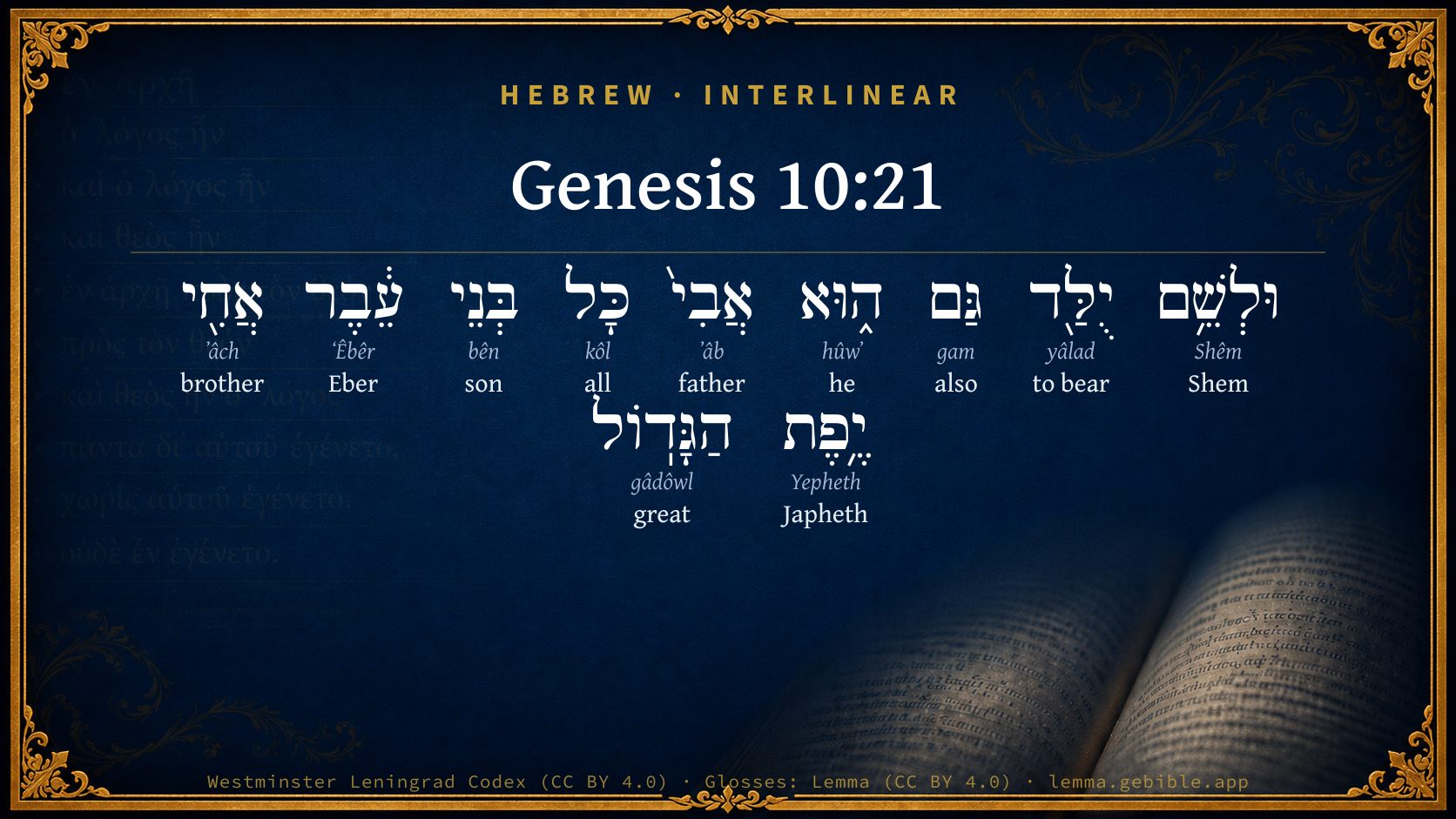
Genesis 10:21

Hebrew (Westminster Leningrad Codex) Genesis 10:21 appears in the Hebrew Old Testament. The text above is from the Westminster Leningrad Codex. Each word links to its Strong’s number, a concise gloss, and parsing drawn from the Open Scriptures Hebrew Bible morphology. Click any word for its full Brown-Driver-Briggs (BDB) entry.
Download image
Cite this verse

Genesis 10:21 (World English Bible). Public Domain. Lemma interlinear Bible study tool, https://lemma.gebible.app/v/genesis/10/21.

Show BibTeX & RIS
BibTeX
RIS
English Translation
To Shem, the father of all the children of Eber, the elder brother of Japheth, to him also were children born.
World English Bible · Public Domain
Highlights
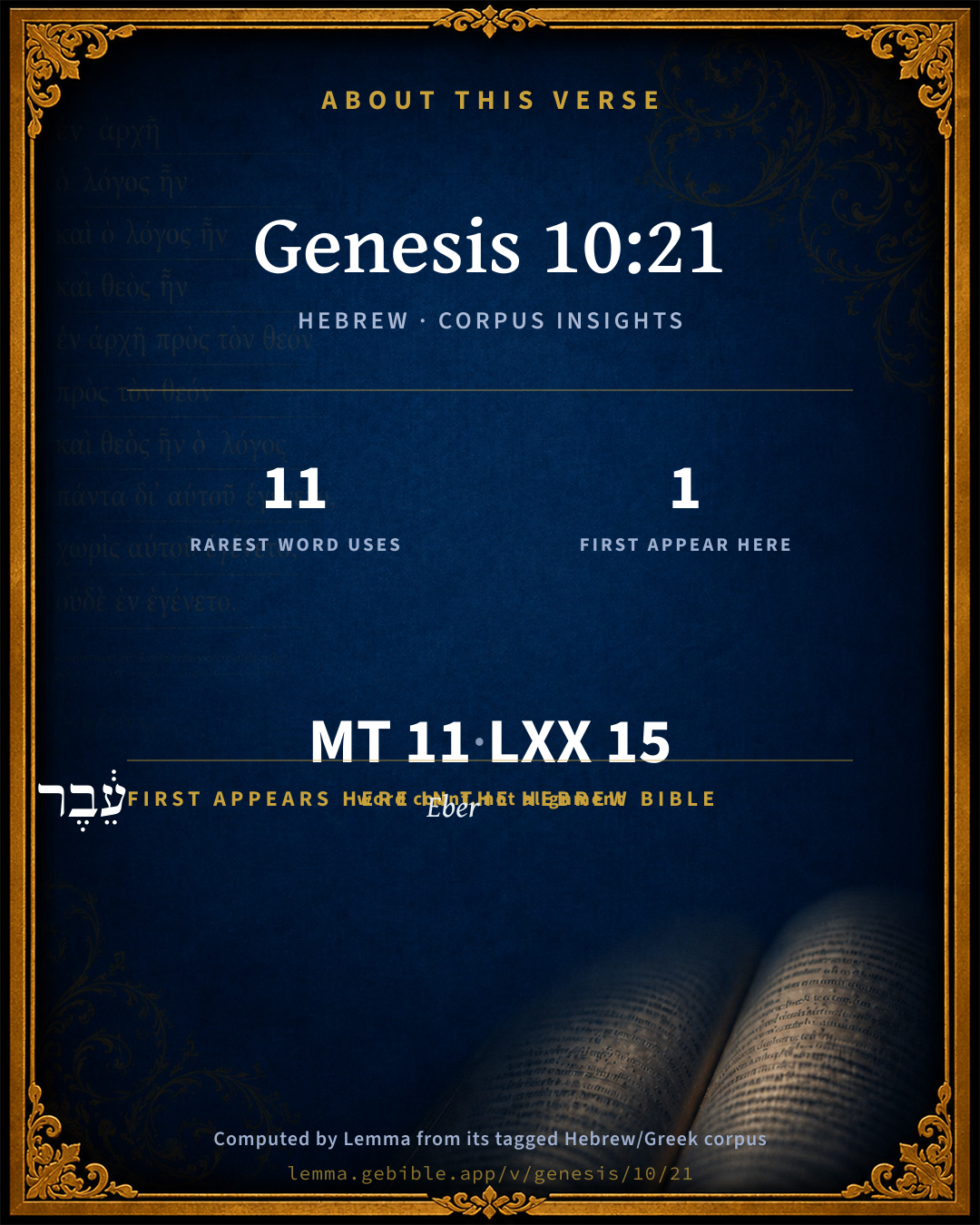
  • 1 first appearance in the Hebrew Bible
Full analysis ↓
Download a study sheet

One document with this verse’s original text, its word-by-word gloss line, the meaning frame, cross-references with their text, attributed commentary, and full source and license credits — printable, and it pastes into notes with its structure intact.

This verse Autodidact and up

Study sheet (.html) Plain text (.txt)

A passage Seminary Student

Up to 50 verses in one chapter. A passage sheet keeps up to 6 commentary sources and 12 cross-references per verse, in the order this page ranks them, and says so on the sheet whenever that leaves anything out. Ask for a single verse and you get the Autodidact verse sheet above.

Everything on this page stays free to read, with no account — the sheet is a download of what is already on screen, not access to it.

Want to remove ads? Support Godless Engineer
Compare translations 3

The same verse in 3 English versions, stacked beneath the original-language interlinear above. Click any original word for its lexicon entry.

Each is an independent rendering of the whole verse — the interlinear is not word-aligned to these translations.

Highlighted words mark where these versions differ — a whole-verse word diff, not a word-by-word alignment.

  • World English Bible Public Domain
    To Shem, the father of all the children of Eber, the elder brother of Japheth, to him also were children born.
  • King James Version Public Domain
    Unto Shem also, the father of all the children of Eber, the brother of Japheth the elder, even to him were children born.
  • unfoldingWord Literal Text CC BY-SA 4.0
    And sons were also born to Shem; he the father of all the sons of Eber and the brother of Japheth the elder.

unfoldingWord Literal Text — © unfoldingWord, licensed CC BY-SA 4.0. Word-aligned USFM3 via Door43 (git.door43.org/unfoldingWord/en_ult).

Versions to compare (up to 4)

3 of 4 selected

Show all 18 translations

Every available English version of this verse, each an independent rendering of the whole verse.

  • World English Bible Public Domain
    To Shem, the father of all the children of Eber, the elder brother of Japheth, to him also were children born.
  • Berean Standard Bible Public Domain
    And sons were also born to Shem, the older brother of Japheth; Shem was the forefather of all the sons of Eber.
  • Majority Standard Bible Public Domain
    And sons were also born to Shem, the older brother of Japheth; Shem was the forefather of all the sons of Eber.
  • King James Version Public Domain
    Unto Shem also, the father of all the children of Eber, the brother of Japheth the elder, even to him were children born.
  • American Standard Version (1901) Public Domain
    And unto Shem, the father of all the children of Eber, the elder brother of Japheth, to him also were children born.
  • Revised Version (1885) Public Domain
    And unto Shem, the father of all the children of Eber, the elder brother of Japheth, to him also were children born.
  • Geneva Bible (1599) Public Domain
    Vnto Shem also the father of all the sonnes of Eber, and elder brother of Iapheth were children borne.
  • Douay-Rheims (1899) Public Domain
    Of Sem also, the father of all children of Heber, the elder brother of Japheth, sons were born.
  • Young's Literal Translation Public Domain
    As to Shem, father of all sons of Eber, brother of Japheth the elder, he hath also begotten:
  • Literal Standard Version CC BY-SA 4.0
    As for Shem, father of all sons of Eber, the older brother of Japheth, he has also begotten.
  • Unlocked Literal Bible CC BY-SA 4.0
    Sons also were born to Shem, the older brother of Japheth. Shem was also the ancestor of all the people of Eber.
  • unfoldingWord Literal Text CC BY-SA 4.0
    And sons were also born to Shem; he the father of all the sons of Eber and the brother of Japheth the elder.
  • Darby Bible Public Domain
    And to Shem -- to him also were [sons] born; he is the father of all the sons of Eber, the brother of Japheth the elder.
  • World Messianic Bible Public Domain
    Children were also born to Shem (the elder brother of Japheth), the father of all the children of Eber.
  • Webster's Bible Public Domain
    To Shem also, the father of all the children of Eber, the brother of Japheth the elder, even to him were children born.
  • Free Bible Version CC BY-SA 4.0
    Shem, whose older brother was Japheth, also had sons. Shem was the forefather of all the sons of Eber.
  • Bible in Basic English Public Domain
    And Shem, the older brother of Japheth, the father of the children of Eber, had other sons in addition.
  • JPS Tanakh (1917) Public Domain
    And unto Shem, the father of all the children of Eber, the elder brother of Japheth, to him also were children born.

Literal Standard Version (2020), Covenant Press — licensed CC BY-SA 4.0. Text via the HelloAO Bible API (eBible.org). Unlocked Literal Bible (unfoldingWord) — licensed CC BY-SA 4.0. Text via the HelloAO Bible API (eBible.org). unfoldingWord Literal Text — © unfoldingWord, licensed CC BY-SA 4.0. Word-aligned USFM3 via Door43 (git.door43.org/unfoldingWord/en_ult). Free Bible Version, Dr. Jonathan Gallagher — licensed CC BY-SA 4.0. Text via the HelloAO Bible API (eBible.org).

Word by word

More ways to search: Search by grammar → Find every occurrence → Compare this word →

Practice this passage: Drill this verse → Learn its vocabulary →

About this verse

These counts appear in no published source. They are computed here, from the morphology-tagged text and Lemma’s own curated glosses. What Lemma adds →

11
words
11
distinct lemmas
Pentateuch
section

Notable vocabulary

The rarest word here is יֶ֥פֶת Japheth H3315 — appearing just 11 times in the whole Hebrew Bible.

First appearance in Scripture

This word makes its first canonical appearance in the Hebrew Bible here:

  • עֵ֔בֶר Eber H5677

Shared distinctive vocabulary

יֶ֥פֶת Japheth H3315 occurs in 11 verses of the Hebrew Bible. Also found in:

Grammatical profile

  • 1 verb
  • 7 nouns
  • 1 adjective
  • 1 pronoun
  • 1 particle

Verb forms

  • יֻלַּ֖ד Pual · Perfect

Hebrew & Septuagint length

In English translation the verse runs 21 words from the Hebrew and 22 from the Septuagint (LXX English) — closely comparable.

A rough comparison of the two English renderings, which tokenize alike — not a word-level alignment.

Word counts can differ between the Hebrew and the Greek without any difference in meaning — e.g. the Hebrew direct-object marker אֵת has no separate Greek word, and Greek often adds the article ὁ.

In the original languages it is 11 Hebrew tokens and 15 Greek tokens — but the two are counted differently (Hebrew bundles its prefixes and suffixes into one token; the Greek is in lemma form), so that isn’t a like-for-like length.

Cross-references

2

Topical passages linked to Genesis 10:21 in the Treasury of Scripture Knowledge — connected by theme and wording, ordered by reader-vote popularity; previews shown in the World English Bible.

  • Numbers 24:24 But ships [shall come] from the coast of Kittim, They shall afflict Asshur, and shall afflict Eber; He also shall come to destruction.
  • Genesis 11:10–26 This is the history of the generations of Shem. Shem was one hundred years old, and became the father of Arpachshad two years after the flood.

Cross-references courtesy of OpenBible.info (CC BY 4.0).

Hebrew and Greek witnesses Masoretic Hebrew ↔ Greek Septuagint

The same verse in the two great witnesses to the Old Testament, shown verse-for-verse.

These are two independent witnesses, not word-aligned to each other, and the Septuagint is shown in lemma (dictionary) form.

Hebrew Genesis 10:21 Masoretic · Westminster Leningrad Codex

וּלְשֵׁ֥ם יֻלַּ֖ד גַּם ה֑וּא אֲבִי֙ כָּל בְּנֵי עֵ֔בֶר אֲחִ֖י יֶ֥פֶת הַגָּדֽוֹל

To Shem, the father of all the children of Eber, the elder brother of Japheth, to him also were children born.

World English Bible · Public Domain

Greek LXX Genesis 10:21 Septuagint · lemma form

καί ὁ σημ γίγνομαι καί αὐτός πατήρ πᾶς ὁ υἱός εβερ ἀδελφός ιαφεθ ὁ μέγας

And to Sem himself also were children born, the father of all the sons of Heber, the brother of Japheth the elder.

LXX2012 (modern English Septuagint) · Public Domain

On this verse, Albert Barnes' Notes on the Bible discusses the Septuagint’s reading. Read the note in Commentary ↓

Hebrew: Westminster Leningrad Codex (CC BY 4.0). Greek: Septuagint (public domain); English from LXX2012 (modern English Septuagint) (Public Domain). How the Septuagint differs from the Hebrew →

Targum (Aramaic paraphrase)

2

The Targum is the ancient Jewish Aramaic paraphrase of the Hebrew Scriptures — an interpretive translation, not the Hebrew text itself. Onkelos (literal) and Pseudo-Jonathan (expansive) render the Torah, and Jonathan the Prophets. Coverage is partial: where no permissively-licensed English translation exists for a verse, only the Aramaic is shown. This is verse-level text, not a word-by-word alignment to the Hebrew.

  1. Targum Onkelos Torah (Genesis–Deuteronomy)
    וּלְשֵׁם אִתְיְלִיד אַף הוּא אֲבוּהוֹן דְּכָל בְּנֵי עֵבֶר אָחוּהִי דְּיֶפֶת רַבָּא

    And of Shem was born: (also he is the father of all the sons of Eber, and the brother of Yapheth the Great:)

    Targum Onkelos — Aramaic: “Onkelos Genesis” (public domain); “Onkelos Exodus” (public domain); “Onkelos Leviticus” (public domain); “Onkelos Numbers” (public domain); “Onkelos Deuteronomy” (public domain). English: “Sefaria Community Translation” (CC0 1.0 (public-domain dedication)); “J.W. Etheridge. The Targums of Onkelos and Jonathan Ben Uzziel on the Pentateuch. London: Longmans, Green, 1862” (public domain). Text via Sefaria.

  2. Targum Pseudo-Jonathan Torah (Genesis–Deuteronomy)
    וּלְשֵׁם אִיתְיְלִיד אַף הוּא בַּר הוּא אַבוּהוֹן דְכָל בְּנֵי עִיבְרָאֵי אָחוֹי דְיֶפֶת רַבָּא בִּדְחַלְתָּא דַיְיָ

    And to Shem also was born a son. He is the father of all the sons of the Hebrews, the brother of Japheth, great in the fear of the Lord.

    Targum Pseudo-Jonathan — Aramaic: “Targum Jonathan on Genesis” (public domain); “Targum Jonathan on Exodus” (public domain); “Targum Jonathan on Leviticus” (public domain); “Targum Jonathan on Numbers” (public domain); “Targum Jonathan on Deuteronomy” (public domain). English: “The Targum of Jonathan ben Uzziel, trans. J. W. Etheridge, London, 1862” (public domain). Text via Sefaria.

Commentary

Notes on Genesis 10:21 from classic Christian and Jewish commentators (each source and its license shown beneath its notes). The classic Christian expositions comment on the surrounding passage and are grouped to its opening verse, so a note may address several verses; the Jewish commentaries on the Tanakh (Rashi and others) are per-verse, so they appear only where the commentator wrote on this verse.

Lemma curates 59 commentaries, every one of them public domain or Creative Commons licensed, each selected and text-cleaned for this edition rather than reprinted as found. About our sources →

Matthew Henry's Commentary

Two things especially are observable in this account of the posterity of Shem: -

I. The description of Shem, Gen 10:21. We have not only his name, Shem, which signifies a name, but two titles to distinguish him by: -

1. He was the father of all the children of Eber. Eber was his great grandson; but why should he be called the father of all his children, rather than of all Arphaxad's, or Salah's, etc.? Probably because Abraham and his seed, God's covenant-people, not only descended from Heber, but from him were called Hebrews; Gen 14:13, Abram the Hebrew. Paul looked upon it as his privilege that he was a Hebrew of the Hebrews, Phi 3:5. Eber himself, we may suppose, was a man eminent for religion in a time of general apostasy, and a great example of piety to his family; and, the holy tongue being commonly called from him the Hebrew, it is probable that he retained it in his family, in the confusion of Babel, as a special token of God's favour to him; and from him the professors of religion were called the children of Eber. Now, when the inspired penman would give Shem an honourable title, he calls him the father of the Hebrews. Though when Moses wrote this, they were a poor despised people, bond-slaves in Egypt, yet, being God's people, it was an honour to a man to be akin to them. As Ham, though he had many sons, is disowned by being called the father of Canaan, on whose seed the curse was entailed (Gen 9:22), so Shem, though he had many sons, is dignified with the title of the father of Eber, on whose seed the blessing was entailed. Note, a family of saints is more truly honourable than a family of nobles, Shem's holy seed than Ham's royal seed, Jacob's twelve patriarchs than Ishmael's twelve princes, Gen 17:20. Goodness is true greatness.

2. He was the brother of Japheth the elder, by which it appears that, though Shem is commonly put first, he was not Noah's first-born, but Japheth was older. But why should this also be put as part of Shem's title and description, that he was the brother of Japheth, since it had been, in effect, said often before? And was he not as much brother to Ham? Probably this was intended to signify the union of the Gentiles with the Jews in the church. The sacred historian had mentioned it as Shem's honour that he was the father of the Hebrews; but, lest Japheth's seed should therefore be looked upon as for ever shut out from the church, he here reminds us that he was the brother of Japheth, not in birth only, but in blessing; for Japheth was to dwell in the tents of Shem. Note, (1.) Those are brethren in the best manner that are so by grace, and that meet in the covenant of God and in the communion of saints. (2.) God, in dispensing his grace, does not go by seniority, but the younger sometimes gets the start of the elder in coming into the church; so the last shall be first and the first last.

II. The reason of the name of Peleg (Gen 10:25): Because in his days (that is, about the time of his birth, when his name was given him), was the earth divided among the children of men that were to inhabit it; either when Noah divided it by an orderly distribution of it, as Joshua divided the land of Canaan by lot, or when, upon their refusal to comply with that division, God, in justice, divided them by the confusion of tongues: whichsoever of these was the occasion, pious Heber saw cause to perpetuate the remembrance of it in the name of his son; and justly may our sons be called by the same name, for in our days, in another sense, is the earth, the church, most wretchedly divided.

Matthew Henry's Commentary on the Whole Bible (1708–1710) — public domain (CC PDM 1.0). Text via the HelloAO Bible API.

Trapp's Complete Commentary

John Trapp

Gen 10:21 Unto Shem also, the father of all the children of Eber, the brother of Japheth the elder, even to him were [children] born.

Ver. 21. Unto Shem also.] His issue is set down last, because to be most insisted on in the holy history.

John Trapp, A Commentary or Exposition upon All the Books of the Old and New Testament (1647–1656) — public domain. Text from a community e-Sword module.

Albert Barnes' Notes on the Bible

- XXXIII. Shem

21. אבר 'eber, “‘Eber, yonder side; verb: pass, cross.”

22. עילם 'eylām, “‘Elam.” עוּל ‛ûl, “suckle.” עלם ‛ālam, “hide; be mature.” ארפכשׁד 'arpakshad, “Arpakshad.” כשׂד ארף 'arp keśed, “boundary of Kesed, or (von-Bohlen) Arjapakshata, beside Aria.” ארם 'ǎrām, “Aram, high; verb: be high.”

23. עוּץ ‛ûts, “‘Uts; verb: counsel; be firm, solid.” חוּל chûl, “Chul; verb: rub, twist, writhe, be strong, await.” גתר geter, “Gether, bridge?” משׁ meshek, “Mash; related: feel, touch.”

24. שׁלח shelach, “Shelach, missile, shoot.”

25. פלג peleg, “Peleg; noun: brook, canal; verb: divide.” יקטן yāqṭān, “Joctan, small.”

26. אלמודד 'almôdād, “Almodad.” למד lāmad, “learn.” מדד mādad, “measure.” שׁלף shelep, “Sheleph; verb: draw out or off.” חערמות chatsarmāvet, “Chatsarmaveth, court of death.” ירח yerach, “Jerach, moon, month.”

27. הדורם hadôrām, Hadoram, “majesty, beauty;” verb: “swell, honor.” אוּזל 'ûzāl, Uzal; verb: “go out or away.” דקלה dı̂qlâh Diclah, “palm.”

28. עובל ‛ôbāl, ‘Obal, “bare, bald.” אבימאל 'ǎbı̂ymā'ēl, Abimael, “father of Mael” (circumcision).

29. אופיר 'ôpı̂r, Ophir; verb: “break, veil.” יובב yôbāb, Jobab; verb: “cry, call.”

30. משׁא mēshā', Mesha, שׁאה shā'âh = שׁוא shô', “roar, crash.” ספר sepār Sephar, “counting. writing.”

From Japheth, who penetrated into the remotest regions, the writer proceeds to Ham, who came into close contact with Shem. From Ham, he passes to Shem, in whom the line of history is to be continued.

Gen 10:21

Shem is here distinguished by two characteristics - the former referring to a subsequent, the latter to an antecedent event. He is “the father of all the sons of Heber.” It is evident from this that the sons of Heber cast luster on the family of Shem, and therefore on the whole human race. It is unnecessary to anticipate the narrative, except so far as to note that the sons of Heber include most of the Arabians, a portion of those who mingled with the race and inhabited the land of Aram, and, most probably, the original element of the population in the land of Kenaan. This characteristic of Shem shows that the table in which it is found was composed after the Hebrews had become conspicuous among the descendants of Shem.

Shem is next distinguished as the “older brother of Japheth”; that is, older than Ham. This interpretation of the words is most agreeable to the Hebrew idiom, and is the only one which affords an important sense. That Shem was the second son appears from the facts that Ham was the youngest Gen 9:24, that Shem was born in the five hundred and third year of Noah Gen 11:10, and, therefore, Japheth must have been the one born when Noah was in his five hundredth year Gen 5:32. The reason for inserting this statement is to prevent the order in which the brothers are introduced in the pedigree from being taken as that of their age, instead of that of the historical relationship subsisting among the nations descended from them.

Gen 10:22

Twenty-six of the primitive nations are descended from Shem, of which five are immediate.

(45) Elam was settled in a part of the modern Persia, to which he gave name. This name seems to be preserved in Elymais, a province of that country bordering on the Dijlah, and now included in Khusistan. It was early governed by its own kings Gen 14:1, and continued to occupy a distinct place among the nations in the time of the later prophets Isa 22:6; Jer 49:34; Eze 32:24. Its capital was Shushan or Susa Dan 8:2, now Shuster.

(46) Asshur seems to have originally occupied a district of Mesopotamia, which was bounded on the east by the Tigris Gen 2:14. The inviting plains and slopes on the east of the Tigris would soon occasion a migration of part of the nation across that river. It is possible there may have been an ancient Asshur occupying the same region even before the flood Gen 2:14.

(47) Arpakshad is traced in Ἀῤῥαπαχῖτις Arrapachitis, Arrhapachitis, a region in the north of Assyria. V. Bohlen and Benfey identify it with Ariapakshata, denoting a country beside Aria. Gesenius renders it border or stronghold of the Kasdim; but the components of the word are uncertain. The nations descended from Arpakshad are noted at the close on account of their late origin, as well as their import for the subsequent narrative.

(48) Lud is usually identified with the Lydians, Λυδοὶ Ludoi, who by migration at length reached and gave their name to a part of the west coast of Asia Minor.

(49) Aram gave name to the upper parts of Mesopotamia and the parts of Syria north of Palestine. Hence, we read of Aram Naharaim (of the two rivers), Aram Dammesek (of Damascus), Aram Maakah on the southwest border of Damascus, about the sources of the Jordan, Aram Beth Rechob in the same neighborhood, and Aram Zoba to the north of Damascus. The name is perhaps varied in the Ἄριμοι Arimoi of Homer (Iliad 2:783) and Strabo (xiii. 4, 6). From Aram are descended four later nations.

Gen 10:23

(50) Uz (Ἀνσῖτις Ausitis, Septuagint.) the chief of a people having their seat in the north of Arabia Deserta, between Palestine and the Euphrates. From this Uz it is possible that the sons of Nahor and of Seir Gen 22:21; Gen 36:28 obtained their name. Job dwelt in this land.

(51) Hul is supposed to have his settlement about the sources of the Jordan in Huleh. Others trace this nation in the Hylatae (Pliny 5:19) near Emesa.

(52) Gether is of uncertain position, probably in Arabia.

(53) Mash may have left a trace of his name in Mons Masius, Karajah Dagh, south of Diarbekir, and perhaps also in the Mysians and Moesians, who may have wandered westward from under this mountain.

Gen 10:24

Arpakshad begat (54) Shelah. We know nothing of the nation of which he was the founder. He begat

(55) Heber. He is the progenitor of the Hebrews, the race to which Abraham belonged. He is marked out very prominently for reasons partly unknown to us at this distance of time, but partly no doubt because he was the ancestor of the chosen race who immediately preceded the confusion of tongues, and to whom belonged that generic Hebrew tongue, which afterward branched into several dialects, of which the Hebrew, now strictly so called, was one. It is probable that most of the diversified modes of speech retained the substance of the primeval speech of mankind. And it is not improbable, for various reasons, that this Hebrew tongue, taken in its largest sense, deviated less from the original standard than any other. The Shemites, and especially the Hebrews, departed less from the knowledge of the true God than the other families of man, and, therefore, may be presumed to have suffered less from the concussion given to the living speech of the race.

The knowledge previously accumulated of the true God, and of his will and way, would have been lost, if the terms and other modes of expressing divine things had been entirely obliterated. It is consonant with reason, then, to suppose that some one language was so little shaken from its primary structure as to preserve this knowledge. We know as a fact, that, while other nations retained some faint traces of the primeval history, the Hebrews have handed down certain and tangible information concerning former things in a consecutive order from the very first. This is a proof positive that they had the distinct outline and material substance of the primeval tongue in which these things were originally expressed. In keeping with this line of reasoning, while distinct from it, is the fact that the names of persons and things are given and explained in the Hebrew tongue, and most of them in that branch of it in which the Old Testament is composed. We do not enter further into the special nature of the Hebrew family of languages, or the relationship in which they are found to stand with the other forms of human speech than to intimate that such investigations tend to confirm the conclusions here enunciated.

Gen 10:25

This nation was very extensive, and accordingly branched out into several, of which the immediate ones are Peleg and Joctan.

(56) Peleg is remarkable on account of the origin assigned to his name. “In his days was the land divided.” Here two questions occur. What is the meaning of the earth being divided, and what is the time denoted by “his days?” The verb “divide” (פלג pālag) occurs only three times elsewhere in the Hebrew scriptures 1Ch 1:19; Job 38:25; Psa 55:9. The connection in which this rare word is used in the Psalm, “divide their tongues,” seems to determine its reference in the present passage to the confusion of tongues and consequent dispersion of mankind recorded in the following chapter. This affords a probable answer to our first question. The land was in his days divided among the representative heads of the various nations. But to what point of time are we directed by the phrase “in his days?” Was the land divided at his birth, or some subsequent period of his life? The latter is possible, as Jacob and Gideon received new names, and Joshua an altered name, in later life.

The phrase “in his days” seems to look the same way. And the short interval from the deluge to his birth appears scarcely to suffice for such an increase of the human family as to allow of a separation into nations. Yet, on the other hand, it is hard to find any event in later life which connected this individual more than any other with the dispersion of man. It is customary to give the name at birth. The phrase “in his days” may, without any straining, refer to this period. And if we suppose, at a time when there were only a few families on the earth, an average increase of ten children in each in four generations, we shall have a thousand, or twelve hundred full-grown persons, and, therefore, may have five hundred families at the birth of Peleg. We cannot suppose more than fifty-five nations distinguished from one another at the dispersion, as Heber is the fifty-fifth name, and all the others are descended from him.

And if three families were sufficient to propagate the race after the flood, nine or ten were enough to constitute a primeval tribe or nation. We see some reason, therefore, to take the birth of Peleg as the occasion on which he received his name, and no stringent reason for fixing upon any later date. At all events the question seems to be of no chronological importance, as in any case only four generations preceded Peleg, and these might have been of comparatively longer or shorter duration without materially affecting the number of mankind at the time of his birth. Peleg is also remarkable as the head of that nation out of which, at an after period, the special people of God sprang. Of the Palgites, as a whole, we hear little or nothing further in history.

(57) Joctan, if little or insignificant as an individual or a nation, is the progenitor of a large group of tribes, finding their place among the wandering races included afterward under the name Arabic. Cachtan, as the Arabs designate him in their traditions, may have given name to Cachtan, a town and province mentioned by Niebuhr.

Gen 10:26-29

The thirteen tribes of the Joctanites or primitive Arabs are enumerated here in Gen 10:26-29.

(58) Almodad is usually referred to Yemen. The first syllable may be the Arabic article. Mudad is the name of one celebrated in Arab story as the stepfather of Ishmael and chief of the Jurhum tribe of Joctanites. The Ἀλλουμαιῶται Alloumaiōtai of Ptolemy belonged to the interior of Arabia Felix.

(59) Sheleph is traced in the Σαλαπηνοὶ Salapeenoi of Ptolemy (vi. 7), belonging to the interior.

(60) Hazarmaveth gives name to a district on the Indian Ocean, abounding in spices, now called Hadramaut. This tribe is the Chatramitae of Greek writers.

(61) Jerah occupied a district where are the coast and mountain of the moon, near Hadramaut.

(62) Hadoram is preserved in the tribe called Ἀδραμῖται Adamitai Atramitae, placed by Pliny (vi. 28) between the Homerites and the Sachalites on the south coast of Arabia.

(63) Uzal perhaps gave the ancient name of Azal to Sana, the capital of Yemen, a place still celebrated for the manufacture of beautiful stuffs.

(64) Diclah settled possibly in the palm-bearing region of the Minaei in Hejaz.

(65) Obal is otherwise unknown.

(66) Abimael is equally obscure. Bochart supposes there is a trace of the name in Μάλι Mali, a place in Arabia Aromatifera.

(67) Sheba is the progenitor of the Sabaei in Arabia Felix, celebrated for spices, gold, and precious stones, and noted for the prosperity arising from traffic in these commodities. A queen of Sheba visited Solomon. The dominant family among the Sabaeans was that of Himjar, from whom the Himjarites (Homeritae) of a later period descended.

(68) Ophir gave name to a country celebrated for gold, precious stones, and almug wood, which seems to have lain on the south side of Arabia, where these products may be found. What kind of tree the almug is has not been clearly ascertained. Some suppose it to be the sandal wood which grows in Persia and India; others, a species of pine. If this wood was not native, it may have been imported from more distant countries to Ophir, which was evidently a great emporium. Others, however, have supposed Ophir to be in India, or Eastern Africa. The chief argument for a more distant locality arises from the supposed three years’ voyage to it from Ezion-geber, and the products obtained in the country so reached. But the three years’ voyage 1Ki 10:22; 2Ch 9:21 seems to be in reality to Tarshish, a very different region.

(69) Havilah here is the founder of a Joctanite tribe of Arabs, and therefore his territory must be sought somewhere in the extensive country which was occupied by these wandering tribes. A trace of the name is probably preserved in Khawlan, a district lying in the northwest of Yemen, between Sana and Mecca, though the tribe may have originally settled or extended further north.

(70) Jobab has been compared with the Ἰωβαρῖται Iōbaritai of Ptolemy (vi. 7). Bochart finds the name in the Arabic: yobab, a desert.

Gen 10:29

The situation of Mesha is uncertain. But it is obviously the western boundary of the settlement, and may have been in the neighborhood of Mecca and Medina. Sephar is perhaps the Arabic Zaphari, called by the natives Isfor, a town on the south coast near Mirbat. It seems, however, to be, in the present passage, the “mount of the east” itself, a thuriferous range of hills, adjacent, it may be, to the seaport so-called. Gesenius and others fix upon Mesene, an island at the head of the Persian Gulf, as the Mesha of the text. But this island may have had no existence at the time of the Joctanite settlement. These boundaries include the greater part of the west and south coast of the peninsula, and are therefore sufficient to embrace the provinces of Hejaz (in part), Yemen, and Hadramaut, and afford space for the settlements of the thirteen sons of Joctan. The limits thus marked out determine that all these settlers, Ophir among the rest, were at first to be found in Arabia, how far soever they may have wandered from it afterward.

Gen 10:31-32

Gen 10:31 contains the usual closing formula for the pedigree of the Shemite tribes; and Gen 10:32 contains the corresponding form for the whole table of nations.

From a review of these lands it is evident that Shem occupied a much smaller extent of territory than either of his brothers. The mountains beyond the Tigris, the Persian Gulf, the Red Sea, the Levant, the Archipelago, and the Black Sea, bound the countries that were in part peopled by Shem. Arabia, Syria, and Assyria contained the great bulk of the Shemites, intermingled with some of the Hamites. The Kushites, Kenaanites, and Philistines trench upon their ground. The rest of the Hamites peopled Africa, and such countries as were supplied from it. The Japhethites spread over all the rest of the world.

In this table there are 70 names, exclusive of Nimrod, of heads of families, tribes, or nations descended from the 3 sons of Noah - 14 from Japheth, 30 from Ham, and 26 from Shem. Among the heads of tribes descended from Japheth are 7 grandsons. Among those from Ham are 23 grandsons and 3 great-grandsons. Among those of Shem are 5 grandsons, one great-grandson, 2 of the fourth generation, and 13 of the fifth. Whence, it appears that the subdivisions are traced further in Ham and much further in Shem than in Japheth, and that they are pursued only in those lines which are of importance for the coming events in the history of Shem.

It is to be observed, also, that, though the different races are distinguished by the diversity of tongues, yet the different languages are much less numerous than the tribes. The eleven tribes of Kenaanites, and the thirteen tribes of Joctanites, making allowance for some tribal peculiarities, most probably spoke at first only two dialects of one family of languages, which we have designated the Hebrew, itself a branch of, if not identical with, what is commonly called the Shemitic. Hence, some Hamites spoke the language of Shem. A similar community of language may have occurred in some other instances of diversity of descent.

Albert Barnes' Notes on the Bible (1834–1885) — public domain. Text from a community e-Sword/MySword module.

Joseph Benson's Commentary

Gen 10:21. Unto Shem, &c. — The word Shem signifies a name; but two titles are also added whereby to distinguish him: 1st, He was the father of all the children of Eber. Eber was his great-grandson; but why should he be called the father of all his children, rather than of all Arphaxad’s or Salah’s? Probably because Abraham and his seed, from Eber, were called Hebrews. Eber himself, we may suppose, was a man eminent for religion in a time of general apostacy; and the holy tongue being commonly called from him the Hebrew, was retained in his family in the confusion of Babel, as a special token of God’s favour to him. 2d, He is styled the brother of Japheth, perhaps to signify the union of the Gentiles and Jews in the church.

Joseph Benson's Commentary on the Old and New Testaments (1811–1818) — public domain. Text from a community e-Sword module.

Whedon's Commentary on the Bible

Daniel D. Whedon

THE SHEMITIC FAMILY, Gen_10:21-31.

21. Unto Shem also, the father of all the children of Eber, the brother of Japheth the elder, even to him were children born — That is, older than Ham, though younger than Japheth. Comp. note on Gen_5:32. This expression, “elder brother,” seems to be inserted here to remind the reader that, although Shem was mentioned after Ham, he was really older than he. Shem’s posterity is mentioned last, to form a more immediate and natural connexion with the following history, which pertains to them exclusively. Shem signifies name, that is, great or distinguished name; made illustrious as the line through which God shines on the world — the line in which arose the “NAME that is above every name.” Shem was the ancestor of the Persians, Assyrians, Arabians, and Lydians, (perhaps also of the Phenicians, see Gen_10:15,) all great nations of western Asia; but he is especially conspicuous in this history as father of the “children of Eber,” the Hebrew people, through whom came revelation and the Messiah. For the meaning of “Hebrew,” see Gen_10:24 and note. The names of most of these sons of Shem became early transferred to the countries they occupied.

Daniel D. Whedon (gen. ed.), Commentary on the Old and New Testaments (1874–1909) — public domain. Text from a community e-Sword module.

Keil & Delitzsch

C. F. Keil & F. Delitzsch

Descendants of Shem. - Gen 10:21. For the construction, vid., Gen 4:26. Shem is called the father of all the sons of Eber, because two tribes sprang from Eber through Peleg and Joktan, viz., the Abrahamides, and also the Arabian tribe of the Joktanides (Gen 4:26.). - On the expression, "the brother of Japhet הגּדול," see Gen 9:24. The names of the five sons of Shem occur elsewhere as the names of the tribes and countries; at the same time, as there is no proof that in any single instance the name was transferred from the country to its earliest inhabitants, no well-grounded objection can be offered to the assumption, which the analogy of the other descendants of Shem renders probable, that they were originally the names of individuals. As the name of a people, Elam denotes the Elymaeans, who stretched from the Persian Gulf to the Caspian Sea, but who are first met with as Persians no longer speaking a Semitic language. Asshur: the Assyrians who settled in the country of Assyria, Ἀτουρία, to the east of the Tigris, but who afterwards spread in the direction of Asia Minor. Arphaxad: the inhabitants of Ἀῤῥαπαχῖχτις in northern Assyria. The explanation given of the name, viz., "fortress of the Chaldeans" (Ewald), "highland of the Chaldeans" (Knobel), "territory of the Chaldeans" (Dietrich), are very questionable. Lud: the Lydians of Asia Minor, whose connection with the Assyrians is confirmed by the names of the ancestors of their kings. Aram: the ancestor of the Aramaeans of Syria and Mesopotamia.

Keil & Delitzsch — Biblical Commentary on the Old Testament (1861–1891) — public domain (CC PDM 1.0). Text via the HelloAO Bible API. (Old Testament only.)

Tyndale Open Study Notes

Tyndale Open Resources

10:21 Shem, the older brother of Japheth, was the father of the Semitic peoples. The descendants listed represent countries east of Israel (modern Iraq, Iran, and Syria). The narrator lists these locations within Mesopotamia since Abram, the father of Israel, originated from this area (see 11:27-32). • Eber receives special attention because of his connection with Abram (see study note on 10:24).

Tyndale Open Study Notes — © Tyndale Open Resources, licensed CC BY-SA 4.0. Text via the HelloAO Bible API.

Geneva Bible (1599)

Geneva Bible translators

Of whom came the Hebrews or Jews.

In his stock the Church was preserved: therefore Moses leaveth off speaking of Japheth and Ham, and entreateth of Shem more at large.

Geneva Bible (1599) marginal notes — public domain. Text via Bolls.life.

Jamieson, Fausset & Brown

Robert Jamieson, A. R. Fausset & David Brown

Unto Shem--The historian introduces him with marked distinction as "the father of Eber," the ancestor of the Hebrews.

Jamieson, Fausset & Brown — Commentary Critical and Explanatory on the Whole Bible (1871) — public domain (CC PDM 1.0). Text via the HelloAO Bible API.

Adam Clarke's Commentary

Verse 21. Shem also, the father of all the children of Eber] It is generally supposed that the Hebrews derived their name from Eber or Heber, son of Shem; but it appears much more likely that they had it from the circumstance of Abraham passing over (for so the word עבר abar signifies) the river Euphrates to come into the land of Canaan. See the history of Abraham, Ge 14:13.

Adam Clarke's Commentary on the Bible (1810–1826) — public domain. Text from a community e-Sword/MySword module.

John Calvin's Commentaries

21. Unto Shem also, the father of all the children of Eber. Moses, being about to speak of the sons of Shem, makes a brief introduction, which he had not done in reference to the others. Nor was it without reason; for since this was the race chosen by God, he wished to sever it from other nations by some special mark. This also is the reason why he expressly styles him the ‘father of the sons of Eber,’ and the elder brother of Japheth. For the benediction of Shem does not descend to all his grandchildren indiscriminately, but remains in one family. And although the grandchildren themselves of Eber declined from the true worship of God, so that the Lord might justly have disinherited them; yet the benediction was not extinguished, but only buried for a season, until Abraham was called, in honor of whom this singular dignity is ascribed to the race and name of Eber. For the same cause, mention is made of Japheth, in order that the promise may be confirmed, ‘God shall speak gently unto Japheth, that he may dwell in the tents of Shem.’ Shem is not here called the brother of Ham, inasmuch as the latter was cut off from the fraternal order, and was debarred his own right. Fraternity remained only between them and Japheth; because, although they were separated, God had engaged that he would cause them to return from this dissension into union. As it respects the name Eber, they who deny it to be a proper name, but deduce it from the word which signifies to pass over, are more than sufficiently refuted by this passage alone.

John Calvin's Commentaries (1540-1563) — public domain. Text from the Calvin Translation Society English edition (1840s-50s) via the Christian Classics Ethereal Library (ccel.org). Calvin's coverage is partial (roughly two-thirds of the Bible); uncommented books and verses are honest gaps, never fabricated. The 19th-century editor's footnotes and remarks are omitted so the notes are faithfully Calvin's own voice.

Ellicott's Commentary for English Readers

(21-23) shem . . . the brother of Japheth the elder.—Really, the elder brother of Japheth. Though the rules of Hebrew grammar will admit of no other rendering, it is remarkable that both the Syriac and the Vulg. make the same mistake as our own version. In designating Shem as “the father of all the children of Eber,” attention is called to the fact that the descendants of Peleg, his elder son, are omitted from this table, and reserved for the Tôldôth Shem. (See Gen_11:10.)

The nations descended from Shem were:—

1. Elam.—According to Mr. Sayce (Chald. Gen., p. 196), “the primitive inhabitants of Elam were a race closely allied to the Accadians, and spread over the whole range of country which stretched from the southern shores of the Caspian to the Persian Gulf.” But just as the Semitic Asshur expelled a Hamite race from Assyria, so another branch of this conquering family occupied Elymais. It is now called Chuzistan, and was the most easternly of the countries occupied by the Semites. But see Excursus to Genesis 14 on the conquests of the Elamite Chedorlaomer.

2. Asshur.—This Semitic stock seems to have been the first to settle on the Tigris, as the Hamites were the first to settle on the Euphrates. Finally, as we have seen (Gen_10:11), they conquered the whole country.

3. Arphaxad.—Heb., Arpachshad. We may dismiss the idea that he was connected with the region called Arrapachitis, for this correctly is Aryapakshata, “the land next the Aryans.” Really he appears as the ancestor of Eber and the Joktanite Arabs.

4. Lud.—Probably the Lydians, who, after various wanderings, settled in Asia Minor.

5. Aram.—As Asshur means plain, so Aram means highland. It was originally the name of the Lebanon ranges, and thus Damascus is called Aram in 2Sa_8:5. Subsequently the race so extended itself as to possess Mesopotamia, a lowland country, but called, as early as Gen_24:10, “Aram of the two rivers.” The greatness of Aram will be best seen by examining those places in our version where Syria and Syrian are spoken of, and which, in the Hebrew, are really Aram.

To the Aramæan stock belonged also four outlying dependencies—(1) Uz, the land of Job, a district in the northern part of Arabia Deserta; (2) Hul and (3) Gether, regions of which nothing is known; and (4) Mash, a desert region on the western side of the Euphrates (Chald. Gen., p. 276).

A Bible Commentary for English Readers, edited by Charles John Ellicott (1878–1897) — public domain. Text from a community e-Sword module.

The Cambridge Bible for Schools and Colleges

gen. ed. J. J. S. Perowne

21–31. The Sons of Shem (J and P)

21. And unto Shem, &c.] The brief account in verse is from J.

the father of all the children of Eber] This is the point in the description of Shem which would seem most honourable to Israelite readers. The names “Eber” and “Hebrew” are almost identical in the Hebrew language. “Eber” was accepted as the ancestor of the Hebrew-speaking peoples. In the widest sense of the word, “Hebrews” are a group of Semitic peoples who issued from the Arabian Peninsula. They are included among the descendants of Joktan and Peleg, as well as of Terah. For the ordinary derivation of the word “Hebrew,” as = “the man from the further side” of the river, see Gen_10:24 and Gen_14:13. The term “Hebrew” is racial, “Israelite” national; though ultimately used as synonyms.

the elder brother of Japheth] These words seem to be inserted, in order to remind the reader that Shem, though here mentioned last, was the eldest of Noah’s sons. The rendering of R.V. marg., the brother of Japheth the elder, is very improbable.

The Cambridge Bible for Schools and Colleges (gen. ed. J. J. S. Perowne; Cambridge University Press, 1878–1918) — public domain. Text from a community e-Sword module.

John Gill's Exposition

Unto Shem also, the father of all the children of Eber,.... And for the sake of those Shem is particularly said to be the father of, is this genealogy given, and indeed the whole book of Genesis wrote: Eber was the great-grandson of Shem, and is here spoken of by anticipation, and Shem is called not the father of either of his immediate sons, but of the posterity of this man; because the Hebrews sprung from him in his line, among whom the church of God and the true religion were preserved, and from whom the Messiah was to come, as he did: the word Eber, Jarchi interprets, "beyond the river, Euphrates" or "Tigris", or both, as describing the seat of the posterity of Shem; but as this too much straitens them, since they inhabited on both sides, Dr. Hyde (d) has shown that the word used may refer to both, to those beyond these rivers, and to those on this side; see Num 24:24.

the brother of Japheth the elder; he was the brother of Ham too, but he is not mentioned because of the behaviour towards his father, and because of the curse that was upon him and his; but Shem's relation to Japheth is expressed to show that they were alike in their disposition; and it may be to signify, that in times to come their posterity would unite in spiritual things, which has been fulfilled already in part, and will be more fully by the coalition of the Jews, the posterity of Shem, and of the Gentiles, the posterity of Japheth, in the Christian church state: and from hence we learn that Japheth was the eldest of Noah's sons, though some render the words, "the elder brother of Japheth" (e); and so make Shem to be the eldest; but as this is contrary to the accents, so to the history: for Noah was five hundred years old when he began to beget sons, Gen 5:32 he was six hundred when he went into the ark, Gen 7:11 two years after the flood Shem begat Arphaxad, when he was one hundred years old, and Noah six hundred and two, Gen 11:10 so that Shem must be born when Noah was five hundred and two years old; and since he begot children, there must be one two years older than Shem, which can be no other than Japheth, since Ham is called his younger son, Gen 9:24.

even to him were children born, who are reckoned as follow.

(d) Hist. Relig. Pers. c. 2. p. 47, 48. (e) "fratre Japheth majore". V. L. Samar. Syr. Ar. "frater major natu ipsius Japheth", Tigurine version; "fratri Japheti majori", Cocceius; so some in Vatablus.

John Gill's Exposition of the Whole Bible (1746–1763) — public domain (CC PDM 1.0). Text via the HelloAO Bible API.

Haydock's Catholic Bible Commentary

Of Heber. That is, of the nations beyond the Euphrates. Hebrews, &c. (Calmet) --- The elder brother, fratre Japheth majore, may be rendered as well "Japheth being his elder brother," which, as we have already observed, was probably the case. By mentioning him alone, we may gather that Sem was elder than Cham, who is called the less or younger son. (Haydock) --- The Hebrew may be translated either way. But the Chaldean, Liranus, and many excellent interpreters, make Jepheth the eldest. (Calmet)

George Leo Haydock (1774–1849), Haydock's Catholic Family Bible and Commentary, 1859 edition — public domain. Excludes Psalms (Douay-Rheims chapter numbering differs from Protestant) and Deuterocanonical books (Catholic canon only).

Matthew Poole's English Annotations

Of all the children of Eber, i.e. of the Hebrews, the only church and people of God when Moses wrote, who are called

Eber, Num 24:24, as here, the children of Eber. And he is here called the father of them peculiarly, though he had other children, because he was their father not only by natural generation, but also in respect of the promise of God, which was conveyed to them through Shem’s hands, and of that faith and holiness wherein he was their predecessor and eminent pattern; even as Ham, though he had other sons, is specially called the father of Canaan, Gen 9:22, because his father’s curse rested upon him, Gen 10:25.

Object. Eber had many other children here recorded, and therefore in that sense Shem was not the father of all the children of Eber.

Answ. Though Eber had other children, yet none are called in Scripture the children of Eber, or, which is all one, the Hebrews, but Abraham’s posterity; even as though Abraham had divers other children, yet the Israelites are in many places peculiarly called the children of Abraham. And the ungodly Jews, when they degenerate from God and godliness, God takes away their name, and denieth them to be Jews, Rom 2:28, and calls them Sodomites, Isa 1:10. And therefore no wonder if Joktan and his posterity, having, as it is probable, forsaken their father’s God, and turned idolaters, be here disowned as bastards, and blotted out of the honourable catalogue of the children of Eber: see Rom 9:8.

Japheth alone is here mentioned as his brother, and not Ham, because he was deservedly shut out from Shem’s blessing pronounced by Noah, and was accursed of God, whereas Japheth was partaker with Shem, both in the piety exercised towards their father, and the blessing thereupon pronounced; the word brother being often applied to persons alike in condition, disposition, or manners: see Gen 49:5.

The elder. Though the words in Hebrew may seem ambiguous, yet other texts make it probable that Japheth was the elder. For Noah began to beget children in his five hundredth year, Gen 5:32. And Shem was but a hundred years old two years after the flood, Gen 11:10. Therefore he was not the eldest. And Ham is concluded not to be the eldest, from Gen 9:24; of which see Poole "Gen 9:24"; if so, Japheth must be the eldest. And Shem is generally named first, not because he was the first-born, but because he had the privileges of the first-born, and was chief in dignity and authority in the church of God.

Matthew Poole's English Annotations on the Holy Bible (1683–1685) — public domain. Text from a community e-Sword/MySword module.

The Pulpit Commentary

Unto Shem also, the father of all the children of Eber, as Ham of Canaan (Gen_9:22; vide ver. 24) the brother of Japheth the elder. Either the eldest brother of Japheth (Syriac, Arabic, Vulgate, Gesenius, Rosenm Kalisch); or the brother of Japheth who was older (LXX, Symmachus, Onkelos, Raschi, Aben Ezra, Luther, Clerieus, Michaelis, Dathe); or the elder of Japheth"s brothers, as distinguished from Ham the younger, i.e. the son who was older than Ham, But younger than Japheth. (Murphy, Quarry; vide. Gen_5:32) Even to him were children born.

The Pulpit Commentary (1880–1919), ed. H.D.M. Spence-Jones & Joseph S. Exell — public domain. Text from a community e-Sword module.

John Wesley's Explanatory Notes

Two things especially are observable in this account of the posterity of Shem. The description of Shem, ver. 21, we have not only his name, Shem, which signifies a name; but two titles to distinguish him by.

1. He was the father of all the children of Eber. Eber was his great grandson, but why should he be called the father of all his children, rather than of all Arphaxad's or Salah's? Probably because Abraham and his seed, not only descended from Hebser, but from him were called Hebrews. Eber himself, we may suppose, was a man eminent for religion in a time of general apostasy; and the holy tongue being commonly called from him the Hebrew, it is probable he retained it in his family in the confusion of Babel, as a special token of God's favour to him.

2. He was the brother of Japheth the elder; by which it appears, that though Shem be commonly put first, yet he was not Noah's first-born, but Japheth was elder. But why should this also be put as part of Shem's description, that he was the brother of Japheth, since that had been said before? Probably this is intended to signify the union of the Gentiles with the Jews in the church. He had mentioned it as Shem's honour, that he was the father of the Hebrews; but lest Japheth's seed should therefore be looked upon as shut out from the church, he here minds us, that he was the brother of Japheth, not in birth only, but in blessing, for Japheth was to dwell in the tents of Shem. The reason of the name of Peleg, ver. 25, because, in his days, (that is, about the time of his birth) was the earth divided among the children of men that were to inhabit it; either when Noah divided it, by an orderly distribution of it, as Joshua divided the land of Canaan by lot, or when, upon their refusal to comply with that division, God, in justice, divided them by the confusion of tongues.

John Wesley, Explanatory Notes Upon the Whole Bible (1754–1765) — public domain. Text via the GEBible commentary corpus.

Kretzmann's Popular Commentary

Paul E. Kretzmann

The Sons of Shem

v. 21. Unto Shem also, the father of all the children of Eber, the brother of Japheth the elder, even to him were children born. Shem is here called the father of all the children of Eber, the Hebrews in the wider sense of the word, because Eber, through his sons Peleg and Joktan, was the progenitor of two distinct series of peoples, the Joktanites of Arabia and the Abrahamites, afterward the children of Israel.

v. 22. The children of Shem: Elam, and Asshur, and Arphaxad, and Lud, and Aram. The nations, or tribes, which descended from them were afterward found in the Persian country of Elymais, in Assyria, in Chaldea, in Lydia in Asia Minor, and in Syria, respectively.

v. 23. And the children of Aram: Uz, and Hul, and Gether, and Mash. These names, as found in various accounts, point to the fact that the tribes descending from Aram gradually moved toward the east and northeast.

v. 24. And Arphaxad begat Salah; and Salah begat Eber. The two names Salah (sending forth) and Eber (passing over) may indicate that the emigration of tribes in one large movement, as spoken of in the next Chapter, took place at this time.

v. 25. And unto Eber were born two sons: the name of one was Peleg; for in his days was the earth divided; and his brother’s name was Joktan. Eber probably took part in the great Babylonian emigration, or he named his older son Peleg (division), with reference, undoubtedly, to the division and confusion brought about in consequence of the interference of God.

v. 26. And Joktan begat Almodad, and Sheleph, and Hazarmaveth, and Jerah,

v. 27. and Hadoram, and Uzal, and Diklah,

v. 28. and Obal, and Abimael, and Sheba,

v. 29. and Ophir, and Havilah, and Jobab: all these were the sons of Joktan.

v. 30. And their dwelling was from Mesha, as thou goest unto Sephar, a mount of the east. of the thirteen names in this list several have been preserved in various parts of Arabia, and so the Arabians are the Joktanites, descendants of Shem.

v. 31. These are the sons of Shem, after their families, after their tongues, in their lands, after their nations.

v. 32. These are the families of the sons of Noah, after their generations, in their nations: and by these were the nations divided in the earth after the Flood. This is the Lord’s own genealogical table, and it has not yet been superseded. The most careful work on the part of archeologists has rather confirmed the Biblical account in every item. All the nations of men that dwell on the earth have come from one blood, Act 17:26.

Paul E. Kretzmann, Popular Commentary of the Bible (1921–1924) — public domain. Text from a community e-Sword module.

unfoldingWord translationNotes

Door43 World Missions Community

translationWords

Shem

Japheth

unfoldingWord translationNotes — © Distant Shores Media and the Door43 World Missions Community, licensed CC BY-SA 4.0. Source: git.door43.org/Door43/en_tn.

Rashi

Rabbi Shlomo Yitzchaki (Rashi)

אבי כל בני עבר THE FATHER OF ALL THE CHILDREN OF EBER — (עבר means the “side” or “ other side” of a river) — The father of all the children of עבר הנהר, the other side of the River (Euphrates), was Shem.

אחי יפת הגדול [SHEM …] THE BROTHER OF JAPHETH, THE ELDER — (The Hebrew is ambiguous: “the elder” may refer either to Shem or to Japheth). One cannot from here determine whether Japheth was the elder or Shem. Since, however, it states (10:10) “Shem was a hundred years old … two years after the flood” you must admit that Japheth was the elder. Because Noah was 500 years old when he first had children (5:32), and the Flood happened in the six hundredth year of his life (7:11), consequently the eldest of his sons was then one hundred years old, whereas Shem reached his hundredth year only two years after the Flood (and therefore Japheth was the elder of the two) (Genesis Rabbah 37:7).

אחי יפת THE BROTHER OF JAPHETH — It does not state “brother of Ham”, because those two honoured their father whereas Ham put him to shame.

Rashi on the Tanakh — English translations: “The Judaica Press complete Tanach with Rashi, translated by A. J. Rosenberg” (CC BY 4.0); “Pentateuch with Rashi's commentary by M. Rosenbaum and A.M. Silbermann, 1929-1934” (public domain); “The Metsudah Tanach series, Lakewood, N.J” (CC BY 4.0); and “The Book of Joshua, Metsudah Publications, 1997” (CC BY 4.0). Text via Sefaria.

Ramban (Nachmanides)

Rabbi Moshe ben Nachman (Ramban / Nachmanides)

AND UNTO SHEM, TO HIM ALSO WERE CHILDREN BORN. Since Scripture delayed the narration of the generations of Shem and related the generations of his younger brother as if Shem had no children, it therefore says here, to him also.

THE FATHER OF ALL THE CHILDREN OF ‘EBER.’ This means that he was the father of all who dwelled beyond (eber) the Euphrates River, which was the place of Abraham’s family. But it is not possible that Eber in this context be the name of the person who was the father of Peleg for why would Scripture connect the children of Eber with Shem [moreso than with any of his other offspring]?

THE BROTHER OF JAPHETH THE ELDER. It is the way of Scripture to record a younger brother beside the oldest of his brothers, and not beside a younger one than himself., rather than “the elder brother of Ham.” And similarly, we find the verse, Miriam the prophetess, the sister of Aaron. The reason for mentioning this altogether is to state that he [Shem] is the brother of the honorable Japheth, comparable to him in distinction. Scripture thus declares that the reason it delayed telling of his genealogy is not because Ham was more distinguished than he.It appears to me that “the elder” is descriptive of Shem, is descriptive either of Japheth or of Shem. If so, the elder refers to age in years for in my opinion Shem was the oldest of the brothers while, in the opinion of most commentators, Japheth was the oldest. It is also possible to explain the elder as referring to distinction, and it may also be descriptive of either of them.” meaning that he was the older brother of Japheth, as Ham was the youngest of all, even though Scripture mentioned Japheth first. So, likewise, in all places in Scripture, the descriptive noun refers to the subject spoken of, such as: Isaiah the son of Amoz the prophet, [the term “the prophet” refers to Isaiah, who is the subject of the narration]; Unto Hobab, the son of Reuel the Midianite, Moses’ father-in-law, [here, “Moses’ father-in-law” refers back to Hobab]. But Rashi wrote: “The brother of Japheth. It does not state “the brother of Ham” because these two [Shem and Japheth] honored their father whereas Ham put him to shame.” This interpretation also declares that the sense of the verse is that Shem is the brother of the righteous brother, and not the brother of the wicked brother even though he is counted after him.

Ramban (Nachmanides) on the Tanakh — English translation: “Commentary on the Torah by Ramban (Nachmanides). Translated and annotated by Charles B. Chavel. New York, Shilo Pub. House, 1971-1976” (CC BY 4.0). Text via Sefaria.

Radak

Rabbi David Kimhi (Radak)

ולשם, the reason that the descendants of Shem are listed last in this chapter is that the story will continue with the lives of the patriarchs, all of whom are descended from Shem. The Torah is trying to preserve continuity. As to the unusual phrase

גם הוא, the Torah adds these words as if to say that we should not think that seeing that up to now we heard about Shem always first, that the fact that we had not heard about him in this chapter means that he had not been blessed with offspring. Not only did he have sons, but he became the founding father of all the tribes descended from עבר, who in turn became the ancestor of the patriarchs. In fact, his descendants were even more important than those of his older brother Yaphet, described as הגדול, the great one. The attribute הגדול, when used in conjunction with Yaphet may be understood as Shem sharing his brother Yaphet’s distinction of doing good deeds. The Torah invites you to note that Shem has not been compared to Cham, neither in seniority nor in quality of lifestyle. The word הגדול may equally well be understood as “the great one,” i.e. in deeds.

יולד, a somewhat strange word when we would have expected יולדו in the plural mode, seeing that a number of sons were born to him. The singular is used to cover the subject of progeny being born. It has been use in a similar manner in verse 25, when speaking of Ever’s progeny.

Radak on the Tanakh — English translations: “Sefaria Community Translation” (CC0 1.0 (public-domain dedication)); “Eliyahu Munk, HaChut Hameshulash” (CC BY 4.0); “Rabbi Mike Feuer, Jerusalem Anthology” (CC BY 4.0); and “R. David Kimhi on the first book of Psalms, Translated by R.G. Finch, London, 1919” (public domain). Text via Sefaria.

Lesson kit

Teaching starters — assembled from the data on this page, not authored interpretation. Every prompt links to the verse data it draws on. Edit before teaching.

Genesis, in the Pentateuch, opens this verse with 11 words (11 distinct Hebrew lemmas). Its most distinctive word is Yepheth (“Japheth”). A historical commentator’s framing appears above. Read the whole chapter for the surrounding context.

Discussion questions

  1. The word Yepheth carries the sense “Japheth.” How does it shape the verse?
  2. The word “Eber” first appears here in Scripture. What is being introduced at this debut?
  3. Genesis 5:32 shares the word «Japheth» with this verse. How do the two illuminate each other?
  4. These translations render this verse differently. What is at stake in choosing one wording over another?
  5. The verb «יֻלַּ֖ד» is Pual Perfect. How does its form color the action?
  6. Reading how Matthew Henry's Commentary and Trapp's Complete Commentary read this verse, where do the two commentators agree and where do they part?

Things to notice

Reading settings

Reading text

Shown beneath each verse's original-language words.

Old Testament
Old Testament edition

Read the OT as the Masoretic Hebrew (MT) or the Greek Septuagint (LXX).

English shown for the Greek Septuagint (in the Hebrew ↔ Greek comparison).

Comparing translations? Open the Compare panel on any verse page to stack up to four side by side.