
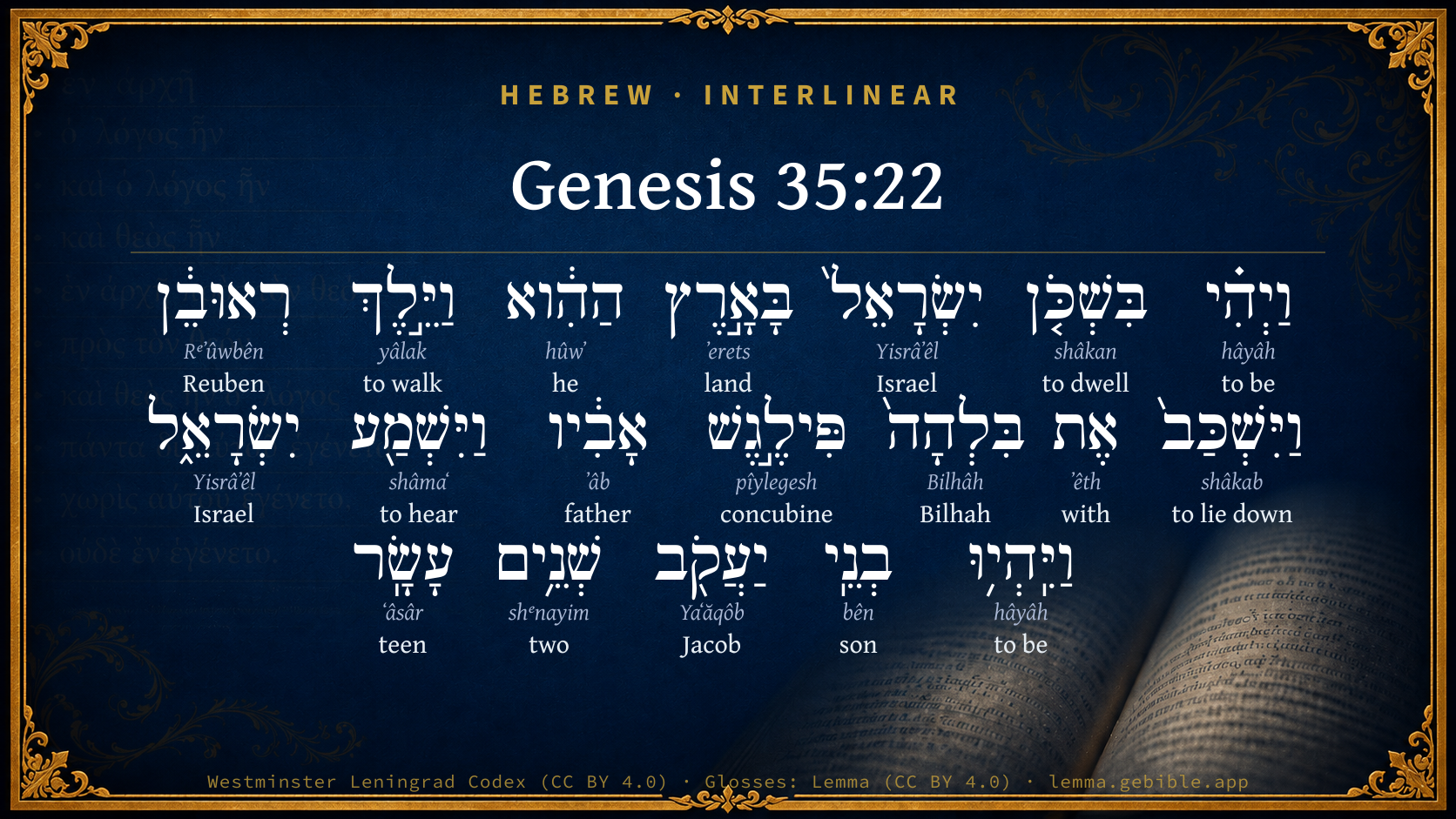
Genesis 35:22

Hebrew (Westminster Leningrad Codex) Genesis 35:22 appears in the Hebrew Old Testament. The text above is from the Westminster Leningrad Codex. Each word links to its Strong’s number, a concise gloss, and parsing drawn from the Open Scriptures Hebrew Bible morphology. Click any word for its full Brown-Driver-Briggs (BDB) entry.
Download image
Cite this verse

Genesis 35:22 (World English Bible). Public Domain. Lemma interlinear Bible study tool, https://lemma.gebible.app/v/genesis/35/22.

Show BibTeX & RIS
BibTeX
RIS
English Translation
It happened, while Israel lived in that land, that Reuben went and lay with Bilhah, his father's concubine, and Israel heard of it. Now the sons of Jacob were twelve.
World English Bible · Public Domain
Download a study sheet

One document with this verse’s original text, its word-by-word gloss line, the meaning frame, cross-references with their text, attributed commentary, and full source and license credits — printable, and it pastes into notes with its structure intact.

This verse Autodidact and up

Study sheet (.html) Plain text (.txt)

A passage Seminary Student

Up to 50 verses in one chapter. A passage sheet keeps up to 6 commentary sources and 12 cross-references per verse, in the order this page ranks them, and says so on the sheet whenever that leaves anything out. Ask for a single verse and you get the Autodidact verse sheet above.

Everything on this page stays free to read, with no account — the sheet is a download of what is already on screen, not access to it.

Want to remove ads? Support Godless Engineer
Compare translations 3

The same verse in 3 English versions, stacked beneath the original-language interlinear above. Click any original word for its lexicon entry.

Each is an independent rendering of the whole verse — the interlinear is not word-aligned to these translations.

Highlighted words mark where these versions differ — a whole-verse word diff, not a word-by-word alignment.

  • World English Bible Public Domain
    It happened, while Israel lived in that land, that Reuben went and lay with Bilhah, his father's concubine, and Israel heard of it. Now the sons of Jacob were twelve.
  • King James Version Public Domain
    And it came to pass, when Israel dwelt in that land, that Reuben went and lay with Bilhah his father's concubine: and Israel heard it. Now the sons of Jacob were twelve:
  • unfoldingWord Literal Text CC BY-SA 4.0
    And it happened while Israel was living in that land, then Reuben went and lay with Bilhah, the concubine of his father, and Israel heard. Now the sons of Jacob were twelve.

unfoldingWord Literal Text — © unfoldingWord, licensed CC BY-SA 4.0. Word-aligned USFM3 via Door43 (git.door43.org/unfoldingWord/en_ult).

Versions to compare (up to 4)

3 of 4 selected

Show all 18 translations

Every available English version of this verse, each an independent rendering of the whole verse.

  • World English Bible Public Domain
    It happened, while Israel lived in that land, that Reuben went and lay with Bilhah, his father's concubine, and Israel heard of it. Now the sons of Jacob were twelve.
  • Berean Standard Bible Public Domain
    While Israel was living in that region, Reuben went in and slept with his father’s concubine Bilhah, and Israel heard about it. Jacob had twelve sons:
  • Majority Standard Bible Public Domain
    While Israel was living in that region, Reuben went in and slept with his father’s concubine Bilhah, and Israel heard about it. Jacob had twelve sons:
  • King James Version Public Domain
    And it came to pass, when Israel dwelt in that land, that Reuben went and lay with Bilhah his father's concubine: and Israel heard it. Now the sons of Jacob were twelve:
  • American Standard Version (1901) Public Domain
    And it came to pass, while Israel dwelt in that land, that Reuben went and lay with Bilhah his father's concubine: and Israel heard of it. Now the sons of Jacob were twelve:
  • Revised Version (1885) Public Domain
    And it came to pass, while Israel dwelt in that land, that Reuben went and lay with Bilhah his father’s concubine: and Israel heard of it. Now the sons of Jacob were twelve:
  • Geneva Bible (1599) Public Domain
    Now, when Israel dwelt in that land, Reuben went, and lay with Bilhah his fathers concubine, and it came to Israels eare. And Iaakob had twelue sonnes.
  • Douay-Rheims (1899) Public Domain
    And when he dwelt in that country, Ruben went, and slept with Bala, the concubine of his father: which he was not ignorant of. Now the sons of Jacob were twelve.
  • Young's Literal Translation Public Domain
    and it cometh to pass in Israel's dwelling in that land, that Reuben goeth, and lieth with Bilhah his father's concubine; and Israel heareth.
  • Literal Standard Version CC BY-SA 4.0
    and it comes to pass in Israel’s dwelling in that land, that Reuben goes, and lies with his father’s concubine Bilhah; and Israel hears.
  • Unlocked Literal Bible CC BY-SA 4.0
    While Israel was living in that land, Reuben slept with Bilhah his father's concubine, and Israel heard of it. Now Jacob had twelve sons.
  • unfoldingWord Literal Text CC BY-SA 4.0
    And it happened while Israel was living in that land, then Reuben went and lay with Bilhah, the concubine of his father, and Israel heard. Now the sons of Jacob were twelve.
  • Darby Bible Public Domain
    And it came to pass when Israel dwelt in that land, that Reuben went and lay with Bilhah, his father's concubine; and Israel heard of it. And the sons of Jacob were twelve.
  • World Messianic Bible Public Domain
    While Israel lived in that land, Reuben went and lay with Bilhah, his father’s concubine, and Israel heard of it. Now the sons of Jacob were twelve.
  • Webster's Bible Public Domain
    And it came to pass, when Israel dwelt in that land, that Reuben went and lay with Bilhah his father's concubine: and Israel heard it. Now the sons of Jacob were twelve:
  • Free Bible Version CC BY-SA 4.0
    During the time he was living there, Reuben went and slept with Bilhah, his father's concubine, and Israel found out about it. These were the twelve sons of Jacob:
  • Bible in Basic English Public Domain
    Now while they were living in that country, Reuben had connection with Bilhah, his father's servant-woman: and Israel had news of it.
  • JPS Tanakh (1917) Public Domain
    And it came to pass, while Israel dwelt in that land, that Reuben went and lay with Bilhah his father's concubine; and Israel heard of it. Now the sons of Jacob were twelve:

Literal Standard Version (2020), Covenant Press — licensed CC BY-SA 4.0. Text via the HelloAO Bible API (eBible.org). Unlocked Literal Bible (unfoldingWord) — licensed CC BY-SA 4.0. Text via the HelloAO Bible API (eBible.org). unfoldingWord Literal Text — © unfoldingWord, licensed CC BY-SA 4.0. Word-aligned USFM3 via Door43 (git.door43.org/unfoldingWord/en_ult). Free Bible Version, Dr. Jonathan Gallagher — licensed CC BY-SA 4.0. Text via the HelloAO Bible API (eBible.org).

Word by word

More ways to search: Search by grammar → Find every occurrence → Compare this word →

Practice this passage: Drill this verse → Learn its vocabulary →

בִּלְהָה֙
Bilhâh
H1090
“Bilhah”
Noun, Proper
Part of Speech
Noun
Type
Proper
Full BDB Definition

Origin: from H1089

TWOT: None

Bilhah = "troubled" - Rachel's handmaid whom she gave to Jacob as a concubine, mother to two of Jacob's children, Dan and Naphtali (noun proper feminine) - a city in Simeon (noun proper locative)
  1. וַיְהִ֗י hâyâh H1961 “and · to be” Conjunction + Verb, Qal, Sequential Imperfect, 3rd Person, Masculine, Singular
  2. בִּשְׁכֹּ֤ן shâkan H7931 “in/at · to dwell” Preposition + Verb, Qal, Infinitive Construct
  3. יִשְׂרָאֵל֙ Yisrâʼêl H3478 “Israel” Noun, Proper
  4. בָּאָ֣רֶץ ʼerets H776 “in/at the · land” Preposition, Determined + Noun, Common, Both, Singular, Absolute
  5. הַהִ֔וא hûwʼ H1931 “the · he” Particle, Definite Article + Pronoun, Personal, 3rd Person, Feminine, Singular
  6. וַיֵּ֣לֶךְ yâlak H3212 “and · to walk” Conjunction + Verb, Qal, Sequential Imperfect, 3rd Person, Masculine, Singular
  7. רְאוּבֵ֔ן Rᵉʼûwbên H7205 “Reuben” Noun, Proper
  8. וַיִּשְׁכַּב֙ shâkab H7901 “and · to lie down” Conjunction + Verb, Qal, Sequential Imperfect, 3rd Person, Masculine, Singular
  9. אֶת ʼêth H854 “with” Preposition
  10. פִּילֶ֣גֶשׁ pîylegesh H6370 “concubine of” Noun, Common, Feminine, Singular, Construct
  11. אָבִ֔יו ʼâb H1 “father · his” Noun, Common, Masculine, Singular, Construct + Suffix, Personal, 3rd Person, Masculine, Singular
  12. וַיִּשְׁמַ֖ע shâmaʻ H8085 “and · to hear” Conjunction + Verb, Qal, Sequential Imperfect, 3rd Person, Masculine, Singular
  13. יִשְׂרָאֵ֑ל Yisrâʼêl H3478 “Israel” Noun, Proper
  14. וַיִּֽהְי֥וּ hâyâh H1961 “and · to be” Conjunction + Verb, Qal, Sequential Imperfect, 3rd Person, Masculine, Plural
  15. בְנֵֽי bên H1121 “sons of” Noun, Common, Masculine, Plural, Construct
  16. יַעֲקֹ֖ב Yaʻăqôb H3290 “Jacob” Noun, Proper
  17. שְׁנֵ֥ים shᵉnayim H8147 “two” Adjective, Cardinal number, Masculine, Dual, Absolute
  18. עָשָֽׂר ʻâsâr H6240 “teen” Adjective, Cardinal number, Masculine, Singular, Absolute

About this verse

These counts appear in no published source. They are computed here, from the morphology-tagged text and Lemma’s own curated glosses. What Lemma adds →

19
words
17
distinct lemmas
Pentateuch
section

Notable vocabulary

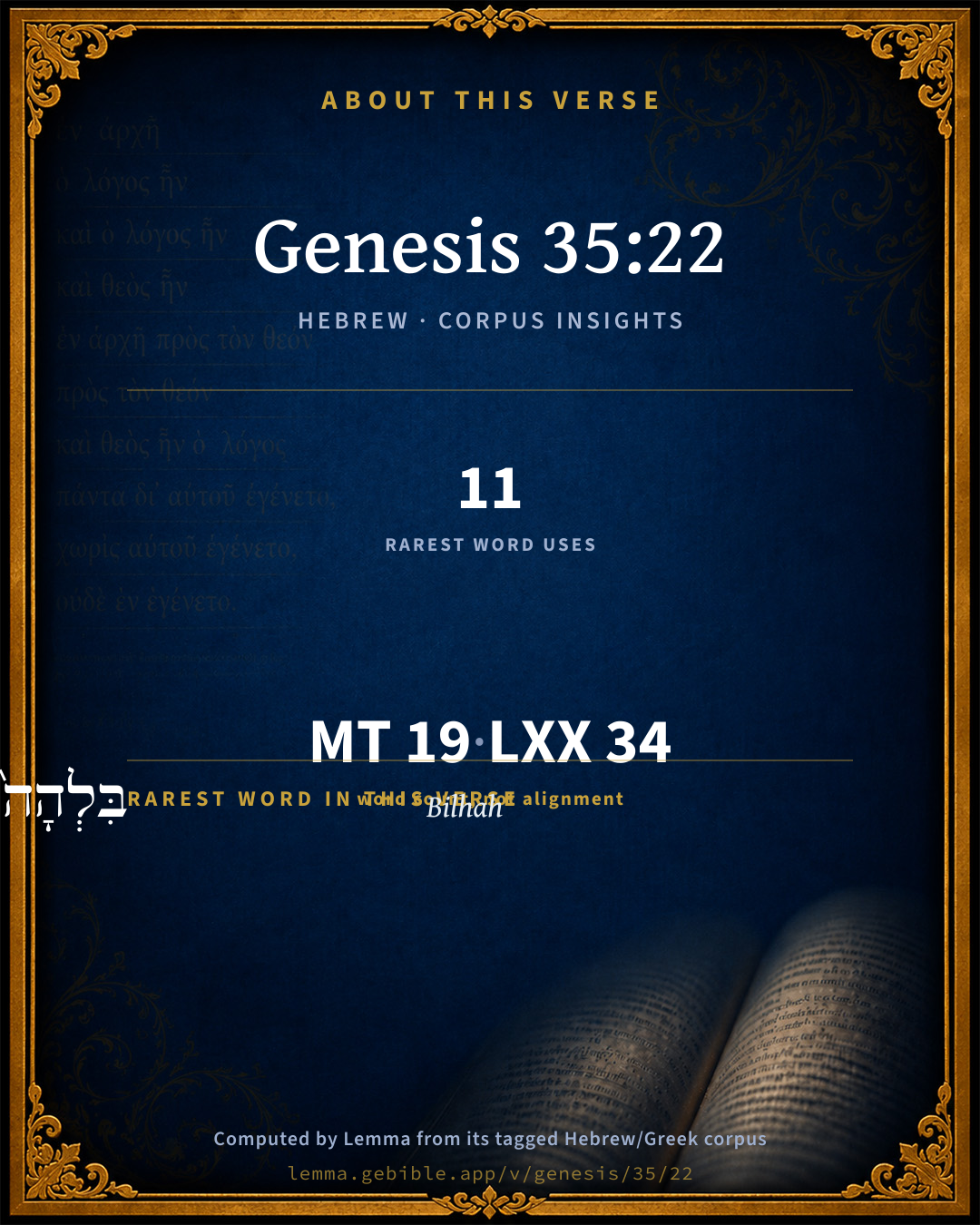
The rarest word here is בִּלְהָה֙ Bilhah H1090 — appearing just 11 times in the whole Hebrew Bible.

Shared distinctive vocabulary

בִּלְהָה֙ Bilhah H1090 occurs in 11 verses of the Hebrew Bible. Also found in:

Grammatical profile

  • 6 verbs
  • 9 nouns
  • 2 adjectives
  • 1 pronoun
  • 1 preposition

Verb forms

  • וַיְהִ֗י Qal · Sequential Imperfect
  • בִּשְׁכֹּ֤ן Qal · Infinitive Construct
  • וַיֵּ֣לֶךְ Qal · Sequential Imperfect
  • וַיִּשְׁכַּב֙ Qal · Sequential Imperfect
  • וַיִּשְׁמַ֖ע Qal · Sequential Imperfect
  • וַיִּֽהְי֥וּ Qal · Sequential Imperfect

Repetition

Words recur within this verse — often emphatic in Hebrew:

  • וַיְהִ֗י to be H1961 ×2
  • יִשְׂרָאֵל֙ Israel H3478 ×2

Hebrew & Septuagint length

In English translation the verse runs 30 words from the Hebrew and 7 from the Septuagint (LXX English) — the Septuagint runs noticeably shorter here. See the side-by-side →

A rough comparison of the two English renderings, which tokenize alike — not a word-level alignment.

Word counts can differ between the Hebrew and the Greek without any difference in meaning — e.g. the Hebrew direct-object marker אֵת has no separate Greek word, and Greek often adds the article ὁ.

In the original languages it is 19 Hebrew tokens and 34 Greek tokens — but the two are counted differently (Hebrew bundles its prefixes and suffixes into one token; the Greek is in lemma form), so that isn’t a like-for-like length.

Cross-references

28

Topical passages linked to Genesis 35:22 in the Treasury of Scripture Knowledge — connected by theme and wording, ordered by reader-vote popularity; previews shown in the World English Bible.

  • 1 Chronicles 5:1 The sons of Reuben the firstborn of Israel (for he was the firstborn; but, because he defiled his father's couch, his birthright was given to the sons of Joseph the son of Israel; and the genealogy is not to be reckoned after the birthright.
  • Leviticus 18:8 "'You shall not uncover the nakedness of your father's wife: it is your father's nakedness.
  • Genesis 49:1–28 Jacob called to his sons, and said: "Gather yourselves together, that I may tell you that which will happen to you in the days to come.
  • 2 Samuel 16:21–22 Ahithophel said to Absalom, Go in to your father's concubines, that he has left to keep the house; and all Israel will hear that you are abhorred of your father: then will the hands of all who are with you be strong.
  • 2 Samuel 20:3 David came to his house at Jerusalem; and the king took the ten women his concubines, whom he had left to keep the house, and put them in custody, and provided them with sustenance, but didn't go in to them. So they were shut up to the day of their death, living in widowhood.
  • 1 Corinthians 5:1 It is actually reported that there is sexual immorality among you, and such sexual immorality as is not even named among the Gentiles, that one has his father's wife.
  • Genesis 29:31–35 Yahweh saw that Leah was hated, and he opened her womb, but Rachel was barren.
  • Genesis 30:5–24 Bilhah conceived, and bore Jacob a son.
  • Genesis 35:18 It happened, as her soul was departing (for she died), that she named him Ben-oni, but his father named him Benjamin.
  • Genesis 46:8–27 These are the names of the children of Israel, who came into Egypt, Jacob and his sons: Reuben, Jacob's firstborn.
  • Exodus 1:1–5 Now these are the names of the sons of Israel, who came into Egypt (every man and his household came with Jacob):
  • Exodus 6:14–16 These are the heads of their fathers' houses. The sons of Reuben the firstborn of Israel: Hanoch, and Pallu, Hezron, and Carmi; these are the families of Reuben.
  • Numbers 1:5–15 These are the names of the men who shall stand with you: Of Reuben: Elizur the son of Shedeur.
  • Numbers 1:20–46 The children of Reuben, Israel's firstborn, their generations, by their families, by their fathers' houses, according to the number of the names, one by one, every male from twenty years old and upward, all who were able to go out to war;
  • Numbers 2:3–33 Those who encamp on the east side toward the sunrise shall be of the standard of the camp of Judah, according to their divisions: and the prince of the children of Judah shall be Nahshon the son of Amminadab.
  • Numbers 7:12–89 He who offered his offering the first day was Nahshon the son of Amminadab, of the tribe of Judah,
  • Numbers 26:5–51 Reuben, the firstborn of Israel; the sons of Reuben: [of] Hanoch, the family of the Hanochites; of Pallu, the family of the Palluites;
  • Numbers 26:57–62 These are those who were numbered of the Levites after their families: of Gershon, the family of the Gershonites; of Kohath, the family of the Kohathites; of Merari, the family of the Merarites.
  • Numbers 34:14–28 for the tribe of the children of Reuben according to their fathers' houses, and the tribe of the children of Gad according to their fathers' houses, have received, and the half-tribe of Manasseh have received, their inheritance:
  • Deuteronomy 33:1–29 This is the blessing, with which Moses the man of God blessed the children of Israel before his death.
  • Joshua 13:1–21 Now Joshua was old and well stricken in years; and Yahweh said to him, You are old and well stricken in years, and there remains yet very much land to be possessed.
  • 1 Chronicles 2:1–2 These are the sons of Israel: Reuben, Simeon, Levi, and Judah, Issachar, and Zebulun,
  • 1 Chronicles 12:23–40 These are the numbers of the heads of those who were armed for war, who came to David to Hebron, to turn the kingdom of Saul to him, according to the word of Yahweh.
  • 1 Chronicles 27:16–22 Furthermore over the tribes of Israel: of the Reubenites was Eliezer the son of Zichri the ruler: of the Simeonites, Shephatiah the son of Maacah:
  • Ezekiel 48:1–35 Now these are the names of the tribes: From the north end, beside the way of Hethlon to the entrance of Hamath, Hazar Enan at the border of Damascus, northward beside Hamath, (and they shall have their sides east [and] west), Dan, one [portion].
  • Acts 7:8 He gave him the covenant of circumcision. So Abraham became the father of Isaac, and circumcised him the eighth day. Isaac became the father of Jacob, and Jacob became the father of the twelve patriarchs.
  • Revelation 7:4–8 I heard the number of those who were sealed, one hundred forty-four thousand, sealed out of every tribe of the children of Israel:
  • Revelation 21:14 The wall of the city had twelve foundations, and on them twelve names of the twelve Apostles of the Lamb.

Cross-references courtesy of OpenBible.info (CC BY 4.0).

Hebrew and Greek witnesses Masoretic Hebrew ↔ Greek Septuagint

The same verse in the two great witnesses to the Old Testament, shown verse-for-verse.

Here the Septuagint runs noticeably shorter than the Hebrew — LXX2012 (modern English Septuagint) 7 words vs World English Bible 30. A rough length comparison of the two English translations, not a word-level alignment — read both below.

These are two independent witnesses, not word-aligned to each other, and the Septuagint is shown in lemma (dictionary) form.

Hebrew Genesis 35:22 Masoretic · Westminster Leningrad Codex

וַיְהִ֗י בִּשְׁכֹּ֤ן יִשְׂרָאֵל֙ בָּאָ֣רֶץ הַהִ֔וא וַיֵּ֣לֶךְ רְאוּבֵ֔ן וַיִּשְׁכַּב֙ אֶת בִּלְהָה֙ פִּילֶ֣גֶשׁ אָבִ֔יו וַיִּשְׁמַ֖ע יִשְׂרָאֵ֑ל וַיִּֽהְי֥וּ בְנֵֽי יַעֲקֹ֖ב שְׁנֵ֥ים עָשָֽׂר

It happened, while Israel lived in that land, that Reuben went and lay with Bilhah, his father's concubine, and Israel heard of it. Now the sons of Jacob were twelve.

World English Bible · Public Domain

Greek LXX Genesis 35:22 Septuagint · lemma form

γίγνομαι δέ ἡνίκα καταοἰκέω ἰσραήλ ἐν ὁ γῆ ἐκεῖνος πορεύομαι ρουβην καί κοιμάω μετά βαλλα ὁ παλλακή ὁ πατήρ αὐτός καί ἀκούω ἰσραήλ καί πονηρός φαίνω ἐναντίον αὐτός εἰμί δέ ὁ υἱός ἰακώβ δώδεκα

And the sons of Jacob were twelve.

LXX2012 (modern English Septuagint) · Public Domain

On this verse, Adam Clarke's Commentary discusses the Septuagint’s reading. Read the note in Commentary ↓

Hebrew: Westminster Leningrad Codex (CC BY 4.0). Greek: Septuagint (public domain); English from LXX2012 (modern English Septuagint) (Public Domain). How the Septuagint differs from the Hebrew →

Targum (Aramaic paraphrase)

2

The Targum is the ancient Jewish Aramaic paraphrase of the Hebrew Scriptures — an interpretive translation, not the Hebrew text itself. Onkelos (literal) and Pseudo-Jonathan (expansive) render the Torah, and Jonathan the Prophets. Coverage is partial: where no permissively-licensed English translation exists for a verse, only the Aramaic is shown. This is verse-level text, not a word-by-word alignment to the Hebrew.

  1. Targum Onkelos Torah (Genesis–Deuteronomy)
    וַהֲוָה כַּד שְׁרָא יִשְׂרָאֵל בְּאַרְעָא הַהִיא וַאֲזַל רְאוּבֵן וּשְׁכִיב עִם בִּלְהָה לְחֵינָתָא דַאֲבוּהִי וּשְׁמַע יִשְׂרָאֵל וַהֲווֹ בְנֵי יַעֲקֹב תְּרֵי עֲסַר

    (no public-domain English translation for this verse)

    Targum Onkelos — Aramaic: “Onkelos Genesis” (public domain); “Onkelos Exodus” (public domain); “Onkelos Leviticus” (public domain); “Onkelos Numbers” (public domain); “Onkelos Deuteronomy” (public domain). English: “Sefaria Community Translation” (CC0 1.0 (public-domain dedication)); “J.W. Etheridge. The Targums of Onkelos and Jonathan Ben Uzziel on the Pentateuch. London: Longmans, Green, 1862” (public domain). Text via Sefaria.

  2. Targum Pseudo-Jonathan Torah (Genesis–Deuteronomy)
    וַהֲוָה כַּד שְׁרָא יִשְרָאֵל בְּאַרְעָא הַהוּא וַאֲזַל רְאוּבֵן וּבִלְבֵּל יַת מַצְעָא דְבִלְהָה פְּלַקְתֵּיהּ דְאָבוֹי דַהֲוָה מְסַדְרָא כָּל קָבֵיל מַצְעָא דְלֵאָה אִמֵי וְאִתְחַשֵׁיב עִילוֹי כְּאִלוּ שִׁימֵשׁ עִמָהּ וּשְׁמַע יִשְרָאֵל וּבְאִישׁ לֵיהּ וְאָמַר וַוי דִלְמָא נָפַק מִינִי פִּיסוּלָא הֵיכְמָא דְנָפַק מִן אַבְרָהָם יִשְׁמָעֵאל וּמִן אַבָּא נְפַק עֵשָו מְתִיבָא רוּחָא דְקוּדְשָׁא וְכֵן אָמַר לֵיהּ לָא תִדְחַל דְכֻלְהוֹן צַדִיקִין וְלֵית בְּהוֹן פִּיסוּלָא דְמִבָּתַר דְאִתְיְלִיד בִּנְיָמִין הֲווֹ בְּנֵי יַעֲקב תְּרֵיסַר

    And it was while Israel dwelt in this land that Reuben went and confounded the bed of Bilhah the concubine of his father, which had been ordained along with the bed of Leah his mother; and this is reputed with regard to him, as if he had lain with her. And Israel heard it, and it afflicted him, and he said, Alas, that one should have come forth from me so profane, even as Ishmael came forth from Abraham, and Esau from my father! The Spirit of Holiness answered and thus spake to him: fear not, for all are righteous and none of them is profane! So, after Benjamin was born, the sons of Jakob were twelve.

    Targum Pseudo-Jonathan — Aramaic: “Targum Jonathan on Genesis” (public domain); “Targum Jonathan on Exodus” (public domain); “Targum Jonathan on Leviticus” (public domain); “Targum Jonathan on Numbers” (public domain); “Targum Jonathan on Deuteronomy” (public domain). English: “The Targum of Jonathan ben Uzziel, trans. J. W. Etheridge, London, 1862” (public domain). Text via Sefaria.

Commentary

Notes on Genesis 35:22 from classic Christian and Jewish commentators (each source and its license shown beneath its notes). The classic Christian expositions comment on the surrounding passage and are grouped to its opening verse, so a note may address several verses; the Jewish commentaries on the Tanakh (Rashi and others) are per-verse, so they appear only where the commentator wrote on this verse.

Lemma curates 59 commentaries, every one of them public domain or Creative Commons licensed, each selected and text-cleaned for this edition rather than reprinted as found. About our sources →

Trapp's Complete Commentary

John Trapp

Gen 35:22 And it came to pass, when Israel dwelt in that land, that Reuben went and lay with Bilhah his father’s concubine: and Israel heard [it]. Now the sons of Jacob were twelve:

Ver. 23. Reuben, Jacob’s firstborn.] Who, though by his sin he fell from his birthright, yet is here reckoned as a patriarch, and afterwards, upon his repentance, not a little honoured. {Exo 28:21; Exo 28:29 Rev 21:12} God is not off and on with his elect; their frowardness interrupts not the course of his goodness.

John Trapp, A Commentary or Exposition upon All the Books of the Old and New Testament (1647–1656) — public domain. Text from a community e-Sword module.

The Biblical Illustrator

Joseph S. Exell

Gen_35:22-26

The sons of Jacob

I.

SIGNIFICANCE OF NAMES. Proper names had among them (the Hebrews) a deeper meaning, and were more closely connected in mens thoughts with character and condition, than among any other ancient nation with the history and character of which we are acquainted. This is apparent from the care taken in the sacred writings to record the origin of so many names of individuals and of places, from the frequent allusions to them as significant, and the remarks made upon their meaning, and from the peculiar employment of them on important and solemn occasions, when given or changed, to mark some great transaction or event, to form titles of honour; or to record a promise, or threat, or prophecy.

II. DIVERSITY OF CHARACTER. Among these twelve sons of one man no two precisely alike. Dark and bright traits of character strangely intermingle in this household. Joseph seems to have served the Lord from his youth, and Simeon appears to have been the darkest character of the twelve. As children often differ in complexion and stature, &c., so do they also in taste, moral character, &c. Often less like their immediate progenitors than their remoter ancestors; pointing far back to past times in their moral and physical portrait. How far back we point to the source of the evil there is in us. Diversity of bodily, mental, and moral qualities a blessing, when under the influence of Divine grace; otherwise a source of mischief and sorrow, engendering rivalry and strife.

III. WAYS OF PROVIDENCE. How marvellous the history wrought out in the world by means of these twelve men and their descendants! How wonderously Providence blended these unlike characters for working out His purposes! He maketh the wrath of men to praise Him. While imagining they were working their own will, their acts were subordinate, by the power of God, to high and gracious purposes. Yet the good, in the end, attain to the most honourable places, and the widest influence. The youngest, and most despised, and helpless, are in the end advanced. We often spoil the best instruments, and turn but sorry work out of most refined materials. God brings good out of evil. A world of beauty out of chaos: a great people out of these twelve shepherds. Think of another twelve whose work it was to lay the foundation of a still greater and more enduring kingdom. They also were shepherds in another sense. Learn:

I. Among all names there is only one whereby we can be saved. Thou shalt call His name Jesus, for He shall save His people, &c.

II. Natural differences of character may be purified by Divine grace. The worst may be saved by Christ, the best need His salvation.

III. Cast yourself upon the bountiful care and inexhaustible wisdom of Providence. He who of such material laid the foundations of a great nation, can make all things work together for our good. (J. C. Gray.)

Jacobs grief at Reubens sin

Moses expresseth not how Jacob grieved when he heard this, but only saith, It came to Israels ears that it was done. Surely the reason was this, that we might thereby conceive that the grief was greater than could be expressed, to have his bed defiled by his own son. So read we, the painter that portrayed the intended sacrifice of Iphigenia, painted her father Agamemnons face covered, because it was not possible to express well the countenance of a man so plunged in woe. Think we then earnestly of Jacobs sorrow, but know that we cannot think how it was. And what crossing griefs the Lord sends us, let us strive to patience by these examples. Yea, let us grow by these examples to a Christian strength against worldly scandals and offences, not moved by them to waver up and down as some do, condemning truth, and judging persons by faults and offences that do happen. As if one should say, See the religion of these men; can it be true, can it be good, when the professors of it have such spots? Simeon and Levi cruel bloodshedders, Dinah wanton and wantonly defiled, and now Reuben an incestuous person, defiling his own fathers bed. How should the religion of these men be good? Surely the idolatrous ignorance, and ignorant idolatry of the Gentiles, of the Canaanites, Perizzites, Jebusites, or such like, was the good religion, and not the way that Jacob served God by. But let us be wise, and learn by this to take a surer course to judge both of men and of religion. Jacob and his family had the true religion, though their sinful flesh offended sometimes. All were not evil in such degrees, though some offended too much. Bewail the falls we may of those that profess the truth, nay, bewail them we ought with a sighing heart; but forsake truth for them, or condemn truth to be no truth, we may not, we dare not, we ought not. Let God be true, and all men liars. Let truth be truth, and all men sinful; yea, such great patriarchs as these were not ever free. (Bp. Babington.)

Lessons

1. God carrieth His Jacobs sometimes from Ephrath to Edar, from one affliction to a worse.

2. The Churchs journeys and stages are appointed and ordered by God.

3. Israel is willing to pitch his tents where God allots him.

4. The Church and its pastor sit down by the tower of the flock; shepherds and sheep have their tower (Gen_35:21).

5. The Churchs habitation is not free from affection and affliction in the land of its sojournings.

6. Providence ordereth the permission of the foulest crimes sometimes in His own Church.

7. The chiefest in outward privilege in the Church may fall into greatest sin. Gods wisdom orders it.

8. God will not suffer the blots in His Church to be wholly covered or silenced. Others may learn by them.

9. Great is the fascination of lust which makes a son and wife conspire to pollute the fathers bed.

10. Deep impressions the tidings of such wickedness in the Church makes upon gracious men, to consternation.

11. Providence distinctly notes the genealogy and number of the Churchs beginnings, to observe Gods making good His promises. Now Jacob was come to twelve (Gen_35:22).

12. God doth not always cast out of His visible Church for greatest wickedness. Reuben is numbered.

13. The twelve first patriarchs were ordained of Gods grace, not for their worth.

14. Scripture useth figurative speeches, warily to be opened by Gods ministers (Gen_35:23-26). (G. Hughes, B. D.)

The Biblical Illustrator, edited by Joseph S. Exell (c. 1880s–1900s) — public domain. Text from a community e-Sword module.

Joseph Benson's Commentary

Gen 35:22. When Israel dwelt in that land — And probably was absent from his family, which might be the unhappy occasion of these disorders. Though, perhaps, Bilhah was the greater criminal, yet Reuben’s crime was so provoking, that for it he lost his birthright and blessing, chap. Gen 49:4. Israel heard it — No more is said: that is enough: he heard it with the utmost grief and shame, horror and displeasure. No doubt he forsook Bilhah’s bed upon it, as David afterward acted in a like case. The sons of Jacob were twelve — Moses makes this observation here, because Benjamin being now born, Jacob had no more sons. When he says, (Gen 35:26,) which were born to him in Padan-aram, he speaks by a synecdoche, a figure of speech often used in Scripture, whereby that which belonged to the greater part is ascribed to all. They were all born there except Benjamin, the place of whose birth had been just mentioned.

Joseph Benson's Commentary on the Old and New Testaments (1811–1818) — public domain. Text from a community e-Sword module.

Tyndale Open Study Notes

Tyndale Open Resources

35:22 Reuben had intercourse with Bilhah, thus defiling his father’s marriage bed. Perhaps Reuben, as the oldest son, was trying to replace his father as head of the clan by a pagan procedure (cp. 2 Sam 16:15-22), but by this action he lost his birthright (see Gen 49:3-4). • Jacob soon heard about it, but he again delayed his response (see 49:3-4; cp. 34:5).

Tyndale Open Study Notes — © Tyndale Open Resources, licensed CC BY-SA 4.0. Text via the HelloAO Bible API.

Geneva Bible (1599)

Geneva Bible translators

This teacheth that the fathers were not chosen for their merits, but by God’s only mercies, whose election by their faults was not changed.

Geneva Bible (1599) marginal notes — public domain. Text via Bolls.life.

Adam Clarke's Commentary

Verse 22. Reuben went and lay with Bilhah his father's concubine] Jonathan, in his Targum, says that Reuben only overthrew the bed of Bilhah, which was set up opposite to the bed of his mother Leah, and that this was reputed to him as if he had lain with her. The colouring given to the passage by the Targumist is, that Reuben was incensed, because he found Bilhah preferred after the death of Rachel to his own mother Leah; and therefore in his anger he overthrew her couch. The same sentiment is repeated by Jonathan, and glanced at by the Jerusalem Targum, Ge 49:4. Could this view of the subject be proved to be correct, both piety and candour would rejoice.

And Israel heard it.] Not one word is added farther in the Hebrew text; but a break is left in the verse, opposite to which there is a Masoretic note, which simply states that there is a hiatus in the verse. This hiatus the Septuagint has thus supplied: και πονηρον εφανη εναντιον αυτον, and it appeared evil in his sight.

Now the sons of Jacob were twelve] Called afterwards the twelve patriarchs, because they became heads or chiefs of numerous families or tribes, Ac 7:8; and the people that descended from them are called the twelve tribes, Ac 26:7; Jas 1:1. Twelve princes came from Ishmael, Ge 25:16, who were heads of families and tribes. And in reference to the twelve patriarchs, our Lord chose twelve apostles. Strictly speaking, there were thirteen tribes among the Hebrews, as Ephraim and Manasses were counted for tribes, Ge 48:5-6; Gen 48:6; but the Scripture in naming them, says Mr. Ainsworth, usually sets down but twelve, omitting the name now of one, then of another, as may in sundry places be observed, De 33:5-29; Eze 48:1-35; Re 7:4-8, &c.

Adam Clarke's Commentary on the Bible (1810–1826) — public domain. Text from a community e-Sword/MySword module.

John Calvin's Commentaries

22. Reuben went and lay with Bilhah. A sad and even tragic history is now related concerning the incestuous intercourse of Reuben with his mother-in-law. Moses, indeed, calls Bilhah Jacob’s concubine: but though she had not come into the hands of her husband, as the mistress of the family and a partaker of his goods; yet, as it respected the bed, she was his lawful wife, as we have before seen. If even a stranger had defiled the wife of the holy man, it would have been a great disgrace; it was, however, far more atrocious that he should suffer such an indignity from his own son. But how great and how detestable was the dishonor, that the mother of two tribes should not only contaminate herself with adultery, but even with incest; which crime is so abhorrent to nature, that, not even among the Gentiles, has it ever been held tolerable? And truly, by the wonderful artifice of Satan, this great obscenity penetrated into the holy house, in order that the election of God might seem to be of no effect. Satan endeavors, by whatever means he can, to pervert the grace of God in the elect; and since he cannot effect that, he either covers it with infamy, or at least obscures it. Hence it happens that disgraceful examples often steal into the Church. And the Lord, in this manner, suffers his own people to be humbled, that they may be more attentively careful of themselves, that they may more earnestly watch unto prayer, and may learn entirely to depend on his mercy. Moses only relates that Jacob was informed of this crime; but he conceals his grief, not because he was unfeeling, (for he was not so stupid as to be insensible to sorrow,) but because his grief was too great to be expressed. For here Moses seems to have acted as the painter did who, in representing the sacrifice of Iphigenia, put a veil over her father’s face, because he could not sufficiently express the grief of his countenance. In addition to this eternal disgrace of the family, there were other causes of anxiety which transfixed the breast of the holy man. The sum of his happiness was in his offspring, from which the salvation of the whole world was to proceed. Whereas, already, two of his sons had been perfidious and sanguinary robbers; the first-born, now, exceeds them both in wickedness. But here the gratuitous election of God has appeared the more illustrious, because it was not on account of their worthiness that he preferred the sons of Jacob to all the world; and also because, when they had fallen so basely, this election nevertheless remained firm and efficacious. Warned by such examples, let us learn to fortify ourselves against those dreadful scandals by which Satan strives to disturb us. Let every one also privately apply this to the strengthening of his own faith. For sometimes even good men slide, as if they had fallen from grace. Desperation would necessarily be the consequence of such ruin, unless the Lord, on the other hand, held out the hope of pardon. A remarkable instance of this is set before us in Reuben; who, after this extreme act of iniquity, yet retained his rank of a patriarch in the Church. We must, however, remain under the custody of fear and watchfulness, lest temptation should seize upon us unawares, and thus the snares of Satan should envelop us. For the holy Spirit did not design to set before us an example of vile lust, in order that every one might rush into incestuous connections; but would rather expose to infamy the baseness of this crime, in an honorable person, that all, on that account, might more vehemently abhor it. This passage also refutes the error of Novatus. Reuben had been properly instructed; he bore in his flesh, from early infancy, the symbol of the divine covenant; he was even born again by the Spirit of God; we see, therefore, what was the deep abyss from which he was raised by the incredible mercy of God. The Novatians, therefore, and similar fanatics, have no right to cut off the hope of pardon from the lapsed: for it is no slight injury to Christ, if we suppose the grace of God to be more restricted by his advent.

Now the sons of Jacob were twelve. Moses again recounts the sons of Jacob in a regular series. Reuben is put the first among them, not for the sake of honor, but that he may be loaded with the greater opprobrium: for the greater the honor which any one receives from the Lord, the more severely is he to be blamed, if he afterwards makes himself the slave of Satan, and deserts his post. Moses seems to insert this catalogue before the account of the death of Isaac, for the purpose of discriminating between the progeny of Jacob and the Idumeans, of whom he is about to make mention in Genesis 36:1. For on the death of Isaac the fountain of the holy race became divided, as into two streams; but since the adoption of God restrained itself to one branch only, it was necessary to distinguish it from the other.

John Calvin's Commentaries (1540-1563) — public domain. Text from the Calvin Translation Society English edition (1840s-50s) via the Christian Classics Ethereal Library (ccel.org). Calvin's coverage is partial (roughly two-thirds of the Bible); uncommented books and verses are honest gaps, never fabricated. The 19th-century editor's footnotes and remarks are omitted so the notes are faithfully Calvin's own voice.

Ellicott's Commentary for English Readers

(22) Reuben.—Again another grief for Jacob to mar his return home, and this time it arises from the sin of his first-born, who thereby forfeits the birthright. It was the thought of these miseries, following upon his long years of exile, which made Jacob speak so sorrowfully of his experience of life before Pharaoh (Gen_47:9).

And Israel heard it.—The Masora notes that some words have here fallen out of the text, which the LXX. fill up by adding, “And it was evil in his sight.”

A Bible Commentary for English Readers, edited by Charles John Ellicott (1878–1897) — public domain. Text from a community e-Sword module.

The Cambridge Bible for Schools and Colleges

gen. ed. J. J. S. Perowne

22b–29 (P). Jacob’s Sons, and the Death of Isaac

22b. the sons of Jacob] The names of Jacob’s sons are enumerated after the mention of Benjamin’s birth. But the enumeration is that of P, which assumes that all the sons of Jacob, including Benjamin, were born to him in Paddan-aram (Gen_35:26), in direct contradiction to Gen_35:16-18 (J).

twelve] A sacred number, found also in the sons of Nahor and Ishmael (Gen_17:20, Gen_22:20-24, Gen_25:16).

The Cambridge Bible for Schools and Colleges (gen. ed. J. J. S. Perowne; Cambridge University Press, 1878–1918) — public domain. Text from a community e-Sword module.

John Gill's Exposition

The sons of Leah,.... Jacob's first wife, which are six, and are reckoned in order, according to their birth, Reuben, Simeon, Levi, Judah, Issachar, Zebulun.

The sons of Leah,.... Jacob's first wife, which are six, and are reckoned in order, according to their birth, Reuben, Simeon, Levi, Judah, Issachar, Zebulun.

Genesis 35:24

gen 35:24

gen 35:24

gen 35:24The sons of Rachel,.... Then Rachel's, Jacob's next wife, though in right his first and only one, who had two children, Joseph and Benjamin.

John Gill's Exposition of the Whole Bible (1746–1763) — public domain (CC PDM 1.0). Text via the HelloAO Bible API.

Haydock's Catholic Bible Commentary

The concubine. She was his lawful wife; but according to the style of the Hebrews, is called concubine, because of her servile extraction. (Challoner) --- Ignorant of; and therefore, to mark his displeasure, he deprived him of the birth-right, chap. xlix. 4. Jacob approached no more to Bala, as David had no farther commerce with the wives whom Absalom had defiled, 2 Kings xvi. 22. (Menochius) --- The Septuagint add, and it appeared evil in his sight; an omission which the Hebrew editions seem to acknowledge, by leaving a vacant space. (Kennicott)

George Leo Haydock (1774–1849), Haydock's Catholic Family Bible and Commentary, 1859 edition — public domain. Excludes Psalms (Douay-Rheims chapter numbering differs from Protestant) and Deuterocanonical books (Catholic canon only).

Matthew Poole's English Annotations

This was a horrid incest; for concubines were a sort of wives. See Gen 22:24; 25:1.

Israel heard it, and doubtless sadly resented it, both in Reuben, as appears from Gen 49:4; 1Ch 5:1,2; and in Bilhah, whose bed without question he forsook upon it, as afterwards David did in the like case. See 2Sa 16:22; 20:3. Yet here is no mention of Jacob’s reproof of it, nor any censure of Moses added to it; possibly to teach us, that we are not to approve of every fact which is mentioned in Scripture without censure, and that the miscarriages of professors of religion are rather to be silently bewailed than publicly reproached, lest religion should suffer by it.

The sons of Jacob were twelve, which were heads of the twelve tribes; therefore his daughter Dinah is not here mentioned, because she was not the head of a tribe.

Matthew Poole's English Annotations on the Holy Bible (1683–1685) — public domain. Text from a community e-Sword/MySword module.

Whedon's Commentary on the Bible

Daniel D. Whedon

22. Bilhah — Rachel’s handmaid, and mother of Dan and of Naphtali.

Gen_30:3-8.

Israel heard — And it occasioned to Reuben the loss of his birthright, and the words of reproach recorded in Gen_49:4.

LIST OF JACOB’S SONS, Gen_30:22-26.

This list is given here, at the close of this section of the book, and before the account of the death and burial of Isaac, as a sort of concluding record of Jacob’s history thus far. The subsequent historic “generations of Jacob,” do not begin until after we have, in chap. 36, “the generations of Esau.” See Gen_37:2.

Daniel D. Whedon (gen. ed.), Commentary on the Old and New Testaments (1874–1909) — public domain. Text from a community e-Sword module.

The Pulpit Commentary

And it came to pass, when Israel dwelt in that land, that Reuben went and lay with Bilhah his father"s concubine: an act of incest (Lev_18:8) for which he was afterwards disinherited (Gen_49:4; 1Ch_5:1) and Israel heard it. The hiatus in the text and the break in the MS. at this point may both have been designed to express Jacob"s grief at the tidings. The LXX add feebly kai ponhronh ejnantion aujtou, which surely fails to represent the mingled shame and sorrow, indignation and horror, with which his eldest son"s wickedness must have filled him. Now the sons of Jacob were twelve a separate verse in the LXX, which is certainly more in accordance with the sense than the division in the text.

The Pulpit Commentary (1880–1919), ed. H.D.M. Spence-Jones & Joseph S. Exell — public domain. Text from a community e-Sword module.

John Wesley's Explanatory Notes

When Israel dwelt in that land - As if he were then absent from his family, which might be the unhappy occasion of these disorders. Though perhaps Bilhah was the greater criminal, yet Reuben's crime was so provoking that for it he lost his birth-right and blessing, chap. xlix, 4. And Israel heard it - No more is said, that is enough; he heard it with the utmost grief and shame, horror and displeasure.

John Wesley, Explanatory Notes Upon the Whole Bible (1754–1765) — public domain. Text via the GEBible commentary corpus.

Rashi

Rabbi Shlomo Yitzchaki (Rashi)

בשכן ישראל בארץ ההוא WHEN ISRAEL DWELT IN THAT LAND — before he came to Isaac at Hebron, all these troubles happened to him.

וישכב AND HE LAY — Because he had disturbed his couch Scripture accounts it to him as though he had actually sinned in this manner. But why did he disturb his couch? When Rachel died Jacob removed to Bilhah’s tent and Reuben came and protested against the slight thus inflicted on his mother (Leah). He said: “If my mother’s sister was her rival, is that any reason why the handmaid of my mother’s sister should become a rival to her!” On this account he disturbed the couch (Shabbat 55b).

ויהיו בני יעקב שנים עשר NOW THE SONS OF JACOB WERE TWELVE — Scripture begins again where it left off the previous narrative (i.e. the birth of Benjamin): when Benjamin was born the destined number of his sons was complete and it was proper that they should then be enumerated; and therefore it enumerates them. Our Rabbis explained that these words are intended to tell us that Jacob’s twelve sons were all equal — they were all equally righteous, for Reuben had committed no actual sin (Shabbat 55b).

Rashi on the Tanakh — English translations: “The Judaica Press complete Tanach with Rashi, translated by A. J. Rosenberg” (CC BY 4.0); “Pentateuch with Rashi's commentary by M. Rosenbaum and A.M. Silbermann, 1929-1934” (public domain); “The Metsudah Tanach series, Lakewood, N.J” (CC BY 4.0); and “The Book of Joshua, Metsudah Publications, 1997” (CC BY 4.0). Text via Sefaria.

Ramban (Nachmanides)

Rabbi Moshe ben Nachman (Ramban / Nachmanides)

AND ISRAEL HEARD OF IT. Scripture relates Jacob’s humility. He heard that his son had profaned his couch, but yet he did not command them to remove him from his house and from inclusion among his sons so that he should not inherit with them. Instead, he is counted among them, as it is written, And the sons of Jacob, were twelve, and he is counted first. It is for this reason that Scripture has combined the two sections of the Torah. Then a new section begins, And the sons of Jacob were twelve. Ramban explains why the Masorah combines them into one verse. through one verse. For although this is the beginning of a subject wherein Scripture commences to count the tribes now that they were all born, it hints that Reuben was not rejected on account of his deed.In line with the simple meaning of Scripture it is possible that Reuben disturbed the couch of Bilhah [Rachel’s handmaid] because he feared that she might give birth again from Jacob, for he, being the first-born and thinking of taking two portions of the inheritance, would thus lose more than all the brothers. He had no fear of his mother for she was elderly. Zilpah had perhaps died, or it may be that he had concern for his mother’s honor, and since Zilpah was her handmaid, he did not disturb her. It was for this reason that the right of the first-born was taken away from Reuben, measure for measure. And this is the purport of the verse, And the sons of Jacob were twelve, meaning that he did not beget children after that.

Ramban (Nachmanides) on the Tanakh — English translation: “Commentary on the Torah by Ramban (Nachmanides). Translated and annotated by Charles B. Chavel. New York, Shilo Pub. House, 1971-1976” (CC BY 4.0). Text via Sefaria.

Sforno

Rabbi Ovadia Sforno

And Yisrael heard. Nevertheless, he did not cease to count Reuvein among his sons because he had no doubt that he repented immediately.

Sforno on the Tanakh — English translation: “Yalkut, Sifsei Chachomim Chumash, Metsudah Publications, 2009” (CC BY 4.0). Text via Sefaria.

Radak

Rabbi David Kimhi (Radak)

ויהי בשכון, Yaakov did not reside anywhere until he came to his father; however, seeing that he had so many animals and possessions that he moved extremely slowly, it appeared as if he was actually settling down.

וילך ראובן, he went to Bilhah’s tent and slept with her.

פלגש אביו, his father’s concubine. Actually, she was his father’s wife, but in Reuven’s view she was no better than a concubine. Reuven did not consider her as out of bounds to him as she had been a slave woman originally, and his father had subsequently taken her to be his concubine. The Torah clearly states that she had become Yaakov’s proper wife in all matters legal. (30,4) As such Bilhah was totally out of bounds to him. Even before the giving of the Torah, the laws of incest governing all of mankind (Noachide laws) included the prohibition of sleeping with one’s father’s wife. (compare our commentary on 20,24) If such legislation applied to all of mankind, how much more so did it apply to the sons of Yaakov. As a result of this trespass Reuven’s status as Yaakov’s legal firstborn was revoked on Yaakov’s deathbed when he publicly announced his unfitness for the title as we also know from Chronicles I 5,1, and his position was given to Joseph instead.

וישמע ישראל, he stopped living with Bilhah as a result of this. The meaning of the line ויהיו בני יעקב שנים עשר, is that from that time on Yisrael had no further children. He no longer slept with any woman for the remainder of his life. In fact, he basically became a recluse, not attending to mundane activities but concentrating on serving G’d directly. This is what he had meant when he said in his vow, that once he would return safely to his father’s house, והיה ה' לי לאלוקים, “the Lord will be my G’d.” According to the Talmud Shabbat 55 Reuven had not actually slept with Bilhah at all, but had only made her bed look slept in, disturbed, to give the impression that intimacy had taken place there. This was a protest against his father not only having spent most of his married life with Rachel, but even now after her death spending his time with Rachel’s maidservant instead of with his mother, with Leah.

Radak on the Tanakh — English translations: “Sefaria Community Translation” (CC0 1.0 (public-domain dedication)); “Eliyahu Munk, HaChut Hameshulash” (CC BY 4.0); “Rabbi Mike Feuer, Jerusalem Anthology” (CC BY 4.0); and “R. David Kimhi on the first book of Psalms, Translated by R.G. Finch, London, 1919” (public domain). Text via Sefaria.

Lesson kit

Teaching starters — assembled from the data on this page, not authored interpretation. Every prompt links to the verse data it draws on. Edit before teaching.

Genesis, in the Pentateuch, opens this verse with 19 words (17 distinct Hebrew lemmas). Its most distinctive word is Bilhâh (“Bilhah”). The Greek Septuagint runs shorter here. A historical commentator’s framing appears above. Read the whole chapter for the surrounding context.

Discussion questions

  1. How does “Bilhah” (Bilhâh) shape what this verse is saying?
  2. Genesis 29:29 shares the word «Bilhah» with this verse. How do the two illuminate each other?
  3. “to be” occurs 2× in this one verse. What is the effect of the repetition?
  4. Compared with the Hebrew, the Septuagint runs shorter here. What questions does that raise?
  5. These translations render this verse differently; the difference is in the English rendering, not the original. What questions does that raise?
  6. The verb «וַיְהִ֗י» is Qal Sequential Imperfect. How does its form color the action?
  7. Reading how Trapp's Complete Commentary and The Biblical Illustrator read this verse, where do the two commentators agree and where do they part?

Things to notice

Reading settings

Reading text

Shown beneath each verse's original-language words.

Old Testament
Old Testament edition

Read the OT as the Masoretic Hebrew (MT) or the Greek Septuagint (LXX).

English shown for the Greek Septuagint (in the Hebrew ↔ Greek comparison).

Comparing translations? Open the Compare panel on any verse page to stack up to four side by side.