
Genesis 31:42

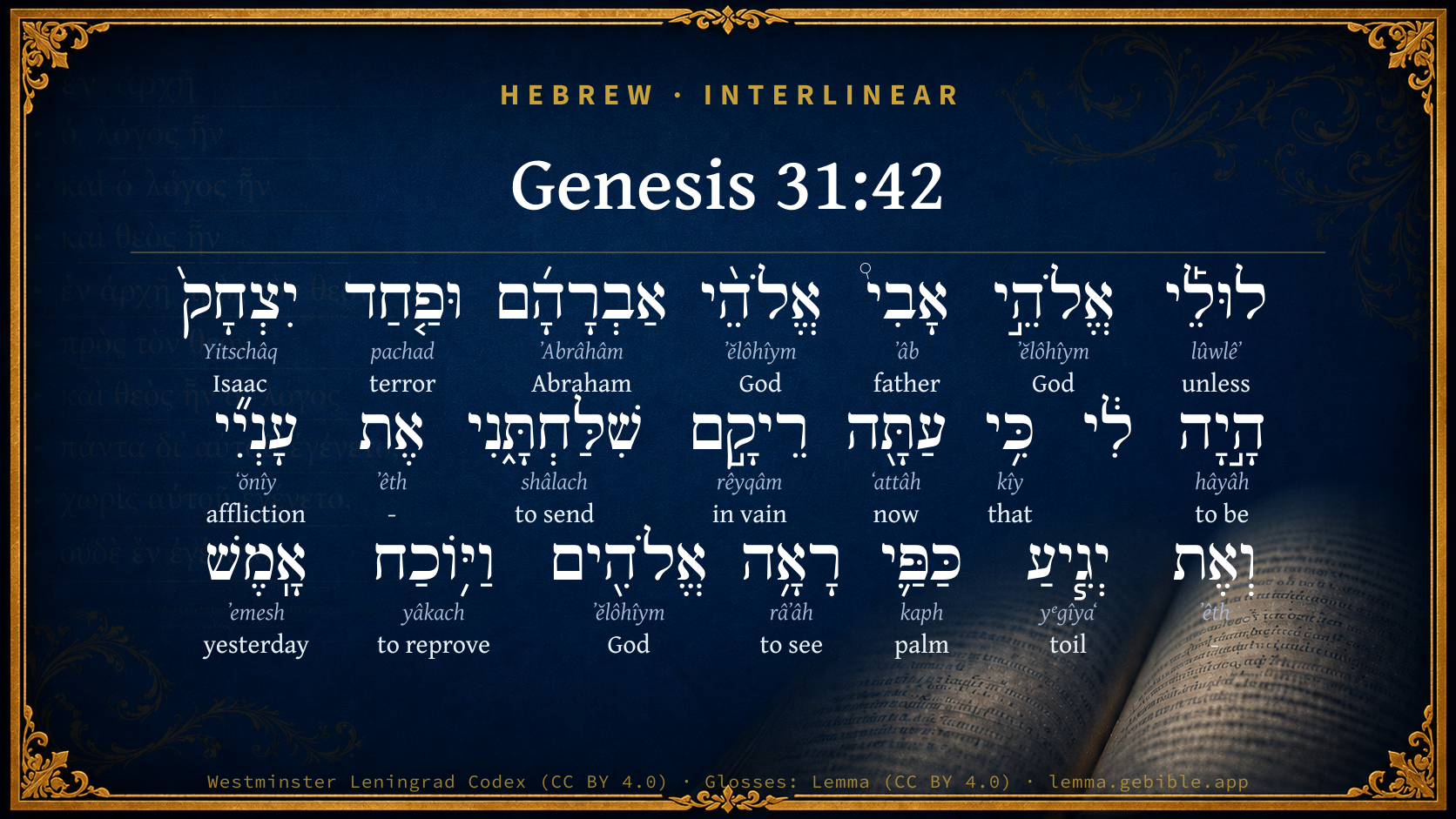
Hebrew (Westminster Leningrad Codex) Genesis 31:42 appears in the Hebrew Old Testament. The text above is from the Westminster Leningrad Codex. Each word links to its Strong’s number, a concise gloss, and parsing drawn from the Open Scriptures Hebrew Bible morphology. Click any word for its full Brown-Driver-Briggs (BDB) entry.
Download image
Cite this verse

Genesis 31:42 (World English Bible). Public Domain. Lemma interlinear Bible study tool, https://lemma.gebible.app/v/genesis/31/42.

Show BibTeX & RIS
BibTeX
RIS
English Translation
Unless the God of my father, the God of Abraham, and the fear of Isaac, had been with me, surely now you would have sent me away empty. God has seen my affliction and the labor of my hands, and rebuked you last night."
World English Bible · Public Domain
Highlights
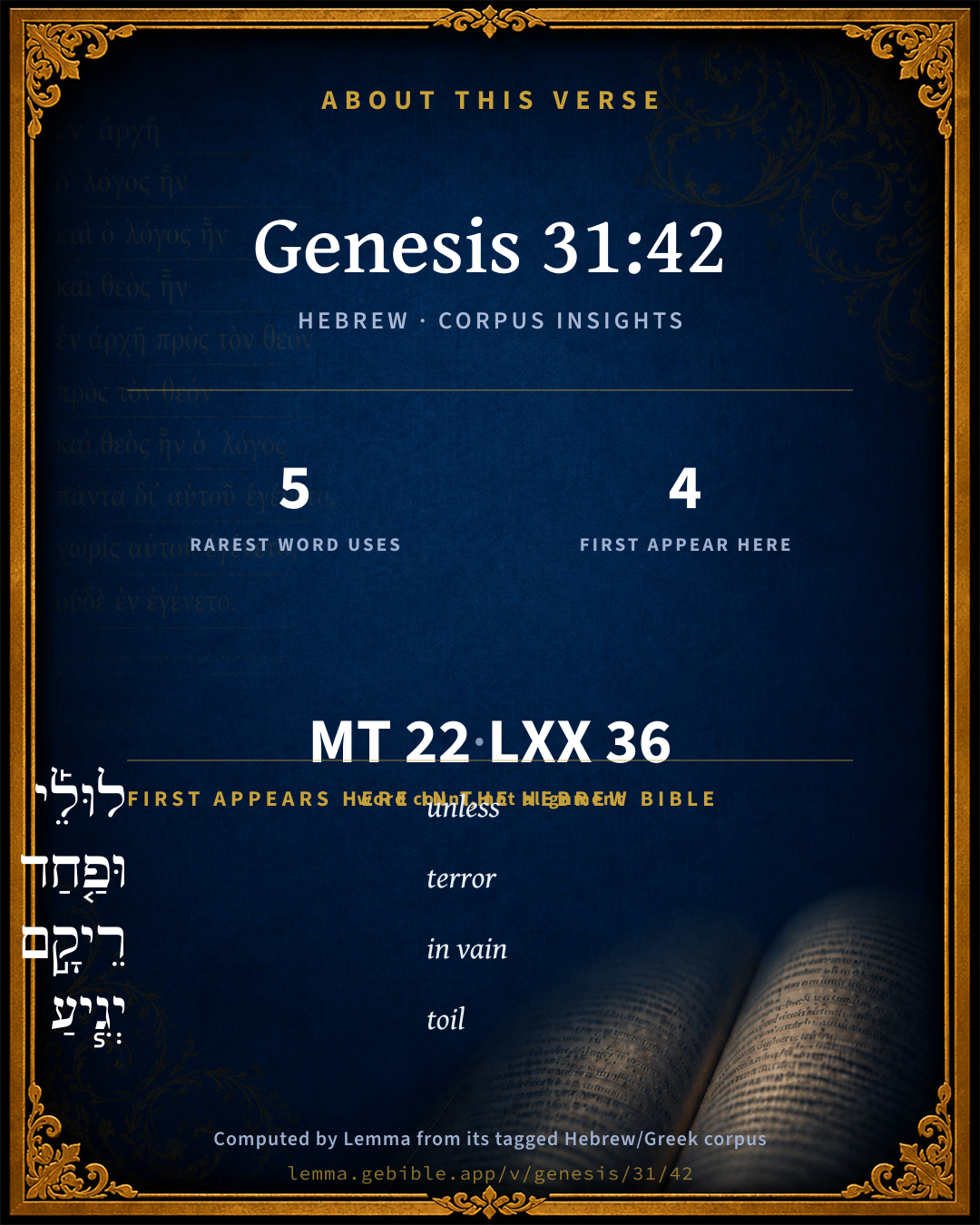
  • 4 first appearances in the Hebrew Bible
Full analysis ↓
Download a study sheet

One document with this verse’s original text, its word-by-word gloss line, the meaning frame, cross-references with their text, attributed commentary, and full source and license credits — printable, and it pastes into notes with its structure intact.

This verse Autodidact and up

Study sheet (.html) Plain text (.txt)

A passage Seminary Student

Up to 50 verses in one chapter. A passage sheet keeps up to 6 commentary sources and 12 cross-references per verse, in the order this page ranks them, and says so on the sheet whenever that leaves anything out. Ask for a single verse and you get the Autodidact verse sheet above.

Everything on this page stays free to read, with no account — the sheet is a download of what is already on screen, not access to it.

Want to remove ads? Support Godless Engineer
Compare translations 3

The same verse in 3 English versions, stacked beneath the original-language interlinear above. Click any original word for its lexicon entry.

Each is an independent rendering of the whole verse — the interlinear is not word-aligned to these translations.

Highlighted words mark where these versions differ — a whole-verse word diff, not a word-by-word alignment.

  • World English Bible Public Domain
    Unless the God of my father, the God of Abraham, and the fear of Isaac, had been with me, surely now you would have sent me away empty. God has seen my affliction and the labor of my hands, and rebuked you last night."
  • King James Version Public Domain
    Except the God of my father, the God of Abraham, and the fear of Isaac, had been with me, surely thou hadst sent me away now empty. God hath seen mine affliction and the labor of my hands, and rebuked thee yesternight.
  • unfoldingWord Literal Text CC BY-SA 4.0
    If the God of my father, the God of Abraham and the Fear of Isaac, had not been with me, surely now you would have sent me away empty-handed. God has seen my affliction and the toil of my palms, and he judged last night.” Jacob and Laban Cut a Covenant 31:43-55

unfoldingWord Literal Text — © unfoldingWord, licensed CC BY-SA 4.0. Word-aligned USFM3 via Door43 (git.door43.org/unfoldingWord/en_ult).

Versions to compare (up to 4)

3 of 4 selected

Show all 18 translations

Every available English version of this verse, each an independent rendering of the whole verse.

  • World English Bible Public Domain
    Unless the God of my father, the God of Abraham, and the fear of Isaac, had been with me, surely now you would have sent me away empty. God has seen my affliction and the labor of my hands, and rebuked you last night."
  • Berean Standard Bible Public Domain
    If the God of my father, the God of Abraham and the Fear of Isaac, had not been with me, surely by now you would have sent me away empty-handed. But God has seen my affliction and the toil of my hands, and last night He rendered judgment.”
  • Majority Standard Bible Public Domain
    If the God of my father, the God of Abraham and the Fear of Isaac, had not been with me, surely by now you would have sent me away empty-handed. But God has seen my affliction and the toil of my hands, and last night He rendered judgment.”
  • King James Version Public Domain
    Except the God of my father, the God of Abraham, and the fear of Isaac, had been with me, surely thou hadst sent me away now empty. God hath seen mine affliction and the labor of my hands, and rebuked thee yesternight.
  • American Standard Version (1901) Public Domain
    Except the God of my father, the God of Abraham, and the Fear of Isaac, had been with me, surely now hadst thou sent me away empty. God hath seen mine affliction and the labor of my hands, and rebuked thee yesternight.
  • Revised Version (1885) Public Domain
    Except the God of my father, the God of Abraham, and the Fear of Isaac, had been with me, surely now hadst thou sent me away empty. God hath seen mine affliction and the labour of my hands, and rebuked thee yesternight.
  • Geneva Bible (1599) Public Domain
    Except the God of my father, the God of Abraham, and the feare of Izhak had bene with me, surely thou haddest sent me away nowe emptie: but God behelde my tribulation, and the labour of mine hads, and rebuked thee yester night.
  • Douay-Rheims (1899) Public Domain
    Unless the God of my father Abraham, and the fear of Isaac had stood by me, peradventure now thou hadst sent me away naked: God beheld my affliction and the labour of my hands, and rebuked thee yesterday.
  • Young's Literal Translation Public Domain
    unless the God of my father, the God of Abraham, and the Fear of Isaac, had been for me, surely now empty thou hadst sent me away; mine affliction and the labour of my hands hath God seen, and reproveth yesternight.'
  • Literal Standard Version CC BY-SA 4.0
    unless the God of my father, the God of Abraham, and the Fear of Isaac, had been for me, surely now you had sent me away empty; God has seen my affliction and the labor of my hands, and reproves last night.”
  • Unlocked Literal Bible CC BY-SA 4.0
    Unless the God of my father, the God of Abraham, and the one Isaac fears, had been with me, surely now you would have sent me away empty-handed. God has seen my oppression and how hard I worked, and he rebuked you last night.”
  • unfoldingWord Literal Text CC BY-SA 4.0
    If the God of my father, the God of Abraham and the Fear of Isaac, had not been with me, surely now you would have sent me away empty-handed. God has seen my affliction and the toil of my palms, and he judged last night.” Jacob and Laban Cut a Covenant 31:43-55
  • Darby Bible Public Domain
    Had not the God of my father, the God of Abraham, and the fear of Isaac, been with me, it is certain thou wouldest have sent me away now empty. God has looked upon my affliction and the labour of my hands, and has judged last night.
  • World Messianic Bible Public Domain
    Unless the God of my father, the God of Abraham, and the fear of Isaac, had been with me, surely now you would have sent me away empty. God has seen my affliction and the labor of my hands, and rebuked you last night.”
  • Webster's Bible Public Domain
    Except the God of my father, the God of Abraham, and the fear of Isaac had been with me, surely thou hadst now sent me away empty. God hath seen my affliction, and the labor of my hands, and rebuked thee yesternight.
  • Free Bible Version CC BY-SA 4.0
    If it weren't for the God of my father, the God of Abraham, the awesome God of Isaac, who took care of me, you would have dismissed me with nothing. But God saw my suffering, how hard I worked, and he condemned you last night.”
  • Bible in Basic English Public Domain
    If the God of my father, the God of Abraham and the Fear of Isaac, had not been with me, you would have sent me away with nothing in my hands. But God has seen my troubles and the work of my hands, and this night he kept you back.
  • JPS Tanakh (1917) Public Domain
    Except the God of my father, the God of Abraham, and the Fear of Isaac, had been on my side, surely now hadst thou sent me away empty. God hath seen mine affliction and the labour of my hands, and gave judgment yesternight.'

Literal Standard Version (2020), Covenant Press — licensed CC BY-SA 4.0. Text via the HelloAO Bible API (eBible.org). Unlocked Literal Bible (unfoldingWord) — licensed CC BY-SA 4.0. Text via the HelloAO Bible API (eBible.org). unfoldingWord Literal Text — © unfoldingWord, licensed CC BY-SA 4.0. Word-aligned USFM3 via Door43 (git.door43.org/unfoldingWord/en_ult). Free Bible Version, Dr. Jonathan Gallagher — licensed CC BY-SA 4.0. Text via the HelloAO Bible API (eBible.org).

Word by word

More ways to search: Search by grammar → Find every occurrence → Compare this word →

Practice this passage: Drill this verse → Learn its vocabulary →

אָֽמֶשׁ
ʼemesh
H570
“yesterday”
Adverb
Part of Speech
Adverb
Full BDB Definition

Origin: unknown derivation

TWOT: 120

yesterday, last night - recently (figuratively)
  1. לוּלֵ֡י lûwlêʼ H3884 “unless” Conjunction
  2. אֱלֹהֵ֣י ʼĕlôhîym H430 “God(s) of” Noun, Common, Masculine, Plural, Construct
  3. אָבִי֩ ʼâb H1 “father · my” Noun, Common, Masculine, Singular, Construct + Suffix, Personal, 1st Person, Common, Singular
  4. אֱלֹהֵ֨י ʼĕlôhîym H430 “God(s) of” Noun, Common, Masculine, Plural, Construct
  5. אַבְרָהָ֜ם ʼAbrâhâm H85 “Abraham” Noun, Proper
  6. וּפַ֤חַד pachad H6343 “and · terror of” Conjunction + Noun, Common, Masculine, Singular, Construct
  7. יִצְחָק֙ Yitschâq H3327 “Isaac” Noun, Proper
  8. הָ֣יָה hâyâh H1961 “to be” Verb, Qal, Perfect, 3rd Person, Masculine, Singular
  9. כִּ֥י kîy H3588 “that” Conjunction
  10. עַתָּ֖ה ʻattâh H6258 “now” Adverb
  11. רֵיקָ֣ם rêyqâm H7387 “in vain” Adverb
  12. שִׁלַּחְתָּ֑נִי shâlach H7971 “to send · me” Verb, Piel, Perfect, 2nd Person, Masculine, Singular + Suffix, Personal, 1st Person, Common, Singular
  13. אֶת ʼêth H853 “-” Particle, Direct Object
  14. עָנְיִ֞י ʻŏnîy H6040 “affliction · my” Noun, Common, Masculine, Singular, Construct + Suffix, Personal, 1st Person, Common, Singular
  15. וְאֶת ʼêth H853 “and · -” Conjunction + Particle, Direct Object
  16. יְגִ֧יעַ yᵉgîyaʻ H3018 “toil of” Noun, Common, Masculine, Singular, Construct
  17. כַּפַּ֛י kaph H3709 “palms · our” Noun, Common, Feminine, Dual, Construct + Suffix, Personal, 1st Person, Common, Plural
  18. רָאָ֥ה râʼâh H7200 “to see” Verb, Qal, Perfect, 3rd Person, Masculine, Singular
  19. אֱלֹהִ֖ים ʼĕlôhîym H430 “God(s)” Noun, Common, Masculine, Plural, Absolute
  20. וַיּ֥וֹכַח yâkach H3198 “and · to reprove” Conjunction + Verb, Hiphil, Sequential Imperfect, 3rd Person, Masculine, Singular

About this verse

These counts appear in no published source. They are computed here, from the morphology-tagged text and Lemma’s own curated glosses. What Lemma adds →

22
words
18
distinct lemmas
Pentateuch
section

Notable vocabulary

The rarest word here is אָֽמֶשׁ yesterday H570 — appearing just 5 times in the whole Hebrew Bible.

First appearance in Scripture

These words make their first canonical appearance in the Hebrew Bible here:

  • לוּלֵ֡י unless H3884
  • וּפַ֤חַד terror H6343
  • רֵיקָ֣ם in vain H7387
  • יְגִ֧יעַ toil H3018

Shared distinctive vocabulary

אָֽמֶשׁ yesterday H570 occurs in 5 verses of the Hebrew Bible. Also found in:

Grammatical profile

  • 4 verbs
  • 10 nouns
  • 1 preposition
  • 2 conjunctions
  • 3 adverbs
  • 2 particles

Verb forms

  • הָ֣יָה Qal · Perfect
  • שִׁלַּחְתָּ֑נִי Piel · Perfect
  • רָאָ֥ה Qal · Perfect
  • וַיּ֥וֹכַח Hiphil · Sequential Imperfect

Repetition

A word recurs within this verse — often emphatic in Hebrew:

  • אֱלֹהֵ֣י God H430 ×3

Hebrew & Septuagint length

In English translation the verse runs 44 words from the Hebrew and 36 from the Septuagint (LXX English) — closely comparable.

A rough comparison of the two English renderings, which tokenize alike — not a word-level alignment.

Word counts can differ between the Hebrew and the Greek without any difference in meaning — e.g. the Hebrew direct-object marker אֵת has no separate Greek word, and Greek often adds the article ὁ.

In the original languages it is 22 Hebrew tokens and 36 Greek tokens — but the two are counted differently (Hebrew bundles its prefixes and suffixes into one token; the Greek is in lemma form), so that isn’t a like-for-like length.

Cross-references

17

Topical passages linked to Genesis 31:42 in the Treasury of Scripture Knowledge — connected by theme and wording, ordered by reader-vote popularity; previews shown in the World English Bible.

  • Psalms 31:7 I will be glad and rejoice in your loving kindness, For you have seen my affliction. You have known my soul in adversities.
  • Isaiah 8:13 Yahweh of hosts, him shall you sanctify; and let him be your fear, and let him be your dread.
  • Genesis 31:29 It is in the power of my hand to hurt you, but the God of your father spoke to me last night, saying, 'Take heed to yourself that you don't speak to Jacob either good or bad.'
  • Genesis 31:53 The God of Abraham, and the God of Nahor, the God of their father, judge between us." Then Jacob swore by the fear of his father, Isaac.
  • Genesis 29:32 Leah conceived, and bore a son, and she named him Reuben. For she said, "Because Yahweh has looked at my affliction. For now my husband will love me."
  • Genesis 31:24 God came to Laban, the Syrian, in a dream of the night, and said to him, "Take heed to yourself that you don't speak to Jacob either good or bad."
  • Exodus 3:7 Yahweh said, "I have surely seen the affliction of my people who are in Egypt, and have heard their cry because of their taskmasters, for I know their sorrows.
  • Psalms 124:1–3 If it had not been Yahweh who was on our side, Let Israel now say,
  • 1 Chronicles 12:17 David went out to meet them, and answered them, If you be come peaceably to me to help me, my heart shall be knit to you; but if [you be come] to betray me to my adversaries, seeing there is no wrong in my hands, the God of our fathers look thereon, and rebuke it.
  • Jude 1:9 But Michael, the archangel, when contending with the devil and arguing about the body of Moses, dared not bring against him an abusive condemnation, but said, "May the Lord rebuke you!"
  • Genesis 11:5 Yahweh came down to see the city and the tower, which the children of men built.
  • Genesis 16:11 The angel of Yahweh said to her, "Behold, you are with child, and will bear a son. You shall call his name Ishmael, because Yahweh has heard your affliction.
  • Genesis 16:13 She called the name of Yahweh who spoke to her, "You are a God who sees," for she said, "Have I even stayed alive after seeing him?"
  • Genesis 27:33 Isaac trembled violently, and said, "Who, then, is he who has taken venison, and brought it me, and I have eaten of all before you came, and have blessed him? Yes, he will be blessed."
  • Genesis 31:5 and said to them, "I see the expression on your father's face, that it is not toward me as before; but the God of my father has been with me.
  • Genesis 31:12 He said, 'Now lift up your eyes, and behold, all the male goats which leap on the flock are streaked, speckled, and grizzled, for I have seen all that Laban does to you.
  • Psalms 76:11–12 Make vows to Yahweh your God, and fulfill them! Let all of his neighbors bring presents to him who is to be feared.

Cross-references courtesy of OpenBible.info (CC BY 4.0).

Hebrew and Greek witnesses Masoretic Hebrew ↔ Greek Septuagint

The same verse in the two great witnesses to the Old Testament, shown verse-for-verse.

These are two independent witnesses, not word-aligned to each other, and the Septuagint is shown in lemma (dictionary) form.

Hebrew Genesis 31:42 Masoretic · Westminster Leningrad Codex

לוּלֵ֡י אֱלֹהֵ֣י אָבִי֩ אֱלֹהֵ֨י אַבְרָהָ֜ם וּפַ֤חַד יִצְחָק֙ הָ֣יָה לִ֔י כִּ֥י עַתָּ֖ה רֵיקָ֣ם שִׁלַּחְתָּ֑נִי אֶת עָנְיִ֞י וְאֶת יְגִ֧יעַ כַּפַּ֛י רָאָ֥ה אֱלֹהִ֖ים וַיּ֥וֹכַח אָֽמֶשׁ

Unless the God of my father, the God of Abraham, and the fear of Isaac, had been with me, surely now you would have sent me away empty. God has seen my affliction and the labor of my hands, and rebuked you last night."

World English Bible · Public Domain

Greek LXX Genesis 31:42 Septuagint · lemma form

εἰ μή ὁ θεός ὁ πατήρ ἐγώ αβρααμ καί ὁ φόβος ισαακ εἰμί ἐγώ νῦν ἄν κενός ἐγώ ἐκ ἀποστέλλω ὁ ταπείνωσις ἐγώ καί ὁ κόπος ὁ χείρ ἐγώ ὁράω ὁ θεός καί ἐλέγχω σύ χθές

Unless I had the God of my father Abraam, and the fear of Isaac, now you would have sent me away empty; God saw my humiliation, and the labor of my hands, and rebuked you yesterday.

LXX2012 (modern English Septuagint) · Public Domain

Hebrew: Westminster Leningrad Codex (CC BY 4.0). Greek: Septuagint (public domain); English from LXX2012 (modern English Septuagint) (Public Domain). How the Septuagint differs from the Hebrew →

Targum (Aramaic paraphrase)

2

The Targum is the ancient Jewish Aramaic paraphrase of the Hebrew Scriptures — an interpretive translation, not the Hebrew text itself. Onkelos (literal) and Pseudo-Jonathan (expansive) render the Torah, and Jonathan the Prophets. Coverage is partial: where no permissively-licensed English translation exists for a verse, only the Aramaic is shown. This is verse-level text, not a word-by-word alignment to the Hebrew.

  1. Targum Onkelos Torah (Genesis–Deuteronomy)
    אִילוּלָא פוֹן אֱלָהֵהּ דְּאַבָּא אֱלָהֵהּ דְּאַבְרָהָם וּדְדָחִיל לֵהּ יִצְחָק הֲוָה בְּסַעְדִּי אֲרֵי כְעַן רֵיקָן שִׁלַּחְתָּנִי יָת עַמְלִי וְיָת לֵיאוּת יְדַי גְלֵי קֳדָם יְיָ וְאוֹכַח בְּרַמְשָׁא

    (no public-domain English translation for this verse)

    Targum Onkelos — Aramaic: “Onkelos Genesis” (public domain); “Onkelos Exodus” (public domain); “Onkelos Leviticus” (public domain); “Onkelos Numbers” (public domain); “Onkelos Deuteronomy” (public domain). English: “Sefaria Community Translation” (CC0 1.0 (public-domain dedication)); “J.W. Etheridge. The Targums of Onkelos and Jonathan Ben Uzziel on the Pentateuch. London: Longmans, Green, 1862” (public domain). Text via Sefaria.

  2. Targum Pseudo-Jonathan Torah (Genesis–Deuteronomy)
    אִילוּלֵי פּוֹן אֱלָהֵיהּ דְאַבָּא אֱלָהֵיהּ דְאַבְרָהָם וּדְדָחִיל לֵיהּ יִצְחָק הֲוָה בְסַעֲדִי אֲרוּם כְּדוֹן רֵיקָם שְׁלַחְתַּנִי יַת סִיגוּפִי וְיַת לֵיאוֹת יְדַיי גְלֵי קֳדָם יְיָ בְּגִין כֵּן אוֹכַח בְּרַמְשָׁא

    Unless the God of my father, the God of Abraham, and He whom Izhak feareth had been in my help, even now hadst thou sent me away empty: but my affliction and the travail of my hands are manifest before the Lord, and therefore He admonished thee in the evening.

    Targum Pseudo-Jonathan — Aramaic: “Targum Jonathan on Genesis” (public domain); “Targum Jonathan on Exodus” (public domain); “Targum Jonathan on Leviticus” (public domain); “Targum Jonathan on Numbers” (public domain); “Targum Jonathan on Deuteronomy” (public domain). English: “The Targum of Jonathan ben Uzziel, trans. J. W. Etheridge, London, 1862” (public domain). Text via Sefaria.

Commentary

Notes on Genesis 31:42 from classic Christian and Jewish commentators (each source and its license shown beneath its notes). The classic Christian expositions comment on the surrounding passage and are grouped to its opening verse, so a note may address several verses; the Jewish commentaries on the Tanakh (Rashi and others) are per-verse, so they appear only where the commentator wrote on this verse.

Lemma curates 59 commentaries, every one of them public domain or Creative Commons licensed, each selected and text-cleaned for this edition rather than reprinted as found. About our sources →

Trapp's Complete Commentary

John Trapp

Gen 31:42 Except the God of my father, the God of Abraham, and the fear of Isaac, had been with me, surely thou hadst sent me away now empty. God hath seen mine affliction and the labour of my hands, and rebuked [thee] yesternight.

Ver. 42. The fear of Isaac.] God, the proper object of fear; whence he is absolutely called "The fear". {Psa 76:11} "Bring presents to fear"; that is, to him, to whom all dread is due. The Chaldee Paraphrast rendereth Teraphim, {Gen 31:32} Laban’s fear. It was an atheistical speech of Statius, Primus in orbe deos fecit Timor. But it was a true saying of Varro, as Calvin cites his words, They that first brought in images of the gods, increased men’s error, but took away their fear. {a}

{a} Qui primi deorum simulachra induxerunt, errorem auxerunt, metum dempserunt. - Var.

John Trapp, A Commentary or Exposition upon All the Books of the Old and New Testament (1647–1656) — public domain. Text from a community e-Sword module.

Joseph Benson's Commentary

Gen 31:42. Except God had been with me — Jacob, on every mention of his substance, attributes all the increase of it to the care that God had of him. And he here speaks of God, as the God of his father, intimating, that he thought himself unworthy to be thus regarded, but was beloved for his father’s sake. He calls him the God of Abraham and the Fear of Isaac: for Abraham was dead, and gone to that world where there is no fear; but Isaac was yet alive, sanctifying the Lord in his heart as his fear and his dread.

Joseph Benson's Commentary on the Old and New Testaments (1811–1818) — public domain. Text from a community e-Sword module.

Tyndale Open Study Notes

Tyndale Open Resources

31:42 The God that Isaac feared (see textual note) was with Jacob (31:3), had seen his hard work and faithfulness despite Laban’s abuse, and had rewarded Jacob. Laban’s dream only proved to Jacob that he was in the right.

Tyndale Open Study Notes — © Tyndale Open Resources, licensed CC BY-SA 4.0. Text via the HelloAO Bible API.

Geneva Bible (1599)

Geneva Bible translators

That is, the God whom Isaac did fear, and reverence.

Geneva Bible (1599) marginal notes — public domain. Text via Bolls.life.

Adam Clarke's Commentary

Verse 42. The fear of Isaac] It is strange that Jacob should say, the GOD of Abraham and the FEAR of Isaac, when both words are meant of the same Being. The reason perhaps was this; Abraham was long since dead, and God was his unalienable portion for ever. Isaac was yet alive in a state of probation, living in the fear of God, not exempt from the danger of falling; therefore God is said to be his fear, not only the object of his religious worship in a general way, but that holy and just God before whom he was still working out his salvation with fear and trembling, fear lest he should fall, and trembling lest he should offend.

Adam Clarke's Commentary on the Bible (1810–1826) — public domain. Text from a community e-Sword/MySword module.

John Calvin's Commentaries

42. Except the God of my father. Jacob here ascribes it to the favor of God, that he was not about to return home entirely empty; whereby he not only aggravates the sin of Laban, but meets an objection which might seem at variance with his complaints. He therefore denies that he has been made rich by the kindness of his father-in-law; but testifies that he has been favourably regarded by the Lord: as if he had said, I owe it not to thee, that thou hast not further injured me; but God, who is propitious to me, has withstood thee. Now, since God is not the defender of unfaithfulness, nor is wont to help the wicked, the integrity of Jacob may be ascertained from the fact that God interposed as his vindicator. It is also to be observed, that by expressly distinguishing the God of Abraham from all fictitious gods, he declares that there is no other true God: by which he, at the same time, proves himself to be a truly pious worshipper. The expression “the fear of Isaac,” is to be taken passively for the God whom Isaac revered; just as, on account of the reverence due to him, he is called the “fear and the dread” of his people. A similar expression occurs immediately after, in the same chapter. Now the pious, while they fear God, are by no means horror — struck at his presence, like the reprobates; but trembling at his judgment, they walk circumspectly before him.

God has seen my affliction, and the labor of my hands. This was spoken from a pious feeling that God would bring help to him when afflicted, if he should conduct himself with fidelity and honesty. Therefore, in order that the Lord may sustain us with his favor, let us learn to discharge our duty rightly; let us not flee from our proper work; and let us not refuse to purchase peace by submitting to many inconveniences. Further, if they from whom we have deserved well treat us severely and unjustly, let us bear our cross in hope and in silence, until the Lord shall succor us: for he will never forsake us, as the whole Scripture testifies. But Jacob distinctly presses his father-in-law with his own confession. For why had God rebuked him, unless because he was persecuting an innocent man in defiance of justice and equity; for as I have lately intimated, it is abhorrent to the nature of God to favor evil and unjust causes.

John Calvin's Commentaries (1540-1563) — public domain. Text from the Calvin Translation Society English edition (1840s-50s) via the Christian Classics Ethereal Library (ccel.org). Calvin's coverage is partial (roughly two-thirds of the Bible); uncommented books and verses are honest gaps, never fabricated. The 19th-century editor's footnotes and remarks are omitted so the notes are faithfully Calvin's own voice.

Ellicott's Commentary for English Readers

(42) The fear of Isaac—That is, the object of Isaac’s worship. The reason given by the Jewish Commentators for this remarkable way of describing the Deity whom Isaac served is that, as his father was still alive, Jacob would have been wanting in reverence, if he had spoken of God as “Isaac’s God,” even though Jehovah had condescended so to call Himself (Gen_28:13).

A Bible Commentary for English Readers, edited by Charles John Ellicott (1878–1897) — public domain. Text from a community e-Sword module.

The Cambridge Bible for Schools and Colleges

gen. ed. J. J. S. Perowne

42. the God of my father] Cf. Gen_31:5.

the Fear of Isaac] Cf. Gen_31:53. A remarkable phrase, denoting the personal God who was the object of Isaac’s worship. Cf. Isa_8:13, “Neither fear ye their fear. The Lord of Hosts … let him be your fear.” It clearly shews not that Isaac was regarded as a deity; but that He whom Isaac feared was the true God of Jacob.

sent me away empty] A regular phrase for destitution; cf. Job_22:9; Luk_1:53.

rebuked thee] Cf. Gen_31:29.

The Cambridge Bible for Schools and Colleges (gen. ed. J. J. S. Perowne; Cambridge University Press, 1878–1918) — public domain. Text from a community e-Sword module.

John Gill's Exposition

Now therefore, come thou, let us make a covenant, I and thou,.... Let us be good friends, and enter into an alliance for mutual safety, and make an agreement for each other's good. Laban perceiving that Jacob's God was with him, and blessed him, and made him prosperous, and protected him, was fearful, lest, growing powerful, he should some time or other revenge himself on him or his, for his ill usage of him; and therefore was desirous of entering into a covenant of friendship with him:

and let it be for a witness between me and thee; that all past differences are made up, and former quarrels subside, and everything before amiss is forgiven and forgotten, and that for the future peace and good will subsist; of which a covenant made between them would be a testimony.

John Gill's Exposition of the Whole Bible (1746–1763) — public domain (CC PDM 1.0). Text via the HelloAO Bible API.

Haydock's Catholic Bible Commentary

CHAPTER XXXI.

The fear of Isaac; or of that God, whom Isaac fears, on account of the danger to which he is exposed of losing his friendship; a thing which, Abraham being now departed in peace, has not to dread. (Calmet)

George Leo Haydock (1774–1849), Haydock's Catholic Family Bible and Commentary, 1859 edition — public domain. Excludes Psalms (Douay-Rheims chapter numbering differs from Protestant) and Deuterocanonical books (Catholic canon only).

Matthew Poole's English Annotations

The fear of Isaac, i.e. the God whom my father Isaac worships with reverence and godly fear, as appears by comparing Gen 31:53. The act is here put for the object, as it frequently is; and particularly God is called our fear, Isa 8:13. And fear is one of God’s names amongst the rabbins. He calls him not Isaac’s God, but his fear, because Isaac was yet alive, and in the state of probation, and served God with fear and trembling: see Gen 27:33. The Jews observe, that God is not called the God of any particular person, as of Abraham, Isaac, and Jacob, till after their death.

God hath seen my affliction, with compassion and intention of good to me for it. God’s seeing is oft used for his relieving and helping, as Gen 16:13; 29:32; Exo 3:7,9. Or, hath showed or proved it, to wit, that he hath seen, & c.: compare Gen 20:16. Either way it is an ellipsis of the pronoun, which is usual, as appears by comparing 1Ki 10:7, with 2Ch 9:6 and Psa 41:9, with Joh 13:18.

Matthew Poole's English Annotations on the Holy Bible (1683–1685) — public domain. Text from a community e-Sword/MySword module.

Whedon's Commentary on the Bible

Daniel D. Whedon

42. Fear of Isaac — He whom Isaac feared. Laban closed his speech with allusion to his gods, (Gen_31:30,) and now Jacob, more nobly, appeals to the intervention of the God of his fathers, who had rebuked Laban as an adversary.

Daniel D. Whedon (gen. ed.), Commentary on the Old and New Testaments (1874–1909) — public domain. Text from a community e-Sword module.

John Wesley's Explanatory Notes

Jacob speaks of God as the God of his father, intimating that he thought himself unworthy to be thus regarded, but was beloved for his father's sake. He calls him the God of Abraham and the fear of Isaac: for Abraham was dead, and gone to that world where there is no fear; but Isaac was yet alive, sanctifying the Lord in his heart as his fear and his dread.

John Wesley, Explanatory Notes Upon the Whole Bible (1754–1765) — public domain. Text via the GEBible commentary corpus.

Keil & Delitzsch

C. F. Keil & F. Delitzsch

"Except the God of my father...had been for me, surely thou wouldst now have sent me away empty. God has seen mine affliction and the labour of my hands, and last night He judged it." By the warning given to Laban, God pronounced sentence upon the matter between Jacob and Laban, condemning the course which Laban had pursued, and still intended to pursue, towards Jacob; but not on that account sanctioning all that Jacob had done to increase his own possessions, still less confirming Jacob's assertion that the vision mentioned by Jacob (Gen 31:11, Gen 31:12) was a revelation from God. But as Jacob had only met cunning with cunning, deceit with deceit, Laban had no right to punish him for what he had done. Some excuse may indeed be found for Jacob's conduct in the heartless treatment he received from Laban, but the fact that God defended him from Laban's revenge did not prove it to be right. He had not acted upon the rule laid down in Pro 20:22 (cf. Rom 12:17; Th1 5:15).

Keil & Delitzsch — Biblical Commentary on the Old Testament (1861–1891) — public domain (CC PDM 1.0). Text via the HelloAO Bible API. (Old Testament only.)

Rashi

Rabbi Shlomo Yitzchaki (Rashi)

ופחד יצחק AND THE DREAD OF ISAAC — He did not like to say “God of Isaac” because God does not associate His name with the righteous whilst they are alive. And although He (God) said, when he (Jacob) was departing from Beer-Sheba, (Genesis 28:13) “I am the Lord, the God of Abraham thy father and the God of Isaac”, this was because his (Isaac’s) eyes were dim and he might therefore be regarded as dead (Midrash Tanchuma, Toldot 7) — Jacob, however, feared to say “God of Isaac” and said “the Dread”.

ויוכח The word here has the meaning of reproof (“and he reproved thee”; cf. Genesis 5:24) and not of deciding (as in Genesis 5:37).

Rashi on the Tanakh — English translations: “The Judaica Press complete Tanach with Rashi, translated by A. J. Rosenberg” (CC BY 4.0); “Pentateuch with Rashi's commentary by M. Rosenbaum and A.M. Silbermann, 1929-1934” (public domain); “The Metsudah Tanach series, Lakewood, N.J” (CC BY 4.0); and “The Book of Joshua, Metsudah Publications, 1997” (CC BY 4.0). Text via Sefaria.

Ramban (Nachmanides)

Rabbi Moshe ben Nachman (Ramban / Nachmanides)

AND THE FEAR OF ISAAC HAD BEEN ON MY SIDE. “He did not want to say “G-d of Isaac” because G-d does not associate His name with the righteous during their lifetime. Although G-d said to Jacob when he was departing from the Land of Israel, I am the Eternal, the G-d of Abraham thy father and the G-d of Isaac, this was because Isaac’s eyes were dim, and he might therefore be regarded as dead. Jacob, however, feared to say so, [and instead said, ‘the Fear of Isaac’].” Thus the words of Rashi. It is also the opinion of Onkelos that pachad Yitzchak means “his G-d,” for he translated it as: “He Whom Isaac fears.”And Rabbi Abraham ibn Ezra said: “Isaac’s fear of G-d helped me, for the merit of the father helps the son. And Jacob swore ‘bepachad’ of his father Isaac, — by Him Whom Isaac fears.” Ibn Ezra’s explanations of the same expression are thus not alike. Ibn Ezra further wrote, “And there are some who say that this ‘fear’ is an allusion to the day of Isaac’s Binding.” This is not far fetched.By way of the Truth [namely, the mystic lore of the Cabala] the language fits its plain meaning and intent, that is, it refers to the attribute of Justice on high. Based on this, Scripture says: Afterward shall the children of Israel return, and seek the Eternal their G-d, and David their king; and shall come trembling unto the Eternal and to His goodness in the end of days. The verse is stating that they will seek the Merciful One and the attribute of Justice on earth, and bring the Fear of Isaac to G-d and His goodness mentioned.

‘VAYOCHACH’ YESTERNIGHT. “The word here has the meaning of ‘reproof’ [and he reproved] and not of ‘clarification.’” These are the words of Rashi. But is is more correct to say that it is an expression meaning “clarification.” Since Jacob said above, ‘veyochichu’ (that they may judge) between us both, he now said that it is G-d, Who knows the hidden secrets, Who should clarify the dispute between the two of them. This is why Jacob did not say, vayochach othcha emesh, [which would mean, “and He reproved ‘thee’ yesternight,” for the meaning of the word is not “rebuke” but “clarify”].

Ramban (Nachmanides) on the Tanakh — English translation: “Commentary on the Torah by Ramban (Nachmanides). Translated and annotated by Charles B. Chavel. New York, Shilo Pub. House, 1971-1976” (CC BY 4.0). Text via Sefaria.

Radak

Rabbi David Kimhi (Radak)

לולי אלוקי אבי, after having used this term, Yaakov amplifies whom he meant by it, i.e. אלוקי אברהם ופחד יצחק היה לי, as explained by Onkelos פחד יצחק is the G’d Yitzchok was in awe of. Yitzchok had subjected himself to slaughter by his father as he had been in awe of his father’s G’d. One can explain the words פחד יצחק as referring to Yaakov who was afraid that if he did not go home now he would never see his father again while he was alive.

היה לי, Yaakov explains his surviving of Lavan’s machinations as being due to two separate causes. 1) if the G’d of Avraham had not been on my side ריקם שלחתני, you would have sent me home as empty-handed as when I arrived at your home. 2) had it not been for my urgent longing to see my father Yitzchok before he died. I doubt that I would have still have found him alive on my return if I had stayed with you any longer. Out of these considerations I could not remain with you. When I left my father he was already worried about his death approaching. If I want to see him once more alive, I decided that I must return home before it is too late. I could not tell you of my intention as you might have prevented me from being present at his death and my burying him.

ויוכח אמש. He rebuked (you) last night, when He told you not to dare to display a hostile attitude towards me. (verse 29)

Radak on the Tanakh — English translations: “Sefaria Community Translation” (CC0 1.0 (public-domain dedication)); “Eliyahu Munk, HaChut Hameshulash” (CC BY 4.0); “Rabbi Mike Feuer, Jerusalem Anthology” (CC BY 4.0); and “R. David Kimhi on the first book of Psalms, Translated by R.G. Finch, London, 1919” (public domain). Text via Sefaria.

Lesson kit

Teaching starters — assembled from the data on this page, not authored interpretation. Every prompt links to the verse data it draws on. Edit before teaching.

Genesis, in the Pentateuch, opens this verse with 22 words (18 distinct Hebrew lemmas). Its most distinctive word is ʼemesh (“yesterday”). A historical commentator’s framing appears above. Read the whole chapter for the surrounding context.

Discussion questions

  1. How does “yesterday” (ʼemesh) shape what this verse is saying?
  2. 4 words here appear for the first time in Scripture. What is being introduced at this debut?
  3. Genesis 19:34 shares the word «yesterday» with this verse. How do the two illuminate each other?
  4. “God” occurs 3× in this one verse. What is the effect of the repetition?
  5. The translations on this page render this verse differently — a whole-verse word diff, not a word-by-word alignment. What might account for the different wordings?
  6. The verb «הָ֣יָה» is Qal Perfect. How does its form color the action?
  7. Reading how Trapp's Complete Commentary and Joseph Benson's Commentary read this verse, where do the two commentators agree and where do they part?

Things to notice

Reading settings

Reading text

Shown beneath each verse's original-language words.

Old Testament
Old Testament edition

Read the OT as the Masoretic Hebrew (MT) or the Greek Septuagint (LXX).

English shown for the Greek Septuagint (in the Hebrew ↔ Greek comparison).

Comparing translations? Open the Compare panel on any verse page to stack up to four side by side.