Leviticus 18:14

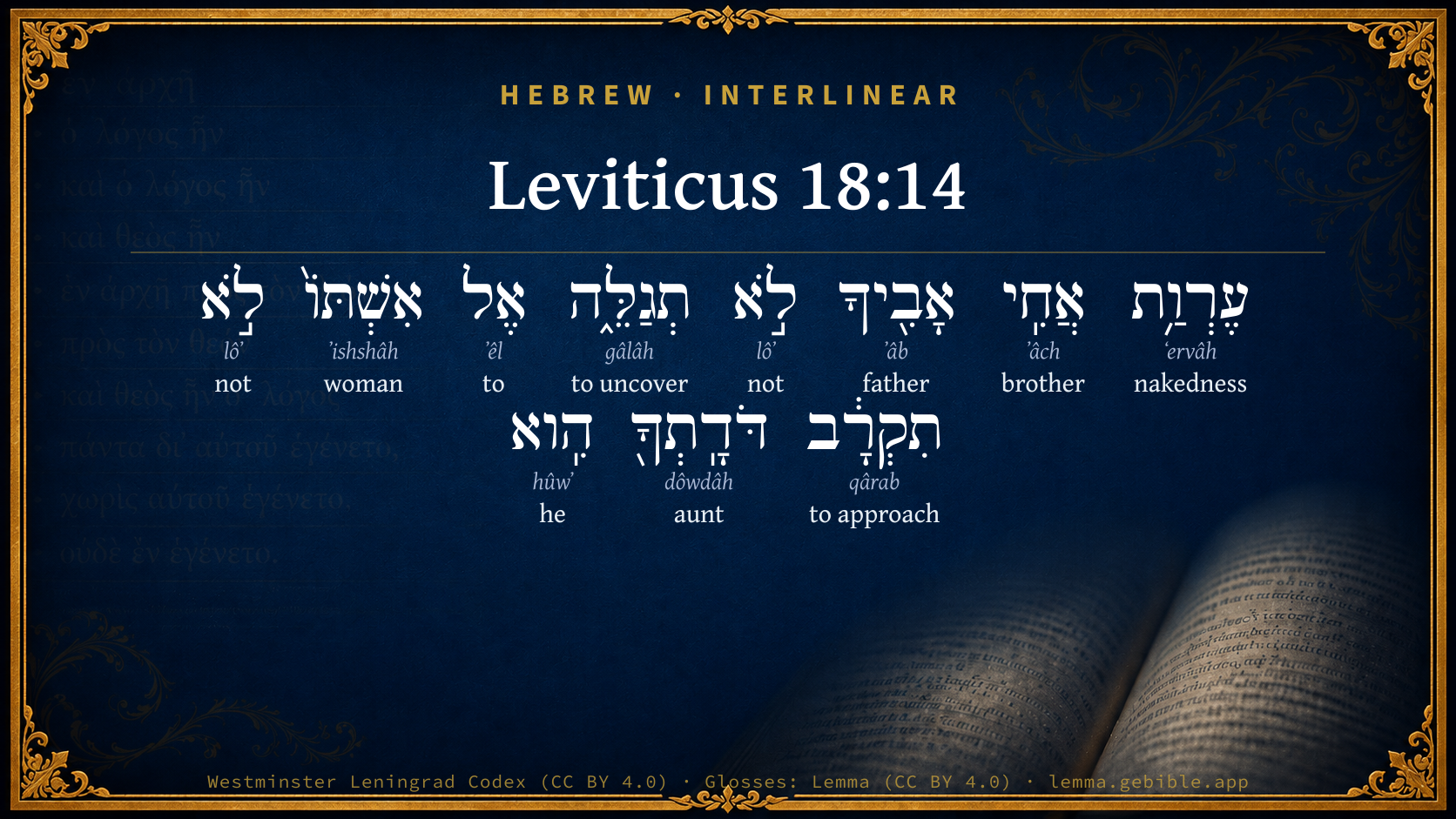
Hebrew (Westminster Leningrad Codex) Leviticus 18:14 appears in the Hebrew Old Testament. The text above is from the Westminster Leningrad Codex. Each word links to its Strong’s number, a concise gloss, and parsing drawn from the Open Scriptures Hebrew Bible morphology. Click any word for its full Brown-Driver-Briggs (BDB) entry.
Download image
Cite this verse

Leviticus 18:14 (World English Bible). Public Domain. Lemma interlinear Bible study tool, https://lemma.gebible.app/v/leviticus/18/14.

Show BibTeX & RIS
BibTeX
RIS
English Translation
"'You shall not uncover the nakedness of your father's brother, you shall not approach his wife: she is your aunt.
World English Bible · Public Domain
Download a study sheet

One document with this verse’s original text, its word-by-word gloss line, the meaning frame, cross-references with their text, attributed commentary, and full source and license credits — printable, and it pastes into notes with its structure intact.

This verse Autodidact and up

Study sheet (.html) Plain text (.txt)

A passage Seminary Student

Up to 50 verses in one chapter. A passage sheet keeps up to 6 commentary sources and 12 cross-references per verse, in the order this page ranks them, and says so on the sheet whenever that leaves anything out. Ask for a single verse and you get the Autodidact verse sheet above.

Everything on this page stays free to read, with no account — the sheet is a download of what is already on screen, not access to it.

Want to remove ads? Support Godless Engineer
Compare translations 3

The same verse in 3 English versions, stacked beneath the original-language interlinear above. Click any original word for its lexicon entry.

Each is an independent rendering of the whole verse — the interlinear is not word-aligned to these translations.

Highlighted words mark where these versions differ — a whole-verse word diff, not a word-by-word alignment.

  • World English Bible Public Domain
    "'You shall not uncover the nakedness of your father's brother, you shall not approach his wife: she is your aunt.
  • King James Version Public Domain
    Thou shalt not uncover the nakedness of thy father's brother, thou shalt not approach to his wife: she is thine aunt.
  • unfoldingWord Literal Text CC BY-SA 4.0
    The nakedness of the brother of your father, you shall not uncover; to his wife you shall not draw near. She is your aunt.

unfoldingWord Literal Text — © unfoldingWord, licensed CC BY-SA 4.0. Word-aligned USFM3 via Door43 (git.door43.org/unfoldingWord/en_ult).

Versions to compare (up to 4)

3 of 4 selected

Show all 18 translations

Every available English version of this verse, each an independent rendering of the whole verse.

  • World English Bible Public Domain
    "'You shall not uncover the nakedness of your father's brother, you shall not approach his wife: she is your aunt.
  • Berean Standard Bible Public Domain
    You must not dishonor your father’s brother by approaching his wife to have sexual relations with her; she is your aunt.
  • Majority Standard Bible Public Domain
    You must not dishonor your father’s brother by approaching his wife to have sexual relations with her; she is your aunt.
  • King James Version Public Domain
    Thou shalt not uncover the nakedness of thy father's brother, thou shalt not approach to his wife: she is thine aunt.
  • American Standard Version (1901) Public Domain
    Thou shalt not uncover the nakedness of thy father's brother, thou shalt not approach to his wife: she is thine aunt.
  • Revised Version (1885) Public Domain
    Thou shalt not uncover the nakedness of thy father’s brother, thou shalt not approach to his wife: she is thine aunt.
  • Geneva Bible (1599) Public Domain
    Thou shalt not vncouer the shame of thy fathers brother: that is, thou shalt not goe in to his wife, for she is thine aunte.
  • Douay-Rheims (1899) Public Domain
    Thou shalt not uncover the nakedness of thy father's brother: neither shalt thou approach to his wife, who is joined to thee by affinity.
  • Young's Literal Translation Public Domain
    `The nakedness of thy father's brother thou dost not uncover; unto his wife thou dost not draw near; she `is' thine aunt.
  • Literal Standard Version CC BY-SA 4.0
    You do not uncover the nakedness of your father’s brother; you do not draw near to his wife; she [is] your aunt.
  • Unlocked Literal Bible CC BY-SA 4.0
    Do not dishonor the brother of your father by sleeping with his wife. Do not go near her for that purpose; she is your aunt.
  • unfoldingWord Literal Text CC BY-SA 4.0
    The nakedness of the brother of your father, you shall not uncover; to his wife you shall not draw near. She is your aunt.
  • Darby Bible Public Domain
    The nakedness of thy father's brother shalt thou not uncover; thou shalt not approach his wife: she is thine aunt.
  • World Messianic Bible Public Domain
    “‘You shall not uncover the nakedness of your father’s brother. You shall not approach his wife. She is your aunt.
  • Webster's Bible Public Domain
    Thou shalt not uncover the nakedness of thy father's brother, thou shalt not approach to his wife: she is thy aunt.
  • Free Bible Version CC BY-SA 4.0
    Don't bring shame on your uncle by having sex with his wife. She is your aunt.
  • Bible in Basic English Public Domain
    You may not have sex relations with the wife of your father's brother, for she is of your family;
  • JPS Tanakh (1917) Public Domain
    Thou shalt not uncover the nakedness of thy fathers brother, thou shalt not approach to his wife: she is thine aunt.

Literal Standard Version (2020), Covenant Press — licensed CC BY-SA 4.0. Text via the HelloAO Bible API (eBible.org). Unlocked Literal Bible (unfoldingWord) — licensed CC BY-SA 4.0. Text via the HelloAO Bible API (eBible.org). unfoldingWord Literal Text — © unfoldingWord, licensed CC BY-SA 4.0. Word-aligned USFM3 via Door43 (git.door43.org/unfoldingWord/en_ult). Free Bible Version, Dr. Jonathan Gallagher — licensed CC BY-SA 4.0. Text via the HelloAO Bible API (eBible.org).

Word by word

More ways to search: Search by grammar → Find every occurrence → Compare this word →

Practice this passage: Drill this verse → Learn its vocabulary →

דֹּדָֽתְךָ֖
dôwdâh
H1733
“aunt · your”
Noun, Common, Feminine, Singular, Construct + Suffix, Personal, 2nd Person, Masculine, Singular
Part of Speech
Noun
Type
Common
Gender
Feminine
Number
Singular
State
Construct
Full BDB Definition

Origin: from H1730

TWOT: 410b

aunt
  1. עֶרְוַ֥ת ʻervâh H6172 “nakedness of” Noun, Common, Feminine, Singular, Construct
  2. אֲחִֽי ʼâch H251 “brother of” Noun, Common, Masculine, Singular, Construct
  3. אָבִ֖יךָ ʼâb H1 “father · your” Noun, Common, Masculine, Singular, Construct + Suffix, Personal, 2nd Person, Masculine, Singular
  4. לֹ֣א lôʼ H3808 “not” Particle, Negative
  5. תְגַלֵּ֑ה gâlâh H1540 “to uncover” Verb, Piel, Imperfect, 2nd Person, Masculine, Singular
  6. אֶל ʼêl H413 “to” Preposition
  7. אִשְׁתּוֹ֙ ʼishshâh H802 “woman · his” Noun, Common, Feminine, Singular, Construct + Suffix, Personal, 3rd Person, Masculine, Singular
  8. לֹ֣א lôʼ H3808 “not” Particle, Negative
  9. תִקְרָ֔ב qârab H7126 “to approach” Verb, Qal, Imperfect, 2nd Person, Masculine, Singular
  10. הִֽוא hûwʼ H1931 “he” Pronoun, Personal, 3rd Person, Feminine, Singular

About this verse

These counts appear in no published source. They are computed here, from the morphology-tagged text and Lemma’s own curated glosses. What Lemma adds →

11
words
10
distinct lemmas
Pentateuch
section

Notable vocabulary

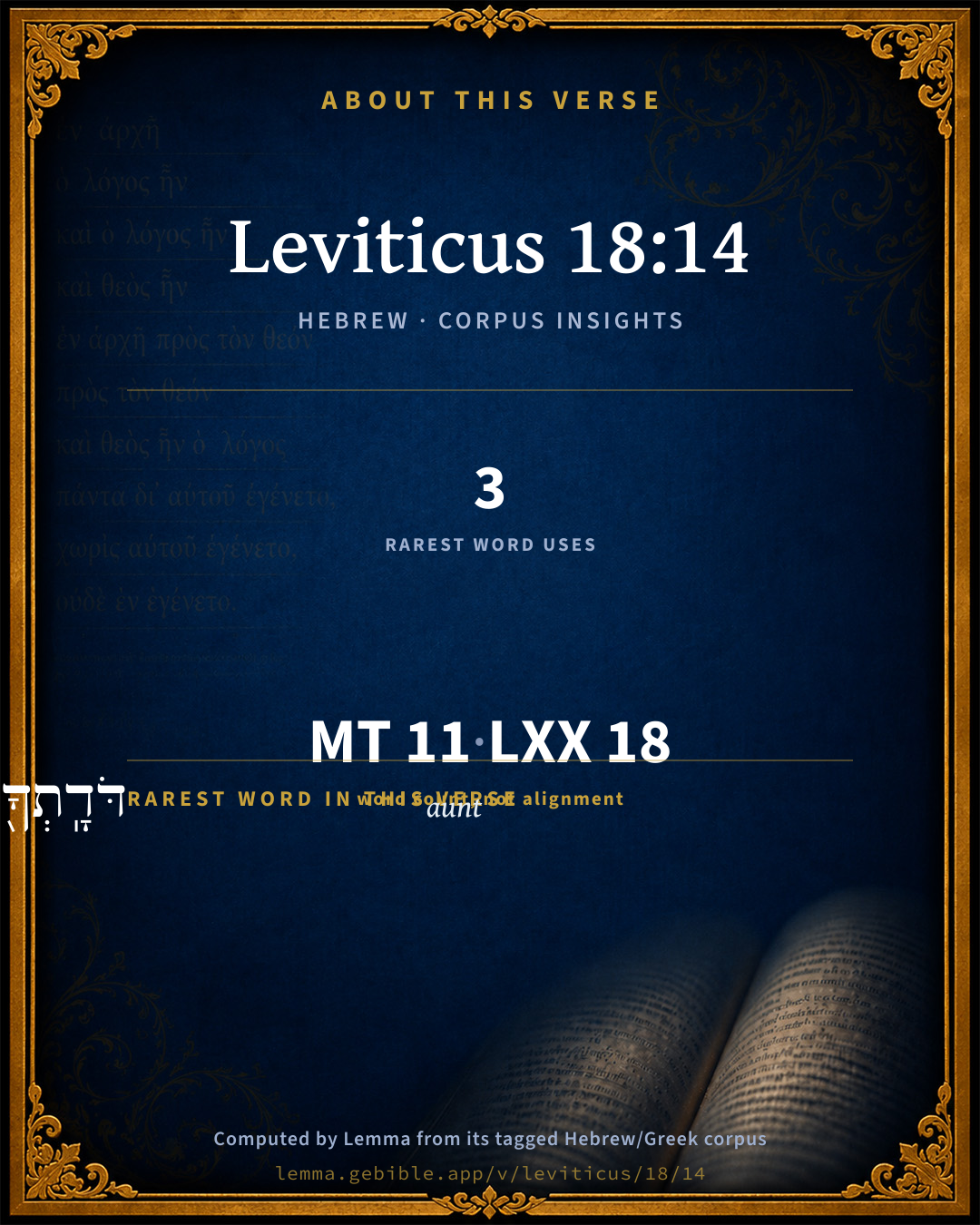
The rarest word here is דֹּדָֽתְךָ֖ aunt H1733 — appearing just 3 times in the whole Hebrew Bible.

Shared distinctive vocabulary

דֹּדָֽתְךָ֖ aunt H1733 occurs in 3 verses of the Hebrew Bible. Also found in:

Grammatical profile

  • 2 verbs
  • 5 nouns
  • 1 pronoun
  • 1 preposition
  • 2 particles

Verb forms

  • תְגַלֵּ֑ה Piel · Imperfect
  • תִקְרָ֔ב Qal · Imperfect

Repetition

A word recurs within this verse — often emphatic in Hebrew:

Hebrew & Septuagint length

In English translation the verse runs 20 words from the Hebrew and 24 from the Septuagint (LXX English) — closely comparable.

A rough comparison of the two English renderings, which tokenize alike — not a word-level alignment.

Word counts can differ between the Hebrew and the Greek without any difference in meaning — e.g. the Hebrew direct-object marker אֵת has no separate Greek word, and Greek often adds the article ὁ.

In the original languages it is 11 Hebrew tokens and 18 Greek tokens — but the two are counted differently (Hebrew bundles its prefixes and suffixes into one token; the Greek is in lemma form), so that isn’t a like-for-like length.

Cross-references

1

Topical passages linked to Leviticus 18:14 in the Treasury of Scripture Knowledge — connected by theme and wording, ordered by reader-vote popularity; previews shown in the World English Bible.

  • Leviticus 20:20 If a man lies with his uncle's wife, he has uncovered his uncle's nakedness: they shall bear their sin; they shall die childless.

Cross-references courtesy of OpenBible.info (CC BY 4.0).

Hebrew and Greek witnesses Masoretic Hebrew ↔ Greek Septuagint

The same verse in the two great witnesses to the Old Testament, shown verse-for-verse.

These are two independent witnesses, not word-aligned to each other, and the Septuagint is shown in lemma (dictionary) form.

Hebrew Leviticus 18:14 Masoretic · Westminster Leningrad Codex

עֶרְוַ֥ת אֲחִֽי אָבִ֖יךָ לֹ֣א תְגַלֵּ֑ה אֶל אִשְׁתּוֹ֙ לֹ֣א תִקְרָ֔ב דֹּדָֽתְךָ֖ הִֽוא

"'You shall not uncover the nakedness of your father's brother, you shall not approach his wife: she is your aunt.

World English Bible · Public Domain

Greek LXX Leviticus 18:14 Septuagint · lemma form

ἀσχημοσύνη ἀδελφός ὁ πατήρ σύ οὐ ἀποκαλύπτω καί πρός ὁ γυνή αὐτός οὐ εἰςἔρχομαι συγγενής γάρ σύ εἰμί

You shall not uncover the nakedness of your father's brother, and you shall not go in to his wife; for she is your relation.

LXX2012 (modern English Septuagint) · Public Domain

Hebrew: Westminster Leningrad Codex (CC BY 4.0). Greek: Septuagint (public domain); English from LXX2012 (modern English Septuagint) (Public Domain). How the Septuagint differs from the Hebrew →

Targum (Aramaic paraphrase)

2

The Targum is the ancient Jewish Aramaic paraphrase of the Hebrew Scriptures — an interpretive translation, not the Hebrew text itself. Onkelos (literal) and Pseudo-Jonathan (expansive) render the Torah, and Jonathan the Prophets. Coverage is partial: where no permissively-licensed English translation exists for a verse, only the Aramaic is shown. This is verse-level text, not a word-by-word alignment to the Hebrew.

  1. Targum Onkelos Torah (Genesis–Deuteronomy)
    עֶרְיַת אַח אֲבוּךְ לָא תְגַלֵי לְאִתְּתֵהּ לָא תִקְרַב אִתַּת אַח אֲבוּךְ הִיא

    (no public-domain English translation for this verse)

    Targum Onkelos — Aramaic: “Onkelos Genesis” (public domain); “Onkelos Exodus” (public domain); “Onkelos Leviticus” (public domain); “Onkelos Numbers” (public domain); “Onkelos Deuteronomy” (public domain). English: “Sefaria Community Translation” (CC0 1.0 (public-domain dedication)); “J.W. Etheridge. The Targums of Onkelos and Jonathan Ben Uzziel on the Pentateuch. London: Longmans, Green, 1862” (public domain). Text via Sefaria.

  2. Targum Pseudo-Jonathan Torah (Genesis–Deuteronomy)
    עֶרְיַית אַחְבוּךְ לָא תִבְזֵי וּלְוַת אִנְתְּתֵיהּ לָא תִקְרֵב בְּתַשְׁמִישׁ עַרְסָא אִיתַּת אַחְבוּךְ הִיא

    The nakedness of thy father's brother thou shalt not dishonour, nor come nigh to his wife carnally; she is the wife of thy father's brother.

    Targum Pseudo-Jonathan — Aramaic: “Targum Jonathan on Genesis” (public domain); “Targum Jonathan on Exodus” (public domain); “Targum Jonathan on Leviticus” (public domain); “Targum Jonathan on Numbers” (public domain); “Targum Jonathan on Deuteronomy” (public domain). English: “The Targum of Jonathan ben Uzziel, trans. J. W. Etheridge, London, 1862” (public domain). Text via Sefaria.

Commentary

Notes on Leviticus 18:14 from classic Christian and Jewish commentators (each source and its license shown beneath its notes). The classic Christian expositions comment on the surrounding passage and are grouped to its opening verse, so a note may address several verses; the Jewish commentaries on the Tanakh (Rashi and others) are per-verse, so they appear only where the commentator wrote on this verse.

Lemma curates 59 commentaries, every one of them public domain or Creative Commons licensed, each selected and text-cleaned for this edition rather than reprinted as found. About our sources →

Trapp's Complete Commentary

John Trapp

Lev 18:14 Thou shalt not uncover the nakedness of thy father’s brother, thou shalt not approach to his wife: she [is] thine aunt.

Ver. 14. Of thy father’s brother.] The nakedness of whose wife is called his nakedness, because man and wife are one flesh. {Mat 19:6} {See Trapp on "Mat 19:6"}

John Trapp, A Commentary or Exposition upon All the Books of the Old and New Testament (1647–1656) — public domain. Text from a community e-Sword module.

Joseph Benson's Commentary

Lev 18:14. Thy father’s brother — Thou shalt not marry thy uncle’s wife, as is explained in the next words.

Joseph Benson's Commentary on the Old and New Testaments (1811–1818) — public domain. Text from a community e-Sword module.

Tyndale Open Study Notes

Tyndale Open Resources

18:14 Having sexual relations with your aunt would dishonor your uncle. In turn, this would also dishonor your father (see 20:20).

Tyndale Open Study Notes — © Tyndale Open Resources, licensed CC BY-SA 4.0. Text via the HelloAO Bible API.

Geneva Bible (1599)

Geneva Bible translators

Which thine uncle doth discover.

Hebrew, thy father’s brother’s wife.

Geneva Bible (1599) marginal notes — public domain. Text via Bolls.life.

Ellicott's Commentary for English Readers

(14) Thy father’s brother, thou shalt not approach to his wife.—That is, according to the ancient legal interpretation, a nephew is to have no commerce with her during her husband’s lifetime, nor marry her when his uncle is dead. Those who transgressed this law had not only to bear their sin, but were doomed to die without issue. (See Lev_20:20.)

A Bible Commentary for English Readers, edited by Charles John Ellicott (1878–1897) — public domain. Text from a community e-Sword module.

John Gill's Exposition

Thou shalt not uncover the nakedness of thy father's brother,.... Which Gersom understands of committing sodomy with him, on which account he was doubly guilty, partly because of lying with a male, and partly because of uncovering the nakedness of his father's brother; but it rather seems at first sight as if the sense was, that a woman should not marry her father's brother, that is, her uncle, as a man might not marry his aunt, whether by father or mother's side, as in Lev 18:12; but Jarchi directs to a better sense than either, when he asks, what is his nakedness? in answer to which he recites the following clause as explanative of it:

thou shall not approach to his wife; in the use of the bed, as the Targum of Jonathan adds, that is, to lie with her, her husband being living, or to marry her, he being dead:

she is thine aunt: even as a father's or mother's sister, only they are aunts by blood, this by marriage or affinity: in the Targums of Onkelos and Jonathan it is, she is the wife of thy father's brother; and as Aben Ezra, she is accounted as thine aunt, and so marriage with her prohibited; and the same holds good of a father's brother's wife, which being not mentioned, the same writer says, we have need of the tradition which expresses that and also of a father's sister's husband; for if marriage with a father's brother's wife is unlawful, then marriage with a father's sister's husband must be so too; for a father's sister's husband stands in the same degree or line of affinity as a father's brother's wife; and it is a sure rule, that in whatsoever degree or line of affinity males are forbid to marry females, in the same females are forbid to marry males.

John Gill's Exposition of the Whole Bible (1746–1763) — public domain (CC PDM 1.0). Text via the HelloAO Bible API.

Haydock's Catholic Bible Commentary

Who....affinity. Hebrew, "she is thy aunt." Some say that, in the old law, a person might marry his niece, but not his aunt; as the order of nature would be inverted if the aunt were subject to her nephew. But others assert that the law was reciprocal, and excluded the marriage of both. The emperor Claudius married his niece Agrippina, and authorized others to do the like. But only one imitated him at Rome; (Suetonius) though Tacitus (An. xii.) says, other nations did it with solemnity, as they had no law to the contrary. Aliis gentibus solemnia, &c. (Calmet)

George Leo Haydock (1774–1849), Haydock's Catholic Family Bible and Commentary, 1859 edition — public domain. Excludes Psalms (Douay-Rheims chapter numbering differs from Protestant) and Deuterocanonical books (Catholic canon only).

Matthew Poole's English Annotations

Of thy father’s brother, i.e. of his wife, as the next words explain it. And as a man may not marry his aunt, so neither may a woman marry her uncle, there being altogether the same distance in kindred, and the selfsame reason of the law. And for the examples of Abraham, Amram, Othniel, &c., to the contrary, they were before the publication of this law, by which it pleased God to restrain the liberty allowed formerly, when the holy seed was in a narrower compass, and fewer persons, which altered the case. For in that regard there was a time when God allowed brethren and sisters to marry, to wit, when there were no other in the world, which was the case of Adam’s immediate children. We learn from hence that the same degrees are forbidden in consanguinity or kindred by blood, and in affinity or kindred by marriage.

She is thine aunt: some infer from hence that it is unlawful for cousin-germans, or the children of brethren and sisters, to marry. But there is not the same reason, nor the same degree of distance, for my uncle or aunt are nearer akin to me than their children are. Yet because it seems doubtful to many, and may hereafter prove occasion of grievous perplexities of mind, especially to tender and scrupulous consciences, Christian prudence directs us to choose the safest way, there being so great a latitude of unquestionable persons.

Matthew Poole's English Annotations on the Holy Bible (1683–1685) — public domain. Text from a community e-Sword/MySword module.

Keil & Delitzsch

C. F. Keil & F. Delitzsch

So, again, with the wife of the father's brother, because the nakedness of the uncle was thereby uncovered. The threat held out in Lev 20:19 and Lev 20:20 against the alliances prohibited in Lev 18:12-14, is that the persons concerned should bear their iniquity or sin, i.e., should suffer punishment in consequence (see at Lev 5:1); and in the last case it is stated that they should die childless. From this it is obvious that sexual connection with the sister of either father or mother was not to be punished with death by the magistrate, but would be punished with disease by God Himself.

Keil & Delitzsch — Biblical Commentary on the Old Testament (1861–1891) — public domain (CC PDM 1.0). Text via the HelloAO Bible API. (Old Testament only.)

Rashi

Rabbi Shlomo Yitzchaki (Rashi)

ערות אחי אביך לא תגלה THE NAKEDNESS OF THY FATHER'S BROTHER THOU SHALT NOT UNCOVER — and what does this "uncovering of his nakedness" mean אל אשתו לא תקרב? THOU SHALT NOT APPROACH TO HIS WIFE.

Rashi on the Tanakh — English translations: “The Judaica Press complete Tanach with Rashi, translated by A. J. Rosenberg” (CC BY 4.0); “Pentateuch with Rashi's commentary by M. Rosenbaum and A.M. Silbermann, 1929-1934” (public domain); “The Metsudah Tanach series, Lakewood, N.J” (CC BY 4.0); and “The Book of Joshua, Metsudah Publications, 1997” (CC BY 4.0). Text via Sefaria.

Lesson kit

Teaching starters — assembled from the data on this page, not authored interpretation. Every prompt links to the verse data it draws on. Edit before teaching.

Leviticus, in the Pentateuch, opens this verse with 11 words (10 distinct Hebrew lemmas). Its most distinctive word is dôwdâh (“aunt”). A historical commentator’s framing appears above. Read the whole chapter for the surrounding context.

Discussion questions

  1. How does “aunt” (dôwdâh) shape what this verse is saying?
  2. Exodus 6:20 shares the word «aunt» with this verse. How do the two illuminate each other?
  3. “not” occurs 2× in this one verse. What is the effect of the repetition?
  4. The translations on this page render this verse differently — a whole-verse word diff, not a word-by-word alignment. What might account for the different wordings?
  5. The verb «תְגַלֵּ֑ה» is Piel Imperfect. How does its form color the action?
  6. Reading how Trapp's Complete Commentary and Joseph Benson's Commentary read this verse, where do the two commentators agree and where do they part?

Things to notice

Reading settings

Reading text

Shown beneath each verse's original-language words.

Old Testament
Old Testament edition

Read the OT as the Masoretic Hebrew (MT) or the Greek Septuagint (LXX).

English shown for the Greek Septuagint (in the Hebrew ↔ Greek comparison).

Comparing translations? Open the Compare panel on any verse page to stack up to four side by side.