
Genesis 27:19

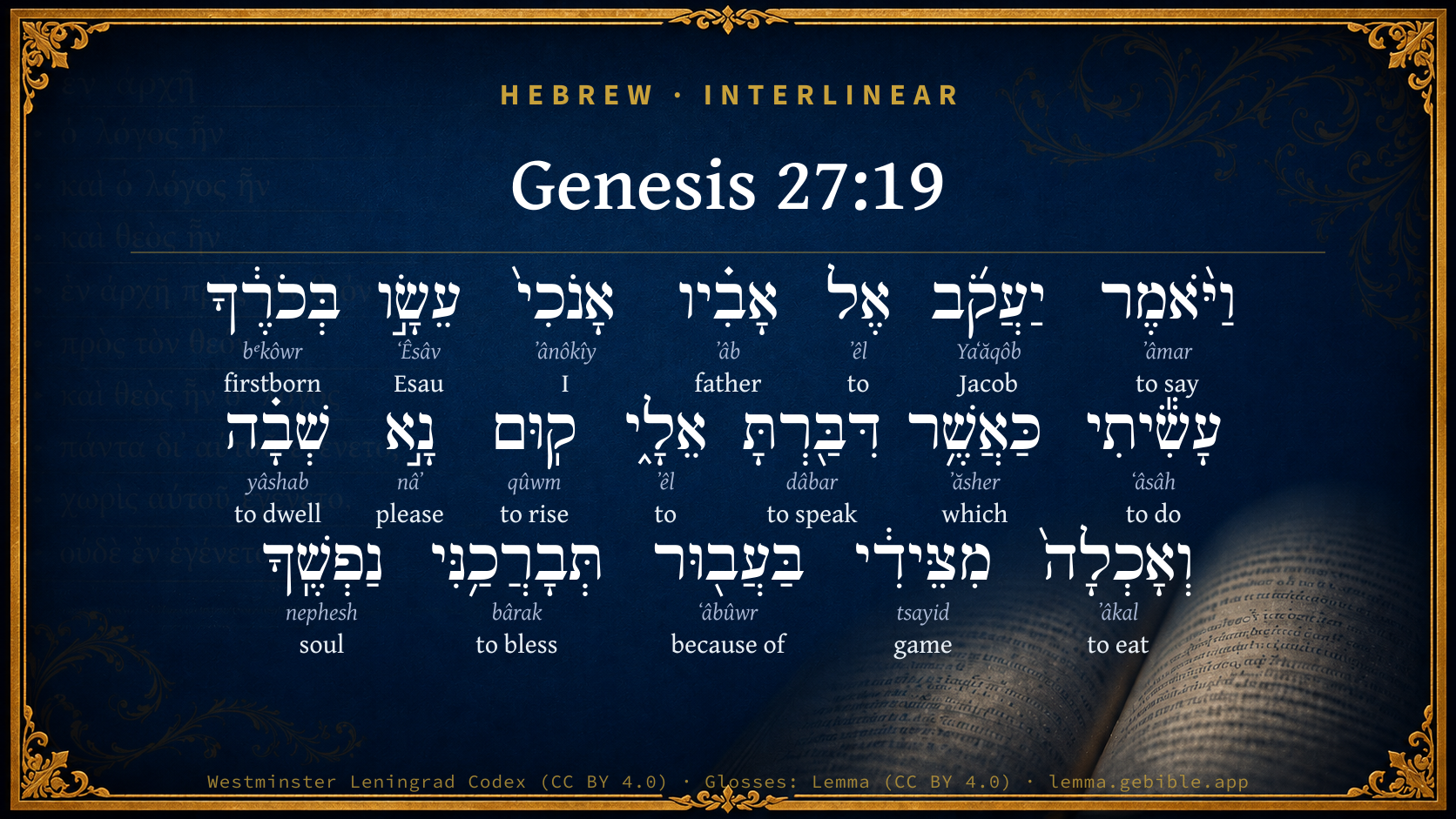
Hebrew (Westminster Leningrad Codex) Genesis 27:19 appears in the Hebrew Old Testament. The text above is from the Westminster Leningrad Codex. Each word links to its Strong’s number, a concise gloss, and parsing drawn from the Open Scriptures Hebrew Bible morphology. Click any word for its full Brown-Driver-Briggs (BDB) entry.
Download image
Cite this verse

Genesis 27:19 (World English Bible). Public Domain. Lemma interlinear Bible study tool, https://lemma.gebible.app/v/genesis/27/19.

Show BibTeX & RIS
BibTeX
RIS
English Translation
Jacob said to his father, "I am Esau your firstborn. I have done what you asked me to do. Please arise, sit and eat of my venison, that your soul may bless me."
World English Bible · Public Domain
Download a study sheet

One document with this verse’s original text, its word-by-word gloss line, the meaning frame, cross-references with their text, attributed commentary, and full source and license credits — printable, and it pastes into notes with its structure intact.

This verse Autodidact and up

Study sheet (.html) Plain text (.txt)

A passage Seminary Student

Up to 50 verses in one chapter. A passage sheet keeps up to 6 commentary sources and 12 cross-references per verse, in the order this page ranks them, and says so on the sheet whenever that leaves anything out. Ask for a single verse and you get the Autodidact verse sheet above.

Everything on this page stays free to read, with no account — the sheet is a download of what is already on screen, not access to it.

Want to remove ads? Support Godless Engineer
Compare translations 3

The same verse in 3 English versions, stacked beneath the original-language interlinear above. Click any original word for its lexicon entry.

Each is an independent rendering of the whole verse — the interlinear is not word-aligned to these translations.

Highlighted words mark where these versions differ — a whole-verse word diff, not a word-by-word alignment.

  • World English Bible Public Domain
    Jacob said to his father, "I am Esau your firstborn. I have done what you asked me to do. Please arise, sit and eat of my venison, that your soul may bless me."
  • King James Version Public Domain
    And Jacob said unto his father, I am Esau thy first born; I have done according as thou badest me: arise, I pray thee, sit and eat of my venison, that thy soul may bless me.
  • unfoldingWord Literal Text CC BY-SA 4.0
    Then Jacob said to his father, “I Esau, your firstborn. I have done as you told me. Please get up, sit and eat some of my game, so that your soul will bless me.”

unfoldingWord Literal Text — © unfoldingWord, licensed CC BY-SA 4.0. Word-aligned USFM3 via Door43 (git.door43.org/unfoldingWord/en_ult).

Versions to compare (up to 4)

3 of 4 selected

Show all 18 translations

Every available English version of this verse, each an independent rendering of the whole verse.

  • World English Bible Public Domain
    Jacob said to his father, "I am Esau your firstborn. I have done what you asked me to do. Please arise, sit and eat of my venison, that your soul may bless me."
  • Berean Standard Bible Public Domain
    Jacob said to his father, “I am Esau, your firstborn. I have done as you told me. Please sit up and eat some of my game, so that you may bless me.”
  • Majority Standard Bible Public Domain
    Jacob said to his father, “I am Esau, your firstborn. I have done as you told me. Please sit up and eat some of my game, so that you may bless me.”
  • King James Version Public Domain
    And Jacob said unto his father, I am Esau thy first born; I have done according as thou badest me: arise, I pray thee, sit and eat of my venison, that thy soul may bless me.
  • American Standard Version (1901) Public Domain
    And Jacob said unto his father, I am Esau thy first-born; I have done according as thou badest me: arise, I pray thee, sit and eat of my venison, that thy soul may bless me.
  • Revised Version (1885) Public Domain
    And Jacob said unto his father, I am Esau thy firstborn; I have done according as thou badest me: arise, I pray thee, sit and eat of my venison, that thy soul may bless me.
  • Geneva Bible (1599) Public Domain
    And Iaakob sayde to his father, I am Esau thy first borne, I haue done as thou badest me, arise, I pray thee: sit vp and eate of my venison, that thy soule may blesse me.
  • Douay-Rheims (1899) Public Domain
    And Jacob said: I am Esau thy firstborn: I have done as thou didst command me: arise, sit, and eat of my venison, that thy soul may bless me.
  • Young's Literal Translation Public Domain
    And Jacob saith unto his father, `I `am' Esau thy first-born; I have done as thou hast spoken unto me; rise, I pray thee, sit, and eat of my provision, so that thy soul doth bless me.'
  • Literal Standard Version CC BY-SA 4.0
    And Jacob says to his father, “I [am] Esau your firstborn; I have done as you have spoken to me; please rise, sit and eat of my game, so that your soul blesses me.”
  • Unlocked Literal Bible CC BY-SA 4.0
    Jacob said to his father, “I am Esau your firstborn; I have done as you said to me. Now sit up and eat some of my game, that you may bless me.”
  • unfoldingWord Literal Text CC BY-SA 4.0
    Then Jacob said to his father, “I Esau, your firstborn. I have done as you told me. Please get up, sit and eat some of my game, so that your soul will bless me.”
  • Darby Bible Public Domain
    And Jacob said to his father, I am Esau, thy firstborn. I have done according as thou didst say to me. Arise, I pray thee, sit and eat of my venison, in order that thy soul may bless me.
  • World Messianic Bible Public Domain
    Jacob said to his father, “I am Esau your firstborn. I have done what you asked me to do. Please arise, sit and eat of my venison, that your soul may bless me.”
  • Webster's Bible Public Domain
    And Jacob said to his father, I am Esau thy first-born; I have done according as thou badest me: arise, I pray thee, sit and eat of my venison, that thy soul may bless me.
  • Free Bible Version CC BY-SA 4.0
    “It's me Esau, your firstborn son,” Jacob told his father. “I did what you told me. So please sit up and eat some of my wild game meat so you can bless me.”
  • Bible in Basic English Public Domain
    And Jacob said, I am Esau, your oldest son; I have done as you said: come now, be seated and take of my meat, so that you may give me a blessing.
  • JPS Tanakh (1917) Public Domain
    And Jacob said unto his father: 'I am Esau thy first-born; I have done according as thou badest me. Arise, I pray thee, sit and eat of my venison, that thy soul may bless me.'

Literal Standard Version (2020), Covenant Press — licensed CC BY-SA 4.0. Text via the HelloAO Bible API (eBible.org). Unlocked Literal Bible (unfoldingWord) — licensed CC BY-SA 4.0. Text via the HelloAO Bible API (eBible.org). unfoldingWord Literal Text — © unfoldingWord, licensed CC BY-SA 4.0. Word-aligned USFM3 via Door43 (git.door43.org/unfoldingWord/en_ult). Free Bible Version, Dr. Jonathan Gallagher — licensed CC BY-SA 4.0. Text via the HelloAO Bible API (eBible.org).

Word by word

More ways to search: Search by grammar → Find every occurrence → Compare this word →

Practice this passage: Drill this verse → Learn its vocabulary →

מִצֵּידִ֔י
tsayid
H6718
“from · game · my”
Preposition + Noun, Common, Masculine, Singular, Construct + Suffix, Personal, 1st Person, Common, Singular
Part of Speech
Preposition + Noun
Type
Common
Gender
Masculine
Number
Singular
State
Construct
Full BDB Definition

Origin: from a form of H6679 and meaning the same

TWOT: 1885a , 1886a

hunting, game - hunting - game hunted - provision, food - provision, food, food-supply
  1. וַיֹּ֨אמֶר ʼâmar H559 “and · to say” Conjunction + Verb, Qal, Sequential Imperfect, 3rd Person, Masculine, Singular
  2. יַעֲקֹ֜ב Yaʻăqôb H3290 “Jacob” Noun, Proper
  3. אֶל ʼêl H413 “to” Preposition
  4. אָבִ֗יו ʼâb H1 “father · his” Noun, Common, Masculine, Singular, Construct + Suffix, Personal, 3rd Person, Masculine, Singular
  5. אָנֹכִי֙ ʼânôkîy H595 “I” Pronoun, Personal, 1st Person, Common, Singular
  6. עֵשָׂ֣ו ʻÊsâv H6215 “Esau” Noun, Proper
  7. בְּכֹרֶ֔ךָ bᵉkôwr H1060 “firstborn · your” Noun, Common, Masculine, Singular, Construct + Suffix, Personal, 2nd Person, Masculine, Singular
  8. עָשִׂ֕יתִי ʻâsâh H6213 “to do” Verb, Qal, Perfect, 1st Person, Common, Singular
  9. כַּאֲשֶׁ֥ר ʼăsher H834 “like/as · which” Preposition + Particle, Relative
  10. דִּבַּ֖רְתָּ dâbar H1696 “to speak” Verb, Piel, Perfect, 2nd Person, Masculine, Singular
  11. אֵלָ֑י ʼêl H413 “to · me” Preposition + Suffix, Personal, 1st Person, Common, Singular
  12. קֽוּם qûwm H6965 “rise” Verb, Qal, Imperative, 2nd Person, Masculine, Singular
  13. נָ֣א nâʼ H4994 “please” Particle, Exhortation
  14. שְׁבָ֗ה yâshab H3427 “dwell” Verb, Qal, Imperative, 2nd Person, Masculine, Singular + Suffix, h
  15. וְאָכְלָה֙ ʼâkal H398 “and · eat” Conjunction + Verb, Qal, Imperative, 2nd Person, Masculine, Singular + Suffix, h
  16. בַּעֲב֖וּר ʻâbûwr H5668 “in/at · because of of” Preposition + Noun, Common, Masculine, Singular, Construct
  17. תְּבָרֲכַ֥נִּי bârak H1288 “to bless · me” Verb, Piel, Imperfect, 3rd Person, Feminine, Singular + Suffix, Personal, 1st Person, Common, Singular
  18. נַפְשֶֽׁךָ nephesh H5315 “soul · your” Noun, Common, Both, Singular, Construct + Suffix, Personal, 2nd Person, Masculine, Singular

About this verse

These counts appear in no published source. They are computed here, from the morphology-tagged text and Lemma’s own curated glosses. What Lemma adds →

19
words
18
distinct lemmas
Pentateuch
section

Notable vocabulary

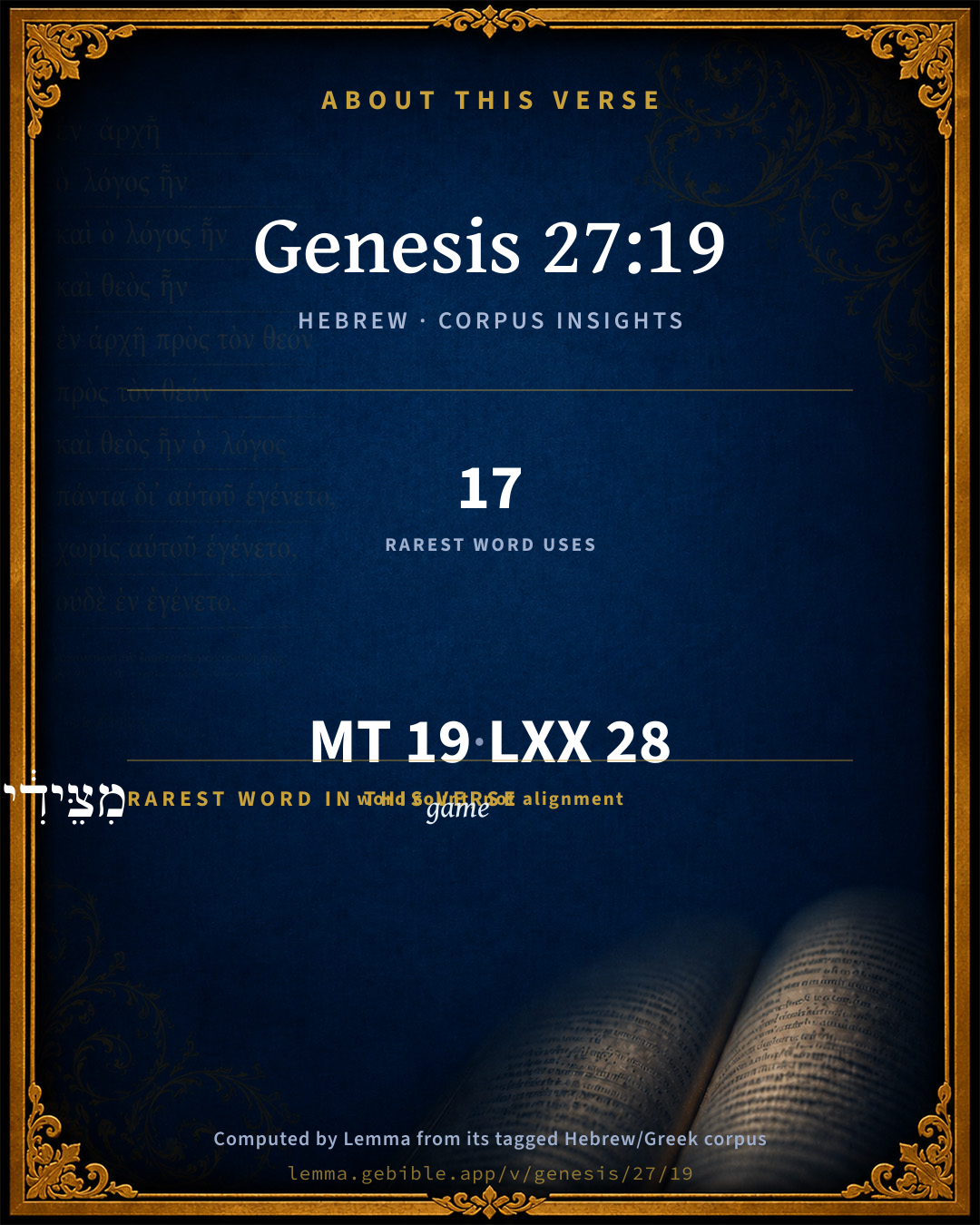
The rarest word here is מִצֵּידִ֔י game H6718 — appearing just 17 times in the whole Hebrew Bible.

Shared distinctive vocabulary

מִצֵּידִ֔י game H6718 occurs in 16 verses of the Hebrew Bible. Also found in:

Grammatical profile

  • 7 verbs
  • 7 nouns
  • 1 pronoun
  • 2 prepositions
  • 2 particles

Verb forms

  • וַיֹּ֨אמֶר Qal · Sequential Imperfect
  • עָשִׂ֕יתִי Qal · Perfect
  • דִּבַּ֖רְתָּ Piel · Perfect
  • קֽוּם Qal · Imperative
  • שְׁבָ֗ה Qal · Imperative
  • וְאָכְלָה֙ Qal · Imperative
  • תְּבָרֲכַ֥נִּי Piel · Imperfect

Repetition

A word recurs within this verse — often emphatic in Hebrew:

  • אֶל to H413 ×2

Hebrew & Septuagint length

In English translation the verse runs 33 words from the Hebrew and 29 from the Septuagint (LXX English) — closely comparable.

A rough comparison of the two English renderings, which tokenize alike — not a word-level alignment.

Word counts can differ between the Hebrew and the Greek without any difference in meaning — e.g. the Hebrew direct-object marker אֵת has no separate Greek word, and Greek often adds the article ὁ.

In the original languages it is 19 Hebrew tokens and 28 Greek tokens — but the two are counted differently (Hebrew bundles its prefixes and suffixes into one token; the Greek is in lemma form), so that isn’t a like-for-like length.

Cross-references

10

Topical passages linked to Genesis 27:19 in the Treasury of Scripture Knowledge — connected by theme and wording, ordered by reader-vote popularity; previews shown in the World English Bible.

  • Isaiah 28:15 Because you have said, We have made a covenant with death, and with Sheol are we at agreement; when the overflowing scourge shall pass through, it shall not come to us; for we have made lies our refuge, and under falsehood have we hid ourselves:
  • Zechariah 13:3–4 It will happen that, when anyone still prophesies, then his father and his mother who bore him will tell him, 'You must die, because you speak lies in the name of Yahweh;' and his father and his mother who bore him will stab him when he prophesies.
  • Matthew 26:70–74 But he denied it before them all, saying, "I don't know what you are talking about."
  • Genesis 25:25 The first came out red all over, like a hairy garment. They named him Esau.
  • Genesis 27:4 Make me savory food, such as I love, and bring it to me, that I may eat, and that my soul may bless you before I die."
  • Genesis 27:21 Isaac said to Jacob, "Please come near, that I may feel you, my son, whether you are really my son Esau or not."
  • Genesis 27:24–25 He said, "Are you really my son Esau?" He said, "I am."
  • Genesis 29:23–25 It happened in the evening, that he took Leah his daughter, and brought her to him. He went in to her.
  • 1 Kings 14:2 Jeroboam said to his wife, Please get up and disguise yourself, that you not be known to be the wife of Jeroboam; and get you to Shiloh: behold, there is Ahijah the prophet, who spoke concerning me that I should be king over this people.
  • 1 Kings 13:18 He said to him, I also am a prophet as you are; and an angel spoke to me by the word of Yahweh, saying, Bring him back with you into your house, that he may eat bread and drink water. [But] he lied to him.

Cross-references courtesy of OpenBible.info (CC BY 4.0).

Hebrew and Greek witnesses Masoretic Hebrew ↔ Greek Septuagint

The same verse in the two great witnesses to the Old Testament, shown verse-for-verse.

These are two independent witnesses, not word-aligned to each other, and the Septuagint is shown in lemma (dictionary) form.

Hebrew Genesis 27:19 Masoretic · Westminster Leningrad Codex

וַיֹּ֨אמֶר יַעֲקֹ֜ב אֶל אָבִ֗יו אָנֹכִי֙ עֵשָׂ֣ו בְּכֹרֶ֔ךָ עָשִׂ֕יתִי כַּאֲשֶׁ֥ר דִּבַּ֖רְתָּ אֵלָ֑י קֽוּם נָ֣א שְׁבָ֗ה וְאָכְלָה֙ מִצֵּידִ֔י בַּעֲב֖וּר תְּבָרֲכַ֥נִּי נַפְשֶֽׁךָ

Jacob said to his father, "I am Esau your firstborn. I have done what you asked me to do. Please arise, sit and eat of my venison, that your soul may bless me."

World English Bible · Public Domain

Greek LXX Genesis 27:19 Septuagint · lemma form

καί εἶπον ἰακώβ ὁ πατήρ αὐτός ἐγώ ησαυ ὁ πρωτότοκος σύ ποιέω καθά λαλέω ἐγώ ἀναἵστημι καταἵζω καί ἐσθίω ὁ θήρα ἐγώ ὅπως εὐλογέω ἐγώ ὁ ψυχή σύ

And Jacob said to his father, I, Esau your firstborn, have done as you told me; rise, sit, and eat of my venison, that your soul may bless me.

LXX2012 (modern English Septuagint) · Public Domain

Hebrew: Westminster Leningrad Codex (CC BY 4.0). Greek: Septuagint (public domain); English from LXX2012 (modern English Septuagint) (Public Domain). How the Septuagint differs from the Hebrew →

Targum (Aramaic paraphrase)

2

The Targum is the ancient Jewish Aramaic paraphrase of the Hebrew Scriptures — an interpretive translation, not the Hebrew text itself. Onkelos (literal) and Pseudo-Jonathan (expansive) render the Torah, and Jonathan the Prophets. Coverage is partial: where no permissively-licensed English translation exists for a verse, only the Aramaic is shown. This is verse-level text, not a word-by-word alignment to the Hebrew.

  1. Targum Onkelos Torah (Genesis–Deuteronomy)
    וַאֲמַר יַעֲקֹב לַאֲבוּהִי אֲנָא עֵשָׂו בּוּכְרָךְ עֲבָדִית כּמָא דִי מַלֵּילְתָּא עִמִּי (נ''י:לִי) קוּם כְּעַן אִסְתַּחַר וֶאֱכוּל מִצֵידִי בְּדִיל דִּי תְבָרְכִנַּנִּי נַפְשָׁךְ

    (no public-domain English translation for this verse)

    Targum Onkelos — Aramaic: “Onkelos Genesis” (public domain); “Onkelos Exodus” (public domain); “Onkelos Leviticus” (public domain); “Onkelos Numbers” (public domain); “Onkelos Deuteronomy” (public domain). English: “Sefaria Community Translation” (CC0 1.0 (public-domain dedication)); “J.W. Etheridge. The Targums of Onkelos and Jonathan Ben Uzziel on the Pentateuch. London: Longmans, Green, 1862” (public domain). Text via Sefaria.

  2. Targum Pseudo-Jonathan Torah (Genesis–Deuteronomy)
    וַאֲמַר יַעֲקב לְאָבוֹי אֲנָא עֵשָו בּוּכְרָךְ עֲבַדְנָא הֵיכְמָא דְמַלֵילְתָּא עִמִי קוּם כְּדֵין אִסְתְּחַר וְתֵכוּל מִצִידִי בְּגִין דִתְבָרְכִינַנִי נַפְשָׁךְ

    And Jacob said to his father, I am Esau thy firstborn: I have done as thou spakest with me. Arise now, sit and eat of my venison, that thy soul may bless me.

    Targum Pseudo-Jonathan — Aramaic: “Targum Jonathan on Genesis” (public domain); “Targum Jonathan on Exodus” (public domain); “Targum Jonathan on Leviticus” (public domain); “Targum Jonathan on Numbers” (public domain); “Targum Jonathan on Deuteronomy” (public domain). English: “The Targum of Jonathan ben Uzziel, trans. J. W. Etheridge, London, 1862” (public domain). Text via Sefaria.

Commentary

Notes on Genesis 27:19 from classic Christian and Jewish commentators (each source and its license shown beneath its notes). The classic Christian expositions comment on the surrounding passage and are grouped to its opening verse, so a note may address several verses; the Jewish commentaries on the Tanakh (Rashi and others) are per-verse, so they appear only where the commentator wrote on this verse.

Lemma curates 59 commentaries, every one of them public domain or Creative Commons licensed, each selected and text-cleaned for this edition rather than reprinted as found. About our sources →

Trapp's Complete Commentary

John Trapp

Gen 27:19 And Jacob said unto his father, I [am] Esau thy firstborn; I have done according as thou badest me: arise, I pray thee, sit and eat of my venison, that thy soul may bless me.

Ver. 19. I am Esau thy firstborn, &c.] Here he utters three lies in a breath: besides his ascribing to God that he did, {Gen 27:20} so taking that reverend name in vain. This was his sin, and he smarted for it to his dying day: for he had scarcely a merry hour after this; but God followed him with one sorrow upon another, to teach him and us what an "evil and bitter thing sin is," {Jer 2:19} and how it ensnares and ensnarls us. Aristotle could say, that a lie is in itself evil and wicked. {a} The Hebrews call it Aven, a great iniquity. And the Scripture reckons it among monstrous sins, {Rev 21:8} and condemns it to hell, - whether it be the officious, merry, or pernicious lie. Indeed, every lie is pernicious to ourselves or others, or both; because flatly forbidden of God, and because it is against the order of nature, and for that "no lie is of the truth," as St John hath it, {1Jn 2:21} but of the devil, who began, and still upholds his kingdom by lies. {Joh 8:44} Contrarily, God is truth, and his children are all such as will not lie, {Isa 63:8 Rev 14:5} at least, not get a haunt and a habit of lying, which David calls "a way of lying": "Remove from me the way of lying," saith he, {Psa 119:29} that I make not a trade or common practice of it. We find that {1Sa 21:2} he very roundly telleth two or three lies together, as Jacob here did; and all deliberate. So that tale he told Achish of invading the south of Judah, when he had been upon the Geshurites and Gerarites. {1Sa 27:8-11} I know not how it can be excused. But this was not David’s "way," his common course; pity it should. Honest heathens condemned lying; the Persians punished it severely in their children. {b} Homer censures it in Dolon, Ulysses, and others, {c} Clitarchi historici, saith Quintilian, ingenium probatur, fides infamatur. Nepos reporteth of Epaminondas, {d} that he so loved truth that he would not once lie, no, not in jest. A shame to many Christians, who think the officious and sporting lie to be nothing. Whereas {Gal 1:10} we must not speak the truth to please men, much less lie. And for saving ourselves, we must rather die then lie; else Peter had not sinned in denying his Master. As for profiting others, we may not lie, though it were to save a soul. {Rom 3:7} We may as well commit fornication with the Moabites, to draw them to our religion, or steal from rich men to give to the poor, as lie to do another man a good turn. See Job 13:7-9.

{a} Arist. Ethic., lib. iv. cap. 7.

{b} Xenoph., Cyrop., lib. i.

{c} Iσκε ψευδεα πολλα λεγειν ετυμοισιν ομοια. - Hom.

{d} Cor. Nepos in Vita Epam.

John Trapp, A Commentary or Exposition upon All the Books of the Old and New Testament (1647–1656) — public domain. Text from a community e-Sword module.

Joseph Benson's Commentary

Gen 27:19. And Jacob said, I am Esau — Who would have thought this plain man could have played such a part? His mother having put him in the way of it, he applies himself to those methods which he had never accustomed himself to, but had always conceived an abhorrence of. But lying is soon learned. I wonder how honest Jacob could so readily turn his tongue to say, I am Esau, thy firstborn: and when his father asked him, (Gen 27:24,) Art thou my very son Esau? to reply, I am. How could he say, I have done as thou badest me, when he had received no command from his father, but was doing as his mother bid him? How could he say, Eat of my venison, when he knew it came not from the field, but from the fold? But especially I wonder how he could have the forehead to father it upon God, and to use his name in the cheat.

Joseph Benson's Commentary on the Old and New Testaments (1811–1818) — public domain. Text from a community e-Sword module.

Geneva Bible (1599)

Geneva Bible translators

Although Jacob was assured of this blessing by faith: yet he did evil to seek it by lies, and the more because he abuseth God’s name thereunto.

Geneva Bible (1599) marginal notes — public domain. Text via Bolls.life.

Adam Clarke's Commentary

Verse 19. I am Esau thy first-born] Here are many palpable falsehoods, and such as should neither be imitated nor excused. "Jacob," says Calmet, "imposes on his father in three different ways.

1. By his words: I am thy first-born Esau.

2. By his actions; he gives him kids' flesh for venison, and says he had executed his orders, and got it by hunting.

3. By his clothing; he puts on Esau's garments, and the kids' skins upon his hands and the smooth of his neck.

In short, he made use of every species of deception that could be practised on the occasion, in order to accomplish his ends." To attempt to palliate or find excuses for such conduct, instead of serving, disserves the cause of religion and truth. Men have laboured, not only to excuse all this conduct of Rebekah and Jacob, but even to show that it was consistent, and that the whole was according to the mind and will of God!

Non tali auxilio, non defensoribus istis

The cause of God and truth is under no obligation to such defenders; their hands are more unhallowed than those of Uzzah; and however the bearers may stumble, the ark of God requires not their support. It was the design of God that the elder should serve the younger, and he would have brought it about in the way of his own wise and just providence; but means such as here used he could neither sanction nor recommend.

Adam Clarke's Commentary on the Bible (1810–1826) — public domain. Text from a community e-Sword/MySword module.

John Calvin's Commentaries

19. And Jacob said unto his father, I am Esau At first Jacob was timid and anxious; now, having dismissed his fear, he confidently and audaciously lies. By which example we are taught, that when any one has transgressed the proper bounds of duty, he soon allows himself unmeasured license. Wherefore there is nothing better than for each to keep himself within the limits divinely prescribed to him, lest by attempting more than is lawful, he should open the door to Satan. I have before shown how far his seeking the blessing by fraud, and insinuating himself into the possession of it by falsehood, was contrary to faith. Yet this particular fault and divergence from the right path, did not prevent the faith which had been produced by the oracle from holding on, in some way, its course. In excusing the quickness of his return by saying that the venison was brought to him by God, he speaks in accordance with the rule of piety: he sins, however, in mixing the sacred name of God with his own falsehoods. Thus, when there is a departure from truth, the reverence which is apparently shown to God is nothing else than a profanation of his glory. It was right that the prosperous issue of his hunting should be ascribed to the providence of God, lest we should imagine that any good thing was the result of chance; but when Jacob pretended that God was the author of a benefit which had not been granted to himself, and that, too, as a cloak for his deception, his fault was not free from perjury.

John Calvin's Commentaries (1540-1563) — public domain. Text from the Calvin Translation Society English edition (1840s-50s) via the Christian Classics Ethereal Library (ccel.org). Calvin's coverage is partial (roughly two-thirds of the Bible); uncommented books and verses are honest gaps, never fabricated. The 19th-century editor's footnotes and remarks are omitted so the notes are faithfully Calvin's own voice.

Ellicott's Commentary for English Readers

(19) Arise . . . sit and eat.—The Hebrews at this time, and for centuries, sat at their meals (1Sa_20:25). It was from the Romans that they learned to recline at table, as we find was their custom in the Gospels. It is a mistake, moreover, to suppose that Isaac was a bedridden old man, for Jacob bids him arise and seat himself. Nor does he help him, though his sight was weak. It is only when commanded to draw near that he lets his father touch him.

A Bible Commentary for English Readers, edited by Charles John Ellicott (1878–1897) — public domain. Text from a community e-Sword module.

The Cambridge Bible for Schools and Colleges

gen. ed. J. J. S. Perowne

19. And Jacob said] Jacob’s reply combines (a) a statement of direct falsehood and (b) a specious assumption of virtue in the prompt obedience to his father’s command.

The Cambridge Bible for Schools and Colleges (gen. ed. J. J. S. Perowne; Cambridge University Press, 1878–1918) — public domain. Text from a community e-Sword module.

John Gill's Exposition

And Jacob said unto his father, I am Esau thy firstborn,.... Had he only said that he was his firstborn, he might have been excused from lying, because he had bought the birthright of Esau; but when he says, I am Esau, he can by no means be excused; for to say he impersonated Esau will not do; besides, he afterwards says he was his very son Esau, Gen 27:24,

I have done according as thou badest me; which is another lie; for Isaac had not bid him bring him any venison, nor go into the field for it, and take it and dress it for him; nor indeed had Jacob done either of these:

arise, I pray thee, sit and eat of my venison; or "hunting" (u), what he had hunted; another untruth, for it was not venison he brought him, nor anything that was hunted by him: by this it seems that Isaac lay upon a bed or couch through infirmity, and therefore is bid to arise and put himself in a proper posture for eating, which in those times and countries was usually sitting:

that thy soul may bless me; as this was the thing in view, so speaking of it as soon as he came in, and which he desired might be done after his father had eat and drank, might serve to take off the suspicion of his being another person; since this was what Isaac himself proposed to Esau to do; and this he said when there were none else present.

(u) "de venatione mea", Pagninus, Montanus, Junius & Tremellius, &c.

John Gill's Exposition of the Whole Bible (1746–1763) — public domain (CC PDM 1.0). Text via the HelloAO Bible API.

Haydock's Catholic Bible Commentary

I am Esau, thy first-born. St. Augustine, (L. Contra Mendacium, c. x..) treating at large upon this place, excuseth Jacob from a lie, because this whole passage was mysterious, as relating to the preference which was afterwards to be given to the Gentiles before the carnal Jews, which Jacob by prophetic light might understand. So far is certain, that the first birth-right, both by divine election, and by Esau’s free cession, belonged to Jacob: so that if there were any lie in the case, it could be no more than an officious and venial one. (Challoner) --- Ignorance might also excuse them from any sin; as many good and learned men have thought an officious lie to be lawful. (St. Chrysostom,, hom. 52; Origen; Bonfrere.) And even if we allow that they did wrong; the Scripture relates, but does not sanction what they did, Let him that thinks himself to stand, take heed lest he fall, 1 Corinthians x. 12. (Calmet) --- As our Saviour says of St. John the Baptist, He is Elias, Matthew xi, so, Jacob says, I am Esau, not in person , but in right of the first-born. (Worthington)

George Leo Haydock (1774–1849), Haydock's Catholic Family Bible and Commentary, 1859 edition — public domain. Excludes Psalms (Douay-Rheims chapter numbering differs from Protestant) and Deuterocanonical books (Catholic canon only).

Matthew Poole's English Annotations

This cannot be excused, for it was a manifest untruth, and no less is all this following relation, though it pleased God graciously to pardon it; and notwithstanding these failings, to confer the blessing promised upon Jacob.

Matthew Poole's English Annotations on the Holy Bible (1683–1685) — public domain. Text from a community e-Sword/MySword module.

The Pulpit Commentary

And Jacob (either not observing or not regarding the trepidation which his voice caned, but being well schooled by his crafty mother, and determined to go through with what perhaps he esteemed a perfectly justifiable transaction) said unto his father, I am Esau thy firstborn. A reply for which laborious excuses have been invented; as that Jacob spoke mystically, meaning not that he individually, but that his descendants, the Church, were Isaac"s firstborn (Augustine); or figuratively, as importing that since he had already bought Esau s birthright, he might justly regard himself as standing in Esau"s place (Theodoret, Aquinas). It is better not to attempt vindication of conduct which to ordinary minds must ever appear questionable, but rather to hold that "Jacob told an officious lie to his father" (Willet). I have done according as thou badest me. If the former assertion might be cleared of mendacity, it is difficult to see how this can. By no conceivable sophistry could he convince his conscience that he was acting in obedience to his father, while he was knowingly implementing the instructions of his mother. This was Jacob"s second lie. Arise, I pray thee, sit and eat of my venison. Lie three. One lie commonly requires another to support or conceal it. Few who enter on a course of deception stop at one falsehood. That thy soul may bless me. It was the blessing of the Abrahamic covenant he craved.

The Pulpit Commentary (1880–1919), ed. H.D.M. Spence-Jones & Joseph S. Exell — public domain. Text from a community e-Sword module.

John Wesley's Explanatory Notes

And Jacob said, I am Esau - Who would have thought this plain man could have played such a part? His mother having put him in the way of it, he applies himself to those methods which he had never accustomed himself to, but had always conceived an abhorrence of. But lying is soon learned. I wonder how honest Jacob could so readily turn his tongue to say, I am Esau thy first-born: and when his father asked him, ver. 24. Art thou my very son Esau? to reply I am. How could he say, I have done as thou badst me, when he had received no command from his father, but was doing as his mother bid him? How could he say, Eat of my venison, when he knew it came not from the field, but from the fold? But especially I wonder how he could have the forehead to father it upon God, and to use his name in the cheat.

John Wesley, Explanatory Notes Upon the Whole Bible (1754–1765) — public domain. Text via the GEBible commentary corpus.

Rashi

Rabbi Shlomo Yitzchaki (Rashi)

אנכי עשו בכרך I AM ESAU THY FIRST-BORN — I am he that brings food to you, and Esau is your first-born.

עשיתי I HAVE DONE many things at different times כאשר דברת אלי ACCORDING AS THOU SPAKEST UNTO ME

שבה SIT — The word means to sit at the table and therefore it is translated in the Targum by אסתחר (from סחר to “go round” corresponding to the Hebrew סבב from which the term מֵסֵב to recline at, to sit round the table at a meal is derived).

Rashi on the Tanakh — English translations: “The Judaica Press complete Tanach with Rashi, translated by A. J. Rosenberg” (CC BY 4.0); “Pentateuch with Rashi's commentary by M. Rosenbaum and A.M. Silbermann, 1929-1934” (public domain); “The Metsudah Tanach series, Lakewood, N.J” (CC BY 4.0); and “The Book of Joshua, Metsudah Publications, 1997” (CC BY 4.0). Text via Sefaria.

Radak

Rabbi David Kimhi (Radak)

ויאמר...אנכי עשו בכרך, some people wonder how Yaakov, a righteous person, could say something like this, an outright lie in their opinion. Actually, the matter is not so strange seeing that Yaakov knew that he was entitled to the blessing more than his brother, and that the spirit of prophecy would come to rest on Yitzchok so that he would bless him instead. If, in a situation such as this, the tzaddik changes words so that they sound like a lie, this is in order and does not reflect on him negatively. Our example is Samuel I 16,2 where G’d tells the prophet Samuel to go and crown one of Yishai’s sons as the future king of Israel. In order to escape suspicion in case Sha-ul would challenge his trip to Chevron where Yishai lived, G’d told him to take with him a calf and to claim that he was taking it to Chevron to offer as a sacrifice. Besides, Yaakov was well aware that both his father and his grandfather had on occasion told lies about the marital status of their wives. No one ever accused either as having told lies, seeing there was an adequate reason for telling such a lie. Yaakov therefore was entitled to tell such a lie under the circumstances, and by representing himself as the one who was to get this blessing this did not turn him into a liar. Furthermore, in doing what he did he carried out his mother’s instructions. The Torah specifically orders איש אמו ואביו תיראו “you shall be in awe of your mother and father.” (Leviticus 19,3) Also, his mother was known to be a prophetess, so that her instructions could be trusted without reservations. Onkelos translates verse 13 עלי קללתך בני, to mean that what Rivkah said was “I have received a prophetic vision telling me that you will not be cursed.”

קום נא שבה, he told his father to get up and sit up as he had found him lying down.

ואכלה, an imperative mode with an added letter ה, the letter א having a chataf kametz, an abbreviated vowel kametz.

Radak on the Tanakh — English translations: “Sefaria Community Translation” (CC0 1.0 (public-domain dedication)); “Eliyahu Munk, HaChut Hameshulash” (CC BY 4.0); “Rabbi Mike Feuer, Jerusalem Anthology” (CC BY 4.0); and “R. David Kimhi on the first book of Psalms, Translated by R.G. Finch, London, 1919” (public domain). Text via Sefaria.

Lesson kit

Teaching starters — assembled from the data on this page, not authored interpretation. Every prompt links to the verse data it draws on. Edit before teaching.

Genesis, in the Pentateuch, opens this verse with 19 words (18 distinct Hebrew lemmas). Its most distinctive word is tsayid (“game”). A historical commentator’s framing appears above. Read the whole chapter for the surrounding context.

Discussion questions

  1. The word tsayid carries the sense “game.” How does it shape the verse?
  2. How does Genesis 10:9, which shares the word «game», read alongside this verse?
  3. What does the repetition of “to” (2× in this one verse) do in this verse?
  4. These translations render this verse differently; the difference is in the English rendering, not the original. What questions does that raise?
  5. «וַיֹּ֨אמֶר» is a Qal Sequential Imperfect verb. How does that grammatical form shape the action described?
  6. Compare how Trapp's Complete Commentary and Joseph Benson's Commentary read this verse. Where do they agree or differ?

Things to notice

Reading settings

Reading text

Shown beneath each verse's original-language words.

Old Testament
Old Testament edition

Read the OT as the Masoretic Hebrew (MT) or the Greek Septuagint (LXX).

English shown for the Greek Septuagint (in the Hebrew ↔ Greek comparison).

Comparing translations? Open the Compare panel on any verse page to stack up to four side by side.