Leviticus 18:9

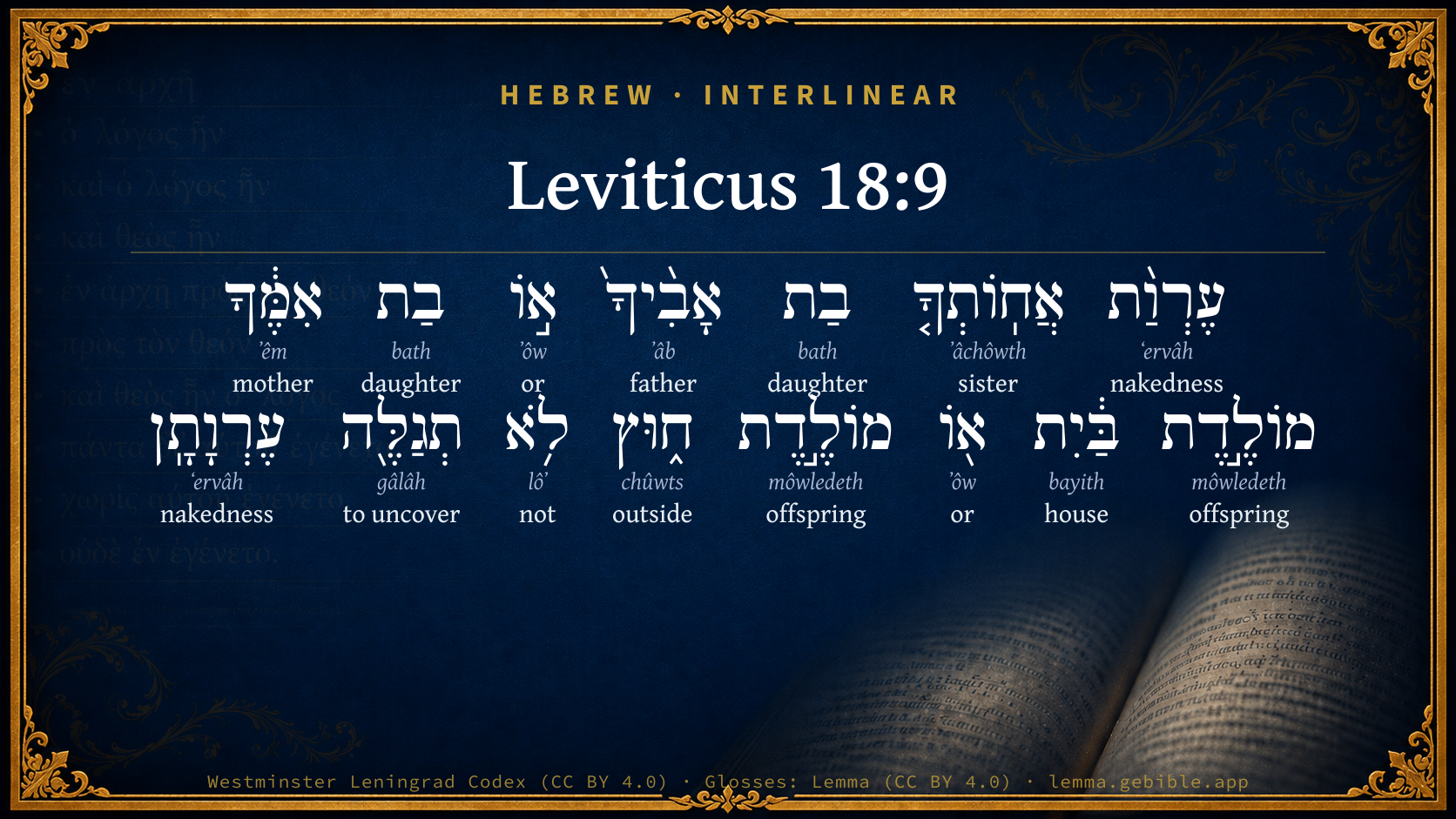
Hebrew (Westminster Leningrad Codex) Leviticus 18:9 appears in the Hebrew Old Testament. The text above is from the Westminster Leningrad Codex. Each word links to its Strong’s number, a concise gloss, and parsing drawn from the Open Scriptures Hebrew Bible morphology. Click any word for its full Brown-Driver-Briggs (BDB) entry.
Download image
Cite this verse

Leviticus 18:9 (World English Bible). Public Domain. Lemma interlinear Bible study tool, https://lemma.gebible.app/v/leviticus/18/9.

Show BibTeX & RIS
BibTeX
RIS
English Translation
"'You shall not uncover the nakedness of your sister, the daughter of your father, or the daughter of your mother, whether born at home, or born abroad.
World English Bible · Public Domain
Download a study sheet

One document with this verse’s original text, its word-by-word gloss line, the meaning frame, cross-references with their text, attributed commentary, and full source and license credits — printable, and it pastes into notes with its structure intact.

This verse Autodidact and up

Study sheet (.html) Plain text (.txt)

A passage Seminary Student

Up to 50 verses in one chapter. A passage sheet keeps up to 6 commentary sources and 12 cross-references per verse, in the order this page ranks them, and says so on the sheet whenever that leaves anything out. Ask for a single verse and you get the Autodidact verse sheet above.

Everything on this page stays free to read, with no account — the sheet is a download of what is already on screen, not access to it.

Want to remove ads? Support Godless Engineer
Compare translations 3

The same verse in 3 English versions, stacked beneath the original-language interlinear above. Click any original word for its lexicon entry.

Each is an independent rendering of the whole verse — the interlinear is not word-aligned to these translations.

Highlighted words mark where these versions differ — a whole-verse word diff, not a word-by-word alignment.

  • World English Bible Public Domain
    "'You shall not uncover the nakedness of your sister, the daughter of your father, or the daughter of your mother, whether born at home, or born abroad.
  • King James Version Public Domain
    The nakedness of thy sister, the daughter of thy father, or daughter of thy mother, whether she be born at home, or born abroad, even their nakedness thou shalt not uncover.
  • unfoldingWord Literal Text CC BY-SA 4.0
    The nakedness of your sister, the daughter of your father or the daughter of your mother, born of house or born outside, you shall not uncover their nakedness.

unfoldingWord Literal Text — © unfoldingWord, licensed CC BY-SA 4.0. Word-aligned USFM3 via Door43 (git.door43.org/unfoldingWord/en_ult).

Versions to compare (up to 4)

3 of 4 selected

Show all 18 translations

Every available English version of this verse, each an independent rendering of the whole verse.

  • World English Bible Public Domain
    "'You shall not uncover the nakedness of your sister, the daughter of your father, or the daughter of your mother, whether born at home, or born abroad.
  • Berean Standard Bible Public Domain
    You must not have sexual relations with your sister, either your father’s daughter or your mother’s daughter, whether she was born in the same home or elsewhere.
  • Majority Standard Bible Public Domain
    You must not have sexual relations with your sister, either your father’s daughter or your mother’s daughter, whether she was born in the same home or elsewhere.
  • King James Version Public Domain
    The nakedness of thy sister, the daughter of thy father, or daughter of thy mother, whether she be born at home, or born abroad, even their nakedness thou shalt not uncover.
  • American Standard Version (1901) Public Domain
    The nakedness of thy sister, the daughter of thy father, or the daughter of thy mother, whether born at home, or born abroad, even their nakedness thou shalt not uncover.
  • Revised Version (1885) Public Domain
    The nakedness of thy sister, the daughter of thy father, or the daughter of thy mother, whether born at home, or born abroad, even their nakedness thou shalt not uncover.
  • Geneva Bible (1599) Public Domain
    Thou shalt not discouer the shame of thy sister the daughter of thy father, or the daughter of thy mother, whether shee bee borne at home, or borne without: thou shalt not discouer their shame.
  • Douay-Rheims (1899) Public Domain
    Thou shalt not uncover the nakedness of thy sister by father or by mother, whether born at home or abroad.
  • Young's Literal Translation Public Domain
    `The nakedness of thy sister, daughter of thy father, or daughter of thy mother, born at home or born without; thou dost not uncover their nakedness.
  • Literal Standard Version CC BY-SA 4.0
    The nakedness of your sister, daughter of your father, or daughter of your mother, born at home or born outside—you do not uncover their nakedness.
  • Unlocked Literal Bible CC BY-SA 4.0
    Do not sleep with any sister of yours, whether she is the daughter of your father or the daughter of your mother, whether she was raised at your home or distant from you. You must not sleep with your sisters.
  • unfoldingWord Literal Text CC BY-SA 4.0
    The nakedness of your sister, the daughter of your father or the daughter of your mother, born of house or born outside, you shall not uncover their nakedness.
  • Darby Bible Public Domain
    The nakedness of thy sister, the daughter of thy father, or daughter of thy mother, born at home, or born abroad -- their nakedness shalt thou not uncover.
  • World Messianic Bible Public Domain
    “‘You shall not uncover the nakedness of your sister, the daughter of your father, or the daughter of your mother, whether born at home or born abroad.
  • Webster's Bible Public Domain
    The nakedness of thy sister, the daughter of thy father, or daughter of thy mother, whether born at home, or born abroad, even their nakedness thou shalt not uncover.
  • Free Bible Version CC BY-SA 4.0
    Don't have sex with your sister, whether she's your father's daughter or your mother's daughter, or whether she was born in the same house as you or somewhere else.
  • Bible in Basic English Public Domain
    You may not take your sister, the daughter of your father or of your mother, wherever her birth took place, among you or in another country.
  • JPS Tanakh (1917) Public Domain
    The nakedness of thy sister, the daughter of thy father, or the daughter of thy mother, whether born at home, or born abroad, even their nakedness thou shalt not uncover.

Literal Standard Version (2020), Covenant Press — licensed CC BY-SA 4.0. Text via the HelloAO Bible API (eBible.org). Unlocked Literal Bible (unfoldingWord) — licensed CC BY-SA 4.0. Text via the HelloAO Bible API (eBible.org). unfoldingWord Literal Text — © unfoldingWord, licensed CC BY-SA 4.0. Word-aligned USFM3 via Door43 (git.door43.org/unfoldingWord/en_ult). Free Bible Version, Dr. Jonathan Gallagher — licensed CC BY-SA 4.0. Text via the HelloAO Bible API (eBible.org).

Word by word

More ways to search: Search by grammar → Find every occurrence → Compare this word →

Practice this passage: Drill this verse → Learn its vocabulary →

מוֹלֶ֣דֶת
môwledeth
H4138
“offspring of”
Noun, Common, Feminine, Singular, Construct
Part of Speech
Noun
Type
Common
Gender
Feminine
Number
Singular
State
Construct
Full BDB Definition

Origin: from H3205

TWOT: 867f

kindred, birth, offspring, relatives - kindred - birth, circumstances of birth - one born, begotten, issue, offspring, female offspring
  1. עֶרְוַ֨ת ʻervâh H6172 “nakedness of” Noun, Common, Feminine, Singular, Construct
  2. אֲחֽוֹתְךָ֤ ʼâchôwth H269 “sister · your” Noun, Common, Feminine, Singular, Construct + Suffix, Personal, 2nd Person, Masculine, Singular
  3. בַת bath H1323 “daughter of” Noun, Common, Feminine, Singular, Construct
  4. אָבִ֨יךָ֙ ʼâb H1 “father · your” Noun, Common, Masculine, Singular, Construct + Suffix, Personal, 2nd Person, Masculine, Singular
  5. א֣וֹ ʼôw H176 “or” Conjunction
  6. בַת bath H1323 “daughter of” Noun, Common, Feminine, Singular, Construct
  7. אִמֶּ֔ךָ ʼêm H517 “mother · your” Noun, Common, Feminine, Singular, Construct + Suffix, Personal, 2nd Person, Masculine, Singular
  8. בַּ֔יִת bayith H1004 “house” Noun, Common, Masculine, Singular, Absolute
  9. א֖וֹ ʼôw H176 “or” Conjunction
  10. מוֹלֶ֣דֶת môwledeth H4138 “offspring of” Noun, Common, Feminine, Singular, Construct
  11. ח֑וּץ chûwts H2351 “outside” Noun, Common, Masculine, Singular, Absolute
  12. לֹ֥א lôʼ H3808 “not” Particle, Negative
  13. תְגַלֶּ֖ה gâlâh H1540 “to uncover” Verb, Piel, Imperfect, 2nd Person, Masculine, Singular
  14. עֶרְוָתָֽן ʻervâh H6172 “nakedness · their” Noun, Common, Feminine, Singular, Construct + Suffix, Personal, 3rd Person, Feminine, Plural

About this verse

These counts appear in no published source. They are computed here, from the morphology-tagged text and Lemma’s own curated glosses. What Lemma adds →

15
words
11
distinct lemmas
Pentateuch
section

Notable vocabulary

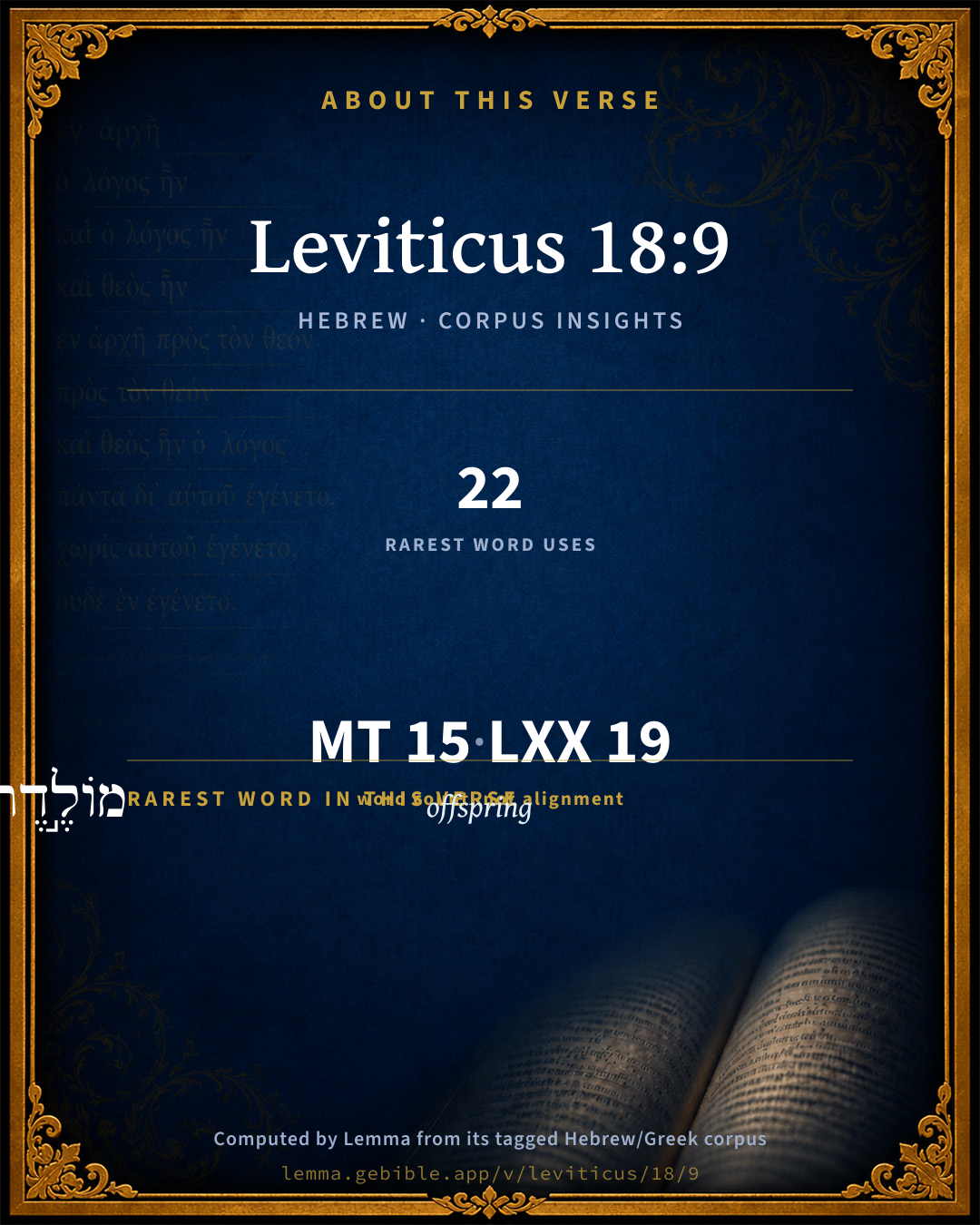
The rarest word here is מוֹלֶ֣דֶת offspring H4138 — appearing just 22 times in the whole Hebrew Bible.

Shared distinctive vocabulary

מוֹלֶ֣דֶת offspring H4138 occurs in 21 verses of the Hebrew Bible. Also found in:

Grammatical profile

  • 1 verb
  • 11 nouns
  • 2 conjunctions
  • 1 particle

Verb forms

  • תְגַלֶּ֖ה Piel · Imperfect

Repetition

Words recur within this verse — often emphatic in Hebrew:

  • עֶרְוַ֨ת nakedness H6172 ×2
  • בַת daughter H1323 ×2
  • מוֹלֶ֣דֶת offspring H4138 ×2
  • א֣וֹ or H176 ×2

Hebrew & Septuagint length

In English translation the verse runs 27 words from the Hebrew and 23 from the Septuagint (LXX English) — closely comparable.

A rough comparison of the two English renderings, which tokenize alike — not a word-level alignment.

Word counts can differ between the Hebrew and the Greek without any difference in meaning — e.g. the Hebrew direct-object marker אֵת has no separate Greek word, and Greek often adds the article ὁ.

In the original languages it is 15 Hebrew tokens and 19 Greek tokens — but the two are counted differently (Hebrew bundles its prefixes and suffixes into one token; the Greek is in lemma form), so that isn’t a like-for-like length.

Cross-references

5

Topical passages linked to Leviticus 18:9 in the Treasury of Scripture Knowledge — connected by theme and wording, ordered by reader-vote popularity; previews shown in the World English Bible.

  • Leviticus 20:17 "'If a man takes his sister, his father's daughter, or his mother's daughter, and sees her nakedness, and she sees his nakedness; it is a shameful thing; and they shall be cut off in the sight of the children of their people: he has uncovered his sister's nakedness; he shall bear his iniquity.
  • Deuteronomy 27:22 Cursed be he who lies with his sister, the daughter of his father, or the daughter of his mother. All the people shall say, Amen.
  • Ezekiel 22:11 One has committed abomination with his neighbor's wife; and another has lewdly defiled his daughter-in-law; and another in you has humbled his sister, his father's daughter.
  • 2 Samuel 13:11–14 When she had brought them near to him to eat, he took hold of her, and said to her, Come, lie with me, my sister.
  • Leviticus 18:11 "'You shall not uncover the nakedness of your father's wife's daughter, conceived by your father, since she is your sister. "'

Cross-references courtesy of OpenBible.info (CC BY 4.0).

Hebrew and Greek witnesses Masoretic Hebrew ↔ Greek Septuagint

The same verse in the two great witnesses to the Old Testament, shown verse-for-verse.

These are two independent witnesses, not word-aligned to each other, and the Septuagint is shown in lemma (dictionary) form.

Hebrew Leviticus 18:9 Masoretic · Westminster Leningrad Codex

עֶרְוַ֨ת אֲחֽוֹתְךָ֤ בַת אָבִ֨יךָ֙ א֣וֹ בַת אִמֶּ֔ךָ מוֹלֶ֣דֶת בַּ֔יִת א֖וֹ מוֹלֶ֣דֶת ח֑וּץ לֹ֥א תְגַלֶּ֖ה עֶרְוָתָֽן

"'You shall not uncover the nakedness of your sister, the daughter of your father, or the daughter of your mother, whether born at home, or born abroad.

World English Bible · Public Domain

Greek LXX Leviticus 18:9 Septuagint · lemma form

ἀσχημοσύνη ὁ ἀδελφή σύ ἐκ πατήρ σύ ἤ ἐκ μήτηρ σύ ἐνδογενής ἤ γεννάω ἔξω οὐ ἀποκαλύπτω ἀσχημοσύνη αὐτός

The nakedness of your sister by your father or by your mother, born at home or abroad, their nakedness you shall not uncover.

LXX2012 (modern English Septuagint) · Public Domain

Hebrew: Westminster Leningrad Codex (CC BY 4.0). Greek: Septuagint (public domain); English from LXX2012 (modern English Septuagint) (Public Domain). How the Septuagint differs from the Hebrew →

Targum (Aramaic paraphrase)

2

The Targum is the ancient Jewish Aramaic paraphrase of the Hebrew Scriptures — an interpretive translation, not the Hebrew text itself. Onkelos (literal) and Pseudo-Jonathan (expansive) render the Torah, and Jonathan the Prophets. Coverage is partial: where no permissively-licensed English translation exists for a verse, only the Aramaic is shown. This is verse-level text, not a word-by-word alignment to the Hebrew.

  1. Targum Onkelos Torah (Genesis–Deuteronomy)
    עֶרְיַת אֲחָתָךְ בַּת אֲבוּךְ אוֹ בַת אִמָךְ דִילִידָא מִן אֲבוּךְ מִן אִתַּת אָחֳרִי אוֹ מִן אִמָךְ לִגְבַר אָחֳרָן לָא תְגַלֵי עֶרְיַתְהֶן

    (no public-domain English translation for this verse)

    Targum Onkelos — Aramaic: “Onkelos Genesis” (public domain); “Onkelos Exodus” (public domain); “Onkelos Leviticus” (public domain); “Onkelos Numbers” (public domain); “Onkelos Deuteronomy” (public domain). English: “Sefaria Community Translation” (CC0 1.0 (public-domain dedication)); “J.W. Etheridge. The Targums of Onkelos and Jonathan Ben Uzziel on the Pentateuch. London: Longmans, Green, 1862” (public domain). Text via Sefaria.

  2. Targum Pseudo-Jonathan Torah (Genesis–Deuteronomy)
    עֶרְיַית אֲחָתָךְ בַּת אָבוּךְ אוֹ בַּת אִמָךְ מַה דְיוֹלִיד אַבָּךְ מִן אִיתָא אוֹחְרִי אוֹ מִן אִמָךְ אוֹ מַה דִילֵידַת אִמָךְ מִן אַבָּךְ אוֹ מִן גְבַר חוֹרַן לָא תִבְזֵי עֶרְיַתְהֶן

    The nakedness of thy sister, the daughter of thy father, or the daughter of thy mother, (or of her) whom, thy father begat by another wife, or of thy mother, whom thy mother bare by thy father or by another husband, thou shalt not dishonour.

    Targum Pseudo-Jonathan — Aramaic: “Targum Jonathan on Genesis” (public domain); “Targum Jonathan on Exodus” (public domain); “Targum Jonathan on Leviticus” (public domain); “Targum Jonathan on Numbers” (public domain); “Targum Jonathan on Deuteronomy” (public domain). English: “The Targum of Jonathan ben Uzziel, trans. J. W. Etheridge, London, 1862” (public domain). Text via Sefaria.

Commentary

Notes on Leviticus 18:9 from classic Christian and Jewish commentators (each source and its license shown beneath its notes). The classic Christian expositions comment on the surrounding passage and are grouped to its opening verse, so a note may address several verses; the Jewish commentaries on the Tanakh (Rashi and others) are per-verse, so they appear only where the commentator wrote on this verse.

Lemma curates 59 commentaries, every one of them public domain or Creative Commons licensed, each selected and text-cleaned for this edition rather than reprinted as found. About our sources →

Trapp's Complete Commentary

John Trapp

Lev 18:9 The nakedness of thy sister, the daughter of thy father, or daughter of thy mother, [whether she be] born at home, or born abroad, [even] their nakedness thou shalt not uncover.

Ver. 9. Or born abroad,] i.e., Base born, which our English laws call natural children. The Hebrews call them brambles, and Mamzerim, spots abroad, and Shatukim, such as must say nothing when others are praising their parents. The Greeks call bastards, υβριδες, because they are their fathers’ reproach, and are subject to contempt and contumelies of others.

John Trapp, A Commentary or Exposition upon All the Books of the Old and New Testament (1647–1656) — public domain. Text from a community e-Sword module.

Joseph Benson's Commentary

Lev 18:9. Whether she be born at home, or born abroad — Whether she be legitimately born in wedlock, or illegitimately out of wedlock. Others explain it thus: “Whether she be thy sister by the same father, or by another marriage.”

Joseph Benson's Commentary on the Old and New Testaments (1811–1818) — public domain. Text from a community e-Sword module.

Tyndale Open Study Notes

Tyndale Open Resources

18:9 Sexual relations with a full sister dishonored both parents, and relations with a half sister dishonored one parent.

Tyndale Open Study Notes — © Tyndale Open Resources, licensed CC BY-SA 4.0. Text via the HelloAO Bible API.

Geneva Bible (1599)

Geneva Bible translators

Either by father or mother, born in marriage or otherwise.

Geneva Bible (1599) marginal notes — public domain. Text via Bolls.life.

Ellicott's Commentary for English Readers

(9) The nakedness of thy sister.—The fact that Adam married “bone of his bone and flesh of his flesh,” and that his sons married their own sisters, encouraged the ancient Hebrew to imitate their example. Hence we find Abraham, the father of the faithful, married his half-sister (Gen_20:12). The same practice obtained amongst other nations of antiquity. Thus the Athenians married their half-sisters by their father’s side, and the Spartans married half-sisters by the same mother, whilst the Assyrians and Egyptians married full sisters. Though nothing can be more explicit than the law here laid down, and though the transgression of it is denounced as an accursed and impious crime, to be visited with capital punishment (see Lev_20:17; Deu_27:22), yet from the narrative of Amnon and his sister Tamar, and especially from the touching and melancholy remark of the outraged sister (2Sa_13:13; 2Sa_13:16; 2Sa_13:20), it is evident that the practice of the primitive parents of the human race and the example of the father of the Hebrew nation, continued to be followed in spite of this law. (Comp. Eze_22:11.)

Born at home or born abroad.—Literally, the birth, or offspring of the house or the birth, or offspring from abroad. According to the administrators of the law during the second Temple, the import of this precept is to forbid commerce between a brother and a sister, whether the sister is born in wedlock, which is meant by born at home, or whether she is illegitimate, which is meant by birth or offspring from abroad. Hence the ancient Chaldee Version of this clause, “whom thy father begot of another woman or of thy mother, or whom thy mother brought forth by thy father or by another man.”

A Bible Commentary for English Readers, edited by Charles John Ellicott (1878–1897) — public domain. Text from a community e-Sword module.

John Gill's Exposition

The nakedness of thy sister,.... To lie with one in so near a relation is exceeding criminal, and for which the law curses a man, Deu 27:22; and to marry her is not lawful; for though it was necessary for the propagation of mankind that a man should marry his sister, for who else could Cain and Abel marry? yet afterwards, when there was an increase of mankind, and there were people enough remote from each other, it became unlawful for persons in such near ties of consanguinity to marry with each other; though the Egyptians did, in imitation of Isis and Osiris (e), and so the Persians, following the example of Cambyses (f):

the daughter of thy father, or the daughter of thy mother; whether she is a sister both by father and mother's side, or whether only by the fathers side and not the mother's, as Sarah was to Abraham, Gen 20:12; or only by the mother's side and not the father's:

whether she be born at home or born abroad; not whether born and brought up in his and her father's house, or born and brought up in another place and province; though there were some, as Aben Ezra observes, that so interpreted it, according to the sense of the word in Gen 50:23; but rather the sense is, as that writer gives it, whether born according to the law of the house of Israel, after espousals and marriage, or without it; that is, whether begotten in lawful marriage or not, whether a legitimate offspring or spurious, born in adultery and whoredom, whether on the father or mother's side; so the Targum of Jonathan, whom thy father begat of another woman, or of thy mother, or whom thy mother bore or brought forth, of thy father, or of another man; and to the same purpose Onkelos:

even their nakedness thou shalt not uncover; neither lie with, or have carnal knowledge of, nor marry one or the other.

(e) Diodor. Sicul. l. 1. p. 23. (f) Herodot. Thalia, sive, l. 3. c. 31.

John Gill's Exposition of the Whole Bible (1746–1763) — public domain (CC PDM 1.0). Text via the HelloAO Bible API.

Albert Barnes' Notes on the Bible

Thy sister - What was here spoken of was the distinguishing offence of the Egyptians.

Albert Barnes' Notes on the Bible (1834–1885) — public domain. Text from a community e-Sword/MySword module.

Haydock's Catholic Bible Commentary

Abroad; being born of your mother, while she was married to another. The marriages of brothers and sisters at the beginning, were authorized by necessity; but now they are the more to be condemned, as religion forbids them. (St. Augustine, City of God xv. 16.) Some Rabbins assert, that such connexions were lawful till the time of Moses. But St. Epiphanius (hær. 39,) maintains, they had been condemned long before. Seneca (St. Augustine, City of God vi. 10,) acknowledges that such marriages of the pagan gods were not right; ne pie quidem: and Plato says, they are hateful to God. The Romans punished them with death. Many barbarians do not, however, make any scruple to contract marriage with their children, or with their mothers. (St. Jerome, contra Jov. ii. 2.; Eurip. Hermione.) (Calmet)

George Leo Haydock (1774–1849), Haydock's Catholic Family Bible and Commentary, 1859 edition — public domain. Excludes Psalms (Douay-Rheims chapter numbering differs from Protestant) and Deuterocanonical books (Catholic canon only).

Matthew Poole's English Annotations

Thy sister, by both parents.

The daughter of thy father, or

daughter of thy mother; thy sister by either of thy parents.

Whether she be born at home, to wit, of thy father by another wife, whom he hath taken into his house. Or born abroad; either of thy mother, by another, whether a former or a second husband, in another house and family; or of thy father by some strange woman, for there might be some doubt in these cases.

Matthew Poole's English Annotations on the Holy Bible (1683–1685) — public domain. Text from a community e-Sword/MySword module.

Whedon's Commentary on the Bible

Daniel D. Whedon

9. Thy sister — The half-sister is here described; born at home, or born abroad — This has generally been understood as equivalent to “in or out of wedlock,” that is, the daughter of the father’s former wife or concubine; or it may amplify the preceding words, and signify one born to either parent in a former marriage. The Athenians were allowed to marry half-sisters by the father’s side; the Spartans married half-sisters by the same mother.

Daniel D. Whedon (gen. ed.), Commentary on the Old and New Testaments (1874–1909) — public domain. Text from a community e-Sword module.

The Pulpit Commentary

In the third place, incest with a sister is forbidden, and it is specifically stated that under the term "sister" is meant the half-sister, the daughter of thy father, or... thy mother,... born at home, as would naturally be the case if she were the father"s daughter, or born abroad, that is, the daughter of the mother by a previous marriage, when she belonged to a different household. Tamar"s appeal to Amnon, "I pray thee speak unto the king; for he will not withhold me from thee," exhibits to us the poor woman grasping at any argument which might save her from her half-brother"s brutality, and does not indicate that such marriages were, in the time of David, permissible. (2Sa_13:29) The exact degree of relationship which existed between Abraham and Sarah is not altogether certain. (cf. Gen_20:12 with Gen_11:29) Ezekiel reckons this sin in the catalogue of the iniquities of Jerusalem. (Eze_22:11)

The Pulpit Commentary (1880–1919), ed. H.D.M. Spence-Jones & Joseph S. Exell — public domain. Text from a community e-Sword module.

Keil & Delitzsch

C. F. Keil & F. Delitzsch

By the sister, the daughter of father or mother, we are to understand only the step-or half-sister, who had either the same father or the same mother as the brother had. The clause, "whether born at home or born abroad," does not refer to legitimate or illegitimate birth, but is to be taken as a more precise definition of the words, daughter of thy father or of thy mother, and understood, as Lud. de Dieu supposes, as referring to the half-sister "of the first marriage, whether the father's daughter left by a deceased wife, or the mother's daughter left by a deceased husband," so that the person marrying her would be a son by a second marriage. Sexual intercourse with a half-sister is described as חסד in Lev 20:17, and threatened with extermination. This word generally signifies sparing love, favour, grace; but here, as in Pro 14:34, it means dishonour, shame, from the Piel חסּד, to dishonour.

Keil & Delitzsch — Biblical Commentary on the Old Testament (1861–1891) — public domain (CC PDM 1.0). Text via the HelloAO Bible API. (Old Testament only.)

unfoldingWord translationNotes

Door43 World Missions Community

whether she is the daughter of your father or the daughter of your mother

This means a man cannot sleep with his sister if they have the same parents or even if she has a different mother or father.

whether she was raised at your home or distant from you

This can be translated in active form. AT: "whether she grew up at your home or far away from you" (See: Active or Passive)

Do not sleep with your father's wife's daughter

Possible meanings are 1) "Do not sleep with your half-sister" or 2) "Do not sleep with your stepsister." Here the man does not have the same father or mother as the woman. They became brother and sister when their parents married.

translationWords

had relations with

raise

shame

unfoldingWord translationNotes — © Distant Shores Media and the Door43 World Missions Community, licensed CC BY-SA 4.0. Source: git.door43.org/Door43/en_tn.

Rashi

Rabbi Shlomo Yitzchaki (Rashi)

בת אביך [THE NAKEDNESS OF THY SISTER] THE DAUGHTER OF THY FATHER [OR THE DAUGHTER OF THY MOTHER… THOU SHALT NOT UNCOVER] — Also the daughter of a woman raped by one's father is implied by the term מולדת בית או מולדת חוץ.

.בת — WHETHER SHE BE BORN IN THE HOUSE OR WHETHER SHE BE BORN OUTSIDE THE HOUSE — This means, thy sister, thy father's daughter, whether according to the law we can say to thy father, "Keep her mother as your wife" or whether we have to say to him, "Divorce her mother", as, for instance, when she is a ממזרת (the issue of a union forbidden in the Torah under the penalty of כרת) or a נתינה (the daughter of a Gibeonite woman, cf. Joshua 9:27, forbidden under the penalty of מלקות) (Yevamot 23a).

Rashi on the Tanakh — English translations: “The Judaica Press complete Tanach with Rashi, translated by A. J. Rosenberg” (CC BY 4.0); “Pentateuch with Rashi's commentary by M. Rosenbaum and A.M. Silbermann, 1929-1934” (public domain); “The Metsudah Tanach series, Lakewood, N.J” (CC BY 4.0); and “The Book of Joshua, Metsudah Publications, 1997” (CC BY 4.0). Text via Sefaria.

Ramban (Nachmanides)

Rabbi Moshe ben Nachman (Ramban / Nachmanides)

THE NAKEDNESS OF THY SISTER, THE DAUGHTER OF THY FATHER, OR THE DAUGHTER OF THY MOTHER, WHETHER BORN AT HOME, OR BORN ABROAD, EVEN THEIR NAKEDNESS THOU SHALT NOT UNCOVER. “Whether born at home, or born abroad — this means whether [the court] says to your father, ‘Keep her mother as your wife,’ or whether it has to say to him, ‘Divorce her mother,’ as for instance when she [i.e., the mother] is a mamzereth or a nethinah” [a mamzereth is the female product from one of the forbidden sexual relationships in this section, and a nethinah is a female descendant of the Gibeonites — relationships with these women being in both cases punishable by whipping]. Thus the language of Rashi. But it is not correct, since this interpretation leads to the conclusion that a sister that is born from [a woman who is herself one of] the relations forbidden [to his father], the penalty for which is excision [and not mere whipping], it would follow that the child born from that union is not included under the terms of this prohibition; since by stating these two examples — that the mother was either a mamzereth or a nethinah, with whom, in both of which cases, sexual intercourse is punishable only with whipping — Rashi thereby seems to exclude from this verse the case where the mother was one of the forbidden relations, where the penalty is excision! This conclusion is obviously incorrect. is not included in this prohibition [against marrying one’s sister. For since Rashi explained the expressions whether born at home, or born abroad as referring to the mother, whether she is a lawful wife or a mamzereth or nethinah, both of whom are forbidden to the father only by punishment of whipping, and not by excision, unlike all forbidden relations, then the illogical result follows that if the mother were one of those relations forbidden to his father by punishment of excision, then the son’s sister born from that union would not be included in this prohibition]! And yet all [sisters] are forbidden by excision [i.e., regardless of whether the sister was born of a union itself permitted, or forbidden by whipping only, or by excision], unless she be born of a bondwoman or a Cuthean woman [in which case she is not considered his sister at all]!And I wonder at the Rabbi [Rashi]! For in the Gemara of Tractate Yebamoth in the second chapter it is clearly stated: “Perhaps I can say that this excludes a sister born of a union forbidden by whipping [as in the case where his father married a mamzereth and she gave birth to a daughter, for I might say that the marriage, being forbidden, had no validity, and she is therefore not his ‘sister’ in the sense that she is included in the prohibition against having intercourse with one’s sister]! Said Rav Papa: In unions punishable by whipping, the marriage, [although forbidden], has legal validity. For it is written, If a man have two wives, the one beloved, and the other hated. Now is there before G-d a beloved one and a hated one [i.e., could it be supposed that the law should allow discrimination between the children of a favored wife and those of a hated wife]? Rather, you must say ‘beloved’ denotes ‘beloved for her well-chosen marriage’ [i.e., that it was blameless, since it was within the law], and ‘hated’ means ‘hated for her [illicit] marriage.’ And the Merciful One states, ‘ki thihyena l’ish’ (if a man ‘have’) — two wives. is a word indicating legal status of marriage. Thus you must say that in the case of a marriage which is “hated” because it is punishable merely by whipping, [as in the case of a man marrying a mamzereth], the act of betrothal does take effect, and the daughter born from such a union is considered one’s “sister” with respect to the prohibition before us. Perhaps I might say that this excludes a sister born of a union punishable by excision [so that she is not his ‘sister’ in the sense that she is included in the prohibition against having intercourse with one’s sister]! Said Rava: Scripture states, The nakedness of thy sister, the daughter of thy father, or the daughter of thy mother, whether born at home, or born abroad, which means whether [the court] can say to your father, ‘Keep [the mother as your wife],’ or whether it has to say to him, ‘Hotzei’ [as explained further on], and yet the Merciful One states that she is thy sister!” and yet goes on to mention the one ‘born abroad,’ it is clear that even a daughter born of a union which is punishable by excision [as explained further on], is a “sister” with respect to this prohibition. Now the meaning of the word hotzei is that [the court] tells him, “Take her out from your house, for she is not your [legitimate] wife, and the act of marriage has no legal validity in those cases where the union is punishable by excision or by any of the [four] deaths by the hand of the court.” And yet notwithstanding this, one is punished for having intercourse with her because she is considered his sister! Only one’s sister born from a bondwoman or a Cuthean woman is not included in this prohibition, since the offspring is of her own [legal] standing.By way of the plain meaning of Scripture the verse is stating: “The nakedness of thy sister, the daughter of thy father, or the daughter of thy mother, whether born of a marriage, as when the father brought the woman into the home as a wife [and she gave birth to a daughter], or born abroad, as when the man found her outside, and lay hold on her, and lie with her and she gave him birth [to a daughter], thou shalt not uncover their nakedness.” Thus He mentioned [the prohibition concerning] a mother’s daughter whether she be born in wedlock or from unchastity. For even though in either case she is only his mother’s daughter and not his father’s daughter, [and if so, why did Scripture have to mention both cases], yet one might have thought that a brotherly relationship [forbidding sexual intercourse] applies only to a sister born in wedlock, but not to one born from unchastity, where everything is “free;” therefore Scripture had to admonish against all [kinds of sisters]. There is yet another verse which He stated with reference to one’s father’s daughter, stating The nakedness of thy father’s wife’s daughter, begotten of thy father [thou shalt not uncover], this being [a prohibition against having intercourse with] a sister who is one’s father’s daughter born of his legitimate wife. It was necessary that He state this, because having said [in Verse 9 before us], the nakedness of thy sister, the daughter of thy father, without any qualification, and then in connection with the daughter of thy mother He explained whether born at home through marriage, or born abroad through unchastity, one might therefore have thought that one’s father’s daughter born in unchastity is permissible to him; for perhaps the Torah was not particular about a man’s offspring born in unchastity, because these are not known to him; therefore He said in explanation, The nakedness of thy father’s wife’s daughter [thou shalt not uncover], thus declaring that the daughter of one’s father mentioned at first [in Verse 9 before us] is not one’s father’s daughter born of his legitimate wife [since that is specifically mentioned further on in Verse 11]. Also, because in the case of the Noachides the prohibition [against sexual intercourse] was only if the brotherhood was from the same mother, and not [if it was exclusively] from the father, Scripture therefore explains that with respect to Israelites, all are alike in the prohibition [whether they are born of one father or one mother].The correct interpretation of this verse is what the Sages have said in the Gemara of Tractate Yebamoth; “A man who has intercourse with his sister, who is also the daughter of his father’s wife [through marriage], in Rashi. who is not his mother, is guilty both on account of his sister, and his father’s wife’s daughter.” And there in the Gemara the Rabbis explained the reason: “Observe, it is written, the nakedness of thy sister, the daughter of thy father etc.; what need was there for the expression, the nakedness of thy father’s wife’s daughter etc.? In order to teach that he is guilty both on account of his sister, and his father’s wife’s daughter.” Thus Scripture repeats certain prohibitions in order to make one [who commits these abominable practices] guilty on many counts, for even with reference to creeping things [which we are forbidden to eat] He has repeated many prohibitions regarding one matter, in order to punish the offender on all counts.

Ramban (Nachmanides) on the Tanakh — English translation: “Commentary on the Torah by Ramban (Nachmanides). Translated and annotated by Charles B. Chavel. New York, Shilo Pub. House, 1971-1976” (CC BY 4.0). Text via Sefaria.

Lesson kit

Teaching starters — assembled from the data on this page, not authored interpretation. Every prompt links to the verse data it draws on. Edit before teaching.

Leviticus, in the Pentateuch, opens this verse with 15 words (11 distinct Hebrew lemmas). Its most distinctive word is môwledeth (“offspring”). A historical commentator’s framing appears above. Read the whole chapter for the surrounding context.

Discussion questions

  1. What does “offspring” (môwledeth) contribute to the verse as a whole?
  2. Genesis 11:28 shares the word «offspring» with this verse. How do the two illuminate each other?
  3. “nakedness” occurs 2× in this one verse. What is the effect of the repetition?
  4. These translations render this verse differently. What is at stake in choosing one wording over another?
  5. The verb «תְגַלֶּ֖ה» is Piel Imperfect. How does its form color the action?
  6. Reading how Trapp's Complete Commentary and Joseph Benson's Commentary read this verse, where do the two commentators agree and where do they part?

Things to notice

Reading settings

Reading text

Shown beneath each verse's original-language words.

Old Testament
Old Testament edition

Read the OT as the Masoretic Hebrew (MT) or the Greek Septuagint (LXX).

English shown for the Greek Septuagint (in the Hebrew ↔ Greek comparison).

Comparing translations? Open the Compare panel on any verse page to stack up to four side by side.