
Daniel 11:24

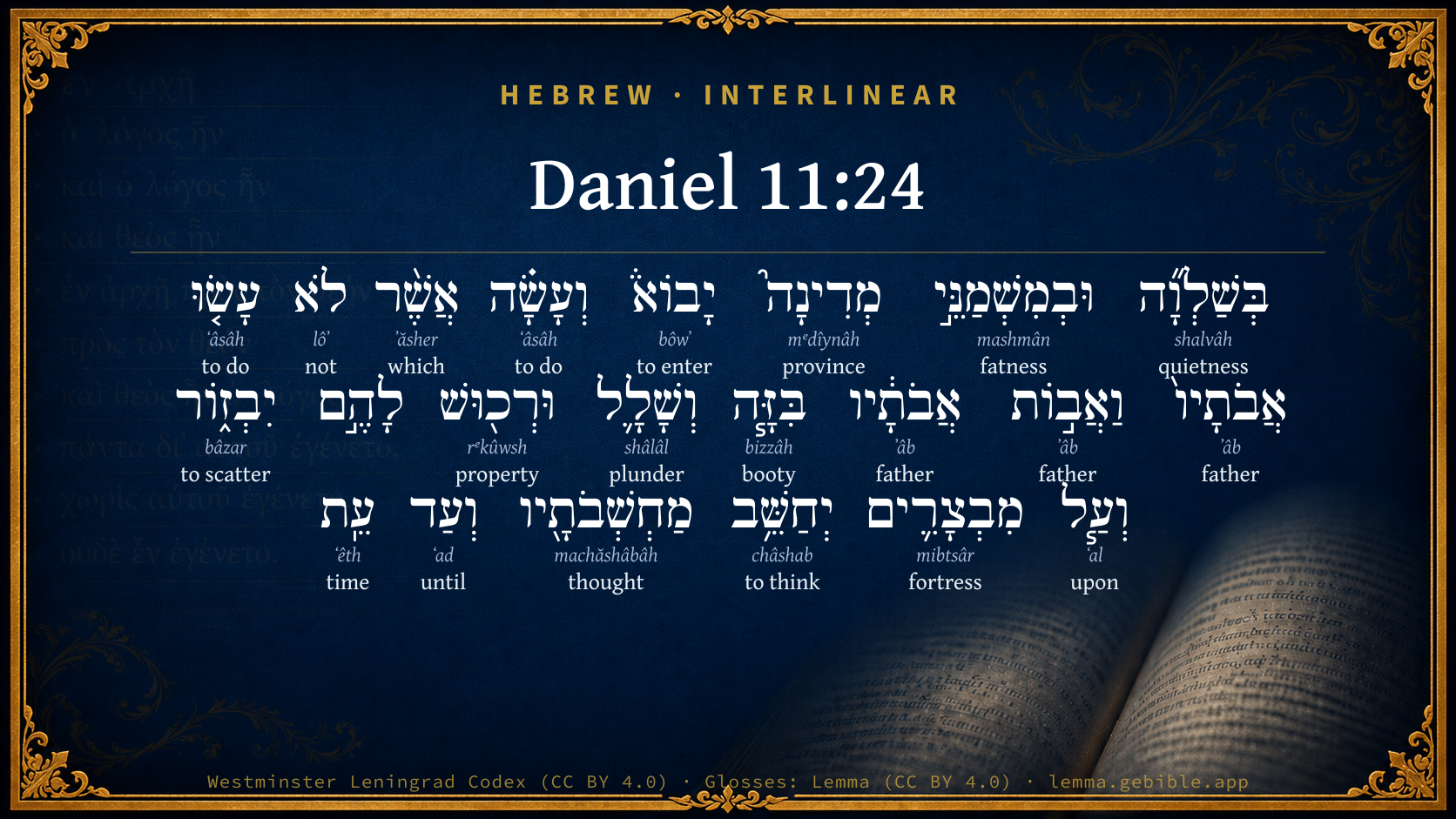
Hebrew (Westminster Leningrad Codex) Daniel 11:24 appears in the Hebrew Old Testament. The text above is from the Westminster Leningrad Codex. Each word links to its Strong’s number, a concise gloss, and parsing drawn from the Open Scriptures Hebrew Bible morphology. Click any word for its full Brown-Driver-Briggs (BDB) entry.
Download image
Cite this verse

Daniel 11:24 (World English Bible). Public Domain. Lemma interlinear Bible study tool, https://lemma.gebible.app/v/daniel/11/24.

Show BibTeX & RIS
BibTeX
RIS
English Translation
In time of security shall he come even on the fattest places of the province; and he shall do that which his fathers have not done, nor his fathers' fathers; he shall scatter among them prey, and spoil, and substance: yes, he shall devise his devices against the strongholds, even for a time.
World English Bible · Public Domain
Download a study sheet

One document with this verse’s original text, its word-by-word gloss line, the meaning frame, cross-references with their text, attributed commentary, and full source and license credits — printable, and it pastes into notes with its structure intact.

This verse Autodidact and up

Study sheet (.html) Plain text (.txt)

A passage Seminary Student

Up to 50 verses in one chapter. A passage sheet keeps up to 6 commentary sources and 12 cross-references per verse, in the order this page ranks them, and says so on the sheet whenever that leaves anything out. Ask for a single verse and you get the Autodidact verse sheet above.

Everything on this page stays free to read, with no account — the sheet is a download of what is already on screen, not access to it.

Want to remove ads? Support Godless Engineer
Compare translations 3

The same verse in 3 English versions, stacked beneath the original-language interlinear above. Click any original word for its lexicon entry.

Each is an independent rendering of the whole verse — the interlinear is not word-aligned to these translations.

Highlighted words mark where these versions differ — a whole-verse word diff, not a word-by-word alignment.

  • World English Bible Public Domain
    In time of security shall he come even on the fattest places of the province; and he shall do that which his fathers have not done, nor his fathers' fathers; he shall scatter among them prey, and spoil, and substance: yes, he shall devise his devices against the strongholds, even for a time.
  • King James Version Public Domain
    He shall enter peaceably even upon the fattest places of the province; and he shall do that which his fathers have not done, nor his fathers' fathers; he shall scatter among them the prey, and spoil, and riches: yea, and he shall forecast his devices against the strong holds, even for a time.
  • unfoldingWord Literal Text CC BY-SA 4.0
    Without warning he will come into the richest parts of the province, and he will do what neither his fathers nor his fathers’ fathers did. He will scatter among them plunder, booty, and possessions. He will devise his plans against fortresses, but only for a time.

unfoldingWord Literal Text — © unfoldingWord, licensed CC BY-SA 4.0. Word-aligned USFM3 via Door43 (git.door43.org/unfoldingWord/en_ult).

Versions to compare (up to 4)

3 of 4 selected

Show all 18 translations

Every available English version of this verse, each an independent rendering of the whole verse.

  • World English Bible Public Domain
    In time of security shall he come even on the fattest places of the province; and he shall do that which his fathers have not done, nor his fathers' fathers; he shall scatter among them prey, and spoil, and substance: yes, he shall devise his devices against the strongholds, even for a time.
  • Berean Standard Bible Public Domain
    In a time of peace, he will invade the richest provinces and do what his fathers and forefathers never did. He will lavish plunder, loot, and wealth on his followers, and he will plot against the strongholds—but only for a time.
  • Majority Standard Bible Public Domain
    In a time of peace, he will invade the richest provinces and do what his fathers and forefathers never did. He will lavish plunder, loot, and wealth on his followers, and he will plot against the strongholds—but only for a time.
  • King James Version Public Domain
    He shall enter peaceably even upon the fattest places of the province; and he shall do that which his fathers have not done, nor his fathers' fathers; he shall scatter among them the prey, and spoil, and riches: yea, and he shall forecast his devices against the strong holds, even for a time.
  • American Standard Version (1901) Public Domain
    In time of security shall he come even upon the fattest places of the province; and he shall do that which his fathers have not done, nor his fathers' fathers; he shall scatter among them prey, and spoil, and substance: yea, he shall devise his devices against the strongholds, even for a time.
  • Revised Version (1885) Public Domain
    In time of security shall he come even upon the fattest places of the province; and he shall do that which his fathers have not done, nor his fathers’ fathers; he shall scatter among them prey, and spoil, and substance: yea, he shall devise his devices against the strong holds, even for a time.
  • Geneva Bible (1599) Public Domain
    He shall enter into the quiet and plentifull prouince, and he shall doe that which his fathers haue not done, nor his fathers fathers: he shall deuide among them the pray and the spoyle, and the substance, yea, and he shall forecast his deuises against the strong holdes, euen for a time.
  • Douay-Rheims (1899) Public Domain
    And he shall enter into rich and plentiful cities: and he shall do that which his fathers never did, nor his fathers' fathers: he shall scatter their spoils, and their prey, and their riches, and shall forecast devices against the best fenced places: and this until a time.
  • Young's Literal Translation Public Domain
    Peaceably even into the fertile places of the province He cometh, and he hath done that which his fathers did not, nor his fathers' fathers; prey, and spoil, and substance, to them he scattereth, and against fenced places he deviseth his devices, even for a time.
  • Literal Standard Version CC BY-SA 4.0
    Peaceably even into the fertile places of the province He comes, and he has done that which his fathers did not, nor his fathers’ fathers; prey, and spoil, and substance, he scatters to them, and against fortifications he devises his plans, even for a time.
  • Unlocked Literal Bible CC BY-SA 4.0
    Without warning he will come into the richest part of the province, and he will do what neither his father nor his father's father did. He will spread among his followers the booty, the plunder, and the wealth. He will plan the overthrow of fortresses, but only for a time.
  • unfoldingWord Literal Text CC BY-SA 4.0
    Without warning he will come into the richest parts of the province, and he will do what neither his fathers nor his fathers’ fathers did. He will scatter among them plunder, booty, and possessions. He will devise his plans against fortresses, but only for a time.
  • Darby Bible Public Domain
    In time of peace shall he enter even into the fattest places of the province; and he shall do that which his fathers have not done, nor his fathers' fathers: he shall scatter among them prey, and spoil, and substance, and he shall plan his devices against the fortified places, even for a time.
  • World Messianic Bible Public Domain
    In time of security he will come even on the fattest places of the province. He will do that which his fathers have not done, nor his fathers’ fathers. He will scatter among them prey, plunder, and wealth. Yes, he will devise his plans against the strongholds, but only for a time.
  • Webster's Bible Public Domain
    He shall enter peaceably even upon the fattest places of the province; and he shall do that which his fathers have not done, nor his fathers' fathers; he shall scatter among them the prey, and spoil, and riches: yes, and he shall forecast his devices against the strong holds, even for a time.
  • Free Bible Version CC BY-SA 4.0
    He will invade the richest parts of the land and do what his fathers and forefathers never did—he will distribute plunder, spoil, and possessions. He will make plans to attack fortresses, but only for a time.
  • Bible in Basic English Public Domain
    Against fertile places, and will make waste a part of the country; and he will do what his fathers have not done, or his fathers' fathers; he will make distribution among them of goods taken in war and by force, and of property: he will even make designs against the strong places for a time.
  • JPS Tanakh (1917) Public Domain
    In time of security shall he come even upon the fattest places of the province; and he shall do that which his fathers have not done, nor his fathers' fathers: he shall scatter among them prey, and spoil, and substance; yea, he shall devise his devices against fortresses, but only until the time.

Literal Standard Version (2020), Covenant Press — licensed CC BY-SA 4.0. Text via the HelloAO Bible API (eBible.org). Unlocked Literal Bible (unfoldingWord) — licensed CC BY-SA 4.0. Text via the HelloAO Bible API (eBible.org). unfoldingWord Literal Text — © unfoldingWord, licensed CC BY-SA 4.0. Word-aligned USFM3 via Door43 (git.door43.org/unfoldingWord/en_ult). Free Bible Version, Dr. Jonathan Gallagher — licensed CC BY-SA 4.0. Text via the HelloAO Bible API (eBible.org).

Word by word

More ways to search: Search by grammar → Find every occurrence → Compare this word →

Practice this passage: Drill this verse → Learn its vocabulary →

יִבְז֑וֹר
bâzar
H967
“to scatter”
Verb, Qal, Imperfect, 3rd Person, Masculine, Singular
Part of Speech
Verb
Stem
Qal
Form
Imperfect
Person
3rd Person
Gender
Masculine
Number
Singular
Full BDB Definition

Origin: a primitive root

TWOT: 227

to scatter, disperse - (Qal) to scatter - (Piel) to scatter
  1. בְּשַׁלְוָ֞ה shalvâh H7962 “in/at · quietness” Preposition + Noun, Common, Feminine, Singular, Absolute
  2. וּבְמִשְׁמַנֵּ֣י mashmân H4924 “and · in/at · fat pieces of” Conjunction + Preposition + Noun, Common, Masculine, Plural, Construct
  3. מְדִינָה֮ mᵉdîynâh H4082 “province” Noun, Common, Feminine, Singular, Absolute
  4. יָבוֹא֒ bôwʼ H935 “to enter” Verb, Qal, Imperfect, 3rd Person, Masculine, Singular
  5. וְעָשָׂ֗ה ʻâsâh H6213 “and · to do” Conjunction + Verb, Qal, Sequential Perfect, 3rd Person, Masculine, Singular
  6. אֲשֶׁ֨ר ʼăsher H834 “which” Particle, Relative
  7. לֹא lôʼ H3808 “not” Particle, Negative
  8. עָשׂ֤וּ ʻâsâh H6213 “to do” Verb, Qal, Perfect, 3rd Person, Common, Plural
  9. אֲבֹתָיו֙ ʼâb H1 “fathers · his” Noun, Common, Masculine, Plural, Construct + Suffix, Personal, 3rd Person, Masculine, Singular
  10. וַאֲב֣וֹת ʼâb H1 “and · fathers of” Conjunction + Noun, Common, Masculine, Plural, Construct
  11. אֲבֹתָ֔יו ʼâb H1 “fathers · his” Noun, Common, Masculine, Plural, Construct + Suffix, Personal, 3rd Person, Masculine, Singular
  12. בִּזָּ֧ה bizzâh H961 “booty” Noun, Common, Feminine, Singular, Absolute
  13. וְשָׁלָ֛ל shâlâl H7998 “and · plunder” Conjunction + Noun, Common, Masculine, Singular, Absolute
  14. וּרְכ֖וּשׁ rᵉkûwsh H7399 “and · property” Conjunction + Noun, Common, Masculine, Singular, Absolute
  15. וְעַ֧ל ʻal H5921 “and · upon” Conjunction + Preposition
  16. מִבְצָרִ֛ים mibtsâr H4013 “fortresses” Noun, Common, Masculine, Plural, Absolute
  17. יְחַשֵּׁ֥ב châshab H2803 “to think” Verb, Piel, Imperfect, 3rd Person, Masculine, Singular
  18. מַחְשְׁבֹתָ֖יו machăshâbâh H4284 “thoughts · his” Noun, Common, Feminine, Plural, Construct + Suffix, Personal, 3rd Person, Masculine, Singular
  19. וְעַד ʻad H5704 “and · until” Conjunction + Preposition
  20. עֵֽת ʻêth H6256 “time” Noun, Common, Both, Singular, Absolute

About this verse

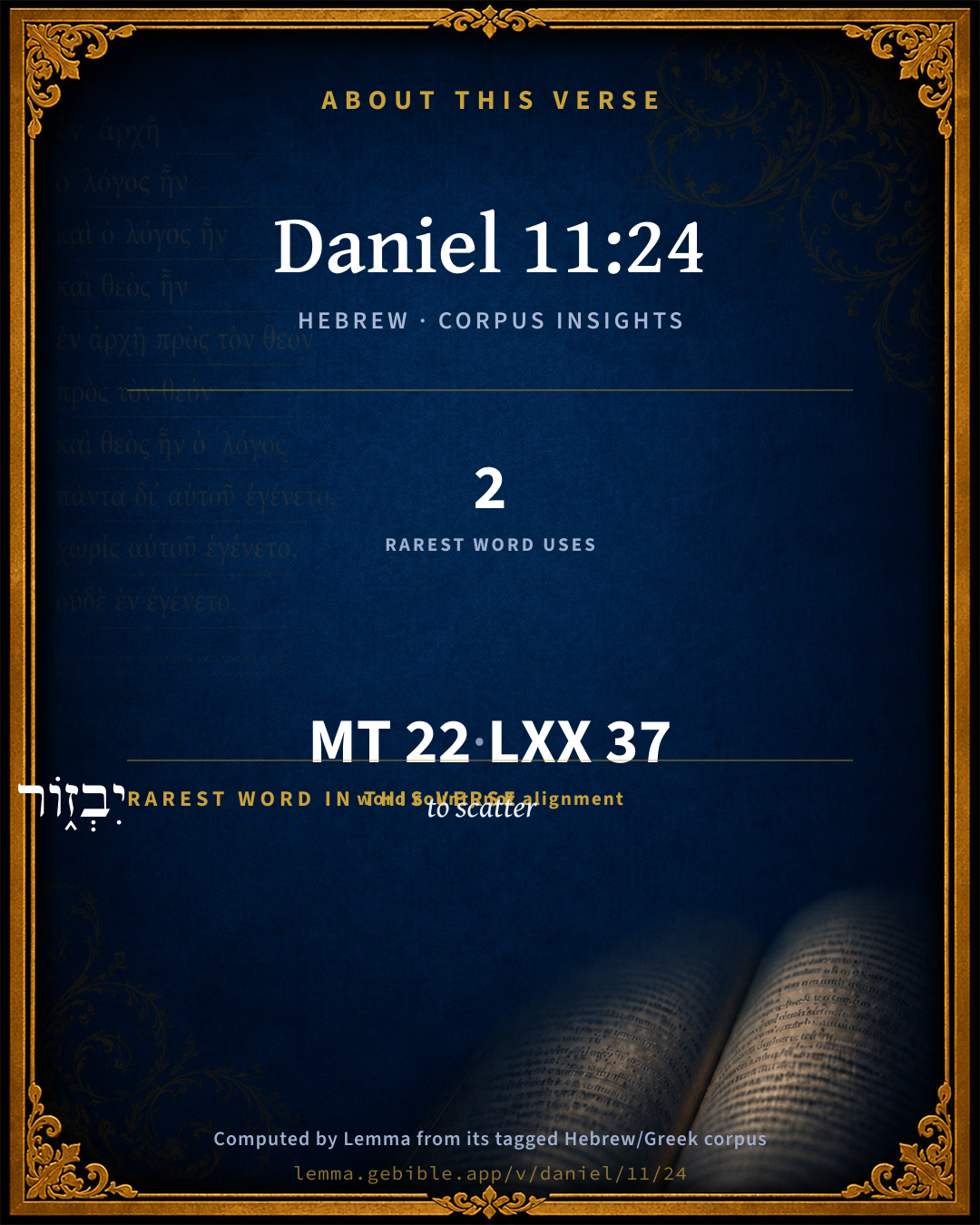
These counts appear in no published source. They are computed here, from the morphology-tagged text and Lemma’s own curated glosses. What Lemma adds →

22
words
18
distinct lemmas
Prophets
section

Notable vocabulary

The rarest word here is יִבְז֑וֹר to scatter H967 — appearing just 2 times in the whole Hebrew Bible.

Shared distinctive vocabulary

יִבְז֑וֹר to scatter H967 occurs in 2 verses of the Hebrew Bible. Also found in:

Grammatical profile

  • 5 verbs
  • 12 nouns
  • 3 prepositions
  • 2 particles

Verb forms

  • יָבוֹא֒ Qal · Imperfect
  • וְעָשָׂ֗ה Qal · Sequential Perfect
  • עָשׂ֤וּ Qal · Perfect
  • יִבְז֑וֹר Qal · Imperfect
  • יְחַשֵּׁ֥ב Piel · Imperfect

Repetition

Words recur within this verse — often emphatic in Hebrew:

  • אֲבֹתָיו֙ father H1 ×3
  • וְעָשָׂ֗ה to do H6213 ×2

Hebrew & Septuagint length

In English translation the verse runs 53 words from the Hebrew and 46 from the Septuagint (LXX English) — closely comparable.

A rough comparison of the two English renderings, which tokenize alike — not a word-level alignment.

Word counts can differ between the Hebrew and the Greek without any difference in meaning — e.g. the Hebrew direct-object marker אֵת has no separate Greek word, and Greek often adds the article ὁ.

In the original languages it is 22 Hebrew tokens and 37 Greek tokens — but the two are counted differently (Hebrew bundles its prefixes and suffixes into one token; the Greek is in lemma form), so that isn’t a like-for-like length.

Cross-references

8

Topical passages linked to Daniel 11:24 in the Treasury of Scripture Knowledge — connected by theme and wording, ordered by reader-vote popularity; previews shown in the World English Bible.

  • Ezekiel 38:10 Thus says the Lord Yahweh: It shall happen in that day, that things shall come into your mind, and you shall devise an evil device:
  • Judges 9:4 They gave him seventy [pieces] of silver out of the house of Baal Berith, with which Abimelech hired vain and light fellows, who followed him.
  • Nehemiah 9:25 They took fortified cities, and a fat land, and possessed houses full of all good things, cisterns hewn out, vineyards, and olive groves, and fruit trees in abundance: so they ate, and were filled, and became fat, and delighted themselves in your great goodness.
  • Proverbs 17:8 A bribe is a precious stone in the eyes of him who gives it; Wherever he turns, he prospers.
  • Proverbs 19:6 Many will entreat the favor of a ruler, And everyone is a friend to a man who gives gifts.
  • Proverbs 23:7 For as he thinks about the cost, so he is. "Eat and drink!" he says to you, But his heart is not with you.
  • Daniel 7:25 He shall speak words against the Most High, and shall wear out the saints of the Most High; and he shall think to change the times and the law; and they shall be given into his hand until a time and times and half a time.
  • Matthew 9:4 Jesus, knowing their thoughts, said, "Why do you think evil in your hearts?

Cross-references courtesy of OpenBible.info (CC BY 4.0).

Hebrew and Greek witnesses Masoretic Hebrew ↔ Greek Septuagint

The same verse in the two great witnesses to the Old Testament, shown verse-for-verse.

These are two independent witnesses, not word-aligned to each other, and the Septuagint is shown in lemma (dictionary) form.

Hebrew Daniel 11:24 Masoretic · Westminster Leningrad Codex

בְּשַׁלְוָ֞ה וּבְמִשְׁמַנֵּ֣י מְדִינָה֮ יָבוֹא֒ וְעָשָׂ֗ה אֲשֶׁ֨ר לֹא עָשׂ֤וּ אֲבֹתָיו֙ וַאֲב֣וֹת אֲבֹתָ֔יו בִּזָּ֧ה וְשָׁלָ֛ל וּרְכ֖וּשׁ לָהֶ֣ם יִבְז֑וֹר וְעַ֧ל מִבְצָרִ֛ים יְחַשֵּׁ֥ב מַחְשְׁבֹתָ֖יו וְעַד עֵֽת

In time of security shall he come even on the fattest places of the province; and he shall do that which his fathers have not done, nor his fathers' fathers; he shall scatter among them prey, and spoil, and substance: yes, he shall devise his devices against the strongholds, even for a time.

World English Bible · Public Domain

Greek LXX Daniel 11:24 Septuagint · lemma form

ἐξάπινα ἐρημόω πόλις καί ποιέω ὅσος οὐ ποιέω ὁ πατήρ αὐτός οὐδέ ὁ πατήρ ὁ πατήρ αὐτός προνομή καί σκῦλον καί χρῆμα αὐτός δίδωμι καί ἐπί ὁ πόλις ὁ ἰσχυρός διανοέομαι καί ὁ λογισμός αὐτός εἰς μάτην

And he shall enter with prosperity, and that into fertile districts; and he shall do what his fathers and his fathers' fathers have not done; he shall scatter among them plunder, and spoils, and wealth; and he shall devise plans against Egypt, even for a time.

LXX2012 (modern English Septuagint) · Public Domain

On this verse, The Pulpit Commentary discusses the Septuagint’s reading. Read the note in Commentary ↓

Hebrew: Westminster Leningrad Codex (CC BY 4.0). Greek: Septuagint (public domain); English from LXX2012 (modern English Septuagint) (Public Domain). How the Septuagint differs from the Hebrew →

Commentary

Notes on Daniel 11:24 from classic Christian and Jewish commentators (each source and its license shown beneath its notes). The classic Christian expositions comment on the surrounding passage and are grouped to its opening verse, so a note may address several verses; the Jewish commentaries on the Tanakh (Rashi and others) are per-verse, so they appear only where the commentator wrote on this verse.

Lemma curates 59 commentaries, every one of them public domain or Creative Commons licensed, each selected and text-cleaned for this edition rather than reprinted as found. About our sources →

Trapp's Complete Commentary

John Trapp

Dan 11:24 He shall enter peaceably even upon the fattest places of the province; and he shall do [that] which his fathers have not done, nor his fathers’ fathers; he shall scatter among them the prey, and spoil, and riches: [yea], and he shall forecast his devices against the strong holds, even for a time.

Ver. 24. He shall enter peaceably, even upon the fattest places of the province,] i.e., Upon Memphis, in the very heart of the country.

And he shall do that which his fathers have not done,] i.e., Rob and spoil, as never any of his ancestors did before in Egypt.

And he shall scatter among them the prey.] Throwing handfuls of money among the Vulgate as he went along the streets; and all to ingratiate, and to steal away their hearts. {a} Absalom did the like at Jerusalem. {2Sa 15:6}

And he shall forecast his devices against the strongholds.] By sowing dissension between Philometor and Physcon, his younger brother. The devil was as great a monster then as since, with his divide et impera, make division and get dominion.

{a} Ptole. Hypom., lib. i. and v.

John Trapp, A Commentary or Exposition upon All the Books of the Old and New Testament (1647–1656) — public domain. Text from a community e-Sword module.

Tyndale Open Study Notes

Tyndale Open Resources

11:24 richest areas of the land: Antiochus IV seized the riches of the Temple, took large tributes from Jerusalem, and stationed troops there (1 Maccabees 1:29-40).

Tyndale Open Study Notes — © Tyndale Open Resources, licensed CC BY-SA 4.0. Text via the HelloAO Bible API.

Geneva Bible (1599)

Geneva Bible translators

Meaning, in Egypt.

He will content himself with the small holds for a time, but ever labor by craft to attain to the chiefest.

Geneva Bible (1599) marginal notes — public domain. Text via Bolls.life.

Jamieson, Fausset & Brown

Robert Jamieson, A. R. Fausset & David Brown

peaceably--literally, "unexpectedly"; under the guise of friendship he seized Ptolemy Philometer.

he shall do that which his fathers have not done--His predecessors, kings of Syria, had always coveted Egypt, but in vain: he alone made himself master of it.

scatter among them . . . prey--among his followers (1 Maccabees 1:19).

forecast his devices against . . . strongholds--He shall form a studied scheme for making himself master of the Egyptian fortresses. He gained them all except Alexandria, which successfully resisted him. Retaining to himself Pelusium, he retired to Judea, where, in revenge for the joy shown by the Jews at the report of his death, which led them to a revolt, he subdued Jerusalem by storm or stratagem.

for a time--His rage shall not be for ever; it is but for a time limited by God. CALVIN makes "for a time" in antithesis to "unexpectedly," in the beginning of the verse. He suddenly mastered the weaker cities: he had to "forecast his plans" more gradually ("for a time") as to how to gain the stronger fortresses.

Jamieson, Fausset & Brown — Commentary Critical and Explanatory on the Whole Bible (1871) — public domain (CC PDM 1.0). Text via the HelloAO Bible API.

Adam Clarke's Commentary

Verse 24. He shall enter peaceably even upon the fattest places] The very richest provinces - Coelesyria and Palestine.

He shall do that which his fathers have not done, nor his fathers' fathers] He became profuse in his liberalities, and scattered among them the prey of his enemies, the spoil of temples, and the riches of his friends, as well as his own revenues. He spent much in public shows, and bestowed largesses among the people. We are told in 1Macc 3:30, that "in the liberal giving of gifts he abounded above all the kings that went before him." These are nearly the words of the prophet; and perhaps without any design to copy them on the part of the apocryphal writer. He would sometimes go into the streets, and throw about a handful of money, crying out, "Let him take it, to whom Fortune sends it."

He shall forecast his devices] As Eulaeus and Lenaeus, who were the guardians of the young Egyptian king Ptolemy Philometer, demanded from Antiochus the restitution of Coelesyria and Palestine, which he refused, he foresaw that he might have a war with that kingdom; and therefore he forecast devices - fixed a variety of plans to prevent this; visited the strong holds and frontier places to see that they were in a state of defense. And this he did for a time - he employed some years in hostile preparations against Egypt.

Adam Clarke's Commentary on the Bible (1810–1826) — public domain. Text from a community e-Sword/MySword module.

John Calvin's Commentaries

The history is here continued: The angel shews how Antiochus in a short time and with a small band should acquire many cities, as he should come in peace upon the fatness of the province, implying his oppressing them while sleeping in security. He shews also how he should become conqueror, not by any hostile invasion of Egypt, but by cunning and stealth he should deprive King Ptolemy of his cities when he least expected it. There should be no appearance of war; hence he says, he shall come in peace upon the fatness of the land The word “fatness” is used metaphorically for “richness.” When the Egyptians supposed all danger to be far removed, and were persuaded of the friendship of Antiochus towards them, and relied on him as an ally should any adversity arise, they indulged themselves in luxuries till Antiochus came suddenly and subdued them. He next adds, He shall despise the spoil, and prey, and goods, which belonged to them Some take the words for spoil and prey in the sense of “soldiers,” and join it with the verb יבזור ibzor, “he shall disperse,” meaning, he shall distribute their possessions among his soldiers, to conciliate their good will, and to prepare them for new wars, as we know how easily soldiers are enticed when they receive the rewards of their service; for they are actuated solely by covetousness and avarice. Some writers expound it in this way — Antiochus shall divide the prey among his soldiers, but I prefer the other sense — he shall disperse the prey, and the spoil, and the goods, of the Egyptians After suddenly oppressing the Egyptians, he shall proceed to spoil them like a robber.

He afterwards adds, And against the fortifications shall he devise machinations, meaning, he shall lay his plans for seizing the fortified cities. For at; first he penetrated as far as certain cities, and occupied first Coelo-Syria, and afterwards Phoenica, but could not quickly possess the fortified towns; hence he deferred the execution of his plans to a more suitable time. Therefore, the angel says, he shall arrange his plans against the fortified cities, but only for the time; meaning, he shall not immediately bring forward his intentions, hoping to oppress his nephew when off his guard. Thus under the disguise of peace an access to these cities would always be open to him, and he would reconcile to himself all whom he could corrupt by either gifts or other devices. We perceive, then, how a summary is here presented to us of the arts and schemes by which Antiochus should deprive his nephew of a portion of his territory and its towns, how suddenly he should invade some of the weakest in a state of unsuspecting tranquillity; and how by degrees he should invent machinations for seizing upon the stronger towns as well as he could. He also says, for the time The cunning and malice of Antiochus was always apparent throughout these transactions. He did not engage in open warfare, but was always endeavoring to add to his possessions by indirect frauds, — a course which was not without its success.

When it is said, He shall do what neither his fathers nor his fathers’ fathers did, this must be restricted solely to Egypt. For Seleucus the first king of Syria enjoyed a wide extent of dominion, then he prospered in warfare, and his fame flourished even to a good old age, and though at last he was unsuccessful in battle, yet on the whole he was a superior and celebrated warrior. Besides this we know him to have been one of the chief generals of Alexander the Great. As to his son Antiochus, we have previously observed the wide extent of his dominion, and how highly he was esteemed for prudence and valor. The angel does not compare Antiochus Epiphanes generally with either his fat, her, or grandfather, or great-grandfather, but only with respect to Egypt. For his ancestors always longed after Egypt, but their designs against it were entirely frustrated; he, however, was more successful in his aggression where his ancestors had failed in their attempts. Hence it becomes manifest how God overrules the events of war, so that the conqueror and the triumphant hero is not the man who excels in counsel, or in prudence, or valor, but he who fights under the heavenly leader. It pleases God at one time to afflict nations, and at another to set over them kings who are really his servants. So he wished to punish Egypt by the hands of this robber. It afterwards follows, —

John Calvin's Commentaries (1540-1563) — public domain. Text from the Calvin Translation Society English edition (1840s-50s) via the Christian Classics Ethereal Library (ccel.org). Calvin's coverage is partial (roughly two-thirds of the Bible); uncommented books and verses are honest gaps, never fabricated. The 19th-century editor's footnotes and remarks are omitted so the notes are faithfully Calvin's own voice.

Ellicott's Commentary for English Readers

(24) Peaceably.—The subject continues to be the perfidious conduct of the king mentioned in the last two verses. While the inhabitants are expecting nothing of the sort, he enters the richest parts of the province, and while he scatters largesses with profuseness and in apparent friendship, he is really planning attacks against the fortresses of the district, endeavouring to reduce them into his power.

This has been referred to the conduct of Antiochus Epiphanes, mentioned in 1Ma_3:27-30, after the defeat of the Syrian army by Judas Maccabæus. According to another interpretation, the meaning is that he will scatter or disperse the accumulated wealth of the different provinces “among them”—that is, to their hurt. The former explanation appears to be most in accordance with the deceit and craft which the prophecy attributes to the king.

For a time.—That is, the end of the time decreed by God. (Comp. Dan_11:35, Dan_8:17; Dan_8:19; Dan_12:4; Dan_12:6.)

A Bible Commentary for English Readers, edited by Charles John Ellicott (1878–1897) — public domain. Text from a community e-Sword module.

The Cambridge Bible for Schools and Colleges

gen. ed. J. J. S. Perowne

24. In (time of) security (Dan_11:21) and upon the fattest places (cf. Gen_27:28, Heb.) of the province shall he come] The Heb. is unusually harsh; though the fact in both A.V. and R.V. is most successfully concealed. ‘In security’ is probably accidentally out of place, and should follow ‘come’ (in the Heb. ובמשמני מדינה בשלוה יבוא for בשלוה ובמשמני מדינה יבוא). Cf. Dan_8:25 (also of Antiochus) ‘and in (time of) security he shall destroy many.’ Again, the allusion is uncertain: it may be to Antiochus’ acquisition of power over Syria; it may be to his attacks upon Judah, or to his invasions of Egypt.

prey and spoil and substance he shall scatter unto them] to his followers, or it may be to his people generally (for the vague use of the pron., cf. Dan_11:7; Dan_11:25). The allusion is, no doubt, to Antiochus’ lavish prodigality, in which he differed from most of the previous Syrian kings (‘his fathers,’ and ‘his fathers’ fathers’), who were usually in lack of surplus money. Cf. 1Ma_3:30, ‘and he feared that he should not have enough as at other times for the charges and the gifts which he used to give aforetime with a liberal hand, and he abounded above the kings which were before him’; also his liberality at Naukratis (above, p. 180), and the anecdotes of his lavish gifts to boon-companions, and even to strangers, in Polyb. xxvi. 10. 9–10, and Athen. x. 52 (p. 438). He was also very munificent in gifts to cities and temples, and in public shows (Liv. xli. 20, who cites examples[379]). Naturally, the funds for such purposes were obtained largely from the ‘prey’ and ‘spoil’ of plundered provinces: cf. 1Ma_1:19, ‘and he took the spoils of Egypt,’ iii. 31; Polyb. xxxi. 4. 9 (the cost of the games given by him in rivalry with those of Aem. Paullus in 167, defrayed in part out of the plunder of Egypt).

[379] For instance, he promised and partly bore the cost of, a city-wall at Megalopolis in Arcadia: he contributed largely to the restoration of the temple of Zeus Olympios at Athens; he presented gold vessels to the Prytaneum at Cyzicus, and beautified Delos with altars and statues; and at home he not only made many improvements in his capital, but also, what in Syria was an innovation, gave frequent gladiatorial shows. The words ‘spectaculorum quoque omnis generis magnificentia superiores reges vicit’ (cf. Polyb. xxvi. 10. 11) illustrate especially 1Ma_3:30, cited above.

against fortresses, also, he shall devise his devices] frame warlike plans,—whether successfully, as against Pelusium and the other places in Egypt which he secured (cf. 1Ma_1:19, of his first campaign in Egypt, ‘and they took the strong cities in the land of Egypt’), or unsuccessfully, as against Alexandria (see p. 180): perhaps, more particularly, the latter (‘devise,’—as though ineffectually).

and that, until a time] until the time fixed, in the counsels of God, as the limit of such enterprises: cf. Dan_11:27; Dan_11:35.

The Cambridge Bible for Schools and Colleges (gen. ed. J. J. S. Perowne; Cambridge University Press, 1878–1918) — public domain. Text from a community e-Sword module.

John Gill's Exposition

He shall enter peaceably even upon the fattest places of the province,.... Or, "into tranquillity, and the fattest places of the province" (s); that is, into such places as were in great tranquillity, and men thought themselves safe and secure, and had no suspicion of his designs upon them, and which abounded in wealth and riches: these were either the principal cities in the kingdom of Syria, which he visited in order to establish himself in their good opinion of him; or the chief places of the province of Phoenicia, where he endeavoured to make himself acceptable by his munificence; or it may be the best parts of the kingdom of Egypt are meant, the richest of them, such as Memphis, and the places about it; where, as Sutorius in Jerome says, he went; and which places being fat, producing a large increase, and abounding in wealth, invited him thither; and which wealth he took, and scattered among his friends and soldiers, as in a following clause:

and he shall do that which his fathers have not done, nor his fathers' fathers; none of his ancestors, more near or more remote; not Antiochus the great, nor Seleucus Ceraunus, nor Seleucus Callinicus, nor Antiochus Theos, nor Antiochus Soter, nor Seleucus Nicator, the founder of the Syrian empire; for, however greater these might be in power or riches, they were inferior to him in success; though they all, or most of them, however, had their eye upon Egypt, and would gladly have been masters of it; yet none of the kings of Syria prevailed over it, as Antiochus did; and this may also refer to what follows:

he shall scatter among them the prey, and spoil, and riches; which he took from the places or rich cities he entered into; and these he plentifully and liberally dispersed among his followers, his soldiers, "the small people" he became strong with, Dan 11:23, whereby he gained their affections, and attached them to his interest; and in this his liberality and munificence he is said to abound above all the kings that were before him, in the Apocrypha:

"He feared that he should not be able to bear the charges any longer, nor to have such gifts to give so liberally as he did before: for he had abounded above the kings that were before him.'' (1 Maccabees 3:30)

and the character Josephus (t) gives of him is, that he was a man of a large and liberal heart:

yea, and he shall forecast his devices against the strong holds; the fortresses of Egypt; as he got into the fat and richest parts of it, and distributed the wealth of them among his favourites and followers, which answered a good purpose; so he had his eye upon the fortified places of the kingdom, and contrived ways and means to get them into his possession, as Pelusium, and other places; and how to keep them when he had got them, which he did:

even for a time; till Ptolemy Philometor was at age, and freed himself from him; or till the Romans (u) put a stop to his power.

(s) "in quietem et in pinguia", Montanus; "in tranquillitatem et opima", Cocceius; "in tranquillitatem et in pinguissima", Michaelis. (t) Antiqu. l. 12. c. 7. sect. 2. (u) Vid. Joseph. Antiqu. l. 19. c. 5. sect. 2.

John Gill's Exposition of the Whole Bible (1746–1763) — public domain (CC PDM 1.0). Text via the HelloAO Bible API.

Albert Barnes' Notes on the Bible

He shall enter peaceably even upon the fattest places of the province - The margin is, “or, into the peaceable and fat.” The version in the text, however, is the more correct, and the sense is, that he would do this “unexpectedly” (Lengerke, uvermuthet); he would make gradual and artful approaches until he had seized upon the best portions of the land. Compare Gen 27:28, Gen 27:39. The history is, that he went there with different professions than those of conquest, and one after another he took possession of the principal towns of Egypt. In his first invasion of that country, Diodorus Siculus and Josephus both say that Antiochus “availed himself of a mean artifice,” without specifying what it was. Jahn says that probably it was that he pretended to come as the friend of Ptolemy. It was to this that the allusion is here, when it is said that he would “enter peaceably” - that is, with some pretence of peace or friendship, or with some false and flattering art. Josephus (Ant. xii. ch. v. Section 2) says of Antiochus, that “he came with great forces to Pelusium, and circumvented Ptolemy Philorector “by treachery,” and seized upon Egypt.” The fact stated by Diodorus and Josephus, that he took possession of Memphis and of all Egypt, as far as Alexandria, fully illustrates what is said here, that he would “enter upon the fattest places of the province.” These were the most choice and fertile portions of Egypt.”

And he shall do what his fathers have not done, nor his fathers’ fathers - Which none of his predecessors have been able to do; to wit, in the conquest of Egypt. No one of them had it so completely in his possession; no one obtained from it so much spoil. There can be no doubt that such was the fact. The wars of his predecessors with the Egyptians had been mostly waged in Coelo-Syria and Palestine, for the possession of these provinces. Antiochus Epiphanes, however, at first took Pelusium, the key of Egypt, and then invaded Egypt itself, seized upon its strongest places, and made the king a captive. - Jahn, “Heb. Commonwealth,” p. 263. Compare 1 Macc. 1:16.

He shall scatter among them the prey ... - Among his followers. He shall reward them with the spoils of Egypt. Compare 1 Macc. 1:19: “Thus they got the strong cities in the land of Egypt, and he took the spoils thereof.

And he shall forecast his devices - Margin, “think his thoughts.” The margin is in accordance with the Hebrew. The meaning is, that he would form plans, or that this would be his aim. He would direct the war against the strongly-fortified places of Egypt.

Against the strongholds - Antiochus took possession of Pelusium, the key of Egypt; he seized upon Memphis, and he then laid siege to Alexandria, supposing that if that were reduced, the whole country would be his. - Jos. “Ant.” b. xii. ch. v. Section 2.

Even for a time - Josephus (ut sup.) says that he was driven from Alexandria, and out of all Egypt, by the threatenings of the Romans, commanding him to let that country alone. There were other reasons also which, combined with this, induced him to retire from that country. He was greatly enraged by the effect which a report of his death had produced in Judea. It was said that all the Jews rejoiced at that report, and rose in rebellion; and he therefore resolved to inflict revenge on them, and left Egypt, and went to Jerusalem, and subdued it either by storm or by stratagem.

Albert Barnes' Notes on the Bible (1834–1885) — public domain. Text from a community e-Sword/MySword module.

Haydock's Catholic Bible Commentary

Places. Theodot. reads, "Egypt," omitting the b, (Haydock) which gives a good sense. --- (Calmet)

George Leo Haydock (1774–1849), Haydock's Catholic Family Bible and Commentary, 1859 edition — public domain. Excludes Psalms (Douay-Rheims chapter numbering differs from Protestant) and Deuterocanonical books (Catholic canon only).

Matthew Poole's English Annotations

He shall enter peaceably even upon the fattest places of the province; he shall come in upon the Egyptians under pretence of peace, and in time of peace, to a secure people in a plentiful and delicious country, and among a mass of treasures which the kings successively had heaped up, the greatest part of which this Antiochus took and distributed among his chiefest confidants, whereby he obliged them the faster to him, for he was large-hearted and liberal. He did herein (saith the text.)

what his fathers had not done, the kings of Syria before him could never attain to this success over Egypt. as he did.

He shall forecast his devices against the strong holds, i.e. having succeeded thus far in the lesser places of the country, he shall proceed to the most important cities and places of greatest strength in that kingdom. Even for a time; that is, till God put a stop to his career; for he held Egypt not long, the Egyptians found means to deliver themselves from his yoke when their king grew to riper years; yet against this did Antiochus forecast his devices, as saith the text.

Matthew Poole's English Annotations on the Holy Bible (1683–1685) — public domain. Text from a community e-Sword/MySword module.

Whedon's Commentary on the Bible

Daniel D. Whedon

24. He shall enter peaceably, etc. — This sentence may be translated either, “In time of your security shall become even upon the fattest places of the province” (R.V.), or “In time of security and with the fat (rich) ones of the province shall he come” (Terry), or “And by stealth he shall assail the mightiest men of (each) province.” Each rendering may be grammatically and historically defended. Antiochus did have the art of selecting the best places in which to plunder; he did succeed in allying to himself as strong supporters some of the chief men of Syria and other provinces, and he had no scruples about striking down any influential friends when it seemed to his advantage to do so.

He shall do that which his fathers have not done — This has been quite generally supposed to refer to the characteristic of Antiochus just noted in the preceding phrase; but certainly his predecessors had not been remarkable for their failure to acquire territory, etc., even by robbery, or for their antipathy to influential alliances, or for their noncombativeness. (See Dan_11:13-17; Dan_11:20.) It therefore seems best to translate, “He shall do what his fathers have not done: he shall scatter among them,” etc.; considering this to be a reference to the prodigal hand with which Antiochus Epiphanes was accustomed to lavish gifts upon those who helped him or with whom he was specially pleased. He scattered his gold pieces as his predecessors had never done (1Ma_3:28-30; Livy, 41:20; Polybius, 28:17). He shall forecast his devices, etc. — Rather, he shall devise devices against strongholds; that is, he was always plotting against his neighbors and depended as much upon his wily strategy as upon the force of his arms. (See Dan_8:23.)

Even for a time — Or, but [only] for a time. The end of his successfully wicked career is coming.

Daniel D. Whedon (gen. ed.), Commentary on the Old and New Testaments (1874–1909) — public domain. Text from a community e-Sword module.

The Pulpit Commentary

He shall enter peaceably even upon the fattest places of the province; and he shall do that which his fathers have not done, nor his fathers" fathers; he shall scatter among them the prey, and spoil, and riches: yea, and he shall forecast his devices against the strong holds, even for a time. The rendering of the LXX is," Suddenly he shall desolate the city, and he shall do such things as his fathers have not done, nor his father"s fathers, and he shall give captives (pronomh, De 21) and spoils and riches to them; and against the strong city a device shall be forecast (dianohqhsetai), and his reasonings are in vain." In the first clause, w seems to have been read instead of yNemivimW. Medeena is taken in its Syriac meaning. It is difficult to see what reading could produce both the Massoretic and the Septuagint renderings. Theodotion differs alike from this and from the Massoretic, "And in plenty, and in the fat places he shall corn and he shall do what his fathers have not done, nor his fathers" fathers; and he shall disperse among them captives (pronomhn), and spoil and possessions, and against (ejp) Egypt he shall devise devices, even for a season." The Peshitta is like the Massoretic. It joins what is reckoned the last clause of ver. 23 to the present verse, and omits "peaceably;" the last words of this verse are transferred to the next. The Vulgate is more related to Theodotion than to the Massoretic text, "And he shall enter plenteous (abundantes) and rich cities. " The remaining part of the verse agrees with the Massoretic text The events here indicated are somewhat difficult to identify. The histories of this period are scanty, and, with the exception of Polybius, whose work has come to us in a fragmentary condition, not very trustworthy. Moreover, the readings are uncertain in a portion of the verse. It is generally held to describe the first entrance of Epiphanes into Palestine or Egypt more generally the latter an opinion shared by Theodotion. The English versions do not bring out the probable meaning, although their rendering agrees with the Massoretic pointing, "That which his fathers have not done," etc. The repeated triumphant invasions of Egypt are probably referred to. Forecast devices against the strong holds. This may refer to the siege of Alexandria, which he was on the eve of commencing when he was compelled by the Roman envoy, Popilius Lena, to desist; but this is evidently the subject of the later verse. We can most easily understand this verse if we regard it as a summary of the whole reign of Antiochus.

The Pulpit Commentary (1880–1919), ed. H.D.M. Spence-Jones & Joseph S. Exell — public domain. Text from a community e-Sword module.

John Wesley's Explanatory Notes

He shall enter peaceably - He shall come in upon the Egyptians under pretense of peace, in a plentiful and delicious country, and among a mass of treasures which the kings successively had heaped up; the greatest part of which Antiochus distributed among his confidants, whereby he obliged them the faster to him. He did herein what his fathers had not done; the kings of Syria before him, could never attain to this success over Egypt. Against the strong-holds - Having succeeded thus far, he shall proceed to the places of greatest strength in that kingdom. For a time - That is 'till God put a stop to his career, for the Egyptians found means to deliver themselves from his yoke.

John Wesley, Explanatory Notes Upon the Whole Bible (1754–1765) — public domain. Text via the GEBible commentary corpus.

Rashi

Rabbi Shlomo Yitzchaki (Rashi)

plunder and spoils and belongings he will distribute to them He will distribute to those who accept their yoke upon themselves until they conquer all with flattery and smooth speech.

will distribute Heb. יִבְזוֹר, like יִפְזוֹר. and so (Ps. 68:31): “he scatters (בִּזַר) peoples.”

and about the fortresses of the nations he will devise in his plans—to station [in them] the heads of his troops until the time that all will be conquered under them.

Rashi on the Tanakh — English translations: “The Judaica Press complete Tanach with Rashi, translated by A. J. Rosenberg” (CC BY 4.0); “Pentateuch with Rashi's commentary by M. Rosenbaum and A.M. Silbermann, 1929-1934” (public domain); “The Metsudah Tanach series, Lakewood, N.J” (CC BY 4.0); and “The Book of Joshua, Metsudah Publications, 1997” (CC BY 4.0). Text via Sefaria.

Lesson kit

Teaching starters — assembled from the data on this page, not authored interpretation. Every prompt links to the verse data it draws on. Edit before teaching.

Daniel, in the Prophets, opens this verse with 22 words (18 distinct Hebrew lemmas). Its most distinctive word is bâzar (“to scatter”). A historical commentator’s framing appears above. Read the whole chapter for the surrounding context.

Discussion questions

  1. How does “to scatter” (bâzar) shape what this verse is saying?
  2. How does Psalms 68:30, which shares the word «to scatter», read alongside this verse?
  3. What does the repetition of “father” (3× in this one verse) do in this verse?
  4. These translations render this verse differently. What is at stake in choosing one wording over another?
  5. «יָבוֹא֒» is a Qal Imperfect verb. How does that grammatical form shape the action described?
  6. Compare how Trapp's Complete Commentary and Tyndale Open Study Notes read this verse. Where do they agree or differ?

Things to notice

Reading settings

Reading text

Shown beneath each verse's original-language words.

Old Testament
Old Testament edition

Read the OT as the Masoretic Hebrew (MT) or the Greek Septuagint (LXX).

English shown for the Greek Septuagint (in the Hebrew ↔ Greek comparison).

Comparing translations? Open the Compare panel on any verse page to stack up to four side by side.