
Exodus 3:15

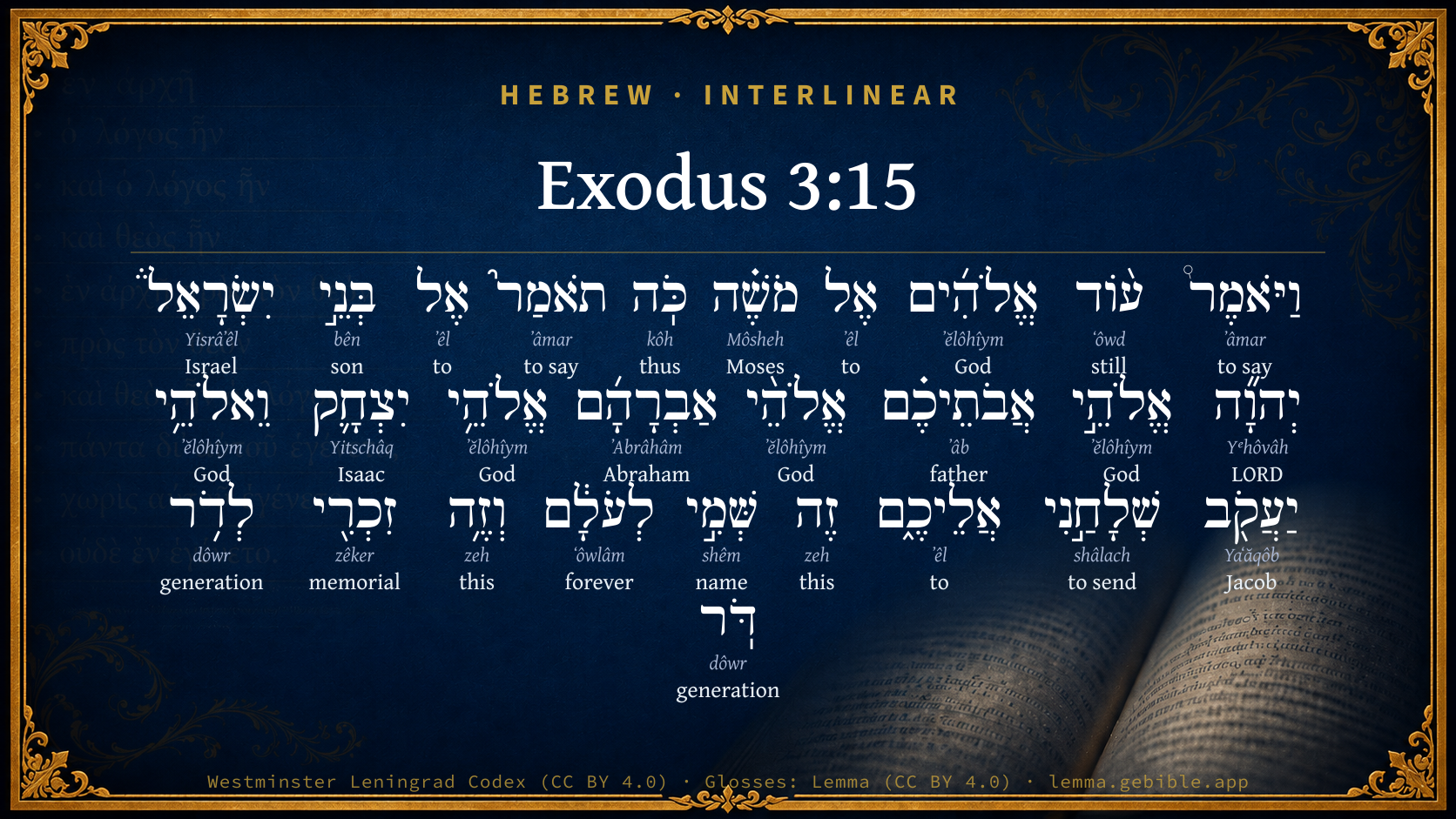
Hebrew (Westminster Leningrad Codex) Exodus 3:15 appears in the Hebrew Old Testament. The text above is from the Westminster Leningrad Codex. Each word links to its Strong’s number, a concise gloss, and parsing drawn from the Open Scriptures Hebrew Bible morphology. Click any word for its full Brown-Driver-Briggs (BDB) entry.
Download image
Cite this verse

Exodus 3:15 (World English Bible). Public Domain. Lemma interlinear Bible study tool, https://lemma.gebible.app/v/exodus/3/15.

Show BibTeX & RIS
BibTeX
RIS
English Translation
God said moreover to Moses, "You shall tell the children of Israel this, 'Yahweh, the God of your fathers, the God of Abraham, the God of Isaac, and the God of Jacob, has sent me to you.' This is my name forever, and this is my memorial to all generations.
World English Bible · Public Domain
Highlights
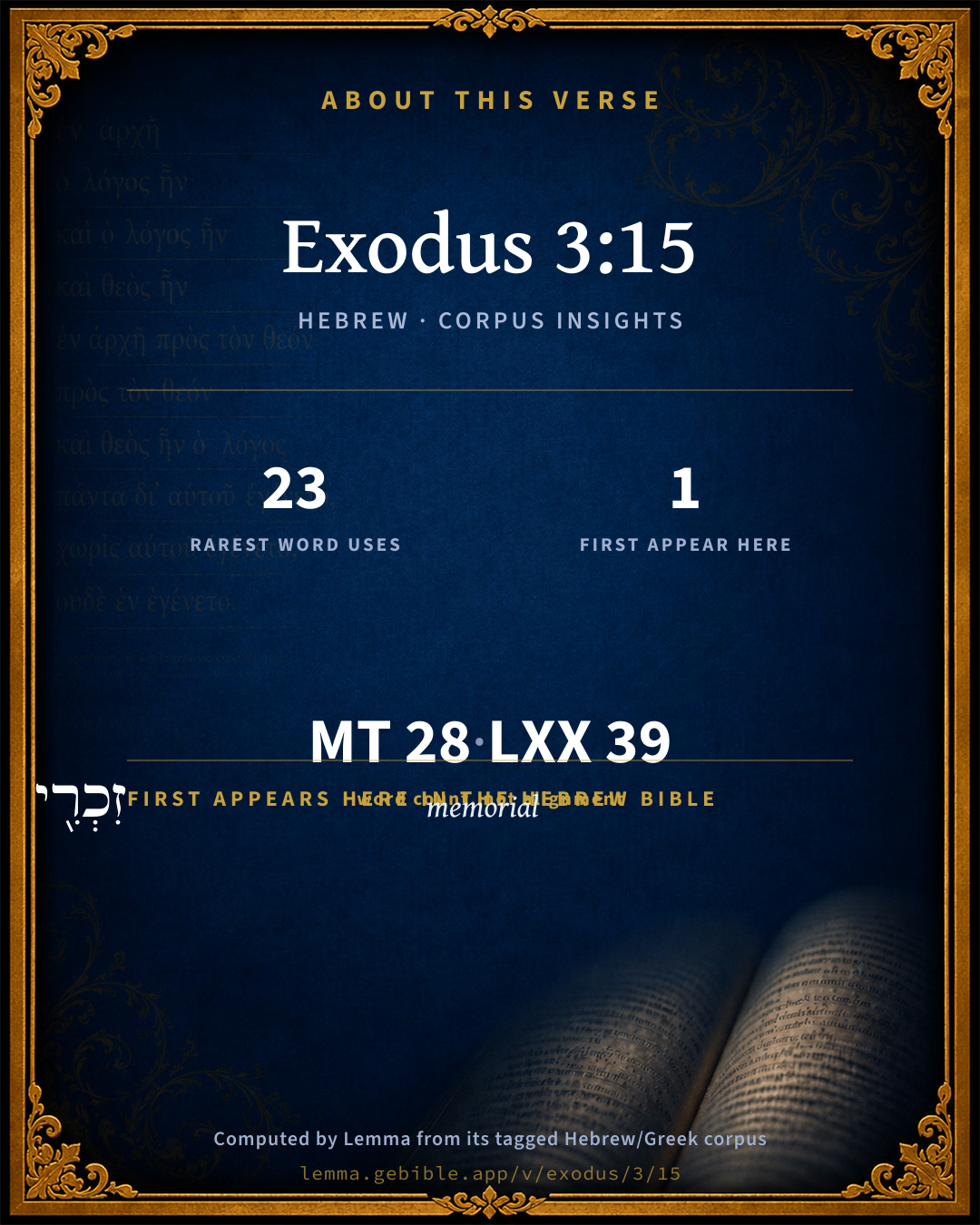
  • 1 first appearance in the Hebrew Bible
Full analysis ↓
Download a study sheet

One document with this verse’s original text, its word-by-word gloss line, the meaning frame, cross-references with their text, attributed commentary, and full source and license credits — printable, and it pastes into notes with its structure intact.

This verse Autodidact and up

Study sheet (.html) Plain text (.txt)

A passage Seminary Student

Up to 50 verses in one chapter. A passage sheet keeps up to 6 commentary sources and 12 cross-references per verse, in the order this page ranks them, and says so on the sheet whenever that leaves anything out. Ask for a single verse and you get the Autodidact verse sheet above.

Everything on this page stays free to read, with no account — the sheet is a download of what is already on screen, not access to it.

Want to remove ads? Support Godless Engineer
Compare translations 3

The same verse in 3 English versions, stacked beneath the original-language interlinear above. Click any original word for its lexicon entry.

Each is an independent rendering of the whole verse — the interlinear is not word-aligned to these translations.

Highlighted words mark where these versions differ — a whole-verse word diff, not a word-by-word alignment.

  • World English Bible Public Domain
    God said moreover to Moses, "You shall tell the children of Israel this, 'Yahweh, the God of your fathers, the God of Abraham, the God of Isaac, and the God of Jacob, has sent me to you.' This is my name forever, and this is my memorial to all generations.
  • King James Version Public Domain
    And God said moreover unto Moses, Thus shalt thou say unto the children of Israel, the LORD God of your fathers, the God of Abraham, the God of Isaac, and the God of Jacob, hath sent me unto you: this is my name for ever, and this is my memorial unto all generations.
  • unfoldingWord Literal Text CC BY-SA 4.0
    And God also said to Moses, “You shall speak this way to the sons of Israel: ‘Yahweh, the God of your fathers, the God of Abraham, the God of Isaac, and the God of Jacob, sent me to you. This is my name forever, and this is my memorial from generation to generation.’

unfoldingWord Literal Text — © unfoldingWord, licensed CC BY-SA 4.0. Word-aligned USFM3 via Door43 (git.door43.org/unfoldingWord/en_ult).

Versions to compare (up to 4)

3 of 4 selected

Show all 18 translations

Every available English version of this verse, each an independent rendering of the whole verse.

  • World English Bible Public Domain
    God said moreover to Moses, "You shall tell the children of Israel this, 'Yahweh, the God of your fathers, the God of Abraham, the God of Isaac, and the God of Jacob, has sent me to you.' This is my name forever, and this is my memorial to all generations.
  • Berean Standard Bible Public Domain
    God also told Moses, “Say to the Israelites, ‘The LORD, the God of your fathers—the God of Abraham, the God of Isaac, and the God of Jacob—has sent me to you.’ This is My name forever, and this is how I am to be remembered in every generation.
  • Majority Standard Bible Public Domain
    God also told Moses, “Say to the Israelites, ‘The LORD, the God of your fathers—the God of Abraham, the God of Isaac, and the God of Jacob—has sent me to you.’ This is My name forever, and this is how I am to be remembered in every generation.
  • King James Version Public Domain
    And God said moreover unto Moses, Thus shalt thou say unto the children of Israel, the LORD God of your fathers, the God of Abraham, the God of Isaac, and the God of Jacob, hath sent me unto you: this is my name for ever, and this is my memorial unto all generations.
  • American Standard Version (1901) Public Domain
    And God said moreover unto Moses, Thus shalt thou say unto the children of Israel, Jehovah, the God of your fathers, the God of Abraham, the God of Isaac, and the God of Jacob, hath sent me unto you: this is my name forever, and this is my memorial unto all generations.
  • Revised Version (1885) Public Domain
    And God said moreover unto Moses, Thus shalt thou say unto the children of Israel, The LORD, the God of your fathers, the God of Abraham, the God of Isaac, and the God of Jacob, hath sent me unto you: this is my name for ever, and this is my memorial unto all generations.
  • Geneva Bible (1599) Public Domain
    And God spake further vnto Moses, Thus shalt thou say vnto the children of Israel, The Lord God of your fathers, the God of Abraham, the God of Izhak, and the God of Iaakob hath sent me vnto you: this is my Name for euer, and this is my memoriall vnto all ages.
  • Douay-Rheims (1899) Public Domain
    And God said again to Moses: Thus shalt thou say to the children of Israel: The Lord God of your fathers, the God of Abraham, the God of Isaac, and the God of Jacob, hath sent me to you: This is my name for ever, and this is my memorial unto all generations.
  • Young's Literal Translation Public Domain
    And God saith again unto Moses, `Thus dost thou say unto the sons of Israel, Jehovah, God of your fathers, God of Abraham, God of Isaac, and God of Jacob, hath sent me unto you; this `is' My name -- to the age, and this My memorial, to generation -- generation.
  • Literal Standard Version CC BY-SA 4.0
    And God says again to Moses, “Thus you say to the sons of Israel: YHWH, God of your fathers, God of Abraham, God of Isaac, and God of Jacob, has sent me to you; this [is] My Name for all time, and this [is] My memorial, to generation [and] generation.
  • Unlocked Literal Bible CC BY-SA 4.0
    God also said to Moses, “You must say to the Israelites, 'Yahweh, the God of your ancestors, the God of Abraham, the God of Isaac, and the God of Jacob, has sent me to you. This is my name forever, and this is how I will be kept in mind for all generations.'
  • unfoldingWord Literal Text CC BY-SA 4.0
    And God also said to Moses, “You shall speak this way to the sons of Israel: ‘Yahweh, the God of your fathers, the God of Abraham, the God of Isaac, and the God of Jacob, sent me to you. This is my name forever, and this is my memorial from generation to generation.’
  • Darby Bible Public Domain
    And God said moreover to Moses, Thus shalt thou say unto the children of Israel: Jehovah, the God of your fathers, the God of Abraham, the God of Isaac, and the God of Jacob, hath sent me unto you. This is my name for ever, and this is my memorial unto all generations.
  • World Messianic Bible Public Domain
    God said moreover to Moses, “You shall tell the children of Israel this, ‘The LORD, the God of your fathers, the God of Abraham, the God of Isaac, and the God of Jacob, has sent me to you.’ This is my name forever, and this is my memorial to all generations.
  • Webster's Bible Public Domain
    And God said, moreover, to Moses, Thus shalt thou say to the children of Israel, The LORD God of your fathers, the God of Abraham, the God of Isaac, and the God of Jacob, hath sent me to you: this is my name for ever, and this is my memorial to all generations.
  • Free Bible Version CC BY-SA 4.0
    Then God said to Moses, “Tell the Israelites, ‘The Lord—the God of your fathers, the God of Abraham, the God of Isaac, and the God of Jacob—has sent me to you. This is my name forever, the name you are to call me for all generations to come.’
  • Bible in Basic English Public Domain
    And God went on to say to Moses, Say to the children of Israel, The Lord, the God of your fathers, the God of Abraham, of Isaac, and of Jacob, has sent me to you: this is my name for ever, and this is my sign to all generations.
  • JPS Tanakh (1917) Public Domain
    And God said moreover unto Moses: 'Thus shalt thou say unto the children of Israel: The LORD, the God of your fathers, the God of Abraham, the God of Isaac, and the God of Jacob, hath sent me unto you; this is My name for ever, and this is My memorial unto all generations.

Literal Standard Version (2020), Covenant Press — licensed CC BY-SA 4.0. Text via the HelloAO Bible API (eBible.org). Unlocked Literal Bible (unfoldingWord) — licensed CC BY-SA 4.0. Text via the HelloAO Bible API (eBible.org). unfoldingWord Literal Text — © unfoldingWord, licensed CC BY-SA 4.0. Word-aligned USFM3 via Door43 (git.door43.org/unfoldingWord/en_ult). Free Bible Version, Dr. Jonathan Gallagher — licensed CC BY-SA 4.0. Text via the HelloAO Bible API (eBible.org).

Word by word

More ways to search: Search by grammar → Find every occurrence → Compare this word →

Practice this passage: Drill this verse → Learn its vocabulary →

זִכְרִ֖י
zêker
H2143
“memorial · my”
Noun, Common, Masculine, Singular, Construct + Suffix, Personal, 1st Person, Common, Singular
Part of Speech
Noun
Type
Common
Gender
Masculine
Number
Singular
State
Construct
Full BDB Definition

Origin: from H2142

TWOT: 551a

memorial, remembrance - remembrance, memory - memorial
  1. וַיֹּאמֶר֩ ʼâmar H559 “and · to say” Conjunction + Verb, Qal, Sequential Imperfect, 3rd Person, Masculine, Singular
  2. ע֨וֹד ʻôwd H5750 “still” Adverb
  3. אֱלֹהִ֜ים ʼĕlôhîym H430 “God(s)” Noun, Common, Masculine, Plural, Absolute
  4. אֶל ʼêl H413 “to” Preposition
  5. מֹשֶׁ֗ה Môsheh H4872 “Moses” Noun, Proper
  6. כֹּֽה kôh H3541 “thus” Adverb
  7. תֹאמַר֮ ʼâmar H559 “to say” Verb, Qal, Imperfect, 2nd Person, Masculine, Singular
  8. אֶל ʼêl H413 “to” Preposition
  9. בְּנֵ֣י bên H1121 “sons of” Noun, Common, Masculine, Plural, Construct
  10. יִשְׂרָאֵל֒ Yisrâʼêl H3478 “Israel” Noun, Proper
  11. יְהוָ֞ה Yᵉhôvâh H3068 “LORD” Noun, Proper
  12. אֱלֹהֵ֣י ʼĕlôhîym H430 “God(s) of” Noun, Common, Masculine, Plural, Construct
  13. אֲבֹתֵיכֶ֗ם ʼâb H1 “fathers · your” Noun, Common, Masculine, Plural, Construct + Suffix, Personal, 2nd Person, Masculine, Plural
  14. אֱלֹהֵ֨י ʼĕlôhîym H430 “God(s) of” Noun, Common, Masculine, Plural, Construct
  15. אַבְרָהָ֜ם ʼAbrâhâm H85 “Abraham” Noun, Proper
  16. אֱלֹהֵ֥י ʼĕlôhîym H430 “God(s) of” Noun, Common, Masculine, Plural, Construct
  17. יִצְחָ֛ק Yitschâq H3327 “Isaac” Noun, Proper
  18. וֵאלֹהֵ֥י ʼĕlôhîym H430 “and · God(s) of” Conjunction + Noun, Common, Masculine, Plural, Construct
  19. יַעֲקֹ֖ב Yaʻăqôb H3290 “Jacob” Noun, Proper
  20. שְׁלָחַ֣נִי shâlach H7971 “to send · me” Verb, Qal, Perfect, 3rd Person, Masculine, Singular + Suffix, Personal, 1st Person, Common, Singular
  21. אֲלֵיכֶ֑ם ʼêl H413 “to · you” Preposition + Suffix, Personal, 2nd Person, Masculine, Plural
  22. זֶה zeh H2088 “this” Pronoun, Demonstrative, Masculine, Singular
  23. שְּׁמִ֣י shêm H8034 “name · my” Noun, Common, Masculine, Singular, Construct + Suffix, Personal, 1st Person, Common, Singular
  24. לְעֹלָ֔ם ʻôwlâm H5769 “to/for · forever” Preposition + Noun, Common, Masculine, Singular, Absolute
  25. וְזֶ֥ה zeh H2088 “and · this” Conjunction + Pronoun, Demonstrative, Masculine, Singular
  26. לְדֹ֥ר dôwr H1755 “to/for · generation” Preposition + Noun, Common, Masculine, Singular, Absolute
  27. דֹּֽר dôwr H1755 “generation” Noun, Common, Masculine, Singular, Absolute

About this verse

These counts appear in no published source. They are computed here, from the morphology-tagged text and Lemma’s own curated glosses. What Lemma adds →

28
words
19
distinct lemmas
Pentateuch
section

Notable vocabulary

The rarest word here is זִכְרִ֖י memorial H2143 — appearing just 23 times in the whole Hebrew Bible.

First appearance in Scripture

This word makes its first canonical appearance in the Hebrew Bible here:

  • זִכְרִ֖י memorial H2143

Shared distinctive vocabulary

זִכְרִ֖י memorial H2143 occurs in 23 verses of the Hebrew Bible. Also found in:

Grammatical profile

  • 3 verbs
  • 18 nouns
  • 2 pronouns
  • 3 prepositions
  • 2 adverbs

Verb forms

  • וַיֹּאמֶר֩ Qal · Sequential Imperfect
  • תֹאמַר֮ Qal · Imperfect
  • שְׁלָחַ֣נִי Qal · Perfect

Repetition

Words recur within this verse — often emphatic in Hebrew:

  • אֱלֹהִ֜ים God H430 ×5
  • וַיֹּאמֶר֩ to say H559 ×2
  • לְדֹ֥ר generation H1755 ×2
  • אֶל to H413 ×3
  • זֶה this H2088 ×2

Hebrew & Septuagint length

In English translation the verse runs 50 words from the Hebrew and 51 from the Septuagint (LXX English) — closely comparable.

A rough comparison of the two English renderings, which tokenize alike — not a word-level alignment.

Word counts can differ between the Hebrew and the Greek without any difference in meaning — e.g. the Hebrew direct-object marker אֵת has no separate Greek word, and Greek often adds the article ὁ.

In the original languages it is 28 Hebrew tokens and 39 Greek tokens — but the two are counted differently (Hebrew bundles its prefixes and suffixes into one token; the Greek is in lemma form), so that isn’t a like-for-like length.

Cross-references

20

Topical passages linked to Exodus 3:15 in the Treasury of Scripture Knowledge — connected by theme and wording, ordered by reader-vote popularity; previews shown in the World English Bible.

  • Genesis 17:7–8 I will establish my covenant between me and you and your seed after you throughout their generations for an everlasting covenant, to be a God to you and to your seed after you.
  • Hebrews 13:8 Jesus Christ is the same yesterday, today, and forever.
  • Hosea 12:5 Even Yahweh, the God of hosts; Yahweh is his name of renown!
  • Malachi 3:6 "For I, Yahweh, don't change; therefore you, sons of Jacob, are not consumed.
  • Exodus 3:6 Moreover he said, "I am the God of your father, the God of Abraham, the God of Isaac, and the God of Jacob." Moses hid his face; for he was afraid to look at God.
  • Micah 4:5 Indeed all the nations may walk in the name of their gods; But we will walk in the name of Yahweh our God forever and ever.
  • Psalms 102:12 But you, Yahweh, will abide forever; Your renown endures to all generations.
  • Isaiah 9:6 For to us a child is born, to us a son is given; and the government shall be on his shoulder: and his name shall be called Wonderful, Counselor, Mighty God, Everlasting Father, Prince of Peace.
  • Psalms 135:13 Your name, Yahweh, endures forever; Your renown, Yahweh, throughout all generations.
  • Exodus 4:5 "That they may believe that Yahweh, the God of their fathers, the God of Abraham, the God of Isaac, and the God of Jacob, has appeared to you."
  • Deuteronomy 1:11 Yahweh, the God of your fathers, make you a thousand times as many as you are, and bless you, as he has promised you!
  • Psalms 145:1–2 I will exalt you, my God, the King. I will praise your name forever and ever.
  • Acts 7:32 'I am the God of your fathers, the God of Abraham, the God of Isaac, and the God of Jacob.' Moses trembled, and dared not look.
  • 2 Chronicles 28:9 But a prophet of Yahweh was there, whose name was Oded: and he went out to meet the host that came to Samaria, and said to them, Behold, because Yahweh, the God of your fathers, was angry with Judah, he has delivered them into your hand, and you have slain them in a rage which has reached up to heaven.
  • Psalms 72:17 His name endures forever. His name continues as long as the sun. Men shall be blessed by him. All nations will call him blessed.
  • Psalms 72:19 Blessed be his glorious name forever! Let the whole earth be filled with his glory! Amen and amen.
  • Isaiah 63:12 who caused his glorious arm to go at the right hand of Moses? who divided the waters before them, to make himself an everlasting name?
  • Matthew 22:32 'I am the God of Abraham, and the God of Isaac, and the God of Jacob?' God is not the God of the dead, but of the living."
  • Deuteronomy 1:35 Surely there shall not one of these men of this evil generation see the good land, which I swore to give to your fathers,
  • Deuteronomy 4:1 Now, Israel, listen to the statutes and to the ordinances, which I teach you, to do them; that you may live, and go in and possess the land which Yahweh, the God of your fathers, gives you.

Cross-references courtesy of OpenBible.info (CC BY 4.0).

Hebrew and Greek witnesses Masoretic Hebrew ↔ Greek Septuagint

The same verse in the two great witnesses to the Old Testament, shown verse-for-verse.

These are two independent witnesses, not word-aligned to each other, and the Septuagint is shown in lemma (dictionary) form.

Hebrew Exodus 3:15 Masoretic · Westminster Leningrad Codex

וַיֹּאמֶר֩ ע֨וֹד אֱלֹהִ֜ים אֶל מֹשֶׁ֗ה כֹּֽה תֹאמַר֮ אֶל בְּנֵ֣י יִשְׂרָאֵל֒ יְהוָ֞ה אֱלֹהֵ֣י אֲבֹתֵיכֶ֗ם אֱלֹהֵ֨י אַבְרָהָ֜ם אֱלֹהֵ֥י יִצְחָ֛ק וֵאלֹהֵ֥י יַעֲקֹ֖ב שְׁלָחַ֣נִי אֲלֵיכֶ֑ם זֶה שְּׁמִ֣י לְעֹלָ֔ם וְזֶ֥ה זִכְרִ֖י לְדֹ֥ר דֹּֽר

God said moreover to Moses, "You shall tell the children of Israel this, 'Yahweh, the God of your fathers, the God of Abraham, the God of Isaac, and the God of Jacob, has sent me to you.' This is my name forever, and this is my memorial to all generations.

World English Bible · Public Domain

Greek LXX Exodus 3:15 Septuagint · lemma form

καί εἶπον ὁ θεός πάλιν πρός μωυσῆς οὕτως εἶπον ὁ υἱός ἰσραήλ κύριος ὁ θεός ὁ πατήρ σύ θεός αβρααμ καί θεός ισαακ καί θεός ἰακώβ ἀποστέλλω ἐγώ πρός σύ οὗτος ἐγώ εἰμί ὄνομα αἰώνιος καί μνημόσυνον γενεά γενεά

And God said again to Moses, Thus shall you say to the sons of Israel, The Lord God of our fathers, the God of Abraam, and God of Isaac, and God of Jacob, has sent me to you: this is my name for ever, and my memorial to generations of generations.

LXX2012 (modern English Septuagint) · Public Domain

On this verse, Ellicott's Commentary for English Readers discusses the Septuagint’s reading. Read the note in Commentary ↓

Hebrew: Westminster Leningrad Codex (CC BY 4.0). Greek: Septuagint (public domain); English from LXX2012 (modern English Septuagint) (Public Domain). How the Septuagint differs from the Hebrew →

Targum (Aramaic paraphrase)

2

The Targum is the ancient Jewish Aramaic paraphrase of the Hebrew Scriptures — an interpretive translation, not the Hebrew text itself. Onkelos (literal) and Pseudo-Jonathan (expansive) render the Torah, and Jonathan the Prophets. Coverage is partial: where no permissively-licensed English translation exists for a verse, only the Aramaic is shown. This is verse-level text, not a word-by-word alignment to the Hebrew.

  1. Targum Onkelos Torah (Genesis–Deuteronomy)
    וַאֲמַר עוֹד יְיָ לְמשֶׁה כִּדְנַן תֵּימַר לִבְנֵי יִשְׂרָאֵל יְיָ אֱלָהָא דְאַבְהַתְכוֹן אֱלָהֵהּ דְאַבְרָהָם אֱלָהֵהּ דְיִצְחָק וֵאלָהֵהּ דְיַעֲקֹב שַׁלְחַנִי לְוָתְכוֹן דֵין שְׁמִי לְעָלַם וְדֵין דָכְרָנִי לְכָל דָר וְדָר:

    (no public-domain English translation for this verse)

    Targum Onkelos — Aramaic: “Onkelos Genesis” (public domain); “Onkelos Exodus” (public domain); “Onkelos Leviticus” (public domain); “Onkelos Numbers” (public domain); “Onkelos Deuteronomy” (public domain). English: “Sefaria Community Translation” (CC0 1.0 (public-domain dedication)); “J.W. Etheridge. The Targums of Onkelos and Jonathan Ben Uzziel on the Pentateuch. London: Longmans, Green, 1862” (public domain). Text via Sefaria.

  2. Targum Pseudo-Jonathan Torah (Genesis–Deuteronomy)
    וַאֲמַר תּוּב יְיָ לְמשֶׁה כִּדְנַן תֵּימַר לִבְנֵי יִשְרָאֵל אֱלָהָא דְאַבְהַתְכוֹן אֱלָהֵיהּ דְאַבְרָהָם אֱלָהֵיהּ דְיִצְחָק וֵאלָהֵיהּ דְיַעֲקב שַׁדְרַנִי לְוַותְכוֹן דֵין הוּא שְׁמִי לְעָלַם וְדֵין דוּכְרָנִי לְכָל דַר וָדַר

    And the Lord said again unto Mosheh, Thus shalt thou speak to the sons of Israel, The God of your fathers, the God of Abraham, the God of Izhak, and the God of Jakob, hath sent me unto you. This is His Name for ever, and this is His Memorial to every generation and generation.

    Targum Pseudo-Jonathan — Aramaic: “Targum Jonathan on Genesis” (public domain); “Targum Jonathan on Exodus” (public domain); “Targum Jonathan on Leviticus” (public domain); “Targum Jonathan on Numbers” (public domain); “Targum Jonathan on Deuteronomy” (public domain). English: “The Targum of Jonathan ben Uzziel, trans. J. W. Etheridge, London, 1862” (public domain). Text via Sefaria.

Commentary

Notes on Exodus 3:15 from classic Christian and Jewish commentators (each source and its license shown beneath its notes). The classic Christian expositions comment on the surrounding passage and are grouped to its opening verse, so a note may address several verses; the Jewish commentaries on the Tanakh (Rashi and others) are per-verse, so they appear only where the commentator wrote on this verse.

Lemma curates 59 commentaries, every one of them public domain or Creative Commons licensed, each selected and text-cleaned for this edition rather than reprinted as found. About our sources →

Trapp's Complete Commentary

John Trapp

Exo 3:15 And God said moreover unto Moses, Thus shalt thou say unto the children of Israel, The LORD God of your fathers, the God of Abraham, the God of Isaac, and the God of Jacob, hath sent me unto you: this [is] my name for ever, and this [is] my memorial unto all generations.

Ver. 15. Unto all generations.] The Jews, to countenance their conceit of the ineffability of the name of Jehovah, did corrupt this text: and for This is my name, Legnolam, for ever, they read, This is my name, Legnalam, to be concealed. {a}

{a} Galatinus.

John Trapp, A Commentary or Exposition upon All the Books of the Old and New Testament (1647–1656) — public domain. Text from a community e-Sword module.

The Biblical Illustrator

Joseph S. Exell

Exo_3:15

The Lord God of your fathers, the God of Abraham, the God of Isaac.

The God of the generations

Men are always influenced more or less by the power of great names. This appears in every sphere of life, social, scientific, political, literary, religious. The name of a wise, heroic, or philanthropic, or notably godly man, is a perpetual fountain of inspiration--a well-spring of living water from which we gather stimulus, courage, power to be and to do. The sound of it stirs the pulses of our better life. But no names in any country, or among any people, have wielded a mightier power than these three mentioned in the text exerted over the minds and history of the Jews. Abraham, Isaac, and Jacob stood forth in every succeeding age in increasing lustre, unshadowed even by the memories of other noble names, such as Moses, Daniel, Solomon, Elijah, Isaiah. Appeal to them was always effective when all other means of rousing the national heart failed.

I. It announces Gods relation to individual life. I am the God of Abraham, Isaac, and Jacob. Here there is a sublime fact upon which our minds can lay hold. The statement is not vague or unsubstantial, but tells us that the great God has to do with men, and holds a distinct personal relation towards each of them. Perhaps we have been too apt to attempt to satisfy ourselves with impalpable generalities, and to talk of God as the God of Creation, from whose fulness of life and omnipotence of energy the universe has derived its existence. In like manner we employ what may be termed His official titles to represent Him to our thought. He is the King of kings, the Ruler, the Governor of the nations. But the hearts of men crave a more intimate knowledge of God than these ideas can possibly convey. We cannot satisfy ourselves with abstractions. Official titles never command our affection. What we want is not a revelation that only declares Gods universal dealings with humanity, but His personal interest in individual men. And we see that thus early in the history of the race this revelation is clearly made. Nay, from the first and earliest declaration of Gods relation to the world, this is unhesitatingly announced. All the beautiful stories of Divine intercourse with men contained in the Book of Genesis are recorded to teach us that God has not been satisfied with a merely general and official relationship to men, but that He has ever had regard to the personal wants, the personal struggles, the personal sins, the personal joys and sorrows, the personal lives and deaths of each man, woman, and child born into this world. I am the Lord thy God; and our response is, This God is our God. He will be our guide even unto death. The Lord is my shepherd, I shall not want. More clearly still is this revelation made in the New Testament--that carries the truth further, and by Jesus Christ we are shown that God has the most intimate relation with human souls. Indeed, the very use of the word Father implies this personal relationship. It is impossible for a true father to regard and treat the members of his family in a general indiscriminate manner--looking upon them in the mass, and not as individuals--that were to destroy the very meaning and beauty of family life. But the father knows that he has a distinct love for each member. Thus our Lord teaches us the particular and special and personal nature of the relationship of God to us. We are not lost in the mass, as one in a crowd for whom no one cares, and whom no one would miss. I am the God of Abraham, the God of Isaac, and the God of Jacob. Connected with this is another thought worthy of notice. It is that God here expresses His relation to persons of distinct and differing characters. Perhaps no three men were more unlike than this father, son, and grandson. Look at Abraham, the bold, brave, generous, trusting chief, a dweller in tents, at home in the desert. Compare him with the quiet, meditative, ease-loving, simple-minded Isaac, somewhat fond of savoury living, who succeeded him. There is as much unlikeness as could possibly exist between father and son. Take, again, Jacob, the cunning, adroit, ingenious, selfish, money-loving, physically timid--a man who probably had more brains than either of his predecessors, but who was made to be a politician, a statesman, to whose active, contriving spirit, sitting at home, or roving in the desert, would be alike uncongenial. There we have three men totally distinct in character, yet the declaration is made--I am the God of Abraham, Isaac, and Jacob. Surely there is meaning in this, and it is that God cares equally for, and is as truly related to, one kind of disposition and character as another. Ah! there is exquisite beauty and comfort in the tenderly-expressed words of John concerning Christ--Now Jesus loved Martha, and her sister, and Lazarus. Three varieties of character, but all beloved. If all this be true, what need of our nature is left unsatisfied? If this be true, who is there will not feel that his life, so specially the subject of Gods thought, is therefore a grander, nobler, and, withal, a more responsible thing? Who will depreciate his.own proud worth? Who will bemoan his lot, thinking with envy of others better circumstanced?

II. It announces Gods relation to successive generations. These three men represented an unbroken succession of three generations, running into one another, yet in a measure distinct. May we not learn from these facts that God is not a God of seasons and partialities, but that He belongs to all the successive generations as they move across the world to the silence of the grave? There is no break in His thoughtful care or in the manifestations of His love. He does not appear at one age and disappear at another, at one time show Himself peculiarly concerned with human welfare, at another time altogether indifferent about the joys and sorrows, the sins and the cravings of men. In such a Being as that we could neither trust nor believe. There is no intermission. Gods intercourse with men is never broken off. This intercourse may assume different forms. What is suited to one age may be altogether unsuited to the next. At one time His revelations may be such as the senses can testify to; He may instruct men in His mind and will through the medium of miracles, flashing symbols of omnipotence before their eyes; at other times He may reveal Himself in a person, in a human life, as we believe He did in Christ Jesus our Lord. At others, all visions may disappear; no miracle shall startle the world into wondering awe. God is not tied to methods. He may and does employ all at one time or another in order to convince men of His nearness to them and interest in their life. The God of the Hebrews is not our God. That is the sum of much of the unbelief of the day. The cry is for palpable evidence. Palpable evidence! Why, we have abundance of it on all sides. Miracles! There is no need of them. Why, the very researches of our scientific men are doing away with the necessity for miracles, for they are demonstrating by their discoveries that the world is full of order, of beauty, of marvellous contrivances that must be the work of mind. Here are the proofs of Divine existence, Divine working, Divine wisdom and bounty and power. To believe He is not as much the God of this generation as of any in all the long past, is to cut to the very root of all true faith and trust in Him, is to regard Him as partial, as doing more for one people than for another equally in need of His revelation of power and love; it is to throw us back for our faith in God upon dead history, which can never create or nourish into a living hope the trust of human souls. We may say that the age of supernatural displays of mere power is passed, but we are called upon to rise from the merely materialistic and tangible, and to realise God in the hallowed and invisible communion of the Spirit. The God of the father is to be the God of the son and the grandson by legitimate, unhindered succession, and those who come after can speak of the God of our fathers. That there is no reason against it in the will and purposes of the Divine Being Himself we have seen. He is willing to bless and enrich each and all, without choice or favouritism. But in how few cases in the family life is He recognized from one generation to another. Here I bring the matter direct home to your hearts. I know I must be speaking to some who are thinking of pious parents. You have a godly father or mother, or perhaps both. What of yourself? Are you continuing the succession? The name you bear has been associated with godliness in one or two generations past. Is it to be separated in your time? What will your children say of you? Will they be able to pray to the God of their parents? (W. Braden.)

The Biblical Illustrator, edited by Joseph S. Exell (c. 1880s–1900s) — public domain. Text from a community e-Sword module.

Joseph Benson's Commentary

Exo 3:15. God will be known, 2d, By a name that speaks what he is to his people. Lest they should not understand the name I AM, Moses is directed to make use of another name of God more familiar to them. The Lord God of your fathers hath sent me unto you — Thus God made himself known, that he might revive among them the religion of their fathers, which was much decayed, and almost lost. And, that he might raise their expectations of the speedy performance of the promises made unto their fathers, Abraham, Isaac, and Jacob are particularly named, because with Abraham the covenant was first made, and with Isaac and Jacob often expressly renewed, and these three were distinguished from their brethren, and chosen to be the trustees of the covenant. This God will have to be his name for ever, and it has been, is, and will be his name, by which his worshippers know him, and distinguish him from all false gods.

Joseph Benson's Commentary on the Old and New Testaments (1811–1818) — public domain. Text from a community e-Sword module.

Tyndale Open Study Notes

Tyndale Open Resources

3:15 Yahweh is probably a form of the Hebrew verb “to be,” so it could mean “he causes to be,” or “he who is,” or “I am.” Later Jews were not permitted to speak God’s name aloud, so the Hebrew text supplies the vowels from the word ’adonay (which means “lord” or “master”) whenever God’s proper name, YHWH, appears. In oral reading, the Hebrew reader would pronounce ’adonay, even though the written text is YHWH. We do not know the pronunciation of the divine name. The widely used Yahweh is an informed guess. The English word “Jehovah” is an artificial term made by combining the vowels of ’adonay with the consonants Y-H-W-H. In the NLT, this name is usually translated “Lord” (with small capitals), but it is transliterated “Yahweh” in the few instances, like this verse, where a point is made about the name itself. Also in 6:2-3; 15:3; 33:19; 34:5-6.

Tyndale Open Study Notes — © Tyndale Open Resources, licensed CC BY-SA 4.0. Text via the HelloAO Bible API.

Adam Clarke's Commentary

Verse 15. This is my name for ever] The name here referred to is that which immediately precedes, יהוה אלהים Yehovah Elohim, which we translate the LORD GOD, the name by which God had been known from the creation of the world, (see Ge 2:4.) and the name by which he is known among the same people to the present day. Even the heathens knew this name of the true God; and hence out of our יהוה Yehovah they formed their Jao, Jeve, and Jove; so that the word has been literally fulfilled, This is my memorial unto all generations. See Clarke on Ge 1:1. As to be self-existent and eternal must be attributes of God for ever, does it not follow that the לעלם leolam, for ever, in the text signifies eternity? "This is my name to eternity-and my memorial," לדר דר ledor dor, "to all succeeding generations." While human generations continue he shall be called the God of Abraham, the God of Isaac, and the God of Jacob; but when time shall be no more, he shall be Jehovah Elohim. Hence the first expression refers to his eternal existence, the latter to the discovery he should make of himself as long as time should last. See Ge 21:33. Diodorus Siculus says, that "among the Jews, Moses is reported to have received his laws from the God named Jao," Ιαω, i.e., Jeue, Jove, or Jeve; for in all these ways the word יהוה Yehovah may be pronounced; and in this way I have seen it on Egyptian monuments. See Diod., lib. l., c. xciv.

Adam Clarke's Commentary on the Bible (1810–1826) — public domain. Text from a community e-Sword/MySword module.

Ellicott's Commentary for English Readers

(15) The Lord God of your fathers.—Heb., Jehovah, God of your fathers. The “I AM” of the preceding verse (‘ehyeh) is modified here into Jahveh, or Jehovah, by a substitution of the third person for the first. The meaning of the name remains the same.

This is my name for ever.—Jehovah is the pre. dominant name of God throughout the rest of the Old Testament. (On the meaning of the name see Note on Gen_2:4.) Rendered by the LXX. κύριος, [“Lord”] the name appears under that form everywhere throughout the Authorised Version printed in capitals. It does not occur in the New Testament, since “Lord” takes its place. An equivalent of the name occurs, however, frequently in the Revelation of St. John, where God appears as “He which is, and which was, and which is to come” (Rev_1:4; Rev_1:8; Rev_4:8; Rev_11:17; Rev_16:5). Necessary, self-sustained, independent, eternal existence, must always be of his essence.

My memorial—i.e., the designation by which I shall be remembered.

A Bible Commentary for English Readers, edited by Charles John Ellicott (1878–1897) — public domain. Text from a community e-Sword module.

The Cambridge Bible for Schools and Colleges

gen. ed. J. J. S. Perowne

15. Yahweh, the Israelites are to be told, is the name of the God of their fathers, who has sent Moses to them.

this is my name, &c.] The sentence, with its two parallel clauses, has a poetical tinge: the Heb. for ‘to all generations,’ also, occurs elsewhere only Pro_27:24 Kt. Cf. Psa_135:13.

memorial] The Heb. zçker means usually ‘remembrance’ (e.g. Exo_17:14): here it is a poet. synonym of ‘name’; so Hos_12:5; Psa_30:4 = Psa_97:12 (see RVm.); Isa_26:8.

The Cambridge Bible for Schools and Colleges (gen. ed. J. J. S. Perowne; Cambridge University Press, 1878–1918) — public domain. Text from a community e-Sword module.

John Gill's Exposition

And God said moreover unto Moses,.... As a further explanation of the above name, and of the design and use of it:

thus shalt thou say unto the children of Israel: for their further instruction in the said name, and for the confirmation of the mission of Moses, and the success of it:

the Lord God of your fathers, the God of Abraham, the God of Isaac, and the God of Jacob, hath sent me unto you; he who is Jehovah, and the covenant God of the ancestors of the people of Israel, and of them, so he is called, Ecc 3:6.

this is my name for ever: meaning either "Ehjeh, I am", in the preceding verse, or, which is the same, Jehovah in this, and so both of them, and including also the name of the God of Abraham, &c. which he was always to be known by:

and this is my memorial unto all generations; the name by which he should be made mention of both by himself and others, and by which he would be called to remembrance by his people, and what he had promised unto them, and done for them.

John Gill's Exposition of the Whole Bible (1746–1763) — public domain (CC PDM 1.0). Text via the HelloAO Bible API.

Albert Barnes' Notes on the Bible

The Lord God ... - Better, Jehovah יהוה yehovâh, God of your fathers, God of Abraham, God of Isaac, and God of Jacob. It corresponds exactly to the preceding verse, the words “I am” and “Jehovah” (Yahweh) being equivalent. This name met all the requirements of Moses, involving a two-fold pledge of accomplishment; the pledges of ancient benefits and of a new manifestation.

Name ... memorial - The name signifies that by which God makes Himself known, the memorial that by which His people worship Him.

Albert Barnes' Notes on the Bible (1834–1885) — public domain. Text from a community e-Sword/MySword module.

Haydock's Catholic Bible Commentary

Memorial. By this title he is still known among Christians. (Menochius) --- Hitherto God had generally been called Elohim. But now he assumes the incommunicable name (Tirinus) consisting of four vowels, Jod, He, Vau, He, Jehovah, the essence, or Greek: OON [Omikron, Omega, Nu.], a word which the Greek Scriptures leave undeclined, to denote the unchangeable nature of the Deity. The word has been pronounced Jehovah by the moderns, and by the ancients Jevo, Jao, Jave, &c. (Haydock)

George Leo Haydock (1774–1849), Haydock's Catholic Family Bible and Commentary, 1859 edition — public domain. Excludes Psalms (Douay-Rheims chapter numbering differs from Protestant) and Deuterocanonical books (Catholic canon only).

Matthew Poole's English Annotations

The Lord, Heb. Jehovah; a word of the same root and signification with I am. See Exo 6:3. This he adds, because God was best known to the Israelites by that name; and to show, that though he had given himself a new name, yet he was the same God. This is my memorial, by which I will be remembered, owned, and served by my people, and distinguished from all others. See Psa 102:12; 135:13.

Matthew Poole's English Annotations on the Holy Bible (1683–1685) — public domain. Text from a community e-Sword/MySword module.

The Pulpit Commentary

The Lord God. In the original Jehovah elokey God of your fathers," etc. The name is clearly an equivalent of the "I AM" in the preceding versa The exact mode of its formation from the old root hava, "to be," is still disputed among the best Hebraists. This is my name for ever. Henceforth there will be no change this will be my most appropriate name so long as the world endures Existent Alone Existent that is, and was, and is to come". (Rev_1:4, 8 4:8 11:17 16:5) My memorial. The name whereby I am to be spoken of.

Vers. 15-16. The Name.

The request of Moses to know the name of the Being who had filled him with such unutterable awe (ver. 6), rested on ideas deeply rooted in ancient modes of thought. The "name" with us tends to become an arbitrary symbol a mere vocable. But this is not the true idea of a name. A real name expresses the nature of that to which it is given. It is significant. This idea of the name is the ruling one in scientific nomenclature, where names are not imposed arbitrarily, but are designed to express exactly the essential characteristics of the object or fact of Nature for which a name is sought. The man of science interrogates Nature allows it to reveal itself. He stands before his fact, asking me, I pray thee, thy name?", (Gen_32:29) and the name but expresses the properties which come to light as the result of the interrogation. Hence, as science progresses, old names are superseded by new ones-the former no longer proving adequate to the stage at which knowledge has arrived. This illustrates in some degree the ancient idea of a name, and the desire that was felt at each new stage of revelation for a new name of God. God"s Name is the revelation of his attributes or essence the disclosure of some part or aspect of the fulness of his Deity. The vocable is valueless in itself its significance is derived from the fact of revelation of which it is the memorial. To know God"s absolute Name the Name, if one might so speak, wherewith he names himself, would be to wrest from him the secret of his absolute existence. And Jacob was rebuked when, in this sense, he sought to wrest from God his Name. (Gen_32:29) God"s revealed Name expresses that of his Nature which is communicable and comprehensible his attributes in their relations to the intelligence and needs of the creature. Each of his names is but part of the whole a ray. The whole Name is given in the completed revelation. (An illustration of the extent to which in ancient times name and reality were held to interpenetrate each other is furnished by the practice of conjuration the name being viewed as so truly a living part of the Being, so bound up with his essence and qualities, that to know it was to obtain a certain power over him.)

I THE NAME ASKED (ver. 13). Moses expected that this would be the first question the people would ask him is his Name?

1. It was natural to expect that a Being announcing himself, would do so by some name, either a name by which he was already known, or a new one given in the revelation.

2. It was probable, in analogy with past history, that the name would be a new one, and would serve

1. As a memorial of the revelation;

2. As an exponent of its signfificance;

3. As a clue to God"s purpose in it; and

4. As a name by which God might suitably be invoked in the new crisis of their nation"s history.

And

3. It was certain that the people would ask this question, familiarised as they were in Egypt with the practice of invoking the gods by the one or other of their many names which bore particularly on the wants and circumstances of the worshippers. To Moses, however, this request for the Name had a much deeper significance. It originated, we may believe, in the felt inadequacy of all existing names of God to syllable the deep and powerful impression made on him by this actual contact with the Divine. Cf. Jacob at Peniel. (Gen_32:24 Gen_32:30) God in that hour was nameless to the spirit of Moses his experience of God went beyond any name he knew for him. A multitude of ideas crowded on him, and he could not fix or express them. Language thus fails us in moments of extraordinary experience, not always because none of the words we know would suit our purpose, but because language tends to become conventional, and the profounder meaning which lies in words gets rubbed off them. The name which God gave was after all not a new one, but an old name with new life put into it.

II THE NAME GIVEN (vers. 14, 15). God grants his servant"s request. The name is given first explicatively, am that I am" (ver. 14), then as a denominative "Jehovah" (ver. 15); while he who gives it expressly claims for himself, as formerly (ver. 6), that he is the God of the old covenants the "Jehovah God" of the fathers (vers. 15, 16).

1. The name, as above remarked, while new in this relation, is itself an old one. This is already implied in the expression God of your fathers" (ver. 16); and is proved by its occurrence in the earlier history, and by the name of Moses" own mother Jochebed, (Exo_6:20) "she whose glory is Jehovah." This old and half-obsolete name God revives, and makes it the key-word of a new era of revelation.

2. He who assumes the name is the Angel of Jehovah" of ver. 1. The Angel self-presentation of Jehovah entering into the sphere of the creature, which is one in essence with Jehovah; and is yet again different from him" (Oehler). The soundest view is that which regards the "Angel" as the Pre-incarnate Logos the Divine Son.

3. The name was eminently suitable and significant. The ideas awakened in Moses by the revelation he had received would be such as these God"s living Personality; his enduring Existence (the same God that spoke to the fathers of old, speaking to him at Horeb); his covenant-keeping Faithfulness; his Self-identity in will and purpose; his unfailing Power (the bush burning unconsumed); his Mercy and Compassion. All these ideas are expressed in the name Jehovah, which represents the highest reach of Old Testament revelation. That name denotes God as

1. Personal.

2. Self-existent.

3. Eternal.

4. Independent of his creatures.

5. Self-identical.

6. Self-revealing and gracious.

Hence

1. Changeless in his purpose.

2. Faithful to his promises.

3. Able to fulfil them.

4. Certain to do so. J.O.

The Pulpit Commentary (1880–1919), ed. H.D.M. Spence-Jones & Joseph S. Exell — public domain. Text from a community e-Sword module.

John Wesley's Explanatory Notes

The Lord God of our fathers hath sent me unto you - Thus God made himself known, that he might revive among them the religion of their fathers, which was much decayed, and almost lost. And that he might raise their expectations of the speedy performance of the promises made unto their fathers: Abraham, Isaac, and Jacob are particularly named, because with Abraham the covenant was first made, and with Isaac and Jacob oft expressly renewed, and these three were distinguished from their brethren, and chosen to be the trustees of the covenant. This God will have to be his name forever, and it has been, is, and will be his name, by which his worshippers know him, and distinguish him from all false gods.

John Wesley, Explanatory Notes Upon the Whole Bible (1754–1765) — public domain. Text via the GEBible commentary corpus.

Rashi

Rabbi Shlomo Yitzchaki (Rashi)

זה שמי לעלם THIS IS MY NAME FOR EVER — The last word is written without ו (so that it may be read לְעַלֵּם and it would mean “this is My Name which is to be concealed”) to suggest: Conceal it (this Divine Name), so that it shall not be read exactly as it is written (but should be read as אדני; cf. Pesachim 50a; Exodus Rabbah 3:7).

וזה זכרי AND THIS IS MY MEMORIAL (the word may signify “the mention of Me”) — He taught him how the Divine Name should be read. So, too, did David say, (Psalms 135:13) “O Lord, Thy name is for ever (שמך לעולם), O Lord, Thy memorial is throughout all generations (זכרך לדר ודר).

Rashi on the Tanakh — English translations: “The Judaica Press complete Tanach with Rashi, translated by A. J. Rosenberg” (CC BY 4.0); “Pentateuch with Rashi's commentary by M. Rosenbaum and A.M. Silbermann, 1929-1934” (public domain); “The Metsudah Tanach series, Lakewood, N.J” (CC BY 4.0); and “The Book of Joshua, Metsudah Publications, 1997” (CC BY 4.0). Text via Sefaria.

Ramban (Nachmanides)

Rabbi Moshe ben Nachman (Ramban / Nachmanides)

AND THIS IS MY MEMORIAL UNTO ALL GENERATIONS. This refers back to the G-d of Abraham, the G-d of Isaac, and the G-d of Jacob, for the covenant [of G-d] with the patriarchs will never be forgotten, and throughout all generations whenever the children of Israel will mention [in prayer], “the G-d of Abraham, Isaac, and Jacob,” G-d shall hear and answer them.. Whenever you mention Me in prayer say thus: ‘G-d of Abraham, G-d of Isaac…’ This is My memorial unto all generations.”By way of the Truth, [the mystic lore of the Cabala], this is My name forever refers to the G-d of Abraham, the G-d of Isaac. And this is My memorial refers to the expression, and the G-d of Jacob. This is the reason He added here the letter vav — [v’zeh zichri (‘And’ this is My memorial)]. This is the sense of the expression, zichri l’dor dor, [with the words l’dor dor written] defectively, [i.e., without a vav between the dalet and the resh]. The person learned in the mysteries of the Torah will understand.

Ramban (Nachmanides) on the Tanakh — English translation: “Commentary on the Torah by Ramban (Nachmanides). Translated and annotated by Charles B. Chavel. New York, Shilo Pub. House, 1971-1976” (CC BY 4.0). Text via Sefaria.

Lesson kit

Teaching starters — assembled from the data on this page, not authored interpretation. Every prompt links to the verse data it draws on. Edit before teaching.

Exodus, in the Pentateuch, opens this verse with 28 words (19 distinct Hebrew lemmas). Its most distinctive word is zêker (“memorial”). A historical commentator’s framing appears above. Read the whole chapter for the surrounding context.

Discussion questions

  1. What does “memorial” (zêker) contribute to the verse as a whole?
  2. This is the first place “memorial” appears in Scripture (first appears here). What does its debut here establish?
  3. How does Exodus 17:14, which shares the word «memorial», read alongside this verse?
  4. What does the repetition of “God” (5× in this one verse) do in this verse?
  5. These translations render this verse differently. What is at stake in choosing one wording over another?
  6. «וַיֹּאמֶר֩» is a Qal Sequential Imperfect verb. How does that grammatical form shape the action described?
  7. Compare how Trapp's Complete Commentary and The Biblical Illustrator read this verse. Where do they agree or differ?

Things to notice

Reading settings

Reading text

Shown beneath each verse's original-language words.

Old Testament
Old Testament edition

Read the OT as the Masoretic Hebrew (MT) or the Greek Septuagint (LXX).

English shown for the Greek Septuagint (in the Hebrew ↔ Greek comparison).

Comparing translations? Open the Compare panel on any verse page to stack up to four side by side.