
1 Samuel 2:25

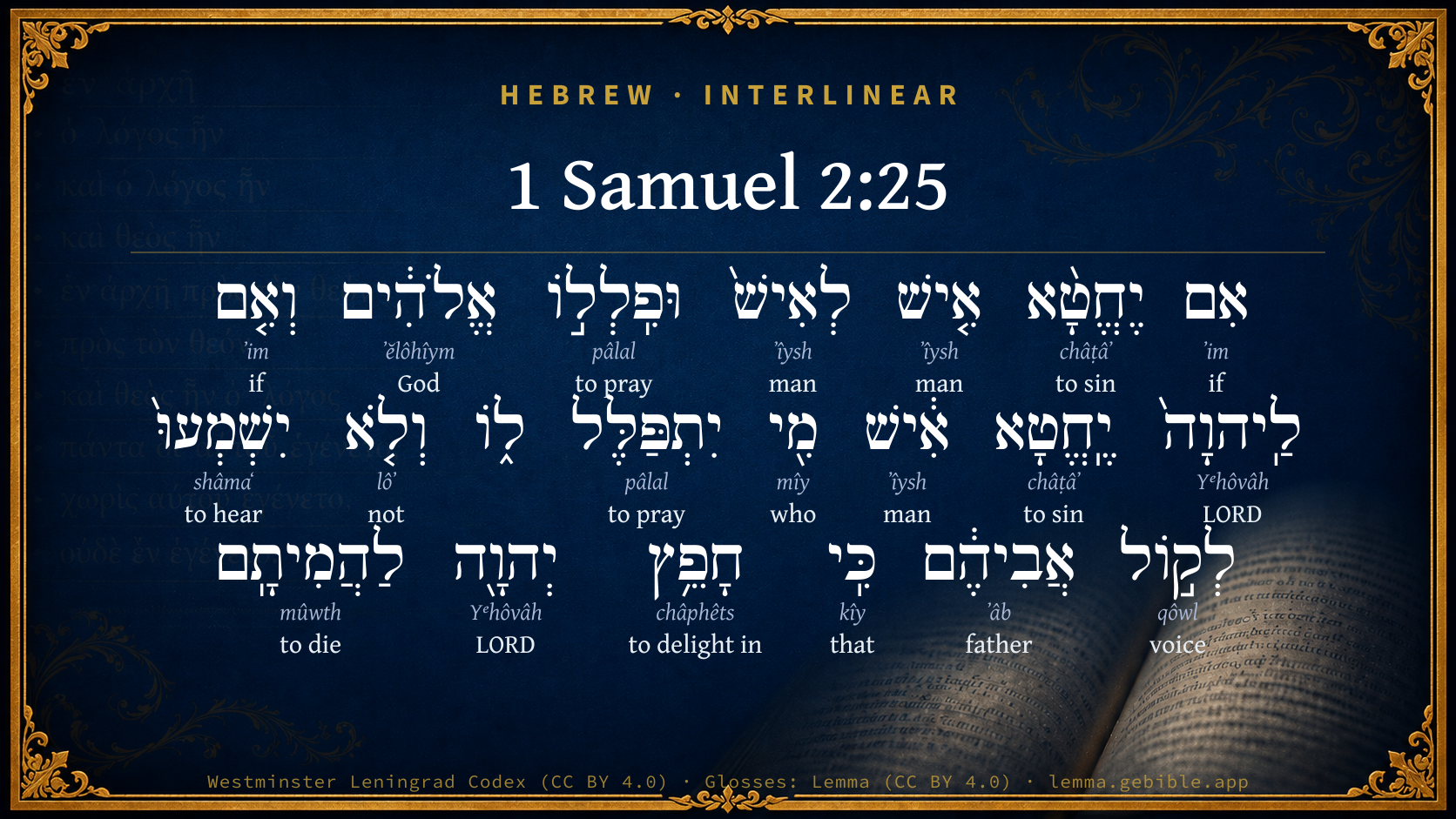
Hebrew (Westminster Leningrad Codex) 1 Samuel 2:25 appears in the Hebrew Old Testament. The text above is from the Westminster Leningrad Codex. Each word links to its Strong’s number, a concise gloss, and parsing drawn from the Open Scriptures Hebrew Bible morphology. Click any word for its full Brown-Driver-Briggs (BDB) entry.
Download image
Cite this verse

1 Samuel 2:25 (World English Bible). Public Domain. Lemma interlinear Bible study tool, https://lemma.gebible.app/v/1-samuel/2/25.

Show BibTeX & RIS
BibTeX
RIS
English Translation
If one man sin against another, God shall judge him; but if a man sin against Yahweh, who shall entreat for him? Notwithstanding, they didn't listen to the voice of their father, because Yahweh was minded to kill them.
World English Bible · Public Domain
Download a study sheet

One document with this verse’s original text, its word-by-word gloss line, the meaning frame, cross-references with their text, attributed commentary, and full source and license credits — printable, and it pastes into notes with its structure intact.

This verse Autodidact and up

Study sheet (.html) Plain text (.txt)

A passage Seminary Student

Up to 50 verses in one chapter. A passage sheet keeps up to 6 commentary sources and 12 cross-references per verse, in the order this page ranks them, and says so on the sheet whenever that leaves anything out. Ask for a single verse and you get the Autodidact verse sheet above.

Everything on this page stays free to read, with no account — the sheet is a download of what is already on screen, not access to it.

Want to remove ads? Support Godless Engineer
Compare translations 3

The same verse in 3 English versions, stacked beneath the original-language interlinear above. Click any original word for its lexicon entry.

Each is an independent rendering of the whole verse — the interlinear is not word-aligned to these translations.

Highlighted words mark where these versions differ — a whole-verse word diff, not a word-by-word alignment.

  • World English Bible Public Domain
    If one man sin against another, God shall judge him; but if a man sin against Yahweh, who shall entreat for him? Notwithstanding, they didn't listen to the voice of their father, because Yahweh was minded to kill them.
  • King James Version Public Domain
    If one man sin against another, the judge shall judge him: but if a man sin against the LORD, who shall entreat for him? Notwithstanding they hearkened not unto the voice of their father, because the LORD would slay them.
  • unfoldingWord Literal Text CC BY-SA 4.0
    If a man sins against a man, then God will intercede for him, but if a man sins against Yahweh, who will intercede for him?” But they would not listen to the voice of their father, for Yahweh desired to make them die.

unfoldingWord Literal Text — © unfoldingWord, licensed CC BY-SA 4.0. Word-aligned USFM3 via Door43 (git.door43.org/unfoldingWord/en_ult).

Versions to compare (up to 4)

3 of 4 selected

Show all 18 translations

Every available English version of this verse, each an independent rendering of the whole verse.

  • World English Bible Public Domain
    If one man sin against another, God shall judge him; but if a man sin against Yahweh, who shall entreat for him? Notwithstanding, they didn't listen to the voice of their father, because Yahweh was minded to kill them.
  • Berean Standard Bible Public Domain
    If a man sins against another man, God can intercede for him; but if a man sins against the LORD, who can intercede for him?” But they would not listen to their father, since the LORD intended to put them to death.
  • Majority Standard Bible Public Domain
    If a man sins against another man, God can intercede for him; but if a man sins against the LORD, who can intercede for him?” But they would not listen to their father, since the LORD intended to put them to death.
  • King James Version Public Domain
    If one man sin against another, the judge shall judge him: but if a man sin against the LORD, who shall entreat for him? Notwithstanding they hearkened not unto the voice of their father, because the LORD would slay them.
  • American Standard Version (1901) Public Domain
    If one man sin against another, God shall judge him; but if a man sin against Jehovah, who shall entreat for him? Notwithstanding, they hearkened not unto the voice of their father, because Jehovah was minded to slay them.
  • Revised Version (1885) Public Domain
    If one man sin against another, God shall judge him: but if a man sin against the LORD, who shall entreat for him? Notwithstanding they hearkened not unto the voice of their father, because the LORD would slay them.
  • Geneva Bible (1599) Public Domain
    If one man sinne against another, the Iudge shall iudge it: but if a man sinne against the Lord, who will pleade for him? Notwithstanding they obeyed not the voyce of their father, because the Lord would slay them.
  • Douay-Rheims (1899) Public Domain
    If one man shall sin against another, God may be appeased in his behalf: but if a man shall sin against the Lord, who shall pray for him? And they hearkened not to the voice of their father, because the Lord would slay them.
  • Young's Literal Translation Public Domain
    If a man sin against a man, then hath God judged him; but if against Jehovah a man sin, who doth pray for him?' and they hearken not to the voice of their father, though Jehovah hath delighted to put them to death.
  • Literal Standard Version CC BY-SA 4.0
    If a man sins against a man, then God has judged him; but if a man sins against YHWH, who prays for him?” And they do not listen to the voice of their father, though YHWH has delighted to put them to death.
  • Unlocked Literal Bible CC BY-SA 4.0
    “If one man sins against another, God will judge him; but if a man sins against Yahweh, who will speak for him?” But they would not listen to the voice of their father, because Yahweh intended to kill them.
  • unfoldingWord Literal Text CC BY-SA 4.0
    If a man sins against a man, then God will intercede for him, but if a man sins against Yahweh, who will intercede for him?” But they would not listen to the voice of their father, for Yahweh desired to make them die.
  • Darby Bible Public Domain
    If one man sin against another, God will judge him; but if a man sin against Jehovah, who shall intreat for him? But they hearkened not to the voice of their father, for Jehovah was minded to slay them.
  • World Messianic Bible Public Domain
    If one man sins against another, God will judge him; but if a man sins against the LORD, who will intercede for him?” Notwithstanding, they didn’t listen to the voice of their father, because the LORD intended to kill them.
  • Webster's Bible Public Domain
    If one man shall sin against another, the judge shall judge him: but if a man shall sin against the LORD, who shall entreat for him? Notwithstanding they hearkened not to the voice of their father, because the LORD would slay them.
  • Free Bible Version CC BY-SA 4.0
    If a man sins against someone, God can intercede for him; but if a man sin against the Lord, who is going to intercede for him?” But they didn't pay attention to what their father said, for the Lord was planning to put them to death.
  • Bible in Basic English Public Domain
    If one man does wrong to another, God will be his judge: but if a man's sin is against the Lord, who will take up his cause? But they gave no attention to the voice of their father, for it was the Lord's purpose to send destruction on them.
  • JPS Tanakh (1917) Public Domain
    If one man sin against another, God shall judge him; but if a man sin against the LORD, who shall entreat for him?' But they hearkened not unto the voice of their father, because the LORD would slay them.

Literal Standard Version (2020), Covenant Press — licensed CC BY-SA 4.0. Text via the HelloAO Bible API (eBible.org). Unlocked Literal Bible (unfoldingWord) — licensed CC BY-SA 4.0. Text via the HelloAO Bible API (eBible.org). unfoldingWord Literal Text — © unfoldingWord, licensed CC BY-SA 4.0. Word-aligned USFM3 via Door43 (git.door43.org/unfoldingWord/en_ult). Free Bible Version, Dr. Jonathan Gallagher — licensed CC BY-SA 4.0. Text via the HelloAO Bible API (eBible.org).

Word by word

More ways to search: Search by grammar → Find every occurrence → Compare this word →

Practice this passage: Drill this verse → Learn its vocabulary →

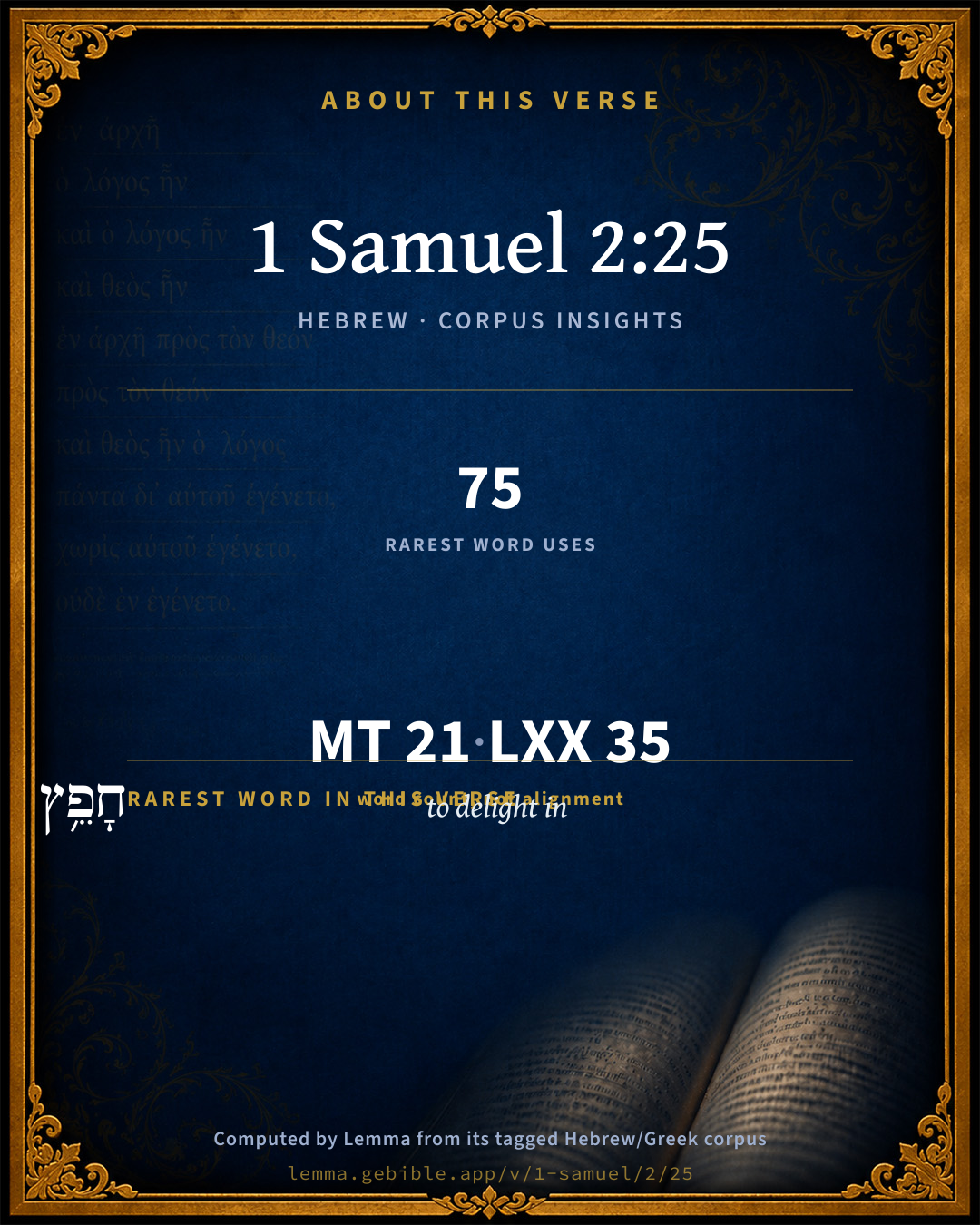
חָפֵ֥ץ
châphêts
H2654
“to delight in”
Verb, Qal, Perfect, 3rd Person, Masculine, Singular
Part of Speech
Verb
Stem
Qal
Form
Perfect
Person
3rd Person
Gender
Masculine
Number
Singular
Full BDB Definition

Origin: a primitive root

TWOT: 712 , 713

to delight in, take pleasure in, desire, be pleased with - (Qal) - of men - to take pleasure in, delight in - to delight, desire, be pleased to do - of God - to delight in, have pleasure in - to be pleased to do - to move, bend down - (Qal) to bend down
  1. אִם ʼim H518 “if” Conjunction
  2. יֶחֱטָ֨א châṭâʼ H2398 “to sin” Verb, Qal, Imperfect, 3rd Person, Masculine, Singular
  3. אִ֤ישׁ ʼîysh H376 “man” Noun, Common, Masculine, Singular, Absolute
  4. לְאִישׁ֙ ʼîysh H376 “to/for · man” Preposition + Noun, Common, Masculine, Singular, Absolute
  5. וּפִֽלְל֣וֹ pâlal H6419 “and · to pray · him” Conjunction + Verb, Piel, Sequential Perfect, 3rd Person, Masculine, Singular + Suffix, Personal, 3rd Person, Masculine, Singular
  6. אֱלֹהִ֔ים ʼĕlôhîym H430 “God(s)” Noun, Common, Masculine, Plural, Absolute
  7. וְאִ֤ם ʼim H518 “and · if” Conjunction + Conjunction
  8. לַֽיהוָה֙ Yᵉhôvâh H3068 “to/for · LORD” Preposition + Noun, Proper
  9. יֶֽחֱטָא châṭâʼ H2398 “to sin” Verb, Qal, Imperfect, 3rd Person, Masculine, Singular
  10. אִ֔ישׁ ʼîysh H376 “man” Noun, Common, Masculine, Singular, Absolute
  11. מִ֖י mîy H4310 “who” Particle, Interrogative
  12. יִתְפַּלֶּל pâlal H6419 “to pray” Verb, Hithpael, Imperfect, 3rd Person, Masculine, Singular
  13. וְלֹ֤א lôʼ H3808 “and · not” Conjunction + Particle, Negative
  14. יִשְׁמְעוּ֙ shâmaʻ H8085 “to hear” Verb, Qal, Imperfect, 3rd Person, Masculine, Plural
  15. לְק֣וֹל qôwl H6963 “to/for · voice of” Preposition + Noun, Common, Masculine, Singular, Construct
  16. אֲבִיהֶ֔ם ʼâb H1 “father · their” Noun, Common, Masculine, Singular, Construct + Suffix, Personal, 3rd Person, Masculine, Plural
  17. כִּֽי kîy H3588 “that” Conjunction
  18. יְהוָ֖ה Yᵉhôvâh H3068 “LORD” Noun, Proper
  19. לַהֲמִיתָֽם mûwth H4191 “to die · them” Preposition + Verb, Hiphil, Infinitive Construct + Suffix, Personal, 3rd Person, Masculine, Plural

About this verse

These counts appear in no published source. They are computed here, from the morphology-tagged text and Lemma’s own curated glosses. What Lemma adds →

21
words
14
distinct lemmas
Historical
section

Grammatical profile

  • 7 verbs
  • 8 nouns
  • 1 preposition
  • 3 conjunctions
  • 2 particles

Verb forms

  • יֶחֱטָ֨א Qal · Imperfect
  • וּפִֽלְל֣וֹ Piel · Sequential Perfect
  • יֶֽחֱטָא Qal · Imperfect
  • יִתְפַּלֶּל Hithpael · Imperfect
  • יִשְׁמְעוּ֙ Qal · Imperfect
  • חָפֵ֥ץ Qal · Perfect
  • לַהֲמִיתָֽם Hiphil · Infinitive Construct

Repetition

Words recur within this verse — often emphatic in Hebrew:

  • אִ֤ישׁ man H376 ×3
  • יֶחֱטָ֨א to sin H2398 ×2
  • וּפִֽלְל֣וֹ to pray H6419 ×2
  • לַֽיהוָה֙ LORD H3068 ×2
  • אִם if H518 ×2

Hebrew & Septuagint length

In English translation the verse runs 39 words from the Hebrew and 50 from the Septuagint (LXX English) — closely comparable.

A rough comparison of the two English renderings, which tokenize alike — not a word-level alignment.

Word counts can differ between the Hebrew and the Greek without any difference in meaning — e.g. the Hebrew direct-object marker אֵת has no separate Greek word, and Greek often adds the article ὁ.

In the original languages it is 21 Hebrew tokens and 35 Greek tokens — but the two are counted differently (Hebrew bundles its prefixes and suffixes into one token; the Greek is in lemma form), so that isn’t a like-for-like length.

Cross-references

15

Topical passages linked to 1 Samuel 2:25 in the Treasury of Scripture Knowledge — connected by theme and wording, ordered by reader-vote popularity; previews shown in the World English Bible.

  • 1 Samuel 3:14 Therefore I have sworn to the house of Eli, that the iniquity of Eli's house shall not be expiated with sacrifice nor offering forever.
  • Hebrews 10:26 For if we sin willfully after we have received the knowledge of the truth, there remains no more a sacrifice for sins,
  • Joshua 11:20 For it was of Yahweh to harden their hearts, to come against Israel in battle, that he might utterly destroy them, that they might have no favor, but that he might destroy them, as Yahweh commanded Moses.
  • Numbers 15:30 But the soul who does anything with a high hand, whether he is home-born or a foreigner, the same blasphemes Yahweh; and that soul shall be cut off from among his people.
  • Proverbs 15:10 There is stern discipline for one who forsakes the way: Whoever hates reproof shall die.
  • 1 Timothy 2:5 For there is one God, and one mediator between God and men, the man Christ Jesus,
  • Hebrews 7:25 Therefore he is also able to save to the uttermost those who draw near to God through him, seeing he ever lives to make intercession for them.
  • Deuteronomy 1:17 You shall not show partiality in judgment; you shall hear the small and the great alike; you shall not be afraid of the face of man; for the judgment is God's: and the cause that is too hard for you, you shall bring to me, and I will hear it.
  • 2 Chronicles 25:16 It happened, as he talked with him, that [the king] said to him, Have we made you of the king's counsel? Stop! Why should you be struck down? Then the prophet stopped, and said, I know that God has determined to destroy you, because you have done this, and have not listened to my counsel.
  • Psalms 51:4 Against you, and you only, have I sinned, And done that which is evil in your sight; That you may be proved right when you speak, And justified when you judge.
  • John 12:39–40 For this cause they couldn't believe, for Isaiah said again,
  • Deuteronomy 2:30 But Sihon king of Heshbon would not let us pass by him; for Yahweh your God hardened his spirit, and made his heart obstinate, that he might deliver him into your hand, as at this day.
  • Deuteronomy 17:8–12 If there arise a matter too hard for you in judgment, between blood and blood, between plea and plea, and between stroke and stroke, being matters of controversy within your gates; then shall you arise, and go up to the place which Yahweh your God shall choose;
  • Deuteronomy 25:1–3 If there be a controversy between men, and they come to judgment, and [the judges] judge them; then they shall justify the righteous, and condemn the wicked;
  • Psalms 51:16 For you don't delight in sacrifice, or else I would give it. You have no pleasure in burnt offering.

Cross-references courtesy of OpenBible.info (CC BY 4.0).

Hebrew and Greek witnesses Masoretic Hebrew ↔ Greek Septuagint

The same verse in the two great witnesses to the Old Testament, shown verse-for-verse.

These are two independent witnesses, not word-aligned to each other, and the Septuagint is shown in lemma (dictionary) form.

Hebrew 1 Samuel 2:25 Masoretic · Westminster Leningrad Codex

אִם יֶחֱטָ֨א אִ֤ישׁ לְאִישׁ֙ וּפִֽלְל֣וֹ אֱלֹהִ֔ים וְאִ֤ם לַֽיהוָה֙ יֶֽחֱטָא אִ֔ישׁ מִ֖י יִתְפַּלֶּל ל֑וֹ וְלֹ֤א יִשְׁמְעוּ֙ לְק֣וֹל אֲבִיהֶ֔ם כִּֽי חָפֵ֥ץ יְהוָ֖ה לַהֲמִיתָֽם

If one man sin against another, God shall judge him; but if a man sin against Yahweh, who shall entreat for him? Notwithstanding, they didn't listen to the voice of their father, because Yahweh was minded to kill them.

World English Bible · Public Domain

Greek LXX 1 Samuel 2:25 Septuagint · lemma form

ἐάν ἁμαρτάνω ἁμαρτάνω ἀνήρ εἰς ἀνήρ καί προςεὔχομαι ὑπέρ αὐτός πρός κύριος καί ἐάν ὁ κύριος ἁμαρτάνω τίς προςεὔχομαι ὑπέρ αὐτός καί οὐ ἀκούω ὁ φωνή ὁ πατήρ αὐτός ὅτι βούλομαι βούλομαι κύριος διαφθείρω αὐτός

If a man should at all sin against another, then shall they pray for him to the Lord; but if a man sin against the Lord, who shall entreat for him? But they listened not to the voice of their father, because the Lord would by all means destroy them.

LXX2012 (modern English Septuagint) · Public Domain

On this verse, Haydock's Catholic Bible Commentary discusses the Septuagint’s reading. Read the note in Commentary ↓

Hebrew: Westminster Leningrad Codex (CC BY 4.0). Greek: Septuagint (public domain); English from LXX2012 (modern English Septuagint) (Public Domain). How the Septuagint differs from the Hebrew →

Targum (Aramaic paraphrase)

1

The Targum is the ancient Jewish Aramaic paraphrase of the Hebrew Scriptures — an interpretive translation, not the Hebrew text itself. Onkelos (literal) and Pseudo-Jonathan (expansive) render the Torah, and Jonathan the Prophets. Coverage is partial: where no permissively-licensed English translation exists for a verse, only the Aramaic is shown. This is verse-level text, not a word-by-word alignment to the Hebrew.

  1. Targum Jonathan Prophets (Joshua–Malachi)
    אִם יֵחוֹב גְבַר לִגְבַר הֲלָא יֵיתוּן לָקֳדָם דַיָנָא וְיִשְׁמַע מִלֵיהוֹן וְיַפְלֵי בֵינֵיהוֹן וְאִם קֳדָם יְיָ יֵיחוֹב גַבְרָא מִמָן יִבְעֵי וְיִשְׁתְּבֵיק לֵיהּ וְלָא קַבִּילוּ לְמֵימַר אֲבוּהוֹן אֲרֵי רַעֲוָא קֳדָם יְיָ לְקַטָלוּתְהוֹן:

    (no public-domain English translation for this verse)

    Targum Jonathan — Aramaic: “Mikraot Gedolot” (public domain). English: “Sefaria Community Translation” (CC0 1.0 (public-domain dedication)); “London "Chaldee Paraphrase," 1871” (public domain). Text via Sefaria.

Commentary

Notes on 1 Samuel 2:25 from classic Christian and Jewish commentators (each source and its license shown beneath its notes). The classic Christian expositions comment on the surrounding passage and are grouped to its opening verse, so a note may address several verses; the Jewish commentaries on the Tanakh (Rashi and others) are per-verse, so they appear only where the commentator wrote on this verse.

Lemma curates 59 commentaries, every one of them public domain or Creative Commons licensed, each selected and text-cleaned for this edition rather than reprinted as found. About our sources →

Trapp's Complete Commentary

John Trapp

1Sa 2:25 If one man sin against another, the judge shall judge him: but if a man sin against the LORD, who shall intreat for him? Notwithstanding they hearkened not unto the voice of their father, because the LORD would slay them.

Ver. 25. If one man sin against another.] The magistrate or umpire may compose the difference in such a case, and piece them together again, if they be not implacable, and if their hearts be not bigger than their suits.

But if a man sin against the Lord,] i.e., Directly in things concerning his service, and purposely to offend him. {Lev 15:30} Saul killed the priests to be avenged on the Lord, who had set up David.

Who shall intreat for him?] Who shall be his daysman? Quid ergo si iacerdos ipse peccet? &c. What then if the priest himself, whose office is to offer sacrifice, and to intercede for others, fall into foul offences, as Cyprian {a} gravely argueth, since the means of atonement is thereby perverted and taken away? I read not in Scripture of a hypocrite’s conversion; and what wonder? for whereas after sin, conversion is left as a means to cure all other sins, what means to recover him who hath converted conversion itself into sin?

Notwithstanding they hearkened not unto the voice of their father.] Who should therefore have thrust them out of the priesthood, as the father of Marcion, a godly bishop, expelled him from the Church for fornication.

Because the Lord would slay them.] God withdrew his grace from them, and gave them up to a hard heart that could not repent, that they might perish in their corruptions. This text then maketh nothing at all for the Novatians, who denied pardon to the penitent. {b} These sinners against their own souls perished by their pertinacy, or rather obstinacy in wicked practices.

{a} Lib. i. epist. 3.

{b} Amb., lib. i. De Paenit., cap. 8.

John Trapp, A Commentary or Exposition upon All the Books of the Old and New Testament (1647–1656) — public domain. Text from a community e-Sword module.

The Biblical Illustrator

Joseph S. Exell

1Sa_2:25

If one man sin against another, the judge shall judge him.

The sinners friend

Even had we no revelation on the subject, a future judgment would be inferred by us from reason; for we should be led by analogy to conclude, that, as when one man sinned against another the judge judged him and awarded his punishment, so God would certainly enter into judgment with those who sinned against Him. We are taught it in Gods dealings both with individuals and nations; we are told it in the plainest terms. We see it, in the expulsion of our guilty first parents from the once happy Eden. We see it, in the fire and brimstone which consumed Sodom and Gomorrah. If one man sin against another, the judge shall judge him. Thanks be to God for this arrangement: judges are his vicegerents on earth, and bear the sword for Him. Thankful ought we to be for this blessing; for laws and magistrates and judges--the powers that be--are ordained of God. Without them, the bonds of society would be broken in sunder; the bonds of iniquity would everywhere prevail. If when one man sins against another, the judge judges and condemns him, what shall be done when God cometh to judgment? If an earthly judge can punish severely a sinner on earth, how shall not God terribly judge and punish sinners in His great day! If a judge can pass sentence for the punishment of a mans person or the taking away of his life here, how much more shall God pass sentence on the soul for an eternal hereafter! If there be none to put in an arrest of judgment for a condemned sinner now, who shall entreat, who shall save, when God shall pass judgment then? If the whole of the machinery employed for putting in force laws passed by man on earth, be of an arresting and startling nature, how much more when God shall enter into judgment with the breakers of His law! If an accused person on trial here would employ an able advocate to plead his cause, how much more shall we need and desire the help of one to entreat for us when standing at the bar of God! If we anxiously watch the chain and tissue of evidence produced before the judge in courts of assize holden here, shall we not with intense solicitude mark the evidence produced from the books which are to be opened and exposed to view in that great day. God has denounced His judgment against sin, and has passed the sentence on the sinner, the soul that sinneth it shall die. Now Gods truth and Gods justice are the pillars which support His throne; and these, admitting of no room for the exhibition of unconditional mercy, demand the execution of the sentence, part of which has already taken effect, the other part is hanging over our heads. In Adam we are all dead; on account of his sin in paradise, guilt and ruin were entailed upon us: we are partakers in his fall and in the consequences of his fall, he being our covenant head. And, must this be our inevitable doom--must all mankind perish everlastingly? because we have all sinned against the Lord, is there none to entreat for us? It was so once. God the Father planned the scheme of a vicarious sacrifice: God the Son, by assuming human nature and dying in its form, offered that sacrifice in the very person of the sinner. But are there any here who look to some other than Christ to entreat for them? The hope is vain. The expectation cannot be realised. There is but one mediator between God and man, and that Mediator is Christ. No creature can entreat for another: the desperateness of our case is so great, that the united force of men and angels can never reach it. Are there any, who fondly hope that they have no need of a Saviour to entreat for them? who put their trust in good deeds? This is a delusive hope. Here, then, I come to the practical part of my subject. We must all stand before the judgment seat: we shall all need Jesus Christ to entreat for us with God then. I beseech you, then, to flee for refuge to Him, that Saviour who gave Himself a ransom for all. Make Him your friend now, and you shall not lack one to entreat for you when the heavens are riven, and the Almighty Judge descends to hold that grand assize, which will award to all their everlasting doom. (E. J. Wilcocks, M. A.)

If a man sin against the Lord who shall entreat for him?--

Reasons why man cannot entreat for us

1. Man cannot entreat for you because he is of your class. We are all in the same boat. One man has sinned one way, another a different way; but they are both sinners. The difficulty is that a man thinks that because another does not sin in his way, the other is the greater sinner. That is the mischief.

2. Again, man cannot entreat for us, because the offence is not against man.

3. No man can entreat for us because he does not know what the offence is, and nobody else can help him to know. Black never looks so black as when it is against white. The sun does not make the dust, the sun reveals it. We cannot see our offence, as its far-reaching, its depth, its corruptness, its awfulness; only God knows what sin is. Who then shall entreat? Here comes the great Gospel of Grace. Jesus did not die instead of us, He died for us. He says: I only came to meet this great problem; reconciliation must come by grace; eternity must help time; the heavens must come to redeem the earth. I have come to seek and to save that which was lost. If one man sin against another judge and save him, but if a man sin against God, how then? (Christian Weekly.)

The Biblical Illustrator, edited by Joseph S. Exell (c. 1880s–1900s) — public domain. Text from a community e-Sword module.

Joseph Benson's Commentary

1Sa 2:25. If one man sin against another, &c. — If only man be wronged, man can set the matter right, and reconcile the persons. If a man sin against the Lord — As you have done, wilfully and presumptuously; who shall entreat for him? — The offence is of so high a nature that few or none will dare to intercede for him, but will leave him to the just judgment of God. The words may be rendered, Who shall judge for him? Who shall interpose as umpire between God and him? Who shall compound that difference? None can or dare do it. And therefore he must be left to the dreadful but righteous displeasure of God. Eli reasoned well; but reasoning was not sufficient, nor any reproof he could have given in this case. It demanded a more serious interference; and he ought not to have referred their punishment unto God, when it was in his power to have punished them himself. They hearkened not, &c., because the Lord would slay them — Or, as the Hebrew may be rendered, Therefore the Lord would slay them. The sense, however, according to the common translation, is Scriptural and good. They had disregarded many admonitions, which, no doubt, their father had given them; they had now hardened their hearts, and sinned away their day of grace, and therefore God had given them up to a reprobate mind, and determined to destroy them, 2Ch 25:16.

Joseph Benson's Commentary on the Old and New Testaments (1811–1818) — public domain. Text from a community e-Sword module.

Tyndale Open Study Notes

Tyndale Open Resources

2:25 God (or the judges; Hebrew ’elohim): The Hebrew verb translated mediate is plural here, and when ’elohim means “God,” it often appears with a singular verb. In addition, some ancient translations render ’elohim as “judges” here. If that is the correct translation, then the judges would mediate for the guilty party in a common human court. However, many Hebrew scholars believe that ’elohim should never be translated “judges.” If this is the case, in what sense could God mediate for the guilty party? Possibly Eli considered the court verdict to come directly from God. God might work through his revealed law or other circumstances to either acquit or convict an individual charged with wrongdoing. Or Eli might have been referring to the sacrificial system. • The sexual immorality (2:22) and gluttony (2:12-17) of Eli’s sons were sins against the Lord because they were corrupting Israel’s worship of him. No one can intercede for sinners who rebel so completely against God’s will (cp. Matt 12:31). • Eli’s sons did not listen to their father because the Lord had already begun to punish them by hardening their hearts (cp. Exod 4:21; 7:3; 8:15-32; 10:27; 11:10).

Tyndale Open Study Notes — © Tyndale Open Resources, licensed CC BY-SA 4.0. Text via the HelloAO Bible API.

Geneva Bible (1599)

Geneva Bible translators

So that to obey good admonitions is God’s mercy, and to disobey them is his just judgment for sin.

Geneva Bible (1599) marginal notes — public domain. Text via Bolls.life.

Jamieson, Fausset & Brown

Robert Jamieson, A. R. Fausset & David Brown

they hearkened not unto the voice of their father, because--it should be therefore.

the Lord would slay them--It was not God's preordination, but their own wilful and impenitent disobedience which was the cause of their destruction.

Jamieson, Fausset & Brown — Commentary Critical and Explanatory on the Whole Bible (1871) — public domain (CC PDM 1.0). Text via the HelloAO Bible API.

Adam Clarke's Commentary

Verse 25. If one man sin against another] All differences between man and man may be settled by the proper judge; but if a man sin against the Supreme Judge, God himself, who shall reconcile him to his Maker? Your sin is immediately against God himself, and is the highest insult that can be offered, because it is in the matter of his own worship, therefore ye may expect his heaviest judgments.

But if a man sin against the Lord, who shall entreat for him?] This was a question of the most solemn importance under the old covenant, especially after the death of Moses, the mediator. The law had determined what sins should be punished with death; and it was supposed that there was not any appeal from the decision there pronounced. 1Jo 2:1 is an answer to this question; but it is an answer which the Gospel alone can give: My little children, these things write I unto you, that ye sin not; but if any man sin, we have an Advocate with the Father, Jesus Christ the righteous.

Because the Lord would slay them.] The particle כי ki, which we translate because, and thus make their continuance in sin the effect of God's determination to destroy them, should be translated therefore, as it means in many parts of the sacred writings. See Noldius's Particles, where the very text in question is introduced: Sed non auscultarunt, c., IDEO voluit Jehova eos interficere "But they would not hearken, c. THEREFORE God purposed to destroy them." It was their not hearkening that induced the Lord to will their destruction.

Adam Clarke's Commentary on the Bible (1810–1826) — public domain. Text from a community e-Sword/MySword module.

Ellicott's Commentary for English Readers

(25) Sin against the Lord.—This touches on the mystery of sin. There are transgressions which may again and again receive pardon, but there seems to be a transgression beyond the limits of Divine forgiveness. The pitiful Redeemer, in no obscure language, told His listeners the same awful truth when He warned them of the sin against the Holy Ghost.

They hearkened not . . . because the Lord would slay them.—Here the mysteries connected with God’s foreknowledge and man’s free-will are touched upon. The Lord’s resolution to slay them was founded on the eternal foreknowledge of their persistence in wrong-doing.

There seems to be a period in the sinner’s life when the Spirit of the Eternal ceases to plead; then the man is left to himself, and he feels no longer any remorse for evil done; this is spoken of in Exo_4:21 as “hardening the heart.” This period in the life of Hophni and Phinehas apparently had been reached when the Lord resolved to slay them.

A Bible Commentary for English Readers, edited by Charles John Ellicott (1878–1897) — public domain. Text from a community e-Sword module.

The Cambridge Bible for Schools and Colleges

gen. ed. J. J. S. Perowne

25. If one man &c.] Better,

If a man sin against a man, then Elohim shall judge him:

but if a man sin against Jehovah, who shall intercede for him?

For man’s offences against his fellow-man, there is a third superior party to arbitrate and rectify the wrongs, namely God, or God’s representative, the duly appointed judge: but for man’s offences against Jehovah, there is no third superior party to intercede as a mediator.

This is most likely an ancient proverb, quoted by Eli to impress his sons with a sense of the enormity of their sins, which were committed against Jehovah. The point is obscured by the impossibility of translating the paronomasia of the Hebrew which expresses “judge” and “intercede” by different voices of the same verb.

the judge] Heb. Elôhîm, i.e. God. Judges, as the representatives of God in executing justice on earth (Deu_1:17), are sometimes styled gods (Exo_21:6; Exo_22:8-9; Psa_82:1; Psa_82:6), but it seems best not to limit the present passage to human judgments.

because the Lord would slay them] Literally, was pleased to slay them. Compare the language of Exo_4:21, and Jos_11:20, where we read that the Lord hardened the hearts of Pharaoh and the Canaanites; and 1Sa_16:14, where it is said that “an evil spirit from the Lord troubled Saul.” Yet we are assured that “the Lord delighteth in mercy” (Mic_7:18), and “hath no pleasure in the death of him that dieth” (Eze_18:32). This coexistence of mercy and judgment in the divine will (Exo_34:6-7) is a mystery which necessarily transcends our comprehension. But it must be carefully noted that it is not till Pharaoh has turned a deaf ear to repeated warnings, not till the Canaanites have polluted themselves with intolerable abominations, that God hardens their hearts; not till Eli’s sons have ignored His existence and defied His laws docs He determine to slay them: not till Saul has set at naught his calling and deserted God, is he deserted by Him. Obstinate impenitence may be judicially punished by the withdrawal of the grace which leads to repentance.

The Cambridge Bible for Schools and Colleges (gen. ed. J. J. S. Perowne; Cambridge University Press, 1878–1918) — public domain. Text from a community e-Sword module.

John Gill's Exposition

And the child Samuel grew up,.... Increased in stature and in grace, grew more and more in all respects, and better and better, while Eli's sons grew worse and worse; the contrast between these make the one to shine and appear illustrious, and the other to look the blacker: or "he went on, and grew, and was good" (z); as he proceeded on in years, and grew in stature, he appeared more and more to be a good man, a virtuous, holy, and gracious person:

and was in favour both with the Lord, and also with men; the Lord was pleased to give him some tokens of his favour, that he delighted in him, that he was wellpleasing in his sight, and that his person and services were acceptable to him; and the more Eli's sons disgusted the people by their ill lives and conduct, the greater esteem among them did Samuel obtain by his becoming life and conversation; all admired him, spoke well of him, and thanked God that in such bad times he was raising up one among them, of whom they had the most hopeful prospect of usefulness to them.

(z) "ambulans, et grandescens et bonus", Montanus; so Vatablus & Drusius.

John Gill's Exposition of the Whole Bible (1746–1763) — public domain (CC PDM 1.0). Text via the HelloAO Bible API.

Albert Barnes' Notes on the Bible

The sense seems to be, If one man sin against another, the judge shall amerce him in the due penalty, and then he shall be free; but if he sin against the Lord, who shall act the part of judge and arbiter for him? His guilt must remain to the great day of judgment.

Because the Lord would slay them - There is a sense in which whatever comes to pass is the accomplishment of God’s sovereign will and pleasure, and all the previous steps, even when they involve moral causes, by which this will and pleasure are brought about, are in this sense also brought about by God. How this truth, which reason and revelation alike acknowledge, consists with man’s free will on the one hand; or, when the evil deeds and punishment of a sinner are some of the previous steps, with God’s infinite mercy and love on the other, is what cannot possibly be explained. We can only firmly believe both statements,

(1) that God hath no pleasure in the death of him that dieth, and that He willeth not the death of a sinner, but rather that he should be converted and live;

(2) that the sins and the punishments of sin are accomplishments of God’s eternal purpose (compare the marginal references, and Isa 6:9-10; Mar 4:12; Rom 9:15). It may be explained by saying that in the case of Hophni and Phinehas God’s will to kill them was founded upon His foreknowledge of their impenitence; while from another point of view, in which God’s will is the fixed point, that impenitence may be viewed in its relation to that fixed point, and so dependent upon it, and a necessary step to it.

Albert Barnes' Notes on the Bible (1834–1885) — public domain. Text from a community e-Sword/MySword module.

Haydock's Catholic Bible Commentary

Who shall pray for him. By these words Heli would have his sons understand, that by their wicked abuse of sacred things, and of the very sacrifices which were appointed to appease the Lord, they deprived themselves of the ordinary means of reconciliation with God; which was by sacrifices. The more, because as they were the chief priests, whose business it was to intercede for all others, they had no other to offer sacrifice and make atonement for them. (Challoner) --- We need not, however, consider the words of Heli as an oracle of God. (Sanchez) --- In human transactions, a person would find more difficulty in obtaining pardon, when the judge himself had received the injury. Septuagint, instead of appeased, have "and they shall pray for him." (Menochius) --- Some may be found to plead his cause, but if he offend the judge, who will undertake to be his advocate? What medicines shall be used, when those, which God has appointed, are trodden under foot? (Haydock) --- By persevering in such wickedness, no redress can be expected: and indeed, the infinite distance between God and man, would place an insuperable obstacle to a reconciliation, if Jesus Christ had not undertaken the cause even of the most desperate sinner. (Calmet) --- Because the Lord would slay them. In consequence of their manifold sacrileges, he would not soften their hearts with his efficacious grace, but was determined to destroy them. (Challoner) --- They had filled up the measure of their crimes; and, though God wills not the death of a sinner, they had treasured up to themselves wrath, which he will now display. We might also translate ci, "therefore," (Noldius; Osee ix. 15, &c.) or "that." They would not be convinced that the threat of their father would be executed. (Schmid) (Calmet) --- Sins directly against God, and which hinder his service, are remitted with greater difficulty, though to all true penitents pardon is promised, Ezechiel xxxiii. God did not take away the free will of Ophni and Phinees, but left them to their own obstinacy, and justly punished them. See St. Augustine, contra Jul. v. 3. (Worthington) --- They had already rendered themselves unworthy of extraordinary graces. (Tirinus) (St. Thomas Aquinas, [Summa Theologiae] 1 p. q. 23, n. 3.)

George Leo Haydock (1774–1849), Haydock's Catholic Family Bible and Commentary, 1859 edition — public domain. Excludes Psalms (Douay-Rheims chapter numbering differs from Protestant) and Deuterocanonical books (Catholic canon only).

Matthew Poole's English Annotations

If one man sin against another, by doing any injury.

The judge shall judge him; the magistrate shall by his sentence end the difference, and both parties shall acquiesce in his determination, and so the breach shall be made up. The sense is, if only man be wronged, man can right it, and reconcile the persons.

If a man sin against the Lord, to wit, in such manner as you have done, directly and immediately, in the matters of his worship and service, wilfully and presumptuously.

Who shall entreat for him? the offence is of so high a nature, that few or none will dare to intercede for him, but will leave him to the just judgment of God. He speaks after the manner of men, who do oft intercede with the prince for such as have injured any private person; but will not presume to do so when the injury is committed against his own person. The words are, and may be thus rendered,

Who shall judge for him? Who shall interpose himself as umpire, or arbitrator, between God and him? Who shall compound that difference? None can or dare do it, and therefore he must be left to the dreadful, but righteous judgment of God; which is your case and misery. Because the Lord would slay them, i.e. because God hath determined to destroy them for their many and great sins; and therefore would not and did not give them grace to hearken to Eli’s counsel, and to repent of their wickedness, but hardened their hearts to their destruction.

Matthew Poole's English Annotations on the Holy Bible (1683–1685) — public domain. Text from a community e-Sword/MySword module.

Whedon's Commentary on the Bible

Daniel D. Whedon

25. If one man sin against another — Better and literally, if man sins against man.

The judge shall judge him — Hebrew, God will judge him; that is, by the properly constituted authorities, the priests, Levites, and judges. See Deu_17:8-13. Eli himself was such a judge, and intimates to his sons that in sins of man against man he might hear testimony and decide, and in rendering his judgment be partial and kind to the offender; but in sins against Jehovah he could not render judgment, but the offended Majesty of heaven would take the judgment into his own hands.

If a man sin against the Lord, who shall entreat for him — This question was not put for the purpose of eliciting a direct answer, but to lead these wicked sons to reflection. Yet even such solemn appeals failed.

Because the Lord would slay them — חפצ להמיתם, was inclined to kill them. He had already given them over to judicial blindness. They had made themselves vessels of wrath fitted to destruction, and therefore God had resolved to destroy them.

Daniel D. Whedon (gen. ed.), Commentary on the Old and New Testaments (1874–1909) — public domain. Text from a community e-Sword module.

John Wesley's Explanatory Notes

The judge - If only man be wronged, man can right it, and reconcile the persons. Against the Lord - As you have done wilfully and presumptuously. Who shall, &c. - The offense is of so high a nature, that few or none will dare to intercede for him, but will leave him to the just judgment of God. The words may be rendered, Who shall judge for him? Who shall interpose as umpire, between God and him? Who shall compound that difference? None can or dare do it, and therefore he must be left to the dreadful, but righteous judgment of God. They had now sinned away their day of grace. They had long hardened their hearts. And God at length gave them up to a reprobate mind, and determined to destroy them, 2 Chron. xxv, 16.

John Wesley, Explanatory Notes Upon the Whole Bible (1754–1765) — public domain. Text via the GEBible commentary corpus.

Keil & Delitzsch

C. F. Keil & F. Delitzsch

"If man sins against man, God judges him; but if a man sins against Jehovah, who can interpose with entreaty for him?" In the use of פּללו and יתפּלּל־לו there is a paranomasia which cannot be reproduced in our language. פּלּל signifies to decide or pass sentence (Gen 48:11), then to arbitrate, to settle a dispute as arbitrator (Eze 16:52; Psa 106:30), and in the Hithpael to act as mediator, hence to entreat. And these meanings are applicable here. In the case of one man's sin against another, God settles the dispute as arbitrator through the proper authorities; whereas, when a man sins against God, no one can interpose as arbitrator. Such a sin cannot be disposed of by intercession. But Eli's sons did not listen to this admonition, which was designed to reform daring sinners with mild words and representation; "for," adds the historian, "Jehovah was resolved to slay them." The father's reproof made no impression upon them, because they were already given up to the judgment of hardening. (On hardening as a divine sentence, see the discussions at Exo 4:21.)

Keil & Delitzsch — Biblical Commentary on the Old Testament (1861–1891) — public domain (CC PDM 1.0). Text via the HelloAO Bible API. (Old Testament only.)

unfoldingWord translationNotes

Door43 World Missions Community

who will speak for him?

This rhetorical question can be translated as a statement. AT: "there is certainly no one who can speak for him." (See: Rhetorical Question)

speak for him

"ask Yahweh to have mercy on him"

the voice of their father

Here the father's "voice" represents the father. AT: "their father" or "what their father said" (See: Synecdoche)

translationWords

sin

judge

voice

ancestor

favor

unfoldingWord translationNotes — © Distant Shores Media and the Door43 World Missions Community, licensed CC BY-SA 4.0. Source: git.door43.org/Door43/en_tn.

Rashi

Rabbi Shlomo Yitzchaki (Rashi)

Tries him.וּפִלְלוֹ is an expression of judgment, as in, "and he shall pay by order of the judges ]פְלִילִים[."

Judge. The judge.

For it was Adonoy's will to kill them. For their verdict had already been sealed. Before the verdict is sealed however, Scripture states, "for I do not desire the death of one who should die."

Rashi on the Tanakh — English translations: “The Judaica Press complete Tanach with Rashi, translated by A. J. Rosenberg” (CC BY 4.0); “Pentateuch with Rashi's commentary by M. Rosenbaum and A.M. Silbermann, 1929-1934” (public domain); “The Metsudah Tanach series, Lakewood, N.J” (CC BY 4.0); and “The Book of Joshua, Metsudah Publications, 1997” (CC BY 4.0). Text via Sefaria.

Lesson kit

Teaching starters — assembled from the data on this page, not authored interpretation. Every prompt links to the verse data it draws on. Edit before teaching.

1 Samuel, in the Historical, opens this verse with 21 words (14 distinct Hebrew lemmas). Its most distinctive word is châphêts (“to delight in”). A historical commentator’s framing appears above. Read the whole chapter for the surrounding context.

Discussion questions

  1. How does “to delight in” (châphêts) shape what this verse is saying?
  2. How does 1 Samuel 3:14, which shares this passage’s theme, read alongside this verse?
  3. What does the repetition of “man” (3× in this one verse) do in this verse?
  4. These translations render this verse differently. What is at stake in choosing one wording over another?
  5. «יֶחֱטָ֨א» is a Qal Imperfect verb. How does that grammatical form shape the action described?
  6. Compare how Trapp's Complete Commentary and The Biblical Illustrator read this verse. Where do they agree or differ?

Things to notice

Reading settings

Reading text

Shown beneath each verse's original-language words.

Old Testament
Old Testament edition

Read the OT as the Masoretic Hebrew (MT) or the Greek Septuagint (LXX).

English shown for the Greek Septuagint (in the Hebrew ↔ Greek comparison).

Comparing translations? Open the Compare panel on any verse page to stack up to four side by side.