
Exodus 2:18

Hebrew (Westminster Leningrad Codex) Exodus 2:18 appears in the Hebrew Old Testament. The text above is from the Westminster Leningrad Codex. Each word links to its Strong’s number, a concise gloss, and parsing drawn from the Open Scriptures Hebrew Bible morphology. Click any word for its full Brown-Driver-Briggs (BDB) entry.
Download image
Cite this verse

Exodus 2:18 (World English Bible). Public Domain. Lemma interlinear Bible study tool, https://lemma.gebible.app/v/exodus/2/18.

Show BibTeX & RIS
BibTeX
RIS
English Translation
When they came to Reuel, their father, he said, "How is it that you have returned so early today?"
World English Bible · Public Domain
Download a study sheet

One document with this verse’s original text, its word-by-word gloss line, the meaning frame, cross-references with their text, attributed commentary, and full source and license credits — printable, and it pastes into notes with its structure intact.

This verse Autodidact and up

Study sheet (.html) Plain text (.txt)

A passage Seminary Student

Up to 50 verses in one chapter. A passage sheet keeps up to 6 commentary sources and 12 cross-references per verse, in the order this page ranks them, and says so on the sheet whenever that leaves anything out. Ask for a single verse and you get the Autodidact verse sheet above.

Everything on this page stays free to read, with no account — the sheet is a download of what is already on screen, not access to it.

Want to remove ads? Support Godless Engineer
Compare translations 3

The same verse in 3 English versions, stacked beneath the original-language interlinear above. Click any original word for its lexicon entry.

Each is an independent rendering of the whole verse — the interlinear is not word-aligned to these translations.

Highlighted words mark where these versions differ — a whole-verse word diff, not a word-by-word alignment.

  • World English Bible Public Domain
    When they came to Reuel, their father, he said, "How is it that you have returned so early today?"
  • King James Version Public Domain
    And when they came to Reuel their father, he said, How is it that ye are come so soon to day?
  • unfoldingWord Literal Text CC BY-SA 4.0
    And they came to Reuel their father, and he said, “Why have you hurried coming today?”

unfoldingWord Literal Text — © unfoldingWord, licensed CC BY-SA 4.0. Word-aligned USFM3 via Door43 (git.door43.org/unfoldingWord/en_ult).

Versions to compare (up to 4)

3 of 4 selected

Show all 18 translations

Every available English version of this verse, each an independent rendering of the whole verse.

  • World English Bible Public Domain
    When they came to Reuel, their father, he said, "How is it that you have returned so early today?"
  • Berean Standard Bible Public Domain
    When the daughters returned to their father Reuel, he asked them, “Why have you returned so early today?”
  • Majority Standard Bible Public Domain
    When the daughters returned to their father Reuel, he asked them, “Why have you returned so early today?”
  • King James Version Public Domain
    And when they came to Reuel their father, he said, How is it that ye are come so soon to day?
  • American Standard Version (1901) Public Domain
    And when they came to Reuel their father, he said, How is it that ye are come so soon to-day?
  • Revised Version (1885) Public Domain
    And when they came to Reuel their father, he said, How is it that ye are come so soon today?
  • Geneva Bible (1599) Public Domain
    And whe they came to Reuel their father, he said, Howe are ye come so soone to day?
  • Douay-Rheims (1899) Public Domain
    And when they returned to Raguel their father, he said to them: Why are ye come sooner than usual?
  • Young's Literal Translation Public Domain
    And they come in to Reuel their father, and he saith, `Wherefore have ye hastened to come in to-day?'
  • Literal Standard Version CC BY-SA 4.0
    And they come to their father Reuel, and he says, “Why have you hurried to come in today?”
  • Unlocked Literal Bible CC BY-SA 4.0
    When the girls went to Reuel their father, he said, “Why are you home so early today?”
  • unfoldingWord Literal Text CC BY-SA 4.0
    And they came to Reuel their father, and he said, “Why have you hurried coming today?”
  • Darby Bible Public Domain
    And when they came to Reuel their father, he said, Why are ye come so soon to-day?
  • World Messianic Bible Public Domain
    When they came to Reuel, their father, he said, “How is it that you have returned so early today?”
  • Webster's Bible Public Domain
    And when they came to Reuel their father, he said, How is it that you are come so soon to day?
  • Free Bible Version CC BY-SA 4.0
    When they got home, their father Reuel asked them, “How did you get back so quickly today?”
  • Bible in Basic English Public Domain
    And when they came to Reuel their father, he said, How is it that you have come back so quickly today?
  • JPS Tanakh (1917) Public Domain
    And when they came to Reuel their father, he said: 'How is it that ye are come so soon to-day?'

Literal Standard Version (2020), Covenant Press — licensed CC BY-SA 4.0. Text via the HelloAO Bible API (eBible.org). Unlocked Literal Bible (unfoldingWord) — licensed CC BY-SA 4.0. Text via the HelloAO Bible API (eBible.org). unfoldingWord Literal Text — © unfoldingWord, licensed CC BY-SA 4.0. Word-aligned USFM3 via Door43 (git.door43.org/unfoldingWord/en_ult). Free Bible Version, Dr. Jonathan Gallagher — licensed CC BY-SA 4.0. Text via the HelloAO Bible API (eBible.org).

Word by word

More ways to search: Search by grammar → Find every occurrence → Compare this word →

Practice this passage: Drill this verse → Learn its vocabulary →

רְעוּאֵ֖ל
Rᵉʻûwʼêl
H7467
“Reuel”
Noun, Proper
Part of Speech
Noun
Type
Proper
Full BDB Definition

Origin: from the same as H7466 and H410

TWOT: None

Reuel or Raguel = "friend of God" - a son of Esau by his wife Bashemath, the sister of Ishmael - the father-in-law of Moses - also 'Jethro' - father of Eliasaph, the leader of the tribe of Gad at the time of the census at Sinai - a Benjamite, ancestor of Elah
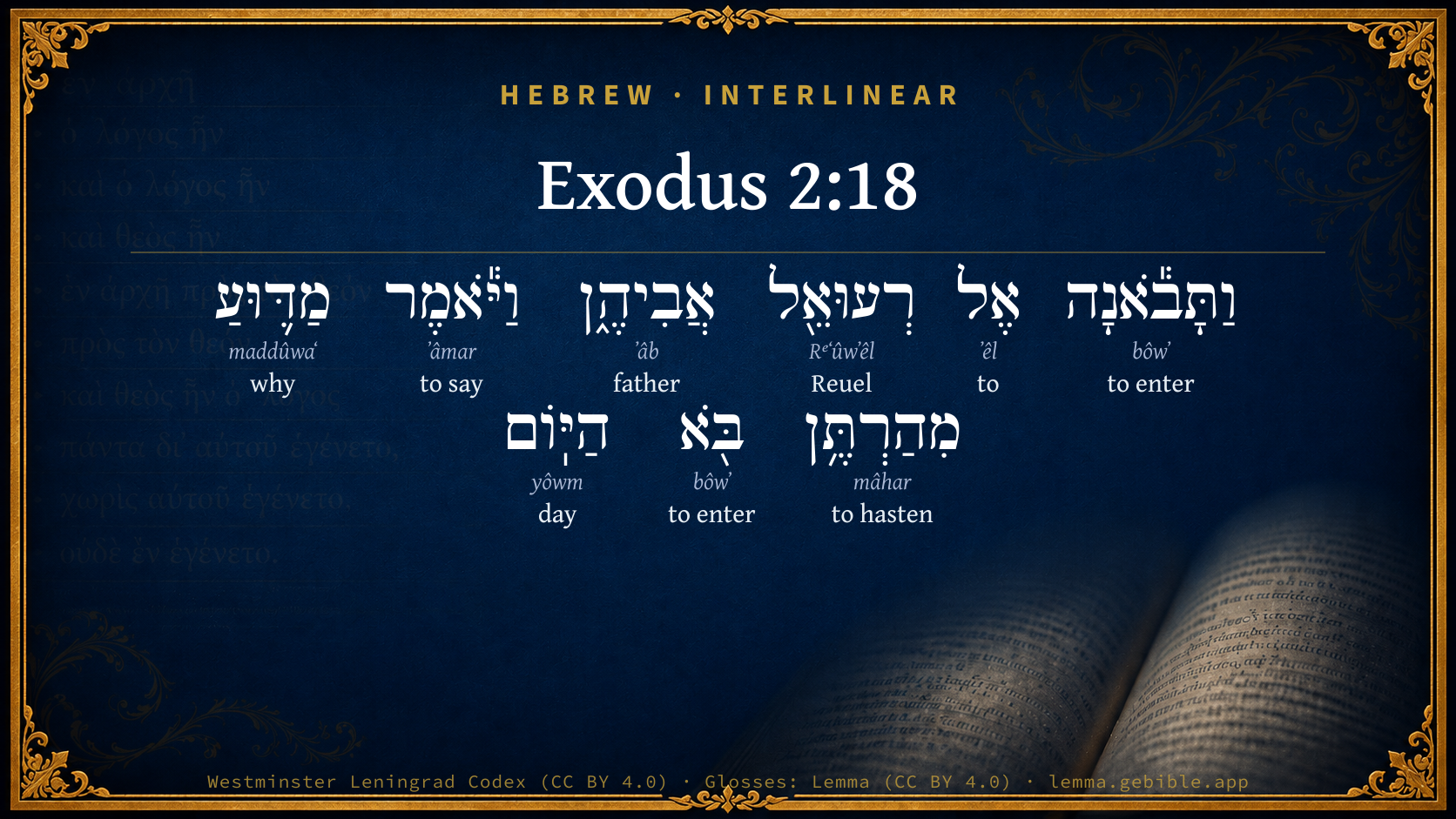
  1. וַתָּבֹ֕אנָה bôwʼ H935 “and · to enter” Conjunction + Verb, Qal, Sequential Imperfect, 3rd Person, Feminine, Plural
  2. אֶל ʼêl H413 “to” Preposition
  3. אֲבִיהֶ֑ן ʼâb H1 “father · their” Noun, Common, Masculine, Singular, Construct + Suffix, Personal, 3rd Person, Feminine, Plural
  4. וַיֹּ֕אמֶר ʼâmar H559 “and · to say” Conjunction + Verb, Qal, Sequential Imperfect, 3rd Person, Masculine, Singular
  5. מַדּ֛וּעַ maddûwaʻ H4069 “why” Particle, Interrogative
  6. מִהַרְתֶּ֥ן mâhar H4116 “to hasten” Verb, Piel, Perfect, 2nd Person, Feminine, Plural
  7. בֹּ֖א bôwʼ H935 “to enter” Verb, Qal, Infinitive Construct
  8. הַיּֽוֹם yôwm H3117 “the · day” Particle, Definite Article + Noun, Common, Masculine, Singular, Absolute

About this verse

These counts appear in no published source. They are computed here, from the morphology-tagged text and Lemma’s own curated glosses. What Lemma adds →

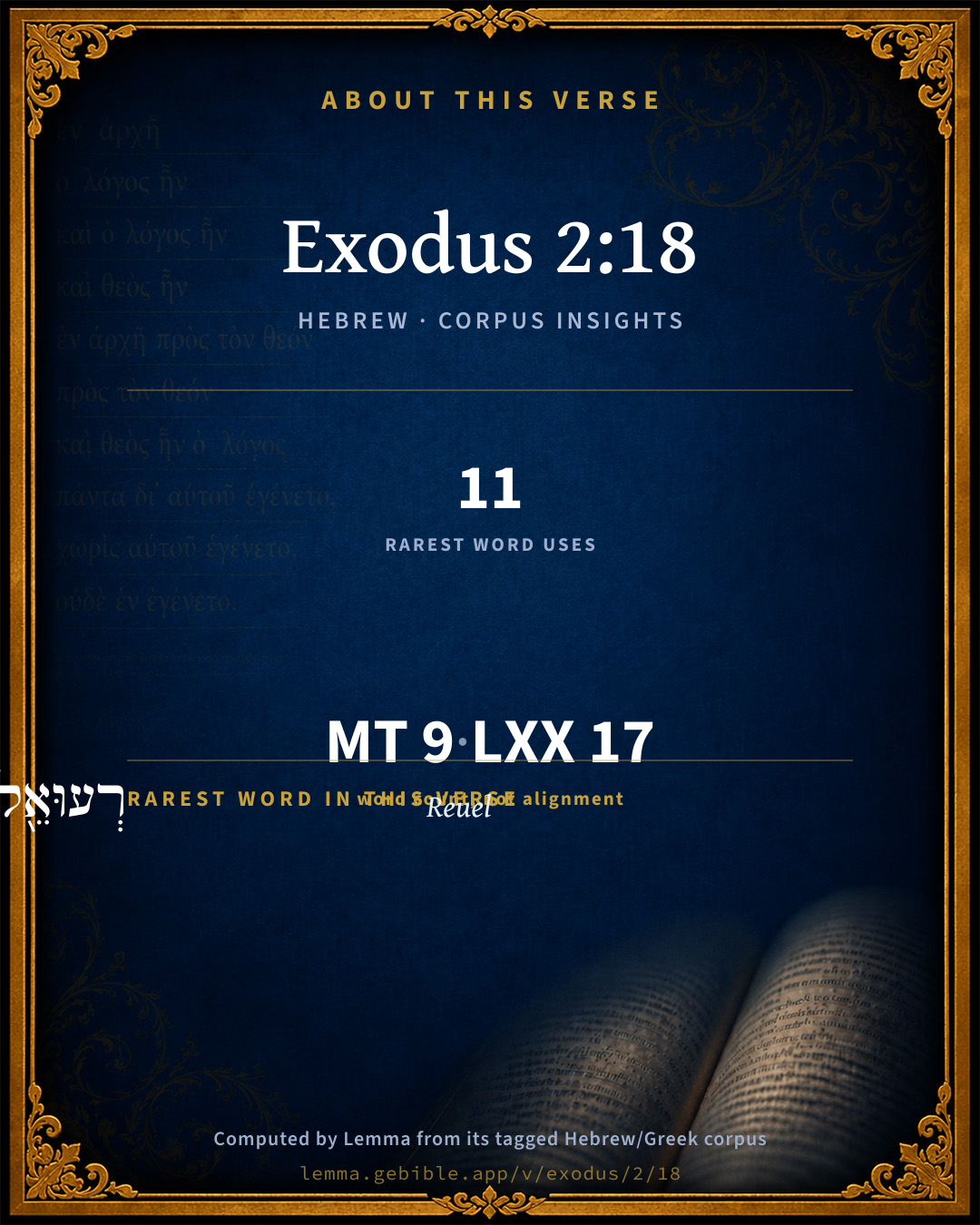
9
words
8
distinct lemmas
Pentateuch
section

Notable vocabulary

The rarest word here is רְעוּאֵ֖ל Reuel H7467 — appearing just 11 times in the whole Hebrew Bible.

Shared distinctive vocabulary

רְעוּאֵ֖ל Reuel H7467 occurs in 10 verses of the Hebrew Bible. Also found in:

Grammatical profile

  • 4 verbs
  • 3 nouns
  • 1 preposition
  • 1 particle

Verb forms

  • וַתָּבֹ֕אנָה Qal · Sequential Imperfect
  • וַיֹּ֕אמֶר Qal · Sequential Imperfect
  • מִהַרְתֶּ֥ן Piel · Perfect
  • בֹּ֖א Qal · Infinitive Construct

Repetition

A word recurs within this verse — often emphatic in Hebrew:

  • וַתָּבֹ֕אנָה to enter H935 ×2

Hebrew & Septuagint length

In English translation the verse runs 19 words from the Hebrew and 19 from the Septuagint (LXX English) — the same length.

A rough comparison of the two English renderings, which tokenize alike — not a word-level alignment.

Word counts can differ between the Hebrew and the Greek without any difference in meaning — e.g. the Hebrew direct-object marker אֵת has no separate Greek word, and Greek often adds the article ὁ.

In the original languages it is 9 Hebrew tokens and 17 Greek tokens — but the two are counted differently (Hebrew bundles its prefixes and suffixes into one token; the Greek is in lemma form), so that isn’t a like-for-like length.

Cross-references

5

Topical passages linked to Exodus 2:18 in the Treasury of Scripture Knowledge — connected by theme and wording, ordered by reader-vote popularity; previews shown in the World English Bible.

  • Exodus 3:1 Now Moses was keeping the flock of Jethro, his father-in-law, the priest of Midian, and he led the flock to the back of the wilderness, and came to God's mountain, to Horeb.
  • Exodus 4:18 Moses went and returned to Jethro his father-in-law, and said to him, "Please let me go and return to my brothers who are in Egypt, and see whether they are still alive." Jethro said to Moses, "Go in peace."
  • Numbers 10:29 Moses said to Hobab, the son of Reuel the Midianite, Moses' father-in-law, We are journeying to the place of which Yahweh said, I will give it you: come you with us, and we will do you good; for Yahweh has spoken good concerning Israel.
  • Exodus 18:1–12 Now Jethro, the priest of Midian, Moses' father-in-law, heard of all that God had done for Moses, and for Israel his people, how that Yahweh had brought Israel out of Egypt.
  • Numbers 19:20 But the man who shall be unclean, and shall not purify himself, that soul shall be cut off from the midst of the assembly, because he has defiled the sanctuary of Yahweh: the water for impurity has not been sprinkled on him; he is unclean.

Cross-references courtesy of OpenBible.info (CC BY 4.0).

Hebrew and Greek witnesses Masoretic Hebrew ↔ Greek Septuagint

The same verse in the two great witnesses to the Old Testament, shown verse-for-verse.

These are two independent witnesses, not word-aligned to each other, and the Septuagint is shown in lemma (dictionary) form.

Hebrew Exodus 2:18 Masoretic · Westminster Leningrad Codex

וַתָּבֹ֕אנָה אֶל רְעוּאֵ֖ל אֲבִיהֶ֑ן וַיֹּ֕אמֶר מַדּ֛וּעַ מִהַרְתֶּ֥ן בֹּ֖א הַיּֽוֹם

When they came to Reuel, their father, he said, "How is it that you have returned so early today?"

World English Bible · Public Domain

Greek LXX Exodus 2:18 Septuagint · lemma form

παραγίγνομαι δέ πρός ραγουηλ ὁ πατήρ αὐτός ὁ δέ εἶπον αὐτός τίς ὅτι ταχύνω ὁ παραγίγνομαι σήμερον

And they came to Raguel their father; and he said to them, Why have you⌃ come so quickly today?

LXX2012 (modern English Septuagint) · Public Domain

On this verse, The Cambridge Bible for Schools and Colleges discusses the Septuagint’s reading. Read the note in Commentary ↓

Hebrew: Westminster Leningrad Codex (CC BY 4.0). Greek: Septuagint (public domain); English from LXX2012 (modern English Septuagint) (Public Domain). How the Septuagint differs from the Hebrew →

Targum (Aramaic paraphrase)

2

The Targum is the ancient Jewish Aramaic paraphrase of the Hebrew Scriptures — an interpretive translation, not the Hebrew text itself. Onkelos (literal) and Pseudo-Jonathan (expansive) render the Torah, and Jonathan the Prophets. Coverage is partial: where no permissively-licensed English translation exists for a verse, only the Aramaic is shown. This is verse-level text, not a word-by-word alignment to the Hebrew.

  1. Targum Onkelos Torah (Genesis–Deuteronomy)
    וַאֲתָאָה לְוַת רְעוּאֵל אֲבוּהֵן וַאֲמַר מָה דֵין אוֹחִיתוּן לְמֵיתֵי יוֹמָא דֵין:

    (no public-domain English translation for this verse)

    Targum Onkelos — Aramaic: “Onkelos Genesis” (public domain); “Onkelos Exodus” (public domain); “Onkelos Leviticus” (public domain); “Onkelos Numbers” (public domain); “Onkelos Deuteronomy” (public domain). English: “Sefaria Community Translation” (CC0 1.0 (public-domain dedication)); “J.W. Etheridge. The Targums of Onkelos and Jonathan Ben Uzziel on the Pentateuch. London: Longmans, Green, 1862” (public domain). Text via Sefaria.

  2. Targum Pseudo-Jonathan Torah (Genesis–Deuteronomy)
    וַאֲתָאָה לְוַת רְעוּאֵל אָבוּהָא דַאֲבוּהוֹן וַאֲמַר מַה דֵין אוֹחֵיתוּן לְמֵיתֵי יוֹמָא דֵין

    And they came to Reuel, their grandfather, who said to them, How is it that you are come (so) early today?

    Targum Pseudo-Jonathan — Aramaic: “Targum Jonathan on Genesis” (public domain); “Targum Jonathan on Exodus” (public domain); “Targum Jonathan on Leviticus” (public domain); “Targum Jonathan on Numbers” (public domain); “Targum Jonathan on Deuteronomy” (public domain). English: “The Targum of Jonathan ben Uzziel, trans. J. W. Etheridge, London, 1862” (public domain). Text via Sefaria.

Commentary

Notes on Exodus 2:18 from classic Christian and Jewish commentators (each source and its license shown beneath its notes). The classic Christian expositions comment on the surrounding passage and are grouped to its opening verse, so a note may address several verses; the Jewish commentaries on the Tanakh (Rashi and others) are per-verse, so they appear only where the commentator wrote on this verse.

Lemma curates 59 commentaries, every one of them public domain or Creative Commons licensed, each selected and text-cleaned for this edition rather than reprinted as found. About our sources →

Trapp's Complete Commentary

John Trapp

Exo 2:18 And when they came to Reuel their father, he said, How [is it that] ye are come so soon to day?

Ver. 18. To Reuel their father.] Indeed, their grandfather. {Num 10:29} Old men are usually about home, and can do little else but see to things, and advise.

John Trapp, A Commentary or Exposition upon All the Books of the Old and New Testament (1647–1656) — public domain. Text from a community e-Sword module.

Joseph Benson's Commentary

Exo 2:18. Reuel — Or Raguel (see Num 10:29) is thought by some to have been their grandfather, and father of Hobab or Jethro, their immediate father.

Joseph Benson's Commentary on the Old and New Testaments (1811–1818) — public domain. Text from a community e-Sword module.

Tyndale Open Study Notes

Tyndale Open Resources

2:18-20 The father of seven daughters was not about to leave a generous and courageous male—excellent husband material—unaccounted for! We see here the well-known hospitality (see also Gen 18:1-8) that characterizes the residents of this region to this day.

Tyndale Open Study Notes — © Tyndale Open Resources, licensed CC BY-SA 4.0. Text via the HelloAO Bible API.

Geneva Bible (1599)

Geneva Bible translators

Or, grandfather.

Geneva Bible (1599) marginal notes — public domain. Text via Bolls.life.

Adam Clarke's Commentary

Verse 18. Reuel, their father] In Nu 10:29 this person is called Raguel, but the Hebrew is the same in both places. The reason of this difference is that the ע ain in רעואל is sometimes used merely as vowel, sometimes as g, ng, and gn, and this is occasioned by the difficulty of the sound, which scarcely any European organs can enunciate. As pronounced by the Arabs it strongly resembles the first effort made by the throat in gargling, or as Meninski says, Est vox vituli matrem vocantis, "It is like the sound made by a calf in seeking its dam." Raguel is the worst method of pronouncing it; Re-u-el, the first syllable strongly accented, is nearer to the true sound. A proper uniformity in pronouncing the same word wherever it may occur, either in the Old or New Testament, is greatly to be desired. The person in question appears to have several names. Here he is called Reuel; in Nu 10:29, Raguel; in Ex 3:1, Jethor; in Jdg 4:11, Hobab; and in Jdg 1:16 he is called קיני Keyni, which in Exodus 4 we translate Kenite. Some suppose that Re-u-el was father to Hobab, who was also called Jethro. This is the most likely; See Clarke on Ex 3:1.

Adam Clarke's Commentary on the Bible (1810–1826) — public domain. Text from a community e-Sword/MySword module.

The Cambridge Bible for Schools and Colleges

gen. ed. J. J. S. Perowne

18. Reuel] Heb. רעואל, the ‘friend’ or ‘companion of God’ (Sayce, EHH. p. 163 ‘Shepherd of God’: but why should the name be Assyrian?). (AV. Raguel, where the g comes from the LXX., and is one of the many instances of ע being expressed in that version by g, as Gaza, Gomorrah, Gotholiah, &c.: see the writer’s Notes on Samuel, on 1Sa_16:20.) The name occurs also in Edom (Gen_36:4; Gen_36:10) and Israel (1Ch_9:8). Here it occasions a difficulty. In Exo_3:1, Exo_4:18, and ch. 18, Moses’ father-in-law is called Jethro1[102]; in Num_10:29, Jdg_4:11 (RVm.) he is called Hobab (RV. ‘brother-in-law,’ cf. Exo_1:16, is a doubtful rend., adopted entirely from harmonistic motives): here, if Reuel is correct, he would have had a third name. Perhaps, however, the word here is a gloss, due to a misconception of Num_10:29 (so Ryssel in Di. al.): had the name been original, it would naturally have been given in v. 16 (where the ‘priest of Midian’ is first mentioned). Still, it is strange, if a name had to be found, that it was taken from the remote Num_10:29, rather than from Exo_3:1. ‘Tradition,’ says Prof. Sayce (EHH. p. 163), ‘has handed down more than one name for the high-priest of Midian’; perhaps indeed, as Nielsen (Die altarab. Mondreligion u. die Mos. Ueberlief., 1904, p. 131) has suggested, the variation is due to the fact that, like many of the Sabaean kings, and some of the Sabaean priests (Mordtmann, Beiträge zur Z. für Assyr. 1897, p. 75 f.), he had actually two names. There seem also to have been different traditions about his nationality; for Hobab,—whether he were really the same as Jethro, or Jethro’s son,—though he is a Midianite in Num_Exo_10:29, is a Kenite in Jdg_4:11 (cf. Exo_1:16).

[102] Or, in Exo_4:18, Jether. The ô, or, as it might be vocalized, u, is doubtless the mark of the Arab. nomin., as in the numerous Arab. names (Zaidu, Sa‘du, etc.) of the Sinaitic inscriptions (p. 179) of 2–3d. cent. a.d.: cf. the Arabian Gashmu, Neh_6:6 (called Geshem in Exo_6:1-2). The name Yether (meaning apparently excellence) recurs as that of several Israelites. The corresponding Arab. form Watr (or Witr) occurs also several times in the Sabaean inscriptions of S. Arabia, both as a principal name (CIS. iv. Nos. 10, 70, 83), and as a cognomen (Nos. 1, 37; cf. pp. 22, 77); and Witru in CIS. 11. ii. 3156 (from Sinai), and RES. No. 53 (from Ḥauran); οὔιθρος, Waddington, Inscr. Grecques de la Syrie, 2537 h.

drew] actually drew: the Heb. idiom, by accentuating the fact, ‘expresses the surprise which they had felt at the kindness of his action’ (McNeile).

The Cambridge Bible for Schools and Colleges (gen. ed. J. J. S. Perowne; Cambridge University Press, 1878–1918) — public domain. Text from a community e-Sword module.

John Gill's Exposition

And when they came to Reuel their father,.... Or Ragouel, as the Septuagint; and so Artapanus (s) calls him. The Targum of Jonathan has it, their father's father; and so Aben Ezra says he was; and is the sense of others, induced thereto by Num 10:29, but it does not follow from thence: he said:

how is it that you are come so soon today? it being not only sooner than they were wont to come, but perhaps their business was done in so short a time; that it was marvellous to him that it could be done in it, so quick a dispatch had Moses made, and they through his assistance; and especially it might be more strange, if it was usual, as it seems it was, to be molested by the shepherds.

(s) Ut supra. (Apud Euseb. Praepar. Evangel. l. 9. c. 27. p. 434.)

John Gill's Exposition of the Whole Bible (1746–1763) — public domain (CC PDM 1.0). Text via the HelloAO Bible API.

Albert Barnes' Notes on the Bible

Reuel - Or, as in Num 10:29, “Raguel.” The name means “friend of God.” It appears to have been not uncommon among Hebrews and Edomites; e. g. Gen 36:4, Gen 36:10. If Reuel be identified with Jethro, a point open to grave objection (see Exo 3:1), then Reuel was his proper name, and Jether or Jethro, which means “excellency,” was his official designation.

Albert Barnes' Notes on the Bible (1834–1885) — public domain. Text from a community e-Sword/MySword module.

Haydock's Catholic Bible Commentary

Raguel. He had two names, being also called Jethro, as appears from the first verse of the following chapter. (Challoner) --- He is also called Hobab and Ceni. (Numbers x. 2; Judges i. 16.) Perhaps Raguel was father of Jethro. (Drusius.)

George Leo Haydock (1774–1849), Haydock's Catholic Family Bible and Commentary, 1859 edition — public domain. Excludes Psalms (Douay-Rheims chapter numbering differs from Protestant) and Deuterocanonical books (Catholic canon only).

Matthew Poole's English Annotations

Their father; either,

1. Strictly, and then he is the same who elsewhere is called Jethro, Exo 3:1; Exo 18 oft times; and, as some think, Hobab, Jdg 4:11. Or,

2. Largely, i.e. their grandfather, for such are oft called fathers, as Gen 31:43; 2Ki 14:3; 16:2; 18:3; so he was the father of Jethro, or Hobab, Num 10:29.

Matthew Poole's English Annotations on the Holy Bible (1683–1685) — public domain. Text from a community e-Sword/MySword module.

Whedon's Commentary on the Bible

Daniel D. Whedon

18. Reu-El — Friend of God. The name implies that he worshipped the God of Abraham his father. Midian was the son of Abraham by Keturah.

Gen_25:2. On the relationship of Reuel, Jethro, and Hobab, see Concluding Note.

Daniel D. Whedon (gen. ed.), Commentary on the Old and New Testaments (1874–1909) — public domain. Text from a community e-Sword module.

The Pulpit Commentary

Reuel their father. Reuel is called "Raguel" in Num_10:29, but the Hebrew spelling is the same in both places. The word means "friend of God," and implies monotheisim. Compare Exo_18:9-12.

The Pulpit Commentary (1880–1919), ed. H.D.M. Spence-Jones & Joseph S. Exell — public domain. Text from a community e-Sword module.

John Wesley's Explanatory Notes

Reul or Raguel (see Num. x, 29,) seems to have been their grandfather and father of Hobab or Jethro, their immediate father.

John Wesley, Explanatory Notes Upon the Whole Bible (1754–1765) — public domain. Text via the GEBible commentary corpus.

Scofield Reference Notes

C. I. Scofield

Reuel

Called Raguel. Num 10:29.

The Scofield Reference Bible (1917 edition), notes by C. I. Scofield — public domain. Text from a community e-Sword module.

unfoldingWord translationNotes

Door43 World Missions Community

Why did you leave the man?

This question is a mild rebuke to the daughters for not inviting Moses into their home according to the normal hospitality of that culture. AT: "You should not have left this man at the well!" (See: Rhetorical Question)

translationWords

Jethro

Egypt

shepherd

flocks

call

unfoldingWord translationNotes — © Distant Shores Media and the Door43 World Missions Community, licensed CC BY-SA 4.0. Source: git.door43.org/Door43/en_tn.

Lesson kit

Teaching starters — assembled from the data on this page, not authored interpretation. Every prompt links to the verse data it draws on. Edit before teaching.

Exodus, in the Pentateuch, opens this verse with 9 words (8 distinct Hebrew lemmas). Its most distinctive word is Rᵉʻûwʼêl (“Reuel”). A historical commentator’s framing appears above. Read the whole chapter for the surrounding context.

Discussion questions

  1. How does “Reuel” (Rᵉʻûwʼêl) shape what this verse is saying?
  2. How does Genesis 36:4, which shares the word «Reuel», read alongside this verse?
  3. What does the repetition of “to enter” (2× in this one verse) do in this verse?
  4. These translations render this verse differently; the difference is in the English rendering, not the original. What questions does that raise?
  5. «וַתָּבֹ֕אנָה» is a Qal Sequential Imperfect verb. How does that grammatical form shape the action described?
  6. Compare how Trapp's Complete Commentary and Joseph Benson's Commentary read this verse. Where do they agree or differ?

Things to notice

Reading settings

Reading text

Shown beneath each verse's original-language words.

Old Testament
Old Testament edition

Read the OT as the Masoretic Hebrew (MT) or the Greek Septuagint (LXX).

English shown for the Greek Septuagint (in the Hebrew ↔ Greek comparison).

Comparing translations? Open the Compare panel on any verse page to stack up to four side by side.