
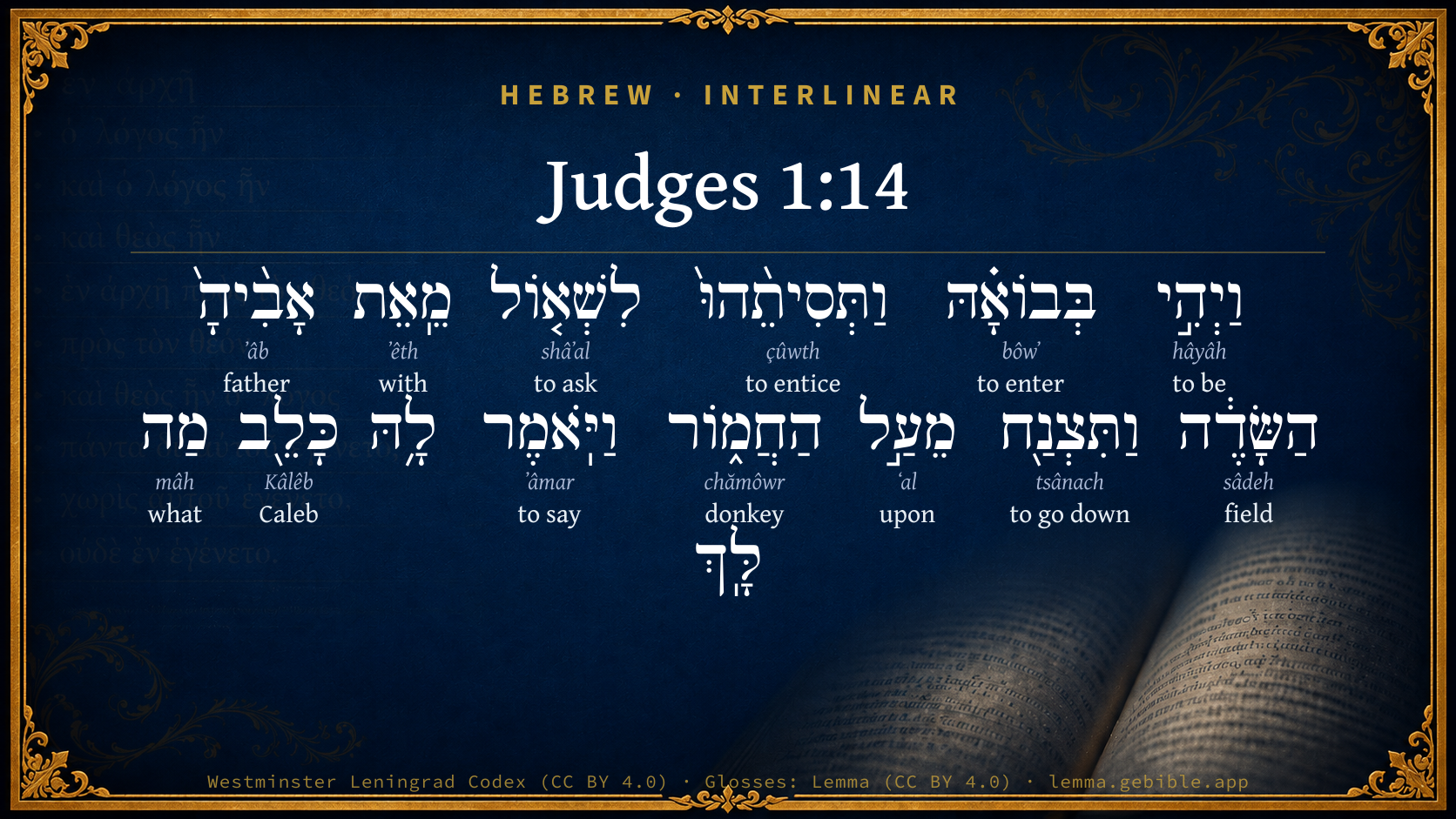
Judges 1:14

Hebrew (Westminster Leningrad Codex) Judges 1:14 appears in the Hebrew Old Testament. The text above is from the Westminster Leningrad Codex. Each word links to its Strong’s number, a concise gloss, and parsing drawn from the Open Scriptures Hebrew Bible morphology. Click any word for its full Brown-Driver-Briggs (BDB) entry.
Download image
Cite this verse

Judges 1:14 (World English Bible). Public Domain. Lemma interlinear Bible study tool, https://lemma.gebible.app/v/judges/1/14.

Show BibTeX & RIS
BibTeX
RIS
English Translation
It happened, when she came [to him], that she moved him to ask of her father a field: and she alighted from off her donkey; and Caleb said to her, What would you?
World English Bible · Public Domain
Download a study sheet

One document with this verse’s original text, its word-by-word gloss line, the meaning frame, cross-references with their text, attributed commentary, and full source and license credits — printable, and it pastes into notes with its structure intact.

This verse Autodidact and up

Study sheet (.html) Plain text (.txt)

A passage Seminary Student

Up to 50 verses in one chapter. A passage sheet keeps up to 6 commentary sources and 12 cross-references per verse, in the order this page ranks them, and says so on the sheet whenever that leaves anything out. Ask for a single verse and you get the Autodidact verse sheet above.

Everything on this page stays free to read, with no account — the sheet is a download of what is already on screen, not access to it.

Want to remove ads? Support Godless Engineer
Compare translations 3

The same verse in 3 English versions, stacked beneath the original-language interlinear above. Click any original word for its lexicon entry.

Each is an independent rendering of the whole verse — the interlinear is not word-aligned to these translations.

Highlighted words mark where these versions differ — a whole-verse word diff, not a word-by-word alignment.

  • World English Bible Public Domain
    It happened, when she came [to him], that she moved him to ask of her father a field: and she alighted from off her donkey; and Caleb said to her, What would you?
  • King James Version Public Domain
    And it came to pass, when she came to him, that she moved him to ask of her father a field: and she lighted from off her ass; and Caleb said unto her, What wilt thou?
  • unfoldingWord Literal Text CC BY-SA 4.0
    Now it happened, in the coming of her, that she persuaded him to request the field from her father. And she descended from upon the donkey, and Caleb said to her, “What for you?”

unfoldingWord Literal Text — © unfoldingWord, licensed CC BY-SA 4.0. Word-aligned USFM3 via Door43 (git.door43.org/unfoldingWord/en_ult).

Versions to compare (up to 4)

3 of 4 selected

Show all 18 translations

Every available English version of this verse, each an independent rendering of the whole verse.

  • World English Bible Public Domain
    It happened, when she came [to him], that she moved him to ask of her father a field: and she alighted from off her donkey; and Caleb said to her, What would you?
  • Berean Standard Bible Public Domain
    One day Acsah came to Othniel and urged him to ask her father for a field. When she got off her donkey, Caleb asked her, “What do you desire?”
  • Majority Standard Bible Public Domain
    One day Acsah came to Othniel and urged him to ask her father for a field. When she got off her donkey, Caleb asked her, “What do you desire?”
  • King James Version Public Domain
    And it came to pass, when she came to him, that she moved him to ask of her father a field: and she lighted from off her ass; and Caleb said unto her, What wilt thou?
  • American Standard Version (1901) Public Domain
    And it came to pass, when she came `unto him', that she moved him to ask of her father a field: and she alighted from off her ass; and Caleb said unto her, What wouldest thou?
  • Revised Version (1885) Public Domain
    And it came to pass, when she came unto him, that she moved him to ask of her father a field: and she lighted down from off her ass; and Caleb said unto her, What wouldest thou?
  • Geneva Bible (1599) Public Domain
    And when shee came to him, shee mooued him to aske of her father a field, and shee lighted off her asse, and Caleb saide vnto her, What wilt thou?
  • Douay-Rheims (1899) Public Domain
    And as she was going on her way her husband admonished her to ask a field of her father. And as she sighed sitting on her ass, Caleb said to her: What aileth thee?
  • Young's Literal Translation Public Domain
    And it cometh to pass in her coming in, that she persuadeth him to ask from her father the field, and she lighteth from off the ass, and Caleb saith to her, `What -- to thee?'
  • Literal Standard Version CC BY-SA 4.0
    And it comes to pass in her coming in, that she persuades him to ask from her father the field, and she comes down off the donkey, and Caleb says to her, “What do you [want]?”
  • Unlocked Literal Bible CC BY-SA 4.0
    Soon Aksah came to Othniel, and she urged him to ask her father to give her a field. As she was getting off her donkey, Caleb asked her, “What can I do for you?”
  • unfoldingWord Literal Text CC BY-SA 4.0
    Now it happened, in the coming of her, that she persuaded him to request the field from her father. And she descended from upon the donkey, and Caleb said to her, “What for you?”
  • Darby Bible Public Domain
    When she came to him, she urged him to ask her father for a field; and she alighted from her ass, and Caleb said to her, "What do you wish?"
  • World Messianic Bible Public Domain
    When she came, she got him to ask her father for a field. She got off her donkey; and Caleb said to her, “What would you like?”
  • Webster's Bible Public Domain
    And it came to pass, when she came to him, that she moved him to ask of her father a field: and she lighted from off her ass; and Caleb said to her, What wilt thou?
  • Free Bible Version CC BY-SA 4.0
    When Acsah came to Othniel, she encouraged him to ask her father for a field. As she got off her donkey, Caleb asked her, “What do you want?”
  • Bible in Basic English Public Domain
    Now when she came to him, he put into her mind the idea of requesting a field from her father: and she got down from her ass; and Caleb said to her, What is it?
  • JPS Tanakh (1917) Public Domain
    And it came to pass, when she came unto him, that she moved him to ask of her father a field; and she alighted from off her ass; and Caleb said unto her: 'What wouldest thou?'

Literal Standard Version (2020), Covenant Press — licensed CC BY-SA 4.0. Text via the HelloAO Bible API (eBible.org). Unlocked Literal Bible (unfoldingWord) — licensed CC BY-SA 4.0. Text via the HelloAO Bible API (eBible.org). unfoldingWord Literal Text — © unfoldingWord, licensed CC BY-SA 4.0. Word-aligned USFM3 via Door43 (git.door43.org/unfoldingWord/en_ult). Free Bible Version, Dr. Jonathan Gallagher — licensed CC BY-SA 4.0. Text via the HelloAO Bible API (eBible.org).

Word by word

More ways to search: Search by grammar → Find every occurrence → Compare this word →

Practice this passage: Drill this verse → Learn its vocabulary →

וַתִּצְנַ֖ח
tsânach
H6795
“and · to go down”
Conjunction + Verb, Qal, Sequential Imperfect, 3rd Person, Feminine, Singular
Part of Speech
Conjunction + Verb
Stem
Qal
Form
Sequential Imperfect
Person
3rd Person
Gender
Feminine
Number
Singular
Full BDB Definition

Origin: a primitive root

TWOT: 1934

(Qal) to go down, descend
  1. וַיְהִ֣י hâyâh H1961 “and · to be” Conjunction + Verb, Qal, Sequential Imperfect, 3rd Person, Masculine, Singular
  2. בְּבוֹאָ֗הּ bôwʼ H935 “in/at · to enter · her” Preposition + Verb, Qal, Infinitive Construct + Suffix, Personal, 3rd Person, Feminine, Singular
  3. וַתְּסִיתֵ֨הוּ֙ çûwth H5496 “and · to entice · him” Conjunction + Verb, Hiphil, Sequential Imperfect, 3rd Person, Feminine, Singular + Suffix, Personal, 3rd Person, Masculine, Singular
  4. לִשְׁא֤וֹל shâʼal H7592 “to ask” Preposition + Verb, Qal, Infinitive Construct
  5. מֵֽאֵת ʼêth H854 “from · with” Preposition + Preposition
  6. אָבִ֨יהָ֙ ʼâb H1 “father · her” Noun, Common, Masculine, Singular, Construct + Suffix, Personal, 3rd Person, Feminine, Singular
  7. הַשָּׂדֶ֔ה sâdeh H7704 “the · field” Particle, Definite Article + Noun, Common, Masculine, Singular, Absolute
  8. מֵעַ֣ל ʻal H5921 “from · upon” Preposition + Preposition
  9. הַחֲמ֑וֹר chămôwr H2543 “the · donkey” Particle, Definite Article + Noun, Common, Both, Singular, Absolute
  10. וַיֹּֽאמֶר ʼâmar H559 “and · to say” Conjunction + Verb, Qal, Sequential Imperfect, 3rd Person, Masculine, Singular
  11. כָּלֵ֖ב Kâlêb H3612 “Caleb” Noun, Proper
  12. מַה mâh H4100 “what” Particle, Interrogative

About this verse

These counts appear in no published source. They are computed here, from the morphology-tagged text and Lemma’s own curated glosses. What Lemma adds →

15
words
13
distinct lemmas
Historical
section

Notable vocabulary

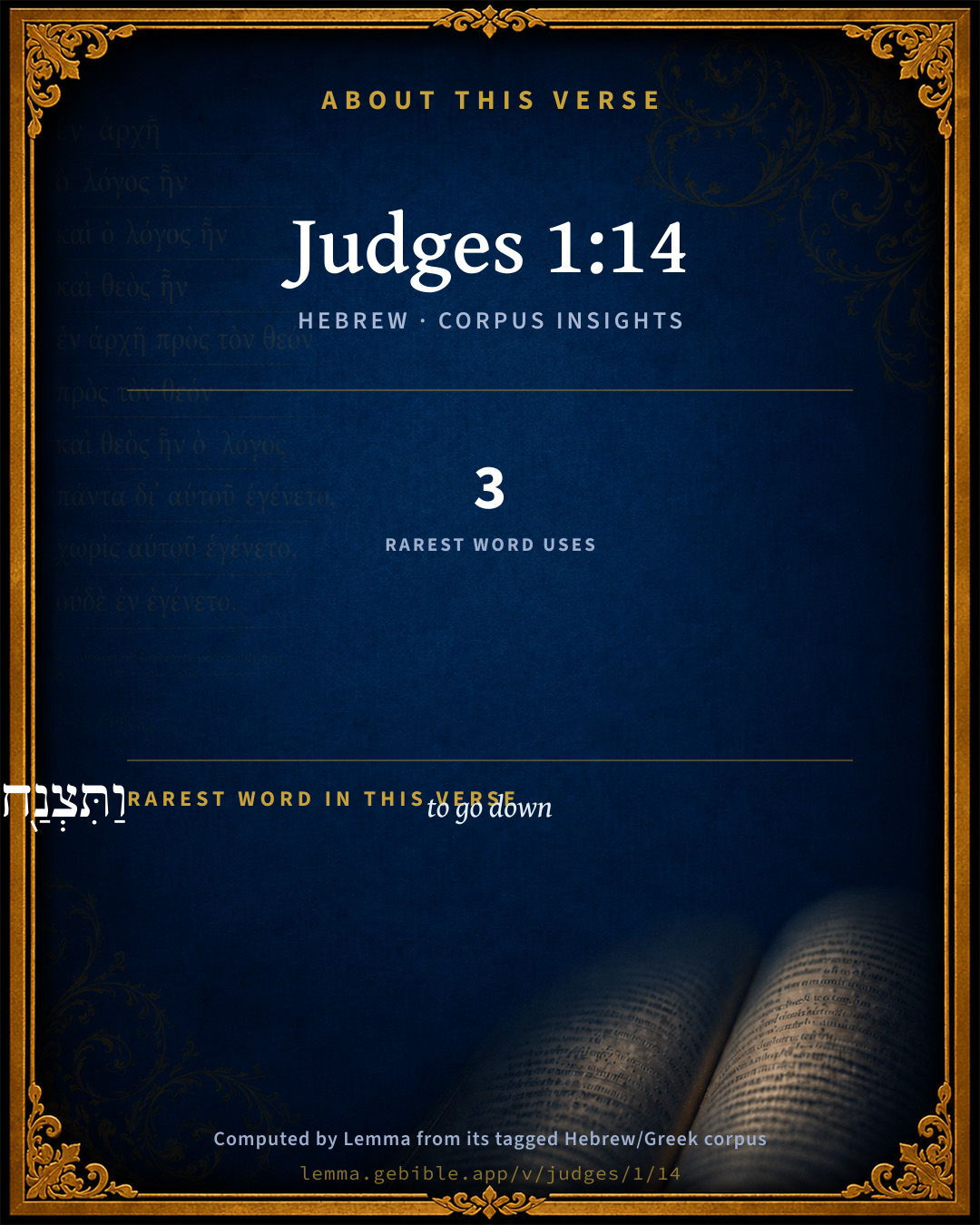
The rarest word here is וַתִּצְנַ֖ח to go down H6795 — appearing just 3 times in the whole Hebrew Bible.

Shared distinctive vocabulary

וַתִּצְנַ֖ח to go down H6795 occurs in 3 verses of the Hebrew Bible. Also found in:

Grammatical profile

  • 6 verbs
  • 4 nouns
  • 4 prepositions
  • 1 particle

Verb forms

  • וַיְהִ֣י Qal · Sequential Imperfect
  • בְּבוֹאָ֗הּ Qal · Infinitive Construct
  • וַתְּסִיתֵ֨הוּ֙ Hiphil · Sequential Imperfect
  • לִשְׁא֤וֹל Qal · Infinitive Construct
  • וַתִּצְנַ֖ח Qal · Sequential Imperfect
  • וַיֹּֽאמֶר Qal · Sequential Imperfect

Hebrew & Septuagint length

In English translation the verse runs 33 words from the Hebrew and 47 from the Septuagint (LXX English) — the Septuagint runs noticeably longer here. See the side-by-side →

A rough comparison of the two English renderings, which tokenize alike — not a word-level alignment.

Word counts can differ between the Hebrew and the Greek without any difference in meaning — e.g. the Hebrew direct-object marker אֵת has no separate Greek word, and Greek often adds the article ὁ.

Cross-references

1

Topical passages linked to Judges 1:14 in the Treasury of Scripture Knowledge — connected by theme and wording, ordered by reader-vote popularity; previews shown in the World English Bible.

  • Joshua 15:18–19 It happened, when she came [to him], that she moved him to ask of her father a field: and she alighted from off her donkey; and Caleb said, What would you?

Cross-references courtesy of OpenBible.info (CC BY 4.0).

Hebrew and Greek witnesses Masoretic Hebrew ↔ Greek Septuagint

The same verse in the two great witnesses to the Old Testament, shown verse-for-verse.

Here the Septuagint runs noticeably longer than the Hebrew — LXX2012 (modern English Septuagint) 47 words vs World English Bible 33. A rough length comparison of the two English translations, not a word-level alignment — read both below.

These are two independent witnesses, not word-aligned to each other, and the Septuagint is shown in lemma (dictionary) form.

Hebrew Judges 1:14 Masoretic · Westminster Leningrad Codex

וַיְהִ֣י בְּבוֹאָ֗הּ וַתְּסִיתֵ֨הוּ֙ לִשְׁא֤וֹל מֵֽאֵת אָבִ֨יהָ֙ הַשָּׂדֶ֔ה וַתִּצְנַ֖ח מֵעַ֣ל הַחֲמ֑וֹר וַיֹּֽאמֶר לָ֥הּ כָּלֵ֖ב מַה לָּֽךְ

It happened, when she came [to him], that she moved him to ask of her father a field: and she alighted from off her donkey; and Caleb said to her, What would you?

World English Bible · Public Domain

Greek LXX Judges 1:14 Septuagint · lemma form

καί γίγνομαι ἐν ὁ εἴσοδος αὐτός καί ἐπισείω αὐτός γοθονιηλ ὁ αἰτέω παρά ὁ πατήρ αὐτός ἀγρός καί γογγύζω καί κράζω ἀπό ὁ ὑποζύγιον εἰς γῆ νότος ἐκδίδωμι ἐγώ καί εἶπον αὐτός χαλεβ τίς εἰμί σύ

And it came to pass as she went in, that Gothoniel urged her to ask a field of her father; and she murmured and cried from off her ass, You have sent me forth into a south land: and Chaleb said to her, What is your request?

LXX2012 (modern English Septuagint) · Public Domain

On this verse, Ellicott's Commentary for English Readers discusses the Septuagint’s reading. Read the note in Commentary ↓

Hebrew: Westminster Leningrad Codex (CC BY 4.0). Greek: Septuagint (public domain); English from LXX2012 (modern English Septuagint) (Public Domain). How the Septuagint differs from the Hebrew →

Targum (Aramaic paraphrase)

1

The Targum is the ancient Jewish Aramaic paraphrase of the Hebrew Scriptures — an interpretive translation, not the Hebrew text itself. Onkelos (literal) and Pseudo-Jonathan (expansive) render the Torah, and Jonathan the Prophets. Coverage is partial: where no permissively-licensed English translation exists for a verse, only the Aramaic is shown. This is verse-level text, not a word-by-word alignment to the Hebrew.

  1. Targum Jonathan Prophets (Joshua–Malachi)
    וַהֲוָה בְּמֵעֲלָהּ וְאַמְלַכְתֵּיהּ לְמִשְׁאַל מִן אֲבוּהָא אַחְסַנְתָּא וְאִתְרְכִינַת מֵעַל חֲמָרָא וַאֲמַר לָהּ כָּלֵב מַה לִיךְ:

    (no public-domain English translation for this verse)

    Targum Jonathan — Aramaic: “Mikraot Gedolot” (public domain). English: “Sefaria Community Translation” (CC0 1.0 (public-domain dedication)); “London "Chaldee Paraphrase," 1871” (public domain). Text via Sefaria.

Commentary

Notes on Judges 1:14 from classic Christian and Jewish commentators (each source and its license shown beneath its notes). The classic Christian expositions comment on the surrounding passage and are grouped to its opening verse, so a note may address several verses; the Jewish commentaries on the Tanakh (Rashi and others) are per-verse, so they appear only where the commentator wrote on this verse.

Lemma curates 59 commentaries, every one of them public domain or Creative Commons licensed, each selected and text-cleaned for this edition rather than reprinted as found. About our sources →

Geneva Bible (1599)

Geneva Bible translators

Read Josh. 15:18.

Geneva Bible (1599) marginal notes — public domain. Text via Bolls.life.

Adam Clarke's Commentary

Verse 14. See Clarke on Jud 1:12.

Adam Clarke's Commentary on the Bible (1810–1826) — public domain. Text from a community e-Sword/MySword module.

Ellicott's Commentary for English Readers

(14) When she came to him.—When she first reached his house as a bride.

She moved him.—He was too modest to ask for himself, and he declined her request; but she will not enter till she has gained her way.

A field.—Rather, the field. In the passage in Jos_15:18 there is no definite article, but by the time this book was written the field then obtained by Achsah had become historical.

Lighted.—Not merely in sign of reverence (like Rebecca in Gen_24:64, and Abigail in 1Sa_25:25), but “leaped off” with eager impetuosity. The Hebrew verb tsanach here used occurs in Jdg_4:21, where it is rendered “fastened,” i.e., “drove it firmly by a blow.” The LXX. render it “screamed” or “shouted from the ass;” the Vulg., “sighed as she was sitting on the ass;” but they probably had a different reading. “Suddenly,” says Ewald, “as if some accident had happened to her, she fell from her ass, and on being embraced by her anxious father, she adjured him as if in words of inspiration” (Hist. Isr. ii. 366).

What wilt thou?—Caleb was unable to understand her conduct in refusing to enter the house of her bridegroom.

A Bible Commentary for English Readers, edited by Charles John Ellicott (1878–1897) — public domain. Text from a community e-Sword module.

The Cambridge Bible for Schools and Colleges

gen. ed. J. J. S. Perowne

14. when she came] into her husband’s house (Rth_4:11), or from the place where she had been kept in safety during the campaign (Moore).

she moved him to ask] Jos_15:18; but since Achsah herself asks the favour Jdg_1:15, it is more natural to read he moved, instigated, her to ask. The LXX and Vulgate give this sense, but their evidence as to the original reading is not very decisive; nor is it easy to see why ‘he instigated her’ should have been altered to the present text.

she lighted down from off her ass] to shew respect (Gen_24:64; 2Ki_5:21) and to beg a favour (1Sa_25:23). The meaning of the verb lighted, descended, only again in Jdg_4:21 (‘it pierced through’ RV.) and Joshua 15, is inferred from the context. To this day in the East the traveller who begs hospitality, for instance, in a Bedouin camp is required to dismount and approach the sheikh on foot.

The Cambridge Bible for Schools and Colleges (gen. ed. J. J. S. Perowne; Cambridge University Press, 1878–1918) — public domain. Text from a community e-Sword module.

Trapp's Complete Commentary

John Trapp

14 And Enoch also, the seventh from Adam, prophesied of these, saying, Behold, the Lord cometh with ten thousands of his saints,

Ver. 14. And Enoch also] Enoch foretold the day of judgment before Noah the deluge. That day is longer before it comes, but shall be more terrible when it is come.

Behold] One calleth this word a starry note; another compares it to a hand in the margin of a book pointing to some notable thing; another compares it to the sounding of a trumpet before some proclamation, to procure attention; and it is no more than need, so heedless we are of our soul’s health. Hence the heathen’s hoc agite, Well this. in their sacred services. And the deacons in Chrysostom’s time were appointed to call often upon the people in these words, Oremus, attendamus, Let us pray, let us pay attention. I am afraid, saith a divine, most of us do believe the predictions of Scripture but as we believe the predictions of an almanac, which tells you that such a day will be rain, and such a day will he wind; you think it may come to pass, and it may not. So here; such a threatening may be fulfilled, and it may not; let us venture it; it may be "the Lord will deal" with us not according to his present menaces, but "according to all his wondrous works," as those rebellious Jews suggested to Jer 21:2.

The Lord cometh] Syr. Maranatha. Hence the Jews say that the great excommunication Maranatha was instituted by Enoch.

With ten thousand of his saints] Or, with his holy myriads; sc. of saints and angels; he shall not leave one of them behind him in heaven, Mat 25:31. And whereas it is said, The Lord cometh, it shows that he is already on his way, and will be with us shortly. Where St Jude had this prophecy of Enoch it much matters not. The Jews have yet to this day some relics of it in their writings. And Tertullian tells us (de Habitu Mulierum), (but who told him I know not), that the book of Enoch’s prophecies were preserved by Noah in the ark, and that they continued and were read until the times of the apostles. But because they contained many famous testimonies concerning Jesus Christ, the Jews out of malice suppressed and abolished the whole book.

John Trapp, A Commentary or Exposition upon All the Books of the Old and New Testament (1647–1656) — public domain. Text from a community e-Sword module.

The Pulpit Commentary

She moved him, etc. There is some obscurity in this verse, which seems to tell us that Achsah, on her wedding-day, when she was going to her husband s house, persuaded him to ask of her father the field, viz. that in which the springs of water were, and which were not included in her original dower; and then goes on to tell us that Achsah herself made the request. The Septuagint reads, "Othniel urged her to ask the field of her father," and the Vulgate has, "Her husband told her to ask her father," and then it follows naturally, "and she lighted from off her ass," etc. But the Hebrew reading may be right, and it may be that when her husband, brave in storming a city, but timid in asking a favour, hung back, she, with the tenacious will of a woman, sprang off the ass herself, and successfully preferred her request. Dean Stanley identifies (though not with absolute certainty) the "field thus obtained by Achsah with an unusually green valley amidst the dry, barren hills of the south country, lying south or west of Hebron, called Wady Nuukur, through which Caleb and Achsah must have ridden on their way from Hebron to Debir, or Kirjath-sepher. This valley breaks into a precipitous and still greener ravine, and both the upper and lower pastures are watered by a clear, bubbling rivulet, which rises in the upper meadow, and flows to the bottom of the ravine below. The name of a village, Dewir, seems to represent the ancient Debir.

Vers. 14, 15. Compensations.

Of the wisdom and carefulness of Achsah we have here abundant proof. They were nobly and honourably exercised. She is the daughter of a rich man, and becomes the bride of a brave soldier who had evidently little but his sword and his reputation to boast of. She is jealous lest he should be rewarded with a mere titular distinction. He has been nobly oblivious of material rewards, she shall be proportionably watchful over his interests. She therefore urges her husband as he passes in triumph to Hebron to ask for the field through which they march. The thoughts of the hero are not to be directed into any such sordid channel. But she, taking advantage of the occasion as she lights from off her ass, asks her father in symbolic language to compensate her for the poverty to which he had consigned her. "Thou hast given me a south land (i.e. married me to a poor younger son); give me also springs of water." To this reasonable request Caleb makes generous response. "She slides from her ass, suddenly, as if she fell, so that her father asks, "What is the matter with thee?" Her answer has a double sense, "Thou gavest me away into a dry land; give me also springs (Cassel).

I A BLESSING WITH A DRAWBACK. Of the bravery of Othniel there could be no question; of his poverty there could be as little. It might be honourable for her to be his wife, but she would have to suffer many sacrifices in leaving the wealthy home of her father, and her husband would have an additional burden to sustain. Are not the dispensations of providence, even when we judge them on the whole to be best for us, frequently as mysteriously qualified and limited? No man would probably care to exchange his life for another"s, but "there"s a crook in every lot." Material blessings generally contain within them elements of discipline, and sometimes even of punishment. But they are alike the gift of a loving father, and are to be accepted in the spirit of trust and affection.

II COMPENSATIONS. IS the gift of Achsah"s father open to grave drawbacks? It is not therefore unalterable. Something may be done to lessen its inconveniences, if not entirely to remove them. Her father is reasonable, and she at once makes appeal to his sense of what is fit and proper. Her request is granted. So with ourselves. Our heavenly Father who apportioned our lot is surely as reasonable and affectionate as any earthly one. It is for us to exercise the same wisdom as Achsah, and request that God will give us such alleviations to our portion in life, or reveal to us those that already exist. Sometimes there are compensations latent in the very circumstances of which we complain: springs of water to moisten a sun-parched soil. In any case God is able to bestow upon us exceeding abundantly above all that we can ask or think. M.

The Pulpit Commentary (1880–1919), ed. H.D.M. Spence-Jones & Joseph S. Exell — public domain. Text from a community e-Sword module.

unfoldingWord translationNotes

Door43 World Missions Community

she urged him

"Aksah urged Othniel"

give her a field ... Since you have given me the land

This implies that Caleb did give her the field when she asked him for it in verse 14. In verse 15, she is now asking for springs of water in addition to that field. (See: Assumed Knowledge and Implicit Information)

Give me a blessing

"Do a favor for me" or "Do this for me"

Since you have given me the land of the Negev

Caleb gave Aksah in marriage to Othniel, so she lived with Othniel in the city that he had captured in the Negev. The full meaning of this statement can be made explicit. AT: "Since you have given me in marriage to live in the Negev" (See: Assumed Knowledge and Implicit Information)

translationWords

ancestor

donkey

bless

Negev

fountain

unfoldingWord translationNotes — © Distant Shores Media and the Door43 World Missions Community, licensed CC BY-SA 4.0. Source: git.door43.org/Door43/en_tn.

Rashi

Rabbi Shlomo Yitzchaki (Rashi)

She cajoled him. She advised him, as in "he took counsel"; one counsels a person, and directs his thinking to an alternative. This is my opinion.

She lowered herself. "She lowered herself" as if falling at her father's feet.

Rashi on the Tanakh — English translations: “The Judaica Press complete Tanach with Rashi, translated by A. J. Rosenberg” (CC BY 4.0); “Pentateuch with Rashi's commentary by M. Rosenbaum and A.M. Silbermann, 1929-1934” (public domain); “The Metsudah Tanach series, Lakewood, N.J” (CC BY 4.0); and “The Book of Joshua, Metsudah Publications, 1997” (CC BY 4.0). Text via Sefaria.

Lesson kit

Teaching starters — assembled from the data on this page, not authored interpretation. Every prompt links to the verse data it draws on. Edit before teaching.

Judges, in the Historical, opens this verse with 15 words (13 distinct Hebrew lemmas). Its most distinctive word is tsânach (“to go down”). The Greek Septuagint runs longer here. A historical commentator’s framing appears above. Read the whole chapter for the surrounding context.

Discussion questions

  1. What does “to go down” (tsânach) contribute to the verse as a whole?
  2. Joshua 15:18 shares the word «to go down» with this verse. How do the two illuminate each other?
  3. Compared with the Hebrew, the Septuagint runs longer here. What questions does that raise?
  4. These translations render this verse differently. What is at stake in choosing one wording over another?
  5. The verb «וַיְהִ֣י» is Qal Sequential Imperfect. How does its form color the action?
  6. Reading how Geneva Bible (1599) and Adam Clarke's Commentary read this verse, where do the two commentators agree and where do they part?

Things to notice

Reading settings

Reading text

Shown beneath each verse's original-language words.

Old Testament
Old Testament edition

Read the OT as the Masoretic Hebrew (MT) or the Greek Septuagint (LXX).

English shown for the Greek Septuagint (in the Hebrew ↔ Greek comparison).

Comparing translations? Open the Compare panel on any verse page to stack up to four side by side.