Deuteronomy 21:19

Hebrew (Westminster Leningrad Codex) Deuteronomy 21:19 appears in the Hebrew Old Testament. The text above is from the Westminster Leningrad Codex. Each word links to its Strong’s number, a concise gloss, and parsing drawn from the Open Scriptures Hebrew Bible morphology. Click any word for its full Brown-Driver-Briggs (BDB) entry.
Download image
Cite this verse

Deuteronomy 21:19 (World English Bible). Public Domain. Lemma interlinear Bible study tool, https://lemma.gebible.app/v/deuteronomy/21/19.

Show BibTeX & RIS
BibTeX
RIS
English Translation
then shall his father and his mother lay hold on him, and bring him out to the elders of his city, and to the gate of his place;
World English Bible · Public Domain
Download a study sheet

One document with this verse’s original text, its word-by-word gloss line, the meaning frame, cross-references with their text, attributed commentary, and full source and license credits — printable, and it pastes into notes with its structure intact.

This verse Autodidact and up

Study sheet (.html) Plain text (.txt)

A passage Seminary Student

Up to 50 verses in one chapter. A passage sheet keeps up to 6 commentary sources and 12 cross-references per verse, in the order this page ranks them, and says so on the sheet whenever that leaves anything out. Ask for a single verse and you get the Autodidact verse sheet above.

Everything on this page stays free to read, with no account — the sheet is a download of what is already on screen, not access to it.

Want to remove ads? Support Godless Engineer
Compare translations 3

The same verse in 3 English versions, stacked beneath the original-language interlinear above. Click any original word for its lexicon entry.

Each is an independent rendering of the whole verse — the interlinear is not word-aligned to these translations.

Highlighted words mark where these versions differ — a whole-verse word diff, not a word-by-word alignment.

  • World English Bible Public Domain
    then shall his father and his mother lay hold on him, and bring him out to the elders of his city, and to the gate of his place;
  • King James Version Public Domain
    Then shall his father and his mother lay hold on him, and bring him out unto the elders of his city, and unto the gate of his place;
  • unfoldingWord Literal Text CC BY-SA 4.0
    then his father and his mother shall seize him and bring him to the elders of his city and to the gate of his place.

unfoldingWord Literal Text — © unfoldingWord, licensed CC BY-SA 4.0. Word-aligned USFM3 via Door43 (git.door43.org/unfoldingWord/en_ult).

Versions to compare (up to 4)

3 of 4 selected

Show all 18 translations

Every available English version of this verse, each an independent rendering of the whole verse.

  • World English Bible Public Domain
    then shall his father and his mother lay hold on him, and bring him out to the elders of his city, and to the gate of his place;
  • Berean Standard Bible Public Domain
    his father and mother are to lay hold of him and bring him to the elders of his city, to the gate of his hometown,
  • Majority Standard Bible Public Domain
    his father and mother are to lay hold of him and bring him to the elders of his city, to the gate of his hometown,
  • King James Version Public Domain
    Then shall his father and his mother lay hold on him, and bring him out unto the elders of his city, and unto the gate of his place;
  • American Standard Version (1901) Public Domain
    then shall his father and his mother lay hold on him, and bring him out unto the elders of his city, and unto the gate of his place;
  • Revised Version (1885) Public Domain
    then shall his father and his mother lay hold on him, and bring him out unto the elders of his city, and unto the gate of his place;
  • Geneva Bible (1599) Public Domain
    Then shall his father and his mother take him, and bring him out vnto the Elders of his citie, and vnto the gate of the place where he dwelleth,
  • Douay-Rheims (1899) Public Domain
    They shall take him and bring him to the ancients of his city, and to the gate of judgment,
  • Young's Literal Translation Public Domain
    then laid hold on him have his father and his mother, and they have brought him out unto the elders of his city, and unto the gate of his place,
  • Literal Standard Version CC BY-SA 4.0
    then his father and his mother have laid hold on him, and they have brought him out to [the] elderly of his city, and to the gate of his place,
  • Unlocked Literal Bible CC BY-SA 4.0
    then his father and his mother must lay hold on him and bring him out to the elders of his city and to the gate of his city.
  • unfoldingWord Literal Text CC BY-SA 4.0
    then his father and his mother shall seize him and bring him to the elders of his city and to the gate of his place.
  • Darby Bible Public Domain
    then shall his father and his mother lay hold on him, and bring him out unto the elders of his city, and unto the gate of his place;
  • World Messianic Bible Public Domain
    then his father and his mother shall take hold of him and bring him out to the elders of his city and to the gate of his place.
  • Webster's Bible Public Domain
    Then shall his father and his mother lay hold on him, and bring him out to the elders of his city, and to the gate of his place;
  • Free Bible Version CC BY-SA 4.0
    his parents must take him to the town elders, to the court in his hometown,
  • Bible in Basic English Public Domain
    Then let his father and mother take him to the responsible men of the town, to the public place;
  • JPS Tanakh (1917) Public Domain
    then shall his father and his mother lay hold on him, and bring him out unto the elders of his city, and unto the gate of his place;

Literal Standard Version (2020), Covenant Press — licensed CC BY-SA 4.0. Text via the HelloAO Bible API (eBible.org). Unlocked Literal Bible (unfoldingWord) — licensed CC BY-SA 4.0. Text via the HelloAO Bible API (eBible.org). unfoldingWord Literal Text — © unfoldingWord, licensed CC BY-SA 4.0. Word-aligned USFM3 via Door43 (git.door43.org/unfoldingWord/en_ult). Free Bible Version, Dr. Jonathan Gallagher — licensed CC BY-SA 4.0. Text via the HelloAO Bible API (eBible.org).

Word by word

More ways to search: Search by grammar → Find every occurrence → Compare this word →

Practice this passage: Drill this verse → Learn its vocabulary →

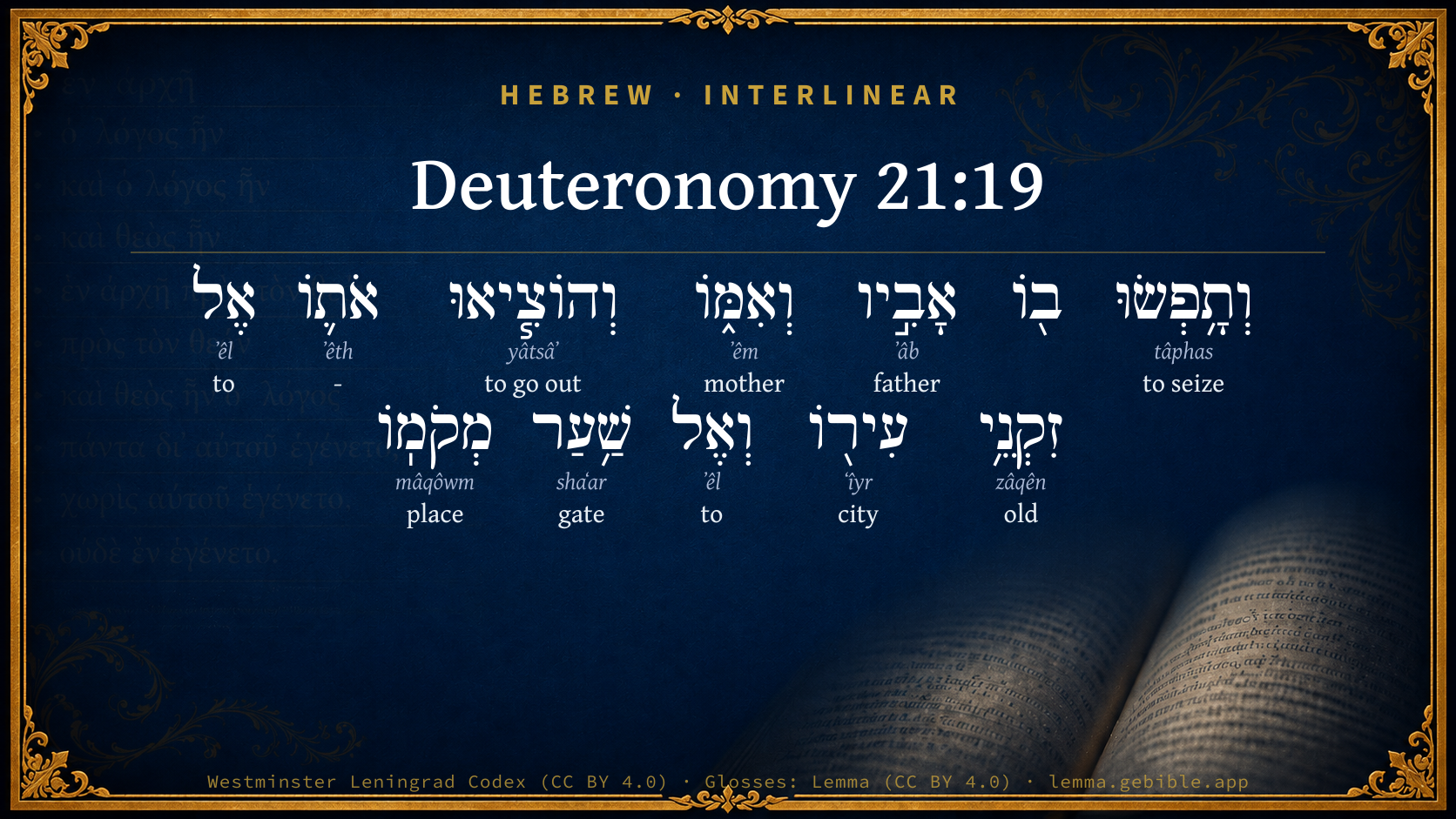
וְתָ֥פְשׂוּ
tâphas
H8610
“and · to seize”
Conjunction + Verb, Qal, Sequential Perfect, 3rd Person, Common, Plural
Part of Speech
Conjunction + Verb
Stem
Qal
Form
Sequential Perfect
Person
3rd Person
Gender
Common
Number
Plural
Full BDB Definition

Origin: a primitive root

TWOT: 2538

to catch, handle, lay hold, take hold of, seize, wield - (Qal) - to lay hold of, seize, arrest, catch - to grasp (in order to) wield, wield, use skilfully - (Niphal) to be seized, be arrested, be caught, be taken, captured - (Piel) to catch, grasp (with the hands)
  1. אָבִ֣יו ʼâb H1 “father · his” Noun, Common, Masculine, Singular, Construct + Suffix, Personal, 3rd Person, Masculine, Singular
  2. וְאִמּ֑וֹ ʼêm H517 “and · mother · his” Conjunction + Noun, Common, Feminine, Singular, Construct + Suffix, Personal, 3rd Person, Masculine, Singular
  3. וְהוֹצִ֧יאוּ yâtsâʼ H3318 “and · to go out” Conjunction + Verb, Hiphil, Sequential Perfect, 3rd Person, Common, Plural
  4. אֹת֛וֹ ʼêth H853 “- · him” Particle, Direct Object + Suffix, Personal, 3rd Person, Masculine, Singular
  5. אֶל ʼêl H413 “to” Preposition
  6. זִקְנֵ֥י zâqên H2205 “old of” Adjective, Adjective, Masculine, Plural, Construct
  7. עִיר֖וֹ ʻîyr H5892 “city · his” Noun, Common, Feminine, Singular, Construct + Suffix, Personal, 3rd Person, Masculine, Singular
  8. וְאֶל ʼêl H413 “and · to” Conjunction + Preposition
  9. שַׁ֥עַר shaʻar H8179 “gate of” Noun, Common, Masculine, Singular, Construct
  10. מְקֹמֽוֹ mâqôwm H4725 “place · his” Noun, Common, Masculine, Singular, Construct + Suffix, Personal, 3rd Person, Masculine, Singular

About this verse

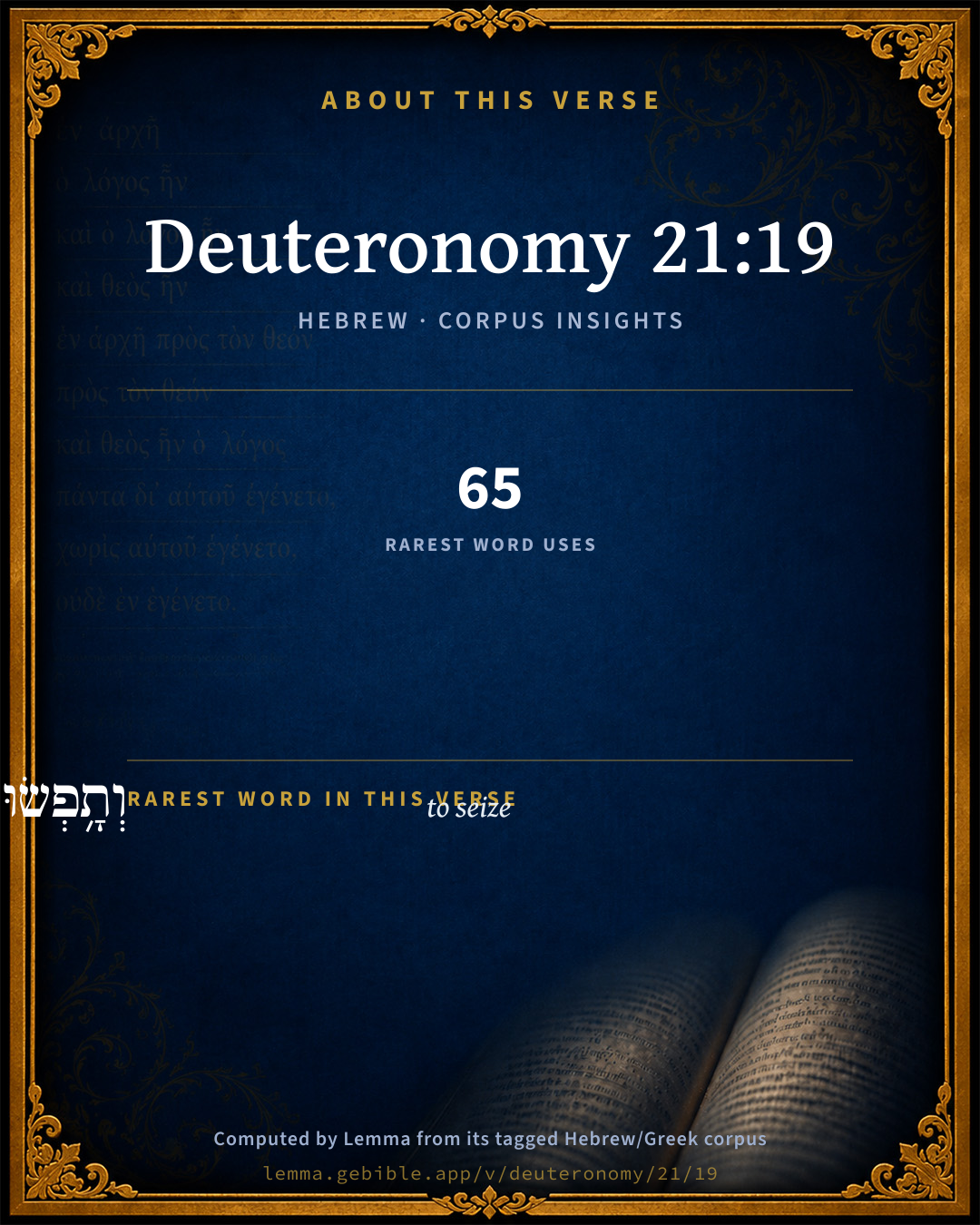
These counts appear in no published source. They are computed here, from the morphology-tagged text and Lemma’s own curated glosses. What Lemma adds →

12
words
10
distinct lemmas
Pentateuch
section

Grammatical profile

  • 2 verbs
  • 5 nouns
  • 1 adjective
  • 3 prepositions
  • 1 particle

Verb forms

  • וְתָ֥פְשׂוּ Qal · Sequential Perfect
  • וְהוֹצִ֧יאוּ Hiphil · Sequential Perfect

Repetition

A word recurs within this verse — often emphatic in Hebrew:

  • אֶל to H413 ×2

Hebrew & Septuagint length

In English translation the verse runs 28 words from the Hebrew and 28 from the Septuagint (LXX English) — the same length.

A rough comparison of the two English renderings, which tokenize alike — not a word-level alignment.

Word counts can differ between the Hebrew and the Greek without any difference in meaning — e.g. the Hebrew direct-object marker אֵת has no separate Greek word, and Greek often adds the article ὁ.

Cross-references

4

Topical passages linked to Deuteronomy 21:19 in the Treasury of Scripture Knowledge — connected by theme and wording, ordered by reader-vote popularity; previews shown in the World English Bible.

  • Deuteronomy 16:18 Judges and officers shall you make you in all your gates, which Yahweh your God gives you, according to your tribes; and they shall judge the people with righteous judgment.
  • Deuteronomy 21:2 then your elders and your judges shall come forth, and they shall measure to the cities which are round about him who is slain:
  • Deuteronomy 25:7 If the man doesn't want to take his brother's wife, then his brother's wife shall go up to the gate to the elders, and say, My husband's brother refuses to raise up to his brother a name in Israel; he will not perform the duty of a husband's brother to me.
  • Zechariah 13:3 It will happen that, when anyone still prophesies, then his father and his mother who bore him will tell him, 'You must die, because you speak lies in the name of Yahweh;' and his father and his mother who bore him will stab him when he prophesies.

Cross-references courtesy of OpenBible.info (CC BY 4.0).

Hebrew and Greek witnesses Masoretic Hebrew ↔ Greek Septuagint

The same verse in the two great witnesses to the Old Testament, shown verse-for-verse.

These are two independent witnesses, not word-aligned to each other, and the Septuagint is shown in lemma (dictionary) form.

Hebrew Deuteronomy 21:19 Masoretic · Westminster Leningrad Codex

וְתָ֥פְשׂוּ ב֖וֹ אָבִ֣יו וְאִמּ֑וֹ וְהוֹצִ֧יאוּ אֹת֛וֹ אֶל זִקְנֵ֥י עִיר֖וֹ וְאֶל שַׁ֥עַר מְקֹמֽוֹ

then shall his father and his mother lay hold on him, and bring him out to the elders of his city, and to the gate of his place;

World English Bible · Public Domain

Greek LXX Deuteronomy 21:19 Septuagint · lemma form

καί συνλαμβάνω αὐτός ὁ πατήρ αὐτός καί ὁ μήτηρ αὐτός καί ἐκἄγω αὐτός ἐπί ὁ γερουσία ὁ πόλις αὐτός καί ἐπί ὁ πύλη ὁ τόπος αὐτός

then shall his father and his mother take hold of him, and bring him forth to the elders of his city, and to the gate of the place:

LXX2012 (modern English Septuagint) · Public Domain

Hebrew: Westminster Leningrad Codex (CC BY 4.0). Greek: Septuagint (public domain); English from LXX2012 (modern English Septuagint) (Public Domain). How the Septuagint differs from the Hebrew →

Targum (Aramaic paraphrase)

2

The Targum is the ancient Jewish Aramaic paraphrase of the Hebrew Scriptures — an interpretive translation, not the Hebrew text itself. Onkelos (literal) and Pseudo-Jonathan (expansive) render the Torah, and Jonathan the Prophets. Coverage is partial: where no permissively-licensed English translation exists for a verse, only the Aramaic is shown. This is verse-level text, not a word-by-word alignment to the Hebrew.

  1. Targum Onkelos Torah (Genesis–Deuteronomy)
    וְיֶחֱדוּן בֵּהּ אֲבוּהִי וְאִמֵּהּ וְיַפְּקוּן יָתֵהּ לָקֳדָם סָבֵי קַרְתֵּהּ וְלִתְרַע בֵּית דִין אַתְרֵהּ

    (no public-domain English translation for this verse)

    Targum Onkelos — Aramaic: “Onkelos Genesis” (public domain); “Onkelos Exodus” (public domain); “Onkelos Leviticus” (public domain); “Onkelos Numbers” (public domain); “Onkelos Deuteronomy” (public domain). English: “Sefaria Community Translation” (CC0 1.0 (public-domain dedication)); “J.W. Etheridge. The Targums of Onkelos and Jonathan Ben Uzziel on the Pentateuch. London: Longmans, Green, 1862” (public domain). Text via Sefaria.

  2. Targum Pseudo-Jonathan Torah (Genesis–Deuteronomy)
    וְיֶחְדוּן בֵּיהּ אָבוֹי וְאִמֵּיהּ וְיַפְקוּן יָתֵיהּ לִקֳדָם חַכִּימֵי קַרְתָּא לִתְרַע בֵּי דִינָא דִבְאַתְרֵיהּ

    his father and mother shall take him, and bring him before the sages of the city at the door of the court of justice in that place,

    Targum Pseudo-Jonathan — Aramaic: “Targum Jonathan on Genesis” (public domain); “Targum Jonathan on Exodus” (public domain); “Targum Jonathan on Leviticus” (public domain); “Targum Jonathan on Numbers” (public domain); “Targum Jonathan on Deuteronomy” (public domain). English: “The Targum of Jonathan ben Uzziel, trans. J. W. Etheridge, London, 1862” (public domain). Text via Sefaria.

Commentary

Notes on Deuteronomy 21:19 from classic Christian and Jewish commentators (each source and its license shown beneath its notes). The classic Christian expositions comment on the surrounding passage and are grouped to its opening verse, so a note may address several verses; the Jewish commentaries on the Tanakh (Rashi and others) are per-verse, so they appear only where the commentator wrote on this verse.

Lemma curates 59 commentaries, every one of them public domain or Creative Commons licensed, each selected and text-cleaned for this edition rather than reprinted as found. About our sources →

Joseph Benson's Commentary

Deu 21:19. His father and mother — The consent of both is required, to prevent the abuse of this law to cruelty. And it cannot reasonably be supposed that both would agree without the son’s abominable and incorrigible wickedness, in which case it seems a righteous law, because the crime of rebellion against his own parents did so fully signify what a pernicious member he would be in the commonwealth of Israel, who had dissolved all his natural obligations. Unto the elders — Which was a sufficient caution to preserve children from the malice of any hard-hearted parents, because these elders were first to examine the cause with all exactness, and then to pronounce the sentence.

Joseph Benson's Commentary on the Old and New Testaments (1811–1818) — public domain. Text from a community e-Sword module.

The Cambridge Bible for Schools and Colleges

gen. ed. J. J. S. Perowne

19. lay hold] Deu_22:28; cp. Deu_9:17. Bring out, Deu_17:5, q.v., Deu_22:21; Deu_22:24. Elders of his city, see on Deu_19:12 and Deu_16:18. Gate of his place, as the local seat of judgement, Deu_22:15, Deu_25:7; cp. Rth_4:1 f., Amo_5:10; Amo_5:12; Amo_5:15, Isa_29:21.

The Cambridge Bible for Schools and Colleges (gen. ed. J. J. S. Perowne; Cambridge University Press, 1878–1918) — public domain. Text from a community e-Sword module.

John Gill's Exposition

Then shall his father and his mother lay hold on him,.... With their own hands, or cause him to be apprehended by others, in which they were to agree, and which the Jews gather from hence;"if (say they (y)) the father is willing (to bring him to justice), and the mother not willing, if his father is not willing and the mother is willing, he is not reckoned a stubborn or rebellious son, until they both agree:"

and bring him out unto the elders of his city; according to the Misnah (z), the sanhedrim, or court of judicature, consisting of twenty three; for they say, that after he has been admonished and scourged by order of the bench of three, if he returns to his corrupt and wicked ways again, he is judged by the court of twenty three:

and unto the gate of his place; or city, where the court sat; so the Targums of Onkelos and Jonathan, to the gate of the sanhedrim of his place.

(y) Misn. Sanhedrin, c. 8. sect. 4. (z) Ibid.

John Gill's Exposition of the Whole Bible (1746–1763) — public domain (CC PDM 1.0). Text via the HelloAO Bible API.

Haydock's Catholic Bible Commentary

Ancients. In considerable cities there was a tribunal of three, and another of 23 judges. The former took cognizance of the first accusation, and condemned the stubborn child to be scourged: but the latter sentenced him to be stoned in case of a relapse, provided both parents concurred in prosecuting their son, as they would not both surely be guided by passion. (Theodoret, q. 20.) The Rabbins, according to their custom, modify this law, and exempt girls, orphans, and boys under 13 years of age. (Selden, Syned.) --- Josephus ([Antiquities?] xvi. 17,) says that the parents laid their hands on the head of the undutiful, and then all the people stoned him. Moses has not specified the punishment of parricides, (Calmet) as he deemed it next to impossible. (Haydock) --- But we may hence judge how he would have chastised so heinous a crime. The Romans formerly sewed such wretches in a leathern sack, (Cic.[Cicero,?] Invent. ii.) but afterwards they enclosed with them a dog, a cock, a viper, and a monkey; and having first whipped them so as to fetch blood, placed them in a chariot drawn by black oxen, and hurled them into the sea or into some river. (Justinian) --- Solomon sentences those who contemn their parents to be the food of crows and eagles, Proverbs xxx. 17. No restraints were laid by the ancient Greeks on the authority of a father, as he was esteemed the most equitable judge. (Sopater, ap. Grotius) (Calmet)

George Leo Haydock (1774–1849), Haydock's Catholic Family Bible and Commentary, 1859 edition — public domain. Excludes Psalms (Douay-Rheims chapter numbering differs from Protestant) and Deuterocanonical books (Catholic canon only).

Matthew Poole's English Annotations

The consent of both father and mother is required to prevent the abuse of this law to cruelty. And it cannot reasonably be supposed that both would agree without manifest necessity, and the son’s abominable and incorrigible wickedness, in which case it seems a fit and righteous law, because the crime of rebellion against his own parents was so high in itself, and did so fully signify what a pernicious member and son of Belial he would be in the commonwealth of Israel, who had dissolved all his natural obligations. Yet the Jews say this law was never put in practice, and therefore it might be made for terror and prevention, and to render the authority of parents more sacred and powerful.

Bring him out unto the elders of his city; which was a sufficient caution to preserve children from the malice of any hard-hearted parents, because these elders were first to examine the cause with all exactness, and then to pronounce the sentence.

Matthew Poole's English Annotations on the Holy Bible (1683–1685) — public domain. Text from a community e-Sword/MySword module.

Whedon's Commentary on the Bible

Daniel D. Whedon

19. Bring him out unto the elders of his city — The elders are the representatives of the whole community, and are to act as magistrates.

Unto the gate of his place — The gate of the Eastern city was the place for the transaction of business and for the administration of justice.

Daniel D. Whedon (gen. ed.), Commentary on the Old and New Testaments (1874–1909) — public domain. Text from a community e-Sword module.

John Wesley's Explanatory Notes

His father and mother - The consent of both is required to prevent the abuse of this law to cruelty. And it cannot reasonably be supposed that both would agree without the son's abominable and incorrigible wickedness, in which case it seems a righteous law, because the crime of rebellion against his own parents did so fully signify what a pernicious member he would be in the commonwealth of Israel, who had dissolved all his natural obligations. Unto the elders - Which was a sufficient caution to preserve children from the malice of any hard-hearted parents, because these elders were first to examine the cause with all exactness, and then to pronounce the sentence.

John Wesley, Explanatory Notes Upon the Whole Bible (1754–1765) — public domain. Text via the GEBible commentary corpus.

Lesson kit

Teaching starters — assembled from the data on this page, not authored interpretation. Every prompt links to the verse data it draws on. Edit before teaching.

Deuteronomy, in the Pentateuch, opens this verse with 12 words (10 distinct Hebrew lemmas). Its most distinctive word is tâphas (“to seize”). A historical commentator’s framing appears above. Read the whole chapter for the surrounding context.

Discussion questions

  1. How does “to seize” (tâphas) shape what this verse is saying?
  2. Deuteronomy 16:18 shares this passage’s theme. How do the two illuminate each other?
  3. “to” occurs 2× in this one verse. What is the effect of the repetition?
  4. The translations on this page render this verse differently — a whole-verse word diff, not a word-by-word alignment. What might account for the different wordings?
  5. The verb «וְתָ֥פְשׂוּ» is Qal Sequential Perfect. How does its form color the action?
  6. Reading how Joseph Benson's Commentary and The Cambridge Bible for Schools and Colleges read this verse, where do the two commentators agree and where do they part?

Things to notice

Reading settings

Reading text

Shown beneath each verse's original-language words.

Old Testament
Old Testament edition

Read the OT as the Masoretic Hebrew (MT) or the Greek Septuagint (LXX).

English shown for the Greek Septuagint (in the Hebrew ↔ Greek comparison).

Comparing translations? Open the Compare panel on any verse page to stack up to four side by side.