Genesis 31:16

Hebrew (Westminster Leningrad Codex) Genesis 31:16 appears in the Hebrew Old Testament. The text above is from the Westminster Leningrad Codex. Each word links to its Strong’s number, a concise gloss, and parsing drawn from the Open Scriptures Hebrew Bible morphology. Click any word for its full Brown-Driver-Briggs (BDB) entry.
Download image
Cite this verse

Genesis 31:16 (World English Bible). Public Domain. Lemma interlinear Bible study tool, https://lemma.gebible.app/v/genesis/31/16.

Show BibTeX & RIS
BibTeX
RIS
English Translation
For all the riches which God has taken away from our father, that is ours and our children's. Now then, whatever God has said to you, do."
World English Bible · Public Domain
Highlights
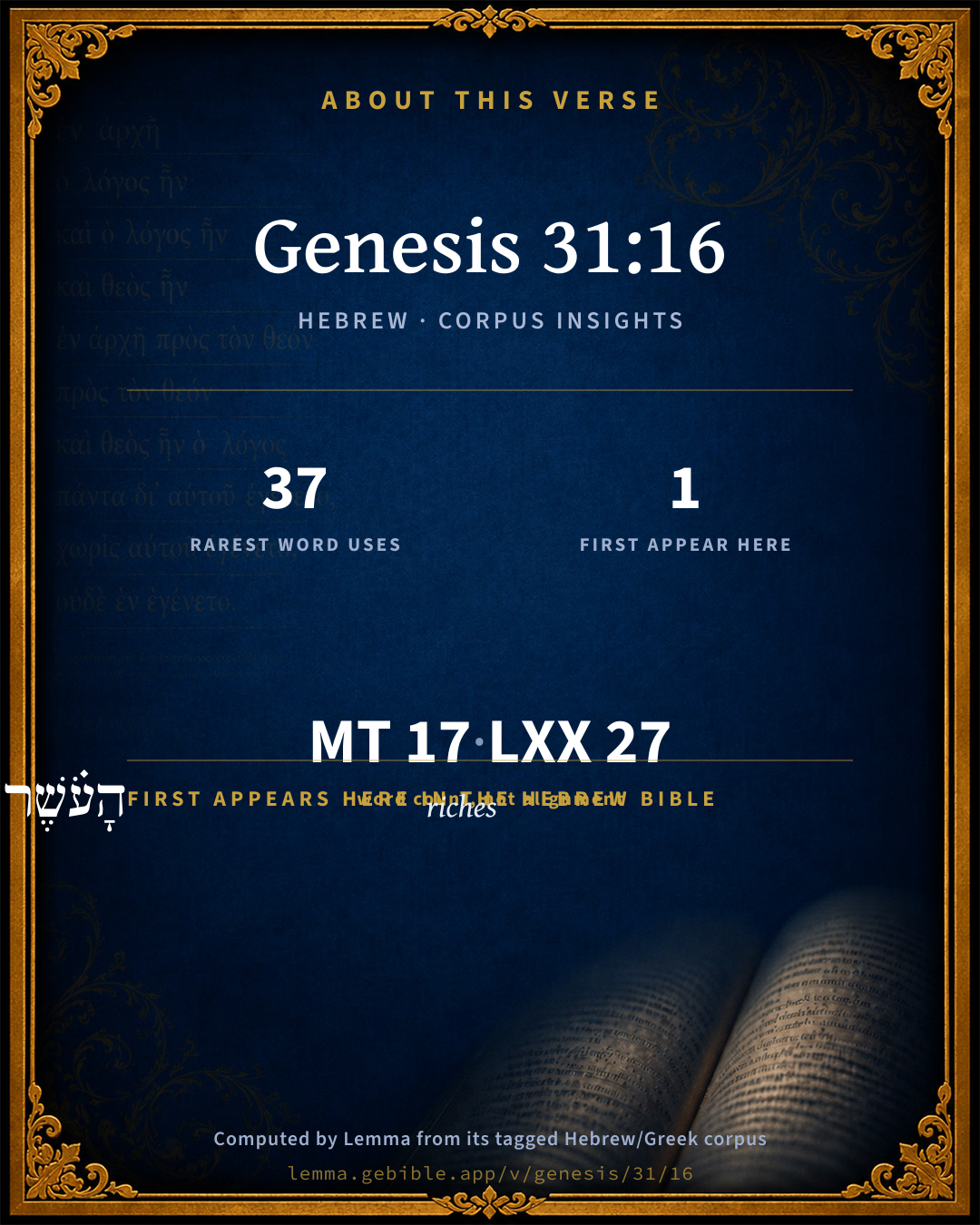
  • 1 first appearance in the Hebrew Bible
Full analysis ↓
Download a study sheet

One document with this verse’s original text, its word-by-word gloss line, the meaning frame, cross-references with their text, attributed commentary, and full source and license credits — printable, and it pastes into notes with its structure intact.

This verse Autodidact and up

Study sheet (.html) Plain text (.txt)

A passage Seminary Student

Up to 50 verses in one chapter. A passage sheet keeps up to 6 commentary sources and 12 cross-references per verse, in the order this page ranks them, and says so on the sheet whenever that leaves anything out. Ask for a single verse and you get the Autodidact verse sheet above.

Everything on this page stays free to read, with no account — the sheet is a download of what is already on screen, not access to it.

Want to remove ads? Support Godless Engineer
Compare translations 3

The same verse in 3 English versions, stacked beneath the original-language interlinear above. Click any original word for its lexicon entry.

Each is an independent rendering of the whole verse — the interlinear is not word-aligned to these translations.

Highlighted words mark where these versions differ — a whole-verse word diff, not a word-by-word alignment.

  • World English Bible Public Domain
    For all the riches which God has taken away from our father, that is ours and our children's. Now then, whatever God has said to you, do."
  • King James Version Public Domain
    For all the riches which God hath taken from our father, that is ours, and our children's: now then, whatsoever God hath said unto thee, do.
  • unfoldingWord Literal Text CC BY-SA 4.0
    For all the wealth that God took from our father to us and to our children. So now, do all that God has said to you.”

unfoldingWord Literal Text — © unfoldingWord, licensed CC BY-SA 4.0. Word-aligned USFM3 via Door43 (git.door43.org/unfoldingWord/en_ult).

Versions to compare (up to 4)

3 of 4 selected

Show all 18 translations

Every available English version of this verse, each an independent rendering of the whole verse.

  • World English Bible Public Domain
    For all the riches which God has taken away from our father, that is ours and our children's. Now then, whatever God has said to you, do."
  • Berean Standard Bible Public Domain
    Surely all the wealth that God has taken away from our father belongs to us and to our children. So do whatever God has told you.”
  • Majority Standard Bible Public Domain
    Surely all the wealth that God has taken away from our father belongs to us and to our children. So do whatever God has told you.”
  • King James Version Public Domain
    For all the riches which God hath taken from our father, that is ours, and our children's: now then, whatsoever God hath said unto thee, do.
  • American Standard Version (1901) Public Domain
    For all the riches which God hath taken away from our father, that is ours and our children's: now then, whatsoever God hath said unto thee, do.
  • Revised Version (1885) Public Domain
    For all the riches which God hath taken away from our father, that is ours and our children’s: now then, whatsoever God hath said unto thee, do.
  • Geneva Bible (1599) Public Domain
    Therefore all the riches, which God hath taken from our father, is ours and our childrens: nowe then whatsoeuer God hath saide vnto thee, doe it.
  • Douay-Rheims (1899) Public Domain
    But God hath taken our father's riches, and delivered them to us, and to our children: wherefore do all that God hath commanded thee.
  • Young's Literal Translation Public Domain
    for all the wealth which God hath taken away from our father, it `is' ours, and our children's; and now, all that God hath said unto thee -- do.'
  • Literal Standard Version CC BY-SA 4.0
    for all the wealth which God has taken away from our father, it [is] ours, and our children’s; and now, all that God has said to you—do.”
  • Unlocked Literal Bible CC BY-SA 4.0
    For all the riches that God has taken away from our father are now ours and our children's. Now then, whatever God has said to you, do it.”
  • unfoldingWord Literal Text CC BY-SA 4.0
    For all the wealth that God took from our father to us and to our children. So now, do all that God has said to you.”
  • Darby Bible Public Domain
    For all the wealth that God has taken from our father is ours and our children's; and now whatever God has said to thee do.
  • World Messianic Bible Public Domain
    For all the riches which God has taken away from our father are ours and our children’s. Now then, whatever God has said to you, do.”
  • Webster's Bible Public Domain
    For all the riches which God hath taken from our father, that is ours, and our children's: now then whatever God hath said to thee, do.
  • Free Bible Version CC BY-SA 4.0
    All the wealth that God has taken from him belongs to us and our children, so do whatever God has told you to do!”
  • Bible in Basic English Public Domain
    For the wealth which God has taken from him is ours and our children's; so now, whatever God has said to you, do.
  • JPS Tanakh (1917) Public Domain
    For all the riches which God hath taken away from our father, that is ours and our children's. Now then, whatsoever God hath said unto thee, do.'

Literal Standard Version (2020), Covenant Press — licensed CC BY-SA 4.0. Text via the HelloAO Bible API (eBible.org). Unlocked Literal Bible (unfoldingWord) — licensed CC BY-SA 4.0. Text via the HelloAO Bible API (eBible.org). unfoldingWord Literal Text — © unfoldingWord, licensed CC BY-SA 4.0. Word-aligned USFM3 via Door43 (git.door43.org/unfoldingWord/en_ult). Free Bible Version, Dr. Jonathan Gallagher — licensed CC BY-SA 4.0. Text via the HelloAO Bible API (eBible.org).

Word by word

More ways to search: Search by grammar → Find every occurrence → Compare this word →

Practice this passage: Drill this verse → Learn its vocabulary →

הָעֹ֗שֶׁר
ʻôsher
H6239
“the · riches”
Particle, Definite Article + Noun, Common, Masculine, Singular, Absolute
Part of Speech
Particle + Noun
Type
Common
Gender
Masculine
Number
Singular
State
Absolute
Full BDB Definition

Origin: from H6238

TWOT: 1714a

wealth, riches
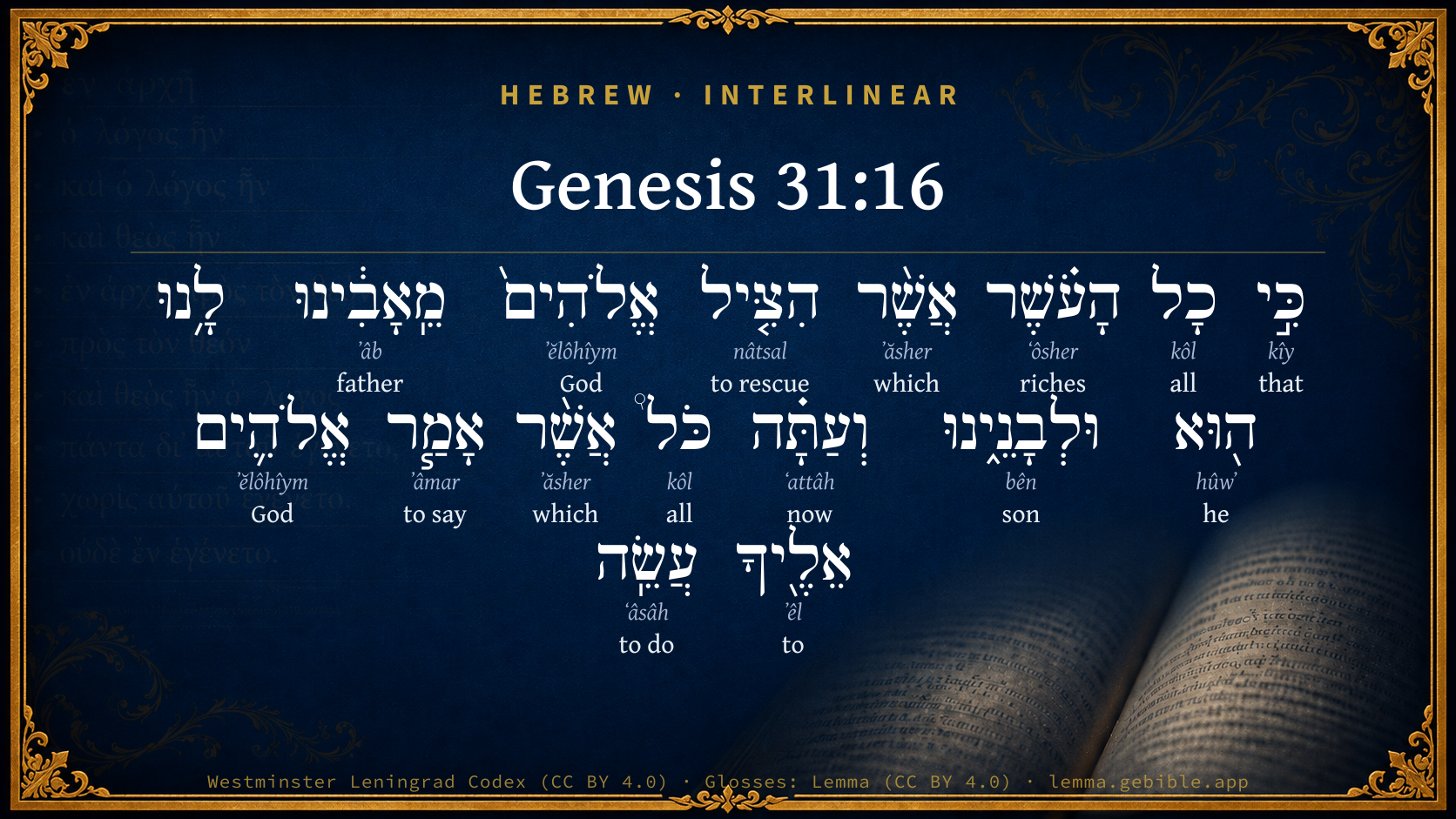
  1. כִּ֣י kîy H3588 “that” Conjunction
  2. כָל kôl H3605 “all of” Noun, Common, Masculine, Singular, Construct
  3. אֲשֶׁ֨ר ʼăsher H834 “which” Particle, Relative
  4. הִצִּ֤יל nâtsal H5337 “to rescue” Verb, Hiphil, Perfect, 3rd Person, Masculine, Singular
  5. אֱלֹהִים֙ ʼĕlôhîym H430 “God(s)” Noun, Common, Masculine, Plural, Absolute
  6. מֵֽאָבִ֔ינוּ ʼâb H1 “from · father · our” Preposition + Noun, Common, Masculine, Singular, Construct + Suffix, Personal, 1st Person, Common, Plural
  7. ה֖וּא hûwʼ H1931 “he” Pronoun, Personal, 3rd Person, Masculine, Singular
  8. וּלְבָנֵ֑ינוּ bên H1121 “and · to/for · sons · our” Conjunction + Preposition + Noun, Common, Masculine, Plural, Construct + Suffix, Personal, 1st Person, Common, Plural
  9. וְעַתָּ֗ה ʻattâh H6258 “and · now” Conjunction + Adverb
  10. כֹּל֩ kôl H3605 “all” Noun, Common, Masculine, Singular, Absolute
  11. אֲשֶׁ֨ר ʼăsher H834 “which” Particle, Relative
  12. אָמַ֧ר ʼâmar H559 “to say” Verb, Qal, Perfect, 3rd Person, Masculine, Singular
  13. אֱלֹהִ֛ים ʼĕlôhîym H430 “God(s)” Noun, Common, Masculine, Plural, Absolute
  14. אֵלֶ֖יךָ ʼêl H413 “to · you” Preposition + Suffix, Personal, 2nd Person, Masculine, Singular
  15. עֲשֵֽׂה ʻâsâh H6213 “do” Verb, Qal, Imperative, 2nd Person, Masculine, Singular

About this verse

These counts appear in no published source. They are computed here, from the morphology-tagged text and Lemma’s own curated glosses. What Lemma adds →

17
words
13
distinct lemmas
Pentateuch
section

First appearance in Scripture

This word makes its first canonical appearance in the Hebrew Bible here:

  • הָעֹ֗שֶׁר riches H6239

Shared distinctive vocabulary

הָעֹ֗שֶׁר riches H6239 occurs in 36 verses of the Hebrew Bible. Also found in:

Grammatical profile

  • 3 verbs
  • 7 nouns
  • 1 pronoun
  • 2 prepositions
  • 1 conjunction
  • 1 adverb
  • 2 particles

Verb forms

  • הִצִּ֤יל Hiphil · Perfect
  • אָמַ֧ר Qal · Perfect
  • עֲשֵֽׂה Qal · Imperative

Repetition

Words recur within this verse — often emphatic in Hebrew:

  • כָל all H3605 ×2
  • אֱלֹהִים֙ God H430 ×2
  • אֲשֶׁ֨ר which H834 ×2

Hebrew & Septuagint length

In English translation the verse runs 27 words from the Hebrew and 29 from the Septuagint (LXX English) — closely comparable.

A rough comparison of the two English renderings, which tokenize alike — not a word-level alignment.

Word counts can differ between the Hebrew and the Greek without any difference in meaning — e.g. the Hebrew direct-object marker אֵת has no separate Greek word, and Greek often adds the article ὁ.

In the original languages it is 17 Hebrew tokens and 27 Greek tokens — but the two are counted differently (Hebrew bundles its prefixes and suffixes into one token; the Greek is in lemma form), so that isn’t a like-for-like length.

Cross-references

3

Topical passages linked to Genesis 31:16 in the Treasury of Scripture Knowledge — connected by theme and wording, ordered by reader-vote popularity; previews shown in the World English Bible.

  • Genesis 30:35–31:1 That day, he removed the male goats that were streaked and spotted, and all the female goats that were speckled and spotted, every one that had white in it, and all the black ones among the sheep, and gave them into the hand of his sons.
  • Genesis 31:9 Thus God has taken away the cattle of your father, and given them to me.
  • Psalms 45:10 Listen, daughter, consider, and turn your ear. Forget your own people, and also your father's house.

Cross-references courtesy of OpenBible.info (CC BY 4.0).

Hebrew and Greek witnesses Masoretic Hebrew ↔ Greek Septuagint

The same verse in the two great witnesses to the Old Testament, shown verse-for-verse.

These are two independent witnesses, not word-aligned to each other, and the Septuagint is shown in lemma (dictionary) form.

Hebrew Genesis 31:16 Masoretic · Westminster Leningrad Codex

כִּ֣י כָל הָעֹ֗שֶׁר אֲשֶׁ֨ר הִצִּ֤יל אֱלֹהִים֙ מֵֽאָבִ֔ינוּ לָ֥נוּ ה֖וּא וּלְבָנֵ֑ינוּ וְעַתָּ֗ה כֹּל֩ אֲשֶׁ֨ר אָמַ֧ר אֱלֹהִ֛ים אֵלֶ֖יךָ עֲשֵֽׂה

For all the riches which God has taken away from our father, that is ours and our children's. Now then, whatever God has said to you, do."

World English Bible · Public Domain

Greek LXX Genesis 31:16 Septuagint · lemma form

πᾶς ὁ πλοῦτος καί ὁ δόξα ὅς ἀποαἱρέω ὁ θεός ὁ πατήρ ἐγώ ἐγώ εἰμί καί ὁ τέκνον ἐγώ νῦν οὖν ὅσος εἶπον σύ ὁ θεός ποιέω

All the wealth and the glory which God has taken from our father, it shall be our's and our children's; now then do whatever God has said to you.

LXX2012 (modern English Septuagint) · Public Domain

Hebrew: Westminster Leningrad Codex (CC BY 4.0). Greek: Septuagint (public domain); English from LXX2012 (modern English Septuagint) (Public Domain). How the Septuagint differs from the Hebrew →

Targum (Aramaic paraphrase)

2

The Targum is the ancient Jewish Aramaic paraphrase of the Hebrew Scriptures — an interpretive translation, not the Hebrew text itself. Onkelos (literal) and Pseudo-Jonathan (expansive) render the Torah, and Jonathan the Prophets. Coverage is partial: where no permissively-licensed English translation exists for a verse, only the Aramaic is shown. This is verse-level text, not a word-by-word alignment to the Hebrew.

  1. Targum Onkelos Torah (Genesis–Deuteronomy)
    אֲרֵי כָל עוּתְרָא דִּי אַפְרֵשׁ יְיָ מֵאֲבוּנָא דִּילָנָא הוּא וְדִבְּנָנָא וּכְעַן כֹּל דִּי אֲמַר יְיָ לָךְ עִבֵד

    (no public-domain English translation for this verse)

    Targum Onkelos — Aramaic: “Onkelos Genesis” (public domain); “Onkelos Exodus” (public domain); “Onkelos Leviticus” (public domain); “Onkelos Numbers” (public domain); “Onkelos Deuteronomy” (public domain). English: “Sefaria Community Translation” (CC0 1.0 (public-domain dedication)); “J.W. Etheridge. The Targums of Onkelos and Jonathan Ben Uzziel on the Pentateuch. London: Longmans, Green, 1862” (public domain). Text via Sefaria.

  2. Targum Pseudo-Jonathan Torah (Genesis–Deuteronomy)
    אֲרוּם כָּל עוּתְרָא דְרוֹקַן יְיָ מִן אָבוּנָא דִי לָנָא הוּא וְדִבְנָנָא וּכְדוֹן כָּל דְאָמַר יְיָ לָךְ עִבֵיד

    Therefore all the wealth that the Lord hath taken from our father is ours and our children's. And now, all that the Lord hath said to thee, do.

    Targum Pseudo-Jonathan — Aramaic: “Targum Jonathan on Genesis” (public domain); “Targum Jonathan on Exodus” (public domain); “Targum Jonathan on Leviticus” (public domain); “Targum Jonathan on Numbers” (public domain); “Targum Jonathan on Deuteronomy” (public domain). English: “The Targum of Jonathan ben Uzziel, trans. J. W. Etheridge, London, 1862” (public domain). Text via Sefaria.

Commentary

Notes on Genesis 31:16 from classic Christian and Jewish commentators (each source and its license shown beneath its notes). The classic Christian expositions comment on the surrounding passage and are grouped to its opening verse, so a note may address several verses; the Jewish commentaries on the Tanakh (Rashi and others) are per-verse, so they appear only where the commentator wrote on this verse.

Lemma curates 59 commentaries, every one of them public domain or Creative Commons licensed, each selected and text-cleaned for this edition rather than reprinted as found. About our sources →

Trapp's Complete Commentary

John Trapp

Gen 31:16 For all the riches which God hath taken from our father, that [is] ours, and our children’s: now then, whatsoever God hath said unto thee, do.

Ver. 16. For all the riches, &c.] Here they speak the truth; but offend, (1.) In that they utter it passionately, and with perturbation of spirit; (2.) In that they seem somewhat to obscure God’s blessing; as though it were but their due, as daughters. In dealing with those that have done us wrong, it is hard not to offend, either in the matter or manner of our expressions.

Now then, whatsoever God hath said, &c.] Thus they prefer a husband to a father. So did Michal, though there was no great store of religion in her. And so nature had taught that "daughter of women" to do, Dan 11:17. Antiochus the Great gave Cleopatra, his daughter, to Ptolemy Epiphanes, thinking to use her as an instrument to destroy him. But she, contrary to his expectation, clave to her husband.

John Trapp, A Commentary or Exposition upon All the Books of the Old and New Testament (1647–1656) — public domain. Text from a community e-Sword module.

John Calvin's Commentaries

16. For all the riches which God has taken from our father. Rachel and Leah confirm the speech of Jacob; but yet in a profane and common manner, not with a lively and pure sense of religion. For they only make a passing allusion to the fact, that God, in pity to his servant, had deigned to honor him with peculiar favor; and in the meantime, insist upon a reason of little solidity, that what they were carrying away was justly their due, because a part of the inheritance pertained to them. They do not argue that the riches they possessed were theirs, because they had been justly acquired by the labor of their husband; but because they themselves ought not to have been defrauded of their dowry, and now deprived of their lawful inheritance. For this reason they mention also their children with themselves, as having sprung from the blood of Laban. By this method they not only obscure the blessing of God, but indulge themselves in greater license than is right. They also form a mean estimate of their husband’s labors, in boasting that the fruit of those labors proceeded from themselves. Wherefore we are, by no means, to seek hence a precedent for the way in which each is to defend his own right, or to attempt the recovery of it, when it has been unjustly wrested from him.

John Calvin's Commentaries (1540-1563) — public domain. Text from the Calvin Translation Society English edition (1840s-50s) via the Christian Classics Ethereal Library (ccel.org). Calvin's coverage is partial (roughly two-thirds of the Bible); uncommented books and verses are honest gaps, never fabricated. The 19th-century editor's footnotes and remarks are omitted so the notes are faithfully Calvin's own voice.

John Gill's Exposition

Then Jacob rose up,.... And went with them to Laban's house, where his children were, as is plain from Rachel's theft, Gen 31:19,

and set his sons and his wives upon camels; which were his own, see Gen 30:43; creatures fit for travelling; on these he set his wives, Rachel and Leah, and his concubine wives, Bilhah and Zilpah; for these went with him, as appears from Gen 33:6; and "his sons", or rather "his children": for they were not all sons, there was one daughter, and they were all young; his eldest son Reuben could not be much more than twelve years of age, and his youngest son Joseph about six.

John Gill's Exposition of the Whole Bible (1746–1763) — public domain (CC PDM 1.0). Text via the HelloAO Bible API.

Matthew Poole's English Annotations

That is ours; not only by God’s special gift, but by the natural right which children have to a share in his estate, and upon the account of thy faitithful and laborious service.

Matthew Poole's English Annotations on the Holy Bible (1683–1685) — public domain. Text from a community e-Sword/MySword module.

John Wesley's Explanatory Notes

Whereas Jacob looked upon the wealth which God had passed over from Laban to him as his wages, they look upon it as their portions; so that both ways God forced Laban to pay his debts, both to his servant and to his daughters.

John Wesley, Explanatory Notes Upon the Whole Bible (1754–1765) — public domain. Text via the GEBible commentary corpus.

Rashi

Rabbi Shlomo Yitzchaki (Rashi)

כי כל העשר FOR ALL THE RICHES — The word כי here means but; as much as to say: of our father’s property we have nothing at all; but what The Holy One, blessed be He, has taken away from our father, that is ours.

הציל means separated (or taken away). Similarly all forms from the Hiphil of this root occuring in Scripture (usually translated by “to deliver”, “to rescue“) mean taking away, for one who rescues a person takes him away from the misfortune or from the enemy.

Rashi on the Tanakh — English translations: “The Judaica Press complete Tanach with Rashi, translated by A. J. Rosenberg” (CC BY 4.0); “Pentateuch with Rashi's commentary by M. Rosenbaum and A.M. Silbermann, 1929-1934” (public domain); “The Metsudah Tanach series, Lakewood, N.J” (CC BY 4.0); and “The Book of Joshua, Metsudah Publications, 1997” (CC BY 4.0). Text via Sefaria.

Sforno

Rabbi Ovadia Sforno

bAll the wealth that Elokim rescued. We do not expect to receive from him anything other than what Hashem has already rescued.

Now. Now that he has accepted the slander about you and may use it to justify stealing whatever you have.

Whatever Hashem has said, do it. There is no need for you to seek further permission.

Sforno on the Tanakh — English translation: “Yalkut, Sifsei Chachomim Chumash, Metsudah Publications, 2009” (CC BY 4.0). Text via Sefaria.

Lesson kit

Teaching starters — assembled from the data on this page, not authored interpretation. Every prompt links to the verse data it draws on. Edit before teaching.

Genesis, in the Pentateuch, opens this verse with 17 words (13 distinct Hebrew lemmas). Its most distinctive word is ʻôsher (“riches”). A historical commentator’s framing appears above. Read the whole chapter for the surrounding context.

Discussion questions

  1. What does “riches” (ʻôsher) contribute to the verse as a whole?
  2. This is the first place “riches” appears in Scripture (first appears here). What does its debut here establish?
  3. How does 1 Samuel 17:25, which shares the word «riches», read alongside this verse?
  4. What does the repetition of “all” (2× in this one verse) do in this verse?
  5. These translations render this verse differently; the difference is in the English rendering, not the original. What questions does that raise?
  6. «הִצִּ֤יל» is a Hiphil Perfect verb. How does that grammatical form shape the action described?
  7. Compare how Trapp's Complete Commentary and John Calvin's Commentaries read this verse. Where do they agree or differ?

Things to notice

Reading settings

Reading text

Shown beneath each verse's original-language words.

Old Testament
Old Testament edition

Read the OT as the Masoretic Hebrew (MT) or the Greek Septuagint (LXX).

English shown for the Greek Septuagint (in the Hebrew ↔ Greek comparison).

Comparing translations? Open the Compare panel on any verse page to stack up to four side by side.