
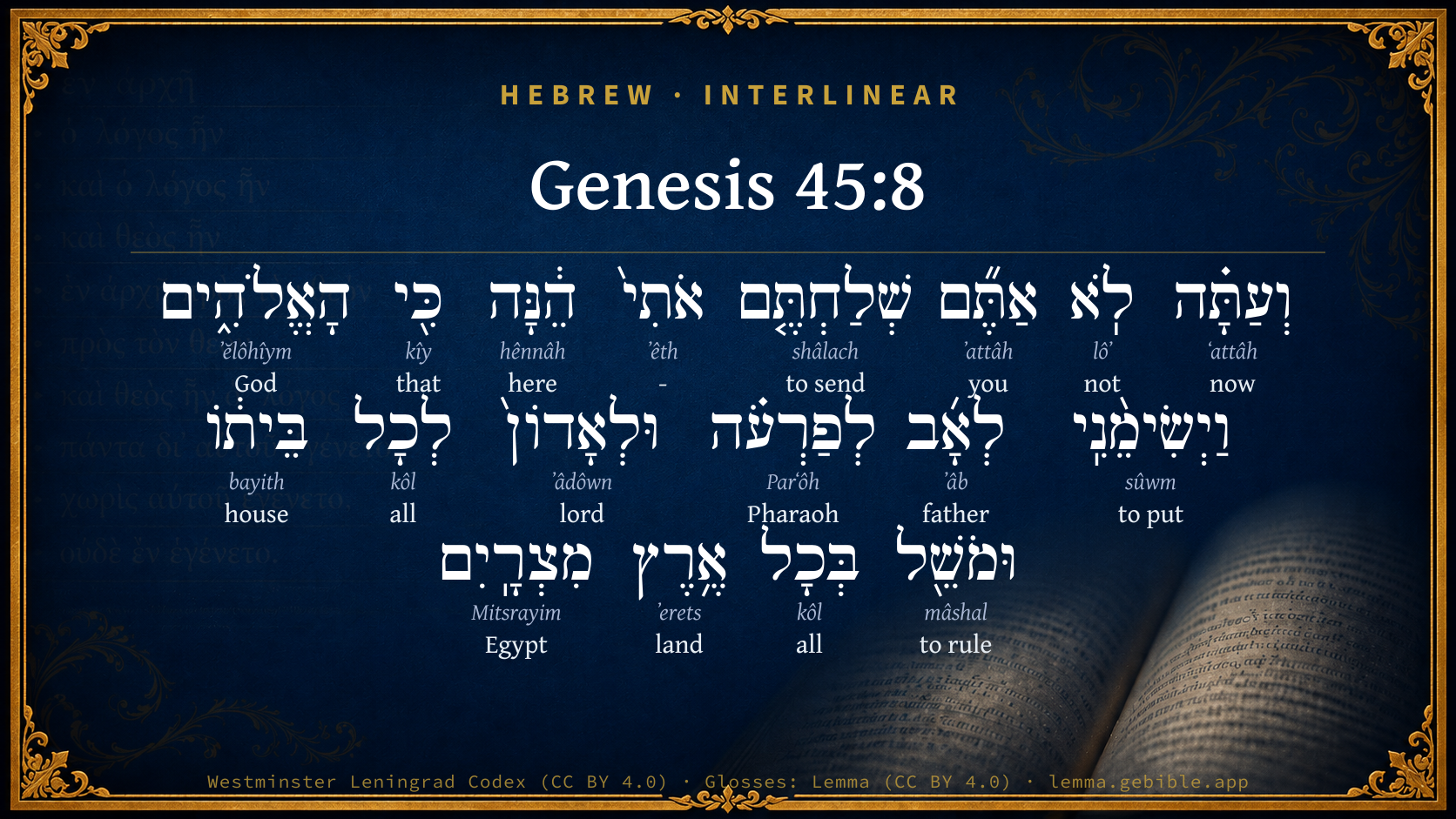
Genesis 45:8

Hebrew (Westminster Leningrad Codex) Genesis 45:8 appears in the Hebrew Old Testament. The text above is from the Westminster Leningrad Codex. Each word links to its Strong’s number, a concise gloss, and parsing drawn from the Open Scriptures Hebrew Bible morphology. Click any word for its full Brown-Driver-Briggs (BDB) entry.
Download image
Cite this verse

Genesis 45:8 (World English Bible). Public Domain. Lemma interlinear Bible study tool, https://lemma.gebible.app/v/genesis/45/8.

Show BibTeX & RIS
BibTeX
RIS
English Translation
So now it wasn't you who sent me here, but God, and he has made me a father to Pharaoh, lord of all his house, and ruler over all the land of Egypt.
World English Bible · Public Domain
Download a study sheet

One document with this verse’s original text, its word-by-word gloss line, the meaning frame, cross-references with their text, attributed commentary, and full source and license credits — printable, and it pastes into notes with its structure intact.

This verse Autodidact and up

Study sheet (.html) Plain text (.txt)

A passage Seminary Student

Up to 50 verses in one chapter. A passage sheet keeps up to 6 commentary sources and 12 cross-references per verse, in the order this page ranks them, and says so on the sheet whenever that leaves anything out. Ask for a single verse and you get the Autodidact verse sheet above.

Everything on this page stays free to read, with no account — the sheet is a download of what is already on screen, not access to it.

Want to remove ads? Support Godless Engineer
Compare translations 3

The same verse in 3 English versions, stacked beneath the original-language interlinear above. Click any original word for its lexicon entry.

Each is an independent rendering of the whole verse — the interlinear is not word-aligned to these translations.

Highlighted words mark where these versions differ — a whole-verse word diff, not a word-by-word alignment.

  • World English Bible Public Domain
    So now it wasn't you who sent me here, but God, and he has made me a father to Pharaoh, lord of all his house, and ruler over all the land of Egypt.
  • King James Version Public Domain
    So now it was not you that sent me hither, but God: and he hath made me a father to Pharaoh, and lord of all his house, and a ruler throughout all the land of Egypt.
  • unfoldingWord Literal Text CC BY-SA 4.0
    So now, not you sent me here, but God. And he has made me father to Pharaoh, and lord over all his house and the ruler in all the land of Egypt.

unfoldingWord Literal Text — © unfoldingWord, licensed CC BY-SA 4.0. Word-aligned USFM3 via Door43 (git.door43.org/unfoldingWord/en_ult).

Versions to compare (up to 4)

3 of 4 selected

Show all 18 translations

Every available English version of this verse, each an independent rendering of the whole verse.

  • World English Bible Public Domain
    So now it wasn't you who sent me here, but God, and he has made me a father to Pharaoh, lord of all his house, and ruler over all the land of Egypt.
  • Berean Standard Bible Public Domain
    Therefore it was not you who sent me here, but God, who has made me a father to Pharaoh—lord of all his household and ruler over all the land of Egypt.
  • Majority Standard Bible Public Domain
    Therefore it was not you who sent me here, but God, who has made me a father to Pharaoh—lord of all his household and ruler over all the land of Egypt.
  • King James Version Public Domain
    So now it was not you that sent me hither, but God: and he hath made me a father to Pharaoh, and lord of all his house, and a ruler throughout all the land of Egypt.
  • American Standard Version (1901) Public Domain
    So now it was not you that sent me hither, but God: and he hath made me a father to Pharaoh, and lord of all his house, and ruler over all the land of Egypt.
  • Revised Version (1885) Public Domain
    So now it was not you that sent me hither, but God: and he hath made me a father to Pharaoh, and lord of all his house, and ruler over all the land of Egypt.
  • Geneva Bible (1599) Public Domain
    Now the you sent not me hither, but God, who hath made mee a father vnto Pharaoh, and lorde of all his house, and ruler throughout all the land of Egypt.
  • Douay-Rheims (1899) Public Domain
    Not by your counsel was I sent hither, but by the will of God: who hath made me as it were a father to Pharao, and lord of his whold house, and governor in all the land of Egypt.
  • Young's Literal Translation Public Domain
    and now, ye -- ye have not sent me hither, but God, and He doth set me for a father to Pharaoh, and for lord to all his house, and ruler over all the land of Egypt.
  • Literal Standard Version CC BY-SA 4.0
    and now, you have not sent me here, but God, and He sets me for a father to Pharaoh, and for lord to all his house, and ruler over all the land of Egypt.
  • Unlocked Literal Bible CC BY-SA 4.0
    So now it was not you who sent me here but God, and he has made me a father to Pharaoh, master of all his house, and ruler of all the land of Egypt.
  • unfoldingWord Literal Text CC BY-SA 4.0
    So now, not you sent me here, but God. And he has made me father to Pharaoh, and lord over all his house and the ruler in all the land of Egypt.
  • Darby Bible Public Domain
    And now it was not you [that] sent me here, but God; and he has made me a father to Pharaoh, and lord of all his house, and governor over all the land of Egypt.
  • World Messianic Bible Public Domain
    So now it wasn’t you who sent me here, but God, and he has made me a father to Pharaoh, lord of all his house, and ruler over all the land of Egypt.
  • Webster's Bible Public Domain
    So now it was not you that sent me hither, but God: and he hath made me a father to Pharaoh, and lord of all his house, and a ruler throughout all the land of Egypt.
  • Free Bible Version CC BY-SA 4.0
    So it wasn't you who sent me here, but God. He was the one who made me Pharaoh's chief advisor in charge of all his affairs, and ruler of the whole country of Egypt.
  • Bible in Basic English Public Domain
    So now it was not you who sent me here, but God: and he has made me as a father to Pharaoh, and lord of all his house, and ruler over all the land of Egypt.
  • JPS Tanakh (1917) Public Domain
    So now it was not you that sent me hither, but God; and He hath made me a father to Pharaoh, and lord of all his house, and ruler over all the land of Egypt.

Literal Standard Version (2020), Covenant Press — licensed CC BY-SA 4.0. Text via the HelloAO Bible API (eBible.org). Unlocked Literal Bible (unfoldingWord) — licensed CC BY-SA 4.0. Text via the HelloAO Bible API (eBible.org). unfoldingWord Literal Text — © unfoldingWord, licensed CC BY-SA 4.0. Word-aligned USFM3 via Door43 (git.door43.org/unfoldingWord/en_ult). Free Bible Version, Dr. Jonathan Gallagher — licensed CC BY-SA 4.0. Text via the HelloAO Bible API (eBible.org).

Word by word

More ways to search: Search by grammar → Find every occurrence → Compare this word →

Practice this passage: Drill this verse → Learn its vocabulary →

הֵ֔נָּה
hênnâh
H2008
“here”
Adverb
Part of Speech
Adverb
Full BDB Definition

Origin: from H2004

TWOT: 510b

here, there, now, hither
  1. וְעַתָּ֗ה ʻattâh H6258 “and · now” Conjunction + Adverb
  2. לֹֽא lôʼ H3808 “not” Particle, Negative
  3. אַתֶּ֞ם ʼattâh H859 “you” Pronoun, Personal, 2nd Person, Masculine, Plural
  4. שְׁלַחְתֶּ֤ם shâlach H7971 “to send” Verb, Qal, Perfect, 2nd Person, Masculine, Plural
  5. אֹתִי֙ ʼêth H853 “- · me” Particle, Direct Object + Suffix, Personal, 1st Person, Common, Singular
  6. כִּ֖י kîy H3588 “that” Conjunction
  7. הָאֱלֹהִ֑ים ʼĕlôhîym H430 “the · God(s)” Particle, Definite Article + Noun, Common, Masculine, Plural, Absolute
  8. וַיְשִׂימֵ֨נִֽי sûwm H7760 “and · to put · me” Conjunction + Verb, Qal, Sequential Imperfect, 3rd Person, Masculine, Singular + Suffix, Personal, 1st Person, Common, Singular
  9. לְאָ֜ב ʼâb H1 “to/for · father” Preposition + Noun, Common, Masculine, Singular, Absolute
  10. לְפַרְעֹ֗ה Parʻôh H6547 “to/for · Pharaoh” Preposition + Noun, Proper
  11. וּלְאָדוֹן֙ ʼâdôwn H113 “and · to/for · lord” Conjunction + Preposition + Noun, Common, Masculine, Singular, Absolute
  12. לְכָל kôl H3605 “to/for · all of” Preposition + Noun, Common, Masculine, Singular, Construct
  13. בֵּית֔וֹ bayith H1004 “house · his” Noun, Common, Masculine, Singular, Construct + Suffix, Personal, 3rd Person, Masculine, Singular
  14. וּמֹשֵׁ֖ל mâshal H4910 “and · ruling” Conjunction + Verb, Qal, Participle Active, Masculine, Singular, Absolute
  15. בְּכָל kôl H3605 “in/at · all of” Preposition + Noun, Common, Masculine, Singular, Construct
  16. אֶ֥רֶץ ʼerets H776 “land of” Noun, Common, Both, Singular, Construct
  17. מִצְרָֽיִם Mitsrayim H4714 “Egypt” Noun, Proper

About this verse

These counts appear in no published source. They are computed here, from the morphology-tagged text and Lemma’s own curated glosses. What Lemma adds →

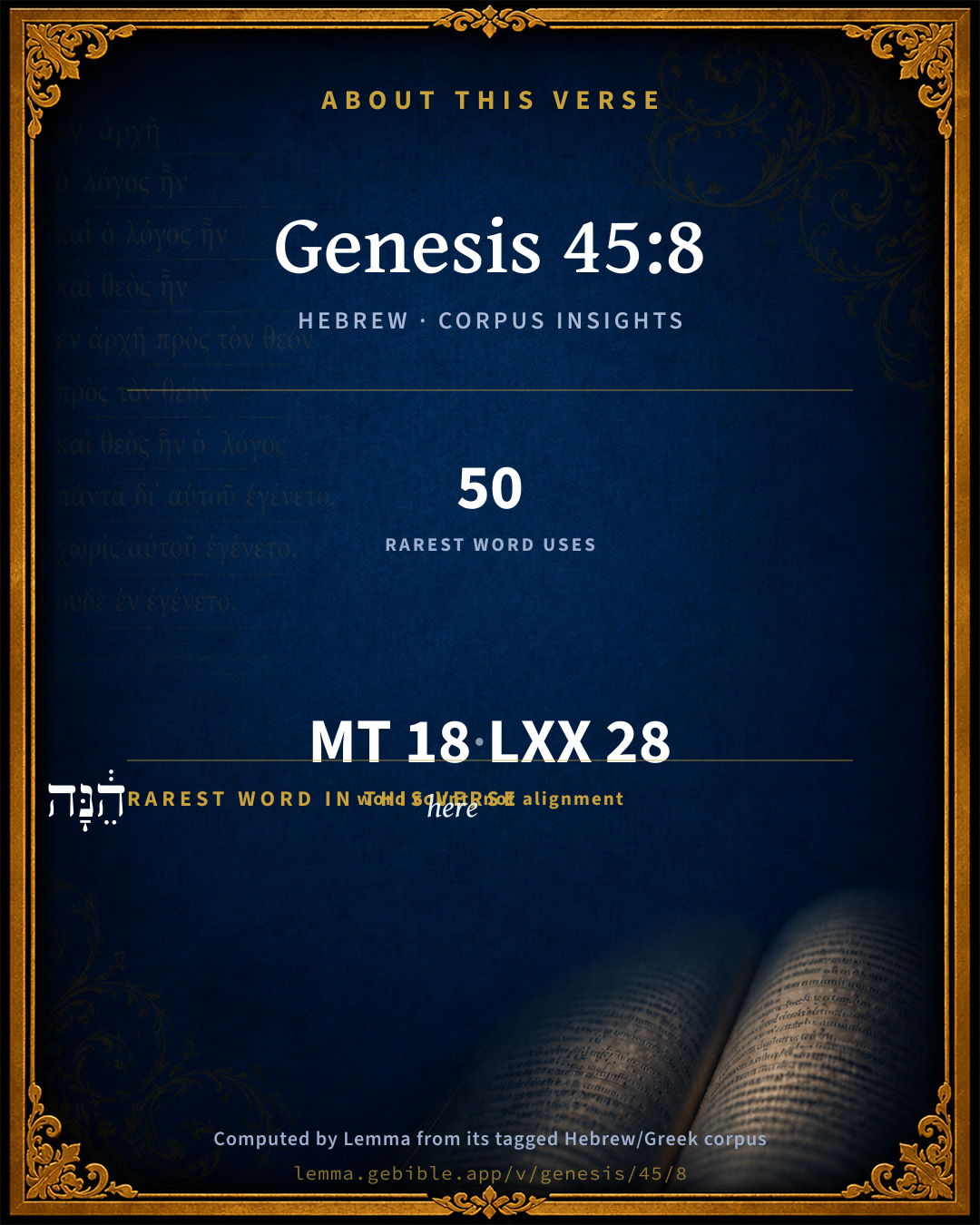
18
words
17
distinct lemmas
Pentateuch
section

Shared distinctive vocabulary

הֵ֔נָּה here H2008 occurs in 42 verses of the Hebrew Bible. Also found in:

Grammatical profile

  • 3 verbs
  • 9 nouns
  • 1 pronoun
  • 1 conjunction
  • 2 adverbs
  • 2 particles

Verb forms

  • שְׁלַחְתֶּ֤ם Qal · Perfect
  • וַיְשִׂימֵ֨נִֽי Qal · Sequential Imperfect
  • וּמֹשֵׁ֖ל Qal · Participle Active

Repetition

A word recurs within this verse — often emphatic in Hebrew:

  • לְכָל all H3605 ×2

Hebrew & Septuagint length

In English translation the verse runs 33 words from the Hebrew and 34 from the Septuagint (LXX English) — closely comparable.

A rough comparison of the two English renderings, which tokenize alike — not a word-level alignment.

Word counts can differ between the Hebrew and the Greek without any difference in meaning — e.g. the Hebrew direct-object marker אֵת has no separate Greek word, and Greek often adds the article ὁ.

In the original languages it is 18 Hebrew tokens and 28 Greek tokens — but the two are counted differently (Hebrew bundles its prefixes and suffixes into one token; the Greek is in lemma form), so that isn’t a like-for-like length.

Cross-references

8

Topical passages linked to Genesis 45:8 in the Treasury of Scripture Knowledge — connected by theme and wording, ordered by reader-vote popularity; previews shown in the World English Bible.

  • John 15:16 You didn't choose me, but I chose you, and appointed you, that you should go and bear fruit, and that your fruit should remain; that whatever you will ask of the Father in my name, he may give it to you.
  • Romans 9:16 So then it is not of him who wills, nor of him who runs, but of God who has mercy.
  • John 19:11 Jesus answered, "You would have no power at all against me, unless it were given to you from above. Therefore he who delivered me to you has greater sin."
  • Psalms 105:21–22 He made him lord of his house, And ruler of all of his possessions;
  • Judges 17:10 Micah said to him, Dwell with me, and be to me a father and a priest, and I will give you ten [pieces] of silver by the year, and a suit of clothing, and your food. So the Levite went in.
  • Job 29:16 I was a father to the needy. The cause of him who I didn't know, I searched out.
  • Genesis 41:39–48 Pharaoh said to Joseph, "Because God has shown you all of this, there is none so discreet and wise as you.
  • Genesis 45:5 Now don't be grieved, nor angry with yourselves, that you sold me here, for God sent me before you to preserve life.

Cross-references courtesy of OpenBible.info (CC BY 4.0).

Hebrew and Greek witnesses Masoretic Hebrew ↔ Greek Septuagint

The same verse in the two great witnesses to the Old Testament, shown verse-for-verse.

These are two independent witnesses, not word-aligned to each other, and the Septuagint is shown in lemma (dictionary) form.

Hebrew Genesis 45:8 Masoretic · Westminster Leningrad Codex

וְעַתָּ֗ה לֹֽא אַתֶּ֞ם שְׁלַחְתֶּ֤ם אֹתִי֙ הֵ֔נָּה כִּ֖י הָאֱלֹהִ֑ים וַיְשִׂימֵ֨נִֽי לְאָ֜ב לְפַרְעֹ֗ה וּלְאָדוֹן֙ לְכָל בֵּית֔וֹ וּמֹשֵׁ֖ל בְּכָל אֶ֥רֶץ מִצְרָֽיִם

So now it wasn't you who sent me here, but God, and he has made me a father to Pharaoh, lord of all his house, and ruler over all the land of Egypt.

World English Bible · Public Domain

Greek LXX Genesis 45:8 Septuagint · lemma form

νῦν οὖν οὐ σύ ἐγώ ἀποστέλλω ὧδε ἀλλά ἤ ὁ θεός καί ποιέω ἐγώ ὡς πατήρ φαραώ καί κύριος πᾶς ὁ οἶκος αὐτός καί ἄρχων πᾶς γῆ αἴγυπτος

Now then you⌃ did not send me hither, but God; and he has made me as a father of Pharao, and lord of all his house, and ruler of all the land of Egypt.

LXX2012 (modern English Septuagint) · Public Domain

Hebrew: Westminster Leningrad Codex (CC BY 4.0). Greek: Septuagint (public domain); English from LXX2012 (modern English Septuagint) (Public Domain). How the Septuagint differs from the Hebrew →

Targum (Aramaic paraphrase)

2

The Targum is the ancient Jewish Aramaic paraphrase of the Hebrew Scriptures — an interpretive translation, not the Hebrew text itself. Onkelos (literal) and Pseudo-Jonathan (expansive) render the Torah, and Jonathan the Prophets. Coverage is partial: where no permissively-licensed English translation exists for a verse, only the Aramaic is shown. This is verse-level text, not a word-by-word alignment to the Hebrew.

  1. Targum Onkelos Torah (Genesis–Deuteronomy)
    וּכְעַן לָא אַתּוּן שְׁלַחְתּוּן יָתִי הַלְכָא אֶלָּהֵן מִן קֳדָם יְיָ וְשַׁוְּיַנִי לְאַבָּא לְפַרְעֹה וּלְרִבּוֹן לְכָל אֱנַשׁ בֵּיתֵהּ וְשַׁלִּיט בְּכָל אַרְעָא דְמִצְרָיִם

    (no public-domain English translation for this verse)

    Targum Onkelos — Aramaic: “Onkelos Genesis” (public domain); “Onkelos Exodus” (public domain); “Onkelos Leviticus” (public domain); “Onkelos Numbers” (public domain); “Onkelos Deuteronomy” (public domain). English: “Sefaria Community Translation” (CC0 1.0 (public-domain dedication)); “J.W. Etheridge. The Targums of Onkelos and Jonathan Ben Uzziel on the Pentateuch. London: Longmans, Green, 1862” (public domain). Text via Sefaria.

  2. Targum Pseudo-Jonathan Torah (Genesis–Deuteronomy)
    וּכְדוֹן לָא אַתּוּן שְׁדַרְתּוּן יָתִי הַלְכָא אֱלָהֵן מִן קֳדָם יְיָ אִסְתַּקֵף פִּתְגָמָא וְשַׁוְיַינִי לְרַב לְפַרְעה וּלְרַב עַל כָּל בֵּיתֵיהּ וְשַׁלִיט בְּכָל אַרְעָא דְמִצְרָיִם

    And now, it was not you who sent me hither, but it was from before the Lord that the thing was occasioned, that He might set me for a prince unto Pharoh, a chief over his house, and a ruler in all the land of Mizraim.

    Targum Pseudo-Jonathan — Aramaic: “Targum Jonathan on Genesis” (public domain); “Targum Jonathan on Exodus” (public domain); “Targum Jonathan on Leviticus” (public domain); “Targum Jonathan on Numbers” (public domain); “Targum Jonathan on Deuteronomy” (public domain). English: “The Targum of Jonathan ben Uzziel, trans. J. W. Etheridge, London, 1862” (public domain). Text via Sefaria.

Commentary

Notes on Genesis 45:8 from classic Christian and Jewish commentators (each source and its license shown beneath its notes). The classic Christian expositions comment on the surrounding passage and are grouped to its opening verse, so a note may address several verses; the Jewish commentaries on the Tanakh (Rashi and others) are per-verse, so they appear only where the commentator wrote on this verse.

Lemma curates 59 commentaries, every one of them public domain or Creative Commons licensed, each selected and text-cleaned for this edition rather than reprinted as found. About our sources →

Trapp's Complete Commentary

John Trapp

Gen 45:8 So now [it was] not you [that] sent me hither, but God: and he hath made me a father to Pharaoh, and lord of all his house, and a ruler throughout all the land of Egypt.

Ver. 8. It was not you that sent me.] Joseph makes the best of an ill matter, that they may not be overwhelmed with grief, and so made a prey to the devil. {2Co 2:11} "After I was made known to myself," saith Ephraim, "I repented." {a} Get thee, saith Mr Bradford, {b} God’s law as a glass, to look in; so shalt thou see thy face foul arrayed, and so shameful, saucy, mangy, pocky, and scabbed, that thou canst not but be sorry at the contemplation thereof, &c. Especially if thou look to the tag tied to God’s law, the malediction, which is such as cannot but make us to cast our currish tails between our legs, if we believe it. But here, to clear our eyesight, and keep us upright, we must anoint our eyes with Christ’s eyesalve. {Rev 3:17-18} We read of a sensible eyesalve made of Christ’s spittle and clay. {Joh 9:6} As it were, of the knowledge of Christ by his word which proceedeth out of his mouth, as also of the knowledge of ourselves; who being made of earth, do savour nothing else but earth. {c} Both of these two knowledges are to be joined and beaten together in a lump; else they help not. For our misery acknowledged, without Christ, breedeth desperation: and Christ, without sense of our vileness, presumption.

{a} Postquam ostensum fuerit mihi. - Tremell.

{b} Mr Bradford’s Sermon of Repent., pp. 26, 27.

{c} Bright., in loc.

John Trapp, A Commentary or Exposition upon All the Books of the Old and New Testament (1647–1656) — public domain. Text from a community e-Sword module.

Joseph Benson's Commentary

Gen 45:8. It was not you that sent me hither, but God — That I came to this place and pitch of honour and power is not to be imputed to your design, which was of another nature, but to God’s overruling providence, which ordered the circumstances of your action, so as that I should be brought to this place and state; compare Gen 50:20. He hath made me a father to Pharaoh — His principal counsellor of state, to guide his affairs with a fatherly care, and to have the authority, respect, and power of a father with him; Gen 41:40-44; Jdg 17:10.

Joseph Benson's Commentary on the Old and New Testaments (1811–1818) — public domain. Text from a community e-Sword module.

Geneva Bible (1599)

Geneva Bible translators

Albeit God detest sin, yet he turneth man’s wickedness to serve to his glory.

Geneva Bible (1599) marginal notes — public domain. Text via Bolls.life.

Adam Clarke's Commentary

Verse 8. He hath made me a father to Pharaoh] It has already been conjectured that father was a name of office in Egypt, and that father of Pharaoh might among them signify the same as prime minister or the king's minister does among us. Calmet has remarked that among the Phoenicians, Persians, Arabians, and Romans, the title of father was given to certain officers of state. The Roman emperors gave the name of father to the prefects of the Praetorium, as appears by the letters of Constantine to Ablavius. The caliphs gave the same name to their prime ministers. In Jdg 17:10, Micah says to the young Levite, Dwell with me, and be unto me a FATHER and a priest. And Diodorus Siculus remarks that the teachers and counsellors of the kings of Egypt were chosen out of the priesthood.

Adam Clarke's Commentary on the Bible (1810–1826) — public domain. Text from a community e-Sword/MySword module.

John Calvin's Commentaries

8. So now, it was not you that sent me hither. This is a remarkable passage, in which we are taught that the right course of events is never so disturbed by the depravity and wickedness of men, but that God can direct them to a good end. We are also instructed in what manner and for what purpose we must consider the providence of God. When men of inquisitive minds dispute concerning it, they not only mingle and pervert all things without regard to the end designed, but invent every absurdity in their power, in order to sully the justice of God. And this rashness causes some pious and moderate men to wish this portion of doctrine to be concealed from view; for as soon as it is publicly declared that God holds the government of the whole world, and that nothing is done but by his will and authority, they who think with little reverence of the mysteries of God, break forth into various questions, not only frivolous but injurious. But, as this profane intemperance of mind is to be restrained, so a just measure is to be observed on the other hand, lest we should encourage a gross ignorance of those things which are not only made plain in the word of God, but are exceedingly useful to be known. Good men are ashamed to confess, that what men undertake cannot be accomplished except by the will of God; fearing lest unbridled tongues should cry out immediately, either that God is the author of sin, or that wicked men are not to be accused of crime, seeing they fulfill the counsel of God. But although this sacrilegious fury cannot be effectually rebutted, it may suffice that we hold it in detestation. Meanwhile, it is right to maintain, what is declared by the clear testimonies of Scripture, that whatever men may contrive, yet, amidst all their tumult, God from heaven overrules their counsels and attempts; and, in short, does, by their hands, what he has himself decreed. Good men, who fear to expose the justice of God to the calumnies of the impious, resort to this distinction, that God wills some things, but permits others to be done. As if, truly, any degree of liberty of action, were he to cease from governing, would be left to men. If he had only permitted Joseph to be carried into Egypt, he had not ordained him to be the minister of deliverance to his father Jacob and his sons; which he is now expressly declared to have done. Away, then, with that vain figment, that, by the permission of God only, and not by his counsel or will, those evils are committed which he afterwards turns to a good account. I speak of evils with respect to men, who propose nothing else to themselves but to act perversely. And as the vice dwells in them, so ought the whole blame also to be laid upon them. But God works wonderfully through their means, in order that, from their impurity, he may bring forth his perfect righteousness. This method of acting is secret, and far above our understanding. Therefore it is not wonderful that the licentiousness of our flesh should rise against it. But so much the more diligently must we be on our guard, that we do not attempt to reduce this lofty standard to the measure of our own littleness. Let this sentiment remain fixed with us, that while the lust of men exults, and intemperately hurries them hither and thither, God is the ruler, and, by his secret rein, directs their motions whithersoever he pleases. At the same time, however, it must also be maintained, that God acts so far distinctly from them, that no vice can attach itself to his providence, and that his decrees have no affinity with the crimes of men. Of which mode of procedure a most illustrious example is placed before our eyes in this history. Joseph was sold by his brethren; for what reason, but because they wished, by any means whatever, to ruin and annihilate him? The same work is ascribed to God, but for a very different end; namely, that in a time of famine the family of Jacob might have an unexpected supply of food. Therefore he willed that Joseph should be as one dead, for a short time, in order that he might suddenly bring him forth from the grave, as the preserver of life. Whence it appears, that although he seems, at the commencement, to do the same thing as the wicked; yet there is a wide distance between their wickedness and his admirable judgment. Let us now examine the words of Joseph. For the consolation of his brethren he seems to draw the veil of oblivion over their fault. But we know that men are not exempt from guilt, although God may, beyond expectation, bring what they wickedly attempt, to a good and happy issue. For what advantage was it to Judas that the redemption of the world proceeded from his wicked treachery? Joseph, however, though he withdraws, in some degree, the minds of his brethren from a consideration of their own guilt, until they can breathe again after their immoderate terror, neither traces their fault to God as its cause, nor really absolves them from it; as we shall see more clearly in the last chapter (Genesis 44:1.) And doubtless, it must be maintained, that the deeds of men are not to be estimated according to the event, but according to the measure in which they may have failed in their duty, or may have attempted something contrary to the Divine command, and may have gone beyond the bounds of their calling. Someone, for instance, has neglected his wife or children, and has not diligently attended to their necessities; and though they do not die, unless God wills it, yet the inhumanity of the father, who wickedly deserted them when he ought to have relieved them, is not screened or excused by this pretext. Therefore, they whose consciences accuse them of evil, derive no advantage from the pretense that the providence of God exonerates them from blame. But on the other hand, whenever the Lord interposes to prevent the evil of those who desire to injure us, and not that only, but turns even their wicked designs to our good; he subdues, by this method, our carnal affections, and renders us more just and placable. Thus we see that Joseph was a skillful interpreter of the providence of God, when he borrowed from it an argument for granting forgiveness to his brethren. The magnitude of the crime committed against him might so have incensed him as to cause him to burn with the desire of revenge: but when he reflects that their wickedness had been overruled by the wonderful and unwonted goodness of God, forgetting the injury received, he kindly embraces the men whose dishonor God had covered with his grace. And truly charity is ingenious in hiding the faults of brethren, and therefore she freely applies to this use anything which may tend to appease anger, and to set enmities at rest. Joseph also is carried forward to another view of the case; namely, that he had been divinely chosen to help his brethren. Whence it happens, that he not only remits their offense, but that, from an earnest desire to discharge the duty enjoined upon him, he delivers them from fear and anxiety as well as from want. This is the reason why he asserts that he was ordained to “put for them a remnant,” that is, to preserve a remaining seed, or rather to preserve them alive, and that by an excellent and wonderful deliverance. In saying that he is a father to Pharaoh, he is not carried away with empty boasting as vain men are wont to be; nor does he make an ostentatious display of his wealth; but he proves, from an event so great and incredible, that he had not obtained the post he occupied by accident, nor by human means; but rather that, by the wonderful counsel of God, a lofty throne had been raised for him, from which he might succor his father and his whole family.

John Calvin's Commentaries (1540-1563) — public domain. Text from the Calvin Translation Society English edition (1840s-50s) via the Christian Classics Ethereal Library (ccel.org). Calvin's coverage is partial (roughly two-thirds of the Bible); uncommented books and verses are honest gaps, never fabricated. The 19th-century editor's footnotes and remarks are omitted so the notes are faithfully Calvin's own voice.

Ellicott's Commentary for English Readers

(8) But God.—Heb., but the God. The article is. rarely found with Elohim in the history of Joseph, but wherever it is added it is a sign of deep feeling on the speaker’s part. (Comp. Gen_48:15.) It was the Elohim, who had been the object of the worship of their race, that had now interposed to save them.

A father.—This was a not uncommon title of the chief minister or vizier of Oriental kings.

A Bible Commentary for English Readers, edited by Charles John Ellicott (1878–1897) — public domain. Text from a community e-Sword module.

The Cambridge Bible for Schools and Colleges

gen. ed. J. J. S. Perowne

8. not you … but God] Notice how Joseph here for the third time ascribes his presence in Egypt to the act of God; cf. Gen_45:5; Gen_45:7.

a father to Pharaoh] According to some scholars, the word “father” was in use among Egyptians as a technical title of honour and position; cf. the use of the word in a more general sense, 2Ki_2:12; 1Ma_11:32; and Add. Esth. 16:11. Observe the three phrases, “father,” “lord,” and “ruler,” corresponding to Joseph’s position, personal, social, and national, i.e. towards Pharaoh, towards the people, towards the kingdom.

The Cambridge Bible for Schools and Colleges (gen. ed. J. J. S. Perowne; Cambridge University Press, 1878–1918) — public domain. Text from a community e-Sword module.

John Gill's Exposition

So now it was not you that sent me hither, but God,.... Which is to be understood not absolutely, as if they had no concern at all in sending him thither; they sold him to the Ishmaelites, who brought him down to Egypt and sold him to Potiphar, and so were instrumental in his coming to Egypt; but comparatively, it was not they so much as God that sent him; whose providence directed, disposed, and overruled all those events, to bring Joseph to this place, and to such an high station, to answer the purposes and designs of God in providing for and preserving Jacob's family in a time of distress:

and he hath made me a father to Pharaoh: to be a teacher to him, as Aben Ezra, that is, to be his counsellor, to advise him well in all things, as a father his children; or to be his partner and patron, as Jarchi, to have a share with him in power and authority, and to be reckoned as a father to him, see Gen 41:43; and to provide for him and the welfare of his kingdom, as parents do for their children: the following phrases explain it of rule and government; and the meaning is, that he was a great man, and a prince (s) in Pharaoh's court:

and lord of all his house; his prime minister, chief counsellor and courtier:

and a ruler throughout all the land of Egypt; to whom all the deputies of the several provinces were subject under Pharaoh, and especially in the affair of the corn.

(s) So it is interpreted by R. Sol. Urbin. Ohel Moed, fol. 50. 1.

John Gill's Exposition of the Whole Bible (1746–1763) — public domain (CC PDM 1.0). Text via the HelloAO Bible API.

Haydock's Catholic Bible Commentary

Counsel. Joseph’s brethren had no design of elevating him to so high a dignity; but God’s will directed Pharao to appoint him his counsellor or prime minister. His father. (Haydock) --- So the Roman emperors styled the prefects of the Prætorium, and the Caliphs their chief minister. (Calmet)

George Leo Haydock (1774–1849), Haydock's Catholic Family Bible and Commentary, 1859 edition — public domain. Excludes Psalms (Douay-Rheims chapter numbering differs from Protestant) and Deuterocanonical books (Catholic canon only).

Matthew Poole's English Annotations

That I came to this place, and pitch of honour and power, is not to be imputed to your design, which was of another nature, but to God’s overruling providence, which ordered the circumstances of your action, so as I should be brought to this place and state. Compare Gen 50:20.

A father to Pharaoh; to advise him, and to provide for him, as fathers do for their children, and to have the authority, respect, and power of a father with him.

Matthew Poole's English Annotations on the Holy Bible (1683–1685) — public domain. Text from a community e-Sword/MySword module.

Whedon's Commentary on the Bible

Daniel D. Whedon

8. A father to Pharaoh — A wise counsellor and intimate friend, to watch over Pharaoh’s great house and land, like a protecting father. The word father is used in such a sense in many lands. The Romanists call their priests fathers, and Mohammedan caliphs give their grand vizier this title.

Daniel D. Whedon (gen. ed.), Commentary on the Old and New Testaments (1874–1909) — public domain. Text from a community e-Sword module.

John Wesley's Explanatory Notes

See what a favourable colour he puts upon the injury they had done him, God sent me before you - God's Israel is the particular care of God's providence. Joseph reckoned that his advancement was not so much designed to save a whole kingdom of Egyptians, as to preserve a small family of Israelites; for the Lord's portion is his people: whatever goes with others, they shall be secured. How admirable are the projects of Providence! How remote its tendencies! What wheels are there within wheels; and yet all directed by the eyes in the wheels, and the Spirit of the living Creature! See note at "ver. 1" for start of item, ie. No. [1.] [5.] He promises to take care of his father and all his family, during the rest of the years of famine. (1.) He desires that his father might speedily be made glad with the tidings of his life and honour. His brethren must hasten to Canaan, and acquaint Jacob that his son Joseph was Lord of all Egypt - He knew it would be a refreshing oil to his hoary head, and a sovereign cordial to his spirits. He desires them to give themselves, and take with them to their father, all possible satisfaction of the truth of these surprising tidings.

John Wesley, Explanatory Notes Upon the Whole Bible (1754–1765) — public domain. Text via the GEBible commentary corpus.

Rashi

Rabbi Shlomo Yitzchaki (Rashi)

לאב A FATHER — he made me his colleague and he bestowed on me the dignity of “Father of the king.”

Rashi on the Tanakh — English translations: “The Judaica Press complete Tanach with Rashi, translated by A. J. Rosenberg” (CC BY 4.0); “Pentateuch with Rashi's commentary by M. Rosenbaum and A.M. Silbermann, 1929-1934” (public domain); “The Metsudah Tanach series, Lakewood, N.J” (CC BY 4.0); and “The Book of Joshua, Metsudah Publications, 1997” (CC BY 4.0). Text via Sefaria.

Lesson kit

Teaching starters — assembled from the data on this page, not authored interpretation. Every prompt links to the verse data it draws on. Edit before teaching.

Genesis, in the Pentateuch, opens this verse with 18 words (17 distinct Hebrew lemmas). Its most distinctive word is hênnâh (“here”). A historical commentator’s framing appears above. Read the whole chapter for the surrounding context.

Discussion questions

  1. The word hênnâh carries the sense “here.” How does it shape the verse?
  2. How does Genesis 15:16, which shares the word «here», read alongside this verse?
  3. What does the repetition of “all” (2× in this one verse) do in this verse?
  4. These translations render this verse differently. What is at stake in choosing one wording over another?
  5. «שְׁלַחְתֶּ֤ם» is a Qal Perfect verb. How does that grammatical form shape the action described?
  6. Compare how Trapp's Complete Commentary and Joseph Benson's Commentary read this verse. Where do they agree or differ?

Things to notice

Reading settings

Reading text

Shown beneath each verse's original-language words.

Old Testament
Old Testament edition

Read the OT as the Masoretic Hebrew (MT) or the Greek Septuagint (LXX).

English shown for the Greek Septuagint (in the Hebrew ↔ Greek comparison).

Comparing translations? Open the Compare panel on any verse page to stack up to four side by side.