Genesis 19:38

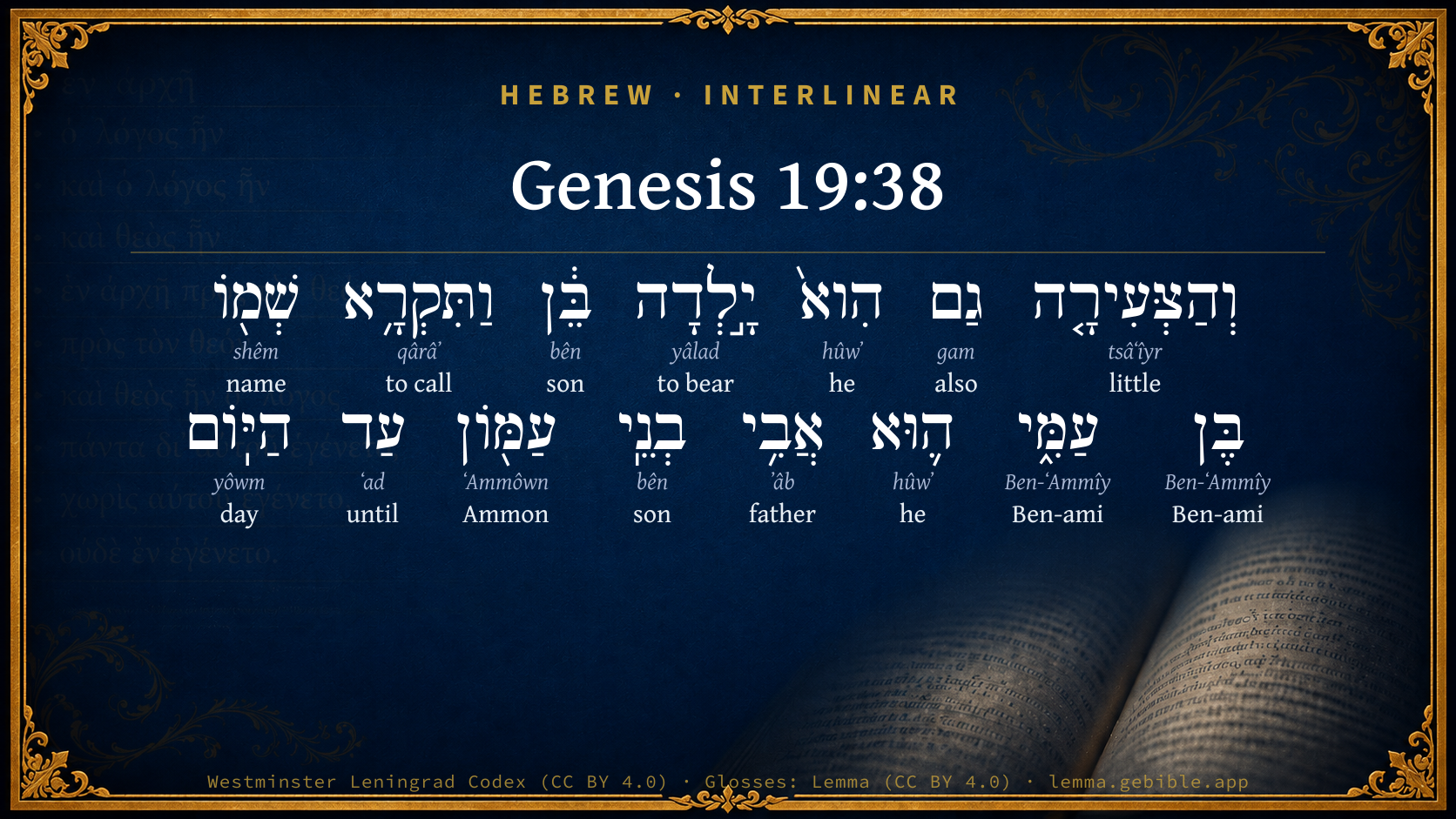
Hebrew (Westminster Leningrad Codex) Genesis 19:38 appears in the Hebrew Old Testament. The text above is from the Westminster Leningrad Codex. Each word links to its Strong’s number, a concise gloss, and parsing drawn from the Open Scriptures Hebrew Bible morphology. Click any word for its full Brown-Driver-Briggs (BDB) entry.
Download image
Cite this verse

Genesis 19:38 (World English Bible). Public Domain. Lemma interlinear Bible study tool, https://lemma.gebible.app/v/genesis/19/38.

Show BibTeX & RIS
BibTeX
RIS
English Translation
The younger also bore a son, and called his name Ben Ammi. The same is the father of the children of Ammon to this day.
World English Bible · Public Domain
Highlights
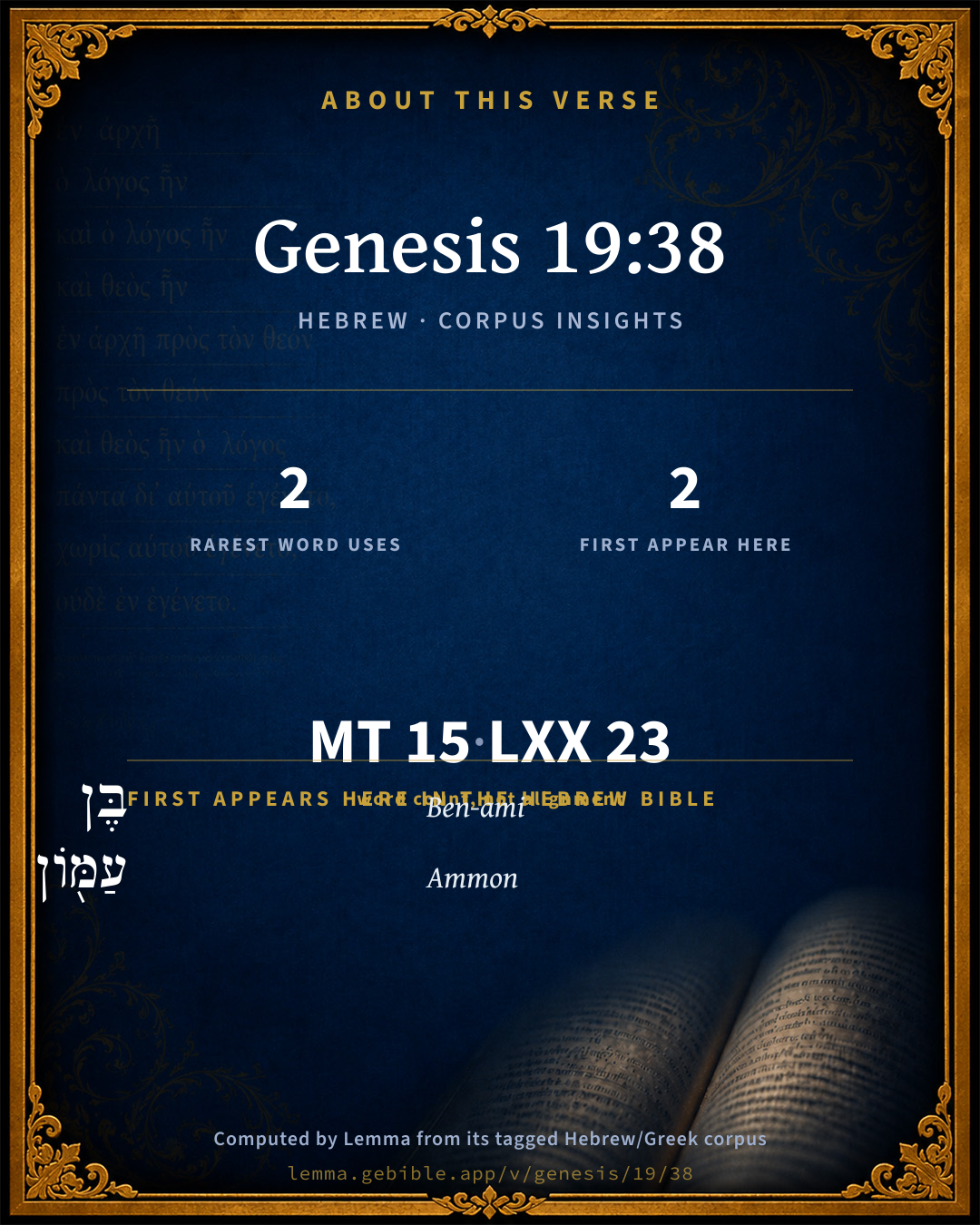
  • 2 first appearances in the Hebrew Bible
Full analysis ↓
Download a study sheet

One document with this verse’s original text, its word-by-word gloss line, the meaning frame, cross-references with their text, attributed commentary, and full source and license credits — printable, and it pastes into notes with its structure intact.

This verse Autodidact and up

Study sheet (.html) Plain text (.txt)

A passage Seminary Student

Up to 50 verses in one chapter. A passage sheet keeps up to 6 commentary sources and 12 cross-references per verse, in the order this page ranks them, and says so on the sheet whenever that leaves anything out. Ask for a single verse and you get the Autodidact verse sheet above.

Everything on this page stays free to read, with no account — the sheet is a download of what is already on screen, not access to it.

Want to remove ads? Support Godless Engineer
Compare translations 3

The same verse in 3 English versions, stacked beneath the original-language interlinear above. Click any original word for its lexicon entry.

Each is an independent rendering of the whole verse — the interlinear is not word-aligned to these translations.

Highlighted words mark where these versions differ — a whole-verse word diff, not a word-by-word alignment.

  • World English Bible Public Domain
    The younger also bore a son, and called his name Ben Ammi. The same is the father of the children of Ammon to this day.
  • King James Version Public Domain
    And the younger, she also bare a son, and called his name Benammi: the same is the father of the children of Ammon unto this day.
  • unfoldingWord Literal Text CC BY-SA 4.0
    Then the younger, she also bore a son, and she called his name Ben-Ammi. He the father of the sons of Ammon to this day.

unfoldingWord Literal Text — © unfoldingWord, licensed CC BY-SA 4.0. Word-aligned USFM3 via Door43 (git.door43.org/unfoldingWord/en_ult).

Versions to compare (up to 4)

3 of 4 selected

Show all 18 translations

Every available English version of this verse, each an independent rendering of the whole verse.

  • World English Bible Public Domain
    The younger also bore a son, and called his name Ben Ammi. The same is the father of the children of Ammon to this day.
  • Berean Standard Bible Public Domain
    The younger daughter also gave birth to a son, and she named him Ben-ammi. He is the father of the Ammonites of today.
  • Majority Standard Bible Public Domain
    The younger daughter also gave birth to a son, and she named him Ben-ammi. He is the father of the Ammonites of today.
  • King James Version Public Domain
    And the younger, she also bare a son, and called his name Benammi: the same is the father of the children of Ammon unto this day.
  • American Standard Version (1901) Public Domain
    And the younger, she also bare a son, and called his name Ben-ammi: the same is the father of the children of Ammon unto this day.
  • Revised Version (1885) Public Domain
    And the younger, she also bare a son, and called his name Ben-ammi: the same is the father of the children of Ammon unto this day.
  • Geneva Bible (1599) Public Domain
    And the yonger bare a sonne also, and she called his name Ben-ammi: the same is the father of the Ammonites vnto this day.
  • Douay-Rheims (1899) Public Domain
    The younger also bore a son, and called his name Ammon, that is, the son of my people: he is the father of the Ammonites unto this day.
  • Young's Literal Translation Public Domain
    as to the younger, she also hath born a son, and calleth his name Ben-Ammi: he `is' father of the Beni-Ammon unto this day.
  • Literal Standard Version CC BY-SA 4.0
    As for the younger, she has also born a son and calls his name Ben-Ammi: he [is] father of the sons of Ammon to this day.
  • Unlocked Literal Bible CC BY-SA 4.0
    As for the younger daughter, she also gave birth to a son, and named him Ben-Ammi. He became the ancestor of the people of Ammon of today.
  • unfoldingWord Literal Text CC BY-SA 4.0
    Then the younger, she also bore a son, and she called his name Ben-Ammi. He the father of the sons of Ammon to this day.
  • Darby Bible Public Domain
    And the younger, she also bore a son, and called his name Ben-ammi; the same is the father of the children of Ammon to this day.
  • World Messianic Bible Public Domain
    The younger also bore a son, and called his name Ben Ammi. He is the father of the children of Ammon to this day.
  • Webster's Bible Public Domain
    And the younger, she also bore a son, and called his name Ben-ammi: the same is the father of the children of Ammon to this day.
  • Free Bible Version CC BY-SA 4.0
    The younger daughter had a son too, and she called him Ben-ammi. He is the ancestor of the Ammonites of today.
  • Bible in Basic English Public Domain
    And the younger had a son and gave him the name Ben-ammi: from him come the children of Ammon to this day.
  • JPS Tanakh (1917) Public Domain
    And the younger, she also bore a son, and called his name Ben-ammi — the same is the father of the children of Ammon unto this day.

Literal Standard Version (2020), Covenant Press — licensed CC BY-SA 4.0. Text via the HelloAO Bible API (eBible.org). Unlocked Literal Bible (unfoldingWord) — licensed CC BY-SA 4.0. Text via the HelloAO Bible API (eBible.org). unfoldingWord Literal Text — © unfoldingWord, licensed CC BY-SA 4.0. Word-aligned USFM3 via Door43 (git.door43.org/unfoldingWord/en_ult). Free Bible Version, Dr. Jonathan Gallagher — licensed CC BY-SA 4.0. Text via the HelloAO Bible API (eBible.org).

Word by word

More ways to search: Search by grammar → Find every occurrence → Compare this word →

Practice this passage: Drill this verse → Learn its vocabulary →

בֶּן
Ben-ʻAmmîy
H1151
“Ben-ami”
Noun, Proper
Part of Speech
Noun
Type
Proper
Full BDB Definition

Origin: from H1121 and H5971 with pronomial suffix

TWOT: None

Ben-ami = "son of my people" - son of Lot, born to his second daughter, progenitor of the Ammonites
  1. וְהַצְּעִירָ֤ה tsâʻîyr H6810 “and · the · little” Conjunction + Particle, Definite Article + Adjective, Adjective, Feminine, Singular, Absolute
  2. גַם gam H1571 “also” Adverb
  3. הִוא֙ hûwʼ H1931 “he” Pronoun, Personal, 3rd Person, Feminine, Singular
  4. יָ֣לְדָה yâlad H3205 “to bear” Verb, Qal, Perfect, 3rd Person, Feminine, Singular
  5. בֵּ֔ן bên H1121 “son” Noun, Common, Masculine, Singular, Absolute
  6. וַתִּקְרָ֥א qârâʼ H7121 “and · to call” Conjunction + Verb, Qal, Sequential Imperfect, 3rd Person, Feminine, Singular
  7. שְׁמ֖וֹ shêm H8034 “name · his” Noun, Common, Masculine, Singular, Construct + Suffix, Personal, 3rd Person, Masculine, Singular
  8. עַמִּ֑י Ben-ʻAmmîy H1151 “Ben-ami” Noun, Proper
  9. ה֛וּא hûwʼ H1931 “he” Pronoun, Personal, 3rd Person, Masculine, Singular
  10. אֲבִ֥י ʼâb H1 “father of” Noun, Common, Masculine, Singular, Construct
  11. בְנֵֽי bên H1121 “sons of” Noun, Common, Masculine, Plural, Construct
  12. עַמּ֖וֹן ʻAmmôwn H5983 “Ammon” Noun, Proper
  13. עַד ʻad H5704 “until” Preposition
  14. הַיּֽוֹם yôwm H3117 “the · day” Particle, Definite Article + Noun, Common, Masculine, Singular, Absolute

About this verse

These counts appear in no published source. They are computed here, from the morphology-tagged text and Lemma’s own curated glosses. What Lemma adds →

15
words
12
distinct lemmas
Pentateuch
section

Notable vocabulary

The rarest word here is בֶּן Ben-ami H1151 — appearing just 2 times in the whole Hebrew Bible.

First appearance in Scripture

These words make their first canonical appearance in the Hebrew Bible here:

  • בֶּן Ben-ami H1151
  • עַמּ֖וֹן Ammon H5983

Grammatical profile

  • 2 verbs
  • 8 nouns
  • 1 adjective
  • 2 pronouns
  • 1 preposition
  • 1 adverb

Verb forms

  • יָ֣לְדָה Qal · Perfect
  • וַתִּקְרָ֥א Qal · Sequential Imperfect

Repetition

Words recur within this verse — often emphatic in Hebrew:

  • בֵּ֔ן son H1121 ×2
  • בֶּן Ben-ami H1151 ×2
  • הִוא֙ he H1931 ×2

Hebrew & Septuagint length

In English translation the verse runs 25 words from the Hebrew and 29 from the Septuagint (LXX English) — closely comparable.

A rough comparison of the two English renderings, which tokenize alike — not a word-level alignment.

Word counts can differ between the Hebrew and the Greek without any difference in meaning — e.g. the Hebrew direct-object marker אֵת has no separate Greek word, and Greek often adds the article ὁ.

In the original languages it is 15 Hebrew tokens and 23 Greek tokens — but the two are counted differently (Hebrew bundles its prefixes and suffixes into one token; the Greek is in lemma form), so that isn’t a like-for-like length.

Cross-references

11

Topical passages linked to Genesis 19:38 in the Treasury of Scripture Knowledge — connected by theme and wording, ordered by reader-vote popularity; previews shown in the World English Bible.

  • Deuteronomy 2:19 and when you come near over against the children of Ammon, don't bother them, nor contend with them; for I will not give you of the land of the children of Ammon for a possession; because I have given it to the children of Lot for a possession.
  • Deuteronomy 2:9 Yahweh said to me, Don't bother Moab, neither contend with them in battle; for I will not give you of his land for a possession; because I have given Ar to the children of Lot for a possession.
  • Deuteronomy 23:3 An Ammonite or a Moabite shall not enter into the assembly of Yahweh; even to the tenth generation shall none belonging to them enter into the assembly of Yahweh forever:
  • Judges 10:6–11:40 The children of Israel again did that which was evil in the sight of Yahweh, and served the Baals, and the Ashtaroth, and the gods of Syria, and the gods of Sidon, and the gods of Moab, and the gods of the children of Ammon, and the gods of the Philistines; and they forsook Yahweh, and didn't serve him.
  • 1 Samuel 11:1–15 Then Nahash the Ammonite came up, and encamped against Jabesh Gilead: and all the men of Jabesh said to Nahash, Make a covenant with us, and we will serve you.
  • 2 Samuel 10:1–19 It happened after this, that the king of the children of Ammon died, and Hanun his son reigned in his place.
  • Nehemiah 13:1–3 On that day they read in the book of Moses in the audience of the people; and therein was found written, that an Ammonite and a Moabite should not enter into the assembly of God forever,
  • Nehemiah 13:23–28 In those days also saw I the Jews who had married women of Ashdod, of Ammon, [and] of Moab:
  • Psalms 83:4–8 "Come," they say, "and let's destroy them as a nation, That the name of Israel may be remembered no more."
  • Isaiah 11:14 They shall fly down on the shoulder of the Philistines on the west; together shall they despoil the children of the east: they shall put forth their hand on Edom and Moab; and the children of Ammon shall obey them.
  • Zephaniah 2:9 Therefore as I live, says Yahweh of Hosts, the God of Israel, surely Moab will be as Sodom, and the children of Ammon as Gomorrah, a possession of nettles, and salt pits, and a perpetual desolation. The remnant of my people will plunder them, and the survivors of my nation will inherit them.

Cross-references courtesy of OpenBible.info (CC BY 4.0).

Hebrew and Greek witnesses Masoretic Hebrew ↔ Greek Septuagint

The same verse in the two great witnesses to the Old Testament, shown verse-for-verse.

These are two independent witnesses, not word-aligned to each other, and the Septuagint is shown in lemma (dictionary) form.

Hebrew Genesis 19:38 Masoretic · Westminster Leningrad Codex

וְהַצְּעִירָ֤ה גַם הִוא֙ יָ֣לְדָה בֵּ֔ן וַתִּקְרָ֥א שְׁמ֖וֹ בֶּן עַמִּ֑י ה֛וּא אֲבִ֥י בְנֵֽי עַמּ֖וֹן עַד הַיּֽוֹם

The younger also bore a son, and called his name Ben Ammi. The same is the father of the children of Ammon to this day.

World English Bible · Public Domain

Greek LXX Genesis 19:38 Septuagint · lemma form

τίκτω δέ καί ὁ νέος υἱός καί καλέω ὁ ὄνομα αὐτός αμμαν υἱός ὁ γένος ἐγώ οὗτος πατήρ αμμανίτης ἕως ὁ σήμερον ἡμέρα

And the younger also bore a son, and called his name Amman, saying, The son of my family. This is the father of the Ammanites to this present day.

LXX2012 (modern English Septuagint) · Public Domain

On this verse, The Pulpit Commentary discusses the Septuagint’s reading. Read the note in Commentary ↓

Hebrew: Westminster Leningrad Codex (CC BY 4.0). Greek: Septuagint (public domain); English from LXX2012 (modern English Septuagint) (Public Domain). How the Septuagint differs from the Hebrew →

Targum (Aramaic paraphrase)

2

The Targum is the ancient Jewish Aramaic paraphrase of the Hebrew Scriptures — an interpretive translation, not the Hebrew text itself. Onkelos (literal) and Pseudo-Jonathan (expansive) render the Torah, and Jonathan the Prophets. Coverage is partial: where no permissively-licensed English translation exists for a verse, only the Aramaic is shown. This is verse-level text, not a word-by-word alignment to the Hebrew.

  1. Targum Onkelos Torah (Genesis–Deuteronomy)
    וּזְעֶרְתָּא אַף הִיא יְלִידַת בַּר וּקְרַת שְׁמֵהּ בַּר עַמִּי הוּא אֲבוּהוֹן דִּבְנֵי עַמּוֹן עַד יוֹמָא דֵין

    (no public-domain English translation for this verse)

    Targum Onkelos — Aramaic: “Onkelos Genesis” (public domain); “Onkelos Exodus” (public domain); “Onkelos Leviticus” (public domain); “Onkelos Numbers” (public domain); “Onkelos Deuteronomy” (public domain). English: “Sefaria Community Translation” (CC0 1.0 (public-domain dedication)); “J.W. Etheridge. The Targums of Onkelos and Jonathan Ben Uzziel on the Pentateuch. London: Longmans, Green, 1862” (public domain). Text via Sefaria.

  2. Targum Pseudo-Jonathan Torah (Genesis–Deuteronomy)
    וּזְעֵירְתָּא אוּף הִיא יְלִידַת בַּר וּקְרַת יַת שְׁמֵיהּ בַּר עַמִי אֲרוּם בַּר אֲבוּהָא הוּא אֲבוּהוֹן דְעַמָא דְעַמוֹנָאֵי עַד זְמַן יוֹמָא דֵין

    And the younger also brought forth a son, and she called his name Bar-Ammi, because he was the son of her father. He is the father of the Ammonite people unto this day.

    Targum Pseudo-Jonathan — Aramaic: “Targum Jonathan on Genesis” (public domain); “Targum Jonathan on Exodus” (public domain); “Targum Jonathan on Leviticus” (public domain); “Targum Jonathan on Numbers” (public domain); “Targum Jonathan on Deuteronomy” (public domain). English: “The Targum of Jonathan ben Uzziel, trans. J. W. Etheridge, London, 1862” (public domain). Text via Sefaria.

Commentary

Notes on Genesis 19:38 from classic Christian and Jewish commentators (each source and its license shown beneath its notes). The classic Christian expositions comment on the surrounding passage and are grouped to its opening verse, so a note may address several verses; the Jewish commentaries on the Tanakh (Rashi and others) are per-verse, so they appear only where the commentator wrote on this verse.

Lemma curates 59 commentaries, every one of them public domain or Creative Commons licensed, each selected and text-cleaned for this edition rather than reprinted as found. About our sources →

Geneva Bible (1599)

Geneva Bible translators

That is, son of my people: signifying that they rather rejoiced in their sin, than repented for the same.

Geneva Bible (1599) marginal notes — public domain. Text via Bolls.life.

Adam Clarke's Commentary

Verse 38. Ben-ammi] בן עמי Ben-ammi, the son of my people. Both these names seem to justify the view taken of this subject above, viz., that it was merely to preserve the family that the daughters of Lot made use of the above expedient; and hence we do not find that they ever attempted to repeat it, which, had it been done for any other purpose, they certainly would not have failed to do. On this subject Origen, in his fifth homily on Genesis, has these remarkable words: Ubi hic libidinis culpa, ubi incesti criminis arguitur? . Quomodo dabitur in VITIO QUOD NON ITERATUR IN FACTO? Vercor proloqui quod sentio, vereor, inquam, ne castior fuerit harum incestus, quam pudicitia multarum. "Where, in all this transaction, can the crime of lust or of incest be proved? How can this be proved to be a vice when the fact was never repeated? I am afraid to speak my whole mind on the subject, lest the incest of these should appear more laudable than the chastity of multitudes." There is a distinction made here by Origen which is worthy of notice; a single bad act, though a sin, does not necessarily argue a vicious heart, as in order to be vicious a man must be habituated to sinful acts.

The generation which proceeded from this incestuous connection, whatever may be said in extenuation of the transaction, (its peculiar circumstances being considered,) was certainly a bad one. The Moabites soon fell from the faith of God, and became idolaters, the people of Chemosh, and of Baal-peor, Nu 21:29; Nu 25:1-3; and were enemies to the children of Abraham. See Nu 22:1-6 c.; Jdg 3:14, c. And the Ammonites, who dwelt near to the Moabites, united with them in idolatry, and were also enemies to Israel. See Jdg 11:4; Jdg 11:24; De 23:3-4. As both these people made afterwards a considerable figure in the sacred history, the impartial inspired writer takes care to introduce at this early period an account of their origin. See what has been said on the case of Noah's drunkenness, Ge 9:20, c.

THIS is an awful history, and the circumstances detailed in it are as distressing to piety as to humanity. It may, however, be profitable to review the particulars.

1. From the commencement of the chapter we find that the example and precepts of Abraham had not been lost on his nephew Lot. He also, like his uncle, watches for opportunities to call in the weary traveller. This Abraham had taught his household, and we see the effect of his blessed teaching. Lot was both hospitable and pious, though living in the midst of a crooked and perverse race. It must be granted that from several circumstances in his history he appears to have been a weak man, but his weakness was such as was not inconsistent with general uprightness and sincerity. He and his family were not forgetful to entertain strangers, and they alone were free from the pollutions of this accursed people. How powerful are the effects of a religious education, enforced by pious example! It is one of God's especial means of grace. Let a man only do justice to his family, by bringing them up in the fear of God, and he will crown it with his blessing. How many excuse the profligacy of their family, which is often entirely owing to their own neglect, by saying, "O, we cannot give them grace!" No, you cannot but you can afford them the means of grace. This is your work, that is the Lord's. If, through your neglect of precept and example, they perish, what an awful account must you give to the Judge of quick and dead! It was the sentiment of a great man, that should the worst of times arrive, and magistracy and ministry were both to fall, yet, if parents would but be faithful to their trust, pure religion would be handed down to posterity, both in its form and in its power.

2. We have already heard of the wickedness of the inhabitants of the cities of the plain, the cup of their iniquity was full; their sin was of no common magnitude, and what a terrible judgment fell upon them! Brimstone and fire are rained down from heaven upon these traders in iniquity; and what a correspondence between the crime and the punishment? They burned in lust towards each other, and God burned them up with fire and brimstone. Their sin was unnatural, and God punished it by supernatural means. Divine justice not only observes a proportion between the crime and the degree of punishment, but also between the species of crime and the kind of punishment inflicted.

3. Disobedience to the command of God must ever meet with severe reprehension, especially in those who have already partaken of his grace, because these know his salvation, and are justly supposed to possess, by his grace, the power of resisting all solicitations to sin. The servant who knew his lord's will and did it not, was to be beaten with many stripes; see Lu 12:47. Lot's wife stands as an everlasting monument of admonition and caution to all backsliders. She ran well, she permitted Satan to hinder, and she died in her provocation! While we lament her fate, we should profit by her example. To begin in the good way is well; to continue in the path is better; and to persevere unto the end, best of all. The exhortation of our blessed Lord on this subject should awaken our caution, and strongly excite our diligence: Remember Lot's wife! On the conduct of Lot and his daughters, See Clarke on Ge 19:31.

Adam Clarke's Commentary on the Bible (1810–1826) — public domain. Text from a community e-Sword/MySword module.

The Cambridge Bible for Schools and Colleges

gen. ed. J. J. S. Perowne

38. Ben-ammi] “The son of my people”; or “the son of my father’s kin”; see Gen_17:14. “Unto this day,” cf. Gen_26:33, Gen_32:32, Gen_35:20, Gen_47:26 (J).

There is no need for us to regard this repulsive story as literal history. It should be included among the popular narratives which grew up round the traditional origin of proper names. It has been held that the tradition may have had a local Moabite origin connected with some famous cavern, and that the people of Moab and Ammon may have had an old belief that their races arose in prehistoric times from the same ancestor, in accordance with this tale. Undoubtedly, there were ancient Eastern peoples to whom the incest here described would have seemed in no way atrocious.

It is, of course, also possible, that the story, as we have it in Gen., reflects the feelings of bitterness and hatred which were felt among the Israelites towards their neighbours on the east side of the Jordan. The antipathy expressed in Deu_23:3 and Neh_13:1-2 may well account for the circulation of traditions concerning the parentage of these two peoples, combining a popular explanation of their names with contumely and reproach as to their origin.

Again, it is conceivable that this story may contain a fragment of a tradition, Moabite and Ammonite in its derivation, which recorded some stupendous catastrophe, from which, through the favour of the Deity, only Lot and his daughters, out of all the inhabitants of the world, were saved. The story may then have been regarded as reflecting not ignominy, but honour, upon those who were the means of preserving the whole human race from the peril of extinction. There is plausibility in this theory of Gunkel’s. The words of the elder daughter, “there is not a man,” seem to imply that all the inhabitants of the earth had been annihilated. Our ignorance of Moabite early traditions forbids us to go further than to admit the possibility of some such explanation.

The Cambridge Bible for Schools and Colleges (gen. ed. J. J. S. Perowne; Cambridge University Press, 1878–1918) — public domain. Text from a community e-Sword module.

Matthew Poole's English Annotations

Called his name Ben-ammi, i.e. the son of my people, or kindred, not of the cursed race of the Sodomites, where I was to be married. This is something more modest than the other in the name she gives, but both impudently glorying in their sin and shame, of which they should have bitterly repented.

Matthew Poole's English Annotations on the Holy Bible (1683–1685) — public domain. Text from a community e-Sword/MySword module.

Whedon's Commentary on the Bible

Daniel D. Whedon

38. Ben-ammi — Which means, son of my people; that is, begotten of my own race. The Ammonites expelled the Zamzummim, and occupied their land, on the north of the territory of Moab. Deu_2:19-21. “In Lot’s history we may trace the judgment as well as the mercy of God. His selfish choice of the plain of the Jordan led him, perhaps, to present wealth and prosperity, but withal to temptation and danger. In the midst of the abandoned profligacy of Sodom he, indeed, was preserved in comparative purity, and so, when God overthrew the cities of the plain, he yet saved Lot from destruction. Still Lot’s feebleness of faith first caused him to linger, (Gen_19:16,) then to fear escape to the mountains, (Gen_19:19,) and, lastly, to doubt the safety of the place which God had spared for him, Gen_19:30. Now again he is led by his children into intoxication, which betrays him, unconsciously, into far more dreadful wickedness. And then we hear of him no more. He is left by the sacred narrative, saved indeed from the conflagration of Sodom, but an outcast — widowed, homeless, hopeless, without children or grandchildren, save the authors and the heirs of his shame.” — Speaker’s Commentary.

Daniel D. Whedon (gen. ed.), Commentary on the Old and New Testaments (1874–1909) — public domain. Text from a community e-Sword module.

The Pulpit Commentary

And the younger, she also bare a son, and called his name Ben-ammi. Ie. son of my people (LXX, Jerome, Augustine), meaning that her child was the offspring of her own kind and blood (Rosenm or the son of her relative (Kalisch), or of an unmixed race ("Speaker"s Commentary"). The same is the father of the children of Ammon an unsettled people who occupied the territory between the Yabbok and the Arnon, from which they had ejected the Rephaims or Zamzummims, (Deu_2:22) and in which they possessed a strong city, Rabbah; (2Sa 40:1) in their habits more migratory and marauding than the Moabites, (Isa 15 Isa 16 Jer 48) and in their religion worshippers of Molech, "the abomination of the Ammonites" (1Ki_11:7) unto this day.

The Pulpit Commentary (1880–1919), ed. H.D.M. Spence-Jones & Joseph S. Exell — public domain. Text from a community e-Sword module.

Radak

Rabbi David Kimhi (Radak)

והצעירה...בן עמי, meaning “the father of this child was a member of my family.” This name was somewhat more chaste than the name given by her older sister, as she did not spell out that Lot was the father of her child.

Radak on the Tanakh — English translations: “Sefaria Community Translation” (CC0 1.0 (public-domain dedication)); “Eliyahu Munk, HaChut Hameshulash” (CC BY 4.0); “Rabbi Mike Feuer, Jerusalem Anthology” (CC BY 4.0); and “R. David Kimhi on the first book of Psalms, Translated by R.G. Finch, London, 1919” (public domain). Text via Sefaria.

Lesson kit

Teaching starters — assembled from the data on this page, not authored interpretation. Every prompt links to the verse data it draws on. Edit before teaching.

Genesis, in the Pentateuch, opens this verse with 15 words (12 distinct Hebrew lemmas). Its most distinctive word is Ben-ʻAmmîy (“Ben-ami”). A historical commentator’s framing appears above. Read the whole chapter for the surrounding context.

Discussion questions

  1. The word Ben-ʻAmmîy carries the sense “Ben-ami.” How does it shape the verse?
  2. 2 words make their first appearance in Scripture here. What does this debut establish?
  3. How does Deuteronomy 2:19, which shares this passage’s theme, read alongside this verse?
  4. What does the repetition of “son” (2× in this one verse) do in this verse?
  5. The translations on this page render this verse differently — a whole-verse word diff, not a word-by-word alignment. What might account for the different wordings?
  6. «יָ֣לְדָה» is a Qal Perfect verb. How does that grammatical form shape the action described?
  7. Compare how Geneva Bible (1599) and Adam Clarke's Commentary read this verse. Where do they agree or differ?

Things to notice

Reading settings

Reading text

Shown beneath each verse's original-language words.

Old Testament
Old Testament edition

Read the OT as the Masoretic Hebrew (MT) or the Greek Septuagint (LXX).

English shown for the Greek Septuagint (in the Hebrew ↔ Greek comparison).

Comparing translations? Open the Compare panel on any verse page to stack up to four side by side.