
Genesis 31:29

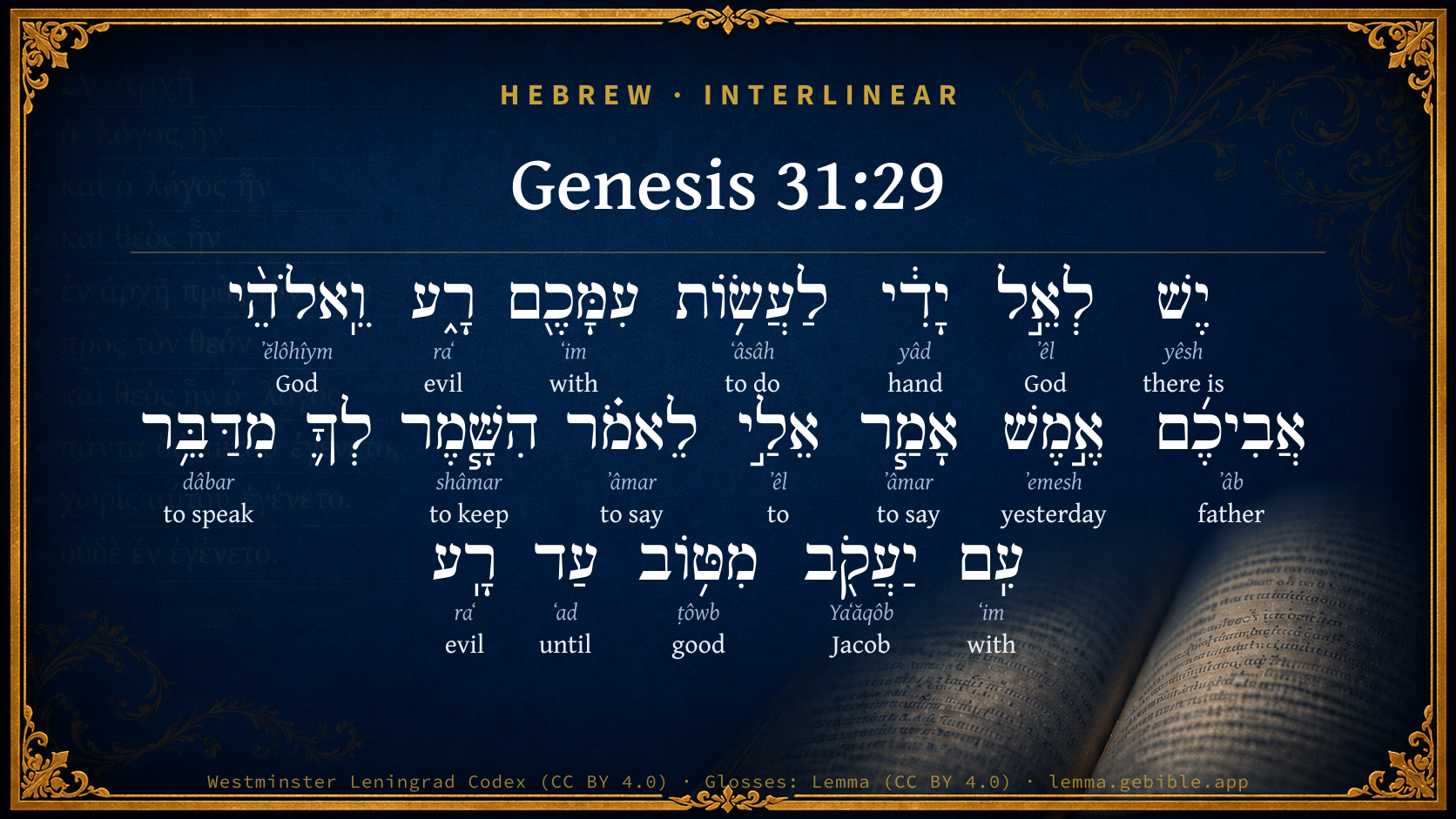
Hebrew (Westminster Leningrad Codex) Genesis 31:29 appears in the Hebrew Old Testament. The text above is from the Westminster Leningrad Codex. Each word links to its Strong’s number, a concise gloss, and parsing drawn from the Open Scriptures Hebrew Bible morphology. Click any word for its full Brown-Driver-Briggs (BDB) entry.
Download image
Cite this verse

Genesis 31:29 (World English Bible). Public Domain. Lemma interlinear Bible study tool, https://lemma.gebible.app/v/genesis/31/29.

Show BibTeX & RIS
BibTeX
RIS
English Translation
It is in the power of my hand to hurt you, but the God of your father spoke to me last night, saying, 'Take heed to yourself that you don't speak to Jacob either good or bad.'
World English Bible · Public Domain
Download a study sheet

One document with this verse’s original text, its word-by-word gloss line, the meaning frame, cross-references with their text, attributed commentary, and full source and license credits — printable, and it pastes into notes with its structure intact.

This verse Autodidact and up

Study sheet (.html) Plain text (.txt)

A passage Seminary Student

Up to 50 verses in one chapter. A passage sheet keeps up to 6 commentary sources and 12 cross-references per verse, in the order this page ranks them, and says so on the sheet whenever that leaves anything out. Ask for a single verse and you get the Autodidact verse sheet above.

Everything on this page stays free to read, with no account — the sheet is a download of what is already on screen, not access to it.

Want to remove ads? Support Godless Engineer
Compare translations 3

The same verse in 3 English versions, stacked beneath the original-language interlinear above. Click any original word for its lexicon entry.

Each is an independent rendering of the whole verse — the interlinear is not word-aligned to these translations.

Highlighted words mark where these versions differ — a whole-verse word diff, not a word-by-word alignment.

  • World English Bible Public Domain
    It is in the power of my hand to hurt you, but the God of your father spoke to me last night, saying, 'Take heed to yourself that you don't speak to Jacob either good or bad.'
  • King James Version Public Domain
    It is in the power of my hand to do you hurt: but the God of your father spake unto me yesternight, saying, Take thou heed that thou speak not to Jacob either good or bad.
  • unfoldingWord Literal Text CC BY-SA 4.0
    It is in the power of my hand to do harm to you, but last night the God of your father said to me, saying, ‘Keep yourself from speaking with Jacob either good or bad.’

unfoldingWord Literal Text — © unfoldingWord, licensed CC BY-SA 4.0. Word-aligned USFM3 via Door43 (git.door43.org/unfoldingWord/en_ult).

Versions to compare (up to 4)

3 of 4 selected

Show all 18 translations

Every available English version of this verse, each an independent rendering of the whole verse.

  • World English Bible Public Domain
    It is in the power of my hand to hurt you, but the God of your father spoke to me last night, saying, 'Take heed to yourself that you don't speak to Jacob either good or bad.'
  • Berean Standard Bible Public Domain
    I have power to do you great harm, but last night the God of your father said to me, ‘Be careful not to say anything to Jacob, either good or bad.’
  • Majority Standard Bible Public Domain
    I have power to do you great harm, but last night the God of your father said to me, ‘Be careful not to say anything to Jacob, either good or bad.’
  • King James Version Public Domain
    It is in the power of my hand to do you hurt: but the God of your father spake unto me yesternight, saying, Take thou heed that thou speak not to Jacob either good or bad.
  • American Standard Version (1901) Public Domain
    It is in the power of my hand to do you hurt: but the God of your father spake unto me yesternight, saying, Take heed to thyself that thou speak not to Jacob either good or bad.
  • Revised Version (1885) Public Domain
    It is in the power of my hand to do you hurt: but the God of your father spake unto me yesternight, saying, Take heed to thyself that thou speak not to Jacob either good or bad.
  • Geneva Bible (1599) Public Domain
    I am able to do you euill: but the God of your father spake vnto me yesternight, saying, Take heed that thou speake not to Iaakob ought saue good.
  • Douay-Rheims (1899) Public Domain
    It is in my power to return thee evil: but the God of your father said to me yesterday: Take heed thou speak not any things harshly against Jacob.
  • Young's Literal Translation Public Domain
    my hand is to God to do evil with you, but the God of your father yesternight hath spoken unto me, saying, Take heed to thyself from speaking with Jacob from good unto evil.
  • Literal Standard Version CC BY-SA 4.0
    my hand is to God to do evil with you, but the God of your father last night has spoken to me, saying, Take heed to yourself from speaking with Jacob from good to evil.
  • Unlocked Literal Bible CC BY-SA 4.0
    It is in my power to do you harm, but the God of your father spoke to me last night and said, 'Be careful that you speak to Jacob neither good nor bad.'
  • unfoldingWord Literal Text CC BY-SA 4.0
    It is in the power of my hand to do harm to you, but last night the God of your father said to me, saying, ‘Keep yourself from speaking with Jacob either good or bad.’
  • Darby Bible Public Domain
    It would be in the power of my hand to do you hurt; but the God of your father spoke to me last night, saying, Take care that thou speak not to Jacob either good or bad.
  • World Messianic Bible Public Domain
    It is in the power of my hand to hurt you, but the God of your father spoke to me last night, saying, ‘Be careful that you don’t speak to Jacob either good or bad.’
  • Webster's Bible Public Domain
    It is in the power of my hand to do you hurt: but the God of your father spoke to me yesternight, saying, Take thou heed that thou speak not to Jacob either good or bad.
  • Free Bible Version CC BY-SA 4.0
    I could really punish you badly, but the God of your father spoke to me last night and told me, ‘Watch what you say to Jacob. Don't try to persuade him to come back, and don't threaten him either.’
  • Bible in Basic English Public Domain
    It is in my power to do you damage: but the God of your father came to me this night, saying, Take care that you say nothing good or bad to Jacob.
  • JPS Tanakh (1917) Public Domain
    It is in the power of my hand to do you hurt; but the God of your father spoke unto me yesternight, saying: Take heed to thyself that thou speak not to Jacob either good or bad.

Literal Standard Version (2020), Covenant Press — licensed CC BY-SA 4.0. Text via the HelloAO Bible API (eBible.org). Unlocked Literal Bible (unfoldingWord) — licensed CC BY-SA 4.0. Text via the HelloAO Bible API (eBible.org). unfoldingWord Literal Text — © unfoldingWord, licensed CC BY-SA 4.0. Word-aligned USFM3 via Door43 (git.door43.org/unfoldingWord/en_ult). Free Bible Version, Dr. Jonathan Gallagher — licensed CC BY-SA 4.0. Text via the HelloAO Bible API (eBible.org).

Word by word

More ways to search: Search by grammar → Find every occurrence → Compare this word →

Practice this passage: Drill this verse → Learn its vocabulary →

אֶ֣מֶשׁ
ʼemesh
H570
“yesterday”
Adverb
Part of Speech
Adverb
Full BDB Definition

Origin: unknown derivation

TWOT: 120

yesterday, last night - recently (figuratively)
  1. יֶשׁ yêsh H3426 “there is” Particle, Demonstrative
  2. לְאֵ֣ל ʼêl H410 “to/for · God of” Preposition + Noun, Common, Masculine, Singular, Construct
  3. יָדִ֔י yâd H3027 “hand · my” Noun, Common, Both, Singular, Construct + Suffix, Personal, 1st Person, Common, Singular
  4. לַעֲשׂ֥וֹת ʻâsâh H6213 “to do” Preposition + Verb, Qal, Infinitive Construct
  5. עִמָּכֶ֖ם ʻim H5973 “with · you” Preposition + Suffix, Personal, 2nd Person, Masculine, Plural
  6. רָ֑ע raʻ H7451 “evil” Adjective, Adjective, Masculine, Singular, Absolute
  7. וֵֽאלֹהֵ֨י ʼĕlôhîym H430 “and · God(s) of” Conjunction + Noun, Common, Masculine, Plural, Construct
  8. אֲבִיכֶ֜ם ʼâb H1 “father · your” Noun, Common, Masculine, Singular, Construct + Suffix, Personal, 2nd Person, Masculine, Plural
  9. אָמַ֧ר ʼâmar H559 “to say” Verb, Qal, Perfect, 3rd Person, Masculine, Singular
  10. אֵלַ֣י ʼêl H413 “to · me” Preposition + Suffix, Personal, 1st Person, Common, Singular
  11. לֵאמֹ֗ר ʼâmar H559 “to say” Preposition + Verb, Qal, Infinitive Construct
  12. הִשָּׁ֧מֶר shâmar H8104 “keep” Verb, Niphal, Imperative, 2nd Person, Masculine, Singular
  13. מִדַּבֵּ֥ר dâbar H1696 “from · to speak” Preposition + Verb, Piel, Infinitive Construct
  14. עִֽם ʻim H5973 “with” Preposition
  15. יַעֲקֹ֖ב Yaʻăqôb H3290 “Jacob” Noun, Proper
  16. מִטּ֥וֹב ṭôwb H2896 “from · good” Preposition + Adjective, Adjective, Masculine, Singular, Absolute
  17. עַד ʻad H5704 “until” Preposition
  18. רָֽע raʻ H7451 “evil” Adjective, Adjective, Masculine, Singular, Absolute

About this verse

These counts appear in no published source. They are computed here, from the morphology-tagged text and Lemma’s own curated glosses. What Lemma adds →

20
words
16
distinct lemmas
Pentateuch
section

Notable vocabulary

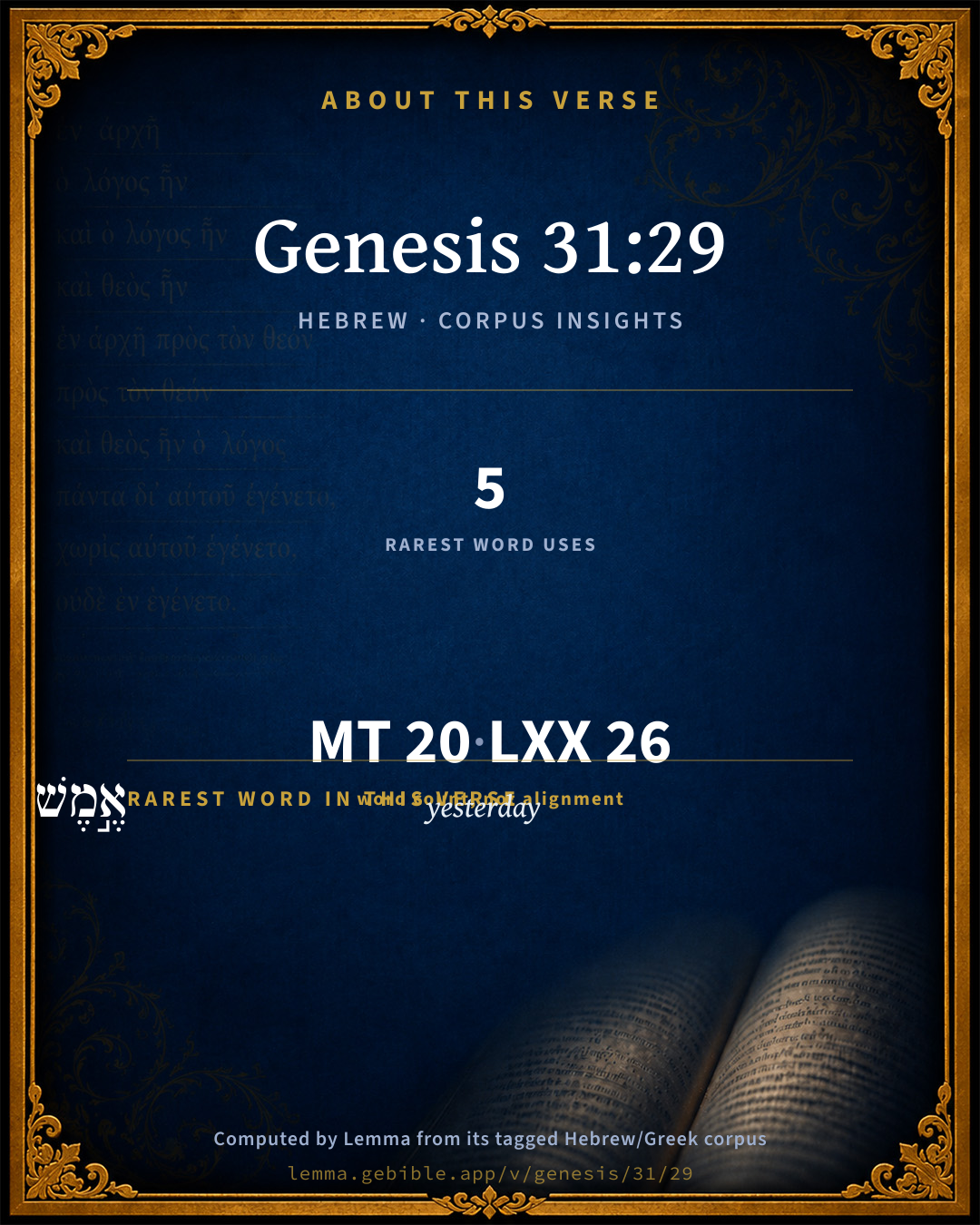
The rarest word here is אֶ֣מֶשׁ yesterday H570 — appearing just 5 times in the whole Hebrew Bible.

Shared distinctive vocabulary

אֶ֣מֶשׁ yesterday H570 occurs in 5 verses of the Hebrew Bible. Also found in:

Grammatical profile

  • 5 verbs
  • 5 nouns
  • 3 adjectives
  • 5 prepositions
  • 1 adverb
  • 1 particle

Verb forms

  • לַעֲשׂ֥וֹת Qal · Infinitive Construct
  • אָמַ֧ר Qal · Perfect
  • לֵאמֹ֗ר Qal · Infinitive Construct
  • הִשָּׁ֧מֶר Niphal · Imperative
  • מִדַּבֵּ֥ר Piel · Infinitive Construct

Repetition

Words recur within this verse — often emphatic in Hebrew:

  • רָ֑ע evil H7451 ×2
  • אָמַ֧ר to say H559 ×2
  • עִמָּכֶ֖ם with H5973 ×2

Hebrew & Septuagint length

In English translation the verse runs 37 words from the Hebrew and 32 from the Septuagint (LXX English) — closely comparable.

A rough comparison of the two English renderings, which tokenize alike — not a word-level alignment.

Word counts can differ between the Hebrew and the Greek without any difference in meaning — e.g. the Hebrew direct-object marker אֵת has no separate Greek word, and Greek often adds the article ὁ.

In the original languages it is 20 Hebrew tokens and 26 Greek tokens — but the two are counted differently (Hebrew bundles its prefixes and suffixes into one token; the Greek is in lemma form), so that isn’t a like-for-like length.

Cross-references

14

Topical passages linked to Genesis 31:29 in the Treasury of Scripture Knowledge — connected by theme and wording, ordered by reader-vote popularity; previews shown in the World English Bible.

  • Genesis 31:42 Unless the God of my father, the God of Abraham, and the fear of Isaac, had been with me, surely now you would have sent me away empty. God has seen my affliction and the labor of my hands, and rebuked you last night."
  • Genesis 31:53 The God of Abraham, and the God of Nahor, the God of their father, judge between us." Then Jacob swore by the fear of his father, Isaac.
  • Genesis 28:13 Behold, Yahweh stood above it, and said, "I am Yahweh, the God of Abraham your father, and the God of Isaac. The land whereon you lie, to you will I give it, and to your seed.
  • Genesis 31:24 God came to Laban, the Syrian, in a dream of the night, and said to him, "Take heed to yourself that you don't speak to Jacob either good or bad."
  • Joshua 24:2–3 Joshua said to all the people, Thus says Yahweh, the God of Israel, Your fathers lived of old time beyond the River, even Terah, the father of Abraham, and the father of Nahor: and they served other gods.
  • 2 Kings 19:10 Thus shall you speak to Hezekiah king of Judah, saying, Don't let your God in whom you trust deceive you, saying, Jerusalem shall not be given into the hand of the king of Assyria.
  • Psalms 52:1 Why do you boast of mischief, mighty man? God's loving kindness endures continually.
  • Daniel 2:47 The king answered to Daniel, and said, Of a truth your God is the God of gods, and the Lord of kings, and a revealer of secrets, seeing you have been able to reveal this secret.
  • Daniel 3:28 Nebuchadnezzar spoke and said, Blessed be the God of Shadrach, Meshach, and Abednego, who has sent his angel, and delivered his servants who trusted in him, and have changed the king's word, and have yielded their bodies, that they might not serve nor worship any god, except their own God.
  • Daniel 6:20 When he came near to the den to Daniel, he cried with a lamentable voice; the king spoke and said to Daniel, Daniel, servant of the living God, is your God, whom you serve continually, able to deliver you from the lions?
  • Daniel 6:26 I make a decree, that in all the dominion of my kingdom men tremble and fear before the God of Daniel; for he is the living God, and steadfast forever, His kingdom that which shall not be destroyed; and his dominion shall be even to the end.
  • John 19:10–11 Pilate therefore said to him, "Aren't you speaking to me? Don't you know that I have power to release you, and have power to crucify you?"
  • Acts 5:38–39 Now I tell you, withdraw from these men, and leave them alone. For if this counsel or this work is of men, it will be overthrown.
  • Acts 9:5 He said, "Who are you, Lord?" The Lord said, "I am Jesus, whom you are persecuting.

Cross-references courtesy of OpenBible.info (CC BY 4.0).

Hebrew and Greek witnesses Masoretic Hebrew ↔ Greek Septuagint

The same verse in the two great witnesses to the Old Testament, shown verse-for-verse.

These are two independent witnesses, not word-aligned to each other, and the Septuagint is shown in lemma (dictionary) form.

Hebrew Genesis 31:29 Masoretic · Westminster Leningrad Codex

יֶשׁ לְאֵ֣ל יָדִ֔י לַעֲשׂ֥וֹת עִמָּכֶ֖ם רָ֑ע וֵֽאלֹהֵ֨י אֲבִיכֶ֜ם אֶ֣מֶשׁ אָמַ֧ר אֵלַ֣י לֵאמֹ֗ר הִשָּׁ֧מֶר לְךָ֛ מִדַּבֵּ֥ר עִֽם יַעֲקֹ֖ב מִטּ֥וֹב עַד רָֽע

It is in the power of my hand to hurt you, but the God of your father spoke to me last night, saying, 'Take heed to yourself that you don't speak to Jacob either good or bad.'

World English Bible · Public Domain

Greek LXX Genesis 31:29 Septuagint · lemma form

καί νῦν ἰσχύω ὁ χείρ ἐγώ κακοποιέω σύ ὁ δέ θεός ὁ πατήρ σύ χθές εἶπον πρός ἐγώ λέγω φυλάσσω σεαυτοῦ μήποτε λαλέω μετά ἰακώβ πονηρός

And now my hand has power to hurt you; but the God of your father spoke to me yesterday, saying, Take heed to yourself that you speak not evil words to Jacob.

LXX2012 (modern English Septuagint) · Public Domain

Hebrew: Westminster Leningrad Codex (CC BY 4.0). Greek: Septuagint (public domain); English from LXX2012 (modern English Septuagint) (Public Domain). How the Septuagint differs from the Hebrew →

Targum (Aramaic paraphrase)

2

The Targum is the ancient Jewish Aramaic paraphrase of the Hebrew Scriptures — an interpretive translation, not the Hebrew text itself. Onkelos (literal) and Pseudo-Jonathan (expansive) render the Torah, and Jonathan the Prophets. Coverage is partial: where no permissively-licensed English translation exists for a verse, only the Aramaic is shown. This is verse-level text, not a word-by-word alignment to the Hebrew.

  1. Targum Onkelos Torah (Genesis–Deuteronomy)
    אִית חֵילָא בִידִי לְמֶעְבַּד עִמְּכוֹן בִּישׁ וֵאלָהָא דַּאֲבוּכוֹן בְּרַמְשָׁא אֲמַר לִי לְמֵימַר אִסְתַּמַּר לָּךְ מִלְּמַלָּלָא עִם יַעֲקֹב מִטַּב עַד בִּישׁ

    (no public-domain English translation for this verse)

    Targum Onkelos — Aramaic: “Onkelos Genesis” (public domain); “Onkelos Exodus” (public domain); “Onkelos Leviticus” (public domain); “Onkelos Numbers” (public domain); “Onkelos Deuteronomy” (public domain). English: “Sefaria Community Translation” (CC0 1.0 (public-domain dedication)); “J.W. Etheridge. The Targums of Onkelos and Jonathan Ben Uzziel on the Pentateuch. London: Longmans, Green, 1862” (public domain). Text via Sefaria.

  2. Targum Pseudo-Jonathan Torah (Genesis–Deuteronomy)
    אִית סְפִיקָא בְּיָדִי לְמֶעֱבַּד עִמְכוֹן בִּישָׁא וֵאלָהָא דַאֲבוּכוֹן בְּרַמְשָׁא אָמַר לִי לְמֵימָר אִסְתַּמַר לָךְ מִלְמַלְלָא עִם יַעֲקב מִטַב וְעַד בִּישׁ

    There is sufficiency in my hand to do evil with thee; but the God of thy father spake with me in the evening, saying, Be careful of speaking with Jakob from good to evil

    Targum Pseudo-Jonathan — Aramaic: “Targum Jonathan on Genesis” (public domain); “Targum Jonathan on Exodus” (public domain); “Targum Jonathan on Leviticus” (public domain); “Targum Jonathan on Numbers” (public domain); “Targum Jonathan on Deuteronomy” (public domain). English: “The Targum of Jonathan ben Uzziel, trans. J. W. Etheridge, London, 1862” (public domain). Text via Sefaria.

Commentary

Notes on Genesis 31:29 from classic Christian and Jewish commentators (each source and its license shown beneath its notes). The classic Christian expositions comment on the surrounding passage and are grouped to its opening verse, so a note may address several verses; the Jewish commentaries on the Tanakh (Rashi and others) are per-verse, so they appear only where the commentator wrote on this verse.

Lemma curates 59 commentaries, every one of them public domain or Creative Commons licensed, each selected and text-cleaned for this edition rather than reprinted as found. About our sources →

Trapp's Complete Commentary

John Trapp

Gen 31:29 It is in the power of my hand to do you hurt: but the God of your father spake unto me yesternight, saying, Take thou heed that thou speak not to Jacob either good or bad.

Ver. 29. It is in the power of my hand.] It was, he might have said, till God forbade him: though indeed it never was (as our Saviour told Pilate, upon a like bravado, Joh 19:10-11), further than "given him from above." "To God belong the issues of death," {Psa 68:20} whatever tyrants dream they can do. Rideo, dicebat Caligula, Consulibus, quod uno nutu meo iugulare vos possim, et uxori tam bana cervix, simul ac iussero, demetur . And Caesar told Metellus, that he could as easily take away his life, as bid it to be done. But what saith our Saviour? "Fear not them that kill the body"; {Mat 10:28} to wit, by divine permission. He saith not, them that can kill the body, have power to do it at their own pleasure: for that is a royalty belongs to God only.

But the God of your father spake unto me, &c.] Hypocrites forbear sin, as dogs do their meat; not because they hate the carrion, but fear the club. These are as wicked, in their fearful abstaining from sin, as in their furious committing of it. Lupus venit ad ovile: quaerit invadere, iugulare devorare vigilant pastores, latrant canes. - Lupus venit fremens, redit tremens: lupus est tamen, et fremens et tremens , saith Augustine. {a}

{a} Aug., De Verb. Apost., ser. 21.

John Trapp, A Commentary or Exposition upon All the Books of the Old and New Testament (1647–1656) — public domain. Text from a community e-Sword module.

Joseph Benson's Commentary

Gen 31:29. The God of your fathers spake to me yesterday — We find here that Laban, whatever his disposition was, and how great soever his anger, paid regard to the heavenly vision. For though he supposed that he had both right and strength on his side, either to revenge the wrong or recover the right, yet he owns himself under the restraint of God’s power; he durst not injure one whom he saw to be the particular care of Heaven. It seems probable that God, who can change the heart in a moment, effected a sudden alteration in his disposition toward Jacob.

Joseph Benson's Commentary on the Old and New Testaments (1811–1818) — public domain. Text from a community e-Sword module.

Geneva Bible (1599)

Geneva Bible translators

Hebrew, power is in mine hand.

He was an Idolater, and therefore would not acknowledge the God of Jacob for his God.

Geneva Bible (1599) marginal notes — public domain. Text via Bolls.life.

Adam Clarke's Commentary

Verse 29. It is in the power of my hand to do you hurt] Literally, My hand is unto God to do you evil, i.e., I have vowed to God that I will punish thee for thy flight, and the stealing of my teraphim; but the God of YOUR father has prevented me from doing it. It is a singular instance that the plural pronoun, when addressing an individual, should be twice used in this place - the God of your father, אביכם abichem, for אביך abicha, thy father.

Adam Clarke's Commentary on the Bible (1810–1826) — public domain. Text from a community e-Sword/MySword module.

John Calvin's Commentaries

29. It is in the power of my hand. The Hebrew phrase is different, “my hand is to power;” yet the meaning is clear, that Laban declares he is ready to take vengeance. Some expound the words thus: “my hand is to God;” but from other places it appears that the word אל (el) is taken for power. But Laban, inflated with foolish boasting, contradicts himself; for whereas he had been forbidden by God to attempt anything against Jacob, where was the power of which he boasted? We see, therefore, he precipitates himself by a blind impulse, as if, at his own pleasure, he could do anything against the purpose of God. For when he perceives that God is opposed to him, he yet does not hesitate to glory in his own strength; and why is this, unless he aimed at being superior to God? Finally; pride is always the companion of unbelief; so that unbelievers, although vanquished, yet cease not impetuously to rise up against God. To this they add another sin, that they complain of being unjustly oppressed by God.

But the God of your father. Why does he not also acknowledge God as his own God, unless because Satan had so fascinated his mind already, that he chose rather to wander in darkness than to turn to the light presented before him? Willingly or unwillingly, he is compelled to yield to the God of Abraham; and yet he defrauds him of the glory which is due, by retaining those fictitious deities by which he had been deceived. We see then that the ungodly, even when they have had proof of the power of God, yet do not entirely submit themselves to his authority. Wherefore, when God manifests himself to us, we must also seek from heaven the spirit of meekness, which shall bend and subdue us to obedience unto himself.

John Calvin's Commentaries (1540-1563) — public domain. Text from the Calvin Translation Society English edition (1840s-50s) via the Christian Classics Ethereal Library (ccel.org). Calvin's coverage is partial (roughly two-thirds of the Bible); uncommented books and verses are honest gaps, never fabricated. The 19th-century editor's footnotes and remarks are omitted so the notes are faithfully Calvin's own voice.

Ellicott's Commentary for English Readers

(29) It is in the power of my hand.—This is the rendering here of all the versions, and is confirmed by Deu_28:32; Neh_5:5; Mic_2:1; but Keil and Knobel wish to translate, “My hand is for God.” This comes to the same thing in an impious way, as the sense would be,” My hand is an El, a god, for me,” and enables me to do what I will.

The speech of Laban is half true and half false. He would have wished not to part with Jacob at all, but to have recovered from him as much as he could of his property. But if he was to go, he would have liked outward appearances maintained; and, probably, he had an affection for his daughters and their children, though not so strong as to counterbalance his selfishness. His character, like that of all men, is a mixture of good and evil.

A Bible Commentary for English Readers, edited by Charles John Ellicott (1878–1897) — public domain. Text from a community e-Sword module.

The Cambridge Bible for Schools and Colleges

gen. ed. J. J. S. Perowne

29. in the power of my hand] A Hebrew idiom occurring in Deu_28:32, Neh_5:5, Pro_3:27, Mic_2:1. The word “power” is “Êl,” usually rendered “God”; in this idiom it denotes “power” or “might” in the abstract.

the God of your father] Laban’s conscience smites him, as is implied by the vision recorded in Gen_31:24.

The Cambridge Bible for Schools and Colleges (gen. ed. J. J. S. Perowne; Cambridge University Press, 1878–1918) — public domain. Text from a community e-Sword module.

John Gill's Exposition

And Jacob answered and said to Laban, because I was afraid,.... That he would have done all he could to have hindered him from going away himself; and not only so, but would have prevented his taking his daughters with him; and especially would have detained his cattle; but of this last Jacob makes no mention, only of the former:

for I said; either within himself, or to his wives:

peradventure thou wouldest take by force thy daughters from me; which of right belonged to him; for though they were Laban's daughters, they were Jacob's wives; and being given in marriage to him, he had a right unto them, and to take them with him; nor had Laban any right to detain them, which Jacob feared he would have attempted to have done, had he known his design; and this must have been done by force if done at all; for neither Jacob nor his wives would have agreed that they should stay with Laban upon his departure: what Laban charges Jacob with, in going away with his wives, he himself would have done, namely, using force to them. Laban's charge was false, but there was much reason for Jacob's suspicion.

John Gill's Exposition of the Whole Bible (1746–1763) — public domain (CC PDM 1.0). Text via the HelloAO Bible API.

Matthew Poole's English Annotations

The God of your father, Isaac or Abraham, by which he disowns him for his God, and tacitly reproacheth him with the novelty of his religion, which was first brought in by his father. Compare Gen 31:53.

Matthew Poole's English Annotations on the Holy Bible (1683–1685) — public domain. Text from a community e-Sword/MySword module.

Whedon's Commentary on the Bible

Daniel D. Whedon

29. Power of my hand — Or, to the God of my hand — לאל ידי. Laban, leavened with the notions of idolatry, contrasts the God of his hand — that is, the God for whom he lifts his hand — with the God of Jacob’s father.

Daniel D. Whedon (gen. ed.), Commentary on the Old and New Testaments (1874–1909) — public domain. Text from a community e-Sword module.

John Wesley's Explanatory Notes

It is in the power of my hand to do you hurt - He supposeth that he had both right on his side, and strength on his side, either to revenge the wrong, or recover the right. Yet he owns himself under the restraint of God's power; he durst not injure one of whom he saw to be the particular care of heaven.

John Wesley, Explanatory Notes Upon the Whole Bible (1754–1765) — public domain. Text via the GEBible commentary corpus.

Keil & Delitzsch

C. F. Keil & F. Delitzsch

ידי לאל ישׁ: "there is to God my hand" (Mic 2:1; cf. Deu 28:32; Neh 5:5), i.e., my hand serves me as God (Hab 1:11; Job 12:6), a proverbial expression for "the power lies in my hand."

Keil & Delitzsch — Biblical Commentary on the Old Testament (1861–1891) — public domain (CC PDM 1.0). Text via the HelloAO Bible API. (Old Testament only.)

unfoldingWord translationNotes

Door43 World Missions Community

It is in my power to do you harm

The word "you" is plural and refers to everyone with Jacob. AT: "I have enough people with me to harm all of you" (See: Forms of You)

Be careful that you speak to Jacob neither good nor bad

The words "good nor bad" are used together to mean "anything." See how you translated this in Genesis 31:24. AT: "Do not say anything to try and stop Jacob from leaving" (See: Merism)

you have gone away

This "you" is singular and refers to Jacob. (See: Forms of You)

to your father's house

Here "house" stands for family. AT: "to be home with your father and the rest of your family" (See: Metonymy)

my gods

"my idols"

translationWords

power

God

ancestor

Jacob

house

false god

unfoldingWord translationNotes — © Distant Shores Media and the Door43 World Missions Community, licensed CC BY-SA 4.0. Source: git.door43.org/Door43/en_tn.

Rashi

Rabbi Shlomo Yitzchaki (Rashi)

יש לאל ידי means MY HAND HAS THE STRENGTH AND THE POWER — to do you hurt (אל therefore means strength and יש לאל ידי is equivalent to יש אל לידי). Wherever אל is used as a Divine Name it is because it signifies strength and abundance of power.

Rashi on the Tanakh — English translations: “The Judaica Press complete Tanach with Rashi, translated by A. J. Rosenberg” (CC BY 4.0); “Pentateuch with Rashi's commentary by M. Rosenbaum and A.M. Silbermann, 1929-1934” (public domain); “The Metsudah Tanach series, Lakewood, N.J” (CC BY 4.0); and “The Book of Joshua, Metsudah Publications, 1997” (CC BY 4.0). Text via Sefaria.

Radak

Rabbi David Kimhi (Radak)

יש לאל ידי, as per Onkelos, i.e. “I possess the power.”

אמש, last night.

ואלוקי אביכם, a reference to the G’d of Avraham whose name Avraham had popularised throughout the region. The reason Lavan speaks of אביכם “your father,” is that he uses the term as a pronoun including Yaakov and his children.

Radak on the Tanakh — English translations: “Sefaria Community Translation” (CC0 1.0 (public-domain dedication)); “Eliyahu Munk, HaChut Hameshulash” (CC BY 4.0); “Rabbi Mike Feuer, Jerusalem Anthology” (CC BY 4.0); and “R. David Kimhi on the first book of Psalms, Translated by R.G. Finch, London, 1919” (public domain). Text via Sefaria.

Lesson kit

Teaching starters — assembled from the data on this page, not authored interpretation. Every prompt links to the verse data it draws on. Edit before teaching.

Genesis, in the Pentateuch, opens this verse with 20 words (16 distinct Hebrew lemmas). Its most distinctive word is ʼemesh (“yesterday”). A historical commentator’s framing appears above. Read the whole chapter for the surrounding context.

Discussion questions

  1. What does “yesterday” (ʼemesh) contribute to the verse as a whole?
  2. How does Genesis 19:34, which shares the word «yesterday», read alongside this verse?
  3. What does the repetition of “evil” (2× in this one verse) do in this verse?
  4. The translations on this page render this verse differently — a whole-verse word diff, not a word-by-word alignment. What might account for the different wordings?
  5. «לַעֲשׂ֥וֹת» is a Qal Infinitive Construct verb. How does that grammatical form shape the action described?
  6. Compare how Trapp's Complete Commentary and Joseph Benson's Commentary read this verse. Where do they agree or differ?

Things to notice

Reading settings

Reading text

Shown beneath each verse's original-language words.

Old Testament
Old Testament edition

Read the OT as the Masoretic Hebrew (MT) or the Greek Septuagint (LXX).

English shown for the Greek Septuagint (in the Hebrew ↔ Greek comparison).

Comparing translations? Open the Compare panel on any verse page to stack up to four side by side.