Genesis 19:32

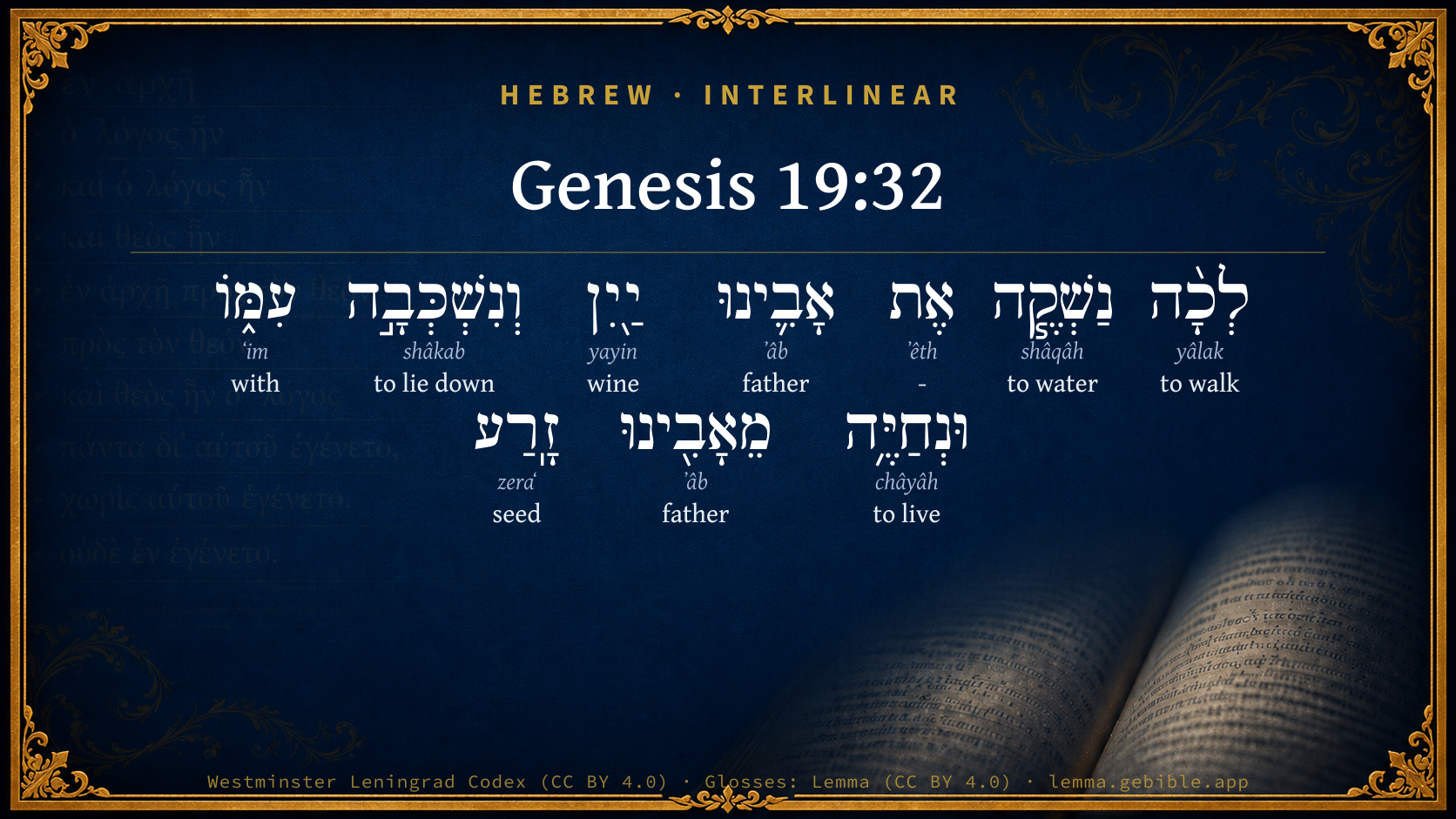
Hebrew (Westminster Leningrad Codex) Genesis 19:32 appears in the Hebrew Old Testament. The text above is from the Westminster Leningrad Codex. Each word links to its Strong’s number, a concise gloss, and parsing drawn from the Open Scriptures Hebrew Bible morphology. Click any word for its full Brown-Driver-Briggs (BDB) entry.
Download image
Cite this verse

Genesis 19:32 (World English Bible). Public Domain. Lemma interlinear Bible study tool, https://lemma.gebible.app/v/genesis/19/32.

Show BibTeX & RIS
BibTeX
RIS
English Translation
Come, let's make our father drink wine, and we will lie with him, that we may preserve our father's seed."
World English Bible · Public Domain
Download a study sheet

One document with this verse’s original text, its word-by-word gloss line, the meaning frame, cross-references with their text, attributed commentary, and full source and license credits — printable, and it pastes into notes with its structure intact.

This verse Autodidact and up

Study sheet (.html) Plain text (.txt)

A passage Seminary Student

Up to 50 verses in one chapter. A passage sheet keeps up to 6 commentary sources and 12 cross-references per verse, in the order this page ranks them, and says so on the sheet whenever that leaves anything out. Ask for a single verse and you get the Autodidact verse sheet above.

Everything on this page stays free to read, with no account — the sheet is a download of what is already on screen, not access to it.

Want to remove ads? Support Godless Engineer
Compare translations 3

The same verse in 3 English versions, stacked beneath the original-language interlinear above. Click any original word for its lexicon entry.

Each is an independent rendering of the whole verse — the interlinear is not word-aligned to these translations.

Highlighted words mark where these versions differ — a whole-verse word diff, not a word-by-word alignment.

  • World English Bible Public Domain
    Come, let's make our father drink wine, and we will lie with him, that we may preserve our father's seed."
  • King James Version Public Domain
    Come, let us make our father drink wine, and we will lie with him, that we may preserve seed of our father.
  • unfoldingWord Literal Text CC BY-SA 4.0
    Come on, let us get our father to drink wine, and let us lie with him so that we will give life to offspring through our father.”

unfoldingWord Literal Text — © unfoldingWord, licensed CC BY-SA 4.0. Word-aligned USFM3 via Door43 (git.door43.org/unfoldingWord/en_ult).

Versions to compare (up to 4)

3 of 4 selected

Show all 18 translations

Every available English version of this verse, each an independent rendering of the whole verse.

  • World English Bible Public Domain
    Come, let's make our father drink wine, and we will lie with him, that we may preserve our father's seed."
  • Berean Standard Bible Public Domain
    Come, let us get our father drunk with wine so we can sleep with him and preserve his line.”
  • Majority Standard Bible Public Domain
    Come, let us get our father drunk with wine so we can sleep with him and preserve his line.”
  • King James Version Public Domain
    Come, let us make our father drink wine, and we will lie with him, that we may preserve seed of our father.
  • American Standard Version (1901) Public Domain
    come, let us make our father drink wine, and we will lie with him, that we may preserve seed of our father.
  • Revised Version (1885) Public Domain
    come, let us make our father drink wine, and we will lie with him, that we may preserve seed of our father.
  • Geneva Bible (1599) Public Domain
    Come, wee will make our father drinke wine, and lie with him, that we may preserue seede of our father.
  • Douay-Rheims (1899) Public Domain
    Come, let us make him drunk with wine, and let us lie with him, that we may preserve seed of our father.
  • Young's Literal Translation Public Domain
    come, we cause our father to drink wine, and lie with him, and preserve from our father -- a seed.'
  • Literal Standard Version CC BY-SA 4.0
    come, we cause our father to drink wine, and lie with him, and preserve a seed from our father.”
  • Unlocked Literal Bible CC BY-SA 4.0
    Come, let us make our father drink wine, and we will sleep with him, so that we may extend our father's line.”
  • unfoldingWord Literal Text CC BY-SA 4.0
    Come on, let us get our father to drink wine, and let us lie with him so that we will give life to offspring through our father.”
  • Darby Bible Public Domain
    come, let us give our father wine to drink, and let us lie with him, that we may preserve seed alive of our father.
  • World Messianic Bible Public Domain
    Come, let’s make our father drink wine, and we will lie with him, that we may preserve our father’s family line.”
  • Webster's Bible Public Domain
    Come, let us make our father drink wine, and we will lie with him, that we may preserve seed of our father.
  • Free Bible Version CC BY-SA 4.0
    Come on, let's get our father drunk with wine and sleep with him so we can keep his family line going.”
  • Bible in Basic English Public Domain
    Come, let us give our father much wine, and we will go into his bed, so that we may have offspring by our father,
  • JPS Tanakh (1917) Public Domain
    Come, let us make our father drink wine, and we will lie with him, that we may preserve seed of our father.'

Literal Standard Version (2020), Covenant Press — licensed CC BY-SA 4.0. Text via the HelloAO Bible API (eBible.org). Unlocked Literal Bible (unfoldingWord) — licensed CC BY-SA 4.0. Text via the HelloAO Bible API (eBible.org). unfoldingWord Literal Text — © unfoldingWord, licensed CC BY-SA 4.0. Word-aligned USFM3 via Door43 (git.door43.org/unfoldingWord/en_ult). Free Bible Version, Dr. Jonathan Gallagher — licensed CC BY-SA 4.0. Text via the HelloAO Bible API (eBible.org).

Word by word

More ways to search: Search by grammar → Find every occurrence → Compare this word →

Practice this passage: Drill this verse → Learn its vocabulary →

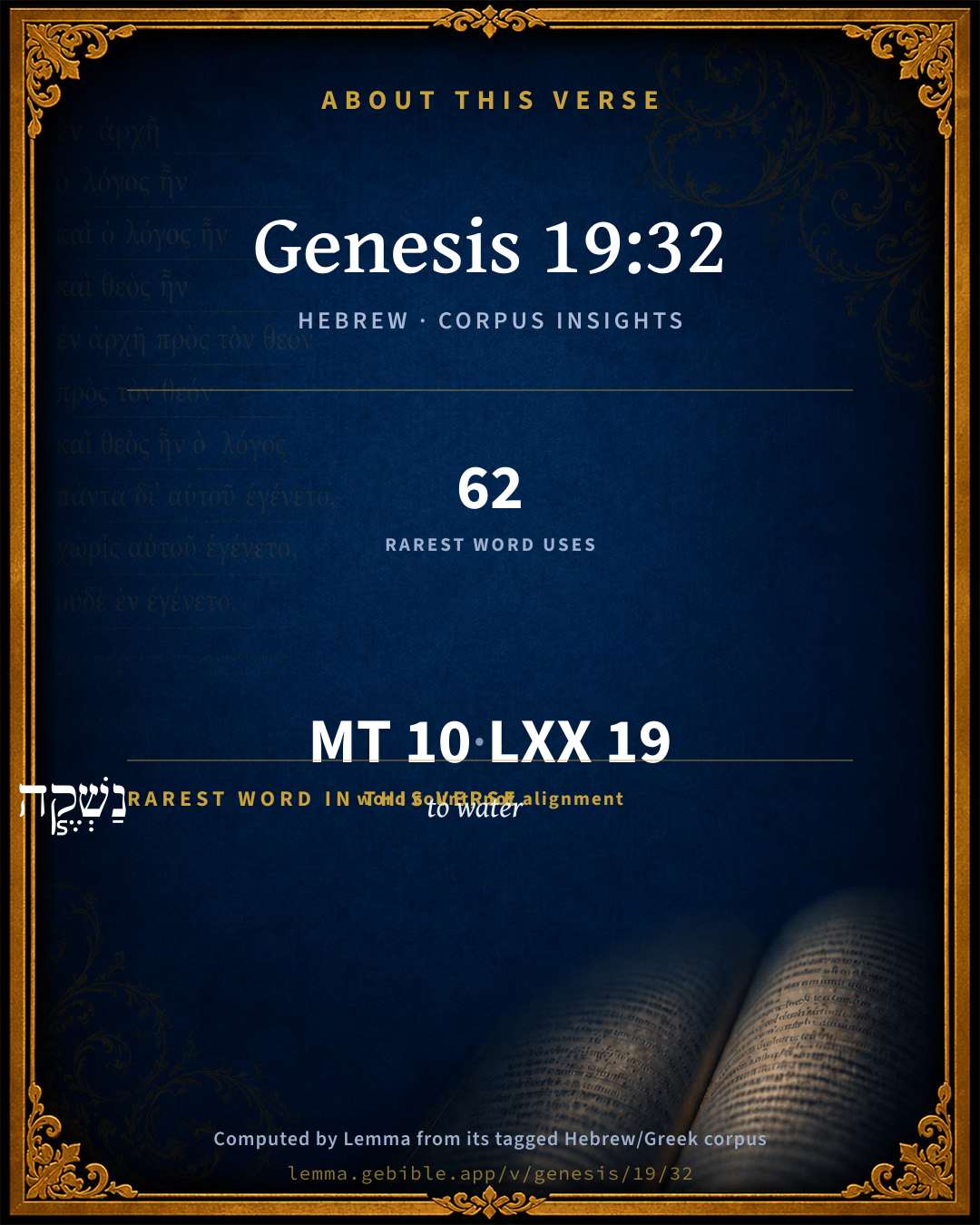
נַשְׁקֶ֧ה
shâqâh
H8248
“to water”
Verb, Hiphil, Imperfect, 1st Person, Common, Plural
Part of Speech
Verb
Stem
Hiphil
Form
Imperfect
Person
1st Person
Gender
Common
Number
Plural
Full BDB Definition

Origin: a primitive root

TWOT: 2452

to give to drink, irrigate, drink, water, cause to drink water - (Hiphil) - to water, irrigate - to water, give drink to - (Pual) to be watered - (Niphal) variant
  1. לְכָ֨ה yâlak H3212 “walk” Verb, Qal, Imperative, 2nd Person, Masculine, Singular + Suffix, h
  2. אֶת ʼêth H853 “-” Particle, Direct Object
  3. אָבִ֛ינוּ ʼâb H1 “father · our” Noun, Common, Masculine, Singular, Construct + Suffix, Personal, 1st Person, Common, Plural
  4. יַ֖יִן yayin H3196 “wine” Noun, Common, Masculine, Singular, Absolute
  5. וְנִשְׁכְּבָ֣ה shâkab H7901 “and · to lie down” Conjunction + Verb, Qal, Cohortative, 1st Person, Common, Plural
  6. עִמּ֑וֹ ʻim H5973 “with · him” Preposition + Suffix, Personal, 3rd Person, Masculine, Singular
  7. וּנְחַיֶּ֥ה châyâh H2421 “and · to live” Conjunction + Verb, Piel, Imperfect, 1st Person, Common, Plural
  8. מֵאָבִ֖ינוּ ʼâb H1 “from · father · our” Preposition + Noun, Common, Masculine, Singular, Construct + Suffix, Personal, 1st Person, Common, Plural
  9. זָֽרַע zeraʻ H2233 “seed” Noun, Common, Masculine, Singular, Absolute

About this verse

These counts appear in no published source. They are computed here, from the morphology-tagged text and Lemma’s own curated glosses. What Lemma adds →

10
words
9
distinct lemmas
Pentateuch
section

Grammatical profile

  • 4 verbs
  • 4 nouns
  • 1 preposition
  • 1 particle

Verb forms

  • לְכָ֨ה Qal · Imperative
  • נַשְׁקֶ֧ה Hiphil · Imperfect
  • וְנִשְׁכְּבָ֣ה Qal · Cohortative
  • וּנְחַיֶּ֥ה Piel · Imperfect

Repetition

A word recurs within this verse — often emphatic in Hebrew:

  • אָבִ֛ינוּ father H1 ×2

Hebrew & Septuagint length

In English translation the verse runs 20 words from the Hebrew and 24 from the Septuagint (LXX English) — closely comparable.

A rough comparison of the two English renderings, which tokenize alike — not a word-level alignment.

Word counts can differ between the Hebrew and the Greek without any difference in meaning — e.g. the Hebrew direct-object marker אֵת has no separate Greek word, and Greek often adds the article ὁ.

In the original languages it is 10 Hebrew tokens and 19 Greek tokens — but the two are counted differently (Hebrew bundles its prefixes and suffixes into one token; the Greek is in lemma form), so that isn’t a like-for-like length.

Cross-references

6

Topical passages linked to Genesis 19:32 in the Treasury of Scripture Knowledge — connected by theme and wording, ordered by reader-vote popularity; previews shown in the World English Bible.

  • Leviticus 18:6–7 "'None of you shall approach anyone who are his close relatives, to uncover their nakedness: I am Yahweh.
  • Genesis 11:3 They said one to another, "Come, let's make brick, and burn them thoroughly." They had brick for stone, and they used tar for mortar.
  • Genesis 9:21 He drank of the wine, and got drunk. He was uncovered within his tent.
  • Proverbs 23:31–33 Don't look at the wine when it is red, When it sparkles in the cup, When it goes down smoothly:
  • Habakkuk 2:15–16 "Woe to him who gives his neighbor drink, pouring your inflaming wine until they are drunk, so that you may gaze at their naked bodies!
  • Mark 12:19 "Teacher, Moses wrote to us, 'If a man's brother dies, and leaves a wife behind him, and leaves no children, that his brother should take his wife, and raise up offspring for his brother.'

Cross-references courtesy of OpenBible.info (CC BY 4.0).

Hebrew and Greek witnesses Masoretic Hebrew ↔ Greek Septuagint

The same verse in the two great witnesses to the Old Testament, shown verse-for-verse.

These are two independent witnesses, not word-aligned to each other, and the Septuagint is shown in lemma (dictionary) form.

Hebrew Genesis 19:32 Masoretic · Westminster Leningrad Codex

לְכָ֨ה נַשְׁקֶ֧ה אֶת אָבִ֛ינוּ יַ֖יִן וְנִשְׁכְּבָ֣ה עִמּ֑וֹ וּנְחַיֶּ֥ה מֵאָבִ֖ינוּ זָֽרַע

Come, let's make our father drink wine, and we will lie with him, that we may preserve our father's seed."

World English Bible · Public Domain

Greek LXX Genesis 19:32 Septuagint · lemma form

δεῦρο καί ποτίζω ὁ πατήρ ἐγώ οἶνος καί κοιμάω μετά αὐτός καί ἐκ ἀναἵστημι ἐκ ὁ πατήρ ἐγώ σπέρμα

Come and let us make our father drink wine, and let us sleep with him, and let us raise up seed from our father.

LXX2012 (modern English Septuagint) · Public Domain

Hebrew: Westminster Leningrad Codex (CC BY 4.0). Greek: Septuagint (public domain); English from LXX2012 (modern English Septuagint) (Public Domain). How the Septuagint differs from the Hebrew →

Targum (Aramaic paraphrase)

2

The Targum is the ancient Jewish Aramaic paraphrase of the Hebrew Scriptures — an interpretive translation, not the Hebrew text itself. Onkelos (literal) and Pseudo-Jonathan (expansive) render the Torah, and Jonathan the Prophets. Coverage is partial: where no permissively-licensed English translation exists for a verse, only the Aramaic is shown. This is verse-level text, not a word-by-word alignment to the Hebrew.

  1. Targum Onkelos Torah (Genesis–Deuteronomy)
    אִיתָא נַשְׁקֵי יָת אֲבוּנָא חַמְרָא וְנִשְׁכּוּב עִמֵּהּ וּנְקַיֵּם מֵאֲבוּנָא בְּנִין

    (no public-domain English translation for this verse)

    Targum Onkelos — Aramaic: “Onkelos Genesis” (public domain); “Onkelos Exodus” (public domain); “Onkelos Leviticus” (public domain); “Onkelos Numbers” (public domain); “Onkelos Deuteronomy” (public domain). English: “Sefaria Community Translation” (CC0 1.0 (public-domain dedication)); “J.W. Etheridge. The Targums of Onkelos and Jonathan Ben Uzziel on the Pentateuch. London: Longmans, Green, 1862” (public domain). Text via Sefaria.

  2. Targum Pseudo-Jonathan Torah (Genesis–Deuteronomy)
    אִיתָא נַשְׁקֵי יַת אָבוּנָא חֲמַר וְכַד יְהֵי רַוֵי נְשַׁמֵשׁ עִימֵהּ וּנְקַיֵים מֵאֲבוּנָא בְּנִין

    come, let us make our father drink wine, and when he is drunken we will lie with him, and raise up sons from our father.

    Targum Pseudo-Jonathan — Aramaic: “Targum Jonathan on Genesis” (public domain); “Targum Jonathan on Exodus” (public domain); “Targum Jonathan on Leviticus” (public domain); “Targum Jonathan on Numbers” (public domain); “Targum Jonathan on Deuteronomy” (public domain). English: “The Targum of Jonathan ben Uzziel, trans. J. W. Etheridge, London, 1862” (public domain). Text via Sefaria.

Commentary

Notes on Genesis 19:32 from classic Christian and Jewish commentators (each source and its license shown beneath its notes). The classic Christian expositions comment on the surrounding passage and are grouped to its opening verse, so a note may address several verses; the Jewish commentaries on the Tanakh (Rashi and others) are per-verse, so they appear only where the commentator wrote on this verse.

Lemma curates 59 commentaries, every one of them public domain or Creative Commons licensed, each selected and text-cleaned for this edition rather than reprinted as found. About our sources →

Trapp's Complete Commentary

John Trapp

Gen 19:32 Come, let us make our father drink wine, and we will lie with him, that we may preserve seed of our father.

Ver. 32. Come, let us make our father drink.] {a} She knew too well, that Venus in vinis, ignis in igne furit . It is like they had wine from Zoar. They sinned against conscience; and therefore intoxicated their father, who now forgets that he is a father, and does that, in a drunken pang, that which heaven and earth were afterwards ashamed of.

{a} So the great whore cometh forth with a cup {Rev 17:2}

John Trapp, A Commentary or Exposition upon All the Books of the Old and New Testament (1647–1656) — public domain. Text from a community e-Sword module.

Joseph Benson's Commentary

Gen 19:32. Come, let us make our father drink wine — Although, upon the whole, Lot was a righteous man, and possessed of many amiable qualities, yet it evidently appears that his principles also, as well as those of his daughters, had suffered some degree of contamination by the society of evil-doers, otherwise surely he would have withstood every temptation to excess of drinking. Here the history of Lot ends; after this we hear no more of him or of his daughters. We cannot but be sorry to leave them under so dark a cloud. He, indeed, we have reason to believe, lived to repent of his sin, otherwise St. Peter would not have spoken so honourably of him; but we have no proof that his daughters repented of theirs. And certainly the children thus desired, and in this unlawful way obtained, were monuments of their own and their father’s reproach, and the names they thought fit to give them, which descended to their posterity, perpetuated the memory of their sin and shame to all generations: Moab signifying, of my father, and Ben-Ammi, the son of my people.

Joseph Benson's Commentary on the Old and New Testaments (1811–1818) — public domain. Text from a community e-Sword module.

Geneva Bible (1599)

Geneva Bible translators

For except he had been overcome with wine, he would never have done that abominable act.

Geneva Bible (1599) marginal notes — public domain. Text via Bolls.life.

Adam Clarke's Commentary

Verse 32. Come, let us make our father drink wine] On their flight from Zoar it is probable they had brought with them certain provisions to serve them for the time being, and the wine here mentioned among the rest.

After considering all that has been said to criminate both Lot and his daughters in this business, I cannot help thinking that the transaction itself will bear a more favourable construction than that which has been generally put on it.

1. It does not appear that it was through any base or sensual desires that the daughters of Lot wished to deceive their father.

2. They might have thought that it would have been criminal to have married into any other family, and they knew that their husbands elect, who were probably of the same kindred, had perished in the overthrow of Sodom.

3. They might have supposed that there was no other way left to preserve the family, and consequently that righteousness for which it had been remarkable, but the way which they now took.

4. They appear to have supposed that their father would not come into the measure, because he would have considered it as profane; yet, judging the measure to be expedient and necessary, they endeavoured to sanctify the improper means used, by the goodness of the end at which they aimed; a doctrine which, though resorted to by many, should be reprobated by all. Acting on this bad principle they caused their father to drink wine. See Clarke on Gen 19:38.

Adam Clarke's Commentary on the Bible (1810–1826) — public domain. Text from a community e-Sword/MySword module.

Ellicott's Commentary for English Readers

(32) That we may preserve seed of our father.—This was a very strong feeling in ancient times, and affords the sole excuse for the revolting conduct of these women. The utter degradation of Lot and his family is the most painful part of his story, which thus ends in his intense shame.

A Bible Commentary for English Readers, edited by Charles John Ellicott (1878–1897) — public domain. Text from a community e-Sword module.

John Gill's Exposition

And they made their father drink wine that night,.... They persuaded him to drink liberally, urged him to it again, in order to make him drunk, and so complete their design; and Lot might be the more prevailed upon to drink freely, in order to remove his sorrow, and refresh his spirits under the loss of his wife, and his daughters, if he had any married in Sodom, as some suppose, and his sons-in-law, and of all his goods and substance; though this will not excuse his drinking to excess, nor can ignorance of the strength of wine be pleaded, since he must needs know it as well as his daughters, who, it is plain, did, and therefore plied him with it:

and the firstborn went in and lay with her father; went to his bed, and lay down by him, which she would not have dared to have done, but that she knew he was drunk and insensible:

and he perceived not when she lay down, nor when she arose: never heard her come to bed nor get up, so dead drunk and fast asleep was he; but finding a woman in bed with him, lay with her, taking her to be his wife, forgetting, through the force of liquor, that she was dead. There is an extraordinary prick on the Vau in Kumah, rendered "she arose", which the Jews say (u) is to show that he knew her not when she lay down, but when she arose he knew her; and indeed it may be rendered, but in her rising up.

(u) T. Bab. Horayot, fol. 10. 2.

John Gill's Exposition of the Whole Bible (1746–1763) — public domain (CC PDM 1.0). Text via the HelloAO Bible API.

Matthew Poole's English Annotations

Wine they carried with them, amongst other necessary provisions, either from Sodom or Zoar.

This, though an incestuous and abominable action, yet they thought was made lawful by the supposed necessity, as in the beginning of the world the marriage of brethren and sisters was lawful because necessary; and when it ceased to be necessary, because of the increase of mankind, it became incestuous.

Matthew Poole's English Annotations on the Holy Bible (1683–1685) — public domain. Text from a community e-Sword/MySword module.

The Pulpit Commentary

Come, let us make our father drink wine, either, therefore, Lot had not left Sodom totally unprovided (Inglis), or some little time had elapsed after his escaping to the mountain cave, since his daughters are provided with this intoxicating beverageand we will He with him. Considering the town in which the daughters of Lot had been reared, the mother of whom they were the offspring, and the example they had received from their father (Ver. 8), "we can understand, though we cannot cease to abhor, their incestuous conduct" (Kalisch). Their proposal was revolting and unnatural in the extreme. By subsequent Mosaic legislation a transgression of such enormity was rendered punishable by death. Even in the present instance the perpetrators were not wholly unconscious of the wickedness of their conduct. The fact that they required a stratagem for the attainment of their purpose shows that at least they could not calculate on their father"s approbation. The entire story has been regarded as the invention of later Jewish hatred to the Moabites and Ammonites (De Wette), a conjecture believed by some to be not improbable (Rosenm but if so, how should the same writer exhibit Abraham (Gen_18:23) as filled with compassionate tenderness towards the cities of the plain? (Havernick). That we may preserve seed of our father. Literally, quicken or vivify seed (cf. Ver. 34). Lot"s daughters may be credited with whatever virtue may be supposed to reside in this motive for their conduct.

The Pulpit Commentary (1880–1919), ed. H.D.M. Spence-Jones & Joseph S. Exell — public domain. Text from a community e-Sword module.

Scofield Reference Notes

C. I. Scofield

Come

Lot "pitched toward Sodom" Gen 13:12 for worldly advantage; then became a great man in Sodom Gen 19:1 at the cost of his daughter’s accepting the morals of Sodom.

The Scofield Reference Bible (1917 edition), notes by C. I. Scofield — public domain. Text from a community e-Sword module.

Ramban (Nachmanides)

Rabbi Moshe ben Nachman (Ramban / Nachmanides)

THAT WE MAY KEEP ALIVE SEED FROM OUR FATHER. The intent is perhaps that they said: “Let us do what we can, so that G-d should have mercy, and we shall give birth to a boy and a girl from whom the world shall be sustained, for the world will be built with kindness, and it is not in vain that G-d has saved us.” Now they were modest and did not want to tell their father to marry them, as a Noachide, Note 288. is permitted to take his daughter. It may be that the matter was extremely repulsive in the eyes of the people of those generations and was never done. Our Rabbis, in Agadic expositions, likewise discredit Lot very much.

Ramban (Nachmanides) on the Tanakh — English translation: “Commentary on the Torah by Ramban (Nachmanides). Translated and annotated by Charles B. Chavel. New York, Shilo Pub. House, 1971-1976” (CC BY 4.0). Text via Sefaria.

Radak

Rabbi David Kimhi (Radak)

לכה, we have already explained the meaning of this expression on Genesis 11,9 as well as the meaning of the word לכו, the same in the plural mode.

נשקה את אבינו יין, enough to make him drunk, so that he will not know what to do when we sleep with him. He certainly would not agree to sleep with his daughters while in full possession of his faculties. Anyone subscribing to the cultural mores of an Avraham would not knowingly engage in such a practice. This story is related in order to teach us that even people not subscribing to the moral standards of the Torah would not stoop to this kind of sexual licentiousness. The entire story reveals the origin of the peoples of Ammon and Moav, two nations who will feature prominently in Jewish history from the time even before the Jews entered the Holy Land until the destruction of the first Temple. G’d prevented the Jewish people under Moses from attacking these nations seeing that their founder, Lot, had been a nephew of Avraham. Also, the Jewish people were not given any part of the lands occupied by these nations at the time when Moses and Joshua were involved in conquering the lands which became their home land.

Radak on the Tanakh — English translations: “Sefaria Community Translation” (CC0 1.0 (public-domain dedication)); “Eliyahu Munk, HaChut Hameshulash” (CC BY 4.0); “Rabbi Mike Feuer, Jerusalem Anthology” (CC BY 4.0); and “R. David Kimhi on the first book of Psalms, Translated by R.G. Finch, London, 1919” (public domain). Text via Sefaria.

Lesson kit

Teaching starters — assembled from the data on this page, not authored interpretation. Every prompt links to the verse data it draws on. Edit before teaching.

Genesis, in the Pentateuch, opens this verse with 10 words (9 distinct Hebrew lemmas). Its most distinctive word is shâqâh (“to water”). A historical commentator’s framing appears above. Read the whole chapter for the surrounding context.

Discussion questions

  1. How does “to water” (shâqâh) shape what this verse is saying?
  2. How does Leviticus 18:6–7, which shares this passage’s theme, read alongside this verse?
  3. What does the repetition of “father” (2× in this one verse) do in this verse?
  4. These translations render this verse differently. What is at stake in choosing one wording over another?
  5. «לְכָ֨ה» is a Qal Imperative verb. How does that grammatical form shape the action described?
  6. Compare how Trapp's Complete Commentary and Joseph Benson's Commentary read this verse. Where do they agree or differ?

Things to notice

Reading settings

Reading text

Shown beneath each verse's original-language words.

Old Testament
Old Testament edition

Read the OT as the Masoretic Hebrew (MT) or the Greek Septuagint (LXX).

English shown for the Greek Septuagint (in the Hebrew ↔ Greek comparison).

Comparing translations? Open the Compare panel on any verse page to stack up to four side by side.