
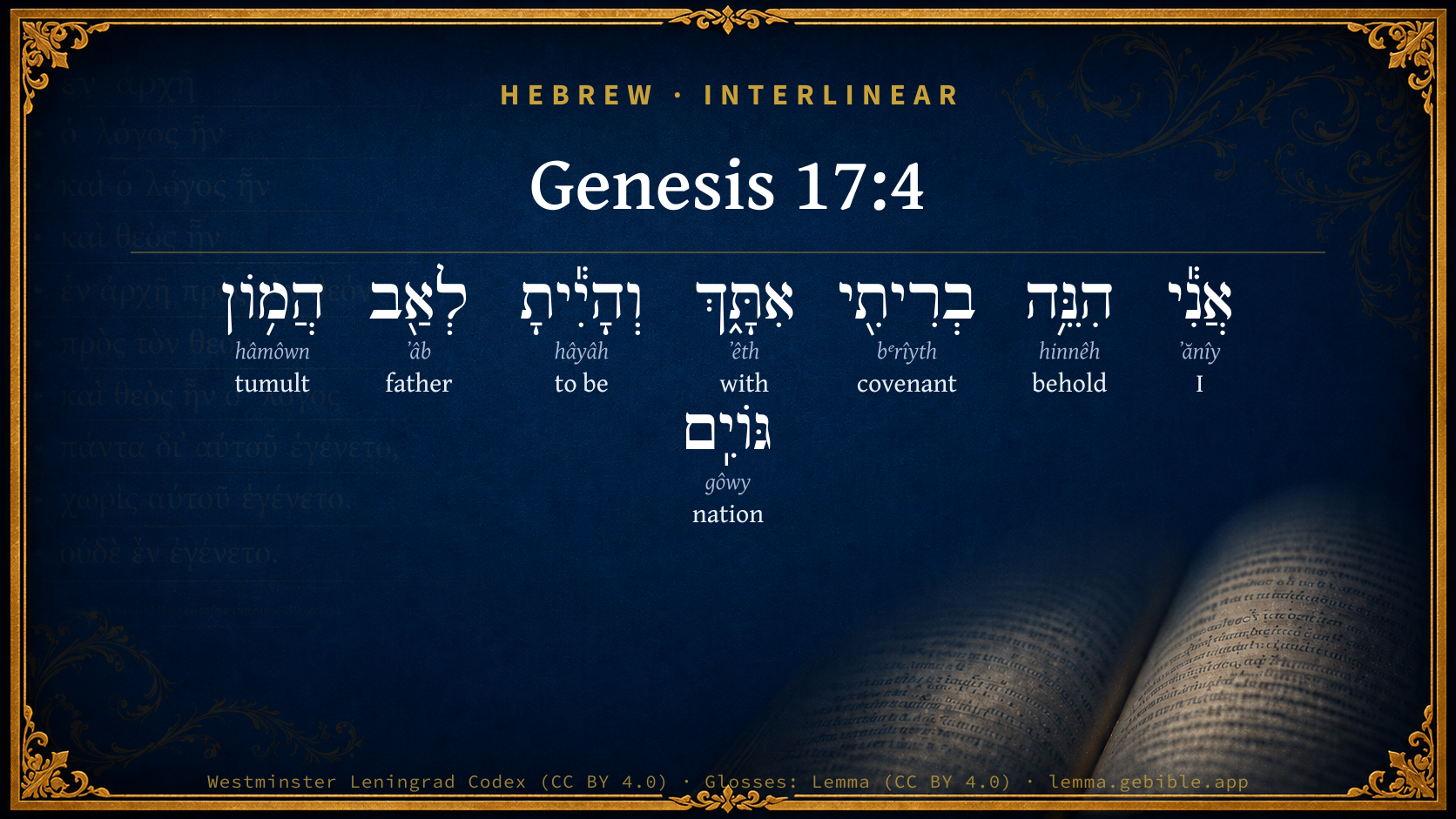
Genesis 17:4

Hebrew (Westminster Leningrad Codex) Genesis 17:4 appears in the Hebrew Old Testament. The text above is from the Westminster Leningrad Codex. Each word links to its Strong’s number, a concise gloss, and parsing drawn from the Open Scriptures Hebrew Bible morphology. Click any word for its full Brown-Driver-Briggs (BDB) entry.
Download image
Cite this verse

Genesis 17:4 (World English Bible). Public Domain. Lemma interlinear Bible study tool, https://lemma.gebible.app/v/genesis/17/4.

Show BibTeX & RIS
BibTeX
RIS
English Translation
"As for me, behold, my covenant is with you. You will be the father of a multitude of nations.
World English Bible · Public Domain
Highlights
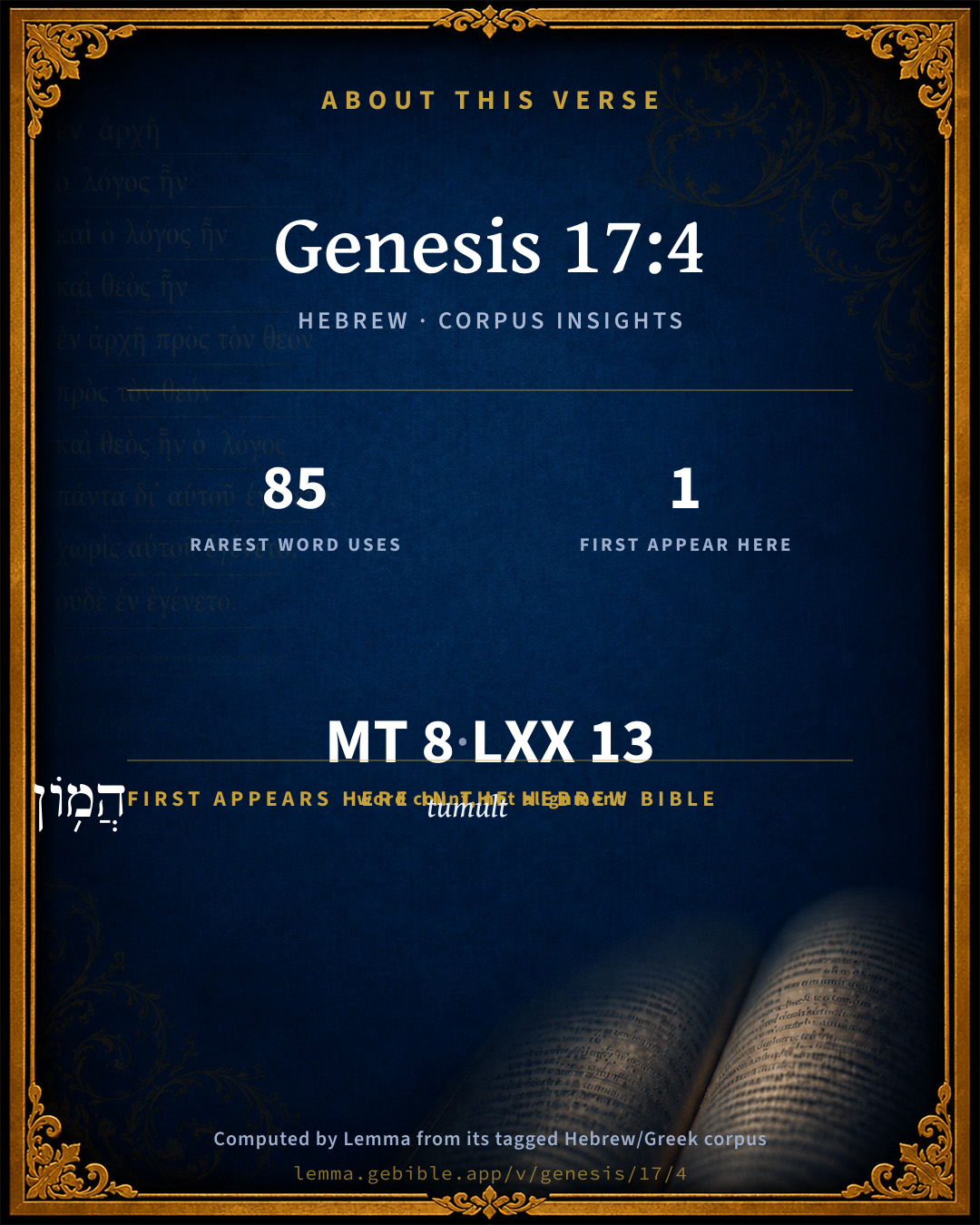
  • 1 first appearance in the Hebrew Bible
Full analysis ↓
Download a study sheet

One document with this verse’s original text, its word-by-word gloss line, the meaning frame, cross-references with their text, attributed commentary, and full source and license credits — printable, and it pastes into notes with its structure intact.

This verse Autodidact and up

Study sheet (.html) Plain text (.txt)

A passage Seminary Student

Up to 50 verses in one chapter. A passage sheet keeps up to 6 commentary sources and 12 cross-references per verse, in the order this page ranks them, and says so on the sheet whenever that leaves anything out. Ask for a single verse and you get the Autodidact verse sheet above.

Everything on this page stays free to read, with no account — the sheet is a download of what is already on screen, not access to it.

Want to remove ads? Support Godless Engineer
Compare translations 3

The same verse in 3 English versions, stacked beneath the original-language interlinear above. Click any original word for its lexicon entry.

Each is an independent rendering of the whole verse — the interlinear is not word-aligned to these translations.

Highlighted words mark where these versions differ — a whole-verse word diff, not a word-by-word alignment.

  • World English Bible Public Domain
    "As for me, behold, my covenant is with you. You will be the father of a multitude of nations.
  • King James Version Public Domain
    As for me, behold, my covenant is with thee, and thou shalt be a father of many nations.
  • unfoldingWord Literal Text CC BY-SA 4.0
    “Me, behold, my covenant will be with you, and you shall be the father of an assembly of nations.

unfoldingWord Literal Text — © unfoldingWord, licensed CC BY-SA 4.0. Word-aligned USFM3 via Door43 (git.door43.org/unfoldingWord/en_ult).

Versions to compare (up to 4)

3 of 4 selected

Show all 18 translations

Every available English version of this verse, each an independent rendering of the whole verse.

  • World English Bible Public Domain
    "As for me, behold, my covenant is with you. You will be the father of a multitude of nations.
  • Berean Standard Bible Public Domain
    “As for Me, this is My covenant with you: You will be the father of many nations.
  • Majority Standard Bible Public Domain
    “As for Me, this is My covenant with you: You will be the father of many nations.
  • King James Version Public Domain
    As for me, behold, my covenant is with thee, and thou shalt be a father of many nations.
  • American Standard Version (1901) Public Domain
    As for me, behold, my covenant is with thee, and thou shalt be the father of a multitude of nations.
  • Revised Version (1885) Public Domain
    As for me, behold, my covenant is with thee, and thou shalt be the father of a multitude of nations.
  • Geneva Bible (1599) Public Domain
    Beholde, I make my couenant with thee, and thou shalt be a father of many nations,
  • Douay-Rheims (1899) Public Domain
    And God said to him: I AM, and my covenant is with thee, and thou shalt be a father. of many nations.
  • Young's Literal Translation Public Domain
    `I -- lo, My covenant `is' with thee, and thou hast become father of a multitude of nations;
  • Literal Standard Version CC BY-SA 4.0
    “I—behold, My covenant [is] with you, and you have become father of a multitude of nations;
  • Unlocked Literal Bible CC BY-SA 4.0
    “As for me, behold, my covenant is with you. You will be the father of a multitude of nations.
  • unfoldingWord Literal Text CC BY-SA 4.0
    “Me, behold, my covenant will be with you, and you shall be the father of an assembly of nations.
  • Darby Bible Public Domain
    It is I: behold, my covenant is with thee, and thou shalt be a father of a multitude of nations.
  • World Messianic Bible Public Domain
    “As for me, behold, my covenant is with you. You will be the father of a multitude of nations.
  • Webster's Bible Public Domain
    As for me, behold, my covenant is with thee, and thou shalt be a father of many nations.
  • Free Bible Version CC BY-SA 4.0
    “Listen! This is the agreement I'm making with you. You will be the father of many nations,
  • Bible in Basic English Public Domain
    As for me, my agreement is made with you, and you will be the father of nations without end.
  • JPS Tanakh (1917) Public Domain
    'As for Me, behold, My covenant is with thee, and thou shalt be the father of a multitude of nations.

Literal Standard Version (2020), Covenant Press — licensed CC BY-SA 4.0. Text via the HelloAO Bible API (eBible.org). Unlocked Literal Bible (unfoldingWord) — licensed CC BY-SA 4.0. Text via the HelloAO Bible API (eBible.org). unfoldingWord Literal Text — © unfoldingWord, licensed CC BY-SA 4.0. Word-aligned USFM3 via Door43 (git.door43.org/unfoldingWord/en_ult). Free Bible Version, Dr. Jonathan Gallagher — licensed CC BY-SA 4.0. Text via the HelloAO Bible API (eBible.org).

Word by word

More ways to search: Search by grammar → Find every occurrence → Compare this word →

Practice this passage: Drill this verse → Learn its vocabulary →

About this verse

These counts appear in no published source. They are computed here, from the morphology-tagged text and Lemma’s own curated glosses. What Lemma adds →

8
words
8
distinct lemmas
Pentateuch
section

First appearance in Scripture

This word makes its first canonical appearance in the Hebrew Bible here:

  • הֲמ֥וֹן tumult H1995

Grammatical profile

  • 1 verb
  • 4 nouns
  • 1 pronoun
  • 1 preposition
  • 1 particle

Verb forms

  • וְהָיִ֕יתָ Qal · Sequential Perfect

Hebrew & Septuagint length

In English translation the verse runs 19 words from the Hebrew and 19 from the Septuagint (LXX English) — the same length.

A rough comparison of the two English renderings, which tokenize alike — not a word-level alignment.

Word counts can differ between the Hebrew and the Greek without any difference in meaning — e.g. the Hebrew direct-object marker אֵת has no separate Greek word, and Greek often adds the article ὁ.

In the original languages it is 8 Hebrew tokens and 13 Greek tokens — but the two are counted differently (Hebrew bundles its prefixes and suffixes into one token; the Greek is in lemma form), so that isn’t a like-for-like length.

Cross-references

13

Topical passages linked to Genesis 17:4 in the Treasury of Scripture Knowledge — connected by theme and wording, ordered by reader-vote popularity; previews shown in the World English Bible.

  • Genesis 35:11 God said to him, "I am God Almighty. Be fruitful and multiply. A nation and a company of nations will be from you, and kings will come out of your loins.
  • Romans 4:11–18 He received the sign of circumcision, a seal of the righteousness of the faith which he had while he was in uncircumcision, that he might be the father of all those who believe, though they be in uncircumcision, that righteousness might also be accounted to them.
  • Genesis 12:2 I will make of you a great nation. I will bless you, and make your name great. You will be a blessing.
  • Galatians 3:28–29 There is neither Jew nor Greek, there is neither slave nor free man, there is neither male nor female; for you are all one in Christ Jesus.
  • Genesis 13:16 I will make your offspring as the dust of the earth, so that if a man can number the dust of the earth, then your seed may also be numbered.
  • Genesis 16:10 The angel of Yahweh said to her, "I will greatly multiply your seed, that they will not be numbered for multitude."
  • Genesis 22:17 that in blessing I will bless you, and in multiplying I will multiply your seed as the stars of the heavens, and as the sand which is on the seashore. Your seed will possess the gate of his enemies.
  • Genesis 25:1–18 Abraham took another wife, and her name was Keturah.
  • Genesis 32:12 You said, 'I will surely do you good, and make your seed as the sand of the sea, which can't be numbered because there are so many.'"
  • Genesis 36:1–43 Now this is the history of the generations of Esau (the same is Edom).
  • Genesis 48:19 His father refused, and said, "I know, my son, I know. He also will become a people, and he also will be great. However, his younger brother will be greater than he, and his seed will become a multitude of nations."
  • Numbers 1:1–54 Yahweh spoke to Moses in the wilderness of Sinai, in the Tent of Meeting, on the first day of the second month, in the second year after they had come out of the land of Egypt, saying,
  • Numbers 26:1–65 It happened after the plague, that Yahweh spoke to Moses and to Eleazar the son of Aaron the priest, saying,

Cross-references courtesy of OpenBible.info (CC BY 4.0).

Hebrew and Greek witnesses Masoretic Hebrew ↔ Greek Septuagint

The same verse in the two great witnesses to the Old Testament, shown verse-for-verse.

These are two independent witnesses, not word-aligned to each other, and the Septuagint is shown in lemma (dictionary) form.

Hebrew Genesis 17:4 Masoretic · Westminster Leningrad Codex

אֲנִ֕י הִנֵּ֥ה בְרִיתִ֖י אִתָּ֑ךְ וְהָיִ֕יתָ לְאַ֖ב הֲמ֥וֹן גּוֹיִֽם

"As for me, behold, my covenant is with you. You will be the father of a multitude of nations.

World English Bible · Public Domain

Greek LXX Genesis 17:4 Septuagint · lemma form

καί ἐγώ ἰδού ὁ διαθήκη ἐγώ μετά σύ καί εἰμί πατήρ πλῆθος ἔθνος

And I, behold! my covenant is with you, and you shall be a father of a multitude of nations.

LXX2012 (modern English Septuagint) · Public Domain

On this verse, The Cambridge Bible for Schools and Colleges discusses the Septuagint’s reading. Read the note in Commentary ↓

Hebrew: Westminster Leningrad Codex (CC BY 4.0). Greek: Septuagint (public domain); English from LXX2012 (modern English Septuagint) (Public Domain). How the Septuagint differs from the Hebrew →

Targum (Aramaic paraphrase)

2

The Targum is the ancient Jewish Aramaic paraphrase of the Hebrew Scriptures — an interpretive translation, not the Hebrew text itself. Onkelos (literal) and Pseudo-Jonathan (expansive) render the Torah, and Jonathan the Prophets. Coverage is partial: where no permissively-licensed English translation exists for a verse, only the Aramaic is shown. This is verse-level text, not a word-by-word alignment to the Hebrew.

  1. Targum Onkelos Torah (Genesis–Deuteronomy)
    אֲנָא הָא (גְזַר) קְיָמִי עִמָךְ וּתְהֵי לְאַב סַגִי עַמְמִין

    (no public-domain English translation for this verse)

    Targum Onkelos — Aramaic: “Onkelos Genesis” (public domain); “Onkelos Exodus” (public domain); “Onkelos Leviticus” (public domain); “Onkelos Numbers” (public domain); “Onkelos Deuteronomy” (public domain). English: “Sefaria Community Translation” (CC0 1.0 (public-domain dedication)); “J.W. Etheridge. The Targums of Onkelos and Jonathan Ben Uzziel on the Pentateuch. London: Longmans, Green, 1862” (public domain). Text via Sefaria.

  2. Targum Pseudo-Jonathan Torah (Genesis–Deuteronomy)
    אֲנָא הָא גְזַר קְיָימִי עִמָךְ וּתְהִי לְאַב סַגִי עַמְמִין

    Behold, I have confirmed (or divided) my covenant with thee; and thou shalt be the father of many peoples.

    Targum Pseudo-Jonathan — Aramaic: “Targum Jonathan on Genesis” (public domain); “Targum Jonathan on Exodus” (public domain); “Targum Jonathan on Leviticus” (public domain); “Targum Jonathan on Numbers” (public domain); “Targum Jonathan on Deuteronomy” (public domain). English: “The Targum of Jonathan ben Uzziel, trans. J. W. Etheridge, London, 1862” (public domain). Text via Sefaria.

Commentary

Notes on Genesis 17:4 from classic Christian and Jewish commentators (each source and its license shown beneath its notes). The classic Christian expositions comment on the surrounding passage and are grouped to its opening verse, so a note may address several verses; the Jewish commentaries on the Tanakh (Rashi and others) are per-verse, so they appear only where the commentator wrote on this verse.

Lemma curates 59 commentaries, every one of them public domain or Creative Commons licensed, each selected and text-cleaned for this edition rather than reprinted as found. About our sources →

Trapp's Complete Commentary

John Trapp

Gen 17:4 As for me, behold, my covenant [is] with thee, and thou shalt be a father of many nations.

Ver. 4. As for me.] Ego ecce . An abrupt speech, to show what haste God made to comfort and confirm Abram, now fallen at his feet.

Thou shalt be a father of many nations.] The Israelites, Ishmaelites, Edomites, Keturites, &c., besides all believers. {Gal 3:28-29}

John Trapp, A Commentary or Exposition upon All the Books of the Old and New Testament (1647–1656) — public domain. Text from a community e-Sword module.

Joseph Benson's Commentary

Gen 17:4. The promise is here introduced with solemnity: As for me, saith the great God, behold — Admire, and be assured of it; my covenant is with thee; and thou shalt be a father of many nations — This implies, 1st, That his seed after the flesh should be very numerous, both in Isaac and in Ishmael, and in the sons of Keturah. And the event answered; for there have been, and are, more of the children of men descended from Abraham, than from any one man at an equal distance with him from Noah, the common root. 2d, That all believers in every age should be looked upon as his spiritual seed. In this sense the apostle directs us to understand this promise, Rom 4:16. He is the father of the faithful, of those, in every nation, that, by faith, enter into covenant with God, and (as the Jewish writers express it) are gathered under the wings of the Divine Majesty.

Joseph Benson's Commentary on the Old and New Testaments (1811–1818) — public domain. Text from a community e-Sword module.

Tyndale Open Study Notes

Tyndale Open Resources

17:4-5 God guaranteed his promise by changing Abram’s name. Abram referred to his noble lineage, as Terah was the “exalted father” (11:27). His new name, Abraham (Hebrew ’ab hamon) was a wordplay on the promise of his own progeny (see also John 8:31-59; Rom 4:16-17; Gal 3:7, 15-19, 29). Whenever the new name was used, he and his household would remember that a multitude of nations would issue from him.

Tyndale Open Study Notes — © Tyndale Open Resources, licensed CC BY-SA 4.0. Text via the HelloAO Bible API.

Geneva Bible (1599)

Geneva Bible translators

Not only according to the flesh, but of a far greater multitude by faith, Rom. 4:17.

Geneva Bible (1599) marginal notes — public domain. Text via Bolls.life.

Matthew Henry's Commentary

The promise here is introduced with solemnity: "As for me," says the great God, "behold, behold and admire it, behold and be assured of it, my covenant is with thee;" as before (Gen 17:2), I will make my covenant. Note, The covenant of grace is a covenant of God's own making; this he glories in (as for me), and so may we. Now here,

I. It is promised to Abraham that he should be a father of many nations; that is, 1. That his seed after the flesh should be very numerous, both in Isaac and Ishmael, as well as in the sons of Keturah: something extraordinary is doubtless included in this promise, and we may suppose that the event answered to it, and that there have been, and are, more of the children of men descended from Abraham than from any one man at an equal distance with him from Noah, the common root. 2. That all believers in every age should be looked upon as his spiritual seed, and that he should be called, not only the friend of God, but the father of the faithful. In this sense the apostle directs us to understand this promise, Rom 4:16, Rom 4:17. He is the father of those in every nation that by faith enter into covenant with God, and (as the Jewish writers express it) are gathered under the wings of the divine Majesty.

II. In token of this his name was changed from Abram, a high father, to Abraham, the father of a multitude. This was, 1. To put an honour upon him. It is spoken of as the glory of the church that she shall be called by a new name, which the mouth of the Lord shall name, Isa 62:2. Princes dignify their favourites by conferring new titles upon them; thus was Abraham dignified by him that is indeed the fountain of honour. All believers have a new name, Rev 2:17. Some think it added to the honour of Abraham's new name that a letter of the name Jehovah was inserted into it, as it was a disgrace to Jeconiah to have the first syllable of his name cut off, because it was the same as the first syllable of the sacred name, Jer 22:28. Believers are named from Christ, Eph 3:15. 2. To encourage and confirm the faith of Abraham. While he was childless perhaps even his own name was sometimes an occasion of grief to him: why should he be called a high father who was not a father at all? But now that God had promised him a numerous issue, and had given him a name which signified so much, that name was his joy. Note, God calls things that are not as though they were. It is the apostle's observation upon this very thing, Rom 4:17. He called Abraham the father of a multitude because he should prove to be so in due time, though as yet he had but one child.

Matthew Henry's Commentary on the Whole Bible (1708–1710) — public domain (CC PDM 1.0). Text via the HelloAO Bible API.

Jamieson, Fausset & Brown

Robert Jamieson, A. R. Fausset & David Brown

my covenant is with thee--Renewed mention is made of it as the foundation of the communication that follows. It is the covenant of grace made with all who believe in the Saviour.

Jamieson, Fausset & Brown — Commentary Critical and Explanatory on the Whole Bible (1871) — public domain (CC PDM 1.0). Text via the HelloAO Bible API.

John Calvin's Commentaries

4. As for me, behold, my covenant is with thee They who translate the passage, ‘Behold, I make a covenant with thee,’ or, ‘Behold, I and my covenant with thee;’ do not seem to me faithfully to represent the meaning of Moses. For, first, God declares that he is the speaker, in order that absolute authority may appear in his words. For since our faith can rest on no other foundation than his eternal veracity, it becomes, above all things, necessary for us to be informed that what is proposed to us, has proceeded from his sacred mouth. Therefore, the pronoun I, is to be read separately as a preface to the rest; in order that Abram might have a composed mind, and might engage, without hesitation, in the proposed covenant. Whence a useful doctrine is deduced, that faith necessarily has reference to God: because, although all angels and men should speak to us, never would their authority appear sufficiently great to confirm our minds. And it cannot but be, that we should at times waver, until that voice sounds from heaven, ‘I am.’ Whence also it appears what kind of religion is that of the Papacy: where, instead of the word of God, the fictions of men are alone the subject of boast. And they are justly exposed to continual fluctuation, who, depending upon the word of men, act unjustly towards God, by ascribing to them more than is right. But let us have no other foundation of our faith than this word ‘I’, not as spoken indifferently by any mouth whatever, but by the mouth of God alone. If, however, myriads of men set themselves in opposition, and proudly exclaim, ‘We, we,’ let this single word of God suffice to dissipate the empty sound of multitudes.

And thou shalt be a father of many nations It is asked what is this multitude of nations? It obviously appears, that different nations had their origin from the holy Patriarch: for Ishmael grew to a great people: the Idumeans, from another branch were spread far and wide; large families also sprung from other sons, whom he had by Keturah. But Moses looked still further, because, indeed, the Gentiles were to be, by faith, inserted into the stock of Abram, although not descended from him according to the flesh: of which fact Paul is to us a faithful interpreter and witness. For he does not gather together the Arabians, Idumeans, and others, for the purpose of making Abram the father of many nations; but he so extends the name of father, as to make it applicable to the whole world, in order that the Gentiles, in other respects strangers, and separated from each other, might, from all sides combine in one family of Abram. I grant, indeed, that, for a time, the twelve tribes were as so many nations; but only in order to form a prelude to that immense multitude, which, at length, is collected together as the one family of Abram. And that Moses speaks of those sons, who, being regenerate by faith, acquire the name, and pass over into the stock of Abram, is sufficiently proved by this one consideration. For the carnal race of Abram could not be divided into different nations, without causing those who had departed from the unity, to be immediately accounted strangers. Thus the Church rejected the Ishmaelites, the Idumeans, and others, and regarded them as foreigners. Abram therefore was not called the father of many nations, because his seed was to be divided into many nations; but rather, because many nations were to be gathered together unto him. A change also of his name is added as a token. For he begins to be called Abraham, in order that the name itself may teach him, that he should not be the father of one family only; but that a progeny should rise up to him from an immense multitude, beyond the common course of nature. For this reason, the Lord so often renews this promise; because the very repetition of it shows that no common blessing was promised.

John Calvin's Commentaries (1540-1563) — public domain. Text from the Calvin Translation Society English edition (1840s-50s) via the Christian Classics Ethereal Library (ccel.org). Calvin's coverage is partial (roughly two-thirds of the Bible); uncommented books and verses are honest gaps, never fabricated. The 19th-century editor's footnotes and remarks are omitted so the notes are faithfully Calvin's own voice.

Ellicott's Commentary for English Readers

(4) Of many nations.—This is a feeble rendering of a remarkable phrase. Literally the word signifies a confused noise like the din of a populous city. Abram is to be the father of a thronging crowd of nations. And so in Gen_17:5.

A Bible Commentary for English Readers, edited by Charles John Ellicott (1878–1897) — public domain. Text from a community e-Sword module.

The Cambridge Bible for Schools and Colleges

gen. ed. J. J. S. Perowne

4. father of a multitude of nations] “Multitude,” hamôn = “tumult.” LXX πολλῶν ἐθνῶν.

The Cambridge Bible for Schools and Colleges (gen. ed. J. J. S. Perowne; Cambridge University Press, 1878–1918) — public domain. Text from a community e-Sword module.

John Gill's Exposition

As for me, behold, my covenant is with thee,.... Who was gracious to make it, faithful to keep it, and immutable in it, though Abram was but a man, and sinful:

and thou shalt be a father of many nations: as he was of many Arabian nations, and of the Turks in the line of Ishmael; and of the Midianites, and others, in the line of his sons by Keturah; and of the Israelites in the line of Isaac, as well as of the Edomites in the line of Esau; and in a spiritual sense the father of all that believe, in all the nations of the world, circumcised or uncircumcised, as the apostle explains it, Rom 4:11.

John Gill's Exposition of the Whole Bible (1746–1763) — public domain (CC PDM 1.0). Text via the HelloAO Bible API.

Haydock's Catholic Bible Commentary

I am unchangeable, and faithful to my promises, the only God. (Du Hamel) --- Nations. Jews, Saracens or Arabs, Idumeans, and, by faith, of all nations who shall believe in Christ, the King of kings. (Calmet) --- The true Church will never then be reduced to a few unknown believers, as the Donatists and Protestants assert. (Worthington)

George Leo Haydock (1774–1849), Haydock's Catholic Family Bible and Commentary, 1859 edition — public domain. Excludes Psalms (Douay-Rheims chapter numbering differs from Protestant) and Deuterocanonical books (Catholic canon only).

Matthew Poole's English Annotations

Both literally, or after the flesh, of the Israelites, Ishmaelites, Edomites, &c., and spiritually, of all believers of all nations, to whom Abram hath in some sort the place of a father, Rom 4:12,17. Not only as he was the great example and teacher of that faith by which they are all saved, (as the instructors of others are called their fathers, both in Scripture, as Gen 4:20-21, and in profane authors,) but as he was made by God the head of the covenant, by or through whom the covenant right was conveyed to all his natural seed, and afterwards to the spiritual seed, all Gentile believers.

Matthew Poole's English Annotations on the Holy Bible (1683–1685) — public domain. Text from a community e-Sword/MySword module.

Whedon's Commentary on the Bible

Daniel D. Whedon

4. As for me — Contrast the thou in Gen_17:9. Here God declares what he will do for his part; there he directs what Abram must do.

A father of many nations — Or, of a noise of nations; a tumultuous mass of nations. The Ishmaelites, the Edomites, and the descendants of Keturah, (xxv, 1,) as well as the twelve tribes of Israel, sprang from Abram. So that Abram was literally the father of a great multitude of nations, and no name is more honoured in the East to day.

Daniel D. Whedon (gen. ed.), Commentary on the Old and New Testaments (1874–1909) — public domain. Text from a community e-Sword module.

The Pulpit Commentary

As for me. Literally, I, standing alone at the beginning of the sentence by way of emphasis (cf. 2Ki_10:29; Psa_11:4 Psa_46:5; wide Ewald"s "Hebrew Syntax," Equivalent to "So far as I am concerned," or, "I for my part," or, "So far as relates to me." Behold, my covenant is with thee, and thou shalt be literally, shalt become, (cf. Gen_2:7) or grow to (cf. Gen_9:15) a father of many (or of a multitude of) nations.

The Pulpit Commentary (1880–1919), ed. H.D.M. Spence-Jones & Joseph S. Exell — public domain. Text from a community e-Sword module.

John Wesley's Explanatory Notes

The promise is here introduced with solemnity: As for me, saith the Great God, Behold, behold and admire it, behold and be assured of it, my covenant is with thee. And thou shalt be a father of many nations - This implies,

1. That his seed after the flesh should be very numerous, both in Isaac and in Ishmael, and in the sons of Keturah. And the event answered, for there have been, and are, more of the children of men descended from Abraham, than from any one man at equal distance with him from Noah, the common root.

2. That all believers, in every age, should be looked upon as his spiritual seed, as the father of the faithful. In this sense the apostle directs us to understand this promise, Rom. iv, 16, 17. He is the father of those, in every nation, that, by faith, enter into covenant with God, and (as the Jewish writers express it) are gathered under the wings of the divine majesty.

John Wesley, Explanatory Notes Upon the Whole Bible (1754–1765) — public domain. Text via the GEBible commentary corpus.

Keil & Delitzsch

C. F. Keil & F. Delitzsch

On the part of God אני placed at the beginning absolutely: so far as I am concerned, for my part) it was to consist of this: (1) that God would make Abram the father (אב instead of אני chosen with reference to the name Abram) of a multitude of nations, the ancestor of nations and kings; (2) that He would be God, show Himself to be God, in an eternal covenant relation, to him and to his posterity, according to their families, according to all their successive generations; and (3) that He would give them the land in which he had wandered as a foreigner, viz., all Canaan, for an everlasting possession. As a pledge of this promise God changed his name אברם, i.e., high father, into אברהם, i.e., father of the multitude, from אב and רהם, Arab. ruhâm = multitude. In this name God gave him a tangible pledge of the fulfilment of His covenant, inasmuch as a name which God gives cannot be a mere empty sound, but must be the expression of something real, or eventually acquire reality.

Keil & Delitzsch — Biblical Commentary on the Old Testament (1861–1891) — public domain (CC PDM 1.0). Text via the HelloAO Bible API. (Old Testament only.)

Ramban (Nachmanides)

Rabbi Moshe ben Nachman (Ramban / Nachmanides)

BEHOLD, MY COVENANT IS WITH THEE, AND THOU SHALT BE THE FATHER OF A MULTITUDE OF NATIONS. This refers to the covenant of the circumcision, as He will explain, “This is the sign of the Covenant,. and after the covenant you will be the father of a multitude of nations.”Blessed be the Lord! By Him alone are actions weighed, for He preceded and commanded Abraham to enter into His covenant to be circumcised before Sarah became pregnant so that his seed would be holy.

Ramban (Nachmanides) on the Tanakh — English translation: “Commentary on the Torah by Ramban (Nachmanides). Translated and annotated by Charles B. Chavel. New York, Shilo Pub. House, 1971-1976” (CC BY 4.0). Text via Sefaria.

Radak

Rabbi David Kimhi (Radak)

אני הנה בריתי אתך, just as you have ben certain that when I said to you that I am א-ל שדי that I have the power to change the laws of nature, I am telling you additionally, that you will not only be the founder of one nation, but that you will became the founder of numerous nations. Both Yitzchok, Ishmael, and the sons of Keturah will al become important nations.

The expression המון means "a multiplicity." In order that this will be remembered for all future times, I change your name by the addition of the letter ה, which by being joined to the letter מsymbolizes the word המון.

Radak on the Tanakh — English translations: “Sefaria Community Translation” (CC0 1.0 (public-domain dedication)); “Eliyahu Munk, HaChut Hameshulash” (CC BY 4.0); “Rabbi Mike Feuer, Jerusalem Anthology” (CC BY 4.0); and “R. David Kimhi on the first book of Psalms, Translated by R.G. Finch, London, 1919” (public domain). Text via Sefaria.

Lesson kit

Teaching starters — assembled from the data on this page, not authored interpretation. Every prompt links to the verse data it draws on. Edit before teaching.

Genesis, in the Pentateuch, opens this verse with 8 words (8 distinct Hebrew lemmas). Its most distinctive word is hâmôwn (“tumult”). A historical commentator’s framing appears above. Read the whole chapter for the surrounding context.

Discussion questions

  1. What does “tumult” (hâmôwn) contribute to the verse as a whole?
  2. The word “tumult” first appears here in Scripture. What is being introduced at this debut?
  3. Genesis 35:11 shares this passage’s theme. How do the two illuminate each other?
  4. The translations on this page render this verse differently — a whole-verse word diff, not a word-by-word alignment. What might account for the different wordings?
  5. The verb «וְהָיִ֕יתָ» is Qal Sequential Perfect. How does its form color the action?
  6. Reading how Trapp's Complete Commentary and Joseph Benson's Commentary read this verse, where do the two commentators agree and where do they part?

Things to notice

Reading settings

Reading text

Shown beneath each verse's original-language words.

Old Testament
Old Testament edition

Read the OT as the Masoretic Hebrew (MT) or the Greek Septuagint (LXX).

English shown for the Greek Septuagint (in the Hebrew ↔ Greek comparison).

Comparing translations? Open the Compare panel on any verse page to stack up to four side by side.