
Genesis 11:29

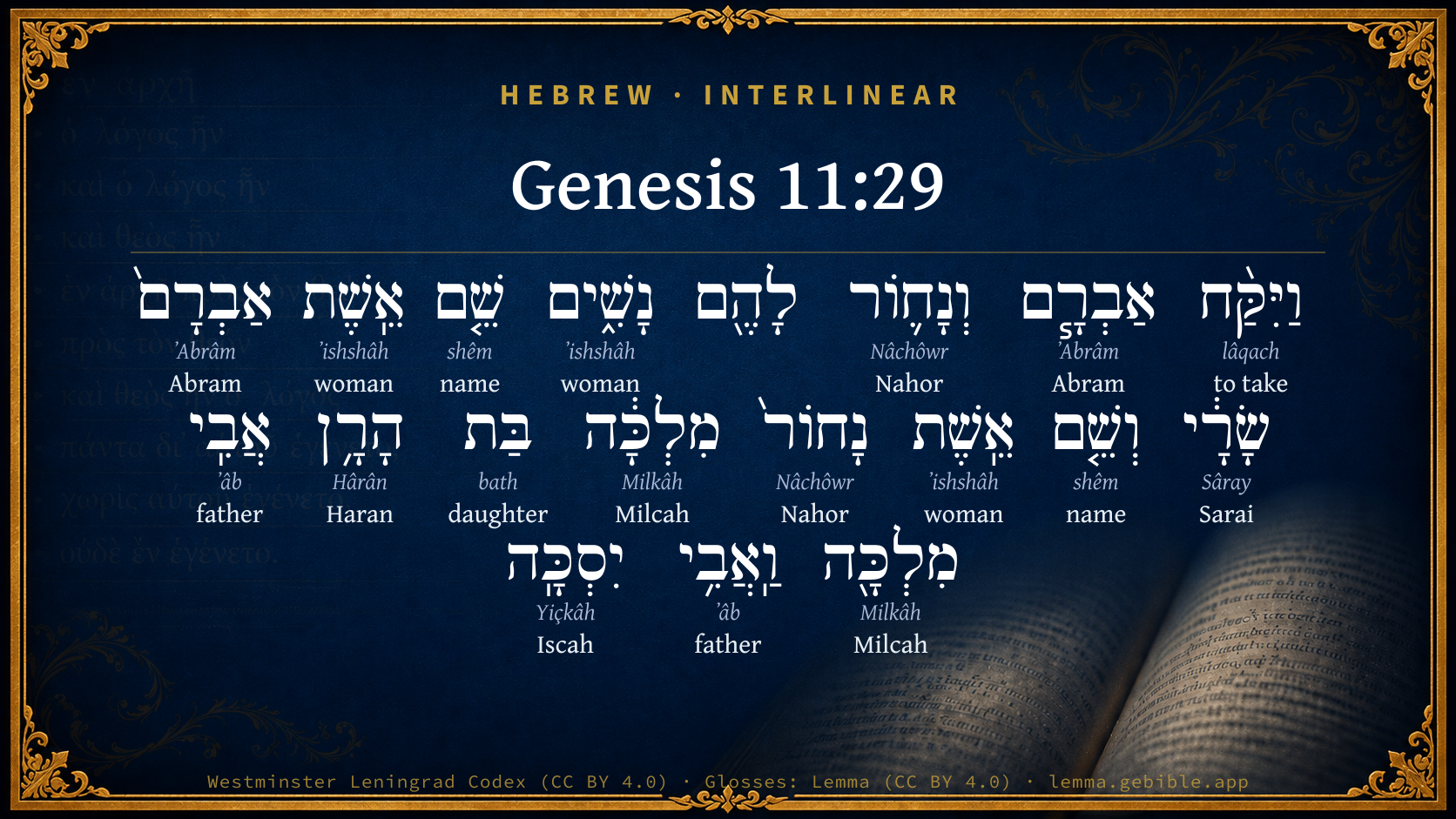
Hebrew (Westminster Leningrad Codex) Genesis 11:29 appears in the Hebrew Old Testament. The text above is from the Westminster Leningrad Codex. Each word links to its Strong’s number, a concise gloss, and parsing drawn from the Open Scriptures Hebrew Bible morphology. Click any word for its full Brown-Driver-Briggs (BDB) entry.
Download image
Cite this verse

Genesis 11:29 (World English Bible). Public Domain. Lemma interlinear Bible study tool, https://lemma.gebible.app/v/genesis/11/29.

Show BibTeX & RIS
BibTeX
RIS
English Translation
Abram and Nahor took wives. The name of Abram's wife was Sarai, and the name of Nahor's wife, Milcah, the daughter of Haran who was also the father of Iscah.
World English Bible · Public Domain
Highlights
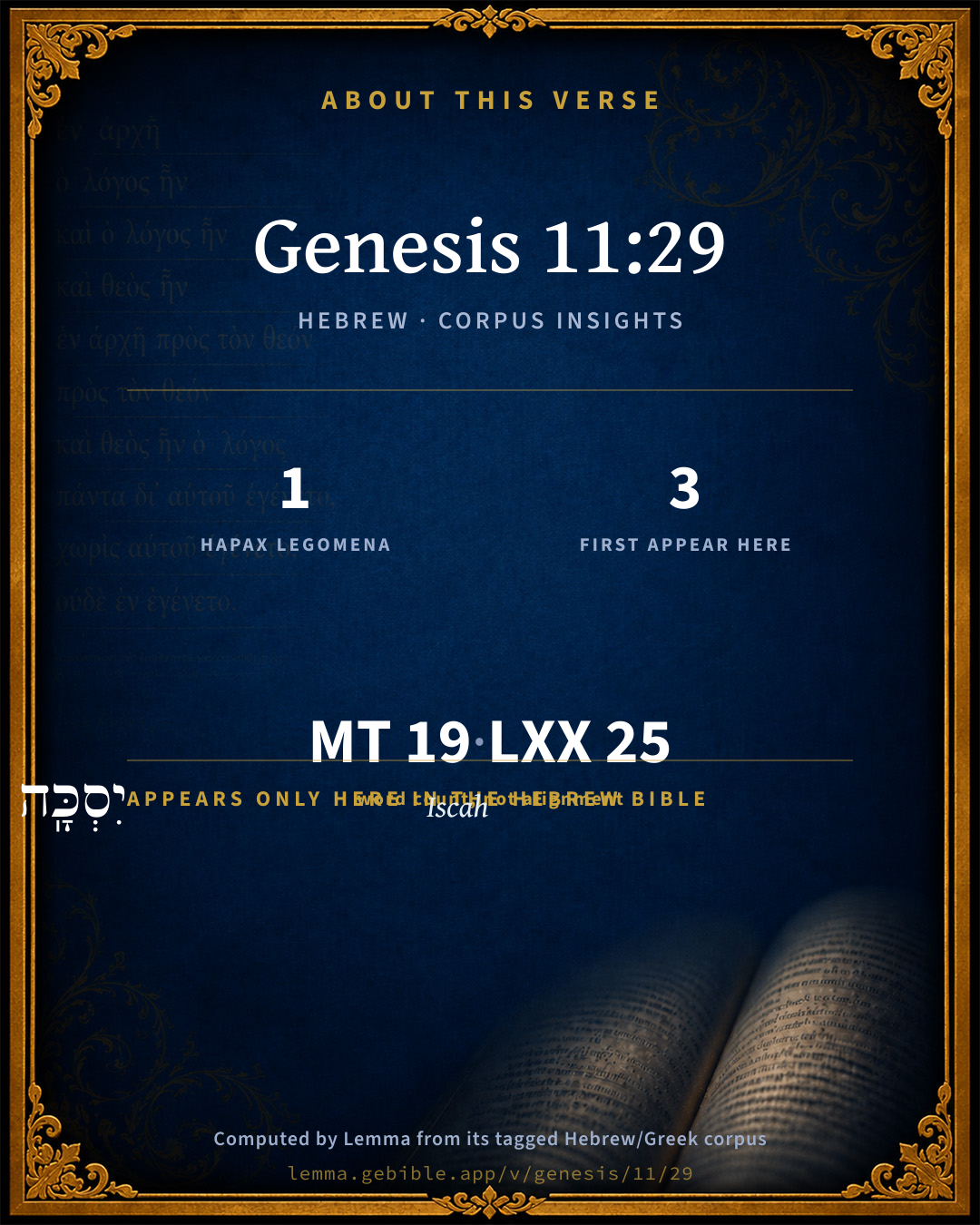
  • 1 hapax legomenon — only here in the Hebrew Bible
  • 3 first appearances in the Hebrew Bible
Full analysis ↓
Download a study sheet

One document with this verse’s original text, its word-by-word gloss line, the meaning frame, cross-references with their text, attributed commentary, and full source and license credits — printable, and it pastes into notes with its structure intact.

This verse Autodidact and up

Study sheet (.html) Plain text (.txt)

A passage Seminary Student

Up to 50 verses in one chapter. A passage sheet keeps up to 6 commentary sources and 12 cross-references per verse, in the order this page ranks them, and says so on the sheet whenever that leaves anything out. Ask for a single verse and you get the Autodidact verse sheet above.

Everything on this page stays free to read, with no account — the sheet is a download of what is already on screen, not access to it.

Want to remove ads? Support Godless Engineer
Compare translations 3

The same verse in 3 English versions, stacked beneath the original-language interlinear above. Click any original word for its lexicon entry.

Each is an independent rendering of the whole verse — the interlinear is not word-aligned to these translations.

Highlighted words mark where these versions differ — a whole-verse word diff, not a word-by-word alignment.

  • World English Bible Public Domain
    Abram and Nahor took wives. The name of Abram's wife was Sarai, and the name of Nahor's wife, Milcah, the daughter of Haran who was also the father of Iscah.
  • King James Version Public Domain
    And Abram and Nahor took them wives: the name of Abram's wife was Sarai; and the name of Nahor's wife, Milcah, the daughter of Haran, the father of Milcah, and the father of Iscah.
  • unfoldingWord Literal Text CC BY-SA 4.0
    And Abram and Nahor took wives for themselves. The name of Abram’s wife Sarai, and the name of Nahor’s wife Milcah, the daughter of Haran, the father of Milcah and the father of Iscah.

unfoldingWord Literal Text — © unfoldingWord, licensed CC BY-SA 4.0. Word-aligned USFM3 via Door43 (git.door43.org/unfoldingWord/en_ult).

Versions to compare (up to 4)

3 of 4 selected

Show all 18 translations

Every available English version of this verse, each an independent rendering of the whole verse.

  • World English Bible Public Domain
    Abram and Nahor took wives. The name of Abram's wife was Sarai, and the name of Nahor's wife, Milcah, the daughter of Haran who was also the father of Iscah.
  • Berean Standard Bible Public Domain
    And Abram and Nahor took wives for themselves. Abram’s wife was named Sarai, and Nahor’s wife was named Milcah; she was the daughter of Haran, who was the father of both Milcah and Iscah.
  • Majority Standard Bible Public Domain
    And Abram and Nahor took wives for themselves. Abram’s wife was named Sarai, and Nahor’s wife was named Milcah; she was the daughter of Haran, who was the father of both Milcah and Iscah.
  • King James Version Public Domain
    And Abram and Nahor took them wives: the name of Abram's wife was Sarai; and the name of Nahor's wife, Milcah, the daughter of Haran, the father of Milcah, and the father of Iscah.
  • American Standard Version (1901) Public Domain
    And Abram and Nahor took them wives: The name of Abram's wife was Sarai; and the name of Nahor's wife, Milcah, the daughter of Haran, the father of Milcah, and the father of Iscah.
  • Revised Version (1885) Public Domain
    And Abram and Nahor took them wives: the name of Abram’s wife was Sarai; and the name of Nahor’s wife, Milcah, the daughter of Haran, the father of Milcah, and the father of Iscah.
  • Geneva Bible (1599) Public Domain
    So Abram and Nahor tooke them wiues. The name of Abrams wife was Sarai, and the name of Nahors wife Milcah, the daughter of Haran, the father of Milcah, and the father of Iscah.
  • Douay-Rheims (1899) Public Domain
    And Abram and Nachor married wives: the name of Abram's wife was Sarai: and the name of Nachor's wife, Melcha, the daughter of Aran, father of Melcha, and father of Jescha.
  • Young's Literal Translation Public Domain
    And Abram and Nahor take to themselves wives; the name of Abram's wife `is' Sarai, and the name of Nahor's wife `is' Milcah, daughter of Haran, father of Milcah, and father of Iscah.
  • Literal Standard Version CC BY-SA 4.0
    And Abram and Nahor take to themselves wives; the name of Abram’s wife [is] Sarai, and the name of Nahor’s wife [is] Milcah, daughter of Haran, father of Milcah, and father of Iscah.
  • Unlocked Literal Bible CC BY-SA 4.0
    Abram and Nahor took wives. The name of Abram's wife was Sarai and the name of Nahor's wife was Milkah, a daughter of Haran, who was the father of Milkah and Iskah.
  • unfoldingWord Literal Text CC BY-SA 4.0
    And Abram and Nahor took wives for themselves. The name of Abram’s wife Sarai, and the name of Nahor’s wife Milcah, the daughter of Haran, the father of Milcah and the father of Iscah.
  • Darby Bible Public Domain
    And Abram and Nahor took wives: the name of Abram's wife was Sarai; and the name of Nahor's wife, Milcah, a daughter of Haran, the father of Milcah and the father of Iscah.
  • World Messianic Bible Public Domain
    Abram and Nahor married wives. The name of Abram’s wife was Sarai, and the name of Nahor’s wife was Milcah, the daughter of Haran, who was also the father of Iscah.
  • Webster's Bible Public Domain
    And Abram and Nahor took them wives: the name of Abram's wife was Sarai; and the name of Nahor's wife Milcah, the daughter of Haran, the father of Milcah, and the father of Iscah.
  • Free Bible Version CC BY-SA 4.0
    Abram and Nahor both got married. Abram's wife was named Sarai, and Nahor's wife was named Milcah. (She was the daughter of Haran, who was the father of both Milcah and Iscah).
  • Bible in Basic English Public Domain
    And Abram and Nahor took wives for themselves: the name of Abram's wife was Sarai, and the name of Nahor's wife was Milcah, the daughter of Haran, the father of Milcah and Iscah.
  • JPS Tanakh (1917) Public Domain
    And Abram and Nahor took them wives: the name of Abram's wife was Sarai; and the name of Nahor's wife, Milcah, the daughter of Haran, the father of Milcah, and the father of Iscah.

Literal Standard Version (2020), Covenant Press — licensed CC BY-SA 4.0. Text via the HelloAO Bible API (eBible.org). Unlocked Literal Bible (unfoldingWord) — licensed CC BY-SA 4.0. Text via the HelloAO Bible API (eBible.org). unfoldingWord Literal Text — © unfoldingWord, licensed CC BY-SA 4.0. Word-aligned USFM3 via Door43 (git.door43.org/unfoldingWord/en_ult). Free Bible Version, Dr. Jonathan Gallagher — licensed CC BY-SA 4.0. Text via the HelloAO Bible API (eBible.org).

Word by word

More ways to search: Search by grammar → Find every occurrence → Compare this word →

Practice this passage: Drill this verse → Learn its vocabulary →

יִסְכָּֽה
Yiçkâh
H3252
“Iscah”
Noun, Proper
Part of Speech
Noun
Type
Proper
Full BDB Definition

Origin: from an unused root meaning to watch

TWOT: None

Iscah = "one who looks forth" - daughter of Haran, niece of Abraham, sister of Lot and Milcah
  1. וַיִּקַּ֨ח lâqach H3947 “and · to take” Conjunction + Verb, Qal, Sequential Imperfect, 3rd Person, Masculine, Singular
  2. אַבְרָ֧ם ʼAbrâm H87 “Abram” Noun, Proper
  3. וְנָח֛וֹר Nâchôwr H5152 “and · Nahor” Conjunction + Noun, Proper
  4. נָשִׁ֑ים ʼishshâh H802 “women” Noun, Common, Feminine, Plural, Absolute
  5. שֵׁ֤ם shêm H8034 “name of” Noun, Common, Masculine, Singular, Construct
  6. אֵֽשֶׁת ʼishshâh H802 “woman of” Noun, Common, Feminine, Singular, Construct
  7. אַבְרָם֙ ʼAbrâm H87 “Abram” Noun, Proper
  8. שָׂרָ֔י Sâray H8297 “Sarai” Noun, Proper
  9. וְשֵׁ֤ם shêm H8034 “and · name of” Conjunction + Noun, Common, Masculine, Singular, Construct
  10. אֵֽשֶׁת ʼishshâh H802 “woman of” Noun, Common, Feminine, Singular, Construct
  11. נָחוֹר֙ Nâchôwr H5152 “Nahor” Noun, Proper
  12. מִלְכָּ֔ה Milkâh H4435 “Milcah” Noun, Proper
  13. בַּת bath H1323 “daughter of” Noun, Common, Feminine, Singular, Construct
  14. הָרָ֥ן Hârân H2039 “Haran” Noun, Proper
  15. אֲבִֽי ʼâb H1 “father of” Noun, Common, Masculine, Singular, Construct
  16. מִלְכָּ֖ה Milkâh H4435 “Milcah” Noun, Proper
  17. וַֽאֲבִ֥י ʼâb H1 “and · father of” Conjunction + Noun, Common, Masculine, Singular, Construct

About this verse

These counts appear in no published source. They are computed here, from the morphology-tagged text and Lemma’s own curated glosses. What Lemma adds →

19
words
11
distinct lemmas
Pentateuch
section

Notable vocabulary

1 hapax legomenon — a word that appears only here in the entire Hebrew Bible:

  • יִסְכָּֽה Iscah H3252

First appearance in Scripture

These words make their first canonical appearance in the Hebrew Bible here:

  • שָׂרָ֔י Sarai H8297
  • מִלְכָּ֔ה Milcah H4435
  • יִסְכָּֽה Iscah H3252

Shared distinctive vocabulary

הָרָ֥ן Haran H2039 occurs in 6 verses of the Hebrew Bible. Also found in:

Grammatical profile

  • 1 verb
  • 17 nouns
  • 1 preposition

Verb forms

  • וַיִּקַּ֨ח Qal · Sequential Imperfect

Repetition

Words recur within this verse — often emphatic in Hebrew:

  • נָשִׁ֑ים woman H802 ×3
  • אַבְרָ֧ם Abram H87 ×2
  • וְנָח֛וֹר Nahor H5152 ×2
  • שֵׁ֤ם name H8034 ×2
  • מִלְכָּ֔ה Milcah H4435 ×2
  • אֲבִֽי father H1 ×2

Hebrew & Septuagint length

In English translation the verse runs 30 words from the Hebrew and 40 from the Septuagint (LXX English) — closely comparable.

A rough comparison of the two English renderings, which tokenize alike — not a word-level alignment.

Word counts can differ between the Hebrew and the Greek without any difference in meaning — e.g. the Hebrew direct-object marker אֵת has no separate Greek word, and Greek often adds the article ὁ.

In the original languages it is 19 Hebrew tokens and 25 Greek tokens — but the two are counted differently (Hebrew bundles its prefixes and suffixes into one token; the Greek is in lemma form), so that isn’t a like-for-like length.

Cross-references

4

Topical passages linked to Genesis 11:29 in the Treasury of Scripture Knowledge — connected by theme and wording, ordered by reader-vote popularity; previews shown in the World English Bible.

  • Genesis 17:15 God said to Abraham, "As for Sarai your wife, you shall not call her name Sarai, but her name will be Sarah.
  • Genesis 22:20 It happened after these things, that it was told Abraham, saying, "Behold, Milcah, she also has borne children to your brother Nahor:
  • Genesis 20:12 Moreover she is indeed my sister, the daughter of my father, but not the daughter of my mother; and she became my wife.
  • Genesis 24:15 It happened, before he had done speaking, that behold, Rebekah came out, who was born to Bethuel the son of Milcah, the wife of Nahor, Abraham's brother, with her pitcher on her shoulder.

Cross-references courtesy of OpenBible.info (CC BY 4.0).

Hebrew and Greek witnesses Masoretic Hebrew ↔ Greek Septuagint

The same verse in the two great witnesses to the Old Testament, shown verse-for-verse.

These are two independent witnesses, not word-aligned to each other, and the Septuagint is shown in lemma (dictionary) form.

Hebrew Genesis 11:29 Masoretic · Westminster Leningrad Codex

וַיִּקַּ֨ח אַבְרָ֧ם וְנָח֛וֹר לָהֶ֖ם נָשִׁ֑ים שֵׁ֤ם אֵֽשֶׁת אַבְרָם֙ שָׂרָ֔י וְשֵׁ֤ם אֵֽשֶׁת נָחוֹר֙ מִלְכָּ֔ה בַּת הָרָ֥ן אֲבִֽי מִלְכָּ֖ה וַֽאֲבִ֥י יִסְכָּֽה

Abram and Nahor took wives. The name of Abram's wife was Sarai, and the name of Nahor's wife, Milcah, the daughter of Haran who was also the father of Iscah.

World English Bible · Public Domain

Greek LXX Genesis 11:29 Septuagint · lemma form

καί λαμβάνω αβραμ καί ναχωρ ἑαυτοῦ γυνή ὄνομα ὁ γυνή αβραμ σαρα καί ὄνομα ὁ γυνή ναχωρ μελχα θυγάτηρ αρραν πατήρ μελχα καί πατήρ ιεσχα

And Abram and Nachor took to themselves wives, the name of the wife of Abram was Sara, and the name of the wife of Nachor, Malcha, daughter of Arrhan, and he was the father of Malcha, the father of Jescha.

LXX2012 (modern English Septuagint) · Public Domain

On this verse, The Pulpit Commentary discusses the Septuagint’s reading. Read the note in Commentary ↓

Hebrew: Westminster Leningrad Codex (CC BY 4.0). Greek: Septuagint (public domain); English from LXX2012 (modern English Septuagint) (Public Domain). How the Septuagint differs from the Hebrew →

Targum (Aramaic paraphrase)

2

The Targum is the ancient Jewish Aramaic paraphrase of the Hebrew Scriptures — an interpretive translation, not the Hebrew text itself. Onkelos (literal) and Pseudo-Jonathan (expansive) render the Torah, and Jonathan the Prophets. Coverage is partial: where no permissively-licensed English translation exists for a verse, only the Aramaic is shown. This is verse-level text, not a word-by-word alignment to the Hebrew.

  1. Targum Onkelos Torah (Genesis–Deuteronomy)
    וּנְסִיב אַבְרָם וְנָחוֹר לְהוֹן נְשִׁין שׁוּם אִתַּת אַבְרָם שָׂרָי וְשׁוּם אִתַּת נָחוֹר מִלְכָּה בַּת הָרָן אֲבוּהָא דְּמִלְכָּה וַאֲבוּהָא דְּיִסְכָּה

    And Abram and Nachor took to them wives: the name of the wife of Abram, Sara; and the name of the wife of Nachor, Milcha, daughter of Haran the father of Milcha and the father of Yiska.

    Targum Onkelos — Aramaic: “Onkelos Genesis” (public domain); “Onkelos Exodus” (public domain); “Onkelos Leviticus” (public domain); “Onkelos Numbers” (public domain); “Onkelos Deuteronomy” (public domain). English: “Sefaria Community Translation” (CC0 1.0 (public-domain dedication)); “J.W. Etheridge. The Targums of Onkelos and Jonathan Ben Uzziel on the Pentateuch. London: Longmans, Green, 1862” (public domain). Text via Sefaria.

  2. Targum Pseudo-Jonathan Torah (Genesis–Deuteronomy)
    וּנְסִיב אַבְרָם וְנָחוֹר לְהוֹן נְשִׁין שׁוּם אִתַּת אַבְרָם שָרַי וְשׁוּם אִתַּת נָחוֹר מִלְכָּה בְּרַת הָרָן אֲבוֹי דְמִלְכָּא וַאֲבוֹי דְיִסְכָּה הִיא שָרַי

    And Abram and Nahor took to them wives: the name of Abram's wife was Sara, and the name of the wife of Nahor, Milcha, the daughter of Haran, the father of Milcha and the father of Iska, who is Sara.

    Targum Pseudo-Jonathan — Aramaic: “Targum Jonathan on Genesis” (public domain); “Targum Jonathan on Exodus” (public domain); “Targum Jonathan on Leviticus” (public domain); “Targum Jonathan on Numbers” (public domain); “Targum Jonathan on Deuteronomy” (public domain). English: “The Targum of Jonathan ben Uzziel, trans. J. W. Etheridge, London, 1862” (public domain). Text via Sefaria.

Commentary

Notes on Genesis 11:29 from classic Christian and Jewish commentators (each source and its license shown beneath its notes). The classic Christian expositions comment on the surrounding passage and are grouped to its opening verse, so a note may address several verses; the Jewish commentaries on the Tanakh (Rashi and others) are per-verse, so they appear only where the commentator wrote on this verse.

Lemma curates 59 commentaries, every one of them public domain or Creative Commons licensed, each selected and text-cleaned for this edition rather than reprinted as found. About our sources →

Trapp's Complete Commentary

John Trapp

Gen 11:29 And Abram and Nahor took them wives: the name of Abram’s wife [was] Sarai; and the name of Nahor’s wife, Milcah, the daughter of Haran, the father of Milcah, and the father of Iscah.

Ver. 29. And the father of Iscah.] The Chaldee Paraphrast addeth Hi Sara; , the same is Sarah. It was not yet flatly forbidden to marry a brother’s daughter, as afterwards it was. {Lev 18:14} Why then should Burgensis on the text say, that such marriages were never prohibited?

John Trapp, A Commentary or Exposition upon All the Books of the Old and New Testament (1647–1656) — public domain. Text from a community e-Sword module.

Tyndale Open Study Notes

Tyndale Open Resources

11:29 Sarai means “princess” in Hebrew. No mention is made of Sarai’s parentage, perhaps to add suspense to the Abimelech story, which reveals that she was Abram’s half sister (20:9-12). Later, the law prohibited such a marriage (Lev 18:9; 20:17; Deut 27:22). • Nahor’s wife was Milcah: Milcah was Haran’s daughter and Nahor’s niece (see Gen 11:29). Her son Bethuel was the father of Rebekah, the wife of Abram’s son Isaac (24:10, 15, 24). The name Milcah is related to the Hebrew word meaning “queen.” In Akkadian, it is a title of the goddess Ishtar, the moon-god’s daughter. Terah’s name is related to the word for “moon” in Hebrew; his whole family appears to have worshiped Sin, the moon-god (see Josh 24:14).

Tyndale Open Study Notes — © Tyndale Open Resources, licensed CC BY-SA 4.0. Text via the HelloAO Bible API.

Geneva Bible (1599)

Geneva Bible translators

Some think that this Iscah was Sarai.

Geneva Bible (1599) marginal notes — public domain. Text via Bolls.life.

Adam Clarke's Commentary

Verse 29. Milcah, the daughter of Haran] Many suppose Sarai and Iscah are the same person under two different names; but this is improbable, as Iscah is expressly said to be the daughter of Haran, and Sarai was the daughter of Terah, and half sister of Abram.

Adam Clarke's Commentary on the Bible (1810–1826) — public domain. Text from a community e-Sword/MySword module.

Ellicott's Commentary for English Readers

(29) Iscah.—Not the same as Sarai, for we learn in Gen_20:12 that she was Abraham’s half-sister—that is, a daughter of Terah by another wife. Nor was she Lot’s wife, as Ewald supposed, for she was his full sister. Marriages between near relatives seem to have been allowed at this time, and were perhaps even common for religious reasons (see Gen_24:3-4; Gen_28:1-2), but not marriages between those actually by the same mother. Thus Abraham takes his half-sister to wife, and Nahor his niece. Iscah, like Naamah (Gen_4:22), was probably eminent in her time, but for reasons not recorded.

A Bible Commentary for English Readers, edited by Charles John Ellicott (1878–1897) — public domain. Text from a community e-Sword module.

The Cambridge Bible for Schools and Colleges

gen. ed. J. J. S. Perowne

29. Sarai] Abram’s wife was, according to Gen_20:12, his half-sister, i.e. a daughter of Terah by another wife. Milcah, Nahor’s wife, is Nahor’s niece. Whether in these marriages we have to deal with the actual details of relationship permitted in nomadic life, or whether we have presented to us, under the imagery of matrimony, the fusion of families or tribes in the main community, is a question which we are not able through lack of evidence to answer. The blending of personal and tribal history produces a result, in which it is impossible to be sure of disentangling the separate elements.

“Sarai” is believed to be an archaic form of “Sarah” = “princess”: cf. Gen_17:15.

The fact that Sarratu (= “princess”) was a title of the moon-goddess, consort of Sin, and Malkatu (= “queen”), a title of Istar, among the deities worshipped in Harran, raises questions with regard to the origin of the Hebrew proper names, Sarah and Milcah.

For Milcah cf. Gen_22:20; Gen_22:23; Gen_24:15; Gen_24:24; Gen_24:47. “Iscah,” otherwise unknown: by some identified with Sarai; by others as Lot’s wife.

The Cambridge Bible for Schools and Colleges (gen. ed. J. J. S. Perowne; Cambridge University Press, 1878–1918) — public domain. Text from a community e-Sword module.

Haydock's Catholic Bible Commentary

Jescha, whom many confound with Sarai, as if both Nacher and Abram had married the daughters of their brother Aran. But why then does Moses mention Sarai before, and then call her Jescha in the same verse? It seems as if he intended to designate two different women. (Haydock) --- In effect, Abram himself says, Sarai was truly his sister, born of the same father, chap. xii. 13. See chap. xx. 12, where we shall give the reasons that seem to prove that she was the daughter of Thare, and not Aran. (Calmet) --- Jescha does not accompany her grandfather, preferring, perhaps, to stay with Nachor, or to marry in her own country; if she were not already dead when Thare departed from Ur, a city of the Chaldees. (Haydock) --- This city is probably Ura, in Mesopotamia, not far from Nisibis, which the Scripture often mentions is a part of Chaldea. (Acts. vii. 2, &c.) (Calmet) --- It is not, however certain that the rest of Thare’s family remained behind; if they did, they removed soon after into the country about Haran, or Charræ, on the Charboras. (chap. xxix. 4; Josephus, Antiquities 1. 6.) (Haydock)

George Leo Haydock (1774–1849), Haydock's Catholic Family Bible and Commentary, 1859 edition — public domain. Excludes Psalms (Douay-Rheims chapter numbering differs from Protestant) and Deuterocanonical books (Catholic canon only).

Matthew Poole's English Annotations

Such marriages of uncles and nieces being permitted then, Exo 6:20, (as in the beginning of the world the marriages of brethren and sisters were), though afterwards, the church being very much enlarged, they were severely forbidden, Lev 18:12,14.

Iscah is either Sarai, as the Jews and many others think, or rather another person. For,

1. Why should Moses express Sarai thus darkly and doubtfully? Had he meant her, he would have added after Iscah, this is Sarai, according to his manner in like cases, Gen 14:2,7; 35:6.

2. He elsewhere calleth her, the daughter, not of his brother, as he should have done, had she been Iscah, but of his father, by another mother.

Matthew Poole's English Annotations on the Holy Bible (1683–1685) — public domain. Text from a community e-Sword/MySword module.

Whedon's Commentary on the Bible

Daniel D. Whedon

29. Iscah is, by Josephus, (Ant., 1:6,) and by the Jewish writers generally, identified with Sarai or Sarah. If so, Abram married his niece, and Lot was his brother-in-law as well as his nephew. See the plan under Gen_11:27. That Sarah was in some way descended from Terah appears from Abram’s statement to Abimelech, Gen_20:12, “She is the daughter of my father, but not the daughter of my mother.”

Daniel D. Whedon (gen. ed.), Commentary on the Old and New Testaments (1874–1909) — public domain. Text from a community e-Sword module.

The Pulpit Commentary

And Abram and Nahor took them wives: (cf. Gen_6:2) the name of Abram"s wife was Sarai. My princess," from sarah, to rule (Gesenius, Lange); "Strife" (Kalisch, Murphy): "Jah is ruler" (Furst). The LXX write Sara, changing afterwards to SarjrJa to correspond with Sarah. That Sarai was Iscah (Josephus, Augustine, Jerome, Jonathan) has been inferred from Gen_20:12; but, though receiving apparent sanction from ver. 31, this opinion "is not supported by any solid argument" (Rosenm And the name of Nahor"s wife, Milcah (Queen, or Counsel), the daughter of Haran, i.e. Nahor"s niece. Marriage with a half-sister or a niece was afterwards forbidden by the Mosaic code. (Lev_18:9, Lev_18:14) The father of Milcah, and the father of Iscah, whose name "Seer" may have been introduced into the narrative like that of Naamah, (Gen_4:22) as that of an eminent lady connected with the family (Murphy). Ewald"s hypothesis, that Iscah was Lot"s wife, is pure conjecture.

HOMILIES BY W. ROBERTS Vers. 29, 30. Two weddings.

I THE TWO BRIDEGROOMS Abram and Nahor.

1. Younger sons in Terah s family.

2. Eminent men in Ur of the Chaldees.

3. Favored saints in the Church of God. Marriage is honorable in all.

II THE TWO BRIDES Sarai and Milcah.

1. Near relations of their husbands. Though permissible at that early stage of the world"s history, the intermarriage of relatives so close as half-sister and niece is not now sanctioned by the law of God.

2. Attractive ladies in themselves. As much as this may be inferred from their names. It is both allowable and desirable to seek as wives women distinguished for beauty and intelligence, provided also they are noted for goodness and piety.

3. Descendants of the holy line. Doubtless this was one cause which led to the choice of Abram and Nahor. So Christians should not be unequally yoked with unbelievers.

III THE TWO HOMES. Formed it might be at the same time, and under similar benignant auspices, they were yet divided.

1. And from the first in their constitutions. This was of necessity.

2. And afterwards in their fortunes. Sarai had no child; Milcah was the mother of a family. "Lo, children are the heritage of the Lord.

3. And eventually in their locations. Nahor and Milcah remained in Ur, and ultimately moved to Haran; Abram and Sarai pitched their tent and established their home in Canaan. So God parts the families of earth. W.

The Pulpit Commentary (1880–1919), ed. H.D.M. Spence-Jones & Joseph S. Exell — public domain. Text from a community e-Sword module.

unfoldingWord translationNotes

Door43 World Missions Community

took wives

"married wives"

Iskah

This is a female name. (See: How to Translate Names)

Now

This word is used to introduce new information about Sarai that will become important in later chapters.

barren

This term describes a woman who is physically unable to conceive or bear a child. (See: Euphemism)

translationWords

Abraham

Sarah

barren

unfoldingWord translationNotes — © Distant Shores Media and the Door43 World Missions Community, licensed CC BY-SA 4.0. Source: git.door43.org/Door43/en_tn.

Rashi

Rabbi Shlomo Yitzchaki (Rashi)

יסכה JISCAH — This was Sarah; she was also named Jiscah (from a root meaning “”to see”, “to look”) because she could see the future by holy inspiration, and because everybody looked (gazed) at her beauty (Megillah 14a). The name Jiscah also has reference to princely dignity (נסיכות) just as the name Sarah (שרה) has an allusion to “ruling’’(שררה).

Rashi on the Tanakh — English translations: “The Judaica Press complete Tanach with Rashi, translated by A. J. Rosenberg” (CC BY 4.0); “Pentateuch with Rashi's commentary by M. Rosenbaum and A.M. Silbermann, 1929-1934” (public domain); “The Metsudah Tanach series, Lakewood, N.J” (CC BY 4.0); and “The Book of Joshua, Metsudah Publications, 1997” (CC BY 4.0). Text via Sefaria.

Radak

Rabbi David Kimhi (Radak)

ויקח ארם ונחור, the singular mode here where we would have expected a plural mode, seeing that each of the brothers took himself a wife, is similar to the singular mode used by the Torah in Exodus 7,10 ויבא משה ואהרן, “Moses and Aaron came,” where we would have expected the plural mode, seeing that two people came. The Torah mentioned the names of the wives in honour of Avram. G’d changed Sarai’s name to Sarah. Seeing that Rivkah was the granddaughter of Milkah and became the wife of Yitzchok they were deserving of mention by name.

בת הרן אבי מלכה ואבי יסכה. This is an unusual sequence the daughter being referred to before the father. Seeing that the Torah had written earlier that Haran had begotten Lot, (verse 26) I might have formed the impression that he had not fathered any other children. To make sure we do not make such a mistake, the Torah, after telling us the names of these girls, reminds us that Haran also fathered these two girls. Our sages in Megillah 14 state that Yiskah was identical with Sarai. This is very plausible, seeing that in 20,12 Avraham refers to her as “my sister the (grand)daughter of my father. From these words of Avraham it is clear that Sarai was Haran’s daughter. Still, it is surprising that the two daughters of Haran are not described as בנות הרן in the plural mode, but each one is referred to separately as בת הרן, a daughter of Haran (singular mode). Perhaps, Sarai was the daughter of a daughter of Terach, although the Torah had not mentioned specifically that Terach had fathered daughters.

Radak on the Tanakh — English translations: “Sefaria Community Translation” (CC0 1.0 (public-domain dedication)); “Eliyahu Munk, HaChut Hameshulash” (CC BY 4.0); “Rabbi Mike Feuer, Jerusalem Anthology” (CC BY 4.0); and “R. David Kimhi on the first book of Psalms, Translated by R.G. Finch, London, 1919” (public domain). Text via Sefaria.

Lesson kit

Teaching starters — assembled from the data on this page, not authored interpretation. Every prompt links to the verse data it draws on. Edit before teaching.

Genesis, in the Pentateuch, opens this verse with 19 words (11 distinct Hebrew lemmas). Its most distinctive word is Yiçkâh (“Iscah”). A historical commentator’s framing appears above. Read the whole chapter for the surrounding context.

Discussion questions

  1. What does “Iscah” (Yiçkâh) contribute to the verse as a whole?
  2. 1 word here appears nowhere else in the Hebrew Bible. Why might the author reach for such rare wording?
  3. 3 words make their first appearance in Scripture here. What does this debut establish?
  4. How does Genesis 11:26, which shares the word «Haran», read alongside this verse?
  5. What does the repetition of “woman” (3× in this one verse) do in this verse?
  6. These translations render this verse differently. What is at stake in choosing one wording over another?
  7. «וַיִּקַּ֨ח» is a Qal Sequential Imperfect verb. How does that grammatical form shape the action described?
  8. Compare how Trapp's Complete Commentary and Tyndale Open Study Notes read this verse. Where do they agree or differ?

Things to notice

  • 1 word in this verse appears nowhere else in the Hebrew Bible.
  • 3 words make their first canonical appearance in Scripture here.
  • This verse counts 19 Hebrew ↔ 25 Greek words.
  • These translations choose different wording for 7 words in this verse.
  • “woman” occurs 3× in this single verse.

Reading settings

Reading text

Shown beneath each verse's original-language words.

Old Testament
Old Testament edition

Read the OT as the Masoretic Hebrew (MT) or the Greek Septuagint (LXX).

English shown for the Greek Septuagint (in the Hebrew ↔ Greek comparison).

Comparing translations? Open the Compare panel on any verse page to stack up to four side by side.