
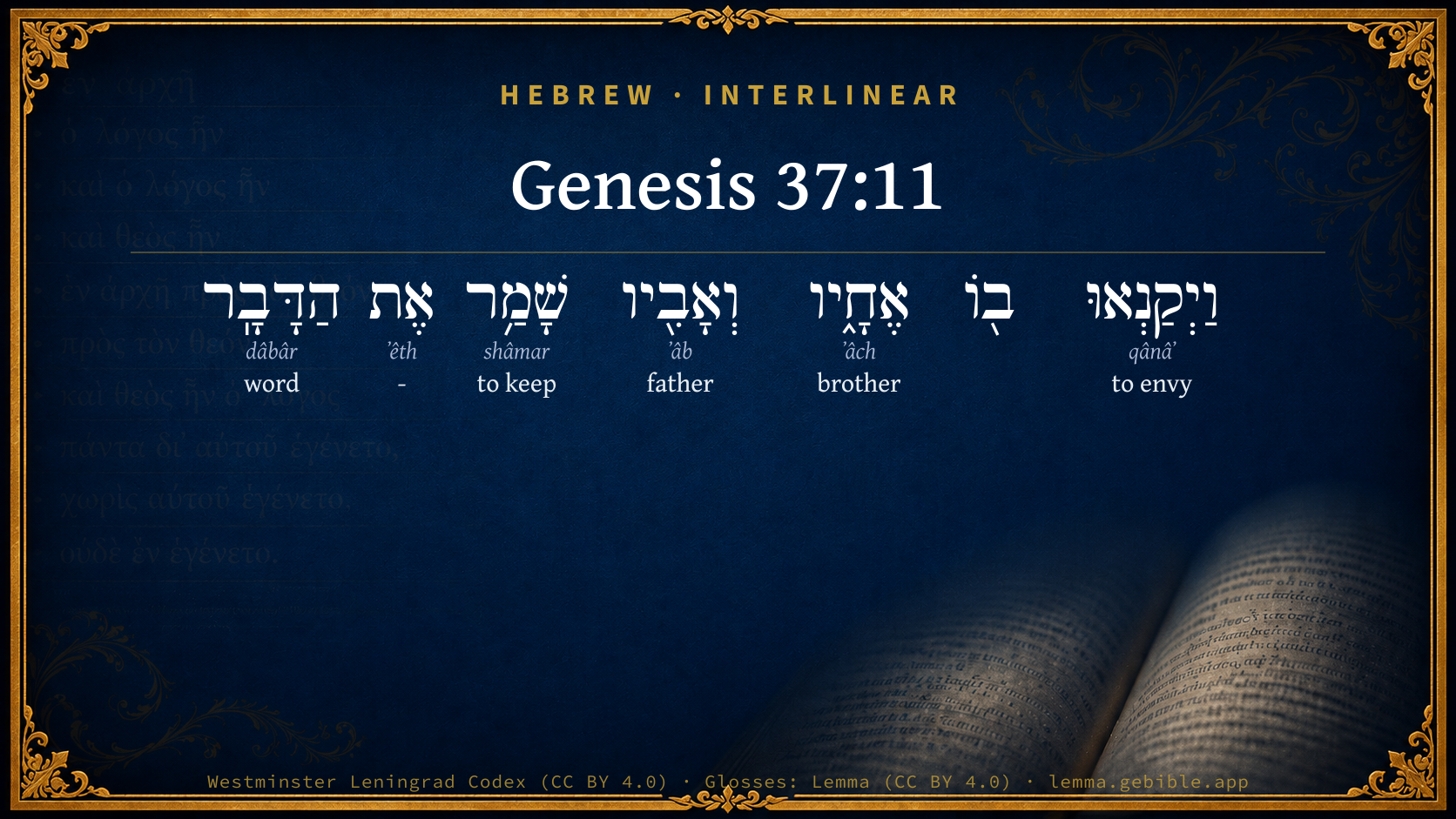
Genesis 37:11

Hebrew (Westminster Leningrad Codex) Genesis 37:11 appears in the Hebrew Old Testament. The text above is from the Westminster Leningrad Codex. Each word links to its Strong’s number, a concise gloss, and parsing drawn from the Open Scriptures Hebrew Bible morphology. Click any word for its full Brown-Driver-Briggs (BDB) entry.
Download image
Cite this verse

Genesis 37:11 (World English Bible). Public Domain. Lemma interlinear Bible study tool, https://lemma.gebible.app/v/genesis/37/11.

Show BibTeX & RIS
BibTeX
RIS
English Translation
His brothers envied him; but his father kept this saying in mind.
World English Bible · Public Domain
Download a study sheet

One document with this verse’s original text, its word-by-word gloss line, the meaning frame, cross-references with their text, attributed commentary, and full source and license credits — printable, and it pastes into notes with its structure intact.

This verse Autodidact and up

Study sheet (.html) Plain text (.txt)

A passage Seminary Student

Up to 50 verses in one chapter. A passage sheet keeps up to 6 commentary sources and 12 cross-references per verse, in the order this page ranks them, and says so on the sheet whenever that leaves anything out. Ask for a single verse and you get the Autodidact verse sheet above.

Everything on this page stays free to read, with no account — the sheet is a download of what is already on screen, not access to it.

Want to remove ads? Support Godless Engineer
Compare translations 3

The same verse in 3 English versions, stacked beneath the original-language interlinear above. Click any original word for its lexicon entry.

Each is an independent rendering of the whole verse — the interlinear is not word-aligned to these translations.

Highlighted words mark where these versions differ — a whole-verse word diff, not a word-by-word alignment.

  • World English Bible Public Domain
    His brothers envied him; but his father kept this saying in mind.
  • King James Version Public Domain
    And his brethren envied him; but his father observed the saying.
  • unfoldingWord Literal Text CC BY-SA 4.0
    And his brothers envied him, but his father kept the matter. Joseph’s Brothers Sell Him as a Slave 37:12-36

unfoldingWord Literal Text — © unfoldingWord, licensed CC BY-SA 4.0. Word-aligned USFM3 via Door43 (git.door43.org/unfoldingWord/en_ult).

Versions to compare (up to 4)

3 of 4 selected

Show all 18 translations

Every available English version of this verse, each an independent rendering of the whole verse.

  • World English Bible Public Domain
    His brothers envied him; but his father kept this saying in mind.
  • Berean Standard Bible Public Domain
    And his brothers were jealous of him, but his father kept in mind what he had said.
  • Majority Standard Bible Public Domain
    And his brothers were jealous of him, but his father kept in mind what he had said.
  • King James Version Public Domain
    And his brethren envied him; but his father observed the saying.
  • American Standard Version (1901) Public Domain
    And his brethren envied him; but his father kept the saying in mind.
  • Revised Version (1885) Public Domain
    And his brethren envied him; but his father kept the saying in mind.
  • Geneva Bible (1599) Public Domain
    And his brethren enuied him, but his father noted the saying.
  • Douay-Rheims (1899) Public Domain
    His brethren therefore envied him: but his father considered the thing with himself.
  • Young's Literal Translation Public Domain
    and his brethren are zealous against him, and his father hath watched the matter.
  • Literal Standard Version CC BY-SA 4.0
    And his brothers are zealous against him, and his father has watched the matter.
  • Unlocked Literal Bible CC BY-SA 4.0
    His brothers were jealous of him, but his father kept the matter in mind.
  • unfoldingWord Literal Text CC BY-SA 4.0
    And his brothers envied him, but his father kept the matter. Joseph’s Brothers Sell Him as a Slave 37:12-36
  • Darby Bible Public Domain
    And his brethren envied him; but his father kept the saying.
  • World Messianic Bible Public Domain
    His brothers envied him, but his father kept this saying in mind.
  • Webster's Bible Public Domain
    And his brethren envied him; but his father observed the saying.
  • Free Bible Version CC BY-SA 4.0
    Joseph's brothers became jealous of him, but his father puzzled over the meaning of the dream.
  • Bible in Basic English Public Domain
    And his brothers were full of envy; but his father kept his words in mind.
  • JPS Tanakh (1917) Public Domain
    And his brethren envied him; but his father kept the saying in mind.

Literal Standard Version (2020), Covenant Press — licensed CC BY-SA 4.0. Text via the HelloAO Bible API (eBible.org). Unlocked Literal Bible (unfoldingWord) — licensed CC BY-SA 4.0. Text via the HelloAO Bible API (eBible.org). unfoldingWord Literal Text — © unfoldingWord, licensed CC BY-SA 4.0. Word-aligned USFM3 via Door43 (git.door43.org/unfoldingWord/en_ult). Free Bible Version, Dr. Jonathan Gallagher — licensed CC BY-SA 4.0. Text via the HelloAO Bible API (eBible.org).

Word by word

More ways to search: Search by grammar → Find every occurrence → Compare this word →

Practice this passage: Drill this verse → Learn its vocabulary →

וַיְקַנְאוּ
qânâʼ
H7065
“and · to envy”
Conjunction + Verb, Piel, Sequential Imperfect, 3rd Person, Masculine, Plural
Part of Speech
Conjunction + Verb
Stem
Piel
Form
Sequential Imperfect
Person
3rd Person
Gender
Masculine
Number
Plural
Full BDB Definition

Origin: a primitive root

TWOT: 2038

to envy, be jealous, be envious, be zealous - (Piel) - to be jealous of - to be envious of - to be zealous for - to excite to jealous anger - (Hiphil) to provoke to jealous anger, cause jealousy
  1. אֶחָ֑יו ʼâch H251 “brothers · his” Noun, Common, Masculine, Plural, Construct + Suffix, Personal, 3rd Person, Masculine, Singular
  2. וְאָבִ֖יו ʼâb H1 “and · father · his” Conjunction + Noun, Common, Masculine, Singular, Construct + Suffix, Personal, 3rd Person, Masculine, Singular
  3. שָׁמַ֥ר shâmar H8104 “to keep” Verb, Qal, Perfect, 3rd Person, Masculine, Singular
  4. אֶת ʼêth H853 “-” Particle, Direct Object
  5. הַדָּבָֽר dâbâr H1697 “the · word” Particle, Definite Article + Noun, Common, Masculine, Singular, Absolute

About this verse

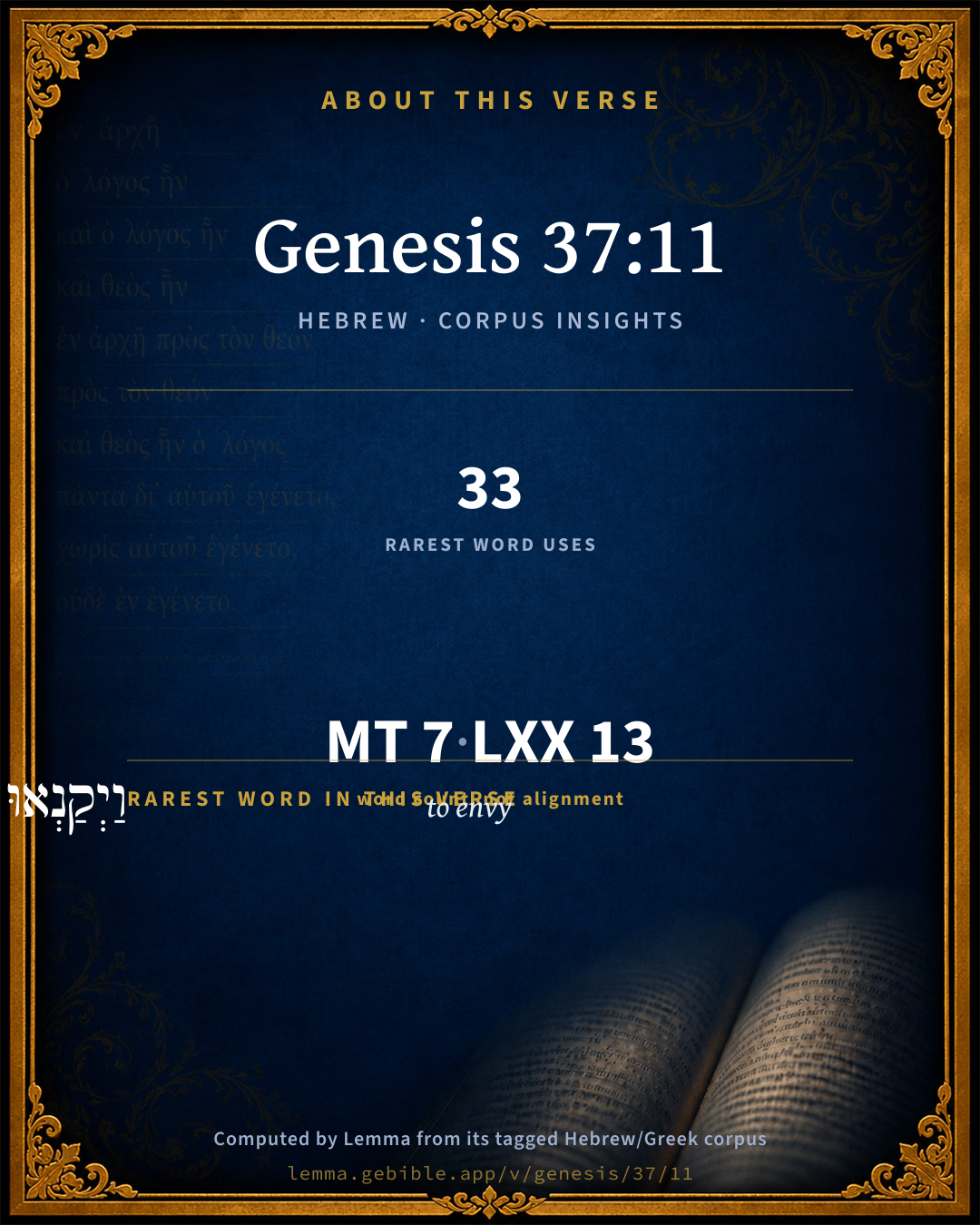
These counts appear in no published source. They are computed here, from the morphology-tagged text and Lemma’s own curated glosses. What Lemma adds →

7
words
6
distinct lemmas
Pentateuch
section

Shared distinctive vocabulary

וַיְקַנְאוּ to envy H7065 occurs in 28 verses of the Hebrew Bible. Also found in:

Grammatical profile

  • 2 verbs
  • 3 nouns
  • 1 preposition
  • 1 particle

Verb forms

  • וַיְקַנְאוּ Piel · Sequential Imperfect
  • שָׁמַ֥ר Qal · Perfect

Hebrew & Septuagint length

In English translation the verse runs 12 words from the Hebrew and 11 from the Septuagint (LXX English) — closely comparable.

A rough comparison of the two English renderings, which tokenize alike — not a word-level alignment.

Word counts can differ between the Hebrew and the Greek without any difference in meaning — e.g. the Hebrew direct-object marker אֵת has no separate Greek word, and Greek often adds the article ὁ.

In the original languages it is 7 Hebrew tokens and 13 Greek tokens — but the two are counted differently (Hebrew bundles its prefixes and suffixes into one token; the Greek is in lemma form), so that isn’t a like-for-like length.

Cross-references

17

Topical passages linked to Genesis 37:11 in the Treasury of Scripture Knowledge — connected by theme and wording, ordered by reader-vote popularity; previews shown in the World English Bible.

  • Acts 7:9 "The patriarchs, moved with jealousy against Joseph, sold him into Egypt. God was with him,
  • Luke 2:19 But Mary kept all these sayings, pondering them in her heart.
  • Luke 2:51 And he went down with them, and came to Nazareth. He was subject to them, and his mother kept all these sayings in her heart.
  • Daniel 7:28 Here is the end of the matter. As for me, Daniel, my thoughts much troubled me, and my face was changed in me: but I kept the matter in my heart.
  • Genesis 26:14–16 He had possessions of flocks, possessions of herds, and a great household. The Philistines envied him.
  • Psalms 106:16 They envied Moses also in the camp, And Aaron, Yahweh's saint.
  • Ecclesiastes 4:4 Then I saw all the labor and achievement that is the envy of a man's neighbor. This also is vanity and a striving after wind.
  • Isaiah 11:13 The envy also of Ephraim shall depart, and those who vex Judah shall be cut off: Ephraim shall not envy Judah, and Judah shall not vex Ephraim.
  • Isaiah 26:11 Yahweh, your hand is lifted up, yet they don't see: but they shall see [your] zeal for the people, and be disappointed; yes, fire shall devour your adversaries.
  • Matthew 27:18 For he knew that because of envy they had delivered him up.
  • Mark 15:10 For he perceived that for envy the chief priests had delivered him up.
  • Acts 13:45 But when the Jews saw the multitudes, they were filled with jealousy, and contradicted the things which were spoken by Paul, and blasphemed.
  • Galatians 5:21 envyings, murders, drunkenness, orgies, and things like these; of which I forewarn you, even as I also forewarned you, that those who practice such things will not inherit the Kingdom of God.
  • Titus 3:3 For we were also once foolish, disobedient, deceived, serving various lusts and pleasures, living in malice and envy, hateful, and hating one another.
  • James 3:14–16 But if you have bitter jealousy and selfish ambition in your heart, don't boast and don't lie against the truth.
  • James 4:5 Or do you think that the Scripture says in vain, "The Spirit who lives in us yearns jealously"?
  • Genesis 24:31 He said, "Come in, you blessed of Yahweh. Why do you stand outside? For I have prepared the house, and room for the camels."

Cross-references courtesy of OpenBible.info (CC BY 4.0).

Hebrew and Greek witnesses Masoretic Hebrew ↔ Greek Septuagint

The same verse in the two great witnesses to the Old Testament, shown verse-for-verse.

These are two independent witnesses, not word-aligned to each other, and the Septuagint is shown in lemma (dictionary) form.

Hebrew Genesis 37:11 Masoretic · Westminster Leningrad Codex

וַיְקַנְאוּ ב֖וֹ אֶחָ֑יו וְאָבִ֖יו שָׁמַ֥ר אֶת הַדָּבָֽר

His brothers envied him; but his father kept this saying in mind.

World English Bible · Public Domain

Greek LXX Genesis 37:11 Septuagint · lemma form

ζηλόω δέ αὐτός ὁ ἀδελφός αὐτός ὁ δέ πατήρ αὐτός διατηρέω ὁ ῥῆμα

And his brethren envied him; but his father observed the saying.

LXX2012 (modern English Septuagint) · Public Domain

On this verse, The Cambridge Bible for Schools and Colleges discusses the Septuagint’s reading. Read the note in Commentary ↓

Hebrew: Westminster Leningrad Codex (CC BY 4.0). Greek: Septuagint (public domain); English from LXX2012 (modern English Septuagint) (Public Domain). How the Septuagint differs from the Hebrew →

Targum (Aramaic paraphrase)

2

The Targum is the ancient Jewish Aramaic paraphrase of the Hebrew Scriptures — an interpretive translation, not the Hebrew text itself. Onkelos (literal) and Pseudo-Jonathan (expansive) render the Torah, and Jonathan the Prophets. Coverage is partial: where no permissively-licensed English translation exists for a verse, only the Aramaic is shown. This is verse-level text, not a word-by-word alignment to the Hebrew.

  1. Targum Onkelos Torah (Genesis–Deuteronomy)
    וְקַנִּיאוּ בֵהּ אֲחוֹהִי וַאֲבוּהִי נְטַר יָת פִּתְגָמָא

    (no public-domain English translation for this verse)

    Targum Onkelos — Aramaic: “Onkelos Genesis” (public domain); “Onkelos Exodus” (public domain); “Onkelos Leviticus” (public domain); “Onkelos Numbers” (public domain); “Onkelos Deuteronomy” (public domain). English: “Sefaria Community Translation” (CC0 1.0 (public-domain dedication)); “J.W. Etheridge. The Targums of Onkelos and Jonathan Ben Uzziel on the Pentateuch. London: Longmans, Green, 1862” (public domain). Text via Sefaria.

  2. Targum Pseudo-Jonathan Torah (Genesis–Deuteronomy)
    וְקַנִיאוּ בֵּיהּ אֲחוּהִי וְאָבוֹי נָטַר בְּלִבֵּיהּ יַת פִּתְגָמָא

    And his brothers envied him; yet his father kept the saying in his heart.

    Targum Pseudo-Jonathan — Aramaic: “Targum Jonathan on Genesis” (public domain); “Targum Jonathan on Exodus” (public domain); “Targum Jonathan on Leviticus” (public domain); “Targum Jonathan on Numbers” (public domain); “Targum Jonathan on Deuteronomy” (public domain). English: “The Targum of Jonathan ben Uzziel, trans. J. W. Etheridge, London, 1862” (public domain). Text via Sefaria.

Commentary

Notes on Genesis 37:11 from classic Christian and Jewish commentators (each source and its license shown beneath its notes). The classic Christian expositions comment on the surrounding passage and are grouped to its opening verse, so a note may address several verses; the Jewish commentaries on the Tanakh (Rashi and others) are per-verse, so they appear only where the commentator wrote on this verse.

Lemma curates 59 commentaries, every one of them public domain or Creative Commons licensed, each selected and text-cleaned for this edition rather than reprinted as found. About our sources →

Trapp's Complete Commentary

John Trapp

Gen 37:11 And his brethren envied him; but his father observed the saying.

Ver. 11. And his brethren envied him.] Envy is a filthy fruit of the flesh {Gal 5:21} and the devil; who is called, the envious man; {Mat 13:19; Mat 13:25} and such wisdom is said to be "devilish." {Jas 3:15} The Pharisees, envying our Saviour, did the devil’s work. {Joh 8:41} So did Cain, the devil’s patriarch, when he laid his cruel club on the innocent head of his brother Abel. And Saul, when, seized upon by the evil spirit more than a melancholy humour, he envied David, and sought his death. For, this vice, as it makes the heart to boil with hellish venom, so it blisters out at the tongue, as here; "They could not speak peaceably to Joseph," but scoff, and consult his ruin. It sits, also, looking out at the windows of the eyes; and, as a basilisk, blasteth the object. {a} Hence, invidere; to see with an evil eye, and naughty mind: and our English saith, to overlook a thing; that is, to bewitch it. This very looking upon other precellencies, whereby we are over shined, so as to lust to have that light put out, that our candle might shine above it - this is every man’s sin - though it act nothing, yet it is abominable. {Jas 4:5} As, on the other side, to rejoice in the good parts of others, though it eclipseth our light, and this from the heart; this is indeed more than to excel others in any excellency, if this be wanting. For this, it is good to get the heart fraught with mercy, meekness of wisdom, fear of God, - whose providence cuts us out our various conditions and proportions, - zeal for his glory, as Moses; humility, charity ("Love envieth not," 1Co 13:4); and to take heed of strife. {Rom 13:13} "Envy and strife" go coupled; they are brought in there by the brace, as it were twisted together. Likewise, of pride and vain-glory; {Php 2:3} covetousness; {Pro 28:22} contention about words; {1Ti 6:4} self-love, ignorance, &c.; all which make the soul sick of the fret, {Psa 37:8; Psa 73:3} and to pierce itself through with many sorrows. For, this sin killeth the silly one, {Job 5:2} if it kill no other. Envy and murder {b} go coupled. {Rom 1:29 Gal 5:21} A hectic it is to itself, however; the same that rust is to iron, blasting to corn, or a moth to the cloth it breeds in. It drinketh the most part of its own venom, gnaws on its own heart, is consumed in its own fire, as Nadab and Abihu were; and, like the snake in the fable, licks off its own tongue, as envying teeth to the file in the forge. Socrates called it, the saw of the soul. {c} David compares it to fire in billets of juniper, which burns vehemently, and continues, they say, more years than one. Simul peccat et plectitur: expedita iustitia, saith Petrarch. Other sins have some pleasure; this hath none, but torment. It is a very hell above ground, and paves a way to the unpardonable sin, as in Saul, and the Pharisees.

{a} Nescio quis teneros, &c.; fascino, Bασκαινω, i.e., τοις φαεσι κτεινειν.

{b} φθονου και φονου. φθονος, of φθινω, to consume.

{c} Serram animae.

John Trapp, A Commentary or Exposition upon All the Books of the Old and New Testament (1647–1656) — public domain. Text from a community e-Sword module.

Joseph Benson's Commentary

Gen 37:11. But his father observed the saying — The words of Joseph, or the dream which he told, well knowing that God did frequently reveal his will, or foretel future events by dreams, and perceiving something singular and extraordinary in this dream, and especially in its being doubled.

Joseph Benson's Commentary on the Old and New Testaments (1811–1818) — public domain. Text from a community e-Sword module.

Tyndale Open Study Notes

Tyndale Open Resources

37:11 His brothers hated Joseph because they were jealous of him. Rather than recognize the hand of God, the brothers tried to prevent the dream from being fulfilled (37:18-36). These actions show that they were not fit to lead the household of faith. God’s sovereign choice of a leader, especially if the one chosen is young or appears unqualified, often brings out the true colors of those who have to submit to that leader’s authority. The brothers represent people throughout history who have been driven by envy and malice because they were not committed to doing the Lord’s will. • Jacob wondered what the dreams meant because he knew that God would choose the next leader, that God could choose the younger son to rule over the older sons, and that God could reveal all this in dreams.

Tyndale Open Study Notes — © Tyndale Open Resources, licensed CC BY-SA 4.0. Text via the HelloAO Bible API.

Geneva Bible (1599)

Geneva Bible translators

He knew that God was author of the dream, but he understood not the meaning.

Or, kept diligently.

Geneva Bible (1599) marginal notes — public domain. Text via Bolls.life.

The Cambridge Bible for Schools and Colleges

gen. ed. J. J. S. Perowne

11. envied] This is the envy of malice rather than of jealousy: it denotes resentment against Joseph for being favoured, and a desire to see him deprived of his privileges.

kept the saying in mind] Lit. “kept the word.” LXX διετήρησεν. Lat. rem tacitus considerabat. This phrase is the origin of the words in Luk_2:51, “kept all these sayings in her heart.” Jacob rebuked Joseph, but evidently was so deeply impressed with the remarkable and seemingly improbable character of the twice repeated dream, that he secretly cherished a presentiment of its fulfilment (Gen_42:6).

The Cambridge Bible for Schools and Colleges (gen. ed. J. J. S. Perowne; Cambridge University Press, 1878–1918) — public domain. Text from a community e-Sword module.

John Gill's Exposition

And his brethren went to feed their father's flock in Shechem. Very probably some considerable time after the telling of the above dreams; it was usual to remove flocks from place to place for the sake of pasturage; and sometimes at a great distance, as Shechem was from Hebron, where Jacob now dwelt, said (i) to be about sixty miles; but this is not so much to be marvelled at as the place itself, whither they went, for though Jacob had bought a parcel of a field in this place, Gen 33:19; which might be a reason for their going thither to feed their father's flocks in his own field; yet it was the place where they had committed a most outrageous action in destroying all, the males there, and therefore might fear the inhabitants of the neighbouring cities would rise upon them and cut them off.

(i) Bunting's Travels, p. 79. Ainsworth in loc.

John Gill's Exposition of the Whole Bible (1746–1763) — public domain (CC PDM 1.0). Text via the HelloAO Bible API.

Haydock's Catholic Bible Commentary

With himself: not doubting but it was prophetical. Thus acted the Blessed Virgin. (Calmet)

George Leo Haydock (1774–1849), Haydock's Catholic Family Bible and Commentary, 1859 edition — public domain. Excludes Psalms (Douay-Rheims chapter numbering differs from Protestant) and Deuterocanonical books (Catholic canon only).

Matthew Poole's English Annotations

The words of Joseph; or the thing, the dream which he told; well knowing that God did frequently at that time signify his mind by dreams, and perceiving something singular and extraordinary in this dream, and especially in the doubling of it.

Matthew Poole's English Annotations on the Holy Bible (1683–1685) — public domain. Text from a community e-Sword/MySword module.

Whedon's Commentary on the Bible

Daniel D. Whedon

11. But his father observed the saying — “So strange and mysterious. So Mary ‘pondered’ and ‘kept in her heart’ the strange sayings of Jesus, which others understood not. Luk_2:50-51.” — Newhall.

Daniel D. Whedon (gen. ed.), Commentary on the Old and New Testaments (1874–1909) — public domain. Text from a community e-Sword module.

The Pulpit Commentary

And his brethren envied him. The verb anq (unused in Kal), to become red in the face, seems to indicate that the hatred of Joseph"s brethren revealed itself in scowling looks. But his father observed the saying literally, kept the word, diethrhse to rJhma (LXX). Cf. Dan_7:28; Luk_2:51.

The Pulpit Commentary (1880–1919), ed. H.D.M. Spence-Jones & Joseph S. Exell — public domain. Text from a community e-Sword module.

Rashi

Rabbi Shlomo Yitzchaki (Rashi)

שמר את הדבר OBSERVED THE MATTER — He awaited and looked forward to the time when this would come to pass. In the same sense we have (Isaiah 26:2) “that watch (שומר) for faithfulness” (i.e., for the performance of a promise) and (Job 14:16) — “לא תשמור for my sin” — which means “thou dost not wait for my sin”.

Rashi on the Tanakh — English translations: “The Judaica Press complete Tanach with Rashi, translated by A. J. Rosenberg” (CC BY 4.0); “Pentateuch with Rashi's commentary by M. Rosenbaum and A.M. Silbermann, 1929-1934” (public domain); “The Metsudah Tanach series, Lakewood, N.J” (CC BY 4.0); and “The Book of Joshua, Metsudah Publications, 1997” (CC BY 4.0). Text via Sefaria.

Radak

Rabbi David Kimhi (Radak)

הדבר, even though Yaakov had been angry at Joseph he was worried about what the dream might forecast and he remembered it.

Radak on the Tanakh — English translations: “Sefaria Community Translation” (CC0 1.0 (public-domain dedication)); “Eliyahu Munk, HaChut Hameshulash” (CC BY 4.0); “Rabbi Mike Feuer, Jerusalem Anthology” (CC BY 4.0); and “R. David Kimhi on the first book of Psalms, Translated by R.G. Finch, London, 1919” (public domain). Text via Sefaria.

Lesson kit

Teaching starters — assembled from the data on this page, not authored interpretation. Every prompt links to the verse data it draws on. Edit before teaching.

Genesis, in the Pentateuch, opens this verse with 7 words (6 distinct Hebrew lemmas). Its most distinctive word is qânâʼ (“to envy”). A historical commentator’s framing appears above. Read the whole chapter for the surrounding context.

Discussion questions

  1. The word qânâʼ carries the sense “to envy.” How does it shape the verse?
  2. Genesis 26:14 shares the word «to envy» with this verse. How do the two illuminate each other?
  3. These translations render this verse differently. What is at stake in choosing one wording over another?
  4. The verb «וַיְקַנְאוּ» is Piel Sequential Imperfect. How does its form color the action?
  5. Reading how Trapp's Complete Commentary and Joseph Benson's Commentary read this verse, where do the two commentators agree and where do they part?

Things to notice

Reading settings

Reading text

Shown beneath each verse's original-language words.

Old Testament
Old Testament edition

Read the OT as the Masoretic Hebrew (MT) or the Greek Septuagint (LXX).

English shown for the Greek Septuagint (in the Hebrew ↔ Greek comparison).

Comparing translations? Open the Compare panel on any verse page to stack up to four side by side.