Genesis 31:14

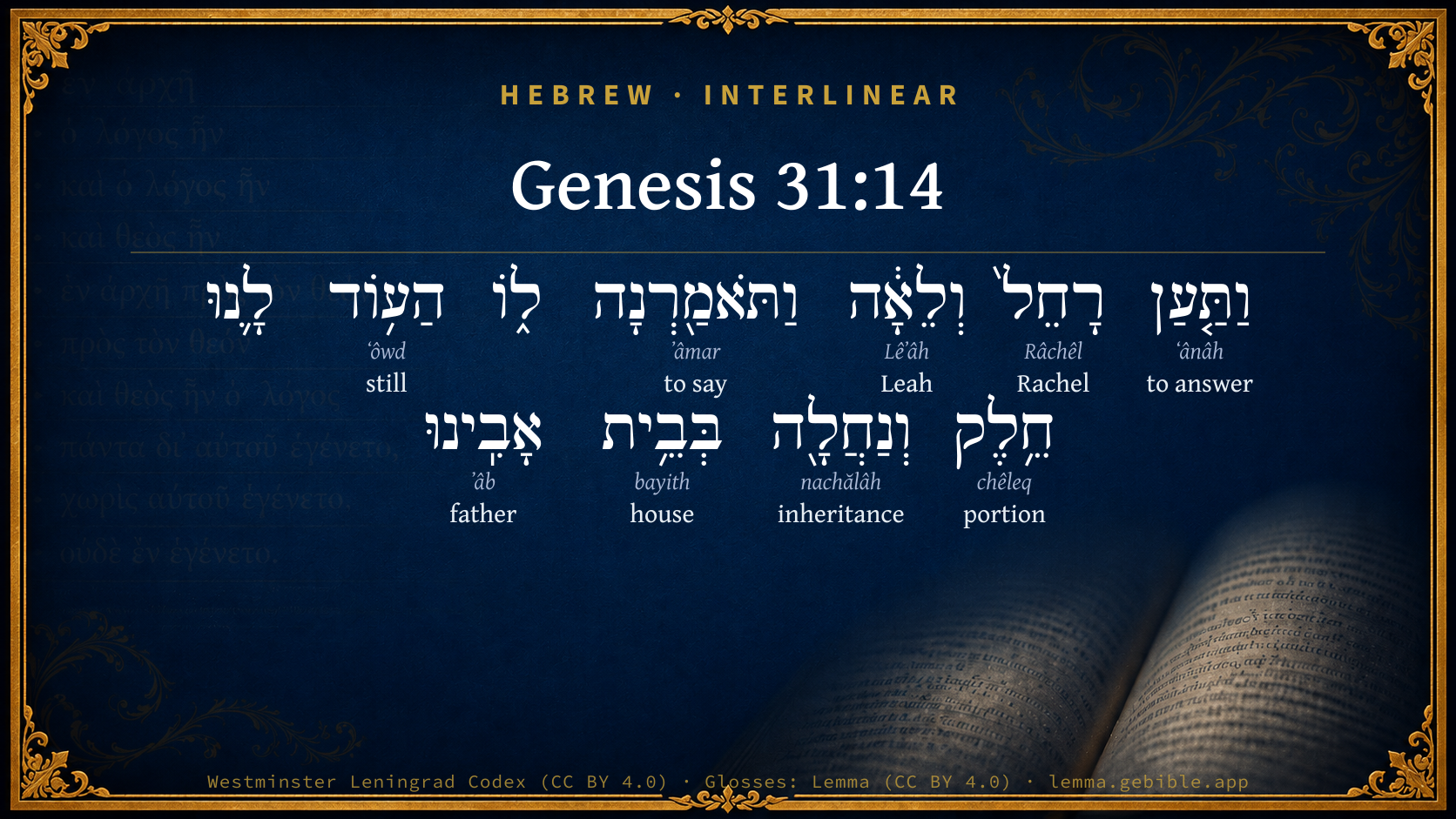
Hebrew (Westminster Leningrad Codex) Genesis 31:14 appears in the Hebrew Old Testament. The text above is from the Westminster Leningrad Codex. Each word links to its Strong’s number, a concise gloss, and parsing drawn from the Open Scriptures Hebrew Bible morphology. Click any word for its full Brown-Driver-Briggs (BDB) entry.
Download image
Cite this verse

Genesis 31:14 (World English Bible). Public Domain. Lemma interlinear Bible study tool, https://lemma.gebible.app/v/genesis/31/14.

Show BibTeX & RIS
BibTeX
RIS
English Translation
Rachel and Leah answered him, "Is there yet any portion or inheritance for us in our father's house?
World English Bible · Public Domain
Highlights
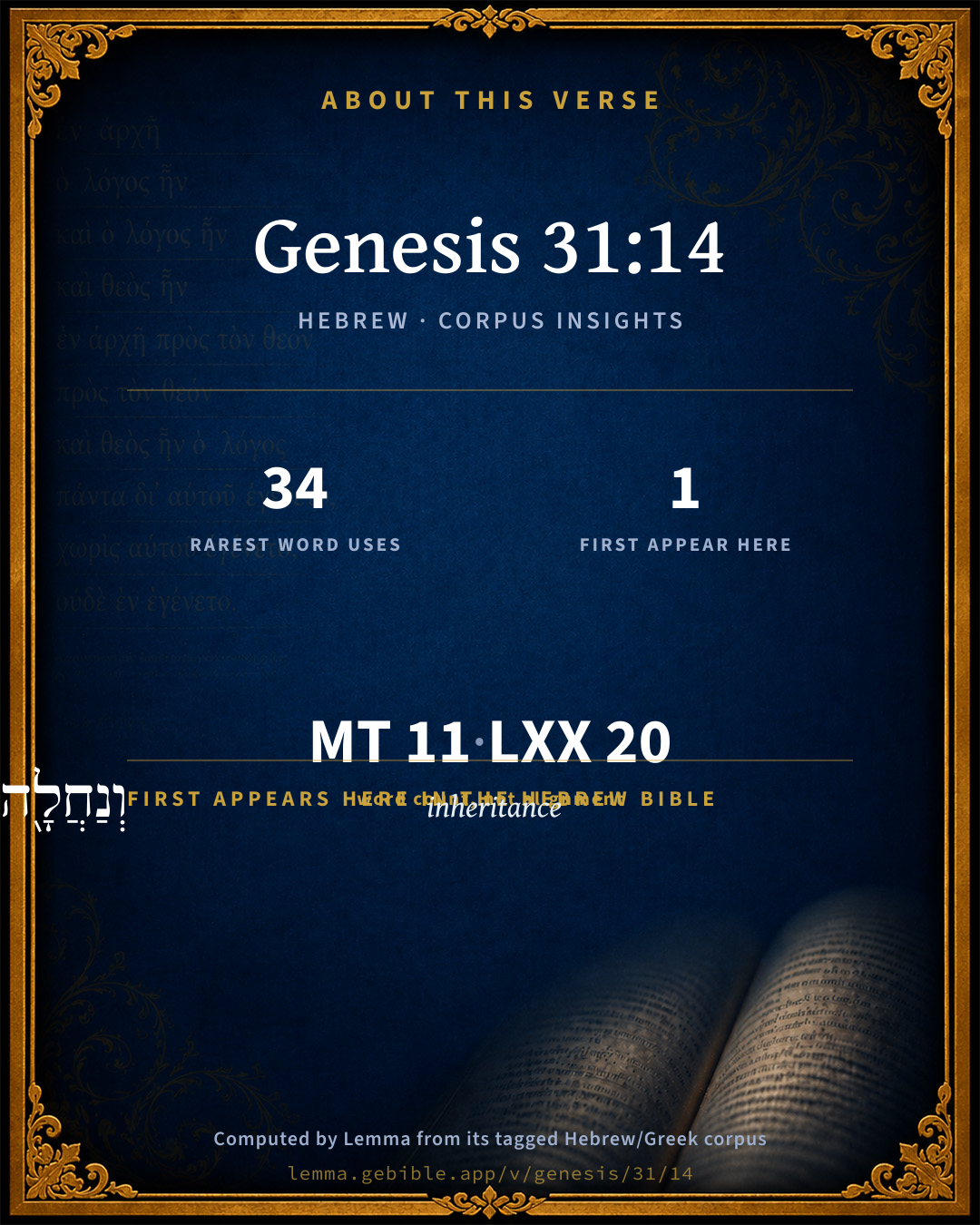
  • 1 first appearance in the Hebrew Bible
Full analysis ↓
Download a study sheet

One document with this verse’s original text, its word-by-word gloss line, the meaning frame, cross-references with their text, attributed commentary, and full source and license credits — printable, and it pastes into notes with its structure intact.

This verse Autodidact and up

Study sheet (.html) Plain text (.txt)

A passage Seminary Student

Up to 50 verses in one chapter. A passage sheet keeps up to 6 commentary sources and 12 cross-references per verse, in the order this page ranks them, and says so on the sheet whenever that leaves anything out. Ask for a single verse and you get the Autodidact verse sheet above.

Everything on this page stays free to read, with no account — the sheet is a download of what is already on screen, not access to it.

Want to remove ads? Support Godless Engineer
Compare translations 3

The same verse in 3 English versions, stacked beneath the original-language interlinear above. Click any original word for its lexicon entry.

Each is an independent rendering of the whole verse — the interlinear is not word-aligned to these translations.

Highlighted words mark where these versions differ — a whole-verse word diff, not a word-by-word alignment.

  • World English Bible Public Domain
    Rachel and Leah answered him, "Is there yet any portion or inheritance for us in our father's house?
  • King James Version Public Domain
    And Rachel and Leah answered and said unto him, Is there yet any portion or inheritance for us in our father's house?
  • unfoldingWord Literal Text CC BY-SA 4.0
    Then Rachel replied, and Leah, and they said to him, “Is there still for us a portion or inheritance in the house of our father?

unfoldingWord Literal Text — © unfoldingWord, licensed CC BY-SA 4.0. Word-aligned USFM3 via Door43 (git.door43.org/unfoldingWord/en_ult).

Versions to compare (up to 4)

3 of 4 selected

Show all 18 translations

Every available English version of this verse, each an independent rendering of the whole verse.

  • World English Bible Public Domain
    Rachel and Leah answered him, "Is there yet any portion or inheritance for us in our father's house?
  • Berean Standard Bible Public Domain
    And Rachel and Leah replied, “Do we have any portion or inheritance left in our father’s house?
  • Majority Standard Bible Public Domain
    And Rachel and Leah replied, “Do we have any portion or inheritance left in our father’s house?
  • King James Version Public Domain
    And Rachel and Leah answered and said unto him, Is there yet any portion or inheritance for us in our father's house?
  • American Standard Version (1901) Public Domain
    And Rachel and Leah answered and said unto him, Is there yet any portion or inheritance for us in our father's house?
  • Revised Version (1885) Public Domain
    And Rachel and Leah answered and said unto him, Is there yet any portion or inheritance for us in our father’s house?
  • Geneva Bible (1599) Public Domain
    Then answered Rahel and Leah, and sayde vnto him, Haue wee any more porcion and inheritance in our fathers house?
  • Douay-Rheims (1899) Public Domain
    And Rachel and Lia answered: Have we anything left among the goods and inheritance of our father's house?
  • Young's Literal Translation Public Domain
    And Rachel answereth -- Leah also -- and saith to him, `Have we yet a portion and inheritance in the house of our father?
  • Literal Standard Version CC BY-SA 4.0
    And Rachel answers—Leah also—and says to him, “Have we yet a portion and inheritance in the house of our father?
  • Unlocked Literal Bible CC BY-SA 4.0
    Rachel and Leah answered and said to him, “Is there any portion or inheritance for us in our father's house?
  • unfoldingWord Literal Text CC BY-SA 4.0
    Then Rachel replied, and Leah, and they said to him, “Is there still for us a portion or inheritance in the house of our father?
  • Darby Bible Public Domain
    And Rachel and Leah answered and said to him, Is there yet any portion or inheritance for us in our father's house?
  • World Messianic Bible Public Domain
    Rachel and Leah answered him, “Is there yet any portion or inheritance for us in our father’s house?
  • Webster's Bible Public Domain
    And Rachel and Leah answered, and said to him, Is there yet any portion or inheritance for us in our father's house?
  • Free Bible Version CC BY-SA 4.0
    “There's nothing for us to inherit from our father's estate anyway,” Rachel and Leah replied.
  • Bible in Basic English Public Domain
    Then Rachel and Leah said to him in answer, What part or heritage is there for us in our father's house?
  • JPS Tanakh (1917) Public Domain
    And Rachel and Leah answered and said unto him: 'Is there yet any portion or inheritance for us in our father's house?

Literal Standard Version (2020), Covenant Press — licensed CC BY-SA 4.0. Text via the HelloAO Bible API (eBible.org). Unlocked Literal Bible (unfoldingWord) — licensed CC BY-SA 4.0. Text via the HelloAO Bible API (eBible.org). unfoldingWord Literal Text — © unfoldingWord, licensed CC BY-SA 4.0. Word-aligned USFM3 via Door43 (git.door43.org/unfoldingWord/en_ult). Free Bible Version, Dr. Jonathan Gallagher — licensed CC BY-SA 4.0. Text via the HelloAO Bible API (eBible.org).

Word by word

More ways to search: Search by grammar → Find every occurrence → Compare this word →

Practice this passage: Drill this verse → Learn its vocabulary →

וְלֵאָ֔ה
Lêʼâh
H3812
“and · Leah”
Conjunction + Noun, Proper
Part of Speech
Conjunction + Noun
Type
Proper
Full BDB Definition

Origin: from H3811

TWOT: None

Leah = "weary" - daughter of Laban, first wife of Jacob, and mother of Reuben, Simeon, Levi, Judah, Issachar, Zebulun, and Dinah
  1. וַתַּ֤עַן ʻânâh H6030 “and · to answer” Conjunction + Verb, Qal, Sequential Imperfect, 3rd Person, Feminine, Singular
  2. רָחֵל֙ Râchêl H7354 “Rachel” Noun, Proper
  3. וַתֹּאמַ֖רְנָה ʼâmar H559 “and · to say” Conjunction + Verb, Qal, Sequential Imperfect, 3rd Person, Feminine, Plural
  4. הַע֥וֹד ʻôwd H5750 “still” Particle, Interrogative + Adverb
  5. חֵ֥לֶק chêleq H2506 “portion” Noun, Common, Masculine, Singular, Absolute
  6. וְנַחֲלָ֖ה nachălâh H5159 “and · inheritance” Conjunction + Noun, Common, Feminine, Singular, Absolute
  7. בְּבֵ֥ית bayith H1004 “in/at · house of” Preposition + Noun, Common, Masculine, Singular, Construct
  8. אָבִֽינוּ ʼâb H1 “father · our” Noun, Common, Masculine, Singular, Construct + Suffix, Personal, 1st Person, Common, Plural

About this verse

These counts appear in no published source. They are computed here, from the morphology-tagged text and Lemma’s own curated glosses. What Lemma adds →

11
words
9
distinct lemmas
Pentateuch
section

First appearance in Scripture

This word makes its first canonical appearance in the Hebrew Bible here:

  • וְנַחֲלָ֖ה inheritance H5159

Shared distinctive vocabulary

וְלֵאָ֔ה Leah H3812 occurs in 32 verses of the Hebrew Bible. Also found in:

Grammatical profile

  • 2 verbs
  • 6 nouns
  • 2 prepositions
  • 1 adverb

Verb forms

  • וַתַּ֤עַן Qal · Sequential Imperfect
  • וַתֹּאמַ֖רְנָה Qal · Sequential Imperfect

Hebrew & Septuagint length

In English translation the verse runs 18 words from the Hebrew and 22 from the Septuagint (LXX English) — closely comparable.

A rough comparison of the two English renderings, which tokenize alike — not a word-level alignment.

Word counts can differ between the Hebrew and the Greek without any difference in meaning — e.g. the Hebrew direct-object marker אֵת has no separate Greek word, and Greek often adds the article ὁ.

In the original languages it is 11 Hebrew tokens and 20 Greek tokens — but the two are counted differently (Hebrew bundles its prefixes and suffixes into one token; the Greek is in lemma form), so that isn’t a like-for-like length.

Cross-references

4

Topical passages linked to Genesis 31:14 in the Treasury of Scripture Knowledge — connected by theme and wording, ordered by reader-vote popularity; previews shown in the World English Bible.

  • Genesis 2:24 Therefore a man will leave his father and his mother, and will join with his wife, and they will be one flesh.
  • Ruth 4:11 All the people who were in the gate, and the elders, said, We are witnesses. Yahweh make the woman who has come into your house like Rachel and like Leah, which two built the house of Israel: and do you worthily in Ephrathah, and be famous in Bethlehem:
  • Genesis 29:24 Laban gave Zilpah his handmaid to his daughter Leah for a handmaid.
  • Genesis 29:29 Laban gave to Rachel his daughter Bilhah, his handmaid, to be her handmaid.

Cross-references courtesy of OpenBible.info (CC BY 4.0).

Hebrew and Greek witnesses Masoretic Hebrew ↔ Greek Septuagint

The same verse in the two great witnesses to the Old Testament, shown verse-for-verse.

These are two independent witnesses, not word-aligned to each other, and the Septuagint is shown in lemma (dictionary) form.

Hebrew Genesis 31:14 Masoretic · Westminster Leningrad Codex

וַתַּ֤עַן רָחֵל֙ וְלֵאָ֔ה וַתֹּאמַ֖רְנָה ל֑וֹ הַע֥וֹד לָ֛נוּ חֵ֥לֶק וְנַחֲלָ֖ה בְּבֵ֥ית אָבִֽינוּ

Rachel and Leah answered him, "Is there yet any portion or inheritance for us in our father's house?

World English Bible · Public Domain

Greek LXX Genesis 31:14 Septuagint · lemma form

καί ἀποκρίνω ραχηλ καί λεια εἶπον αὐτός μή εἰμί ἐγώ ἔτι μερίς ἤ κληρονομία ἐν ὁ οἶκος ὁ πατήρ ἐγώ

And Rachel and Lea answered and said to him, Have we yet a part or inheritance in the house of our father?

LXX2012 (modern English Septuagint) · Public Domain

Hebrew: Westminster Leningrad Codex (CC BY 4.0). Greek: Septuagint (public domain); English from LXX2012 (modern English Septuagint) (Public Domain). How the Septuagint differs from the Hebrew →

Targum (Aramaic paraphrase)

2

The Targum is the ancient Jewish Aramaic paraphrase of the Hebrew Scriptures — an interpretive translation, not the Hebrew text itself. Onkelos (literal) and Pseudo-Jonathan (expansive) render the Torah, and Jonathan the Prophets. Coverage is partial: where no permissively-licensed English translation exists for a verse, only the Aramaic is shown. This is verse-level text, not a word-by-word alignment to the Hebrew.

  1. Targum Onkelos Torah (Genesis–Deuteronomy)
    וַאֲתִיבַת רָחֵל וְלֵאָה וַאֲמָרַן לֵהּ הַעוֹד (כְּעַן) לָנָא חֳלָק וְאַחֲסָנָא בְּבֵית אֲבוּנָא

    (no public-domain English translation for this verse)

    Targum Onkelos — Aramaic: “Onkelos Genesis” (public domain); “Onkelos Exodus” (public domain); “Onkelos Leviticus” (public domain); “Onkelos Numbers” (public domain); “Onkelos Deuteronomy” (public domain). English: “Sefaria Community Translation” (CC0 1.0 (public-domain dedication)); “J.W. Etheridge. The Targums of Onkelos and Jonathan Ben Uzziel on the Pentateuch. London: Longmans, Green, 1862” (public domain). Text via Sefaria.

  2. Targum Pseudo-Jonathan Torah (Genesis–Deuteronomy)
    וַאֲתָבַת רָחֵל בְּאַסְכָּמוּתָא דְלֵאָה וְאַמְרָן לֵיהּ הַאֶפְשַר דְעַד כְּדוֹן אִית לָנָא חוּלַק וְאַחְסָנָא בְּבֵית אָבוּנָא

    And Rahel answered with the consent of Leah, and said to him, Can there now be yet any portion or inheritance for us in our father's house;

    Targum Pseudo-Jonathan — Aramaic: “Targum Jonathan on Genesis” (public domain); “Targum Jonathan on Exodus” (public domain); “Targum Jonathan on Leviticus” (public domain); “Targum Jonathan on Numbers” (public domain); “Targum Jonathan on Deuteronomy” (public domain). English: “The Targum of Jonathan ben Uzziel, trans. J. W. Etheridge, London, 1862” (public domain). Text via Sefaria.

Commentary

Notes on Genesis 31:14 from classic Christian and Jewish commentators (each source and its license shown beneath its notes). The classic Christian expositions comment on the surrounding passage and are grouped to its opening verse, so a note may address several verses; the Jewish commentaries on the Tanakh (Rashi and others) are per-verse, so they appear only where the commentator wrote on this verse.

Lemma curates 59 commentaries, every one of them public domain or Creative Commons licensed, each selected and text-cleaned for this edition rather than reprinted as found. About our sources →

Trapp's Complete Commentary

John Trapp

Gen 31:14 And Rachel and Leah answered and said unto him, [Is there] yet any portion or inheritance for us in our father’s house?

Ver. 14. Is there yet any portion,] q.d., We have all we are like to have. In setting forth their father’s ill usage of them, they offend not in some respect - viz., in that they speak the truth. Only herein they were to blame, that they speak the truth with more passion, and with less respect to their father than was fit.

John Trapp, A Commentary or Exposition upon All the Books of the Old and New Testament (1647–1656) — public domain. Text from a community e-Sword module.

The Biblical Illustrator

Joseph S. Exell

Gen_31:14

Is there yet any portion or inheritance for us in our fathers house

Inheritance for us

So asked Rachel and Leah of Jacob.

And we see how suggestive these historical touches in Old Testament story are, when vitalized by the spirit of the gospel. We think at once of the Saviour, who is the open door to the great Fathers house. There are multitudes who have lost their portions, and some are very sad and weary. Prodigal meets prodigal, and recounts the story of the painful way. Ruins always touch us with sadness; and human hearts get ruinous in so much less time than stone walls do!

I. THE CRY IS PERSONAL. Men do not ask, Is there hope for the lost--the profligate, the vile? but, Is there hope for me? The soldier lying wounded in the battle-field thinks of the home harvest-fields far away, and the soul amid its wounds and woes whispers, I will arise and go to my Father. There is a home-returning way for me!

II. THE CRY IS ANXIOUS. Is there yet? Once the soul was ready to surmise there might be! But is there now? when sin has consolidated into habit, when the door has been shut so often in the marred face of the Man of Sorrows! My sin is ever before me, is the great cry of conscience. We sympathize with human anxiety. We watch with moistened eyes the widow who asks, Is there yet a table in the wilderness for me and my little ones? In reply to the yet, let us answer, Though thy sins be as scarlet, He shall make them white as wool; He shall blot out thy transgressions as a cloud, and thine iniquities as a thick cloud; He is able to save to the uttermost all that come unto God by Him.

III. THE CRY IS CHILDLIKE. My Fathers house! For we are, in one sense, all of us Gods offspring. True, we have lost likeness to Him and peace with Him; and only by faith can we become the spiritual sons of God. But there is memory of the lost estate in every heart. Man was made for God, and He is the only home of the soul. God gave us our earthly homes and relationships, to be parables of that great central truth. No word thrills us like home; no picture on Academy walls touches us like Proviss interiors. And this is natural. For let home be dark or deserted, let the dove of peace leave that, let those sweet sanctities be desecrated, and no outside joys, no travels, no pursuits can make compensation! And to know the value of a home, you must lose one.

IV. THE CRY IS ANSWERED. Yes! in many parables, in many promises, in deeds of love and sacrifice. Faith leads all along the way, from justification to glory. But it were wrong to conceive of the inheritance as all future. Heaven does begin on earth, because the heavenly principles, purposes, and pleasures may be ours now. CONCLUSION. We close with the remembrance that there is welcome for us, room for us, reward for us. Have you ever stood outside a flower-show in the summer-time, and seen carriage after carriage drive up, with rustling silks and dazzling liveries and crested panels, pride and pomp entering in; and then caught the wistful face of a poor child at the gate, with another child in her arms, shut out from seeing Gods beautiful flowers? The poor, the blind, the maim, the halt, the prodigals of every type are welcome. What, does He want me? does He wait for me? has He asked for me? (W. M. Statham, M. A.)

A worldly-spirited reply

We have seen some things in the history of these women which have induced us to hope well of them, notwithstanding their many failings; but though in this case it was their duty to comply with the desire of their husband, and to own the hand of God in what had taken place between their father and him; yet there is something in their manner of expressing themselves that looks more like the spirit of the world, than the spirit which is of God. A right spirit would have taught them to remember that Laban, whatever was his conduct, was still their father. They might have felt it impossible to vindicate him; but they should not have expatiated on his faults in such a manner as to take pleasure in exposing them. Such conduct was but too much like that of Ham towards his father. And as to their acknowledging the hand of God in giving their fathers riches to their husband, this is no more than is often seen in the most selfish characters, who can easily admire the Divine providence when it goes in their favour. The ease, however, with which all men can discern what is just and equitable towards themselves, renders the love of ourselves a proper standard for the love of others, and will sooner or later stop the mouth of every sinner. Even those who have no written revelation have this Divine law engraven on their consciences: they can judge with the nicest accuracy what is justice to them, and therefore cannot plead ignorance of what is justice from them to others. (A. Fuller.)

Lessons

1. It becometh wives, especially in good families, to listen unto advice of husbands from God.

2. God can make them that disagree in a family sweetly to concur to do His work.

3. It is unnatural for children to find no portions in their fathers house, when they abound.

4. Such brands of cruelty are left upon unnatural fathers by the Spirit (Gen_31:14).

5. It is cruel for fathers to use their children as slaves and make merchandize of them.

6. It is savage for parents to consume the substance of children for whom they should provide.

7. Such unnatural dealings, in Gods justice, alienate hearts of children from parents (Gen_31:15).

8. It is fit to consider how God recompenseth cruelties of unnatural parents in depriving them of their children.

9. What God giveth to parents and children may be justly owned by them.

10. Good women will be free and helpful to their husbands to go and do whatever is the will of God unto them (Gen_31:16). (G. Hughes, B. D.)

The Biblical Illustrator, edited by Joseph S. Exell (c. 1880s–1900s) — public domain. Text from a community e-Sword module.

Joseph Benson's Commentary

Gen 31:14-15. Is there any portion — Any hope of benefit; for us in our father’s house? — They both agree in acknowledging that his behaviour had been extremely ungenerous and sordid, even to them, his own children. Are we not counted of him strangers? — Dealt with as strangers, rather than children: for he hath sold us — To thee for fourteen years’ service. And hath quite devoured (wholly converted to his own use) our money — That which in equity was due to us for our portions, and for our husband’s service. Whereas Jacob looked upon the wealth which God had transferred from Laban to him as his wages, they look upon it as their portions; so that, both ways, God forced Laban to pay his debts, both to his servant and to his daughters.

Joseph Benson's Commentary on the Old and New Testaments (1811–1818) — public domain. Text from a community e-Sword module.

Tyndale Open Study Notes

Tyndale Open Resources

31:14-16 The women responded immediately that they would go with Jacob because God had blessed him. They were very willing to leave Laban, who had squandered their wealth (the property that would have provided for them). They knew that what God had given to Jacob would also be theirs.

Tyndale Open Study Notes — © Tyndale Open Resources, licensed CC BY-SA 4.0. Text via the HelloAO Bible API.

Jamieson, Fausset & Brown

Robert Jamieson, A. R. Fausset & David Brown

Rachel and Leah answered--Having heard his views, they expressed their entire approval; and from grievances of their own, they were fully as desirous of a separation as himself. They display not only conjugal affection, but piety in following the course described--"whatsoever God hath said unto thee, do" [Gen 31:16]. "Those that are really their husbands' helpmeets will never be their hindrances in doing that to which God calls them" [HENRY].

Jamieson, Fausset & Brown — Commentary Critical and Explanatory on the Whole Bible (1871) — public domain (CC PDM 1.0). Text via the HelloAO Bible API.

John Calvin's Commentaries

14. And Rachel and Leah answered. Here we perceive that to be fulfilled which Paul teaches, that all things work together for good to the children of God. (Romans 8:28.) For since the wives of Jacob had been unjustly treated by their father, they so far act in opposition to the natural tenderness of their sex, that at the desire of their husband, they become willing to follow him into a distant and unknown region. Therefore, if Jacob is compelled to take many and very bitter draughts of grief, he is now cheered by the most satisfying compensation, that his wives are not separated from him by their attachment to their father’s house: but rather, being overcome by the irksome nature of their sufferings, they earnestly undertake to join him in his flight. “There is nothing,” they say, “which should cause us to remain with our father; for daughters adhere to their fathers, because they are esteemed members of his family; but what a cruel rejection is this, not only that he has passed us off without dowry, but that he has set us to sale, and has devoured the price for which he sold us?” By the word money (Genesis 31:15), I understand the price of sale. For they complain that, at least, they had not received, instead of dowry, the profit which had been unjustly extorted from their husband, but this gain also had been unjustly suppressed by their covetous father. Therefore the particle גם(gam) is inserted, which is used for the purpose of amplification among the Hebrews. For this increased not a little the meanness of Laban, that, as an insatiable whirlpool, he had absorbed the gain acquired by this most dishonorable traffic. And it is to be noted, that they were then devoted to their husband, and were therefore free to depart from their father; especially since they knew that the hand of God was stretched out to them. There is also no doubt, seeing they were persuaded that Jacob was a faithful prophet of God, but that they freely embraced the heavenly oracle from his mouth; for at the close of their reply, they show that they did not so much yield to his wish as to the command of God.

John Calvin's Commentaries (1540-1563) — public domain. Text from the Calvin Translation Society English edition (1840s-50s) via the Christian Classics Ethereal Library (ccel.org). Calvin's coverage is partial (roughly two-thirds of the Bible); uncommented books and verses are honest gaps, never fabricated. The 19th-century editor's footnotes and remarks are omitted so the notes are faithfully Calvin's own voice.

The Cambridge Bible for Schools and Colleges

gen. ed. J. J. S. Perowne

14. Is there yet] i.e. “we have no reason any longer to expect.” Leah and Rachel had both been alienated from their father by his disregard of their feelings and by his mean grasping policy.

portion or inheritance] A proverbial phrase: see 2Sa_20:1; 1Ki_12:16.

The Cambridge Bible for Schools and Colleges (gen. ed. J. J. S. Perowne; Cambridge University Press, 1878–1918) — public domain. Text from a community e-Sword module.

John Gill's Exposition

Are we not accounted of him strangers?.... He had not treated them as children, nor even as freeborn persons; but as if they were foreigners that he had taken in war, or bought of others; or at least, that they were born bondmaids in his house, and so had a right to sell them as he had:

for he hath sold us; he had sold them to Jacob for fourteen years' service, as if they had been his slaves, instead of giving dowries with them as his children:

and hath quite devoured also our money; that which he got by the servitude of Jacob, instead of giving it to them as their portion; he spent it on himself and his sons, and there was nothing left for them.

John Gill's Exposition of the Whole Bible (1746–1763) — public domain (CC PDM 1.0). Text via the HelloAO Bible API.

Matthew Poole's English Annotations

We can expect no further benefit from him, but deceit, and oppression, and injury, and therefore are willing to leave him. This was the fruit of his unnatural and unworthy carriage to them, that it did eat out their natural affection to him.

Matthew Poole's English Annotations on the Holy Bible (1683–1685) — public domain. Text from a community e-Sword/MySword module.

The Pulpit Commentary

And Rachel and Leah (vide on ver. 4) answered and said unto him (Kalisch overdoes his attempt to blacken Jacob"s character and whitewash Laban"s when he says that Rachel and Leah were so entirely under their husband s influence that they spoke about their father with severity and boldness bordering on disrespect." It rather seems to speak badly for Laban that his daughters eventually rose in protest against his heartless cruelty and insatiable greed), Is there yet any portion or inheritance for us in our father"s house? The interrogative particle indicates a spirited inquiry, to which a negative response is anticipated cf. Gen_30:2; vide Ewald, "Hebrews Synt.," Kalisch obviously regards it as preposterous that Rachel and Leah should have expected anything, since "married daughters in the East never had any such claim where there were sons." But Laban had not treated Jacob"s wives even as daughters. Are we not counted of him strangers? for he hath sold us (however much they loved Jacob they could not but resent the mercenary meanness of Laban, by which they, the free-born daughters of a chieftain, had been sold as common serfs), and hath quits devoured also our money literally, and hath eaten up, yes, even eating up, our money, the inf. abs., lwOa; after the finite verb, expressing the continuance (Keil) and intensity (Kalisch) of the action (vide Ewald, "Hebrews Synt.," For yKi is by some interpreters rendered but (Jarchi), so that (Keil), indeed (Kalisch), though there is no sufficient reason for departing from the usual meaning "for" (Rosenmall the riches which God hath taken from our father, thus Rachel and Leah also recognize the hand of God (Elohim) in Jacob"s unusual prosperitythat is ours, and our children"s (Rachel and Leah mean to say that what Jacob had acquired by his six years of service with their father was no more than would have naturally belonged to him had they obtained their portions at the first): now then, Whatsoever God hath said unto thee, do. It is clear that, equally with himself, they were prepared for breaking off connection with their father Laban.

The Pulpit Commentary (1880–1919), ed. H.D.M. Spence-Jones & Joseph S. Exell — public domain. Text from a community e-Sword module.

Keil & Delitzsch

C. F. Keil & F. Delitzsch

The two wives naturally agreed with their husband, and declared that they had no longer any part or inheritance in their father's house. For he had not treated them as daughters, but sold them like strangers, i.e., servants. "And he has even constantly eaten our money," i.e., consumed the property brought to him by our service. The inf. abs. אכול after the finite verb expresses the continuation of the act, and is intensified by גם "yes, even." כּי in Gen 31:16 signifies "so that," as in Deu 14:24; Job 10:6.

Keil & Delitzsch — Biblical Commentary on the Old Testament (1861–1891) — public domain (CC PDM 1.0). Text via the HelloAO Bible API. (Old Testament only.)

unfoldingWord translationNotes

Door43 World Missions Community

Rachel and Leah answered and said to him

This does not mean they talked at the same time. It emphasizes they agreed with each other.

Is there any portion or inheritance for us in our father's house?

Rachel and Leah use a question to emphasize that there is nothing left for their father to give. AT: "There is absolutely nothing left for us to inherit from our father!" (See: Rhetorical Question)

Are we not treated by him as foreigners?

They use a question to show their anger about how their father treats them. This can be stated in active form. AT: "Our father treats us like a foreign women instead of daughters!" (See: Rhetorical Question and Active or Passive)

For he has sold us

This can be made more explicit. AT: "He has sold us for his own gain" (See: Assumed Knowledge and Implicit Information)

has also completely devoured our money

Laban completely using up the money that he should have given to his daughters is spoken of as if he were a wild beast that ate the money as if it were food. AT: "he completely used up our money" (See: Metaphor)

are now ours and our children's

"belongs to us and to our children"

Now then

Here "Now" does not mean "at this moment," but is used to draw attention to the important point that follows.

whatever God has said to you, do it

"do all that God has told you"

translationWords

Rachel

Leah

inherit

alien

devour

unfoldingWord translationNotes — © Distant Shores Media and the Door43 World Missions Community, licensed CC BY-SA 4.0. Source: git.door43.org/Door43/en_tn.

Rashi

Rabbi Shlomo Yitzchaki (Rashi)

העוד לנו IS THERE YET ANY FOR US? — Why should we prevent you from returning? Can we at all hope to inherit anything belonging to our father together with his sons?

Rashi on the Tanakh — English translations: “The Judaica Press complete Tanach with Rashi, translated by A. J. Rosenberg” (CC BY 4.0); “Pentateuch with Rashi's commentary by M. Rosenbaum and A.M. Silbermann, 1929-1934” (public domain); “The Metsudah Tanach series, Lakewood, N.J” (CC BY 4.0); and “The Book of Joshua, Metsudah Publications, 1997” (CC BY 4.0). Text via Sefaria.

Sforno

Rabbi Ovadia Sforno

Do we still have a portion. Why do you think it will be difficult for us to part from our father?

Sforno on the Tanakh — English translation: “Yalkut, Sifsei Chachomim Chumash, Metsudah Publications, 2009” (CC BY 4.0). Text via Sefaria.

Radak

Rabbi David Kimhi (Radak)

ותען רחל ולאה, here too the younger sister speaks first, just as in Exodus 10,3 ויאמר משב ואהרן, although Moses was the younger. Seeing that Rachel loved Yaakov as intensely as he loved her, she responded first.

Radak on the Tanakh — English translations: “Sefaria Community Translation” (CC0 1.0 (public-domain dedication)); “Eliyahu Munk, HaChut Hameshulash” (CC BY 4.0); “Rabbi Mike Feuer, Jerusalem Anthology” (CC BY 4.0); and “R. David Kimhi on the first book of Psalms, Translated by R.G. Finch, London, 1919” (public domain). Text via Sefaria.

Lesson kit

Teaching starters — assembled from the data on this page, not authored interpretation. Every prompt links to the verse data it draws on. Edit before teaching.

Genesis, in the Pentateuch, opens this verse with 11 words (9 distinct Hebrew lemmas). Its most distinctive word is Lêʼâh (“Leah”). A historical commentator’s framing appears above. Read the whole chapter for the surrounding context.

Discussion questions

  1. The word Lêʼâh carries the sense “Leah.” How does it shape the verse?
  2. This is the first place “inheritance” appears in Scripture (first appears here). What does its debut here establish?
  3. How does Genesis 29:16, which shares the word «Leah», read alongside this verse?
  4. The translations on this page render this verse differently — a whole-verse word diff, not a word-by-word alignment. What might account for the different wordings?
  5. «וַתַּ֤עַן» is a Qal Sequential Imperfect verb. How does that grammatical form shape the action described?
  6. Compare how Trapp's Complete Commentary and The Biblical Illustrator read this verse. Where do they agree or differ?

Things to notice

Reading settings

Reading text

Shown beneath each verse's original-language words.

Old Testament
Old Testament edition

Read the OT as the Masoretic Hebrew (MT) or the Greek Septuagint (LXX).

English shown for the Greek Septuagint (in the Hebrew ↔ Greek comparison).

Comparing translations? Open the Compare panel on any verse page to stack up to four side by side.