Genesis 46:3

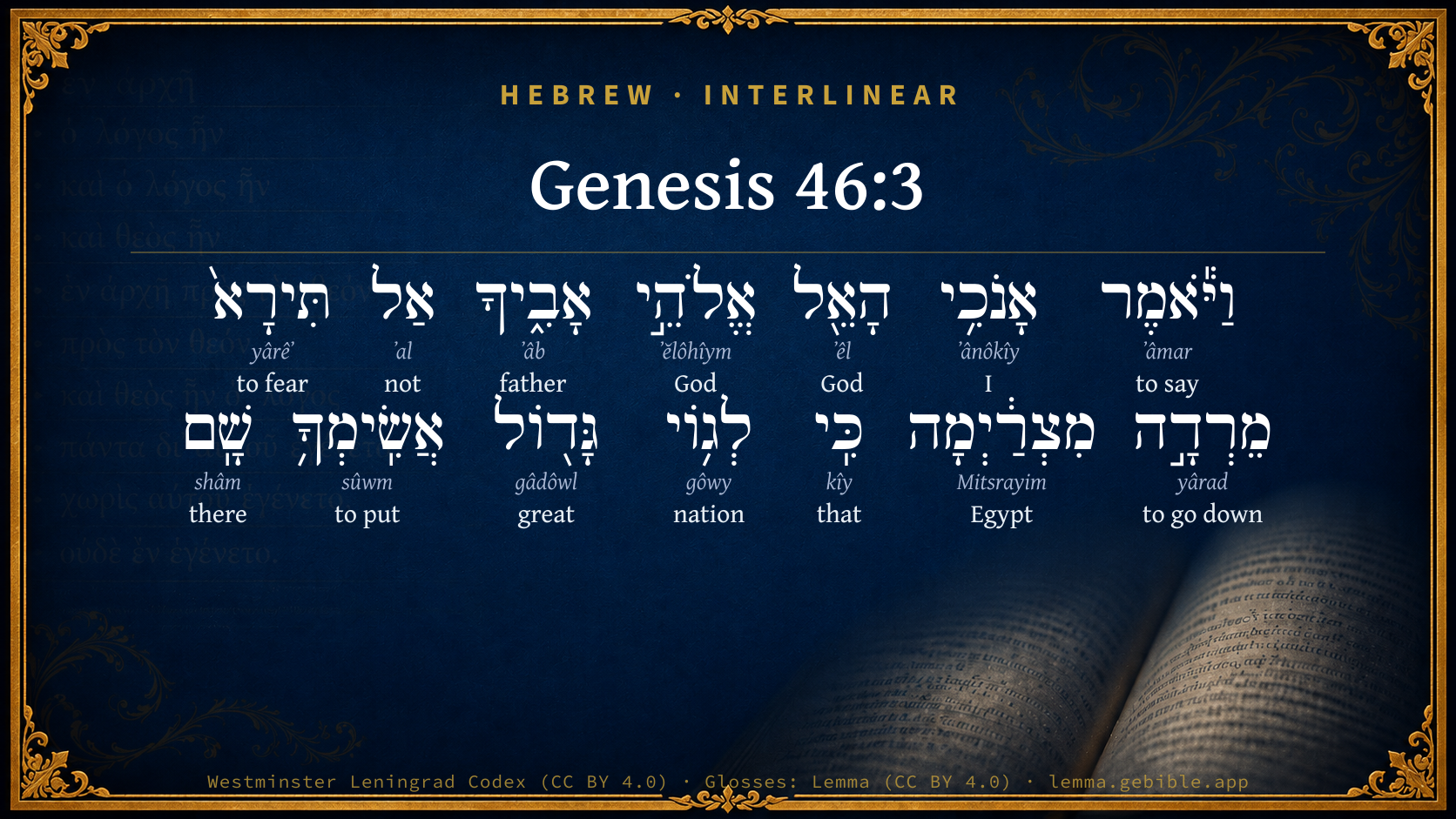
Hebrew (Westminster Leningrad Codex) Genesis 46:3 appears in the Hebrew Old Testament. The text above is from the Westminster Leningrad Codex. Each word links to its Strong’s number, a concise gloss, and parsing drawn from the Open Scriptures Hebrew Bible morphology. Click any word for its full Brown-Driver-Briggs (BDB) entry.
Download image
Cite this verse

Genesis 46:3 (World English Bible). Public Domain. Lemma interlinear Bible study tool, https://lemma.gebible.app/v/genesis/46/3.

Show BibTeX & RIS
BibTeX
RIS
English Translation
He said, "I am God, the God of your father. Don't be afraid to go down into Egypt; for there I will make of you a great nation.
World English Bible · Public Domain
Download a study sheet

One document with this verse’s original text, its word-by-word gloss line, the meaning frame, cross-references with their text, attributed commentary, and full source and license credits — printable, and it pastes into notes with its structure intact.

This verse Autodidact and up

Study sheet (.html) Plain text (.txt)

A passage Seminary Student

Up to 50 verses in one chapter. A passage sheet keeps up to 6 commentary sources and 12 cross-references per verse, in the order this page ranks them, and says so on the sheet whenever that leaves anything out. Ask for a single verse and you get the Autodidact verse sheet above.

Everything on this page stays free to read, with no account — the sheet is a download of what is already on screen, not access to it.

Want to remove ads? Support Godless Engineer
Compare translations 3

The same verse in 3 English versions, stacked beneath the original-language interlinear above. Click any original word for its lexicon entry.

Each is an independent rendering of the whole verse — the interlinear is not word-aligned to these translations.

Highlighted words mark where these versions differ — a whole-verse word diff, not a word-by-word alignment.

  • World English Bible Public Domain
    He said, "I am God, the God of your father. Don't be afraid to go down into Egypt; for there I will make of you a great nation.
  • King James Version Public Domain
    And he said, I am God, the God of thy father: fear not to go down into Egypt; for I will there make of thee a great nation:
  • unfoldingWord Literal Text CC BY-SA 4.0
    And he said, “I God, the God of your father. Do not be afraid to go down to Egypt, because I will make you into a great nation there.

unfoldingWord Literal Text — © unfoldingWord, licensed CC BY-SA 4.0. Word-aligned USFM3 via Door43 (git.door43.org/unfoldingWord/en_ult).

Versions to compare (up to 4)

3 of 4 selected

Show all 18 translations

Every available English version of this verse, each an independent rendering of the whole verse.

  • World English Bible Public Domain
    He said, "I am God, the God of your father. Don't be afraid to go down into Egypt; for there I will make of you a great nation.
  • Berean Standard Bible Public Domain
    “I am God,” He said, “the God of your father. Do not be afraid to go down to Egypt, for I will make you into a great nation there.
  • Majority Standard Bible Public Domain
    “I am God,” He said, “the God of your father. Do not be afraid to go down to Egypt, for I will make you into a great nation there.
  • King James Version Public Domain
    And he said, I am God, the God of thy father: fear not to go down into Egypt; for I will there make of thee a great nation:
  • American Standard Version (1901) Public Domain
    And he said, I am God, the God of thy father: fear not to go down into Egypt; for I will there make of thee a great nation:
  • Revised Version (1885) Public Domain
    And he said, I am God, the God of thy father: fear not to go down into Egypt; for I will there make of thee a great nation:
  • Geneva Bible (1599) Public Domain
    Then hee sayde, I am God, the God of thy father, feare not to goe downe into Egypt: for I will there make of thee a great nation.
  • Douay-Rheims (1899) Public Domain
    God said to him: I am the most mighty God of thy father: fear not, go down into Egypt, for I will make a great nation of thee there.
  • Young's Literal Translation Public Domain
    And He saith, `I `am' God, God of thy father, be not afraid of going down to Egypt, for for a great nation I set thee there;
  • Literal Standard Version CC BY-SA 4.0
    And He says, “I [am] God, God of your father, do not be afraid of going down to Egypt, for I set you there for a great nation;
  • Unlocked Literal Bible CC BY-SA 4.0
    He said, “I am God, the God of your father. Do not fear to go down to Egypt, for there I will make you a great nation.
  • unfoldingWord Literal Text CC BY-SA 4.0
    And he said, “I God, the God of your father. Do not be afraid to go down to Egypt, because I will make you into a great nation there.
  • Darby Bible Public Domain
    And he said, I am ùGod, the God of thy father: fear not to go down to Egypt; for I will there make of thee a great nation.
  • World Messianic Bible Public Domain
    He said, “I am God, the God of your father. Don’t be afraid to go down into Egypt, for there I will make of you a great nation.
  • Webster's Bible Public Domain
    And he said, I am God, the God of thy father: fear not to go down into Egypt; for I will there make of thee a great nation:
  • Free Bible Version CC BY-SA 4.0
    “I am God, the God of your father! Don't be afraid to go to Egypt, because I will turn you and your descendants into a great nation.
  • Bible in Basic English Public Domain
    And he said, I am God, the God of your father: go down to Egypt without fear, for I will make a great nation of you there:
  • JPS Tanakh (1917) Public Domain
    And He said: 'I am God, the God of thy father; fear not to go down into Egypt; for I will there make of thee a great nation.

Literal Standard Version (2020), Covenant Press — licensed CC BY-SA 4.0. Text via the HelloAO Bible API (eBible.org). Unlocked Literal Bible (unfoldingWord) — licensed CC BY-SA 4.0. Text via the HelloAO Bible API (eBible.org). unfoldingWord Literal Text — © unfoldingWord, licensed CC BY-SA 4.0. Word-aligned USFM3 via Door43 (git.door43.org/unfoldingWord/en_ult). Free Bible Version, Dr. Jonathan Gallagher — licensed CC BY-SA 4.0. Text via the HelloAO Bible API (eBible.org).

Word by word

More ways to search: Search by grammar → Find every occurrence → Compare this word →

Practice this passage: Drill this verse → Learn its vocabulary →

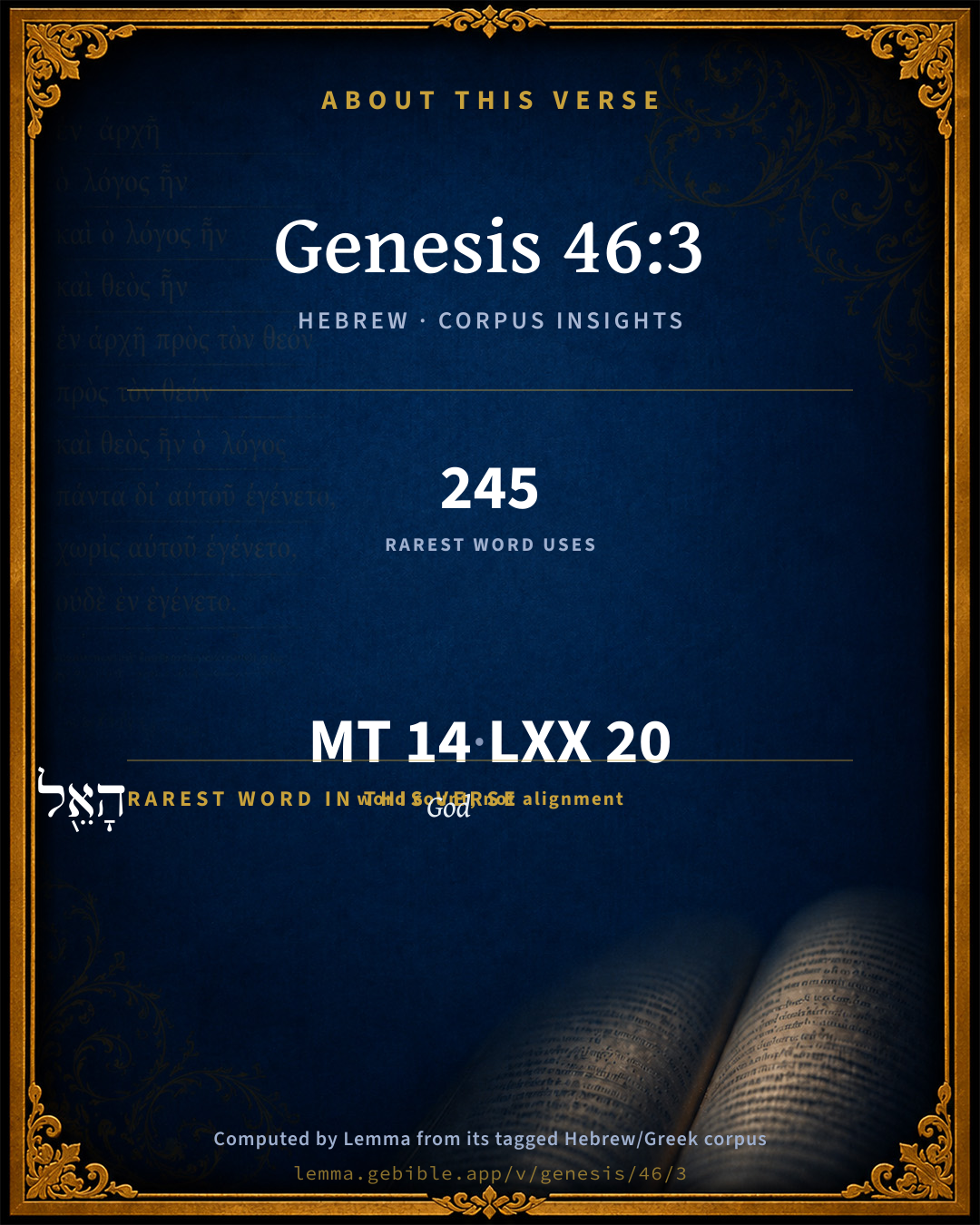
הָאֵ֖ל
ʼêl
H410
“the · God”
Particle, Definite Article + Noun, Common, Masculine, Singular, Absolute
Part of Speech
Particle + Noun
Type
Common
Gender
Masculine
Number
Singular
State
Absolute
Full BDB Definition

Origin: shortened from H352

TWOT: 93a

god, god-like one, mighty one - mighty men, men of rank, mighty heroes - angels - god, false god, (demons, imaginations) - God, the one true God, Jehovah - mighty things in nature - strength, power
  1. וַיֹּ֕אמֶר ʼâmar H559 “and · to say” Conjunction + Verb, Qal, Sequential Imperfect, 3rd Person, Masculine, Singular
  2. אָנֹכִ֥י ʼânôkîy H595 “I” Pronoun, Personal, 1st Person, Common, Singular
  3. אֱלֹהֵ֣י ʼĕlôhîym H430 “God(s) of” Noun, Common, Masculine, Plural, Construct
  4. אָבִ֑יךָ ʼâb H1 “father · your” Noun, Common, Masculine, Singular, Construct + Suffix, Personal, 2nd Person, Masculine, Singular
  5. אַל ʼal H408 “not” Particle, Negative
  6. תִּירָא֙ yârêʼ H3372 “to fear” Verb, Qal, Jussive, 2nd Person, Masculine, Singular
  7. מֵרְדָ֣ה yârad H3381 “from · to go down” Preposition + Verb, Qal, Infinitive Construct
  8. מִצְרַ֔יְמָה Mitsrayim H4714 “Egypt · toward” Noun, Proper + Suffix, Demonstrative
  9. כִּֽי kîy H3588 “that” Conjunction
  10. לְג֥וֹי gôwy H1471 “to/for · nation” Preposition + Noun, Common, Masculine, Singular, Absolute
  11. גָּד֖וֹל gâdôwl H1419 “great” Adjective, Adjective, Masculine, Singular, Absolute
  12. אֲשִֽׂימְךָ֥ sûwm H7760 “to put · you” Verb, Qal, Imperfect, 1st Person, Common, Singular + Suffix, Personal, 2nd Person, Masculine, Singular
  13. שָֽׁם shâm H8033 “there” Adverb

About this verse

These counts appear in no published source. They are computed here, from the morphology-tagged text and Lemma’s own curated glosses. What Lemma adds →

14
words
14
distinct lemmas
Pentateuch
section

Grammatical profile

  • 4 verbs
  • 5 nouns
  • 1 adjective
  • 1 pronoun
  • 1 conjunction
  • 1 adverb
  • 1 particle

Verb forms

  • וַיֹּ֕אמֶר Qal · Sequential Imperfect
  • תִּירָא֙ Qal · Jussive
  • מֵרְדָ֣ה Qal · Infinitive Construct
  • אֲשִֽׂימְךָ֥ Qal · Imperfect

Hebrew & Septuagint length

In English translation the verse runs 28 words from the Hebrew and 28 from the Septuagint (LXX English) — the same length.

A rough comparison of the two English renderings, which tokenize alike — not a word-level alignment.

Word counts can differ between the Hebrew and the Greek without any difference in meaning — e.g. the Hebrew direct-object marker אֵת has no separate Greek word, and Greek often adds the article ὁ.

In the original languages it is 14 Hebrew tokens and 20 Greek tokens — but the two are counted differently (Hebrew bundles its prefixes and suffixes into one token; the Greek is in lemma form), so that isn’t a like-for-like length.

Cross-references

19

Topical passages linked to Genesis 46:3 in the Treasury of Scripture Knowledge — connected by theme and wording, ordered by reader-vote popularity; previews shown in the World English Bible.

  • Genesis 12:2 I will make of you a great nation. I will bless you, and make your name great. You will be a blessing.
  • Deuteronomy 26:5 You shall answer and say before Yahweh your God, A Syrian ready to perish was my father; and he went down into Egypt, and sojourned there, few in number; and he became there a nation, great, mighty, and populous.
  • Isaiah 43:1–2 But now thus says Yahweh who created you, Jacob, and he who formed you, Israel: Don't be afraid, for I have redeemed you; I have called you by your name, you are mine.
  • Acts 27:24 saying, 'Don't be afraid, Paul. You must stand before Caesar. Behold, God has granted you all those who sail with you.'
  • Genesis 26:2–3 Yahweh appeared to him, and said, "Don't go down into Egypt. Dwell in the land which I will tell you of.
  • Genesis 28:13–14 Behold, Yahweh stood above it, and said, "I am Yahweh, the God of Abraham your father, and the God of Isaac. The land whereon you lie, to you will I give it, and to your seed.
  • Genesis 35:11 God said to him, "I am God Almighty. Be fruitful and multiply. A nation and a company of nations will be from you, and kings will come out of your loins.
  • Isaiah 41:10 Don't you be afraid, for I am with you; don't be dismayed, for I am your God; I will strengthen you; yes, I will help you; yes, I will uphold you with the right hand of my righteousness.
  • Genesis 13:15–16 for all the land which you see, I will give to you, and to your offspring forever.
  • Genesis 15:1 After these things the word of Yahweh came to Abram in a vision, saying, "Don't be afraid, Abram. I am your shield, your exceedingly great reward."
  • Genesis 15:13 He said to Abram, "Know for sure that your seed will live as foreigners in a land that is not theirs, and will serve them. They will afflict them four hundred years.
  • Genesis 18:18 seeing that Abraham has surely become a great and mighty nation, and all the nations of the earth will be blessed in him?
  • Genesis 22:17 that in blessing I will bless you, and in multiplying I will multiply your seed as the stars of the heavens, and as the sand which is on the seashore. Your seed will possess the gate of his enemies.
  • Genesis 47:27 Israel lived in the land of Egypt, in the land of Goshen; and they got themselves possessions therein, and were fruitful, and multiplied exceedingly.
  • Exodus 1:7–10 The children of Israel were fruitful, and increased abundantly, and multiplied, and grew exceedingly mighty; and the land was filled with them.
  • Deuteronomy 1:10 Yahweh your God has multiplied you, and, behold, you are this day as the stars of the sky for multitude.
  • Deuteronomy 10:22 Your fathers went down into Egypt with seventy persons; and now Yahweh your God has made you as the stars of the sky for multitude.
  • Acts 7:17 "But as the time of the promise came close which God had sworn to Abraham, the people grew and multiplied in Egypt,
  • Jeremiah 40:9 Gedaliah the son of Ahikam the son of Shaphan swore to them and to their men, saying, Don't be afraid to serve the Chaldeans: dwell in the land, and serve the king of Babylon, and it shall be well with you.

Cross-references courtesy of OpenBible.info (CC BY 4.0).

Hebrew and Greek witnesses Masoretic Hebrew ↔ Greek Septuagint

The same verse in the two great witnesses to the Old Testament, shown verse-for-verse.

These are two independent witnesses, not word-aligned to each other, and the Septuagint is shown in lemma (dictionary) form.

Hebrew Genesis 46:3 Masoretic · Westminster Leningrad Codex

וַיֹּ֕אמֶר אָנֹכִ֥י הָאֵ֖ל אֱלֹהֵ֣י אָבִ֑יךָ אַל תִּירָא֙ מֵרְדָ֣ה מִצְרַ֔יְמָה כִּֽי לְג֥וֹי גָּד֖וֹל אֲשִֽׂימְךָ֥ שָֽׁם

He said, "I am God, the God of your father. Don't be afraid to go down into Egypt; for there I will make of you a great nation.

World English Bible · Public Domain

Greek LXX Genesis 46:3 Septuagint · lemma form

λέγω ἐγώ εἰμί ὁ θεός ὁ πατήρ σύ μή φοβέω καταβαίνω εἰς αἴγυπτος εἰς γάρ ἔθνος μέγας ποιέω σύ ἐκεῖ

And he says to him, I am the God of your fathers; fear not to go down into Egypt, for I will make you there a great nation.

LXX2012 (modern English Septuagint) · Public Domain

On this verse, The Cambridge Bible for Schools and Colleges discusses the Septuagint’s reading. Read the note in Commentary ↓

Hebrew: Westminster Leningrad Codex (CC BY 4.0). Greek: Septuagint (public domain); English from LXX2012 (modern English Septuagint) (Public Domain). How the Septuagint differs from the Hebrew →

Targum (Aramaic paraphrase)

2

The Targum is the ancient Jewish Aramaic paraphrase of the Hebrew Scriptures — an interpretive translation, not the Hebrew text itself. Onkelos (literal) and Pseudo-Jonathan (expansive) render the Torah, and Jonathan the Prophets. Coverage is partial: where no permissively-licensed English translation exists for a verse, only the Aramaic is shown. This is verse-level text, not a word-by-word alignment to the Hebrew.

  1. Targum Onkelos Torah (Genesis–Deuteronomy)
    וַאֲמַר אֲנָא אֵל אֱלָהָא דְאָבוּךְ לָא תִדְחַל מִלְּמֵיחַת לְמִצְרַיִם אֲרֵי לְעַם סַגִּי אֲשֵׁוִּנָּךְ תַּמָּן

    (no public-domain English translation for this verse)

    Targum Onkelos — Aramaic: “Onkelos Genesis” (public domain); “Onkelos Exodus” (public domain); “Onkelos Leviticus” (public domain); “Onkelos Numbers” (public domain); “Onkelos Deuteronomy” (public domain). English: “Sefaria Community Translation” (CC0 1.0 (public-domain dedication)); “J.W. Etheridge. The Targums of Onkelos and Jonathan Ben Uzziel on the Pentateuch. London: Longmans, Green, 1862” (public domain). Text via Sefaria.

  2. Targum Pseudo-Jonathan Torah (Genesis–Deuteronomy)
    וַאֲמַר אֲנָא הוּא אֵל אֱלָהֵיהּ דְאָבוּךְ לָא תִדְחַל מִלְמֵיחוֹת לְמִצְרַיִם עַל עֵיסַק שִׁעֲבּוּדָא דִי פְּסָקִית עִם אַבְרָהָם אֲרוּם לְעַם סַגִי אֲשַׁוִינָךְ תַּמָן

    And He said, I am God, the God of thy father; fear not to go down into Mizraim on account of the servitude I have decreed with Abraham: for a great people will I make thee there.

    Targum Pseudo-Jonathan — Aramaic: “Targum Jonathan on Genesis” (public domain); “Targum Jonathan on Exodus” (public domain); “Targum Jonathan on Leviticus” (public domain); “Targum Jonathan on Numbers” (public domain); “Targum Jonathan on Deuteronomy” (public domain). English: “The Targum of Jonathan ben Uzziel, trans. J. W. Etheridge, London, 1862” (public domain). Text via Sefaria.

Commentary

Notes on Genesis 46:3 from classic Christian and Jewish commentators (each source and its license shown beneath its notes). The classic Christian expositions comment on the surrounding passage and are grouped to its opening verse, so a note may address several verses; the Jewish commentaries on the Tanakh (Rashi and others) are per-verse, so they appear only where the commentator wrote on this verse.

Lemma curates 59 commentaries, every one of them public domain or Creative Commons licensed, each selected and text-cleaned for this edition rather than reprinted as found. About our sources →

Trapp's Complete Commentary

John Trapp

Gen 46:3 And he said, I [am] God, the God of thy father: fear not to go down into Egypt; for I will there make of thee a great nation:

Ver. 3. Fear not to go down into Egypt.] Cause of fear he might see sufficient; but God would have him not to look downward on the rushing and roaring streams of miseries that ran so swiftly under him and his posterity, but steadfastly fasten on his power and providence, who was his God, and the God of his father. He loves to perfect his strength in our weakness; as Elijah would have the sacrifice covered with water, that God’s power might the more appear in the fire from heaven.

John Trapp, A Commentary or Exposition upon All the Books of the Old and New Testament (1647–1656) — public domain. Text from a community e-Sword module.

The Biblical Illustrator

Joseph S. Exell

Gen_46:3-4

And He said, I am God, the God of thy father, fear not to go down into Egypt

Divine assurance vouchsafed to Jacob

Not the invitation of Pharaoh, not the urgent message of Joseph, not even the warmth of his own love alone, carried Jacob out of Canaan.

These furnished the occasion and the impulse, but the head of the covenant people did not leave the Land of Promise without the warrant of his covenant God. There were four promises.

1. I will make of thee a great nation, a promise which ran far into the future. A people great in numbers, greater in their influence on all the earth to the end of time, should be formed of his seed, and formed in Egypt.

2. I will go down with thee. Over every circumstance of the future, nearer and more remote, the Living and Almighty. God would watch.

3. I will also surely bring thee up again. The old promise of the land would not be changed. For the purpose of forming the nation which should possess the land, were they now being taken into Egypt; when the nation had been formed according to Gods promise, He would bring them back.

4. And Joseph shall put his hand upon thine eyes. Long before the nation was formed, Jacobs time to die should come; but when it came it would be accompanied with this tender consolation, the loving touch of Josephs hand on the eyelids he could no longer move. That was to be his last sensation. And it would convey to him far more than the joy of his sons love; it would be the pledge that his soul was passing into the hands of the faithful Redeemer who had given this promise so long before. Thus it was by faith that Israel went into Egypt, consciously led by the hand of God. (A. M.Symington, D. D.)

The Biblical Illustrator, edited by Joseph S. Exell (c. 1880s–1900s) — public domain. Text from a community e-Sword module.

Joseph Benson's Commentary

Gen 46:3. I am God, the God of thy father — True to the covenant made with him. Fear not to go down into Egypt — It seems though Jacob, upon the first intelligence of Joseph’s life and glory in Egypt, resolved, without any hesitation, I will go and see him, yet, upon second thoughts, he saw difficulties in Gen 2:1 st, He was one hundred and thirty years old; it was a long journey, and he was unfit to travel. 2d, He feared lest his sons should be tainted with the idolatry of Egypt, and forget the God of their fathers. 3d, Probably he thought of what God had said to Abraham concerning the bondage and affliction of his seed. 4th, He could not think of laying his bones in Egypt. But whatever his discouragements were, this was enough to answer them all, Fear not to go down into Egypt.

Joseph Benson's Commentary on the Old and New Testaments (1811–1818) — public domain. Text from a community e-Sword module.

Scofield Reference Notes

C. I. Scofield

I am God

It is important to distinguish between the directive and the permissive will of God. In the first sense the place for the covenant family was Canaan Gen 26:1-5; Gen 46:3 is a touching instance of the permissive will of God. Jacob’s family, broken, and in part already in Egypt, the tenderness of Jehovah would not forbid the aged patriarch to follow. God will take up His people and, so far as possible, bless them, even when they are out of His best. In Israel’s choice of a king 1Sa 8:7-9 in the turning back from Kadesh Deu 1:19-22 in the sending of the spies; in the case of Balaam--illustrations of this principle are seen. It is needless to say that God’s permissive will never extends to things morally wrong. The highest blessing is ever found in obedience to His directive will.

The Scofield Reference Bible (1917 edition), notes by C. I. Scofield — public domain. Text from a community e-Sword module.

Jamieson, Fausset & Brown

Robert Jamieson, A. R. Fausset & David Brown

I will there make of thee a great nation--How truly this promise was fulfilled, appears in the fact that the seventy souls who went down into Egypt increased [Exo 1:5-7], in the space of two hundred fifteen years, to one hundred eighty thousand.

Jamieson, Fausset & Brown — Commentary Critical and Explanatory on the Whole Bible (1871) — public domain (CC PDM 1.0). Text via the HelloAO Bible API.

Adam Clarke's Commentary

Verse 3. Fear not to go down into Egypt] It appears that there had been some doubts in the patriarch's mind relative to the propriety of this journey; he found, from the confession of his own sons, how little they were to be trusted. But every doubt is dispelled by this Divine manifestation.

1. He may go down confidently, no evil shall befall him.

2. Even in Egypt the covenant shall be fulfilled, God will make of him there a great nation.

3. God himself will accompany him on his journey, be with him in the strange land, and even bring back his bones to rest with those of his fathers.

4. He shall see Joseph, and this same beloved son shall be with him in his last hours, and do the last kind office for him.

Joseph shall put his hand upon thine eyes. It is not likely that Jacob would have at all attempted to go down to Egypt, had he not received these assurances from God; and it is very likely that he offered his sacrifice merely to obtain this information. It was now a time of famine in Egypt, and God had forbidden his father Isaac to go down to Egypt when there was a famine there, Ge 26:1-3; besides, he may have had some general intimation of the prophecy delivered to his grandfather Abraham, that his seed should be afflicted in Egypt, Ge 15:13-14; and he also knew that Canaan, not Egypt, was to be the inheritance of his family, Ge 12:1; Ge 12:6-7, &c. On all these accounts it was necessary to have the most explicit directions from God, before he should take such a journey.

Adam Clarke's Commentary on the Bible (1810–1826) — public domain. Text from a community e-Sword/MySword module.

John Calvin's Commentaries

3. Jacob, Jacob. The design of the repetition was to render him more attentive. For, by thus familiarly addressing him, God more gently insinuates himself into his mind: as, in the Scripture, he kindly allures us, that he may prepare us to become his disciples. The docility of the holy man appears hence, that as soon as he is persuaded that God speaks, he replies that he is ready to receive with reverence whatever may be spoken, to follow wheresoever he may be called, and to undertake whatever may be commanded. Afterwards, a promise is added, by which God confirms and revives the faith of his servant. Whereas, the descent into Egypt was to him a sad event, he is bidden to be of good and cheerful mind; inasmuch as the Lord would always be his keeper, and after having increased him there to a great nation, would bring him back again to the place, whence he now compelled him to depart. And, indeed, Jacob’s chief consolation turned on this point; that he should not perpetually wander up and down as an exile, but should, at length, enjoy the expected inheritance. For, since the possession of the land of Canaan was the token of the Divine favor, of spiritual blessings, and of eternal felicity; if holy Jacob was defrauded of this, it would have availed him little or nothing to have riches, and all kinds of wealth and power heaped upon him, in Egypt. The return promised him is not, however, to be understood of his own person, but refers to his posterity. Now, as Jacob, relying on the promise, is commanded boldly to go down into Egypt; so it is the duty of all the pious, after his example, to derive such strength from the grace of God, that they may gird themselves to obey his commands. The title by which God here distinguishes himself, is attached to the former oracles which Jacob had received by tradition from his fathers. For why does he not rather call himself the Creator of heaven and earth, than the God of Isaac or of Abraham, except for this reason, that the dominion over the land of Canaan depends on the previous covenant, which he now ratifies anew? At the same time also, he encourages his servant by examples drawn from his own family, lest he should cease to proceed with constancy in his calling. For, when he had seen that his father Isaac, and had heard that his grandfather Abraham, though long surrounded by great troubles, never gave way to any temptations, it ill became him to be overcome by weariness in the same course; especially since, in the act of dying, they handed their lamp to their posterity, and took diligent care to leave the light of their faith to survive them in their family. In short, Jacob is taught that he must not seek, in crooked and diverse paths, that God whom he had learned, from his childhood, to regard as the Ruler of the family of Abraham; provided it did not degenerate from his piety. Moreover, we have elsewhere stated how far, in this respect, the authority of the Fathers ought to prevail. For it was not the design of God, either that Jacob should subject himself to men, or should approve, without discrimination, whatever was handed down from his ancestors, — seeing that he so often condemns in the Jews, a foolish imitation of their fathers, — but his design was to keep Jacob in the true knowledge of himself.

John Calvin's Commentaries (1540-1563) — public domain. Text from the Calvin Translation Society English edition (1840s-50s) via the Christian Classics Ethereal Library (ccel.org). Calvin's coverage is partial (roughly two-thirds of the Bible); uncommented books and verses are honest gaps, never fabricated. The 19th-century editor's footnotes and remarks are omitted so the notes are faithfully Calvin's own voice.

Ellicott's Commentary for English Readers

(3) I am God, the God of thy father.—Heb., I am the El, the Elohim of thy father. This is the last revelation given to Jacob, nor is any other supernatural event recorded until the vision of the burning bush (Exo_3:4). It is brief, clear, and decisive, and every clause is weighty. Jacob is to migrate into Egypt, his race is to grow there into a nation, so that the stay there would be long; God’s presence and blessing will accompany and remain with them, and finally will bring them back to the promised land. For himself, too, there is the promise that Joseph will tend his sick bed and be with him at his death.

A Bible Commentary for English Readers, edited by Charles John Ellicott (1878–1897) — public domain. Text from a community e-Sword module.

The Cambridge Bible for Schools and Colleges

gen. ed. J. J. S. Perowne

3. I am God] Lit. “I am the Êl,” the name occurring in Gen_31:13; Gen_33:20; Gen_35:1; cf. Gen_16:13. LXX does not translate it. The Lat. gives fortissimus. It seems especially to be used of the Divine Being, the true God of Revelation, who had manifested Himself to Abraham and to Isaac.

fear not] These and the following words seem to indicate the reason of Jacob’s prayer and sacrifice at Beer-sheba. He needed reassurance at the thought of leaving his home and settling in Egypt in his old age.

there] Jacob’s family was to grow into a great people while they were still in Egypt (cf. Gen_15:13-16).

The Cambridge Bible for Schools and Colleges (gen. ed. J. J. S. Perowne; Cambridge University Press, 1878–1918) — public domain. Text from a community e-Sword module.

John Gill's Exposition

And he said, I am God, the God of thy father,.... His father Isaac, who was now dead, and who is the rather mentioned, because in him Abraham's seed was to be called, and in his line the promise both of the land of Canaan, and of the Messiah, ran, and from him Jacob received the blessing; and this might be a confirmation of it to him, in that Jehovah calls himself his God; he first declares himself to be his God, and so able to perform whatever he should promise him, and his father's God, who would show him favour, as he had to him:

fear not to go down into Egypt; Jacob might have many fears arise in his mind about this journey, as interpreters generally observe; as lest it should not be agreeable to the will of God, since his father Isaac was forbidden to go into Egypt, when in like circumstances with him, Gen 26:1; as well as he, might fear it would be too great a journey for him in his old age, some evil would befall him, or he die by the way and not see his son; or lest going with his family thither, and there continuing for some time, they might be tempted with the pleasantness and fruitfulness of the land, and settle there, and forget and neglect the promised land of Canaan; and especially lest they should be drawn into the idolatry of the Egyptians, and forsake the worship of the true God; and very probably he might call to mind the prophecy delivered to Abraham, of his seed being strangers and servants, and afflicted in a land not theirs for the space of four hundred years, Gen 15:13; and Jacob might fear this step he was now taking would bring on, as indeed it did, the completion of this prediction, by which his offspring would be oppressed and diminished. The Targum of Jonathan makes this to be Jacob's principal fear;"fear not to go down into Egypt, because of the business of the servitude decreed with Abraham;''as also he might fear his going thither might seem to be a giving up his title to, and expectation of the promised land: to remove which fears the following is said:

for I will there make of thee a great nation: as he did; for though in process of time his seed were greatly afflicted here, yet the more they were afflicted, the more they multiplied; and their increase in Egypt was vastly greater than it had been in a like space of time before; for in the space of two hundred fifteen years before their descent into Egypt, they were become no more than seventy persons, whereas in the like number of years in Egypt, they became 600,000, besides children; see Gen 46:27 Exo 12:37.

John Gill's Exposition of the Whole Bible (1746–1763) — public domain (CC PDM 1.0). Text via the HelloAO Bible API.

Haydock's Catholic Bible Commentary

Fear not. He might be apprehensive, lest his children should be depraved, living among idolaters, or prefer Egypt before the promised land. He was also afraid to undertake this journey without consulting God. (Menochius)

George Leo Haydock (1774–1849), Haydock's Catholic Family Bible and Commentary, 1859 edition — public domain. Excludes Psalms (Douay-Rheims chapter numbering differs from Protestant) and Deuterocanonical books (Catholic canon only).

Matthew Poole's English Annotations

Here were many causes of fear; lest he should do evil in forsaking the promised and blessed land, and going to a place which had been incommodious to his grandfather, Gen 12:15, and forbidden to his father, Gen 26:2; lest he should expose his children to manifold perils, as of being infected with the vices, and particularly the idolatry, which reigned there above all other countries, and of being inveigled by the pleasantness and eminent fruitfulness of that soil, to give up themselves to all manner of pleasures, and to settle themselves there, and give over all thoughts of returning to Canaan, and of being brought into that grievous bondage and affliction which was spoken of Gen 15:13; and lest some mischief should befall him or his in so long and dangerous a journey.

Matthew Poole's English Annotations on the Holy Bible (1683–1685) — public domain. Text from a community e-Sword/MySword module.

Whedon's Commentary on the Bible

Daniel D. Whedon

3. Fear not to go down into Egypt — Abraham’s danger and complications with Pharaoh, (Gen_12:15-20,) and the prohibition against Isaac going there, (Gen_26:2,) may have made Jacob loath to go down into that land of idolatry and superstition. Hence some special divine encouragement was needed.

Daniel D. Whedon (gen. ed.), Commentary on the Old and New Testaments (1874–1909) — public domain. Text from a community e-Sword module.

The Pulpit Commentary

And he said, I am God, the God of thy father literally, I am the El (the Mighty One), the Elohim of thy father. Though in consequence of this phrase the section (vers. 1-7), indeed the entire chapter, is usually assigned to the Elohist (Tuch, Bleek, Vaihinger), yet the contents of this theophany are felt to be so substantially Jehovistic in their import (Hengstenberg), that certain critics have been constrained to give verses 1-5 to the Jehovist (Colenso), or, omitting the last clause of ver. 5, to the redactor (Davidson). in Gen_28:13 the designation used is "I am Jehovah, the God of Abraham thy father." As on that former occasion when setting out for Padanaram, so now, when departing for Egypt, he receives a comforting assurance. Fear not to go down into Egypt. Them was reason for Jacob"s apprehensions, since Abraham had been in peril in the land of the Pharaohs, (Gen_12:14-20) Isaac had been forbidden to go thither, (Gen_26:2) and Egypt had been foreshadowed as a place of servitude for his descendants. (Gen_15:13) hdrme is an irregular infinitive hdre for tdr (cf. hDe for tD Exo_2:4) with mi. prefixed after a verb of fearing (vide Ewald"s "Hebrews Synt.," For I will there make of thee a great nation literally, for to a great nation will I put thee there (cf. Gen_21:13) Jacob had previously received the injunction, accompanied by the Divine benediction, to be fruitful and multiply. (Gen_28:3) Twice over had it previously been predicted that he should develop into a multitudinous people. (Gen_28:14 Gen_35:11) The present promise was an indication that the fulfillment of the prophecy was at band.

HOMILIES BY J.F. MONTGOMERY Vers. 3, 4.

Guidance.

Convinced that Joseph really lived, Jacob"s first impulse was to hasten to him. But at Beersheba, ere he left the land of Canaan, he sought guidance of God. The promise made him reminds of that at Bethel. Each on the occasion of leaving the land; each revealing God"s protecting care. His presence is the only pledge of safety (cf. Exo_33:14, Exo_33:15) It was not a word for Jacob only. Had it been so it would have failed, for Jacob never returned to Canaan. It was like the promise to Abraham (Gen_17:8; Heb_11:9, Heb_11:10) It was the assurance that God"s word would not fail. Though he seemed to be leaving his inheritance, he was being led in the way appointed for its more complete possession. God was with him in all This fully made known to us in Immanuel, without whom we can do nothing, but who by the Holy Spirit abides in his people. (Joh_15:4 Joh_16:14)

I JACOB"S EXAMPLE. Before taking a step of importance he solemnly drew near to God (cf. Neh_2:4; 2Co_12:8) Not even to see Joseph would he go without inquiring of the Lord. Christ by his Holy Spirit is to his people wisdom. (1Co_1:30) The habit of prayer for guidance, or for wisdom to discern the right way, rests on sure promises (Isa_30:21; Luk_11:13) and is a thoroughly practical resource. We look not for visions or direct manifestations. But guidance is given through channels infinitely varied, though our way may seem strange; and it may be long ere we find that our prayer has been all along answered in the course of events. Why so much neglect of this? so much uncertainty? Because often men do not really seek to be guided by God. Their real wish is to be led as they themselves wish.

II They who would be sure of God"s promises MUST LEAN ON HIS GUIDANCE. They may seem to be led far from what they hoped for. They would fain have great spiritual elevation, and are kept low. They would like to do great work, and are led through homely duties; to have great powers for God"s service, and are made weak. The cross must be borne, (Rev_3:19) and it is sure to take a form they do not like. Otherwise it would not be really a cross. Many would willingly endure pain or poverty if they might thereby gain fame.

III GOD"S CARE FOR INDIVIDUALS. "I will go down with thee." The universe in its laws shows power, wisdom, and love. But what inspires trust is the confidence that each one is remembered and cared for by God, a confidence called forth by the human sympathy of Christ M. (Luk_7:13; Joh_11:35)

The Pulpit Commentary (1880–1919), ed. H.D.M. Spence-Jones & Joseph S. Exell — public domain. Text from a community e-Sword module.

John Wesley's Explanatory Notes

I am God, the God of thy father - That is, I am what thou ownest me to be: thou shalt find me a God of divine wisdom and power engaged for thee: and thou shalt find me the God of thy father, true to the covenant made with him. Fear not to go down into Egypt - It seems though Jacob, upon the first intelligence of Joseph's life and glory in Egypt, resolved without any hesitation I will go and see him, yet upon second thoughts he saw difficulties in it.

1. He was old, 130 years old; it was a long journey, and he was unfit to travel.

2. He feared lest his sons should be tainted with the idolatry of Egypt, and forget the God of their fathers.

3. Probably he thought of what God had said to Abraham concerning the bondage and affliction of his seed.

4. He could not think of laying his bones in Egypt. But whatever his discouragements were, this was enough to answer them all, Fear not to go down into Egypt.

John Wesley, Explanatory Notes Upon the Whole Bible (1754–1765) — public domain. Text via the GEBible commentary corpus.

Rashi

Rabbi Shlomo Yitzchaki (Rashi)

אל תירא מרדה מצרימה FEAR NOT TO GO DOWN TO EGYPT — God said this to him because he was grieved that he was compelled to leave the Land of Israel (Pirkei DeRabbi Eliezer 39).

Rashi on the Tanakh — English translations: “The Judaica Press complete Tanach with Rashi, translated by A. J. Rosenberg” (CC BY 4.0); “Pentateuch with Rashi's commentary by M. Rosenbaum and A.M. Silbermann, 1929-1934” (public domain); “The Metsudah Tanach series, Lakewood, N.J” (CC BY 4.0); and “The Book of Joshua, Metsudah Publications, 1997” (CC BY 4.0). Text via Sefaria.

Sforno

Rabbi Ovadia Sforno

I am … God of your father. I am the God who told your father not to go to Egypt (26:2), yet I am telling you to go. There I will make you into a great nation. Whereas if you remain here your offspring will intermarry with the Canaanites. This will not happen in Egypt because the populace will not even eat with the Hebrews; see 43:32

Sforno on the Tanakh — English translation: “Yalkut, Sifsei Chachomim Chumash, Metsudah Publications, 2009” (CC BY 4.0). Text via Sefaria.

Radak

Rabbi David Kimhi (Radak)

אלוקי אביך, the very G’d Who prevented your father from descending to Egypt is now telling you not to be afraid to undertake this journey together with your family, as כי לגוי גדול, the redeeming feature of this journey will be that I will cause you to develop into a great nation there. The promise was fulfilled in Exodus 1,7 where we read that the Israelites multiplied and became a very powerful people in Egypt.

אשימך, i.e. “I will make your children.” What G’d is reported as saying to Yaakov here in verse 4, i.e. אעלך, “I will lead you up” (back to the land of Canaan) is also to be understood as referring to Yaakov’s descendants, the purpose being to inherit the land of Canaan, not to G’d accompanying Yaakov’s his bodily remains.

Radak on the Tanakh — English translations: “Sefaria Community Translation” (CC0 1.0 (public-domain dedication)); “Eliyahu Munk, HaChut Hameshulash” (CC BY 4.0); “Rabbi Mike Feuer, Jerusalem Anthology” (CC BY 4.0); and “R. David Kimhi on the first book of Psalms, Translated by R.G. Finch, London, 1919” (public domain). Text via Sefaria.

Lesson kit

Teaching starters — assembled from the data on this page, not authored interpretation. Every prompt links to the verse data it draws on. Edit before teaching.

Genesis, in the Pentateuch, opens this verse with 14 words (14 distinct Hebrew lemmas). Its most distinctive word is ʼêl (“God”). A historical commentator’s framing appears above. Read the whole chapter for the surrounding context.

Discussion questions

  1. How does “God” (ʼêl) shape what this verse is saying?
  2. How does Genesis 12:2, which shares this passage’s theme, read alongside this verse?
  3. The translations on this page render this verse differently — a whole-verse word diff, not a word-by-word alignment. What might account for the different wordings?
  4. «וַיֹּ֕אמֶר» is a Qal Sequential Imperfect verb. How does that grammatical form shape the action described?
  5. Compare how Trapp's Complete Commentary and The Biblical Illustrator read this verse. Where do they agree or differ?

Things to notice

Reading settings

Reading text

Shown beneath each verse's original-language words.

Old Testament
Old Testament edition

Read the OT as the Masoretic Hebrew (MT) or the Greek Septuagint (LXX).

English shown for the Greek Septuagint (in the Hebrew ↔ Greek comparison).

Comparing translations? Open the Compare panel on any verse page to stack up to four side by side.