Genesis 31:53

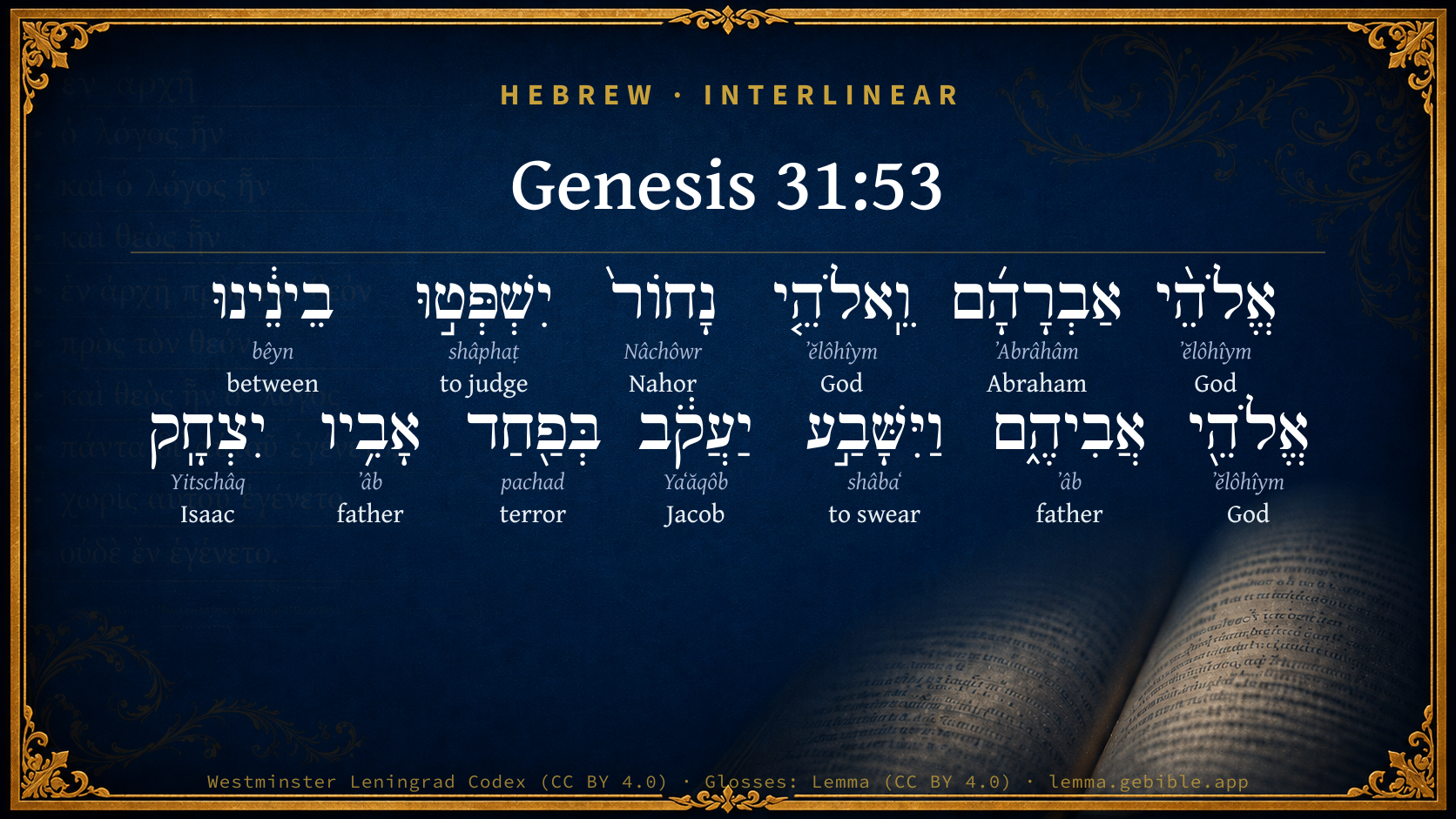
Hebrew (Westminster Leningrad Codex) Genesis 31:53 appears in the Hebrew Old Testament. The text above is from the Westminster Leningrad Codex. Each word links to its Strong’s number, a concise gloss, and parsing drawn from the Open Scriptures Hebrew Bible morphology. Click any word for its full Brown-Driver-Briggs (BDB) entry.
Download image
Cite this verse

Genesis 31:53 (World English Bible). Public Domain. Lemma interlinear Bible study tool, https://lemma.gebible.app/v/genesis/31/53.

Show BibTeX & RIS
BibTeX
RIS
English Translation
The God of Abraham, and the God of Nahor, the God of their father, judge between us." Then Jacob swore by the fear of his father, Isaac.
World English Bible · Public Domain
Download a study sheet

One document with this verse’s original text, its word-by-word gloss line, the meaning frame, cross-references with their text, attributed commentary, and full source and license credits — printable, and it pastes into notes with its structure intact.

This verse Autodidact and up

Study sheet (.html) Plain text (.txt)

A passage Seminary Student

Up to 50 verses in one chapter. A passage sheet keeps up to 6 commentary sources and 12 cross-references per verse, in the order this page ranks them, and says so on the sheet whenever that leaves anything out. Ask for a single verse and you get the Autodidact verse sheet above.

Everything on this page stays free to read, with no account — the sheet is a download of what is already on screen, not access to it.

Want to remove ads? Support Godless Engineer
Compare translations 3

The same verse in 3 English versions, stacked beneath the original-language interlinear above. Click any original word for its lexicon entry.

Each is an independent rendering of the whole verse — the interlinear is not word-aligned to these translations.

Highlighted words mark where these versions differ — a whole-verse word diff, not a word-by-word alignment.

  • World English Bible Public Domain
    The God of Abraham, and the God of Nahor, the God of their father, judge between us." Then Jacob swore by the fear of his father, Isaac.
  • King James Version Public Domain
    The God of Abraham, and the God of Nahor, the God of their father, judge betwixt us. And Jacob sware by the fear of his father Isaac.
  • unfoldingWord Literal Text CC BY-SA 4.0
    May the God of Abraham and the gods of Nahor, the gods of their father, judge between us!” Then Jacob swore by the Fear of his father Isaac,

unfoldingWord Literal Text — © unfoldingWord, licensed CC BY-SA 4.0. Word-aligned USFM3 via Door43 (git.door43.org/unfoldingWord/en_ult).

Versions to compare (up to 4)

3 of 4 selected

Show all 18 translations

Every available English version of this verse, each an independent rendering of the whole verse.

  • World English Bible Public Domain
    The God of Abraham, and the God of Nahor, the God of their father, judge between us." Then Jacob swore by the fear of his father, Isaac.
  • Berean Standard Bible Public Domain
    May the God of Abraham and the God of Nahor, the God of their father, judge between us.” So Jacob swore by the Fear of his father Isaac.
  • Majority Standard Bible Public Domain
    May the God of Abraham and the God of Nahor, the God of their father, judge between us.” So Jacob swore by the Fear of his father Isaac.
  • King James Version Public Domain
    The God of Abraham, and the God of Nahor, the God of their father, judge betwixt us. And Jacob sware by the fear of his father Isaac.
  • American Standard Version (1901) Public Domain
    The God of Abraham, and the God of Nahor, the God of their father, judge betwixt us. And Jacob sware by the Fear of his father Isaac.
  • Revised Version (1885) Public Domain
    The God of Abraham, and the God of Nahor, the God of their father, judge betwixt us. And Jacob sware by the Fear of his father Isaac.
  • Geneva Bible (1599) Public Domain
    The God of Abraham, and the God of Nabor, and the God of their father be iudge betweene vs: But Iaakob sware by the feare of his father Izhak.
  • Douay-Rheims (1899) Public Domain
    The God of Abraham, and the God of Nachor, the God of their father, judge between us. And jacob swore by the fear of his father Isaac.
  • Young's Literal Translation Public Domain
    the God of Abraham and the God of Nahor, doth judge between us -- the God of their father,' and Jacob sweareth by the Fear of his father Isaac.
  • Literal Standard Version CC BY-SA 4.0
    the God of Abraham and the God of Nahor, judges between us—the God of their father,” and Jacob swears by the Fear of his father Isaac.
  • Unlocked Literal Bible CC BY-SA 4.0
    May the God of Abraham, and the god of Nahor, the gods of their father, judge between us.” Jacob swore by the Fear of his father Isaac.
  • unfoldingWord Literal Text CC BY-SA 4.0
    May the God of Abraham and the gods of Nahor, the gods of their father, judge between us!” Then Jacob swore by the Fear of his father Isaac,
  • Darby Bible Public Domain
    The God of Abraham, and the God of Nahor, the God of their father, judge between us! And Jacob swore by the fear of his father Isaac.
  • World Messianic Bible Public Domain
    The God of Abraham, and the God of Nahor, the God of their father, judge between us.” Then Jacob swore by the fear of his father, Isaac.
  • Webster's Bible Public Domain
    The God of Abraham, and the God of Nahor, the God of their father, judge betwixt us. And Jacob swore by the fear of his father Isaac.
  • Free Bible Version CC BY-SA 4.0
    May the God of Abraham and the God of Nahor—the God of our forefathers—be the one to judge between us in any dispute.” Jacob in turn made his solemn promise in the name of the awesome God of his father Isaac.
  • Bible in Basic English Public Domain
    May the God of Abraham and the God of Nahor, the God of their father, be our judge. Then Jacob took an oath by the Fear of his father Isaac.
  • JPS Tanakh (1917) Public Domain
    The God of Abraham, and the God of Nahor, the God of their father, judge betwixt us.' And Jacob swore by the Fear of his father Isaac.

Literal Standard Version (2020), Covenant Press — licensed CC BY-SA 4.0. Text via the HelloAO Bible API (eBible.org). Unlocked Literal Bible (unfoldingWord) — licensed CC BY-SA 4.0. Text via the HelloAO Bible API (eBible.org). unfoldingWord Literal Text — © unfoldingWord, licensed CC BY-SA 4.0. Word-aligned USFM3 via Door43 (git.door43.org/unfoldingWord/en_ult). Free Bible Version, Dr. Jonathan Gallagher — licensed CC BY-SA 4.0. Text via the HelloAO Bible API (eBible.org).

Word by word

More ways to search: Search by grammar → Find every occurrence → Compare this word →

Practice this passage: Drill this verse → Learn its vocabulary →

נָחוֹר֙
Nâchôwr
H5152
“Nahor”
Noun, Proper
Part of Speech
Noun
Type
Proper
Full BDB Definition

Origin: from the same as H5170

TWOT: None

Nahor = "snorting" - son of Serug, father of Terah, and grandfather of Abraham - son of Terah and brother of Abraham
  1. אֱלֹהֵ֨י ʼĕlôhîym H430 “God(s) of” Noun, Common, Masculine, Plural, Construct
  2. אַבְרָהָ֜ם ʼAbrâhâm H85 “Abraham” Noun, Proper
  3. וֵֽאלֹהֵ֤י ʼĕlôhîym H430 “and · God(s) of” Conjunction + Noun, Common, Masculine, Plural, Construct
  4. יִשְׁפְּט֣וּ shâphaṭ H8199 “to judge” Verb, Qal, Imperfect, 3rd Person, Masculine, Plural
  5. בֵינֵ֔ינוּ bêyn H996 “between · us” Preposition + Suffix, Personal, 1st Person, Common, Plural
  6. אֱלֹהֵ֖י ʼĕlôhîym H430 “God(s) of” Noun, Common, Masculine, Plural, Construct
  7. אֲבִיהֶ֑ם ʼâb H1 “father · their” Noun, Common, Masculine, Singular, Construct + Suffix, Personal, 3rd Person, Masculine, Plural
  8. וַיִּשָּׁבַ֣ע shâbaʻ H7650 “and · to swear” Conjunction + Verb, Niphal, Sequential Imperfect, 3rd Person, Masculine, Singular
  9. יַעֲקֹ֔ב Yaʻăqôb H3290 “Jacob” Noun, Proper
  10. בְּפַ֖חַד pachad H6343 “in/at · terror of” Preposition + Noun, Common, Masculine, Singular, Construct
  11. אָבִ֥יו ʼâb H1 “father · his” Noun, Common, Masculine, Singular, Construct + Suffix, Personal, 3rd Person, Masculine, Singular
  12. יִצְחָֽק Yitschâq H3327 “Isaac” Noun, Proper

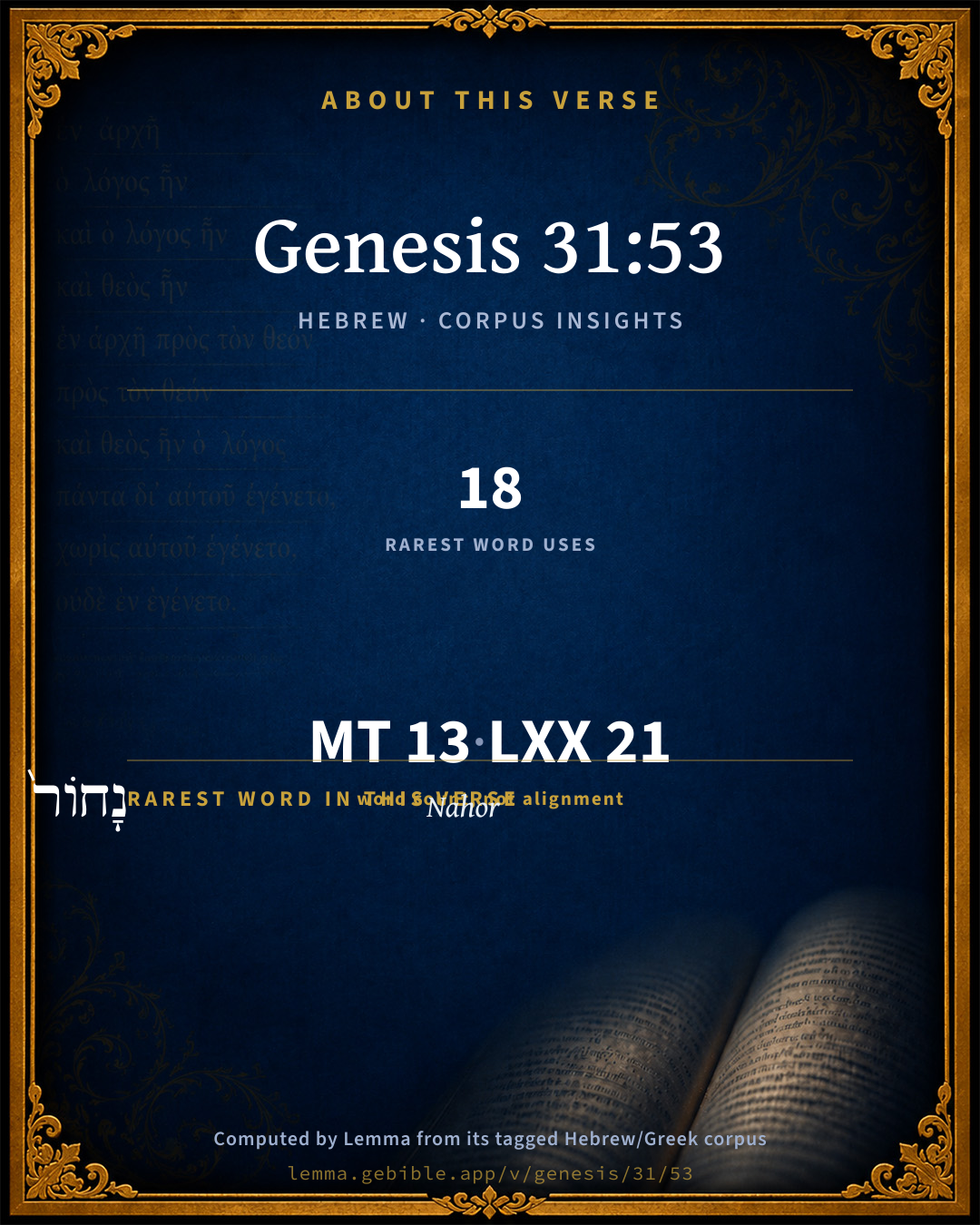
About this verse

These counts appear in no published source. They are computed here, from the morphology-tagged text and Lemma’s own curated glosses. What Lemma adds →

13
words
10
distinct lemmas
Pentateuch
section

Notable vocabulary

The rarest word here is נָחוֹר֙ Nahor H5152 — appearing just 18 times in the whole Hebrew Bible.

Shared distinctive vocabulary

נָחוֹר֙ Nahor H5152 occurs in 17 verses of the Hebrew Bible. Also found in:

Grammatical profile

  • 2 verbs
  • 10 nouns
  • 1 preposition

Verb forms

  • יִשְׁפְּט֣וּ Qal · Imperfect
  • וַיִּשָּׁבַ֣ע Niphal · Sequential Imperfect

Repetition

Words recur within this verse — often emphatic in Hebrew:

  • אֱלֹהֵ֨י God H430 ×3
  • אֲבִיהֶ֑ם father H1 ×2

Hebrew & Septuagint length

In English translation the verse runs 27 words from the Hebrew and 22 from the Septuagint (LXX English) — closely comparable.

A rough comparison of the two English renderings, which tokenize alike — not a word-level alignment.

Word counts can differ between the Hebrew and the Greek without any difference in meaning — e.g. the Hebrew direct-object marker אֵת has no separate Greek word, and Greek often adds the article ὁ.

In the original languages it is 13 Hebrew tokens and 21 Greek tokens — but the two are counted differently (Hebrew bundles its prefixes and suffixes into one token; the Greek is in lemma form), so that isn’t a like-for-like length.

Cross-references

14

Topical passages linked to Genesis 31:53 in the Treasury of Scripture Knowledge — connected by theme and wording, ordered by reader-vote popularity; previews shown in the World English Bible.

  • Genesis 31:42 Unless the God of my father, the God of Abraham, and the fear of Isaac, had been with me, surely now you would have sent me away empty. God has seen my affliction and the labor of my hands, and rebuked you last night."
  • Genesis 16:5 Sarai said to Abram, "This wrong is your fault. I gave my handmaid into your bosom, and when she saw that she had conceived, I was despised in her eyes. Yahweh judge between me and you."
  • Genesis 11:24–29 Nahor lived twenty-nine years, and became the father of Terah.
  • Exodus 3:6 Moreover he said, "I am the God of your father, the God of Abraham, the God of Isaac, and the God of Jacob." Moses hid his face; for he was afraid to look at God.
  • Joshua 24:2 Joshua said to all the people, Thus says Yahweh, the God of Israel, Your fathers lived of old time beyond the River, even Terah, the father of Abraham, and the father of Nahor: and they served other gods.
  • Genesis 11:31 Terah took Abram his son, Lot the son of Haran, his son's son, and Sarai his daughter-in-law, his son Abram's wife. They went forth from Ur of the Chaldees, to go into the land of Canaan. They came to Haran, and lived there.
  • Genesis 14:22 Abram said to the king of Sodom, "I have lifted up my hand to Yahweh, God Most High, possessor of heaven and earth,
  • Genesis 17:7 I will establish my covenant between me and you and your seed after you throughout their generations for an everlasting covenant, to be a God to you and to your seed after you.
  • Genesis 22:20–24 It happened after these things, that it was told Abraham, saying, "Behold, Milcah, she also has borne children to your brother Nahor:
  • Genesis 24:3–4 I will make you swear by Yahweh, the God of heaven and the God of the earth, that you shall not take a wife for my son of the daughters of the Canaanites, among whom I live.
  • Genesis 26:28–31 They said, "We saw plainly that Yahweh was with you. We said, 'Let there now be an oath between us, even between us and you, and let us make a covenant with you,
  • Genesis 28:13 Behold, Yahweh stood above it, and said, "I am Yahweh, the God of Abraham your father, and the God of Isaac. The land whereon you lie, to you will I give it, and to your seed.
  • Deuteronomy 6:13 You shall fear Yahweh your God; and him shall you serve, and shall swear by his name.
  • Genesis 21:23–24 Now therefore swear to me here by God that you will not deal falsely with me, nor with my son, nor with my son's son. But according to the kindness that I have done to you, you shall do to me, and to the land in which you have lived as a foreigner."

Cross-references courtesy of OpenBible.info (CC BY 4.0).

Hebrew and Greek witnesses Masoretic Hebrew ↔ Greek Septuagint

The same verse in the two great witnesses to the Old Testament, shown verse-for-verse.

These are two independent witnesses, not word-aligned to each other, and the Septuagint is shown in lemma (dictionary) form.

Hebrew Genesis 31:53 Masoretic · Westminster Leningrad Codex

אֱלֹהֵ֨י אַבְרָהָ֜ם וֵֽאלֹהֵ֤י נָחוֹר֙ יִשְׁפְּט֣וּ בֵינֵ֔ינוּ אֱלֹהֵ֖י אֲבִיהֶ֑ם וַיִּשָּׁבַ֣ע יַעֲקֹ֔ב בְּפַ֖חַד אָבִ֥יו יִצְחָֽק

The God of Abraham, and the God of Nahor, the God of their father, judge between us." Then Jacob swore by the fear of his father, Isaac.

World English Bible · Public Domain

Greek LXX Genesis 31:53 Septuagint · lemma form

ὁ θεός αβρααμ καί ὁ θεός ναχωρ κρίνω ἀνά μέσος ἐγώ καί ὄμνυμι ἰακώβ κατά ὁ φόβος ὁ πατήρ αὐτός ισαακ

The God of Abraam and the God of Nachor judge between us; and Jacob swore by the Fear of his father Isaac.

LXX2012 (modern English Septuagint) · Public Domain

On this verse, Adam Clarke's Commentary discusses the Septuagint’s reading. Read the note in Commentary ↓

Hebrew: Westminster Leningrad Codex (CC BY 4.0). Greek: Septuagint (public domain); English from LXX2012 (modern English Septuagint) (Public Domain). How the Septuagint differs from the Hebrew →

Targum (Aramaic paraphrase)

2

The Targum is the ancient Jewish Aramaic paraphrase of the Hebrew Scriptures — an interpretive translation, not the Hebrew text itself. Onkelos (literal) and Pseudo-Jonathan (expansive) render the Torah, and Jonathan the Prophets. Coverage is partial: where no permissively-licensed English translation exists for a verse, only the Aramaic is shown. This is verse-level text, not a word-by-word alignment to the Hebrew.

  1. Targum Onkelos Torah (Genesis–Deuteronomy)
    אֱלָהֵהּ דְּאַבְרָהָם וֵאֱלָהֵהּ דְּנָחוֹר יְדוּנוּן בֵּינָנָא אֱלָהֵהּ דַּאֲבוּהוֹן וְקַיֵּים יַעֲקֹב בִּדְדָחִיל לֵהּ אֲבוּהִי יִצְחָק

    (no public-domain English translation for this verse)

    Targum Onkelos — Aramaic: “Onkelos Genesis” (public domain); “Onkelos Exodus” (public domain); “Onkelos Leviticus” (public domain); “Onkelos Numbers” (public domain); “Onkelos Deuteronomy” (public domain). English: “Sefaria Community Translation” (CC0 1.0 (public-domain dedication)); “J.W. Etheridge. The Targums of Onkelos and Jonathan Ben Uzziel on the Pentateuch. London: Longmans, Green, 1862” (public domain). Text via Sefaria.

  2. Targum Pseudo-Jonathan Torah (Genesis–Deuteronomy)
    אֱלָהֵיהּ דְאַבְרָהָם וֶאֱלָהֵיהּ דְנָחוֹר יְדִינוּן בֵּינָנָא אֱלָהֵיהּ דַאֲבוּהוֹן וְקַיֵים יַעֲקב בֶּאֱלָהָא דְדָחֵיל לֵיהּ אָבוֹי יִצְחָק

    The God of Abraham and the God of Nachor shall judge between us, the God of their fathers. But Jakob sware by the God whom his father Izhak feared.

    Targum Pseudo-Jonathan — Aramaic: “Targum Jonathan on Genesis” (public domain); “Targum Jonathan on Exodus” (public domain); “Targum Jonathan on Leviticus” (public domain); “Targum Jonathan on Numbers” (public domain); “Targum Jonathan on Deuteronomy” (public domain). English: “The Targum of Jonathan ben Uzziel, trans. J. W. Etheridge, London, 1862” (public domain). Text via Sefaria.

Commentary

Notes on Genesis 31:53 from classic Christian and Jewish commentators (each source and its license shown beneath its notes). The classic Christian expositions comment on the surrounding passage and are grouped to its opening verse, so a note may address several verses; the Jewish commentaries on the Tanakh (Rashi and others) are per-verse, so they appear only where the commentator wrote on this verse.

Lemma curates 59 commentaries, every one of them public domain or Creative Commons licensed, each selected and text-cleaned for this edition rather than reprinted as found. About our sources →

Trapp's Complete Commentary

John Trapp

Gen 31:53 The God of Abraham, and the God of Nahor, the God of their father, judge betwixt us. And Jacob sware by the fear of his father Isaac.

Ver. 53. And Jacob swear by the Fear of his father.] The Chaldee Paraphrast sometimes useth the word fear, or terror, for God, for the reason above given. {Gen 31:42} Hence Jacob, coming from Syria, and being to swear to a Syrian, swears here by "the Fear of his father Isaac." Where note, that he riseth up no higher than his father, whereas Laban, the idolater, pretends antiquity, appeals to the gods of Abraham, of Nahor, and of their father Terah, who served strange gods. {Jos 24:2} Papists boast much of antiquity, as once the Gibeonites did of old shoes and mouldy bread. A gentleman being importuned by a Popish questionist, to tell where our religion was before Luther; answered, That our religion was always in the Bible, where your religion never was. Mine antiquity is Jesus Christ, saith Ignatius, and we with him. {a}

{a} Eμοι αρχεια εστιν Iησους ο Cριστος - Ignat.

John Trapp, A Commentary or Exposition upon All the Books of the Old and New Testament (1647–1656) — public domain. Text from a community e-Sword module.

Geneva Bible (1599)

Geneva Bible translators

Behold, how the idolaters mingle the true God with their feigned gods.

Meaning, by the true God whom Isaac worshipped.

Geneva Bible (1599) marginal notes — public domain. Text via Bolls.life.

Adam Clarke's Commentary

Verse 53. The God of their father] As Laban certainly speaks of the true God here, with what propriety can he say that this God was the God of Terah, the father of Abraham and Nahor? It is certain that Terah was an idolater; of this we have the most positive proof, Jos 24:2. Because the clause is not in the Septuagint, and is besides wanting in some MSS., Dr. Kennicott considers it an interpolation. But there is no need of having recourse to this expedient if we adopt the reading אביכם abichem, YOUR father, for אביהם abihem, THEIR father, which is supported by several of Kennicott's and De Rossi's MSS., and is precisely the same form made use of by Laban, Ge 31:29, when addressing Jacob, and appears to me to be used here in the same way; for he there most manifestly uses the plural pronoun, when speaking only to Jacob himself. It is therefore to be considered as a form of speech peculiar to Laban; at least we have two instances of his use of it in this chapter.

Jacob sware by the fear of his father Isaac.] See Clarke on Ge 31:42.

Adam Clarke's Commentary on the Bible (1810–1826) — public domain. Text from a community e-Sword/MySword module.

John Calvin's Commentaries

53. The God of Abraham. It is indeed rightly and properly done, that Laban should adjure Jacob by the name of God. For this is the confirmation of covenants; to appeal to God on both sides, that he may not suffer perfidy to pass unpunished. But he sinfully blends idols with the true God, between whom there is nothing in common. Thus, truly, men involved in superstitions, are accustomed to confound promiscuously sacred things with profane, and the figments of men with the true God. He is compelled to give some honor to the God of Abraham, yet he lies plunged in his own idolatrous pollution; and, that his religion may not appear the worse, he gives it the color of antiquity. For in calling him the God of his father, he boasts that this God was handed down to him from his ancestors. Meanwhile Jacob does not swear superstitiously. For Moses expressly declares, that he sware only by “the fear of Isaac;” whence we learn that he did not assent to the preposterous form of oath dictated by his father-in-law; no too many do, who, in order to gain the favor of the wicked, pretend to be of the same religion with them. But when once the only God is made known to us, we wickedly suppress his truth, unless by its light all the clouds of error are dispersed.

John Calvin's Commentaries (1540-1563) — public domain. Text from the Calvin Translation Society English edition (1840s-50s) via the Christian Classics Ethereal Library (ccel.org). Calvin's coverage is partial (roughly two-thirds of the Bible); uncommented books and verses are honest gaps, never fabricated. The 19th-century editor's footnotes and remarks are omitted so the notes are faithfully Calvin's own voice.

Ellicott's Commentary for English Readers

(53) Judge.—The verb is plural, “be he judges,” and as Laban thus joins the name Elohim with a verb plural, it seems as if he regarded Abraham’s Elohim as different from the Elohim of Nahor. We ought, therefore, to translate the gods of their father. Apparently, he thought that Abraham took one of Terah’s Elohim, and Nahor another. His views were thus polytheistic and so, generally, the ancients regarded the gods as local beings, with powers limited to certain districts. Jacob swears by the one Being who was the sole object of Isaac’s worship. (See Note on Gen_20:13.)

A Bible Commentary for English Readers, edited by Charles John Ellicott (1878–1897) — public domain. Text from a community e-Sword module.

The Cambridge Bible for Schools and Colleges

gen. ed. J. J. S. Perowne

53. The God of Abraham … Nahor] The verb “judge” is in the plural. See note on Gen_20:13 for the rare use of the plural verb with “Elohim.” Laban speaks of the God of Abraham, i.e. of the Hebrews in Canaan, and of the God of Nahor, i.e. of the Hebrews in Haran, and as a Syrian may possibly have regarded them as distinct deities. The plural with Elohim is found in Gen_20:13, Gen_35:7.

the God of their father] R.V. marg. gods. These words are not found in the LXX and some Hebrew MSS., and are probably a gloss. If they are omitted, the God of Abraham and the God of Nahor were treated in the original form of the narrative as separate, not identical, deities.

the Fear of his father Isaac] See note on Gen_31:42.

The Cambridge Bible for Schools and Colleges (gen. ed. J. J. S. Perowne; Cambridge University Press, 1878–1918) — public domain. Text from a community e-Sword module.

Haydock's Catholic Bible Commentary

God of Nachor. Hebrew uses Elohim, which is often applied to idols, such as Nachor worshipped along with the true God. (Calmet) --- Jacob swears by the one only God, whom his father revered. (Menochius) --- The God of their father, is omitted in the Septuagint and is deemed an interpolation by Kennicott. The Samaritan reads again the God of Abraham. (Haydock)

George Leo Haydock (1774–1849), Haydock's Catholic Family Bible and Commentary, 1859 edition — public domain. Excludes Psalms (Douay-Rheims chapter numbering differs from Protestant) and Deuterocanonical books (Catholic canon only).

Matthew Poole's English Annotations

The God of Nahor, the God of their father. He joins idols with the true God, and secretly chargeth the religion of Jacob and Abraham with novelty, and prefers his own as the most ancient religion. See Jos 24:2. Whence we may learn that antiquity of itself is no certain argument of the true church or religion.

Matthew Poole's English Annotations on the Holy Bible (1683–1685) — public domain. Text from a community e-Sword/MySword module.

Rashi

Rabbi Shlomo Yitzchaki (Rashi)

אלהי אברהם GOD OF ABRAHAM — Here the word אלהים is holy (i.e. it is the Divine Name). (Genesis Rabbah 74:17)

אלהי נחור THE GOD OF NAHOR — Here the name is non-holy (i.e. it is a designation for an idol) (Genesis Rabbah 74:17).

אלהי אביהם THE GOD OF THEIR FATHER — Here the name is non-holy (Genesis Rabbah 74:17).

Rashi on the Tanakh — English translations: “The Judaica Press complete Tanach with Rashi, translated by A. J. Rosenberg” (CC BY 4.0); “Pentateuch with Rashi's commentary by M. Rosenbaum and A.M. Silbermann, 1929-1934” (public domain); “The Metsudah Tanach series, Lakewood, N.J” (CC BY 4.0); and “The Book of Joshua, Metsudah Publications, 1997” (CC BY 4.0). Text via Sefaria.

Radak

Rabbi David Kimhi (Radak)

אלוקי אברהם ואלהי נחור, the first word “elo-hey” is sacred, the second is profane and may therefore be erased, seeing that Nachor had been an idolater. Lavan himself also believed in the gods of his grandfather Nachor. Neither Yitzchok nor Betuel have been mentioned here, seeing they were well known, famous even.

אלוהי אביהם, here too the word “elohey” is profane and may be erased from a Torah scroll if the occasion demands it. Whenever an expression denoting G’d includes idols, even if as something minor, the word is treated as profane. What was meant here are the respective gods of Yaakov’s father and Lavan’s father, each one in accordance with his religious convictions. Yaakov, when rendering his oath, swore by פחד יצחק, the G’d that Yitzchok had been in awe of when he was prepared to be slaughtered by his father. (as we explained on verse 42)

Radak on the Tanakh — English translations: “Sefaria Community Translation” (CC0 1.0 (public-domain dedication)); “Eliyahu Munk, HaChut Hameshulash” (CC BY 4.0); “Rabbi Mike Feuer, Jerusalem Anthology” (CC BY 4.0); and “R. David Kimhi on the first book of Psalms, Translated by R.G. Finch, London, 1919” (public domain). Text via Sefaria.

Lesson kit

Teaching starters — assembled from the data on this page, not authored interpretation. Every prompt links to the verse data it draws on. Edit before teaching.

Genesis, in the Pentateuch, opens this verse with 13 words (10 distinct Hebrew lemmas). Its most distinctive word is Nâchôwr (“Nahor”). A historical commentator’s framing appears above. Read the whole chapter for the surrounding context.

Discussion questions

  1. How does “Nahor” (Nâchôwr) shape what this verse is saying?
  2. Genesis 11:22 shares the word «Nahor» with this verse. How do the two illuminate each other?
  3. “God” occurs 3× in this one verse. What is the effect of the repetition?
  4. These translations render this verse differently; the difference is in the English rendering, not the original. What questions does that raise?
  5. The verb «יִשְׁפְּט֣וּ» is Qal Imperfect. How does its form color the action?
  6. Reading how Trapp's Complete Commentary and Geneva Bible (1599) read this verse, where do the two commentators agree and where do they part?

Things to notice

Reading settings

Reading text

Shown beneath each verse's original-language words.

Old Testament
Old Testament edition

Read the OT as the Masoretic Hebrew (MT) or the Greek Septuagint (LXX).

English shown for the Greek Septuagint (in the Hebrew ↔ Greek comparison).

Comparing translations? Open the Compare panel on any verse page to stack up to four side by side.