Genesis 24:23

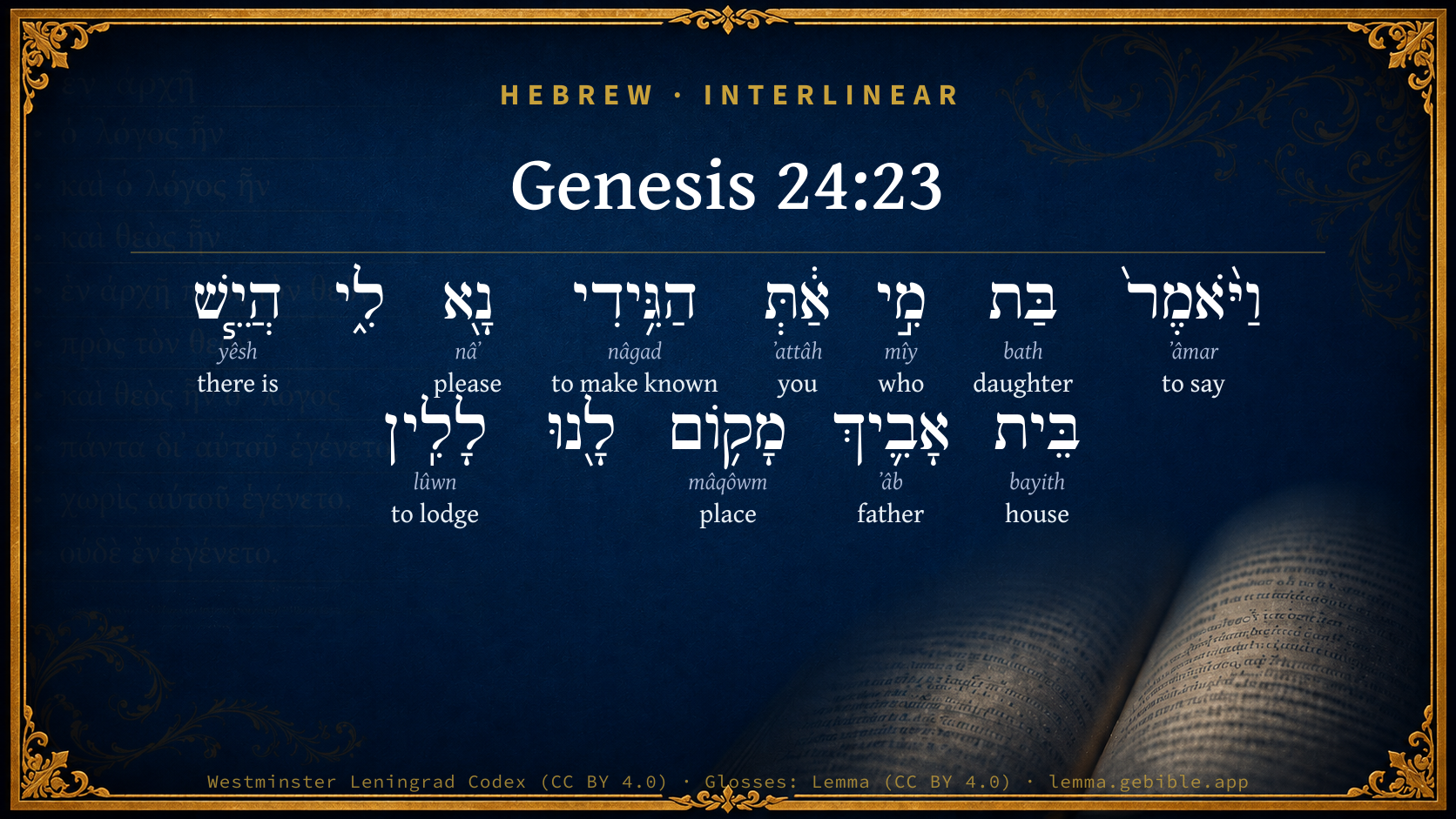
Hebrew (Westminster Leningrad Codex) Genesis 24:23 appears in the Hebrew Old Testament. The text above is from the Westminster Leningrad Codex. Each word links to its Strong’s number, a concise gloss, and parsing drawn from the Open Scriptures Hebrew Bible morphology. Click any word for its full Brown-Driver-Briggs (BDB) entry.
Download image
Cite this verse

Genesis 24:23 (World English Bible). Public Domain. Lemma interlinear Bible study tool, https://lemma.gebible.app/v/genesis/24/23.

Show BibTeX & RIS
BibTeX
RIS
English Translation
and said, "Whose daughter are you? Please tell me. Is there room in your father's house for us to lodge in?"
World English Bible · Public Domain
Download a study sheet

One document with this verse’s original text, its word-by-word gloss line, the meaning frame, cross-references with their text, attributed commentary, and full source and license credits — printable, and it pastes into notes with its structure intact.

This verse Autodidact and up

Study sheet (.html) Plain text (.txt)

A passage Seminary Student

Up to 50 verses in one chapter. A passage sheet keeps up to 6 commentary sources and 12 cross-references per verse, in the order this page ranks them, and says so on the sheet whenever that leaves anything out. Ask for a single verse and you get the Autodidact verse sheet above.

Everything on this page stays free to read, with no account — the sheet is a download of what is already on screen, not access to it.

Want to remove ads? Support Godless Engineer
Compare translations 3

The same verse in 3 English versions, stacked beneath the original-language interlinear above. Click any original word for its lexicon entry.

Each is an independent rendering of the whole verse — the interlinear is not word-aligned to these translations.

Highlighted words mark where these versions differ — a whole-verse word diff, not a word-by-word alignment.

  • World English Bible Public Domain
    and said, "Whose daughter are you? Please tell me. Is there room in your father's house for us to lodge in?"
  • King James Version Public Domain
    And said, Whose daughter art thou? tell me, I pray thee: is there room in thy father's house for us to lodge in?
  • unfoldingWord Literal Text CC BY-SA 4.0
    And he said, “Whose daughter you? Please tell me. Is there a place at the house of your father for us to lodge?”

unfoldingWord Literal Text — © unfoldingWord, licensed CC BY-SA 4.0. Word-aligned USFM3 via Door43 (git.door43.org/unfoldingWord/en_ult).

Versions to compare (up to 4)

3 of 4 selected

Show all 18 translations

Every available English version of this verse, each an independent rendering of the whole verse.

  • World English Bible Public Domain
    and said, "Whose daughter are you? Please tell me. Is there room in your father's house for us to lodge in?"
  • Berean Standard Bible Public Domain
    “Whose daughter are you?” he asked. “Please tell me, is there room in your father’s house for us to spend the night?”
  • Majority Standard Bible Public Domain
    “Whose daughter are you?” he asked. “Please tell me, is there room in your father’s house for us to spend the night?”
  • King James Version Public Domain
    And said, Whose daughter art thou? tell me, I pray thee: is there room in thy father's house for us to lodge in?
  • American Standard Version (1901) Public Domain
    and said, Whose daughter art thou? Tell me, I pray thee. Is there room in thy father's house for us to lodge in?
  • Revised Version (1885) Public Domain
    and said, Whose daughter art thou? tell me, I pray thee. Is there room in thy father’s house for us to lodge in?
  • Geneva Bible (1599) Public Domain
    And he said, Whose daughter art thou? tell me, I pray thee, Is there roume in thy fathers house for vs to lodge in?
  • Douay-Rheims (1899) Public Domain
    And he said to her: Whose daughter art thou? tell me: is there any place in thy father's house to lodge?
  • Young's Literal Translation Public Domain
    and saith, `Whose daughter `art' thou? declare to me, I pray thee, is the house of thy father a place for us to lodge in?'
  • Literal Standard Version CC BY-SA 4.0
    and says, “Whose daughter [are] you? Please declare to me, is the house of your father a place for us to lodge in?”
  • Unlocked Literal Bible CC BY-SA 4.0
    and asked, “Whose daughter are you? Tell me please, is there room in your father's house for us to spend the night?”
  • unfoldingWord Literal Text CC BY-SA 4.0
    And he said, “Whose daughter you? Please tell me. Is there a place at the house of your father for us to lodge?”
  • Darby Bible Public Domain
    and said, Whose daughter art thou? tell me, I pray thee. Is there room [in] thy father's house for us to lodge?
  • World Messianic Bible Public Domain
    and said, “Whose daughter are you? Please tell me. Is there room in your father’s house for us to stay?”
  • Webster's Bible Public Domain
    And said, Whose daughter art thou? tell me, I pray thee: is there room in thy father's house for us to lodge in?
  • Free Bible Version CC BY-SA 4.0
    Then he asked her, “Whose daughter are you? Also could you tell me, is there room in your father's house for us to spend the night?”
  • Bible in Basic English Public Domain
    And said to her, Whose daughter are you? is there room in your father's house for us?
  • JPS Tanakh (1917) Public Domain
    and said: 'Whose daughter art thou? tell me, I pray thee. Is there room in thy father's house for us to lodge in?'

Literal Standard Version (2020), Covenant Press — licensed CC BY-SA 4.0. Text via the HelloAO Bible API (eBible.org). Unlocked Literal Bible (unfoldingWord) — licensed CC BY-SA 4.0. Text via the HelloAO Bible API (eBible.org). unfoldingWord Literal Text — © unfoldingWord, licensed CC BY-SA 4.0. Word-aligned USFM3 via Door43 (git.door43.org/unfoldingWord/en_ult). Free Bible Version, Dr. Jonathan Gallagher — licensed CC BY-SA 4.0. Text via the HelloAO Bible API (eBible.org).

Word by word

More ways to search: Search by grammar → Find every occurrence → Compare this word →

Practice this passage: Drill this verse → Learn its vocabulary →

לָלִֽין
lûwn
H3885
“to lodge”
Preposition + Verb, Qal, Infinitive Construct
Part of Speech
Preposition + Verb
Stem
Qal
Form
Infinitive Construct
Full BDB Definition

Origin: a primitive root

TWOT: 1096 , 1097

to lodge, stop over, pass the night, abide - (Qal) - to lodge, pass the night - to abide, remain (figuratively) - (Hiphil) to cause to rest or lodge - (Hithpalpel) to dwell, abide - to grumble, complain, murmur - (Niphal) to grumble - (Hiphil) to complain, cause to grumble
  1. וַיֹּ֨אמֶר֙ ʼâmar H559 “and · to say” Conjunction + Verb, Qal, Sequential Imperfect, 3rd Person, Masculine, Singular
  2. בַּת bath H1323 “daughter of” Noun, Common, Feminine, Singular, Construct
  3. מִ֣י mîy H4310 “who” Particle, Interrogative
  4. אַ֔תְּ ʼattâh H859 “you” Pronoun, Personal, 2nd Person, Feminine, Singular
  5. הַגִּ֥ידִי nâgad H5046 “make known” Verb, Hiphil, Imperative, 2nd Person, Feminine, Singular
  6. נָ֖א nâʼ H4994 “please” Particle, Exhortation
  7. הֲיֵ֧שׁ yêsh H3426 “there is” Particle, Interrogative + Particle, Demonstrative
  8. בֵּית bayith H1004 “house of” Noun, Common, Masculine, Singular, Construct
  9. אָבִ֛יךְ ʼâb H1 “father · her” Noun, Common, Masculine, Singular, Construct + Suffix, Personal, 3rd Person, Feminine, Singular
  10. מָק֥וֹם mâqôwm H4725 “place” Noun, Common, Masculine, Singular, Absolute

About this verse

These counts appear in no published source. They are computed here, from the morphology-tagged text and Lemma’s own curated glosses. What Lemma adds →

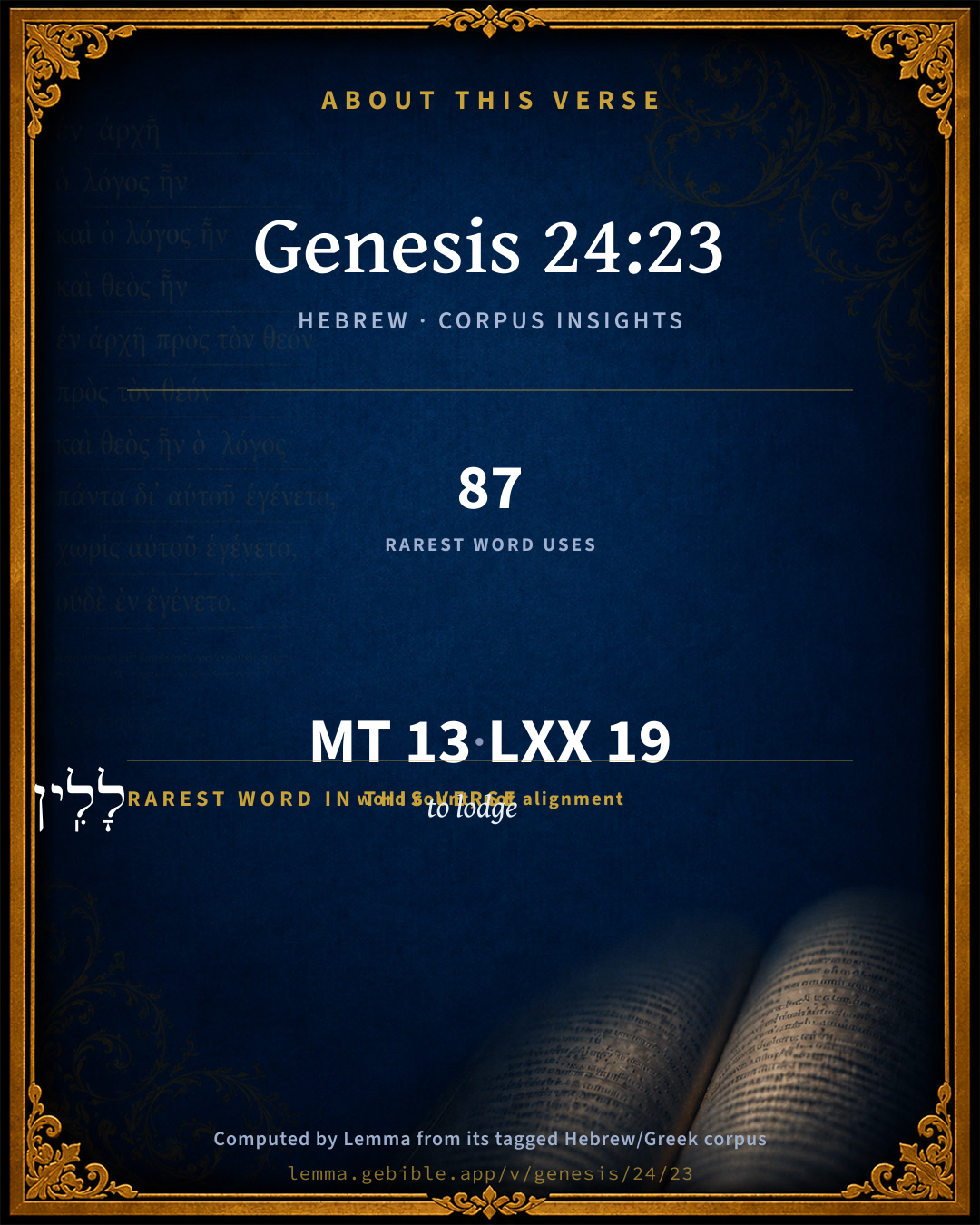
13
words
11
distinct lemmas
Pentateuch
section

Grammatical profile

  • 3 verbs
  • 4 nouns
  • 1 pronoun
  • 2 prepositions
  • 3 particles

Verb forms

  • וַיֹּ֨אמֶר֙ Qal · Sequential Imperfect
  • הַגִּ֥ידִי Hiphil · Imperative
  • לָלִֽין Qal · Infinitive Construct

Hebrew & Septuagint length

In English translation the verse runs 21 words from the Hebrew and 23 from the Septuagint (LXX English) — closely comparable.

A rough comparison of the two English renderings, which tokenize alike — not a word-level alignment.

Word counts can differ between the Hebrew and the Greek without any difference in meaning — e.g. the Hebrew direct-object marker אֵת has no separate Greek word, and Greek often adds the article ὁ.

In the original languages it is 13 Hebrew tokens and 19 Greek tokens — but the two are counted differently (Hebrew bundles its prefixes and suffixes into one token; the Greek is in lemma form), so that isn’t a like-for-like length.

Hebrew and Greek witnesses Masoretic Hebrew ↔ Greek Septuagint

The same verse in the two great witnesses to the Old Testament, shown verse-for-verse.

These are two independent witnesses, not word-aligned to each other, and the Septuagint is shown in lemma (dictionary) form.

Hebrew Genesis 24:23 Masoretic · Westminster Leningrad Codex

וַיֹּ֨אמֶר֙ בַּת מִ֣י אַ֔תְּ הַגִּ֥ידִי נָ֖א לִ֑י הֲיֵ֧שׁ בֵּית אָבִ֛יךְ מָק֥וֹם לָ֖נוּ לָלִֽין

and said, "Whose daughter are you? Please tell me. Is there room in your father's house for us to lodge in?"

World English Bible · Public Domain

Greek LXX Genesis 24:23 Septuagint · lemma form

καί ἐπιἐρωτάω αὐτός καί εἶπον θυγάτηρ τίς εἰμί ἀναἀγγέλλω ἐγώ εἰ εἰμί παρά ὁ πατήρ σύ τόπος ἐγώ καταλύω

And he asked her, and said, Whose daughter are you? Tell me if there is room for us to lodge with your father.

LXX2012 (modern English Septuagint) · Public Domain

Hebrew: Westminster Leningrad Codex (CC BY 4.0). Greek: Septuagint (public domain); English from LXX2012 (modern English Septuagint) (Public Domain). How the Septuagint differs from the Hebrew →

Targum (Aramaic paraphrase)

2

The Targum is the ancient Jewish Aramaic paraphrase of the Hebrew Scriptures — an interpretive translation, not the Hebrew text itself. Onkelos (literal) and Pseudo-Jonathan (expansive) render the Torah, and Jonathan the Prophets. Coverage is partial: where no permissively-licensed English translation exists for a verse, only the Aramaic is shown. This is verse-level text, not a word-by-word alignment to the Hebrew.

  1. Targum Onkelos Torah (Genesis–Deuteronomy)
    וַאֲמַר בַּת מָן אַתְּ חַוִּי כְעַן לִי הַאִית בֵּית אָבוּךְ אָתַר כָּשַׁר לָנָא לִמְבָת

    (no public-domain English translation for this verse)

    Targum Onkelos — Aramaic: “Onkelos Genesis” (public domain); “Onkelos Exodus” (public domain); “Onkelos Leviticus” (public domain); “Onkelos Numbers” (public domain); “Onkelos Deuteronomy” (public domain). English: “Sefaria Community Translation” (CC0 1.0 (public-domain dedication)); “J.W. Etheridge. The Targums of Onkelos and Jonathan Ben Uzziel on the Pentateuch. London: Longmans, Green, 1862” (public domain). Text via Sefaria.

  2. Targum Pseudo-Jonathan Torah (Genesis–Deuteronomy)
    וַאֲמַר בְּרַת מַאן אַתְּ תַּנִי כְדוֹן לִי הַאִית בֵּית אָבוּךְ אֲתַר כָּשַר לָנָא לִמְבָת

    And he said, Whose daughter art thou? Tell me now, if in thy father's house there be room for us to lodge.

    Targum Pseudo-Jonathan — Aramaic: “Targum Jonathan on Genesis” (public domain); “Targum Jonathan on Exodus” (public domain); “Targum Jonathan on Leviticus” (public domain); “Targum Jonathan on Numbers” (public domain); “Targum Jonathan on Deuteronomy” (public domain). English: “The Targum of Jonathan ben Uzziel, trans. J. W. Etheridge, London, 1862” (public domain). Text via Sefaria.

Commentary

Notes on Genesis 24:23 from classic Christian and Jewish commentators (each source and its license shown beneath its notes). The classic Christian expositions comment on the surrounding passage and are grouped to its opening verse, so a note may address several verses; the Jewish commentaries on the Tanakh (Rashi and others) are per-verse, so they appear only where the commentator wrote on this verse.

Lemma curates 59 commentaries, every one of them public domain or Creative Commons licensed, each selected and text-cleaned for this edition rather than reprinted as found. About our sources →

Trapp's Complete Commentary

John Trapp

Gen 24:23 And said, Whose daughter [art] thou? tell me, I pray thee: is there room [in] thy father’s house for us to lodge in?

Ver. 23. Whose daughter art thou?] This he had asked her, before he had put upon her the jewel aforesaid, as may be seen, Gen 24:47.

John Trapp, A Commentary or Exposition upon All the Books of the Old and New Testament (1647–1656) — public domain. Text from a community e-Sword module.

Tyndale Open Study Notes

Tyndale Open Resources

24:23-24 God led the servant to Abraham’s family.

Tyndale Open Study Notes — © Tyndale Open Resources, licensed CC BY-SA 4.0. Text via the HelloAO Bible API.

Jamieson, Fausset & Brown

Robert Jamieson, A. R. Fausset & David Brown

And said, Whose daughter art thou?--After telling her name and family, the kind-hearted damsel hastened home to give notice of a stranger's arrival.

Jamieson, Fausset & Brown — Commentary Critical and Explanatory on the Whole Bible (1871) — public domain (CC PDM 1.0). Text via the HelloAO Bible API.

The Cambridge Bible for Schools and Colleges

gen. ed. J. J. S. Perowne

23. room] Lit. “place” as in Gen_24:25. Cf. Psa_31:8, “in a large room” (A.V.) = “in a large place” (R.V.).

The Cambridge Bible for Schools and Colleges (gen. ed. J. J. S. Perowne; Cambridge University Press, 1878–1918) — public domain. Text from a community e-Sword module.

John Gill's Exposition

And said,.... After he had given her the earring and the bracelets, he put the following question, according to Jarchi, and so our version seems to intimate the same; but, as it is related in Gen 24:47; the question was put before those were given, therefore some render the words, "and he had said", or, "and after he had said" (f), namely, what follows; though, as Schmidt observes, the matter is easily reconciled, and both accounts stand clear and plain, if it be only remarked, that he took out the earring and bracelets before he put the question, but it was after it that he gave her them, or put them upon her:

whose daughter art thou? the reason of this question is, because by her answer to it he would know whether she was of the family related to Abraham or not; from whom only, according to his oath, he was to take a wife for Isaac, and which would in a good measure satisfy him as to what he had been musing about, whether the Lord had made his journey prosperous or not:

tell me, I pray thee, is there room in thy father's house for us to lodge in? by her answer to this he would know whether her family was wealthy, and so fit to be in connection with his master's; and besides, if she appeared to be the person he hoped she was, he was desirous of lodging in her father's house, that he might have the better opportunity of managing the affair he was come about.

(f) "et dixerat", Drusius; "postquam dixisset", Junius & Tremellius, Piscator.

John Gill's Exposition of the Whole Bible (1746–1763) — public domain (CC PDM 1.0). Text via the HelloAO Bible API.

Matthew Poole's English Annotations

And said, or, for he had said; for it is probable he inquired who she was before he gave her those presents.

Matthew Poole's English Annotations on the Holy Bible (1683–1685) — public domain. Text from a community e-Sword/MySword module.

Rashi

Rabbi Shlomo Yitzchaki (Rashi)

ויאמר בת מי את AND HE SAID, WHOSE DAUGHTER ART THOU? — He asked her this after he had given her these presents, for he was confident that, on account of the merit of Abraham, the Holy One blessed be He, had made his journey successful.

ללין TO LODGE IN — the word means one night’s lodging. The word לין is a noun (of the same form as גיל,שיר). She however said (Genesis 24:25) ללון (a verb, “to lodge” generally) meaning many nights’ lodging (Genesis Rabbah 60:6).

Rashi on the Tanakh — English translations: “The Judaica Press complete Tanach with Rashi, translated by A. J. Rosenberg” (CC BY 4.0); “Pentateuch with Rashi's commentary by M. Rosenbaum and A.M. Silbermann, 1929-1934” (public domain); “The Metsudah Tanach series, Lakewood, N.J” (CC BY 4.0); and “The Book of Joshua, Metsudah Publications, 1997” (CC BY 4.0). Text via Sefaria.

Radak

Rabbi David Kimhi (Radak)

ויאמר, he now asked about her family, and whether in the home of such a family there was room to accommodate him and his entourage.

?היש בית אביך מקום ללין, The meaning of the word ללין is a verbal mode meaning the same as להלין, “to provide lodging.” The letter י indicates the transitive conjugation hiphil. The word ללון by comparison which is in the simple conjugation (intransitive) kal, describes what the person enjoying the lodging does, i.e. spend the night. Both the enquiry and the response are the same, i.e. Rivkah answered the question asked, she did not answer obliquely, seeing that she used the verb “to lodge” in a different conjugation. After all, Eliezer had asked her both about lodging for the camels and lodging for himself and his men. It is possible to understand the exchange between Eliezer and Rivkah as meaning: “is there room in your father’s house to provide lodging,” a reference to the camels only, whereas Rivkah responds “not only is there room for the camels but there is also room for the men.” The author quotes Job 24,7 to show that the verb לון when used in the transitive mode ערום ילינו מבלי לבוש, “they will have to spend the night without clothing” also means the same as the intransitive conjugation ילונו.

Radak on the Tanakh — English translations: “Sefaria Community Translation” (CC0 1.0 (public-domain dedication)); “Eliyahu Munk, HaChut Hameshulash” (CC BY 4.0); “Rabbi Mike Feuer, Jerusalem Anthology” (CC BY 4.0); and “R. David Kimhi on the first book of Psalms, Translated by R.G. Finch, London, 1919” (public domain). Text via Sefaria.

Lesson kit

Teaching starters — assembled from the data on this page, not authored interpretation. Every prompt links to the verse data it draws on. Edit before teaching.

Genesis, in the Pentateuch, opens this verse with 13 words (11 distinct Hebrew lemmas). Its most distinctive word is lûwn (“to lodge”). A historical commentator’s framing appears above. Read the whole chapter for the surrounding context.

Discussion questions

  1. How does “to lodge” (lûwn) shape what this verse is saying?
  2. These translations render this verse differently. What is at stake in choosing one wording over another?
  3. «וַיֹּ֨אמֶר֙» is a Qal Sequential Imperfect verb. How does that grammatical form shape the action described?
  4. Compare how Trapp's Complete Commentary and Tyndale Open Study Notes read this verse. Where do they agree or differ?

Things to notice

Reading settings

Reading text

Shown beneath each verse's original-language words.

Old Testament
Old Testament edition

Read the OT as the Masoretic Hebrew (MT) or the Greek Septuagint (LXX).

English shown for the Greek Septuagint (in the Hebrew ↔ Greek comparison).

Comparing translations? Open the Compare panel on any verse page to stack up to four side by side.