
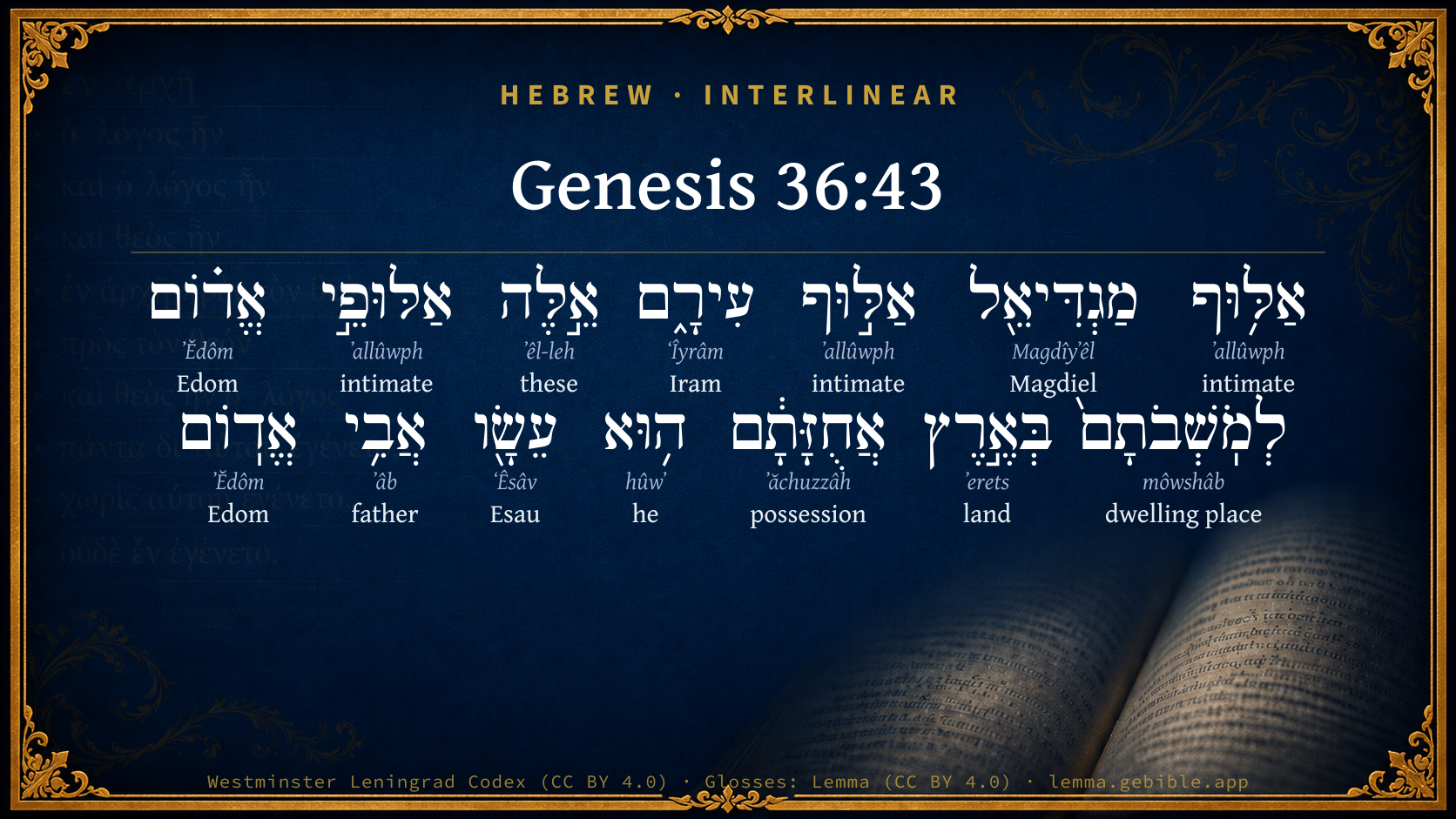
Genesis 36:43

Hebrew (Westminster Leningrad Codex) Genesis 36:43 appears in the Hebrew Old Testament. The text above is from the Westminster Leningrad Codex. Each word links to its Strong’s number, a concise gloss, and parsing drawn from the Open Scriptures Hebrew Bible morphology. Click any word for its full Brown-Driver-Briggs (BDB) entry.
Download image
Cite this verse

Genesis 36:43 (World English Bible). Public Domain. Lemma interlinear Bible study tool, https://lemma.gebible.app/v/genesis/36/43.

Show BibTeX & RIS
BibTeX
RIS
English Translation
chief Magdiel, and chief Iram. These are the chiefs of Edom, according to their habitations in the land of their possession. This is Esau, the father of the Edomites.
World English Bible · Public Domain
Highlights
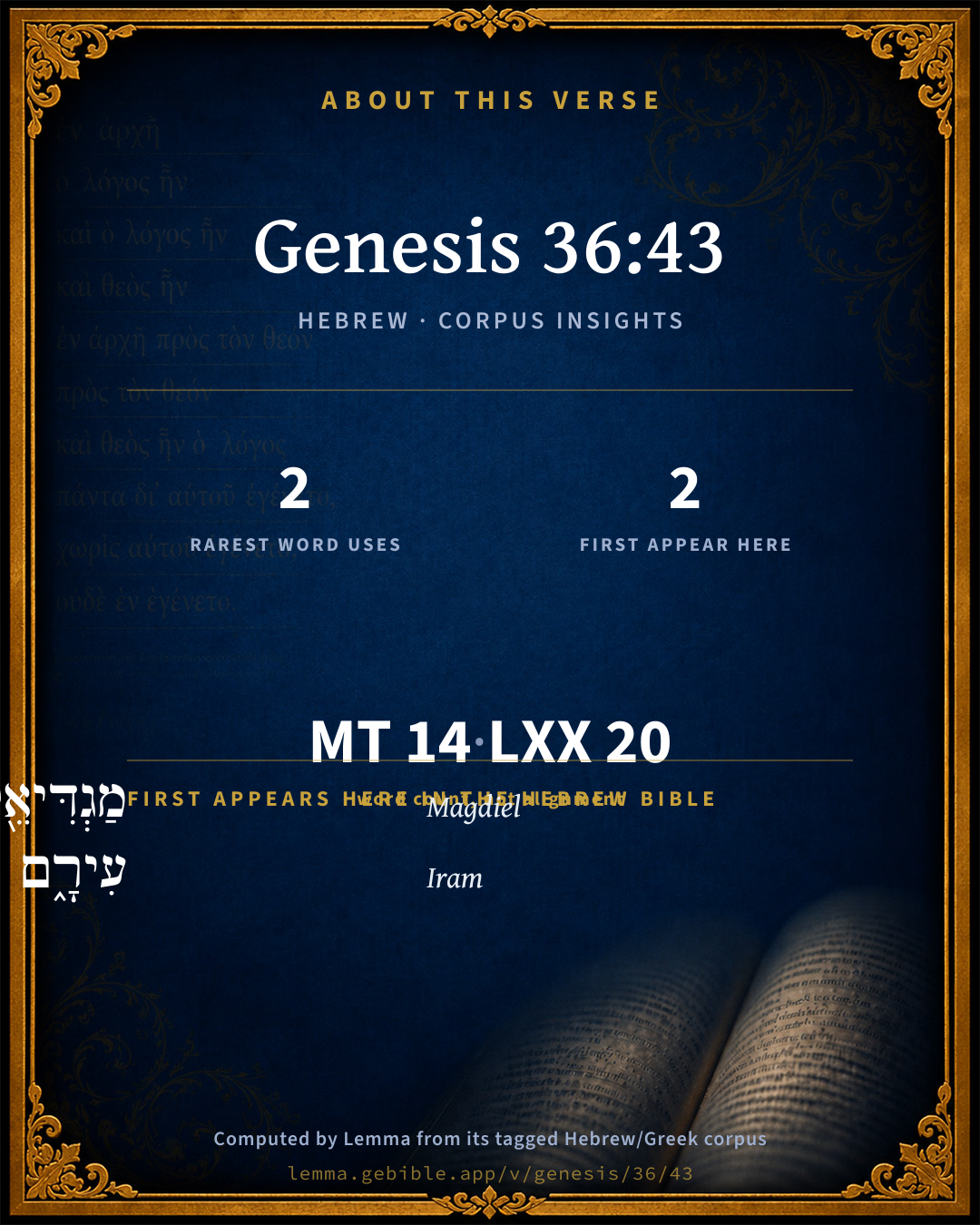
  • 2 first appearances in the Hebrew Bible
Full analysis ↓
Download a study sheet

One document with this verse’s original text, its word-by-word gloss line, the meaning frame, cross-references with their text, attributed commentary, and full source and license credits — printable, and it pastes into notes with its structure intact.

This verse Autodidact and up

Study sheet (.html) Plain text (.txt)

A passage Seminary Student

Up to 50 verses in one chapter. A passage sheet keeps up to 6 commentary sources and 12 cross-references per verse, in the order this page ranks them, and says so on the sheet whenever that leaves anything out. Ask for a single verse and you get the Autodidact verse sheet above.

Everything on this page stays free to read, with no account — the sheet is a download of what is already on screen, not access to it.

Want to remove ads? Support Godless Engineer
Compare translations 3

The same verse in 3 English versions, stacked beneath the original-language interlinear above. Click any original word for its lexicon entry.

Each is an independent rendering of the whole verse — the interlinear is not word-aligned to these translations.

Highlighted words mark where these versions differ — a whole-verse word diff, not a word-by-word alignment.

  • World English Bible Public Domain
    chief Magdiel, and chief Iram. These are the chiefs of Edom, according to their habitations in the land of their possession. This is Esau, the father of the Edomites.
  • King James Version Public Domain
    Duke Magdiel, duke Iram: these be the dukes of Edom, according to their habitations in the land of their possession: he is Esau the father of the Edomites.
  • unfoldingWord Literal Text CC BY-SA 4.0
    Chief Magdiel, Chief Iram. Those the chiefs of Edom, according to their dwellings in the land of their possession. That Esau, the father of the Edomites.

unfoldingWord Literal Text — © unfoldingWord, licensed CC BY-SA 4.0. Word-aligned USFM3 via Door43 (git.door43.org/unfoldingWord/en_ult).

Versions to compare (up to 4)

3 of 4 selected

Show all 18 translations

Every available English version of this verse, each an independent rendering of the whole verse.

  • World English Bible Public Domain
    chief Magdiel, and chief Iram. These are the chiefs of Edom, according to their habitations in the land of their possession. This is Esau, the father of the Edomites.
  • Berean Standard Bible Public Domain
    Magdiel, and Iram. These were the chiefs of Edom, according to their settlements in the land they possessed. Esau was the father of the Edomites.
  • Majority Standard Bible Public Domain
    Magdiel, and Iram. These were the chiefs of Edom, according to their settlements in the land they possessed. Esau was the father of the Edomites.
  • King James Version Public Domain
    Duke Magdiel, duke Iram: these be the dukes of Edom, according to their habitations in the land of their possession: he is Esau the father of the Edomites.
  • American Standard Version (1901) Public Domain
    chief Magdiel, chief Iram: these are the chiefs of Edom, according to their habitations in the land of their possession. This is Esau, the father of the Edomites.
  • Revised Version (1885) Public Domain
    duke Magdiel, duke Iram: these be the dukes of Edom, according to their habitations in the land of their possession. This is Esau the father of the Edomites.
  • Geneva Bible (1599) Public Domain
    Duke Magdiel, Duke Iram: these bee the Dukes of Edom, according to their habitations, in the lande of their inheritance. This Esau is the father of Edom.
  • Douay-Rheims (1899) Public Domain
    Duke Magdiel, duke Hiram: these are the dukes of Edom dwelling in the land of their government; the same is Esau the father of the Edomites.
  • Young's Literal Translation Public Domain
    chief Magdiel, chief Iram: these `are' chiefs of Edom, in reference to their dwellings, in the land of their possession; he `is' Esau father of Edom.
  • Literal Standard Version CC BY-SA 4.0
    Chief Magdiel, Chief Iram: these [are] chiefs of Edom, in reference to their dwellings, in the land of their possession; he [is] Esau father of Edom.
  • Unlocked Literal Bible CC BY-SA 4.0
    Magdiel, and Iram. These were the clan heads of Edom, according to their settlements in the land they possessed. This was Esau, the father of the Edomites.
  • unfoldingWord Literal Text CC BY-SA 4.0
    Chief Magdiel, Chief Iram. Those the chiefs of Edom, according to their dwellings in the land of their possession. That Esau, the father of the Edomites.
  • Darby Bible Public Domain
    chief Magdiel, chief Iram. These are the chiefs of Edom, according to their dwelling-places in the land of their possession. This is Esau, the father of Edom.
  • World Messianic Bible Public Domain
    chief Magdiel, and chief Iram. These are the chiefs of Edom, according to their habitations in the land of their possession. This is Esau, the father of the Edomites.
  • Webster's Bible Public Domain
    Duke Magdiel, duke Iram; these are the dukes of Edom, according to their habitations, in the land of their possession: he is Esau the father of the Edomites.
  • Free Bible Version CC BY-SA 4.0
    Magdiel, and Iram. These were the tribal leaders of Edom, listed according to the places where they lived in the country. Esau was the ancestor of the Edomites.
  • Bible in Basic English Public Domain
    Magdiel, Iram; these are the Edomite chiefs, in their places in their heritage; this is Esau, the father of the Edomites.
  • JPS Tanakh (1917) Public Domain
    the chief of Magdiel, the chief of Iram. These are the chiefs of Edom, according to their habitations in the land of their possession. This is Esau the father of the Edomites.

Literal Standard Version (2020), Covenant Press — licensed CC BY-SA 4.0. Text via the HelloAO Bible API (eBible.org). Unlocked Literal Bible (unfoldingWord) — licensed CC BY-SA 4.0. Text via the HelloAO Bible API (eBible.org). unfoldingWord Literal Text — © unfoldingWord, licensed CC BY-SA 4.0. Word-aligned USFM3 via Door43 (git.door43.org/unfoldingWord/en_ult). Free Bible Version, Dr. Jonathan Gallagher — licensed CC BY-SA 4.0. Text via the HelloAO Bible API (eBible.org).

Word by word

More ways to search: Search by grammar → Find every occurrence → Compare this word →

Practice this passage: Drill this verse → Learn its vocabulary →

מַגְדִּיאֵ֖ל
Magdîyʼêl
H4025
“Magdiel”
Noun, Proper
Part of Speech
Noun
Type
Proper
Full BDB Definition

Origin: from H4022 and H410

TWOT: None

Magdiel = "prince of God" - a descendant of Esau and one of the chiefs of Edom
  1. אַלּ֥וּף ʼallûwph H441 “intimate” Noun, Common, Masculine, Singular, Absolute
  2. אַלּ֣וּף ʼallûwph H441 “intimate” Noun, Common, Masculine, Singular, Absolute
  3. עִירָ֑ם ʻÎyrâm H5902 “Iram” Noun, Proper
  4. אֵ֣לֶּה ʼêl-leh H428 “these” Pronoun, Demonstrative, Common, Plural
  5. אַלּוּפֵ֣י ʼallûwph H441 “intimates of” Noun, Common, Masculine, Plural, Construct
  6. אֱד֗וֹם ʼĔdôm H123 “Edom” Noun, Proper
  7. לְמֹֽשְׁבֹתָם֙ môwshâb H4186 “to/for · dwelling places · their” Preposition + Noun, Common, Masculine, Plural, Construct + Suffix, Personal, 3rd Person, Masculine, Plural
  8. בְּאֶ֣רֶץ ʼerets H776 “in/at · land of” Preposition + Noun, Common, Both, Singular, Construct
  9. אֲחֻזָּתָ֔ם ʼăchuzzâh H272 “possession · their” Noun, Common, Feminine, Singular, Construct + Suffix, Personal, 3rd Person, Masculine, Plural
  10. ה֥וּא hûwʼ H1931 “he” Pronoun, Personal, 3rd Person, Masculine, Singular
  11. עֵשָׂ֖ו ʻÊsâv H6215 “Esau” Noun, Proper
  12. אֲבִ֥י ʼâb H1 “father of” Noun, Common, Masculine, Singular, Construct
  13. אֱדֽוֹם ʼĔdôm H123 “Edom” Noun, Proper

About this verse

These counts appear in no published source. They are computed here, from the morphology-tagged text and Lemma’s own curated glosses. What Lemma adds →

14
words
11
distinct lemmas
Pentateuch
section

Notable vocabulary

The rarest word here is מַגְדִּיאֵ֖ל Magdiel H4025 — appearing just 2 times in the whole Hebrew Bible.

First appearance in Scripture

These words make their first canonical appearance in the Hebrew Bible here:

  • מַגְדִּיאֵ֖ל Magdiel H4025
  • עִירָ֑ם Iram H5902

Shared distinctive vocabulary

מַגְדִּיאֵ֖ל Magdiel H4025 occurs in 2 verses of the Hebrew Bible. Also found in:

Grammatical profile

  • 12 nouns
  • 2 pronouns

Repetition

Words recur within this verse — often emphatic in Hebrew:

  • אַלּ֥וּף intimate H441 ×3
  • אֱד֗וֹם Edom H123 ×2

Hebrew & Septuagint length

In English translation the verse runs 29 words from the Hebrew and 26 from the Septuagint (LXX English) — closely comparable.

A rough comparison of the two English renderings, which tokenize alike — not a word-level alignment.

Word counts can differ between the Hebrew and the Greek without any difference in meaning — e.g. the Hebrew direct-object marker אֵת has no separate Greek word, and Greek often adds the article ὁ.

In the original languages it is 14 Hebrew tokens and 20 Greek tokens — but the two are counted differently (Hebrew bundles its prefixes and suffixes into one token; the Greek is in lemma form), so that isn’t a like-for-like length.

Cross-references

11

Topical passages linked to Genesis 36:43 in the Treasury of Scripture Knowledge — connected by theme and wording, ordered by reader-vote popularity; previews shown in the World English Bible.

  • Genesis 25:12 Now this is the history of the generations of Ishmael, Abraham's son, whom Hagar the Egyptian, Sarah's handmaid, bore to Abraham.
  • Genesis 25:30 Esau said to Jacob, "Please feed me with that same red stew, for I am famished." Therefore his name was called Edom.
  • Genesis 36:7–8 For their substance was too great for them to dwell together, and the land of their travels couldn't bear them because of their cattle.
  • Genesis 36:15 These are the chiefs of the sons of Esau: the sons of Eliphaz the firstborn of Esau: chief Teman, chief Omar, chief Zepho, chief Kenaz,
  • Genesis 36:18–19 These are the sons of Oholibamah, Esau's wife: chief Jeush, chief Jalam, chief Korah: these are the chiefs who came of Oholibamah the daughter of Anah, Esau's wife.
  • Genesis 36:30–31 chief Dishon, chief Ezer, and chief Dishan: these are the chiefs who came of the Horites, according to their chiefs in the land of Seir.
  • Genesis 45:8 So now it wasn't you who sent me here, but God, and he has made me a father to Pharaoh, lord of all his house, and ruler over all the land of Egypt.
  • Exodus 15:15 Then the chiefs of Edom were dismayed. Trembling takes hold of the mighty men of Moab. All the inhabitants of Canaan are melted away.
  • Numbers 20:14 Moses sent messengers from Kadesh to the king of Edom, Thus says your brother Israel, You know all the travail that has happened to us:
  • Deuteronomy 2:5 don't contend with them; for I will not give you of their land, no, not so much as for the sole of the foot to tread on; because I have given Mount Seir to Esau for a possession.
  • 1 Chronicles 4:14 Meonothai became the father of Ophrah: and Seraiah became the father of Joab the father of Ge Harashim; for they were craftsmen.

Cross-references courtesy of OpenBible.info (CC BY 4.0).

Hebrew and Greek witnesses Masoretic Hebrew ↔ Greek Septuagint

The same verse in the two great witnesses to the Old Testament, shown verse-for-verse.

These are two independent witnesses, not word-aligned to each other, and the Septuagint is shown in lemma (dictionary) form.

Hebrew Genesis 36:43 Masoretic · Westminster Leningrad Codex

אַלּ֥וּף מַגְדִּיאֵ֖ל אַלּ֣וּף עִירָ֑ם אֵ֣לֶּה אַלּוּפֵ֣י אֱד֗וֹם לְמֹֽשְׁבֹתָם֙ בְּאֶ֣רֶץ אֲחֻזָּתָ֔ם ה֥וּא עֵשָׂ֖ו אֲבִ֥י אֱדֽוֹם

chief Magdiel, and chief Iram. These are the chiefs of Edom, according to their habitations in the land of their possession. This is Esau, the father of the Edomites.

World English Bible · Public Domain

Greek LXX Genesis 36:43 Septuagint · lemma form

ἡγεμών μεγεδιηλ ἡγεμών ζαφωιμ οὗτος ἡγεμών εδωμ ἐν ὁ καταοἰκοδομέω ἐν ὁ γῆ ὁ κτῆσις αὐτός οὗτος ησαυ πατήρ εδωμ

chief Magediel, chief Zaphoin. These are the chiefs of Edom in their dwelling-places in the land of their possession; this is Esau, the father of Edom.

LXX2012 (modern English Septuagint) · Public Domain

Hebrew: Westminster Leningrad Codex (CC BY 4.0). Greek: Septuagint (public domain); English from LXX2012 (modern English Septuagint) (Public Domain). How the Septuagint differs from the Hebrew →

Targum (Aramaic paraphrase)

2

The Targum is the ancient Jewish Aramaic paraphrase of the Hebrew Scriptures — an interpretive translation, not the Hebrew text itself. Onkelos (literal) and Pseudo-Jonathan (expansive) render the Torah, and Jonathan the Prophets. Coverage is partial: where no permissively-licensed English translation exists for a verse, only the Aramaic is shown. This is verse-level text, not a word-by-word alignment to the Hebrew.

  1. Targum Onkelos Torah (Genesis–Deuteronomy)
    רַבָּא מַגְדִיאֵל רַבָּא עִירָם אִלֵּין רַבְרְבֵי אֱדוֹם לְמוֹתְבָנְהוֹן בְּאַרְעָא אַחֲסַנְתְּהוֹן הוּא עֵשָׂו אֲבוּהוֹן דֶאֱדוֹמָאֵי

    (no public-domain English translation for this verse)

    Targum Onkelos — Aramaic: “Onkelos Genesis” (public domain); “Onkelos Exodus” (public domain); “Onkelos Leviticus” (public domain); “Onkelos Numbers” (public domain); “Onkelos Deuteronomy” (public domain). English: “Sefaria Community Translation” (CC0 1.0 (public-domain dedication)); “J.W. Etheridge. The Targums of Onkelos and Jonathan Ben Uzziel on the Pentateuch. London: Longmans, Green, 1862” (public domain). Text via Sefaria.

  2. Targum Pseudo-Jonathan Torah (Genesis–Deuteronomy)
    רַבָּא מַגְדִיאֵל הוּא הֲוָה מִתְקְרֵי מַגְדִיאֵל עַל שׁוּם קַרְתֵּיהּ מִגְדָל תַּקִיף הוּא רַבָּא עִירָם אִלֵין רַבְרְבֵי אֱדוֹם לְמוֹתְבָנֵיהוֹן בְּאַרְעָא אַחְסַנְתֵּיהוֹן הוּא עֵשָו אֲבוּהוֹן דֶאֱדוֹמָאֵי

    Rabba Magdiel, he was called Magdiel from the name of his city whose (migdol) tower was strong, Rabba Hiram. These are the chieftains of Edom, according to their habitations in the land of their possessions. He is Esau the father of the Edomites.

    Targum Pseudo-Jonathan — Aramaic: “Targum Jonathan on Genesis” (public domain); “Targum Jonathan on Exodus” (public domain); “Targum Jonathan on Leviticus” (public domain); “Targum Jonathan on Numbers” (public domain); “Targum Jonathan on Deuteronomy” (public domain). English: “The Targum of Jonathan ben Uzziel, trans. J. W. Etheridge, London, 1862” (public domain). Text via Sefaria.

Commentary

Notes on Genesis 36:43 from classic Christian and Jewish commentators (each source and its license shown beneath its notes). The classic Christian expositions comment on the surrounding passage and are grouped to its opening verse, so a note may address several verses; the Jewish commentaries on the Tanakh (Rashi and others) are per-verse, so they appear only where the commentator wrote on this verse.

Lemma curates 59 commentaries, every one of them public domain or Creative Commons licensed, each selected and text-cleaned for this edition rather than reprinted as found. About our sources →

Trapp's Complete Commentary

John Trapp

Gen 36:43 Duke Magdiel, duke Iram: these [be] the dukes of Edom, according to their habitations in the land of their possession: he [is] Esau the father of the Edomites.

Ver. 43. These be the dukes of Edom.] As the principality of Edom began with dukes, and rose to kings; so it returneth to dukes again, after the death of Hadad, in Moses’s time. {1Ch 1:51} It is likely, saith an interpreter, that, upon the unkind dealing of that Hadad, in denying to let Israel pass through his land, the Lord removed the dignity of kings from that commonwealth, and let it be ruled by dukes again; whereof eleven are here by name rehearsed. So sensible is God, and so severe, in punishing the least unkindness done to his people. Julius Pflugius, complaining to the Emperor, by whom he had been employed, of great wrong done him by the Duke of Saxony, received this answer: Have a little patience; tua causa erit mea causa. So saith God to his abused. "He reproveth," yea, deposeth "even kings for their sakes"; {Psa 105:14} and accounts that the whole "world is not worthy of them!" {Heb 11:38} nay, not worth one of them, how mean soever regard of outwards; as Chrysostom expounds it.

John Trapp, A Commentary or Exposition upon All the Books of the Old and New Testament (1647–1656) — public domain. Text from a community e-Sword module.

Joseph Benson's Commentary

Gen 36:43. In the land of their possession — While the Israelites dwelt in the house of bondage, and their Canaan was only the land of promise, the Edomites dwelt in their own habitations, and Seir was in their possession. The children of this world have their all in hand, and nothing in hope, while the children of God have often their all in hope, and next to nothing in hand. But, all things considered, it is better to have Canaan in promise than mount Seir in possession.

Joseph Benson's Commentary on the Old and New Testaments (1811–1818) — public domain. Text from a community e-Sword module.

Geneva Bible (1599)

Geneva Bible translators

Of Edom came the Idumeans.

Geneva Bible (1599) marginal notes — public domain. Text via Bolls.life.

Adam Clarke's Commentary

Verse 43. He is Esau the father of the Edomites.] That is, The preceding list contains an account of the posterity of Esau, who was the father of Edom. Thus ends Esau's history; for after this there is no farther account of his life, actions, or death, in the Pentateuch.

1. As Esau is so considerable a person in polemic divinity, it may be necessary, in this place especially, to say something farther of his conduct and character. I have already, in several places, endeavoured, and I hope successfully, to wipe off the odium that has been thrown upon this man, (see the notes on chap. xxvii. and chap. xxxiii.), without attempting to lessen his faults; and the unprejudiced reader must see that, previously to this last account we have of him, his character stands without a blot, except in the case of selling his birthright, and his purpose to destroy his brother. To the first he was led by his famishing situation and the unkindness of his brother, who refused to save his life but on this condition; and the latter, made in the heat of vexation and passion, he never attempted to execute, even when he had the most ample means and the fairest opportunity to do it.

Dr. Shuckford has drawn an impartial character of Esau, from which I extract the following particulars: "Esau was a plain, generous, and honest man, for we have no reason, from any thing that appears in his life or actions, to think him wicked beyond other men of his age or times; and his generous and good temper appears from all his behaviour towards his brother. When they first met he was all humanity and affection, and he had no uneasiness when he found that Jacob followed him not to Seir, but went to live near his father. And at Isaac's death we do not find that he made any difficulty of quitting Canaan, which was the very point which, if he had harboured any latent (evil) intentions, would have revived all his resentments. He is indeed called in Scripture the profane Esau; and it is written, Jacob have I loved, and Esau have I hated; but there is, I think, no reason to infer, from any of those expressions, that Esau was a very wicked man, or that God hated or punished him for an immoral life. For,

(1) The sentence here against him is said expressly to be founded, not upon his actions, for it was determined before the children had done good or evil.

(2) God's hatred of Esau was not a hatred which induced him to punish him with any evil, for he was as happy in all the blessings of this life as either Abraham, Isaac, or Jacob; and his posterity had a land designed by God to be their possession, as well as the children of Jacob, and they were put in possession of it much sooner than the Israelites; and God was pleased to protect them in the enjoyment of it, and to caution the Israelites against invading them with a remarkable strictness, De 2:4-5. And as God was pleased thus to bless Esau and his children in the blessings of this life, even as much as he blessed Abraham, Isaac, or Jacob, if not more, why may we not hope to find him with them at the last day, as well as Lot or Job or any other good and virtuous man, who was not designed to be a partaker of the blessing given to Abraham?

(3) All the punishment inflicted on Esau was an exclusion from being heir to the blessing promised to Abraham and to his seed, which was a favour not granted to Lot, to Job, to several other very virtuous and good men.

(4) St. Paul, in the passage before cited, only intends to show the Jews that God had all along given the favours that led to the Messiah where he pleased; to Abraham, not to Lot; to Jacob, not to Esau; as at the time St. Paul wrote the Gentiles were made the people of God, not the Jews. 5. Esau is indeed called profane, (βεβηλος,) but I think that word does not mean wicked or immoral, ασεβης or αμαρτωλος. he was called profane for not having that due value for the priest's office which he should have had; and therefore, though I think it does not appear that he was cut off from being the heir of the promises by any particular action in his life, yet his turn of mind and thoughts do appear to have been such as to evidence that God's purpose towards Jacob was founded on the truest wisdom." - SHUCKFORD'S Connections, vol.ii., p.174, c.

The truth is, the Messiah must spring from some ONE family, and God chose Abraham's through Isaac, Jacob, c., rather than the same through Ishmael, Esau, and the others in that line but from this choice it does not follow that the first were all necessarily saved, and the others necessarily lost.

2. To some the genealogical lists in this chapter will doubtless appear uninteresting, especially those which concern Esau and his descendants but it was as necessary to register the generations of Esau as to register those of Jacob, in order to show that the Messiah did not spring from the former, but that he did spring from the latter. The genealogical tables, so frequently met with in the sacred writings, and so little regarded by Christians in general, are extremely useful.

(1) As they are standing proofs of the truth of the prophecies, which stated that the Messiah should come from a particular family, which prophecies were clearly fulfilled in the birth of Christ.

(2) As they testify, to the conviction of the Jews, that the Messiah thus promised is found in the person of Jesus of Nazareth, who incontestably sprang from the last, the only remaining branch of the family of David.

These registers were religiously preserved among the Jews till the destruction of Jerusalem, after which they were all destroyed, insomuch that there is not a Jew in the universe who can trace himself to the family of David; consequently, all expectation of a Messiah to come is, even on their own principles, nugatory and absurd, as nothing remains to legitimate his birth. When Christ came all these registers were in existence. When St. Matthew and St. Luke wrote, all these registers were still in existence; and had they pretended what could not have been supported, an appeal to the registers would have convicted them of a falsehood. But no Jew attempted to do this, notwithstanding the excess of their malice against Christ and his followers; and because they did not do it, we may safely assert no Jew could do it. Thus the foundation standeth sure.

Adam Clarke's Commentary on the Bible (1810–1826) — public domain. Text from a community e-Sword/MySword module.

The Cambridge Bible for Schools and Colleges

gen. ed. J. J. S. Perowne

43. the Edomites] Heb. Edom; cf. Gen_36:9.

The Cambridge Bible for Schools and Colleges (gen. ed. J. J. S. Perowne; Cambridge University Press, 1878–1918) — public domain. Text from a community e-Sword module.

Haydock's Catholic Bible Commentary

The same Edom is Esau. Moses seems particularly attentive to assert both titles for the same person, ver. 8, &c. The time of Esau’s death cannot be ascertained. There is reason to hope that he died penitent; though in the early part of his life, he gave way to his ferocious temper, and became a figure of the reprobate. He lived on terms of friendship with his brother, assisted him to bury his father, &c. (Calmet) --- He was a hunter, indeed; which St. Jerome looks upon as a bad sign: "nunquam venatorem in bonam partem legi," in Micheas v. But this was also in his younger days. (Haydock) --- I have hated Esau, Matthew i., refers to his irreligious posterity, and to his being deprived of temporal advantages, attending the birth-right. (Tirinus) (Calmet)

George Leo Haydock (1774–1849), Haydock's Catholic Family Bible and Commentary, 1859 edition — public domain. Excludes Psalms (Douay-Rheims chapter numbering differs from Protestant) and Deuterocanonical books (Catholic canon only).

John Wesley's Explanatory Notes

Mount Seir is called the land of their possession - While the Israelites dwelt in the house of bondage, and their Canaan was only the land of promise, the Edomites dwelt in their own habitations, and Seir was in their possession. The children of this world have their all in hand, and nothing in hope, while the children of God have often their all in hope, and next to nothing in hand. But, all things considered, it is better to have Canaan in promise than mount Seir in possession.

John Wesley, Explanatory Notes Upon the Whole Bible (1754–1765) — public domain. Text via the GEBible commentary corpus.

Rashi

Rabbi Shlomo Yitzchaki (Rashi)

מגדיאל MAGDIEL — This is Rome (Pirkei D'Rabbi Eliezer 38).

Rashi on the Tanakh — English translations: “The Judaica Press complete Tanach with Rashi, translated by A. J. Rosenberg” (CC BY 4.0); “Pentateuch with Rashi's commentary by M. Rosenbaum and A.M. Silbermann, 1929-1934” (public domain); “The Metsudah Tanach series, Lakewood, N.J” (CC BY 4.0); and “The Book of Joshua, Metsudah Publications, 1997” (CC BY 4.0). Text via Sefaria.

Ramban (Nachmanides)

Rabbi Moshe ben Nachman (Ramban / Nachmanides)

MAGDIEL. This is Rome. Thus the words of Rashi. But I have not understood this. If we say that this is a prophecy for many days to come, and of times that are far off, then many Roman kings have ruled over the Roman kingdom, and Rome is not a chieftaincy, but rather it is a great empire, terrible, and strong exceedingly, there never having been her like among kingdoms. However, the Rabbis have said in Pirkei d’Rabbi Eliezer, “In reward for having cleared out his utensils in the face of our father Jacob, G-d granted him one hundred provinces, from Se’ir to Magdiel, and Magdiel is Rome, as it is said, The chief of Magdiel, the chief of Iram.” By this the Rabbis intended to say that of which I have already informed you several times, i.e., that that which occurred with the first ones contains allusion to their descendants. Now these last ten chiefs, together with Magdiel who is the tenth, allude that there will be ten Edomite kings. in their sovereignty during the Fourth Kingdom. who will rule over Edom, and the tenth of these will rule over Rome, and from there their kingdom will spread over the whole world. It is to this that the name Magdiel — [from the words gadol and el] — hints that he will magnify himself above every power, as it is said concerning him, And the king shall do according to his will, and he shall exalt himself, and magnify himself above every power., 11:36. And it is this which is written, And as for the ten horns, [which were on the head of the fourth beast], out of this kingdom shall ten kings arise; and another shall arise after them, and he shall be diverse from the former., 7:24. And the Rabbis have said in Bereshith Rabbah, “All of the chiefs mentioned by Scripture are descendants of Esau.” And the Rabbis have further interpreted: “The chief of Iram — that he is destined to heap up [l’arom] treasures for the king Messiah.” May he speedily reveal himself.Vayeishev

Ramban (Nachmanides) on the Tanakh — English translation: “Commentary on the Torah by Ramban (Nachmanides). Translated and annotated by Charles B. Chavel. New York, Shilo Pub. House, 1971-1976” (CC BY 4.0). Text via Sefaria.

Lesson kit

Teaching starters — assembled from the data on this page, not authored interpretation. Every prompt links to the verse data it draws on. Edit before teaching.

Genesis, in the Pentateuch, opens this verse with 14 words (11 distinct Hebrew lemmas). Its most distinctive word is Magdîyʼêl (“Magdiel”). A historical commentator’s framing appears above. Read the whole chapter for the surrounding context.

Discussion questions

  1. How does “Magdiel” (Magdîyʼêl) shape what this verse is saying?
  2. 2 words here appear for the first time in Scripture. What is being introduced at this debut?
  3. 1 Chronicles 1:54 shares the word «Magdiel» with this verse. How do the two illuminate each other?
  4. “intimate” occurs 3× in this one verse. What is the effect of the repetition?
  5. These translations render this verse differently; the difference is in the English rendering, not the original. What questions does that raise?
  6. Reading how Trapp's Complete Commentary and Joseph Benson's Commentary read this verse, where do the two commentators agree and where do they part?

Things to notice

Reading settings

Reading text

Shown beneath each verse's original-language words.

Old Testament
Old Testament edition

Read the OT as the Masoretic Hebrew (MT) or the Greek Septuagint (LXX).

English shown for the Greek Septuagint (in the Hebrew ↔ Greek comparison).

Comparing translations? Open the Compare panel on any verse page to stack up to four side by side.