Genesis 43:28

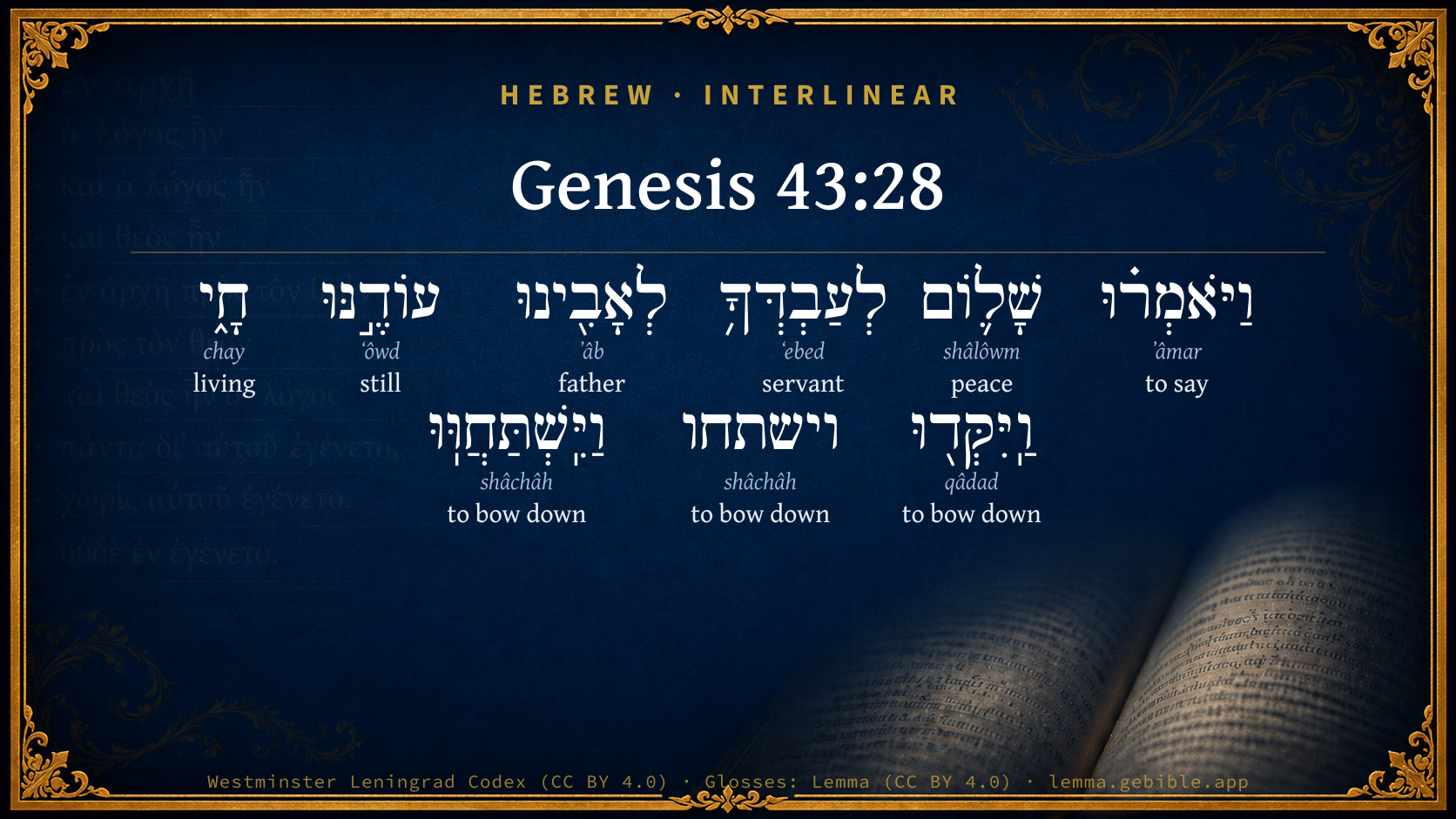
Hebrew (Westminster Leningrad Codex) Genesis 43:28 appears in the Hebrew Old Testament. The text above is from the Westminster Leningrad Codex. Each word links to its Strong’s number, a concise gloss, and parsing drawn from the Open Scriptures Hebrew Bible morphology. Click any word for its full Brown-Driver-Briggs (BDB) entry.
Download image
Cite this verse

Genesis 43:28 (World English Bible). Public Domain. Lemma interlinear Bible study tool, https://lemma.gebible.app/v/genesis/43/28.

Show BibTeX & RIS
BibTeX
RIS
English Translation
They said, "Your servant, our father, is well. He is still alive." They bowed the head, and did homage.
World English Bible · Public Domain
Download a study sheet

One document with this verse’s original text, its word-by-word gloss line, the meaning frame, cross-references with their text, attributed commentary, and full source and license credits — printable, and it pastes into notes with its structure intact.

This verse Autodidact and up

Study sheet (.html) Plain text (.txt)

A passage Seminary Student

Up to 50 verses in one chapter. A passage sheet keeps up to 6 commentary sources and 12 cross-references per verse, in the order this page ranks them, and says so on the sheet whenever that leaves anything out. Ask for a single verse and you get the Autodidact verse sheet above.

Everything on this page stays free to read, with no account — the sheet is a download of what is already on screen, not access to it.

Want to remove ads? Support Godless Engineer
Compare translations 3

The same verse in 3 English versions, stacked beneath the original-language interlinear above. Click any original word for its lexicon entry.

Each is an independent rendering of the whole verse — the interlinear is not word-aligned to these translations.

Highlighted words mark where these versions differ — a whole-verse word diff, not a word-by-word alignment.

  • World English Bible Public Domain
    They said, "Your servant, our father, is well. He is still alive." They bowed the head, and did homage.
  • King James Version Public Domain
    And they answered, Thy servant our father is in good health, he is yet alive. And they bowed down their heads, and made obeisance.
  • unfoldingWord Literal Text CC BY-SA 4.0
    And they said, “ well for your servant our father. He still alive.” Then they bowed and bowed down.

unfoldingWord Literal Text — © unfoldingWord, licensed CC BY-SA 4.0. Word-aligned USFM3 via Door43 (git.door43.org/unfoldingWord/en_ult).

Versions to compare (up to 4)

3 of 4 selected

Show all 18 translations

Every available English version of this verse, each an independent rendering of the whole verse.

  • World English Bible Public Domain
    They said, "Your servant, our father, is well. He is still alive." They bowed the head, and did homage.
  • Berean Standard Bible Public Domain
    “Your servant our father is well,” they answered. “He is still alive.” And they bowed down to honor him.
  • Majority Standard Bible Public Domain
    “Your servant our father is well,” they answered. “He is still alive.” And they bowed down to honor him.
  • King James Version Public Domain
    And they answered, Thy servant our father is in good health, he is yet alive. And they bowed down their heads, and made obeisance.
  • American Standard Version (1901) Public Domain
    And they said, Thy servant our father is well, he is yet alive. And they bowed the head, and made obeisance.
  • Revised Version (1885) Public Domain
    And they said, Thy servant our father is well, he is yet alive. And they bowed the head, and made obeisance.
  • Geneva Bible (1599) Public Domain
    Who answered, Thy seruant our father is in good health, he is yet aliue: and they bowed downe, and made obeysance.
  • Douay-Rheims (1899) Public Domain
    And they answered: Thy servant our father is in health, he is yet living. And bowing themselves they made obeisance to him.
  • Young's Literal Translation Public Domain
    and they say, `Thy servant our father `is' well, he is yet alive;' and they bow, and do obeisance.
  • Literal Standard Version CC BY-SA 4.0
    And they say, “Your servant our father [is] well, he is yet alive”; and they bow, and pay respect.
  • Unlocked Literal Bible CC BY-SA 4.0
    They said, “Your servant our father is well. He is still alive.” They prostrated themselves and bowed down.
  • unfoldingWord Literal Text CC BY-SA 4.0
    And they said, “ well for your servant our father. He still alive.” Then they bowed and bowed down.
  • Darby Bible Public Domain
    And they said, Thy servant our father is well; he is yet alive. And they bowed, and made obeisance.
  • World Messianic Bible Public Domain
    They said, “Your servant, our father, is well. He is still alive.” They bowed down humbly.
  • Webster's Bible Public Domain
    \\43:29\\And he lifted up his eyes, and saw his brother Benjamin, his mother's son, and said, Is this your younger brother, of whom ye spoke to me? And he said, God be gracious to thee, my son.
  • Free Bible Version CC BY-SA 4.0
    “Yes, your servant our father is still alive, and is well,” they replied and bowed low in respect.
  • Bible in Basic English Public Domain
    Then, lifting up his eyes, he saw Benjamin, his brother, his mother's son, and he said, Is this your youngest brother of whom you gave me word? And he said, God be good to you, my son.
  • JPS Tanakh (1917) Public Domain
    And they said: 'Thy servant our father is well, he is yet alive.' And they bowed the head, and made obeisance.

Literal Standard Version (2020), Covenant Press — licensed CC BY-SA 4.0. Text via the HelloAO Bible API (eBible.org). Unlocked Literal Bible (unfoldingWord) — licensed CC BY-SA 4.0. Text via the HelloAO Bible API (eBible.org). unfoldingWord Literal Text — © unfoldingWord, licensed CC BY-SA 4.0. Word-aligned USFM3 via Door43 (git.door43.org/unfoldingWord/en_ult). Free Bible Version, Dr. Jonathan Gallagher — licensed CC BY-SA 4.0. Text via the HelloAO Bible API (eBible.org).

Word by word

More ways to search: Search by grammar → Find every occurrence → Compare this word →

Practice this passage: Drill this verse → Learn its vocabulary →

וַֽיִּקְּד֖וּ
qâdad
H6915
“and · to bow down”
Conjunction + Verb, Qal, Sequential Imperfect, 3rd Person, Masculine, Plural
Part of Speech
Conjunction + Verb
Stem
Qal
Form
Sequential Imperfect
Person
3rd Person
Gender
Masculine
Number
Plural
Full BDB Definition

Origin: a primitive root

TWOT: 1985

(Qal) to bow down
  1. וַיֹּאמְר֗וּ ʼâmar H559 “and · to say” Conjunction + Verb, Qal, Sequential Imperfect, 3rd Person, Masculine, Plural
  2. שָׁל֛וֹם shâlôwm H7965 “peace” Noun, Common, Masculine, Singular, Absolute
  3. לְעַבְדְּךָ֥ ʻebed H5650 “to/for · servant · your” Preposition + Noun, Common, Masculine, Singular, Construct + Suffix, Personal, 2nd Person, Masculine, Singular
  4. לְאָבִ֖ינוּ ʼâb H1 “to/for · father · our” Preposition + Noun, Common, Masculine, Singular, Construct + Suffix, Personal, 1st Person, Common, Plural
  5. עוֹדֶ֣נּוּ ʻôwd H5750 “still · his” Adverb + Suffix, Personal, 3rd Person, Masculine, Singular
  6. חָ֑י chay H2416 “living” Adjective, Adjective, Masculine, Singular, Absolute
  7. וישתחו shâchâh H7812 “and · to bow down” Conjunction + Verb, Hishtaphel, Sequential Imperfect, 3rd Person, Masculine, Singular
  8. וַיִּֽשְׁתַּחֲוּֽוּ shâchâh H7812 “and · to bow down” Conjunction + Verb, Hishtaphel, Sequential Imperfect, 3rd Person, Masculine, Plural

About this verse

These counts appear in no published source. They are computed here, from the morphology-tagged text and Lemma’s own curated glosses. What Lemma adds →

9
words
8
distinct lemmas
Pentateuch
section

Notable vocabulary

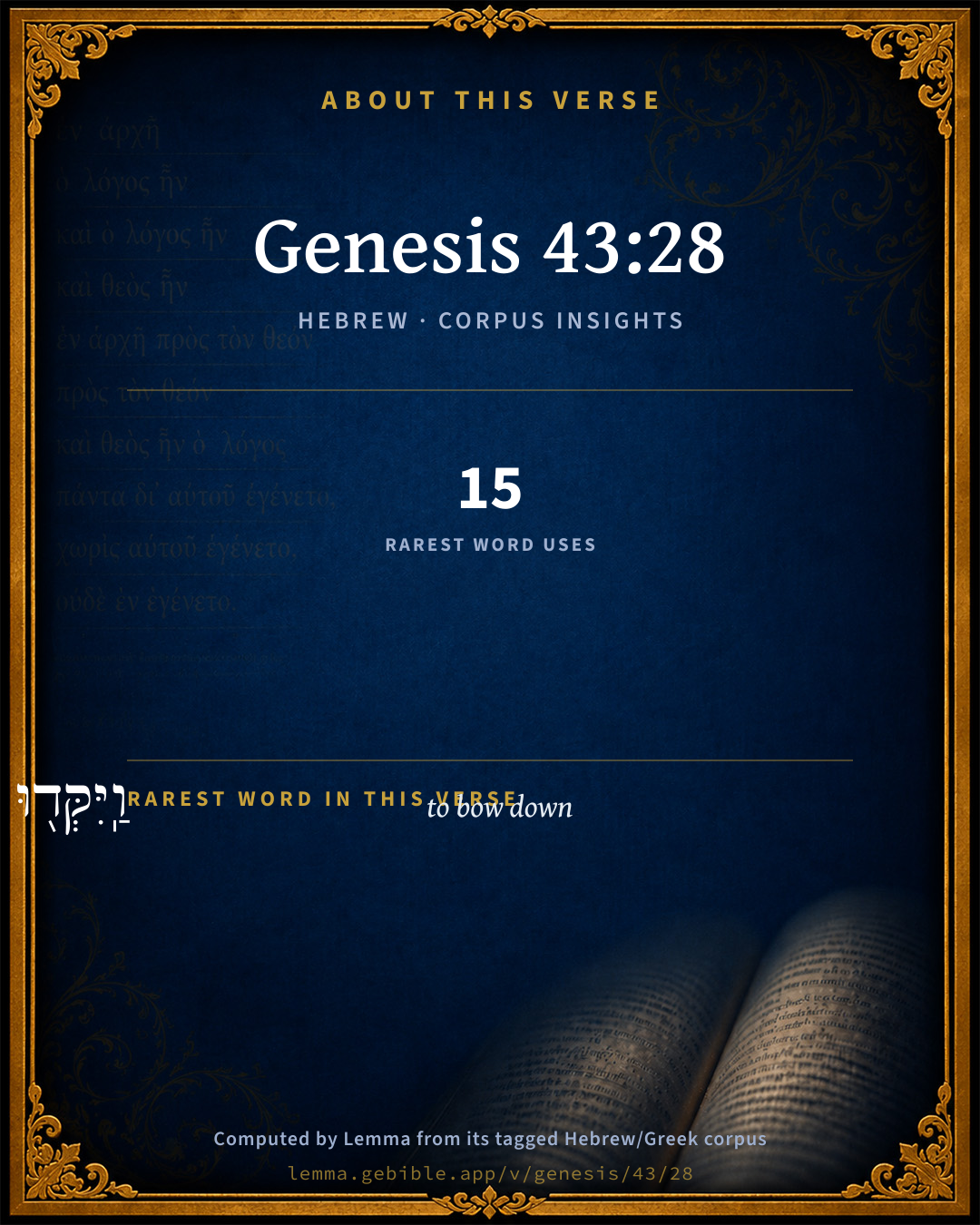
The rarest word here is וַֽיִּקְּד֖וּ to bow down H6915 — appearing just 15 times in the whole Hebrew Bible.

Shared distinctive vocabulary

וַֽיִּקְּד֖וּ to bow down H6915 occurs in 15 verses of the Hebrew Bible. Also found in:

Grammatical profile

  • 4 verbs
  • 3 nouns
  • 1 adjective
  • 1 adverb

Verb forms

  • וַיֹּאמְר֗וּ Qal · Sequential Imperfect
  • וַֽיִּקְּד֖וּ Qal · Sequential Imperfect
  • וישתחו Hishtaphel · Sequential Imperfect
  • וַיִּֽשְׁתַּחֲוּֽוּ Hishtaphel · Sequential Imperfect

Repetition

A word recurs within this verse — often emphatic in Hebrew:

  • וישתחו to bow down H7812 ×2

Hebrew & Septuagint length

In English translation the verse runs 19 words from the Hebrew and 29 from the Septuagint (LXX English) — the Septuagint runs noticeably longer here. See the side-by-side →

A rough comparison of the two English renderings, which tokenize alike — not a word-level alignment.

Word counts can differ between the Hebrew and the Greek without any difference in meaning — e.g. the Hebrew direct-object marker אֵת has no separate Greek word, and Greek often adds the article ὁ.

Cross-references

8

Topical passages linked to Genesis 43:28 in the Treasury of Scripture Knowledge — connected by theme and wording, ordered by reader-vote popularity; previews shown in the World English Bible.

  • Genesis 37:7 for, behold, we were binding sheaves in the field, and behold, my sheaf arose and also stood upright; and behold, your sheaves came around, and bowed down to my sheaf."
  • Genesis 43:26 When Joseph came home, they brought him the present which was in their hand into the house, and bowed down themselves to him to the earth.
  • Genesis 37:9–10 He dreamed yet another dream, and told it to his brothers, and said, "Behold, I have dreamed yet another dream: and behold, the sun and the moon and eleven stars bowed down to me."
  • Exodus 18:7 Moses went out to meet his father-in-law, and bowed and kissed him. They asked each other of their welfare, and they came into the tent.
  • 2 Samuel 1:2 it happened on the third day, that behold, a man came out of the camp from Saul, with his clothes torn, and earth on his head: and so it was, when he came to David, that he fell to the earth, and did obeisance.
  • 2 Samuel 14:4 When the woman of Tekoa spoke to the king, she fell on her face to the ground, and did obeisance, and said, Help, O king.
  • 1 Kings 1:16 Bathsheba bowed, and did obeisance to the king. The king said, What would you?
  • 2 Chronicles 24:17 Now after the death of Jehoiada came the princes of Judah, and made obeisance to the king. Then the king listened to them.

Cross-references courtesy of OpenBible.info (CC BY 4.0).

Hebrew and Greek witnesses Masoretic Hebrew ↔ Greek Septuagint

The same verse in the two great witnesses to the Old Testament, shown verse-for-verse.

Here the Septuagint runs noticeably longer than the Hebrew — LXX2012 (modern English Septuagint) 29 words vs World English Bible 19. A rough length comparison of the two English translations, not a word-level alignment — read both below.

These are two independent witnesses, not word-aligned to each other, and the Septuagint is shown in lemma (dictionary) form.

Hebrew Genesis 43:28 Masoretic · Westminster Leningrad Codex

וַיֹּאמְר֗וּ שָׁל֛וֹם לְעַבְדְּךָ֥ לְאָבִ֖ינוּ עוֹדֶ֣נּוּ חָ֑י וַֽיִּקְּד֖וּ וישתחו וַיִּֽשְׁתַּחֲוּֽוּ

They said, "Your servant, our father, is well. He is still alive." They bowed the head, and did homage.

World English Bible · Public Domain

Greek LXX Genesis 43:28 Septuagint · lemma form

ὁ δέ εἶπον ὑγιαίνω ὁ παῖς σύ ὁ πατήρ ἐγώ ἔτι ζάω καί εἶπον εὐλογητός ὁ ἄνθρωπος ἐκεῖνος ὁ θεός καί κύπτω προςκυνέω αὐτός

And they said, Your servant our father is well; he is yet alive. And he said, Blessed be that man by God; —and they bowed, and did him reverence.

LXX2012 (modern English Septuagint) · Public Domain

On this verse, Haydock's Catholic Bible Commentary discusses the Septuagint’s reading. Read the note in Commentary ↓

Hebrew: Westminster Leningrad Codex (CC BY 4.0). Greek: Septuagint (public domain); English from LXX2012 (modern English Septuagint) (Public Domain). How the Septuagint differs from the Hebrew →

Targum (Aramaic paraphrase)

2

The Targum is the ancient Jewish Aramaic paraphrase of the Hebrew Scriptures — an interpretive translation, not the Hebrew text itself. Onkelos (literal) and Pseudo-Jonathan (expansive) render the Torah, and Jonathan the Prophets. Coverage is partial: where no permissively-licensed English translation exists for a verse, only the Aramaic is shown. This is verse-level text, not a word-by-word alignment to the Hebrew.

  1. Targum Onkelos Torah (Genesis–Deuteronomy)
    וַאֲמָרוּ שְׁלַם לְעַבְדָךְ לְאָבוּנָא עַד כְּעַן קַיָּם וּכְרָעוּ וּסְגִידוּ

    (no public-domain English translation for this verse)

    Targum Onkelos — Aramaic: “Onkelos Genesis” (public domain); “Onkelos Exodus” (public domain); “Onkelos Leviticus” (public domain); “Onkelos Numbers” (public domain); “Onkelos Deuteronomy” (public domain). English: “Sefaria Community Translation” (CC0 1.0 (public-domain dedication)); “J.W. Etheridge. The Targums of Onkelos and Jonathan Ben Uzziel on the Pentateuch. London: Longmans, Green, 1862” (public domain). Text via Sefaria.

  2. Targum Pseudo-Jonathan Torah (Genesis–Deuteronomy)
    וַאֲמָרוּ שְׁלַם לְעַבְדָךְ לְאָבוּנָא עַד כְּדוֹן הוּא קַיֵים וְגַחֲנוּ וּסְגִידוּ

    They answered, It is well with thy servant our father; he is yet alive. And they bowed and made obeisance.

    Targum Pseudo-Jonathan — Aramaic: “Targum Jonathan on Genesis” (public domain); “Targum Jonathan on Exodus” (public domain); “Targum Jonathan on Leviticus” (public domain); “Targum Jonathan on Numbers” (public domain); “Targum Jonathan on Deuteronomy” (public domain). English: “The Targum of Jonathan ben Uzziel, trans. J. W. Etheridge, London, 1862” (public domain). Text via Sefaria.

Commentary

Notes on Genesis 43:28 from classic Christian and Jewish commentators (each source and its license shown beneath its notes). The classic Christian expositions comment on the surrounding passage and are grouped to its opening verse, so a note may address several verses; the Jewish commentaries on the Tanakh (Rashi and others) are per-verse, so they appear only where the commentator wrote on this verse.

Lemma curates 59 commentaries, every one of them public domain or Creative Commons licensed, each selected and text-cleaned for this edition rather than reprinted as found. About our sources →

Trapp's Complete Commentary

John Trapp

Gen 43:28 And they answered, Thy servant our father [is] in good health, he [is] yet alive. And they bowed down their heads, and made obeisance.

Ver. 28. {See Trapp on "Gen 43:26"}

John Trapp, A Commentary or Exposition upon All the Books of the Old and New Testament (1647–1656) — public domain. Text from a community e-Sword module.

Joseph Benson's Commentary

Gen 43:28. When they brought him the present, they bowed themselves before him, and again, when they gave him an account of their father’s health, they made obeisance, and called him, Thy servant, our father — Thus were Joseph’s dreams fulfilled more and more; and even the father, by the sons, bowed before him. Probably Jacob had directed them, if they had occasion to speak of him to the man, the lord of the land, to call him his servant.

Joseph Benson's Commentary on the Old and New Testaments (1811–1818) — public domain. Text from a community e-Sword module.

Ellicott's Commentary for English Readers

(28) They bowed down.—This was the literal fulfilment of the first dream concerning the eleven sheaves making obeisance. As their business in Egypt was to buy corn, there was a fitness also in their being represented as sheaves.

A Bible Commentary for English Readers, edited by Charles John Ellicott (1878–1897) — public domain. Text from a community e-Sword module.

John Gill's Exposition

And he lifted up his eyes and saw his brother Benjamin,.... He had seen him before when his brethren first presented themselves to him, but then took no particular and special notice of him, only gave him a side look as it were, but now he looked wistly at him:

his mother's son; the son of Rachel his mother, and who was his only brother by his mother's side, the rest, though his brethren, yet only by his father's side, not his mother's sons:

and said, is this your younger brother, of whom ye spake unto me? he knew he was the same, but was willing to have it from their mouths, to lead on to what he had further to say:

and he said; after they had answered his question, and told him it was he:

God be gracious unto thee, my son; speaking as a superior, a governor, in which capacity he was a father to his inferiors; and as a man, a relation, a brother, though not as yet discovered; he spoke in the most tender and affectionate manner, and, as a religious good man, he wishes the best thing he could for his brother, the grace and goodness of God; and which may be understood in the largest and most expressive sense, as including all good things, temporal, spiritual, and eternal.

John Gill's Exposition of the Whole Bible (1746–1763) — public domain (CC PDM 1.0). Text via the HelloAO Bible API.

Haydock's Catholic Bible Commentary

Living. The Samaritan and Septuagint add, "Joseph replied, Blessed be he of God: and bowing themselves," &c. Thus all Joseph’s brethren adore him, chap. xxxvii. 7. (Haydock)

George Leo Haydock (1774–1849), Haydock's Catholic Family Bible and Commentary, 1859 edition — public domain. Excludes Psalms (Douay-Rheims chapter numbering differs from Protestant) and Deuterocanonical books (Catholic canon only).

Matthew Poole's English Annotations

Thy servant; by which expression delivered in Jacob’s name, and by his order, Jacob himself made obeisance to him, as was foretold, Gen 37:9.

Matthew Poole's English Annotations on the Holy Bible (1683–1685) — public domain. Text from a community e-Sword/MySword module.

The Pulpit Commentary

And they answered, Thy servant our father is in good health, he is yet alive. And they bowed down their heads, and made obeisance.

The Pulpit Commentary (1880–1919), ed. H.D.M. Spence-Jones & Joseph S. Exell — public domain. Text from a community e-Sword module.

unfoldingWord translationNotes

Door43 World Missions Community

Your servant our father

They refer to their father as "Your servant" to show respect. AT: "Our father who serves you"

They prostrated themselves and bowed down

These words basically mean the same thing. They laid down in front of the man to show him respect. AT: "They bowed down in front of him" (See: Symbolic Action)

he lifted up his eyes

This means "he looked up." (See: Idiom)

his mother's son, and he said

This can be translated with a new sentence. AT: "his mother's son. Joseph said"

Is this your youngest brother ... me?

Possible meanings are 1) Joseph is truly asking a question to confirm that this man is Benjamin, or 2) it is a rhetorical question. AT: "So this is your youngest brother ... me." (See: Rhetorical Question)

my son

This is a friendly way one man speaks to another man of lower rank. AT: "young man"

translationWords

servant

prostrate

bow

Benjamin

grace

unfoldingWord translationNotes — © Distant Shores Media and the Door43 World Missions Community, licensed CC BY-SA 4.0. Source: git.door43.org/Door43/en_tn.

Rashi

Rabbi Shlomo Yitzchaki (Rashi)

ויקדו וישתחו AND THEY BOWED THE HEAD AND PROSTRATED THEMSELVES — in recognition of his enquiry regarding their welfare. The root קדד denotes bowing the head: the verb שחה in the Hiphil denotes prostration upon the ground (Megillah 22b).

Rashi on the Tanakh — English translations: “The Judaica Press complete Tanach with Rashi, translated by A. J. Rosenberg” (CC BY 4.0); “Pentateuch with Rashi's commentary by M. Rosenbaum and A.M. Silbermann, 1929-1934” (public domain); “The Metsudah Tanach series, Lakewood, N.J” (CC BY 4.0); and “The Book of Joshua, Metsudah Publications, 1997” (CC BY 4.0). Text via Sefaria.

Radak

Rabbi David Kimhi (Radak)

ויקדו וישתחוו, when they prostrated themselves this was with the intention of making an obeisance to their father after whom Joseph had inquired (although outwardly, this was not noticeable).

Radak on the Tanakh — English translations: “Sefaria Community Translation” (CC0 1.0 (public-domain dedication)); “Eliyahu Munk, HaChut Hameshulash” (CC BY 4.0); “Rabbi Mike Feuer, Jerusalem Anthology” (CC BY 4.0); and “R. David Kimhi on the first book of Psalms, Translated by R.G. Finch, London, 1919” (public domain). Text via Sefaria.

Ibn Ezra

Rabbi Abraham ibn Ezra

They bowed (vayikdu) … and prostrated. They lowered their heads (kadkod) to the ground after having already prostrated themselves.

Ibn Ezra on the Tanakh — English translations: “Sefaria Community Translation” (CC0 1.0 (public-domain dedication)); “Yalkut, Sifsei Chachomim Chumash, Metsudah Publications, 2009” (CC BY 4.0); and “Commentary of Ibn Ezra on Isaiah - trans. by M. Friedlander, 1873” (public domain). Text via Sefaria.

Lesson kit

Teaching starters — assembled from the data on this page, not authored interpretation. Every prompt links to the verse data it draws on. Edit before teaching.

Genesis, in the Pentateuch, opens this verse with 9 words (8 distinct Hebrew lemmas). Its most distinctive word is qâdad (“to bow down”). The Greek Septuagint runs longer here. A historical commentator’s framing appears above. Read the whole chapter for the surrounding context.

Discussion questions

  1. How does “to bow down” (qâdad) shape what this verse is saying?
  2. How does Genesis 24:26, which shares the word «to bow down», read alongside this verse?
  3. What does the repetition of “to bow down” (2× in this one verse) do in this verse?
  4. The Septuagint runs longer here than the Hebrew. What might account for the difference?
  5. These translations render this verse differently. What is at stake in choosing one wording over another?
  6. «וַיֹּאמְר֗וּ» is a Qal Sequential Imperfect verb. How does that grammatical form shape the action described?
  7. Compare how Trapp's Complete Commentary and Joseph Benson's Commentary read this verse. Where do they agree or differ?

Things to notice

  • These translations choose different wording for 13 words in this verse.
  • “to bow down” occurs 2× in this single verse.
  • 8 distinct Hebrew lemmas span 9 words in this verse.

Reading settings

Reading text

Shown beneath each verse's original-language words.

Old Testament
Old Testament edition

Read the OT as the Masoretic Hebrew (MT) or the Greek Septuagint (LXX).

English shown for the Greek Septuagint (in the Hebrew ↔ Greek comparison).

Comparing translations? Open the Compare panel on any verse page to stack up to four side by side.