
Genesis 45:27

Hebrew (Westminster Leningrad Codex) Genesis 45:27 appears in the Hebrew Old Testament. The text above is from the Westminster Leningrad Codex. Each word links to its Strong’s number, a concise gloss, and parsing drawn from the Open Scriptures Hebrew Bible morphology. Click any word for its full Brown-Driver-Briggs (BDB) entry.
Download image
Cite this verse

Genesis 45:27 (World English Bible). Public Domain. Lemma interlinear Bible study tool, https://lemma.gebible.app/v/genesis/45/27.

Show BibTeX & RIS
BibTeX
RIS
English Translation
They told him all the words of Joseph, which he had said to them. When he saw the wagons which Joseph had sent to carry him, the spirit of Jacob, their father, revived.
World English Bible · Public Domain
Download a study sheet

One document with this verse’s original text, its word-by-word gloss line, the meaning frame, cross-references with their text, attributed commentary, and full source and license credits — printable, and it pastes into notes with its structure intact.

This verse Autodidact and up

Study sheet (.html) Plain text (.txt)

A passage Seminary Student

Up to 50 verses in one chapter. A passage sheet keeps up to 6 commentary sources and 12 cross-references per verse, in the order this page ranks them, and says so on the sheet whenever that leaves anything out. Ask for a single verse and you get the Autodidact verse sheet above.

Everything on this page stays free to read, with no account — the sheet is a download of what is already on screen, not access to it.

Want to remove ads? Support Godless Engineer
Compare translations 3

The same verse in 3 English versions, stacked beneath the original-language interlinear above. Click any original word for its lexicon entry.

Each is an independent rendering of the whole verse — the interlinear is not word-aligned to these translations.

Highlighted words mark where these versions differ — a whole-verse word diff, not a word-by-word alignment.

  • World English Bible Public Domain
    They told him all the words of Joseph, which he had said to them. When he saw the wagons which Joseph had sent to carry him, the spirit of Jacob, their father, revived.
  • King James Version Public Domain
    And they told him all the words of Joseph, which he had said unto them: and when he saw the wagons which Joseph had sent to carry him, the spirit of Jacob their father revived:
  • unfoldingWord Literal Text CC BY-SA 4.0
    Then they told him all the words of Joseph that he had spoken to them, and he saw the carts that Joseph had sent to carry him, then the spirit of Jacob their father revived.

unfoldingWord Literal Text — © unfoldingWord, licensed CC BY-SA 4.0. Word-aligned USFM3 via Door43 (git.door43.org/unfoldingWord/en_ult).

Versions to compare (up to 4)

3 of 4 selected

Show all 18 translations

Every available English version of this verse, each an independent rendering of the whole verse.

  • World English Bible Public Domain
    They told him all the words of Joseph, which he had said to them. When he saw the wagons which Joseph had sent to carry him, the spirit of Jacob, their father, revived.
  • Berean Standard Bible Public Domain
    However, when they relayed all that Joseph had told them, and when he saw the wagons that Joseph had sent to carry him back, the spirit of their father Jacob was revived.
  • Majority Standard Bible Public Domain
    However, when they relayed all that Joseph had told them, and when he saw the wagons that Joseph had sent to carry him back, the spirit of their father Jacob was revived.
  • King James Version Public Domain
    And they told him all the words of Joseph, which he had said unto them: and when he saw the wagons which Joseph had sent to carry him, the spirit of Jacob their father revived:
  • American Standard Version (1901) Public Domain
    And they told him all the words of Joseph, which he had said unto them: and when he saw the wagons which Joseph had sent to carry him, the spirit of Jacob their father revived:
  • Revised Version (1885) Public Domain
    And they told him all the words of Joseph, which he had said unto them: and when he saw the wagons which Joseph had sent to carry him, the spirit of Jacob their father revived:
  • Geneva Bible (1599) Public Domain
    And they told him al the words of Ioseph, which he had said vnto the: but when he saw the charets, which Ioseph had sent to cary him, then the spirit of Iaakob their father reuiued.
  • Douay-Rheims (1899) Public Domain
    They, on the other side, told the whole order of the thing. And when he saw the wagons and all that he had sent his spirit revived,
  • Young's Literal Translation Public Domain
    And they speak unto him all the words of Joseph, which he hath spoken unto them, and he seeth the waggons which Joseph hath sent to bear him away, and live doth the spirit of Jacob their father;
  • Literal Standard Version CC BY-SA 4.0
    And they speak to him all the words of Joseph, which he has spoken to them, and he sees the wagons which Joseph has sent to carry him away, and the spirit of their father Jacob lives;
  • Unlocked Literal Bible CC BY-SA 4.0
    They told him all the words of Joseph that he had said to them. When Jacob saw the carts that Joseph had sent to carry him, the spirit of Jacob their father revived.
  • unfoldingWord Literal Text CC BY-SA 4.0
    Then they told him all the words of Joseph that he had spoken to them, and he saw the carts that Joseph had sent to carry him, then the spirit of Jacob their father revived.
  • Darby Bible Public Domain
    And they spoke to him all the words of Joseph, which he had spoken to them. And he saw the waggons that Joseph had sent to carry him. And the spirit of Jacob their father revived.
  • World Messianic Bible Public Domain
    They told him all the words of Joseph, which he had said to them. When he saw the wagons which Joseph had sent to carry him, the spirit of Jacob, their father, revived.
  • Webster's Bible Public Domain
    And they told him all the words of Joseph, which he had said to them: and when he saw the wagons which Joseph had sent to carry him, the spirit of Jacob their father revived:
  • Free Bible Version CC BY-SA 4.0
    But when they told him everything that Joseph had said to them, and when he saw the wagons that Joseph had sent to take him to Egypt, Jacob came back to his senses.
  • Bible in Basic English Public Domain
    And they gave him an account of everything Joseph had said to them; and when he saw the carts which Joseph had sent for them, his spirit came back to him:
  • JPS Tanakh (1917) Public Domain
    And they told him all the words of Joseph, which he had said unto them; and when he saw the wagons which Joseph had sent to carry him, the spirit of Jacob their father revived.

Literal Standard Version (2020), Covenant Press — licensed CC BY-SA 4.0. Text via the HelloAO Bible API (eBible.org). Unlocked Literal Bible (unfoldingWord) — licensed CC BY-SA 4.0. Text via the HelloAO Bible API (eBible.org). unfoldingWord Literal Text — © unfoldingWord, licensed CC BY-SA 4.0. Word-aligned USFM3 via Door43 (git.door43.org/unfoldingWord/en_ult). Free Bible Version, Dr. Jonathan Gallagher — licensed CC BY-SA 4.0. Text via the HelloAO Bible API (eBible.org).

Word by word

More ways to search: Search by grammar → Find every occurrence → Compare this word →

Practice this passage: Drill this verse → Learn its vocabulary →

הָ֣עֲגָל֔וֹת
ʻăgâlâh
H5699
“the · wagons”
Particle, Definite Article + Noun, Common, Feminine, Plural, Absolute
Part of Speech
Particle + Noun
Type
Common
Gender
Feminine
Number
Plural
State
Absolute
Full BDB Definition

Origin: from the same as H5696

TWOT: 1560d

cart, wagon
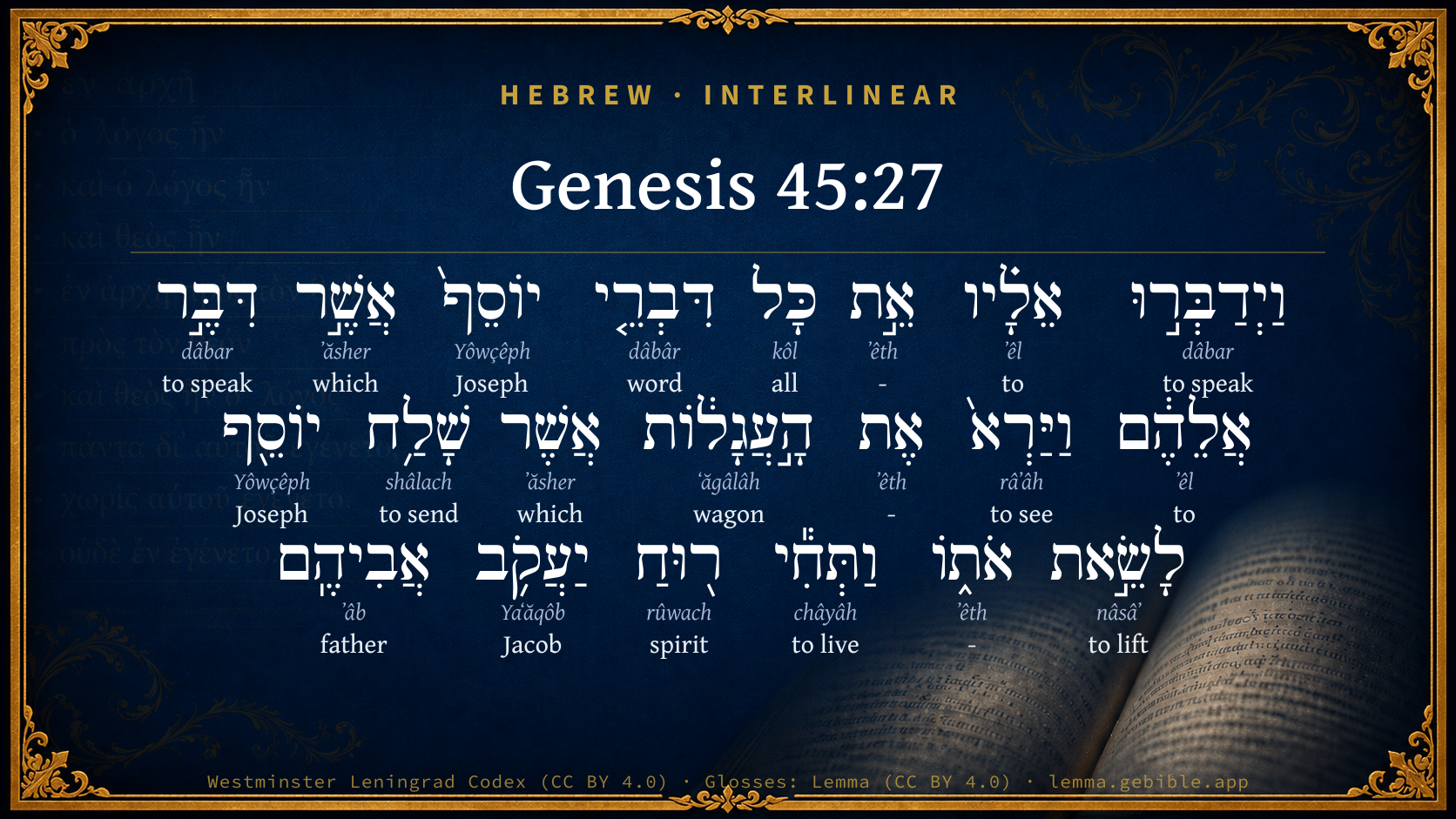
  1. וַיְדַבְּר֣וּ dâbar H1696 “and · to speak” Conjunction + Verb, Piel, Sequential Imperfect, 3rd Person, Masculine, Plural
  2. אֵלָ֗יו ʼêl H413 “to · him” Preposition + Suffix, Personal, 3rd Person, Masculine, Singular
  3. אֵ֣ת ʼêth H853 “-” Particle, Direct Object
  4. כָּל kôl H3605 “all of” Noun, Common, Masculine, Singular, Construct
  5. דִּבְרֵ֤י dâbâr H1697 “words of” Noun, Common, Masculine, Plural, Construct
  6. יוֹסֵף֙ Yôwçêph H3130 “Joseph” Noun, Proper
  7. אֲשֶׁ֣ר ʼăsher H834 “which” Particle, Relative
  8. דִּבֶּ֣ר dâbar H1696 “to speak” Verb, Piel, Perfect, 3rd Person, Masculine, Singular
  9. אֲלֵהֶ֔ם ʼêl H413 “to · them” Preposition + Suffix, Personal, 3rd Person, Masculine, Plural
  10. וַיַּרְא֙ râʼâh H7200 “and · to see” Conjunction + Verb, Qal, Sequential Imperfect, 3rd Person, Masculine, Singular
  11. אֶת ʼêth H853 “-” Particle, Direct Object
  12. אֲשֶׁר ʼăsher H834 “which” Particle, Relative
  13. שָׁלַ֥ח shâlach H7971 “to send” Verb, Qal, Perfect, 3rd Person, Masculine, Singular
  14. יוֹסֵ֖ף Yôwçêph H3130 “Joseph” Noun, Proper
  15. לָשֵׂ֣את nâsâʼ H5375 “to lift” Preposition + Verb, Qal, Infinitive Construct
  16. אֹת֑וֹ ʼêth H853 “- · him” Particle, Direct Object + Suffix, Personal, 3rd Person, Masculine, Singular
  17. וַתְּחִ֕י châyâh H2421 “and · to live” Conjunction + Verb, Qal, Sequential Imperfect, 3rd Person, Feminine, Singular
  18. ר֖וּחַ rûwach H7307 “spirit of” Noun, Common, Both, Singular, Construct
  19. יַעֲקֹ֥ב Yaʻăqôb H3290 “Jacob” Noun, Proper
  20. אֲבִיהֶֽם ʼâb H1 “father · their” Noun, Common, Masculine, Singular, Construct + Suffix, Personal, 3rd Person, Masculine, Plural

About this verse

These counts appear in no published source. They are computed here, from the morphology-tagged text and Lemma’s own curated glosses. What Lemma adds →

21
words
15
distinct lemmas
Pentateuch
section

Notable vocabulary

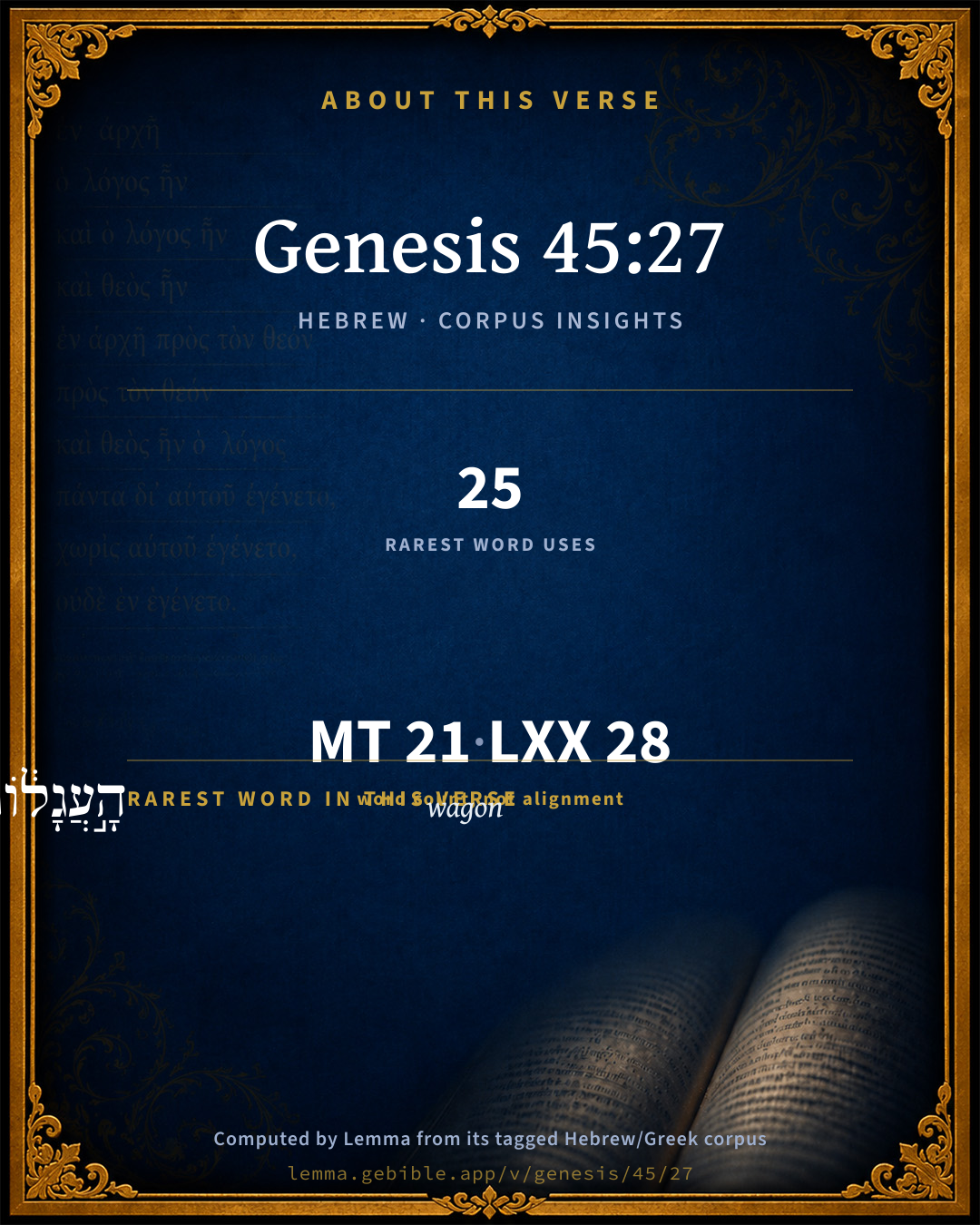
The rarest word here is הָ֣עֲגָל֔וֹת wagon H5699 — appearing just 25 times in the whole Hebrew Bible.

Shared distinctive vocabulary

הָ֣עֲגָל֔וֹת wagon H5699 occurs in 20 verses of the Hebrew Bible. Also found in:

Grammatical profile

  • 6 verbs
  • 8 nouns
  • 2 prepositions
  • 5 particles

Verb forms

  • וַיְדַבְּר֣וּ Piel · Sequential Imperfect
  • דִּבֶּ֣ר Piel · Perfect
  • וַיַּרְא֙ Qal · Sequential Imperfect
  • שָׁלַ֥ח Qal · Perfect
  • לָשֵׂ֣את Qal · Infinitive Construct
  • וַתְּחִ֕י Qal · Sequential Imperfect

Repetition

Words recur within this verse — often emphatic in Hebrew:

  • וַיְדַבְּר֣וּ to speak H1696 ×2
  • יוֹסֵף֙ Joseph H3130 ×2
  • אֵלָ֗יו to H413 ×2
  • אֲשֶׁ֣ר which H834 ×2

Hebrew & Septuagint length

In English translation the verse runs 33 words from the Hebrew and 35 from the Septuagint (LXX English) — closely comparable.

A rough comparison of the two English renderings, which tokenize alike — not a word-level alignment.

Word counts can differ between the Hebrew and the Greek without any difference in meaning — e.g. the Hebrew direct-object marker אֵת has no separate Greek word, and Greek often adds the article ὁ.

In the original languages it is 21 Hebrew tokens and 28 Greek tokens — but the two are counted differently (Hebrew bundles its prefixes and suffixes into one token; the Greek is in lemma form), so that isn’t a like-for-like length.

Cross-references

6

Topical passages linked to Genesis 45:27 in the Treasury of Scripture Knowledge — connected by theme and wording, ordered by reader-vote popularity; previews shown in the World English Bible.

  • Genesis 45:19 Now you are commanded: do this. Take wagons out of the land of Egypt for your little ones, and for your wives, and bring your father, and come.
  • Psalms 85:6 Won't you revive us again, That your people may rejoice in you?
  • Isaiah 57:15 For thus says the high and lofty One who inhabits eternity, whose name is Holy: I dwell in the high and holy place, with him also who is of a contrite and humble spirit, to revive the spirit of the humble, and to revive the heart of the contrite.
  • 1 Samuel 30:12 They gave him a piece of a cake of figs, and two clusters of raisins: and when he had eaten, his spirit came again to him; for he had eaten no bread, nor drunk any water, three days and three nights.
  • Hosea 6:2 After two days will he revive us. On the third day he will raise us up, And we will live before him.
  • Judges 15:19 But God split the hollow place that is in Lehi, and water came out of it. When he had drunk, his spirit came again, and he revived: therefore the name of it was called En Hakkore, which is in Lehi, to this day.

Cross-references courtesy of OpenBible.info (CC BY 4.0).

Hebrew and Greek witnesses Masoretic Hebrew ↔ Greek Septuagint

The same verse in the two great witnesses to the Old Testament, shown verse-for-verse.

These are two independent witnesses, not word-aligned to each other, and the Septuagint is shown in lemma (dictionary) form.

Hebrew Genesis 45:27 Masoretic · Westminster Leningrad Codex

וַיְדַבְּר֣וּ אֵלָ֗יו אֵ֣ת כָּל דִּבְרֵ֤י יוֹסֵף֙ אֲשֶׁ֣ר דִּבֶּ֣ר אֲלֵהֶ֔ם וַיַּרְא֙ אֶת הָ֣עֲגָל֔וֹת אֲשֶׁר שָׁלַ֥ח יוֹסֵ֖ף לָשֵׂ֣את אֹת֑וֹ וַתְּחִ֕י ר֖וּחַ יַעֲקֹ֥ב אֲבִיהֶֽם

They told him all the words of Joseph, which he had said to them. When he saw the wagons which Joseph had sent to carry him, the spirit of Jacob, their father, revived.

World English Bible · Public Domain

Greek LXX Genesis 45:27 Septuagint · lemma form

λαλέω δέ αὐτός πᾶς ὁ εἶπον ὑπό ιωσηφ ὅσος εἶπον αὐτός ὁράω δέ ὁ ἅμαξα ὅς ἀποστέλλω ιωσηφ ὥστε ἀναλαμβάνω αὐτός ἀναζωπυρέω ὁ πνεῦμα ἰακώβ ὁ πατήρ αὐτός

But they spoke to him all the words uttered by Joseph, whatever he said to them; and having seen the chariots which Joseph sent to take him up, the spirit of Jacob their father revived.

LXX2012 (modern English Septuagint) · Public Domain

On this verse, Adam Clarke's Commentary discusses the Septuagint’s reading. Read the note in Commentary ↓

Hebrew: Westminster Leningrad Codex (CC BY 4.0). Greek: Septuagint (public domain); English from LXX2012 (modern English Septuagint) (Public Domain). How the Septuagint differs from the Hebrew →

Targum (Aramaic paraphrase)

2

The Targum is the ancient Jewish Aramaic paraphrase of the Hebrew Scriptures — an interpretive translation, not the Hebrew text itself. Onkelos (literal) and Pseudo-Jonathan (expansive) render the Torah, and Jonathan the Prophets. Coverage is partial: where no permissively-licensed English translation exists for a verse, only the Aramaic is shown. This is verse-level text, not a word-by-word alignment to the Hebrew.

  1. Targum Onkelos Torah (Genesis–Deuteronomy)
    וּמַלִּילוּ עִמֵּהּ יָת כָּל פִּתְגָּמֵי יוֹסֵף דִּי מַלִּיל עִמְּהוֹן וַחֲזָא יָת עֲגַלָּתָא דִּשְׁלַח יוֹסֵף לְמִטַּל יָתֵהּ וּשְׁרַת רוּחַ נְבוּאָה עַל יַעֲקֹב אֲבוּהוֹן

    (no public-domain English translation for this verse)

    Targum Onkelos — Aramaic: “Onkelos Genesis” (public domain); “Onkelos Exodus” (public domain); “Onkelos Leviticus” (public domain); “Onkelos Numbers” (public domain); “Onkelos Deuteronomy” (public domain). English: “Sefaria Community Translation” (CC0 1.0 (public-domain dedication)); “J.W. Etheridge. The Targums of Onkelos and Jonathan Ben Uzziel on the Pentateuch. London: Longmans, Green, 1862” (public domain). Text via Sefaria.

  2. Targum Pseudo-Jonathan Torah (Genesis–Deuteronomy)
    וּמַלִילוּ עִמֵיהּ יַת כָּל פִּתְגָמֵי יוֹסֵף דְמַלֵיל עִמְהוֹן וַחֲמָא יַת סְדָנַיָיא דְשָׁדַר יוֹסֵף לְמִיטוּל יָתֵיהּ וּשְׁרַת רוּחַ נְבוּאָה דְאִיסְתַּלְקַת מִנֵיהּ בְּעִידַן דְזַבִּינוּ יַת יוֹסֵף וְתָבַת עֲלוֹי יַעֲקב אֲבוּהוֹן

    And they told him all the words of Joseph which he had spoken to them. And when he saw the waggons which Joseph had sent to bring him, the Spirit of Prophecy which had gone up from him at the time that Joseph was sold, returning, rested upon Jakob their father.

    Targum Pseudo-Jonathan — Aramaic: “Targum Jonathan on Genesis” (public domain); “Targum Jonathan on Exodus” (public domain); “Targum Jonathan on Leviticus” (public domain); “Targum Jonathan on Numbers” (public domain); “Targum Jonathan on Deuteronomy” (public domain). English: “The Targum of Jonathan ben Uzziel, trans. J. W. Etheridge, London, 1862” (public domain). Text via Sefaria.

Commentary

Notes on Genesis 45:27 from classic Christian and Jewish commentators (each source and its license shown beneath its notes). The classic Christian expositions comment on the surrounding passage and are grouped to its opening verse, so a note may address several verses; the Jewish commentaries on the Tanakh (Rashi and others) are per-verse, so they appear only where the commentator wrote on this verse.

Lemma curates 59 commentaries, every one of them public domain or Creative Commons licensed, each selected and text-cleaned for this edition rather than reprinted as found. About our sources →

Trapp's Complete Commentary

John Trapp

Gen 45:27 And they told him all the words of Joseph, which he had said unto them: and when he saw the wagons which Joseph had sent to carry him, the spirit of Jacob their father revived:

Ver. 27. When he saw the wagons.] Such assurance have deeds above words, {a} Nos non eloquitour magna, sed vivimus, said those primitive Christians. And no Christian is an ill-lived man, unless he be a pretender only to that religion, saith Athenagoras, in his apclogy for them. {b} For as one said of David’s words in the ll9th Psalm, that they are verba vivenda non legenda; so is religion to be credited, by the power and practice of it. Christians should lead convincing lives: and, by their piety and patience, muzzle the malevolent, throttle envy itself. I have read {c} of a woman, who, living in professed doubt of the Godhead, after better illumination and repentance, did often protest that the vicious life of knowing man in that town did conjure up those damnable doubts in her soul. The difference between divinity and other sciences is, that it is not enough to know, but you must do it; as lessons of music must be practised, and a copy not read only, but acted.

The spirit of Jacob their father revived.] How will our spirits exult and triumph when we shall hear the last trump, see the messengers and wagons sent for us! Consider the crowns, sceptres, kingdoms, glories, beauties, angelical entertainments, beatifical visions, sweetest varieties, felicities, eternities, that we are now to be possessed of! Surely, as Aeneas and his company, when they came within view of Italy, after long tossing in the Mediterranean and Aegean seas, joyfully cried out -

“Italiam, Italiam primus conclarnat Achates;

Italiam socii laeto clamore salutant.” - Virg.

And as when Godfrey of Bulloin and his company went to Jerusalem, as soon as they saw the highi turrets they gave a mighty shout, that the earth: rang. So when we shall see the battlements of the New Jerusalem, what acclamations will it ring of!

{a} Segnius irritant animos demissa per aurem,

Quam quae sunt oculis subiecta fidelibus, &c.

{b} Oυδεις Cριστιανος πονηρος, ει με υποκρινηται τον λογον.

{c} Mr Ward’s Serm., The Happiness of Paradise.

John Trapp, A Commentary or Exposition upon All the Books of the Old and New Testament (1647–1656) — public domain. Text from a community e-Sword module.

The Biblical Illustrator

Joseph S. Exell

Gen_45:27

When he saw the waggons which Joseph had sent to carry him, the spirit of Jacob their father revived

Probability an aid to faith

We see here how probabilities are the handmaids and the helpers of faith.

Slight tokens become the aliment, the very food, on which action feeds, strengthens, nurtures itself, and goes forth to fulfil the work marked out by Providence for the life.

I. Jacobs heart fainted; but old men, dying persons, often feel that some unrealized object detains them here. Jacob was like watchers who have gone to the point and taken lodgings, to be the first to hail the ship; and as pennon after pennon flutters in sight they hail it, but it is not the expected vessel, and the heart faints, until at last the well-known signal waves in the wind. Sense sees it, and faith revives.

II. The lesson of the patriarchs history is that faith may not realize all it desires, but it may realize what confirms, revives, assures. He saw the waggons: Faith cometh by hearing; it is a moral principle created in the mind, not so much by facts as probabilities. Faith is moved and swayed by antecedental considerations. So these waggons were, in all probability, an aid to faith, and his heart revived. Treasure up marks and tokens of another country; you will find they will not be wanting.

III. If you deal faithfully with the tremendous hints and probabilities sacred to your own nature, sacred to the Holy Word, sacred to the infinite manifestation of God in the flesh in the person of Jesus Christ, they will hold you fast in the power of awful convictions, and in the embrace of infinite consolations. The waggons assured Jacob that Joseph was yet alive, and there are innumerable conveyances of grace which assure us that Jesus is yet alive. (E. Paxton Hood.)

The joyful news told to Jacob

I. IT IS, AT FIRST, RECEIVED WITH INCREDULITY.

II. IT IS AFTERWARDS ACCEPTED UPON OUTWARD EVIDENCE.

III. IT ENABLED JACOB TO VINDICATE HIS OLD CHARACTER

1. His faith triumphs.

2. His dark destiny is about to be cleared up.

3. He anticipates his peaceful end. (T. H. Leale.)

Josephs waggons

1. No wonder certainly that Jacob could not believe his sons. You know from their history, and particularly from that part which is mingled with the earlier days of Joseph, how deceitfulness (inherited, too, from their parents and ancestry) had marked their conduct towards their father Jacob, whose life, I suspect, was often rendered very bitter by sad instances of their deceitfulness, and by the painful reflections upon his own conduct in his earlier days, which those instances would produce. Even Josephs messages were not believed by Jacob, not because Jacob doubted them, but because he could not believe the messengers.

II. And that Jacob believed at last, was convinced of the truthfulness of the messages, and going down to Egypt, he saw Joseph, often enjoyed his society, and finished his eventful pilgrimage there in peace, and with the full certainty of being buried in the promised land. A sight of Josephs waggons convinced him.

III. We have in this affecting narrative an illustration of two important ways by which truth may be received, and indeed through which it may be communicated. The difference betwixt the mode of teaching a truth by a simple revelation or message, and by the medium of the sight, is not, indeed, in the strictest sense of the term, that of an objective and a subjective truth; but it is very nearly this. For though indeed it may be said truly enough that teaching by means of any of the senses is objective, there is nearly all the difference between objective and subjective in teaching by means of the sight and by means of words; because whatever the eye learns is learned by a real object, or by an object which does not profess to be the thing itself, but a recognized representation thereof. Thus the message of Joseph delivered by his brethren to their father was really (in my view) a subjective truth; I mean it was truth which he was to receive. But then, though the ear was the medium of reception, faith or credibility in the veracity of his children was necessary ere he could profit by it. And this faith he had not in them. He could not believe them, and he only became agitated; but the sight of the waggons convinced him. The truth was exhibited by another means; but I think also it was truth in another form. It was the truth that Joseph was alive, objectively brought home to Jacob by visible tangible realities. They were not like Joseph; they were not pictures, carvings, imitations of him; but there was a reality, a matter of fact truthfulness about what he there saw before him, which, though not a convincing demonstration, was a thoroughly satisfying objective realization to the eye of what would not have happened but for the true loving tenderness of his long lost son. And this objective truth seen as an object by the eye gave reality to the subjective message, heard by the ear, indeed, but receivable only by the mind through faith, so that though it is said of that subjective truth Jacob believed not the messengers, it is immediately recorded of the objective truth that when he saw the waggons which Joseph had sent to carry him, the spirit of Jacob their father revived, and he said, It is enough; Joseph, my son, is yet alive: I will go, and see him before I die.

IV. The application of these observations to the Lords Supper, and indeed to either of the Sacraments, appears to me to be obvious and easy. Your only means of salvation is Christ Jesus, crucified for you and risen. God in Christ reconciling the world unto Himself; Christ, the Son of God, who, by His one oblation offered once for all, hath put away sin by the sacrifice of Himself, forms, through the Holy Spirit, your great hope of acceptance with God. The messages sent to you from heaven are true, and abound in tenderness; they are like Josephs message, full of truth and love. From various causes men demur to receive them. We who bring the messages are often not believed, You to whom the messages are delivered are conscious of many things which you think incapacitate you from applying them to yourselves. The blessed truths of salvation thus presented for your faith to receive and to make personally your own subjectively, are too often not received. But then, amidst all this clatter of disputings, doubtings and arguing, what meaneth this service? What meaneth it that to-day, that every Sunday throughout Christendom, in thousands and thousands of churches, and by many thousands and even millions of Christians, a simple though significant act is celebrated, even as it has been since the last Passover, and will continue to be so till He come who at first appointed it? Why is it that Christians from time to time gather together to break this bread and to drink this cup? What mean ye by this service? It is objectively for you what the waggons proved to Jacob. It is a very simple, but objective act, which brings before you vividly the love of Christ, in giving His body and His blood upon the Cross for you. (G. Venables, S. C. L.)

The kings waggons

The Egyptian capital was the focus of the worlds wealth. In ships and barges there had been brought to it from India frankincense, and cinnamon, and ivory, and diamonds; from the north marble and iron; from Syria purple and silk; from Greece some of the finest horses of the world, and some of the most brilliant chariots; and from all the earth that which could best please the eye, and charm the ear, and gratify the taste. As you stand on the level beach of the sea, on a sunny day, you look either way and there are miles of breakers white with the ocean foam dashing shoreward, so it seemed as if the sea of the worlds pomp and wealth, in the Egyptian capital, for miles and miles flung itself up into white breakers of marble temple, mausoleum, and obelisk. This was the place where Joseph, the shepherd boy, was called to stand next to Pharoah in honour. What a contrast between this scene and his humble standing, and the pit into which his brothers threw him! Yet he was not forgetful of his early home--he was not ashamed of where he came from. The Bishop of Mentz, descended from a wheelwright, covered his house with spokes, and hammers, and wheels; and the King of Sicily, in honour of his father, who was a potter, refused to drink out of anything but earthen vessels. So Joseph was not afraid of his early surroundings, or of his old-time father, or of his brothers. When they came up from the famine-struck land to get corn from the kings corn-crib, Joseph, instead of chiding them for the way they had maltreated and abused him, sent them back with waggons, which Pharoah furnished, laden with corn; and old Jacob, the father, in the very same waggon, was brought back that Joseph, the son, might see him, and give him a home all the rest of his days. Well, I hear the waggons--the kings waggons--rumbling down in front of the palace. On the outside of the palace, to see the waggons go off, stands Pharaoh in royal robes, and beside him prime-minister Joseph, with a chain of gold around his neck, and on his hand a ring, given by Pharaoh to him, so that any time he wanted to stamp the royal seal upon a document he could do so. Waggon after waggon rolled down from the palace, laden with corn, and meat, and changes of raiment, and everything that could help a famine-struck people. One day I see aged Jacob seated in the front of his house; he is possibly thinking of his absent boys (sons, however old they get, are never anything more than boys), and while he is seated there he sees dust arising, and he hears waggons rumbling, and he wonders what is coming now, for the whole land had been smitten with famine and was in silence. But after awhile the waggons come near enough, and he sees his sons in the waggons, and before they come up they shout: Joseph is yet alive! The old man faints dead away. I do not wonder at it. The boys tell the story how that the boy, the long-lost Joseph, has got to be the first man in the Egyptian palace. While they unload the waggons the wan and wasted creatures come up and ask for a handful of corn, and they are satisfied. One day the waggons are brought up for Jacob; the old father is about to go to see Joseph in the Egyptian palace. You know it is not a very easy thing to transplant an old tree, and Jacob has hard work to get away from the place where he bad lived so long. He bids good-bye to the old place, and leaves his blessing with his neighbours; and then his sons steady him while he, determined to help himself, gets into the waggon, stiff, old, and decrepid. Yonder they go, Jacob and his sons, and their wives and their children, eighty-two in all, followed by herds and flocks, which the herdsmen drive along. They are going out from famine to luxuriance, they are going from a plain country home to the finest palace under the sun. My friends, we are in a world by sin famine-struck, but the King is in constant communication with us, His waggons coming and going perpetually; and in the rest of my discourse I will show what the waggons bring and what they take back.

1. In the first place, like those that came from the Egyptian palace, the Kings waggons now bring us corn and meat, and many changes of raiment. We are apt to think of the fields and the orchards as feeding us, but who makes the flax grow for the linen, and the wheat for the bread, and the wool on the sheeps back? None but a God could clothe and feed the world. None but a Kings corncrib could appease the worlds famine. None but a King could tell how many waggons to send, and how heavily to load them, and when they are to start. Oh! thank God for bread--for bread!

2. I remark, again, that, like those that came from the Egyptians palace, the Kings waggons bring us good news. Jacob had not heard from his boy for a great many years. He had never thought of him but with a heart-ache. There was in Jacobs heart a room where lay the corpse of his unburied Joseph; and when the waggons came--the kings waggons--and told him that Joseph was yet alive, he faints dead away. Good news for Jacob! Good news for us! The Kings waggons come down and tell us that our Joseph--Jesus--is yet alive; that He has forgiven us because we threw Him into the pit of suffering and the dungeon of shame. He has risen from thence to stand in a palace. The Bethlehem shepherds were awakened at midnight by the rattling of the waggons that brought the tidings. Our Joseph--Jesus--sends us a message of pardon, of life, of heaven; corn for our hunger, raiment for our nakedness. Joseph--Jesus--is yet alive 1 The Kings waggons will, after a while, unload, and they will turn round, and they will go back to the palace, and I really think that you and I will go with them. The King will not leave us in this famine-struck world. The King has ordered that we be lifted into the waggons, and that we go over into Goshen, where there shall be pasturage for our largest flock of joy; and then we will drive up to the palace where there are glories awaiting us which will melt all the snow of Egyptian marble into forgetfulness.

3. I think that the Kings waggons will take us up to see our lost friends. Jacobs chief anticipation was not of seeing the Nile, or of seeing the long colonnade of architectural beauty, or of seeing the throne-room. There was a focus to all his journeyings--to all his anticipations--and that was Joseph. Well, my friends, I do not think heaven would be worth much if our brother Jesus was not there. Oh! the joy of meeting our brother Joseph--Jesus! After we have talked about Him for ten, or fifty, or seventyyears, to talk with Him I and to clasp hands with the Hero of the ages, not crouching as underlings in His presence, but as Jacob and Joseph hug each other. The kings waggons took Jacob up to see his lost boy; and so I really think that the Kings waggons will take us up to see our lost kindred. How long is it since Joseph went out of your household? How many years is it, now, last Christmas, or the fourteenth of next month? It was a dark night when he died, and a stormy day it was at the burial; and the clouds wept with you, and the winds sighed for the dead. The bell at Greenwoods Gate rang only for a few moments, but your heart has been tolling, tolling, ever since. You have been under a delusion, like Jacob of old. You put his name first in the birth-record of the family Bible, and then you put it in the death-record of the family Bible, and you have been deceived. Joseph is yet alive l He is more alive than you are. Of all the sixteen thousand millions of children that statisticians say have gone into the future world, there is not one of them dead, and the Kings waggons will take you up to see them. In my boyhood, for some time, we lived three miles from church, and on stormy days the children stayed at home, but father and mother always went to church. That was a habit they had. On those stormy Sabbaths when we stayed at home, the absence of our parents seemed very much protracted, for the roads were very bad, and they could not get on very fast. So we would go to the window at twelve oclock to see if they were coming; and at a quarter to one; and then at one oclock. After awhile, Mary or Daniel, or De Witt would shout, The waggons coming! and then we would see it winding out of the woods, and over the brook, and through the lane, and up in the front of the old farmhouse; and then we would rush out, leaving the doors wide open, with many things to tell them, asking them many questions. Well, I think we:are many of us in the Kings waggons, and we are on the way home. The road is very bad, and we get on slowly; but after awhile we will come winding out of the woods, and through the brook of death, and up in front of the old heavenly homestead; and our departed kindred who have been waiting and watching for us will rush out through the doors, and over the lawn, crying: The waggons are coming! the Kings waggons are coming! Hark! the bell of the city hall strikes twelve. Twelve oclock on earth; and likewise it is high noon in heaven. (Dr. Talmage.)

The Biblical Illustrator, edited by Joseph S. Exell (c. 1880s–1900s) — public domain. Text from a community e-Sword module.

Joseph Benson's Commentary

Gen 45:27. When he saw the wagons, his spirit revived — Now Jacob is called Israel, for he begins to recover his wonted vigour. It pleases him to think that Joseph is alive. He says nothing of Joseph’s glory, which they had told him of; it was enough to him that Joseph was alive: it pleases him to think of going to see him. Though he was old, and the journey long, yet he would go to see Joseph, because Joseph’s business would not permit him to come to him. Observe he will go see him, not, I will go live with him; Jacob was old, and did not expect to live long: but I will go see him before I die, and then let me depart in peace; let my eyes be refreshed with this sight before they are closed, and then it is enough; I need no more to make me happy in this world.

Joseph Benson's Commentary on the Old and New Testaments (1811–1818) — public domain. Text from a community e-Sword module.

Tyndale Open Study Notes

Tyndale Open Resources

45:27 their father’s spirits revived: This royal invitation to Jacob, an old man near the end of hope, and to the ten brothers burdened with guilty fears, was a turning point in their lives. It was also a fulfillment of God’s prediction (15:13-16) that they would go into seclusion in a foreign country and there become a great nation without losing their identity. The joyful news about Joseph changed the lives of everyone in this family for the good.

Tyndale Open Study Notes — © Tyndale Open Resources, licensed CC BY-SA 4.0. Text via the HelloAO Bible API.

Adam Clarke's Commentary

Verse 27. When he saw the wagons - the spirit of Jacob - revived] The wagons were additional evidences of the truth of what he had heard from his sons; and the consequence was, that he was restored to fresh vigour, he seemed as if he had gained new life, ותחי vattechi, and he lived; revixit, says the Vulgate, he lived afresh. The Septuagint translate the original word by ανεζωπυρησε, which signifies the blowing and stirring up of almost extinguished embers that had been buried under the ashes, which word St. Paul uses, 2Ti 1:6, for stirring up the gift of God. The passage at once shows the debilitated state of the venerable patriarch, and the wonderful effect the news of Joseph's preservation and glory had upon his mind.

Adam Clarke's Commentary on the Bible (1810–1826) — public domain. Text from a community e-Sword/MySword module.

The Cambridge Bible for Schools and Colleges

gen. ed. J. J. S. Perowne

27. and when he saw the wagons] He did not believe, until he had some ocular proof of the truth of the statement.

the spirit of Jacob … revived] “The spirit” (ruaḥ) here, as in Isa_57:15, “to revive the spirit of the humble,” simply denotes the vital powers. Cf. 1Ki_10:5, “there was no more spirit in her,” i.e. the Queen of Sheba, on seeing the glory of Solomon.

The Cambridge Bible for Schools and Colleges (gen. ed. J. J. S. Perowne; Cambridge University Press, 1878–1918) — public domain. Text from a community e-Sword module.

John Gill's Exposition

And they told him all the words of Joseph, which he had said unto them,.... Not concerning their selling of him, and his forgiveness of them, and reconciliation to them, which perhaps Jacob never heard of to his dying day, since he makes no mention of it, nor hints at it in his dying words to them; but of his great advancement in the court of Pharaoh, and how desirous he was to have his father and family with him, and provide for them, since there were five years of famine yet to come:

and when he saw the wagons which Joseph had sent to carry him, and his sons wives and children, down to Egypt in; and which were so grand and magnificent, that he was easily persuaded could never have been provided by his sons, if what they had said concerning Joseph was not true: and then

the spirit of Jacob their father revived: not the Holy Spirit, or spirit of prophecy, as the Targums, which the Jews say departed from him, and had not been with him since the loss of Joseph, but now returned; but his own natural spirit, he became lively and cheerful, giving credit to the report of his sons.

John Gill's Exposition of the Whole Bible (1746–1763) — public domain (CC PDM 1.0). Text via the HelloAO Bible API.

Haydock's Catholic Bible Commentary

Revived; like a lamp, which was just going out, for want of oil, resumes fresh vigour when a new supply is poured in. (St. Chrysostom)

George Leo Haydock (1774–1849), Haydock's Catholic Family Bible and Commentary, 1859 edition — public domain. Excludes Psalms (Douay-Rheims chapter numbering differs from Protestant) and Deuterocanonical books (Catholic canon only).

Whedon's Commentary on the Bible

Daniel D. Whedon

27. When he saw the wagons — “As they went on with the details of the story the circumstances gradually convinced him, but the decisive thing mentioned is the sight of the wagons, the Egyptian carts, which never appeared in Canaan.” — Newhall.

Daniel D. Whedon (gen. ed.), Commentary on the Old and New Testaments (1874–1909) — public domain. Text from a community e-Sword module.

John Wesley's Explanatory Notes

When he saw the waggons his spirit revived - Now Jacob is called Israel, for he begins to recover his wonted vigour. It pleases him to think that Joseph is alive. He saith nothing of Joseph's glory, which they had told him of; it was enough to him that Joseph was alive: it pleases him to think of going to see him. Though he was old, and the journey long, yet he would go to see Joseph, because Joseph's business would not permit him to come to him. Observe, He will go see him, not I will go live with him; Jacob was old, and did not expect to live long: but I will go see him before I die, and then let me depart in peace; let my eyes be refreshed with this sight before they are closed, and then it is enough, I need no more to make me happy in this world.

John Wesley, Explanatory Notes Upon the Whole Bible (1754–1765) — public domain. Text via the GEBible commentary corpus.

unfoldingWord translationNotes

Door43 World Missions Community

They told him

"They told Jacob"

all the words of Joseph that he had said to them

"everything that Joseph had said to them"

the spirit of Jacob their father revived

The word "spirit" stands for the whole person. AT: "Jacob their father recovered" or "Jacob their father became very excited" (See: Synecdoche)

translationWords

word

Joseph (OT)

Jacob

spirit

unfoldingWord translationNotes — © Distant Shores Media and the Door43 World Missions Community, licensed CC BY-SA 4.0. Source: git.door43.org/Door43/en_tn.

Rashi

Rabbi Shlomo Yitzchaki (Rashi)

.(פג ALL THE WORDS OF JOSEPH — As evidence that it was Joseph who was sending this message he had informed them of the religious subject he had been studying with his father at the time when he left him, viz., the section of the Heifer (עגלה) that had its neck broken (Deuteronomy 21:6). It is to this that Scripture refers in the words “And he saw (i.e comprehended the meaning of) the עגלות (here to be taken in sense of Heifer) which Joseph had sent — and it does not state “which Pharaoh had sent” (as one would expect if עגלות meant wagons) (Genesis Rabbah 94:3).

ותחי רוח יעקב THE SPIRIT OF JACOB [THEIR FATHER] REVIVED — The Shechinah that had departed from him, rested again upon him (cf. Onkelos).

Rashi on the Tanakh — English translations: “The Judaica Press complete Tanach with Rashi, translated by A. J. Rosenberg” (CC BY 4.0); “Pentateuch with Rashi's commentary by M. Rosenbaum and A.M. Silbermann, 1929-1934” (public domain); “The Metsudah Tanach series, Lakewood, N.J” (CC BY 4.0); and “The Book of Joshua, Metsudah Publications, 1997” (CC BY 4.0). Text via Sefaria.

Ramban (Nachmanides)

Rabbi Moshe ben Nachman (Ramban / Nachmanides)

AND THEY TOLD HIM ALL THE WORDS OF JOSEPH. It is my opinion, in line with the plain meaning of Scripture, that it was never told to Jacob throughout his entire lifetime that the brothers had sold Joseph. Rather he thought that Joseph had strayed in the field, and those who found him took him and sold him into Egypt. The brothers did not want to tell him of their sin, being afraid for their lives lest he be wroth and curse them as he did to Reuben, Simeon and Levi, while Joseph in his good ethical conduct did not want to tell him. It is for this reason that it is said, And they sent a message unto Joseph, saying: Thy father did command before he died, etc., 50:16. And had Jacob known of this matter, it would have been proper for them to plead before their father at the time of his death to command Joseph by word of his mouth, for he would have granted his father’s request and not rebelled against his word, and they would not have been in danger, nor would they need to feign words out of their own hearts.

Ramban (Nachmanides) on the Tanakh — English translation: “Commentary on the Torah by Ramban (Nachmanides). Translated and annotated by Charles B. Chavel. New York, Shilo Pub. House, 1971-1976” (CC BY 4.0). Text via Sefaria.

Sforno

Rabbi Ovadia Sforno

They told him all the words. They informed him that there would be another five years of famine in order that he would not faint from excessive joy.

Sforno on the Tanakh — English translation: “Yalkut, Sifsei Chachomim Chumash, Metsudah Publications, 2009” (CC BY 4.0). Text via Sefaria.

Radak

Rabbi David Kimhi (Radak)

ותחי רוח, his spirit which had been as dead from shock, now revived. Our sages (compare Rashi) have said that the “spirit” mentioned in our verse which was revived in Yaakov was the spirit of prophetic insights which had departed from him 22 years ago when Joseph had been sold. We have an ancient tradition, amply documented in history, that in the absence of joy in one’s life a person cannot enjoy such a spirit of prophecy. On the way to Egypt, at Beer Sheva, the prophetic spirit of Yaakov (Yisrael) did indeed become manifest again (46,2)

Radak on the Tanakh — English translations: “Sefaria Community Translation” (CC0 1.0 (public-domain dedication)); “Eliyahu Munk, HaChut Hameshulash” (CC BY 4.0); “Rabbi Mike Feuer, Jerusalem Anthology” (CC BY 4.0); and “R. David Kimhi on the first book of Psalms, Translated by R.G. Finch, London, 1919” (public domain). Text via Sefaria.

Lesson kit

Teaching starters — assembled from the data on this page, not authored interpretation. Every prompt links to the verse data it draws on. Edit before teaching.

Genesis, in the Pentateuch, opens this verse with 21 words (15 distinct Hebrew lemmas). Its most distinctive word is ʻăgâlâh (“wagon”). A historical commentator’s framing appears above. Read the whole chapter for the surrounding context.

Discussion questions

  1. The word ʻăgâlâh carries the sense “wagon.” How does it shape the verse?
  2. Genesis 45:19 shares the word «wagon» with this verse. How do the two illuminate each other?
  3. “to speak” occurs 2× in this one verse. What is the effect of the repetition?
  4. These translations render this verse differently; the difference is in the English rendering, not the original. What questions does that raise?
  5. The verb «וַיְדַבְּר֣וּ» is Piel Sequential Imperfect. How does its form color the action?
  6. Reading how Trapp's Complete Commentary and The Biblical Illustrator read this verse, where do the two commentators agree and where do they part?

Things to notice

Reading settings

Reading text

Shown beneath each verse's original-language words.

Old Testament
Old Testament edition

Read the OT as the Masoretic Hebrew (MT) or the Greek Septuagint (LXX).

English shown for the Greek Septuagint (in the Hebrew ↔ Greek comparison).

Comparing translations? Open the Compare panel on any verse page to stack up to four side by side.