
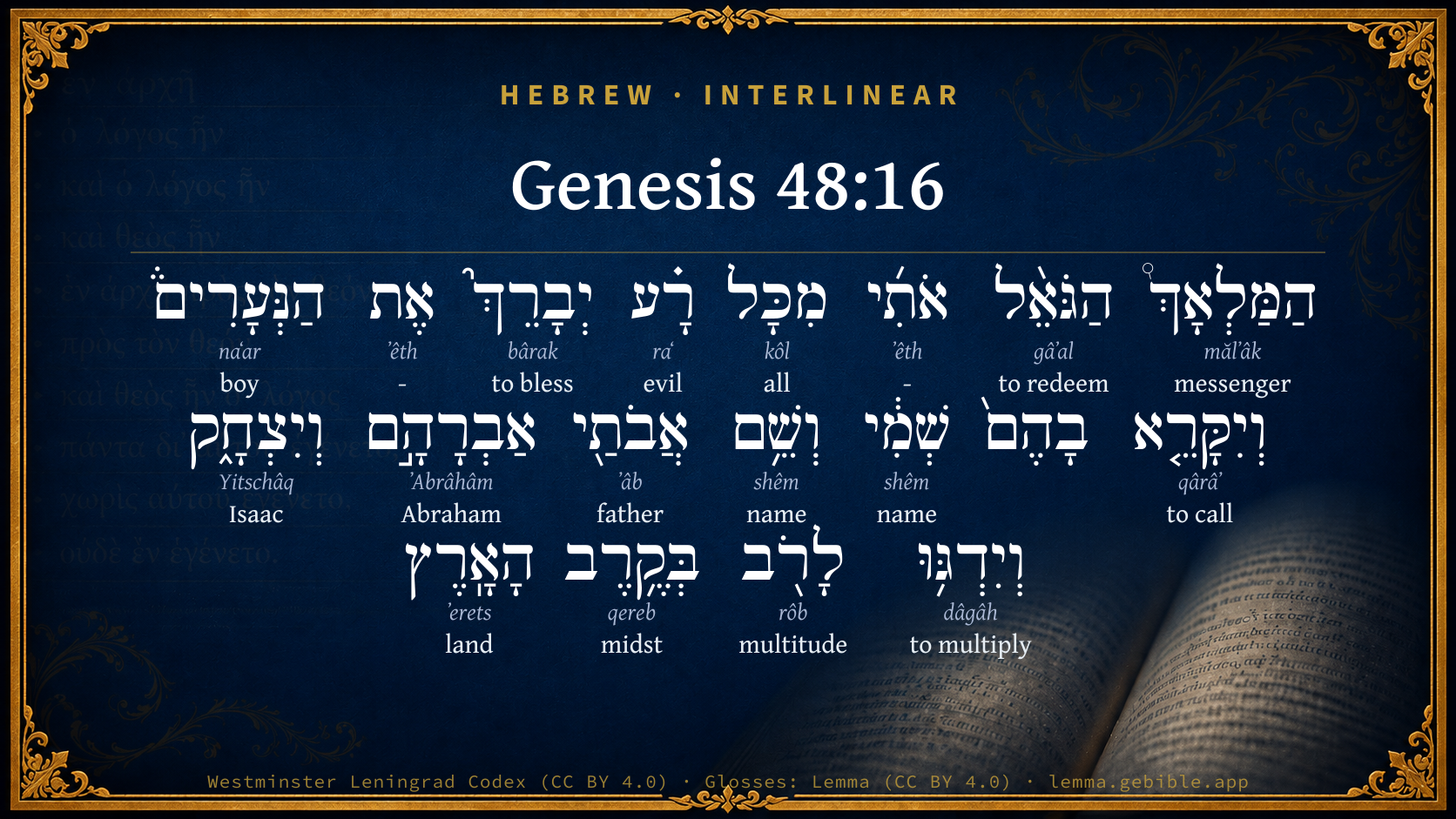
Genesis 48:16

Hebrew (Westminster Leningrad Codex) Genesis 48:16 appears in the Hebrew Old Testament. The text above is from the Westminster Leningrad Codex. Each word links to its Strong’s number, a concise gloss, and parsing drawn from the Open Scriptures Hebrew Bible morphology. Click any word for its full Brown-Driver-Briggs (BDB) entry.
Download image
Cite this verse

Genesis 48:16 (World English Bible). Public Domain. Lemma interlinear Bible study tool, https://lemma.gebible.app/v/genesis/48/16.

Show BibTeX & RIS
BibTeX
RIS
English Translation
the angel who has redeemed me from all evil, bless the lads, and let my name be named on them, and the name of my fathers Abraham and Isaac. Let them grow into a multitude in the midst of the earth."
World English Bible · Public Domain
Highlights
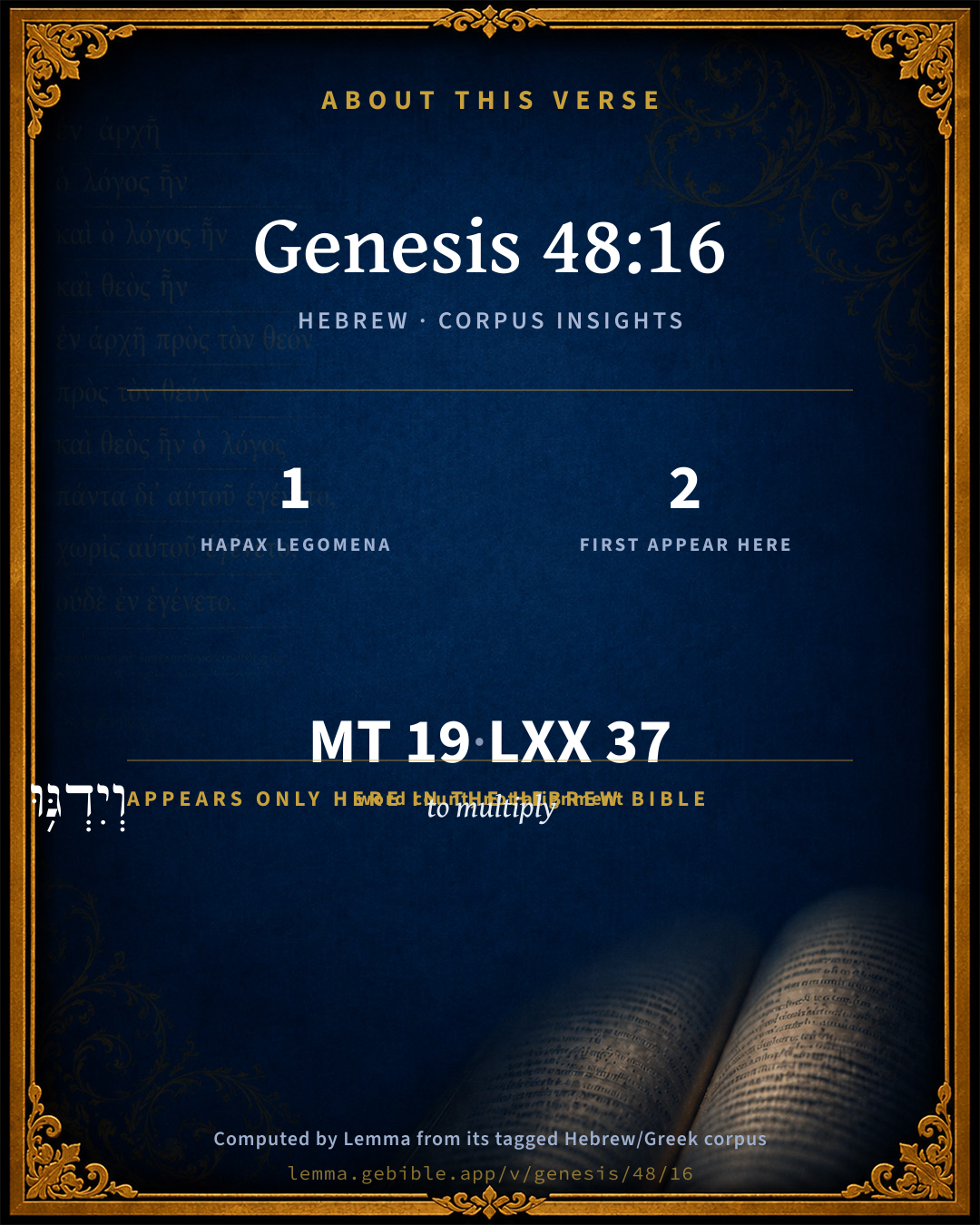
  • 1 hapax legomenon — only here in the Hebrew Bible
  • 2 first appearances in the Hebrew Bible
Full analysis ↓
Download a study sheet

One document with this verse’s original text, its word-by-word gloss line, the meaning frame, cross-references with their text, attributed commentary, and full source and license credits — printable, and it pastes into notes with its structure intact.

This verse Autodidact and up

Study sheet (.html) Plain text (.txt)

A passage Seminary Student

Up to 50 verses in one chapter. A passage sheet keeps up to 6 commentary sources and 12 cross-references per verse, in the order this page ranks them, and says so on the sheet whenever that leaves anything out. Ask for a single verse and you get the Autodidact verse sheet above.

Everything on this page stays free to read, with no account — the sheet is a download of what is already on screen, not access to it.

Want to remove ads? Support Godless Engineer
Compare translations 3

The same verse in 3 English versions, stacked beneath the original-language interlinear above. Click any original word for its lexicon entry.

Each is an independent rendering of the whole verse — the interlinear is not word-aligned to these translations.

Highlighted words mark where these versions differ — a whole-verse word diff, not a word-by-word alignment.

  • World English Bible Public Domain
    the angel who has redeemed me from all evil, bless the lads, and let my name be named on them, and the name of my fathers Abraham and Isaac. Let them grow into a multitude in the midst of the earth."
  • King James Version Public Domain
    The Angel which redeemed me from all evil, bless the lads; and let my name be named on them, and the name of my fathers Abraham and Isaac; and let them grow into a multitude in the midst of the earth.
  • unfoldingWord Literal Text CC BY-SA 4.0
    the Angel who has redeemed me from all evil, may he bless boys, and may my name be called in them, and the name of my fathers Abraham and Isaac, and may they grow into a multitude in the midst of the earth.”

unfoldingWord Literal Text — © unfoldingWord, licensed CC BY-SA 4.0. Word-aligned USFM3 via Door43 (git.door43.org/unfoldingWord/en_ult).

Versions to compare (up to 4)

3 of 4 selected

Show all 18 translations

Every available English version of this verse, each an independent rendering of the whole verse.

  • World English Bible Public Domain
    the angel who has redeemed me from all evil, bless the lads, and let my name be named on them, and the name of my fathers Abraham and Isaac. Let them grow into a multitude in the midst of the earth."
  • Berean Standard Bible Public Domain
    the angel who has redeemed me from all harm—may He bless these boys. And may they be called by my name and the names of my fathers Abraham and Isaac, and may they grow into a multitude upon the earth.”
  • Majority Standard Bible Public Domain
    the angel who has redeemed me from all harm—may He bless these boys. And may they be called by my name and the names of my fathers Abraham and Isaac, and may they grow into a multitude upon the earth.”
  • King James Version Public Domain
    The Angel which redeemed me from all evil, bless the lads; and let my name be named on them, and the name of my fathers Abraham and Isaac; and let them grow into a multitude in the midst of the earth.
  • American Standard Version (1901) Public Domain
    the angel who hath redeemed me from all evil, bless the lads; and let my name be named on them, and the name of my fathers Abraham and Isaac; and let them grow into a multitude in the midst of the earth.
  • Revised Version (1885) Public Domain
    the angel which hath redeemed me from all evil, bless the lads; and let my name be named on them, and the name of my fathers Abraham and Isaac; and let them grow into a multitude in the midst of the earth.
  • Geneva Bible (1599) Public Domain
    The Angel, which hath deliuered me from all euill, blesse the children, and let my name be named vpon them, and the name of my fathers Abraham and Izhak, that they may growe as fish into a multitude in the middes of the earth.
  • Douay-Rheims (1899) Public Domain
    The angel that delivereth me from all evils, bless these boys: and let my name be called upon them, and the names of my fathers Abraham, and Isaac, and may they grow into a multitude upon the earth.
  • Young's Literal Translation Public Domain
    the Messenger who is redeeming me from all evil doth bless the youths, and my name is called upon them, and the name of my fathers Abraham and Isaac; and they increase into a multitude in the midst of the land.'
  • Literal Standard Version CC BY-SA 4.0
    the Messenger who is redeeming me from all evil blesses the youths, and my name is called on them, and the name of my fathers Abraham and Isaac; and they increase into a multitude in the midst of the land.”
  • Unlocked Literal Bible CC BY-SA 4.0
    the angel who has protected me from all harm, may he bless these boys. May my name be named in them, and the name of my fathers Abraham and Isaac. May they grow into a multitude on the earth.”
  • unfoldingWord Literal Text CC BY-SA 4.0
    the Angel who has redeemed me from all evil, may he bless boys, and may my name be called in them, and the name of my fathers Abraham and Isaac, and may they grow into a multitude in the midst of the earth.”
  • Darby Bible Public Domain
    the Angel that redeemed me from all evil, bless the lads; and let my name be named upon them, and the name of my fathers Abraham and Isaac; and let them grow into a multitude in the midst of the land!
  • World Messianic Bible Public Domain
    the angel who has redeemed me from all evil, bless the lads, and let my name be named on them, and the name of my fathers Abraham and Isaac. Let them grow into a multitude upon the earth.”
  • Webster's Bible Public Domain
    The angel who hath redeemed me from all evil, bless the lads; and let my name be named on them, and the name of my fathers Abraham and Isaac: and let them grow into a multitude in the midst of the earth.
  • Free Bible Version CC BY-SA 4.0
    the Angel who has saved me from all kinds of trouble—may he bless these boys. May my name and the names of my grandfather Abraham and father Isaac continue through them, and may they have many descendants that spread throughout the earth.”
  • Bible in Basic English Public Domain
    The angel who has been my saviour from all evil, send his blessing on these children: and let my name and the name of my fathers, Abraham and Isaac, be given to them; and let them become a great nation in the earth.
  • JPS Tanakh (1917) Public Domain
    the angel who hath redeemed me from all evil, bless the lads; and let my name be named in them, and the name of my fathers Abraham and Isaac; and let them grow into a multitude in the midst of the earth.'

Literal Standard Version (2020), Covenant Press — licensed CC BY-SA 4.0. Text via the HelloAO Bible API (eBible.org). Unlocked Literal Bible (unfoldingWord) — licensed CC BY-SA 4.0. Text via the HelloAO Bible API (eBible.org). unfoldingWord Literal Text — © unfoldingWord, licensed CC BY-SA 4.0. Word-aligned USFM3 via Door43 (git.door43.org/unfoldingWord/en_ult). Free Bible Version, Dr. Jonathan Gallagher — licensed CC BY-SA 4.0. Text via the HelloAO Bible API (eBible.org).

Word by word

More ways to search: Search by grammar → Find every occurrence → Compare this word →

Practice this passage: Drill this verse → Learn its vocabulary →

וְיִדְגּ֥וּ
dâgâh
H1711
“and · to multiply”
Conjunction + Verb, Qal, Imperfect, 3rd Person, Masculine, Plural
Part of Speech
Conjunction + Verb
Stem
Qal
Form
Imperfect
Person
3rd Person
Gender
Masculine
Number
Plural
Full BDB Definition

Origin: a primitive root

TWOT: 401

(Qal) to multiply, increase
  1. הַמַּלְאָךְ֩ mălʼâk H4397 “the · messenger” Particle, Definite Article + Noun, Common, Masculine, Singular, Absolute
  2. הַגֹּאֵ֨ל gâʼal H1350 “the · redeeming” Particle, Definite Article + Verb, Qal, Participle Active, Masculine, Singular, Absolute
  3. אֹתִ֜י ʼêth H853 “- · me” Particle, Direct Object + Suffix, Personal, 1st Person, Common, Singular
  4. מִכָּל kôl H3605 “from · all of” Preposition + Noun, Common, Masculine, Singular, Construct
  5. רָ֗ע raʻ H7451 “evil” Adjective, Adjective, Masculine, Singular, Absolute
  6. יְבָרֵךְ֮ bârak H1288 “to bless” Verb, Piel, Imperfect, 3rd Person, Masculine, Singular
  7. אֶת ʼêth H853 “-” Particle, Direct Object
  8. הַנְּעָרִים֒ naʻar H5288 “the · boys” Particle, Definite Article + Noun, Common, Masculine, Plural, Absolute
  9. וְיִקָּרֵ֤א qârâʼ H7121 “and · to call” Conjunction + Verb, Niphal, Imperfect, 3rd Person, Masculine, Singular
  10. שְׁמִ֔י shêm H8034 “name · my” Noun, Common, Masculine, Singular, Construct + Suffix, Personal, 1st Person, Common, Singular
  11. וְשֵׁ֥ם shêm H8034 “and · name of” Conjunction + Noun, Common, Masculine, Singular, Construct
  12. אֲבֹתַ֖י ʼâb H1 “fathers · my” Noun, Common, Masculine, Plural, Construct + Suffix, Personal, 1st Person, Common, Singular
  13. אַבְרָהָ֣ם ʼAbrâhâm H85 “Abraham” Noun, Proper
  14. וְיִצְחָ֑ק Yitschâq H3327 “and · Isaac” Conjunction + Noun, Proper
  15. לָרֹ֖ב rôb H7230 “to/for · multitude” Preposition + Noun, Common, Both, Singular, Absolute
  16. בְּקֶ֥רֶב qereb H7130 “in/at · midst of” Preposition + Noun, Common, Masculine, Singular, Construct
  17. הָאָֽרֶץ ʼerets H776 “the · land” Particle, Definite Article + Noun, Common, Both, Singular, Absolute

About this verse

These counts appear in no published source. They are computed here, from the morphology-tagged text and Lemma’s own curated glosses. What Lemma adds →

19
words
16
distinct lemmas
Pentateuch
section

Notable vocabulary

1 hapax legomenon — a word that appears only here in the entire Hebrew Bible:

  • וְיִדְגּ֥וּ to multiply H1711

First appearance in Scripture

These words make their first canonical appearance in the Hebrew Bible here:

  • הַגֹּאֵ֨ל to redeem H1350
  • וְיִדְגּ֥וּ to multiply H1711

Grammatical profile

  • 4 verbs
  • 11 nouns
  • 1 adjective
  • 1 preposition
  • 2 particles

Verb forms

  • הַגֹּאֵ֨ל Qal · Participle Active
  • יְבָרֵךְ֮ Piel · Imperfect
  • וְיִקָּרֵ֤א Niphal · Imperfect
  • וְיִדְגּ֥וּ Qal · Imperfect

Repetition

A word recurs within this verse — often emphatic in Hebrew:

  • שְׁמִ֔י name H8034 ×2

Hebrew & Septuagint length

In English translation the verse runs 41 words from the Hebrew and 40 from the Septuagint (LXX English) — closely comparable.

A rough comparison of the two English renderings, which tokenize alike — not a word-level alignment.

Word counts can differ between the Hebrew and the Greek without any difference in meaning — e.g. the Hebrew direct-object marker אֵת has no separate Greek word, and Greek often adds the article ὁ.

In the original languages it is 19 Hebrew tokens and 37 Greek tokens — but the two are counted differently (Hebrew bundles its prefixes and suffixes into one token; the Greek is in lemma form), so that isn’t a like-for-like length.

Cross-references

39

Topical passages linked to Genesis 48:16 in the Treasury of Scripture Knowledge — connected by theme and wording, ordered by reader-vote popularity; previews shown in the World English Bible.

  • Psalms 34:22 Yahweh redeems the soul of his servants. None of those who take refuge in him shall be condemned.
  • Genesis 28:13–15 Behold, Yahweh stood above it, and said, "I am Yahweh, the God of Abraham your father, and the God of Isaac. The land whereon you lie, to you will I give it, and to your seed.
  • Genesis 48:5 Now your two sons, who were born to you in the land of Egypt before I came to you into Egypt, are mine; Ephraim and Manasseh, even as Reuben and Simeon, will be mine.
  • Genesis 49:22 "Joseph is a fruitful vine, A fruitful vine by a spring; His branches run over the wall.
  • Numbers 26:28–37 The sons of Joseph after their families: Manasseh and Ephraim.
  • Joshua 17:17 Joshua spoke to the house of Joseph, even to Ephraim and to Manasseh, saying, You are a great people, and have great power; you shall not have one lot only:
  • Psalms 121:7 Yahweh will keep you from all evil. He will keep your soul.
  • Acts 15:17 That the rest of men may seek after the Lord; All the Gentiles who are called by my name, Says the Lord, who does all these things.
  • 2 Timothy 4:18 And the Lord will deliver me from every evil work, and will preserve me for his heavenly Kingdom; to whom be the glory forever and ever. Amen.
  • Isaiah 63:9 In all their affliction he was afflicted, and the angel of his presence saved them: in his love and in his pity he redeemed them; and he bore them, and carried them all the days of old.
  • Amos 9:12 that they may possess the remnant of Edom, and all the nations who are called by my name," says Yahweh who does this.
  • John 17:15 I pray not that you would take them from the world, but that you would keep them from the evil one.
  • Hebrews 11:21 By faith, Jacob, when he was dying, blessed each of the sons of Joseph, and worshiped, leaning on the top of his staff.
  • Genesis 16:7–13 The angel of Yahweh found her by a fountain of water in the wilderness, by the fountain in the way to Shur.
  • 1 Corinthians 10:9 Neither let us test the Lord, as some of them tested, and perished by the serpents.
  • Titus 2:14 who gave himself for us, that he might redeem us from all iniquity, and purify for himself a people for his own possession, zealous for good works.
  • Genesis 1:21–22 God created the large sea creatures, and every living creature that moves, with which the waters swarmed, after their kind, and every winged bird after its kind. God saw that it was good.
  • Genesis 31:11–13 The angel of God said to me in the dream, 'Jacob,' and I said, 'Here I am.'
  • Genesis 32:28 He said, "Your name will no longer be called 'Jacob,' but, 'Israel,' for you have fought with God and with men, and have prevailed."
  • Exodus 1:7 The children of Israel were fruitful, and increased abundantly, and multiplied, and grew exceedingly mighty; and the land was filled with them.
  • Exodus 3:2–6 The angel of Yahweh appeared to him in a flame of fire out of the midst of a bush. He looked, and behold, the bush burned with fire, and the bush was not consumed.
  • Exodus 23:20–21 "Behold, I send an angel before you, to keep you by the way, and to bring you into the place which I have prepared.
  • Numbers 1:46 even all those who were numbered were six hundred three thousand five hundred fifty.
  • Deuteronomy 28:10 All the peoples of the earth shall see that you are called by the name of Yahweh; and they shall be afraid of you.
  • Deuteronomy 33:17 The firstborn of his herd, majesty is his; His horns are the horns of the wild-ox: With them he shall push the peoples all of them, [even] the ends of the earth: They are the ten thousands of Ephraim, They are the thousands of Manasseh.
  • Judges 2:1–4 The angel of Yahweh came up from Gilgal to Bochim. He said, I made you to go up out of Egypt, and have brought you to the land which I swore to your fathers; and I said, I will never break my covenant with you:
  • Judges 6:21–24 Then the angel of Yahweh put forth the end of the staff that was in his hand, and touched the flesh and the unleavened cakes; and there went up fire out of the rock, and consumed the flesh and the unleavened cakes; and the angel of Yahweh departed out of his sight.
  • Judges 13:21–22 But the angel of Yahweh did no more appear to Manoah or to his wife. Then Manoah knew that he was the angel of Yahweh.
  • 2 Chronicles 7:14 if my people, who are called by my name, shall humble themselves, and pray, and seek my face, and turn from their wicked ways; then will I hear from heaven, and will forgive their sin, and will heal their land.
  • Psalms 34:2 My soul shall boast in Yahweh. The humble shall hear of it, and be glad.
  • Psalms 34:7 The angel of Yahweh encamps round about those who fear him, And delivers them.
  • Isaiah 47:4 Our Redeemer, Yahweh of hosts is his name, the Holy One of Israel.
  • Jeremiah 14:9 Why should you be like a scared man, as a mighty man who can't save? yet you, Yahweh, are in the midst of us, and we are called by your name; don't leave us.
  • Hosea 12:4–5 Indeed, he had power over the angel, and prevailed; He wept, and made supplication to him. He found him at Bethel, and there he spoke with us,
  • Malachi 3:1 "Behold, I send my messenger, and he will prepare the way before me; and the Lord, whom you seek, will suddenly come to his temple; and the messenger of the covenant, whom you desire, behold, he comes!" says Yahweh of hosts.
  • Matthew 6:13 Bring us not into temptation, but deliver us from the evil one. For yours is the Kingdom, the power, and the glory forever. Amen.'
  • Acts 7:30–35 "When forty years were fulfilled, an angel of the Lord appeared to him in the wilderness of Mount Sinai, in a flame of fire in a bush.
  • Romans 8:23 Not only so, but ourselves also, who have the first fruits of the Spirit, even we ourselves groan within ourselves, waiting for adoption, the redemption of our body.
  • 1 Corinthians 10:4 and all drank the same spiritual drink. For they drank of a spiritual rock that followed them, and the rock was Christ.

Cross-references courtesy of OpenBible.info (CC BY 4.0).

Hebrew and Greek witnesses Masoretic Hebrew ↔ Greek Septuagint

The same verse in the two great witnesses to the Old Testament, shown verse-for-verse.

These are two independent witnesses, not word-aligned to each other, and the Septuagint is shown in lemma (dictionary) form.

Hebrew Genesis 48:16 Masoretic · Westminster Leningrad Codex

הַמַּלְאָךְ֩ הַגֹּאֵ֨ל אֹתִ֜י מִכָּל רָ֗ע יְבָרֵךְ֮ אֶת הַנְּעָרִים֒ וְיִקָּרֵ֤א בָהֶם֙ שְׁמִ֔י וְשֵׁ֥ם אֲבֹתַ֖י אַבְרָהָ֣ם וְיִצְחָ֑ק וְיִדְגּ֥וּ לָרֹ֖ב בְּקֶ֥רֶב הָאָֽרֶץ

the angel who has redeemed me from all evil, bless the lads, and let my name be named on them, and the name of my fathers Abraham and Isaac. Let them grow into a multitude in the midst of the earth."

World English Bible · Public Domain

Greek LXX Genesis 48:16 Septuagint · lemma form

ὁ ἄγγελος ὁ ῥύομαι ἐγώ ἐκ πᾶς ὁ κακός εὐλογέω ὁ παιδίον οὗτος καί ἐπικαλέω ἐν αὐτός ὁ ὄνομα ἐγώ καί ὁ ὄνομα ὁ πατήρ ἐγώ αβρααμ καί ισαακ καί πληθύνω εἰς πλῆθος πολύς ἐπί ὁ γῆ

the angel who delivers me from all evils, bless these boys, and my name shall be called upon them, and the name of my fathers, Abraam and Isaac; and let them be increased to a great multitude on the earth.

LXX2012 (modern English Septuagint) · Public Domain

Hebrew: Westminster Leningrad Codex (CC BY 4.0). Greek: Septuagint (public domain); English from LXX2012 (modern English Septuagint) (Public Domain). How the Septuagint differs from the Hebrew →

Targum (Aramaic paraphrase)

2

The Targum is the ancient Jewish Aramaic paraphrase of the Hebrew Scriptures — an interpretive translation, not the Hebrew text itself. Onkelos (literal) and Pseudo-Jonathan (expansive) render the Torah, and Jonathan the Prophets. Coverage is partial: where no permissively-licensed English translation exists for a verse, only the Aramaic is shown. This is verse-level text, not a word-by-word alignment to the Hebrew.

  1. Targum Onkelos Torah (Genesis–Deuteronomy)
    מַלְאָכָא דִי פְרַק יָתִי מִכָּל בִּישָׁא יְבָרֵךְ יָת עוּלֵמַיָּא וְיִתְקְרֵי בְהוֹן שְׁמִי וְשׁוּם אֲבָהָתַי אַבְרָהָם וְיִצְחָק וּכְנוּנֵי יַמָּא יִסְגוּן בְּגוֹ בְנֵי אֱנָשָׁא עַל אַרְעָא

    (no public-domain English translation for this verse)

    Targum Onkelos — Aramaic: “Onkelos Genesis” (public domain); “Onkelos Exodus” (public domain); “Onkelos Leviticus” (public domain); “Onkelos Numbers” (public domain); “Onkelos Deuteronomy” (public domain). English: “Sefaria Community Translation” (CC0 1.0 (public-domain dedication)); “J.W. Etheridge. The Targums of Onkelos and Jonathan Ben Uzziel on the Pentateuch. London: Longmans, Green, 1862” (public domain). Text via Sefaria.

  2. Targum Pseudo-Jonathan Torah (Genesis–Deuteronomy)
    יְהֵי רַעֲוָא קֳדָמָךְ דְמַלְאָכָא דְזַמִינְתָּא לִי לְמִפְרַק יָתִי מִכָּל בִּישָׁא יְבָרֵךְ יַת טַלְיָיא וְיִתְקְרִי בְהוֹן שְׁמִי וְשׁוּם אַבְהָתַי אַבְרָהָם וְיִצְחָק וְהֵיכְמָא דְכַוְורֵי יַמָא סַגִי מִסְתְּגֵי בְמַיָא כְּדֵין בְּנוֹי דְיוֹסֵף יִתְקְפוּן לִסְגֵי בְּגוֹ אַרְעָא

    be pleased that the angel whom thou didst ordain for me, to redeem me from all evil, may bless the children; and let my name be called upon them, and the names of my fathers Abrabam and Izhak. And as the fishes of the sea in multiplying are multiplied in the sea, so may the children of Joseph be multiplied abundantly in the midst of the earth.

    Targum Pseudo-Jonathan — Aramaic: “Targum Jonathan on Genesis” (public domain); “Targum Jonathan on Exodus” (public domain); “Targum Jonathan on Leviticus” (public domain); “Targum Jonathan on Numbers” (public domain); “Targum Jonathan on Deuteronomy” (public domain). English: “The Targum of Jonathan ben Uzziel, trans. J. W. Etheridge, London, 1862” (public domain). Text via Sefaria.

Commentary

Notes on Genesis 48:16 from classic Christian and Jewish commentators (each source and its license shown beneath its notes). The classic Christian expositions comment on the surrounding passage and are grouped to its opening verse, so a note may address several verses; the Jewish commentaries on the Tanakh (Rashi and others) are per-verse, so they appear only where the commentator wrote on this verse.

Lemma curates 59 commentaries, every one of them public domain or Creative Commons licensed, each selected and text-cleaned for this edition rather than reprinted as found. About our sources →

Trapp's Complete Commentary

John Trapp

Gen 48:16 The Angel which redeemed me from all evil, bless the lads; and let my name be named on them, and the name of my fathers Abraham and Isaac; and let them grow into a multitude in the midst of the earth.

Ver. 16. The Angel which redeemed me.] Christ, the Angel of the Covenant, the Mediator of the New Testament, the Redeemer, the Lamb slain from the beginning of the world. "For we were not redeemed with silver and gold, but with the blood of Christ, as of a lamb undefiled." {1Pe 1:19} Paul by that "freedom" {Act 22:28} escaped whipping: we, by this, the pain of eternal torment.

And let my name be named on them.] Lest any should think it to be some prejudice to them that they were born in Egypt, and of an Egyptian mother, he adopts them for his own.

John Trapp, A Commentary or Exposition upon All the Books of the Old and New Testament (1647–1656) — public domain. Text from a community e-Sword module.

Joseph Benson's Commentary

Gen 48:16. The Angel which redeemed me — Not a created angel surely, but Christ, termed an angel, Exo 23:20, and the Angel of the covenant, Mal 3:1, and who was the conductor of Israel in the wilderness, 1Co 10:4-9. Add to this, that this Angel is called Jacob’s Redeemer, a title appropriated by God to himself, Isa 43:14; Isa 47:4; is said to redeem him from all evil, and therefore from sin, from which certainly no created angel, but only Christ can deliver us, Mat 1:21; and he is worshipped and prayed to by Jacob here, for the blessing desired for Joseph’s sons: all which circumstances show, that he was God and not a creature. From all evil — A great deal of trouble and hardship he had had in his time, but God had graciously kept him from the evil of his troubles. It becomes the servants of God, when they are old and dying, to witness for God that they have found him gracious.

Joseph Benson's Commentary on the Old and New Testaments (1811–1818) — public domain. Text from a community e-Sword module.

Geneva Bible (1599)

Geneva Bible translators

This Angel must be understood of Christ, as Gen. 31:13 and 32:1.

Let them be taken as my children.

Geneva Bible (1599) marginal notes — public domain. Text via Bolls.life.

Adam Clarke's Commentary

Verse 16. The Angel which redeemed me from all evil] המלאך הגאל hammalac haggoel. The Messenger, the Redeemer or Kinsman; for so גאל goel signifies; for this term, in the law of Moses, is applied to that person whose right it is, from his being nearest akin, to redeem or purchase back a forfeited inheritance. But of whom does Jacob speak? We have often seen, in the preceding chapters, an angel of God appearing to the patriarchs; (see particularly Ge 16:7, and the note there; See Clarke on Ge 16:7) and we have full proof that this was no created angel, but the Messenger of the Divine Council, the Lord Jesus Christ. Who then was the angel that redeemed Jacob, and whom he invoked to bless Ephraim and Manasseh? Is it not JESUS? He alone can be called Goel, the redeeming Kinsman; for he alone took part of our flesh and blood that the right of redemption might be his; and that the forfeited possession of the favour and image of God might be redeemed, brought back, and restored to all those who believe in his name. To have invoked any other angel or messenger in such a business would have been impiety. Angels bless not; to GOD alone this prerogative belongs. With what confidence may a truly religious father use these words in behalf of his children: "JESUS, the CHRIST, who hath redeemed me, bless the lads, redeem them also, and save them unto eternal life!"

Let my name be named on them] "Let them be ever accounted as a part of my own family; let them be true Israelites-persons who shall prevail with God as I have done; and the name of Abraham - being partakers of his faith; and the name of Isaac - let them be as remarkable for submissive obedience as he was. Let the virtues of Abraham, Isaac, and Jacob be accumulated in them, and invariably displayed by them!" These are the very words of adoption; and by the imposition of hands, the invocation of the Redeemer, and the solemn blessing pronounced, the adoption was completed. From this moment Ephraim and Manasseh had the same rights and privileges as Jacob's sons, which as the sons of Joseph they could never have possessed.

And let them grow into a multitude] וידגו לרב veyidgu larob; Let them increase like fishes into a multitude. FISH are the most prolific of all animals; see the instances produced on See Clarke on Ge 1:20. This prophetic blessing was verified in a most remarkable manner; see Nu 26:34, Nu 26:37; De 33:17; Jos 17:17. At one time the tribe of Ephraim amounted to 40,500 effective men, and that of Manasseh to 52,700, amounting in the whole to 93,200.

Adam Clarke's Commentary on the Bible (1810–1826) — public domain. Text from a community e-Sword/MySword module.

John Calvin's Commentaries

16. The Angel which redeemed me. He so joins the Angel to God as to make him his equal. Truly he offers him divine worship, and asks the same things from him as from God. If this be understood indifferently of any angel what ever, the sentence is absurd. Nay, rather, as Jacob himself sustains the name and character of God, in blessing his son, he is superior, in this respect, to the angels. Wherefore it is necessary that Christ should be here meant, who does not bear in vain the title of Angel, because he had become the perpetual Mediator. And Paul testifies that he was the Leader and Guide of the journey of his ancient people. (1 Corinthians 10:4.) He had not yet indeed been sent by the Father, to approach more nearly to us by taking our flesh, but because he was always the bond of connection between God and man, and because God formally manifested himself in no other way than through him, he is properly called the Angel. To which may be added, that the faith of the fathers was always fixed on his future mission. He was therefore the Angel, because even then he poured forth his rays, that the saints might approach God, through him, as Mediator. For there was always so wide a distance between God and men, that, without a mediator; there could be no communication. Nevertheless though Christ appeared in the form of an angel, we must remember what the Apostle says to the Hebrews, (Hebrews 2:16,) that “he took not on him the nature of angels,” so as to become one of them, in the manner in which he truly became man; for even when angels put on human bodies, they did not, on that account, become men. Now since we are taught, in these words, that the peculiar office of Christ is to defend us and to deliver us from all evil, let us take heed not to bury this grace in impious oblivion: yea, seeing that now it is more clearly exhibited to us, than formerly to the saints under the law, since Christ openly declares that the faithful are committed to his care, that not one of them might perish, (John 17:12,) so much the more ought it to flourish in our hearts, both that it may be highly celebrated by us with suitable praise, and that it may stir us up to seek this guardianship of our best Protector. And this is exceedingly necessary for us; for if we reflect how many dangers surround us, that we scarcely pass a day without being delivered from a thousand deaths; whence does this arise, except from that care which is taken of us, by the Son of God, who has received us under his protection, from the hand of his Father.

And let my name be named on them. This is a mark of the adoption before mentioned: for he puts his name upon them, that they may obtain a place among the patriarchs. Indeed the Hebrew phrase signifies nothing else than to be reckoned among the family of Jacob. Thus the name of the husband is said to be called upon the wife, (Isaiah 4:1,) because the wife borrows the name from the head to which she is subject. So much the more ridiculous is the ignorance of the Papists, who would prove hence that the dead are to be invoked in prayers. Jacob, say they, desired after his death to be invoked by his posterity. What! that being prayed to, he might bring them succor; and not — according to the plain intention of the speaker — that Ephraim and Manasseh might be added to the society of the patriarchs, to constitute two tribes of the holy people! Moreover it is wonderful, that the Papists, leaving under this pretext framed for themselves innumerable patrons, should have passed over Abraham, Isaac, and Jacob, as unworthy of the office. But the Lord, by this brutish stupor, has avenged their impious profanation of his name. What Jacob adds in the next clause, namely, that they should grow into a multitude, refers also to the same promise. The sum amounts to this, that the Lord would complete in them, what he had promised to the patriarchs.

John Calvin's Commentaries (1540-1563) — public domain. Text from the Calvin Translation Society English edition (1840s-50s) via the Christian Classics Ethereal Library (ccel.org). Calvin's coverage is partial (roughly two-thirds of the Bible); uncommented books and verses are honest gaps, never fabricated. The 19th-century editor's footnotes and remarks are omitted so the notes are faithfully Calvin's own voice.

The Cambridge Bible for Schools and Colleges

gen. ed. J. J. S. Perowne

16. the angel] “The angel” is here indistinguishable from the “God of Jacob.” As in Gen_16:7; Gen_16:10; Gen_16:13, it was the impersonation of the Divine Being as an Angel, whom Jacob had met and acknowledged as his God in the crises of his life, Gen_28:12-16, Gen_31:11; Gen_31:13; Gen_31:24, Gen_32:1; Gen_32:24-31. The reference here is to the manifestation at Peniel (Gen_32:30, where see note).

hath redeemed me] “To redeem” is to play the kinsman’s part, Lev_25:48-49; Rth_3:13; Rth_4:6. Jacob acknowledges that the manifestations of the Angel had been the fulfilment of a Divine goodness of purpose towards him. The idea of “redemption,” the deliverance by the Goêl, or kinsman-Redeemer, is a favourite one in the religious teaching of the O.T., e.g. Psa_103:4. Cf. Isa_44:22-23; Isa_49:7; Isa_63:9. Here the deliverance is from calamity, as in 2Sa_4:9; 1Ki_1:29. It is different from the more common word for “redeem,” pâdah = “deliver,” “ransom,” e.g. in Psa_25:22.

16. let my name be named on them] This is the formula of adoption according to E, corresponding to that in Gen_48:5 according to P. The meaning seems to be, “let my name be given to them,” in other words, “let them be counted as the children of Israel.”

grow into a multitude] For the fulfilment of the blessing, see the numbers of the tribes, Ephraim and Manasseh, in Num_1:33; Num_1:35; Num_26:34; Num_26:37. Compare Deu_33:17, “they are the ten thousands of Ephraim, and they are the thousands of Manasseh.”

The Cambridge Bible for Schools and Colleges (gen. ed. J. J. S. Perowne; Cambridge University Press, 1878–1918) — public domain. Text from a community e-Sword module.

John Gill's Exposition

The Angel which redeemed me from all evil, bless the lads,.... Ephraim and Manasseh, now about twenty years old or upwards: this is not to be understood of a created angel he wishes to be their guardian, but of an eternal one, the Son of God, the Angel of God's presence, the Angel of the covenant; the same with the God of his father before mentioned, as appears by the character he gives him, as having "redeemed him from all evil"; not only protected and preserved him from temporal evils and imminent dangers from Esau, Laban, and others; but had delivered him from the power, guilt, and punishment of sin, the greatest of evils, and from the dominion and tyranny of Satan the evil one, and from everlasting wrath, ruin, and damnation; all which none but a divine Person could do, as well as he wishes, desires, and prays, that he would "bless" the lads with blessings temporal and spiritual, which a created angel cannot do; and Jacob would never have asked it of him:

and let my name be named on them, and the name of my fathers Abraham and Isaac; having adopted them, he foretells they would be called not only the sons of Joseph, but the children of Israel or Jacob, and would have a name among the tribes of Israel, and be heads of them, as well as would be called the seed of Abraham and of Isaac, and inherit their blessings: and let them grow into a multitude in the midst of the earth; where they increased as fishes, as the word signifies (s), and more than any other of the tribes; even in the times of Moses the number of them were 85,200 men fit for war, Num 26:34; and their situation was in the middle of the land of Canaan.

(s) "et instar piscium sint", Pagninus, Montanus; so Junius & Tremellius, Piscator, Ainsworth, and the Targum of Onkelos, and Jarchi.

John Gill's Exposition of the Whole Bible (1746–1763) — public domain (CC PDM 1.0). Text via the HelloAO Bible API.

Haydock's Catholic Bible Commentary

The angel guardian, who, by God’s ordinance, has ever protected me, continue his kind attention towards these my grand-children. It is not probably that he, who was called God before, should now be styled an angel, as some Protestants would have us believe. (Haydock) --- St. Basil (contra Eunom. iii.) and St. Chrysostom, with many others, allege this text, to prove that an angel is given to man for the direction of his life, and to protect him against the assaults of the rebel angels, as Calvin himself dares not deny. --- Let my, &c. Let them partake of the blessings (promised by name to me, to Abraham, and to Isaac) among the other tribes; or, may God bless them, in consideration of his servants. Moses obtained pardon for the Hebrews, by reminding God of these his chosen friends, Exodus xxxii. (Worthington)

George Leo Haydock (1774–1849), Haydock's Catholic Family Bible and Commentary, 1859 edition — public domain. Excludes Psalms (Douay-Rheims chapter numbering differs from Protestant) and Deuterocanonical books (Catholic canon only).

Matthew Poole's English Annotations

The Angel; not surely a created angel, but Christ Jesus, who is called an Angel, Exo 23:20, and the Angel of the covenant, Mal 3:1, who was the conductor of the Israelites in the wilderness, as plainly appears by comparing of Exo 23:20,21, with 1Co 10:4,9. Add hereunto, that this Angel is called Jacob’s Redeemer, which is the title appropriated by God to himself, Isa 43:14; 47:4, and that from all evil, and therefore from sin, from which no created angel can deliver us, but Christ only, Mat 1:21; and that Jacob worshippeth and prayeth to this Angel no less than to God for the blessing, and that without any note of distinction, the word bless being in the singular number, and equally relating to God and to the Angel; and that the Angel to whom he here ascribes his deliverances from all evil, must in all reason be the same to whom he prayed for these very deliverances which he here commemorates, and that was no other than the very God of Abraham, as is evident from Gen 28:15,20,21; 32:9-11; 35:3.

Let my name be named on them, i.e. let them be called by my name, owned for my immediate children, and invested with the same privileges with my other children, be the heads of distinct tribes, and as such receive distinct inheritances. And hence they are called the children of Jacob or Israel, no less than the children of Joseph. For the phrase, see Deu 28:10; 2Ch 7:14; Isa 4:1; Jer 14:9.

And the name of my fathers; let them be called their children; let them not only have my blessing, but the blessings of Abraham and Isaac; let all meet together upon their heads; and let that gracious covenant of God made with Abraham, and confirmed with Isaac and me, be ratified and made good unto them.

Matthew Poole's English Annotations on the Holy Bible (1683–1685) — public domain. Text from a community e-Sword/MySword module.

John Wesley's Explanatory Notes

The angel who redeemed me from all evil - A great deal of hardship he had known in his time, but God had graciously kept him from the evil of his troubles. Christ, the angel of the covenant is he that redeems us from all evil. It becomes the servants of God, when they are old and dying, to witness for our God that they have found him gracious. Joseph had placed his children so, as that Jacob's right-hand should be put on the head of Manasseh the eldest, ver. 12, 13, but Jacob would put it on the head of Ephraim the youngest, ver. 14. This displeased Joseph, who was willing to support the reputation of his first-born and would therefore have removed his father's hands, ver. 17, 18, but Jacob gave him to understand that he knew what he did, and that he did it neither by mistake nor in a humour, nor from a partial affection to one more than the other, but from a spirit of prophecy.

John Wesley, Explanatory Notes Upon the Whole Bible (1754–1765) — public domain. Text via the GEBible commentary corpus.

Scofield Reference Notes

C. I. Scofield

Angel (See Scofield "Heb 1:4")

redeemed Heb. goel, Redemp. (Kinsman type). Isa 59:20 (See Scofield "Isa 59:20").

The Scofield Reference Bible (1917 edition), notes by C. I. Scofield — public domain. Text from a community e-Sword module.

Rashi

Rabbi Shlomo Yitzchaki (Rashi)

המלאך הגאל אתי THE ANGEL REDEEMING ME — The angel who was usually sent to me in my trouble, as it is said, (Genesis 31:11) “And the angel of God said unto me in the dream: Jacob etc. … (Genesis 31:13), I am the God of Beth-el.”

יברך את הנערים SHALL BLESS THE LADS — viz, Manasseh and Ephraim.

וידגו AND LET THEM INCREASE — like fishes (דגים) which are fruitful and which multiply and which the evil eye cannot effect (Berakhot 20a).

Rashi on the Tanakh — English translations: “The Judaica Press complete Tanach with Rashi, translated by A. J. Rosenberg” (CC BY 4.0); “Pentateuch with Rashi's commentary by M. Rosenbaum and A.M. Silbermann, 1929-1934” (public domain); “The Metsudah Tanach series, Lakewood, N.J” (CC BY 4.0); and “The Book of Joshua, Metsudah Publications, 1997” (CC BY 4.0). Text via Sefaria.

Ramban (Nachmanides)

Rabbi Moshe ben Nachman (Ramban / Nachmanides)

AND LET MY NAME BE CALLED ON THEM. Rabbi Abraham ibn Ezra said that it means that all Israel be called by the name Ephraim, (Jeremiah 31:19), the reference there being to all Israel. just as they are called “the children of Abraham, Isaac, and Jacob.”This is not correct for Scripture uses the word bahem (on them), [thus referring to both Ephraim and Menasheh], and they were not called by the name of Menasheh. But perhaps this is because they were called the house of Joseph..The correct interpretation though is that their race and their name will exist forever, and the name of Abraham, Isaac and Jacob will forever be upon them.

Ramban (Nachmanides) on the Tanakh — English translation: “Commentary on the Torah by Ramban (Nachmanides). Translated and annotated by Charles B. Chavel. New York, Shilo Pub. House, 1971-1976” (CC BY 4.0). Text via Sefaria.

Radak

Rabbi David Kimhi (Radak)

ויקרא בהם שמי ושם אבותי, he meant that Joseph would be called Israel on occasion, as for instance in Psalms 80,2 רועה ישראל האזינה נהג כצאן יוסף, “Give ear O shepherd of Israel who leads Joseph like a flock.” Also in Amos 6,6 we read ולא נחלו על שבר יוסף, “but they are not concerned about the ruin of Joseph;” (Joseph being a euphemism for Israel, of course) The author quotes several more verses proving the same point, i.e. that Joseph is being equated with his father Israel, i.e. is the spiritual continuation of his father Yisrael, the founder of the 12 tribes. Psalms 80,3 uses the same simile for Joseph’s sons Ephrayim and Menashe when writing לפני אפרים ובנימין ומנשה עוררה את גבורתך ולכה לישועתך לנו, “at the head of Ephrayim, Benjamin, and Menashe! Rouse Your might and come to our help!”

וידגו לרב, may the multiply like fish.

Radak on the Tanakh — English translations: “Sefaria Community Translation” (CC0 1.0 (public-domain dedication)); “Eliyahu Munk, HaChut Hameshulash” (CC BY 4.0); “Rabbi Mike Feuer, Jerusalem Anthology” (CC BY 4.0); and “R. David Kimhi on the first book of Psalms, Translated by R.G. Finch, London, 1919” (public domain). Text via Sefaria.

Lesson kit

Teaching starters — assembled from the data on this page, not authored interpretation. Every prompt links to the verse data it draws on. Edit before teaching.

Genesis, in the Pentateuch, opens this verse with 19 words (16 distinct Hebrew lemmas). Its most distinctive word is dâgâh (“to multiply”). A historical commentator’s framing appears above. Read the whole chapter for the surrounding context.

Discussion questions

  1. How does “to multiply” (dâgâh) shape what this verse is saying?
  2. 1 word here appears nowhere else in the Hebrew Bible. Why might the author reach for such rare wording?
  3. 2 words make their first appearance in Scripture here. What does this debut establish?
  4. How does Psalms 34:22, which shares this passage’s theme, read alongside this verse?
  5. What does the repetition of “name” (2× in this one verse) do in this verse?
  6. These translations render this verse differently; the difference is in the English rendering, not the original. What questions does that raise?
  7. «הַגֹּאֵ֨ל» is a Qal Participle Active verb. How does that grammatical form shape the action described?
  8. Compare how Trapp's Complete Commentary and Joseph Benson's Commentary read this verse. Where do they agree or differ?

Things to notice

  • 1 word in this verse appears nowhere else in the Hebrew Bible.
  • 2 words make their first canonical appearance in Scripture here.
  • This verse counts 19 Hebrew ↔ 37 Greek words.
  • These translations choose different wording for 9 words in this verse.
  • “name” occurs 2× in this single verse.

Reading settings

Reading text

Shown beneath each verse's original-language words.

Old Testament
Old Testament edition

Read the OT as the Masoretic Hebrew (MT) or the Greek Septuagint (LXX).

English shown for the Greek Septuagint (in the Hebrew ↔ Greek comparison).

Comparing translations? Open the Compare panel on any verse page to stack up to four side by side.