Genesis 50:2

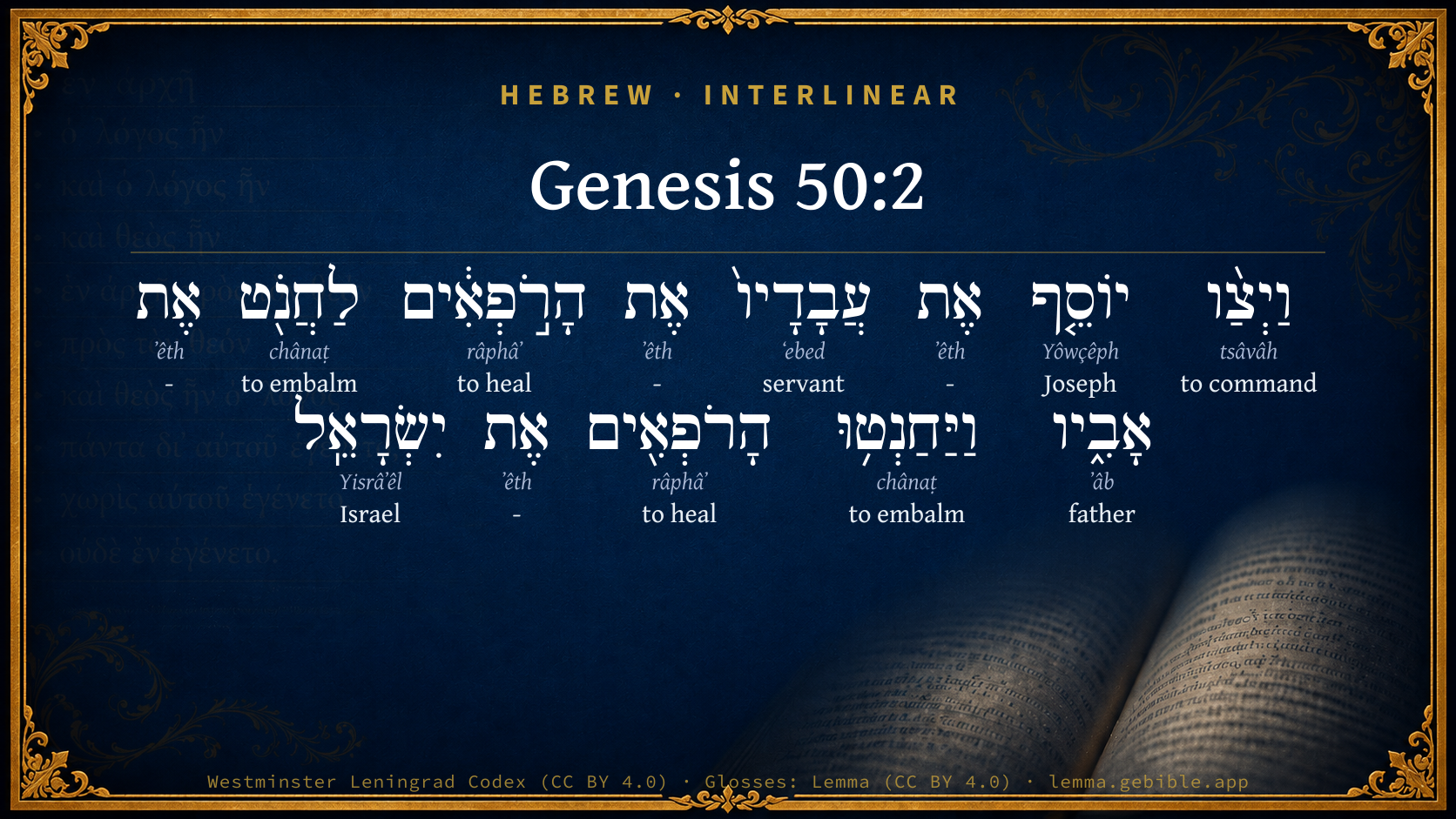
Hebrew (Westminster Leningrad Codex) Genesis 50:2 appears in the Hebrew Old Testament. The text above is from the Westminster Leningrad Codex. Each word links to its Strong’s number, a concise gloss, and parsing drawn from the Open Scriptures Hebrew Bible morphology. Click any word for its full Brown-Driver-Briggs (BDB) entry.
Download image
Cite this verse

Genesis 50:2 (World English Bible). Public Domain. Lemma interlinear Bible study tool, https://lemma.gebible.app/v/genesis/50/2.

Show BibTeX & RIS
BibTeX
RIS
English Translation
Joseph commanded his servants, the physicians, to embalm his father; and the physicians embalmed Israel.
World English Bible · Public Domain
Highlights
  • 1 first appearance in the Hebrew Bible
Full analysis ↓
Download a study sheet

One document with this verse’s original text, its word-by-word gloss line, the meaning frame, cross-references with their text, attributed commentary, and full source and license credits — printable, and it pastes into notes with its structure intact.

This verse Autodidact and up

Study sheet (.html) Plain text (.txt)

A passage Seminary Student

Up to 50 verses in one chapter. A passage sheet keeps up to 6 commentary sources and 12 cross-references per verse, in the order this page ranks them, and says so on the sheet whenever that leaves anything out. Ask for a single verse and you get the Autodidact verse sheet above.

Everything on this page stays free to read, with no account — the sheet is a download of what is already on screen, not access to it.

Want to remove ads? Support Godless Engineer
Compare translations 3

The same verse in 3 English versions, stacked beneath the original-language interlinear above. Click any original word for its lexicon entry.

Each is an independent rendering of the whole verse — the interlinear is not word-aligned to these translations.

Highlighted words mark where these versions differ — a whole-verse word diff, not a word-by-word alignment.

  • World English Bible Public Domain
    Joseph commanded his servants, the physicians, to embalm his father; and the physicians embalmed Israel.
  • King James Version Public Domain
    And Joseph commanded his servants the physicians to embalm his father: and the physicians embalmed Israel.
  • unfoldingWord Literal Text CC BY-SA 4.0
    Then Joseph commanded his servants the physicians to embalm his father. So the physicians embalmed Israel,

unfoldingWord Literal Text — © unfoldingWord, licensed CC BY-SA 4.0. Word-aligned USFM3 via Door43 (git.door43.org/unfoldingWord/en_ult).

Versions to compare (up to 4)

3 of 4 selected

Show all 18 translations

Every available English version of this verse, each an independent rendering of the whole verse.

  • World English Bible Public Domain
    Joseph commanded his servants, the physicians, to embalm his father; and the physicians embalmed Israel.
  • Berean Standard Bible Public Domain
    And Joseph directed the physicians in his service to embalm his father Israel. So they embalmed him,
  • Majority Standard Bible Public Domain
    And Joseph directed the physicians in his service to embalm his father Israel. So they embalmed him,
  • King James Version Public Domain
    And Joseph commanded his servants the physicians to embalm his father: and the physicians embalmed Israel.
  • American Standard Version (1901) Public Domain
    And Joseph commanded his servants the physicians to embalm his father: and the physicians embalmed Israel.
  • Revised Version (1885) Public Domain
    And Joseph commanded his servants the physicians to embalm his father: and the physicians embalmed Israel.
  • Geneva Bible (1599) Public Domain
    And Ioseph commanded his seruantes the physicions, to enbaume his father, and the physicions enbaumed Israel.
  • Douay-Rheims (1899) Public Domain
    And he commanded his servants the physicians to embalm his father.
  • Young's Literal Translation Public Domain
    and Joseph commandeth his servants, the physicians, to embalm his father, and the physicians embalm Israel;
  • Literal Standard Version CC BY-SA 4.0
    and Joseph commands his servants, the physicians, to embalm his father, and the physicians embalm Israel;
  • Unlocked Literal Bible CC BY-SA 4.0
    Joseph commanded his servants the physicians to embalm his father. So the physicians embalmed Israel.
  • unfoldingWord Literal Text CC BY-SA 4.0
    Then Joseph commanded his servants the physicians to embalm his father. So the physicians embalmed Israel,
  • Darby Bible Public Domain
    And Joseph commanded his servants the physicians to embalm his father. And the physicians embalmed Israel.
  • World Messianic Bible Public Domain
    Joseph commanded his servants, the physicians, to embalm his father; and the physicians embalmed Israel.
  • Webster's Bible Public Domain
    And Joseph commanded his servants the physicians to embalm his father: and the physicians embalmed Israel.
  • Free Bible Version CC BY-SA 4.0
    Then Joseph instructed the physicians who worked for him to embalm his father's body. So the physicians embalmed Israel.
  • Bible in Basic English Public Domain
    And Joseph gave orders to his servants who had the necessary knowledge, to make his father's body ready, folding it in linen with spices, and they did so.
  • JPS Tanakh (1917) Public Domain
    And Joseph commanded his servants the physicians to embalm his father. And the physicians embalmed Israel.

Literal Standard Version (2020), Covenant Press — licensed CC BY-SA 4.0. Text via the HelloAO Bible API (eBible.org). Unlocked Literal Bible (unfoldingWord) — licensed CC BY-SA 4.0. Text via the HelloAO Bible API (eBible.org). unfoldingWord Literal Text — © unfoldingWord, licensed CC BY-SA 4.0. Word-aligned USFM3 via Door43 (git.door43.org/unfoldingWord/en_ult). Free Bible Version, Dr. Jonathan Gallagher — licensed CC BY-SA 4.0. Text via the HelloAO Bible API (eBible.org).

Word by word

More ways to search: Search by grammar → Find every occurrence → Compare this word →

Practice this passage: Drill this verse → Learn its vocabulary →

לַחֲנֹ֖ט
chânaṭ
H2590
“to embalm”
Preposition + Verb, Qal, Infinitive Construct
Part of Speech
Preposition + Verb
Stem
Qal
Form
Infinitive Construct
Full BDB Definition

Origin: a primitive root

TWOT: TWOT- 691

to embalm, spice, make spicy (verb) - (Qal) - to spice, make spicy - to embalm - (CLBL) to ripen - (BDB) embalming (noun masculine plural abstract)
  1. וַיְצַ֨ו tsâvâh H6680 “and · to command” Conjunction + Verb, Piel, Sequential Imperfect, 3rd Person, Masculine, Singular
  2. יוֹסֵ֤ף Yôwçêph H3130 “Joseph” Noun, Proper
  3. אֶת ʼêth H853 “-” Particle, Direct Object
  4. עֲבָדָיו֙ ʻebed H5650 “servants · his” Noun, Common, Masculine, Plural, Construct + Suffix, Personal, 3rd Person, Masculine, Singular
  5. אֶת ʼêth H853 “-” Particle, Direct Object
  6. הָרֹ֣פְאִ֔ים râphâʼ H7495 “the · healing” Particle, Definite Article + Verb, Qal, Participle Active, Masculine, Plural, Absolute
  7. אֶת ʼêth H853 “-” Particle, Direct Object
  8. אָבִ֑יו ʼâb H1 “father · his” Noun, Common, Masculine, Singular, Construct + Suffix, Personal, 3rd Person, Masculine, Singular
  9. וַיַּחַנְט֥וּ chânaṭ H2590 “and · to embalm” Conjunction + Verb, Qal, Sequential Imperfect, 3rd Person, Masculine, Plural
  10. הָרֹפְאִ֖ים râphâʼ H7495 “the · healing” Particle, Definite Article + Verb, Qal, Participle Active, Masculine, Plural, Absolute
  11. אֶת ʼêth H853 “-” Particle, Direct Object
  12. יִשְׂרָאֵֽל Yisrâʼêl H3478 “Israel” Noun, Proper

About this verse

These counts appear in no published source. They are computed here, from the morphology-tagged text and Lemma’s own curated glosses. What Lemma adds →

13
words
8
distinct lemmas
Pentateuch
section

Notable vocabulary

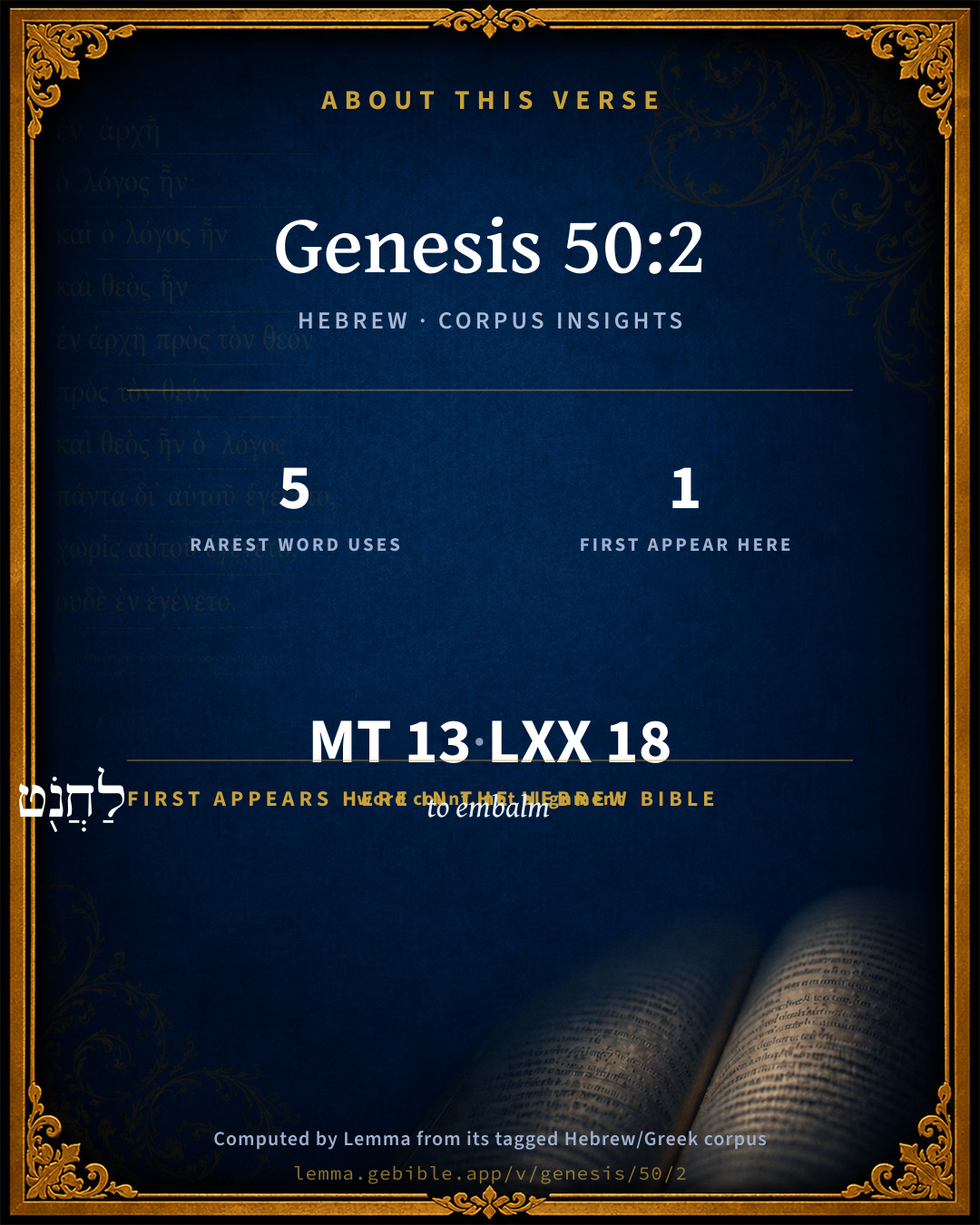
The rarest word here is לַחֲנֹ֖ט to embalm H2590 — appearing just 5 times in the whole Hebrew Bible.

First appearance in Scripture

This word makes its first canonical appearance in the Hebrew Bible here:

  • לַחֲנֹ֖ט to embalm H2590

Shared distinctive vocabulary

לַחֲנֹ֖ט to embalm H2590 occurs in 4 verses of the Hebrew Bible. Also found in:

Grammatical profile

  • 5 verbs
  • 4 nouns
  • 4 particles

Verb forms

  • וַיְצַ֨ו Piel · Sequential Imperfect
  • הָרֹ֣פְאִ֔ים Qal · Participle Active
  • לַחֲנֹ֖ט Qal · Infinitive Construct
  • וַיַּחַנְט֥וּ Qal · Sequential Imperfect
  • הָרֹפְאִ֖ים Qal · Participle Active

Repetition

Words recur within this verse — often emphatic in Hebrew:

  • הָרֹ֣פְאִ֔ים to heal H7495 ×2
  • לַחֲנֹ֖ט to embalm H2590 ×2

Hebrew & Septuagint length

In English translation the verse runs 15 words from the Hebrew and 16 from the Septuagint (LXX English) — closely comparable.

A rough comparison of the two English renderings, which tokenize alike — not a word-level alignment.

Word counts can differ between the Hebrew and the Greek without any difference in meaning — e.g. the Hebrew direct-object marker אֵת has no separate Greek word, and Greek often adds the article ὁ.

In the original languages it is 13 Hebrew tokens and 18 Greek tokens — but the two are counted differently (Hebrew bundles its prefixes and suffixes into one token; the Greek is in lemma form), so that isn’t a like-for-like length.

Cross-references

8

Topical passages linked to Genesis 50:2 in the Treasury of Scripture Knowledge — connected by theme and wording, ordered by reader-vote popularity; previews shown in the World English Bible.

  • Genesis 50:26 So Joseph died, being one hundred ten years old, and they embalmed him, and he was put in a coffin in Egypt.
  • 2 Chronicles 16:14 They buried him in his own tombs, which he had hewn out for himself in the city of David, and laid him in the bed which was filled with sweet odors and various kinds [of spices] prepared by the perfumers' are: and they made a very great burning for him.
  • Mark 16:1 When the Sabbath was past, Mary Magdalene, and Mary the mother of James, and Salome, bought spices, that they might come and anoint him.
  • John 19:39–40 Nicodemus, who at first came to Jesus by night, also came bringing a mixture of myrrh and aloes, about a hundred pounds.
  • Matthew 26:12 For in pouring this ointment on my body, she did it to prepare me for burial.
  • Mark 14:8 She has done what she could. She has anointed my body beforehand for the burying.
  • Luke 24:1 But on the first day of the week, at early dawn, they and some others came to the tomb, bringing the spices which they had prepared.
  • John 12:7 But Jesus said, "Leave her alone. She has kept this for the day of my burial.

Cross-references courtesy of OpenBible.info (CC BY 4.0).

Hebrew and Greek witnesses Masoretic Hebrew ↔ Greek Septuagint

The same verse in the two great witnesses to the Old Testament, shown verse-for-verse.

These are two independent witnesses, not word-aligned to each other, and the Septuagint is shown in lemma (dictionary) form.

Hebrew Genesis 50:2 Masoretic · Westminster Leningrad Codex

וַיְצַ֨ו יוֹסֵ֤ף אֶת עֲבָדָיו֙ אֶת הָרֹ֣פְאִ֔ים לַחֲנֹ֖ט אֶת אָבִ֑יו וַיַּחַנְט֥וּ הָרֹפְאִ֖ים אֶת יִשְׂרָאֵֽל

Joseph commanded his servants, the physicians, to embalm his father; and the physicians embalmed Israel.

World English Bible · Public Domain

Greek LXX Genesis 50:2 Septuagint · lemma form

καί προςτάσσω ιωσηφ ὁ παῖς αὐτός ὁ ἐνταφιαστής ἐνταφιάζω ὁ πατήρ αὐτός καί ἐνταφιάζω ὁ ἐνταφιαστής ὁ ἰσραήλ

And Joseph commanded his servants the embalmers to embalm his father; and the embalmers embalmed Israel.

LXX2012 (modern English Septuagint) · Public Domain

On this verse, The Cambridge Bible for Schools and Colleges discusses the Septuagint’s reading. Read the note in Commentary ↓

Hebrew: Westminster Leningrad Codex (CC BY 4.0). Greek: Septuagint (public domain); English from LXX2012 (modern English Septuagint) (Public Domain). How the Septuagint differs from the Hebrew →

Targum (Aramaic paraphrase)

2

The Targum is the ancient Jewish Aramaic paraphrase of the Hebrew Scriptures — an interpretive translation, not the Hebrew text itself. Onkelos (literal) and Pseudo-Jonathan (expansive) render the Torah, and Jonathan the Prophets. Coverage is partial: where no permissively-licensed English translation exists for a verse, only the Aramaic is shown. This is verse-level text, not a word-by-word alignment to the Hebrew.

  1. Targum Onkelos Torah (Genesis–Deuteronomy)
    וּפַקֵּיד יוֹסֵף יָת עַבְדוֹהִי יָת אַסְוָתָא לְמֶחְנַט יָת אָבוּהִי וְחָנְטוּ אַסְוָתָא יָת יִשְׂרָאֵל

    (no public-domain English translation for this verse)

    Targum Onkelos — Aramaic: “Onkelos Genesis” (public domain); “Onkelos Exodus” (public domain); “Onkelos Leviticus” (public domain); “Onkelos Numbers” (public domain); “Onkelos Deuteronomy” (public domain). English: “Sefaria Community Translation” (CC0 1.0 (public-domain dedication)); “J.W. Etheridge. The Targums of Onkelos and Jonathan Ben Uzziel on the Pentateuch. London: Longmans, Green, 1862” (public domain). Text via Sefaria.

  2. Targum Pseudo-Jonathan Torah (Genesis–Deuteronomy)
    וּפְקַד יוֹסֵף יַת עַבְדוֹי יַת אַסְוָותָא לְבַסְמָא יַת אָבוֹי וּבְסִימוּ אַסְוָותָא יַת יִשְרָאֵל

    And Joseph commanded his servants the physicians to embalm his father; and the physicians embalmed Israel.

    Targum Pseudo-Jonathan — Aramaic: “Targum Jonathan on Genesis” (public domain); “Targum Jonathan on Exodus” (public domain); “Targum Jonathan on Leviticus” (public domain); “Targum Jonathan on Numbers” (public domain); “Targum Jonathan on Deuteronomy” (public domain). English: “The Targum of Jonathan ben Uzziel, trans. J. W. Etheridge, London, 1862” (public domain). Text via Sefaria.

Commentary

Notes on Genesis 50:2 from classic Christian and Jewish commentators (each source and its license shown beneath its notes). The classic Christian expositions comment on the surrounding passage and are grouped to its opening verse, so a note may address several verses; the Jewish commentaries on the Tanakh (Rashi and others) are per-verse, so they appear only where the commentator wrote on this verse.

Lemma curates 59 commentaries, every one of them public domain or Creative Commons licensed, each selected and text-cleaned for this edition rather than reprinted as found. About our sources →

Trapp's Complete Commentary

John Trapp

Gen 50:2 And Joseph commanded his servants the physicians to embalm his father: and the physicians embalmed Israel.

Ver. 2. And Joseph commanded his servants the physicians.] Physicians, {a} it seems, were formerly of no great esteem; perhaps it was because, through ignorance, they many times officiously killed their patients. We know who it was that cried out upon his death bed, Many physicians have killed the emperor. {b} And it is grown to a proverb, No physician can be his craftsmaster, till he have been the death of thirty men. {c} The Egyptians, to prevent this mischief, appointed fox every ordinary disease, a several physician; enjoining them to study the cure of that only. And till then, the fashion was to lay the sick man at his door, where every passenger was bound to inquire the nature of his disease; that if either himself or any within his knowledge had recovered of the like, he might tell by what means, or stay to make trial of that skill he had upon the patient. {d} Physic is, without question, the ordinance of God. {Exo 21:19} He styles himself, "Jehovah Rophe," {Exo 15:26} the Lord the physician. And a physician is more worth than many others, saith the heathen poet. {e} Use them we must, when there is need, {Mar 2:17 1Ti 4:4} but not idolise them, as 2Ch 16:12.

And the physicians embalmed Israel.] According to the custom of that country; concerning which, he that will see more, may read in Herodotus and Pliny. {f} This custom continued also in after ages, as well among Jews as Gentiles. But the devil turned it, in time, into most vain superstition, both among the Greeks, whom Lucian frequently jeers for it, and among the Latins; witness that of Ennius, Tavquinii corpus bona faemina lavit, et unxit. Joseph embalmed his father’s corpse, partly to honour {2Ch 16:14; 2Ch 21:19} him with this solemnity; and partly to preserve him for so long a journey; but principally to testify his faith of the resurrection, and that incorruption he hoped for at the last day. Some think the apostle hath relation to this, in that 1Co 15:29, and they read it thus; "Why do they then wash - βαπτιζονται, voce media - over the dead?" Compare Act 9:37.

{a} Yεραπευω, famulor, curo, remedium morbo adhibeo.

{b} πολλοι ιατροι κατεκτειναν τον βασιλεα. - Adrian Imp.

{c} Tritum est, nullum medicum esse peritum, nisi triginta homines Orco demiserit. "Farewell, Physic," was Chaucer’s motto.

{d} Olim exponebatur aeger obvio cuilibet sanandus. - Plutarch. Herodot., lib. i.

{e} Iατηρ δ ανηρ πολλων ανταξιος αλλων. - Hom.

{f} Herodot., Euierpe. Plin., lib. xi. cap. 27.

John Trapp, A Commentary or Exposition upon All the Books of the Old and New Testament (1647–1656) — public domain. Text from a community e-Sword module.

Joseph Benson's Commentary

Gen 50:2. He ordered the body to be embalmed, not only because he died in Egypt, and that was the manner of the Egyptians, but because he was to be carried to Canaan, which would be a work of time. “Embalming is the opening of a dead body, taking out the intestines, and filling the place with odoriferous and desiccative drugs and spices, to prevent its putrifying. The Egyptians excelled all other nations in the art of preserving bodies from corruption; for some, that they embalmed upward of two thousand years ago, remain whole to this day, and they are often brought into other countries as great curiosities. Their manner of embalming was this; they scooped the brains with an iron scoop out at the nostrils, and threw in medicaments to fill up the vacuum. They also took out the entrails, and having filled the body with myrrh, cassia, and other spices (except frankincense) proper to dry up the humours, they pickled it in nitre, where it lay soaking for seventy days. The body was then wrapped up in bandages of fine linen and gums, to make it stick like glue; and so was delivered to the kindred of the deceased, entire in all its features, the very hairs of the eyelids being preserved. They used to keep the bodies of their ancestors, thus embalmed, in little houses magnificently adorned, and took great pleasure in beholding them alive, as it were, without any change in their size, features, or complexion. The Egyptians also embalmed birds,” &c. —

Encyclop. Britan. This practice of embalming, it appears, was common both to the rich and poor, but it was more or less costly, according to the rank and circumstances of the person. Joseph commanded his servants the physicians — To perform this office. For, according to Herodotus and Diodorus Siculus, the same persons who prescribed as physicians for the living, were employed in embalming the dead. As it appears that many of these physicians were wont to be kept in pay, as servants, in the courts of princes, and the families of the great, we may conclude that Joseph, in his office of prime minister, had not a few of them belonging to his household. Indeed, if we may credit Herodotus, all places in Egypt were crowded with them. And no wonder; for “every distinct distemper” says he, “hath its own physician, who confines himself to the study and care of that alone, and meddles with no other. Thus, one class hath the care of the eyes, another of the head, another of the region of the belly,” &c.; (lib. 2. c. 84;) so that their number must have been very great.

Joseph Benson's Commentary on the Old and New Testaments (1811–1818) — public domain. Text from a community e-Sword module.

Tyndale Open Study Notes

Tyndale Open Resources

50:2 Jacob’s body was embalmed for burial in typical Egyptian fashion.

Tyndale Open Study Notes — © Tyndale Open Resources, licensed CC BY-SA 4.0. Text via the HelloAO Bible API.

Geneva Bible (1599)

Geneva Bible translators

He meaneth them that embalmed the dead and buried them.

Geneva Bible (1599) marginal notes — public domain. Text via Bolls.life.

Jamieson, Fausset & Brown

Robert Jamieson, A. R. Fausset & David Brown

Joseph commanded his servants the physicians to embalm his father, &c.--In ancient Egypt the embalmers were a class by themselves. The process of embalmment consisted in infusing a great quantity of resinous substances into the cavities of the body, after the intestines had been removed, and then a regulated degree of heat was applied to dry up the humors, as well as decompose the tarry materials which had been previously introduced. Thirty days were alloted for the completion of this process; forty more were spent in anointing it with spices; the body, tanned from this operation, being then washed, was wrapped in numerous folds of linen cloth--the joinings of which were fastened with gum, and then it was deposited in a wooden chest made in the form of a human figure.

Jamieson, Fausset & Brown — Commentary Critical and Explanatory on the Whole Bible (1871) — public domain (CC PDM 1.0). Text via the HelloAO Bible API.

Adam Clarke's Commentary

Verse 2. The physicians] רפאים ropheim, the healers, those whose business it was to heal or restore the body from sickness by the administration of proper medicines; and when death took place, to heal or preserve it from dissolution by embalming, and thus give it a sort of immortality or everlasting duration. The original word חנט chanat, which we translate to embalm, has undoubtedly the same meaning with the Arabic [Arabic] hanata, which also signifies to embalm, or to preserve from putrefaction by the application of spices, c., and hence [Arabic] hantat, an embalmer. The word is used to express the reddening of leather and probably the ideal meaning may be something analogous to our tanning, which consists in removing the moisture, and closing up the pores so as to render them impervious to wet. This probably is the grand principle in embalming; and whatever effects this, will preserve flesh as perfectly as skin. Who can doubt that a human muscle, undergoing the same process of tanning as the hide of an ox, would not become equally incorruptible? I have seen a part of the muscle of a human thigh, that, having come into contact with some tanning matter, either in the coffin or in the grave, was in a state of perfect soundness, when the rest of the body had been long reduced to earth; and it exhibited the appearance of a thick piece of well tanned leather.

In the art of embalming, the Egyptians excelled all nations in the world; with them it was a common practice. Instances of the perfection to which they carried this art may be seen in the numerous mummies, as they are called, which are found in different European cabinets, and which have been all brought from Egypt. This people not only embalmed men and women, and thus kept the bodies of their beloved relatives from the empire of corruption, but they embalmed useful animals also. I have seen the body of the Ibris thus preserved; and though the work had been done for some thousands of years, the very feathers were in complete preservation, and the colour of the plumage discernible. The account of this curious process, the articles used, and the manner of applying them, I subjoin from Herodotus and Diodorus Siculus, as also the manner of their mournings and funeral solemnities, which are highly illustrative of the subjects in this chapter.

"When any man of quality dies," says Herodotus, "all the women of that family besmear their heads and faces with dirt; then, leaving the body at home, they go lamenting up and down the city with all their relations; their apparel being girt about them, and their breasts left naked. On the other hand the men, having likewise their clothes girt about them, beat themselves. These things being done, they carry the dead body to be embalmed; for which there are certain persons appointed who profess this art. These, when the body is brought to them, show to those that bring it certain models of dead persons in wood, according to any of which the deceased may be painted. One of these they say is accurately made like to one whom, in such a matter, I do not think lawful to name; του ουκ ὁσιον ποιουμαι το ουνομα επι τοιουτῳ πρηγματι ονομαζειν; (probably Osiris, one of the principal gods of Egypt, is here intended;) then they show a second inferior to it, and of an easier price; and next a third, cheaper than the former, and of a very small value; which being seen, they ask them after which model the deceased shall be represented. When they have agreed upon the price they depart; and those with whom the dead corpse is left proceed to embalm it after the following manner: First of all, they with a crooked iron draw the brain out of the head through the nostrils; next, with a sharp AEthiopic stone they cut up that part of the abdomen called the ilia, and that way draw out all the bowels, which, having cleansed and washed with palm wine, they again rinse and wash with wine perfumed with pounded odours: then filling up the belly with pure myrrh and cassia grossly powdered, and all other odours except frankincense, they sew it up again. Having so done, they salt it up close with nitre seventy days, for longer they may not salt it. After this number of days are over they wash the corpse again, and then roll it up with fine linen, all besmeared with a sort of gum, commonly used by the Egyptians instead of glue. Then is the body restored to its relations, who prepare a wooden coffin for it in the shape and likeness of a man, and then put the embalmed body into it, and thus enclosed, place it in a repository in the house, setting it upright against the wall. After this manner they, with great expense, preserve their dead; whereas those who to avoid too great a charge desire a mediocrity, thus embalm them: they neither cut the belly nor pluck out the entrails, but fill it with clysters of oil of cedar injected up the anus, and then salt it the aforesaid number of days. On the last of these they press out the cedar clyster by the same way they had injected it, which has such virtue and efficacy that it brings out along with it the bowels wasted, and the nitre consumes the flesh, leaving only the skin and bones: having thus done, they restore the dead body to the relations, doing nothing more. The third way of embalming is for those of yet meaner circumstances; they with lotions wash the belly, then dry it up with salt for seventy days, and afterwards deliver it to be carried away. Nevertheless, beautiful women and ladles of quality were not delivered to be embalmed till three or four days after they had been dead;" for which Herodotus assigns a sufficient reason, however degrading to human nature: Τουτο δε ποιεουσι οὑτω τουδε εἱνεκα, ἱνα μη σφι οἱ ταριχευται μισγωνται τῃσι γυναιξι· λαμφθηναι γαρ τινα φασι μισγομενον νεκρῳ προσφατῳ γυναικος· κατειπαι δε τον ὁμοτεχνον. [The original should not be put into a plainer language; the abomination to which it refers being too gross.] "But if any stranger or Egyptian was either killed by a crocodile or drowned in the river, the city where he was cast up was to embalm and bury him honourably in the sacred monuments, whom no one, no, not a relation or friend, but the priests of the Nile only, might touch; because they buried one who was something more than a dead man." - HEROD. Euterpe, p. 120, ed. Gale.

Diodorus Siculus relates the funeral ceremonies of the Egyptians more distinctly and clearly, and with some very remarkable additional circumstances. "When any one among the Egyptians dies," says he, "all his relations and friends, putting dirt upon their heads, go lamenting about the city, till such time as the body shall be buried: in the meantime, they abstain from baths and wine, and all kinds of delicate meats; neither do they, during that time, wear any costly apparel. The manner of their burials is threefold: one very costly, a second sort less chargeable, and a third very mean. In the first, they say, there is spent a talent of silver; in the second, twenty minae; but in the last there is very little expense. 'Those who have the care of ordering the body are such as have been taught that art by their ancestors. These, showing each kind of burial, ask them after what manner they will have the body prepared. When they have agreed upon the manner, they deliver the body to such as are usually appointed for this office. First, he who has the name of scribe, laying it upon the ground, marks about the flank on the left side how much is to be cut away; then he who is called παρασχιστης, paraschistes, the cutter or dissector, with an AEthiopic stone, cuts away as much of the flesh as the law commands, and presently runs away as fast as he can; those who are present, pursuing him, cast stones at him, and curse him, hereby turning all the execrations which they imagine due to his office upon him. For whosoever offers violence, wounds, or does any kind of injury to a body of the same nature with himself, they think him worthy of hatred: but those who are ταριχευται, taricheutae, the embalmers, they esteem worthy of honour and respect; for they are familiar with their priests, and go into the temples as holy men, without any prohibition. As soon as they come to embalm the dissected body, one of them thrusts his hand through the wound into the abdomen, and draws forth all the bowels but the heart and kidneys, which another washes and cleanses with wine made of palms and aromatic odours. Lastly, having washed the body, they anoint it with oil of cedar and other things for about thirty days, and afterwards with myrrh, cinnamon, and other such like matters, which have not only a power to preserve it a long time, but also give it a sweet smell; after which they deliver it to the kindred in such manner that every member remains whole and entire, and no part of it changed, but the beauty and shape of the face seem just as they were before; and the person may be known, even the eyebrows and eyelids remaining as they were at first. By this means many of the Egyptians, keeping the dead bodies of their ancestors in magnificent houses, so perfectly see the true visage and countenance of those that died many ages before they themselves were born, that in viewing the proportions of every one of them, and the lineaments of their faces, they take as much delight as if they were still living among them. Moreover, the friends and nearest relations of the deceased, for the greater pomp of the solemnity, acquaint the judges and the rest of their friends with the time prefixed for the funeral or day of sepulture, declaring that such a one (calling the dead by his name) is such a day to pass the lake; at which time above forty judges appear, and sit together in a semicircle, in a place prepared on the hither side of the lake, where a ship, provided beforehand by such as have the care of the business, is haled up to the shore, and steered by a pilot whom the Egyptians in their language called Charon. Hence they say Orpheus, upon seeing this ceremony while he was in Egypt, invented the fable of hell, partly imitating therein the people of Egypt, and partly adding somewhat of his own. The ship being thus brought to the lake side, before the coffin is put on board every one is at liberty by the law to accuse the dead of what he thinks him guilty. If any one proves he was a bad man, the judges give sentence that the body shall be deprived of sepulture; but in case the informer be convicted of false accusation, then he is severely punished. If no accuser appear, or the information prove false, then all the kindred of the deceased leave off mourning, and begin to set forth his praises, yet say nothing of his birth, (as the custom is among the Greeks,) because the Egyptians all think themselves equally noble; but they recount how the deceased was educated from his youth and brought up to man's estate, exalting his piety towards the gods, and justice towards men, his chastity, and other virtues wherein he excelled; and lastly pray and call upon the infernal deities (τους κατω θεους, the gods below) to receive him into the societies of the just. The common people take this from the others, and consequently all is said in his praise by a loud shout, setting forth likewise his virtues in the highest strains of commendation, as one that is to live for ever with the infernal gods. Then those that have tombs of their own inter the corpse in places appointed for that purpose; and they that have none rear up the body in its coffin against some strong wall of their house. But such as are denied sepulture on account of some crime or debt, are laid up at home without coffins; yet when it shall afterwards happen that any of their posterity grows rich, he commonly pays off the deceased person's debts, and gets his crimes absolved, and so buries him honourably; for the Egyptians are wont to boast of their parents and ancestors that were honourably buried. It is a custom likewise among them to pawn the dead bodies of their parents to their creditors; but then those that do not redeem them fall under the greatest disgrace imaginable, and are denied burial themselves at their deaths." - Diod. Sic. Biblioth., lib. i., cap. 91-93., edit. Bipont. See also the Necrokedia, or Art of Embalming, by Greenhill, 4to., p. 241, who endeavoured in vain to recommend and restore the art But he could not give his countrymen Egyptian manners; for a dead carcass is to the British an object of horror, and scarcely any, except a surgeon or an undertaker, cares to touch it.

Adam Clarke's Commentary on the Bible (1810–1826) — public domain. Text from a community e-Sword/MySword module.

John Calvin's Commentaries

2. And Joseph commanded his servants. Although formerly more labor was expended on funerals, and that even without superstition, than has been deemed right subsequently to the proof given of the resurrection exhibited by Christ: yet we know that among the Egyptians there was greater expense and pomp than among the Jews. Even the ancient historians record this among the most memorable customs of that nation. Indeed it is not to be doubted (as we have said elsewhere) that the sacred rite of burial descended from the holy fathers, to be a kind of mirror of the future resurrection: but as hypocrites are always more diligent in the performance of ceremonies, than they are, who possess the solid substance of things; it happens that they who have declined from the true faith, assume a far more ostentatious appearance than the faithful, to whom pertain the truth and the right use of the symbol. If we compare the Jews with ourselves, these shadowy ceremonies, in which God required them to be occupied, would, at this time, appear intolerable; though compared with those of other nations, they were moderate and easily to be borne. But the heathen scarcely knew why they incurred so much labor and expense. Hence we infer how empty and trivial a matter it is, to attend only to external signs, when the pure doctrine which exhibits their true origin and their legitimate end, does not flourish. It is an act of piety to bury the dead. To embalm corpses with aromatic spices, was, in former times, no fault; inasmuch as it was done as a public symbol of future incorruption. For it is not possible but that the sight of a dead man should grievously affect us; as if one common end, without distinction, awaited both us and the beasts that perish. At this day the resurrection of Christ is a sufficient support for us against yielding to this temptation. But the ancients, on whom the full light of day had not yet shone, were aided by figures: they, however, whose minds were not raised to the hope of a better life, did nothing else than trifle, and foolishly imitate the holy fathers. Finally, where faith has not so breathed its odour, as to make men know that something remains for them after death, all embalming will be vapid. Yea, if death is to them the eternal destruction of the body, it would be an impious profanation of a sacred and useful ceremony, to attempt to place what had perished under such costly custody. It is probable that Joseph, in conforming himself to the Egyptians, whose superfluous care was not free from absurdity; acted rather from fear than from judgment, or from approval of their method. Perhaps he improperly imitated the Egyptians, lest the condition of his father might be worse than that of other men. But it would have been better, had he confined himself to the frugal practice of his fathers. Nevertheless though he might be excusable, the same practice is not now lawful for us. For unless we wish to subvert the glory of Christ, we must cultivate greater sobriety.

John Calvin's Commentaries (1540-1563) — public domain. Text from the Calvin Translation Society English edition (1840s-50s) via the Christian Classics Ethereal Library (ccel.org). Calvin's coverage is partial (roughly two-thirds of the Bible); uncommented books and verses are honest gaps, never fabricated. The 19th-century editor's footnotes and remarks are omitted so the notes are faithfully Calvin's own voice.

Ellicott's Commentary for English Readers

L.

BURIAL OF JACOB, AND HAPPY OLD AGE OF JOSEPH.

(2) The physicians embalmed Israel.—The command given first by Jacob to Joseph (Gen_47:29-30), and then urged earnestly upon all his sons, and with the reminder that the cave of Machpelah had been purchased and belonged to him by right (Gen_49:29-32), made it specially necessary that the patriarch’s body should be prepared for so long a journey. It was also usual at that period to embalm the dead; and during the many centuries while the custom lasted, from B.C. 2000 to A.D. 700, it is calculated that no less than 420,000,000 bodies were thus preserved. For the process, which was very expensive if done in the best manner, see Rawlinson, Egypt, i. 511 ff. The embalmers are not generally called physicians, but probably what is meant is that the embalming of Jacob’s body was superintended by the physicians attached to Joseph’s household. Egypt was famous for its physicians, who were in advance of those of other countries, and were subdivided into classes, which had each the charge of some special disease. (See Rawlinson as above, i. 305 ff.) Mas-pero thinks that their real knowledge was inconsiderable, and that there were specialists only for the eyes, and one or two similar diseases (Hist. Anc. 82). Ophthalmia continues to be one of the most common diseases of Egypt.

A Bible Commentary for English Readers, edited by Charles John Ellicott (1878–1897) — public domain. Text from a community e-Sword module.

The Cambridge Bible for Schools and Colleges

gen. ed. J. J. S. Perowne

2. the physicians] LXX οἱ ἐνταφιασταί; Lat. medici. By this expression we should probably understand “the guild of embalmers” (ταριχευταί, Herod. ii. 86), a large and influential class in Egypt, who, with an expert knowledge of the body and of drugs, practised embalming almost as a fine art.

to embalm] Embalming was carried out to great perfection in Egypt. It was supposed that the soul, or ka, would return to inhabit the body. The mummy was the body ready for occupation. See Budge, The Mummy (1893).

The Cambridge Bible for Schools and Colleges (gen. ed. J. J. S. Perowne; Cambridge University Press, 1878–1918) — public domain. Text from a community e-Sword module.

John Gill's Exposition

And Joseph commanded his servants, the physicians, to embalm his father,.... Which he did, not merely because it was the custom of the Egyptians, but because it was necessary, his father's corpse being to be carried into Canaan to be interred there, which would require time; and therefore it was proper to make use of some means for the preservation of it, and these men were expert in this business, which was a branch of the medicinal art, as Pliny (x) and Mela (y) suggest; and of these Joseph had more than one, as great personages have their physicians ready to attend them on any occasion, as kings and princes, and such was Joseph, being viceroy of Egypt. Herodotus (z) says the Egyptians had physicians peculiar to every disease, one for one disease, and another for another; and Homer (a) speaks of them as the most skilful of all men; though the Septuagint render the word by the "buriers", such who took care of the burial of persons, to provide for it, and among the rest to embalm, dry, and roll up the bodies in linen:

and the physicians embalmed him; the manner of embalming, as Herodotus (b) relates, was this,"first with a crooked iron instrument they extracted the brain through the nostrils, which they got out partly by this means, and partly by the infusion of medicines; then with a sharp Ethiopian stone they cut about the flank, and from thence took out all the bowels, which, when they had cleansed, they washed with palm wine (or wine of dates), and after that again with odours, bruised; then they filled the bowels (or hollow place out of which they were taken) with pure myrrh beaten, and with cassia and other odours, frankincense excepted, and sewed them up; after which they seasoned (the corpse) with nitre, hiding (or covering it therewith) seventy days, and more than that they might not season it; the seventy days being ended, they washed the corpse, and wrapped the whole body in bands of fine linen, besmearing it with gum, which gum the Egyptians use generally instead of glue.''And Diodorus Siculus (c), who gives much the same account, says, that every part was retained so perfectly, that the very hairs of the eyebrows, and the whole form of the body, were invariable, and the features might be known; and the same writer tells us, that the expense of embalming was different; the highest price was a talent of silver, about one hundred and eighty seven pounds and ten shillings of our money, the middlemost twenty pounds, and the last and lowest were very small. The embalmers he calls and says they were in great esteem, and reckoned worthy of much honour, and were very familiar with the priests, and might go into holy places when they pleased, as the priests themselves.

(x) Plin. Nat. Hist. l. 11. c. 37. (y) De Orbis Situ, l. 1. c. 9. (z) Euterpe, sive, l. 2. c. 84. (a) Odyss. 4. (b) lbid. c. 86. (c) Bibliothec. l. 1. p. 81, 82.

John Gill's Exposition of the Whole Bible (1746–1763) — public domain (CC PDM 1.0). Text via the HelloAO Bible API.

Haydock's Catholic Bible Commentary

Physicians, whose business it was to embalm dead bodies, with a composition of myrrh, &c., in order to keep them from putrefaction, (Menochius) as the Egyptian mummies are treated. (Haydock) --- The entrails are taken out, &c., by the embalmer during 30 days, and the body is left in salt and various drugs, for other 40, in all 70 days, as Herodotus informs us, (B. xi. 86,) and as Moses here insinuates, ver. 3. This was an honour peculiar to the kings. Before any person was buried, his praises were rehearsed; and it was lawful on this occasion to declare, what evil even the kings themselves had done; which sometimes caused them to be deprived of funeral honours. We have several funeral canticles preserved in Scripture: 2 Kings i. 18; iii. 33; 2 Paralipomenon xxxv. 25. (Calmet) --- The Lamentations of Jeremias were perhaps of this nature, on the death of King Josias. The usual time for mourning among the Jews, was 30 days for people of eminence, (Numbers xx.; Deuteronomy xxxiv. 8; Procopius) and seven for the rest, Ecclesiasticus xxii. 13. (Haydock)

George Leo Haydock (1774–1849), Haydock's Catholic Family Bible and Commentary, 1859 edition — public domain. Excludes Psalms (Douay-Rheims chapter numbering differs from Protestant) and Deuterocanonical books (Catholic canon only).

Matthew Poole's English Annotations

The dead corpse of his father with spices, and ointments, and other things necessary for the preservation of the body from putrefaction as long as might be. This Joseph did, partly, because he would comply as far as he could with the Egyptians, whose custom this was, from whom also the Jews took it, 2Ch 16:14; Joh 19:39-40; partly, to do honour and show his affections to his worthy father; and partly, because this was necessary for the keeping of the body so long as the times of mourning and the journey to Canaan required.

Matthew Poole's English Annotations on the Holy Bible (1683–1685) — public domain. Text from a community e-Sword/MySword module.

Whedon's Commentary on the Bible

Daniel D. Whedon

2. Commanded… to embalm — “The Egyptians were famous for their skill in medicine. Homer says that every physician in Egypt ‘knew more than all other men.’ Odyss., 4, 229. Medical specialties were carefully cultivated, and the land abounded with oculists, aurists, dentists, etc., so that persons of rank and wealth generally had several different kinds of physicians among their servants, as Joseph seems to have had, according to the text. The Persian kings, Cyrus and Darius, had Egyptian physicians at their courts. Herod., 2:84; 3:1, 132. The Theban mummies show that they filled teeth with gold; and Pliny says, that they practised postmortem examinations; while one of the books of Hermes treated of medical instruments, and another of anatomy. The government was very severe upon quacks, and the death of a patient who had not been ‘doctored by the books,’ was held a capital crime. Wilkinson, in Rawl., Her., ii, p. 117.

European medicine came from Egypt through the Arabs, whence the Arab symbols of our chemists, while the very word chem-istry is a souvenir of the land of Ham, or Chem.

“Embalming was practised by several ancient nations, but the art was carried to the highest perfection in Egypt. The materials principally used were cedar oil, natron, (native carbonate of soda,) and various spices. Embalming was the work of a special class, (Herod., 2:86,) whom probably Joseph’s physicians employed.”— Newhall.

Daniel D. Whedon (gen. ed.), Commentary on the Old and New Testaments (1874–1909) — public domain. Text from a community e-Sword module.

The Pulpit Commentary

And Joseph commanded his servants, the physicians literally, the healers, from apr to sew together, to mend, hence to heal, a class of persons which abounded in Ancient Egypt, each physician being only qualified to treat a single disorder (Herod., 2:84). The medical men of Egypt were held in high repute abroad, and their assistance was at various times required by persons from other countries, as, e.g., Cyrus and Darius (Herod., 3:1, 132). Their knowledge of medicines was extensive, and is referred to both in sacred and profane (Homer, "Odyssey" 4. 229) writings. The Egyptian doctors belonged to the sacerdotal order, and were expected to know all things relating to the body, and diseases and remedies contained in the six last of the sacred books of Hermes. According to Pliny (7:56), the study of medicine originated in Egypt (vide Wilkinson in Rawlinson"s "Herodotus," vol 2. pp. 116, 117). The physicians employed by Joseph were those attached to his own household, or the court practitionersto embalm his father: literally, to spice or season (the body of) his father, i.e. to prepare it for burial by means of aromatics; ut aromatibus condirent (Vulgate); ejntafiasai tora aujtou (LXX), which is putting part of a proceeding for the whole (Tayler Lewis). According to Herodotus (ii. 86), the embalmers belonged to a distinct hereditary class or guild from the ordinary physicians; but either their formation into such a separate order of practitioners was of later origin (Hengstenberg, Kurtz, Kalisch), or Jacob was embalmed by the physicians instead of the embalmers proper because, not being an Egyptian, he could not be subjected to the ordinary treatment of the embalming art ("Speaker"s Commentary")and the physicians embalmed Israel. The method of preparing mummies in Ancient Egypt has been elaborately described, both by Herodotus (2:86) and Diodorus Sieulus (1:91), and, in the main, the accuracy of their descriptions has been confirmed by the evidence derived from the mummies themselves. According to the most expensive process, which cost one talent of silver, or about sterling, the brain was first extracted through the nostrils by means of a crooked piece of iron, the skull being thoroughly cleansed of any remaining portions by rinsing with drugs; then, through an opening in the left side made with a sharp Ethiopian knife of agate or of flint, the viscera were removed, the abdomen being afterwards purified with palm wine and an infusion of aromatics; next, the disemboweled corpse was filled with every sort of spicery except frankincense, and the opening sewed up; after that the stuffed form was steeped for seventy days in natrum or subcarbonate of soda obtained from the Libyan desert, and sometimes in wax and tanning, bitumen also being employed in later times; and finally, on the expiration of that period, which was scrupulously observed, the body was washed, wrapped about with linen bandages, smeared over with gum, decorated with amulets, sometimes with a network of porcelain bugles, covered with a linen shroud, and, in due course, transferred to a mummy case (vide Wilkinson"s "Manners and Customs of the Ancient Egyptians," vol. 3. p. 471, ed.1878; Rawlinson"s "Herodotus," vol. 2. pp. 118-123).

The Pulpit Commentary (1880–1919), ed. H.D.M. Spence-Jones & Joseph S. Exell — public domain. Text from a community e-Sword module.

John Wesley's Explanatory Notes

He ordered the body to be embalmed, not only because he died in Egypt, and that was the manner of the Egyptians, but because he was to be carried to Canaan, which would be a work of time.

John Wesley, Explanatory Notes Upon the Whole Bible (1754–1765) — public domain. Text via the GEBible commentary corpus.

Rashi

Rabbi Shlomo Yitzchaki (Rashi)

לחנט את אביו TO EMBALM HIS FATHER — Embalming is a matter of using a mixture of aromatic spices.

Rashi on the Tanakh — English translations: “The Judaica Press complete Tanach with Rashi, translated by A. J. Rosenberg” (CC BY 4.0); “Pentateuch with Rashi's commentary by M. Rosenbaum and A.M. Silbermann, 1929-1934” (public domain); “The Metsudah Tanach series, Lakewood, N.J” (CC BY 4.0); and “The Book of Joshua, Metsudah Publications, 1997” (CC BY 4.0). Text via Sefaria.

Radak

Rabbi David Kimhi (Radak)

לחנט, a procedure of embalming the remains of the deceased so the body would not become putrid.

Radak on the Tanakh — English translations: “Sefaria Community Translation” (CC0 1.0 (public-domain dedication)); “Eliyahu Munk, HaChut Hameshulash” (CC BY 4.0); “Rabbi Mike Feuer, Jerusalem Anthology” (CC BY 4.0); and “R. David Kimhi on the first book of Psalms, Translated by R.G. Finch, London, 1919” (public domain). Text via Sefaria.

Lesson kit

Teaching starters — assembled from the data on this page, not authored interpretation. Every prompt links to the verse data it draws on. Edit before teaching.

Genesis, in the Pentateuch, opens this verse with 13 words (8 distinct Hebrew lemmas). Its most distinctive word is chânaṭ (“to embalm”). A historical commentator’s framing appears above. Read the whole chapter for the surrounding context.

Discussion questions

  1. What does “to embalm” (chânaṭ) contribute to the verse as a whole?
  2. This is the first place “to embalm” appears in Scripture (first appears here). What does its debut here establish?
  3. How does Genesis 50:3, which shares the word «to embalm», read alongside this verse?
  4. What does the repetition of “to heal” (2× in this one verse) do in this verse?
  5. «וַיְצַ֨ו» is a Piel Sequential Imperfect verb. How does that grammatical form shape the action described?
  6. Compare how Trapp's Complete Commentary and Joseph Benson's Commentary read this verse. Where do they agree or differ?

Things to notice

Reading settings

Reading text

Shown beneath each verse's original-language words.

Old Testament
Old Testament edition

Read the OT as the Masoretic Hebrew (MT) or the Greek Septuagint (LXX).

English shown for the Greek Septuagint (in the Hebrew ↔ Greek comparison).

Comparing translations? Open the Compare panel on any verse page to stack up to four side by side.