
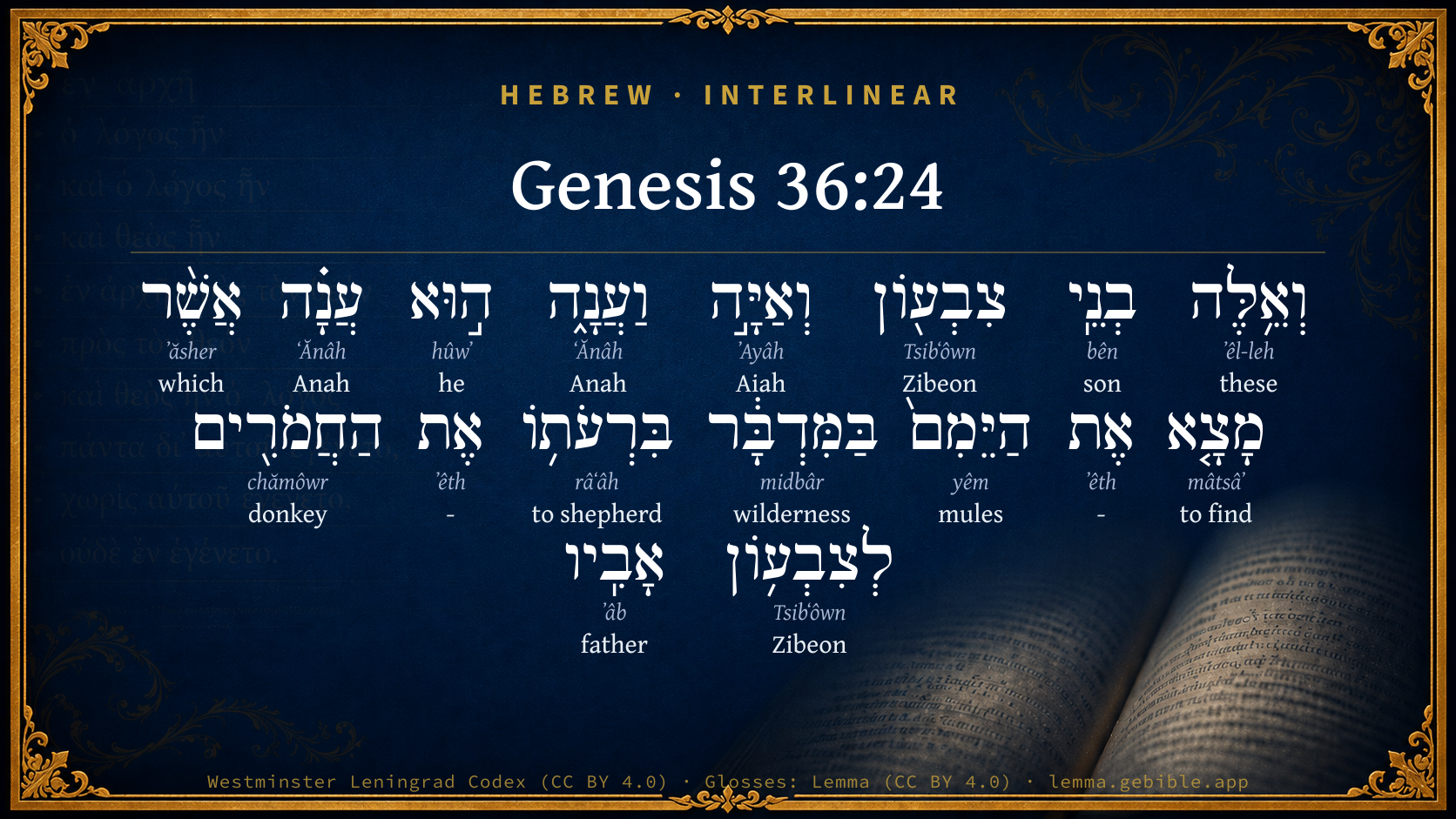
Genesis 36:24

Hebrew (Westminster Leningrad Codex) Genesis 36:24 appears in the Hebrew Old Testament. The text above is from the Westminster Leningrad Codex. Each word links to its Strong’s number, a concise gloss, and parsing drawn from the Open Scriptures Hebrew Bible morphology. Click any word for its full Brown-Driver-Briggs (BDB) entry.
Download image
Cite this verse

Genesis 36:24 (World English Bible). Public Domain. Lemma interlinear Bible study tool, https://lemma.gebible.app/v/genesis/36/24.

Show BibTeX & RIS
BibTeX
RIS
English Translation
These are the children of Zibeon: Aiah and Anah. This is Anah who found the hot springs in the wilderness, as he fed the donkeys of Zibeon his father.
World English Bible · Public Domain
Highlights
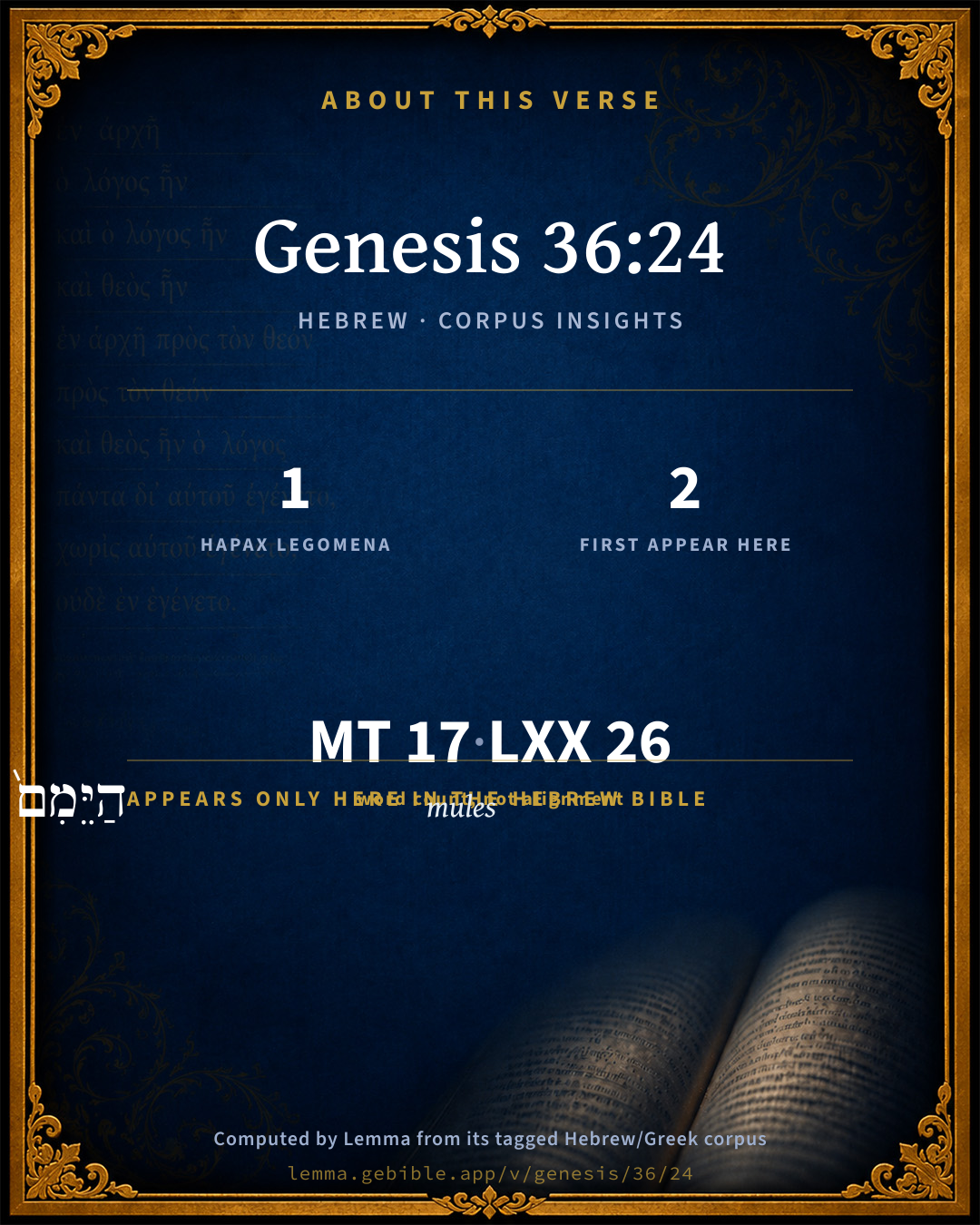
  • 1 hapax legomenon — only here in the Hebrew Bible
  • 2 first appearances in the Hebrew Bible
Full analysis ↓
Download a study sheet

One document with this verse’s original text, its word-by-word gloss line, the meaning frame, cross-references with their text, attributed commentary, and full source and license credits — printable, and it pastes into notes with its structure intact.

This verse Autodidact and up

Study sheet (.html) Plain text (.txt)

A passage Seminary Student

Up to 50 verses in one chapter. A passage sheet keeps up to 6 commentary sources and 12 cross-references per verse, in the order this page ranks them, and says so on the sheet whenever that leaves anything out. Ask for a single verse and you get the Autodidact verse sheet above.

Everything on this page stays free to read, with no account — the sheet is a download of what is already on screen, not access to it.

Want to remove ads? Support Godless Engineer
Compare translations 3

The same verse in 3 English versions, stacked beneath the original-language interlinear above. Click any original word for its lexicon entry.

Each is an independent rendering of the whole verse — the interlinear is not word-aligned to these translations.

Highlighted words mark where these versions differ — a whole-verse word diff, not a word-by-word alignment.

  • World English Bible Public Domain
    These are the children of Zibeon: Aiah and Anah. This is Anah who found the hot springs in the wilderness, as he fed the donkeys of Zibeon his father.
  • King James Version Public Domain
    And these are the children of Zibeon; both Ajah, and Anah: this was that Anah that found the mules in the wilderness, as he fed the asses of Zibeon his father.
  • unfoldingWord Literal Text CC BY-SA 4.0
    And these the sons of Zibeon: both Aiah and Anah. He Anah who found the hot springs in the wilderness when he was pasturing the donkeys for Zibeon his father.

unfoldingWord Literal Text — © unfoldingWord, licensed CC BY-SA 4.0. Word-aligned USFM3 via Door43 (git.door43.org/unfoldingWord/en_ult).

Versions to compare (up to 4)

3 of 4 selected

Show all 18 translations

Every available English version of this verse, each an independent rendering of the whole verse.

  • World English Bible Public Domain
    These are the children of Zibeon: Aiah and Anah. This is Anah who found the hot springs in the wilderness, as he fed the donkeys of Zibeon his father.
  • Berean Standard Bible Public Domain
    These are the sons of Zibeon: Aiah and Anah. (This is the Anah who found the hot springs in the wilderness as he was pasturing the donkeys of his father Zibeon.)
  • Majority Standard Bible Public Domain
    These are the sons of Zibeon: Aiah and Anah. (This is the Anah who found the hot springs in the wilderness as he was pasturing the donkeys of his father Zibeon.)
  • King James Version Public Domain
    And these are the children of Zibeon; both Ajah, and Anah: this was that Anah that found the mules in the wilderness, as he fed the asses of Zibeon his father.
  • American Standard Version (1901) Public Domain
    And these are the children of Zibeon: Aiah and Anah; this is Anah who found the hot springs in the wilderness, as he fed the asses of Zibeon his father.
  • Revised Version (1885) Public Domain
    And these are the children of Zibeon; Aiah and Anah: this is Anah who found the hot springs in the wilderness, as he fed the asses of Zibeon his father.
  • Geneva Bible (1599) Public Domain
    And these are the sonnes of Zibeon: Both Aiah, and Anah: this was Anah that founde mules in the wildernesse, as he fedde his father Zibeons asses.
  • Douay-Rheims (1899) Public Domain
    And these the sons of Sebeon: Aia and Ana. This is Ana that found the hot waters in the wilderness, when he fed the asses of Sebeon his father:
  • Young's Literal Translation Public Domain
    And these `are' sons of Zibeon, both Ajah and Anah: it `is' Anah that hath found the Imim in the wilderness, in his feeding the asses of Zibeon his father.
  • Literal Standard Version CC BY-SA 4.0
    And these [are] sons of Zibeon, both Ajah and Anah: it [is] Anah that has found the Imim in the wilderness, in his feeding the donkeys of his father Zibeon.
  • Unlocked Literal Bible CC BY-SA 4.0
    These were the sons of Zibeon: Aiah and Anah. This is Anah who found the hot springs in the wilderness, as he was pasturing donkeys of Zibeon his father.
  • unfoldingWord Literal Text CC BY-SA 4.0
    And these the sons of Zibeon: both Aiah and Anah. He Anah who found the hot springs in the wilderness when he was pasturing the donkeys for Zibeon his father.
  • Darby Bible Public Domain
    -- And these are the sons of Zibeon: both Ajah and Anah. This is the Anah that found the warm springs in the wilderness as he fed the asses of Zibeon his father.
  • World Messianic Bible Public Domain
    These are the children of Zibeon: Aiah and Anah. This is Anah who found the hot springs in the wilderness, as he fed the donkeys of Zibeon his father.
  • Webster's Bible Public Domain
    And these are the children of Zibeon; both Ajah and Anah; this was that Anah that found the mules in the wilderness, as he fed the asses of Zibeon his father.
  • Free Bible Version CC BY-SA 4.0
    These were the sons of Zibeon: Aiah and Anah. (This was the Anah who discovered the hot springs in the desert while he was looking after the donkeys of his father Zibeon.)
  • Bible in Basic English Public Domain
    And these are the children of Zibeon: Aiah and Anah; that same Anah who made the discovery of the water-springs in the waste land, when he was looking after the asses of his father Zibeon.
  • JPS Tanakh (1917) Public Domain
    And these are the children of Zibeon: Aiah and Anah — this is Anah who found the hot springs in the wilderness, as he fed the asses of Zibeon his father.

Literal Standard Version (2020), Covenant Press — licensed CC BY-SA 4.0. Text via the HelloAO Bible API (eBible.org). Unlocked Literal Bible (unfoldingWord) — licensed CC BY-SA 4.0. Text via the HelloAO Bible API (eBible.org). unfoldingWord Literal Text — © unfoldingWord, licensed CC BY-SA 4.0. Word-aligned USFM3 via Door43 (git.door43.org/unfoldingWord/en_ult). Free Bible Version, Dr. Jonathan Gallagher — licensed CC BY-SA 4.0. Text via the HelloAO Bible API (eBible.org).

Word by word

More ways to search: Search by grammar → Find every occurrence → Compare this word →

Practice this passage: Drill this verse → Learn its vocabulary →

הַיֵּמִם֙
yêm
H3222
“the · mules”
Particle, Definite Article + Noun, Common, Masculine, Plural, Absolute
Part of Speech
Particle + Noun
Type
Common
Gender
Masculine
Number
Plural
State
Absolute
Full BDB Definition

Origin: from the same as H3117

TWOT: 871b

meaning uncertain, meaning perhaps mules or hot springs
  1. וְאֵ֥לֶּה ʼêl-leh H428 “and · these” Conjunction + Pronoun, Demonstrative, Common, Plural
  2. בְנֵֽי bên H1121 “sons of” Noun, Common, Masculine, Plural, Construct
  3. צִבְע֖וֹן Tsibʻôwn H6649 “Zibeon” Noun, Proper
  4. וְאַיָּ֣ה ʼAyâh H345 “and · Aiah” Conjunction + Noun, Proper
  5. וַעֲנָ֑ה ʻĂnâh H6034 “and · Anah” Conjunction + Noun, Proper
  6. ה֣וּא hûwʼ H1931 “he” Pronoun, Personal, 3rd Person, Masculine, Singular
  7. עֲנָ֗ה ʻĂnâh H6034 “Anah” Noun, Proper
  8. אֲשֶׁ֨ר ʼăsher H834 “which” Particle, Relative
  9. מָצָ֤א mâtsâʼ H4672 “to find” Verb, Qal, Perfect, 3rd Person, Masculine, Singular
  10. אֶת ʼêth H853 “-” Particle, Direct Object
  11. בַּמִּדְבָּ֔ר midbâr H4057 “in/at the · wilderness” Preposition, Determined + Noun, Common, Masculine, Singular, Absolute
  12. בִּרְעֹת֥וֹ râʻâh H7462 “in/at · to shepherd · him” Preposition + Verb, Qal, Infinitive Construct + Suffix, Personal, 3rd Person, Masculine, Singular
  13. אֶת ʼêth H853 “-” Particle, Direct Object
  14. הַחֲמֹרִ֖ים chămôwr H2543 “the · donkeys” Particle, Definite Article + Noun, Common, Both, Plural, Absolute
  15. לְצִבְע֥וֹן Tsibʻôwn H6649 “to/for · Zibeon” Preposition + Noun, Proper
  16. אָבִֽיו ʼâb H1 “father · his” Noun, Common, Masculine, Singular, Construct + Suffix, Personal, 3rd Person, Masculine, Singular

About this verse

These counts appear in no published source. They are computed here, from the morphology-tagged text and Lemma’s own curated glosses. What Lemma adds →

17
words
14
distinct lemmas
Pentateuch
section

Notable vocabulary

1 hapax legomenon — a word that appears only here in the entire Hebrew Bible:

  • הַיֵּמִם֙ mules H3222

First appearance in Scripture

These words make their first canonical appearance in the Hebrew Bible here:

  • וְאַיָּ֣ה Aiah H345
  • הַיֵּמִם֙ mules H3222

Shared distinctive vocabulary

וְאַיָּ֣ה Aiah H345 occurs in 6 verses of the Hebrew Bible. Also found in:

Grammatical profile

  • 2 verbs
  • 10 nouns
  • 2 pronouns
  • 3 particles

Verb forms

  • מָצָ֤א Qal · Perfect
  • בִּרְעֹת֥וֹ Qal · Infinitive Construct

Repetition

Words recur within this verse — often emphatic in Hebrew:

  • צִבְע֖וֹן Zibeon H6649 ×2
  • וַעֲנָ֑ה Anah H6034 ×2

Hebrew & Septuagint length

In English translation the verse runs 29 words from the Hebrew and 29 from the Septuagint (LXX English) — the same length.

A rough comparison of the two English renderings, which tokenize alike — not a word-level alignment.

Word counts can differ between the Hebrew and the Greek without any difference in meaning — e.g. the Hebrew direct-object marker אֵת has no separate Greek word, and Greek often adds the article ὁ.

In the original languages it is 17 Hebrew tokens and 26 Greek tokens — but the two are counted differently (Hebrew bundles its prefixes and suffixes into one token; the Greek is in lemma form), so that isn’t a like-for-like length.

Cross-references

7

Topical passages linked to Genesis 36:24 in the Treasury of Scripture Knowledge — connected by theme and wording, ordered by reader-vote popularity; previews shown in the World English Bible.

  • Leviticus 19:19 "'You shall keep my statutes. "'You shall not crossbreed different kinds of animals. "'you shall not sow your field with two kinds of seed; "'neither shall there come upon on you a garment made of two kinds of material.
  • Deuteronomy 2:10 (The Emim lived therein before, a people great, and many, and tall, as the Anakim:
  • 2 Samuel 13:29 The servants of Absalom did to Amnon as Absalom had commanded. Then all the king's sons arose, and every man got him up on his mule, and fled.
  • 2 Samuel 18:9 Absalom happened to meet the servants of David. Absalom was riding on his mule, and the mule went under the thick boughs of a great oak, and his head caught hold of the oak, and he was taken up between the sky and earth; and the mule that was under him went on.
  • 1 Kings 1:38 So Zadok the priest, and Nathan the prophet, and Benaiah the son of Jehoiada, and the Cherethites and the Pelethites, went down, and caused Solomon to ride on king David's mule, and brought him to Gihon.
  • 1 Kings 1:44 and the king has sent with him Zadok the priest, and Nathan the prophet, and Benaiah the son of Jehoiada, and the Cherethites and the Pelethites; and they have caused him to ride on the king's mule;
  • 1 Kings 4:28 Barley also and straw for the horses and swift steeds brought they to the place where [the officers] were, every man according to his charge.

Cross-references courtesy of OpenBible.info (CC BY 4.0).

Hebrew and Greek witnesses Masoretic Hebrew ↔ Greek Septuagint

The same verse in the two great witnesses to the Old Testament, shown verse-for-verse.

These are two independent witnesses, not word-aligned to each other, and the Septuagint is shown in lemma (dictionary) form.

Hebrew Genesis 36:24 Masoretic · Westminster Leningrad Codex

וְאֵ֥לֶּה בְנֵֽי צִבְע֖וֹן וְאַיָּ֣ה וַעֲנָ֑ה ה֣וּא עֲנָ֗ה אֲשֶׁ֨ר מָצָ֤א אֶת הַיֵּמִם֙ בַּמִּדְבָּ֔ר בִּרְעֹת֥וֹ אֶת הַחֲמֹרִ֖ים לְצִבְע֥וֹן אָבִֽיו

These are the children of Zibeon: Aiah and Anah. This is Anah who found the hot springs in the wilderness, as he fed the donkeys of Zibeon his father.

World English Bible · Public Domain

Greek LXX Genesis 36:24 Septuagint · lemma form

καί οὗτος υἱός σεβεγων αιε καί ωναν οὗτος εἰμί ὁ ωνας ὅς εὑρίσκω ὁ ιαμιν ἐν ὁ ἔρημος ὅτε νέμω ὁ ὑποζύγιον σεβεγων ὁ πατήρ αὐτός

And these are the sons of Sebegon; Aie, and Ana; this is the Ana who found Jamin in the wilderness, when he tended the beasts of his father Sebegon.

LXX2012 (modern English Septuagint) · Public Domain

On this verse, Adam Clarke's Commentary discusses the Septuagint’s reading. Read the note in Commentary ↓

Hebrew: Westminster Leningrad Codex (CC BY 4.0). Greek: Septuagint (public domain); English from LXX2012 (modern English Septuagint) (Public Domain). How the Septuagint differs from the Hebrew →

Targum (Aramaic paraphrase)

2

The Targum is the ancient Jewish Aramaic paraphrase of the Hebrew Scriptures — an interpretive translation, not the Hebrew text itself. Onkelos (literal) and Pseudo-Jonathan (expansive) render the Torah, and Jonathan the Prophets. Coverage is partial: where no permissively-licensed English translation exists for a verse, only the Aramaic is shown. This is verse-level text, not a word-by-word alignment to the Hebrew.

  1. Targum Onkelos Torah (Genesis–Deuteronomy)
    וְאִלֵּין בְּנֵי צִבְעוֹן וְאַיָּה וַעֲנָה הוּא עֲנָה דִּי אַשְׁכַּח יָתּ גִּבָּרַיָּא בְּמַדְבְּרָא כַּד הֲוָה רָעֵי יָת חֲמָרַיָּא לְצִבְעוֹן אֲבוּהִי

    (no public-domain English translation for this verse)

    Targum Onkelos — Aramaic: “Onkelos Genesis” (public domain); “Onkelos Exodus” (public domain); “Onkelos Leviticus” (public domain); “Onkelos Numbers” (public domain); “Onkelos Deuteronomy” (public domain). English: “Sefaria Community Translation” (CC0 1.0 (public-domain dedication)); “J.W. Etheridge. The Targums of Onkelos and Jonathan Ben Uzziel on the Pentateuch. London: Longmans, Green, 1862” (public domain). Text via Sefaria.

  2. Targum Pseudo-Jonathan Torah (Genesis–Deuteronomy)
    וְאִלֵין בְּנֵי צִבְעוֹן וְאַיָה וַעֲנָה הוּא עֲנָה דְאַרְבַּע יַת עֶדְרַיָא [צ"ל ערוציה] עִם אַתְנִי וְלִזְמַן אַשְׁכַּח יַת כּוּדְנַיְיתָא דִי נְפָקוּ מִנְהוֹן כַּד הֲוָה רָעֵי יַת חַמְרַיָיא לְצִבְעוֹן אָבוּי

    And these are the sons of Sebeon, Aja and Anah: he is Anah who coupled the onagers with the she--asses, and after a time found mules which had come forth from them, when he was tending the asses of Sebeon his father.

    Targum Pseudo-Jonathan — Aramaic: “Targum Jonathan on Genesis” (public domain); “Targum Jonathan on Exodus” (public domain); “Targum Jonathan on Leviticus” (public domain); “Targum Jonathan on Numbers” (public domain); “Targum Jonathan on Deuteronomy” (public domain). English: “The Targum of Jonathan ben Uzziel, trans. J. W. Etheridge, London, 1862” (public domain). Text via Sefaria.

Commentary

Notes on Genesis 36:24 from classic Christian and Jewish commentators (each source and its license shown beneath its notes). The classic Christian expositions comment on the surrounding passage and are grouped to its opening verse, so a note may address several verses; the Jewish commentaries on the Tanakh (Rashi and others) are per-verse, so they appear only where the commentator wrote on this verse.

Lemma curates 59 commentaries, every one of them public domain or Creative Commons licensed, each selected and text-cleaned for this edition rather than reprinted as found. About our sources →

Trapp's Complete Commentary

John Trapp

Gen 36:24 And these [are] the children of Zibeon; both Ajah, and Anah: this [was that] Anah that found the mules in the wilderness, as he fed the asses of Zibeon his father.

Ver. 24. That found the mules.] By breeding different kinds together, contrary to Lev 19:19. Neither did the world, till then, want any perfect kind of creature; for the mule and the ass differ not, but only in degree. The Greeks call mules half-asses. {a} See here, saith one, {b} the busy curiosity of some men’s natures, given to new and strange inventions. So he that taught a parrot in Rome to repeat the Creed, every article in order, and by itself, distinctly. {c} Another, that painted the whole story of our Savour’s passion, both for persons and things, upon the nails of his own fingers. Had not he little to do, that learned to write a fair hand with his feet? Heidfeld saith he saw it with wonderment. And he {d} as little, that enclosed Homer’s Iliads written in a nut? which Cicero tells us he saw with his eyes. These were laborious toys, quae nec ignoranti nocent, nec scientem iuvant, as Seneca saith {e} of sophistry. Hard they are to come by; but of no use or worth: like an olive, or date stone; hard to crack the one, or cleave the other: but nothing, or nothing worth aught, when cracked or cloven, within either, {f} This same foolish wittiness Alexander wittily scoffed, when he gave a fellow only a bushel of peas, for his pains of throwing, every time, a pea upon a needle’s point, standing a pretty way off.

{a} Hμιονους.

{b} Bp. Babington.

{c} Fuit olim psittacus Romae aureis centum comparatus, &c. - C. Rhodig., lib. ii. cap. 32.

{d} Maiolus, in Canic., coloq. 23.

{e} Sphinx Phil., p. 785.

{f} Plin., lib. vii. cap. 12.

John Trapp, A Commentary or Exposition upon All the Books of the Old and New Testament (1647–1656) — public domain. Text from a community e-Sword module.

Joseph Benson's Commentary

Gen 36:24. Found mules — As the Hebrew word, here rendered mules, occurs nowhere else in Scripture, it is difficult to ascertain the meaning of this passage. Various have been the conjectures concerning what it was that Anah found. Some render the word waters, or hot waters, and understand the meaning to be, that he found some springs of water which in those hot countries were both rare and valuable, or some hot and medicinal springs. But the Chaldee renders it giants, and the Samaritan version Emims, a sort of giants mentioned Deu 2:10-11, who were neighbours to the Horites, here spoken of, (Gen 14:5-6,) and therefore, according to the manner of those times, might make inroads upon them. It has been generally supposed, however, that our translators are right, and that, in keeping asses, he discovered the method of breeding mules; probably by accident.

Joseph Benson's Commentary on the Old and New Testaments (1811–1818) — public domain. Text from a community e-Sword module.

Geneva Bible (1599)

Geneva Bible translators

Who not contented with those kinds of beasts, which God had created, found out the monstrous generation of mules between the Ass and the mare.

Geneva Bible (1599) marginal notes — public domain. Text via Bolls.life.

Jamieson, Fausset & Brown

Robert Jamieson, A. R. Fausset & David Brown

This was that Anah that found the mules in the wilderness--The word "mules" is, in several ancient versions, rendered "water springs"; and this discovery of some remarkable fountain was sufficient, among a wandering or pastoral people, to entitle him to such a distinguishing notice.

Jamieson, Fausset & Brown — Commentary Critical and Explanatory on the Whole Bible (1871) — public domain (CC PDM 1.0). Text via the HelloAO Bible API.

Adam Clarke's Commentary

Verse 24. This was that Anah that found the mules in the wilderness] The words את הימם eth kaiyemim, here translated mules, has given rise to a great variety of conjectures and discordant opinions. St. Jerome, who renders it aquas calidas, warm springs, or hot baths, says there are as many opinions concerning it as there are commentators.

The Septuagint has τον Ιαμειν, which seems to be the name of a man; but this is expressed in a great variety of ways in different MSS. of that version.

The Syriac renders it [Syriac] mayé, waters; the author of this version having read in the Hebrew copy from which he translated. מים mayim, waters, for ימם yemim, the two first letters being transposed.

Onkelos translates the word גבריא gibbaraiya, giants, or strong or powerful men.

The Samaritan text has [Samaritan] haaimim, and the Samaritan version [Samaritan] am aimai, the Emim, a warlike people, bordering upon the Horites.

The Targum of Jonathan ben Uzziel paraphrases the place thus: "This is the Anah who united the onager with the tame ass, and in process of time he found mules produced by them." R. D. Kimchi says, that "Zibeon was both the father and brother of Anah; and this Anah, intent on heterogeneous mixtures, caused asses and horses to copulate, and so produced mules." R. S. Jarchi is of the same opinion. See his comment on this place.

Bochart believes the Emim are meant; and argues forcibly,

1. That מצא matsa, he found, never signifies to invent, but rather the meeting with or happening on a thing which already exists.

2. That mules are never called ימם yemim in the Scriptures, but פרדים peradim.

3. That Anah fed ASSES only, not horses. And,

4. That there is no mention of mules in Palestine till the days of David.

From the whole he concludes that the Emim are meant, with whom Anah fought; and he brings many places of Scripture where the same form of expression, he or they found, signifies the onset to battle, Jdg 1:5; 1Sa 31:3; 1Kg 13:24; 2Ch 22:8; Nu 35:27; Ge 4:14; with many others. See the Hierozoicon, vol. i., cap. 21, p. 23S., edit. 1692.

Gusset, in Comment. Heb. Ling., examines what Bochart has asserted, and supposes that mules, not the Emim, were found by Anah.

Wagenseil would credit what Bochart has asserted, did not stronger reasons lead him to believe that the word means a sort of plant!

From the above opinions and versions the reader may choose which he likes best, or invent one for himself. My own opinion is, that mules were not known before the time of Anah; and that he was probably the first who coupled the mare and ass together to produce this mongrel, or the first who met with creatures of this race in some very secluded part of the wilderness. Is it not probable that from this Anah, or ענה enah, the Enetae derived at least their fabulous origin, whom Homer mentions as famous for their race of wild mules?

Παφλαγονων δ' ἡγειτο Πυλαιμενεος λασιον κηρ,

Εξ Ενετων, ὁθεν ἡμιονων γενος αγροτεραων.

IL., lib. ii., v. 852.

The Paphlagonians Pylaemenes rules,

Where rich HENETIA breeds her SAVAGE MULES.

POPE.

The Enetae or Henetae, who were a people contiguous to Paphlagonia, Cappadocia, and Galatia, might have derived their origin from this Anah, or Henah, out of which the ενετοι of the ancient Greek writers might have been formed; and according to Theophrastus, Strabo, and Plutarch, the first mules were seen among these people. See Ludov, De Dieu and Scheuchzer.

Adam Clarke's Commentary on the Bible (1810–1826) — public domain. Text from a community e-Sword/MySword module.

John Calvin's Commentaries

24. This was that Anah that found the mules. Mules are the adulterous offspring of the horse and the ass. Moses says that Anah was the author of this connection. But I do not consider this as said in praise of his industry; for the Lord has not in vain distinguished the different kinds of animals from the beginning. But since the vanity of the flesh often solicits the children of this world, so that they apply their minds to superfluous matters, Moses marks this unnatural pursuit in Anah, who did not think it sufficient to have a great number of animals; but he must add to them a degenerate race produced by unnatural intercourse. Moreover, we learn hence, that there is more moderation among brute animals in following the law of nature, than in men, who invent vicious admixtures.

John Calvin's Commentaries (1540-1563) — public domain. Text from the Calvin Translation Society English edition (1840s-50s) via the Christian Classics Ethereal Library (ccel.org). Calvin's coverage is partial (roughly two-thirds of the Bible); uncommented books and verses are honest gaps, never fabricated. The 19th-century editor's footnotes and remarks are omitted so the notes are faithfully Calvin's own voice.

Ellicott's Commentary for English Readers

(24) Anah that found the mules.—Mules is the traditional rendering of the Jews; but as horses were at this date unknown in Palestine, Anah could not have discovered the art of crossing them with asses, and so producing mules. Jerome, moreover, says that “the word in Punic, a language allied to Hebrew, means hot springs;” and this translation is now generally adopted. Lange gives a list of hot springs in the Edomite region, of which those of Calirrhoe, “the stream of beauty,” in the Wady Zerka Maion, are probably those found by Anah.

A Bible Commentary for English Readers, edited by Charles John Ellicott (1878–1897) — public domain. Text from a community e-Sword module.

The Cambridge Bible for Schools and Colleges

gen. ed. J. J. S. Perowne

24. Zibeon] means “an hyaena.”

Anah] See note on Gen_36:2. Whether son or brother (Gen_36:20) of Zibeon, Anah stands for a clan.

the hot springs] There must have been some well-known story about Anah and his discovery of certain hot springs, while he was, like Saul in 1 Samuel 9, searching for strayed asses. Hot springs are found not far from the pilgrim road to Mecca. The tradition probably claimed their possession for the clan of Anah.

The word for “hot springs” presented a difficulty. The A.V. and Luther render “mules,” and LXX makes it a proper name τὸν Ἰαμείν, while Targ. Onk. renders “the Emim”; but Lat. aquas calidas correctly.

The Cambridge Bible for Schools and Colleges (gen. ed. J. J. S. Perowne; Cambridge University Press, 1878–1918) — public domain. Text from a community e-Sword module.

John Gill's Exposition

The children of Dishon are these,.... The last of the seven sons of Seir, and who had two sons:

Uz and Aran; from the former of these the land of Uz, inhabited by the Edomites, had its name, Lam 4:21; some have taken this to be the country of Job, Job 1:1.

John Gill's Exposition of the Whole Bible (1746–1763) — public domain (CC PDM 1.0). Text via the HelloAO Bible API.

Haydock's Catholic Bible Commentary

Hot waters. Medicinal, (Menochius) like the springs at Bath, &c. (Haydock) --- Hebrew hayemim, a word which some translate mules; others, the nation of that name; or the giants, Emeans, with whom he had perhaps some engagement, as Adad (ver. 35,) had with the Madianites, the particulars of which were then well known. The Septuagint and ancient versions retain the original word. It is used for a body of water. (Calmet)

George Leo Haydock (1774–1849), Haydock's Catholic Family Bible and Commentary, 1859 edition — public domain. Excludes Psalms (Douay-Rheims chapter numbering differs from Protestant) and Deuterocanonical books (Catholic canon only).

Matthew Poole's English Annotations

Mules; so most understand the word Jemim, which is no where else used, and give this sense of it, that he found out the way of the generation of mules by the copulation of a horse and a mare. Others render it waters, that he found out some springs of water, which in those hot countries were rare and precious; or hot waters, some hot and medicinal springs. But the Chaldee renders it giants, and the Samaritan version Emims, a sort of giants mentioned Deu 2:10,11; who also were neighbours to the Horites here spoken of, as appears from Gen 14:5,6; and therefore might, according to the manner of those times, make inroads one upon another. So Jemim is put for Emim, either by an apocope of the first letter, or by the change of the Hebrew letter Jod into Aleph, both which are frequent among the Hebrews. And the sense is, that Anah the Horite found out the Emims; that is, he met with them, or came upon them suddenly, and smote them. In this sense the word finding is oft used, as Jdg 1:5; 1Sa 31:3; Psa 21:8; Isa 10:10.

Matthew Poole's English Annotations on the Holy Bible (1683–1685) — public domain. Text from a community e-Sword/MySword module.

The Pulpit Commentary

And these are the children of Zibeon; both Ajah, (Gesenius)and Anah: the father-in-law of Esau (ver. 2)this was that Anah that found the mules in the wilderness, neither invented the procreation of mules (Aben Ezra, Kimchi, Luther, Calvin, Willet, Clarke, Ainsworth, &c.), since am; does not signify to invent, but to light upon or discover (Keil), and there were no horses at that time in those regions (Michaelis), and it is not said that Anah was feeding his father"s horses and asses, but only asses (Rosenm nor overcame the giants (Onkelos, Samaritan, Bochart), which would have required (Gen_14:5; Deu_2:11) nor found out salt water (Oleaster, Percrius), a useful herb (Mais), or jIamein as a proper name (LXX); but discovered the warm springs, the apax legomenon, being now generally taken to mean aquce callidae (Vulgate, Dathius, Gesenius, Rosenm Hengstenberg, Keil, Kalisch, Murphy), of which there were venous in the vicinity, as, e.g., the springs of Callirrhoe in the Wady Zerka Maein, and those, in the Wady-el-Ahsa to the south-east of the Dead Sea, and those in the Wady Hamad between Kerek and the Dead Seaas he fed (literally, in his feeding) the asses of Zibeon his father. "The whirlpool of Karlsbad is said to have been discovered through a hound of Charles IV which pursued a stag into a hot spring, and attracted the huntsmen to the spot by its howling" (Keil in loco; cf. Tacitus, "Hist," 5:3).

The Pulpit Commentary (1880–1919), ed. H.D.M. Spence-Jones & Joseph S. Exell — public domain. Text from a community e-Sword module.

John Wesley's Explanatory Notes

This Anah was not only industrious in his business, but ingenious too, and successful, for he found mules, or, (as some read it) waters, hot baths in the wilderness. Those that are diligent in their business sometimes find more advantages than they expected.

John Wesley, Explanatory Notes Upon the Whole Bible (1754–1765) — public domain. Text via the GEBible commentary corpus.

Rashi

Rabbi Shlomo Yitzchaki (Rashi)

ואיה וענה literally, AND AJAH AND ANAH — The ו in ואיה is redundant, so that the words are equivalent to איה וענה Ajah and Anah. There are many examples of this in Biblical Hebrew: (Daniel 8:13) “to give (וקדש וצבא) both the Sanctuary and the host to be trampled underfoot”; (Psalms 86:7) “they are cast into a deep sleep (ורכב וסוס) the riders also and the horses”.

הוא ענה THIS WAS THAT ANAH mentioned above (Genesis 36:20) as the brother of Zibeon. Here is called his son, thus telling us that Zibeon and his own mother were the parents of Anah (Pesachim 54a).

את הימים means THE MULES — He crossed an ass and a mare, the offspring being a mule. Being himself the offspring of an unnatural union he reared such in the animal world (Pesachim 54a). Why are they called ימים (which may signify “dreaded beings”)? Because the fear of them lies upon people; for R. Hanina said, “No-one has ever consulted me about an injury caused by a white mule and has recovered (וחיה literally, lived)”. “But do we not see that such a person has recovered (lived)? But you should not read וחיה “and he lived”, but וחיתה “and it (the wound) healed up” — for such a wound never heals up (Chullin 7b). From “But do we not see" is to be found in an old text of Rashi. It would have been unnecessary to write the genealogy of the Horites had it not been that it wishes to mention Timna, thereby showing in what importance Abraham was held, as I have explained above (Genesis 5:12).

Rashi on the Tanakh — English translations: “The Judaica Press complete Tanach with Rashi, translated by A. J. Rosenberg” (CC BY 4.0); “Pentateuch with Rashi's commentary by M. Rosenbaum and A.M. Silbermann, 1929-1934” (public domain); “The Metsudah Tanach series, Lakewood, N.J” (CC BY 4.0); and “The Book of Joshua, Metsudah Publications, 1997” (CC BY 4.0). Text via Sefaria.

Ramban (Nachmanides)

Rabbi Moshe ben Nachman (Ramban / Nachmanides)

AND THESE ARE THE CHILDREN OF ZIBEON: AND AJAH, AND ANAH. The letter vav in the word v’ayah — (and Ajah) is redundant. Similarly: Thy father’s servant ‘va’ani’ (and I) have been in time past, so ‘va’ani’ (and I) will now be thy servant. In both cases the vav is redundant, and the meaning of the word is ani (I). And there were the heads of their fathers’ houses: ‘va’epher’ (and Epher), and Ishi — here too the vav is redundant. And there are many others like them.Now this Zibeon was the third son of Se’ir the Horite, and he begot these two children, Ajah and Anah, and Scripture relates that this Anah, Zibeon’s son, was that same Anah who found the mules in the desert as he fed the asses of Zibeon his father, to differentiate between him and his uncle Anah, the brother of his father, Zibeon. This Anah, Zibeon’s son, was Esau’s father-in-law..

WHO FOUND THE ‘YEIMIM’ IN THE DESERT. In the opinion of some of our Rabbis in the Talmud, the yeimim are mules, and this man discovered that an ass and a mare, even though they were unlike species, could breed together as opposed to other unlike species. Scripture says that he found them in the wilderness as he fed the asses, for he had there in the desert many asses seeking she-asses and he mated them with mares, and they begot offspring. It would appear that in his generation it was accounted to him as an act of wisdom in that he knew the various species which are nearly alike in nature and thus can produce offspring by cross-breeding. He was thus known by this deed, and therefore Scripture described him by it. And Onkelos translated yeimim as valiant men. It would appear from his opinion that this Anah was attacked by people from a nation called Emim, as it is said, The Emim… a people great, and many and tall as the Anakim, and they wished to rob him of the asses of Zibeon his father. He was in the desert with no one to help him, but he overtook them and saved the asses from their hand. The word matza in matza eth hayeimim is thus to be associated with these expressions: Thine hand ‘timtza’ (shall overtake) all thine enemies; And I have not delivered thee into the hand of Saul. It may be that the word matza means that he found them and they were thus saved, and he came to be known for this prowess. This is correct.

Ramban (Nachmanides) on the Tanakh — English translation: “Commentary on the Torah by Ramban (Nachmanides). Translated and annotated by Charles B. Chavel. New York, Shilo Pub. House, 1971-1976” (CC BY 4.0). Text via Sefaria.

Radak

Rabbi David Kimhi (Radak)

ואלה בני צבעון ואיה וענה, the letter ו in the word ואיה, is not part of the name of the person described. It is the kind of ו used in Scripture sometimes to introduce a new sequence, such as in 22,4 ויהי ביום השלישי וישא אברהם את עיניו, “on the third day Avraham raised his eyes.” For the previous 2 days he had been proceeding in the direction of the land of Moriah; now, on the third day, he thought it was time to look for a definitive place in that region. A similar use of the letter ו occurs in Psalms 67,7 נרדם ורכב וסוס, where the letter ו at the beginning of ורכב, introduces a new subject (of sorts). Other examples of a similar nature are Samuel II 13,20, etc. My grandfather of blessed memory wrote that none of these letters ו are additional, i.e. meant for considerations involving syntax, but they are an alert to the reader that a word prior to the word starting with the letter ו is missing in the sentence and has to be found in the text preceding it. Accordingly, the meaning of the words ואיה וענה is that Tzivon had other sons beside those listed here, senior to the ones listed here, but that the Torah had not considered it necessary to mention their names. Perhaps the reason is that those sons had not produced progeny. The ענה mentioned here is not the same as has been mentioned in verse 20. The one mentioned in verse 20 was a descendent of the בני שעיר and was not a son of Tzivon who was a brother of Tzivon. Our sages in Pessachim 54 believe that the two men called ענה are one and the same. To the possible question whether we are dealing with two men of the same name, the Torah answers: “this is the Anah who was well known previously for having located the Yeymim, etc.” Our sages concluded further that Tzivon had slept with his mother having begotten Anah from that intercourse. Not only had Anah himself been a bastard, but he had produced more bastards himself. According to the plain meaning of the text, the words הוא ענה, simply mean: “he is the well known Anah.”

אשר מצא את הימים, our sages explain the word as meaning “mules,” i.e. just as he had been a bastard he now bread bastards, i.e. animals which resulted from crossbreeding horses and donkeys. This is the meaning of the words that follow ברעותו את החמורים “while he was engaged in tending the donkeys.” It occurred to him that it might be a good idea to see what would happen if he allowed or persuaded a horse to mount an ass. He found to his astonishment that the ass gave birth to a mule as well as a female mule. Our sages have said in Bereshit Rabbah 82,14 that any mule, i.e. an animal resembling it traces its ancestry by means of the size of its ears. If the ears are short it has been sired by a donkey and born by a horse, whereas if it has long ears it has been sired by a horse having been born by an ass. Tzivon had violated G’d’s law according to which the species are not to be crossbred, whether humans or animals or plants. As a reminder of this legislation the Torah subsequently forbade products of crossbreeding, a prohibition which extends to our having any beneficial use of the result of such crossbreeding. According to Bereshit Rabbah in the section just quoted, neither fire nor kilayim, i.e. the product of crossbreeding different species of animals, were created during the 6 days of creation. Mules, i.e. the result of crossbreeding was not created until the days of Anah (whose father had made the experiment). There is a discussion as to when fire was created. According to Levi the original light created on the first day served man for 36 hours, i.e. during the 12 hours before the onset of the first Sabbath, i.e. the first 12 hours after his creation, and the 24 hours of the Sabbath. When the world sank into darkness as a result of G’d withdrawing the original light, as part of Adam’s punishment for having violated His commandment not to eat from the tree of knowledge, Adam was disconsolate and exclaimed (Psalms 139,11) “is darkness to conceal me permanently?” G’d responded to his cry of anguish by replacing the original light with fire, sparks, by teaching him how to produce fire by striking two flints against each other. Having been successful in this, Adam blessed the fire. This corresponds to the view of Shemuel who taught us that the reason we pronounce a benediction over fire on the evening following the Sabbath is that this was the time that fire was created. Rabbi Avuhu added in the name of Rabbi Yochanan that we also bless fire on the evening after Yom Kippur because the fire had to observe “Sabbath” during that whole day, i.e. handling it was out of bounds to us. [Of course, fire is also prohibited for use (handling) on the Sabbath, but Yom Kippur is also called Sabbath even when it does not occur on the day we would normally observe the Sabbath. Ed.]

Concerning the words in our verse here ברעותו את החמורים, he was also tending horses, but most of the animals he was looking after were donkeys. This is why the Torah mentioned only the donkeys. We do not know what Onkelos meant when he translated the word הימים as גבריא. The reason why the Torah mentioned all these Alufim of Seir is because of G’d’s love for Yitzchok. Had G’d not loved Yitzchok He would not have gone out of his way for Esau and his sons and have allowed his sons to become such “bigshots” in the land of Seir.

Radak on the Tanakh — English translations: “Sefaria Community Translation” (CC0 1.0 (public-domain dedication)); “Eliyahu Munk, HaChut Hameshulash” (CC BY 4.0); “Rabbi Mike Feuer, Jerusalem Anthology” (CC BY 4.0); and “R. David Kimhi on the first book of Psalms, Translated by R.G. Finch, London, 1919” (public domain). Text via Sefaria.

Lesson kit

Teaching starters — assembled from the data on this page, not authored interpretation. Every prompt links to the verse data it draws on. Edit before teaching.

Genesis, in the Pentateuch, opens this verse with 17 words (14 distinct Hebrew lemmas). Its most distinctive word is yêm (“mules”). A historical commentator’s framing appears above. Read the whole chapter for the surrounding context.

Discussion questions

  1. The word yêm carries the sense “mules.” How does it shape the verse?
  2. 1 word here appears nowhere else in the Hebrew Bible. Why might the author reach for such rare wording?
  3. 2 words make their first appearance in Scripture here. What does this debut establish?
  4. How does 2 Samuel 3:7, which shares the word «Aiah», read alongside this verse?
  5. What does the repetition of “Zibeon” (2× in this one verse) do in this verse?
  6. These translations render this verse differently; the difference is in the English rendering, not the original. What questions does that raise?
  7. «מָצָ֤א» is a Qal Perfect verb. How does that grammatical form shape the action described?
  8. Compare how Trapp's Complete Commentary and Joseph Benson's Commentary read this verse. Where do they agree or differ?

Things to notice

  • 1 word in this verse appears nowhere else in the Hebrew Bible.
  • 2 words make their first canonical appearance in Scripture here.
  • This verse counts 17 Hebrew ↔ 26 Greek words.
  • These translations choose different wording for 14 words in this verse.
  • “Zibeon” occurs 2× in this single verse.

Reading settings

Reading text

Shown beneath each verse's original-language words.

Old Testament
Old Testament edition

Read the OT as the Masoretic Hebrew (MT) or the Greek Septuagint (LXX).

English shown for the Greek Septuagint (in the Hebrew ↔ Greek comparison).

Comparing translations? Open the Compare panel on any verse page to stack up to four side by side.