Genesis 34:13

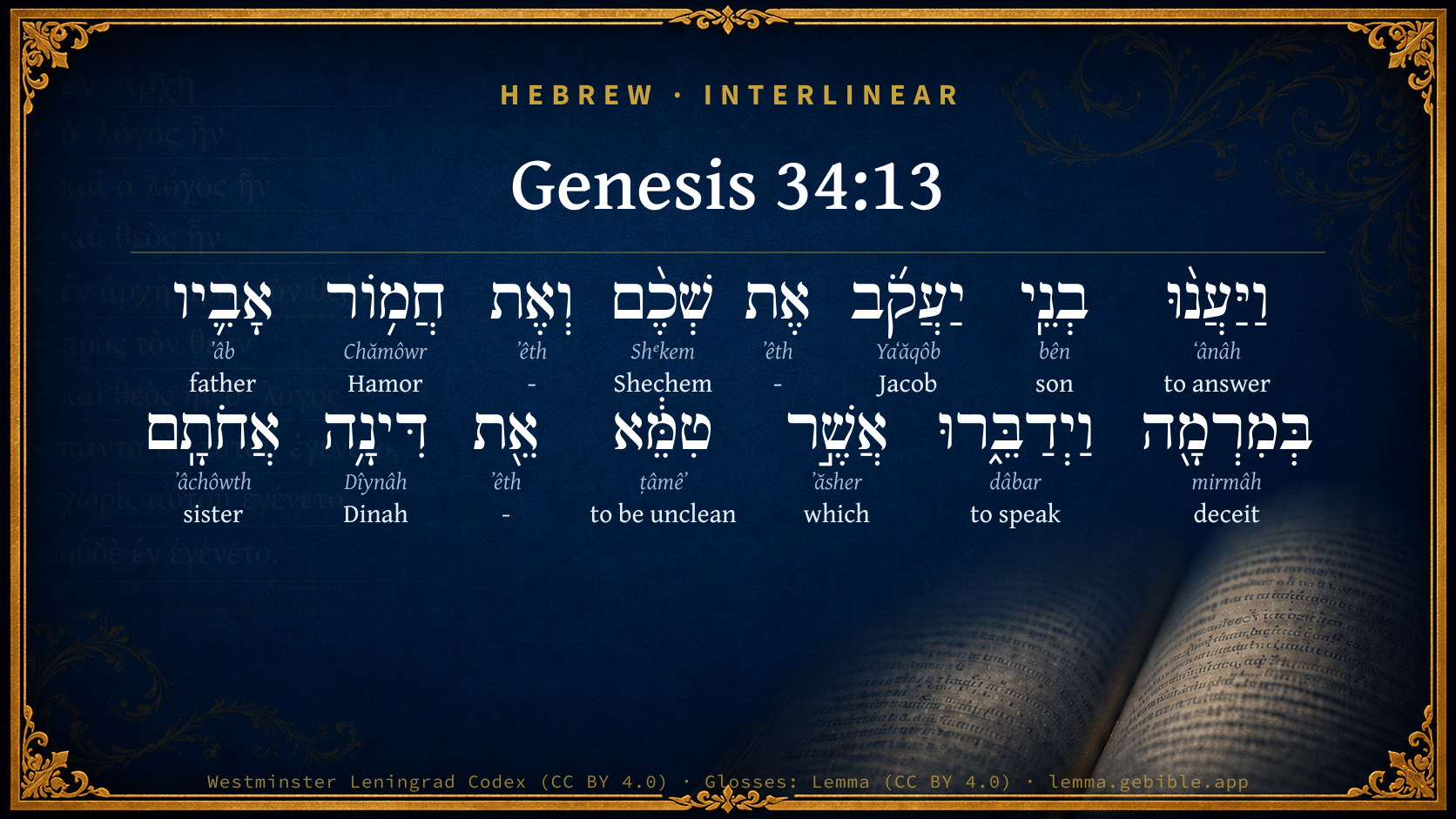
Hebrew (Westminster Leningrad Codex) Genesis 34:13 appears in the Hebrew Old Testament. The text above is from the Westminster Leningrad Codex. Each word links to its Strong’s number, a concise gloss, and parsing drawn from the Open Scriptures Hebrew Bible morphology. Click any word for its full Brown-Driver-Briggs (BDB) entry.
Download image
Cite this verse

Genesis 34:13 (World English Bible). Public Domain. Lemma interlinear Bible study tool, https://lemma.gebible.app/v/genesis/34/13.

Show BibTeX & RIS
BibTeX
RIS
English Translation
The sons of Jacob answered Shechem and Hamor his father with deceit, and spoke, because he had defiled Dinah their sister,
World English Bible · Public Domain
Download a study sheet

One document with this verse’s original text, its word-by-word gloss line, the meaning frame, cross-references with their text, attributed commentary, and full source and license credits — printable, and it pastes into notes with its structure intact.

This verse Autodidact and up

Study sheet (.html) Plain text (.txt)

A passage Seminary Student

Up to 50 verses in one chapter. A passage sheet keeps up to 6 commentary sources and 12 cross-references per verse, in the order this page ranks them, and says so on the sheet whenever that leaves anything out. Ask for a single verse and you get the Autodidact verse sheet above.

Everything on this page stays free to read, with no account — the sheet is a download of what is already on screen, not access to it.

Want to remove ads? Support Godless Engineer
Compare translations 3

The same verse in 3 English versions, stacked beneath the original-language interlinear above. Click any original word for its lexicon entry.

Each is an independent rendering of the whole verse — the interlinear is not word-aligned to these translations.

Highlighted words mark where these versions differ — a whole-verse word diff, not a word-by-word alignment.

  • World English Bible Public Domain
    The sons of Jacob answered Shechem and Hamor his father with deceit, and spoke, because he had defiled Dinah their sister,
  • King James Version Public Domain
    And the sons of Jacob answered Shechem and Hamor his father deceitfully, and said, because he had defiled Dinah their sister:
  • unfoldingWord Literal Text CC BY-SA 4.0
    Then the sons of Jacob answered Shechem and Hamor his father with deceit when they spoke, because he had defiled Dinah their sister.

unfoldingWord Literal Text — © unfoldingWord, licensed CC BY-SA 4.0. Word-aligned USFM3 via Door43 (git.door43.org/unfoldingWord/en_ult).

Versions to compare (up to 4)

3 of 4 selected

Show all 18 translations

Every available English version of this verse, each an independent rendering of the whole verse.

  • World English Bible Public Domain
    The sons of Jacob answered Shechem and Hamor his father with deceit, and spoke, because he had defiled Dinah their sister,
  • Berean Standard Bible Public Domain
    But because Shechem had defiled their sister Dinah, Jacob’s sons answered him and his father Hamor deceitfully.
  • Majority Standard Bible Public Domain
    But because Shechem had defiled their sister Dinah, Jacob’s sons answered him and his father Hamor deceitfully.
  • King James Version Public Domain
    And the sons of Jacob answered Shechem and Hamor his father deceitfully, and said, because he had defiled Dinah their sister:
  • American Standard Version (1901) Public Domain
    And the sons of Jacob answered Shechem and Hamor his father with guile, and spake, because he had defiled Dinah their sister,
  • Revised Version (1885) Public Domain
    And the sons of Jacob answered Shechem and Hamor his father with guile, and spake, because he had defiled Dinah their sister,
  • Geneva Bible (1599) Public Domain
    Then the sonnes of Iaakob answered Shechem and Hamor his father, talking deceitfully, because he had defiled Dinah their sister,
  • Douay-Rheims (1899) Public Domain
    The sons of Jacob answered Sichem and his father deceitfully, being enraged at the deflowering of their sister:
  • Young's Literal Translation Public Domain
    And the sons of Jacob answer Shechem and Hamor his father deceitfully, and they speak (because he defiled Dinah their sister),
  • Literal Standard Version CC BY-SA 4.0
    And the sons of Jacob answer Shechem and his father Hamor deceitfully, and they speak (because he defiled their sister Dinah),
  • Unlocked Literal Bible CC BY-SA 4.0
    The sons of Jacob answered Shechem and Hamor his father with deceit, because Shechem had defiled Dinah their sister.
  • unfoldingWord Literal Text CC BY-SA 4.0
    Then the sons of Jacob answered Shechem and Hamor his father with deceit when they spoke, because he had defiled Dinah their sister.
  • Darby Bible Public Domain
    And the sons of Jacob answered Shechem and Hamor his father deceitfully, and spoke -- because he had defiled Dinah their sister --
  • World Messianic Bible Public Domain
    The sons of Jacob answered Shechem and Hamor his father with deceit when they spoke, because he had defiled Dinah their sister,
  • Webster's Bible Public Domain
    And the sons of Jacob answered Shechem and Hamor his father deceitfully, and said, (because he had defiled Dinah their sister,)
  • Free Bible Version CC BY-SA 4.0
    Jacob's sons weren't honest when they answered him and his father Hamor because Shechem had violated their sister Dinah.
  • Bible in Basic English Public Domain
    But the sons of Jacob gave a false answer to Shechem and Hamor his father, because of what had been done to Dinah their sister.
  • JPS Tanakh (1917) Public Domain
    And the sons of Jacob answered Shechem and Hamor his father with guile, and spoke, because he had defiled Dinah their sister,

Literal Standard Version (2020), Covenant Press — licensed CC BY-SA 4.0. Text via the HelloAO Bible API (eBible.org). Unlocked Literal Bible (unfoldingWord) — licensed CC BY-SA 4.0. Text via the HelloAO Bible API (eBible.org). unfoldingWord Literal Text — © unfoldingWord, licensed CC BY-SA 4.0. Word-aligned USFM3 via Door43 (git.door43.org/unfoldingWord/en_ult). Free Bible Version, Dr. Jonathan Gallagher — licensed CC BY-SA 4.0. Text via the HelloAO Bible API (eBible.org).

Word by word

More ways to search: Search by grammar → Find every occurrence → Compare this word →

Practice this passage: Drill this verse → Learn its vocabulary →

דִּינָ֥ה
Dîynâh
H1783
“Dinah”
Noun, Proper
Part of Speech
Noun
Type
Proper
Full BDB Definition

Origin: from H1779

TWOT: None

Dinah = "judgment" - daughter of Jacob by Leah, full sister of Simeon and Levi
  1. וַיַּעֲנ֨וּ ʻânâh H6030 “and · to answer” Conjunction + Verb, Qal, Sequential Imperfect, 3rd Person, Masculine, Plural
  2. בְנֵֽי bên H1121 “sons of” Noun, Common, Masculine, Plural, Construct
  3. יַעֲקֹ֜ב Yaʻăqôb H3290 “Jacob” Noun, Proper
  4. אֶת ʼêth H853 “-” Particle, Direct Object
  5. שְׁכֶ֨ם Shᵉkem H7927 “Shechem” Noun, Proper
  6. וְאֶת ʼêth H853 “and · -” Conjunction + Particle, Direct Object
  7. חֲמ֥וֹר Chămôwr H2544 “Hamor” Noun, Proper
  8. אָבִ֛יו ʼâb H1 “father · his” Noun, Common, Masculine, Singular, Construct + Suffix, Personal, 3rd Person, Masculine, Singular
  9. בְּמִרְמָ֖ה mirmâh H4820 “in/at · deceit” Preposition + Noun, Common, Feminine, Singular, Absolute
  10. וַיְדַבֵּ֑רוּ dâbar H1696 “and · to speak” Conjunction + Verb, Piel, Sequential Imperfect, 3rd Person, Masculine, Plural
  11. אֲשֶׁ֣ר ʼăsher H834 “which” Particle, Relative
  12. טִמֵּ֔א ṭâmêʼ H2930 “to be unclean” Verb, Piel, Perfect, 3rd Person, Masculine, Singular
  13. אֵ֖ת ʼêth H853 “-” Particle, Direct Object
  14. אֲחֹתָֽם ʼâchôwth H269 “sister · their” Noun, Common, Feminine, Singular, Construct + Suffix, Personal, 3rd Person, Masculine, Plural

About this verse

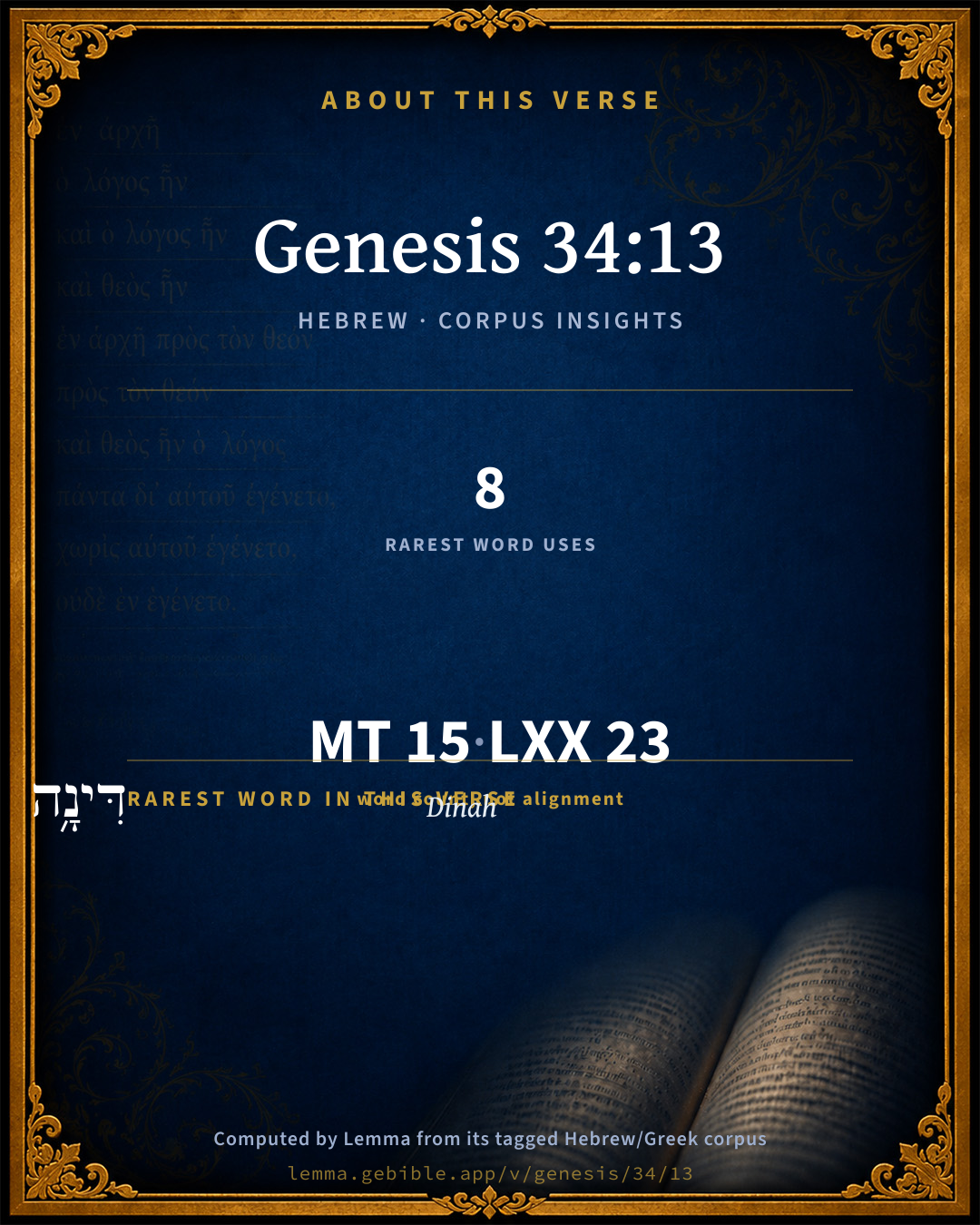
These counts appear in no published source. They are computed here, from the morphology-tagged text and Lemma’s own curated glosses. What Lemma adds →

15
words
13
distinct lemmas
Pentateuch
section

Notable vocabulary

The rarest word here is דִּינָ֥ה Dinah H1783 — appearing just 8 times in the whole Hebrew Bible.

Shared distinctive vocabulary

דִּינָ֥ה Dinah H1783 occurs in 8 verses of the Hebrew Bible. Also found in:

Grammatical profile

  • 3 verbs
  • 8 nouns
  • 4 particles

Verb forms

  • וַיַּעֲנ֨וּ Qal · Sequential Imperfect
  • וַיְדַבֵּ֑רוּ Piel · Sequential Imperfect
  • טִמֵּ֔א Piel · Perfect

Hebrew & Septuagint length

In English translation the verse runs 21 words from the Hebrew and 24 from the Septuagint (LXX English) — closely comparable.

A rough comparison of the two English renderings, which tokenize alike — not a word-level alignment.

Word counts can differ between the Hebrew and the Greek without any difference in meaning — e.g. the Hebrew direct-object marker אֵת has no separate Greek word, and Greek often adds the article ὁ.

In the original languages it is 15 Hebrew tokens and 23 Greek tokens — but the two are counted differently (Hebrew bundles its prefixes and suffixes into one token; the Greek is in lemma form), so that isn’t a like-for-like length.

Cross-references

15

Topical passages linked to Genesis 34:13 in the Treasury of Scripture Knowledge — connected by theme and wording, ordered by reader-vote popularity; previews shown in the World English Bible.

  • Genesis 25:27–34 The boys grew. Esau was a skillful hunter, a man of the field. Jacob was a quiet man, living in tents.
  • Judges 15:3 Samson said to them, This time shall I be blameless in regard of the Philistines, when I do them a mischief.
  • 2 Samuel 13:23–29 It happened after two full years, that Absalom had sheep-shearers in Baal Hazor, which is beside Ephraim: and Absalom invited all the king's sons.
  • Job 13:4 But you are forgers of lies. You are all physicians of no value.
  • Job 13:7 Will you speak unrighteously for God, And talk deceitfully for him?
  • Psalms 12:2 Everyone lies to his neighbor. They speak with flattering lips, and with a double heart.
  • Proverbs 12:13 An evil man is trapped by sinfulness of lips, But the righteous shall come out of trouble.
  • Proverbs 12:18–20 There is one who speaks rashly like the piercing of a sword, But the tongue of the wise heals.
  • Proverbs 24:28–29 Don't be a witness against your neighbor without cause. Don't deceive with your lips.
  • Proverbs 26:24–26 A malicious man disguises himself with his lips, But he harbors evil in his heart.
  • Isaiah 59:13 transgressing and denying Yahweh, and turning away from following our God, speaking oppression and revolt, conceiving and uttering from the heart words of falsehood.
  • Micah 7:2 The godly man has perished out of the earth, And there is no one upright among men. They all lie in wait for blood; Every man hunts his brother with a net.
  • Matthew 28:13 saying, "Say that his disciples came by night, and stole him away while we slept.
  • Romans 12:19 Don't seek revenge yourselves, beloved, but give place to God's wrath. For it is written, "Vengeance belongs to me; I will repay, says the Lord."
  • 1 Thessalonians 5:15 See that no one returns evil for evil to anyone, but always follow after that which is good, for one another, and for all.

Cross-references courtesy of OpenBible.info (CC BY 4.0).

Hebrew and Greek witnesses Masoretic Hebrew ↔ Greek Septuagint

The same verse in the two great witnesses to the Old Testament, shown verse-for-verse.

These are two independent witnesses, not word-aligned to each other, and the Septuagint is shown in lemma (dictionary) form.

Hebrew Genesis 34:13 Masoretic · Westminster Leningrad Codex

וַיַּעֲנ֨וּ בְנֵֽי יַעֲקֹ֜ב אֶת שְׁכֶ֨ם וְאֶת חֲמ֥וֹר אָבִ֛יו בְּמִרְמָ֖ה וַיְדַבֵּ֑רוּ אֲשֶׁ֣ר טִמֵּ֔א אֵ֖ת דִּינָ֥ה אֲחֹתָֽם

The sons of Jacob answered Shechem and Hamor his father with deceit, and spoke, because he had defiled Dinah their sister,

World English Bible · Public Domain

Greek LXX Genesis 34:13 Septuagint · lemma form

ἀποκρίνω δέ ὁ υἱός ἰακώβ ὁ συχεμ καί εμμωρ ὁ πατήρ αὐτός μετά δόλος καί λαλέω αὐτός ὅτι μιαίνω δινα ὁ ἀδελφή αὐτός

And the sons of Jacob answered to Sychem and Emmor his father craftily, and spoke to them, because they had defiled Dina their sister.

LXX2012 (modern English Septuagint) · Public Domain

On this verse, Haydock's Catholic Bible Commentary discusses the Septuagint’s reading. Read the note in Commentary ↓

Hebrew: Westminster Leningrad Codex (CC BY 4.0). Greek: Septuagint (public domain); English from LXX2012 (modern English Septuagint) (Public Domain). How the Septuagint differs from the Hebrew →

Targum (Aramaic paraphrase)

2

The Targum is the ancient Jewish Aramaic paraphrase of the Hebrew Scriptures — an interpretive translation, not the Hebrew text itself. Onkelos (literal) and Pseudo-Jonathan (expansive) render the Torah, and Jonathan the Prophets. Coverage is partial: where no permissively-licensed English translation exists for a verse, only the Aramaic is shown. This is verse-level text, not a word-by-word alignment to the Hebrew.

  1. Targum Onkelos Torah (Genesis–Deuteronomy)
    וַאֲתִיבוּ בְנֵי יַעֲקֹב יָת שְׁכֶם וְיָת חֲמוֹר אֲבוּהִי בְּחָכְמְתָא וּמַלִּילוּ דִּי סָאֵב יָת דִּינָה אֲחָתְהוֹן

    (no public-domain English translation for this verse)

    Targum Onkelos — Aramaic: “Onkelos Genesis” (public domain); “Onkelos Exodus” (public domain); “Onkelos Leviticus” (public domain); “Onkelos Numbers” (public domain); “Onkelos Deuteronomy” (public domain). English: “Sefaria Community Translation” (CC0 1.0 (public-domain dedication)); “J.W. Etheridge. The Targums of Onkelos and Jonathan Ben Uzziel on the Pentateuch. London: Longmans, Green, 1862” (public domain). Text via Sefaria.

  2. Targum Pseudo-Jonathan Torah (Genesis–Deuteronomy)
    וְאָתִיבוּ בְּנֵי יַעֲקב יַת שְׁכֶם וְיַת חֲמוֹר אָבוּי בְּחוּכְמָא וּמַלִילוּ בְּגִין דְסָאִיב יַת דִינָה אֲחַתְהוֹן

    But the sons of Jakob answered Shekem. and Hamor his father with subtilty, and so spake, because he had polluted Dinah their sister,

    Targum Pseudo-Jonathan — Aramaic: “Targum Jonathan on Genesis” (public domain); “Targum Jonathan on Exodus” (public domain); “Targum Jonathan on Leviticus” (public domain); “Targum Jonathan on Numbers” (public domain); “Targum Jonathan on Deuteronomy” (public domain). English: “The Targum of Jonathan ben Uzziel, trans. J. W. Etheridge, London, 1862” (public domain). Text via Sefaria.

Commentary

Notes on Genesis 34:13 from classic Christian and Jewish commentators (each source and its license shown beneath its notes). The classic Christian expositions comment on the surrounding passage and are grouped to its opening verse, so a note may address several verses; the Jewish commentaries on the Tanakh (Rashi and others) are per-verse, so they appear only where the commentator wrote on this verse.

Lemma curates 59 commentaries, every one of them public domain or Creative Commons licensed, each selected and text-cleaned for this edition rather than reprinted as found. About our sources →

The Cambridge Bible for Schools and Colleges

gen. ed. J. J. S. Perowne

13. the sons of Jacob] In Gen_34:13-18 we have the treacherous proposal, made by the sons of Jacob, by which they would be able to revenge themselves upon the Shechemites, and attack them, when they would be incapacitated for defence.

The Cambridge Bible for Schools and Colleges (gen. ed. J. J. S. Perowne; Cambridge University Press, 1878–1918) — public domain. Text from a community e-Sword module.

Trapp's Complete Commentary

John Trapp

Gen 34:13 And the sons of Jacob answered Shechem and Hamor his father deceitfully, and said, because he had defiled Dinah their sister:

Ver. 13. Deceitfully, and said, Because he had, &c.] Therefore they thought they had reason to do as they did. Satan doth so bemist men, many times, that they think they have reason to be mad, and that there is some sense in sinning; when as, indeed, our only wisdom is to keep God’s laws; {Deu 4:6} all which are founded upon so good reason, that, had God never made them, yet it had been best for us to have practised them.

John Trapp, A Commentary or Exposition upon All the Books of the Old and New Testament (1647–1656) — public domain. Text from a community e-Sword module.

Tyndale Open Study Notes

Tyndale Open Resources

34:13-17 Dinah’s brothers responded to the proposal without waiting for Jacob to respond, and they acted deceitfully. They may not have thought that Shechem and his people would ever agree to the rite of circumcision, but they knew what they would do if the Canaanites accepted (34:25).

Tyndale Open Study Notes — © Tyndale Open Resources, licensed CC BY-SA 4.0. Text via the HelloAO Bible API.

Jamieson, Fausset & Brown

Robert Jamieson, A. R. Fausset & David Brown

The sons of Jacob answered--The honor of their family consisted in having the sign of the covenant. Circumcision was the external rite by which persons were admitted members of the ancient Church. But that outward rite could not make the Shechemites true Israelites; and yet it does not appear that Jacob's sons required anything more. Nothing is said of their teaching the people to worship the true God, but only of their insisting on their being circumcised; and it is evident that they did not seek to convert Shechem, but only made a show of religion--a cloak to cover their diabolical design. Hypocrisy and deceit, in all cases vicious, are infinitely more so when accompanied with a show of religion; and here the sons of Jacob, under the pretense of conscientious scruples, conceal a scheme of treachery as cruel and diabolical as was, perhaps, ever perpetrated.

Jamieson, Fausset & Brown — Commentary Critical and Explanatory on the Whole Bible (1871) — public domain (CC PDM 1.0). Text via the HelloAO Bible API.

Adam Clarke's Commentary

Verse 13. Answered - deceitfully] Which nothing could excuse; yet, to show that they had had much provocation, it is immediately subjoined וידברו vaidabberu, they spoke thus because he had defiled Dinah their sister; for so this parenthesis should be read.

Adam Clarke's Commentary on the Bible (1810–1826) — public domain. Text from a community e-Sword/MySword module.

John Calvin's Commentaries

13. And the sons of Jacob answered. The commencement of their perfidious course is here related: for they, being outrageous rather than simply angry, wish to overthrow the whole city, and not being sufficiently strong to contend against so great a number of people, they contrive a new fraud, in order that they may suddenly rise upon the inhabitants weakened by wounds. Therefore, since the Shechemites had no strength to resist, it became a cruel butchery rather than a conquest, which increased the atrocity of wickedness in Jacob’s sons, who cared for nothing so that they might but gratify their rage. They allege in excuse, that, whereas they were separated from other nations, it was not lawful for them to give wives of their own family to the uncircumcised. Which indeed was true if they said it sincerely; but they falsely use the sacred name of God as a pretext; yea, their double profanation of that name proves them to be doubly sacrilegious; for they cared nothing about circumcision, but were intent on this one thing, how they might crush the miserable men in a state of weakness. Besides, they wickedly sever the sign from the truth which it represents; as if any one, by laying aside his uncircumcision, might suddenly pass over into the Church of God. And in this mode they pollute the spiritual symbol of life, by admitting foreigners, promiscuously and without discrimination, into its society. But since their pretense has some color of probability, we must observe what they say, that it would be disgraceful to them to give their sister to a man uncircumcised. This also is true, if they who used the words were sincere; for since they bore the mark of God in their flesh, it was wicked in them to contract marriages with unbelievers. So also, at the present time, our baptism separates us from the profane, so that whoever mixes himself with them, fixes a mark of infamy upon himself.

John Calvin's Commentaries (1540-1563) — public domain. Text from the Calvin Translation Society English edition (1840s-50s) via the Christian Classics Ethereal Library (ccel.org). Calvin's coverage is partial (roughly two-thirds of the Bible); uncommented books and verses are honest gaps, never fabricated. The 19th-century editor's footnotes and remarks are omitted so the notes are faithfully Calvin's own voice.

Ellicott's Commentary for English Readers

(13, 14) And said . . . and they said.—These are two different verbs in the Hebrew, and should be translated and spake (because he had defiled Dinah their sister), and said. The intermediate words are parenthetical, and there is no reason for translating spake by plotted, laid a snare, as Gesenius and others have done.

A Bible Commentary for English Readers, edited by Charles John Ellicott (1878–1897) — public domain. Text from a community e-Sword module.

John Gill's Exposition

And the sons of Jacob answered Shechem and Hamor deceitfully,.... Proposing the marriage of their sister on terms after mentioned, when they never intended it should ever be: Onkelos, Jonathan, and Jarchi interpret it, "with wisdom", as if they answered wisely and prudently, but the word is never used in a good sense; and if it was wisdom, it was carnal wisdom and wicked cunning, and was disapproved of by plain hearted Jacob:

and said: or spoke in this deceitful manner:

because he had defiled Dinah their sister; and therefore were filled with indignation at him, and fired with resentment against him, and vowed within themselves revenge upon him.

John Gill's Exposition of the Whole Bible (1746–1763) — public domain (CC PDM 1.0). Text via the HelloAO Bible API.

Haydock's Catholic Bible Commentary

Deceitfully. The sons of Jacob, on this occasion, were guilty of a grievous sin, as well by falsely pretending religion, as by excess of their revenge. Though, otherwise their zeal against so foul a crime was commendable. (Challoner) --- In this light it is viewed by Judith ix. 2. Simeon and Levi spoke on this occasion, Septuagint, as they were afterwards the chief actors, ver. 25. There were commissioned by their father to speak for him; but Jacob was ignorant of their deceit. (Haydock)

George Leo Haydock (1774–1849), Haydock's Catholic Family Bible and Commentary, 1859 edition — public domain. Excludes Psalms (Douay-Rheims chapter numbering differs from Protestant) and Deuterocanonical books (Catholic canon only).

Matthew Poole's English Annotations

Deceitfully; pretending and promising marriages with them upon that condition which they never intended.

Matthew Poole's English Annotations on the Holy Bible (1683–1685) — public domain. Text from a community e-Sword/MySword module.

Whedon's Commentary on the Bible

Daniel D. Whedon

13. Sons of Jacob answered — “Jacob had scarcely time to advance a reply; for his sons eagerly availed themselves of their share of the influence generally allowed to brothers in the matrimonial arrangements of their sisters; and they acted with a zeal to which he thought he might safely trust the matter. But he was doomed to soon perceive his error.” — Kalisch.

Deceitfully — In this they seem to have inherited something of their father’s duplicity in his younger days. And men, like Hamor and Shechem, under the impulses of ambition and of love, are easily deceived, and led to concede or adopt any thing that will serve their purpose and desire.

Daniel D. Whedon (gen. ed.), Commentary on the Old and New Testaments (1874–1909) — public domain. Text from a community e-Sword module.

The Pulpit Commentary

Vers. 13-17. And the sons of Jacob (manifestly without the knowledge of their father) answered Shechem and Humor his father deceitfully, and said, the object of the verb said is to be found in the next verse, "we cannot do this thing," the clause commencing because" being parenthetical (Rosenm Furst), so that it is unnecessary either to take rB,d in the unusual sense of doles struere (Schultens, Gasenius, Keil), or to supply after said with deceit" from the preceding clause (Onkelos, Ainsworth, Murphy, et alii)because he had defiled Dinah their sister (to be taken parenthetically, as already explained): and they said unto them (these words revert to the preceding verse), We cannot do this thing, to give our sister to one that is uncircumcised; (vide Gen_17:11) for that were a reproach unto us. The ground on which they declined a matrimonial alliance with Shechem was good; their sin lay in advancing this simply as a pretext to enable them to wreak their unholy vengeance on Shechem and his innocent people. The treacherous character of their next proposal is difficult to be reconciled with any claim to humanity, far less to religion, on the part of Jacob"s sons; so much so, that "Jacob on his death-bed can offer no palliation for the atrocious cruelty to which it led. (Gen_49:6, Gen_49:7) But in this (i.e. under this condition) will we consent unto you: If ye will be as we be, that every male of you be circumcised (literally, to have circumcision administered to you every male); then will we give our daughters unto you, and we will take your daughters to us (i.e. to be our wives), and we will dwell with you, and we will become one people. This proposal was sinful, since

(1) they had no right to offer the sign of God"s covenant to a heathen people;

(2) they had less right to employ it in ratification of a merely human agreement; and

(3) they had least right of all to employ it in duplicity as a mask for their treachery. But if ye will not hearken unto us, to be circumcised; then (rather, sc. then we will not consent to your proposal, and) we will take our daughter, who was still in Shechem s house (ver. 26)and we will be gone.

The Pulpit Commentary (1880–1919), ed. H.D.M. Spence-Jones & Joseph S. Exell — public domain. Text from a community e-Sword module.

Keil & Delitzsch

C. F. Keil & F. Delitzsch

Attractive as these offers of the Hivite prince and his son were, they were declined by Jacob's sons, who had the chief voice in the question of their sister's marriage (vid., Gen 24:50). And they were quite right; for, by accepting them, they would have violated the sacred call of Israel and his seed, and sacrificed the promises of Jehovah to Mammon. But they did it in a wrong way; for "they answered with deceit and acted from behind" (וידבּרוּ בּמרמה: דּבּר) is to be rendered dolos struxit; דּברים דּבּר would be the expression for "giving mere words," Hos 10:4; vid., Ges. thes.), "because he had defiled Dinah their sister." They told him that they could not give their sister to an uncircumcised man, because this would be a reproach to them; and the only condition upon which they would consent (נאות imperf. Niph. of אוּת) was, that the Shechemites should all be circumcised; otherwise they would take their sister and go.

Keil & Delitzsch — Biblical Commentary on the Old Testament (1861–1891) — public domain (CC PDM 1.0). Text via the HelloAO Bible API. (Old Testament only.)

Kretzmann's Popular Commentary

Paul E. Kretzmann

The Demand of Jacob’s Sons

v. 13. And the sons of Jacob, who had a voice in the marriage of their sister, Gen 24:50, answered Shechem and Hamor, his father, deceitfully. It was true enough that their acceptance of the proposal would never have agreed with the destiny of the chosen people of God; they would have sacrificed the Messianic promises for mere temporal gain, but the method which they adopted to carry out their purpose is inexcusable. And said, because he had defiled Dinah, their sister;

v. 14. and they said unto them, We cannot do this thing, to give our sister to one that is uncircumcised; for that were a reproach unto us. That, in itself, may have been true enough that blood-relationship with such as were not Shemites was altogether undesirable, but to include this consideration in their plan of revenge was wrong.

v. 15. But in this will we consent unto you: if ye will be as we be, that every male of you be circumcised;

v. 16. then will we give our daughters unto you and we will take your daughters to us, and we will dwell with you, and we will become one people.

v. 17. But if ye will not hearken unto us to be circumcised, then will we take our daughter, and we will be gone. This proposal is to be condemned as hypocritical because the sons of Jacob must have known that the Israelites were not to blend with the Shechemites; it lacked sincerity.

v. 18. And their words pleased Hamor, and Shechem, Hamor’s son.

v. 19. And the young man deferred not to do the thing, because he had delight in Jacob’s daughter; and he was more honorable than all the house of his father. No matter what the motive had been in defiling Dinah, Shechem now was undoubtedly sincere, and he accepted the words of Jacob’s sons at their face value. His position of power and influence was such as to give his words much weight, and he lost no time in carrying out his intention.

Paul E. Kretzmann, Popular Commentary of the Bible (1921–1924) — public domain. Text from a community e-Sword module.

Rashi

Rabbi Shlomo Yitzchaki (Rashi)

במרמה WITH GUILE — cleverly

אשר טמא BECAUSE HE HAD DEFILED — Scripture (the Sacred Historian) says that there was no deception (מרמה) in this because he had defiled Dinah their sister (Genesis Rabbah 80:8).

Rashi on the Tanakh — English translations: “The Judaica Press complete Tanach with Rashi, translated by A. J. Rosenberg” (CC BY 4.0); “Pentateuch with Rashi's commentary by M. Rosenbaum and A.M. Silbermann, 1929-1934” (public domain); “The Metsudah Tanach series, Lakewood, N.J” (CC BY 4.0); and “The Book of Joshua, Metsudah Publications, 1997” (CC BY 4.0). Text via Sefaria.

Ramban (Nachmanides)

Rabbi Moshe ben Nachman (Ramban / Nachmanides)

AND THE SONS OF JACOB ANSWERED SHECHEM AND HAMOR HIS FATHER WITH SUBTLETY. Now Hamor and Shechem spoke to her father and her brothers, but the patriarch did not answer them at all as his sons spoke in his place on this matter out of respect for him for since the affair was a source of shame to them, they did not want him to speak about it at all.There is a question which may be raised here. It would appear that they answered with the concurrence of her father and his advice for they were in his presence, and it was he who understood the answer which they spoke with subtlety, and, if so, why was he angry afterwards? Moreover, it is inconceivable that Jacob would have consented to give his daughter in marriage to a Canaanite who had defiled her. Now surely all the brothers gave that answer with subtlety, while Simeon and Levi alone executed the deed, and the father cursed only their wrath. [But if all the brothers shared responsibility for the answer and the plan, why did Jacob single out only Simeon and Levi for chastisement?] The answer is that the craftiness lay in their saying that every male of theirs be circumcised, as they thought that the people of the city will not consent to it. Even if perchance they will listen to their prince and they will all become circumcised, they will come on the third day, when they were in pain, and will take their daughter from the house of Shechem. Now this was the advice of all the brothers and with the permission of their father, but Simeon and Levi wanted to take revenge of them and so they killed all the men of the city.It is possible that Jacob’s anger in cursing their wrath was because they killed the men of the city who had committed no sin against him; they should have killed Shechem alone. It is this which Scripture says, And the sons of Jacob answered Shechem and Hamor his father with subtlety, and spoke, because he had defiled Dinah their sister, for they all agreed to speak to him craftily because of the base deed which he had done to them.Now many people ask: “But how did the righteous sons of Jacob commit this deed, spilling innocent blood?” The Rabbi (Moshe ben Maimon) answered in his Book of Judges, saying that “sons of Noah”, Note 222. are commanded concerning Laws, and thus they are required to appoint judges in each and every district to give judgment concerning their six commandments which are obligatory upon all mankind. “And a Noachide who transgresses one of them is subject to the death-penalty by the sword. If he sees a person transgressing one of these seven laws and does not bring him to trial for a capital crime, he who saw him is subject to the same death-penalty. It was on account of this that the people of Shechem had incurred the death-penalty because Shechem committed an act of robbery and they saw and knew of it, but they did not bring him to trial.”But these words do not appear to me to be correct for if so, our father Jacob should have been the first to obtain the merit of causing their death, and if he was afraid of them, why was he angry at his sons and why did he curse their wrath a long time after that and punish them by dividing them and scattering them in Israel? Were they not meritorious, fulfilling a commandment and trusting in G-d Who saved them?In my opinion, the meaning of “Laws” which the Rabbis have counted among their seven Noachidic commandments is not just that they are to appoint judges in each and every district, but He commanded them concerning the laws of theft, overcharge, wronging, and a hired man’s wages; the laws of guardians of property, forceful violation of a woman, seduction, principles of damage and wounding a fellowman; laws of creditors and debtors, and laws of buying and selling, and their like, similar in scope to the laws with which Israel was charged, and involving the death-penalty for stealing, wronging or violating or seducing the daughter of his fellowman, or kindling his stack, or wounding him, and their like. And it is also included in this commandment that they appoint judges for each and every city, just as Israel was commanded to do, but if they failed to do so they are free of the death-penalty since this is a positive precept of theirs [and failing to fulfill a positive precept does not incur the death-penalty]. The Rabbis have only said: “For violation of their admonishments there is the death-penalty,” and only a prohibition against doing something is called an “admonishment.” And such is the purport of the Gemara in Tractate Sanhedrin. And in the Jerusalem Talmud they have said: “With respect to Noachide laws, a judge who perverts justice is to be slain. If he took a bribe he is to be slain. With respect to Jewish laws, [if after having heard both parties] you know perfectly well what the proper legal decision should be, you are not permitted to withdraw from the case without rendering a decision, and if you know that it is not perfectly clear to you, you may withdraw from the case. But with respect to their laws, even though you know the law perfectly well you may withdraw from it.” From this it would appear that a non-Jewish judge may say to the litigants, “I am not beholden to you,” for it is only in Israel that there is an additional admonishment — “‘Lo thaguru’ (ye shall not be afraid) of the face of any man,” meaning, “You shall not gather in, [i.e., restrain], your words before any man” and ogeir (gathering) as in the expression, gathering in summer, (Proverbs 10:5). — and surely he is not to be slain for failing to make himself chief, overseer, or ruler in order to judge superiors. [Ramban thus disagrees with Rambam, who writes that the people of Shechem had incurred the death-penalty by not having brought Shechem to justice.] Moreover, why does the Rabbi [Moshe ben Maimon] have to seek to establish their guilt? Were not the people of Shechem and all seven nations idol worshippers, perpetrators of unchaste acts, and practitioners of all things that are abominable to G-d? In many places Scripture loudly proclaims concerning them: Upon the high mountains, and upon their hills, and under every leafy tree, etc.;, 12:2. Thou shalt not learn to do after the abominations, etc.?, 18:9. For all these abominations have the men of the land done, etc. However, it was not the responsibility of Jacob and his sons to bring them to justice.But the matter of Shechem was that the people of Shechem were wicked [by virtue of their violation of the seven Noachide laws] and had thereby forfeited their lives. Therefore Jacob’s sons wanted to take vengeance of them with a vengeful sword, and so they killed the king and all the men of his city who were his subjects, obeying his commands. The covenant represented by the circumcision of the inhabitants of Shechem had no validity in the eyes of Jacob’s sons for it was done to curry favor with their master [and did not represent a genuine conversion]. But Jacob told them here that they had placed him in danger, as it is said, You have troubled me, to make me odious, and there, [i.e., at the time he blessed the other children], he cursed the wrath of Simeon and Levi for they had done violence to the men of the city whom they had told in his presence, And we will dwell with you, and we will become one people. They would have chosen to believe in G-d and trust their word, and perhaps they might have indeed returned to G-d and thus Simeon and Levi killed them without cause for the people had done them no evil at all. It is this which Jacob said, Weapons of violence are their kinship. And if we are to believe in the book, ‘The Wars of the Sons of Jacob,’. See Eisenstein, Otzar Midrashim, p. 157, and L. Ginzberg’s, The Legends of the Jews, Vol. I, pp. 404-411. their father’s fear was due to the fact that the neighbors of Shechem gathered together and waged three major wars against them, and were it not for their father who also donned his weapons and warred against them, they would have been in danger, as is related in that book. Our Rabbis have mentioned something of this conflict in their commentary on the verse, Which I took out of the hand of the Amorite with my sword and with my bow. They said, See also Bereshith Rabbah 80:9. “All the surrounding nations gathered together to join in battle against them, and Jacob donned his weapons to war against them,” just as Rashi writes there. Scripture, however, is brief about this because it was a hidden miracle, for the sons of Jacob were valiant men, and it appeared as if their own arm saved them. Scripture is similarly brief about the matter of Abraham in Ur of the Chaldees, and it did not at all mention Esau’s wars with the Horites. Instead, Scripture mentions here that there was the terror of G-d upon the cities that were round them, and they did not all assemble to pursue after the sons of Jacob for they would have fallen upon them as the sand which is on the sea-shore in multitude. And this is the meaning of the terror of G-d, for the terror and dread of the military prowess they had seen fell upon them. Therefore Scripture says, And Jacob came to Luz… he and all the people that were with him, in order to inform us that not one man among them or their servants was lost in warfare.

Ramban (Nachmanides) on the Tanakh — English translation: “Commentary on the Torah by Ramban (Nachmanides). Translated and annotated by Charles B. Chavel. New York, Shilo Pub. House, 1971-1976” (CC BY 4.0). Text via Sefaria.

Radak

Rabbi David Kimhi (Radak)

ויענו בני יעקב, Yaakov himself did not utter a single word of falsehood or deceit, even though seeing that he had been the injured party he could have excused such conduct. He left the matter in his sons’ care and if they used subterfuge he did not interfere. The brothers did not consider their conduct as reprehensible for people who had defiled their sister and were still holding her captive.

Radak on the Tanakh — English translations: “Sefaria Community Translation” (CC0 1.0 (public-domain dedication)); “Eliyahu Munk, HaChut Hameshulash” (CC BY 4.0); “Rabbi Mike Feuer, Jerusalem Anthology” (CC BY 4.0); and “R. David Kimhi on the first book of Psalms, Translated by R.G. Finch, London, 1919” (public domain). Text via Sefaria.

Lesson kit

Teaching starters — assembled from the data on this page, not authored interpretation. Every prompt links to the verse data it draws on. Edit before teaching.

Genesis, in the Pentateuch, opens this verse with 15 words (13 distinct Hebrew lemmas). Its most distinctive word is Dîynâh (“Dinah”). A historical commentator’s framing appears above. Read the whole chapter for the surrounding context.

Discussion questions

  1. What does “Dinah” (Dîynâh) contribute to the verse as a whole?
  2. How does Genesis 30:21, which shares the word «Dinah», read alongside this verse?
  3. The translations on this page render this verse differently — a whole-verse word diff, not a word-by-word alignment. What might account for the different wordings?
  4. «וַיַּעֲנ֨וּ» is a Qal Sequential Imperfect verb. How does that grammatical form shape the action described?
  5. Compare how The Cambridge Bible for Schools and Colleges and Trapp's Complete Commentary read this verse. Where do they agree or differ?

Things to notice

Reading settings

Reading text

Shown beneath each verse's original-language words.

Old Testament
Old Testament edition

Read the OT as the Masoretic Hebrew (MT) or the Greek Septuagint (LXX).

English shown for the Greek Septuagint (in the Hebrew ↔ Greek comparison).

Comparing translations? Open the Compare panel on any verse page to stack up to four side by side.