
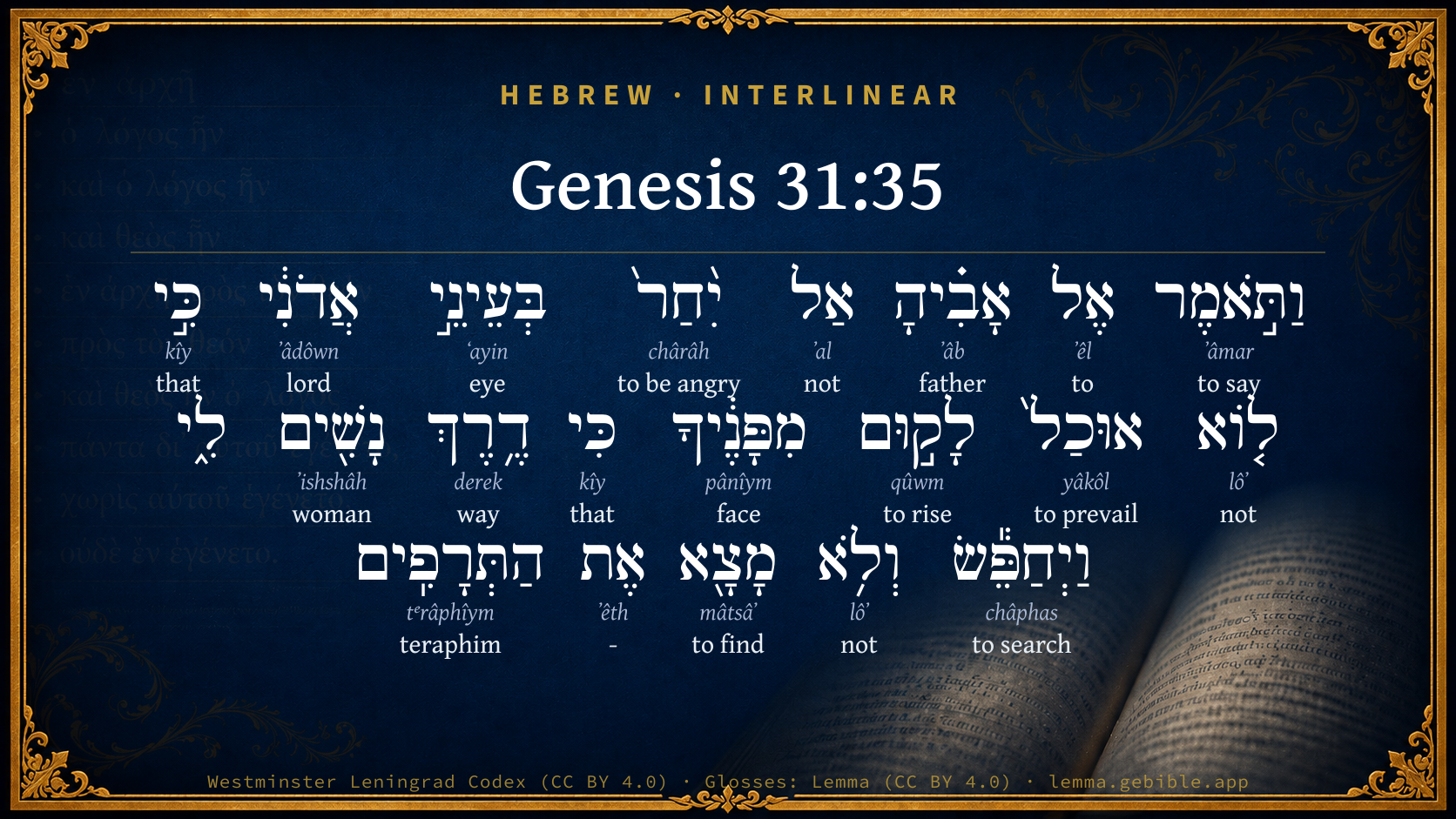
Genesis 31:35

Hebrew (Westminster Leningrad Codex) Genesis 31:35 appears in the Hebrew Old Testament. The text above is from the Westminster Leningrad Codex. Each word links to its Strong’s number, a concise gloss, and parsing drawn from the Open Scriptures Hebrew Bible morphology. Click any word for its full Brown-Driver-Briggs (BDB) entry.
Download image
Cite this verse

Genesis 31:35 (World English Bible). Public Domain. Lemma interlinear Bible study tool, https://lemma.gebible.app/v/genesis/31/35.

Show BibTeX & RIS
BibTeX
RIS
English Translation
She said to her father, "Don't let my lord be angry that I can't rise up before you; for the manner of women is on me." He searched, but didn't find the teraphim.
World English Bible · Public Domain
Highlights
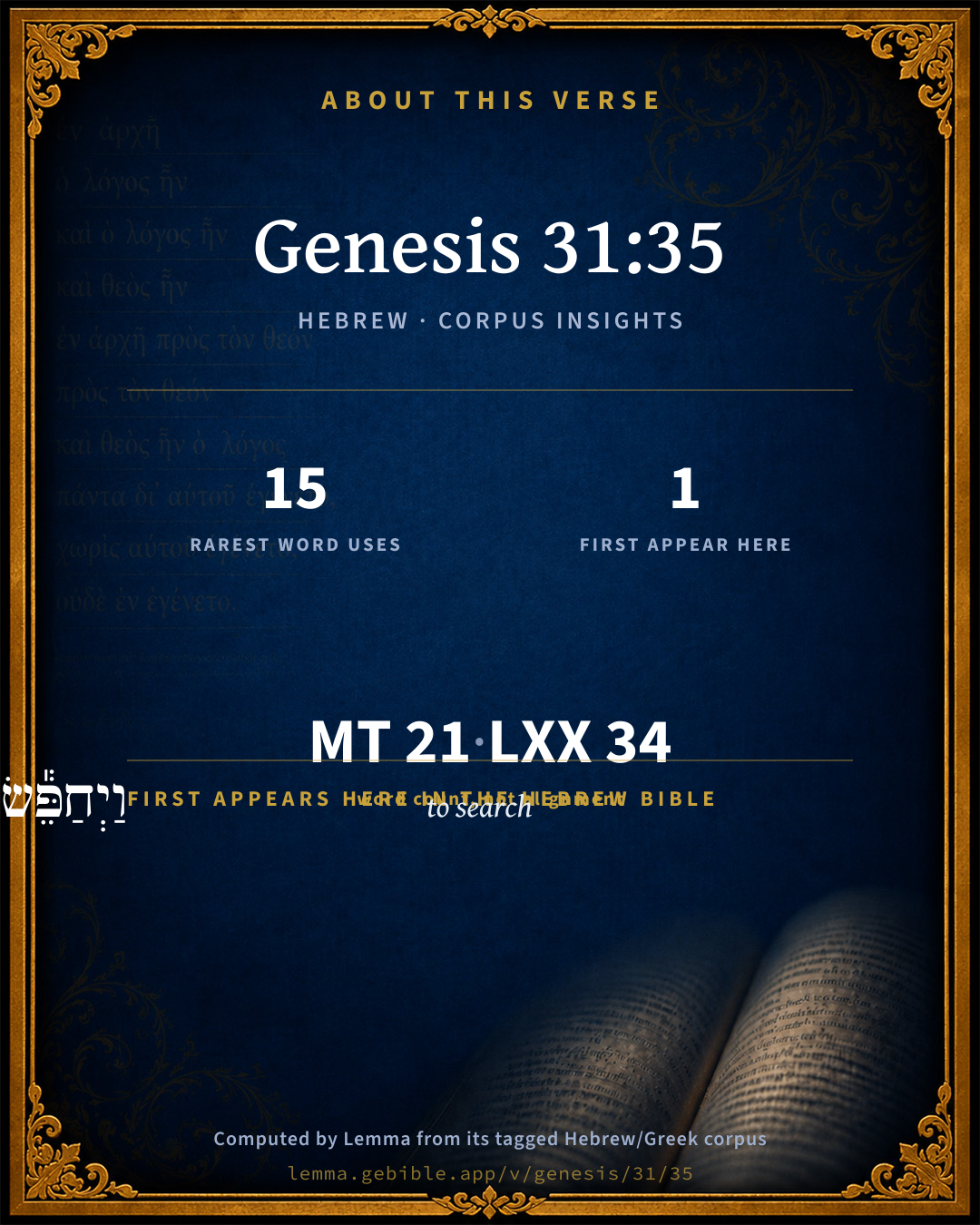
  • 1 first appearance in the Hebrew Bible
Full analysis ↓
Download a study sheet

One document with this verse’s original text, its word-by-word gloss line, the meaning frame, cross-references with their text, attributed commentary, and full source and license credits — printable, and it pastes into notes with its structure intact.

This verse Autodidact and up

Study sheet (.html) Plain text (.txt)

A passage Seminary Student

Up to 50 verses in one chapter. A passage sheet keeps up to 6 commentary sources and 12 cross-references per verse, in the order this page ranks them, and says so on the sheet whenever that leaves anything out. Ask for a single verse and you get the Autodidact verse sheet above.

Everything on this page stays free to read, with no account — the sheet is a download of what is already on screen, not access to it.

Want to remove ads? Support Godless Engineer
Compare translations 3

The same verse in 3 English versions, stacked beneath the original-language interlinear above. Click any original word for its lexicon entry.

Each is an independent rendering of the whole verse — the interlinear is not word-aligned to these translations.

Highlighted words mark where these versions differ — a whole-verse word diff, not a word-by-word alignment.

  • World English Bible Public Domain
    She said to her father, "Don't let my lord be angry that I can't rise up before you; for the manner of women is on me." He searched, but didn't find the teraphim.
  • King James Version Public Domain
    And she said to her father, Let it not displease my lord that I cannot rise up before thee; for the custom of women is upon me. And he searched but found not the images.
  • unfoldingWord Literal Text CC BY-SA 4.0
    And she said to her father, “Do not let it burn in the eyes of my lord that I am not able to stand up in your presence, because the way of women on me.” So he searched, but he did not find the idols.

unfoldingWord Literal Text — © unfoldingWord, licensed CC BY-SA 4.0. Word-aligned USFM3 via Door43 (git.door43.org/unfoldingWord/en_ult).

Versions to compare (up to 4)

3 of 4 selected

Show all 18 translations

Every available English version of this verse, each an independent rendering of the whole verse.

  • World English Bible Public Domain
    She said to her father, "Don't let my lord be angry that I can't rise up before you; for the manner of women is on me." He searched, but didn't find the teraphim.
  • Berean Standard Bible Public Domain
    Rachel said to her father, “Sir, do not be angry that I cannot stand up before you; for I am having my period.” So Laban searched, but could not find the household idols.
  • Majority Standard Bible Public Domain
    Rachel said to her father, “Sir, do not be angry that I cannot stand up before you; for I am having my period.” So Laban searched but could not find the household idols.
  • King James Version Public Domain
    And she said to her father, Let it not displease my lord that I cannot rise up before thee; for the custom of women is upon me. And he searched but found not the images.
  • American Standard Version (1901) Public Domain
    And she said to her father, Let not my lord be angry that I cannot rise up before thee; for the manner of women is upon me. And he searched, but found not the teraphim.
  • Revised Version (1885) Public Domain
    And she said to her father, Let not my lord be angry that I cannot rise up before thee; for the manner of women is upon me. And he searched, but found not the teraphim.
  • Geneva Bible (1599) Public Domain
    Then said she to her father, My Lord, be not angrie that I cannot rise vp before thee: for the custome of women is vpon me: so he searched, but found not the idoles.
  • Douay-Rheims (1899) Public Domain
    She said: Let not my lord be angry that I cannot rise up before thee, because it has now happened to me, according to the custom of women, So his careful search was in vain.
  • Young's Literal Translation Public Domain
    and she saith unto her father, `Let it not be displeasing in the eyes of my lord that I am not able to rise at thy presence, for the way of women `is' on me;' and he searcheth, and hath not found the teraphim.
  • Literal Standard Version CC BY-SA 4.0
    and she says to her father, “Let it not be displeasing in the eyes of my lord that I am not able to rise at your presence, for the way of women [is] on me”; and he searches, and has not found the teraphim.
  • Unlocked Literal Bible CC BY-SA 4.0
    She said to her father, “Do not be angry, my master, that I cannot stand up before you, for I am having my period.” So he searched but did not find his household gods.
  • unfoldingWord Literal Text CC BY-SA 4.0
    And she said to her father, “Do not let it burn in the eyes of my lord that I am not able to stand up in your presence, because the way of women on me.” So he searched, but he did not find the idols.
  • Darby Bible Public Domain
    And she said to her father, Let it not be an occasion of anger in the eyes of my lord that I cannot rise up before thee, for it is with me after the manner of women. And he searched carefully, but did not find the teraphim.
  • World Messianic Bible Public Domain
    She said to her father, “Don’t let my lord be angry that I can’t rise up before you; for I’m having my period.” He searched, but didn’t find the teraphim.
  • Webster's Bible Public Domain
    And she said to her father, Let it not displease my lord that I cannot rise up before thee; for the custom of women is upon me. And he searched, but found not the images.
  • Free Bible Version CC BY-SA 4.0
    She said to her father, “Sir, please don't get upset with me for not standing up in your presence, but I have my period.” He looked everywhere but didn't find the idols.
  • Bible in Basic English Public Domain
    And she said to her father, Let not my lord be angry because I do not get up before you, for I am in the common condition of women. And with all his searching, he did not come across the images.
  • JPS Tanakh (1917) Public Domain
    And she said to her father: 'Let not my lord be angry that I cannot rise up before thee; for the manner of women is upon me.' And he searched, but found not the teraphim.

Literal Standard Version (2020), Covenant Press — licensed CC BY-SA 4.0. Text via the HelloAO Bible API (eBible.org). Unlocked Literal Bible (unfoldingWord) — licensed CC BY-SA 4.0. Text via the HelloAO Bible API (eBible.org). unfoldingWord Literal Text — © unfoldingWord, licensed CC BY-SA 4.0. Word-aligned USFM3 via Door43 (git.door43.org/unfoldingWord/en_ult). Free Bible Version, Dr. Jonathan Gallagher — licensed CC BY-SA 4.0. Text via the HelloAO Bible API (eBible.org).

Word by word

More ways to search: Search by grammar → Find every occurrence → Compare this word →

Practice this passage: Drill this verse → Learn its vocabulary →

הַתְּרָפִֽים
tᵉrâphîym
H8655
“the · teraphim”
Particle, Definite Article + Noun, Common, Masculine, Plural, Absolute
Part of Speech
Particle + Noun
Type
Common
Gender
Masculine
Number
Plural
State
Absolute
Full BDB Definition

Origin: pl. from H7495

TWOT: 2545

idolatry, idols, image(s), teraphim, family idol - a kind of idol used in household shrine or worship
  1. וַתֹּ֣אמֶר ʼâmar H559 “and · to say” Conjunction + Verb, Qal, Sequential Imperfect, 3rd Person, Feminine, Singular
  2. אֶל ʼêl H413 “to” Preposition
  3. אָבִ֗יהָ ʼâb H1 “father · her” Noun, Common, Masculine, Singular, Construct + Suffix, Personal, 3rd Person, Feminine, Singular
  4. אַל ʼal H408 “not” Particle, Negative
  5. יִ֨חַר֙ chârâh H2734 “to be angry” Verb, Qal, Jussive, 3rd Person, Masculine, Singular
  6. בְּעֵינֵ֣י ʻayin H5869 “in/at · eyes of” Preposition + Noun, Common, Both, Dual, Construct
  7. אֲדֹנִ֔י ʼâdôwn H113 “lord · my” Noun, Common, Masculine, Singular, Construct + Suffix, Personal, 1st Person, Common, Singular
  8. כִּ֣י kîy H3588 “that” Conjunction
  9. ל֤וֹא lôʼ H3808 “not” Particle, Negative
  10. אוּכַל֙ yâkôl H3201 “to prevail” Verb, Qal, Imperfect, 1st Person, Common, Singular
  11. לָק֣וּם qûwm H6965 “to rise” Preposition + Verb, Qal, Infinitive Construct
  12. מִפָּנֶ֔יךָ pânîym H6440 “from · face(s) · your” Preposition + Noun, Common, Both, Plural, Construct + Suffix, Personal, 2nd Person, Masculine, Singular
  13. כִּי kîy H3588 “that” Conjunction
  14. דֶ֥רֶךְ derek H1870 “way of” Noun, Common, Both, Singular, Construct
  15. נָשִׁ֖ים ʼishshâh H802 “women” Noun, Common, Feminine, Plural, Absolute
  16. וַיְחַפֵּ֕שׂ châphas H2664 “and · to search” Conjunction + Verb, Piel, Sequential Imperfect, 3rd Person, Masculine, Singular
  17. וְלֹ֥א lôʼ H3808 “and · not” Conjunction + Particle, Negative
  18. מָצָ֖א mâtsâʼ H4672 “to find” Verb, Qal, Perfect, 3rd Person, Masculine, Singular
  19. אֶת ʼêth H853 “-” Particle, Direct Object

About this verse

These counts appear in no published source. They are computed here, from the morphology-tagged text and Lemma’s own curated glosses. What Lemma adds →

21
words
18
distinct lemmas
Pentateuch
section

Notable vocabulary

The rarest word here is הַתְּרָפִֽים teraphim H8655 — appearing just 15 times in the whole Hebrew Bible.

First appearance in Scripture

This word makes its first canonical appearance in the Hebrew Bible here:

  • וַיְחַפֵּ֕שׂ to search H2664

Shared distinctive vocabulary

הַתְּרָפִֽים teraphim H8655 occurs in 15 verses of the Hebrew Bible. Also found in:

Grammatical profile

  • 6 verbs
  • 7 nouns
  • 2 prepositions
  • 2 conjunctions
  • 4 particles

Verb forms

  • וַתֹּ֣אמֶר Qal · Sequential Imperfect
  • יִ֨חַר֙ Qal · Jussive
  • אוּכַל֙ Qal · Imperfect
  • לָק֣וּם Qal · Infinitive Construct
  • וַיְחַפֵּ֕שׂ Piel · Sequential Imperfect
  • מָצָ֖א Qal · Perfect

Repetition

Words recur within this verse — often emphatic in Hebrew:

  • כִּ֣י that H3588 ×2
  • ל֤וֹא not H3808 ×2

Hebrew & Septuagint length

In English translation the verse runs 33 words from the Hebrew and 38 from the Septuagint (LXX English) — closely comparable.

A rough comparison of the two English renderings, which tokenize alike — not a word-level alignment.

Word counts can differ between the Hebrew and the Greek without any difference in meaning — e.g. the Hebrew direct-object marker אֵת has no separate Greek word, and Greek often adds the article ὁ.

In the original languages it is 21 Hebrew tokens and 34 Greek tokens — but the two are counted differently (Hebrew bundles its prefixes and suffixes into one token; the Greek is in lemma form), so that isn’t a like-for-like length.

Cross-references

9

Topical passages linked to Genesis 31:35 in the Treasury of Scripture Knowledge — connected by theme and wording, ordered by reader-vote popularity; previews shown in the World English Bible.

  • Leviticus 19:32 You shall rise up before the gray head, and honor the face of an old man, and you shall fear your God. I am Yahweh.
  • Exodus 20:12 "Honor your father and your mother, that your days may be long in the land which Yahweh your God gives you.
  • Genesis 18:11–12 Now Abraham and Sarah were old, well advanced in age. It had ceased to be with Sarah after the manner of women.
  • Leviticus 15:19 "'If a woman has a discharge, and her discharge in her flesh is blood, she shall be in her impurity seven days: and whoever touches her shall be unclean until the evening.
  • Leviticus 19:3 "'Each one of you shall respect his mother and his father. You shall keep my Sabbaths. I am Yahweh your God.
  • 1 Kings 2:19 Bathsheba therefore went to king Solomon, to speak to him for Adonijah. The king rose up to meet her, and bowed himself to her, and sat down on his throne, and caused a throne to be set for the king's mother; and she sat on his right hand.
  • Ephesians 6:1 Children, obey your parents in the Lord, for this is right.
  • 1 Peter 2:18 Servants, be in subjection to your masters with all fear; not only to the good and gentle, but also to the wicked.
  • 1 Peter 3:6 as Sarah obeyed Abraham, calling him lord, whose children you now are, if you do well, and are not put in fear by any terror.

Cross-references courtesy of OpenBible.info (CC BY 4.0).

Hebrew and Greek witnesses Masoretic Hebrew ↔ Greek Septuagint

The same verse in the two great witnesses to the Old Testament, shown verse-for-verse.

These are two independent witnesses, not word-aligned to each other, and the Septuagint is shown in lemma (dictionary) form.

Hebrew Genesis 31:35 Masoretic · Westminster Leningrad Codex

וַתֹּ֣אמֶר אֶל אָבִ֗יהָ אַל יִ֨חַר֙ בְּעֵינֵ֣י אֲדֹנִ֔י כִּ֣י ל֤וֹא אוּכַל֙ לָק֣וּם מִפָּנֶ֔יךָ כִּי דֶ֥רֶךְ נָשִׁ֖ים לִ֑י וַיְחַפֵּ֕שׂ וְלֹ֥א מָצָ֖א אֶת הַתְּרָפִֽים

She said to her father, "Don't let my lord be angry that I can't rise up before you; for the manner of women is on me." He searched, but didn't find the teraphim.

World English Bible · Public Domain

Greek LXX Genesis 31:35 Septuagint · lemma form

καί εἶπον ὁ πατήρ αὐτός μή βαρέως φέρω κύριος οὐ δύναμαι ἀναἵστημι ἐνώπιον σύ ὅτι ὁ κατά ἐθισμός ὁ γυνή ἐγώ εἰμί ἐρευνάω δέ λαβαν ἐν ὅλος ὁ οἶκος καί οὐ εὑρίσκω ὁ εἴδωλον

And she said to her father, Be not indignant, Sir; I can’t rise up before you, for it is with me according to the manner of women. Laban searched in all the house, and found not the images.

LXX2012 (modern English Septuagint) · Public Domain

Hebrew: Westminster Leningrad Codex (CC BY 4.0). Greek: Septuagint (public domain); English from LXX2012 (modern English Septuagint) (Public Domain). How the Septuagint differs from the Hebrew →

Targum (Aramaic paraphrase)

2

The Targum is the ancient Jewish Aramaic paraphrase of the Hebrew Scriptures — an interpretive translation, not the Hebrew text itself. Onkelos (literal) and Pseudo-Jonathan (expansive) render the Torah, and Jonathan the Prophets. Coverage is partial: where no permissively-licensed English translation exists for a verse, only the Aramaic is shown. This is verse-level text, not a word-by-word alignment to the Hebrew.

  1. Targum Onkelos Torah (Genesis–Deuteronomy)
    וַאֲמֶרֶת לַאֲבוּהָא לָא יִתְקֵף בְּעֵינֵי רִבּוֹנִי אֲרֵי לָא אִכּוּל לְמֵיקַם מִן קֳדָמָךְ אֲרֵי אֹרַח נְשִׁין לִי וּבְלַשׁ וְלָא אַשְׁכַּח יָת צַלְמָנַיָּא

    (no public-domain English translation for this verse)

    Targum Onkelos — Aramaic: “Onkelos Genesis” (public domain); “Onkelos Exodus” (public domain); “Onkelos Leviticus” (public domain); “Onkelos Numbers” (public domain); “Onkelos Deuteronomy” (public domain). English: “Sefaria Community Translation” (CC0 1.0 (public-domain dedication)); “J.W. Etheridge. The Targums of Onkelos and Jonathan Ben Uzziel on the Pentateuch. London: Longmans, Green, 1862” (public domain). Text via Sefaria.

  2. Targum Pseudo-Jonathan Torah (Genesis–Deuteronomy)
    וַאֲמַרַת לָא יִתְקוֹף בְּעֵינֵי רִבּוֹנִי אֲרוּם לֵית אֶפְשַׁר לְמֵיקוֹם מִן קָמָךְ אֲרוּם אוֹרַח נְשִׁין לִי וּפִשְׁפַּשׁ וְלָא אַשְׁכַּח יַת צַלְמָנַיָא

    And she said, Let it not be displeasing in my lord's eyes that I am not able to arise before thee, because I have the way of women. And he searched, but found not the images.

    Targum Pseudo-Jonathan — Aramaic: “Targum Jonathan on Genesis” (public domain); “Targum Jonathan on Exodus” (public domain); “Targum Jonathan on Leviticus” (public domain); “Targum Jonathan on Numbers” (public domain); “Targum Jonathan on Deuteronomy” (public domain). English: “The Targum of Jonathan ben Uzziel, trans. J. W. Etheridge, London, 1862” (public domain). Text via Sefaria.

Commentary

Notes on Genesis 31:35 from classic Christian and Jewish commentators (each source and its license shown beneath its notes). The classic Christian expositions comment on the surrounding passage and are grouped to its opening verse, so a note may address several verses; the Jewish commentaries on the Tanakh (Rashi and others) are per-verse, so they appear only where the commentator wrote on this verse.

Lemma curates 59 commentaries, every one of them public domain or Creative Commons licensed, each selected and text-cleaned for this edition rather than reprinted as found. About our sources →

Trapp's Complete Commentary

John Trapp

Gen 31:35 And she said to her father, Let it not displease my lord that I cannot rise up before thee; for the custom of women [is] upon me. And he searched, but found not the images.

Ver. 35. For the custom of women is upon me.] A subtle, but sinful excuse, to shift a shame. Women’s wits, we say, are best at a pinch: but they must take heed they be not as C. Curio the Roman, ingeniose nequam , wittily wicked, {a} Wit will not bear out sin.

{a} Velleius, lib. ii. c. xlviii.

John Trapp, A Commentary or Exposition upon All the Books of the Old and New Testament (1647–1656) — public domain. Text from a community e-Sword module.

Geneva Bible (1599)

Geneva Bible translators

Hebrew, let not anger be in the eyes of my Lord.

Geneva Bible (1599) marginal notes — public domain. Text via Bolls.life.

Adam Clarke's Commentary

Verse 35. The custom of women is upon me.] This she knew must be a satisfactory reason to her father; for if the teraphim were used to any religious purpose, and they seem to have been used in this way, as Laban calls them his gods, he therefore could not suspect that a woman in such a situation, whose touch was considered as defiling, would have sat upon articles that were either the objects of his adoration, or used for any sacred purpose. The stratagem succeeded to her wish, and Laban departed without suspicion. It seems very natural to suppose that Rachel did believe that by the use of these teraphim Laban could find out their flight, and the direction they took, and therefore she stole them; and having stolen them she was afraid to acknowledge the theft, and probably might think that they might be of some use to herself. Therefore, for these reasons, she brought them away.

Adam Clarke's Commentary on the Bible (1810–1826) — public domain. Text from a community e-Sword/MySword module.

The Cambridge Bible for Schools and Colleges

gen. ed. J. J. S. Perowne

35. rise] i.e. in honour to her father. For the custom of rising to do honour to age, see Lev_19:32.

The Cambridge Bible for Schools and Colleges (gen. ed. J. J. S. Perowne; Cambridge University Press, 1878–1918) — public domain. Text from a community e-Sword module.

John Gill's Exposition

Whereas thou hast searched all my stuff,.... Or all my vessels (n), or utensils; whether household goods, or such as were used with regard to the cattle, or armour for defence:

what hast thou found of all thy household stuff? is there any vessel or utensil, or anything whatever thou canst claim as thine own? is there anything that has been taken away from thee either by me or mine?

set it here before my brethren and thy brethren; publicly before them all, and let it be thoroughly inquired into whose property it was, and whether lawfully taken or not:

that they may judge betwixt us both; Jacob was so conscious to himself of his own uprightness, that he could safely leave anything that might be disputed in arbitration with the very men that Laban had brought with him: it was so clear a case that he had not wronged him of anyone thing.

(n) "omnia vasa mea", Montanus, Munster, Vatablus, Drusius, Schmidt.

John Gill's Exposition of the Whole Bible (1746–1763) — public domain (CC PDM 1.0). Text via the HelloAO Bible API.

Haydock's Catholic Bible Commentary

Vain. For who would imagine, that a woman should treat in this manner the objects of her father’s adoration? (Calmet) --- It would hence appear, that she did not herself adore them, unless fear overcame her religion. (Haydock)

George Leo Haydock (1774–1849), Haydock's Catholic Family Bible and Commentary, 1859 edition — public domain. Excludes Psalms (Douay-Rheims chapter numbering differs from Protestant) and Deuterocanonical books (Catholic canon only).

Matthew Poole's English Annotations

Quest. How could that occasion hinder her from rising up to her father?

Answ. 1. It might be attended in her, as it was and is in some other women, especially in those hot countries, with a great flux of blood, or with more than ordinary infirmity and sickness; and this Laban might know to be usual with her by former observation or information.

2. She offers this as a reason, not why she could not rise up to show a civility to him, but why she could not rise up from his face, or from before him, as the words in the Hebrew sound, i.e. so as to give way to him that he might come and search there for the images; because menstruous women were anciently esteemed polluted, and to pollute the things which they touched or sat upon, as you may see by Lev 15:19-22; which law, though it were not yet given and written, yet that, as well as divers other ceremonial rites, might be enjoined by God, and observed by sober heathens at that time, especially by such as were akin to Abraham, as Laban and his family were, who by that means might easily come to the knowledge of such matters. Add to this, one of the seven precepts given to the sons of Noah, was that of uncovering nakedness; which both Jewish and Christian writers take to be a very comprehensive expression, and to include all such things as have a natural turpitude in them, among which this is confessed to be one. And the words thus understood contain a solid and satisfactory reason why Laban should not now come near her, nor search the things which she sat upon, which had been an uncivil and immodest thing.

Matthew Poole's English Annotations on the Holy Bible (1683–1685) — public domain. Text from a community e-Sword/MySword module.

Whedon's Commentary on the Bible

Daniel D. Whedon

35. My Lord — Rachel addresses her father in terms of cold but dignified respect.

Daniel D. Whedon (gen. ed.), Commentary on the Old and New Testaments (1874–1909) — public domain. Text from a community e-Sword module.

The Pulpit Commentary

And she said to her father, theft by subtlety and untruth" (Kalisch), and thus proving herself a time daughter of Laban, as well as showing with how much imperfection her religious character was taintedLet it not displease my lord literally, let it not burn with anger (rjyi, from hrj to glow, to burn) in the eyes of my lord (Adoni) that I cannot rise up before thee; Oriental politeness required children to rise up in the presence of their parents (vide Lev_19:32; and cf. 1Ki_2:19) Hence Rachel"s apology was not unnecessaryfor the custom of women (literally, the way of women; a periphrasis for menstruation (cf. Gen_18:11) which, under the law, required females, as ceremonially unclean, to be put apart. (Lev_15:19) That, prior to the law, this particular statute concerning women was in force among the Aramaeans appears from the present instance; and that it was not exclusively Jewish, but shared in by other nations of antiquity, is the opinion of the best authorities (vide Kurtz, "History of the Old Covenant," "Sacrificial Worship of the Old Testament," Keil in loco; both of whom quote Bahr"s "Symbolik of the Mosaic Cultus," 2. 466). Roberts mentions that under similar circumstances with Rachel no one in India goes to the temple or any religious ceremony ("Oriental Illustrations," p. 37)is upon me. It is just possible Rachel may have been speaking the exact truth, though the probability is she was guilty of fabrication. And he searched (everywhere except among the camel"s furniture, partly from fear of defilement, but chiefly as regarding it impossible that Rachel in her then state would sit upon his gods), but found not the images (teraphim). The three times repeated phrase "he found not," emphasizes the completeness, of Lahan"s deception.

The Pulpit Commentary (1880–1919), ed. H.D.M. Spence-Jones & Joseph S. Exell — public domain. Text from a community e-Sword module.

Ramban (Nachmanides)

Rabbi Moshe ben Nachman (Ramban / Nachmanides)

LET NOT MY LORD BE ANGRY THAT I CANNOT RISE UP BEFORE THEE. I do not understand what kind of an apology this is. Do women in that condition not rise or stand? Perhaps she said that her head and limbs feel heavy, and she was sick on account of the menstruation, for such is the customary way among them, and all the more among those such as Rachel, whose birth-giving powers are diminished since they have little blood, and menstruation presses very heavily upon them.The correct interpretation appears to me to be that in ancient days menstruants kept very isolated for they were ever referred to as niddoth on account of their isolation since they did not approach people and did not speak with them. For the ancients in their wisdom knew that their breath is harmful, their gaze is detrimental and makes a bad impression, as the philosophers have explained. I will yet mention their experiences in this matter. And the menstruants dwelled isolated in tents where no one entered, just as our Rabbis have mentioned in the Beraitha that for some reason had not been included in the Mishnah by Rabbi Yehudah Hanasi. The collection of Beraithoth was compiled by Rabbi Chiyah and Rabbi Oshayah. They are generally found in the Tosephta. which follows the order of the Mishnah. of Tractate Niddah:. See my Hebrew commentary, p. 177, and commencing with the second edition also on p. 548, column 2, top of page. “A learned man or talmud here is not clear. is forbidden to greet a menstruant. Rabbi Nechemyah says, ‘Even the utterance of her mouth is unclean.’ Said Rabbi Yochanan: ‘One is forbidden to walk after a menstruant and tread upon her footsteps, which are as unclean as a corpse; so is the dust upon which the menstruant stepped unclean, and it is forbidden to derive any benefit from her work.’” Therefore Rachel said, “It would be proper for me to rise before my lord to kiss his hands, but the way of women is upon me, and I cannot come near you nor walk at all in the tent so that you should not tread upon the dust of my feet.” And Laban kept silent and did not answer her, as it was customary not to converse with them at all because the speech of a menstruant was unclean.

Ramban (Nachmanides) on the Tanakh — English translation: “Commentary on the Torah by Ramban (Nachmanides). Translated and annotated by Charles B. Chavel. New York, Shilo Pub. House, 1971-1976” (CC BY 4.0). Text via Sefaria.

Radak

Rabbi David Kimhi (Radak)

ותאמר...כי דרך נשים לי, she referred to menstruation. The Torah elsewhere described this as אורח הנשים, when describing Sarah as no longer experiencing these cycles (Genesis 18,11).

Radak on the Tanakh — English translations: “Sefaria Community Translation” (CC0 1.0 (public-domain dedication)); “Eliyahu Munk, HaChut Hameshulash” (CC BY 4.0); “Rabbi Mike Feuer, Jerusalem Anthology” (CC BY 4.0); and “R. David Kimhi on the first book of Psalms, Translated by R.G. Finch, London, 1919” (public domain). Text via Sefaria.

Lesson kit

Teaching starters — assembled from the data on this page, not authored interpretation. Every prompt links to the verse data it draws on. Edit before teaching.

Genesis, in the Pentateuch, opens this verse with 21 words (18 distinct Hebrew lemmas). Its most distinctive word is tᵉrâphîym (“teraphim”). A historical commentator’s framing appears above. Read the whole chapter for the surrounding context.

Discussion questions

  1. The word tᵉrâphîym carries the sense “teraphim.” How does it shape the verse?
  2. The word “to search” first appears here in Scripture. What is being introduced at this debut?
  3. Genesis 31:19 shares the word «teraphim» with this verse. How do the two illuminate each other?
  4. “that” occurs 2× in this one verse. What is the effect of the repetition?
  5. These translations render this verse differently; the difference is in the English rendering, not the original. What questions does that raise?
  6. The verb «וַתֹּ֣אמֶר» is Qal Sequential Imperfect. How does its form color the action?
  7. Reading how Trapp's Complete Commentary and Geneva Bible (1599) read this verse, where do the two commentators agree and where do they part?

Things to notice

Reading settings

Reading text

Shown beneath each verse's original-language words.

Old Testament
Old Testament edition

Read the OT as the Masoretic Hebrew (MT) or the Greek Septuagint (LXX).

English shown for the Greek Septuagint (in the Hebrew ↔ Greek comparison).

Comparing translations? Open the Compare panel on any verse page to stack up to four side by side.