Genesis 27:9

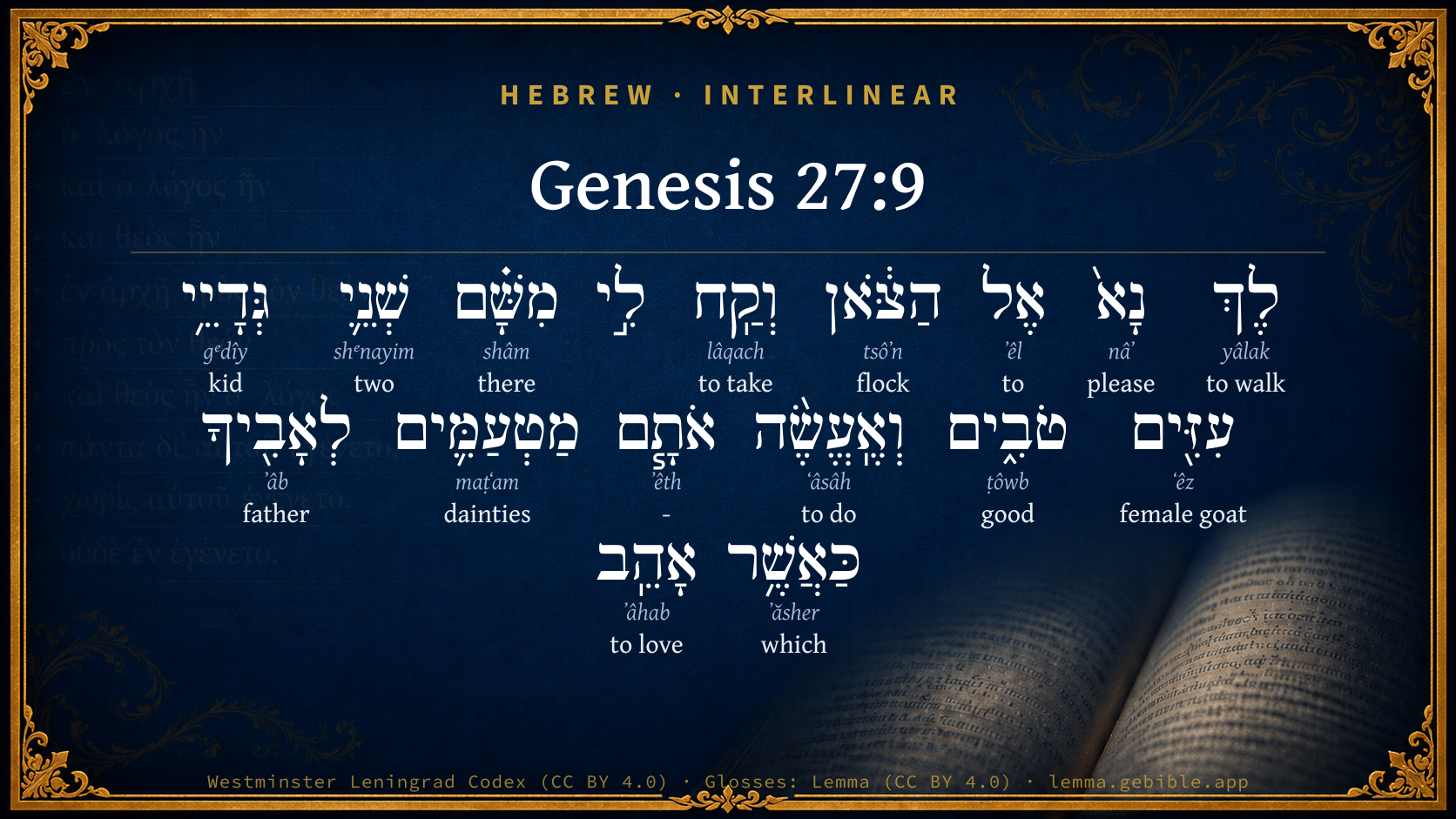
Hebrew (Westminster Leningrad Codex) Genesis 27:9 appears in the Hebrew Old Testament. The text above is from the Westminster Leningrad Codex. Each word links to its Strong’s number, a concise gloss, and parsing drawn from the Open Scriptures Hebrew Bible morphology. Click any word for its full Brown-Driver-Briggs (BDB) entry.
Download image
Cite this verse

Genesis 27:9 (World English Bible). Public Domain. Lemma interlinear Bible study tool, https://lemma.gebible.app/v/genesis/27/9.

Show BibTeX & RIS
BibTeX
RIS
English Translation
Go now to the flock, and get me from there two good kids of the goats. I will make them savory food for your father, such as he loves.
World English Bible · Public Domain
Highlights
  • 1 first appearance in the Hebrew Bible
Full analysis ↓
Download a study sheet

One document with this verse’s original text, its word-by-word gloss line, the meaning frame, cross-references with their text, attributed commentary, and full source and license credits — printable, and it pastes into notes with its structure intact.

This verse Autodidact and up

Study sheet (.html) Plain text (.txt)

A passage Seminary Student

Up to 50 verses in one chapter. A passage sheet keeps up to 6 commentary sources and 12 cross-references per verse, in the order this page ranks them, and says so on the sheet whenever that leaves anything out. Ask for a single verse and you get the Autodidact verse sheet above.

Everything on this page stays free to read, with no account — the sheet is a download of what is already on screen, not access to it.

Want to remove ads? Support Godless Engineer
Compare translations 3

The same verse in 3 English versions, stacked beneath the original-language interlinear above. Click any original word for its lexicon entry.

Each is an independent rendering of the whole verse — the interlinear is not word-aligned to these translations.

Highlighted words mark where these versions differ — a whole-verse word diff, not a word-by-word alignment.

  • World English Bible Public Domain
    Go now to the flock, and get me from there two good kids of the goats. I will make them savory food for your father, such as he loves.
  • King James Version Public Domain
    Go now to the flock, and fetch me from thence two good kids of the goats; and I will make them savory meat for thy father, such as he loveth:
  • unfoldingWord Literal Text CC BY-SA 4.0
    Please go to the flock and bring to me from there two good kids of the goats so that I will prepare from them tasty food for your father such as he loves.

unfoldingWord Literal Text — © unfoldingWord, licensed CC BY-SA 4.0. Word-aligned USFM3 via Door43 (git.door43.org/unfoldingWord/en_ult).

Versions to compare (up to 4)

3 of 4 selected

Show all 18 translations

Every available English version of this verse, each an independent rendering of the whole verse.

  • World English Bible Public Domain
    Go now to the flock, and get me from there two good kids of the goats. I will make them savory food for your father, such as he loves.
  • Berean Standard Bible Public Domain
    Go out to the flock and bring me two choice young goats, so that I can make them into a tasty dish for your father—the kind he loves.
  • Majority Standard Bible Public Domain
    Go out to the flock and bring me two choice young goats, so that I can make them into a tasty dish for your father—the kind he loves.
  • King James Version Public Domain
    Go now to the flock, and fetch me from thence two good kids of the goats; and I will make them savory meat for thy father, such as he loveth:
  • American Standard Version (1901) Public Domain
    Go now to the flock, and fetch me from thence two good kids of the goats. And I will make them savory food for thy father, such as he loveth.
  • Revised Version (1885) Public Domain
    Go now to the flock, and fetch me from thence two good kids of the goats; and I will make them savoury meat for thy father, such as he loveth:
  • Geneva Bible (1599) Public Domain
    Get thee nowe to the flocke, and bring me thence two good kids of the goates, that I may make pleasant meate of them for thy father, such as he loueth.
  • Douay-Rheims (1899) Public Domain
    And go thy way to the flock, bring me two kids of the best, that I may make of them meat for thy father, such as he gladly eateth:
  • Young's Literal Translation Public Domain
    Go, I pray thee, unto the flock, and take for me from thence two good kids of the goats, and I make them tasteful things for thy father, `such' as he hath loved;
  • Literal Standard Version CC BY-SA 4.0
    Now go to the flock, and take for me two good kids of the goats from there, and I make them tasteful things for your father, [such] as he has loved;
  • Unlocked Literal Bible CC BY-SA 4.0
    Go to the flock, and bring me two good young goats; and I will make delicious food from them for your father, just like he loves.
  • unfoldingWord Literal Text CC BY-SA 4.0
    Please go to the flock and bring to me from there two good kids of the goats so that I will prepare from them tasty food for your father such as he loves.
  • Darby Bible Public Domain
    Go, I pray thee, to the flock, and fetch me thence two good kids of the goats. And I will make of them a savoury dish for thy father, such as he loves.
  • World Messianic Bible Public Domain
    Go now to the flock and get me two good young goats from there. I will make them savory food for your father, such as he loves.
  • Webster's Bible Public Domain
    Go now to the flock, and bring me from thence two good kids of the goats; and I will make them savory meat for thy father, such as he loveth:
  • Free Bible Version CC BY-SA 4.0
    Go to the flock and bring me two nice young goats. I'll cook them and make the tasty food your father loves.
  • Bible in Basic English Public Domain
    Go to the flock and get me two fat young goats; and I will make of them a meal to your father's taste:
  • JPS Tanakh (1917) Public Domain
    Go now to the flock, and fetch me from thence two good kids of the goats; and I will make them savoury food for thy father, such as he loveth;

Literal Standard Version (2020), Covenant Press — licensed CC BY-SA 4.0. Text via the HelloAO Bible API (eBible.org). Unlocked Literal Bible (unfoldingWord) — licensed CC BY-SA 4.0. Text via the HelloAO Bible API (eBible.org). unfoldingWord Literal Text — © unfoldingWord, licensed CC BY-SA 4.0. Word-aligned USFM3 via Door43 (git.door43.org/unfoldingWord/en_ult). Free Bible Version, Dr. Jonathan Gallagher — licensed CC BY-SA 4.0. Text via the HelloAO Bible API (eBible.org).

Word by word

More ways to search: Search by grammar → Find every occurrence → Compare this word →

Practice this passage: Drill this verse → Learn its vocabulary →

מַטְעַמִּ֛ים
maṭʻam
H4303
“dainties”
Noun, Common, Masculine, Plural, Absolute
Part of Speech
Noun
Type
Common
Gender
Masculine
Number
Plural
State
Absolute
Full BDB Definition

Origin: from H2938

TWOT: 815b

tasty or savory food, delectable food, dainties
  1. לֶךְ yâlak H3212 “walk” Verb, Qal, Imperative, 2nd Person, Masculine, Singular
  2. נָא֙ nâʼ H4994 “please” Particle, Exhortation
  3. אֶל ʼêl H413 “to” Preposition
  4. הַצֹּ֔אן tsôʼn H6629 “the · flock” Particle, Definite Article + Noun, Common, Both, Singular, Absolute
  5. וְקַֽח lâqach H3947 “and · take” Conjunction + Verb, Qal, Imperative, 2nd Person, Masculine, Singular
  6. מִשָּׁ֗ם shâm H8033 “from · there” Preposition + Adverb
  7. שְׁנֵ֛י shᵉnayim H8147 “two” Adjective, Cardinal number, Masculine, Dual, Construct
  8. גְּדָיֵ֥י gᵉdîy H1423 “kids of” Noun, Common, Masculine, Plural, Construct
  9. עִזִּ֖ים ʻêz H5795 “female goats” Noun, Common, Feminine, Plural, Absolute
  10. טֹבִ֑ים ṭôwb H2896 “good” Adjective, Adjective, Masculine, Plural, Absolute
  11. וְאֶֽעֱשֶׂ֨ה ʻâsâh H6213 “and · to do” Conjunction + Verb, Qal, Imperfect, 1st Person, Common, Singular
  12. אֹתָ֧ם ʼêth H853 “- · them” Particle, Direct Object + Suffix, Personal, 3rd Person, Masculine, Plural
  13. לְאָבִ֖יךָ ʼâb H1 “to/for · father · your” Preposition + Noun, Common, Masculine, Singular, Construct + Suffix, Personal, 2nd Person, Masculine, Singular
  14. כַּאֲשֶׁ֥ר ʼăsher H834 “like/as · which” Preposition + Particle, Relative
  15. אָהֵֽב ʼâhab H157 “to love” Verb, Qal, Perfect, 3rd Person, Masculine, Singular

About this verse

These counts appear in no published source. They are computed here, from the morphology-tagged text and Lemma’s own curated glosses. What Lemma adds →

17
words
16
distinct lemmas
Pentateuch
section

Notable vocabulary

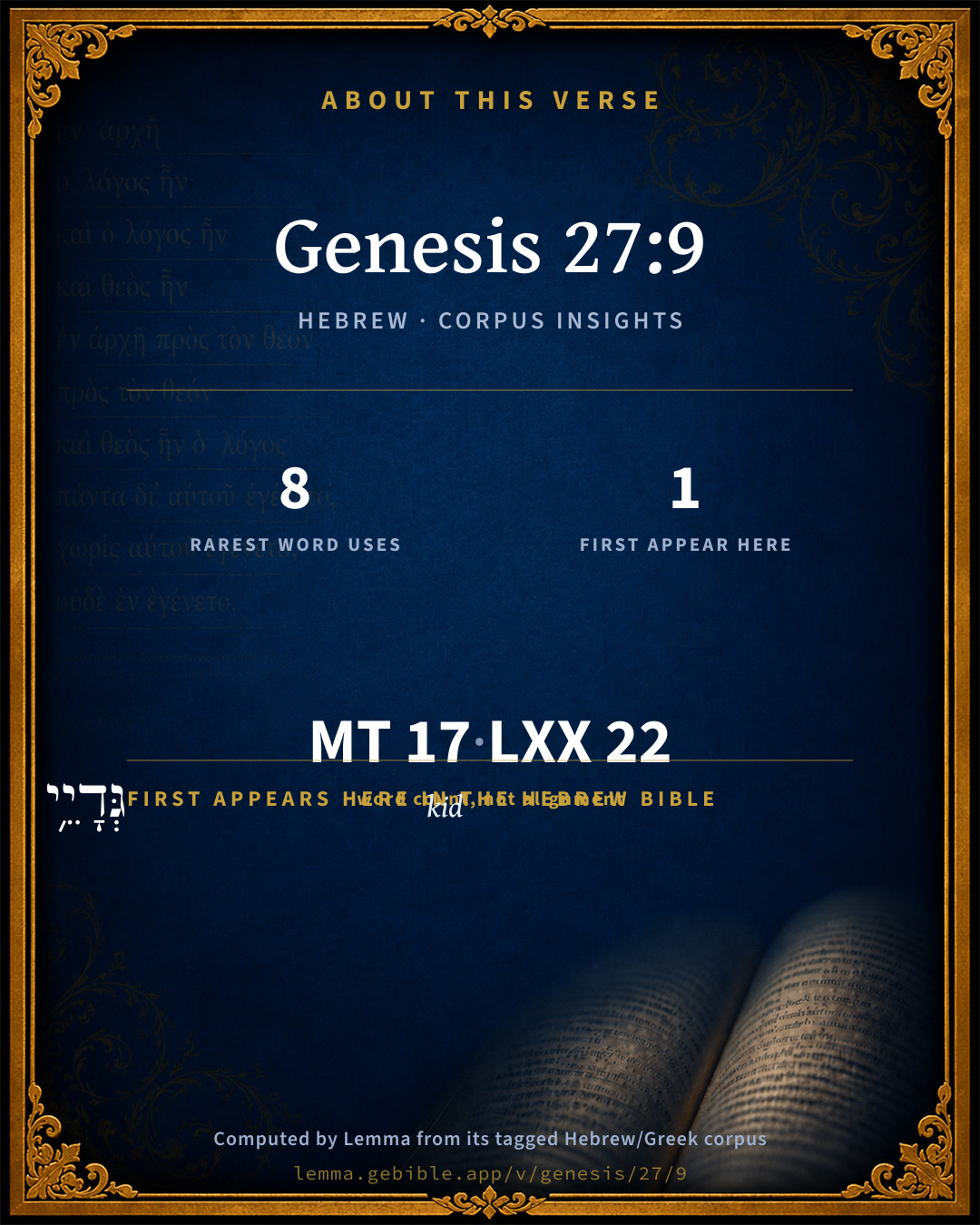
The rarest word here is מַטְעַמִּ֛ים dainties H4303 — appearing just 8 times in the whole Hebrew Bible.

First appearance in Scripture

This word makes its first canonical appearance in the Hebrew Bible here:

  • גְּדָיֵ֥י kid H1423

Shared distinctive vocabulary

מַטְעַמִּ֛ים dainties H4303 occurs in 8 verses of the Hebrew Bible. Also found in:

Grammatical profile

  • 4 verbs
  • 5 nouns
  • 2 adjectives
  • 2 prepositions
  • 1 adverb
  • 3 particles

Verb forms

  • לֶךְ Qal · Imperative
  • וְקַֽח Qal · Imperative
  • וְאֶֽעֱשֶׂ֨ה Qal · Imperfect
  • אָהֵֽב Qal · Perfect

Hebrew & Septuagint length

In English translation the verse runs 29 words from the Hebrew and 27 from the Septuagint (LXX English) — closely comparable.

A rough comparison of the two English renderings, which tokenize alike — not a word-level alignment.

Word counts can differ between the Hebrew and the Greek without any difference in meaning — e.g. the Hebrew direct-object marker אֵת has no separate Greek word, and Greek often adds the article ὁ.

In the original languages it is 17 Hebrew tokens and 22 Greek tokens — but the two are counted differently (Hebrew bundles its prefixes and suffixes into one token; the Greek is in lemma form), so that isn’t a like-for-like length.

Cross-references

2

Topical passages linked to Genesis 27:9 in the Treasury of Scripture Knowledge — connected by theme and wording, ordered by reader-vote popularity; previews shown in the World English Bible.

  • Judges 13:15 Manoah said to the angel of Yahweh, I pray you, let us detain you, that we may make ready a kid for you.
  • 1 Samuel 16:20 Jesse took a donkey loaded with bread, and a bottle of wine, and a kid, and sent them by David his son to Saul.

Cross-references courtesy of OpenBible.info (CC BY 4.0).

Hebrew and Greek witnesses Masoretic Hebrew ↔ Greek Septuagint

The same verse in the two great witnesses to the Old Testament, shown verse-for-verse.

These are two independent witnesses, not word-aligned to each other, and the Septuagint is shown in lemma (dictionary) form.

Hebrew Genesis 27:9 Masoretic · Westminster Leningrad Codex

לֶךְ נָא֙ אֶל הַצֹּ֔אן וְקַֽח לִ֣י מִשָּׁ֗ם שְׁנֵ֛י גְּדָיֵ֥י עִזִּ֖ים טֹבִ֑ים וְאֶֽעֱשֶׂ֨ה אֹתָ֧ם מַטְעַמִּ֛ים לְאָבִ֖יךָ כַּאֲשֶׁ֥ר אָהֵֽב

Go now to the flock, and get me from there two good kids of the goats. I will make them savory food for your father, such as he loves.

World English Bible · Public Domain

Greek LXX Genesis 27:9 Septuagint · lemma form

καί πορεύομαι εἰς ὁ πρόβατον λαμβάνω ἐγώ ἐκεῖθεν δύο ἔριφος ἁπαλός καί καλός καί ποιέω αὐτός ἔδεσμα ὁ πατήρ σύ ὡς φιλέω

And go to the cattle and take for me thence two kids, tender and good, and I will make them meats for your father, as he likes.

LXX2012 (modern English Septuagint) · Public Domain

Hebrew: Westminster Leningrad Codex (CC BY 4.0). Greek: Septuagint (public domain); English from LXX2012 (modern English Septuagint) (Public Domain). How the Septuagint differs from the Hebrew →

Targum (Aramaic paraphrase)

2

The Targum is the ancient Jewish Aramaic paraphrase of the Hebrew Scriptures — an interpretive translation, not the Hebrew text itself. Onkelos (literal) and Pseudo-Jonathan (expansive) render the Torah, and Jonathan the Prophets. Coverage is partial: where no permissively-licensed English translation exists for a verse, only the Aramaic is shown. This is verse-level text, not a word-by-word alignment to the Hebrew.

  1. Targum Onkelos Torah (Genesis–Deuteronomy)
    אִזֵיל כְּעַן לְוַת עָנָא וְסַב לִי מִתַּמָּן תְּרֵין גַדְיֵי (בַר) עִזְּין טָבָן וְאֶעְבֵּד יָתְהוֹן תַּבְשִׁילִין לְאָבוּךְ כְּמָא דִי רְחֵם

    (no public-domain English translation for this verse)

    Targum Onkelos — Aramaic: “Onkelos Genesis” (public domain); “Onkelos Exodus” (public domain); “Onkelos Leviticus” (public domain); “Onkelos Numbers” (public domain); “Onkelos Deuteronomy” (public domain). English: “Sefaria Community Translation” (CC0 1.0 (public-domain dedication)); “J.W. Etheridge. The Targums of Onkelos and Jonathan Ben Uzziel on the Pentateuch. London: Longmans, Green, 1862” (public domain). Text via Sefaria.

  2. Targum Pseudo-Jonathan Torah (Genesis–Deuteronomy)
    אִיזֵיל כְּדוֹן לְבֵית עָנָא וְסַב לִי מִתַּמָן תְּרֵי גְדָיֵי עִזִין שַׁמְנִין חַד לְשׁוּם פִּסְחָא וְחַד לְשׁוּם קָרְבַּן חַגָא וְאַעֲבֵיד יַתְהוֹן תַּבְשִׁילִין לְאָבוּךְ הֵיכְמָא דִי רָחִים

    Go now to the house of the flock, and take me from thence two fat kids of the goats; one for the pascha, and one for the oblation of the feast; and I will make of them food for thy father such as he loveth.

    Targum Pseudo-Jonathan — Aramaic: “Targum Jonathan on Genesis” (public domain); “Targum Jonathan on Exodus” (public domain); “Targum Jonathan on Leviticus” (public domain); “Targum Jonathan on Numbers” (public domain); “Targum Jonathan on Deuteronomy” (public domain). English: “The Targum of Jonathan ben Uzziel, trans. J. W. Etheridge, London, 1862” (public domain). Text via Sefaria.

Commentary

Notes on Genesis 27:9 from classic Christian and Jewish commentators (each source and its license shown beneath its notes). The classic Christian expositions comment on the surrounding passage and are grouped to its opening verse, so a note may address several verses; the Jewish commentaries on the Tanakh (Rashi and others) are per-verse, so they appear only where the commentator wrote on this verse.

Lemma curates 59 commentaries, every one of them public domain or Creative Commons licensed, each selected and text-cleaned for this edition rather than reprinted as found. About our sources →

Trapp's Complete Commentary

John Trapp

Gen 27:9 Go now to the flock, and fetch me from thence two good kids of the goats; and I will make them savoury meat for thy father, such as he loveth:

Ver. 9. Savoury meat for thy father, &c.] She knew his diet, and could fit his tooth. The wife is to take care to please (μεριμνα) her husband; to use her wits, and busy her thoughts how to give him content in diet, and other things of the world, as the apostle hath it. {1Co 7:34} It was devilish policy in Agrippina, the mother of Nero - and it came home to her - to temper the poison that she gave her husband Claudius the emperor, in the meat he most delighted in, {a} and then to make a jest of it. Let us be sure to bring God such service as he loveth. He will eat, not only our "honey," but our "honeycomb"; he will drink, not only our "wine," but our "milk"; {Son 5:1} take in good part unperfect performances, so the heart be upright. But displeasing service is a double dishonour. The fat of rams was rejected with infinite disdain, where the hands are full of blood, the heart of sin. {Isa 1:11; Isa 1:15} The philosopher {b} could complain of his countrymen, that when they went to offer sacrifice to health, they did then banquet most riotously against health.

{a} Dixit Nero boletos θεων βρωμα ειναι, quod Claudius boleto in numerum Deorum relatus esset. - Dio.

{b} Diog. Laert.

John Trapp, A Commentary or Exposition upon All the Books of the Old and New Testament (1647–1656) — public domain. Text from a community e-Sword module.

Geneva Bible (1599)

Geneva Bible translators

This subtlety is blameworthy because she should have tarried till God had performed his promise.

Geneva Bible (1599) marginal notes — public domain. Text via Bolls.life.

Ellicott's Commentary for English Readers

(9) Two good kids.—These would be about equal to one antelope or animal of the larger game. After Isaac had eaten of the flesh, so solemn an occasion would doubtless be marked by a feast for those, at least in the foremost tents, if not for all the household and followers of Isaac.

A Bible Commentary for English Readers, edited by Charles John Ellicott (1878–1897) — public domain. Text from a community e-Sword module.

John Gill's Exposition

Go now to the flock,.... To the flock he had the care of, and that immediately, for the case required haste:

and fetch me from thence two good kids of the goats; two young kids that were fat, as Jonathan and Ben Melech interpret it; and, though two may seem to be too much to be dressed for Isaac only; it may be observed, that Rebekah intended only to take out some of the choicest and most tender and delicate parts of them, and which would best suit her purpose, and which she would make most like to venison; and the rest could be disposed of for the use of the family: and, if it should be questioned whether Rebekah had a right to do this without her husband's leave, the Jewish writers have an answer ready; that, in her dowry or matrimonial contract, Isaac had allowed her to take two kids of the goats every day (p):

and I will make them savoury meat for thy father, such as he loveth; such as would pass with him for venison: Jarchi says, that the taste of a kid is like the taste of a young roe or fawn; however, by seasoning, the natural taste might be altered so as not to be distinguished, as we find it was; and such as have the best skill in venison may be imposed upon and deceived by more ways than one, as well as Isaac was.

(p) Bereshit Rabba, sect. 65. fol. 57. 4. Jarchi in loc.

John Gill's Exposition of the Whole Bible (1746–1763) — public domain (CC PDM 1.0). Text via the HelloAO Bible API.

Matthew Poole's English Annotations

It is observable, that as Jacob deceived his father by a kid, so his sons deceived him by the same creature, Gen 37:31-33.

I will make them savoury meat, out of their most tender and delicate parts; wherewith it was not difficult to deceive Isaac, partly because of the likeness of the flesh, especially being altered by convenient sauce; and partly because the same old age which had dimmed Isaac’s sight had also dulled his other senses.

Matthew Poole's English Annotations on the Holy Bible (1683–1685) — public domain. Text from a community e-Sword/MySword module.

Whedon's Commentary on the Bible

Daniel D. Whedon

9. Go now to the flock — Isaac had said to Esau: “Go out to the field.” Gen_27:3. The flock was nearer at hand.

Two good kids — A bountiful meal is provided. One kid would have been more than sufficient for Isaac, but the two made the feast a sort of covenant meal, and somewhat of the nature of a sacrifice on the part of him who was to receive the blessing.

I will make them savoury meat — Rebekah knows how to cook and season kids that Isaac will not distinguish them from the game of Esau.

Daniel D. Whedon (gen. ed.), Commentary on the Old and New Testaments (1874–1909) — public domain. Text from a community e-Sword module.

The Pulpit Commentary

Vers. 9, 10. Go now to the flock, and fetch me literally, take for me, i.e. for my purposes (cf. Gen_15:9) from thence two good kids of the goats. According to Jarchi kids were selected as being the nearest approach to the flesh of wild animals. Two were specified, it has been thought, either to extract from both the choicest morsels (Menochius), or to have the appearance of animals taken in hunting (Rosenm or to make an ample provision as of venison (Lunge), or to make a second experiment, if the first failed (Willet). And I will make them probably concealing any difference in taste by means of condiments, though Isaac s palate would not be sensitive in consequence of age and debility savory meat for thy father, such as he loveth (vide ver. 4): and thou shalt bring it to thy father, that he may eat (literally, and he shall eat), and that he may bless thee r rbu) in order that, from the idea of passing over to that which one desires to attain; less fully in ver. 4before his death. Clearly Rebekah was anticipating Isaac"s early dissolution, else why this indecent haste to forestall Esau? There is no reason to surmise that she believed any connection to subsist between the eating and the benediction, though she probably imagined that the supposed prompt obedience of Isaac"s son would stimulate his feeble heart to speak (Rosenm

The Pulpit Commentary (1880–1919), ed. H.D.M. Spence-Jones & Joseph S. Exell — public domain. Text from a community e-Sword module.

Rashi

Rabbi Shlomo Yitzchaki (Rashi)

וקח לי AND TAKE FOR ME — (The words may mean “Take that which belongs to me”) — these are mine and not the proceeds of theft. Isaac had made provision in her marriage contract that she should receive daily two kids of the goats (Genesis Rabbah 65:14).

שני גדיי עזים TWO KIDS OF THE GOATS — Did then two kids of the goats form a meal for Isaac? But the explanation is: it being Passover he offered one as his Paschal sacrifice and of the other he prepared the savoury food. So is it stated in Pirkei DeRabbi Eliezer 32).

כאשר אהב SUCH AS HE LOVETH (Genesis 27:5) — For the taste of a kid is similar to the taste of a deer.

Rashi on the Tanakh — English translations: “The Judaica Press complete Tanach with Rashi, translated by A. J. Rosenberg” (CC BY 4.0); “Pentateuch with Rashi's commentary by M. Rosenbaum and A.M. Silbermann, 1929-1934” (public domain); “The Metsudah Tanach series, Lakewood, N.J” (CC BY 4.0); and “The Book of Joshua, Metsudah Publications, 1997” (CC BY 4.0). Text via Sefaria.

Radak

Rabbi David Kimhi (Radak)

טובים, fat ones. We find that Avraham (18,7) also offered the angels calves which were רך וטוב, “tender and fat.” When we read about the seven good cows Pharaoh saw in his dream (41,26), the word for “fat” is also טובות.

Radak on the Tanakh — English translations: “Sefaria Community Translation” (CC0 1.0 (public-domain dedication)); “Eliyahu Munk, HaChut Hameshulash” (CC BY 4.0); “Rabbi Mike Feuer, Jerusalem Anthology” (CC BY 4.0); and “R. David Kimhi on the first book of Psalms, Translated by R.G. Finch, London, 1919” (public domain). Text via Sefaria.

Lesson kit

Teaching starters — assembled from the data on this page, not authored interpretation. Every prompt links to the verse data it draws on. Edit before teaching.

Genesis, in the Pentateuch, opens this verse with 17 words (16 distinct Hebrew lemmas). Its most distinctive word is maṭʻam (“dainties”). A historical commentator’s framing appears above. Read the whole chapter for the surrounding context.

Discussion questions

  1. The word maṭʻam carries the sense “dainties.” How does it shape the verse?
  2. The word “kid” first appears here in Scripture. What is being introduced at this debut?
  3. Genesis 27:4 shares the word «dainties» with this verse. How do the two illuminate each other?
  4. These translations render this verse differently. What is at stake in choosing one wording over another?
  5. The verb «לֶךְ» is Qal Imperative. How does its form color the action?
  6. Reading how Trapp's Complete Commentary and Geneva Bible (1599) read this verse, where do the two commentators agree and where do they part?

Things to notice

Reading settings

Reading text

Shown beneath each verse's original-language words.

Old Testament
Old Testament edition

Read the OT as the Masoretic Hebrew (MT) or the Greek Septuagint (LXX).

English shown for the Greek Septuagint (in the Hebrew ↔ Greek comparison).

Comparing translations? Open the Compare panel on any verse page to stack up to four side by side.