
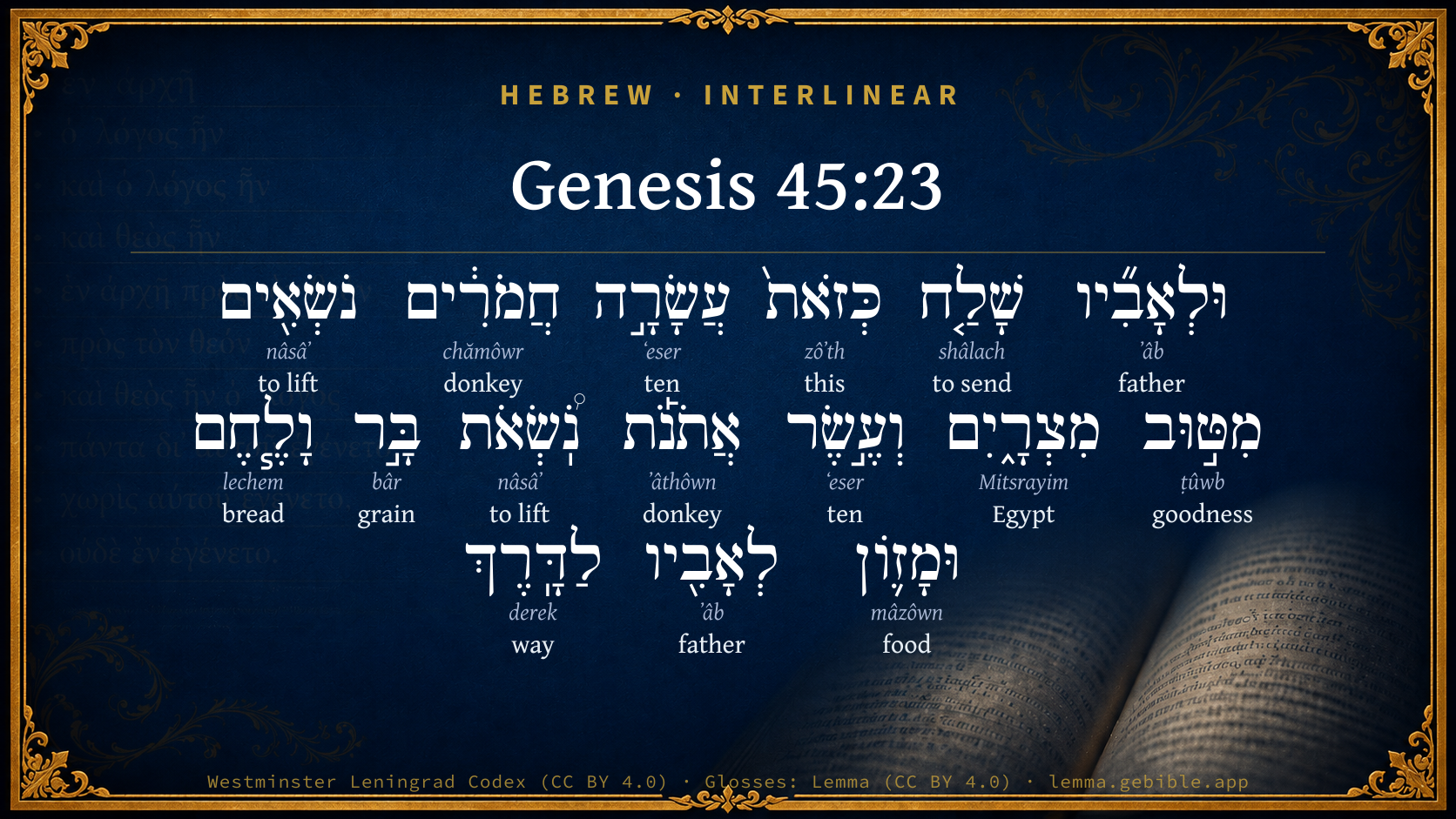
Genesis 45:23

Hebrew (Westminster Leningrad Codex) Genesis 45:23 appears in the Hebrew Old Testament. The text above is from the Westminster Leningrad Codex. Each word links to its Strong’s number, a concise gloss, and parsing drawn from the Open Scriptures Hebrew Bible morphology. Click any word for its full Brown-Driver-Briggs (BDB) entry.
Download image
Cite this verse

Genesis 45:23 (World English Bible). Public Domain. Lemma interlinear Bible study tool, https://lemma.gebible.app/v/genesis/45/23.

Show BibTeX & RIS
BibTeX
RIS
English Translation
To his father, he sent after this manner: ten donkeys loaded with the good things of Egypt, and ten female donkeys loaded with grain and bread and provision for his father by the way.
World English Bible · Public Domain
Highlights
  • 1 first appearance in the Hebrew Bible
Full analysis ↓
Download a study sheet

One document with this verse’s original text, its word-by-word gloss line, the meaning frame, cross-references with their text, attributed commentary, and full source and license credits — printable, and it pastes into notes with its structure intact.

This verse Autodidact and up

Study sheet (.html) Plain text (.txt)

A passage Seminary Student

Up to 50 verses in one chapter. A passage sheet keeps up to 6 commentary sources and 12 cross-references per verse, in the order this page ranks them, and says so on the sheet whenever that leaves anything out. Ask for a single verse and you get the Autodidact verse sheet above.

Everything on this page stays free to read, with no account — the sheet is a download of what is already on screen, not access to it.

Want to remove ads? Support Godless Engineer
Compare translations 3

The same verse in 3 English versions, stacked beneath the original-language interlinear above. Click any original word for its lexicon entry.

Each is an independent rendering of the whole verse — the interlinear is not word-aligned to these translations.

Highlighted words mark where these versions differ — a whole-verse word diff, not a word-by-word alignment.

  • World English Bible Public Domain
    To his father, he sent after this manner: ten donkeys loaded with the good things of Egypt, and ten female donkeys loaded with grain and bread and provision for his father by the way.
  • King James Version Public Domain
    And to his father he sent after this manner; ten asses laden with the good things of Egypt, and ten she asses laden with corn and bread and meat for his father by the way.
  • unfoldingWord Literal Text CC BY-SA 4.0
    And to his father he sent this: ten he-donkeys loaded with the best of Egypt, and ten she-donkeys loaded grain and bread and provisions for his father for the road.

unfoldingWord Literal Text — © unfoldingWord, licensed CC BY-SA 4.0. Word-aligned USFM3 via Door43 (git.door43.org/unfoldingWord/en_ult).

Versions to compare (up to 4)

3 of 4 selected

Show all 18 translations

Every available English version of this verse, each an independent rendering of the whole verse.

  • World English Bible Public Domain
    To his father, he sent after this manner: ten donkeys loaded with the good things of Egypt, and ten female donkeys loaded with grain and bread and provision for his father by the way.
  • Berean Standard Bible Public Domain
    And he sent to his father the following: ten donkeys loaded with the best of Egypt, and ten female donkeys loaded with grain and bread and provisions for his father’s journey.
  • Majority Standard Bible Public Domain
    And he sent to his father the following: ten donkeys loaded with the best of Egypt, and ten female donkeys loaded with grain and bread and provisions for his father’s journey.
  • King James Version Public Domain
    And to his father he sent after this manner; ten asses laden with the good things of Egypt, and ten she asses laden with corn and bread and meat for his father by the way.
  • American Standard Version (1901) Public Domain
    And to his father he sent after this manner: ten asses laden with the good things of Egypt, and ten she-asses laden with grain and bread and provision for his father by the way.
  • Revised Version (1885) Public Domain
    And to his father he sent after this manner; ten asses laden with the good things of Egypt, and ten she-asses laden with corn and bread and victual for his father by the way.
  • Geneva Bible (1599) Public Domain
    And vnto his father likewise hee sent ten hee asses laden with the best things of Egypt, and ten shee asses laden with wheate, and bread and meate for his father by the way.
  • Douay-Rheims (1899) Public Domain
    Sending to his father as much money and raiment, adding besides ten he asses to carry off all the riches of Egypt, and as many she asses, carrying wheat and bread for the journey.
  • Young's Literal Translation Public Domain
    and to his father he hath sent thus: ten asses bearing of the good things of Egypt, and ten she-asses bearing corn and bread, even food for his father for the way.
  • Literal Standard Version CC BY-SA 4.0
    and to his father he has sent thus: ten donkeys carrying of the good things of Egypt, and ten female donkeys carrying grain and bread, even food for his father for the way.
  • Unlocked Literal Bible CC BY-SA 4.0
    For his father he sent this: ten donkeys loaded with the good things of Egypt; and ten female donkeys loaded with grain, bread, and other supplies for his father for the journey.
  • unfoldingWord Literal Text CC BY-SA 4.0
    And to his father he sent this: ten he-donkeys loaded with the best of Egypt, and ten she-donkeys loaded grain and bread and provisions for his father for the road.
  • Darby Bible Public Domain
    And to his father he sent this: ten asses laden with the good things of Egypt, and ten she-asses laden with corn and bread, and food for his father by the way.
  • World Messianic Bible Public Domain
    He sent the following to his father: ten donkeys loaded with the good things of Egypt, and ten female donkeys loaded with grain and bread and provision for his father by the way.
  • Webster's Bible Public Domain
    And to his father he sent after this manner; ten asses laden with the good things of Egypt, and ten she-asses laden with corn and bread and meat, for his father by the way.
  • Free Bible Version CC BY-SA 4.0
    Joseph also sent to his father the following: ten donkeys carrying the best things from Egypt, and ten female donkeys carrying grain and bread and supplies needed for his father's journey.
  • Bible in Basic English Public Domain
    And to his father he sent ten asses with good things from Egypt on their backs, and ten she-asses with grain and bread and food for his father on the journey.
  • JPS Tanakh (1917) Public Domain
    And to his father he sent in like manner ten asses laden with the good things of Egypt, and ten she-asses laden with corn and bread and victual for his father by the way.

Literal Standard Version (2020), Covenant Press — licensed CC BY-SA 4.0. Text via the HelloAO Bible API (eBible.org). Unlocked Literal Bible (unfoldingWord) — licensed CC BY-SA 4.0. Text via the HelloAO Bible API (eBible.org). unfoldingWord Literal Text — © unfoldingWord, licensed CC BY-SA 4.0. Word-aligned USFM3 via Door43 (git.door43.org/unfoldingWord/en_ult). Free Bible Version, Dr. Jonathan Gallagher — licensed CC BY-SA 4.0. Text via the HelloAO Bible API (eBible.org).

Word by word

More ways to search: Search by grammar → Find every occurrence → Compare this word →

Practice this passage: Drill this verse → Learn its vocabulary →

וּמָז֛וֹן
mâzôwn
H4202
“and · food”
Conjunction + Noun, Common, Masculine, Singular, Absolute
Part of Speech
Conjunction + Noun
Type
Common
Gender
Masculine
Number
Singular
State
Absolute
Full BDB Definition

Origin: from H2109

TWOT: 539a

food, sustenance
  1. וּלְאָבִ֞יו ʼâb H1 “and · to/for · father · his” Conjunction + Preposition + Noun, Common, Masculine, Singular, Construct + Suffix, Personal, 3rd Person, Masculine, Singular
  2. שָׁלַ֤ח shâlach H7971 “to send” Verb, Qal, Perfect, 3rd Person, Masculine, Singular
  3. כְּזֹאת֙ zôʼth H2063 “like/as · this” Preposition + Pronoun, Demonstrative, Feminine, Singular
  4. עֲשָׂרָ֣ה ʻeser H6235 “ten” Adjective, Cardinal number, Masculine, Singular, Absolute
  5. חֲמֹרִ֔ים chămôwr H2543 “donkeys” Noun, Common, Both, Plural, Absolute
  6. נֹשְׂאִ֖ים nâsâʼ H5375 “lifting” Verb, Qal, Participle Active, Masculine, Plural, Absolute
  7. מִטּ֣וּב ṭûwb H2898 “from · goodness of” Preposition + Noun, Common, Masculine, Singular, Construct
  8. מִצְרָ֑יִם Mitsrayim H4714 “Egypt” Noun, Proper
  9. וְעֶ֣שֶׂר ʻeser H6235 “and · ten” Conjunction + Adjective, Cardinal number, Feminine, Singular, Absolute
  10. אֲתֹנֹ֡ת ʼâthôwn H860 “donkeys” Noun, Common, Feminine, Plural, Absolute
  11. נֹֽ֠שְׂאֹת nâsâʼ H5375 “lifting” Verb, Qal, Participle Active, Feminine, Plural, Absolute
  12. בָּ֣ר bâr H1250 “grain” Noun, Common, Masculine, Singular, Absolute
  13. וָלֶ֧חֶם lechem H3899 “and · bread” Conjunction + Noun, Common, Both, Singular, Absolute
  14. לְאָבִ֖יו ʼâb H1 “to/for · father · his” Preposition + Noun, Common, Masculine, Singular, Construct + Suffix, Personal, 3rd Person, Masculine, Singular
  15. לַדָּֽרֶךְ derek H1870 “to/for the · way” Preposition, Determined + Noun, Common, Both, Singular, Absolute

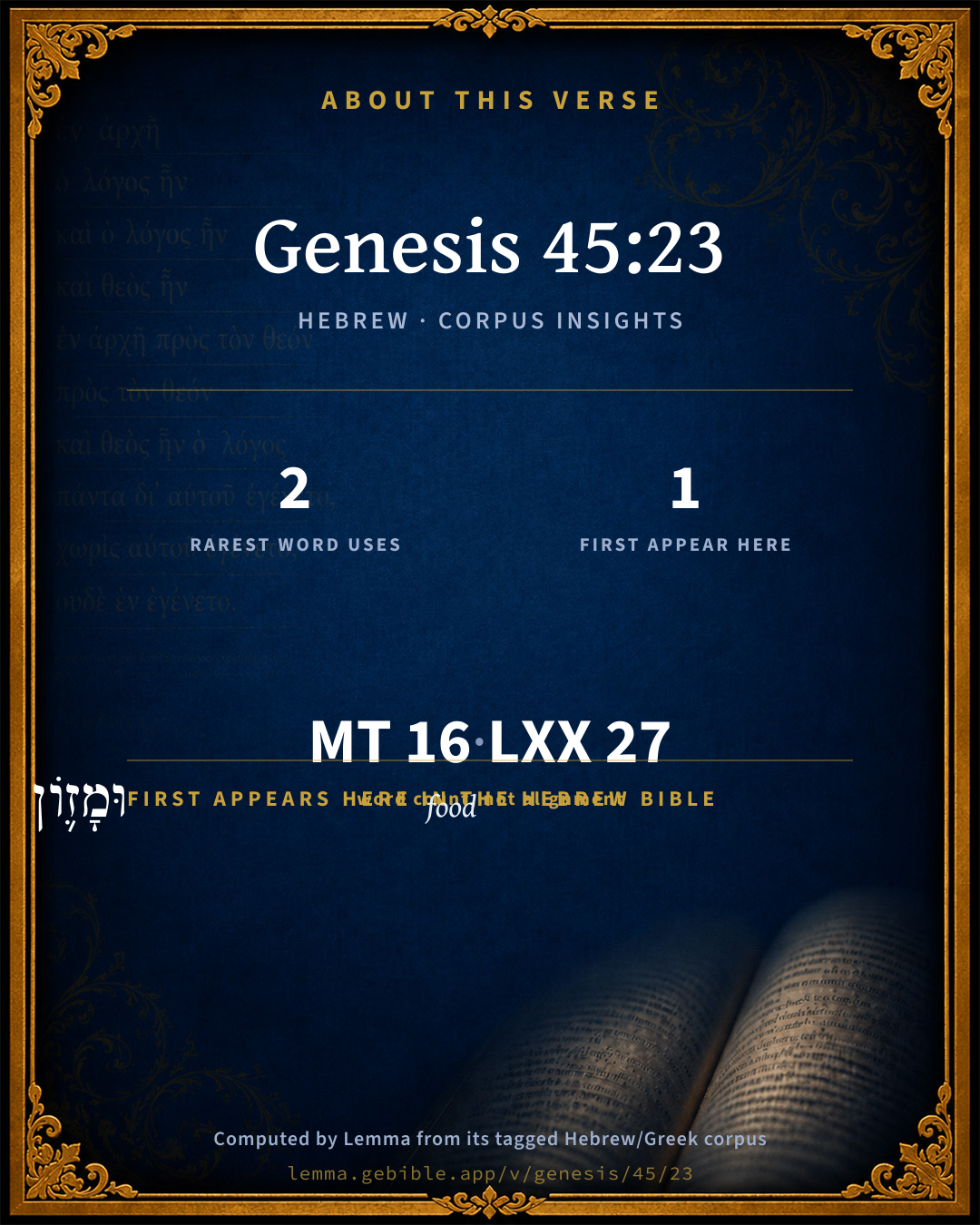
About this verse

These counts appear in no published source. They are computed here, from the morphology-tagged text and Lemma’s own curated glosses. What Lemma adds →

16
words
13
distinct lemmas
Pentateuch
section

Notable vocabulary

The rarest word here is וּמָז֛וֹן food H4202 — appearing just 2 times in the whole Hebrew Bible.

First appearance in Scripture

This word makes its first canonical appearance in the Hebrew Bible here:

  • וּמָז֛וֹן food H4202

Shared distinctive vocabulary

וּמָז֛וֹן food H4202 occurs in 2 verses of the Hebrew Bible. Also found in:

Grammatical profile

  • 3 verbs
  • 10 nouns
  • 2 adjectives
  • 1 pronoun

Verb forms

  • שָׁלַ֤ח Qal · Perfect
  • נֹשְׂאִ֖ים Qal · Participle Active
  • נֹֽ֠שְׂאֹת Qal · Participle Active

Repetition

Words recur within this verse — often emphatic in Hebrew:

  • וּלְאָבִ֞יו father H1 ×2
  • עֲשָׂרָ֣ה ten H6235 ×2
  • נֹשְׂאִ֖ים to lift H5375 ×2

Hebrew & Septuagint length

In English translation the verse runs 34 words from the Hebrew and 34 from the Septuagint (LXX English) — the same length.

A rough comparison of the two English renderings, which tokenize alike — not a word-level alignment.

Word counts can differ between the Hebrew and the Greek without any difference in meaning — e.g. the Hebrew direct-object marker אֵת has no separate Greek word, and Greek often adds the article ὁ.

In the original languages it is 16 Hebrew tokens and 27 Greek tokens — but the two are counted differently (Hebrew bundles its prefixes and suffixes into one token; the Greek is in lemma form), so that isn’t a like-for-like length.

Cross-references

3

Topical passages linked to Genesis 45:23 in the Treasury of Scripture Knowledge — connected by theme and wording, ordered by reader-vote popularity; previews shown in the World English Bible.

  • Genesis 24:10 The servant took ten camels, of his master's camels, and departed, having all goodly things of his master's in his hand. He arose, and went to Mesopotamia, to the city of Nahor.
  • Genesis 43:11 Their father, Israel, said to them, "If it be so now, do this. Take from the choice fruits of the land in your bags, and carry down a present for the man, a little balm, a little honey, spices and myrrh, nuts, and almonds;
  • Exodus 16:3 and the children of Israel said to them, "We wish that we had died by the hand of Yahweh in the land of Egypt, when we sat by the flesh-pots, when we ate our fill of bread, for you have brought us out into this wilderness, to kill this whole assembly with hunger."

Cross-references courtesy of OpenBible.info (CC BY 4.0).

Hebrew and Greek witnesses Masoretic Hebrew ↔ Greek Septuagint

The same verse in the two great witnesses to the Old Testament, shown verse-for-verse.

These are two independent witnesses, not word-aligned to each other, and the Septuagint is shown in lemma (dictionary) form.

Hebrew Genesis 45:23 Masoretic · Westminster Leningrad Codex

וּלְאָבִ֞יו שָׁלַ֤ח כְּזֹאת֙ עֲשָׂרָ֣ה חֲמֹרִ֔ים נֹשְׂאִ֖ים מִטּ֣וּב מִצְרָ֑יִם וְעֶ֣שֶׂר אֲתֹנֹ֡ת נֹֽ֠שְׂאֹת בָּ֣ר וָלֶ֧חֶם וּמָז֛וֹן לְאָבִ֖יו לַדָּֽרֶךְ

To his father, he sent after this manner: ten donkeys loaded with the good things of Egypt, and ten female donkeys loaded with grain and bread and provision for his father by the way.

World English Bible · Public Domain

Greek LXX Genesis 45:23 Septuagint · lemma form

καί ὁ πατήρ αὐτός ἀποστέλλω κατά ὁ αὐτός καί δέκα ὄνος αἴρω ἀπό πᾶς ὁ ἀγαθός αἴγυπτος καί δέκα ἡμίονος αἴρω ἄρτος ὁ πατήρ αὐτός εἰς ὁδός

And to his father he sent presents at the same rate, and ten asses, bearing some of all the good things of Egypt, and ten mules, bearing bread for his father for your journey.

LXX2012 (modern English Septuagint) · Public Domain

On this verse, Haydock's Catholic Bible Commentary discusses the Septuagint’s reading. Read the note in Commentary ↓

Hebrew: Westminster Leningrad Codex (CC BY 4.0). Greek: Septuagint (public domain); English from LXX2012 (modern English Septuagint) (Public Domain). How the Septuagint differs from the Hebrew →

Targum (Aramaic paraphrase)

2

The Targum is the ancient Jewish Aramaic paraphrase of the Hebrew Scriptures — an interpretive translation, not the Hebrew text itself. Onkelos (literal) and Pseudo-Jonathan (expansive) render the Torah, and Jonathan the Prophets. Coverage is partial: where no permissively-licensed English translation exists for a verse, only the Aramaic is shown. This is verse-level text, not a word-by-word alignment to the Hebrew.

  1. Targum Onkelos Torah (Genesis–Deuteronomy)
    וְלַאֲבוּהִי שְׁלַח כְּדָא עַסְרָא חֲמָרִין טְעִינִין מִטּוּבָא דְמִצְרָיִם וַעֲסַר אַתְנָן טְעִינָן עִיבוּר וּלְחֵם וּזְוָדִין לַאֲבוּהִי לְאָרְחָא

    (no public-domain English translation for this verse)

    Targum Onkelos — Aramaic: “Onkelos Genesis” (public domain); “Onkelos Exodus” (public domain); “Onkelos Leviticus” (public domain); “Onkelos Numbers” (public domain); “Onkelos Deuteronomy” (public domain). English: “Sefaria Community Translation” (CC0 1.0 (public-domain dedication)); “J.W. Etheridge. The Targums of Onkelos and Jonathan Ben Uzziel on the Pentateuch. London: Longmans, Green, 1862” (public domain). Text via Sefaria.

  2. Targum Pseudo-Jonathan Torah (Genesis–Deuteronomy)
    וּלְאָבוֹי שָׁדַר דוֹרוֹן כְּדֵין עַשְרָא חֲמָרִין טְעִינִין חַמְרָא וּמִטוּבָא דְמִצְרַיִם וְעֶשֶר אַתְנָן טְעִינָן עִיבּוּר וּלְחֵם וּזְוָודִין לְאָבוֹי לְאָרְחָא

    And these presents he sent to his father; ten asses laden with wine and the good things of Mizraim, and ten she asses laden with corn and bread, and provisions for his father's journey.

    Targum Pseudo-Jonathan — Aramaic: “Targum Jonathan on Genesis” (public domain); “Targum Jonathan on Exodus” (public domain); “Targum Jonathan on Leviticus” (public domain); “Targum Jonathan on Numbers” (public domain); “Targum Jonathan on Deuteronomy” (public domain). English: “The Targum of Jonathan ben Uzziel, trans. J. W. Etheridge, London, 1862” (public domain). Text via Sefaria.

Commentary

Notes on Genesis 45:23 from classic Christian and Jewish commentators (each source and its license shown beneath its notes). The classic Christian expositions comment on the surrounding passage and are grouped to its opening verse, so a note may address several verses; the Jewish commentaries on the Tanakh (Rashi and others) are per-verse, so they appear only where the commentator wrote on this verse.

Lemma curates 59 commentaries, every one of them public domain or Creative Commons licensed, each selected and text-cleaned for this edition rather than reprinted as found. About our sources →

Trapp's Complete Commentary

John Trapp

Gen 45:23 And to his father he sent after this [manner]; ten asses laden with the good things of Egypt, and ten she asses laden with corn and bread and meat for his father by the way.

Ver. 23. After this manner.] Not the same that he gave Benjamin, as some sense it; but as followeth in the text.

John Trapp, A Commentary or Exposition upon All the Books of the Old and New Testament (1647–1656) — public domain. Text from a community e-Sword module.

Geneva Bible (1599)

Geneva Bible translators

Or, he sent as much, to wit, silver as verse 22, and ten asses.

Geneva Bible (1599) marginal notes — public domain. Text via Bolls.life.

Jamieson, Fausset & Brown

Robert Jamieson, A. R. Fausset & David Brown

to his father he sent--a supply of everything that could contribute to his support and comfort--the large and liberal scale on which that supply was given being intended, like the five messes of Benjamin, as a token of his filial love [see on Gen 43:34].

Jamieson, Fausset & Brown — Commentary Critical and Explanatory on the Whole Bible (1871) — public domain (CC PDM 1.0). Text via the HelloAO Bible API.

Adam Clarke's Commentary

Verse 23. Meat for his father by the way.] מזון mazon, from זן zan, to prepare, provide, c. Hence prepared meat, some made-up dish, delicacies, confectionaries, c. As the word is used, 2Ch 16:14, for aromatic preparations, it may be restrained in its meaning to something of that kind here. In Asiatic countries they have several curious methods of preserving flesh by potting, by which it may be kept for any reasonable length of time sweet and wholesome. Some delicacy, similar to the savoury food which Isaac loved, may be here intended and this was sent to Jacob in consideration of his age, and to testify the respect of his son. Of other kinds of meat he could need none, as he had large herds, and could kill a lamb, kid, sheep, or goat, whenever he pleased.

Adam Clarke's Commentary on the Bible (1810–1826) — public domain. Text from a community e-Sword/MySword module.

Ellicott's Commentary for English Readers

(23) Meat.—Heb., food, victual, the usual meaning of meat in our version.

A Bible Commentary for English Readers, edited by Charles John Ellicott (1878–1897) — public domain. Text from a community e-Sword module.

John Gill's Exposition

And to his father he sent after this manner,.... Or "according to" this (l); either in like manner, as he gave his brethren change of raiment, &c. so he sent the like to him, as Aben Ezra and Ben Melech interpret it, referring it to what goes before; or rather as Jarchi, according to this account or number, even which follows: namely:

ten asses laden with the good things of Egypt: the best things the land afforded; the Targum of Jonathan says with wine, but that Egypt did not abound with; and so Jarchi, out of the Talmud, observes, that it was old wine that was sent, such as is agreeable to ancient men:

and ten she asses laden with corn; not made up into bread, next mentioned, and so distinguished from it:

and bread: ready made and baked:

and meat for his father by the way; food and fruit of various sorts; Aben Ezra reckons many, peas, beans, lentils, millet, fetches, figs, currants, and dates.

(l) "sicut hoc", Pagninus, Montanus; "in hunc modum", Tigurine version.

John Gill's Exposition of the Whole Bible (1746–1763) — public domain (CC PDM 1.0). Text via the HelloAO Bible API.

Haydock's Catholic Bible Commentary

As much...besides. This is omitted in Hebrew or at least is left ambiguous, "He sent in like manner to his father ten," &c. But the Syriac and Septuagint explain it like the Vulgate. --- She-asses. Septuagint, "mules." --- Bread. Hebrew adds, "meat," or provisions. (Calmet) --- These presents might convince Jacob that Joseph was still alive. (Haydock)

George Leo Haydock (1774–1849), Haydock's Catholic Family Bible and Commentary, 1859 edition — public domain. Excludes Psalms (Douay-Rheims chapter numbering differs from Protestant) and Deuterocanonical books (Catholic canon only).

Matthew Poole's English Annotations

After this manner; Heb. according to this. What? Either what went before, changes of raiment, or what follows, ten asses, & c.

Or, contend, one with another, each vindicating himself, and laying the blame upon his brother.

Matthew Poole's English Annotations on the Holy Bible (1683–1685) — public domain. Text from a community e-Sword/MySword module.

Whedon's Commentary on the Bible

Daniel D. Whedon

23. Ten asses laden with the good things of Egypt — “These presents to his aged father were in princely profusion, as was fitting the rank of the highest subject of Pharaoh, calculated to impress Jacob unmistakably with the reality of the romantic story which the brethren were to carry back to their father; yet as Jacob was immediately to leave home he could really use but a very small part of this provision.” — Newhall.

Daniel D. Whedon (gen. ed.), Commentary on the Old and New Testaments (1874–1909) — public domain. Text from a community e-Sword module.

The Pulpit Commentary

And to his father he sent after this manner; ten asses (vide Gen_12:16) laden with (literally, carrying) the good things of Egypt, and ten she asses laden with (or carrying) corn and bread and meat probably prepared meats, some sort of delicacy (Clarke) for hisfather by the way.

The Pulpit Commentary (1880–1919), ed. H.D.M. Spence-Jones & Joseph S. Exell — public domain. Text from a community e-Sword module.

Rashi

Rabbi Shlomo Yitzchaki (Rashi)

שלח כזאת HE SENT AFTER THIS MANNER — according to this amount. And what was the amount? עשרה חמרים וגו׳ ten asses etc (i.e. as much as ten asses could carry).

מטוב מצרים OF THE BEST THINGS OF EGYPT — We find it stated in the Talmud (Megillah 16b) that he sent him old wine which old people like very much. The Midrash states that he sent him split beans. (Genesis Rabbah 94:2).

בר ולחם CORN AND BREAD — understand this as the Targum renders it.

ומזון means things that are eaten together with bread.

Rashi on the Tanakh — English translations: “The Judaica Press complete Tanach with Rashi, translated by A. J. Rosenberg” (CC BY 4.0); “Pentateuch with Rashi's commentary by M. Rosenbaum and A.M. Silbermann, 1929-1934” (public domain); “The Metsudah Tanach series, Lakewood, N.J” (CC BY 4.0); and “The Book of Joshua, Metsudah Publications, 1997” (CC BY 4.0). Text via Sefaria.

Ramban (Nachmanides)

Rabbi Moshe ben Nachman (Ramban / Nachmanides)

AND TO HIS FATHER HE SENT ‘KAZOTH’ (IN LIKE MANNER). I.e., according to this amount. And what was the amount? Ten asses, etc. This is the language of Rashi. It is not correct that kazoth should refer to the amount [for if it refers to cheshbon (amount), it should have said kazeh in the masculine, and not kazoth in the feminine]. But it is possible that Scripture says, in like manner, meaning “according to this gift,” [with the word minchah matching the feminine gender of kazoth] The purport thereof is, “and to his father he sent this gift: ten asses, etc.,” [with the word kazoth being understood as if it were written zoth], and the letter kaph in the word kazoth is considered redundant. However, it is the way of the Sacred Language to express it in this way, just as, And she spoke to him, [saying]: ‘ka’dvarim ha’eileh’ (after the manner of these things) did thy servant do to me., Verses 17 and 19. It may be that Scripture is saying: “and to his father he sent provision (tzeidah), [which is also in the feminine gender], which was like this provision which he gave to his brothers.” But the intent of the expression is not to make them equal, but only to say that just as he gave them provision for the road when they went to Canaan, so did he send his father corn and bread and sustenance for his journey towards Egypt. And this is the correct interpretation. Scripture mentions asses and she-asses to inform us that he sent him both the provisions and the animals that carried them, and it was customary to send males and females, as his father had done., 32:16.

Ramban (Nachmanides) on the Tanakh — English translation: “Commentary on the Torah by Ramban (Nachmanides). Translated and annotated by Charles B. Chavel. New York, Shilo Pub. House, 1971-1976” (CC BY 4.0). Text via Sefaria.

Radak

Rabbi David Kimhi (Radak)

ולאביו שלח כזאת, changes of clothes, similar to what he had already given to the brothers. In addition he sent עשרה חמורים

בר, ten donkeys loaded with grain, fodder for the animals. ולחם, not literally bread, but the kind of grain for human consumption used to make into flour and bake into bread. The word לחם applies to food generally, not only food made from cereals. It includes even delicacies such as dates, etc.

Radak on the Tanakh — English translations: “Sefaria Community Translation” (CC0 1.0 (public-domain dedication)); “Eliyahu Munk, HaChut Hameshulash” (CC BY 4.0); “Rabbi Mike Feuer, Jerusalem Anthology” (CC BY 4.0); and “R. David Kimhi on the first book of Psalms, Translated by R.G. Finch, London, 1919” (public domain). Text via Sefaria.

Lesson kit

Teaching starters — assembled from the data on this page, not authored interpretation. Every prompt links to the verse data it draws on. Edit before teaching.

Genesis, in the Pentateuch, opens this verse with 16 words (13 distinct Hebrew lemmas). Its most distinctive word is mâzôwn (“food”). A historical commentator’s framing appears above. Read the whole chapter for the surrounding context.

Discussion questions

  1. The word mâzôwn carries the sense “food.” How does it shape the verse?
  2. The word “food” first appears here in Scripture. What is being introduced at this debut?
  3. 2 Chronicles 11:23 shares the word «food» with this verse. How do the two illuminate each other?
  4. “father” occurs 2× in this one verse. What is the effect of the repetition?
  5. These translations render this verse differently; the difference is in the English rendering, not the original. What questions does that raise?
  6. The verb «שָׁלַ֤ח» is Qal Perfect. How does its form color the action?
  7. Reading how Trapp's Complete Commentary and Geneva Bible (1599) read this verse, where do the two commentators agree and where do they part?

Things to notice

Reading settings

Reading text

Shown beneath each verse's original-language words.

Old Testament
Old Testament edition

Read the OT as the Masoretic Hebrew (MT) or the Greek Septuagint (LXX).

English shown for the Greek Septuagint (in the Hebrew ↔ Greek comparison).

Comparing translations? Open the Compare panel on any verse page to stack up to four side by side.