1 Chronicles 2:24

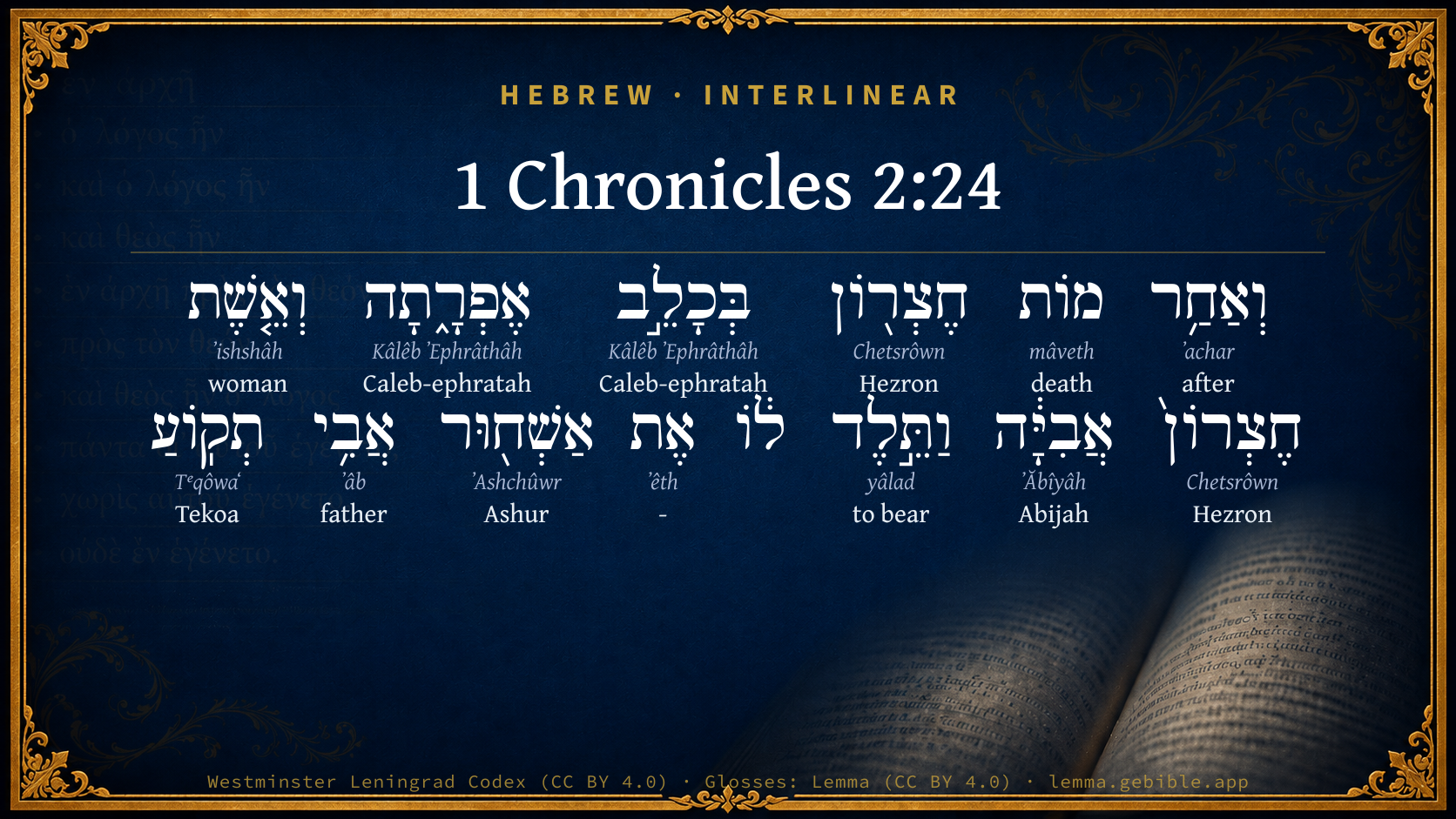
Hebrew (Westminster Leningrad Codex) 1 Chronicles 2:24 appears in the Hebrew Old Testament. The text above is from the Westminster Leningrad Codex. Each word links to its Strong’s number, a concise gloss, and parsing drawn from the Open Scriptures Hebrew Bible morphology. Click any word for its full Brown-Driver-Briggs (BDB) entry.
Download image
Cite this verse

1 Chronicles 2:24 (World English Bible). Public Domain. Lemma interlinear Bible study tool, https://lemma.gebible.app/v/1-chronicles/2/24.

Show BibTeX & RIS
BibTeX
RIS
English Translation
After that Hezron was dead in Caleb Ephrathah, then Abijah Hezron's wife bore him Ashhur the father of Tekoa.
World English Bible · Public Domain
Highlights
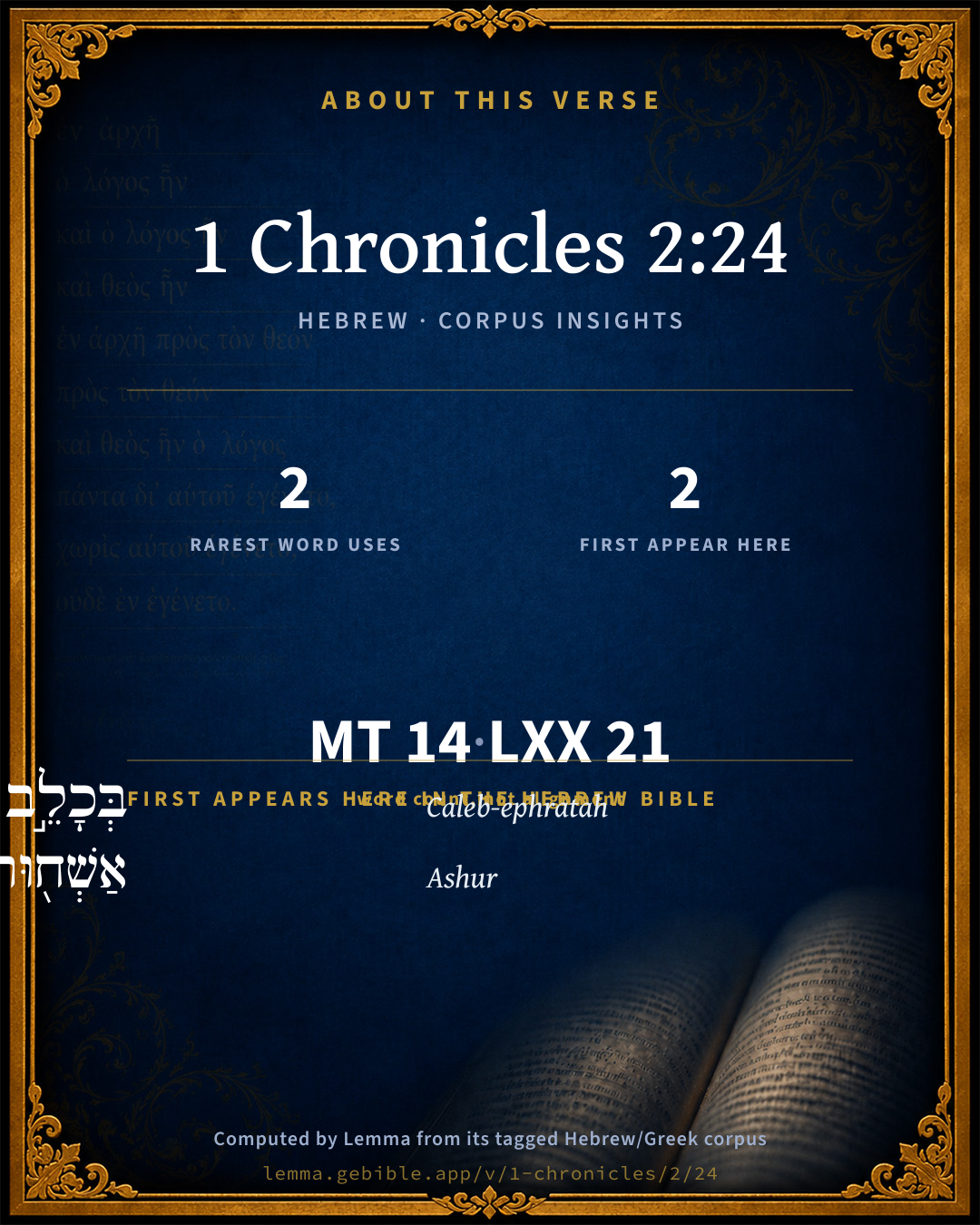
  • 2 first appearances in the Hebrew Bible
Full analysis ↓
Download a study sheet

One document with this verse’s original text, its word-by-word gloss line, the meaning frame, cross-references with their text, attributed commentary, and full source and license credits — printable, and it pastes into notes with its structure intact.

This verse Autodidact and up

Study sheet (.html) Plain text (.txt)

A passage Seminary Student

Up to 50 verses in one chapter. A passage sheet keeps up to 6 commentary sources and 12 cross-references per verse, in the order this page ranks them, and says so on the sheet whenever that leaves anything out. Ask for a single verse and you get the Autodidact verse sheet above.

Everything on this page stays free to read, with no account — the sheet is a download of what is already on screen, not access to it.

Want to remove ads? Support Godless Engineer
Compare translations 3

The same verse in 3 English versions, stacked beneath the original-language interlinear above. Click any original word for its lexicon entry.

Each is an independent rendering of the whole verse — the interlinear is not word-aligned to these translations.

Highlighted words mark where these versions differ — a whole-verse word diff, not a word-by-word alignment.

  • World English Bible Public Domain
    After that Hezron was dead in Caleb Ephrathah, then Abijah Hezron's wife bore him Ashhur the father of Tekoa.
  • King James Version Public Domain
    And after that Hezron was dead in Calebephratah, then Abiah Hezron's wife bare him Ashur the father of Tekoa.
  • unfoldingWord Literal Text CC BY-SA 4.0
    And after the death of Hezron in Caleb Ephrathah, then the wife of Hezron, Abijah, then she bore to him Ashhur, the father of Tekoa. q1

unfoldingWord Literal Text — © unfoldingWord, licensed CC BY-SA 4.0. Word-aligned USFM3 via Door43 (git.door43.org/unfoldingWord/en_ult).

Versions to compare (up to 4)

3 of 4 selected

Show all 18 translations

Every available English version of this verse, each an independent rendering of the whole verse.

  • World English Bible Public Domain
    After that Hezron was dead in Caleb Ephrathah, then Abijah Hezron's wife bore him Ashhur the father of Tekoa.
  • Berean Standard Bible Public Domain
    After Hezron died in Caleb-ephrathah, his wife Abijah bore to him Ashhur the father of Tekoa.
  • Majority Standard Bible Public Domain
    After Hezron died in Caleb-ephrathah, his wife Abijah bore to him Ashhur the father of Tekoa.
  • King James Version Public Domain
    And after that Hezron was dead in Calebephratah, then Abiah Hezron's wife bare him Ashur the father of Tekoa.
  • American Standard Version (1901) Public Domain
    And after that Hezron was dead in Caleb-ephrathah, then Abijah Hezron's wife bare him Ashhur the father of Tekoa.
  • Revised Version (1885) Public Domain
    And after that Hezron was dead in Caleb-ephrathah, then Abijah Hezron’s wife bare him Ashhur the father of Tekoa.
  • Geneva Bible (1599) Public Domain
    And after that Hezron was dead at Caleb Ephratah, then Abiah Hezrons wife bare him also Ashur the father of Tekoa.
  • Douay-Rheims (1899) Public Domain
    And when Hesron was dead, Caleb went in to Ephrata. Hesron also had to wife Abia who bore him Ashur the father of Thecua.
  • Young's Literal Translation Public Domain
    And after the death of Hezron in Caleb-Ephratah, then the wife of Hezron, Abijah, even beareth to him Asshur, father of Tekoa.
  • Literal Standard Version CC BY-SA 4.0
    And after the death of Hezron in Caleb-Ephratah, then the wife of Hezron, Abijah, even bears to him Asshur, father of Tekoa.
  • Unlocked Literal Bible CC BY-SA 4.0
    After the death of Hezron, Caleb slept with Ephrathah, the wife of his father Hezron. She bore him Ashhur, the father of Tekoa.
  • unfoldingWord Literal Text CC BY-SA 4.0
    And after the death of Hezron in Caleb Ephrathah, then the wife of Hezron, Abijah, then she bore to him Ashhur, the father of Tekoa. q1
  • Darby Bible Public Domain
    And after the death of Hezron in Caleb-Ephratah, Abijah, Hezron's wife, bore him Ashhur, the father of Tekoa.
  • World Messianic Bible Public Domain
    After Hezron died in Caleb Ephrathah, Abijah, Hezron’s wife, bore him Ashhur the father of Tekoa.
  • Webster's Bible Public Domain
    And after that Hezron was dead in Caleb-ephratah, then Abiah Hezron's wife bore him Ashur the father of Tekoa.
  • Free Bible Version CC BY-SA 4.0
    After Hezron died in Caleb Ephrathah, his wife Abijah bore him Ashhur the father of Tekoa.
  • Bible in Basic English Public Domain
    And after the death of Hezron, Caleb had connection with Ephrath, his father Hezron's wife, and she gave birth to his son Asshur, the father of Tekoa.
  • JPS Tanakh (1917) Public Domain
    And after that Hezron was dead in Caleb-ephrath, then Abiah Hezron's wife bore him Ashhur the father of Tekoa.

Literal Standard Version (2020), Covenant Press — licensed CC BY-SA 4.0. Text via the HelloAO Bible API (eBible.org). Unlocked Literal Bible (unfoldingWord) — licensed CC BY-SA 4.0. Text via the HelloAO Bible API (eBible.org). unfoldingWord Literal Text — © unfoldingWord, licensed CC BY-SA 4.0. Word-aligned USFM3 via Door43 (git.door43.org/unfoldingWord/en_ult). Free Bible Version, Dr. Jonathan Gallagher — licensed CC BY-SA 4.0. Text via the HelloAO Bible API (eBible.org).

Word by word

More ways to search: Search by grammar → Find every occurrence → Compare this word →

Practice this passage: Drill this verse → Learn its vocabulary →

בְּכָלֵ֣ב
Kâlêb ʼEphrâthâh
H3613
“in/at · Caleb-ephratah”
Preposition + Noun, Proper
Part of Speech
Preposition + Noun
Type
Proper
Full BDB Definition

Origin: from H3612 and H672

TWOT: None

Caleb-ephratah = "dog or ash heap" - a place in Gilead
  1. וְאַחַ֥ר ʼachar H310 “and · after” Conjunction + Preposition
  2. מוֹת mâveth H4194 “death of” Noun, Common, Masculine, Singular, Construct
  3. חֶצְר֖וֹן Chetsrôwn H2696 “Hezron” Noun, Proper
  4. אֶפְרָ֑תָה Kâlêb ʼEphrâthâh H3613 “Caleb-ephratah” Noun, Proper
  5. וְאֵ֤שֶׁת ʼishshâh H802 “and · woman of” Conjunction + Noun, Common, Feminine, Singular, Construct
  6. חֶצְרוֹן֙ Chetsrôwn H2696 “Hezron” Noun, Proper
  7. אֲבִיָּ֔ה ʼĂbîyâh H29 “Abijah” Noun, Proper
  8. וַתֵּ֣לֶד yâlad H3205 “and · to bear” Conjunction + Verb, Qal, Sequential Imperfect, 3rd Person, Feminine, Singular
  9. אֶת ʼêth H853 “-” Particle, Direct Object
  10. אַשְׁח֖וּר ʼAshchûwr H806 “Ashur” Noun, Proper
  11. אֲבִ֥י ʼâb H1 “father of” Noun, Common, Masculine, Singular, Construct
  12. תְקֽוֹעַ Tᵉqôwaʻ H8620 “Tekoa” Noun, Proper

About this verse

These counts appear in no published source. They are computed here, from the morphology-tagged text and Lemma’s own curated glosses. What Lemma adds →

14
words
11
distinct lemmas
Historical
section

Notable vocabulary

The rarest word here is בְּכָלֵ֣ב Caleb-ephratah H3613 — appearing just 2 times in the whole Hebrew Bible.

First appearance in Scripture

These words make their first canonical appearance in the Hebrew Bible here:

  • בְּכָלֵ֣ב Caleb-ephratah H3613
  • אַשְׁח֖וּר Ashur H806

Grammatical profile

  • 1 verb
  • 10 nouns
  • 2 prepositions
  • 1 particle

Verb forms

  • וַתֵּ֣לֶד Qal · Sequential Imperfect

Repetition

Words recur within this verse — often emphatic in Hebrew:

  • חֶצְר֖וֹן Hezron H2696 ×2
  • בְּכָלֵ֣ב Caleb-ephratah H3613 ×2

Hebrew & Septuagint length

In English translation the verse runs 19 words from the Hebrew and 26 from the Septuagint (LXX English) — closely comparable.

A rough comparison of the two English renderings, which tokenize alike — not a word-level alignment.

Word counts can differ between the Hebrew and the Greek without any difference in meaning — e.g. the Hebrew direct-object marker אֵת has no separate Greek word, and Greek often adds the article ὁ.

In the original languages it is 14 Hebrew tokens and 21 Greek tokens — but the two are counted differently (Hebrew bundles its prefixes and suffixes into one token; the Greek is in lemma form), so that isn’t a like-for-like length.

Cross-references

6

Topical passages linked to 1 Chronicles 2:24 in the Treasury of Scripture Knowledge — connected by theme and wording, ordered by reader-vote popularity; previews shown in the World English Bible.

  • 1 Chronicles 4:5 Ashhur the father of Tekoa had two wives, Helah and Naarah.
  • 1 Samuel 30:14 We made a raid on the South of the Cherethites, and on that which belongs to Judah, and on the South of Caleb; and we burned Ziklag with fire.
  • 2 Samuel 14:2 Joab sent to Tekoa, and fetched there a wise woman, and said to her, please act like a mourner, and put on mourning clothing, Please, and don't anoint yourself with oil, but be as a woman who has a long time mourned for the dead:
  • 1 Chronicles 2:9 The sons also of Hezron, who were born to him: Jerahmeel, and Ram, and Chelubai.
  • 1 Chronicles 2:18–19 Caleb the son of Hezron became the father of [children] of Azubah [his] wife, and of Jerioth; and these were her sons: Jesher, and Shobab, and Ardon.
  • Amos 1:1 The words of Amos, who was among the herdsmen of Tekoa, which he saw concerning Israel in the days of Uzziah king of Judah, and in the days of Jeroboam the son of Joash king of Israel, two years before the earthquake.

Cross-references courtesy of OpenBible.info (CC BY 4.0).

Hebrew and Greek witnesses Masoretic Hebrew ↔ Greek Septuagint

The same verse in the two great witnesses to the Old Testament, shown verse-for-verse.

These are two independent witnesses, not word-aligned to each other, and the Septuagint is shown in lemma (dictionary) form.

Hebrew 1 Chronicles 2:24 Masoretic · Westminster Leningrad Codex

וְאַחַ֥ר מוֹת חֶצְר֖וֹן בְּכָלֵ֣ב אֶפְרָ֑תָה וְאֵ֤שֶׁת חֶצְרוֹן֙ אֲבִיָּ֔ה וַתֵּ֣לֶד ל֔וֹ אֶת אַשְׁח֖וּר אֲבִ֥י תְקֽוֹעַ

After that Hezron was dead in Caleb Ephrathah, then Abijah Hezron's wife bore him Ashhur the father of Tekoa.

World English Bible · Public Domain

Greek LXX 1 Chronicles 2:24 Septuagint · lemma form

καί μετά ὁ ἀποθνήσκω εσερων ἔρχομαι χαλεβ εἰς εφραθα καί ὁ γυνή εσερων αβια καί τίκτω αὐτός ὁ ασχωδ πατήρ θεκωε

And after the death of Esron, Chaleb came to Ephratha; and the wife of Esron was Abia; and she bore him Ascho the father of Thecoe.

LXX2012 (modern English Septuagint) · Public Domain

On this verse, Ellicott's Commentary for English Readers discusses the Septuagint’s reading. Read the note in Commentary ↓

Hebrew: Westminster Leningrad Codex (CC BY 4.0). Greek: Septuagint (public domain); English from LXX2012 (modern English Septuagint) (Public Domain). How the Septuagint differs from the Hebrew →

Commentary

Notes on 1 Chronicles 2:24 from classic Christian and Jewish commentators (each source and its license shown beneath its notes). The classic Christian expositions comment on the surrounding passage and are grouped to its opening verse, so a note may address several verses; the Jewish commentaries on the Tanakh (Rashi and others) are per-verse, so they appear only where the commentator wrote on this verse.

Lemma curates 59 commentaries, every one of them public domain or Creative Commons licensed, each selected and text-cleaned for this edition rather than reprinted as found. About our sources →

Trapp's Complete Commentary

John Trapp

1Ch 2:24 And after that Hezron was dead in Calebephratah, then Abiah Hezron’s wife bare him Ashur the father of Tekoa.

Ver. 24. The father of Tekoa,] i.e., The prince of Tekoa. Augustus would not be called lord, but father of his country, taking great delight in that title given him by the people, and calling the commonwealth his daughter, as Macrobius {a} writeth.

{a} Lib. ii. cap. 5.

John Trapp, A Commentary or Exposition upon All the Books of the Old and New Testament (1647–1656) — public domain. Text from a community e-Sword module.

Joseph Benson's Commentary

1Ch 2:24. The father of Tekoa — A known place, of which he is termed the father, because he was either the progenitor of the people who inhabited it, or their prince and ruler, or the builder of the city.

Joseph Benson's Commentary on the Old and New Testaments (1811–1818) — public domain. Text from a community e-Sword module.

Tyndale Open Study Notes

Tyndale Open Resources

2:24 Tekoa was a small Judean village southeast of Bethlehem (see also 4:5-8).

Tyndale Open Study Notes — © Tyndale Open Resources, licensed CC BY-SA 4.0. Text via the HelloAO Bible API.

Geneva Bible (1599)

Geneva Bible translators

Which was a town named of the husband and wife, called also Bethlehem Ephrathah.

Meaning, the chief and prince.

Geneva Bible (1599) marginal notes — public domain. Text via Bolls.life.

Jamieson, Fausset & Brown

Robert Jamieson, A. R. Fausset & David Brown

Caleb-ephratah--so called from uniting the names of husband and wife (Ch1 2:19), and supposed to be the same as was afterwards called Beth-lehem-ephratah.

Ashur, the father of Tekoa-- (Sa2 14:2-4). He is called the father, either from his being the first founder, or perhaps the ruler, of the city.

Jamieson, Fausset & Brown — Commentary Critical and Explanatory on the Whole Bible (1871) — public domain (CC PDM 1.0). Text via the HelloAO Bible API.

Ellicott's Commentary for English Readers

(24) And after that Hezron was dead . . .—Or, “And after the death of Hezron in Caleb-ephratah—and the wife of Hezron was Abiah—and she bare him Ashur . . .” The text is evidently corrupt. The best suggestion is based on the reading of the LXX.: καὶ μετὰ τὸ ἀποθανεῖν Εσερων ἦλθεν Χαλεβ εἰς Εφραθα; “And after Hezron’s death Caleb went to Ephrath.” Some very slight changes in the Hebrew, affecting only three letters of the entire sentence, will give the sense, “And after Hezron’s death Caleb went in to Ephrath, the wife of his father Hezron (1Ch_2:19); and she bare him Ash-hur, father (founder, or chief) of Tekoa.” (Comp. Gen_35:22.)

Ashur (Heb., Ash-hur) means “man of Hur”—that is, the chief of the clan of the Hurites, settled at Ephrath or Bethlehem (1Ch_2:19). Comp. Ashbel “man of Bel.” (Ash is the elder form of Ish “man”; as appears from the Phenician inscriptions.)

That “Caleb” in this verse means the house of Caleb is evident if we consider that the genealogy makes him great grandson of Judah, whereas the individual Caleb son of Jephunneh took part in the conquest of Canaan, more than four centuries after Judah went down to Egypt.

III.—The Jerahmeelites (1Ch_2:25-41). Comp. 1Sa_27:10, “the south (land) of the Jerahmeelites,” in the territory of Judah.

A Bible Commentary for English Readers, edited by Charles John Ellicott (1878–1897) — public domain. Text from a community e-Sword module.

The Cambridge Bible for Schools and Colleges

gen. ed. J. J. S. Perowne

24. And after that Hezron was dead in Caleb-ephratah (R.V. ephrathah)]

The text of this passage is probably corrupt, for (1) “Caleb-ephrathah” is a very strange combination to signify the name of a place, (2) Vulg. LXX. have a verb (ingressus est, ἦλθεν) instead of the preposition, “in”. A few small changes in the Heb. would yield the sense, “And after Hezron was dead Caleb went in to Ephrath (1Ch_2:19) his father Hezron’s wife and she bare him” etc.

Ashur] R.V. Ashhur. Hur (1Ch_2:19) the father of Bethlehem is described as the “firstborn of Ephrathah,” so that Ashhur would be a younger brother (1Ch_4:4).

the father of Tekoa] i.e. the founder of the town or the eponymous ancestor of its inhabitants. Cp. 1Ch_4:4; 1Ch_4:14; 1Ch_4:21 etc. For Tekoa see 2Ch_20:20, note.

The Cambridge Bible for Schools and Colleges (gen. ed. J. J. S. Perowne; Cambridge University Press, 1878–1918) — public domain. Text from a community e-Sword module.

John Gill's Exposition

And the sons of Nadab,.... The eldest son of Shammai, Ch1 2:28,

Seled and Appaim; but Seled died without children; and therefore we hear no more of him.

John Gill's Exposition of the Whole Bible (1746–1763) — public domain (CC PDM 1.0). Text via the HelloAO Bible API.

Haydock's Catholic Bible Commentary

Hesron. Perhaps it ought to be Azuba, ver. 19. Hebrew, "and after Hesron was dead, in Caleb-ephrata, then Abia, the wife of Hesron, bore him a (posthumous) son, Ashur, the father of those who dwelt at Thecua." He could not reside there himself no more than Caleb did at Bethlehem, which some, without proof, pretend was called Caleb-ephrata. The Septuagint agree with the Vulgate. They may signify that Caleb went to the town of Ephrata. But he son of Hebron certainly never resided at Bethlehem. (Calmet)

George Leo Haydock (1774–1849), Haydock's Catholic Family Bible and Commentary, 1859 edition — public domain. Excludes Psalms (Douay-Rheims chapter numbering differs from Protestant) and Deuterocanonical books (Catholic canon only).

Matthew Poole's English Annotations

Caleb-ephratah; a place then so called by a conjunction of the names of the man and his wife; afterwards supposed to be called Beth-lehem Ephratah. Others translate the words thus, When Caleb took Ephratah. So it is an ellipsis of the verb, which is here to be understood out of 1Ch 2:19, where it is expressed.

Abiah bare him Ashur, after the father’s death.

The father of Tekoa; a known place, 2Sa 14:2,4; Jer 6:1; Amo 1:1; whose father he is called, because he was either the progenitor of the people inhabiting there, or their prince and ruler, or the builder of the city.

Matthew Poole's English Annotations on the Holy Bible (1683–1685) — public domain. Text from a community e-Sword/MySword module.

The Pulpit Commentary

The remaining verse of this section brings another point of difficulty unsolved yet. No place Caleb-ephratah is known, and no sort of accounting for Hezron dying anywhere but in Egypt, whither he went with, (Gen_46:12) is producible. The Vulgate has Ingressus est Caleb ad Ephratam, but our Hebrew text cannot be made to justify it, if for nothing else, for want of a preposition la, before "Ephrata." This reading of the Vulgate has suggested to others that by a slight but still gratuitous alteration of our Hebrew text ab; might be substituted for the preposition B prefixed to the name of Caleb; but upon that showing we have to suppose that Caleb did leave Egypt on his own account and travel to Ephratah, and then there fails any strong connection (but see Septuagint, in loc. ) between that fact and what is said about Abiah. Still, the explanation might receive some countenance from the fact that it is said that Abiah"s son became the father or founder of Tekoa, a place near Bethlehem, in South Judah. (1Sa_30:14) Bertheau has at this point suggested that Caleb-ephratah, instead of being included in Neger-Caleb, may rather, in distinction from it, designate the northern portion of the territory of Caleb. The solution of the problem will probably not yield to anything but a justly restored text.

The Pulpit Commentary (1880–1919), ed. H.D.M. Spence-Jones & Joseph S. Exell — public domain. Text from a community e-Sword module.

John Wesley's Explanatory Notes

Tekoa - A known place whose father he is called, because he was either the progenitor of the people inhabiting there: or, their prince and ruler: or, the builder of the city.

John Wesley, Explanatory Notes Upon the Whole Bible (1754–1765) — public domain. Text via the GEBible commentary corpus.

Keil & Delitzsch

C. F. Keil & F. Delitzsch

And the sons of Nadab,.... The eldest son of Shammai, Ch1 2:28,

Seled and Appaim; but Seled died without children; and therefore we hear no more of him.

Keil & Delitzsch — Biblical Commentary on the Old Testament (1861–1891) — public domain (CC PDM 1.0). Text via the HelloAO Bible API. (Old Testament only.)

Rashi

Rabbi Shlomo Yitzchaki (Rashi)

In Caleb Ephrathah He called the city Caleb Ephrathah after his wife.

and she bore him Ashhur after Hezron’s death.

the father of Tekoa the ruler of the city Tekoa, which belonged to the tribe of Judah.

Rashi on the Tanakh — English translations: “The Judaica Press complete Tanach with Rashi, translated by A. J. Rosenberg” (CC BY 4.0); “Pentateuch with Rashi's commentary by M. Rosenbaum and A.M. Silbermann, 1929-1934” (public domain); “The Metsudah Tanach series, Lakewood, N.J” (CC BY 4.0); and “The Book of Joshua, Metsudah Publications, 1997” (CC BY 4.0). Text via Sefaria.

Lesson kit

Teaching starters — assembled from the data on this page, not authored interpretation. Every prompt links to the verse data it draws on. Edit before teaching.

1 Chronicles, in the Historical, opens this verse with 14 words (11 distinct Hebrew lemmas). Its most distinctive word is Kâlêb ʼEphrâthâh (“Caleb-ephratah”). A historical commentator’s framing appears above. Read the whole chapter for the surrounding context.

Discussion questions

  1. How does “Caleb-ephratah” (Kâlêb ʼEphrâthâh) shape what this verse is saying?
  2. 2 words make their first appearance in Scripture here. What does this debut establish?
  3. How does 1 Chronicles 4:5, which shares this passage’s theme, read alongside this verse?
  4. What does the repetition of “Hezron” (2× in this one verse) do in this verse?
  5. The translations on this page render this verse differently — a whole-verse word diff, not a word-by-word alignment. What might account for the different wordings?
  6. «וַתֵּ֣לֶד» is a Qal Sequential Imperfect verb. How does that grammatical form shape the action described?
  7. Compare how Trapp's Complete Commentary and Joseph Benson's Commentary read this verse. Where do they agree or differ?

Things to notice

Reading settings

Reading text

Shown beneath each verse's original-language words.

Old Testament
Old Testament edition

Read the OT as the Masoretic Hebrew (MT) or the Greek Septuagint (LXX).

English shown for the Greek Septuagint (in the Hebrew ↔ Greek comparison).

Comparing translations? Open the Compare panel on any verse page to stack up to four side by side.